

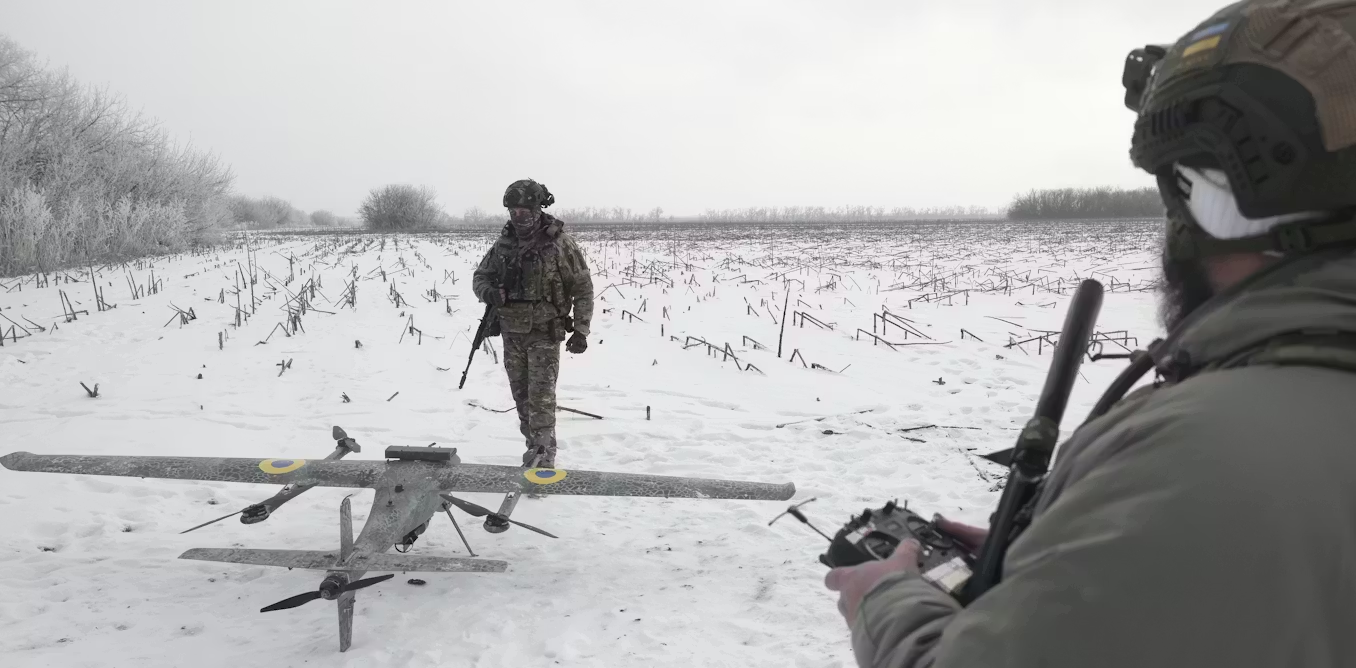
In a surprise announcement on February 10, Ukraine’s president, Volodymyr Zelensky, said that his administration was preparing to hold presidential elections before the middle of May. Alongside these elections, he is reported to be planning to hold a referendum on a peace deal with Russia.
This is a dramatic shift in Zelensky’s stance: the president has long resisted elections under conditions of war, despite the fact his mandate ran out in 2024. One possible explanation for the turnaround is that US pressure on Ukraine is having some real effects. A few days ago, Zelensky indicated as much, saying that his US counterpart, Donald Trump, was pushing for a negotiated end to the war by June.
Trump’s timeline – probably with an eye towards the US mid-term elections, when the White House would like to present a Ukraine deal as another major foreign policy success – is one thing. The feasibility of elections and, even more so, a peace deal between Russia and Ukraine is quite another.
1. Organising a free and fair vote in wartime
The first problem is logistics. Who will be eligible to vote? Where and who could monitor the elections to ensure they are free and fair? Apart from the hundreds of thousands serving in the trenches defending Ukraine against Russia’s aggression, there are also 3.7 million internally displaced Ukrainians and almost 6 million refugees abroad – plus approximately 5 million Ukrainians currently living under Russian occupation.
There is also the uncertainty of a Russian ceasefire – needed to facilitate not only the conduct of the elections but the preceding election campaign – and the near certainty of large-scale Russian election interference.
We can expect something similar to what Moldova experienced during its presidential elections, European integration referendum in 2024 and parliamentary elections in 2025, when voters were flooded with disinformation. Moscow even recruited Orthodox priests to try to sway the electorate. Russia’s attempts to influence the outcomes of these votes were shown to have clear limitations. But this will not deter it from trying again, and harder, in Ukraine.
Given all this, the prospects of organising any vote – let alone one of such consequence for the country and its people – look worse than daunting.
2. There’s no realistic peace deal yet
A second problem is the feasibility of any peace deal between Russia and Ukraine. At present, it is hard to imagine the gaps between Russia and Ukraine can be bridged in a meaningful way that does not cross either side’s red lines – especially on territory and security guarantees.
Even if it were possible to find a form of words to which the Russian and Ukrainian presidents could both sign up, the approval of any such deal in a referendum in Ukraine looks remote. Likely to be held on the same day as the presidential elections, a referendum would face all the same logistical and eligibility pressures.
3. Ukrainians might say no to peace
It is not clear what would happen if a majority of Ukrainians rejected the settlement put to them in the referendum. Would this mean a return to negotiations, or to war? The latter is the more likely scenario.
A third option would be the continuation of a shaky ceasefire and the implementation of parts of any settlement beneficial to both sides, such as prisoner exchanges.
But as was the case with the ill-fated Minsk agreements of 2014 and 2015, a return to all-out war would remain firmly on the cards.
EPA/stringer
4. Europe must play a part
So far, Ukraine’s European partners have mostly been on the sidelines of the peace negotiations. They may not be a direct party to the war, but they clearly have a stake in the peace terms that might now be hammered out between Moscow, Kyiv and Washington. The mostly European coalition of the willing is expected to play a key role in the implementation of US-backed security guarantees, and to do the heavy lifting on Ukraine’s post-war reconstruction.
But after more than 12 months of hostility from Washington towards Brussels, there is little trust left in the dependability of US backing for Ukraine. The fourth problem, therefore, is that European acquiescence with a US-imposed peace deal cannot anymore be taken for granted either.
This does not necessarily mean a peace deal is impossible – but it will almost certainly be unless Europe has played a part in its negotiation.
The French president, Emmanuel Macron, recently dispatched his most senior diplomat, Emmanuel Bonne, to Moscow for talks in the Kremlin. And the country’s former permanent representative on the UN security council, Nicolas de Rivière, has been appointed as the new French ambassador to Moscow, signalling the importance that Paris assigns to direct contacts with Russia.
The EU, according to its foreign policy chief, Kaja Kallas, might also appoint a special representative for contacts with Moscow – after the bloc has agreed on the messages it wants to send.
However, despite the fact that Brussels holds some powerful cards – including frozen Russian assets and a wide range of sanctions – there is no indication for now that either Washington or Moscow are willing to grant Brussels a seat at the negotiating table.
5. Russia can’t be trusted
The final problem is whether Russia will accept even the best possible terms in a peace agreement, and then stick to it. The US push to seal a deal in the coming months suggests there is some confidence in the White House that a deal acceptable to the Kremlin can be forged, and that Ukraine and its allies can be coerced to go along with it.
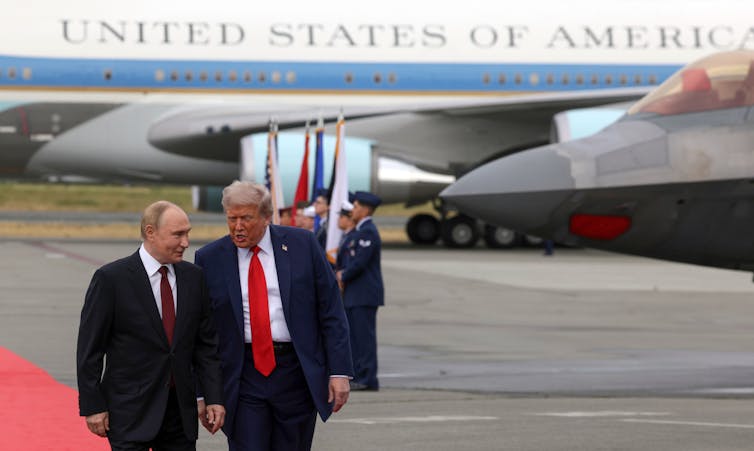
EPA/Gavril Grigorov/Sputnik/Kremlin pool
There is a lot in what has transpired in recent days that will be to Russia’s liking: presidential elections in Ukraine; the US using its support for security guarantees as leverage to push Kyiv towards accepting more and more compromises; and the parallel US-Russia negotiations on an economic deal.
Russia’s president, Vladimir Putin, has got to this situation without making any concessions. He has played the US president perfectly so far, and there is no indication that he is done playing him. Trump is almost certain to continue to do Putin’s bidding – and to walk away as and when his grandiose plan unravels.
Is there a backup plan?
It is not clear what the backup plan is for Zelensky and his European allies. Given there is little to suggest the current US plan and timeline for a deal will lead to a happy ending, they need to come up with credible contingencies very quickly.
Offering logistically almost-impossible elections and a referendum with a highly uncertain outcome would be a smart way for the Ukrainian president and his European allies to buy themselves the time they need for a new strategy.
Putin may think he has successfully tricked Trump into doing his bidding. But on this occasion, Zelensky may have outsmarted them both – albeit at the price of the war against his country continuing.












































You must be logged in to post a comment Login