
Crypto World
Why CZ Says Self-Custody Is Riskier Than Centralized Exchanges?

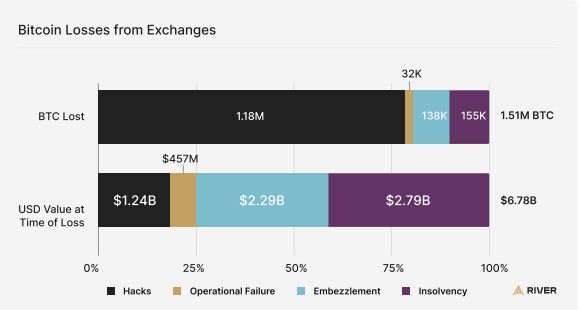
Binance founder Changpeng Zhao (CZ) said exchanges are statistically safer than self-custody, citing new Bitcoin (BTC) loss data from analyst Willy Woo.
Woo shared figures from River’s 2025 industry report on Monday, showing 1.57 million BTC lost through self-custody compared with 1.51 million BTC lost on exchanges. The gap sits below 60,000 BTC.
Why CZ Says Exchange Hacks Look Worse Than They Are
Zhao argued the comparison misses how each side reports losses. Exchange hacks generate major headlines. Hence, reporters and researchers track them closely. Self-custody losses, however, rarely reach the same visibility.
Lost private keys, forgotten passwords, and destroyed hardware wallets often go unreported. As a result, Zhao suggested the self-custody figure likely understates the true scale of losses.
He also noted that some exchange-side losses come from platforms that no longer operate. BitMEX, for instance, announced its shutdown in July, closing an 11-year run. Meanwhile, industry hack tracking shows incidents climbed roughly 50% in the first half of 2026, even as total stolen sums fell.

Binance’s SAFU Fund and the Self-Custody Comparison
Zhao pointed to Binance’s compensation practice as a key part of his argument. The exchange, he said, has consistently covered user losses tied to CEX-side breaches. Binance recently expanded its Secure Asset Fund into a $1 billion Bitcoin reserve.
Self-custody risk has drawn fresh attention this month. A Coldcard hardware wallet vulnerability drained BTC from users in early August. One victim lost $1.6 million in minutes despite following standard security steps. Zhao weighed in on that incident too, warning that no wallet setup guarantees full protection.
Zhao stopped short of recommending exchanges over private wallets. Instead, he framed the choice as one of risk tolerance and product fit rather than a simple safety ranking.
Whether Woo’s data holds up against further scrutiny remains an open question. Self-custody losses are inherently harder to verify than exchange breaches. Bitcoin traded near $60,347 at the time of writing, up roughly 1.2% over 24 hours.
The post Why CZ Says Self-Custody Is Riskier Than Centralized Exchanges? appeared first on BeInCrypto.


In the latest XRP News, Ripple announced strategic equity investments in two UK-based firms, Zilo and Licuido, on August 3, 2026, converting existing commercial partnerships into ownership positions to complete a full-lifecycle institutional capital markets stack on the XRP Ledger.
The move targets the gap that has stalled most institutional tokenization pilots: minting a token is straightforward; financing, pledging, and settling it with the same reliability as a conventional holding is not.

Discover: Everyone’s Got a Take. Get Free $25 to Actually Trade Yours
The Problem: Tokenized Assets That Sit Idle
Institutional RWA tokenization has exhibited a consistent structural failure: tokenized fund shares are issued and then parked.
The ownership record, issuance rail, and settlement mechanism have historically been handled by separate, often incompatible legacy systems that were never designed to interface with on-chain collateral markets.
Ripple’s framing of the deal is explicit on this point. The company described the investments as addressing constraints in which collateral sits idle, settlement takes longer than necessary, and institutions have no reliable path to unlock liquidity from tokenized positions.
The Zilo and Licuido stakes are designed to close those three gaps simultaneously on XRPL.
Discover: Your Market Calls Are Worth Something. Start With Free $25 on Kalshi
XRP News: What Zilo and Licuido Each Provide
Zilo handles transfer agency and fund administration – the regulated record of who owns what, extended to cover tokenized share classes as funds move on-chain. Before any lender will extend credit against a tokenized fund position, they need a legally reliable ownership register; Zilo supplies that layer. Its client roster, which includes Citi, Fidelity International, and State Street, provides Ripple with a direct bridge into incumbent custody and TA infrastructure.
Licuido, an FCA-regulated platform, manages issuance, distribution, and execution, allowing traditional financial assets, including fund shares, to move as digital collateral through on-chain atomic settlement.
— Arthur (@XrpArthur) August 4, 2026
 Ripple invested in two regulated capital markets firms. Today.
ZILO — digital transfer agency for asset managers. On XRPL.
Licuido — FCA-regulated issuance and collateral platform. On XRPL.
Partners already building on this infrastructure :
Aviva Investors. Franklin… https://t.co/8vOjuu87UP
Trades settle on the XRPL in three to five seconds. Ripple’s dollar-pegged stablecoin, RLUSD, functions as the regulated cash leg for delivery-versus-payment transactions, so asset transfer and payment settle simultaneously rather than sequentially.
Together, the three-part stack – Zilo for regulated record-keeping, Licuido for issuance and collateral mobility, RLUSD for the cash leg – gives institutions a single operating model for tokenized fund assets from issuance through financing. Neither company’s financial terms were disclosed.

Nigel Khakoo, Ripple’s SVP of Trading and Markets, characterized the infrastructure role of both firms in the official press release: “ZILO and Licuido provide core capabilities that are essential to further scaling this shift: regulated digital transfer agency infrastructure and liquidity for issuance and collateral mobility.”
Building on Live Deployments, Not Pilots
The stakes are not speculative bets on unproven vendors. Ripple confirmed that both investments build on pre-existing partnerships, and Licuido was already in production as the tokenization infrastructure for the Aviva Investors USD Liquidity Fund, the first tokenized fund structure approved by the Central Bank of Ireland on a public blockchain, which went live on XRPL on July 29, 2026.
BNY holds the underlying assets; Komainu provides digital asset custody.
The institutional pipeline extends further. Ripple’s parallel push into institutional infrastructure also encompasses a September 2025 memorandum of understanding with Franklin Templeton and DBS to list Franklin Templeton’s sgBENJI tokenized money market fund on the DBS Digital Exchange alongside RLUSD, with a stated path toward using sgBENJI as repo collateral.
The collateral-mobility thesis Ripple is industrializing through Zilo, and Licuido is the same structure that the partnership was designed to test.
On the network side, Ripple reported that XRPL has processed more than four billion transactions since 2012 and is maintained by 120 independent validators. A major protocol upgrade, xrpld 3.3.0, targeting improvements in XRPL infrastructure and institutional finance functionality, was expected to be released within days of the announcement.
Ripple is also one of 54 firms on a UK government task force formed to build live tokenized wholesale financial market use cases over the next 12 months, alongside Circle, Coinbase, BlackRock, Goldman Sachs, J.P. Morgan, and Morgan Stanley. The first target is the tokenized repo. Ripple’s expanding regulatory positioning in Europe provides additional runway for the institutional tokenization push built on XRPL.
The practical test for the Zilo and Licuido stack is whether tokenized fund shares generate genuine secondary liquidity and serve as working collateral in live credit markets over the next 12 to 24 months – or whether they remain a more sophisticated form of the same idle token problem Ripple is explicitly trying to solve.
Discover: Get Paid to Be Right, $25 to Start on Kalshi
Don’t Miss Out on Our $1,000 USDT Airdrop on ByBit
The post XRP News: Ripple Takes Equity Stakes in Zilo and Licuido to Fix Idle Tokenized Assets appeared first on Cryptonews.

The 230-ft. Falcon 9 lifted off from launch complex 39A at the Kennedy Space Center on Jan. 15, 2025, packed with a pair of spacecraft bound for the moon. One of them, the Blue Ghost lander, built by Firefly Aerospace of Cedar Park, Texas, landed on the moon on March 2, 2025, becoming the first privately built ship to pull off a completely successful lunar touchdown. The other, the Resilience lander, built by the Japanese company ispace, wasn’t so fortunate, crash-landing on the moon on June 5, 2025, after its laser range-finder failed. At the beginning of their missions, once the ships had climbed to near-Earth space, both of them relied on the Falcon 9’s 45-ft. upper stage to blast them away from the Earth and outward to the moon. After releasing the two lunar landers, that Falcon stage was supposed to fall harmlessly away, but instead it’s hung around.

The White House is reportedly preparing fresh restrictions targeting Chinese-made data centers as it seeks to secure the infrastructure powering the race for AI domination.
The new rules, reported by Reuters earlier today, would prohibit US imports of new models of Chinese optical transceivers used in AI data centers.
AI-Security Needs Increase
The Federal Communications Commission is developing the proposed restrictions and is expected to announce them later this year. If approved, they would block future imports of the network components, which transmit data through fiber-optic cables at extremely high speeds. They have a key role in connecting AI chips inside modern data centers.
Reuters further claimed that US officials are concerned that Chinese-made transceivers could be exploited to steal sensitive information, install malicious software, or disrupt operations inside the massive data centers that power some of the leading AI models.
Divyansh Kaushik, an AI policy expert in advisory firm Beacon Global Strategies, doubled down that “transceivers definitely pose a risk,” and warned that AI developers “want to make sure the data center supply chain is secure from the get-go.”
According to the report, the proposals come after some hard lessons learned by the US government from the Huawei fiasco, when Chinese telecommunications equipment became so deeply embedded into American infrastructure that replacing it became highly expensive and time-consuming.
Beijing Will Respond
Although the White House and the FCC failed to respond to Reuters’ queries, the Chinese embassy in Washington said Beijing had urged the US to “heed the objective and rational voices of the business communities in both countries and stop smearing Chinese companies and threatening them with sanctions.”
The officials added that China will “take all necessary measures” in response to whatever action is undertaken by the Trump administration.
The POTUS has frequently outlined in the past the significance of keeping the US as the leader in terms of artificial intelligence and cryptocurrency adoption and development.
The post Trump Administration Plans Ban on New Chinese AI Data Center Components: Report appeared first on CryptoPotato.

Senate Majority Leader John Thune confirmed on August 3 that H.R. 3633, the Digital Asset Market Clarity Act, will receive a Senate floor vote before the August recess, upgrading the bill’s status from probable to scheduled.
The confirmation matters, but it does not resolve the harder question: whether Republicans can assemble the roughly seven Democratic votes needed to clear the 60-vote filibuster threshold that stands between a floor vote and actual passage.
JUST IN: — Watcher.Guru (@WatcherGuru) August 3, 2026
 Senate Majority Leader Thune says he still expects to hold a vote for the crypto Clarity Act this week before recess.
As of that confirmation, the CLARITY Act was still absent from the official Senate floor calendar, and no cloture motion had been filed.
Per analysis from crypto analyst Ted Pillows, if Senate leadership waits until Wednesday, August 6, to file cloture, the earliest possible floor vote falls on Friday, August 8, leaving almost no margin before the chamber disperses for its state work period.
The primary source identifies August 7 as the last functional Senate workday, with August 10 marking the visible close of the window.
Thune’s move to force a vote, even without guaranteed passage, is partly about accountability. A floor vote creates a public record, placing every undecided Democrat on the spot before the midterm cycle intensifies. That political calculation does not change the arithmetic, but it changes the pressure environment heading into September.

Discover: Get Paid to Be Right, $25 to Start on Kalshi
What the CLARITY Act Would Actually Restructure
The core function of the CLARITY Act is jurisdictional. The SEC retains oversight of investment contracts and tokenized securities.
The CFTC acquires full spot market regulatory authority over digital commodities, a significant expansion given the agency currently holds derivatives jurisdiction but limited fraud enforcement reach in spot markets.
That SEC-CFTC split is the structural change the industry has been lobbying toward for years, as covered in earlier reporting on Treasury Secretary Bessent’s pressure campaign for the same vote.
The total crypto market stood at $2.28 trillion as of July 20, 2026, with Bitcoin accounting for $1.29 trillion, roughly 56% dominance, and stablecoins representing approximately $305 billion.
The remaining $680 billion in digital assets is the most directly affected tranche: those are the tokens whose securities-versus-commodities classification remains legally ambiguous, and whose exchanges, market makers, and issuers would face new registration and compliance obligations under the bill.
Bitcoin is the least affected asset in this picture. It already carries established commodity treatment, a derivatives market, and spot ETF access. The CLARITY Act would confirm its status rather than change it.
The primary beneficiaries sit in the mid- and long-tail of the market: investment contract-type tokens seeking commodity reclassification, U.S. spot exchanges pursuing federal registration, stablecoin platforms navigating yield restrictions, and DeFi protocols with identifiable governance structures.
Discover: Everyone’s Got a Take. Get Free $25 to Actually Trade Yours
Three Unresolved Disputes That Could Sink the 60-Vote Count
The Senate Banking Committee passed its version of the bill 15-9 on May 14, 2026, with all Republicans plus Democratic Senators Ruben Gallego and Angela Alsobrooks in favor, though both explicitly reserved judgment on floor support pending further negotiations.
The Senate Agriculture Committee, which oversees CFTC jurisdiction over digital commodity spot markets, approved a separate version in January 2026. Senator Cynthia Lummis released a unified draft merging both committee texts on July 22, but reconciliation gaps remain.
The stablecoin rewards debate is the most commercially charged open issue. The Senate Banking draft would prohibit yield payments on stablecoin holdings, treating platforms that pay such yields as de facto deposit-taking institutions subject to bank-equivalent requirements.
Crypto firms argue the provision protects incumbent banks rather than consumers, and the carve-outs for transaction rewards, digital payments, and loyalty programs raise definitional questions that the SEC, CFTC, and Treasury would have to resolve jointly in rulemaking, adding implementation uncertainty even if the bill passes.
Ethics rules represent the more politically explosive obstacle. Several Democratic senators are pushing for stricter restrictions on federal officials and their families engaging in crypto dealings, a demand inseparable from the Trump family’s crypto activity.
The updated draft includes a temporary restriction on senior officials issuing or sponsoring digital assets, set to expire in 2029, but that provision has not secured White House backing.
Senator Thom Tillis acknowledged negotiators are “not quite there” on an ethics agreement. Without that resolution, the Democratic vote count necessary to reach 60 likely does not exist. Per crypto.news, Polymarket traders price the CLARITY Act’s probability of becoming law in 2026 at approximately 33%, while Galaxy Research puts it at 30%.
What Failure Before August 10 Actually Means for Crypto Markets
The August 10 date carries institutional weight rather than immediate market weight. No existing exchange, token, or stablecoin faces legal jeopardy if the bill misses the window.
What changes is the regulatory trajectory: a failed vote pushes the realistic timeline for comprehensive crypto market-structure legislation into mid-2027 at the earliest, as post-recess legislative calendar compression coincides with government funding negotiations and a sharpening midterm environment.
The practical consequence of continued delay is that the SEC and CFTC proceed through guidance and enforcement rather than statute, a framework that is both less predictable and more reversible with each change in administration.
That regulatory uncertainty is already priced into U.S.-based exchange valuations and token classification risk premiums. Passage would compress those premiums; failure extends them.
The parallel is instructive: MiCA’s implementation in Europe demonstrated how codified market structure rules can materially shift institutional positioning once legal ambiguity is removed.
Even if the CLARITY Act clears the Senate and reaches the president’s desk, the operational timeline is not immediate. The current draft sets a 360-day effective date after enactment, with additional delays built in for SEC and CFTC rulemaking on exchanges, custody, derivatives, and market data.
Most operational changes would not take effect until late 2027. Passage in 2026 matters for the institutional commitment it signals and the legal baseline it sets, not because it flips a switch on market structure in the near term. The next 72 hours of Senate scheduling will determine whether that baseline arrives this year or gets deferred into another Congress entirely.
Discover: Everyone’s Got a Take. Get Free $25 to Actually Trade Yours
The post CLARITY Act Senate Vote Locked In, But 60-Vote Hurdle Looms Large appeared first on Cryptonews.

On Friday, Trump said that Israel was “very happy” with the deal, which he called a “big step for the Middle East.”
Instead, Israel has appeared to buck Trump—not for the first time—by sharply intensifying its deadly attacks on Gaza. The weekend airstrikes are just the latest Israeli attacks since the October cease-fire, which was meant to halt fighting after the war killed more than 67,000 Palestinians. Since then, the Palestinian death toll has risen to 73,000, according to Gaza’s Health Ministry, while five Israeli soldiers have been killed, including one in friendly fire, since the cease-fire, according to Israeli officials. The war began after the Palestinian militant group Hamas launched a terrorist attack on Israel on Oct. 7, 2023, killing around 1,200 people.
The preferred shares have recovered nearly 24% from their June closing low as Strategy builds its cash reserve and repurchases STRC.
The pound just closed its strongest week against the dollar in months, ending July up more than 1% and holding just below $1.35. Two factors are driving the move. First, political risk has faded: the UK appointed its seventh prime minister in a decade, and the new government’s pledge of fiscal discipline has reassured markets. Second, the Bank of England surprised with a more hawkish tone than expected—policymakers voted 6-3 to hold rates steady, but three members pushed for a hike, a stronger signal of resolve than markets had priced in.
The dollar, meanwhile, has had a rough few sessions. Following the Fed’s decision to hold rates for a fifth consecutive meeting, Chair Kevin Warsh offered little clarity on the path ahead, leaving investors questioning whether the central bank is doing enough to bring inflation back to target. The dollar index posted its worst weekly performance in three months as a result, though roughly two-thirds of the market still expects a September hike.
With both central banks striking cautiously hawkish tones but offering little forward guidance, GBP/USD’s next move looks set to hinge on incoming US labor data.
Technical Analysis of GBP/USD
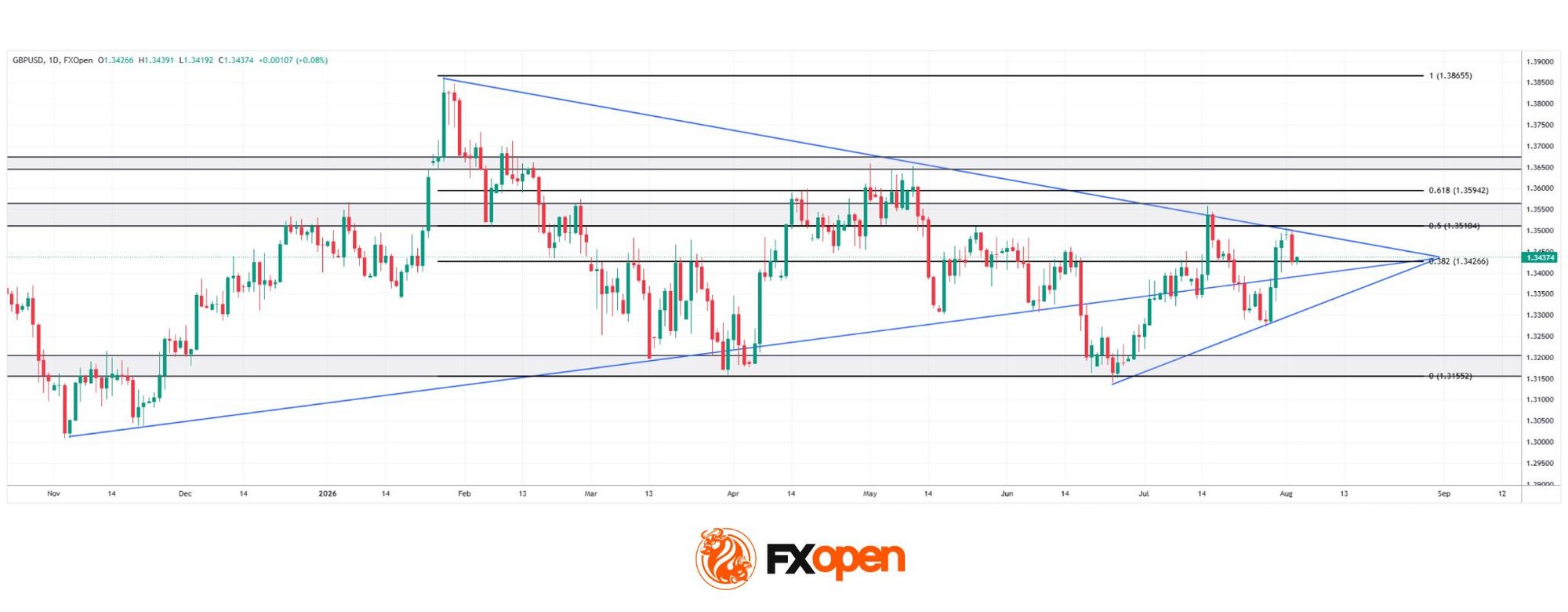
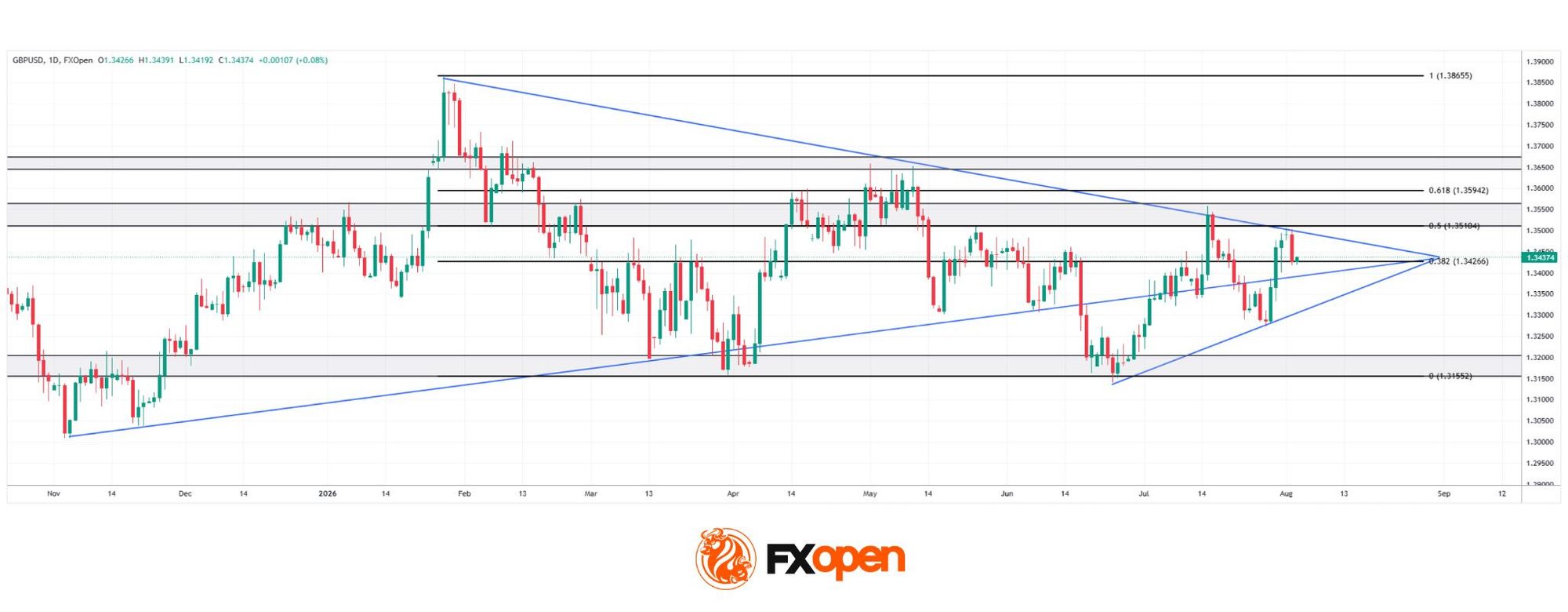
As the GBP/USD chart shows, the pair has been compressing into a broad symmetrical triangle since January’s highs, with price now converging near the 0.382 Fibonacci retracement around 1.3427, exactly where the two trendlines meet. This narrowing structure suggests a decisive breakout may be approaching after months of range-bound trading.
Bullish Scenario
Should buyers push through the descending trendline and reclaim the 0.5 Fibonacci retracement near 1.3510, the path would open toward the 0.618 level around 1.3594, with a stronger move potentially targeting the 1.3865 highs from January if fundamental momentum aligns.
Bearish Scenario
Conversely, a break below the ascending trendline would expose the 1.3200 support zone, with a more significant breakdown risking a retest of the 1.3155 low that anchored this entire triangle formation.
With price coiled right at the apex of this multi-month triangle, and both the Fed and incoming labor data serving as potential catalysts, GBP/USD looks primed for its next major directional move—will the pound extend its recent strength, or is the dollar poised for a comeback?
Trade over 50 forex markets 24 hours a day with FXOpen. Take advantage of low commissions, deep liquidity, and spreads from 0.0 pips (additional fees may apply). Open your FXOpen account now or learn more about trading forex with FXOpen.
This article represents the opinion of the Companies operating under the FXOpen brand only. It is not to be construed as an offer, solicitation, or recommendation with respect to products and services provided by the Companies operating under the FXOpen brand, nor is it to be considered financial advice.
Crypto World
BlackRock (BLK) debuts tokenized access to $311 billion of money market funds in Europe


BlackRock (BLK), the world’s largest asset manager, is building on its recent expansion of tokenized cash offerings in the U.S. by tapping into a combined $311 billion of assets under management in European money market funds in a sign of the growing appeal of holding real-world assets on blockchain technology.
BlockRock unveiled 12 new tokenized share classes based on six funds across 15 European markets. The funds, which comply with the European Union’s UCITS regulations, include sterling, euro and dollar share classes, the asset manager said Tuesday. The move comes one day after the firm added two tokenized cash offerings in the U.S.
CEO Larry Fink has repeatedly championed tokenization technology as a way to modernize financial markets. The tokenized real-world asset market has grown more than 200% over the past year to over $30 billion, according to rwa.xyz, while Citi projects tokenized securities could reach $5.5 trillion by 2030.
The tokenized funds are designed for corporate treasurers who already use money market funds to manage operating and reserve cash, as well as at asset managers and investment consultants across traditional and digital markets, BlackRock said.
After a painful end to the previous week (and month), the spot Bitcoin ETFs began August with a bang, attracting over $170 million in net inflows.
This made them the best-performing exchange-traded funds tracking any cryptocurrency on Monday, which has not always been the case lately.
The fresh capital that entered the BTC funds on Monday is almost the same as the entire net positive for July, which was $172.42 million. At the same time, the underlying asset rebounded from another dip to $62,200, and jumped to $64,000 in midday trading.
In contrast, the Ethereum ETFs far outperformed in July, attracting more than $365 million last month. However, SoSoValue data shows that the financial vehicles tracking the largest altcoin were actually in the red on Monday, losing $11.42 million.
The XRP ETFs gained a modest $1.15 million, but extended their non-red streak, as the last day with more withdrawals was July 8.
The Solana funds saw no reportable action, similar to those tracking Dogecoin, but that’s no surprise since they have rarely seen any actual inflows.
The spot HYPE ETFs, which were once the top-performing crypto funds, are on a painful streak. The last time they were in the green was July 15. On Monday, the ETFs lost nearly $1 million again.
The post BTC vs ETH vs XRP: Which ETFs Attracted the Most Money on Monday? appeared first on CryptoPotato.
Crypto asset manager Hashdex is set to close and liquidate its $14.7 million spot bitcoin exchange-traded fund, in what may be the first liquidation of a U.S. spot bitcoin offering.
Bitcoin futures ETFs have closed before, including VanEck’s XBTF in 2024, but no U.S. fund holding bitcoin directly appears to have previously been liquidated.
Hashdex cited an evaluation of the fund’s assets under management, liquidity, operating costs, investor interest and its place within the company’s broader product lineup when announcing the closure.
Flows into the ETFs, which were first approved in January 2024, have dwindled as investors chased the better returns offered by AI-related investments. Taken as a group, the funds have seen net outflows in each of the past three months, according to data from SoSoValue.
“Much of the market views the opportunity cost of holding BTC as too high while anything AI-related soars,” K33 Research head Vetle Lunde wrote in a June report.
BlackRock’s iShares Future AI & Tech ETF gained 39% through July and held $3.6 billion in assets while the crypto market fell roughly 36%, based on the CoinDesk 20 (CD20) Index.

Influencers draw backlash for attending OpenAI’s first luxury trip

Crissy Rock speaks out on ITV show Benidorm returning to TV

City of Perth’s new Culture and Arts Advisory Group members revealed

Renter of Home in Anne Heche Crash Denies Settlement With Son

No Jackpot Winner as $257 Million Prize Rolls Over to $269 Million Monday Draw

Weekend Open Thread: Staud – Corporette.com

How to Ease Financial Stress When Money Is Tight

VERYPOWERFUL:Money Guided Meditation |Manifest Money Fast | Money Meditation in Telugu| Money Mantra

Crypto & Gold Analysis | 29 July || Trading Techstreet | Akhand Pratap Singh
-

 Business6 days ago
Why Trees Belong on the Risk Register
-

 Fashion4 days ago
Weekend Open Thread: Wit & Wisdom
-

 Politics4 days ago
Meta enters AI-training agreement with far-right ‘propaganda rag’ Newsmax
-
 Entertainment7 days ago
‘Stargate’ Creator’s New Sci-Fi Series Returns for Season 3 Tomorrow
-

 Crypto World3 days ago
MicroStrategy Post-Earnings CLARITY Act Push Could Add New Catalyst for Its Stock
-

 Business6 days ago
Major shareholder moves on Canyon
-

 Politics6 days ago
Reform UK betrays West Mids residents by running from party pledges
-

 Crypto World3 days ago
XRP Ledger v3.3.0 brings five institutional features
-

 News Videos5 days ago
Bitcoin Enters the 3rd Stage of the Bear Market
-

 Crypto World6 days ago
Kraken Enables Retail Access to Jersey Mike’s IPO via Tokenized Shares
-

 Politics5 days ago
Luke Littler’s dominance sparks GOAT debate
-

 Sports4 days ago
Seema Kaliramna Wins Discus Throw Bronze, Takes India’s CWG Medals Tally To 17
-

 News Videos7 days ago
Claude: Build Financial Dashboards in Minutes (2026)
-

 Crypto World2 days ago
Crypto PAC spending tops $2M in Michigan House race
-

 Crypto World3 days ago
New York sues Kalshi over prediction market gambling
-

 Business7 days ago
Johnson & Johnson agrees to $5.5B settlement over talc cancer claims
-

 Business4 days ago
Trump Announces Hamas Disarmament Agreement as Iran Strikes Kuwait Air Base and US Attacks Pause Overnight
-

 Tech6 days ago
Gemini can now summarize the messiest comment threads in Google Docs
-

 Tech2 days ago
ESET tracks rise in malicious AI skills and adaptable malware
-

 Politics2 days ago
Zack Polanski: an incitement to murder Nigel Farage?
You must be logged in to post a comment Login