Connect with us

Business

Is Kuwait International Airport Open Today? Here’s the Latest on Terminals, Flights and Airspace Status

Published

on

Kuwait International Airport

KUWAIT CITY — Kuwait International Airport remains open and operating Tuesday, but with significant restrictions still in place months after a series of Iranian strikes damaged the facility and forced the country to overhaul its aviation operations amid the broader regional conflict tied to the 2026 Iran war.

Passengers can still fly in and out of Kuwait, but the airport’s normal operations remain far from fully restored, with one major terminal closed for repairs, a long-anticipated new terminal still under construction, and the country’s airspace still partially restricted to overflights as of Tuesday.

Terminal by terminal: what’s open

Kuwait International Airport currently operates through two active passenger terminals. Terminal 4 serves as the base for Kuwait Airways, along with a growing number of returning international carriers, including Emirates, flydubai, Air Arabia and Oman Air. Terminal 5 remains the dedicated home for Jazeera Airways, which has continued expanding its route network even amid the broader disruptions affecting the airport.

Advertisement

Terminal 1, traditionally the airport’s primary international passenger facility, remains closed. The terminal briefly reopened on June 1 before sustaining damage just two days later in a June 3 strike, and it has stayed offline ever since while repair work continues. No confirmed date has been set for its reopening.

Terminal 2 still under construction, not open today

Despite periodic social media speculation, Kuwait International Airport’s long-awaited new Terminal 2 has not opened and did not open Tuesday. The $5.8 billion project, designed by the architecture firm Foster + Partners and built by Turkey’s Limak İnşaat, remains under construction, with officials targeting completion of civil works by Nov. 30, followed by systems testing and trial operations before passenger service begins in the final quarter of the year.

The sprawling 700,000-square-meter terminal, envisioned as part of Kuwait’s broader “New Kuwait 2035” economic diversification strategy, is designed to eventually handle up to 25 million passengers annually, with capacity for future expansion to 50 million. Construction on the project began in 2017, with the original target completion date of 2022 repeatedly pushed back due to the COVID-19 pandemic, supply chain disruptions and, more recently, damage sustained during the regional conflict. Kuwait’s Directorate General of Civil Aviation has repeatedly urged the public to rely only on official channels for updates, pushing back against unverified claims of imminent reopenings.

Advertisement

A conflict that has repeatedly disrupted operations

The disruptions at Kuwait International Airport trace back to Feb. 28, when Iran launched a campaign of aerial attacks against the airport as part of the broader 2026 Iran war, targeting Terminal 1 and critical air traffic control infrastructure in what officials described as an effort to disrupt a facility being used as a logistics hub for coalition transport. The campaign forced a total suspension of commercial aviation in Kuwaiti airspace that stretched for more than 40 days before authorities began a phased reopening in late April.

Since then, operations have been repeatedly interrupted by renewed strikes and precautionary shutdowns. A June 3 attack caused fresh damage to the newly reopened Terminal 1, while a further round of Iranian missile and drone strikes on July 18 prompted Kuwait’s aviation authorities to reimpose broader airspace restrictions. Throughout the conflict, radar systems, fuel storage infrastructure and structural elements at the airport have all sustained damage at various points, according to regional aviation trackers monitoring the situation.

Overflights remain banned

Advertisement

While arrivals and departures at Kuwait International Airport have continued, Kuwait’s airspace has remained closed to overflights since the July 18 strikes, with the ban extended repeatedly and most recently set to run until at least Tuesday, according to aviation industry trackers monitoring Gulf airspace. That restriction has made Kuwait something of an outlier in the region, as neighboring Iraq, Bahrain, Qatar and the United Arab Emirates have all reopened their airspace to overflights in some form, forcing airlines to route around Kuwaiti airspace via longer corridors through Egypt, Saudi Arabia and Oman, or further north through the Caucasus.

The European Union Aviation Safety Agency has advised operators to avoid the airspace of Kuwait, along with Iran, Iraq, Lebanon, Bahrain, Qatar, the UAE and parts of the Gulf of Oman, citing continued risk from the conflict. Whether Kuwait extends its overflight ban further, or begins easing restrictions as conditions stabilize, remains to be determined by the country’s aviation authorities.

What travelers should know

Passengers with flights booked through Kuwait International Airport are strongly advised to confirm their specific flight details directly with their airline given how frequently conditions have shifted throughout 2026. Travelers flying with Kuwait Airways should expect to depart from Terminal 4, while those flying with Jazeera Airways will use Terminal 5. Anyone whose itinerary was originally booked through Terminal 1 should check with their airline regarding rebooking, alternate terminal arrangements or refund options, since that facility remains offline with no confirmed reopening date.

Advertisement

During earlier phases of the disruption, Kuwait’s national carriers temporarily rerouted operations through Saudi Arabia’s King Fahd International Airport in Dammam, requiring passengers to complete lengthy bus transfers to reach their flights. While most operations have since returned to Kuwait International Airport itself, the underlying volatility means schedules can still change with little notice.

Kuwait’s aviation authorities continue to describe the current arrangement, two operating terminals, one closed for repairs and a new terminal still months from completion, as a temporary state tied directly to the broader regional conflict rather than a permanent operating model. Officials have emphasized that once Terminal 2 opens in the final quarter of the year, it will substantially expand the airport’s capacity and modernize the overall passenger experience as Kuwait works to position itself as a competitive aviation hub alongside Dubai, Doha and Abu Dhabi.

For now, though, the answer to whether Kuwait International Airport is open remains layered: yes, for arrivals and departures through Terminals 4 and 5, but with Terminal 1 closed, Terminal 2 still under construction, and the country’s skies remaining only partially open to the wider region as the conflict’s effects continue to ripple through Gulf aviation.

Advertisement
Continue Reading
Click to comment

You must be logged in to post a comment Login

Leave a Reply

Business

Building that played key role in Swansea’s copper industry being transformed

Published

on

Business Live

Work transforming the historic Laboratory Building at the Hafod-Morfa Copperworks site is due to be completed this year

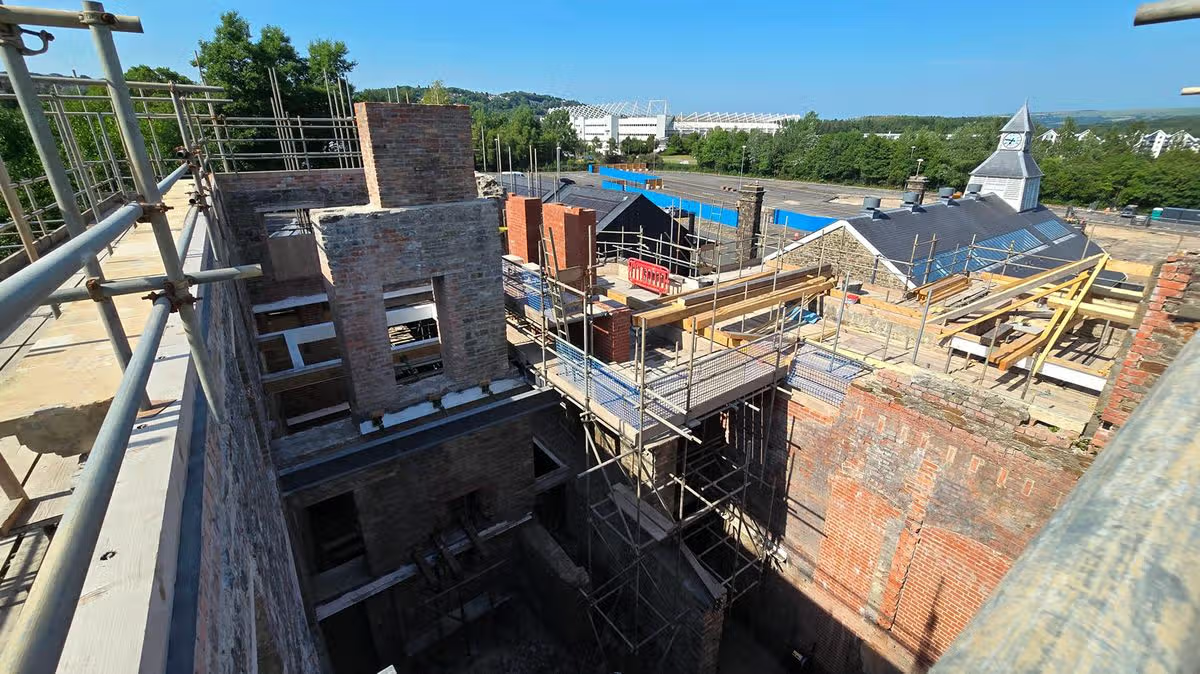
Looking from the top of the Laboratory Building towards the Swansea.com Stadium and Penderyn Whisky(Image: Swansea Council )

The transformation of a building where copper ore was probably tested during Swansea’s industrial heyday is due to be completed this year.

Council contractors have been working on the Laboratory Building at the Hafod-Morfa Copperworks site since late 2024 and are starting to install new floors. A Welsh slate roof will also be added.

It’s one of a number buildings at the site that have been or are being restored, including a Penderyn whisky distillery, and it’ll be ready for internal fit-out once finished.

The council said future uses could include it becoming a restaurant for more than 100 diners.

Advertisement

The grade-two listed Laboratory Building with its ornate windows and stone doorcase is next to the Morfa Gates, once a key copperworks entrance.

The council said it was probably used to test the quality of copper ore coming into the site.

How the grade two-listed Laboratory Building could look.(Image: GWP Architecture)

A council spokesman said the rebuild was part of its ongoing programme to regenerate the Lower Swansea Valley, with support via the UK Government’s local regeneration fund.

Council leader Rob Stewart said: “We’re bringing the historic Laboratory Building back into use so and it’s great to see the floors going in and the building coming back to life.

Advertisement

“The copperworks site has the potential to become a major leisure destination, building on its status as a key part of Swansea’s heritage.”

He added: “We’re pushing forward with the restoration of the Tawe river corridor and the Lower Swansea valley project. Penderyn are there, the two historic engine houses are being restored, and we have plans for more boating pontoons on the river.“A new river walkway is planned, new facilities will be created along the river, and a new major tourism destination is set to open nearby.”

John Weaver Contractors have been overhauling the Laboratory Building. GWP Architecture and Coreus Group are also involved. The council said a search for a tenant would get under way shortly.The nearby Vivian and Musgrave engine houses will also be restored.

The council’s planning committee heard last month that remains of wheel pits, rolling mill trenches and furnace bases – some potentially up to 200 years old – were found at the engine houses during excavation work.

Advertisement

The project includes a new link building between the grade two-listed engine houses. The new-look site will be suitable for restaurant, cafe, retail, and exhibition uses when completed.

Continue Reading

Business

Micron Shares Jump More Than 6% as AI Memory Demand Sparks Rebound After Recent Selloff

Published

on

Earnings News: Micron Technology Inc (NASDAQ: MU)

Micron Technology shares rose more than 6% in early trading Tuesday, climbing back toward recent levels as investors returned to memory chip stocks amid ongoing strength in artificial intelligence-related demand.

The stock traded at $881.50, up $51.99 or 6.27%, as of mid-morning Eastern time. The advance came after a period of volatility in which the shares had pulled back from highs reached earlier in the summer, pressured in part by reports of planned capacity expansions by Chinese competitors and broader profit-taking across the semiconductor sector.

Micron has been one of the clearest beneficiaries of the AI infrastructure buildout. In its fiscal third quarter ended in late May, the company reported revenue of $41.46 billion, a more than fourfold increase from the year-earlier period and well above Wall Street expectations. Adjusted earnings reached $25.11 per share. Gross margins expanded sharply to about 84.6%, reflecting higher pricing power in a market where demand for advanced memory has outstripped available supply.

Management guided for fiscal fourth-quarter revenue of approximately $50 billion, plus or minus $1 billion, with gross margins near 86% and adjusted earnings of about $31 per share. Those figures pointed to continued sequential growth and reinforced the view that the current upcycle in memory pricing remains intact.

Advertisement

Chief Executive Sanjay Mehrotra said the results and outlook “reflect the strategic value of memory in the AI era.” He added that the company expects “tight conditions to persist beyond calendar 2027 as a result of AI-driven demand across all segments coupled with structural supply constraints.”

High-bandwidth memory, or HBM, used alongside advanced processors in AI accelerators, has been a key driver. Micron has reported that its HBM supply for the year is largely committed under multi-year contracts, and it has secured strategic customer agreements totaling billions of dollars, including cash deposits and pricing protections designed to stabilize volumes and margins. Data-center related revenue has grown to represent a substantial portion of overall sales.

The company has also outlined elevated capital spending to expand production capacity, including investments aimed at meeting customer needs for HBM and other high-performance DRAM. Analysts have noted that these long-term supply agreements help reduce the traditional cyclicality of the memory business by locking in a portion of future demand.

Despite the strong fundamentals, the stock experienced a correction in recent weeks. Shares had risen hundreds of percent over the prior year, pushing valuations higher and leaving the name vulnerable to shifts in sentiment. Reports that China’s ChangXin Memory Technologies was considering additional DRAM production capacity contributed to caution among some investors concerned about eventual supply increases. Broader market rotation away from high-flying AI names also played a role.

Advertisement

Tuesday’s rebound appeared tied to a broader recovery in semiconductor and AI-related shares. Positive signals from other technology companies about enterprise AI adoption helped restore confidence that demand for the memory chips required by large-scale data centers remains robust. Several analysts have maintained or raised price targets, citing the combination of near-term pricing strength, multi-year contracts and the structural shift toward higher-value AI memory products.

Wall Street consensus remains constructive, with a majority of analysts rating the shares a buy and average price targets implying further upside from current levels. Some research notes have highlighted free-cash-flow generation potential that could support share repurchases or other capital returns over time, even as the company invests heavily in new capacity.

Micron operates in a concentrated industry alongside Samsung and SK Hynix. The three dominate global production of DRAM and related products. Supply discipline and the specialized nature of HBM manufacturing have so far limited rapid capacity responses, helping sustain elevated prices. Industry commentary from peers has similarly pointed to multi-year tightness in certain memory segments.

Risks remain. Memory markets have historically been volatile, and any slowdown in AI capital spending by hyperscale cloud providers could eventually pressure pricing. Competitive responses from Chinese manufacturers, execution risks on new technology ramps such as next-generation HBM, and the high capital intensity of the business are ongoing considerations. Valuation after the large run-up also leaves less margin for error if growth expectations are revised lower.

Advertisement

For now, the early-session gains reflected renewed focus on the company’s position at the center of AI hardware demand. Micron’s ability to convert record revenue and margins into sustained free cash flow, while expanding capacity under long-term customer commitments, continues to shape investor views of the stock.

Trading remained active as the session progressed, with the shares recovering a portion of the ground lost during the recent pullback. The performance underscored the sensitivity of memory-chip equities to shifts in AI spending expectations and supply-demand balances in the broader semiconductor market.

Micron is scheduled to report its next quarterly results later in September. Until then, investors are likely to watch for updates on customer demand, pricing trends and any further developments on competitive capacity plans. The company’s recent results and guidance have positioned it as a primary proxy for the health of the AI-driven memory cycle.

Advertisement
Continue Reading

Business

Dutch technologist praises Newport role in compound semiconductor cluster

Published

on

Business Live

Joost Helms has played a key role in turning the Dutch city of Eindhoven into a tech powerhouse

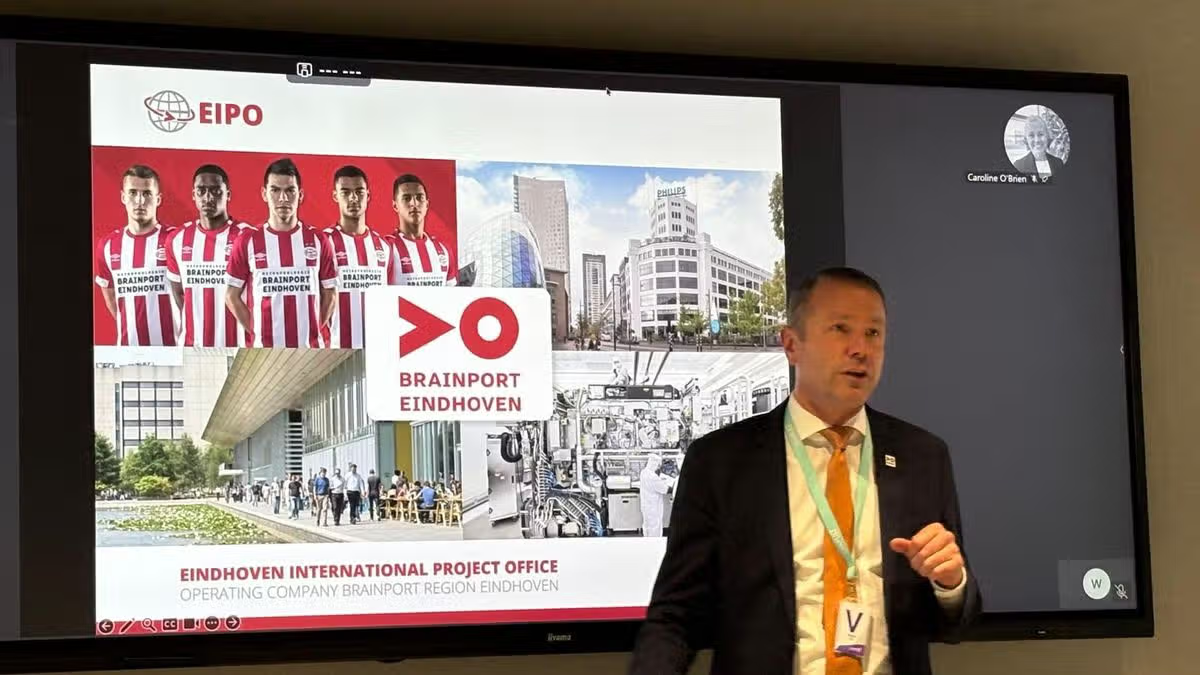
Joost Helms speaking in Newport.

A key figure in the transformation of the Dutch city of Eindhoven into a technology powerhouse has praised the impact that the emerging compound semiconductor of South Wales is having on the city of Newport.

Joost Helms has been in South Wales as part of an initiative to strengthen international ties around the city’s semiconductor industry. He was invited by leader of Newport Council Dimitri Batrouni and councillor James Clarke because of his knowledge and experience delivering Eindhoven’s Brainport development, which transformed the city into Europe’s premier technology hubs, generating thousands of jobs and significant economic growth.

Advertisement

Newport is home to some of biggest players in the compound semiconductor cluster such as Vishay, KLA and IQE. The cluster, from early stage and academic research to commercial firms, is targeting employing more than 6,000 by 2030 and generating combined revenues of £1bn.

An independent report, from the Welsh Economy Research Unit (WERU) at Cardiff University, shows that the cluster – known as CSconnected – last year directly employed 1,914 people, with a further 1,226 jobs supported across Wales through its wider economic indirect and induced impacts. Total Welsh employment linked to the cluster increased from 2,748 in 2024 to 3,140 last year, a 14% year-on-year rise.

It also generated £267m in direct GVA, with an additional £169m supported elsewhere in Wales, bringing total Welsh GVA impact to £436m, up 19% on 2024.

Mr Batrouni said: “It was absolute pleasure to welcome Joost Helms to Newport. We invited him to the city and the region because of his knowledge and experience of the technological regeneration of Eindhoven, Through the city’s Brainport project, it has become the premier tech capital of Europe, generating a huge number of jobs and economic wealth. I believe Newport is on the same trajectory and we must grab this opportunity, so once again Newport leads the next Industrial Revolution. For us, for our children and grandchildren.”

Advertisement

Mr Helms, said: “What I found in Newport genuinely surprised me. South Wales is a well-kept secret in the global semiconductor value chain: South Wales is already recognised as one of the UK’s leading semiconductor clusters. Yet internationally, its capabilities remain far less visible than those of many better-known semiconductor regions. The initiative taken by Dimitri Batrouni and James Clarke to reach out to learn from international partners is timely and can help Newport translate these strengths into greater recognition, investment and opportunity.”

Mr Clarke, said: “Learning from internationally recognised success stories such as Eindhoven’s Brainport will help us better understand how we can unlock further investment, create skilled jobs and strengthen our position as a leading technology hub. We are ambitious for Newport and determined to ensure the city is at the forefront of future economic growth.”

Continue Reading

Business

Chubb announces leadership changes at Westchester division

Published

on


Chubb announces leadership changes at Westchester division

Continue Reading

Business

Banc of California Stock: Reactionary Selloff Creates Buying Opportunity (NYSE:BANC)

Published

on

Banc of California Stock: Reactionary Selloff Creates Buying Opportunity (NYSE:BANC)

This article was written by

Other writing on Substack: https://yieldstrategies.substack.com/I am currently focused on income investing through either common shares, preferred shares, or bonds. I will occasionally break away and write about the economy at large or a special situation involving a company I’ve been researching in. I target two articles per week for publication on Monday and Tuesday.About My Background: Bachelors in history/political science, Masters in Business Administration with a specialization in Finance and Economics. I enjoy numbers. I have been investing since 2000. Professionally, I am the CEO of an independent living retirement community in Illinois.

Analyst’s Disclosure: I/we have a beneficial long position in the shares of BANC either through stock ownership, options, or other derivatives. I wrote this article myself, and it expresses my own opinions. I am not receiving compensation for it (other than from Seeking Alpha). I have no business relationship with any company whose stock is mentioned in this article.

Seeking Alpha’s Disclosure: Past performance is no guarantee of future results. No recommendation or advice is being given as to whether any investment is suitable for a particular investor. Any views or opinions expressed above may not reflect those of Seeking Alpha as a whole. Seeking Alpha is not a licensed securities dealer, broker or US investment adviser or investment bank. Our analysts are third party authors that include both professional investors and individual investors who may not be licensed or certified by any institute or regulatory body.

Advertisement
Continue Reading

Business

AVL, Alcoa explore vanadium battery storage rollout

Published

on

AVL, Alcoa explore vanadium battery storage rollout

Australian Vanadium and Alcoa Australia are working together to evaluate the potential rollout of vanadium flow battery technology at the miner’s WA alumina refineries.

Continue Reading

Business

Australian shares surge as banks, miners charge higher

Published

on

Australian shares surge as banks, miners charge higher

Australia’s share market is narrowing on its record high as easing oil prices and confidence in a strong earnings season for heavily weighted sectors bolster risk sentiment.

Continue Reading

Business

BP profit highest since 2022 as Iran war pushes up oil price

Published

on

Close up of petrol and diesel pumps and hand on one of the pumps with the BP logo to the side

Despite the big rise in profits, BP chief executive Meg O’Neill said the company was not reaching its full potential.

BP, which employs nearly 14,000 people in the UK, confirmed plans to move further away from clean energy, revealing plans to sell off its US renewable natural gas business Archaea.

O’Neill said this was part of her plan to prioritise “value, not sentiment or history”.

“We have to focus on the assets with the strongest potential to deliver competitive returns and long-term value,” she said.

Advertisement

Last week, BP announced it was putting its North Sea business up for sale in a move that would end 60 years of production in the region by the company.

Russ Mould, investment director at AJ Bell, said the sell-offs intended to make the business more streamlined.

“O’Neill will be aware she cannot rely on oil and gas prices remaining this high indefinitely,” he said.

“She needs to make sure it can prosper even when the backdrop is less helpful.”

Advertisement

The bumper profits reported by oil companies have led to an angry response from campaign groups.

Angharad Hopkinson, from environmental group Greenpeace, said BP’s results showed that “corporate gains have become entirely divorced from the public good”.

She said “the one point on which we agree with BP” is its decision to sell off its North Sea operations.

“Prolonging this parasitic relationship by trying to squeeze the last few drops of expensive oil out of the North Sea is sheer folly,” Hopkinson said.

Advertisement

Simon Francis, co-ordinator of the End Fuel Poverty Coalition, said oil firms “have banked more billions from a crisis that has created real hardship for millions of households”.

“The lesson is not to hand yet more tax breaks to an industry posting billions in profit every quarter, but to use Windfall Tax receipts to clear the record energy debt households built up during the crisis,” he said.

Energy firms operating in the UK are subject to a windfall tax – called the Energy Profits Levy – that was introduced in 2022.

However, the tax only applies to profits made from extracting oil and gas in the UK.

Advertisement
Continue Reading

Business

Yorkshire’s Caddick Construction to build huge new storage centre in Newcastle

Published

on

Business Live

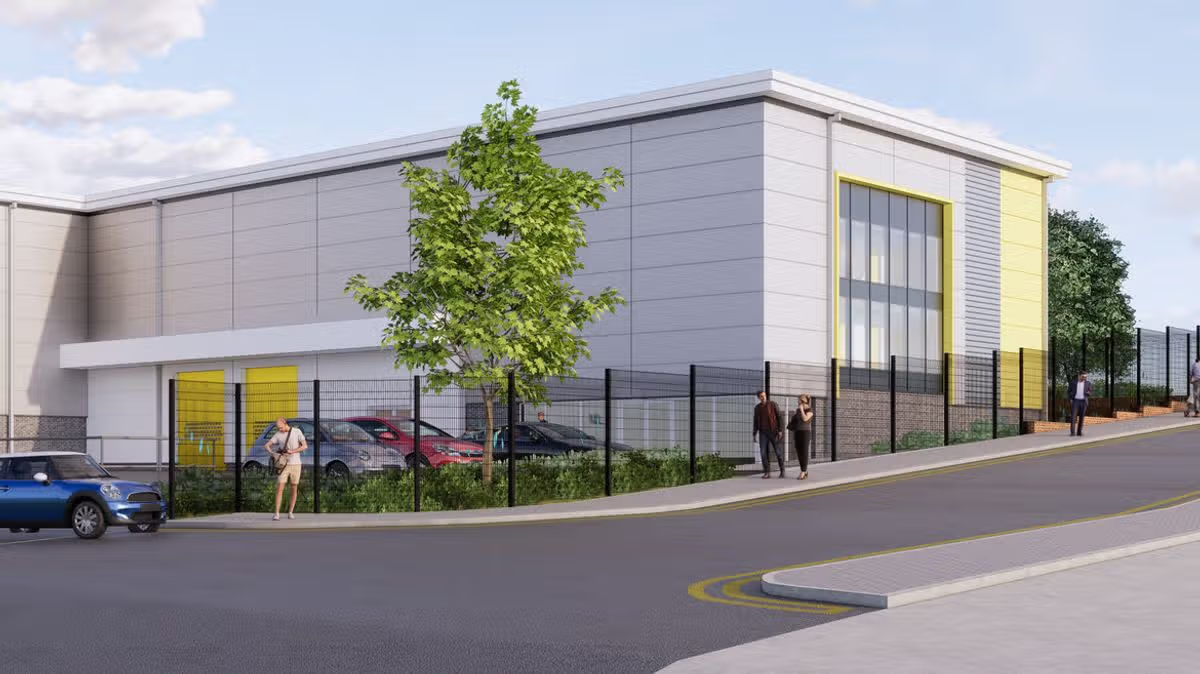
The facility will become the second Big Yellow Self Storage in the city

A CGI of the new Big Yellow self storage site being created in Newcastle

A CGI of the new Big Yellow self storage site being created in Newcastle(Image: Caddick Construction)

A new storage facility is set to be built in Newcastle following the appointment of a leading Yorkshire construction company. Caddick Construction, based in Wakefield, has been named principal contractor for the design and build of a new Big Yellow Self Storage facility in Newcastle’s west end – the second in the city alongside its Industry Road site.

The company is a leading provider of secure, modern self-storage units, offering customers rooms of varying sizes for both personal and business needs, and rapid expansion over the last few years has seen it grow to operate 114 locations across England, Scotland, and Wales.

Being delivered on behalf of the Big Yellow Construction Company, the new facility will have around 60,000 sqft of internal storage space spread across four floors, customer loading bays, staff welfare, office and reception areas.

Based on Scotswood Road, the facility will also have roof mounted solar photovoltaics (PV), battery storage, car parks, landscaping and external works. The storage centre is due to be completed next summer, and will be built to meet BREEAM ‘Very Good’ requirements.

Advertisement

The appointment builds on the success of Caddick’s first year in the North East, having secured a range of contracts totalling £127m since opening its new office in Durham in 2025. It also adds to its portfolio of industrial projects, which includes Richardson Barberry’s new DPD parcel hub at Newton Aycliffe.

Steve Ford, regional managing director, Caddick Construction North East & Yorkshire, said: “We’re pleased to have been appointed to the design and construction of Big Yellow Self Storage’s new facility. This project expands our industrial portfolio in the North East and builds on our team’s expertise in delivering high-specification schemes.

“As one of the most active development markets in the UK, we’re proud to support the region and the local area through this investment, and we look forward to working closely with the Big Yellow team and our regional supply chain to deliver a high-quality, sustainable development.”

Nigel Hartley, Big Yellow’s construction director, added: “Big Yellow Construction has a strong track record of delivering high-quality, sustainable assets for the operational business across the UK. To maintain these consistently high standards, we work only with the best, and we are delighted to partner with Caddick Construction on what we hope will be another successful project for everyone involved.”

Advertisement

Headquartered in Wakefield and with regional offices in Warrington, Kendal, Durham and Birmingham, Caddick Construction Group employs over 500 people across Yorkshire, the North East, North West and Midlands. In its last financial year, Caddick Construction Group – which is formed of Caddick Construction, Caddick Civil Engineering and CCL Facades – reported a turnover of £375m, a pre-tax profit of £4.5m and a forward order book of over £1.4bn.

Like this story? For more news from the commercial property scene around the regions, visit our dedicated section here for the latest news and analysis within the sector.

Continue Reading

Business

Isuzu Motors Limited (ISUZY) Q1 2027 Earnings Call Prepared Remarks Transcript

Published

on

OneWater Marine Inc. (ONEW) Q1 2026 Earnings Call Transcript