
Politics
Manchester’s lowest-ever election turnout results broken down

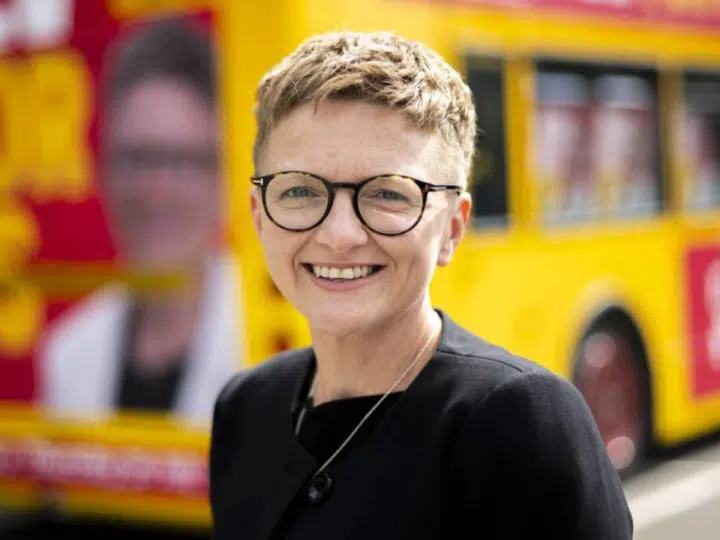

After a string of high-profile elections, Greater Manchester has elected another Labour mayor in Bev Craig. On the face of things, that might seem like nothing much of a change.
But having been around Gorton and Denton, local elections, Makerfield and the mayoral, I can assure readers that things have changed in the region. For progressives, that change isn’t looking too great.
Burnham got over 420k votes last time so 251,449 is not good for Labour.
— Lady Jane Simkins
(@JaneSim66) July 31, 2026


Manchester experiences poor voter turnout
The most striking statistic is undoubtedly dire voter turnout on Thursday. Only 25% of the total possible electorate bothered to show up, which was as low as 22% in Wigan and Oldham. That’s a bad indictment of all mayoral options.
To be sure, it’s never been a strong show. It peaked at 34.7% in 2021, with lockdown-weary voters desperate for an excuse to leave their house, and dipped to 32.1% in 2024. But even when the mayoral role was brand-new in 2017, some 28.9% still voted. So what’s happened?
It’s possible that voters across Greater Manchester are fed up with elections, by-elections, and all the fleeting national attention these bring. I experienced this firsthand in Makerfield, with multiple voters offering me statements like, “I’ll be glad when it’s over” and “I want it all to be over!” In fairness to them, at least these ones came out to vote on the day that ultimately, decided our new prime minister.
No doubt these voters felt rather exasperated returning to the polls scarcely six weeks later, not even 12 weeks after local elections. But it’s also reflective of wider national phenomena.
Keir Starmer’s “loveless landslide” majority of over 400 MPs was elected by a mere 52% of the voting-age population. This was the second-lowest turnout since universal suffrage, only beaten by 2001’s post-political haze.
Council election turnout has hovered between 33–34.5% in recent years, despite the most recent round in May feeling somewhat more momentous than usual.
This is not healthy for a supposedly representative democratic system. As one study puts it, published about a survey of Brighton and Hove County Council by the Institute of Development Studies:
Without participation in local elections, we run the risk of unrepresentative implementation of vast swathes of the welfare state and those behind these implementations not being held to account by most residents.
This is equally true, if not more so, for Greater Manchester. Especially as Andy Burnham promises to hand his successor and her peers greater devolved powers.
Burnham’s brainy protégé takes power
Labour candidate, Bev Craig, was elected mayor by Greater Manchester. She’s been Manchester City Council leader since 2021, a position that seems a natural predecessor to the big job.
In some ways, Craig could be a welcome development. She’s the first female Greater Manchester mayor, and is an out-and-proud lesbian in one of England’s most powerful jobs. She also said, at the Mill hustings, that she wears it as a “badge of honour” that the Telegraph smears her for standing by the trans community.
I was most impressed by Craig when she was asked about other cities she takes inspiration from. While other candidates floundered, Craig mentioned some solid examples of good governance. She lauded Barcelona’s combative approach to Airbnb rental takeovers and their ‘super-blocks’ method for traffic reduction.
She also cited Vienna’s world-class socialised housing model and the co-operative housing movement in Copenhagen. Craig looks to China for their sustainable ‘sponge parks’ programme too.
These aside, I’ve written about my reasons for doubting Bev Craig (here and here).
More on Burnham and Craig’s vote share
Craig has been alternately, not to mention rather confusingly, profiled as Andy Burnham’s protégé and also dubbed the “brains behind Burnham.” She says they’ve “worked very closely” since 2021 and admits there will be continuity.
However, for all their mutual respect and working relationship, Craig’s vote return was brutally low compared to Burnham’s prior successes.
In 2021, Burnham secured an almost unheard-of 67.3% in the mayoral vote. This only dropped marginally to 63.4% in 2024. Then he managed to persuade 55% of Makerfield voters to make him their MP, and our prime minister, and stop a double far-right threat from Reform UK and Restore Britain.
It’s no stretch to say that Burnham has unparalleled personal favourability in this neck of the woods. His successor, meanwhile, secured just 47.1% of the vote. Craig was the first to face a two-round run-off, where Burnham’s previously resounding popular vote had never necessitated a second vote count.
Perhaps worst for Craig, her mandate saw a real term voter drop of just over 40%. This means that far fewer people came out to support her than they ever did Burnham. Only about 12% of the electorate, in fact. She can take some solace from her second-choice share of 66% dwarfing that of Reform’s candidate.
In her acceptance speech, Craig at least promised to be a mayor for all Mancunians:
I will serve every single one of them, every single day.
Let’s hope she keeps true to that promise.
Labour and Reform dodge Manchester mayoral election community hustings
Green Party gains, but far right consolidates
I genuinely came to believe that Greens second place was plausible. Perhaps I spent too much time around Green Party activists on the campaign trail. Unfortunately, Reform’s Sian Astley took that spot.
All the same, the Greens’ candidate, Geraldine Coggins, managed to secure a solid third place vote. She came second in Manchester central, while Astley took second in most boroughs.
In real terms, the Greens gained about 19,000 voters. That was up to just shy of 65,000, up from almost 46,000 in 2024. But as a percentage of those motivated to vote, they gained a full 5%, now up to 12%. This mirrors much national polling.
I didn’t doubt that Labour would clear up on second round voting. They represent the less-bad middle way for both polarised Green and Reform/Restore Britain voters. In a way, tactical voting is just deferred with the second choice voting system, called ‘supplementary vote’. (Public information around the point of this new-fangled system — or how to vote smartly — was abysmal, if even existent.)
What is far more concerning to Canary readers, however, is the consolidation of the far-right vote. The semi-defunct Tory party was actually leapfrogged into fifth place by Restore Britain. From nowhere, Restore’s Marlon West took 9% — above where Greens were two years ago. This is a man cynically weaponising his daughter’s rape and abuse to demonise Pakistani and Muslim communities.
Meanwhile, Reform held second place and secured a full fifth of the popular first round vote with 21%. Then a full third of non-Labour, non-Restore first choice voters decided that Reform was a sensible second choice, which is baffling too. This consolidates their outer-borough gains from May’s council elections.
Combined with Restore’s gains, the far right finds itself comfortably ahead of the progressive, anti-status-quo left by some 250%. That should give Manchester serious pause for concern.
If one thing’s certain, there’s plenty of work to be done before we vote again.
Featured image via Anthony Devlin/ Getty Images



Ecocidal oil companies are raking in so much money that even the most corrupt American president in history – Donald Trump – has to make a public show of disapproval at least.
US-based Chevron reported its largest quarterly net profit ever, at $12.1 billion; ExxonMobil’s $14.5 billion second-quarter income and Shell’s $10.8 billion in net earnings represented their most profitable quarters spince 2022, when they previously benefited from the Russia-Ukraine war.
Trump pipes up
Trump told reporters on Monday:
I don’t like it. Chevron, too much money. ExxonMobil, too much. Too much money.
 Big Oil did spend a lot on getting Trump re-elected. Fossil fuel interests poured $96 million into Donald Trump’s re-election campaign and affiliated political action committees.
You going to stop taking their money then, Trump? Of course not!
Redistribution for the worse
The Iran war is a redistribution machine: Big oil profits have shot up to historic highs. Our research shows that 50% of fossil fuel profits go to the richest 1% in the U.S. The rich are the ultimate beneficiaries of the war windfalls. The bottom 50% claim a mere 1% of profits… pic.twitter.com/lh1XJVtEY4
— Isabella M Weber (@IsabellaMWeber) August 1, 2026
She also lashed out at JP Morgan CEO Jamie Dimon’s record quarter and for him saying the banking environment was ‘close to as good as it gets.’
War kills.
War makes life unaffordable for the many.
But war is great for profits.
“Profits accounted for 13.9% of US economic output in the first quarter, the highest share recorded.”
JPMorgan CEO Dimon said the environment was “getting close to as good as it gets”. pic.twitter.com/MT4phbFB9J
— Isabella M Weber (@IsabellaMWeber) August 3, 2026
The banking environment sure is great, isn’t it, Dimon? Never mind the genocide and ecocide that paved the way.
Corporate America’s profit frenzy
The Financial Times reported that US companies are off to a “blistering start in second-quarter earnings season, reporting double-digit profit growth despite higher energy costs, elevated interest rates and cautious spending by consumers.”
America’s biggest companies report ‘rock solid’ profits as consumers face higher costs https://t.co/2GPbec4Z3F
— Financial Times (@FT) August 2, 2026
S&P 500 earnings are on track for 47.4% year-on-year growth, their strongest quarter in five years.
Defence companies and tech companies are also cashing in, the FT said. Lockheed, General Dynamics, and Raytheon are all reporting higher profits as the US shifts to a “war footing.”
Google’s net income quadrupled to $112 billion, thanks to a little help from its SpaceX investment, just casual billions. Amazon’s profits more than tripled.
As Weber said:
War kills. War makes life unaffordable for the many. But war is great for profits.
By The Canary


Academic David Miller’s explosive win this morning against Bristol University’s attempt to overturn an employment tribunal finding has shown how comprehensively the university’s appeal was defeated.
The university sacked anti-Zionist professor Miller after an Israel lobby pressure campaign. To do so, it ignored two separate investigations by its own lawyers that concluded Miller had said nothing antisemitic in his critiques of Zionism and Israel lobby pressure.
Comprehensive failure
But to justify its appeal, the university put together a Byzantine document. It contained nine ‘grounds of appeal’, most of which were subdivided into smaller grounds – and some of those divided again. Yet every single one was rejected this morning by the Employment Appeal Tribunal (EAT). The win enshrines anti-Zionism as protected belief under equality law – and as legal precedent in future court cases.
A new statement by Miller’s lawyers Rahman Lowe reveals just how far the university went to try to rescue its right to sack employees for opposing Israel – and how badly it failed (emphases added):
The EAT upheld the decision of the Employment Tribunal and concluded that Dr Miller was discriminated against because of his philosophical belief that Zionism is inherently racist, imperialist, and colonial, and ought to be opposed. The EAT held that his anti-Zionist beliefs constitute a protected belief under the Equality Act 2010 (EqA); he was dismissed because he manifested those beliefs and as the dismissal was tainted by discrimination, he was unfairly dismissed.
This means that it is unlawful to discriminate against someone because they hold those beliefs. The successful appeal outcome reinforces that controversial beliefs are not excluded from protection under the EqA simply because they generate complaints or public controversy.
Background
Dr Miller is a renowned sociologist, specialising in state and corporate propaganda, public relations and lobbying. He was employed by the University as a Professor of Political Sociology, and he continued working for the University until he was unfairly dismissed on 1 October 2021 for alleged gross misconduct.
…
Dr Miller believes that the Zionist movement comes at the expense of equal rights for Palestinians. He strongly believes that political Zionism is inherently racist, imperialist and ought to be opposed.
He appealed against his dismissal, but the appeal did not succeed. He then brought claims in the Employment Tribunal of:
- direct philosophical belief discrimination contrary to sections 10 and 13 of the EqA;
- harassment related to belief contrary to section 26 EqA;
- unfair dismissal contrary to section 98 of the Employment Rights Act 1996 (“ERA”); and
- wrongful dismissal at common law.
Employment Tribunal decision
Having heard evidence over seven days in October and November 2023, the Tribunal concluded that Dr Miller was dismissed because of his philosophical beliefs that were protected under the EqA. His dismissal was found to be discriminatory and unfair, as well as wrongful, because it was without notice.
The University appealed the decision and advanced nine grounds of appeal, which the EAT referred to as being “very lengthy because the majority of them contain multiple sub-grounds (and, in some cases, sub-sub-grounds) each of which alleges a separate error of law”.
Employment Appeal Tribunal decision
The EAT dismissed the University’s appeal and held that Dr Miller’s anti-Zionist beliefs qualified as a philosophical belief under the EqA. In particular, the EAT held that the Tribunal was entitled to conclude that the expression of his beliefs about Zionism had a “material impact” upon the decision to dismiss, and he was thus dismissed “because of” the manifestation of his beliefs.
The EAT confirmed that an important free-speech principle that any court or tribunal must have at the forefront of its mind in considering a case involving the expression or manifestation of belief is that: the protection of freedom of speech is particularly important in the case of ‘political speech’- that is, expression of opinion on matters of public and political interest.
Zionism ‘coherently’ confirmed as racism
The EAT continued by confirming that to describe Zionism as racism is not merely opinion, but a “coherent” belief – a finding that is sure to have Israel’s ‘friends of genocide’ supporters frothing at the mouth. And the university was reminded that it had already admitted Miller had done nothing antisemitic:
The EAT rejected the University’s argument that David Miller’s beliefs were political and merely opinions. On the contrary, the EAT found that “it is coherent to describe as “racist” an ideology [Zionism] that promotes the establishment of a state [in this case, Israel] for only one race of people [Jewish] in a territory that formerly contained a large number of people of a different race [Palestinians]. Such an ideology, which supports the migration of members of the first group into the territory with the support of an imperial power to dislodge an indigenous population, could also coherently be described as colonial and imperialistic”.
The University’s attempts to re-litigate factual issues and assert that Dr Miller’s true beliefs were something entirely different, were also dismissed on the basis that the University had agreed at the Tribunal that it was not its position that anything Dr Miller said or done was antisemitic.
The EAT slapped down the university’s attacks and legal arguments against the original Tribunal’s decision amounted to nothing more than, basically, being a bad loser – “no more than expressions of disagreement”. And it rejected entirely Bristol’s attempt to have Miller’s compensation for wrongful dismissal cut to zero – an argument described as “not competent”:
The EAT also upheld the finding of the Tribunal that Dr Miller “did not oppose or hold antipathy towards Jews or Judaism”, and that he was not supportive of or “open to” the use of violence as a means of opposing Zionism.
With respect to the University’s contention that the Tribunal had failed to apply the correct proportionality test as set out in the case of Higgs v Farmor’s School [2023] ICR 1072, the
EAT strongly rejected this argument and stated: “The litany of criticisms levelled by the appellant at the Tribunal’s decision on proportionality (comprising seven “headline” points and thirty separate sub-points) are ultimately no more than expressions of disagreement with the conclusion reached by the Tribunal and an attempt to re-try the issue of proportionality.
The University also argued that any compensation awarded for the direct discrimination claim should be reduced by 100%. The EAT rejected this ground as “not competent”, because the Tribunal had expressly reserved the issue of compensation in the discrimination claims to a later remedy hearing which is yet to take place.
The only issue on which the university received a reprieve on its total humiliation was its claim that Miller might have been lawfully sacked later because of his social media posts. The EAT did not agree – and said it couldn’t see how Bristol had worked it out – but sent the issue back to the Tribunal to think about during the decision about what remedies the uni must make to Miller for its unlawful conduct:
The only ground of appeal that was allowed to proceed was in relation to the Tribunal’s findings that there was a 30% chance that Dr. Miller’s employment may have terminated in or around October 2023 with respect to Tweets he had posted in August 2023. The EAT found that it was not clear to them on what basis the Tribunal concluded that there was a chance of a lawful dismissal as a result of the August 2023 Tweets or, if there was, that the degree of that chance was 30%.
This issue has therefore been remitted back to the Tribunal for consideration during the remedy hearing.
Miller’s lawyer Zillur Rahman congratulated his client for his “comprehensive victory” and noted the precedent it set:
This is a comprehensive victory. Dr Miller’s belief that Zionism is inherently racist, has now been recognised by a binding appellate authority as a protected philosophical belief. We are proud to have played a part in securing recognition of the legal right to hold that belief and hope this judgment will provide reassurance and guidance for others in the future.
I am once again delighted for our client, David, who has now been vindicated for a second time. We look forward to assisting him in the next stage of the proceedings and in securing the maximum compensation to which he is entitled to, and which has been delayed because of the University’s appeal.
Miller, in turn, thanked his legal team and the many people who had supported his fight.
Implications after Miller
The statement then concludes by outlining the legal significance of the win:
Implications
The case has implications for every employer dealing with religion and belief issues at work. The judgment reinforces the principle that equality laws exist to protect unpopular beliefs just as much as popular ones, and protects workers from discrimination because of those beliefs.
Anti-Zionism is now a protected philosophical belief under the EqA, and therefore protected in the workplace. Employers should ensure that employees are not bullied, harassed, or subjected to any detriments because of their beliefs, even if their views are offensive or disturbing, so long as they have good reason for expressing them and their beliefs are worthy of respect. As the EAT (Choudhury P) observed in Forstater [2021], “beliefs that are offensive, shocking or even disturbing to others, and which fall into the less grave forms of hate speech would not be excluded from the protection”.
Both the Tribunal and EAT found that there was absolutely nothing wrong with the many statements Dr Miller made about Zionism. The case demonstrates that beliefs that may be considered offensive to others may nonetheless be protected under the EqA , and therefore, employers and regulators must take care to be even-handed. They must also ensure that they do not bow to pressure from third parties, including lobby groups, who wish to stifle free speech, academic debate and human rights issues.
The UK Israel lobby will, of course, have no regard to the law against its war on those who expose and oppose Israel’s genocide and endless crimes. But employers and other organisations it tries to bully into obedience against humanitarians will now face far clearer legal consequences if they cave and collude.
Featured image via the Canary
By Skwawkbox


Andy Burnham has said that the debate on assisted dying shouldn’t happen until palliative and social care are improved.
Speaking to Sky News reporter Sam Coates after delivering a speech on adult social care in England, he said:
I take the view that that debate, and I don’t say that there shouldn’t be a debate at some point about those issues, personally I think there’s something that needs to happen first, and that’s the fixing of the funding of palliative care and social care.
I think it is very challenging to introduce that wider debate in a context of people not receiving that care and having the piece of mind about that care, and that’s a position that I will stick to.
The prime minister yesterday pledged to tackle adult social care, with plans to finally launch a National Care Service (NCS). Burnham plans to nationalise care through improving the workforce.
While the NCS is much welcomed, many are worried that it will be carved up and sold for parts to privateers like the NHS was.
Burnham also announced that Louise Casey will be bringing forward her social care review by a year to 2027. The report will outline how the government can deliver the NCS. The prime minister also confirmed that his approach to tackling the care crisis will be cross-party.
This was backed by Lib Dem leader Ed Davey, who shared on X that he’d had a meeting with Burnham. Davey said he raised the issue “closest to my heart “, which is unpaid carers — but which was absent from Burnham’s address.
Assisted dying: The legal history
The Terminally Ill Adults (End of Life) Bill was originally voted through by MPs after Kim Leadbeater used every bullshit weapon in her arsenal to stop those concerned about coercion and disabled people voicing opposition.
In the Lords, so many Peers wanted to speak that the debate had to be spread over two days, with two-thirds of speakers being against the bill. It progressed to committee stage, where the corrupt committee restricted evidence.
After that it went back to the lords, where Charlie Falconer casually said that both poor people and pregnant people would be allowed assisted deaths. The bill eventually ran out of time as so many peers wanted to scrutinise it, which again was criticised.
However, ironically, the Assisted Dying Bill just won’t f*cking die and is due to come back to parliament in August.
MP Lauren Edwards is attempting to push assisted dying through parliament again using dirty tricks.
As I wrote at the time:
Under the Parliament Act, if the same bill is passed by MPs in two consecutive parliamentary sessions, peers have no power to stop it. While Lords can suggest amendments, there’s also no requirement for the Commons to pass them.
And here’s the worst part: if the Lords don’t agree to pass the bill and it gets talked out by the end of the parliamentary session, it becomes law by default.
Edwards, who is apparently as bloodthirsty as Leadbeater, told BBC Radio 4:
Laws passed in the House of Commons are then refined by the House of Lords, but they don’t have the opportunity to block them.
It’s perfectly reasonable for us to ask the House of Lords to finish the job.
Yes, she used the words ‘finish the job’ about euthanising disabled people.
Lauren Edwards on Burnham’s stance
Of course, the ghoul had something to say about the prime minister’s comments, but it appears she’s trying to get on his good side.
Her statement read:
We all want to see better social, palliative and hospice care in every part of the country. The government has already made better palliative care provision a priority and it is very welcome that the new Prime Minister wants to take that even further.
The evidence from around the world is that this can happen alongside providing the choice of an assisted death to that small minority for whom even the very best palliative care cannot relieve their suffering.
She continued:
Improving social and palliative care and offering choice in the last weeks of a dying person’s life can and must go hand in hand. The bill that has been before parliament and thoroughly debated since October 2024 provides for a four-year implementation period. That means if my current bill becomes law next year, we would have until 2031 to fix the status quo that Andy Burnham rightly says is broken and has let people down for too long
However, advocates against the bill have pointed out how misleading Edwards’ statement is.
Dan Hitchens pointed out on X that the bill’s remit will include far more than “a small minority”. It also has no provision to ensure those seeking it consider palliative care first.
Hitchens wrote:
In fact, when Labour MPs proposed an amendment to guarantee a meeting with a palliative care specialist, Kim Leadbeater et al voted it down.
He also highlights that experts warned the committee that the two cannot go hand in hand and assisted dying would hinder the further development of palliative care.
Finally, he points to the fact that the four-year implementation plan Edwards references was described by Leadbeater as “a backstop”, with campaigners worrying it could be ignored and pushed through.
Burnham could still kill disabled people
Whilst it’s clear that some ghouls in the Labour Party are trying to push this murderous bill through, it’s a relief to hear that Burnham wants to commit to fixing the care system first.
However, it’s still concerning to disabled people that alongside this, he’s still very much supportive of the DWPs plans. It seems he may still kill disabled people one way or another.
Featured image via Kwaku Griffin/ Pexels
Ever-alert Wings readers will be aware that for the past three and a half years or so I’ve been the target of a campaign by disgraced former policeman Lynsay Watson, who has tirelessly attempted to get me arrested, prosecuted and imprisoned for knowing – and saying – that human beings can’t change sex.
(As we’ll learn over this article, I am far from unique in that regard.)

Watson has made numerous ludicrous, vexatious complaints to various police forces about me – a particularly memorable one being when he reported me last September for “perverting the course of justice” because I’d tweeted a link to a fundraiser for someone being persecuted by another transactivist – as well as trying to extort tens of thousands of pounds from me with threats.
Yesterday, though, he finally found some police officers gullible enough to listen.
The first I heard of it was in mid-April this year, when I was away catsitting and got a phonecall one morning from a woman claiming to be an officer of “Bath Police”, which immediately made me suspicious because the local force is called Avon & Somerset. The woman explained that she was investigating a complaint of harassment against me and wanted me to come in for a voluntary interview, although she said that if I declined I’d be arrested.
I said I’d need to verify who she was first, so asked her to send details by email or text so I could be sure she was the police and arrange things with my solicitor. She agreed, but then hours turned into days turned into weeks and I heard nothing, so I assumed it had been some sort of twisted “prank” by Watson or one of his associates like “Sophia” Brooks or “Freda” Wallace, who notoriously love to troll gender-critical people.
Then in the middle of last month I got another phonecall from an unfamiliar number, this time at 1.30am. It was someone else claiming to be a police officer – this time a male – demanding that I submit to being arrested and hauled off to Keynsham Police Centre about 10 miles away, right there and then, in the middle of the night. He was most insistent that it couldn’t wait for a less absurd time.
Once again I said I’d have to verify his identity first, and a short while later sent me an email. I was still in the process of checking it when people started ringing and battering on my door (I didn’t know who, you can’t see who’s at the front door from inside my house), at what was by now 2.15am.
Fortunately a couple of fellow Watson targets were still up at this unsociable hour, some of whom were lawyers and former police officers, and by happy chance so was my crime-fighting associate Roddy Dunlop KC, as he happened to be several time-zones away that week, where it was still a civilised hour.
Fortified by wise counsel from such experts, I ignored the hammering on the door until it went away, and immediately contacted the Free Speech Union (pretty much the last bastion of civil liberties in the UK – please join up if you can, you never know when you might need them), who by later that day had set me up with a solicitor, Daniel Berke, with extensive experience of dealing with malicious transactivists.

Daniel got in touch with the male officer, secured an apology for what he admitted had been “inappropriate” and “not ideal” behaviour the previous evening, and set about arranging a voluntary interview – though not before the officer lied to him that I’d “misled” him about previously refusing one, which I hadn’t done, and which they’d been using as justification for arrest and seizing all my internet devices.
(By doing a voluntary interview, and admitting that I was the editor of Wings, we were able to forego device seizure. The last time I was arrested on the basis of an utterly ridiculous complaint from someone opposed to my political views the Metropolitan Police had taken every desktop PC, laptop, tablet and phone from my house, kept them for three months before deciding there was no case to answer, and then refused to bring them back. I had to spend over £5,000 replacing them all in order to keep doing my job in the meantime.
Transactivists know this is police procedure, and deliberately make malevolent reports in the hopes of causing victims huge amounts of trouble and expense even if they’re not charged. And it works – to all intents and purposes I’d been “fined” five grand, not to mention months of living in absolute dread, even though I’d done nothing wrong. It was years before I’d answer the doorbell again if I wasn’t expecting someone.)
So at 3pm yesterday I met Daniel, not outside the only “police station” in Bath I knew about (actually a small unit inside some council buildings), but in Redbridge Business Centre, a rundown unmarked office building round the back of a Ford and Kia dealership on the outskirts of town, shared with a community salvage organisation, which I’ve walked past a hundred times without the slightest inkling it was Bath’s central law-enforcement hub.
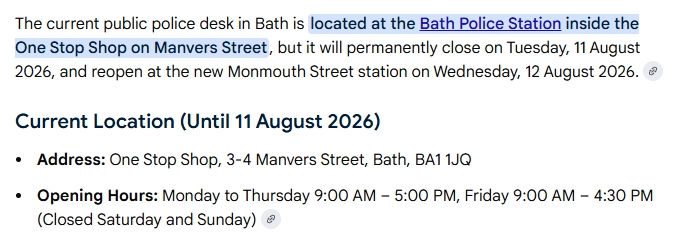


Single-sex toilets, though, so that’s something.
An officer came out to meet us, who turned out to be the one who’d called me in April – a slightly-built, bespectacled young woman of maybe 24-25. We went in and I waited in the grubby hallway outside the Share & Repair office, with a small library of books and jigsaw puzzles to pass the time, while Daniel went through “disclosure”, which is when the police tell your solicitor what you’re going to be questioned about, at which point Daniel appears to have read her the Riot Act, for reasons we’ll get to in a moment.
Then I was called in, we went through all the preliminaries, and the officer brought me some water in a cute Cadbury’s Mini Eggs mug (“We don’t have any glasses, sorry”). She read me the standard caution, which now comes with an interactive questionnaire whereby they read you the caution, explain what the caution means, and ask you three questions to see if you’ve understood it.
OFFICER: “Do you have to say anything in this interview?”
YOU: “Um, no?”
OFFICER: “Correct.”
(I swear I’m not making that up. I was so weirded out by the question I had to actually think for a couple of seconds before answering.)
Then it was time to get down to business. She told me the complaint was that I’d published a number of “false and demeaning” articles about Watson, and that I’d “repeatedly misgendered” him.
At this point Daniel interjected to get on tape the fact that I was attending the interview under protest – having been told that I would definitely be arrested otherwise – that misgendering someone was not an offence and was in fact a legally protected right, that reading articles about yourself that upset you did not make those articles criminal, and that if you felt someone had written something about you that was untrue the correct remedy was a civil claim for defamation, not calling the police.
He said that nothing he’d been shown in disclosure came even remotely close to the threshold of a crime, and that any attempt to charge me would result in a lawsuit. Daniel is quite fierce.
Nevertheless the officer then began her questioning, asking me how I’d come to be aware of Watson. I gave her the highlights of his life story, starting with reading about his sacking for gross misconduct in 2023 (on my birthday, trivia fans) and then learning that by that point, unbeknownst to me and while still a serving police officer, he’d already been trying to get me arrested for six months.

As I then ran through his extensive track record of dodging harassment complaints, filing baseless crime reports, frequently calling for the murder of gender-critical figures, repeated doxxing of JK Rowling, social media bannings, arrests and all the other unpleasantries Watson fills his tragic life with – and I must confess I went on at some length – I could see her facial expression slowly imploding. It seemed very clear to me that she knew absolutely nothing about Lynsay Watson before yesterday.
(She visibly winced when near the end I noted that Watson had made at least 300 police complaints and the only one that had resulted in anyone being taken in for questioning before me was the one he made against Graham Linehan – the outcome of which, just last month, was the Metropolitan Police issuing Graham a grovelling apology accompanied by a cheque for £25,000.)

She asked a few questions to clarify some of the stuff I’d said, and then said she was going to show me some things I’d published online and ask me about them. I’d expected to be quizzed on some of the extensive articles we’ve published about Watson, and had detailed and comprehensive responses ready for anything I thought the police might even remotely be able to consider in some way objectionable. (Though of course all of it was in fact wholly legitimate journalism about significant news events.)
But hold onto your bunnets, readers, because that wasn’t how it went.
She started off by showing me this tweet.

What was its purpose, she enquired. “It’s a joke”, I said, explaining that one of the excuses police had used for their being unable to locate Watson when people made harassment complaints about him and he was evading arrest was that the police thought he was living in a caravan or campervan somewhere.
Oddly, she seemed a lot less concerned with a fugitive repeatedly evading the police on serious allegations than with someone making a joke about it.
(I pointed out that my Twitter bio does contain a “possible humour” warning.)

Then she asked about this one:
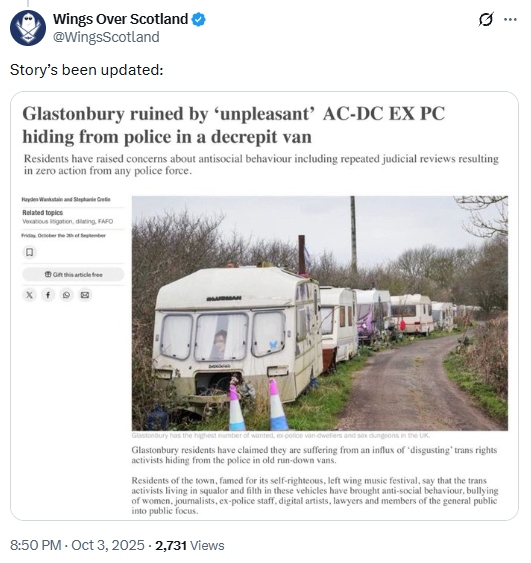
which is fairly plainly the same joke again, but using a satirically-edited version of the image that someone had tweeted or sent me in response to the first one. (The “AC-DC PC” line is taken from an old Daily Record headline about Watson being sacked from another police force in 1997.)

She then showed me this tweet, which I’ve censored very heavily partly out of sensitivity but also because I don’t want to identify the person who posted it and have transactivists send over-excited constables to hammer on their door in the early hours.

It’s an AI-edited version of one of the pics taken on the day of Watson’s arrest in February over harassment allegations from at least two people (one of whom was me), made to look like Watson had turned up at Manchester Civil Justice Centre wearing only a filthy nappy.
It’s pretty horrible, but humour is subjective, it doesn’t break any laws that I know of and more to the point, it wasn’t posted by me, it wasn’t retweeted or quote-tweeted or linked to in any way by me, it wasn’t a reply to any tweet of mine and I have no idea who the person who posted it is.
I duly explained that to the officer, who offered no explanation whatsoever as to why she’d apparently thought the tweet was anything to do with me (presumably the answer was simply that Watson had said so), and… the interview was over.
She told us she had no more questions, and Daniel and I looked at each other with “What?” expressions on our faces. Avon & Somerset Police had apparently just spent 10 months – Watson had complained at the end of September, in revenge for my complaint against him – investigating two innocuous, near-identical jokes about a caravan, and a completely unconnected tweet by someone else entirely.

The only possible explanation for the inclusion of the third tweet that makes ANY sort of sense is as a tool to extend the deadline for a harassment case. Ordinarily those have to reach a charging decision within six months, but that period can be extended if the “course of conduct” continues after the initial complaint.

(“An information” there means “presenting the charge to a magistrate or JP”.)
The caravan tweets were made on 3 October 2025, which means the six-month limit expired on 2 April 2026, days before even the initial mid-April phonecall from the female officer, let along the July one from the male officer. Including the February tweet from someone else altogether would give them – by whatever twisted logic they were using to connect it to me – up to next Friday to charge me.
(I haven’t yet been notified of any official decision.)
Readers may have noticed the somewhat stark contrast in the way that numerous police forces have adopted a “can’t-be-arsed” approach to at least six legitimate complaints from different people against Lynsay Watson, and yet – and despite his astonishing track record of literally hundreds of obviously malicious and baseless complaints BY him – still leap to act as his personal goon squad to terrorise innocent people for entirely lawful beliefs and comments.
Is it misplaced all-cops-together solidarity/empathy for a former colleague? Is it merely staggering incompetence and jaw-dropping ignorance of the law? Is it professional indoctrination? (It may be pertinent that Avon & Somerset has a particularly woke imbecile for a Chief Constable whose main driving focuses appear to be diversity and inclusion rather than, y’know, fighting crime.)

We don’t know. What we CAN be sure of is that Lynsay Watson will continue to spend every waking moment of his life spewing out hopeless malign complaints in the hope that once in every few hundred attempts he’ll get lucky and find a gullible cop who’ll bang on someone’s door in the middle of the night and terrify the bejesus out of them.
It is absurdly overdue that someone in a position of authority sits down and examines the simply astounding amount of taxpayers’ money and police time he’s wasted on his vicious, demented vendetta against everyone who knows what biology is, and his long string of incitements to murder, and either labels him a vexatious litigant, puts him in the dock, or preferably both.
In a country where Lucy Connolly, a mother who’d never been in trouble with the police in her life, was sentenced to two and a half years in prison for a single intemperate tweet that was visible for less than four hours, Lynsay Watson is allowed to explicitly incite murder and violence for political reasons over and over again, and to lodge endless harassment complaints against people he himself has been arrested for harassing, while he’s still on bail for harassing other people, after he was sacked by the police for harassment.


And if his victims (or as he calls them, “key propagandists” and “Nazis”) talk about it, the police will go out to arrest them.
As Daniel and I left the police station, we struggled to find words for the absurdity of what had just happened (and as an experienced solicitor, Daniel’s been party to some pretty damn absurd cases). When I tell lawyers and cops and legal types about it and show them what got my door battered on at 2.15am, most of them struggle to manage more than “WTF? FFS!”
Even as we speak, though, you can be certain that Watson is simply doubling, tripling and quadrupling down, making more spurious complaints, filing more doomed judicial review applications, and whipping up more hatred and death threats. Like a rampaging bull in a china shop, his blind, hateful, furious thrashing and bellowing results in a trail of civic destruction, loss of faith in the forces of law and order, public expense and damaged lives, and he proudly boasts that he’ll “never, ever stop”.

Despite the events of this week, Wings will continue to report on his activities until hopefully, one day, the relevant authorities finally tire of his ruinous, uncontrollable rage and do something to give innocent people some peace.



Disabled campaigners have written to Andy Burnham to demand he immediately establishes a new autistic-led Autism Strategy ahead of the Autumn Budget.
Deliver for Autism, a newly formed advocacy group, has published an open letter calling on the prime minister to not let autistic people down.
The letter was created by autistic campaigner Chelsea Webster, and backed by well-known disabled campaigners and allies, such as Elle McNicoll, Lou Chandler and Sally Phillips.
Autistic people left in limbo
Webster says in the letter:
I am asking you to support autistic people by committing to a working group made up of diverse people, who can develop a new Autism Strategy, in line with the Autism Act 2009 and recommendations in the 2025 Time to deliver report.
The current Autism Strategy ran out in July, and there has been no timeline or publicly available plan around creating a new one or the failures of the 2021-2026 strategy.
As the letter says, this means autistic people are left in limbo, being continuously failed by the government.
As the House of Lords Autism Act Committee said:
The Committee recommends that the government must develop the new autism strategy now, so it is ready to launch when the current one expires in July 2026. The government must identify priority outcomes, produce a costed, deliverable plan to achieve them, and make clear who is responsible and accountable for delivery.
Too often, decisions about autistic people’s lives are made for them, not by them. This must change. Autistic people and those who support them must be meaningfully involved in every stage of the development and delivery of the new strategy.
This was, of course, completely ignored and no new strategy was created, meaning the last one just ran out.
Time to Deliver raised the alarm on shortcomings
The Time to Deliver report assessed the extent to which the Autism Act 2009 and Autism Strategy had met the needs of autistic people in England. It concluded that successive national strategies have consistently “failed to tackle the key barriers that stand in the way of improving outcomes” for autistic people.
On this, Chelsea Webster told the Canary:
The 2021-2026 Autism Strategy failed to deliver the support autistic people need. Without a new Autism Strategy to address the deficits in care and support, thousands of autistic people are left facing inequalities in life expectancy, health care, education, employment and other areas of life.
It’s unacceptable. The government needs to act immediately and provide support that removes these inequalities.
Drawing on findings in Time to deliver, the open letter highlights particular crises for autistic people:
Autistic people face unacceptable inequalities in health outcomes and life expectancy.
The autism assessment system can become a bottleneck, giving overstretched services a means to ration access to support.
Autistic children and young people do not have equal access to education.
Most autistic people are not in work, but many would like to be.
Autistic people are at higher risk of falling through the cracks in systems of support.
Autistic people often fall into gaps between mental health, social care services and other systems of support.
Autistic people are at risk of becoming involved in the criminal justice system, as victims, witnesses, or offenders.
The government’s response lacked any substance or accountability. Despite a record number of responses for a House of Lords inquiry, the government gave a “flimsy” response, Canary writer Charli Clement wrote.
In direct contrast to the careful recommendations of the committee, the government’s response lacks any real substance at all. It commits to almost nothing, apart from the existing 10 Year Health Plan for England, which does not mention autistic people once in its entirety, and to the existing commitments of work.
Clement continued:
The response is flimsy, and says it welcomes the recommendations without any real intention to act upon them. There is seemingly no commitment to any timelines for a new national strategy. It would be a breach of statutory process if there is no follow-up action.
Burnham must act now
The letter also points to Burnham’s history of autism advocacy. As health secretary, he played an integral role in bringing the Autism Act 2009 into law. He also supported two Greater Manchester Autism Strategies whilst mayor.
Burnham also successfully piloted WorkWell, which received positive feedback in Manchester, but has recently said he would cut benefits.
Webster added:
We’re asking, as Prime Minister, for Burnham to finish what he started and deliver support that genuinely does improve our lives, starting with an autistic-led working group developing a new Autism Strategy, before the Autumn Budget. Anything less puts lives and wellbeing at risk.
You can sign the open letter here.
Featured image via Sóc Năng Động/ Pexels
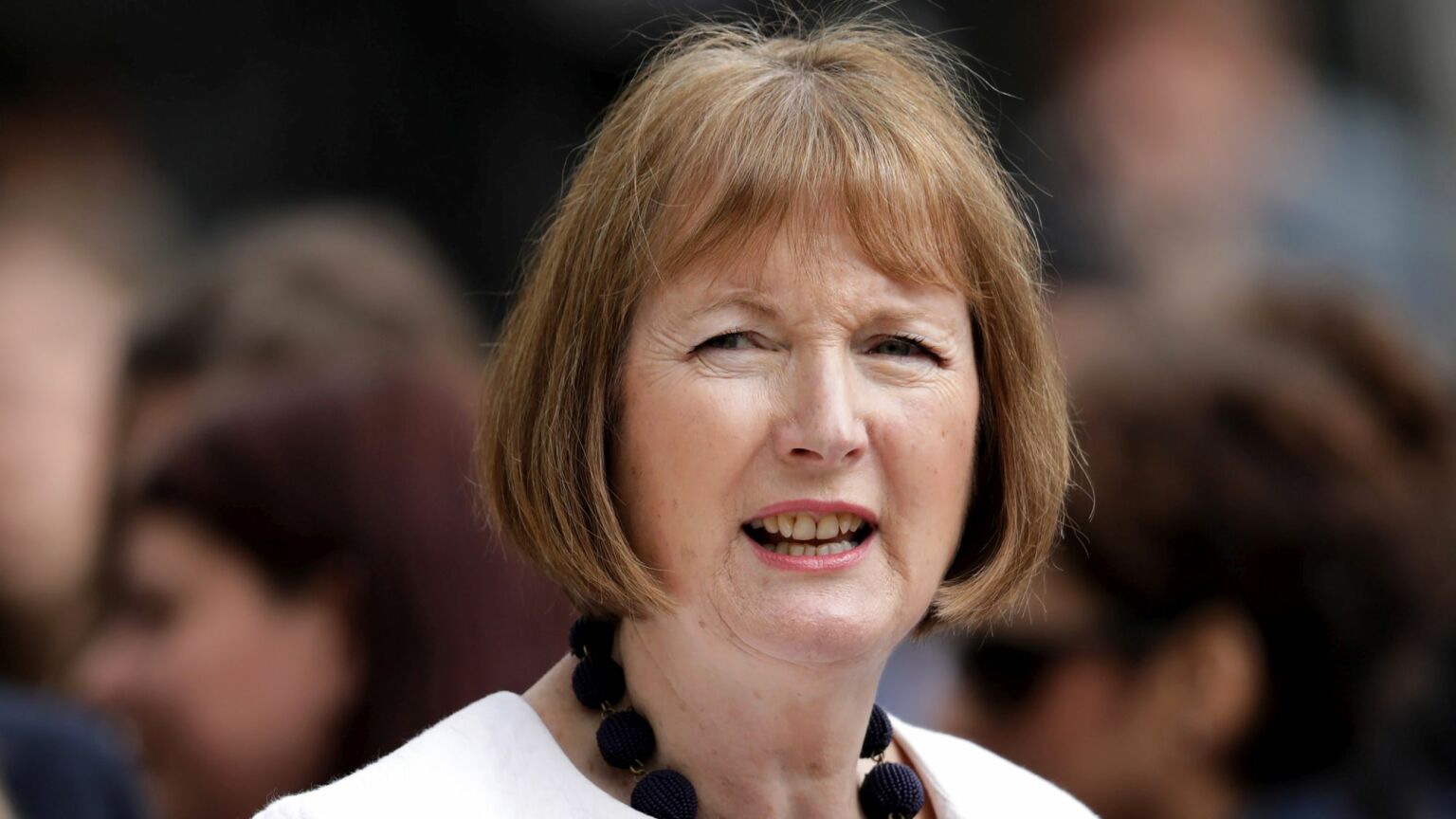
Labour peer Harriet Harman has called for men not to stand in the next Labour leadership race, whenever that will be.
Talking to Sky News’s Electoral Dysfunction podcast, Baroness Harman said she would ‘encourage and support’ fresh male talent in the party, but would ask them: ‘Are you going to put yourself in front and put a woman behind you?’
Poor Andy Burnham. The new UK prime minister hasn’t even had a chance to warm up the seat of power and the Labour grand dames are already talking about replacing him.
Harman explained that she wants to ‘start the discussion about male ambition and male allyship’. She is hardly a lone voice in this regard. It seems there is a sisterhood within the Labour Party who are sick of men in leadership positions.
Most of these have complained about a ‘boys’ club’ at the top of the party, especially in the wake of the Peter Mandelson scandal. Indeed, Polly Billington, MP for East Thanet, has used the phrase ‘boys’ club’ so many times in interviews, even she must be bored of it. Earlier this year, it was culture secretary Lisa Nandy’s turn to moan that Labour had been operating as a ‘boys’ club’. She went on to complain that some of the No10 briefings against her female colleagues ‘have absolutely been dripping with misogyny’.
It’s all a bit rich. Many of the same women pointing fingers at Labour’s ‘boys’ club’ and calling for a woman-only shortlist for the next Labour leader, have often appeared not to know what a woman is. Remember when Harriet Harman said ‘women are women who are born women, but women are also women who are transwomen’? Which is as clear as mud. Or remember Billington, who took to social media to apologise for the Supreme Court ruling on the biological meaning of sex. She said it would cause ‘worry’ among ‘trans people’. It’s all very confusing. They insist that the next Labour leader must be a woman, while casting doubt on the meaning of womanhood itself.
Yet even if those Labourites demanding a woman leader did know what a woman is, a woman-only shortlist would still be a terrible idea. What matters most about a politician, leader or otherwise, is not her sex, but her own qualities and political views. Tory leader Kemi Badenoch has done well at the dispatch box recently, because she is confident and principled, not because she wears a dress. Margaret Thatcher may have been the first woman prime minister, but she is remembered for her achievements, not for being female – and she was certainly no feminist.
And who would be Harman’s pick for Labour’s first woman leader? Angela Rayner? Jess Phillips? Rachel Reeves? They’re hardly the most impressive of candidates. Rayner has only just returned to the cabinet after a scandal over under-paying stamp duty on a flat purchase; Phillips has made an almighty mess of the grooming-gangs inquiry; and we all saw what Reeves can do in power during her ill-fated stint as chancellor – that is, nothing positive.
Maybe this is all a ruse on Harman’s part. Perhaps the New Labour old-timer fancies another pop at the leadership, having twice performed the role in an ‘acting’ capacity – first after Gordon Brown stepped down in 2010, and then again after Ed Miliband walked away in 2015. For women’s own sake, let’s hope not. This is the same politician who thought riding a pink bus around the country was enough to woo female voters ahead of the 2015 election, and who praised Kim Kardashian for her ‘pioneering spirit’.
The likes of Harman can strike pseudo-feminist poses all they like. Labour has done very little to benefit women and a hell of a lot more to annoy us through its dogged denial of the reality of biological sex.
Right now, Labour might well be better off putting a red rosette on a donkey, male or female, and making it leader instead.
Ella Whelan is the author of The Case For Women’s Freedom, a part of the Academy of Ideas’ radical pamphleteering series, Letters on Liberty.


Prime Minister Andy Burnham speaks with John Craig, Interim Chief Coastguard, and Duncan Capps, Border Security Commander, near a recovered small boat, August 2, 2026 (PA Images / Alamy)
4 min read
Andy Burnham arrived in Downing Street with a promise to do politics differently.
With little said so far on immigration, and Shabana Mahmood returning as Home Secretary, it would be easy to assume that there will be continuity in this policy area. But there are welcome clues that he may try to walk a different line.
Here are three ways a Burnham government could do things differently on immigration.
1. Put care of people first
Our new Prime Minister is often described as an instinctive politician, visibly empathising with people’s concerns and experiences. His willingness to listen to voters’ anxieties over the current immigration system, without engaging in an arms race on rhetoric or dehumanising those at the centre of the debate, has been a breath of fresh air to many.
While Burnham agrees that the current system of permanent settlement in the UK needs root and branch reform, he has also shown concern about forcing people to wait many years without the ability to settle. This may mean the Starmer government’s contentious reforms to settlement are liable to change. These proposals not only extend the wait for a route to permanent residency for most migrants; they could lead to hundreds of thousands becoming ineligible entirely, risking unsettlement and indefinite insecurity.
The Home Office is reportedly preparing to amend its proposals. A Burnham government should ensure this happens, scrapping plans to make status temporary for as long as 15 or even 20 years for care workers and recognised refugees, and choosing not to change the rules retrospectively for those people who are already here.
2. Hand power back to communities
By now, those listening closely will know Burnham’s central diagnosis: in the 1980s, Britain took some wrong turns, with political power centralised and economic power privatised.
Asylum dispersal is a good example of this. Since Labour was last in power, asylum accommodation and support has been centralised and outsourced, creating a system that houses asylum seekers in the greatest numbers in some of the UK’s poorest postcodes, while making billionaires out of the owners of the private companies.
Burnham has previously said he wants to rip up these contracts and hand power back to local government. He could also clear hotels far earlier than the planned 2029 deadline by switching the money spent on hotels into a capital fund that allows councils to invest in social housing for all – another priority for the Prime Minister.
Another way he can hand communities greater control is through the government’s new ‘named community sponsorship’ scheme. Announced with little fanfare last month, the scheme allows community groups to identify refugees they wish to sponsor to be resettled in the UK, if they meet basic criteria. Similar to ‘Homes for Ukraine’, this is a real opportunity to put communities in the driving seat if it is prioritised.
3. Get Britain believing in itself again
Burnham has promised to “bring back hope” and get Britain believing in itself again. Creating a progressive immigration system that works and commands public support will be integral to this.
The Prime Minister should start by addressing irregular Channel crossings. If the government acts fast, there could be scope to bring other European countries into an expanded version of the UK-France deal, allowing Britain to return far more people arriving by small boat in exchange for offering a safe passage to those in need of asylum from Europe. Expanding the deal could allow Burnham make real progress on a key voter concern while delivering an asylum system that is both principled and orderly.
Of course, other aspects of the system urgently need reform too. It is visibly and badly broken; delivering poorly for local communities, refugees and migrants alike. But there is scope through reforms like these to begin to rebuild it, and in doing so, project a vision of a confident, multiracial Britain that can believe in its future again.
Beth Gardiner-Smith is senior policy associate at the Future Governance Forum
Politics
The House | When the public is offered a window into Parliament, it can see how it works for them
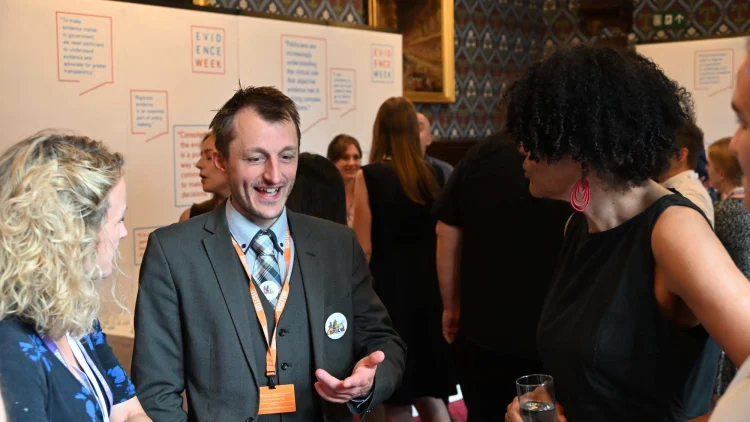

Chi Onwurah following a reverse select committee Credit: Sense About Science
4 min read
“They don’t speak for us.”
Again and again we hear the public complain that MPs are out of touch, that they don’t represent the public interest, that Parliament is just a game for careerists. It’s not only the public making these claims, of course: we hear colleagues making similar statements to crowd-pleasing effect. The fact that such claims please the crowd should give us all cause to pause.
However, while those claims might be true of individuals, they’re certainly not my experience of Parliament. As Chair of the Defence Select Committee, I can see for myself how much time and attention not only goes into formulating policy in all areas, but also into scrutinising it. Nobody does this work on a whim, as the naysayers might have us believe, or because it lines their pockets: they’re putting the hours in to make our country a better, stronger, safer place to live and work.
Nonetheless, while we Parliamentarians enjoy the benefit of seeing all the work that goes on behind the scenes – the weeks and months of effort before the headlines land – that same privilege is rarely afforded to the public.
To be sure, the government rightly insists on transparency. “There should be no power without accountability, and true accountability requires transparency,” wrote former Prime Minister Keir Starmer back in 2020. And indeed the public rightly has access to a raft of statistics and data on what’s being done, where and how decisions have been reached.
But transparency isn’t the same thing as visibility. It’s one thing to have access to information about Parliament, it’s another to experience it.
That’s why I agreed to participate in this year’s Evidence Week in Parliament, a week-long series of activities organised by the charity Sense about Science to champion the public interest in sound evidence use, and in the process help demystify the workings of our democracy.
Evidence Week opened with a unique ‘Reverse Select Committee’ hearing: 20 members of the public, selected to represent as wide as possible a range of interests and backgrounds, assembled in a Committee Room to each put a question to a panel of Select Committee Chairs and Members, alongside other expert advisers.
Chaired by Sense about Science’s Chief Executive Tracey Brown, it followed the form of an authentic select committee hearing and challenged us panellists to explain our work.
“How does Parliament stay informed of the realities of defence technologies, when they are rapidly developing?”
“Given the rising number of 16-24 year olds not in education or employment, how does Parliament make sure that government is implementing AI technology in a way that addresses this issue, rather than exacerbates it?”
“How can Parliament keep track of the social value created by sports groups?”
These questions – just a handful of those asked and answered – are intelligent, incisive and deserve attention. But in what other forum would members of the public normally get to ask them?
Having the opportunity not only to address their queries, but also to explain how we were able to address them – to describe the workings of a select committee, to outline the Parliamentary process to people who would otherwise never have an opportunity to see inside the Palace of Westminster, let alone observe a committee meeting – was both humbling and empowering.
My fellow panellist Lord Clement-Jones noted that the experience was “both of interest and reassuring to those who came – that’s democratic engagement for you.”
And isn’t that the antidote to “they don’t speak for us”? A window into Parliament. Direct, democratic, public engagement. The participants, I hope, left with a deeper understanding of how policy is formed and scrutinised, and a greater awareness of the accountability that the select committee process enforces. Most of all, they saw that the great Westminster machine is intended to work for them. And you can bet they’ll tell their friends.
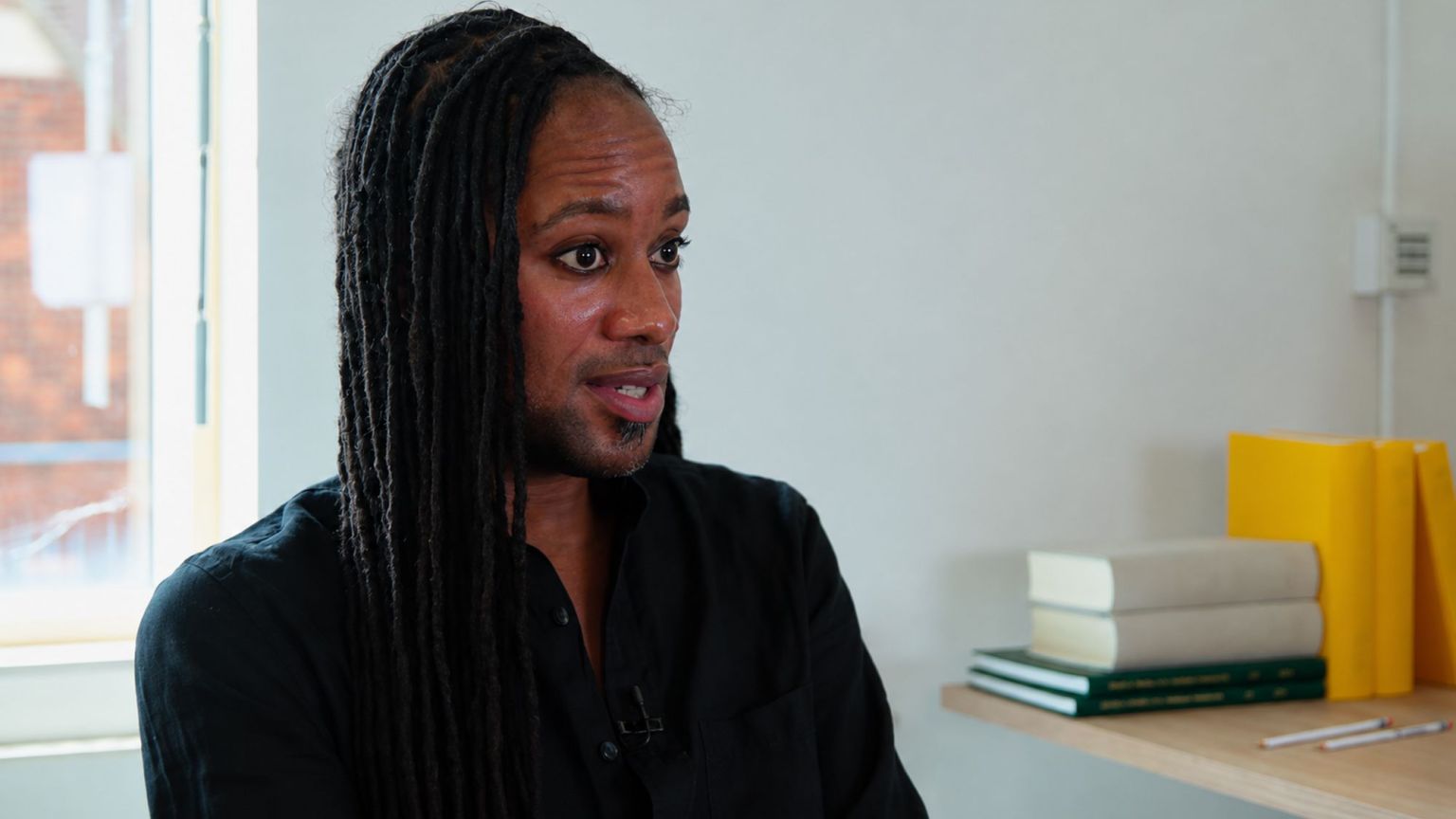
Jason Arday, the Cambridge professor accused of plagiarism and of exaggerating his backstory, has achieved in a very short period of time something of a Falstaffian ideal. If not himself visibly witty, since he seems to have intended his lavish claims to be taken seriously, he has certainly been the cause of wit in others.
Arday has been likened to Don Quixote, Walter Mitty and Finchy from The Office. His seemingly more fanciful claims include starring in ITV’s Seven Up! documentary series, raising £5million for charity, and having bullets and mutilated animals sent to his family home.
More remarkable still, like the hero of one of his own apparently tall tales, the Cambridge don has kept going, scaling an even higher cumulonimbus of credulity with every new claim.
To give just one well-known example, Arday has boasted of having run 30 marathons in as many days (give or take) and covered 600 miles in six days – a feat that would, if true, put him in the absolute elite of endurance athletes. Some have seen fit to ruthlessly mock the claim as Baron von Munchausen-tier confabulation.
But Arday outpaced all scepticism when it emerged that merely completing these tasks in these times was the least of it. He had, it seems, run the last nine of these marathons after sustaining a hairline fracture in his leg – demonstrating character far beyond mere fitness and determination.
To run over 200 miles with a hairline fracture would require the kind of indifference to personal comfort that is normally only found in Victoria Cross citations: John Cruickshank, for example, who, as a badly wounded pilot in the Second World War, refused morphine so that he could continue to at least supervise his plane’s landing.
Reading tales like these, my traditional reaction has been to wonder at such heroism emerging under such awful conditions, and muse that such people simply no longer exist. Does the Arday case force me to reconsider this? His marathon feats may well be true, but my very, very strong suspicion – as strong as I can state it without attracting the attention of notorious law firm Farter-Fuck – is that, if anything, the Arday case only further deepens my despair, to have been born at a time when the human race is so degraded.
The resort to gleeful mockery of Arday’s seemingly more improbable claims is, I think, the healthiest reaction, and one that has a proud history. It has been encouraging to see that Britain, in particular, especially after the meekness with which we accepted Covid restrictions, can still at least mount a decent response when confronted with such apparently lurid displays of self-aggrandisement.
But laughing alone is not good enough. After the laughter dies away and the thing gets stale, we have to stay focussed on the rot that’s developed in our most treasured institutions.
Oxford and Cambridge are, for now, still regarded as among the very best universities in the world. Their global ranking is almost invariably in the top five, and often top three. They cannot allow their reputation to be undermined by seemingly appointing people on the basis of DEI priorities rather than merit. In this case, the Cambridge education faculty may well have failed in its duty to enforce the highest standards in awarding professorial chairs to an alleged plagiarist and fantasist.
The idea of a university has been discussed by many great men and women over the years. Cardinal Newman wrote a famous book of that title – which, in the spirit of this article, I will now plainly state I have not read. But Newman’s idea has been interrogated and distilled by many others before and since. And on the very short list of non-negotiables to which the university must aspire, truth sits at the very top.
The quest for truth is not merely an affectation of academics, an abstract ideal for be-gowned dreamers. The excellence of Harvard, Princeton et al is arguably the rock on which America’s entire project – and certainly its dominance since the world wars – has been built. Britain’s continued ability to maintain a genuine rivalry to US universities’ otherwise unchallenged eminence is a small, soft-power miracle. Oxbridge is one of the very few British institutions that has – unlike the BBC, Church of England and police force – not yet become an international laughing stock nor lost the dressing room at home. Not least because it is quite naturally regarded by most of us to be above our pay grade to judge.
But not anymore. Anyone scrolling through their newsfeed can now see that yet another long march through our institutions has reached the vital organs. They have something seemingly close to academic sepsis, and serious measures may be required if they are to survive with their reputations intact.
I am reminded of two examples of showing the threat to the university’s core tenets. One involves a famous little book by philosopher Harry Frankfurt, entitled On Bullshit. There he explored the idea that more harmful than liars to the intellectual health of a nation, or its subdivisions, are ‘those who are almost entirely unconcerned with the truth’. Liars are at least actively aware that the truth exists and are trying to conceal its whereabouts. Bullshitters just don’t care.
Everyone loved that little book and knew exactly the sort of thing Frankfurt was talking about. Yet like intellectual knotweed, this indifference to the truth has proved not only resilient but anti-fragile. It has a few dauntless foes, but from every bloody stump of neck, two or three new heads seem to spring every day.
The second is a quote from 2022 attributed to Katherine Maher, the CEO of NPR and former head of the Wikimedia Foundation: ‘Our reverence for the truth might be a distraction that’s getting in the way of finding common ground and getting things done.’ I say attributed to – I saw her say it and you can, too. It’s from her TED Talk and she seems to be in no hurry to distance herself from it. She might, of course, argue that the context was important, and she was not talking about the criteria by which we appoint professors to one of the great seats of learning in the history of the world. And maybe she’s right. But honestly, why should I care?
Stay focussed. Demand action in our universities. If not heads, then mortarboards at least must surely roll. And if that suggests an impossibility, given their geometrical properties – well, then I think we know just the man for the job.
Simon Evans is a spiked columnist and stand-up comedian. Tickets for his tour, Staring at the Sun, are on sale here.
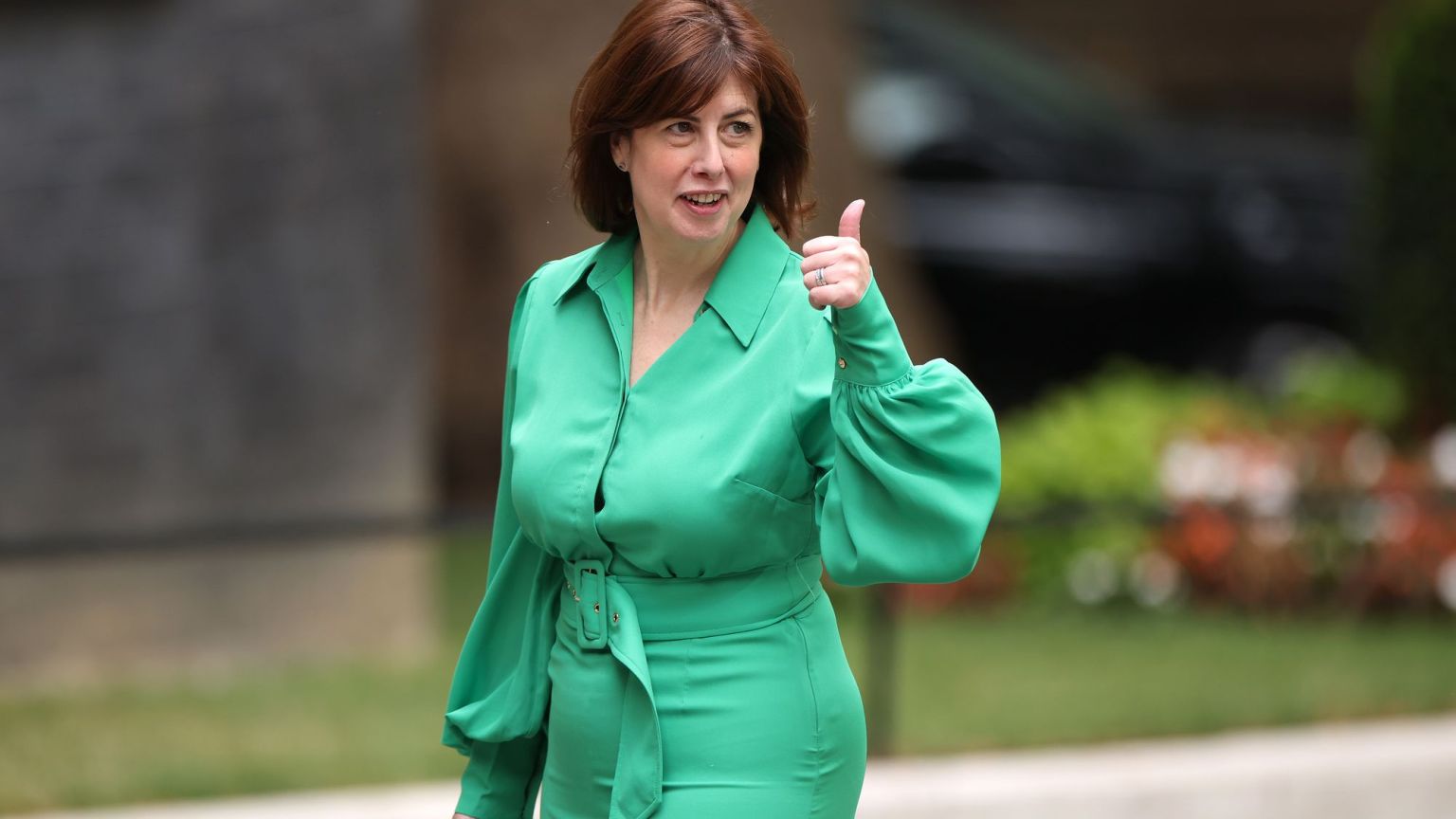
Lucy Powell is taking a wrecking ball to England’s schools. Labour’s newly appointed education secretary is determined to erode academic standards and diminish the status of traditional subjects, in order to turn schools into employability factories where children are made workplace-ready. She must be stopped.
Writing in The Times on Monday, Powell takes aim at one of her Conservative predecessors, Michael Gove. Pushing children into learning maths, English, history and science has turned education into a ‘straitjacket’, she moans. Rather than what she derides as a ‘one-size-fits-all’ approach, Powell wants teachers to lower their expectations, free up more room for ‘creativity’ on the curriculum, and allow pupils as young as 14 to focus on vocational skills training. Given that so many of her assumptions about the current state of schooling are plain wrong (14-year-olds can already study for technical qualifications and GCSE passes require shockingly little knowledge), it is hard not to conclude that Powell is determined to ensure every child leaves school as dumb as she is.
Signs of the Philistinism about to be unleashed were there last week when Andy Burnham set out his ambition for a society that values ‘the hard hat as much as the graduation cap’. It’s a worthy aspiration: too many in the graduate class treat manual workers and skilled craftsmen with contempt. But Burnham seems unable to conceive of education as being about anything other than preparation for the world of work. His plan is for teachers to act as intermediaries in negotiating local jobs for local people, beginning with work experience for teenagers. This means sorting children into academic and vocational streams aged just 14, with subject knowledge the preserve of some and the rest consigned to – let’s be honest – low-level, basic skills. This is hardly likely to be a great leap towards levelling up.
Lucy Powell shares the same conviction that the shamefully high proportion of young people not in education, employment or training (NEET) is all down to failings in our education system. Putting the number of NEETs at one million, she finds it far easier to point the finger of blame at a former Tory education secretary than to unpick a decades-long, cross-party consensus on deindustrialisation, mass migration and overly generous and easily obtained sickness benefits. Burnham and Powell prefer tearing up the national curriculum to admitting that increasing both the minimum wage and employers’ national-insurance contributions has cut the number of jobs for young people. They would rather gear school around work experience than question the debilitating impact of the countless mental-health initiatives children routinely experience.
Powell’s Times column exposes her inability to conceive of education as being important in its own right. ‘Education should be a passport’, she writes, ‘A passport into work, into life, on to the next stage.’ In other words, there is no point in knowing stuff just for the sake of it. There is no literature so inspiring, no art so beautiful, no science so fascinating that knowledge alone is worth revelling in. Rather than introducing children to the best that has been thought and said, Powell wants schools to prepare children for ‘the modern economy, or societal demands’.
Powell may think she’s socking it to the Conservatives and coming up with a radically new agenda, but her aim of gearing schooling around ‘societal demands’ harks back to the origins of the so-called progressive education movement. Since the 1920s, educationalists such as John Dewey have been associated with the idea that teaching should be guided by children’s own curiosity. But this was always disingenuous. Behind the child-centred rhetoric lay Dewey’s view that the role of teachers was to ‘shape the experiences of the young so that instead of reproducing current habits, better habits shall be formed, and thus the future adult society be an improvement on their own’. In other words, the role of the teacher is not to pass on to children their intellectual birthright, but to mould them into politically desirable and economically useful future citizens.
This approach to education has been tried and tested for a century. The idea that schools should sort children into future ‘brains’ and ‘hands’ workers, and give them academic or vocational qualifications as appropriate, has meant that working-class children in particular have been patronised with low expectations and denied access to knowledge, whether through secondary modern schools in the 1960s or GNVQs in the 1990s (General National Vocational Qualifications, or, as they came to be known, Generally Not Very Qualified). This reinforced social inequality at every turn. By contrast, Michael Gove’s determination that every child should have the opportunity to engage with a knowledge-rich and intellectually demanding curriculum meant social class no longer needed to limit educational success.
Powell’s derision for the ‘straitjacket’ of academic study and her sneering at the backwardness of ‘pen and paper exams’ reveal her contempt for education itself. Rather than striving for a nation where all children know about the richness and beauty of the world they have been born into, she wants local employers to dictate the curriculum, and a generation of school-leavers who can hit play on a PowerPoint presentation but know nothing about their country’s past.
Joanna Williams is a spiked columnist and author of How Woke Won. Follow her on Substack: cieo.substack.com

‘We are cool’ – Szoboszlai plays down Liverpool row

Math Terrified Me When I Was a Student. That Made Me a Better Tea

Memahami Konsep Trilema Moneter dan Macro Financial Doom Loop dalam Ekonomi Indonesia

Renter of Home in Anne Heche Crash Denies Settlement With Son

No Jackpot Winner as $257 Million Prize Rolls Over to $269 Million Monday Draw

Weekend Open Thread: Staud – Corporette.com
Memahami Konsep Trilema Moneter dan Macro Financial Doom Loop dalam Ekonomi Indonesia

MONEY MONEY (Full Video): Yo Yo Honey Singh, Ajay Devgn, Jacqueline F, Riteish D | Bhushan K |RAID 2

Why I’m holding Bittensor crypto! #crypto #tao #altcoins
-

 Business6 days ago
Why Trees Belong on the Risk Register
-

 Fashion4 days ago
Weekend Open Thread: Wit & Wisdom
-

 Politics4 days ago
Meta enters AI-training agreement with far-right ‘propaganda rag’ Newsmax
-
 Entertainment7 days ago
‘Stargate’ Creator’s New Sci-Fi Series Returns for Season 3 Tomorrow
-

 Crypto World3 days ago
MicroStrategy Post-Earnings CLARITY Act Push Could Add New Catalyst for Its Stock
-

 Politics6 days ago
Reform UK betrays West Mids residents by running from party pledges
-

 Business6 days ago
Major shareholder moves on Canyon
-

 Crypto World3 days ago
XRP Ledger v3.3.0 brings five institutional features
-

 News Videos5 days ago
Bitcoin Enters the 3rd Stage of the Bear Market
-

 Crypto World7 days ago
Kraken Enables Retail Access to Jersey Mike’s IPO via Tokenized Shares
-

 Politics5 days ago
Luke Littler’s dominance sparks GOAT debate
-

 Sports5 days ago
Seema Kaliramna Wins Discus Throw Bronze, Takes India’s CWG Medals Tally To 17
-

 News Videos7 days ago
Claude: Build Financial Dashboards in Minutes (2026)
-

 Crypto World4 days ago
New York sues Kalshi over prediction market gambling
-

 Crypto World2 days ago
Crypto PAC spending tops $2M in Michigan House race
-

 Politics2 days ago
Zack Polanski: an incitement to murder Nigel Farage?
-

 Business7 days ago
Johnson & Johnson agrees to $5.5B settlement over talc cancer claims
-

 Business4 days ago
Trump Announces Hamas Disarmament Agreement as Iran Strikes Kuwait Air Base and US Attacks Pause Overnight
-

 Tech6 days ago
Gemini can now summarize the messiest comment threads in Google Docs
-

 Tech2 days ago
ESET tracks rise in malicious AI skills and adaptable malware
You must be logged in to post a comment Login