
Crypto World
What is PayFi and how stablecoins are replacing wire transfers



Most people still think crypto payments means buying coffee with bitcoin. The real shift is quieter and far larger: stablecoins now settle more value annually than many traditional payment networks, and a new category called PayFi is building programmable payment infrastructure on top of that volume. This guide explains what PayFi is, how the plumbing works, and why it matters that a dollar sent on Solana arrives in seconds for a fraction of a cent while the same dollar sent through SWIFT takes days and costs $25 to $50.
Summary
- PayFi, short for payment finance, is the application of decentralized finance protocols to real-world payments, combining stablecoin settlement with programmable logic like streaming payments, conditional escrow, and yield-funded spending.
- Stablecoins processed over $27 trillion in on-chain transfer volume in 2024, exceeding the combined volume of Visa and Mastercard, though the comparison requires qualification because stablecoin volume includes DeFi activity and treasury management alongside consumer payments.
- The core PayFi thesis rests on eliminating correspondent banking, the chain of intermediary banks that makes cross-border wire transfers slow and expensive, by replacing it with direct stablecoin settlement on public blockchains.
- Protocols like Huma Finance, Superfluid, and Sablier represent different approaches to PayFi: Huma finances real-world payment flows using on-chain capital, Superfluid enables continuous per-second payment streaming, and Sablier provides token vesting and payroll distribution.
- Regulatory frameworks are catching up. The EU’s MiCA regulation and proposed US stablecoin legislation would create licensing requirements for stablecoin issuers, which could either legitimize PayFi by providing regulatory clarity or constrain it by imposing compliance costs.
When Lily Liu, chair of the Solana Foundation, introduced the term PayFi at Token2049 in September 2024, she framed it around a specific concept: the time value of money. The idea is that if your stablecoins are earning yield in a DeFi protocol, you can spend the yield today without touching the principal. Buy a coffee with the interest your USDC earned overnight. Pay a subscription with the yield from your savings. The principal never moves, only the earnings do.
That framing captured attention, but PayFi has grown beyond the time-value-of-money concept. It now encompasses any payment infrastructure built on stablecoins and smart contracts, from cross-border payroll to trade finance to merchant point-of-sale settlement. The common thread is replacing slow, expensive, intermediary-heavy payment rails with programmable stablecoin flows.
Why wire transfers cost what they cost
To understand what PayFi replaces, it helps to understand what it replaces.
A domestic wire transfer in the United States costs between $25 and $30 and settles same-day through the Fedwire system. An international wire transfer costs between $30 and $50, takes one to five business days, and passes through a chain of correspondent banks that each take a fee.
The cost comes from the correspondent banking system. When you send dollars from a US bank to a recipient’s bank in the Philippines, your bank rarely has a direct relationship with the Philippine bank. Instead, the payment passes through one or more intermediary banks that maintain accounts with both institutions. Each intermediary charges a fee, performs compliance checks, and introduces processing time.
SWIFT, the messaging network that coordinates international transfers, does not actually move money. It sends instructions between banks. The actual settlement happens through correspondent accounts, which is why a SWIFT transfer can take days even though the message itself arrives in seconds.
The global remittance market, where migrant workers send money home, illustrates the cost most clearly. The World Bank reports that the global average cost of sending $200 is approximately 6.2 percent, or $12.40 in fees. For some corridors, particularly sub-Saharan African routes, the cost exceeds 8 percent. These fees fall disproportionately on people who can least afford them.
How stablecoin settlement works
A stablecoin transfer eliminates most of the intermediary chain. Sending USDC from one wallet to another on Solana costs less than one cent in transaction fees and settles in under two seconds, with price execution unaffected by slippage because stablecoins trade at a fixed peg. The sender does not need a bank account. The recipient does not need a bank account. No correspondent bank takes a cut.
The settlement is final in the blockchain sense: once the transaction is confirmed, the USDC is in the recipient’s wallet and cannot be reversed. This is different from a wire transfer, where settlement finality depends on the clearing system and can technically be reversed in certain dispute scenarios.
The infrastructure that makes this possible has three layers:
The stablecoin itself. USDC (issued by Circle) and USDT (issued by Tether) are the dominant payment stablecoins. Both maintain reserves denominated in US dollars and dollar-equivalent assets. Circle publishes monthly attestations of its reserves through an independent accounting firm. Tether publishes quarterly reserve reports. The trustworthiness of the stablecoin depends entirely on the issuer’s reserves and governance, not on the blockchain it runs on.
The blockchain network. Stablecoins exist on multiple chains. USDC runs on Ethereum, Solana, Base, Avalanche, Arbitrum, and several others. The choice of network affects transaction speed, cost, and the ecosystem of applications available. Solana and Base offer the lowest fees for payment-scale transactions, while Ethereum offers the deepest DeFi liquidity.
The on-ramp and off-ramp. Converting between fiat currency and stablecoins still requires a regulated financial intermediary: an exchange, a licensed money transmitter, or a banking partner. This is the bottleneck. The on-chain transfer is fast and cheap, but getting dollars into and out of the stablecoin system involves KYC checks, bank transfers, and processing delays that reintroduce some of the friction PayFi aims to remove.
What PayFi protocols actually build
PayFi is not a single protocol. It is a category of applications that use stablecoins and smart contracts to create payment infrastructure that would be difficult or impossible to build on traditional rails.
Trade finance and receivables. Huma Finance is the most prominent PayFi protocol by total value locked. Huma allows businesses to finance real-world payment flows using on-chain capital. A payment company that processes cross-border transactions can use Huma to access working capital backed by its receivables, receiving stablecoins today against payments it will collect in 30 or 60 days. The on-chain capital providers earn yield from the interest charged on these advances. This is traditional factoring, but the capital comes from a DeFi pool instead of a bank, and the settlement happens in stablecoins instead of through correspondent banking.
Streaming payments. Superfluid enables continuous, per-second payment flows. Instead of paying an employee $5,000 at the end of the month, an employer can stream $0.0019 per second continuously. The employee’s balance increases in real time and can be withdrawn at any moment. This model has applications beyond payroll: subscription payments, rental agreements, and service fees can all be structured as continuous flows instead of discrete monthly charges.
Token vesting and distribution. Sablier provides lockup and vesting schedules for token distributions. While not a payment protocol in the traditional sense, Sablier’s linear and dynamic vesting curves solve a real treasury management problem for crypto projects that need to distribute tokens to employees, investors, and community members over time.
Merchant acceptance. Several payment processors now allow merchants to accept stablecoin payments and receive settlement in their local fiat currency. The merchant never touches crypto. The customer pays in USDC or USDT, the processor converts to fiat, and the merchant receives dollars, euros, or pesos in their bank account. The conversion happens at the processor level, and the merchant’s accounting treats it as a normal card-like transaction.
Cross-border payroll. Companies with distributed international teams face a persistent problem: paying contractors in different countries through traditional banking is slow, expensive, and administratively complex. PayFi payroll solutions allow employers to fund a smart contract with stablecoins and distribute payments to contractors worldwide, who then convert to their local currency. The employer sends one transaction instead of initiating separate wire transfers to each country. Several platforms now offer this service with built-in tax reporting and compliance documentation for the jurisdictions they support.
The time value of money concept
The original PayFi thesis, as articulated by Lily Liu, centers on a specific application of yield-bearing stablecoins.
Here is the arithmetic. Suppose a user holds $10,000 in USDC deposited into a lending protocol earning 5 percent annual yield. That position generates approximately $1.37 per day in interest. Instead of waiting for the interest to compound, a PayFi application could allow the user to spend today against the yield that will accrue tomorrow. The principal remains untouched and continues earning.
In practice, this requires a protocol that can advance the expected yield, absorb the risk that the yield rate changes or the lending protocol fails, and settle the payment in real time. The user experiences something like a credit card with no interest charges and no principal drawdown, funded entirely by the return on their deposited assets.
This model works as long as three conditions hold: the yield remains positive, the stablecoin maintains its peg, and the lending protocol remains solvent. If any of these conditions fail, the payment stream breaks. The user is not spending “free money.” They are spending returns on capital that carries smart contract risk, rate risk, and peg risk.
The arithmetic: stablecoin transfer versus wire transfer
The cost advantage of stablecoin settlement becomes concrete when you compare a specific payment scenario across both rails.
Consider a small business in the United States paying a supplier in Vietnam $5,000 per month.
Through traditional banking, the wire transfer costs $45 per transaction in bank fees. The intermediary correspondent bank charges an additional $15 to $25. The foreign exchange conversion at the receiving end costs 1 to 2 percent of the transfer amount, adding $50 to $100. Total cost per transfer: approximately $110 to $170. The payment takes two to four business days to arrive, and the supplier cannot access the funds until the receiving bank processes the credit.
Through stablecoin settlement, the sender converts $5,000 to USDC through an exchange or on-ramp provider, paying a conversion fee of 0.1 to 0.5 percent ($5 to $25). The on-chain transfer costs less than $0.01 on Solana and settles in seconds. The recipient converts USDC to Vietnamese dong through a local exchange or off-ramp, paying another 0.5 to 1 percent ($25 to $50). Total cost: approximately $30 to $75. The payment arrives in minutes, and the recipient can convert to local currency the same day.
The savings increase with volume. A company making 50 cross-border payments per month saves between $2,000 and $5,000 monthly by switching from wire transfers to stablecoin settlement. Annualized, that is $24,000 to $60,000 in direct cost savings, plus the working capital benefit of receiving funds days earlier.
The comparison has important limits. Stablecoin settlement requires both parties to have access to crypto exchanges or regulated on-ramp and off-ramp services. The regulatory status of those services varies by country. And the conversion fees at both ends can fluctuate based on local market liquidity and competition among providers.
Where user experience still breaks down
The on-chain transfer is the easy part. The friction points that prevent PayFi from mainstream adoption sit on either side of it.
On-ramp complexity. Converting fiat to stablecoins requires identity verification through a regulated exchange or money service business. In developed markets, this typically takes one to three business days and requires a bank account, government-issued ID, and sometimes proof of address. In emerging markets, regulated on-ramps may not exist, or existing services may exclude users without bank accounts — exactly the population PayFi aims to serve.
Self-custody burden. A payment recipient who holds stablecoins in a self-custodied wallet is responsible for securing their private key. Losing the key means losing the funds permanently. This is not a problem that improved blockchain infrastructure can solve. It is a fundamental tension between the censorship-resistance of self-custody and the safety nets that traditional banking provides through account recovery and fraud protection.
Regulatory fragmentation. The legal status of stablecoin payments varies dramatically by country. Some jurisdictions treat stablecoin transfers as currency transactions subject to money transmission licensing. Others treat them as securities transactions. A cross-border payment that is legal on both ends may pass through regulatory grey zones in the countries whose financial systems it touches.
Volatility in local currency terms. A recipient in a country with a depreciating currency faces a conversion decision every time they receive a stablecoin payment. Holding USDC while the local currency weakens is effectively a gain. But converting too slowly during a period of local currency strengthening creates a loss. This timing risk does not exist in traditional wire transfers, where the funds arrive in local currency.
What this does not cover
This guide covers the mechanics of PayFi, stablecoin settlement, and the economics of cross-border payments. It does not cover:
- Central bank digital currencies, which use different infrastructure and are issued by governments instead of private companies. CBDCs and stablecoins solve similar problems but through fundamentally different governance structures.
- Crypto debit cards, which convert stablecoins to fiat at point of sale. These are consumer products built on PayFi infrastructure, not the infrastructure itself.
- The legal and tax treatment of stablecoin payments, which varies by jurisdiction and is subject to ongoing regulatory development in most major markets.
- Algorithmic stablecoins, which maintain their peg through protocol mechanics instead of fiat reserves. These carry fundamentally different risk profiles and are not currently used in serious PayFi applications after the failure of TerraUSD in 2022.
Practical checks before using a PayFi protocol
Before using a PayFi application for real money, verify these points:
Check the stablecoin’s reserve attestation. USDC publishes monthly third-party attestations through Grant Thornton. USDT publishes quarterly reserve reports. If a PayFi application uses a stablecoin with no published reserves or unaudited reserves, the peg stability is not verifiable.
Verify the smart contract audit status. PayFi protocols that hold user funds should have audits from reputable firms, not just informal reviews. Check whether the audit was completed for the current contract version, since protocol upgrades can introduce new vulnerabilities that invalidate prior audits.
Understand the off-ramp path. Know exactly how your recipient will convert the stablecoin to local currency before sending. A PayFi payment that arrives instantly but takes five days to convert because local off-ramps are slow or expensive has not improved on a wire transfer.
Check transaction finality on the chosen network. Different blockchains have different finality characteristics. A transaction confirmed on Solana is effectively irreversible after one to two seconds. Ethereum transactions achieve probabilistic finality after a few minutes. Some bridges and payment processors wait for multiple block confirmations before releasing funds. Know the actual settlement time end-to-end, not just the on-chain confirmation time.
Confirm regulatory status in both countries. For cross-border payments, check whether the stablecoin transfer is legal in both the sending and receiving jurisdiction. This is particularly important for corridors involving countries with capital controls or cryptocurrency restrictions.
What to watch
US stablecoin legislation. The GENIUS Act and STABLE Act are advancing through Congress. If passed, they would create a licensing framework for stablecoin issuers, require reserve backing and redemption rights, and potentially restrict who can issue dollar-pegged stablecoins. The outcome would significantly affect which stablecoins dominate PayFi applications and what compliance costs those applications face.
Visa and Mastercard stablecoin integration. Both networks have announced or piloted programs to settle transactions in USDC. If traditional card networks complete their stablecoin integration, PayFi infrastructure may merge with existing merchant payment flows rather than competing with them.
Circle’s IPO and public disclosures. Circle, the issuer of USDC, filed for a US IPO. Public company status will require more detailed reserve disclosures and subject Circle to securities regulation, providing more transparency into the largest payment stablecoin’s backing.
Banking licenses for stablecoin issuers. Several stablecoin issuers are pursuing banking charters or bank partnerships that would allow them to hold reserves directly at the Federal Reserve. This would remove the counterparty risk of reserves held at commercial banks, as happened during the SVB crisis when USDC briefly depegged because $3.3 billion of its reserves were trapped at the failed bank.
Off-ramp infrastructure in emerging markets. The practical utility of PayFi in the remittance corridors where it matters most depends on competitive off-ramp services in markets like the Philippines, Nigeria, Mexico, and India. Watch for new entrants and regulatory approvals that expand the availability of local currency conversion.
What is PayFi?
PayFi, short for payment finance, is the application of decentralized finance protocols to real-world payment infrastructure. It combines stablecoin settlement with programmable smart contract logic to create payment systems that are faster and cheaper than traditional wire transfers. Examples include streaming payroll, cross-border stablecoin remittances, and yield-funded spending.
How are stablecoins different from regular cryptocurrencies for payments?
Stablecoins are pegged to a reference asset, typically the US dollar, which means their value does not fluctuate the way Bitcoin or Ethereum does. This makes them practical for payments, since both sender and recipient know the dollar value of the transaction at the time it executes. Regular cryptocurrencies expose both parties to price risk between the time of sending and the time of converting to fiat.
Why are wire transfers slow and expensive?
Wire transfers are slow and expensive because they pass through correspondent banking chains. Your bank rarely has a direct relationship with the recipient’s bank in another country, so the payment routes through one or more intermediary banks that each charge fees and introduce processing delays. SWIFT, the messaging system that coordinates international transfers, sends instructions but does not move money, which is why a SWIFT message arrives in seconds but the funds take days.
What is the time value of money concept in PayFi?
The time value of money in PayFi refers to using the yield earned on deposited stablecoins to fund spending, leaving the principal untouched. For example, $10,000 in USDC earning 5% annual yield generates roughly $1.37 per day. A PayFi application could allow spending against tomorrow’s yield today, so the user pays for expenses without drawing down their savings. The principal continues compounding while the yield stream funds consumption.
Is USDC backed by real dollars?
USDC is backed by US dollar-denominated assets held in reserve, including cash and short-term US Treasury securities. Circle, the issuer, publishes monthly reserve attestations through an independent accounting firm. The reserve backing means each USDC token is redeemable for one US dollar through Circle’s redemption system, subject to the reserves remaining intact and Circle remaining solvent.
What happened to USDC during the SVB crisis?
In March 2023, Silicon Valley Bank collapsed while holding approximately $3.3 billion in USDC reserves. Circle disclosed the exposure on a Friday, and USDC briefly fell to $0.87 before recovering after US regulators announced they would guarantee SVB depositors. The episode illustrated that stablecoin reserves held at commercial banks carry counterparty risk, and that even well-reserved stablecoins can depeg temporarily during banking crises.
What is Huma Finance?
Huma Finance is a PayFi protocol that allows businesses to finance real-world payment flows using on-chain capital. Payment companies and fintechs that process cross-border transactions can access working capital backed by their receivables, receiving stablecoins today against payments they will collect in 30 to 60 days. Capital providers in Huma’s lending pools earn yield from the interest charged on these advances.
Can stablecoin payments replace bank accounts for unbanked populations?
Stablecoin wallets can provide store-of-value and payment functions without a traditional bank account. However, converting between stablecoins and local cash still typically requires a licensed exchange, mobile money service, or agent network. The final-mile cash access problem limits PayFi’s ability to fully replace banking in markets where digital financial infrastructure is underdeveloped.
This article is for informational purposes only and does not constitute financial, investment, or legal advice. Stablecoin and DeFi protocols carry smart contract risk, reserve risk, and regulatory risk. Always conduct your own research before making any financial decision. Information current as of August 4, 2026.



Four of the largest banks in the United States are building a shared network that will let corporate clients move tokenized deposits around the clock, seven days a week. The project, coordinated through The Clearing House, is targeting a first half 2027 launch. It is the clearest sign yet that Wall Street is no longer experimenting with blockchain. It is rebuilding the plumbing.
Summary
- JPMorgan, Citigroup, Bank of America, and Wells Fargo are building a shared tokenized deposit network through The Clearing House, targeting the first half of 2027.
- BlackRock has expanded its tokenized fund suite with BSTBL and BRSRV following the 2024 launch of BUIDL, which crossed $1 billion in assets under management.
- Mastercard added stablecoin settlement for issuers and acquirers while Visa is testing private stablecoin settlement on the Canton Network.
- The DTCC is rolling out a tokenization service with more than 50 financial firms, with limited production trades starting in July 2026 and a broader launch in October.
- Citi launched Digital Depositary Receipts for private company shares, creating a new tokenized pathway into pre IPO markets.
The phrase “tokenize everything” has been a crypto industry talking point since at least 2018. For most of that time, the institutions that actually control global financial infrastructure treated it as a science project. Pilots were announced, whitepapers were published, and nothing changed about the way a wire transfer actually moved from one bank to another.
That dynamic shifted in the first half of 2026. In a span of roughly 90 days, JPMorgan Chase expanded its Kinexys deposit token network, Wells Fargo committed to tokenized deposits for corporate clients, BlackRock filed to expand its tokenized money market fund lineup, Mastercard added stablecoin settlement rails, the DTCC recruited more than 50 firms for a production tokenization service, and Citi created a new class of tokenized securities for private markets. These are not concept papers. They are production deployments with target dates, partner lists, and capital committed.
This feature maps the three layers of that buildout: the money layer where payments are being redesigned, the asset layer where securities are moving on chain, and the infrastructure layer where the back office systems that settle trillions of dollars in daily transactions are being replaced.
The money layer: tokenized deposits versus stablecoins
The most consequential project in the current wave is the shared tokenized deposit network being built by JPMorgan Chase, Citigroup, Bank of America, Wells Fargo, and The Clearing House. According to the Wall Street Journal, the network is targeting a first half 2027 launch and will allow corporate clients to move tokenized deposits between participating banks on a 24/7 basis.
A tokenized deposit is not a stablecoin. A stablecoin like USDC or USDT is a bearer instrument: whoever holds the token holds the value, and the issuer (Circle, Tether) maintains a reserve to back it. A tokenized deposit remains a liability of the issuing bank. When JPMorgan creates a deposit token through its Kinexys network, the token represents a claim on JPMorgan, just as a traditional deposit does. The difference is that the claim can settle in seconds instead of hours and can move outside of the Federal Reserve wire system operating window.
That distinction matters for two reasons. First, tokenized deposits inherit the existing regulatory framework for bank deposits, including FDIC insurance eligibility and the capital requirements banks already meet. No new legislation is required. Second, they create a competitive threat to the stablecoin issuers that have captured the market in their absence. If JPMorgan can offer its corporate clients instant settlement through a deposit token, the incentive to hold USDC for the same purpose diminishes.
JPMorgan is furthest along. Its Kinexys platform, formerly known as JPM Coin, already processes billions of dollars in daily transactions for institutional clients. The platform operates as a permissioned blockchain that handles intraday repo, cross border payments, and foreign exchange settlement. Jamie Dimon confirmed during the bank’s most recent earnings call that crypto trading for institutional clients is now operational, a shift from the bank’s historically skeptical public stance.
Wells Fargo announced in August 2026 that it will begin offering tokenized deposits to corporate clients this fall. The bank, which manages over $2 trillion in assets, is joining the shared network rather than building a proprietary system. That decision is significant. A single bank token has limited utility. A shared network where deposits can flow between JPMorgan, Citi, Bank of America, and Wells Fargo starts to resemble an alternative payment rail.
Citigroup is pursuing a parallel but distinct strategy. In addition to joining the shared deposit network, Citi has invested in tokenized securities infrastructure separately. The bank’s Digital Depositary Receipts product and its participation in the DTCC tokenization pilot position it at the intersection of payments and capital markets tokenization. Bank of America, the third pillar of the shared network, has been quieter publicly but holds more blockchain related patents than any other US financial institution.
The architecture of the shared network matters as much as its participants. The Clearing House, which already operates the RTP real time payments network used by US banks, provides the coordination layer. Using an existing industry utility rather than a single bank’s proprietary infrastructure reduces the competitive tension that would otherwise prevent rivals from collaborating. Each bank issues its own deposit token, but the tokens are interoperable on the shared settlement layer.
The payment networks are moving simultaneously. Mastercard said in June that it would add stablecoin settlement options for card issuers and acquirers, supporting USDC, PYUSD, and RLUSD. Visa is testing private stablecoin settlement with Brale on the Canton Network, a privacy focused blockchain designed for institutional use. SoFi launched its own bank issued stablecoin, SoFiUSD, on its retail banking platform, making it the first US national bank to issue a stablecoin directly to consumers.
“Blockchain adoption will be defined by practical, production grade applications in the world’s largest markets,” Yuval Rooz, co founder and CEO of Digital Asset, said in June when his company raised $355 million to scale the Canton Network. The fundraise itself underscores the point. Institutional capital is flowing not into speculative tokens but into the infrastructure that will support tokenized settlement for years to come.
The asset layer: from money market funds to private shares
If the money layer is about moving value faster, the asset layer is about making securities programmable. The highest profile effort belongs to BlackRock, which launched its first tokenized money market fund, BUIDL, in 2024. The fund crossed $1 billion in assets under management and has since been joined by two additional tokenized funds: BSTBL, which runs on Ethereum and provides stablecoin yield exposure, and BRSRV, which supports stablecoin reserve management.
BlackRock has filed with the SEC to expand the suite further. The filings signal that the world’s largest asset manager views tokenized funds not as a novelty but as a scalable distribution channel. The advantage is structural. A tokenized fund share can settle in seconds, be used as collateral in real time, and trade outside of traditional market hours. For institutional investors managing cash positions across time zones, those properties solve real operational problems.
The next frontier is tokenized access to private markets. In June, Citi launched Digital Depositary Receipts for private company shares. The product creates a regulated pathway for investors to buy fractional interests in pre IPO companies. The timing is deliberate. Demand for private market exposure has surged as companies like OpenAI and Anthropic have delayed public listings while reaching valuations that would have triggered IPOs a decade ago.
“For decades, getting in at the IPO price has been a privilege of geography and net worth. That worldview is breaking down,” Mark Greenberg, global head of Payward Services, said in June. Kraken’s parent company has pushed tokenized IPO access through its xStocks platform, which offers tokenized US equities to non US customers. Coinbase has outlined similar plans.
A pilot completed in May demonstrated what cross border tokenized settlement looks like in practice. Ondo Finance, Kinexys, Mastercard, and Ripple completed a joint exercise to redeem a tokenized US Treasury fund on blockchain rails. The transaction settled across borders and across chains, proving that the plumbing exists even if the regulatory framework is still being assembled.
The infrastructure layer: where the real transformation is happening
The deepest and least visible shift is happening in the systems that move assets behind the scenes. The Depository Trust and Clearing Corporation, which processes virtually every US securities transaction, announced in May that it is building a tokenization service with more than 50 financial firms. The DTCC plans to facilitate initial production trades for select tokenized real world assets in July 2026, with a broader rollout targeted for October.
The DTCC handles roughly $2.4 quadrillion in securities transactions annually. When an organization of that scale commits to tokenized settlement rails, the signal is qualitatively different from a fintech startup launching an RWA protocol. The DTCC is not competing with existing infrastructure. It is the existing infrastructure, and it has decided that blockchain based settlement is the next generation of that infrastructure.
Custody is the other critical infrastructure layer. Standard Chartered agreed in May to acquire the crypto custody business of Zodia Custody, a firm it originally helped establish. The acquisition folds digital asset safekeeping directly into the bank’s existing custody operations. “Digital asset custody forms the foundational layer that underpins all digital asset use cases for financial institutions,” a joint report from Ripple and Quinlan and Associates noted in February.
The infrastructure investments reveal a calculation that the trading desks and ETFs of the first institutional crypto wave were just the entry point. The second wave is about using blockchain to settle transactions, manage collateral, issue securities, and move money. Those functions sit at the core of the financial system, not at the periphery.
The competitive threat to stablecoin issuers
The bank led tokenized deposit network creates a direct competitive challenge to Circle and Tether. Today, stablecoins fill the gap that banks have left open: they provide instant, 24/7 settlement in a form that works across borders. The total stablecoin market capitalization exceeds $160 billion, and USDT and USDC together account for the majority of that figure.
If JPMorgan, Citi, Bank of America, and Wells Fargo can offer their corporate clients the same speed and availability through tokenized deposits that carry FDIC insurance and require no new counterparty relationship, the value proposition of holding a third party stablecoin weakens. The banks do not need to win the retail user. They need to capture the corporate treasury flow that currently uses stablecoins as a settlement shortcut.
Circle’s response has been to pursue its own banking relationships and a potential IPO. Tether has diversified into US Treasury holdings and AI infrastructure. Both are positioning for a world where bank issued tokens exist alongside independent stablecoins, rather than one where stablecoins face no institutional competition at all.
What this means for crypto native protocols
The institutional buildout is not uniformly bad for crypto native projects. Several are being pulled into the institutional stack rather than displaced by it. Ondo Finance participated in the Kinexys and Mastercard cross border settlement pilot. Ripple provided the cross chain infrastructure. Stellar’s public blockchain is being connected to the DTCC tokenization service. Canton Network, built by Digital Asset, is the settlement layer Visa chose for its private stablecoin pilot.
The pattern suggests that institutions want the programmability of blockchain but prefer to select specific protocols rather than adopt the public chain ecosystem wholesale. The winners among crypto native projects will be those that provide infrastructure services, settlement layers, and interoperability tools that institutions cannot easily build themselves.
DeFi protocols face a more ambiguous future. Permissionless lending and automated market making remain structurally incompatible with the compliance requirements that govern institutional capital. But the boundary between institutional and permissionless finance is not fixed. As tokenized assets proliferate, the demand for on chain liquidity venues that can serve both categories will grow.
The Layer 1 blockchains that host tokenized assets also stand to benefit from the institutional wave. Ethereum remains the default settlement layer for most tokenized funds, including BlackRock’s BUIDL and BSTBL. But Stellar, Solana, and purpose built chains like Canton are competing for institutional deployments. The chain that captures the most tokenized asset volume will accrue transaction fees, validator revenue, and ecosystem gravity that reinforces its position over time. For public chain ecosystems, institutional tokenization represents the largest potential source of sustainable on chain revenue since DeFi summer.
The custody question: who holds the keys
Every tokenized asset needs a custodian, and the fight over who provides that custody is as consequential as the fight over who issues the tokens. Standard Chartered’s acquisition of Zodia Custody in May was the first time a major global bank absorbed a dedicated digital asset custodian into its core operations. The move signals that banks intend to own the full stack: issuance, settlement, and safekeeping.
The custody landscape is splitting into two tiers. Crypto native custodians like Coinbase Custody, BitGo, and Fireblocks serve the existing digital asset market. Bank affiliated custodians like BNY Mellon, State Street, and now Standard Chartered are positioning for the institutional tokenization market. The two tiers serve different clients with different compliance requirements, but they are converging on the same underlying technology: multi party computation, hardware security modules, and smart contract based access controls.
The custodian that can bridge both worlds, serving institutional clients who hold tokenized deposits and fund shares while also supporting the broader universe of digital assets, will capture a disproportionate share of the market. That is why every major custody announcement in 2026 has emphasized interoperability and multi asset support rather than specialization in a single asset class.
The total addressable market for tokenized securities is staggering. Boston Consulting Group estimated in 2024 that tokenized assets could reach $16 trillion by 2030. McKinsey projected a more conservative but still significant $2 trillion in tokenized assets excluding stablecoins and deposits by the same year. The actual figure will depend on regulatory clarity, interoperability between networks, and whether institutional clients adopt tokenized products for their operational advantages or continue to treat them as an incremental improvement over existing systems.
The regulatory tailwind
The timing of the institutional push is not accidental. The regulatory environment in the United States has shifted from active hostility toward cautious accommodation. The SEC approved spot bitcoin and ether ETFs in 2024. The Clarity Act, currently working through the Senate, would provide a framework for classifying digital assets as securities or commodities. South Korea unveiled a draft Digital Asset Basic Act in April. The UK has laid unified regulatory rails for stablecoins and tokenized deposits.
Banks read regulatory signals before they commit capital. The current wave of tokenization projects reflects a collective judgment that the regulatory direction favors institutional blockchain adoption, even if the specific rules are still being written. No major US bank would announce a tokenized deposit network targeting 2027 if it believed the regulatory environment would reverse course.
The speed advantage in real numbers
The practical case for tokenized settlement comes down to time and cost. A standard domestic wire transfer through the Federal Reserve settles during Fedwire operating hours, roughly 8:30 AM to 6:30 PM Eastern Time on business days. An international wire through the SWIFT network takes one to five business days depending on the corridor, the number of correspondent banks involved, and the compliance checks required at each step. Each intermediary adds cost and delay.
A tokenized deposit on the Kinexys network settles in seconds. The JPMorgan, Citi, UBS cross border payment test completed settlement in an average of 80 seconds. That speed differential is not marginal. For a corporate treasurer managing cash positions across multiple countries and time zones, the difference between five day settlement and 80 second settlement changes the amount of capital that must be held in transit at any given moment.
The cost structure is equally significant. SWIFT payments carry fees at each correspondent bank in the chain, typically ranging from $25 to $50 per intermediary. A complex cross border payment might pass through three or four correspondent banks before reaching the beneficiary. Tokenized settlement on a shared ledger eliminates the correspondent chain entirely. The transaction moves from sender to receiver in a single atomic operation.
These are the economics that explain why the largest banks in the world are investing in tokenized infrastructure despite the upfront cost of building it. The savings from eliminating settlement delays, reducing counterparty risk during the settlement window, and removing intermediary fees accumulate to billions of dollars annually across the financial system.
The Asia factor: South Korea, Singapore, and Hong Kong
The tokenization push is not limited to the United States. South Korea unveiled a draft of the Digital Asset Basic Act in April 2026 that would establish bank style rules for stablecoin issuance and create a comprehensive regulatory framework for digital assets. The country has already trialed tokenized bank deposits for government operational spending, and Samsung’s recent move to integrate stablecoin support into 800 million Galaxy phones reflects a broader national strategy to become a hub for digital asset infrastructure.
Singapore’s Monetary Authority has been running Project Guardian since 2022, a collaborative initiative with major banks to test tokenized bonds, foreign exchange, and asset management. Hong Kong is piloting a wholesale CBDC sandbox that includes tokenized deposit functionality. The Bank of England has stated publicly that tokenized deposits may overtake stablecoins within five years in the UK payments landscape.
The concurrent global buildout creates network effects. As more jurisdictions establish regulatory frameworks for tokenized assets, the interoperability challenge becomes the binding constraint. A tokenized deposit that works on JPMorgan’s Kinexys network needs to be recognizable and settleable on infrastructure operated by DBS in Singapore or HSBC in Hong Kong. That interoperability layer is where much of the next phase of development will concentrate.
What to watch
The Clearing House network launch timeline. The shared tokenized deposit network is the single most consequential project in the current wave. A delay past the first half 2027 target would signal institutional hesitation. An on time launch would validate the thesis that bank issued tokens are coming for the stablecoin market.
DTCC production trades in October. The move from pilot to production for tokenized real world asset settlement through the entity that clears virtually all US securities transactions would mark a point of no return for institutional tokenization.
BlackRock’s tokenized fund expansion. The SEC filings for additional tokenized funds signal intent. The pace and scale of launches will indicate whether BlackRock sees tokenized funds as a niche product or a core distribution channel.
Stablecoin issuer responses. How Circle and Tether adapt to bank issued competition will shape the stablecoin market for the next five years. Circle’s IPO trajectory and Tether’s diversification strategy are both worth monitoring.
Cross border interoperability. The Ondo, Kinexys, Mastercard, and Ripple pilot proved that cross chain, cross border tokenized settlement is technically possible. Whether it becomes commercially viable at scale depends on regulatory harmonization across jurisdictions.
What is a tokenized deposit?
A tokenized deposit is a digital representation of a traditional bank deposit on a blockchain. Unlike a stablecoin, which is a bearer instrument issued by a non bank entity, a tokenized deposit remains a liability of the issuing bank and inherits existing regulatory protections including potential FDIC insurance eligibility.
Which banks are building the shared tokenized deposit network?
JPMorgan Chase, Citigroup, Bank of America, and Wells Fargo are building the network through The Clearing House. The project is targeting a launch in the first half of 2027.
What is JPMorgan Kinexys?
Kinexys is JPMorgan’s blockchain based payment platform, formerly known as JPM Coin. It processes billions of dollars in daily institutional transactions including intraday repo, cross border payments, and foreign exchange settlement.
How do tokenized deposits differ from stablecoins?
Stablecoins like USDC are bearer instruments where the holder owns the token directly. Tokenized deposits represent a claim on the issuing bank, similar to a traditional deposit. Tokenized deposits are regulated under existing banking law while stablecoins operate under a separate and still evolving regulatory framework.
What is BlackRock BUIDL?
BUIDL is BlackRock’s tokenized money market fund launched in 2024. It crossed $1 billion in assets under management and has been followed by two additional tokenized funds, BSTBL and BRSRV, as BlackRock expands its on chain fund suite.
What is the DTCC doing with tokenization?
The Depository Trust and Clearing Corporation is building a tokenization service with more than 50 financial firms. It plans limited production trades for tokenized real world assets starting in July 2026 with a broader launch in October 2026.
Will tokenized deposits replace stablecoins?
Tokenized deposits and stablecoins serve overlapping but distinct markets. Bank issued tokens may capture corporate treasury flows that currently use stablecoins for settlement, while stablecoins will likely retain their role in retail crypto trading, DeFi, and markets where bank access is limited.
What role do crypto native protocols play in institutional tokenization?
Several crypto native projects are being integrated into institutional infrastructure. Ondo Finance participated in the Kinexys cross border settlement pilot, Stellar is connecting to the DTCC tokenization service, and Canton Network is providing settlement infrastructure for Visa’s private stablecoin pilot.
The transition from pilot programs to production infrastructure is the defining story of institutional crypto in 2026. The banks, asset managers, and clearinghouses that are committing capital and engineering resources to tokenized systems are making a bet that the next generation of financial infrastructure will run on shared ledgers rather than bilateral messaging networks. If they are right, the financial system that emerges on the other side will look fundamentally different from the one that exists today. The rails will be faster, the assets will be programmable, and the intermediaries that survive will be those that adapted early enough to remain relevant.
Disclaimer: This article is for informational purposes only and does not constitute financial, investment, or legal advice. Cryptocurrency and tokenized asset investments carry significant risks. Always conduct your own research before making any financial decisions. The information in this article is current as of August 4, 2026.
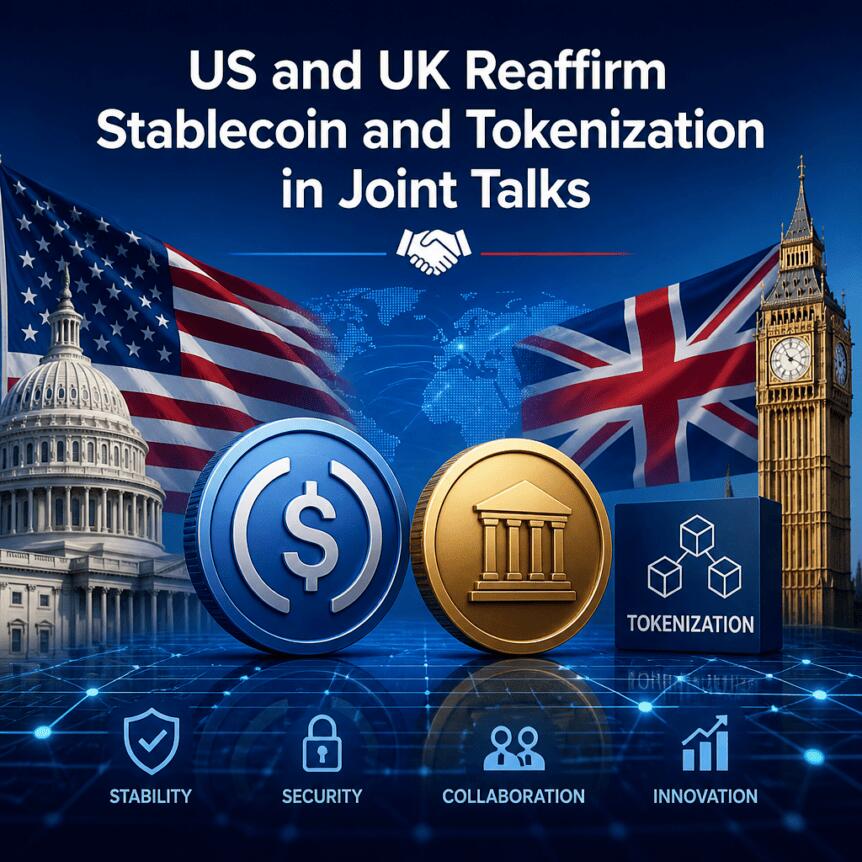
The United States and the United Kingdom used their latest bilateral regulator meeting to reaffirm coordination on digital-asset oversight, with particular focus on stablecoins, market structure, and payment modernization. The 13th session of the UK-US Financial Regulatory Working Group (FRWG) took place in London on July 8, continuing a pattern of policy alignment as the U.S. prepares to roll out the GENIUS Act.
In an Aug. 4 joint statement summarizing the discussions, U.S. officials said they provided their UK counterparts with an update on GENIUS Act implementation, alongside ongoing work related to the structure of digital asset markets. The statement also referenced broader efforts to improve cross-border payments under the G20 Cross-border Payments Roadmap, signaling that stablecoin regulation is being treated as part of a wider payments and financial stability agenda rather than in isolation.
Key takeaways
- The FRWG meeting highlighted continued U.S.-UK coordination on stablecoin rules, including progress on implementing the GENIUS Act.
- Officials also discussed how digital asset market structure is evolving in the United States, alongside UK initiatives tied to tokenization and capital markets.
- The joint statement framed stablecoin oversight within payment modernization and international cooperation on cross-border transfers.
- No new policy measures emerged from the July 8 talks, but the tone emphasized “responsible” innovation alongside financial stability and regulatory alignment.
What the US-UK regulators covered
According to the joint statement issued on Aug. 4, the FRWG meeting included updates on several areas relevant to crypto and tokenized finance. Alongside stablecoin regulation, participants discussed digital asset market structure in the United States—an issue that has attracted heightened attention globally as regulators attempt to define how tokens fit within existing financial frameworks.
The statement also pointed to UK priorities in the tokenization space, referencing the UK’s Wholesale Financial Markets Digital Strategy. While the statement did not announce new rules, the range of topics matters to market participants because it illustrates how regulators are connecting stablecoins and tokenization to mainstream financial infrastructure, including wholesale markets and cross-border payment flows.
Payment modernization was another recurring theme. By tying the meeting’s work to the G20 Cross-border Payments Roadmap, the regulators effectively acknowledged that stablecoins—when they meet defined compliance and reserve requirements—are increasingly viewed as potential tools for faster, lower-friction settlement across borders.
GENIUS Act implementation remains central
For U.S. watchers, the most concrete element in the joint statement is the mention that U.S. officials updated the UK on GENIUS Act implementation. The GENIUS Act is described in the statement as the United Kingdom’s “landmark stablecoin law” counterpart in terms of the stablecoin policy direction both countries are taking—reinforcing that the U.S. and UK see stablecoin legislation as a cornerstone for broader regulatory clarity.
The immediate practical takeaway is that firms operating across the Atlantic may increasingly expect policy outputs that are compatible or at least coordinated in spirit. Even without new measures announced at this meeting, continued communication between regulators can reduce uncertainty for issuers, exchanges, custody providers, and market participants planning product rollouts that depend on stablecoin rails.
UK stablecoin debate: shifting stance and reserve requirements
The U.S.-UK alignment comes as the UK’s stablecoin regulatory posture continues to evolve. Industry reporting referenced in the original coverage indicated that the Bank of England has softened its stance and is exploring alternative approaches to a temporary framework affecting stablecoin holdings.
Earlier coverage also cited the BoE’s review of whether a proposed requirement—holding at least 40% of reserve assets as non-interest-bearing deposits at the central bank—might be too restrictive. That matters because reserve composition requirements directly affect the economics of stablecoin issuance and risk management, and can shape whether dollar-backed stablecoins expand primarily through regulated channels in the UK or migrate to jurisdictions with more operational flexibility.
Separate commentary referenced in the source indicates that the UK Financial Conduct Authority has identified cross-border payments as one of the clearest near-term stablecoin use cases. Taken together, these points suggest the UK is trying to balance financial-stability constraints with a pragmatic recognition that stablecoins may have real utility in international settlement—an area the FRWG also emphasized through the cross-border payments roadmap.
Broader implications: regulation as a competitiveness lever
The meeting did not introduce fresh rules, but the overall direction remains noteworthy. The original reporting framed the UK’s renewed emphasis on stablecoins against concerns that the United States has gained momentum in building a regulated environment for dollar-backed stablecoins. In that context, U.S.-UK coordination can be read as more than technical harmonization: it is also part of a competition between jurisdictions over who sets the terms for compliant stablecoin growth.
That competitive element becomes clearer when viewed alongside earlier U.S.-UK cooperation. On July 14, the Transatlantic Taskforce for Markets of the Future—a joint U.S.-UK initiative aimed at strengthening collaboration on financial innovation and capital markets—published initial recommendations and a joint statement on stablecoins, according to the source. The FRWG meeting’s supportive tone toward “responsible” innovation and emphasis on international cooperation suggests these parallel efforts are feeding into a single long-term policy trajectory: aligning standards so that capital markets innovation, tokenization, and stablecoin use are able to scale without undermining financial stability.
For builders and investors, the most important uncertainty is not whether stablecoin regulation is coming—both countries are clearly moving—but how precisely reserve and operational requirements will be shaped in practice. The UK’s ongoing review process around holding structures and the BoE’s consideration of alternatives signal that implementation details may change before final frameworks fully lock in.
Going forward, market participants should watch for how U.S. GENIUS Act implementation translates into operational requirements for issuers and intermediaries, and whether UK regulators further adjust stablecoin rules in response to concerns about restrictiveness and cross-border payment needs—particularly as U.S.-UK officials continue to tie domestic legislation to international payment modernization objectives.


US and UK financial regulators have expanded talks on stablecoins, tokenization and digital asset oversight as Washington begins implementing the GENIUS Act.
Summary
- The 13th UK-US regulatory meeting took place in London on July 8.
- US officials briefed UK regulators on GENIUS Act implementation and crypto market structure.
- Both governments support one-to-one stablecoin backing and greater cross-border regulatory coordination.
- The Bank of England has replaced proposed holding limits with a £40 billion issuance cap.
US, UK regulators discuss stablecoin policy
Senior officials from HM Treasury and the US Treasury met in London for the 13th UK-US Financial Regulatory Working Group meeting, according to an Aug. 4 joint statement.
Representatives from the Bank of England, Financial Conduct Authority, Federal Reserve, Securities and Exchange Commission, Commodity Futures Trading Commission, Federal Deposit Insurance Corporation and Office of the Comptroller of the Currency also attended.
Digital finance formed a central part of the July 8 meeting. US officials updated their UK counterparts on the implementation of the GENIUS Act, which establishes a federal framework for payment stablecoins, and on continuing work to define the country’s broader digital asset market structure.
Officials also discussed tokenization, payment modernization and the G20 Cross-border Payments Roadmap. UK representatives provided an update on the country’s Wholesale Financial Markets Digital Strategy and the appointment of Christopher Woolard as Wholesale Digital Markets Champion.
The meeting did not produce new regulations or binding agreements. However, both sides reaffirmed support for the “responsible use and growth of digital assets” alongside consumer protection and financial stability, according to the official working group statement.
GENIUS Act raises pressure on UK stablecoin rules
The talks come as the United States moves from stablecoin legislation toward implementation, giving issuers and financial institutions a clearer route to operate under federal rules.
The UK is still completing its own framework. The FCA is expected to oversee the issuance, custody and trading of qualifying UK stablecoins, while the Bank of England will jointly regulate stablecoins considered systemically important.
Coordination could become important for US stablecoin issuers seeking access to UK payment and capital markets. Differences in reserve requirements, custody rules and insolvency protections could otherwise force issuers to maintain separate structures in each country.
The two governments addressed that risk in a separate July 14 statement from the Transatlantic Taskforce for Markets of the Future. They said their goal was to promote convergence where appropriate without replacing either country’s domestic regulatory process.
“Stablecoins held out as money should be fully backed,” the governments said.
The joint stablecoin statement called for at least one-to-one backing with high-quality liquid assets, segregated reserves and timely redemption. It also proposed exploring a pathway for stablecoins issued in one jurisdiction to enter the other market.
Bank of England softens earlier restrictions
The Bank of England has already revised some of its more restrictive stablecoin proposals following industry feedback.
In June, the central bank abandoned proposed per-coin holding limits of £20,000 for individuals and £10 million for businesses. It replaced them with a temporary £40 billion issuance guardrail for each systemic stablecoin, allowing users to transact without individual limits.
The Bank also reduced the share of reserves that systemic issuers must hold as non-interest-bearing central bank deposits from 40% to 30%. The remaining 70% may be held in short-term UK government debt under the steady-state framework.
These changes bring the UK closer to the shared US-UK position that reserve rules should protect holders without creating barriers that make stablecoin businesses commercially unworkable. The Bank of England plans to finalize its systemic stablecoin code by the end of 2026.
What comes next for transatlantic stablecoins
The next phase will depend on how US agencies implement the GENIUS Act and whether the two countries convert their shared principles into formal market-access arrangements.
Key unresolved issues include the treatment of foreign-issued stablecoins, regulatory recognition between jurisdictions, reserve custody and procedures for cross-border issuer failures.
The Financial Regulatory Working Group plans to meet again in early 2027. Until then, the July recommendations provide a policy direction rather than a unified transatlantic regime, leaving issuers subject to separate US and UK requirements.


Bitcoin continues to trade within a well-defined consolidation range after failing to establish a meaningful recovery from its late June lows. While short-term price action has stabilized above key support, the broader structure remains neutral to bearish, with overhead resistance still capping every rally. At the same time, the Coinbase Premium Index remains in negative territory, suggesting that US spot demand has yet to return in a convincing manner.
Bitcoin Price Analysis: The Daily Chart
On the daily timeframe, BTC continues to trade around $63.5K after spending several weeks ranging beneath the $67K resistance zone. This area has repeatedly rejected bullish advances and now represents the first major hurdle for buyers.
The broader trend remains bearish as the price continues to trade below both the 100-day and 200-day moving averages, which are sloping downward around the $68K and $70K regions, respectively. These moving averages reinforce the bearish higher-timeframe structure and create a strong confluence resistance zone above the market.
On the downside, the first important demand area remains at $60K, where buyers previously stepped in to defend the market following the sharp June decline. Below that, the final major support sits around $54K, which would likely become the next downside target if the current range eventually breaks lower.
Meanwhile, momentum remains relatively muted. The RSI is hovering around the midpoint near 50, reflecting a balanced market with neither buyers nor sellers maintaining clear control. Unless BTC reclaims the $67K resistance area, the broader structure continues to favor range-bound trading rather than the beginning of a sustained recovery.
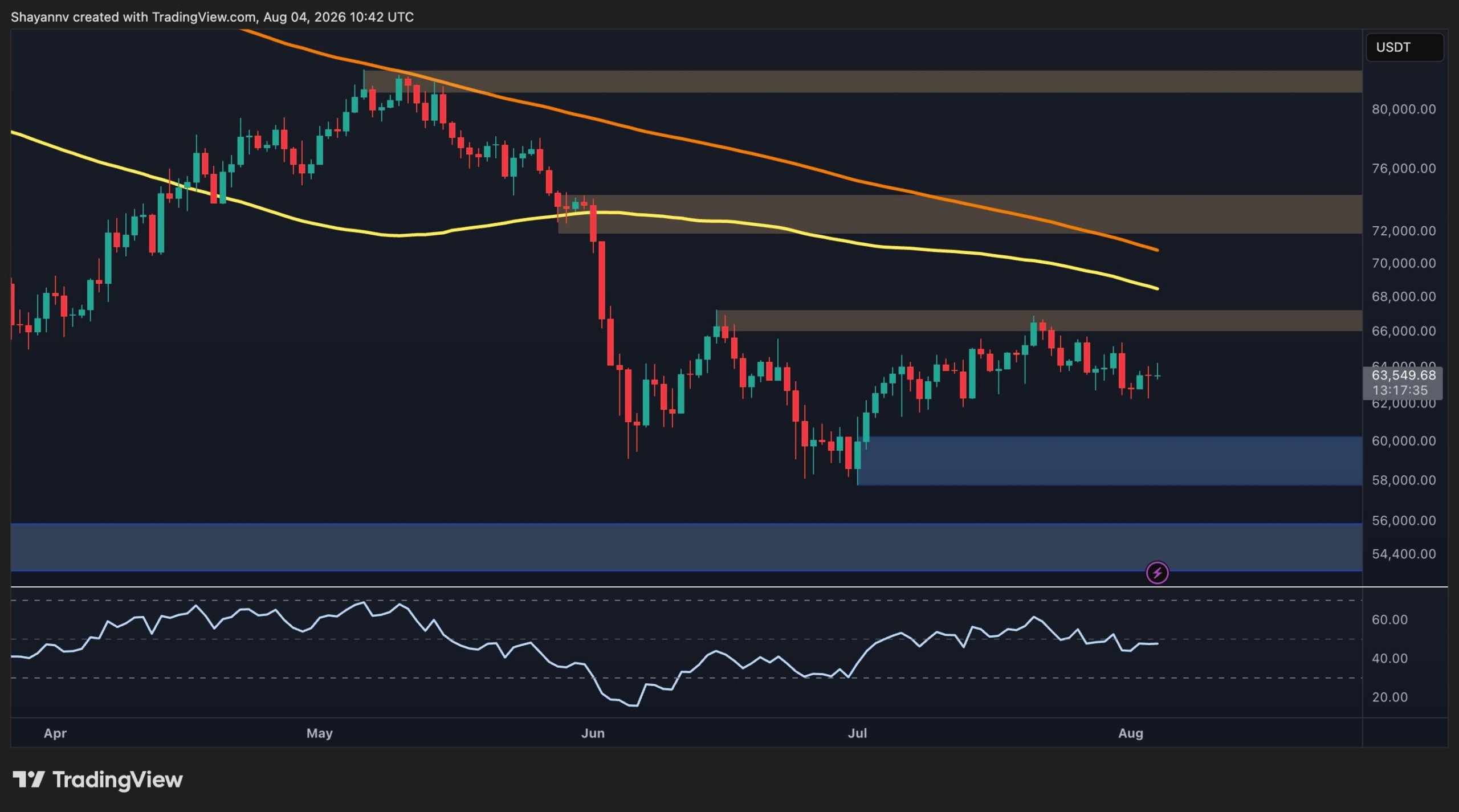
BTC/USDT 4-Hour Chart
The lower timeframe highlights a market that is consolidating above the $62K short-term support after several failed attempts to break lower.
The asset has recently bounced from this demand zone and is now trading inside a small fair value gap formed around $63K. This imbalance is acting as the immediate short-term support, and buyers will need to rebound from this area before attempting another move toward the range highs.
As long as BTC holds above the $62K support, another push toward $66K remains possible. However, repeated failures around the upper boundary would continue to strengthen the existing range and increase the probability of another rotation back toward support.
To the downside, a decisive breakdown below $62K would invalidate the current short-term recovery and expose the broader $60K demand zone once again.

Sentiment Analysis
The Coinbase Premium Index continues to paint a cautious picture despite Bitcoin’s recent stabilization. The metric remains below the zero line, currently around -0.08, indicating that BTC is still trading at a discount on Coinbase relative to offshore exchanges.
Historically, sustained positive Coinbase Premium readings have coincided with stronger buying activity from US institutional and spot investors. In contrast, persistent negative values often reflect weaker spot demand or relatively stronger selling pressure from US participants.
Although the index has recovered from the deeply negative readings recorded during previous selloffs, it has yet to establish a sustained move back into positive territory. This suggests that the recent price stabilization has not been accompanied by meaningful accumulation from Coinbase participants.
As a result, Bitcoin’s recovery appears to be driven more by short-term positioning than by strong spot demand from US investors. A sustained move of the Coinbase Premium Index above zero would strengthen the bullish case as it would show large US investors and institutional traders returning, while continued negative readings would leave the market vulnerable to renewed downside pressure if key support levels begin to fail.

The post Bitcoin Price Analysis: Will BTC Break Above $66K or Fall Below $62K Next? appeared first on CryptoPotato.
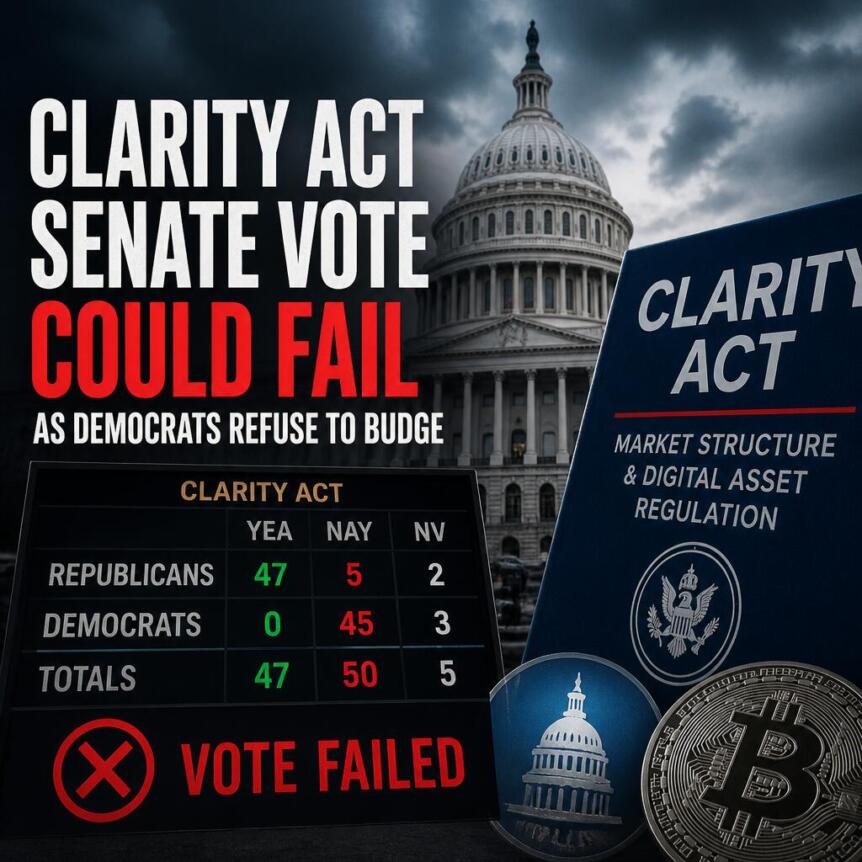
Senate negotiations over digital asset legislation remain unresolved as lawmakers prepare for a key procedural vote. The CLARITY Act faces growing uncertainty after Democratic senators signaled they would not support ending debate without further concessions. Republican leaders continue seeking enough backing before lawmakers leave Washington for the summer recess.
Democrats Signal Resistance Before Procedural Vote
Democratic senators continue coordinating their position before the expected procedural vote on the CLARITY Act. Several lawmakers insist unresolved issues require additional bipartisan negotiations before supporting cloture. Senate leaders have not announced any agreement addressing those concerns.
Punchbowl News reporter Brendan Pedersen described the current Democratic position in a post on X. He wrote, “There is a clear consensus among Senate Democrats right now that—without movement on ethics, illicit finance and stablecoin yield—a cloture vote this week on the Clarity Act will fail.” His comments reflected the latest state of negotiations before the expected vote.
Pedersen also wrote, “Democrats won’t be moved by crypto cash at this point.” That statement highlights continuing resistance despite Republican efforts to secure procedural support. The CLARITY Act therefore remains short of the bipartisan momentum needed for a successful cloture vote.
Outstanding Issues Continue to Divide Both Parties
Senate Majority Leader John Thune continues working toward a procedural vote before lawmakers begin the August recess. However, several Democratic senators argue the CLARITY Act still requires further revisions before advancing. Negotiators continue discussing ethics provisions, illicit finance safeguards, and stablecoin yield rules.
Republican lawmakers have sought Senate consideration of the legislation for several months. Current vote estimates indicate supporters still lack sufficient backing to advance debate. Negotiators continue working to resolve disagreements before the CLARITY Act reaches another procedural milestone.
One Democratic aide questioned whether negotiations could survive another political escalation before Congress returns. The aide said, “If they spend in August, it’s done.” That remark underscores concerns that campaign activity could further complicate CLARITY Act negotiations.
Senate Talks Remain Focused on Reaching Consensus
Senator Ruben Gallego questioned whether Republican negotiators were maintaining productive bipartisan discussions around the CLARITY Act. He said, “We are clearly here, trying to engage constructively.” Gallego also added, “At this point, if they’re not engaging, it’s telling me that they don’t want this to happen.”
Some Democratic lawmakers also expressed concern about political spending by crypto-backed organizations before Congress reconvenes in September. They believe additional campaign activity could further strain ongoing bipartisan discussions. Those concerns continue influencing negotiations surrounding the CLARITY Act.
Supporters of the legislation maintain that additional negotiations could still produce a workable compromise before future procedural votes. They believe remaining differences between House and Senate proposals can still be addressed through bipartisan discussions. For now, the CLARITY Act remains dependent on negotiations before any successful cloture vote can proceed.
Senate negotiations continue without a confirmed breakthrough before the expected procedural vote. The immediate future of the CLARITY Act now depends on whether bipartisan negotiators resolve outstanding disputes. Until then, Democratic resistance continues creating uncertainty over this week’s planned Senate action.
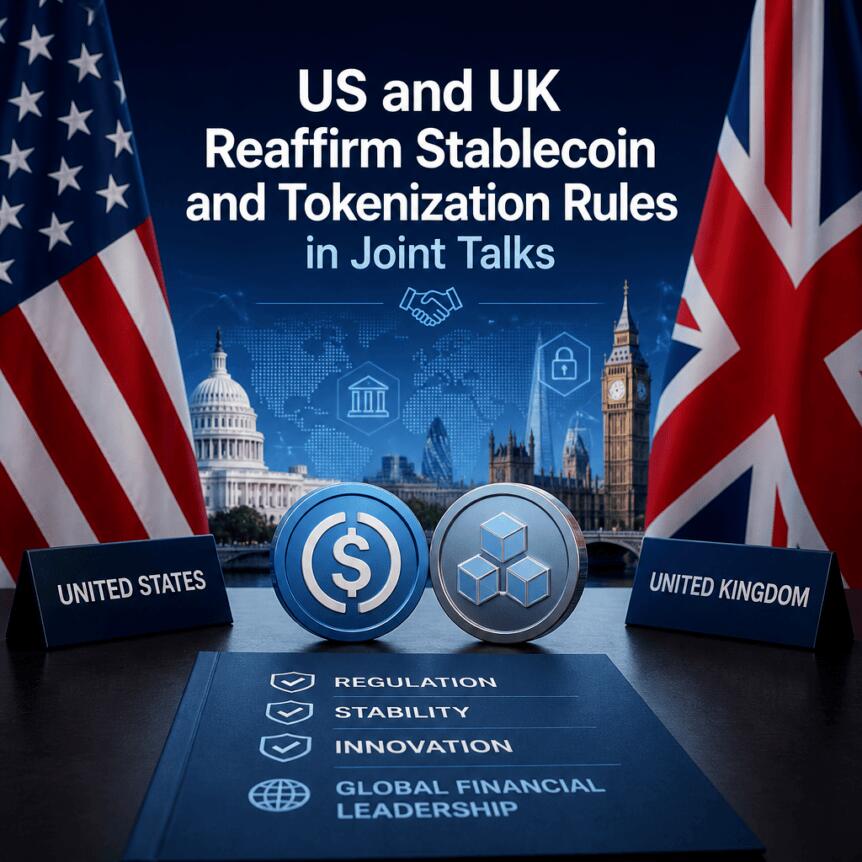
The United States and the United Kingdom used a recent bilateral meeting to signal continued alignment on digital-asset oversight, focusing in particular on stablecoin regulation, cross-border payments, and the structure of tokenized markets. The discussion took place during the 13th session of the UK–US Financial Regulatory Working Group (FRWG) in London on July 8.
In an Aug. 4 joint statement summarizing the meeting, US officials told their UK counterparts they are updating implementation details for the GENIUS Act, alongside ongoing work on how digital asset markets should be regulated. The statement also highlighted broader efforts on payment modernization and participation in the G20 Cross-border Payments Roadmap.
Key takeaways
- The July 8 FRWG meeting reinforced US–UK policy coordination around stablecoins, digital asset market structure, and tokenization.
- US officials provided an update on implementing the UK-referenced GENIUS Act and related stablecoin work, but no new policy measures were announced.
- Cross-border payments modernization remains a shared priority, with both governments pointing to international work under the G20 roadmap.
- UK stablecoin regulation is evolving as the Bank of England and other authorities reassess earlier approaches amid competitive momentum from the US.
FRWG meeting places GENIUS Act implementation and market structure front and center
The FRWG meeting covered several areas that regulators typically treat as interconnected: stablecoin rules, the way digital-asset markets operate in the US, tokenization, and the UK’s “Wholesale Financial Markets Digital Strategy.” Those topics matter because stablecoins are often the settlement layer for payments and tokenized instruments, while regulatory frameworks for market structure influence how exchanges, brokers, custodians, and trading venues adapt to digital assets.
According to the Aug. 4 joint statement released by the US Treasury, the US side shared updates with the UK about implementing the GENIUS Act—framed as the country’s landmark stablecoin legislation—along with work on digital asset market structure. The statement also indicates that participants discussed payment modernization initiatives and international coordination on cross-border payments through the G20 Cross-border Payments Roadmap.
While the meeting did not yield new regulatory actions, it did reinforce a familiar theme in transatlantic policy: the desire to keep pace with fast-moving market developments without undermining financial stability. Notably, the statement described a “responsible” approach to digital-asset innovation, while still emphasizing oversight and the need for international regulatory cooperation.
US–UK coordination extends beyond stablecoins to tokenization and payments
The FRWG meeting appears to fit into a broader effort by the two governments to coordinate on financial innovation. Earlier, on July 14, the Transatlantic Taskforce for Markets of the Future—an initiative aimed at strengthening cooperation on financial innovation and capital markets—published initial recommendations together with a joint statement on stablecoins.
That earlier announcement said the measures would help set the foundation for continued US–UK leadership in digital assets and capital markets. Taken alongside the July 8 FRWG discussion, it suggests regulators are treating stablecoin policy not as an isolated topic, but as part of a larger strategy that includes tokenized finance and how payments infrastructure evolves.
For investors and operators, the implication is straightforward: regulatory decisions in one country may influence how compliant products and services are designed for the other. Even when there are no immediate new rules, ongoing coordination can reduce uncertainty for cross-border issuers, market intermediaries, and firms building payment and tokenization applications intended to serve both jurisdictions.
UK stablecoin review accelerates as US regulation gains momentum
UK policymakers’ renewed attention to stablecoins arrives at a time when some observers believe the US is pulling ahead. The rationale is that the GENIUS Act has created clearer traction for regulated, dollar-backed stablecoin activity, providing a benchmark for other jurisdictions to respond to.
Within the UK, the Bank of England has reportedly softened its stance after earlier controversy over potential limits. Cointelegraph previously reported that the BoE was considering alternatives to temporary limits on stablecoin holdings and reviewing whether a proposal requiring at least 40% of reserve assets to be held as non-interest-bearing deposits at the central bank was too restrictive. Separate coverage also noted the BoE’s ongoing work to calibrate regulation in a way that supports stability without overly constraining legitimate market participation.
At the same time, the UK’s Financial Conduct Authority has signaled where it sees near-term real-world value. Earlier in the year, the FCA pointed to cross-border payments as one of the “clearest near-term use cases” for stablecoins, emphasizing that regulators increasingly recognize the technology’s potential—not just as a trading asset, but as a component of payments systems.
For market participants, these signals together indicate that the UK is attempting to thread a needle: maintain strong financial stability requirements while ensuring its framework does not lag in usability and competitiveness relative to the US approach.
What to watch next: implementation details and remaining UK constraints
With the FRWG meeting described as a coordination exercise rather than a source of new rules, the practical question for the market is what happens next in implementation—especially in the US under the GENIUS Act—and whether the UK continues adjusting aspects of its earlier stablecoin proposals. Readers should watch for further clarity from UK authorities on reserve requirements and for concrete milestones tied to stablecoin market-structure work, since those details will likely determine how quickly compliant dollar-backed stablecoin services can expand across borders.
SpaceX has expanded its partnership with NVIDIA to power Starmind, a proposed network of orbital data centers designed to process artificial intelligence workloads in space.
Summary
- SpaceX will use NVIDIA’s Vera Rubin platform for its planned Starmind satellite network.
- The company has requested FCC approval for up to one million orbital data-center satellites.
- NVIDIA says its Space-1 module provides up to 25 times the AI compute of an H100 GPU.
- SPCX gained 9.8%, while NVIDIA shares rose 2.5% following the announcement.
SpaceX adds NVIDIA chips to Starmind network
SpaceX plans to equip its Starmind satellites with NVIDIA’s Rubin graphics processing units and Vera central processing units. The hardware forms part of NVIDIA’s Space-1 platform, which was developed for AI processing and other computing workloads in orbit.
The partnership expands NVIDIA’s list of space-computing customers after the chipmaker introduced the platform in March. Its initial launch partners included Aetherflux, Axiom Space, Kepler Communications, Planet Labs, Sophia Space and Starcloud.
SpaceX was not included in the original announcement but has now joined the companies working with NVIDIA on orbital computing. Musk later said SpaceX would build its AI infrastructure exclusively on NVIDIA platforms and described Vera Rubin as the strongest available option.
The companies also plan to jointly design computing payloads for future satellites, according to reports following SpaceX’s investor call.
NVIDIA says its Space-1 Vera Rubin module combines GPUs, CPUs and high-bandwidth connections in a system designed for the power and weight limits of satellites. It can run large language models and process data in orbit instead of transmitting all raw information back to Earth.
One million satellites still need FCC approval
SpaceX’s broader plan remains subject to regulatory approval in the United States. The company filed an application in January seeking permission to launch and operate as many as one million non-geostationary satellites.
The proposed system would operate between 500 and 2,000 kilometers above Earth. SpaceX said optical links would connect the satellites through a high-capacity network capable of moving data between orbital computing nodes.
The Federal Communications Commission accepted the application for filing in February and opened it for public comment. That procedural decision did not constitute final approval, correcting reports that the FCC had already authorized the full constellation.
The requested scale is far larger than the existing satellite population around Earth. It could also face questions involving orbital congestion, collision risks, radio interference and effects on astronomical observations.
SPCX and NVIDIA shares rally
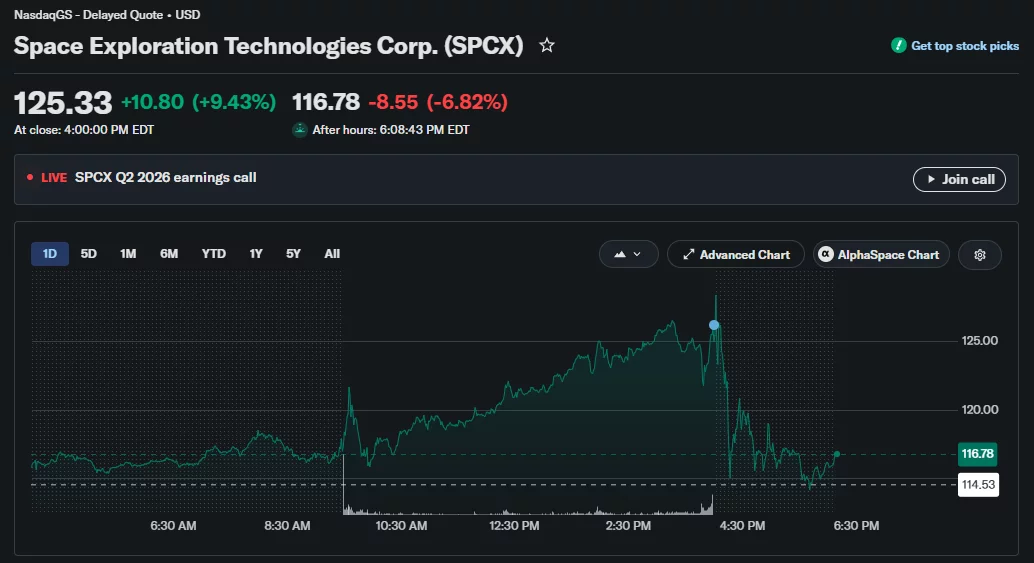
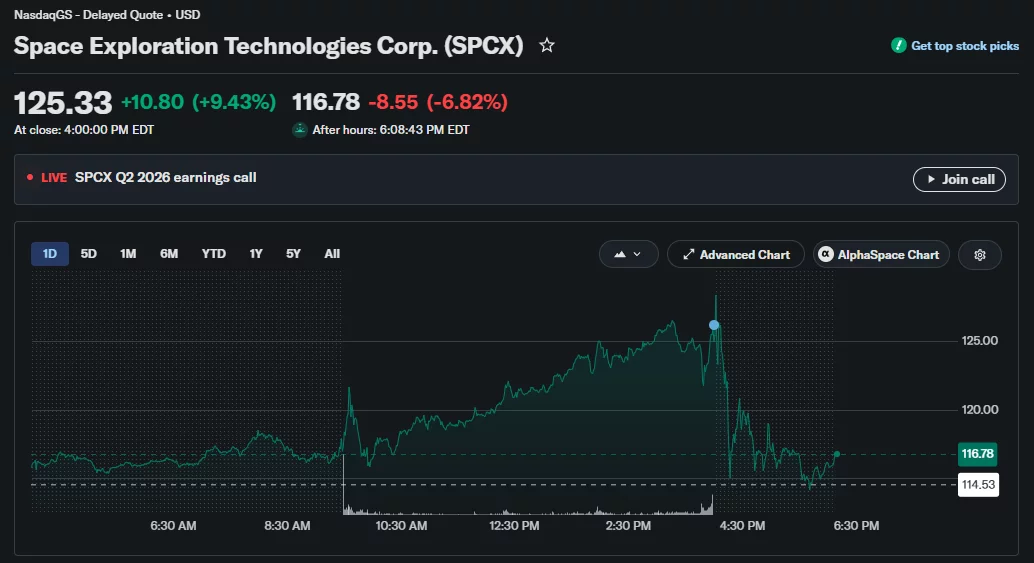
SPCX closed Tuesday at $125.33, up $10.80, or 9.43%, after investors responded to the NVIDIA partnership ahead of SpaceX’s earnings report.
However, the stock reversed course after the closing bell. SPCX fell 6.82% to $116.78 in after-hours trading as investors assessed the company’s quarterly results and AI spending plans.
NVIDIA shares gained 3.03% to $212.91 during Tuesday afternoon trading. The move reflected investor expectations that orbital data centers could create another market for the chipmaker’s AI computing hardware.
NVIDIA says its Space-1 Vera Rubin module can provide up to 25 times the AI computing power of an H100 GPU. The platform is designed for space-based inference, autonomous operations and real-time satellite-data processing.
SpaceX faces cost and execution questions
Starmind could allow SpaceX to combine its launch capabilities, Starlink communications network and AI operations within one infrastructure project. However, deploying orbital data centers would require large investments in satellites, launches, power generation and thermal management.
SpaceX must also demonstrate that the system can operate safely alongside existing spacecraft before receiving final FCC authorization. Even if approved, the company would likely deploy the network in stages rather than launching the full requested number.
For U.S. investors, the NVIDIA agreement provides a clearer hardware path for SpaceX’s AI strategy. The next tests will be regulatory progress, the cost of building the constellation, and whether orbital computing can produce enough revenue to justify the required spending.
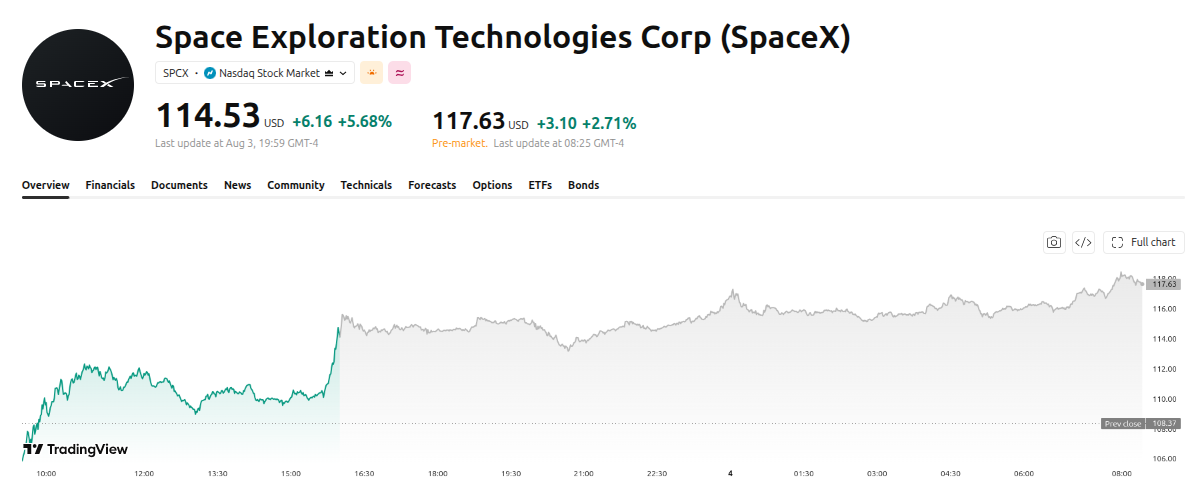
SpaceX reports its first quarterly results as a public company after Tuesday’s close, with a webcast following around 4:30 p.m. ET.
The debut print will test whether Starlink profits can fund the company’s aggressive AI and Starship ambitions.

What Wall Street Expects From the Report
The broader consensus centers on $6.8 to $6.9 billion in revenue, a sharp jump from $4.69 billion in the first quarter. Wall Street also models a non-GAAP loss of near $0.23 to $0.26 per share.
Segment expectations vary considerably. Starlink remains the cash engine, projected at around $3.8 billion with operating margins near 36%.
The AI unit should show the fastest growth. Analysts forecast $2 to $2.3 billion from xAI, Grok, and data-center capacity combined. Space keeps consuming capital instead. Falcon, Dragon, and Starship continue to attract heavy investment without delivering near-term returns.
Timing adds pressure to the report. A major lockup tranche opens August 6, potentially releasing hundreds of millions of shares.
Shares closed Monday at $114.53, up 5.68%, after trading in the mid-100s amid post-IPO volatility, according to TradingView data. The company completed history’s largest public offering in June at roughly $1.5 trillion.
Follow us on X to get the latest news as it happens.
Traders on X are focused on the wide estimate range and the lockup overhang, with options pricing implying significant movement.
Top 3 Scenarios on the Table
Investors have narrowed Tuesday’s possibilities into three broad outcomes. Each depends less on headline revenue than on what management reveals about spending discipline, segment quality, and the path toward self-funding.
Scenario 1: A Clean Beat With Strong Disclosure
Revenue and EBITDA clear consensus while Starlink subscribers and margins hold or improve. AI revenue tracks contracted ramps without slippage.
Management adds concrete detail on capital expenditure phasing, remaining liquidity, and Starship commercialization. Any path toward self-funding would strengthen the case.
That combination could trigger short-covering and a strong rally. It would validate the elevated valuation multiple and offset near-term lockup pressure.
Scenario 2: In-Line Results With Vague Guidance
Numbers land near consensus, with solid sequential growth led by AI and steady Starlink profitability. Details stay high-level instead.
Average Revenue Per User (ARPU) trends, exact AI margins, and peak spending timelines remain unclear, with emphasis shifting toward long-term Mars and orbital-compute vision.
Many analysts consider this the most probable outcome for a first-time public reporter. Markets would likely trade mixed to soft as uncertainty persists.
Scenario 3: Soft Print or Capex Concerns
Total revenue meets or modestly misses, while AI revenue falls short of the expected ramp. Starlink shows ARPU pressure or weaker quality growth.
Space losses widen further from Starship development, while elevated Capex commentary raises fresh funding worries without offsetting positives.
Subscribe to our YouTube channel to watch leaders and journalists provide expert insights.
That outcome would intensify scrutiny of Starlink subsidizing other segments. Sharper selling could follow, especially with increased float arriving days later.
What Really Matters Beyond the Numbers
The earnings call will set the tone for how public investors assess a company blending profitable satellite broadband, leadership in reusable launch, and ambitious AI infrastructure bets. Few listed firms carry that combination, and none at this valuation.
Beyond the headline figures, segment details and management tone will matter most. Signals on cash discipline could prove decisive as the company navigates its early public-market chapter.
The lockup expiration two days later adds another layer entirely. Even a strong report may struggle against fresh supply, leaving Tuesday’s reaction an incomplete verdict on where SpaceX stock heads next.
The post SpaceX Earnings Call Today: Top 3 Scenarios Investors Are Watching appeared first on BeInCrypto.

Michael Burry attends “The Big Short” New York premiere at the Ziegfeld Theater in New York, Nov. 23, 2015.
Andrew Toth | Filmmagic | Getty Images
Michael Burry of “The Big Short” fame is sticking with his bearish wagers even as the S&P 500 surges to a record high, warning that the rally could still end in a sharp sell-off reminiscent of the 1987 stock-market crash.
“I continue to believe it is possible we are near a major top, and possible a 1987-type fall, but the S&P 500 making new highs likely will bring new money into the market,” Burry said in a Tuesday Substack post.
The S&P 500 jumped 1.9% Tuesday to its first record close since June, buoyed by stronger-than-expected corporate earnings and another drop in oil prices as hopes grew that the Strait of Hormuz would reopen to maritime traffic. The tech-heavy Nasdaq Composite soared 2.7%, extending its gain in just the first two days of the week to nearly 5%.
Burry has been among Wall Street’s most outspoken skeptics of the artificial intelligence boom, arguing that demand for AI infrastructure is being fueled by financing arrangements that may prove unsustainable. He said the market’s advance is creating a self-reinforcing cycle, with declining volatility encouraging systematic investors to increase exposure.
“Remember, the market going up on falling volatility forces vol-targeting funds to leverage up, and brings leverage from other momentum strategies into play,” he wrote.
In the face of the rally, Burry said he continues to hold short positions in the iShares Semiconductor ETF (SOXX), Micron, Nvidia, Caterpillar, Palantir, Tesla and Applied Materials.
The investor said he remains confident in his long-term outlook for those positions, though he added that he would cut his losses if the trades moved decisively against him. All of the positions remain profitable except for his bet against Nvidia, he said.
“Again, shorting is not for everyone,” Burry wrote. “I must short. Most should not.”

Netflix’s Official ‘John Wick Replacement Is a Massive Smash Hit

Larne fail to break down Georgians at home despite opponents’ travel woes

US stocks: Dow, S&P 500 close at record highs as AI earnings impress, oil prices tumble


-

 Business6 days ago
Why Trees Belong on the Risk Register
-

 Fashion4 days ago
Weekend Open Thread: Wit & Wisdom
-

 Politics4 days ago
Meta enters AI-training agreement with far-right ‘propaganda rag’ Newsmax
-

 Politics6 days ago
Reform UK betrays West Mids residents by running from party pledges
-

 Crypto World3 days ago
MicroStrategy Post-Earnings CLARITY Act Push Could Add New Catalyst for Its Stock
-

 Business7 days ago
Major shareholder moves on Canyon
-

 Crypto World4 days ago
XRP Ledger v3.3.0 brings five institutional features
-

 Politics2 days ago
Zack Polanski: an incitement to murder Nigel Farage?
-

 News Videos5 days ago
Bitcoin Enters the 3rd Stage of the Bear Market
-

 Crypto World7 days ago
Kraken Enables Retail Access to Jersey Mike’s IPO via Tokenized Shares
-

 Politics5 days ago
Luke Littler’s dominance sparks GOAT debate
-

 Sports5 days ago
Seema Kaliramna Wins Discus Throw Bronze, Takes India’s CWG Medals Tally To 17
-

 Crypto World4 days ago
New York sues Kalshi over prediction market gambling
-

 Crypto World3 days ago
Crypto PAC spending tops $2M in Michigan House race
-

 Business4 days ago
Trump Announces Hamas Disarmament Agreement as Iran Strikes Kuwait Air Base and US Attacks Pause Overnight
-

 Tech6 days ago
Gemini can now summarize the messiest comment threads in Google Docs
-

 Tech3 days ago
ESET tracks rise in malicious AI skills and adaptable malware
-

 NewsBeat5 days ago
Four people die trying to cross Channel in small boats
-

 Tech5 days ago
Gemini Spark can now use Chrome logins and saved passwords to run errands on your behalf
-

 Business2 days ago
DTCR: Deleveraging And A Hedge Fund Collapse Point To A Possible AI Bottom
You must be logged in to post a comment Login