Connect with us

Business

Apple UK encryption challenge filed against Home Office

Published

on

Apple UK encryption challenge filed against Home Office

Apple has confirmed it has lodged a new legal complaint against the UK government at the court that hears objections to the use of covert surveillance powers.

The company has not told said what the complaint relates to. The Financial Times has reported it is a further challenge to a Home Office demand for so-called “backdoor” access to highly encrypted Apple user data.

The dispute centres on the government’s wish to see material protected by Advanced Data Protection, a system Apple says it cannot itself access. It has been running since early 2025.

The government said it would not comment on legal proceedings or on what it called “operational matters”.

It added in a statement: “The UK supports strong encryption and robust privacy protections, but it is also vital that law enforcement can access communications when necessary and proportionate to protect the public from terrorism, serious crime, and child sexual abuse.”

Advertisement

Apple referred reporters to a statement it gave last year, after its initial challenge to the government’s request. That statement said the company was “gravely disappointed” it could still not offer Advanced Data Protection to new UK users, following its decision to withdraw the feature from UK iCloud accounts in February 2025.

“As we have said many times before, we have never built a backdoor or master key to any of our products or services and we never will,” the company added.

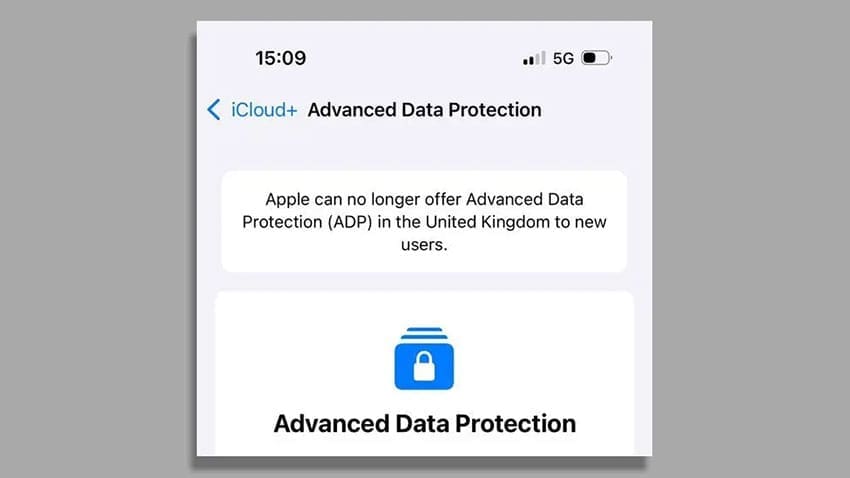
Since February 2025, UK iPhone users have seen a notice on the Advanced Data Protection settings page stating that the tool cannot be enabled.

Apple has confirmed it has lodged a new legal complaint against the UK government at the court that hears objections to the use of covert surveillance powers.

Advanced Data Protection is an opt-in feature that applies a higher level of protection to data stored in iCloud, including back-ups, Drive storage, photos and voice memos. It is secured using end-to-end encryption, meaning Apple is unable to see its contents.

Advertisement

The government’s requests for access to data held under the system were issued under the Investigatory Powers Act. The Act allows the government to issue secret notices, known as technical capability notices, which can require companies to provide UK security services with ways to access customer data.

Under the notices regime code of practice, such notices must be approved by both the Secretary of State and a Judicial Commissioner before they are given to an operator.

The government fought unsuccessfully to keep legal challenges to its first notice to Apple secret. That notice was later withdrawn after objections from US politicians, who were concerned about the effect on their own citizens’ data. The government issued a new request in October which did not apply to US users.

Privacy groups that had campaigned against the secret orders welcomed Apple’s new complaint.

Advertisement

“We are happy to learn that Apple is once again challenging the UK’s regime of secret orders,” said Privacy International. “While we don’t know the substance of Apple’s claim, if it relates to the previously reported orders aimed at undermining the security of Apple’s iCloud storage, then Apple’s claim, alongside side ours and Liberty’s, is crucially important to preserving all of our privacy and security.”

Ruth Ehrlich, director of external relations at Liberty, said the case was “hugely important” and had “far-reaching implications for the public’s privacy rights well into the future”.

“End-to-end encryption is an essential security tool that protects our personal data, including our bank details, health information, private conversations and images,” she said. “Opening a backdoor to all of that information carries a wide range of risks to our personal data. It is critical that the Government listens to the many concerns and commits to protecting our privacy rights.”

Sir Brian Leveson, the Investigatory Powers Commissioner, who provides independent oversight of the use of surveillance powers, has previously criticised media use of the term “backdoor”.

Advertisement

He said notices of the kind at issue in this case would only be issued “if the Secretary of State deems it necessary and proportionate, and this decision is independently reviewed and approved by a Judicial Commissioner”. He added that requests for data would require separate authorisation under the Act, subject to independent oversight.

Apple has previously set out its position on encrypted services in the UK, including its opposition to proposals for scanning of encrypted messages.


Amy Ingham

Amy Ingham

Amy Ingham is a reporter at Business Matters, covering UK business news with a focus on breaking news, business policy, late payments and insolvency. She joined the magazine in 2026 after completing the NCTJ Diploma in Journalism at Harlow College’s journalism school. Her recent reporting includes British Steel’s nationalisation and its impact on SME suppliers, the decline in late payments by large firms, and Insolvency Service director disqualifications. Reach her at aingham@cbmeg.co.uk.

Advertisement

Continue Reading
Click to comment

You must be logged in to post a comment Login

Leave a Reply

Business

OpenAI settles DOJ hiring discrimination claims for $3.2M

Published

on

OpenAI settles DOJ hiring discrimination claims for $3.2M

OpenAI and one of its subsidiaries will pay $3.2 million to settle allegations that they discriminated against U.S. workers by favoring foreign workers with temporary employment visas, the Justice Department announced Tuesday.

The Justice Department said the settlement resolves allegations that OpenAI and its subsidiary, Statsig Inc., violated the Immigration and Nationality Act through the Permanent Labor Certification (PERM) process by discouraging qualified U.S. workers from applying for certain jobs.

Advertisement

According to the Justice Department, OpenAI and Statsig, which develops product software, recruited foreign workers for some positions while taking steps that discouraged U.S. applicants.

According to the DOJ, OpenAI did not advertise positions it sought to fill through the PERM program on its job website, even though its standard practice was to do so with other jobs.

CHINA NARROWS AMERICA’S AI LEAD AS HUAWEI EXPANDS ITS GLOBAL TECH FOOTPRINT, FORMER US OFFICIAL WARNS

OpenAI CEO Sam Altman’s company agreed to pay $3.2 million to settle Justice Department allegations involving its hiring practices while denying wrongdoing. (Reuters/Manuel Orbegozo / Reuters Photos)

Federal investigators alleged that OpenAI failed to advertise certain PERM positions on its careers website, required applicants to mail paper applications for those jobs while accepting electronic applications for other positions, and in some cases aired radio advertisements late at night, practices the Justice Department said discouraged U.S. workers from applying.

Advertisement

The settlement includes $1.2 million in civil penalties and $2 million to compensate alleged victims of discrimination. OpenAI also agreed to revise its employment policies, conduct training and submit to Justice Department monitoring.

OpenAI denied wrongdoing as part of the settlement agreement.

FED DISSENTERS WARN INFLATION COULD BECOME ENTRENCHED WITHOUT MONETARY POLICY TIGHTENING NOW

Justice Department logo

The Justice Department alleged OpenAI favored foreign workers with temporary employment visas for certain positions in violation of federal law. (Brendan Smialowski/AFP via Getty Images / Getty Images)

“It is illegal to discriminate against U.S. workers by preferring temporary visa holders for jobs,” Assistant Attorney General Harmeet Dhillon of the Justice Department’s Civil Rights Division said in a statement.

Advertisement

“This substantial settlement ensures that OpenAI redresses harm and changes its recruitment practices so that U.S. workers receive a fair opportunity for highly sought-after technology positions,” Dhillon added.

President Donald Trump has previously argued that many companies abuse temporary employment visa programs and has sought to limit the hiring of foreign workers, including by proposing a $100,000 fee on new H-1B visas for highly skilled workers. That proposal remains tied up in court.

GET FOX BUSINESS ON THE GO BY CLICKING HERE

OpenAI logo

OpenAI will pay $3.2 million to settle Justice Department allegations involving its recruitment and hiring practices. (Omar Marques/SOPA Images/LightRocket via Getty Images / Getty Images)

FOX Business has reached out to OpenAI for comment.

Advertisement

Reuters contributed to this report.

Continue Reading

Business

When Does Outsourcing Design Make Sense? A Business Owner’s Guide

Published

on

UK-founded legaltech business Lawhive has raised $60 million (£47m) in Series B funding as it accelerates its expansion across the US consumer legal market and doubles down on its AI-driven operating model.

Most growing businesses hit the same wall with design. Demand for branding, websites and marketing collateral is rarely constant, so hiring a full-time designer can mean paying a salary that only earns its keep for part of the year.

Leaning on freelancers solves the cost problem but brings its own: variable availability, inconsistent quality and the time lost managing them. Increasingly, the businesses caught in the middle are turning to a third route, the white-label design studio.

The model has quietly become one of the more practical ways for agencies and busy companies to deliver design work without carrying the overheads. A white-label design studio such as VIVI Creative now runs a service built specifically for this, producing branding, websites and illustration that another business delivers under its own name. For business owners weighing it up, the useful question is not whether white-label is fashionable, but when it actually makes sense.

What White-Label Design Is

In a white-label arrangement, one business produces work that another sells under its own name. A studio designs the branding, website or marketing assets, and the agency or company presents the finished result to its own client as its own. The end client typically never knows a second team was involved.

The distinction from freelancing matters. A freelancer is usually a one-off hire for a single project. A white-label partner plugs into your workflow on an ongoing basis, works to your brand guidelines and operates under a confidentiality agreement, so the relationship stays behind the scenes, and the output stays consistent.

Advertisement

When It Makes Sense

Outsourcing design under your own brand tends to pay off in a few clear situations.

When demand is uneven. If design work comes in peaks and troughs, a white-label partner lets you scale production up and down without a fixed salary sitting idle in the quiet months.

When you want to widen what you offer. Agencies in particular use white-label studios to add branding, web or illustration to their service list without recruiting a specialist for each discipline.

When capacity is the bottleneck, if you are turning away work or straining to meet deadlines, an external partner absorbs the overflow while you keep the client relationship.

Advertisement

When consistency matters. A single ongoing partner who knows your brand delivers more predictable quality than a rotating cast of freelancers.

This flexibility is why the model has spread. It reflects a wider shift in how businesses source skills: Deloitte’s Global Outsourcing Survey found that agility and access to specialist talent now rank alongside cost as reasons to outsource, with most organisations planning to maintain or increase that investment.

When It Doesn’t

White-label is not always the answer. If design is core to what you sell and you need a team immersed in your product day to day, in-house may be worth the cost. If your needs are genuinely one-off, a freelancer or a traditional studio can be simpler. And the model only works with the right partner, one that communicates well, respects the confidentiality the arrangement depends on, and delivers to a standard you can put your name to.

How to Choose a Partner

A few questions separate a strong white-label partner from a risky one. Will they stay fully behind the scenes and never approach your client directly? Can they work to your brand guidelines rather than imposing their own house style? Is their turnaround reliable enough to build into your own deadlines? And can they show a portfolio and references that stand up to scrutiny?

Advertisement

Studios built around this model tend to be clear about how they work. VIVI Creative, for instance, runs its white-label service on exactly these terms, staying behind the scenes and working to the agency’s brand, an example of the more structured, partnership-led approach that has made the model viable for so many businesses.

The Bottom Line

For a business whose design needs rise and fall, or an agency that wants to offer more without building a creative department, white-label design has moved from a workaround to a legitimate strategy. The decision comes down to your own pattern of demand and the quality of the partner you choose. Get both right, and it becomes a way to grow the work you deliver without growing your fixed costs to match.

Advertisement
Continue Reading

Business

OpenAI, Anthropic AI agents implicated in new security breaches

Published

on


OpenAI, Anthropic AI agents implicated in new security breaches

Continue Reading

Business

Crexendo, Inc. (CXDO) Q2 2026 Earnings Call Transcript

Published

on

OneWater Marine Inc. (ONEW) Q1 2026 Earnings Call Transcript