
Business
Eli Lilly (LLY) earnings Q2 2026


The Eli Lilly logo appears on the company’s office in San Diego, California, Nov. 21, 2025.
Mike Blake | Reuters
Eli Lilly on Wednesday reported second-quarter earnings and revenue that blew past estimates and hiked its full-year sales outlook, as demand for its blockbuster weight loss drug Zepbound and diabetes treatment Mounjaro surged again.
The pharmaceutical giant now expects 2026 revenue to come in between $85 billion and $87 billion, up from a previous guidance of $82 billion to $85 billion.
Lilly projects its full-year adjusted profit to be between $35.50 and $36.50 per share, which compares with a previous outlook of $35.50 to $37 per share. The company said it raised the underlying profit guidance by $2.78 per share at the midpoint, but noted that it is offset by $3.03 per share in charges tied to deals in the quarter.
Shares of Lilly rose more than 5% in premarket trading Wednesday.
Fueled by a massive financial windfall from its obesity and diabetes drugs, Lilly is executing a historic M&A spending spree. The company most recently struck a deal to buy a psychedelics drugmaker in July, and also announced plans to buy three vaccine makers in May.
Resilient demand for Zepbound and Mounjaro has helped fuel several strong quarters for Lilly despite lower prices for the medications in the U.S.
Mounjaro’s worldwide revenue rose 91% to $9.94 billion for the quarter, including U.S. sales of $4.8 billion. That surpassed the $8.99 billion in worldwide sales and $4.44 billion in U.S. revenue that analysts were expecting for the quarter, according to StreetAccount.
Mounjaro notably saw strength internationally, with sales outside the U.S. jumping 172%.
Zepbound, which entered the market roughly three years ago, posted $4.93 billion in U.S. revenue for the second quarter. That’s up 44% from the year-earlier period, as demand for the drug also rose while realized prices dropped, in part due to previously announced cash-pay discounts. Analysts were expecting $4.69 billion in U.S. sales for Zepbound, according to StreetAccount.
Lilly’s newly launched obesity pill, Foundayo, which won U.S. approval in April, took in $98 million in sales for the second quarter. Analyst estimates compiled by FactSet as of Wednesday forecasted nearly $103 million in sales.
It marks the first earnings report that includes revenue from the GLP-1 pill, which is competing head-to-head with a rival oral drug from Novo Nordisk that rolled out a few months ahead.
Here’s what Eli Lilly reported for the second quarter compared with what Wall Street was expecting, based on a survey of analysts by LSEG:
- Earnings per share: $8.38 adjusted vs. $6.01 expected
- Revenue: $22.97 billion vs. $20.73 billion expected
Revenue in the U.S. climbed 33% to $14.4 billion. Lilly said it saw a 37% increase in volume — or the number of prescriptions or units sold — for its products, primarily for Mounjaro and Zepbound. That was partially offset by lower realized prices of those same medications.
Notably, revenue outside the U.S. jumped 80% to $8.6 billion, propelled by a 113% surge in volume and partly offset by a 36% drop in realized prices. Lower prices largely came from Mounjaro’s addition to China’s state-run health insurance coverage for Type 2 diabetes.
The pharmaceutical giant booked net income of $7.10 billion, or $7.94 per share, for the second quarter, which includes the $3.03 per share deal charges. That compares with net income of $5.66 billion, or $6.29 per share, a year earlier.
Excluding one-time items associated with the value of intangible assets and other adjustments, Eli Lilly posted earnings of $8.38 per share for the second quarter.
Eli Lilly CEO Dave Ricks said in an interview in late April that he expects lower prices to accelerate prescription volumes in the U.S. He estimated that global GLP-1 use will rise from approximately 20 million patients at the end of last year to 30 million at the end of 2026.
Both Lilly and Novo are expected to benefit from Medicare’s new coverage of obesity drugs, which launched in early July, in the back half of the year.


Ireland’s online betting market has rarely been busier. A World Cup summer has pushed sports betting turnover to seasonal highs, while the Gambling Regulatory Authority of Ireland (GRAI) continues to roll out the country’s first dedicated licensing regime in decades.
The result is a market in which sportsbooks are competing harder than ever for Irish customers, on odds, mobile apps and payout speed rather than marketing spend alone.
That competition has changed how punters choose where to bet. Instead of defaulting to the most familiar high-street name, a growing share of customers now compare Irish betting sites on the measures that matter over a full season: the depth of GAA and horse racing markets, everyday odds value, withdrawal times and how well a bet slip holds up on a phone. Independent comparison platforms such as Topend Sports now test operators with real deposits before ranking them, a sign of how much more discerning the Irish bettor has become.
A newly regulated market takes shape
The backdrop to all of this is the Gambling Regulation Act 2024, the most significant overhaul of Irish gambling law in almost seventy years. The Gambling Regulatory Authority of Ireland, established in March 2025, is phasing in a licensing framework covering betting, gaming and lotteries, alongside consumer protections that include a ban on gambling with credit cards and a National Gambling Exclusion Register.
For operators, the message is straightforward: the era of light-touch oversight is ending. Sportsbooks that want a long-term future in the Irish market are investing in compliance, safer-gambling tools and identity verification, while bettors are being encouraged to check an operator’s licence position before depositing. Brands that appear on the Revenue Commissioners register, and in time on the GRAI’s own register, offer dispute-resolution and self-exclusion protections that offshore operators cannot match.
What separates the best betting sites in Ireland this year
Irish bettors have priorities that set the market apart from its British neighbour. GAA coverage is the clearest test: the sportsbooks earning strong reviews in 2026 price the All-Ireland championships well beyond the match result, into handicaps and scorer markets. The horse racing calendar, from Punchestown to the Galway Races, demands proper each-way terms and best-odds-style concessions, while football remains the biggest driver of turnover, with League of Ireland depth increasingly treated as a mark of an operator that takes the local market seriously.
The way people bet has shifted too. Most wagers are now placed on a phone, so app stability and mobile bet slips carry real commercial weight, and the credit card ban has pushed payments towards debit cards, Revolut and e-wallets. Free bets still headline most sign-up offers, but reviewers consistently advise that everyday odds value beats a one-off promotion over the course of a season. In short, the best betting sites Ireland has to offer in 2026 are winning on product quality rather than promotional noise.
Why the shake-up matters beyond the bookmakers
The Irish experience carries lessons well beyond gambling. The operators gaining ground are, notably, those that treated compliance as a product feature rather than a cost centre. That will sound familiar to UK business owners: a recent government survey on regulation found 96 per cent of firms believe regulators create unnecessary problems, yet in Ireland’s betting market clear rules appear to be rewarding the best-prepared companies rather than holding them back.
Advertising and affiliate marketing are adjusting in parallel. The GRAI has signalled tighter restrictions on gambling promotion, including a broadcast watershed, and comparison publishers are responding with more prominent licence disclosures and responsible gambling signposting. With licensing costs likely to thin the field, analysts expect some consolidation among smaller brands, leaving a market where competition is fought on odds, market depth and payout speed. For Irish bettors, the practical advice from reviewers is consistent: judge a sportsbook on its everyday product and its licence position, not the size of its welcome offer.

Rita Ferro at Disney Upfront 2026.
Courtesy: Disney Co.
Disney could soon make a bigger play into advertising.
During an earnings call with investors on Wednesday, CEO Josh D’Amaro said the company is exploring a free, ad-supported streaming product for consumers.
“We see it as a way to expand our reach to a customer segment that’s more price-sensitive, and expanding our reach … is one of our strategic priorities,” D’Amaro said.
He added that unlike many of Disney’s ad-supported competitors, the company has more ad inventory that “would actually help us accelerate our ad revenue growth.”
“A free offering could help us drive top of funnel Disney+ subscriber growth,” D’Amaro said, though he fell short of making any official announcements. Business Insider earlier reported that Disney was considering a free offering.
Free, ad-supported streaming services like Fox Corp.’s Tubi, Paramount Skydance’s Pluto TV and Roku’s The Roku Channel have been garnering more viewers as the cost of streaming has risen across various services.
Cheaper, ad-supported plans for major streaming players like Netflix and Disney+ have also become increasingly important to attract more customers and boost profitability.
Advertising for live sports and streaming has remained strong, even in a more competitive environment.
Disney also announced Wednesday that it has sold out ad spots for the upcoming Super Bowl, which will air on the company’s ABC and ESPN networks in February.
The Super Bowl has long beckoned the highest ad rates of any live TV programming. This year 30-second spots have reportedly been sold for $9 million.
Read more about media and advertising
Disney CFO Hugh Johnston told investors on Wednesday that Disney was “pleased” with commitments from its recent Upfront negotiations and noted volume commitments were up double-digits compared to last year.
He added other marquee live events, such as the College Football National Championship, the Grammys and Oscars helped to drive ad sales.
“Overall, the current tone I would have is to characterize the market is healthy in sports,” Johnston said on Wednesday’s call, “but at the same time, competitive in streaming, especially given the growth of supply in the marketplace.”
Johnston added the increased streaming supply has led to pricing pressure for ads. Disney reported in Wednesday’s quarterly earnings that lower ad rates weighed on revenue for its overall entertainment unit.

Faced with a barrage of ads, misinformation, AI slop, toxicity and doom-scrolling, it can feel like the internet is kind of… broken. Is it? And what are the alternatives?
Business
Hecla Mining Shares Rise as Silver Producer Posts Debt-Free Balance Sheet and Record Output This Quarter
Shares of Hecla Mining Company rose Wednesday to $16.80, up 9.16%, extending gains following the company’s second-quarter results released Tuesday, which showed the largest silver producer in the United States and Canada achieving a debt-free balance sheet alongside record production at one of its key operations.
The Coeur d’Alene, Idaho-based miner reported cash flow from continuing operations up 61% year over year to $175 million, while free cash flow more than doubled from the prior year to $136 million, results the company described as reflecting the strongest balance sheet in its history.
Record Production at Lucky Friday
Hecla’s Lucky Friday mine set a new quarterly production record during the period, contributing to consolidated silver output from continuing operations that rose to 4.2 million ounces for the quarter. Greens Creek, the company’s flagship low-cost operation located near Juneau, Alaska, continued to deliver strong production, while the company’s Keno Hill operation in Canada’s Yukon territory posted its fourth consecutive quarter of positive free cash flow, a milestone the company said demonstrated the mine’s underlying profitability at current throughput rates and silver prices.
Despite the strong operational performance, Hecla’s overall revenue for the quarter came in at $334 million, representing an expected pullback from a record prior quarter, primarily reflecting lower realized silver and gold prices during the period. Income from continuing operations totaled $118 million, or 18 cents per share, down from $165 million, or 25 cents per share, in the first quarter, while adjusted EBITDA from continuing operations fell 25% sequentially to $199 million but remained more than double the $93 million posted in the same period a year earlier.
Debt-Free for the First Time in Years
A central highlight of Hecla’s results was the redemption of its remaining $263 million in 7.25% senior notes, a move that leaves the company debt-free, excluding financial leases, for the first time in its recent history. That redemption followed the earlier closing of the sale of Hecla’s Casa Berardi operation, which the company said sharpened its focus on its core silver business while also enabling the earlier redemption of a separate tranche of senior notes in April.
Hecla ended the quarter with a cash position of $483 million, alongside an undrawn $225 million revolving credit facility, giving the company substantial financial flexibility as it continues investing in its operating mines and exploration programs. The company also declared cash dividends on both its common and preferred stock, with a common stock dividend of $0.00375 per share payable to shareholders of record as of Aug. 26, alongside a larger preferred stock dividend tied to a mid-September record date.
Exploration Fuels Long-Term Optimism
Beyond its quarterly financial results, Hecla has continued reporting strong exploration and definition drilling results across several of its key properties, including extensions of high-grade mineralization at Keno Hill and the discovery of new high-grade veins at its Midas property. The company has said these results support its broader district-scale growth strategy, with additional drilling recently initiated at its Hollister property and further exploration planned at Aurora in the coming weeks.
Rob Krcmarov, Hecla’s president and chief executive officer, addressed the company’s strengthened financial position in a statement following the company’s first-quarter results earlier this year, saying the results demonstrated the strength of the platform Hecla has built, and specifically pointed to the Casa Berardi sale and subsequent debt redemption as leaving the company with the strongest balance sheet in its recent history.
A Cautious Note From Analysts
Not all analyst commentary surrounding Hecla has been uniformly bullish. Scotiabank recently trimmed its price target on the stock to $21 from $25, citing more cautious expectations for gold prices heading into 2027, even as the firm maintained a relatively more constructive stance on the outlook for silver pricing specifically. A separate non-binding memorandum of understanding with NVRO Metals, under which Hecla would process 35,000 tonnes of tailings, drew a modest premarket pullback in the stock at the time of its announcement, reflecting some investor concern about execution risk associated with the arrangement despite its potential long-term strategic upside.
Guidance for the Remainder of the Year
For the full year 2026, Hecla has maintained its consolidated silver production guidance in a range of 15.1 million to 16.5 million ounces, alongside consolidated gold production guidance of 65,000 to 72,000 ounces. The company’s shares had traded down as much as 20.9% year to date prior to this week’s rally, reflecting a period of broader caution across the metals sector even as the company’s underlying operational and financial performance has continued to strengthen.
With its balance sheet now debt-free and cash reserves continuing to build, Hecla’s near-term focus is expected to center on the completion of its surface cooling project at Lucky Friday, tracking toward completion by mid-2026, along with continued ramp-up efforts at Keno Hill following recent weather-related production disruptions tied to reduced power availability in the Yukon.

AMD: Likely Priced For Perfection
Business
(VIDEO) Kansas Mother of Four Recovering After Suspected Spider Bite Causes Severe Liver Complications

WICHITA, Kan. — A Kansas mother of four is continuing her recovery at home after a suspected spider bite during a Memorial Day weekend campfire triggered a cascade of medical complications that left her fighting for her life, including surgery, dangerous infections and a diagnosis of end-stage liver failure that doctors warned could be fatal.
Britagne Miller, of Goddard, a small city roughly 14 miles west of Wichita, said she was sitting around a campfire with her husband, Jake, and their four children at Cheney Lake on May 28 when several spiders crawled onto her and bit her multiple times, according to local outlets KAKE and FOX Kansas. At the time, none of the bites seemed cause for immediate concern.
A Bite That Kept Getting Worse
Four days later, the situation changed. The area surrounding one bite on Miller’s calf began to swell and grow increasingly painful, prompting her to seek medical care. Describing the sensation to KAKE, Miller said the bite kept swelling and swelling, comparing the feeling to a hot metal fire poker shooting down her leg into her foot, as though she were being stabbed.
Miller was admitted to Wesley Hospital in Wichita on June 4, where doctors performed surgery to address the wound. According to a GoFundMe campaign created by her husband and reporting from KAKE, surgeons removed nearly 300 milliliters of blood clots from the affected area and inserted a drain to help the wound heal.
Complications Multiply
Miller’s treatment quickly grew more complicated. Following the surgery, the wound became infected with both a staph infection and a separate gram-negative bacterial infection, according to KAKE. Her situation was further complicated by preexisting health conditions, including blood-clotting disorders first diagnosed during a previous pregnancy, along with an already compromised liver and allergies to certain medications that limited her treatment options.
As her condition worsened, doctors determined that Miller was suffering from end-stage liver failure and warned her family that her condition could ultimately prove fatal, according to KAKE. Doctors reportedly gave her a prognosis ranging from just days to as little as a month to live. Miller was placed in both medical and cardiac intensive care during the most critical stretch of her hospitalization.
Despite the grim outlook, Miller made the decision to continue pursuing treatment rather than enter hospice care. Recalling the moment she absorbed the severity of her diagnosis, Miller told KAKE that her first thought was that she was done, before her focus immediately shifted to her husband and children. She has said she remembers little from her time in intensive care, a period she described as largely a blur given the severity of her condition.
A Long Road to Recovery
Miller spent roughly 10 days in intensive care before being discharged from the hospital on July 11, bringing her total hospitalization to approximately 44 days. She is now continuing her recovery at home, though her medical journey is far from over. According to her family, Miller now requires ongoing home health care, physical therapy to help her relearn how to walk on her injured leg, and regular visits with specialists in the months ahead.
Perhaps most significantly, Miller still needs a liver transplant, but she is not yet eligible to be placed on a transplant waiting list. Doctors have said her blood clotting levels and other lab values must first stabilize before that process can move forward, leaving her family in a continued state of uncertainty even as she has moved past the most immediate danger.
An Unconfirmed but Suspected Culprit
Despite the severity of Miller’s reaction, doctors have not definitively confirmed which species of spider was responsible for the bite. Based on the appearance of the wound and the region in which the incident occurred, medical staff believe it is consistent with a bite from a brown recluse spider, according to Miller and reporting from KAKE.
Dr. Raymond Cloyd, a horticultural entomologist at Kansas State University, told KAKE that the brown recluse and the black widow are the two venomous spider species most commonly found in Kansas. According to the Cleveland Clinic, brown recluse spiders are typically not aggressive toward humans, and their bite is usually painless at the moment it occurs. In most cases, a bite produces only a red, itchy reaction that resolves without serious complications. However, if left untreated, a brown recluse bite can progress to bruising, blistering, an open sore and lasting scarring. In rare and severe cases, symptoms can include rash, fever, dizziness, vomiting and chills, alongside more serious systemic effects, particularly in individuals with preexisting health vulnerabilities such as compromised organ function or clotting disorders, conditions that closely mirror those Miller was already managing before the bite occurred.
Practical Precautions
For those looking to avoid similar encounters, Cloyd advised sealing cracks and gaps around homes and outdoor structures, and exercising caution when handling boxes, shoes and other items that have gone undisturbed for extended periods, common hiding spots for spiders such as the brown recluse.
A Family Leaning on Community Support
As Miller continues her recovery, her family has turned to a GoFundMe campaign to help offset the costs associated with her extended hospitalization and ongoing medical needs. In an update shared through the campaign, the family expressed hope for better days ahead, writing that although there remains a long road ahead, they are holding on to hope that this season will eventually be behind them and that Miller will be able to return fully to the roles she cherishes most, being a mother now, and someday a grandmother.
Fox News Digital reported it was unable to immediately reach the Miller family for additional comment. As Miller works toward eligibility for a liver transplant, her case has drawn renewed attention to the potential severity of spider bites, particularly for individuals with underlying health conditions that can complicate what might otherwise be a minor, self-resolving injury for most healthy people.

CVS Health saw its shares dip about 6% even though it handily beat Wall Street’s expectations for the most recent quarter and raised its guidance for 2026 earnings. The issue was the company’s unusually early commentary about 2027.
The healthcare giant warned that membership in its Caremark pharmacy-benefits manager will decline next year, as it rewrites contracts to reflect a new pricing model and as some of its insurer clients pull back from certain markets. The warning comes amid broader investor concern about the evolving financial model of PBMs.
The company also flagged pressures related to the 340B drug-discount program. CVS offered a more upbeat view of continued improvements at Aetna, its insurance arm.

Andy Burnham will tell firms bidding for public contracts to prove they are creating jobs rather than meeting green and social targets in a bid to get more people into work.
The prime minister will overhaul the £90bn public procurement system so bidders have to show they are supporting young people into work and addressing local skills shortages.
It comes as the government seeks to tackle the youth unemployment crisis, with Burnham saying he wants to create “growth in every postcode”.
But green groups criticised the plans, arguing supporting young people into work should not come at the expense of the environment.
Companies bidding for government contracts are judged on a range of measures, including value for money and the extent to which they bring benefits to the local community.
Under the changes, the weighting given to the benefits brought by companies will be doubled, from 10% to 20% for contracts worth £5m or more, the Cabinet Office said.
Previously, this accounted for how companies created social value through measures such as equality and diversity, net zero and the post-Covid recovery.
The new 20% measure will instead be based on job creation. Bidders will be given extra credit for creating local jobs paying above the minimum wage, plugging local skills gaps by offering training and particularly by offering 45-day work experience placements for young people.
Office for National Statistics (ONS) figures show more than a million people aged 16 to 24 are currently not in education, employment or training (Neet).
Burnham used a similar initiative to oversee a rise in the latter during his time as mayor of Greater Manchester.
First Secretary of State Louise Haigh — who is effectively Burnham’s deputy prime minister — said the procurement process in its current form was a “tick-box exercise”.
“Every pound of taxpayer money should be spent in a way that benefits local communities — creating good jobs and giving young people the skills they need for the future,” she said.
The new model will apply to both British and international firms bidding for public contracts.
Haigh said: “These new rules will ensure the £90 billion that is spent each year through government contracts supports British jobs, skills and people in every postcode.”
Cabinet Office Minister Mark Ferguson said that businesses who secure government contracts “have a responsibility to give back”.
“Businesses that benefit from the billions of taxpayer pounds spent by government, will have to create more local jobs and opportunities for young people in their area,” he said.
But Greenpeace UK’s head of politics Ami McCarthy said protecting the environment and helping young people into work are “mutually beneficial and one shouldn’t come at a cost to the other”.
“Companies should be held to account with environmental targets to help achieve a better future without leaving young workers behind,” she added.
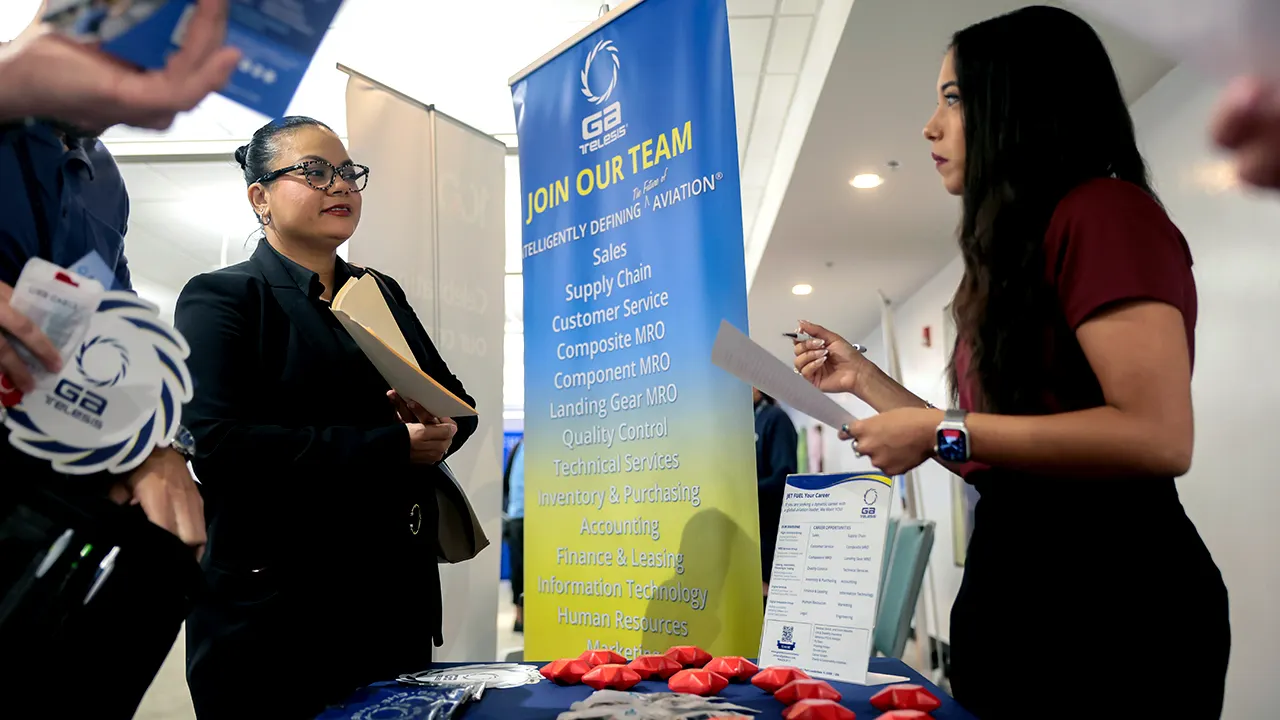
Citi Wealth head of economics Conrad Dequadros and FOX Business co-host Taylor Riggs analyze the S&P 500 hitting all-time highs under President Donald Trump’s economic policies on ‘Kudlow.’
Companies in the private sector added 44,000 jobs in July, payroll processing firm ADP said in its latest report on Wednesday.
The figure is below economists’ estimates of a gain of 70,000 jobs and down from the prior month’s revised 95,000 payrolls figure.
“Job-changers are highly sensitive to real-time economic conditions, and their rapid pay growth implies supply constraints in parts of the labor market,” said Nela Richardson, ADP’s chief economist. “Typical hiring patterns, meanwhile, are changing as employers react to shifting macro-economic conditions.”
THE COLLEGES THAT GIVE GRADUATES THE STRONGEST CAREER EDGE, ACCORDING TO LINKEDIN
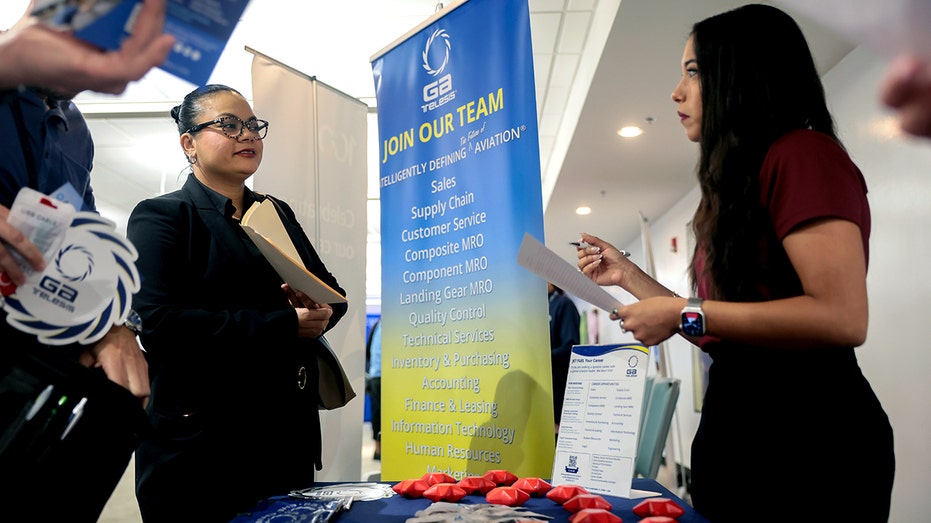
Companies in the private sector added 44,000 jobs in July. (Joe Raedle/Getty Images)
Which industries are hiring the most workers, according to the ADP report?
Education and health services added 36,000 positions, leading job creation in July. Financial activities added 10,000, professional and business services gained 9,000, and other services added 6,000.

Education and health services led hiring in the month of July, according to ADP. (iStock)
US WORKERS INCREASINGLY TRAPPED IN THE ‘GREAT DETACHMENT’ AS HIRING SLOWS, REPORT SHOWS
Information added 5,000 jobs, while manufacturing construction added 2,000 and 1,000 positions, respectively.
On the negative side, leisure and hospitality lost 11,000 jobs, trade, transportation and utilities lost 8,000, and natural resources and mining lost 6,000.
Large businesses – those with 500 or more employees – gained 13,000 jobs in July. Businesses with 50 to 499 employees gained 8,000 workers. Establishments with fewer than 50 employees gained 23,000 jobs.
SOUTHERN CITIES DOMINATE RANKINGS OF BEST JOB MARKETS FOR NEW COLLEGE GRADUATES

Small businesses hired 67,000 workers in May, according to the latest ADP data. (Getty Images)
People staying in their roles saw their pay climb 4.4% from the prior year, while pay gains for those changing their jobs accelerated to 7% – the largest year-over-year increase since August 2025.

According to a Reuters report, the Trump administration is drafting a ban on US imports of new models of Chinese data centre components, citing four people familiar with the matter. The move is aimed at protecting the infrastructure supporting the rapid growth of artificial intelligence.
Also Read |PNB Housing Finance shares rally 5% after Q1 profit rises 4% YoY, loan assets jump 15%
The report further said that the Federal Communications Commission (FCC), which oversees the US telecom industry, is working on a measure to bar imports of new Chinese optical transceivers. These components enable data to travel over fibre-optic cables at the speed of light within data centres.
The move, which has not been previously reported, aims to prevent Chinese firms from stealing data, installing malware or disrupting services at US data centres that house the chips used to train and run AI models.

Reuters reported that the FCC could still modify or shelve the proposed restriction, with sources speaking on condition of anonymity due to the sensitive nature of the matter. However, the move marks another effort by the Trump administration to limit Chinese technological influence in critical US industries before such products become embedded in supply chains.
“Transceivers definitely pose a risk. As the data centre buildout scales up, you want to make sure the data centre supply chain is secure from the get-go,” said Divyansh Kaushik, an AI policy expert at Washington, DC-based advisory firm Beacon Global Strategies.In an exchange filing on Tuesday, HFCL said its board has approved a further expansion of its optical fibre and optical fibre cable manufacturing capacities, with a total capital outlay of around Rs 400 crore. The expansion will be funded through an appropriate mix of internal accruals and debt, as required.
HFCL said the decision was supported by its strong order book for optical fibre cable (OFC) and optical connectivity products, a robust pipeline of additional business opportunities, and a favourable long-term global demand outlook.
The company added that demand is being driven by rising investments in artificial intelligence (AI) infrastructure, hyperscale data centres, cloud computing, high-performance computing, 5G deployments, FTTH and broadband expansion, enterprise fibreisation, rural connectivity initiatives and telecom network modernisation programmes.
Also Read | MapMyIndia shares drop 8% despite strong Q1 earnings; PAT jumps 8% YoY
This proposed expansion is in addition to the company’s ongoing expansion programme. The board has now approved an additional capacity expansion of 4.60 million fkm per annum in optical fibre (OF) and 14.0 million fkm per annum in optical fibre cable (OFC) capacities. Upon completion of these expansion programmes, HFCL’s total OF manufacturing capacity will increase to 38.50 million fkm per annum, while OFC manufacturing capacity will rise to 56.36 million fkm per annum.
The proposed expansion is expected to be completed by July 2028. It is aimed at helping the company cater to rising demand for OFC and optical connectivity products across domestic and international markets, while addressing requirements from existing customer commitments, a healthy order book and an expanding business pipeline.
The Reuters report also highlighted that such a ban could increase costs for US cloud firms such as Amazon Web Services, as they may have to shift to alternative suppliers, including US-based Coherent and Lumentum.
Earlier, the FCC had imposed similar curbs on Chinese drones, routers, robots and inverters.
(Disclaimer: Recommendations, suggestions, views and opinions given by the experts are their own. These do not represent the views of The Economic Times)

Strictly Come Dancing 2026 Cast: ‘The Dogfather’ Graeme Hall Joins Line-Up

Best Betting Sites Ireland 2026

Bitcoin sales and $4 billion cash reserve fuel STRC’s recovery toward par value


-

 Business7 days ago
Why Trees Belong on the Risk Register
-

 Fashion5 days ago
Weekend Open Thread: Wit & Wisdom
-

 Politics5 days ago
Meta enters AI-training agreement with far-right ‘propaganda rag’ Newsmax
-

 Politics3 days ago
Zack Polanski: an incitement to murder Nigel Farage?
-

 Crypto World4 days ago
MicroStrategy Post-Earnings CLARITY Act Push Could Add New Catalyst for Its Stock
-

 Crypto World4 days ago
XRP Ledger v3.3.0 brings five institutional features
-

 News Videos6 days ago
Bitcoin Enters the 3rd Stage of the Bear Market
-

 Politics6 days ago
Luke Littler’s dominance sparks GOAT debate
-

 Sports6 days ago
Seema Kaliramna Wins Discus Throw Bronze, Takes India’s CWG Medals Tally To 17
-

 Crypto World5 days ago
New York sues Kalshi over prediction market gambling
-

 Crypto World3 days ago
Crypto PAC spending tops $2M in Michigan House race
-

 Business5 days ago
Trump Announces Hamas Disarmament Agreement as Iran Strikes Kuwait Air Base and US Attacks Pause Overnight
-

 Tech3 days ago
ESET tracks rise in malicious AI skills and adaptable malware
-

 Business3 days ago
DTCR: Deleveraging And A Hedge Fund Collapse Point To A Possible AI Bottom
-
 Crypto World5 days ago
3 Fed Officials Just Explained Their Rate Hike Vote: Is Inflation Winning?
-

 Tech5 days ago
Gemini Spark can now use Chrome logins and saved passwords to run errands on your behalf
-

 Tech5 days ago
Building A Reproduction PlayStation Motherboard
-

 NewsBeat6 days ago
Four people die trying to cross Channel in small boats
-

 Sports4 days ago
France Cricket implodes: letters hidden in a drawer and a board at war
-

 Crypto World4 days ago
Moneyflip CEO charged in $40K murder-for-hire plot
You must be logged in to post a comment Login