


A+E After Dark series 7 captures unprecedented access to Belfast’s Royal Victoria Hospital A&E department, showing the night shift reality for NHS staff
The gripping documentary series A+E After Dark makes its return for a seventh series on Thursday evening on 5 Star.
This new season has been filmed within the A&E departments of Norfolk and Norwich University Hospital, Newham Hospital in East London, and Royal Victoria Hospital in Belfast.
The programme provides extraordinary access to the night shifts where staff come under immense pressure, face violent incidents and make critical life-or-death decisions.
The opening episode features disturbing racist abuse directed at an A&E nurse in Newham, desperate efforts to save both a stabbing victim and their attacker in Norwich, and four injured young men involved in a 70mph collision during adverse weather conditions in Belfast.
A synopsis for episode one states: “At Norfolk and Norwich University Hospital, doctors race to save both victim and attacker after a shocking stabbing brings two critically injured men into A+E at the same time.”, reports the Mirror.
“In Belfast, a high-speed crash during extreme weather leaves multiple patients at risk of spinal injuries, while an elderly woman undergoes a painful procedure for a broken femur.
“Meanwhile in Newham, security intervene when a patient refuses to stop live streaming inside the department, and in Norwich, a team fights to restart a patient’s heart during a sudden cardiac arrest.”
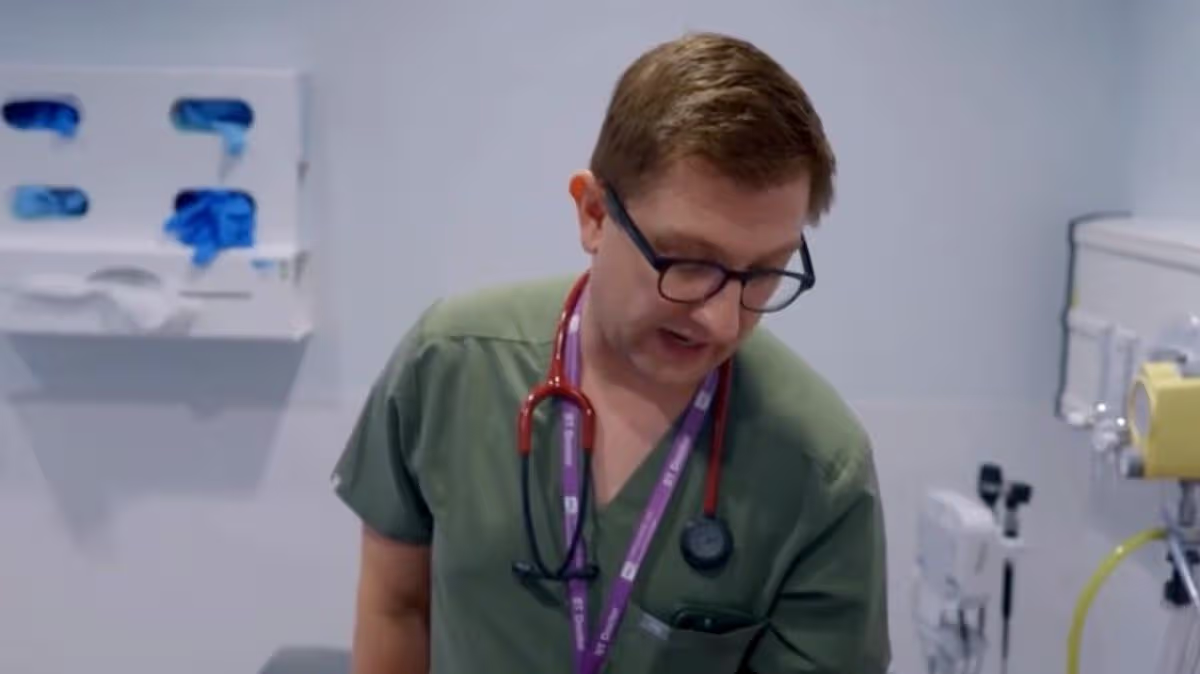
In a chilling preview clip of the Belfast collision, four young men are seen being rushed into the department following a high-impact car crash at 70mph.
The programme then shows Doctor Michael assessing one of the front-seat passengers, David, who is experiencing considerable discomfort. In a recorded segment, Doctor Michael elaborates: “Obviously, the faster the car is going, the more severe injuries you will get.”
While examining David, Doctor Michael indicates the patient will require X-rays of his face, neck, lower back and knees to ensure there are no fractures or breaks.
This comes as NHS England sadly reports a three-year peak in violence directed towards staff. Nearly 1 in 7 NHS employees (14.47%) suffered physical assaults from patients or members of the public last year, with a record figure of staff experiencing unwanted sexual behaviour, climbing steeply to almost 1 in 3 ambulance personnel (31%), while 9% reported encountering discrimination – the highest proportion ever documented, according to fresh statistics from NHS England.
A+E After Dark documents the unrelenting nature of nocturnal emergency care throughout the UK. The latest series tracks committed teams in Belfast, Newham and Norwich as they contend with fatigue, overcrowding and mounting violence while striving to preserve lives.
**A+E After Dark airs on 5 Star at 9pm on Thursday 2 April and is available to stream on My5. You can follow the series on **Facebook** and **Instagram** and **TikTok.









































You must be logged in to post a comment Login