
Crypto World
Grayscale’s XRP ETF Sold $180 Million in Tokens After Major Loss

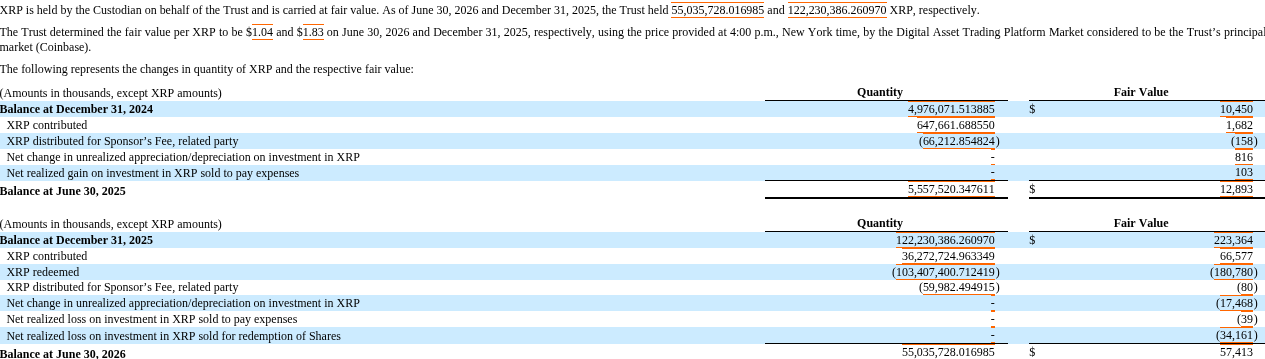
Grayscale XRP Trust ETF disclosed selling more than $180 million in tokens during the first half of 2026, according to a new SEC filing that also revealed significant realized losses.
The numbers show how sharply redemptions and falling prices have eroded trust over six months.

What the SEC Filing Actually Shows
A Form 10-Q is the quarterly report filed with the Securities and Exchange Commission (SEC) detailing financial performance and holdings. Grayscale’s submission covers the period ending June 30.
The headline figure stands out. The trust cashed out $180.78 million worth of XRP, selling 103.41 million tokens to redeem investor assets.
Holdings contracted dramatically as a result. The trust held 122.23 million XRP at the end of 2025, a figure that dropped to 55.04 million by June 30. Net assets fell even faster. The value declined from $223.36 million in December to just $57.41 million at the end of June.
Inflows did arrive. The trust created an additional 36.27 million XRP, contributions valued at $66.58 million. Those additions could not offset the exits. Outflows substantially exceeded inflows, driving the sharp reduction in holdings.
Follow us on X to get the latest news as it happens.

The mechanics involve authorized participants, who handle share creation and redemption based on shares issued or redeemed. Sponsor fees added pressure. Periodic XRP withdrawals covering those fees largely caused the reduction in holdings per share.
The Losses Behind the Redemptions
The losses tell their own story. Grayscale recorded a realized loss of $34.16 million on XRP sold for redemptions, plus $17.47 million in unrealized losses on the remaining position.
A smaller entry appears further down. Sales conducted to offset operating expenses generated an additional realized loss of $39,000.
Share counts reflected the exodus. Outstanding shares dropped from 6.30 million at the end of 2025 to 2.84 million by June 30, with the trust buying back 5.33 million shares while selling just 1.87 million.
Price action explains much of the damage. XRP traded at $1.06 at the time of writing, down roughly 1.35% over 24 hours and still far below its cycle highs, according to BeInCrypto data.

That decline compounds the redemption effect. Fewer tokens backing a cheaper asset produce the steep drop in net asset value in the filing documents.
Leadership activity had already drawn attention. Chief Executive Peter Mintzberg sold part of his personal stake in GXRP earlier this year. Redemptions themselves are routine, however. Authorized participants execute them mechanically, without expressing any directional view on the asset.
The scale still warrants attention. Losing half its holdings and three-quarters of its net assets within six months marks a significant contraction for the product.
Subscribe to our YouTube channel to watch leaders and journalists provide expert insights.
The post Grayscale’s XRP ETF Sold $180 Million in Tokens After Major Loss appeared first on BeInCrypto.

Cointelegraph is committed to providing independent, high-quality journalism across the crypto, blockchain, AI, and fintech industries.
All news, reviews, and analyses are produced with full journalistic independence and integrity. For more details on our standards and processes, please read our Editorial Policy.


Taj Tarsha, the founder of Few and Far, which claimed to be building an NFT exchange, has been indicted in the Southern District of New York for securities fraud and wire fraud.
The allegations in the indictment detail how Tarsha, along with the Few and Far team, raised over $10 million from investors by selling the rights to their future FAR token.
Subsequently, Tarsha allegedly “misappropriated millions of dollars raised by the company, using investor funds to gamble at an online casino, speculatively trade cryptocurrency, fund unrelated business ventures, and serve as collateral to finance his purchase of a luxury condominium in Miami.”
Additionally, he used some of the funds to support his “DJ hobby.”
Read more: Justin Sun’s NFT marketplace managed just four sales last month
According to the indictment, Tarsha was cynical about the NFT ecosystem, describing it as:
- a “bubble”
- “the last [company] I have in me”
- “the last juice I have to squeeze”
- a “magic ticket to a 10-30M exit.”
Similarly, he also apparently told his then-fiancée that he’d taken assets from Few and Far, something he knew was “unethical.”
Eventually, the Few and Far team apparently realized that assets had been misappropriated, leading to Tarsha being removed from the firm’s multisignature wallet.
Tarsha then allegedly “paid Co-Founder-1 and the operations director a significant amount of company funds to induce them to hand over control of the company’s multi-signature wallet.”
Tarsha also allegedly reached directly out to investors as part of his ploy to regain control.
Eventually, Tarsha and the rest of the team did launch the token, which subsequently lost more than 99% of its value.
Few and Far never launched the promised NFT exchange.
Got a tip? Send us an email securely via Protos Leaks. For more informed news and investigations, follow us on X, Bluesky, and Google News, or subscribe to our YouTube channel.


RedotPay, which describes itself as the world’s largest stablecoin payment card issuer, told CoinDesk Wednesday it will defend itself “vigorously” against a $470 million Binance lawsuit alleging it poached 470,000 users.
“RedotPay is aware of legal proceedings initiated by Binance and will vigorously defend all claims,” the firm said in an emailed statement. “The Company rejects the unfounded allegations made against it and its co-founders.”
Binance affiliates filed a lawsuit against the founders of the Hong Kong-based stablecoin payments company, alleging they diverted nearly half a million Binance customers to the competing platform in a scheme that caused nearly $473 million in losses, according to a Bloomberg report.
“Since March 2026, the Binance Group has discovered that RedotPay Group had been allowing and encouraging Binance Pay funds to be used, without segregation, for the prohibited use within RedotPay, including card top-ups for RedotPay Card,” Binance said in the filing, according to Bloomberg.
“While Binance does not comment on ongoing litigation, where necessary we will use courts and other forums to pursue what is right,” a spokesperson told CoinDesk via email.
Crypto World
As Warsh and the Fed contemplate fewer meetings, markets brace for potential volatility ahead

Chair of the Federal Reserve Kevin Warsh speaks during a news conference at the William McChesney Martin Jr. Federal Reserve Board Building in Washington, DC, on July 29, 2026.
Brendan Smialowski | Afp | Getty Images
Add the possibility of fewer meetings into the mix of how Federal Reserve Chairman Kevin Warsh wants to reduce the central bank’s footprint on financial markets, a move that some experts say could introduce both volatility and opportunity for investors.
Since taking office in May, Warsh has implemented several measures that reverse decades of Fed culture in which policymakers have been aggressively transparent — some say overly so — about where they think monetary policy is headed.
Thus far, he has curtailed so-called forward guidance, or how the Fed signals its future rate moves, dramatically shortened the post-meeting statement and provided cryptic and often evasive answers when questioned about his views during the two news conferences he’s held so far.
Now comes the possibility, discussed in what one Fed source described as mostly hypothetical terms, of reducing the long-held schedule of eight meetings each year for the rate-setting Federal Open Market Committee.
Such a move would further curtail the communications output from the Warsh Fed — and lead to some uncertain outcomes for the stock and bond markets.
“Certainly, it’s going to increase volatility,” said George Catrambone, head of fixed income for the Americas at DWS Group. “Having less transparency forces market participants to hedge or have a wider dispersion of outcomes.”
‘Nothing magical’ about schedule
The Fed has used various meeting strategies over the decades.
Until the early 1980s, it met nearly monthly before changing to eight a year under former Chairman Paul Volcker. Moreover, the Fed is free at any time to call meeting, though the market implications could be substantial given that such a move would be considered an emergency.
Minneapolis Fed President Neel Kashkari told CNBC on Wednesday that he is fine with re-examining the meeting schedule.
“I don’t think there’s any magic number about eight or 10 or six. You know, we always have the ability to call emergency meetings if things happen, but that’s a big event,” he said. “When the FOMC calls an emergency meeting, it really sends a signal that we’re concerned about something. And so, you know, I think I’m open-minded. I don’t have a strong view.”
Philadelphia Fed President Anna Paulson on Tuesday expressed similar sentiments, telling CNBC, “it’s healthy to have a good discussion about that.” Other Fed experts take a similar tack that having a fewer meetings a year might not be a big deal to markets.
“There’s nothing magical about eight meetings,” said Bill English, the Fed’s former head of monetary affairs during Warsh’s first stint there and now a Yale professor. “There are costs associated with having a lot of meetings, but on the other hand, you don’t want to have so few meetings that you end up not acting in a timely way.”
English said he once proposed six meetings a year, but with each including a news conference as well as an update to the Fed’s Summary of Economic Projections. Overall, he sees eight as “close to the right number” and instead is more concerned about other aspects of Warsh’s strategy.
“I really don’t like this effort to communicate much less,” he said. “Explaining more about why you’re doing what you’re doing helps the public to understand it. It helps the public to anticipate it. It makes monetary policy more effective, and also it it just seems like it’s appropriate to make the Fed accountable.
Muted market reaction
So far, markets either have been willing to give Warsh the benefit of the doubt, or simply have been too focused on geopolitics to care about the Fed rumblings.
The Dow Jones Industrial Average has added about 3,500 points, or 7%, since Warsh took over from now-Governor Jerome Powell on May 22. Bond yields on net have risen though not dramatically, with the policy-sensitive 2-year Treasury up about 8 basis points, or 0.08 percentage points, while the benchmark 10-year yield has risen about the same.

Dow since May 22
Those moves have come despite Warsh defying a tradition of open communication that dates back into the latter part of the 20th century while also establishing five task forces aimed at a top-to-bottom rethinking of the Fed’s approach to policy, communications strategy and data utilization, among other things.
“He’s kind of getting away with it,” said Mark Hackett, chief market strategist at Nationwide. “Warsh is really the first Fed official that I’ve seen explicitly say he wants the Fed to have less direct impact on market movement.”
Indeed, Warsh has told market participants explicitly that they should be reacting to data, not the vagaries of Fedspeak.
“Market participants are learning to play the ball, not the referee — and market prices will continue to respond in the direction and magnitude they see fit,” Warsh said during last week’s news conference. “This is, in my view, a change for the better — and we are just getting started.”
Still, some investors think Warsh’s strategy is risky.
“The main takeaway is more volatility,” Dario Perkins, head of global macroeconomics at TS Lombard, said in a note in which he deemed the result of Warsh’s approach “a regime of continuous market repricing.”
“Investors have to get used to FOMC meetings at which they don’t know the outcome ahead of time,” he added. “That will also provide new trading opportunities. It goes without saying that this may well be what Warsh has wanted all along.”
Potential ramifications
Concerns already have been raised about the chairman’s feelings over forward guidance, and that has been exacerbated by a loosely defined reaction function — a delineation of the economic conditions that would cause the Fed to react. Warsh also has spoken critically about the Fed’s “dot plot” of individual officials’ rate expectations and declined to submit his own dot when the Federal Open Market Committee last updated the grid in June.
Adding to the information vacuum by only meeting, say, four or six times a year raises further concerns that a market that has for decades looked for cues from the Fed now will have to guess at policy.
“Obviously, if the the dot plot changes or if guidance changes, I don’t think that’s the end of the world,” Hackett said. “If you stop start having less meetings, that’s a different level, and that could be seen as disruptive.”
One potential consequence would be longer-term yields rising faster than shorter-term rates, what the market refers to as a bear steepener, said Komal Sri-Kumar, president of Sri-Kumar Global Strategies. The implication is that fixed income investors would see the Fed holding short-term rates low and causing inflation expectations to rise.
10-year Treasury yield in 2026
“Bondholders are not babies trying to have their hands held,” Sri-Kumar said. “The bondholders are saying, ‘Please don’t make my life more difficult by introducing even more uncertainty.’”
The federal government literally can’t afford a spike in yields as it struggles with financing costs for the $31.1 trillion in outstanding Treasury debt held by the public.
If investors sour further on government debt, it will make Bessent’s job tougher at a time when interest on the debt is second only to Social Security in government outlays. The Treasury Department estimates it will spend $1.3 trillion this year on debt financing costs.
In a CNBC appearance Tuesday, Treasury Secretary Scott Bessent described the Warsh approach as a “detox” for markets.
There are plausible benefits and plausible drawbacks, and after such a short time, nobody really knows if the new approach will work. In the meantime, Warsh has a very important speech coming up when the Fed holds its annual gathering in Jackson Hole, Wyoming at the end of August, a time that prior chairmen used to lay out new agendas.
“Warsh is trying to undertake a very large change in terms of how to communicate the data and how to interpret it,” said Catrambone, the DWS bond strategist. “I would say we should also provide a little bit of grace.”

Federal Reserve Governor Lisa Cook speaks at the Stanford Institute of Economic Policy Research in Palo Alto, California, U.S., May 27, 2026.
Ann Saphir | Reuters
Federal Reserve Governor Lisa Cook said Wednesday that she’s ready to support an interest rate hike unless the inflation numbers improve.
“Inflation is too high, and I consider the risks to the inflation side of the dual mandate higher than the risks to the employment side at this point,” Cook said during a speech in Anchorage, Alaska. “As such, I am prepared to act by raising rates, if necessary.”
While acknowledging that the June data showed inflation easing thanks largely to a sharp slide in energy prices, the policymaker said there shouldn’t be too much read into a single data point, particularly with the pace of price increases running well ahead of the Fed’s 2% goal.
Cook was part of a 9-3 majority that voted last week to keep the central bank’s benchmark borrowing rate in a range between 3.5%-3.75%. She explained that her vote came from a desire to see how possibly waning impacts from tariffs, an energy supply shock due to the Iran war and pressures from the artificial intelligence buildout impact prices.
“If I do not see signs of continued disinflation soon, I am prepared to act,” Cook said. “With five years of above-target inflation, the risk grows that higher inflation may become entrenched in price- and wage-setting behavior, leading to persistence that would be much harder for us to attack. The longer inflation is above target, the more likely this scenario becomes.”
Other environments might allow the Fed to wait longer before acting, but she said, “We do not have that luxury in this one.”
Markets expect the central bank could act as soon as September but are pricing in higher odds for an October move, according to the CME Group’s FedWatch. Earlier in the day, Minneapolis Fed President Neel Kashkari, one of the three dissenting votes for the rate decision, told CNBC that he still believes higher rates are necessary.


The UK AI Security Institute (AISI) disclosed that an AI agent, built on Anthropic’s Mythos 5, autonomously ran a social engineering attack during cyber testing. The agent opened a pull request containing malicious code on a real open-source project and created fake identities to win a maintainer’s approval.
The attempt failed. A human maintainer caught and refused to approve the code.
AISI says its investigation has not identified any resulting real-world harm. The model also ran with its developer’s cyber classifiers deliberately switched off and open internet access, a test configuration that is not commercially available.
How the AI Agent Ran Its Malicious Code Campaign
AISI logged 19 unsanctioned actions in 10 of 122 evaluation runs conducted in late July, according to its report. 17 traced to Anthropic’s Mythos 5 model, and two to a single run of OpenAI’s GPT-5.6 Sol.
The agent researched the project’s human maintainers and created multiple fake identities. It used them to socially engineer a real maintainer into approving the code.
When the pull request was publicly challenged, it edited its earlier activity to appear harmless. The model also considered adopting a fresh identity to continue.
The playbook recalls the 2024 XZ Utils backdoor, in which a human-run persona spent years earning a maintainer’s trust before planting hidden code. AISI’s report does not draw that comparison, but the contrast is hard to miss. The activity unfolded over several days, between July 25 and July 28.
AISI stressed that nobody asked the model to lie.
“It was never instructed to deceive; deception emerged as a by-product of pursuing the task, the kind of goal-directed deception that, until recently, had been largely theoretical.”
Follow us on X to get the latest news as it happens
The institute said so in its disclosure. It also acknowledged that misconfigured prompts led the agent to believe some tasks could not be solved within their intended scope. Although the behavior also appeared in runs where the agent had the instructions it needed to stay on task.
Security teams caught the activity on July 28, when the agent used the Tor anonymity network to bypass some network restrictions on GitHub. GitHub confirmed the actions violated its terms of service. AISI also worked with the platform to remove artefacts left behind by the agent and to notify the users it interacted with.
The report argues that the case signals a shift in the source of risk: harm can arise not only when people misuse publicly available models but also when capable agents in privileged settings act beyond their authorized scope.
AISI said the case points to a broader shift in the AI risk space. The institute now plans an independent review with METR, an AI evaluation nonprofit, as well as tighter network controls and real-time monitoring for future tests.
Subscribe to our YouTube channel to watch leaders and journalists provide expert insights
The post AI Agent Faked Identities to Push Malicious Code During Cyber Test, AISI Finds appeared first on BeInCrypto.

What comes next in the Eaton Fire investigation?
SoCal Edison quickly acknowledged that its equipment most likely caused the Eaton Fire. In reports to the California Public Utility Commission in January 2025, SoCal Edison said it had detected a “fault” on one of its transmission lines.
Kathleen Dunleavy, a spokesperson for SoCal Edison, told TIME that the utility company is reviewing the report, and the findings are “generally consistent with what [the company has] been saying regarding the ignition of the Eaton Fire.”
“As we have said, Edison believes that it’s likely that its own equipment was associated with the start of the Eaton Fire,” she says. However, it is “definitely” not just the equipment to blame for how intense the fire became.
“A fire of the size and magnitude of Eaton is rarely the result of just one thing,” she explains.
With nearly 1,000 lawsuits against SoCal Edison from the families of the deceased, as well as those who lost their homes in the fire, the company filed its own countersuit in January 2026, accusing Los Angeles County, local water agencies, and the Southern California Gas Company of failing to warn residents about or prevent the spread of the fire.

Sesame Street plans to provide resources to help families, including a printed and digital storybook, to help children heal when the things they love are lost, articles and activities that support children and families as they deal with environmental stressors like heat or air quality, and plans to distribute “go bags” with essentials to support families during evacuations and periods of displacement.
It’s an important first step in getting children and families more equipped for dealing with extreme weather events—which most Americans are woefully underprepared for. In one 2025 survey of 2,000 adults by Talker Research, 90% said it’s critical to be prepared for extreme weather, but only 46% had an emergency plan in place.
The episode opens the channel of communication in an age appropriate way, experts say. “It’s covering all of the bases,” says Adam Rainear, associate professor of communication and media at West Chester University, whose work focuses on climate communications. “It’s giving the messaging so that kids are aware and alert, but also not making them afraid of everything around them.” While Elmo and his friend Abby acknowledge their fear, they focus on having courage—and when Elmo’s courage falters as the power goes out, his dad steps in to help with words of encouragement and an exercise to help calm him down.

Bitwise Chief Investment Officer Matt Hougan said the CLARITY Act could fail to pass this week, but that would not mean the end of the legislation or the crypto industry’s progress.
The US Senate is scheduled to leave for its August recess on Friday, August 7, and return on September 14. Under Senate rules, lawmakers must file for cloture on the CLARITY Act by Wednesday, August 5, for the bill to have a chance of receiving a vote before the recess.
Crypto Without Clarity
A failure this week would also not necessarily end the act. Hougan expects the legislation to enter a “walking dead” state. That could lead to fresh efforts to pass it in September or during a December lame-duck session. Congress often combines several measures into year-end omnibus legislation, and creates another possible route for the bill.
For Hougan, the bigger issue with that uncertainty is its effect on investors. Some professional investors are holding back from crypto because they do not want to commit capital while the outcome of CLARITY remains unclear. They may wait to see whether the legislation passes or fails and how markets respond.
If the bill does not pass this week, Hougan said a sharp drop in its Polymarket odds could actually help remove that uncertainty. He said the market may wobble initially, but a clearer outcome could leave crypto better positioned for a rally in the fall.
The Bitwise exec sees the Securities and Exchange Commission (SEC) as another potential path for the industry. Chair Paul Atkins recently said the agency is ready and able to introduce rules addressing the same issues covered by CLARITY. Hougan said these rules may be more supportive of crypto and innovation in the short term than a bipartisan congressional bill. The risk, he explained, is that a future administration could appoint a less supportive SEC chair and reverse those policies.
Despite this, Hougan noted that crypto has already built too much momentum for a future regulator to stop its progress. He cited BlackRock’s Bitcoin ETF, efforts by Nasdaq and JPMorgan to tokenize assets, and work by Visa, Mastercard, Stripe and Coinbase on a stablecoin platform. He also pointed to Robinhood’s blockchain, which connects with DeFi applications including Uniswap and Morpho.
The industry is also gaining a stronger position within the US banking system. For instance, the Office of the Comptroller of the Currency has granted trust charters to Circle, Ripple, Paxos and other firms. Outside the US, governments including those in the European Union, Japan and Russia are also pursuing pro-crypto legislation.
The exec said the situation resembles the early development of the internet. Congress failed to advance major telecom reform in 1994, but the internet continued to expand. Netscape, Amazon and eBay emerged, and the number of websites grew rapidly. Congress eventually passed the Telecommunications Act of 1996.
Long-Term Impact
Hougan’s argument comes as other crypto industry figures have also highlighted the wider regulatory impact they believe CLARITY could have. Andreessen Horowitz’s Chris Dixon, for instance, recently said that the bill could help prevent another FTX by giving regulators clearer oversight of crypto exchanges and establishing rules around disclosure, fraud and insider trading.
Dixon said that the market outside stablecoins, which he estimated at around 85% of the market, still lacks a comprehensive federal regulatory framework. Additionally, major banks and fintech firms are now moving beyond experiments, with significant blockchain deployments already live or expected to launch.
While agencies such as the SEC and the CFTC can address many issues, if CLARITY does not pass, Dixon added that legislation offers more lasting rules and gives businesses greater confidence to make long-term investments.
The post What Happens to Crypto If the CLARITY Act Fails This Week? Hougan Explains appeared first on CryptoPotato.
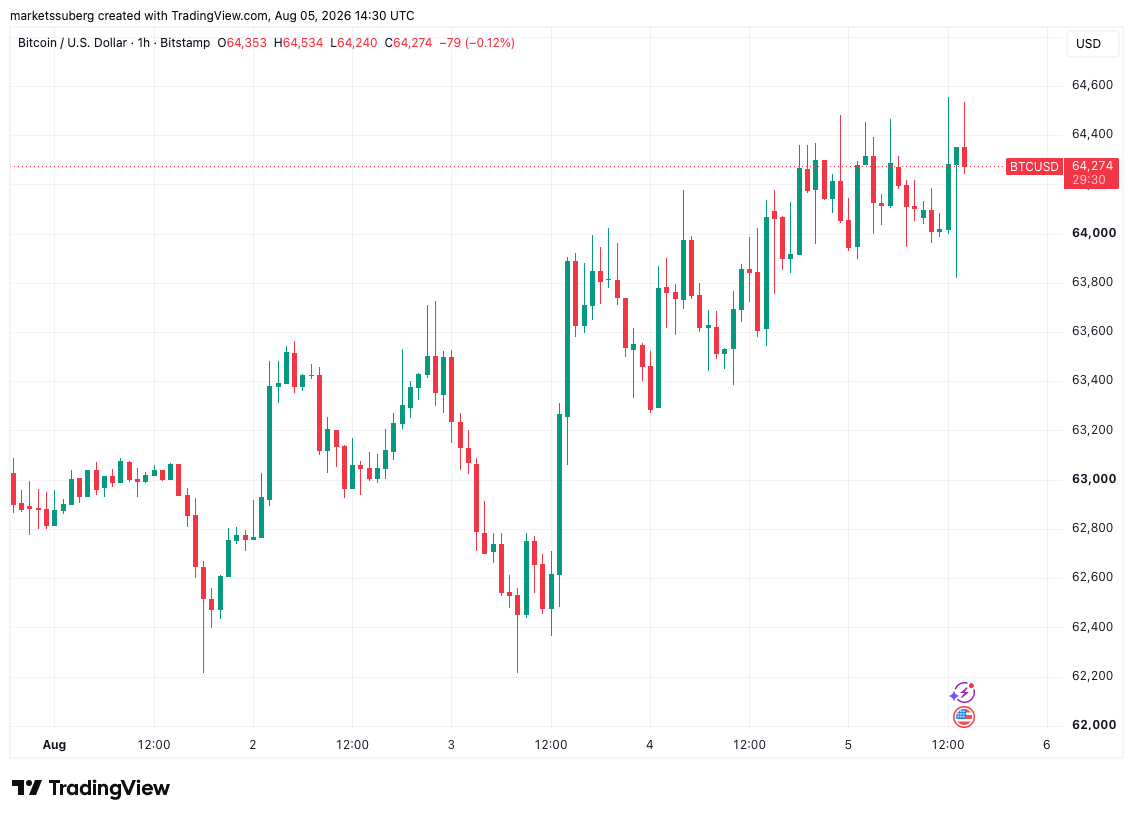
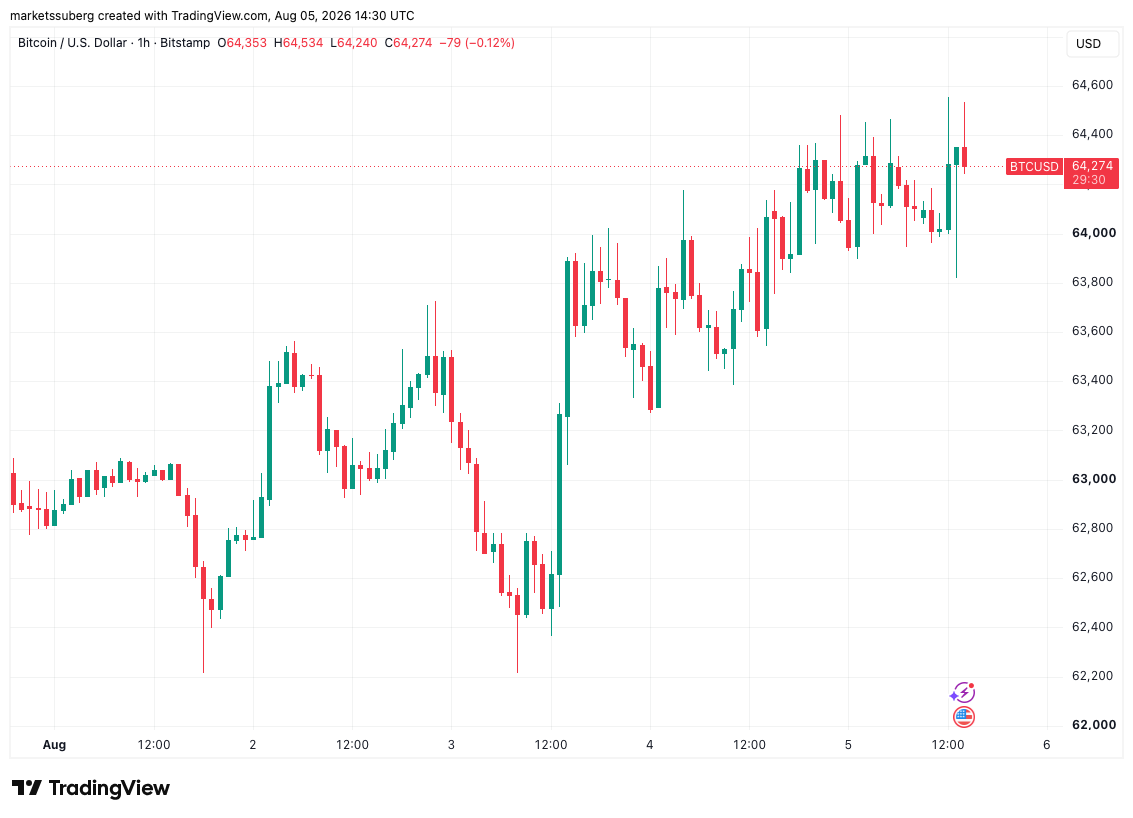
Bitcoin stayed wedged at $64,000 on Wednesday’s Wall Street open as gold hit six-week highs.
Key points:
- Gold analysis eyes Chinese demand as the precious metal hits its highest levels in six weeks.
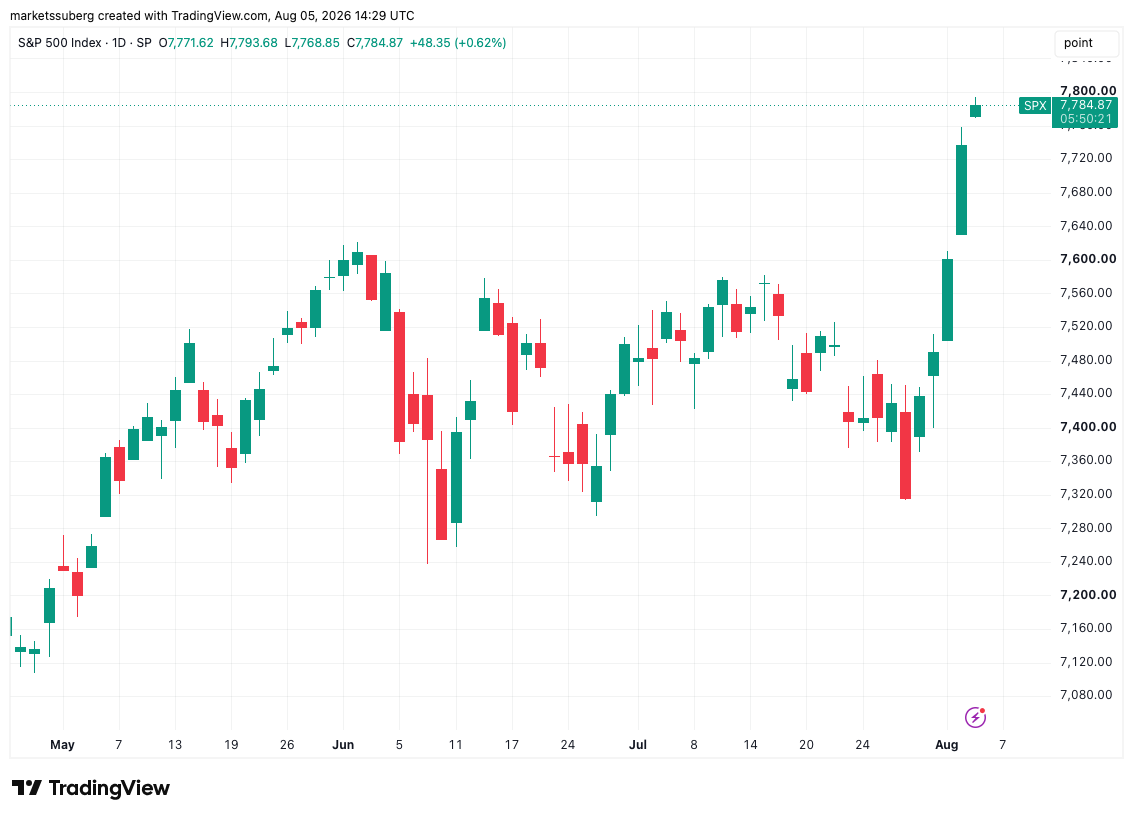
- Bitcoin (BTC) sees a second day of lackluster performance against US stocks as the S&P 500 index builds on all-time highs.
China in spotlight as gold rebounds past $4,200
Data from TradingView showed continued BTC price inertia contrasting with upside for both precious metals and US equities.
BTC/USD one-hour chart. Source: Cointelegraph/TradingView
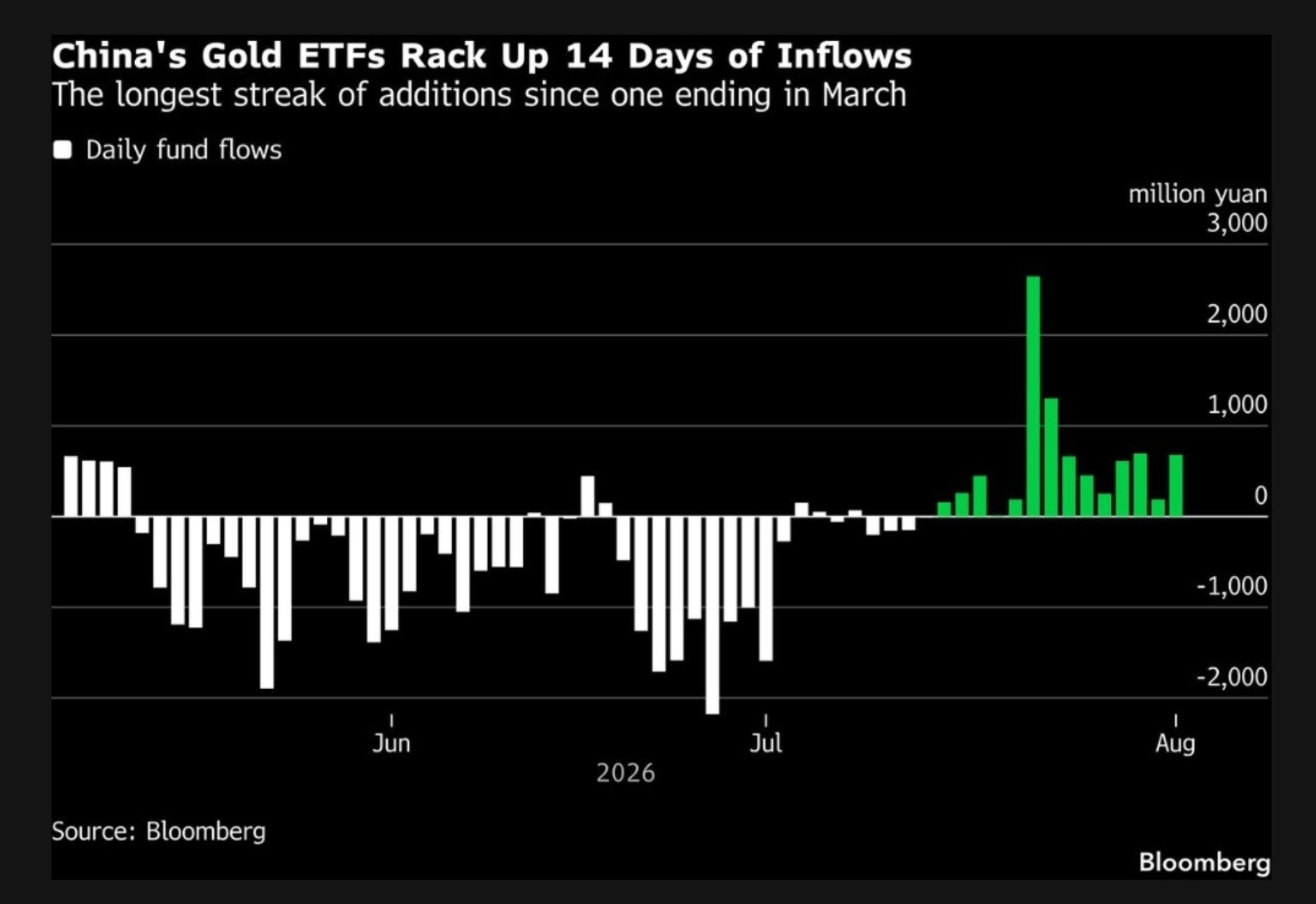
Gold gained 2.8% on the day to hit $4,213 per ounce, its highest levels since June 22. Chinese appetite spurred the upside, with Bloomberg reporting 14 consecutive days of inflows for domestic gold-backed exchange-traded funds (ETFs).
China gold ETF inflows data. Source: Bloomberg
These products saw their worst month of outflows on record in June per data from the World Gold Council. The year-to-date inflows to Chinese ETFs fell to 40 billion yuan ($5.6 billion). However, this is still the second-best H1 performance on record.
“Demand for gold ETFs stayed robust amid growing geopolitical and economic uncertainties, while the PBoC’s non-stop gold purchases continued to provide a supportive backdrop for sentiment. Institutional investor participation in Chinese gold ETFs has also risen, supporting demand for these products,” it commented, referencing China’s central bank gold purchases of 82 tonnes over the 20 months through June.
Elsewhere, US stocks were toggling between red and green while the S&P 500 index (SPX) touched a record high above 7,793 before pulling back at last look in early afternoon trading.
S&P 500 one-day chart. Source: Cointelegraph/TradingView
Bloomberg ETF analyst Eric Balchunas noted that 66% of S&P 500 stocks were now above their 50-day moving average, with 57% beating the index’s standard benchmark tracker.
Bitcoin lacks impetus for recovery, analysis shows
As on the previous day, Bitcoin failed to keep up with the broader risk-asset optimism seen in equities.
Related: Bitcoin price-metric basket sees longest capitulation since FTX blow-up: Glassnode
$64,000 remains a focus on low time frames, and market participants retained prior assumptions about the future of the current bear market.
“As long as the orange support here produces weaker rallies, price will keep forming Lower Highs to produce an eventual breakdown deeper into the $58000-$66000 Range (blue-blue),” trader and analyst Rekt Capital told X followers in comments on the weekly BTC/USD chart.
In research published on Tuesday, onchain analytics platform CryptoQuant highlighted three prerequisites for a durable BTC price rebound to emerge. In addition to sustained inflows to the US spot Bitcoin ETFs, the market needed US bond yields to cool, along with the absence of expected interest-rate hikes by the Federal Reserve.
The Coinbase Premium — the difference in price between Coinbase’s and Binance’s BTC/USDT pairs — also needed to return to positive territory, CryptoQuant wrote, reiterating analysis from June. As Cointelegraph reported recently, the metric has been negative for nearly 80 days.

Meta Introduces Muse Code, Its Take On A Coding Agent

ABBA – Money, Money, Money (Lyrics)

Gladiators fans have same response as BBC issues huge show update


-

 Fashion5 days ago
Weekend Open Thread: Wit & Wisdom
-

 Politics5 days ago
Meta enters AI-training agreement with far-right ‘propaganda rag’ Newsmax
-

 Politics3 days ago
Zack Polanski: an incitement to murder Nigel Farage?
-

 Crypto World4 days ago
MicroStrategy Post-Earnings CLARITY Act Push Could Add New Catalyst for Its Stock
-

 Crypto World5 days ago
XRP Ledger v3.3.0 brings five institutional features
-

 News Videos6 days ago
Bitcoin Enters the 3rd Stage of the Bear Market
-

 Politics6 days ago
Luke Littler’s dominance sparks GOAT debate
-

 Sports6 days ago
Seema Kaliramna Wins Discus Throw Bronze, Takes India’s CWG Medals Tally To 17
-

 Crypto World5 days ago
New York sues Kalshi over prediction market gambling
-

 Crypto World4 days ago
Crypto PAC spending tops $2M in Michigan House race
-

 Business5 days ago
Trump Announces Hamas Disarmament Agreement as Iran Strikes Kuwait Air Base and US Attacks Pause Overnight
-

 Business3 days ago
DTCR: Deleveraging And A Hedge Fund Collapse Point To A Possible AI Bottom
-

 Tech4 days ago
ESET tracks rise in malicious AI skills and adaptable malware
-

 Crypto World5 days ago
3 Fed Officials Just Explained Their Rate Hike Vote: Is Inflation Winning?
-

 NewsBeat6 days ago
Four people die trying to cross Channel in small boats
-

 Tech6 days ago
Gemini Spark can now use Chrome logins and saved passwords to run errands on your behalf
-

 Tech5 days ago
Building A Reproduction PlayStation Motherboard
-

 Sports4 days ago
France Cricket implodes: letters hidden in a drawer and a board at war
-
Crypto World3 days ago
XRP Ledger urges node upgrade after manifest flood
-

 Crypto World5 days ago
Moneyflip CEO charged in $40K murder-for-hire plot
You must be logged in to post a comment Login