Let’s begin with a story from the beginnings of western philosophy that doesn’t sit well with existentialist thought.
In Plato’s Symposium, a character called Aristophanes gives an account of love. He tells us that human beings originally had doubled bodies, with two heads, four arms and four legs. As a punishment for threatening the gods, however, Zeus cut each of them in half.
Now, these half humans, with just one head and one pair of arms and legs, find themselves adrift in the world, searching for the other half of themselves that would make them whole.
This, for Aristophanes, is the origin of love – the desire to return to a lost unity and to become whole. Why this story appeals to us is that it captures our intuition that love is destiny, and that there is someone out there who will take away our feeling of incompleteness.
Advertisement
For the existentialist, however, this feeling of incompleteness points to a fundamental truth about being human. For them, we are this tension. We are thrown into the world we haven’t chosen, but we are still responsible for the sense we make of our lives. This is what the existentialists mean by the slogan: existence precedes essence – there’s no script of our lives.
In his Symposium, Plato wrote that humans were once made up of two conjoined beings before half of them was wrenched away. Scott72/Canva
We become who we are through what we do, in a world defined by contingency and transience. Aristophanes here gives us the comforting illusion that there is some essence or meaning to our lives given before we exist – that there is someone out there who will resolve the tensions of being human by making us whole, if only we can find them.
For the existentialist, stories like Aristophanes’ cover over irresolvable tensions with being human rather than solving them. Think about the idea of finding “the one”. For the existentialist, behind this project is really one of putting the script back into our lives. Love proves that our lives have meaning.
If the aim of love, then, is to resolve our own feelings of anxiety at being cast adrift in a world, then we’re unlikely to really connect with another person. Rather, what will be important about them will be the role they play in our life.
Advertisement
Think about our desire to be the centre of someone else’s world. For existentialist philosopher Jean-Paul Sartre, this is less about them than it is about the place they give us in their lives: their love for us becomes a proof that our own life has meaning. From here, we ask for what our lover cannot in good faith give us – the certainty that we will occupy that place: “you’ll always love me, won’t you?”
It sounds as if love is not so much a relationship, but a project we use to insulate ourselves from our own fears. It lets us believe the meaning of our lives comes from the outside while ensuring that we stay safely on the inside.
Stepping back from love itself, we can see another tension, however.
Advertisement
A more positive possibility for love
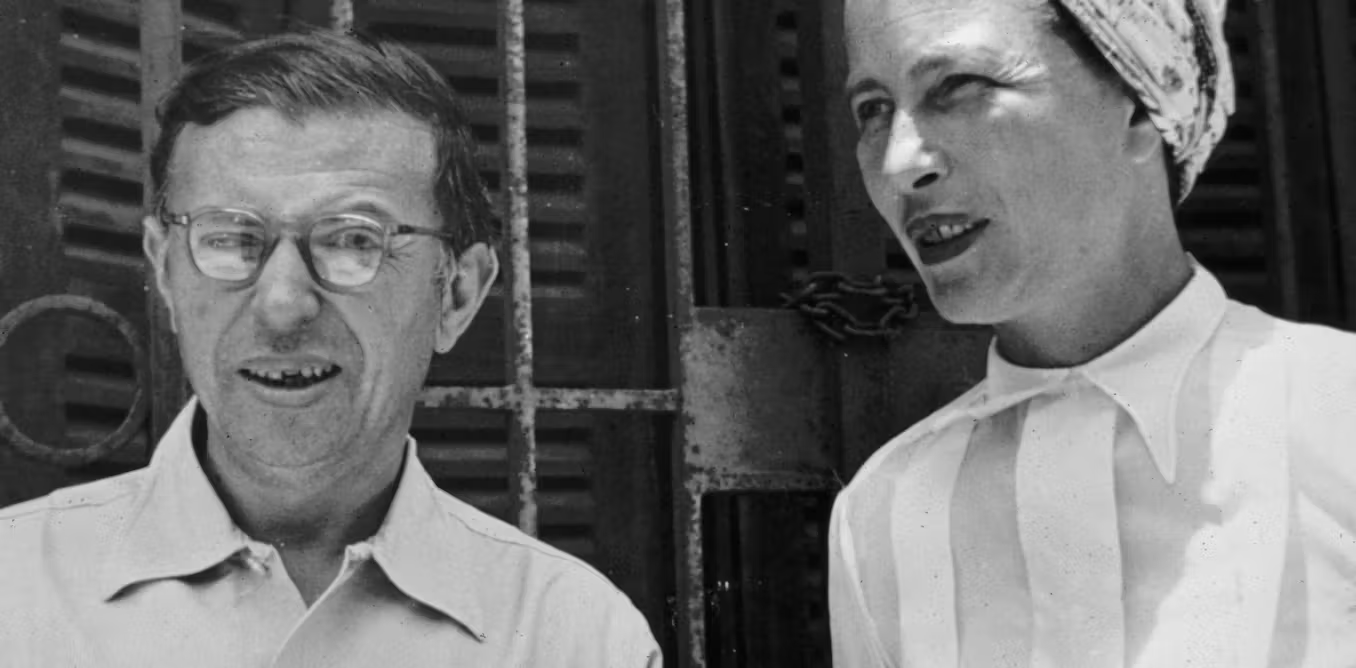
When we think of Sartre and Simone de Beauvoir, whose lifelong partnership combined romantic and intellectual commitment with a deep insistence on personal freedom, it’s difficult not to see a model of romantic love.
At the beginning of the second world war, Sartre wrote to de Beauvoir: “Never have I felt so forcefully that our lives have no meaning outside of our love, and that nothing changes that, neither separation, nor passions, nor the war. You said it was a victory for our morality, but it is just as much a victory for our love.”
There is here, then, a more positive possible account of love.
For Sartre, this possible positive love is not an attempt to resolve the tensions in what it is to be human. Rather, to love authentically is to love in full understanding of the tensions of time and freedom.
Advertisement
Love’s aim, on this account, is not to escape time, but to embrace it together. This means loving, in the moment, absolutely, while recognising that just as we can always disavow our past, this moment, in the future, will itself become another past that we may disavow.
Loving is, then, not using the ideal of love as a project to step out of time, to hide. Instead, it involves the recognition that being with another within time entails living with fragility and transience, and that what makes this love human is the possibility of change.
Rejecting love as an ideal, and the lover as a role to be played, allows us to see our lovers not simply as a foil for our own projects, but as another person, with all the complexity and singularity a human being contains. In this, we find ourselves outside of ourselves, exposed in a world where failure is always possible.
But with such exposure there is also the possibility of a genuine connection with another human being. As Søren Kierkegaard, the first existentialist, puts it, in love, we do not love the “other I”, but the “you”. Love, then, becomes the rejection of destiny for authenticity.

Advertisement
Looking for something good? Cut through the noise with a carefully curated selection of the latest releases, live events and exhibitions, straight to your inbox every fortnight, on Fridays. Sign up here.

Water covers over 70% of our planet, so it’s no wonder that it flows through our storytelling. Biblical rain offered divine judgement either in the form of a blessing and rewards, or retribution and vengeance. In Shakespeare’s Twelfth Night, Feste the fool issued the melancholic refrain: “For the rain it raineth every day.” It reminded the audience of the persistence of suffering in life.
Filmmakers worldwide have revered the visual beauty and the metaphorical value of rain on screen, letting it augment many a classic scene, sequence or speech. Technically, rain intensifies mise-en-scène (the overall visual presentation on screen, combining set design, lighting, props and more): it catches backlight and renders air itself visible, creating depth and shimmer.
And as our global weather patterns undergo changes, media researchers have suggested that engagement with cinematic weather conditions like rain can allow for an “ecological meta-narrative” that connects humans (both on and offscreen) with their environment.
Whether depicting solitude, decay, adversity or romantic destined love, rain in movies emotes as much as a character would. Here are ten key moments where rain took a starring role in film – just perfect for watching on a wet day.
Advertisement
1. Singin’ in the Rain (1952)
The famous scene from Singin’ in the Rain.
Few scenes invert bad weather more joyfully than Gene Kelly’s iconic number. After a night of salvaging their disastrous film project, The Duelling Cavalier, actor Don Lockwood (Gene Kelly) realises that he has fallen for the bubbly singer Kathy Selden (Debbie Reynolds). On his ebullient walk home, a legendary song and dance number turns the perceived bad weather on its head with the cheerful refrain: “Come on with the rain, I’ve a smile on my face.”
Kelly reportedly performed the sequence while running a fever, and the scene’s exuberance reframes rain not as obstacle but as liberation. The uplifting choreography sees Kelly splashing through puddles that reflect streetlights, making the urban space of the set design feel elastic and alive.
2. Seven Samurai (1954)
Rain heightens the brutal physical clashes in filmmaker Akira Kurasawa’s Seven Samurai. As the Samurai face their final battle, the rain (which has been used throughout to add mood and tone) is as cruel and violent as any of the antagonists, amplifying the pressure with its muddy, disorientating and visceral presence in the conflict.
Advertisement
Kurosawa was meticulous about weather effects, using wind, dust and rain to choreograph movement within the frame. The downpour turns the battlefield into sludge, erasing clear footing and underscoring the film’s meditation on chaos, class struggle and the cost of collective defence.
3. Breakfast at Tiffany’s (1961)
The downpour in Breakfast at Tiffany’s.
The final reunion scene of Breakfast at Tiffany’s raises the emotional stakes with its unrelenting rain. In a taxi to the airport, Holly Golightly, played by Audrey Hepburn, tries to run away and abandon her emotional commitments to struggling writer Paul Varjak (George Peppard) and the stray cat she’s adopted.
After an incensed Paul watches her throw the cat out into the rain, he exits, determined to rescue the soggy feline. As she tearfully joins him, her character arc is complete. The storm forces Holly quite literally to stop running, confronting the emotional commitments she has tried to evade.
Advertisement
4. Network (1976)
In Network, a New York rainstorm provides the ultimate backdrop for anchorman Howard Beal’s (Peter Finch) unhinged and rain-drenched live rant. The drumming of rain against studio windows suggests a world outside the sealed, commodified space of television as, in a renowned monologue, he berates the news channel’s manipulation and society’s disintegration with the famous line: “I’m as mad as hell, and I’m not going to take this any more.”
5. Point Break (1991)
Point Break’s final rain scene.
In Point Blank, rookie FBI agent Johnny Utah (Keanu Reeves) confronts Bodhi, a bank-robbing surfer played by Patrick Swayze, in the rain. The weather ultimately enables him to evade capture by allowing him to ride one last big wave; something both know he will never survive.
Here, rain acts as a redemptive force. Bodhi seeks exoneration through the only thing he respects – nature.
Advertisement
6. The Shawshank Redemption (1994)
In prison drama The Shawshank Redemption, Andy’s (Tim Robbins) Raquel-Welch cell poster hides a hidden escape shaft, years in the making while he endured time for a crime he didn’t commit.
Wading through a sewer tunnel he finally emerges to a torrential downpour, holding out his arms and facing the heavens in a symbolic act of cleansing, salvation and freedom. Rain here washes away not guilt, but injustice.
7. Four Weddings and a Funeral (1994)
The rain Carrie ‘doesn’t notice’ in Four Weddings.
Rain doesn’t always have to represent high drama. In the Richard Curtis-penned film Four Weddings and a Funeral, American Carrie’s (Andie MacDowall) famously cheesy line, “Is it still raining, I hadn’t noticed?” puts the seal on her romance with bumbling but charming British Charles (Hugh Grant) and secures the star-crossed lovers a future.
Advertisement
The actors were reportedly freezing during the rain rigged shoot. Rigs often rely on using cold water and multiple takes.
8. Magnolia (2000)
Magnolia’s frenzied collective experience of a thunderstorm of frogs will forever capture the imagination of the more surreally minded. In this scene, rain symbolises the universal chaos of life and binds disparate characters into a shared reckoning.
9. The Notebook (2004)
The rainy reunion of The Notebook.
The physical brutality of heavy rain underscores heartbreak, loss and forgiveness in decades-spanning The Notebook as Ryan Gosling and Rachel McAdams’ separated lovers Noah and Allie reunite after family has dictated their separation.
Advertisement
A sweepingly romantic scene in a sleeper hit turned cult favourite, the downpour legitimises emotional excess – tears indistinguishable from rain.
10. Blade Runner (1982)
The demand of three of the most challenging filming elements – smoke, night shoots and rain – had the crew of Ridley Scott’s futuristic dystopian Blade Runner christen the film “Blood Runner” as 50 nights of filming in constant artificial rain took a physical, mental and logistical toll.
Whether depicting disorder or harmony, life-enhancing joy or unprecedented destruction, rain remains a valuable visual medium and narrative tool for filmmakers.
What’s your favourite rain scene in cinematic history? Let us know in the comments below.
Advertisement
Looking for something good? Cut through the noise with a carefully curated selection of the latest releases, live events and exhibitions, straight to your inbox every fortnight, on Fridays. Sign up here.
Like the Welsh Conservatives, who are also committed to reversing the legislation, Reform UK have identified frustration with the 20mph limit in Wales as a widespread and emotive issue that it hopes will help to propel the party to seat gains in the election. It is currently second in the polls, behind the centre-left Welsh nationalist party Plaid Cymru.
Reform said it will scrap the “blanket approach” to the speed limit, but would still have it around schools and hospitals. Welsh Labour have also said that some roads will return to 30mph under its plans.
Meanwhile, the Wales Green party leader Anthony Slaughter suggested that the party could push for extensions to 20mph coverage in local government, speaking to the BBC Radio 4 Today programme in January.
Advertisement
Polling by More in Common shows that the 20mph limit is the best known of the current Welsh government’s policies, with 90% of respondents confirming awareness, but also the second most unpopular. Some 55% of people polled considered that the change reflected negatively on Welsh Labour, compared with 21% who viewed it positively.
Yet, for others the 20mph limit is a flagship achievement. Lee Walters, the former transport minister who introduced the legislation, has admitted mistakes in the way it was introduced, but told BBC Wales: “The data and evidence shows that it will save lives, and in time it will settle down.”
The history of 20mph limits
The legislation reduced the default speed limit on so-called “restricted roads” in Wales (essentially roads in built-up areas) from 30mph to 20mph.
Part of the aim was to reduce the number of collisions and injuries from road collisions (as well as the cost to the National Health Service of treating these casualties), encouraging walking and cycling, and improving health and wellbeing.
Advertisement
As elsewhere in Britain, 20mph zones already existed in high-risk sites such as outside schools. Exceptions also applied to the 20mph default, with local authorities identifying roads where a 30mph limit would remain.
There’s a division of opinion over 20mph speed limits in Wales.
Overall, the 20mph limit currently applies to 37% of the road network in Wales. The policy featured in both the Labour and Plaid Cymru manifestos for the 2021 Senedd (Welsh parliament) election. It was also supported by the sole Liberal Democrat Senedd member, when introduced.
Conservative Senedd members voted against the legislation. The measure was controversial, with noisy opposition from sections of the public.
A lack of consistent polling makes it difficult to track public opinion on the issue. Polls in October 2023 and July 2024 recorded 54% and 72% of Welsh voters opposed to the 20mph limit respectively, but no more recent poll has directly asked about the policy.
However, a softening of attitudes over time was identified by an analysis of posts on the social media platform X at implementation in September 2023 and six months later. Not only did comments become less negative towards the change, but the content also evolved. Right after implementation, tweets focused on politics, especially criticisms of Welsh government.
Advertisement
Six months later, discussion shifted toward everyday impact: improved safety around schools and residential streets, benefits for pedestrians and cyclists and urban mobility such as buses and traffic flow. Although political criticism remained, misinformation decreased and conversation became more grounded in lived experience, with safety, especially for children and communities, more prominent.
Psychologists refer to this movement as the Goodwin Curve: when behaviour people are anxious about doesn’t materialise, their attitudes soften and they become more accepting of policy change.
Early reports on the impact of the 20mph speed limit were anecdotal. More than two years after implementation, however, there is a growing body of objective evidence on its effects, especially around speed and collision data. The most recent figures show that average speeds for road traffic in Wales have fallen by 3.3 mph.
Relatedly, there has been a marked reduction in both collisions and casualties on roads where the speed limit changed from 30mph to 20mph. In 2024, the first full year after the change, collisions on 20mph and 30mph roads combined were down 23.5% compared with 2022, and casualties were down by 25.8%.
Advertisement
Evidence of environmental and social impacts is less conclusive. Early monitoring shows no material change in air quality (NO₂, PM₁₀ or PM₂.₅) in pilot areas up to April 2024, and analysis of CO₂ emissions is still ongoing. Impacts on walking and cycling also remain unclear, as post-implementation active travel data has not yet been reported.
Speed and the Senedd
So, why are speed limits back on the election agenda? Reform and the Conservatives both cite the cost of the policy, estimated at £32 million. Yet, as journalist Will Hayward points out, this spend has already happened and returning to 30mph would also be expensive.
The significance of 20mph to Reform and the Conservatives is about setting the tone of the election. It is an issue that speaks to the continuing scepticism of some of the Welsh electorate towards devolution.
What’s more, the issue encapsulates different visions for Welsh society. For the rightwing parties, opposition to the 20mph limit reflects a championing of individualism and “common sense” against the perceived intrusive paternalism of the left. As Farage told journalists in Newport: “It’s an example of government saying we know what is best for you, and you must comply with us.”
Advertisement
Reform UK has targeted car drivers as a potential voting base before. Reform-led councils in England have vowed to dismantle low-traffic neighbourhoods, for instance, even in areas that didn’t actually have them.
For some leftwing politicians, on the other hand, the 20mph speed limit is emblematic of a devolved Welsh government taking bold, pioneering action for health and environmental wellbeing. Reductions both in collisions and in motor insurance premiums could be presented as evidence of delivering benefits to Welsh people.
Labour and Plaid Cymru are unlikely to want the 20mph speed limit to be a major topic in the election, and would prefer to focus on issues around jobs, education, health care and public transport. Whether they can achieve a swing to those issues as the primary topic of discussion will be down to the public’s interest, and possibly media coverage.
“Knowing that Charlotte Bankes is behind me – such an incredible rider – kind of loosens me up,” he said. “And I know that when I’m loose, I can ride really well.” As well as the physicality of an event that involves descending more than 150m in altitude while dealing with 24 turns and obstacles, Bankes also showed vast calm shortly before the semi-final.
With the clock counting down, she got hold of a screwdriver herself to help change the binding – the part that attaches the ski-boots to the snowboard – after a breakage in the previous round. “It put a bit of stress on the coaches and the wax techs, but they were great as well to let me change it,” she said.
Bankes and Nightingale had previously also won the world mixed snowboard title together in 2023, with Olympic gold the one major medal missing from Bankes’s stellar career. Born in Hemel Hempstead to British parents Mark and Kate, the family moved to the southern Alps when she was only four and she competed for France in two Olympics until 2018 before switching allegiance to the country of her birth.
Advertisement
Nightingale had also honed his craft in the Alps, moving with his parents from Bolton when they opened a B&B in Westendorf, some 15km from the legendary Kitzbühel slope. His parents, Clive and Christine, were overcome with emotion at the bottom of the piste in Livigno. A group of his best friends from Westendorf also certainly made themselves heard at the bottom of the slope.
“I cry at anything,” said his tearful father Clive. “Long Lost Families, Steve McQueen getting caught in barbed wire in the Great Escape, but this is indescribable.”
His mother Christine added: “Huw played a blinder today. He wasn’t just playing safe. He really attacked.”
It added up to Britain’s greatest Olympic performance on snow following previous peaks of bronze medals by Morgan, Jenny Jones and Izzy Atkin. All 13 other previous Winter Olympic golds had been won on ice, with Team GB having now surpassed their record gold-medal tally, and trying to get past their best overall medal haul of five at a Winter Games in both 2014 and 2018.
Staff and punters were delighted to see him drop in ahead of his Talking Sopranos show at the Waterfront
A very special visitor stopped by The Garrick Bar in Belfast this weekend while on his UK tour.
Advertisement
Staff were delighted to see The Sopranos star Michael Imperioli drop in on Saturday ahead of his Talking Sopranos show at the Waterfront Hall on Sunday.
Imperioli, who played Christopher Moltisanti, and Steve Schirripa, who starred as Bobby Baccalieri, are bringing their hugely popular podcast to the Belfast stage to enthral fans of the hit HBO series, with tales from behind the scenes and insights into how it was made.
But before that Imperioli thrilled bar staff and punters at the busy Chichester Street bar when he made a surprise appearance.
Advertisement
Posting on social media earlier today, The Garrick said: “Great to see @realmichaelimperioli popping in yesterday ahead of his @talkingsopranos show tonight after we visited his bar @scarletloungenyc last year in NYC!”
They added: “Did you know the late great James Gandolfini visited the Garrick around 97/98. He was trying to pick up the Belfast accent for a Broadway play so he sat in the comer of the bar for a few hours drinking half pints and taking notes.
“The Sopranos hadn’t come out here at that stage so he was able to blend in with some anonymity. He’s pictured here alongside previous managers Daryl McGuinness and Bernard O’Niell, by all accounts he was a nice guy taking the time to talk to the staff.”
Want to see more of the stories you love from Belfast Live? Making us your preferred source on Googlemeans you’ll get more of our exclusives, top stories and must-read content straight away. To add Belfast Live as a preferred source, simply click here.

Israeli airstrikes have killed at least 11 people in Gaza, local officials say, including in a blast at a tent encampment housing displaced families.
The IDF said the action was in response to ceasefire violations by Hamas.
A fragile ceasefire between Israel and the militant group has existed since October, but more than 570 Palestinians have been killed since then, according to Gaza’s Hamas-run health ministry.
The latest strikes come just days before the first meeting of President Donald Trump’s controversial Board of Peace.
Advertisement
Medics in Gaza said an Israeli strike on a tent encampment killed at least four people.
Meanwhile, health officials said another strike killed five people in Khan Younis in the southern part of the territory
Airstrikes also targeted what was thought to be a commander of the Islamic Jihad group, an ally of Hamas, in the Tel Al-Hawa neighbourhood in Gaza City.
An IDF official called the strikes “precise” and in accordance with international law, claiming that Hamas had repeatedly violated the October ceasefire.
Hamas spokesperson Hazem Qassem accused Israel of committing a new “massacre” against displaced Palestinians.
Israel and Hamas have repeatedly traded blame for alleged violations of the ceasefire deal.
In other news: Palestine Action ban ruled unlawful
Advertisement
Meanwhile, Nasser Hospital in Gaza has condemned a decision by Doctors Without Borders to pull out of operations over concerns about armed men.
Also known as MSF, the medical organisation said security breaches posed “serious” threats to its teams and patients.
The hospital said the increase in armed men was due to a civilian police presence aimed at protecting patients and staff.
“They had to pay for the bullet that killed their son,” Nasrin says with a mix of anger and disbelief.
She’s telling me the painful details of the day her nephew, Hooman, was killed during recent protests in Iran.
The 37-year-old had joined demonstrations against the regime in Lahijan, in the north of the country, when his family says he was fatally shot by government forces in early January.
“Hooman took to the streets without a weapon. He didn’t even have a small rock in his pockets to defend himself, but he was shot with a military bullet,” his aunt says.
Advertisement
Her distress is palpable.
Throughout the interview she oscillates between heartbreak and utter exhaustion at her powerlessness.
Now living in Germany, Nasrin explains it isn’t safe for her to return to Iran so she cannot hold her family as they grieve.
All she has left of Hooman is a framed photo which she kisses as she cries.
Advertisement
Following her nephew’s death, she explains his relatives went to collect his body but were told it had been moved to the city of Rasht, a place where authorities are also accused of a violent crackdown on protesters.
Image: Nasrin has laid bare the painful details of the day Hooman was killed during recent protests
Image: A picture of Hooman is prominent in Nasrin’s home
Nasrin says a friend in the city told her that the bazaar was set on fire and when protesters ran from the flames, security forces opened fire.
After the blaze, government-backed Iranian state TV aired drone footage of the aftermath which it said showed the scene “three days after the terrorist incident of the Rasht bazaar fire”.
Image: Protests began in Tehran in December over economic grievances, before spreading across Iran
Nasrin says when her family finally arrived at the place where Hooman’s body was being stored many other grieving families were already there.
“They saw so many people crying, all screaming, suffering in every way possible,” she explains.
“There were several containers. They said the body was in the containers. When they opened the doors, there were several corpses stacked on top of each other. They had to look for their son.”
Advertisement
She claims her relatives were told to bury Hooman immediately and had to sign a document when they left saying that they couldn’t talk about what had happened.
“They had to pay money for the bullet that killed their son,” she adds.
Advertisement
Hooman had been married for three years when he died.
His young wife is now a widow.
Image: Hooman was 37 when he was killed
In a post on social media his friend said an hour before Hooman was shot, he’d said if he didn’t return, he’d died so others could be free.
“Who do you think is responsible for his death?” I ask Nasrin.
“The Iranian government, the Mullahs. They’re all murderers, they all have the blood of the Iranian people on their hands,” she quickly replies.
Advertisement
“They shoot the young people and then they demand money for the bullet. Are these the people in power or are they murderers?” she adds.
Image: Nasrin has described her family’s grief after her nephew was killed
The exact death toll following the mass protests which began in late December is difficult to verify.
Iran’s government has released the names of around 3,000 people it says were killed, including civilians and security forces.
It blames rioters and foreign interference for fuelling the violence.
Advertisement
‘I have no hope about Donald Trump’
Following the crackdown, US President Donald Trump has sent warships towards Iran and repeatedly threatened to use force to make them reach a deal on their nuclear programme, but Nasrin says it’s not enough.
Protests in London against Iranian regime
“I have no hope about Donald Trump. They could already help many other Iranian people. They could do sanctions,” she says.
Advertisement
“The people of Iran can get rid of this government, but we need to help them. They don’t need war.“
I ask whether she would support foreign powers going into the country to overturn the regime, or if she believes lasting change can only happen from within.
“From within,” she replies, “From outside, they just want war, they want to destroy our country. We don’t want that.”
Powerless to push for change inside Iran – Nasrin has joined thousands of other Iranians at protests in Germany demanding democracy and justice for the dead; both demands may fail.
Advertisement
Sky News put the allegations made against the Iranian regime in this interview to the Iranian Embassy in London.
At the time of publication, we had not received a reply.
Notions Vintage is moving from the first floor of 22 Colliergate to a larger standalone site 300 metres away in Aldwark Mews, and is set to open on Wednesday, February 18.
Owner Cath Dickinson spoke to The Press at the new premises ahead of the move about plans for expansion of the vintage clothing company and introducing other pre-loved ranges to the shop.
Recommended reading:
She said: “There are three separate rooms here and hopefully, we’ll be adding to the range of vintage designer gowns, affordable jewellery, rare sportswear and original band t-shirts.
Advertisement
“We’re starting out with a small interiors range and are developing a line of gifts with a sustainable theme where possible.
“I think we’re also the only shop in York to have a distribution deal with Donegal Socks – the family are in their third generation staying true to the traditional manufacturing skills of their forefathers.
“If I can prise my husband’s hands off some of our duplicate vinyl albums we’ll have an expanded record range as well as CDs and cassettes.
“It’s great to see people wanting music they can touch as well as listen to again.
Advertisement
“We’re also planning to have artwork and prints in the shop.”
Cath Dickinson has also curated an exhibition of works in York Cityscreen from two late artists from York including JP Warriner (Image: Supplied)
Cath is currently juggling the shop move with her curation of a free exhibition of the works of two late York artists – Penny Marrows and JP Warriner in the bar and upstairs gallery of Cityscreen York in Coney Street, which runs until March 6.
She said she’s been collecting works of John Warriner for five years and some of his works will be available for sale at Notions Vintage.
Cath said she’s excited about showing everybody the new space and expanded range (Image: Kevin Glenton)
Returning to the shop in Aldwark Mews – the former Touch Tuina treatment centre – Cath was going over the finishing touches to the new shop ahead of the new opening.
Advertisement
She said: “I know I’m leaving a busy street, but the large proportion of people who visited 22 Colliergate did not come up to the first floor – we were hidden in plain sight to some extent and there was confusion over whether it was one shop.
“I wanted to be completely independent and create a space for Notions in its own right.
“This building gives me a great template with the wonderful curved windows, the aspect, the light and even the parquet flooring.
“The business model works and it needs more people coming through the door.
Advertisement
“It’s really nice people coming in the shop in pairs and seeing something vintage and remembering when they owned a similar piece, and I smile when I overhear them saying ‘I remember that Fila tracksuit’, or ‘I wish I’d kept that sheepskin’.
“I’ve made so many friends from being here and they always come in and say hi, so I’m so excited about showing them, and everybody, the new space and the expanded range.”
Notions Vintage is moving from 22 Colliergate to 6 Aldwark Mews and opens on Wednesday, February 18.
It removes excess moisture from the air, which can help eliminate mould and reduce musty smells in the rooms where you’re drying your laundry.
The cost of buying a dehumidifier upfront may not be especially cheap, but what are the long-term costs of running it?
Additionally, many people might be curious to know if it’s cheaper to run than a heated airer and what the costs are compared to a tumble dryer.
Advertisement
How much does it cost to run a dehumidifier?
Data from Uswitch.com suggests an 185W dehumidifier costs 10p per load of laundry it helps to dry (taking approximately two hours).
Depending on the size of your device, this could run even cheaper if you have a small one.
In comparison to a 3kWh per cycle tumble dryer, this sees an enormous saving, with it being 73p cheaper than the 83p cost.
You will make a yearly saving of £75.46 using a dehumidifier in comparison to a tumble dryer in these circumstances.
Advertisement
However, what is the cost compared to a heated airer?
Uswitch.com suggests the dehumidifier still comes out on top here, with a 300W heated airer costing 17p per load of laundry dried.
This is still a massive yearly saving in comparison to using a tumble dryer, with it being £68.89 cheaper in these circumstances.
Advertisement
Ben Gallizzi, energy expert at Uswitch.com, said: “To save energy and money, many of us dry wet clothes on radiators or airers during the cold months, instead of using a tumble dryer. But this results in lots of moisture being released into your home.
“The moisture can make rooms damp and create condensation on the windows and sometimes walls.
Recommended reading:
“Using a dehumidifier can remove excess water from the air, which helps combat condensation and prevent mould growth.
Advertisement
“The average dehumidifier uses 185W, which will cost you around 5p an hour in electricity, or 40p for eight hours.
“Tumble dryers use a lot more energy, with a typical machine consuming 3kWh of energy per load of washing. This would cost you 83p at the current standard tariff rates.”
Matt Weston wrote his name in the British Olympic record books as he teamed up with Tabby Stoecker to win a second gold medal at the Milan and Cortina games in the mixed team skeleton competition.
Weston had already claimed top spot in the men’s competition on Friday evening with a dominant performance and he showed why he is the best in world as he turned around a 0.3second deficit after Stoecker’s run to deliver victory by 0.17s.
That gold means he is the first British athlete to win two medals at the same Winter Olympics and joins dual women’s skeleton champion Lizzy Yarnold as the nation’s most successful athlete at the Winter Games.
He said: “There’s some great names in the British Winter Olympian history. I think to even consider putting my name next to those is a massive honour.
Advertisement
“I don’t want to be the one to say what position I am in there, but to have my name next to those is absolutely amazing. A lot of those guys have been a massive inspiration, especially within the sliding sports as well.”
Weston was unaware of the ground he had to make up on eventual silver medallists Susanne Kreher and Axel Jungk, instead focusing on his own start.
He explained: “When I’m at the top of the track I kind of put my helmet just low enough that I can’t see what the splits are. All I was doing was listening to my coach telling me the timings and all I could think was don’t false start.
“I was just staying very calm and trying to be collected, just tick the boxes, get the job done and hopefully that would have been enough and it turns out it was.”
Advertisement
Stoecker had finished fifth in the women’s competition on Saturday evening and had plenty of faith in Weston’s ability to find the time.
She said: “What an honour – it’s incredible. The medal is really heavy, it’s gold and I get to share it with Matt. It’s more than I could have ever hoped for.
“I think I crossed the line and then all I was really focused on was getting to the TV screen to watch Matt come down.
“He’s the individual Olympic champion and his standard of sliding is insane. So I had a lot of faith that he was going to lay down another exceptional run.
Advertisement
“But also it’s always nerve wracking when you have to watch the clock and the splits and you’re not sure how it’s going to go. But the flow that he has on the sled, it’s just unmatched, so from about halfway down I could feel that the gold was coming.”
Stoecker’s boyfriend Pat Atkin, who will be best man at Weston’s wedding in the summer, was among those waiting to celebrate at the Cortina Sliding Centre finish.
She added: “My boyfriend is there, but all my friends and family who have come out to watch, that’s just made it so special.
“I got to put my gold medal on my niece and nephew, they were saying how heavy it was and that’s just a moment that is going to last forever.
Advertisement
“All our families are really close and I consider Matt one of my best friends.”
Weston and Stoecker were winning the second gold of the day for Britain, following Charlotte Bankes and Huw Nightingale in the mixed team snowboard cross, to make it a landmark occasion for Team GB.
“It’s pretty special to be a part of that to be honest,” said Weston.
“I’m extremely proud of what I’ve been able to achieve in the past couple of days. Especially to win the first ever team event is absolutely amazing. To win it with such a great team mate is just the icing on the cake.
Advertisement
“I’m buzzing and I don’t know what’s next to be honest – probably the pub!”
Is Super Smash Bros. coming to Switch 2? (Nintendo)
The Monday letters page realises that the next gen Xbox will be able to play PS5 games, as one reader hopes Bluepoint Games isn’t working on God Of War.
Games Inbox is a collection of our readers’ letters, comments, and opinions. To join in with the discussions yourself email gamecentral@metro.co.uk
Nintendo logic So, Sony has had a successful State of Play, their best in years I’d say, and Xbox’s was good too (I’ll be honest, I can’t remember anything about it, but I remember the buzz was decent). That means that Nintendo is the next one to have a showcase, but we still don’t have a date for it.
I’ve seen some rumours that it’ll be March, but I feel that’s just the obvious guess anyway. But my question is what will they be talking about? All we know about from them at the moment is Fire Emblem and Splatoon Raiders and while I don’t think many people here would consider them a particularly big deal you just don’t know with Nintendo.
Advertisement
But surely they must be preparing to announce at least one new triple-A game (or whatever you’d call them with Nintendo). It’s probably not Animal Crossing or Zelda, because the timings don’t work out, so to me the two obvious options are Super Mario or Smash Bros.
You might say Mario is the most obvious, but Nintendo has been so weird about it so far I don’t think there’s any guarantee they’ll suddenly become predictable. My bet would be on Smash Bros., with some new characters and other minor new content. Not the most thrilling choice, in my opinion, but the logical choice. I would expect it to be the big game for Christmas. Ishi
Expert, exclusive gaming analysis
Sign up to the GameCentral newsletter for a unique take on the week in gaming, alongside the latest reviews and more. Delivered to your inbox every Saturday morning.
Advertisement
Perfect prelude There was a lot of good stuff at the State of Play but it didn’t shake my opinion that Resident Evil Requiem is the most exciting game at the moment and the one I’m most looking forward to. The new footage looked great and so has everything else before it. I don’t think I’ve ever seen a game not make a single mistake before release and always look like a must have.
If it turns out to be a dud after all this I will actually be really impressed that Capcom has been able to hide it so well. I don’t expect that will be the case though and while I’ll still wait for the reviews I’m predicting this will be one of the best game of this year and probably the whole generation. Don’t let me down now! Purple Ranger
Stuck in Sparta I tend to agree with the Reader’s Feature about God Of War. Sons Of Sparta looks bad and a remake trilogy does sound like a big wasted effort, given those earlier games were nothing like the new ones in terms of gameplay or story. It’d be tragic if Santa Monica Studio were wasting their time on it, but it’d be just as bad if it were Bluepoint Games, doing it – which is something I’ve heard fans talking about.
Advertisement
It’s not that remaking the game itself is a terrible idea, it’s just that by doing that you’re locking out talented developers for five years or more. Developers that could be busy moving the franchise forward or just generally not redoing something that already exists and you can play as remasters. I just don’t see any good outcome, because if they get a no-name dev, like with Sons Of Sparta, then that drastically decreases the odds that it will be any good. Focus
Two Keanus I didn’t think much of the state of play. The hair on the back of my neck when the John Wick trailer started playing. It would have been obvious to anyone that has watched at least one of the films it was a John Wick game.
But that’s tempered by the fact that I’m an old gamer that remembers when movie tie-in was just another way of saying a game was a poor quality, rushed cash-in. Remember The Matrix game?
Advertisement
GoldenEye 007 was the first game I remember that was based on a film that turned out to actually be good. TomTom
For the love of the game Interesting comparison of Sony and Valve’s attitude in the Reader’s Feature at the weekend. I would not have thought of the comparison myself, but it does work. I think the problem for both companies is that ordinary games – basically anything but a mega hit – have become too small for them to bother with.
This seems a mistake to me though, as in Sony’s case they lose out on a key incentive in buying their console. But for both companies it’s a waste of talent and knowledge that has taken years to build up and is no longer being used properly. As long as a profit is made why not make them anyway, for the kudos alone?
Advertisement
That worked for Astro Bot, which wasn’t a big hit but made people think better of Sony for a while. Soras will probably be similar, but I feel we need a lot more of that, multiple times a year. Tenna
Only on PlayStation Perhaps I’m just being slow here, but I realised that if the next gen Xbox is just a PC in console’s clothing, as it were, then that means that all PlayStation 5 games will, eventually, be on Xbox. I guess it doesn’t really mean much, since Microsoft doesn’t get a cut of the sales or anything, but we may finally have our all-in-one single format (except for Nintendo, but that was never going to happen).
For years that seemed like something to really wish for but now that it’s actually close to happening it feels like nobody will actually care. In the end, the PC has been the single format all along (especially for those using emulators) and Microsoft putting the Xbox logo on a different machine isn’t going to change that.
I think we’ll soon begin to realise that, in terms of consoles, single format domination is a bad thing. People are upset about Sony not releasing more first party games but now that the Xbox has slipped into irrelevance they have no incentive to change.
Advertisement
Why spend all that money when you’ve already proved it doesn’t matter to whether your game Is a success or not? Sony won by doing nothing so there’s no incentive to do more next time. Tom Meadows
Last gen I’ve been watching Nioh 3 a bit on Twitch and wondered whether or not it should have been a dual console release. I can’t see any reason it couldn’t work on the PlayStation 4. Surely they could lower the resolution or whatever it was that stopped a version on PlayStation 4. It seems like Sony left money on the table with this decision. To me at least it still looks the same as Nioh 1 and 2.
Pretty sure there’s still millions of PlayStation 4 users out there. Bobwallett

GC: It’s not Sony’s game.
Advertisement
Don’t miss Gaming news! Add us as a Preferred Source
As a loyal GameCentral reader, we want to make sure you never miss our articles when searching for gaming stories. We have all the latest video games news, reviews, previews, and interviews, with a vibrant community of highly engaged readers.
Click here and tick Metro.co.uk to ensure you see stories from us first in Google Search.
GameCentral has been delivering unique games news and reviews for over a decade
Positive recap I’m still thinking about Thursday’s State Of Play, because it was more than a few steps ahead of the usual disappointments that we are usually served by Sony. It absolutely began with a bang. Death Stranding 2 on PC; Ghost Of Yōtei: Legends in March; Kena 2; the reveal of a John Wick game, with Keanu Reeves returning in the role of the Baba Yaga. Silent Hill Townfall was revealed and it’s first person; that was quite the surprise. It’s also set in an island inspired by Scotland, so that’s a nice change of pace to see locations from Japan to the UK being used. It’s a very fresh take on the series.
Advertisement
Metal Gear Solid 4 is free from PlayStation 3 jail. I’ve wanted for this for many years and to see it finally happen is just unbelievable. Saros continues to look stunning and I can’t wait for it, personally. Pragmata looks charming and I actually have played the demo; very enjoyable and a fun hacking romp – Diana is a charmer as well. Project Windless is quite interesting. A chicken with a bone to pick and dual swords. Yep, I’m sold.
The anime titles and Marathon were my low points. I’m not particularly interested in either title. Control: Resonant and 007 First Light continue to impress. Crimson Moon sounds like a lot of fun and I look forward to seeing more. The final reveal was the remake of the God Of War trilogy, which was a win for me personally. It’s obviously years away, and it did just begin development, but spoken as a massive fan of the franchise I’m absolutely pumped for this.
However, it was disappointing to see no Phantom Blade 0 at the event. At least pre-orders could have been revealed. Since it does have a release date, after all. We didn’t see Final Fantasy 7 Remake Part 3 or Kingdom Hearts 4. That was a let down on Square Enix’s part. Maybe we’ll see those at the Tokyo Game Show.
Wolverine will be shared in the spring, so I wasn’t expecting that. All in all, it was a fantastic event and the games look very stellar. There’s much to be excited for and I can’t wait to see more. I’ll also say that I would have liked to see more from Judas and Tides Of Annihilation and Lego Batman, but I can wait longer. To a wonderful 2026 and the release of Resident Evil Requiem in two weeks! Shahzaib Sadiq

Advertisement
Inbox also-rans I’ve got a lot of sympathy for the Highguard dev complaining about ‘gamer culture’. It’s not my type of game, so I wouldn’t be interested in it whatever happened. But I never saw any explanation for why everyone turned on it except that they were hoping for something else to be revealed at The Game Awards – which is hardly the developer’s fault. Kakem
Am I the only one that thought the latest trailer for Marathon made it look like Splatoon? Not necessarily a bad thing but why do they have blue blood? Gonk
The small print New Inbox updates appear every weekday morning, with special Hot Topic Inboxes at the weekend. Readers’ letters are used on merit and may be edited for length and content.
Advertisement
You can also submit your own 500 to 600-word Reader’s Feature at any time via email or our Submit Stuff page, which if used will be shown in the next available weekend slot.
You can also leave your comments below and don’t forget to follow us on Twitter.