
Crypto World
Fake World Assets Boosts Buybacks to 80% of Fees After Token Crashes to Record Low



TokenWorks, the two-person team behind NFT gacha protocol Fake World Assets, will route 80% of future protocol fees to FWA token buybacks and spend 327 ETH, about $610,000, buying the token for a team reserve. The commitments came after holders learned that the team's original plan for FWA's… Read the full story at The Defiant


The conversation can also turn toward the past. Davies uses an approach called life review, inviting people to reflect on the experiences that shaped a person’s life—the highs and lows, regrets and celebrations, important relationships, and the legacy they’ll leave. Looking back can include plenty of laughter: Families might retell favorite stories or swap inside jokes. “I have no idea what they’re referencing,” she says, “but it’s almost like they’re recounting the stories.”
Say the four things that matter most
Decades ago, Byock started teaching patients, students, and families that there are four things worth saying to someone before you’re forced to say goodbye. Put them in your own words if you like, but here’s how he phrases it: “Please forgive me. I forgive you. Thank you. I love you.”
The first two are there because no relationship is perfect. “Within the history of almost all relationships, there are times of misunderstandings, hurt feelings, anger—sometimes real transgressions,” Byock says. You can be specific about what you’re asking forgiveness for, or you can keep it general. “Dad, please forgive me, because I know I haven’t been the perfect son,” Byock offers as an example. “And I forgive you for the times that I felt misunderstood and harshly judged by you.”

Western Union is making a significant push into blockchain-enabled payments with the launch of Stablecard, a Visa-branded wallet that lets customers hold, receive, transfer, and spend a US dollar-backed stablecoin. The company says the product is designed to bring dollar-denominated balances into everyday spending for people using remittance flows.
In an announcement on Wednesday, Western Union said Stablecard will support USDPT—an American dollar-pegged stablecoin issued by Anchorage Digital Bank on the Solana blockchain. The wallet-based system is positioned for remittance recipients and consumers in markets where local currency volatility makes it harder to confidently hold savings.
Key takeaways
- Stablecard brings USDPT stablecoin support into a Visa-branded spending flow for users in the 37 markets where it launched.
- Western Union is using stablecoin rails to support on-ramps from remittances, wallet transfers, and payment spending where Visa is accepted.
- USDPT is issued by Anchorage Digital Bank and runs on Solana, tying the wallet to existing cryptocurrency infrastructure.
- Western Union plans to expand Stablecard availability to more than 60 markets by the end of the year.
- The rollout aligns with Western Union’s broader digital asset strategy and its earlier decision to introduce USDPT.
Stablecard: turning USDPT into spendable value
Stablecard is presented as both a digital wallet and a payment method. According to Western Union, users can receive funds directly into a USDPT wallet—built around the stablecoin—then transfer those balances to compatible crypto wallets and exchanges. From there, the same USDPT balance can be spent anywhere Visa is accepted.
Western Union also highlighted that spending can occur through existing digital payment channels connected to Visa, including Apple Pay and Google Pay. For investors and users watching stablecoin adoption beyond trading, this is one of the clearer examples of stablecoins being integrated into a mainstream payments brand rather than remaining confined to crypto-native apps.
The product is intended to address a common challenge in cross-border payments: recipients often receive funds in local currencies that may be volatile, while traditional remittance providers typically deliver payments that are quickly spent or converted. By letting users hold a US dollar-backed asset and use it through familiar payment networks, Stablecard aims to give users more flexibility in how they manage funds.
Market rollout and what it signals for remittance competition
Western Union stated that Stablecard launched in 37 markets, with plans to expand to more than 60 markets by the end of the year. That expansion goal matters because it suggests the company views the product as more than a pilot—aiming to scale stablecoin-backed payments in meaningful geographies.
The move also reflects intensifying competition in money transfers. Stablecoins have increasingly been explored as rails for cross-border transfers, with the industry betting that dollar-pegged tokens can improve speed and reduce certain costs compared with older systems. For established remittance companies, stablecoin integration becomes a strategic attempt to modernize their infrastructure while keeping customer-facing touchpoints familiar.
Western Union’s rival MoneyGram has made a similar bet. Earlier coverage from Cointelegraph noted that MoneyGram launched MGUSD, a US dollar-pegged stablecoin on the Stellar network. In that setup, users can use a self-custodial wallet to hold dollar-denominated balances, send funds globally, and convert to local currencies when needed. Stablecard’s Visa-centered design is different in execution, but it points to the same competitive direction: remittance providers increasingly want stablecoins to help move value, not just settle transactions.
USDPT, Solana, and the regulatory framing
Stablecard’s stablecoin is USDPT, issued by Anchorage Digital Bank on the Solana blockchain. Western Union previously unveiled USDPT in May as part of a broader digital asset strategy, describing it as aligned with the framework established under the GENIUS Act—a recently enacted US law that sets federal rules for the issuance and oversight of payment stablecoins. That regulatory framing is important for long-term adoption, because it signals an effort to fit stablecoin issuance and distribution into clearer compliance expectations.
Western Union has also described ecosystem expansion around USDPT through exchange integrations. Cointelegraph reported earlier that Bybit added support for USDPT trading and transfers in June. These types of partnerships can be particularly relevant to usability: stablecoin wallets and payment systems become more valuable when users can also move balances between consumer apps, self-custody tools, and exchanges.
Why stablecoins still face friction in practice
Despite the momentum, stablecoin remittances are not automatically cheaper or faster in all cases. A recent Bank of Italy study, covered by Cointelegraph, found that stablecoin-based remittances did not consistently outperform traditional payment channels in cost or speed. Researchers pointed to a key bottleneck: friction often remains in fiat on- and off-ramps—converting between bank deposits, cash, and digital assets—where a large portion of settlement delays and transaction costs can still occur.
That observation matters for how to interpret Stablecard’s launch. A wallet that enables receiving and spending can reduce certain steps for users who can transact within the same payment ecosystem, but it doesn’t eliminate conversion challenges across borders. What will likely determine whether stablecoin remittances scale smoothly is how effectively providers integrate stablecoin rails with fiat access points, including local compliance, bank transfers, and cash-out routes.
In that context, Stablecard’s decision to connect stablecoin balances to Visa acceptance could be a practical lever. Rather than requiring a near-immediate conversion to local currency before spending, the product offers a way to use dollar-pegged value directly through established payment acceptance—potentially reducing the number of conversions some users need to make.
As stablecoins continue to expand their role in global payments, the next question for users and market participants is not only how many markets launch, but how well the on-ramps and off-ramps work in practice—especially under real-world load, local banking constraints, and changing compliance requirements.
In other words, no news on cloture on Wednesday night might just be no news.
In one scenario, Majority Leader John Thune files cloture on Wednesday night, gets through all of the Senate’s other priorities by Friday, holds the first procedural vote on Friday night and then everyone goes back to their districts to meet their constituents and campaign for reelection.
In another, the Senate can break on Friday, Aug. 7, without taking any further steps on the Clarity Act.
In that scenario, the Senate could still return in September and take up the Clarity Act once more. The Senate will also have to deal with funding the government and other issues at that time, and there are just 14 working days when the Senate is in session in September and October. This means it would likely be difficult to get the Clarity Act through, short of Senators agreeing to push it through. It’s certainly possible it can get through Clarity in that time period, however.
The legislative staffer told CoinDesk that if the outstanding issues are sorted through, the bill would easily have a chance at passage in September.
Alternatively, the Senate could extend its working session through the weekend or into next week to address outstanding issues, which may give it enough time to at least get a first procedural vote on Clarity.

The race between El-Sayed, 41, and Stevens, 43, had become a proxy fight over the Democratic Party’s future. El-Sayed, a non-practicing doctor who previously ran for governor, built his campaign around a sweeping progressive agenda, calling for Medicare for All, a 7% annual tax on the wealth of billionaires, and a broader effort to challenge what he described as an economic system tilted toward the wealthy and powerful. “Democrats really should be afraid of what I mean for their system of politics,” El-Sayed told TIME in a wide-ranging interview in late May. “When I say I’m coming for it, I’m coming for all of it.”
For progressives, El-Sayed’s victory amounts to a rejection of an establishment seen as overly cautious, too closely aligned with corporate interests and unwilling to challenge traditional power centers. Stevens represented a different path: a candidate with deep party ties, more traditional experience in government, and a message focused on growing American manufacturing.


Stablecoin issuer Circle reported $701 million in revenue for the second quarter of fiscal year 2026 on Wednesday, narrowly missing preliminary Wall Street estimates.
Circle reported $701 million in total revenue and reserve income, up 7% year-over-year, according to its announcement. It also reported net income from continuing operations of $48 million, marking a $530 million year-on-year increase.
Circle also reported $668 million in reserve income, which increased 5% year-on-year, primarily due to a 25% increase in average USDC (USDC) circulation.
The earnings results narrowly missed the average consensus of $713.32 million, according to Wall Street analyst estimates compiled by Yahoo Finance. Circle’s shares rose 5.7% in pre-market trading on Wednesday to change hands above $66.50, but remain down 20% year-to-date, according to Yahoo Finance data.
The earnings report comes weeks ahead of the public mainnet launch of Circle’s Arc blockchain, scheduled for Sept. 16. Ahead of the debut, the blockchain has more than 100 ecosystem and institutional builders, the company said.
Circle also revealed the founding validator cohort for Arc, which includes BlackRock, DTCC, Galaxy, Global Payments, ICE, Mastercard, MoneyGram, SBI Group, Standard Chartered, Sumitomo Corporation, and Visa, according to a separate announcement on Wednesday.
Management hiked its guidance for several key metrics, including other revenue for the current fiscal year. That was increased to a range of $310 million to $330 million, from the previous $150 million to $170 million, and includes Arc token presale revenue.
Circle’s earnings miss came during a stablecoin market slump, which saw the total stablecoin supply fall to $153 billion on June 30 from $156 billion on April 1, according to data provider CryptoQuant.
Circle issues the world’s second-largest stablecoin, USDC, which has a $72 billion circulating supply. Tether’s USDt (USDT) ranks first with $183 billion in circulation, according to CoinMarketCap.
“USDC remains the dominant stablecoin for on-chain settlement, even as supply growth has stalled,” a spokesperson for institutional technology provider Talos told Cointelegraph, adding that USDC drove 72% of the $15.6 trillion in adjusted onchain transfer volume, moving about eight times more transfer volume per dollar of supply than USDT.
Magazine: Why Meta is choosing partners over power in its 2026 stablecoin push


Boltz, the non-custodial bridge that routes swaps between bitcoin's mainchain, the Lightning Network and Liquid, disabled its service indefinitely on Monday, saying months of automated, AI-assisted attacks on its infrastructure have outpaced its ability to ship fixes. Boltz first took its swap… Read the full story at The Defiant
Chart analyst ChartNerd flagged an 8.5-year cup-and-handle pattern on XRP this week, arguing that the token is nearing the 0.618 Fibonacci retracement level that could set up a long-term move toward $8, $13, and $27.
The outlook arrives while XRP itself sits near $1.06, deep in a correction that has wiped out most of its gains from the past year.
Cup and Handle Points to $8, $13, and $27
In an August 4 post on X, ChartNerd said XRP’s cup-and-handle formation is “one of the largest macro setups” on the market and that the token is approaching the 0.618 Fibonacci retracement level, which the analyst believes could support a move toward the Fibonacci extension targets of $8, $13, and $27.
According to him, the targets are “not an if, but a when,” and he has also warned that short-term price action remains uncertain. The analyst said XRP’s recent weakness does not necessarily point to problems with the asset itself, describing it as part of a wider crypto market correction.
That conviction comes with a caveat. In a separate post, ChartNerd laid out a scenario where XRP spends the rest of the year consolidating around $1, comparing it to the bottoming process from June 2022, with a Gaussian channel indicator only catching up to price gradually instead of through a steep drop first.
He framed the scenario as an alternative to an earlier $0.90 to $0.70 target range, not a reversal of the long-term thesis, adding that the original roadmap toward the $1 area was mapped out back when XRP traded near $1.80 to $2.
But not everyone is buying ChartNerd’s numbers. Trader CryptoBull dismissed the lower short-term targets in a post this week, betting XRP skips past $0.87 and $0.73 entirely.
“Those waiting for $0.87 or $0.73, I will see you at $23,” he wrote.
XRP’s Price Slide and What Other Analysts See
Other analysts have also focused on XRP’s current technical position, including EGRAG CRYPTO, who said the Ripple token had lost its 50-day moving average and was approaching the 100-day exponential moving average, a level the analyst described as historically important for long-term support.
According to the market watcher, a move toward the $1 to $0.95 range could be a normal retest if XRP holds that area. He placed a possible downside target near $0.80 if the token falls toward the lower boundary of its long-term channel, while maintaining targets of $15, $27, and above $50.
Another analyst, Ali Martinez, also pointed to $1.06 as the level that could decide XRP’s next move. In an August 4 report, Martinez said holding that price could open a path toward $1.35 and $1.64, while losing it could expose XRP to a drop toward $0.62.
The asset was trading around $1.06 at the time of writing, with CoinGecko data showing it had gone down by about 2% over seven days and more than 6% across 30 days. Over the past year, XRP has fallen about 65%, keeping it nearly 71% below its all-time high of $3.65.
The post XRP Forms Long-Term Pattern With $27 Price Target: Analyst appeared first on CryptoPotato.


Ondo Finance has appointed former Blockchain.com executive Adam Schlisman as its chief financial officer, adding another senior Wall Street and crypto finance veteran as the tokenized-assets company expands its institutional business.
Summary
- Ondo Finance has appointed former Blockchain.com CFO Adam Schlisman as its new finance chief.
- Schlisman joins as the tokenized asset platform continues expanding its institutional operations and product lineup.
- The appointment follows recent leadership and product hires, including former Invesco executive John Hoffman.
- Ondo has continued growing its tokenized markets business through Ondo Network, Ondo Perps and Ondo Global Markets.
According to a company press release issued Wednesday, Schlisman will oversee Ondo Finance’s financial operations after joining from global macro hedge fund Monashee Investment Management, where he served as chief financial officer. His appointment comes as the company continues building products and infrastructure for tokenized capital markets.
Ondo Finance adds another senior executive
Before joining Monashee, Schlisman spent several years as chief financial officer at Blockchain.com, where he managed finance, treasury and risk during a period of rapid expansion. Earlier in his career, he worked for nearly a decade at Graham Capital Management in portfolio management and risk-related roles.
Founded in 2021 by former Goldman Sachs executives, Ondo has grown into one of the largest tokenized real-world asset platforms. The company offers blockchain-based exposure to U.S. Treasuries, tokenized stocks and other financial products, with more than $3.5 billion across its platform, according to the release.
Commenting on his appointment, Schlisman said Ondo had reached a stage where institutional adoption was accelerating across multiple business lines.
“Ondo has reached the inflection point every finance leader looks for,” Schlisman said in emailed comments. “Ondo Stocks crossing $1 billion in TVL, the growth of Ondo Perps and work with traditional market infrastructure providers like DTCC all point to the same thing: tokenized markets are moving from early adoption to institutional scale. My mandate is to build the financial operations that can scale with them.”
His remarks reference several initiatives the company has introduced during recent months, including Ondo Stocks, the Ondo Perps derivatives platform and collaborations with established financial market infrastructure providers.
Institutional expansion continues across Ondo’s business
Schlisman’s arrival extends a series of executive appointments announced this year as Ondo builds out its leadership team.
In June, the company appointed former Grayscale and Invesco executive John Hoffman as managing director and head of product portfolios. Hoffman was tasked with developing tokenized investment portfolios in partnership with asset managers, expanding Ondo’s product lineup beyond individual tokenized Treasury products and equities.
The leadership expansion followed another significant change after Ondo founder Nathan Allman died unexpectedly in May. Longtime president Ian De Bode succeeded him as chief executive officer, with the company stating at the time that its strategy and product roadmap would continue without interruption.
Under De Bode’s leadership, Ondo has continued introducing new products and infrastructure while pursuing institutional partnerships across traditional finance and digital assets.
Ondo Network and tokenized markets remain central
Last month, Ondo replaced its previously announced Ondo Chain with the Ondo Network, an execution layer designed to combine centralized exchange-like trading speeds with self-custody and onchain settlement.
The company said the redesign followed discussions with prospective users while developing Ondo Perps, during which execution speed emerged as a larger obstacle than settlement capacity for institutional trading.
Rather than executing and settling every transaction on a public blockchain, the network processes trades inside trusted execution environments before settling asset transfers on public chains such as Ethereum. Ondo Perps became the first application launched on the new infrastructure, allowing traders outside the United States to access perpetual futures linked to equities and commodities while using tokenized real-world assets as collateral.
Separately, Ondo’s SEC-registered broker-dealer subsidiary Oasis Pro Markets also received expanded FINRA permissions covering a range of securities activities, creating regulated infrastructure for future tokenized securities offerings in the United States, although individual products remain subject to separate regulatory requirements.
Tokenized assets attract traditional finance talent
Schlisman’s appointment comes as competition in tokenized real-world assets continues to draw experienced executives from both Wall Street and the crypto industry.
Banks, asset managers and digital asset companies have increasingly introduced blockchain-based versions of Treasuries, money market funds, private credit products and equities as they test tokenized financial infrastructure.
Alongside its Treasury products OUSG and USDY, Ondo has expanded into tokenized stocks through Ondo Global Markets, which previously crossed $1 billion in total value locked. The platform is available across Solana, Ethereum and BNB Chain and integrates with exchanges, wallets and custodians including Binance, Bitget, MetaMask, Ledger and Blockchain.com.


Robinhood opened the order window on Monday for Robinhood Ventures Fund II, a closed-end fund that will give retail investors exposure to seed-stage startups from the Y Combinator ecosystem,at an expected $25 per share. The fund extends Robinhood's private-markets push from late-stage names like… Read the full story at The Defiant
Binance-affiliated companies have sued the founders of Hong Kong-based cryptocurrency payments company RedotPay, alleging it diverted more than 470,000 users from Binance Card in breach of their commercial agreement.
The plaintiffs seek nearly $473 million in damages, alleging the conduct contributed to RedotPay’s valuation as the company considers a potential initial public offering, Bloomberg reported Wednesday, citing a Hong Kong court filing it obtained.
RedotPay said it is defending the proceedings and rejected what it described as “unfounded allegations” against the company and its co-founders. “RedotPay is strenuously defending the proceedings,” a RedotPay spokesperson told Cointelegraph, adding that it will respond through the appropriate legal process.
The legal dispute comes as crypto payments companies compete to expand stablecoin-based spending products, with RedotPay reporting rapid growth and a global user base of more than 8 million customers.
Binance alleges RedotPay breached an agreement
According to the report, Binance alleged that RedotPay diverted more than 470,000 users from Binance Card by allowing users to fund RedotPay stablecoin payment cards with Binance Pay outside the agreed terms.
Binance Holdings affiliates Nest Trading, DistributedTechnologies and Chaintecs Consulting Singapore filed a petition against RedotPay co-founders Gao Zhangpeng, Chan Wa Choi and Yao Chao. Chaintecs filed a related lawsuit in Singapore, where a hearing is scheduled for Friday.
The plaintiffs estimated damages at $472.8 million, citing a lifetime customer value of $925 for each allegedly diverted user.
A Binance spokesperson told Cointelegraph: “While Binance does not comment on ongoing litigation, where necessary we will use courts and other forums to pursue what is right.”
RedotPay says proceedings will not affect operations
RedotPay said the proceedings will not affect its day-to-day operations and that it will continue defending itself through the legal process.
“We are confident in our legal position, and are vigorously defending all claims. As the matter is currently before the court, RedotPay will not be commenting further on the allegations, the ongoing proceedings, or matters that will be addressed through the judicial process,” the company said in a statement on its website.
Related: Apple faces lawsuit over alleged $1.8M Bitcoin wallet app losses
The company also highlighted its recent growth, saying its user base increased by more than 33% over the past six months. RedotPay said it generates about $180 million in annualized revenue and $14 billion in annualized payment volume.
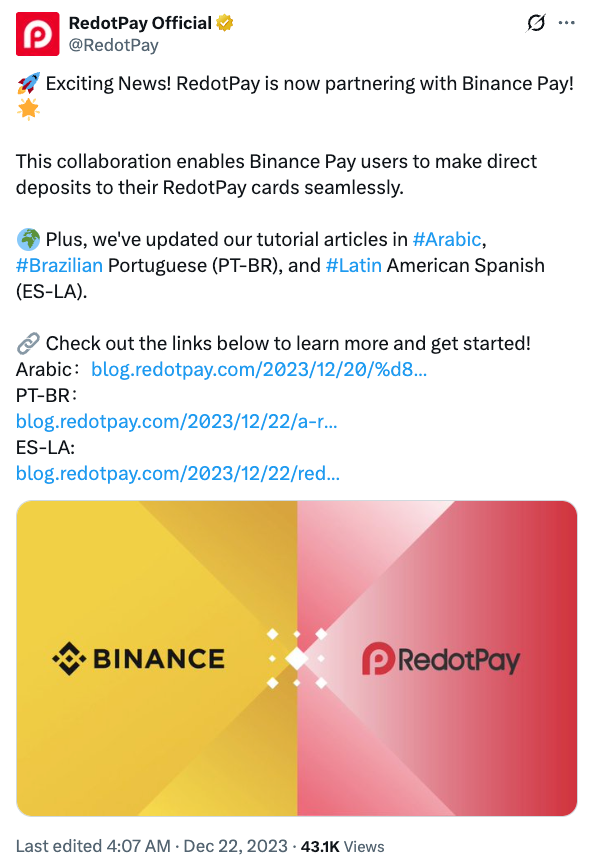
RedotPay announced its Binance Pay partnership in December 2023, saying the integration allowed Binance Pay users to make direct deposits to RedotPay cards. The links included in its announcement on X point to unavailable pages.
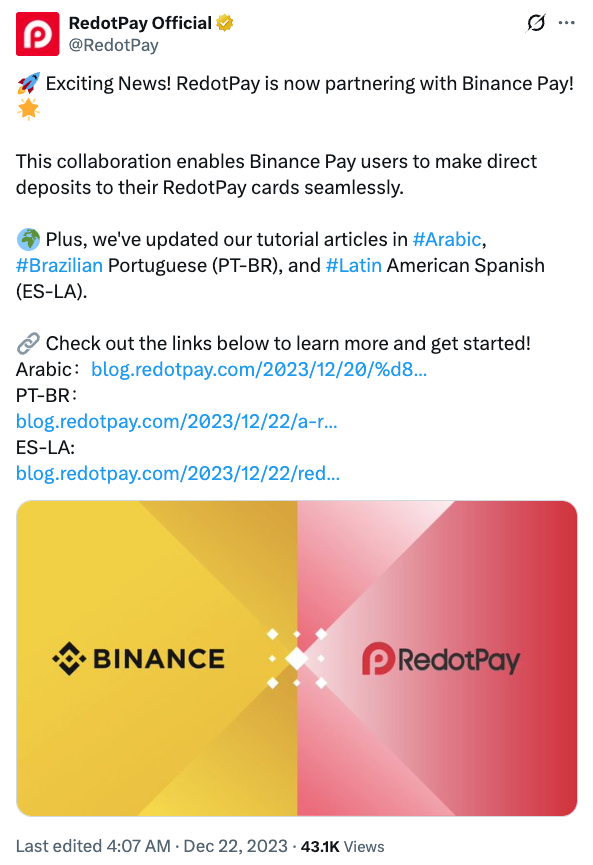
Source: RedotPay
Binance later announced that it would end support for Binance Pay features on the RedotPay platform effective April 3, 2026, as part of a review of its merchant partners. The page no longer loads, although it remains searchable on Binance’s website.
Magazine: Binance phishes its own staff monthly, India censors BitChat code: Asia Express

Westhoughton secures mobile CCTV unit to deter crime

Milky Mist IPO price band fixed at Rs 133-140 for Rs 1,553-crore IPO; issue opens on August 11

What to Say to Someone Who Is Dying, According to Hospice Workers


-

 Fashion5 days ago
Weekend Open Thread: Wit & Wisdom
-

 Politics5 days ago
Meta enters AI-training agreement with far-right ‘propaganda rag’ Newsmax
-

 Politics3 days ago
Zack Polanski: an incitement to murder Nigel Farage?
-

 Crypto World5 days ago
MicroStrategy Post-Earnings CLARITY Act Push Could Add New Catalyst for Its Stock
-

 Crypto World5 days ago
XRP Ledger v3.3.0 brings five institutional features
-

 News Videos7 days ago
Bitcoin Enters the 3rd Stage of the Bear Market
-

 Politics7 days ago
Luke Littler’s dominance sparks GOAT debate
-

 Sports6 days ago
Seema Kaliramna Wins Discus Throw Bronze, Takes India’s CWG Medals Tally To 17
-

 Crypto World5 days ago
New York sues Kalshi over prediction market gambling
-

 Crypto World4 days ago
Crypto PAC spending tops $2M in Michigan House race
-

 Business3 days ago
DTCR: Deleveraging And A Hedge Fund Collapse Point To A Possible AI Bottom
-

 Business6 days ago
Trump Announces Hamas Disarmament Agreement as Iran Strikes Kuwait Air Base and US Attacks Pause Overnight
-
 Crypto World5 days ago
3 Fed Officials Just Explained Their Rate Hike Vote: Is Inflation Winning?
-

 Tech4 days ago
ESET tracks rise in malicious AI skills and adaptable malware
-

 Sports5 days ago
France Cricket implodes: letters hidden in a drawer and a board at war
-

 NewsBeat7 days ago
Four people die trying to cross Channel in small boats
-

 Tech6 days ago
Gemini Spark can now use Chrome logins and saved passwords to run errands on your behalf
-
 Tech6 days ago
Building A Reproduction PlayStation Motherboard
-
Crypto World4 days ago
XRP Ledger urges node upgrade after manifest flood
-

 Crypto World5 days ago
Moneyflip CEO charged in $40K murder-for-hire plot
You must be logged in to post a comment Login