
Crypto World
Mastercard, Borderless Test Shared Identity Checks for Stablecoin Transfers



Payment processor Mastercard and stablecoin orchestration network Borderless will run a new pilot project to explore how Mastercard’s Crypto Credential standards-based framework can bring greater trust to cross-border stablecoin payments.
The pilot will test how Mastercard’s framework can address the challenge of providing assurance signals that participants can incorporate into their approval, compliance and risk processes, they said in an announcement shared with Cointelegraph.
Mastercard’s framework uses common standards and assurance signals to help bring certainty to blockchain transactions. The pilot will seek out new governance signals that can reduce friction in cross-border stablecoin payments.
Compliance remains one of the biggest friction points for stablecoin payments, according to Kevin Lehtiniitty, CEO and co-founder of Borderless. “Correspondent banking solved this decades ago: originating compliance trusted downstream, no re-execution at every counterparty. Mastercard is applying that model to digital asset payments,” he explained.
Mastercard’s Crypto Credential will act as a governance and verification layer, but Mastercard will not process or settle funds as part of the pilot, he told Cointelegraph.
The pilot marks Mastercard’s latest push into the stablecoin industry, coming just after the payments giant completed its acquisition of stablecoin infrastructure company BVNK on Monday, in a deal valued at $1.8 billion.
In June, Mastercard announced plans to expand its settlement capabilities to include intraday, weekend and holiday card settlement, including settlement through stablecoins including Circle’s USDC, Paxos-issued PYUSD, USDG and USDP, Ripple’s RLUSD and SoFi’s SoFiUSD.
Magazine: How Mastercard plans to settle card payments with stablecoins

Chart analyst ChartNerd flagged an 8.5-year cup-and-handle pattern on XRP this week, arguing that the token is nearing the 0.618 Fibonacci retracement level that could set up a long-term move toward $8, $13, and $27.
The outlook arrives while XRP itself sits near $1.06, deep in a correction that has wiped out most of its gains from the past year.
Cup and Handle Points to $8, $13, and $27
In an August 4 post on X, ChartNerd said XRP’s cup-and-handle formation is “one of the largest macro setups” on the market and that the token is approaching the 0.618 Fibonacci retracement level, which the analyst believes could support a move toward the Fibonacci extension targets of $8, $13, and $27.
According to him, the targets are “not an if, but a when,” and he has also warned that short-term price action remains uncertain. The analyst said XRP’s recent weakness does not necessarily point to problems with the asset itself, describing it as part of a wider crypto market correction.
That conviction comes with a caveat. In a separate post, ChartNerd laid out a scenario where XRP spends the rest of the year consolidating around $1, comparing it to the bottoming process from June 2022, with a Gaussian channel indicator only catching up to price gradually instead of through a steep drop first.
He framed the scenario as an alternative to an earlier $0.90 to $0.70 target range, not a reversal of the long-term thesis, adding that the original roadmap toward the $1 area was mapped out back when XRP traded near $1.80 to $2.
But not everyone is buying ChartNerd’s numbers. Trader CryptoBull dismissed the lower short-term targets in a post this week, betting XRP skips past $0.87 and $0.73 entirely.
“Those waiting for $0.87 or $0.73, I will see you at $23,” he wrote.
XRP’s Price Slide and What Other Analysts See
Other analysts have also focused on XRP’s current technical position, including EGRAG CRYPTO, who said the Ripple token had lost its 50-day moving average and was approaching the 100-day exponential moving average, a level the analyst described as historically important for long-term support.
According to the market watcher, a move toward the $1 to $0.95 range could be a normal retest if XRP holds that area. He placed a possible downside target near $0.80 if the token falls toward the lower boundary of its long-term channel, while maintaining targets of $15, $27, and above $50.
Another analyst, Ali Martinez, also pointed to $1.06 as the level that could decide XRP’s next move. In an August 4 report, Martinez said holding that price could open a path toward $1.35 and $1.64, while losing it could expose XRP to a drop toward $0.62.
The asset was trading around $1.06 at the time of writing, with CoinGecko data showing it had gone down by about 2% over seven days and more than 6% across 30 days. Over the past year, XRP has fallen about 65%, keeping it nearly 71% below its all-time high of $3.65.
The post XRP Forms Long-Term Pattern With $27 Price Target: Analyst appeared first on CryptoPotato.


Ondo Finance has appointed former Blockchain.com executive Adam Schlisman as its chief financial officer, adding another senior Wall Street and crypto finance veteran as the tokenized-assets company expands its institutional business.
Summary
- Ondo Finance has appointed former Blockchain.com CFO Adam Schlisman as its new finance chief.
- Schlisman joins as the tokenized asset platform continues expanding its institutional operations and product lineup.
- The appointment follows recent leadership and product hires, including former Invesco executive John Hoffman.
- Ondo has continued growing its tokenized markets business through Ondo Network, Ondo Perps and Ondo Global Markets.
According to a company press release issued Wednesday, Schlisman will oversee Ondo Finance’s financial operations after joining from global macro hedge fund Monashee Investment Management, where he served as chief financial officer. His appointment comes as the company continues building products and infrastructure for tokenized capital markets.
Ondo Finance adds another senior executive
Before joining Monashee, Schlisman spent several years as chief financial officer at Blockchain.com, where he managed finance, treasury and risk during a period of rapid expansion. Earlier in his career, he worked for nearly a decade at Graham Capital Management in portfolio management and risk-related roles.
Founded in 2021 by former Goldman Sachs executives, Ondo has grown into one of the largest tokenized real-world asset platforms. The company offers blockchain-based exposure to U.S. Treasuries, tokenized stocks and other financial products, with more than $3.5 billion across its platform, according to the release.
Commenting on his appointment, Schlisman said Ondo had reached a stage where institutional adoption was accelerating across multiple business lines.
“Ondo has reached the inflection point every finance leader looks for,” Schlisman said in emailed comments. “Ondo Stocks crossing $1 billion in TVL, the growth of Ondo Perps and work with traditional market infrastructure providers like DTCC all point to the same thing: tokenized markets are moving from early adoption to institutional scale. My mandate is to build the financial operations that can scale with them.”
His remarks reference several initiatives the company has introduced during recent months, including Ondo Stocks, the Ondo Perps derivatives platform and collaborations with established financial market infrastructure providers.
Institutional expansion continues across Ondo’s business
Schlisman’s arrival extends a series of executive appointments announced this year as Ondo builds out its leadership team.
In June, the company appointed former Grayscale and Invesco executive John Hoffman as managing director and head of product portfolios. Hoffman was tasked with developing tokenized investment portfolios in partnership with asset managers, expanding Ondo’s product lineup beyond individual tokenized Treasury products and equities.
The leadership expansion followed another significant change after Ondo founder Nathan Allman died unexpectedly in May. Longtime president Ian De Bode succeeded him as chief executive officer, with the company stating at the time that its strategy and product roadmap would continue without interruption.
Under De Bode’s leadership, Ondo has continued introducing new products and infrastructure while pursuing institutional partnerships across traditional finance and digital assets.
Ondo Network and tokenized markets remain central
Last month, Ondo replaced its previously announced Ondo Chain with the Ondo Network, an execution layer designed to combine centralized exchange-like trading speeds with self-custody and onchain settlement.
The company said the redesign followed discussions with prospective users while developing Ondo Perps, during which execution speed emerged as a larger obstacle than settlement capacity for institutional trading.
Rather than executing and settling every transaction on a public blockchain, the network processes trades inside trusted execution environments before settling asset transfers on public chains such as Ethereum. Ondo Perps became the first application launched on the new infrastructure, allowing traders outside the United States to access perpetual futures linked to equities and commodities while using tokenized real-world assets as collateral.
Separately, Ondo’s SEC-registered broker-dealer subsidiary Oasis Pro Markets also received expanded FINRA permissions covering a range of securities activities, creating regulated infrastructure for future tokenized securities offerings in the United States, although individual products remain subject to separate regulatory requirements.
Tokenized assets attract traditional finance talent
Schlisman’s appointment comes as competition in tokenized real-world assets continues to draw experienced executives from both Wall Street and the crypto industry.
Banks, asset managers and digital asset companies have increasingly introduced blockchain-based versions of Treasuries, money market funds, private credit products and equities as they test tokenized financial infrastructure.
Alongside its Treasury products OUSG and USDY, Ondo has expanded into tokenized stocks through Ondo Global Markets, which previously crossed $1 billion in total value locked. The platform is available across Solana, Ethereum and BNB Chain and integrates with exchanges, wallets and custodians including Binance, Bitget, MetaMask, Ledger and Blockchain.com.
Robinhood opened the order window on Monday for Robinhood Ventures Fund II, a closed-end fund that will give retail investors exposure to seed-stage startups from the Y Combinator ecosystem,at an expected $25 per share. The fund extends Robinhood's private-markets push from late-stage names like… Read the full story at The Defiant

Binance-affiliated companies have sued the founders of Hong Kong-based cryptocurrency payments company RedotPay, alleging it diverted more than 470,000 users from Binance Card in breach of their commercial agreement.
The plaintiffs seek nearly $473 million in damages, alleging the conduct contributed to RedotPay’s valuation as the company considers a potential initial public offering, Bloomberg reported Wednesday, citing a Hong Kong court filing it obtained.
RedotPay said it is defending the proceedings and rejected what it described as “unfounded allegations” against the company and its co-founders. “RedotPay is strenuously defending the proceedings,” a RedotPay spokesperson told Cointelegraph, adding that it will respond through the appropriate legal process.
The legal dispute comes as crypto payments companies compete to expand stablecoin-based spending products, with RedotPay reporting rapid growth and a global user base of more than 8 million customers.
Binance alleges RedotPay breached an agreement
According to the report, Binance alleged that RedotPay diverted more than 470,000 users from Binance Card by allowing users to fund RedotPay stablecoin payment cards with Binance Pay outside the agreed terms.
Binance Holdings affiliates Nest Trading, DistributedTechnologies and Chaintecs Consulting Singapore filed a petition against RedotPay co-founders Gao Zhangpeng, Chan Wa Choi and Yao Chao. Chaintecs filed a related lawsuit in Singapore, where a hearing is scheduled for Friday.
The plaintiffs estimated damages at $472.8 million, citing a lifetime customer value of $925 for each allegedly diverted user.
A Binance spokesperson told Cointelegraph: “While Binance does not comment on ongoing litigation, where necessary we will use courts and other forums to pursue what is right.”
RedotPay says proceedings will not affect operations
RedotPay said the proceedings will not affect its day-to-day operations and that it will continue defending itself through the legal process.
“We are confident in our legal position, and are vigorously defending all claims. As the matter is currently before the court, RedotPay will not be commenting further on the allegations, the ongoing proceedings, or matters that will be addressed through the judicial process,” the company said in a statement on its website.
Related: Apple faces lawsuit over alleged $1.8M Bitcoin wallet app losses
The company also highlighted its recent growth, saying its user base increased by more than 33% over the past six months. RedotPay said it generates about $180 million in annualized revenue and $14 billion in annualized payment volume.
RedotPay announced its Binance Pay partnership in December 2023, saying the integration allowed Binance Pay users to make direct deposits to RedotPay cards. The links included in its announcement on X point to unavailable pages.

Source: RedotPay
Binance later announced that it would end support for Binance Pay features on the RedotPay platform effective April 3, 2026, as part of a review of its merchant partners. The page no longer loads, although it remains searchable on Binance’s website.
Magazine: Binance phishes its own staff monthly, India censors BitChat code: Asia Express
Circle stock erased an early 7% rally and fell nearly 3% after mixed second-quarter results and renewed concerns about weaker USDC activity and shrinking margins.
Summary
- Circle reported $701 million in revenue, missing Wall Street’s $717 million estimate.
- Earnings per share reached $0.18, narrowly beating the $0.17 consensus.
- Mizuho maintained its Underperform rating and $45 price target on CRCL.
- CRCL trades near critical support at $58.04 as bearish momentum persists.
Circle earnings beat on profit but miss on revenue
Circle Internet Group reported mixed results for the second quarter of fiscal 2026, giving investors competing signals about the USDC issuer’s financial performance.
Quarterly revenue reached $701 million, falling short of the $717 million expected by Wall Street. However, earnings per share came in at $0.18, slightly above the consensus forecast of $0.17.
Net income also exceeded expectations. Circle generated $48 million in profit during the quarter, compared with analysts’ estimate of $45.8 million.
The initial reaction was positive, with CRCL shares rising about 7% shortly after the report. The rally faded as investors assessed the revenue miss and weaker operating trends underneath the headline profit figures.
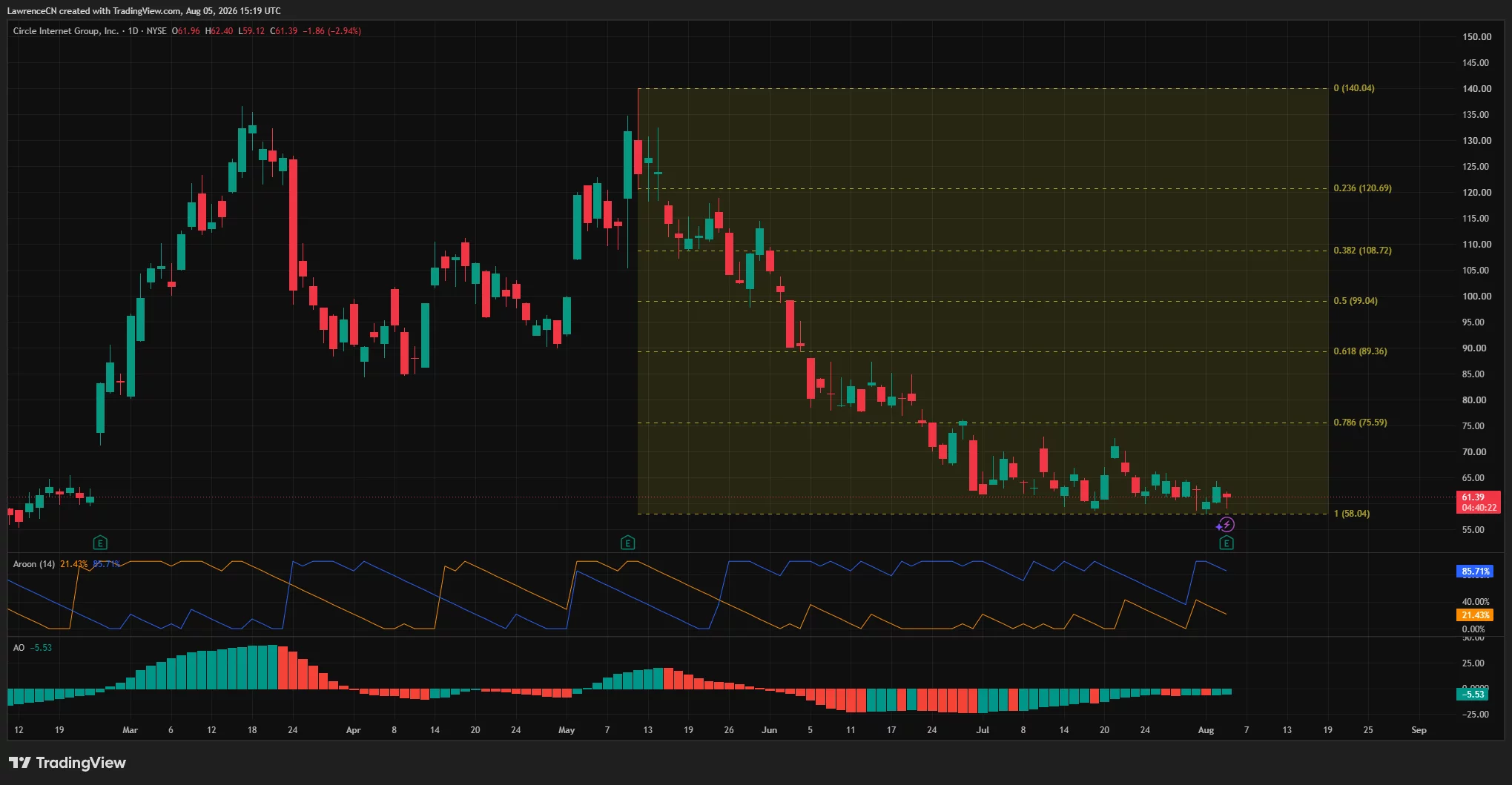
Circle stock subsequently fell around 3%, trading near $61.39 after reaching $63.25 during the previous session. The shares have now lost more than 20% since the beginning of the year.
Mizuho maintains bearish $45 Circle stock target
Mizuho kept its Underperform rating on Circle and maintained a $45 price target following the earnings release. That target implies a decline of roughly 27% from the stock’s current level.
The brokerage pointed to a sequential decline in USDC circulation and a 31% quarter-over-quarter drop in on-chain transaction volume. These figures suggest that stablecoin activity weakened during the reporting period despite Circle’s profit beat.
Margin pressure presented another concern. Circle’s adjusted EBITDA margin fell 329 basis points from the same quarter last year, indicating that the company retained less operating profit from its revenue.
Mizuho’s assessment appears to have contributed to the reversal by shifting attention away from the earnings beat and toward Circle’s underlying operating performance. The bearish rating also contrasts with management’s stronger full-year outlook.
Circle raises USDC and revenue guidance
Circle expects USDC circulation to grow at a compound annual rate of 40%, signaling confidence that demand for its dollar-backed stablecoin will recover and expand over a longer period.
The company also raised its forecast for other revenue to between $310 million and $330 million. Its previous guidance called for $150 million to $170 million, making the revised range one of the strongest positive updates in the report.
Circle increased its RLDC margin forecast to between 41.7% and 43.7%, up from the previous range of 38% to 40%. Adjusted operating expense guidance remained unchanged at $570 million to $585 million.
The outlook gives investors a potential growth case, but Circle must demonstrate that higher USDC circulation can translate into stronger transaction activity and more durable margins.
CRCL stock tests support near $58
CRCL’s daily chart remains bearish after the stock retreated from its May peak near $140.04. Shares are now trading just above the major support level at $58.04, which marks the bottom of the chart’s measured Fibonacci range.
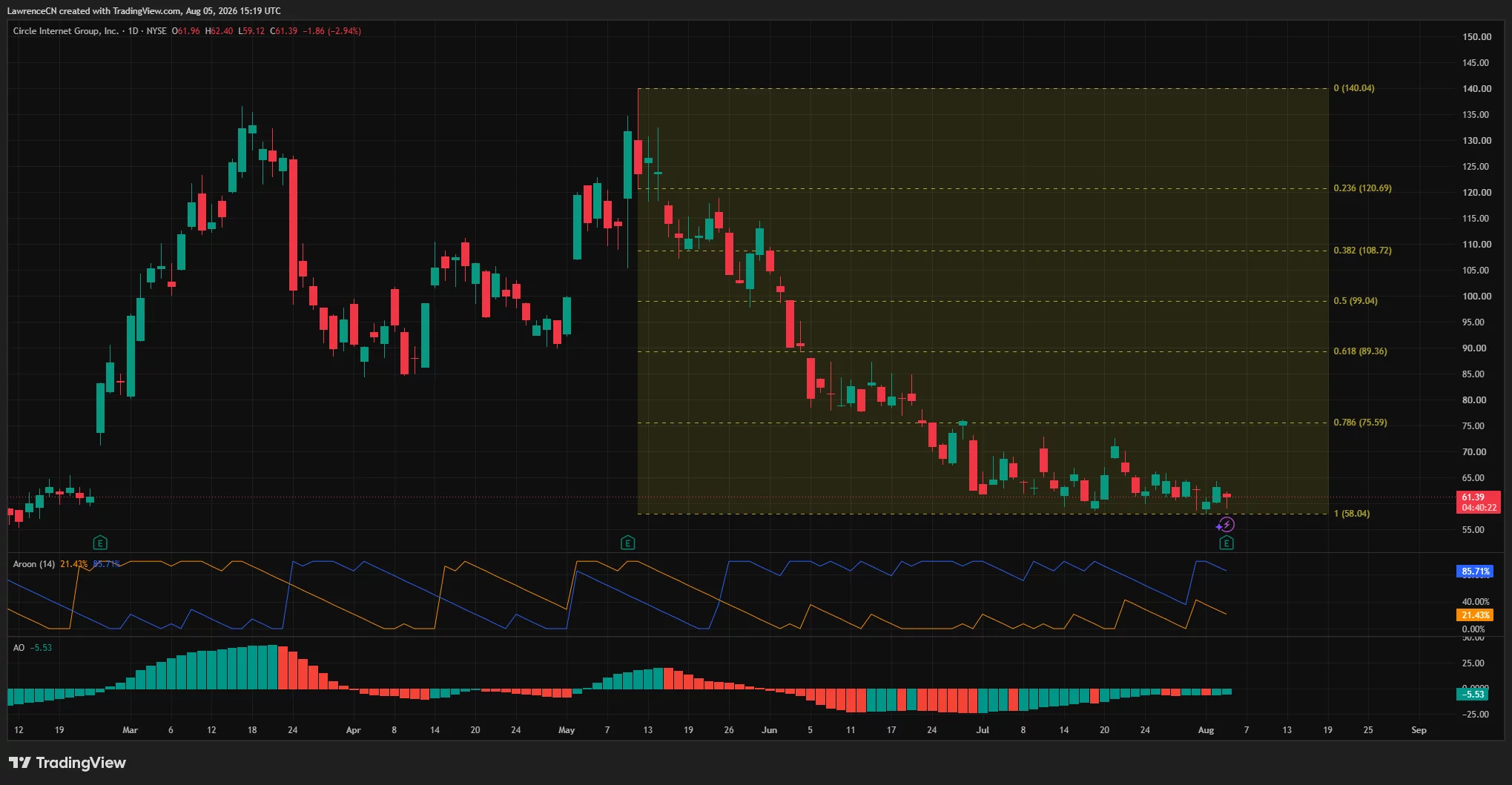
The Aroon indicator shows sellers remain in control. Aroon Down stands at 85.71%, compared with an Aroon Up reading of 21.43%. The Awesome Oscillator also remains below zero at minus 5.53, confirming that momentum has not yet turned positive.
A decisive break below $58.04 could extend the decline and bring Mizuho’s $45 target into greater focus. If buyers defend support, CRCL would first need to reclaim the $63 to $65 region before attempting a recovery toward the 78.6% Fibonacci level at $75.59.
Circle also secured a limited-purpose trust charter from the New York Department of Financial Services on July 31. The approval places Circle Internet Trust Company under state oversight for USDC issuance, adding a US regulatory catalyst as investors weigh the company’s mixed financial and operating signals.
Disclosure: This article does not represent investment advice. The content and materials featured on this page are for educational purposes only.
Remittix has launched Remittix Markets, expanding its ecosystem with perpetual futures trading as the RTX presale approaches the $32 million milestone.
Summary
- Remittix launches Markets, expanding beyond PayFi with perpetual futures trading ahead of its token debut.
- RTX broadens its ecosystem as Remittix Markets goes live, adding crypto derivatives to its payments platform.
- Remittix introduces a perpetual futures platform, marking its shift from a PayFi project to a multi-product ecosystem.
Remittix Markets is now live, giving the RTX ecosystem a new trading layer and changing the way the wider project can be viewed ahead of launch.
Remittix was originally built around PayFi and crypto-to-fiat payments. With perpetual futures trading now added through Remittix Markets, the project is moving beyond a single-product model and into a broader ecosystem spanning payments, trading and future financial products.
That shift gives RTX a stronger utility story at a time when the Remittix presale has already passed $31 million and is closing in on the $32 million milestone expected to trigger the official launch-date reveal.
Remittix markets gives RTX a second growth engine
Remittix Markets brings perpetual futures trading into the ecosystem, giving active traders a new way to engage with the Remittix brand.
Perpetual futures allow users to trade crypto price movements without contracts expiring on a fixed date. The sector has become one of the most active parts of digital asset trading, with users returning regularly to manage positions, respond to volatility and trade changing market conditions.
That creates a different type of activity from a payments platform. PayFi is built around transfers and real-world financial use, while Remittix Markets is designed to attract traders and support ongoing market engagement.
For RTX, this means the ecosystem can now appeal to more than one audience.
From PayFi project to multi-product ecosystem
Before the Markets launch, Remittix was primarily associated with crypto-to-fiat payments. That remains the foundation of the project, but the live perps platform adds another major product category.
The ecosystem now has two clear pillars.
The first is PayFi, which is focused on moving value between crypto and traditional bank accounts. The second is Remittix Markets, which brings perpetual futures trading into the same wider platform.
This is important because multi-product ecosystems can create more reasons for users to remain engaged. Payment users may enter through PayFi, active traders may enter through Markets, and future products such as Remittix Earn could add another layer over time.
PayFi remains the key differentiator
The strongest part of the Remittix proposition is still the problem its PayFi platform is designed to solve.
Crypto can be transferred globally, but converting digital assets into fiat and delivering that money to a normal bank account often requires exchanges, manual conversions and several withdrawal steps.
Remittix aims to simplify that process by allowing users to send crypto while recipients receive fiat directly into their bank accounts. This could support use cases ranging from cross-border payments and business transfers to freelancers and everyday users.
The crypto-to-fiat platform is fully developed and has already been tested by members of the community. That gives Remittix an established product base while Markets adds live trading utility.
RTX approaches a major launch milestone
The Remittix presale has passed $31 million and is moving closer to $32 million, where the team is expected to reveal the official RTX launch date.
That means several parts of the project are now progressing at once. Remittix Markets is live, the PayFi platform has been developed and tested, and the token launch milestone is approaching.
The arrival of Remittix Markets changes the RTX story because the project is no longer tied to one product or one audience. Remittix is now building across both payments and trading, giving the ecosystem greater depth as the official token launch moves closer.
For more information, visit the official website and the perps trading website.
FAQ
What is Remittix Markets?
Remittix Markets is the live perpetual futures trading platform operating within the wider RTX ecosystem.
Why does Remittix Markets make RTX a bigger ecosystem play?
It adds trading utility alongside Remittix’s crypto-to-fiat PayFi platform, giving the project multiple products and user groups.
What is the next major Remittix milestone?
The official RTX launch date is expected to be revealed when the presale reaches $32 million.
Disclosure: This content is provided by a third party. Neither crypto.news nor the author of this article endorses any product mentioned on this page. Users should conduct their own research before taking any action related to the company.

A progressive challenger, Donavan McKinney, has won the Democratic primary for Michigan’s 13th Congressional District, defeating two-term incumbent Shri Thanedar in a campaign that drew fresh accusations about cryptocurrency-linked political influence.
According to The New York Times, McKinney captured 51.9% of the vote compared with Thanedar’s 48.1% as of Wednesday. The contest became a focal point for claims of “payback” tied to the crypto industry, after a crypto-backed political action committee (PAC) reportedly spent more than $2 million on media aimed at re-electing Thanedar.
Key takeaways
- McKinney won Michigan’s 13th District Democratic primary with 51.9% versus Thanedar’s 48.1%, per NYT election results.
- A crypto-linked PAC, Protect Progress, reportedly spent over $2 million on ads to support Thanedar and oppose McKinney, raising “payback” accusations.
- Protect Progress is affiliated with Fairshake, which has received primary backing from major crypto companies such as Coinbase and Ripple, according to reporting referenced in the article.
- McKinney secured support from national progressive and Democratic groups, including the Democratic National Committee and the Democratic Socialists of America.
- McKinney is set to face Republican Taras Nykoriak in November; the campaign did not provide immediate comment when approached.
Why the crypto industry became a central campaign issue
While Michigan’s 13th District primary hinged on typical Democratic-vs-Democratic dynamics, it also turned into a referendum on the relationship between elected officials and the cryptocurrency sector.
McKinney, widely framed as a progressive challenge to Thanedar, argued during the campaign that the crypto industry was effectively “paying [his] opponent back” for facilitating industry-friendly legislation. In his messaging, he referenced Thanedar’s voting record and said the spending was in response to policy outcomes following former President Donald Trump’s 2024 election victory—an argument aimed at tying political fundraising to legislative behavior.
The comparison was supported by the scale and direction of outside spending. As noted in coverage cited in the article, Protect Progress—described as responsible for the super PAC funding media against McKinney—spent more than $2 million on ads during the primary.
Super PAC spending and the Fairshake network
Central to the controversy is Protect Progress’ affiliation with Fairshake, a political network backed primarily by crypto businesses, including Coinbase and Ripple. The article notes that Protect Progress is part of a broader ecosystem that has repeatedly spent heavily on pro- and anti-crypto races.
According to the referenced reporting, Fairshake and related affiliates spent more than $170 million during the 2024 US election cycle on races that involved candidates with competing stances on the crypto industry. For this primary cycle, the article says these groups have again directed significant spending into state contests ahead of the November general election, extending the pattern of outside money shaping crypto policy debates.
For voters, this matters because super PAC advertising can shift how issues are framed in ways that candidates may struggle to counter with their own campaigns—especially in primaries, where turnout is often lower and persuasion through media can carry outsized weight.
Thanedar’s policy record and campaign-ethics scrutiny
Beyond advertising spending, the dispute also drew on allegations involving Thanedar’s personal financial decisions and the policy positions he supported.
The article states that Thanedar voted in favor of legislation including the GENIUS Act and the CLARITY Act. It also reports that Thanedar allegedly lost more than $600,000 in the second quarter of 2026 after investing $3.7 million of campaign funds into crypto companies, citing an investigation published by The Intercept.
That alleged juxtaposition—industry-friendly votes alongside investment activity—became part of McKinney’s broader critique that Washington prioritizes corporate interests over constituents. In a Wednesday post on X, McKinney said, “Washington has spent too long serving billionaires and corporate interests,” and added that he would “always only serve the people I represent,” as reflected in the article’s citation of his statement.
What happens next in Michigan’s 13th District
McKinney’s primary win sets up the November contest against Republican Taras Nykoriak. The article notes that Cointelegraph sought a comment from McKinney’s campaign on Wednesday but did not receive an immediate response.
Meanwhile, national party organizations and progressive groups moved quickly to back McKinney’s candidacy following the primary. The article says McKinney received support from the Democratic National Committee and the Democratic Socialists of America, citing the DNC’s announcement of his victory and framing it as part of a broader alignment with progressive priorities.
Political backers are not the only group to spend in the orbit of crypto politics. The article also references a separate effort by another Fairshake affiliate—Defend American Jobs—in Washington’s 4th Congressional District primary race, where the group reportedly funded media support for Republican candidate Amanda McKinney (no relation to the Michigan nominee). In that contest, both candidates surpassed 30% of the vote to advance to the general election, according to the article.
Across races, the pattern is consistent: crypto-linked groups are treating primary elections as a key battleground for influencing candidates who may later shape regulatory direction. With McKinney now facing a general-election challenge, attention is likely to shift to whether the “payback” narrative and the focus on legislative ethics continue to resonate with voters, and how much outside spending ramps up between now and November.


TokenWorks, the two-person team behind NFT gacha protocol Fake World Assets, will route 80% of future protocol fees to FWA token buybacks and spend 327 ETH, about $610,000, buying the token for a team reserve. The commitments came after holders learned that the team's original plan for FWA's… Read the full story at The Defiant


Galaxy Digital reported an $85 million net loss for the second quarter of 2026 as cryptocurrency valuations declined in the period.
That resulted in a $0.09 loss per share posted on Wednesday which Galaxy attributed to the depreciation of digital asset prices during the quarter.
Revenue at $8.7 billion was down 15% from $10.2 billion in the first quarter of 2026. Analysts had forecast a consensus of $12.7 billion, according to estimates compiled by Yahoo Finance.
Galaxy’s shares fell 6.2% in premarket activity on Wednesday to $20.70, set to extend a nearly 10% decline over the past month.
The total crypto market capitalization fell nearly 15% during the quarter, to $2 trillion on June 30 from $2.35 trillion on April 1, according to CoinMarketCap data.
Despite the slump, the company reported that digital assets generated adjusted gross profit of $66 million and adjusted earnings before interest, taxes, depreciation and amortization (EBITDA) of $11 million, marking a 34% quarter-over-quarter increase in adjusted gross profit. EBITDA measures a company’s core operating profit by removing financing costs, taxes, asset value changes and one-time expenses.
Galaxy said this reflects the “resilience of our business model and further demonstrates that our earnings are becoming less dependent on the direction of digital asset prices.”
The company also reported generating adjusted gross profit of $20 million from AI data centers during the quarter, as it ramped up capacity delivery to CoreWeave. Galaxy expects $1 billion in annual revenue from its 15-year partnership with CoreWeave. The company secured $1.4 billion to expand its Texas Helios AI data center in August 2024.
Magazine: Why institutions still prefer Ethereum despite faster blockchains
Just when you thought crypto market morale couldn’t sink any lower, along comes the Coldcard entropy bug to prove you wrong.
The discovery of a flaw in one of the industry’s longest-running hardware wallets last Friday serves as a stark reminder that there is no perfectly safe place to put all your Bitcoin.
Coldcard disclosed the entropy-generation flaw affecting multiple Coldcard devices on July 31. Since then, researchers at Galaxy Digital say attackers have been able to steal more than 1,596 Bitcoin worth at least $100 million through several coordinated attacks.
Wallet manufacturers are now being forced to explain a process most users never even think about: how their wallet generates the private key to protect their Bitcoin.
Michael Tanguma, head of product at Bitcoin custody firm Onramp Bitcoin, tells Magazine:
“The whole model rests on trust that the vendor got it right […] Almost no individual can audit the hardware, the firmware and the entropy generation underneath their device.”
Coinkite, the company behind Coldcard, has released firmware fixes and told affected users to migrate their funds, but the incident has shaken Bitcoin HODLers to the core, and it raises an uncomfortable question:
If Coldcard wallets can be exploited, does that mean all hardware wallets are potentially insecure?
A bug hidden in the foundations
The Coldcard vulnerability did not exploit Bitcoin itself nor break modern cryptography, but it struck at something much more fundamental: randomness.
Every Bitcoin wallet begins by generating a seed phrase from a pool of random data, which means that randomness should be sufficiently unpredictable to make the resulting private keys effectively impossible to guess. Entropy refers to how random it is.
If that randomness is weakened for any reason, attackers can reduce the number of possible keys that could be generate and eventually find a way to reproduce them.
Related: Coldcard hack sparks biggest sub-1 BTC move since FTX: CryptoQuant
Coinkite first alerted users on July 31 that wallets created on affected firmware should be considered at risk and told customers to migrate funds to newly generated wallets. As researchers dug further into the bug over the following days, their attention quickly turned to how a flaw in such a critical part of the wallet had gone unnoticed for more than five years.
Core Lightning developer Dustin Dettmer suggested that it might have originated during firmware changes made in 2021.
He believes that code intended to interface with the hardware random number generator instead disabled it, which caused wallet creation to fall back to MicroPython’s weaker Yasmarang pseudo-random number generator.
His theory has become one of the leading explanations for how the bug may have entered production firmware, although Coinkite has not confirmed that exact sequence of events, and says that it will publish a full technical postmortem “soon.” A Coinkite spokesperson tells Magazine:
“Certain firmware versions had a fallback path in seed generation that could produce weak entropy when generated on the device firmware itself.”
Devices where users generated their own entropy through dice rolls or similar manual methods “were not affected by this specific fallback path,” the spokesperson says.
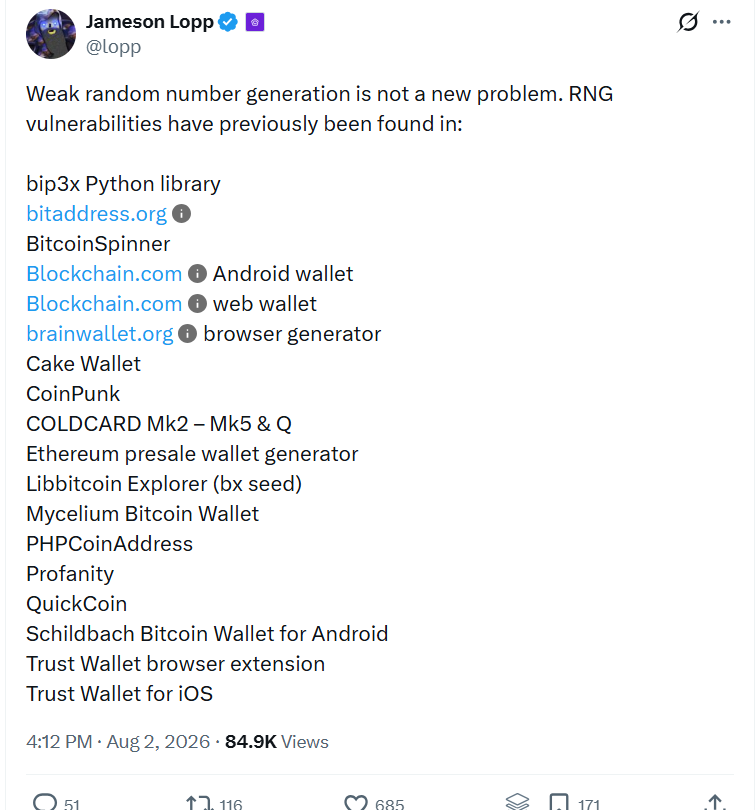
Weak random number generation (RNG) is not unprecedented, but unlike many other security flaws, it is difficult to detect.
Bitcoin security expert Jameson Lopp noted that RNG vulnerabilities have previously affected a long list of cryptocurrency wallets and libraries, ranging from Blockchain.com’s Android wallet to Trust Wallet.
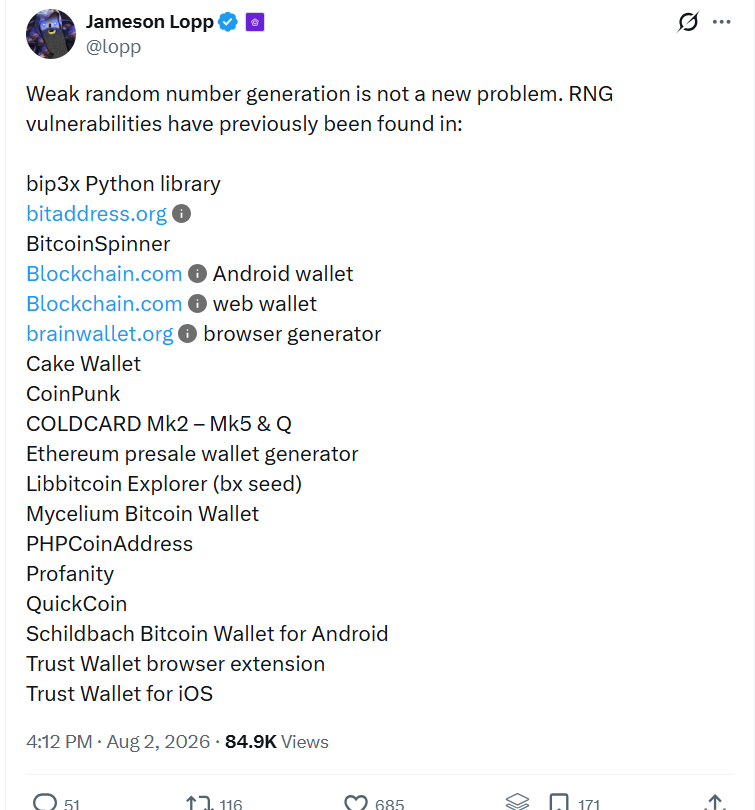
Weak random number generation is not a new problem. Source: Jameson Lopp
Ledger director of product security Vincent Bouzon tells Magazine that “weak randomness passes output tests,” which means that compromised random-number generators can still produce values that appear random, making flaws difficult to identifiy.
Different wallets, different randomness assumptions
Hardware wallet manufacturers agree that secure entropy generation is non-negotiable, but they take different approaches to achieving it.
Related: Zilliqa Ledger app vulnerability lets attackers recover signer’s private keys
Ledger’s philosophy centers on dedicated security hardware. Bouzon says Ledger devices generate seeds using a true random number generator embedded in a certified Secure Element. The entropy source is certified under the AIS-31 PTG.2 standard and the Secure Element undergoes Common Criteria certification. He says:
“This Coldcard incident was a failure in one specific implementation, not a verdict on secure self-custody […] The generation of that entropy must be anchored in secure hardware, with an architecture that cannot silently downgrade to an untrusted software-based source.”
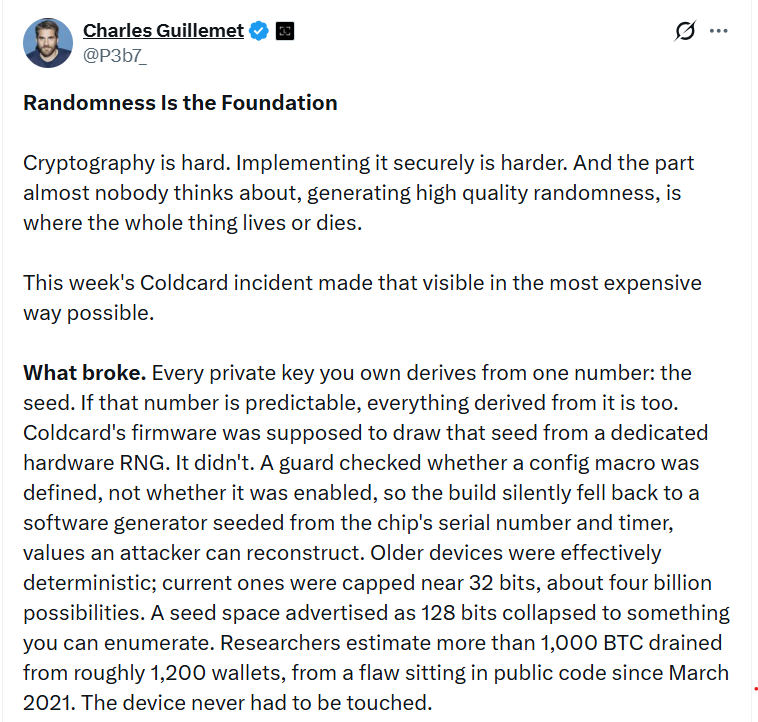
Generating high-quality randoness is where the whole thing lives or dies. Source: Charles Guillemet
For its part, Trezor combines randomness generated inside the device with randomness supplied by the host computer, rather than depending on a single entropy source, and newer models also incorporate additional hardware sources.
The company also includes entropy checks to confirm that the device actually contributed unpredictable randomness during wallet creation. Tomáš Sušánka, Trezor’s chief technical officer, tells Magazine:
“The takeaway for the whole industry is that randomness cannot depend on a single source or a single line of code being correct.”
Foundation’s Passport wallet similarly rely on multiple entropy sources while emphasizing transparency. Chief executive Zach Herbert says Passport combines randomness generated by separate hardware components before creating a wallet.
The firmware is also published as free and open-source software with reproducible builds, so independent researchers can verify that the software running on the device matches the published code. Herbert says:
“The bug itself was specific to Coldcard […] The larger warning is that this went unnoticed for more than five years while people trusted the product with life-changing amounts of money.”
Trust, transparency and verification
The real divide between Ledger, Trezor and Foundation is not about the importance of randomness, but over how users can be certain that it is actually working.
Ledger argues that independent certification provides the strongest assurance. Foundation relies on open-source development, reproducible builds and welcoming external researchers, and Trezor combines open firmware with layered entropy sources to avoid relying on any single component.
Coinkite’s approach to security disclosures has also come under fire, with several Bitcoin developers criticizing the company over past responses to vulnerability reports and the absence of a traditional bug bounty program.
Related: Fears of AI-driven DeFi hack epidemic overstated for now — but not for long
Herbert argues that welcoming external researchers is itself part of building secure products, alongside open-source development and independent audits.
Nick Percoco, chief security officer at Kraken and former chief security officer at Uptake, sees the Coldcard incident as an opportunity for the industry to adopt stronger standards, no matter which design philosophy manufacturers choose.
“The Coldcard entropy failure should be a wake-up call for the entire hardware wallet industry,” he said, arguing that today’s certification schemes often validate individual components without confirming that production firmware is actually using them correctly.
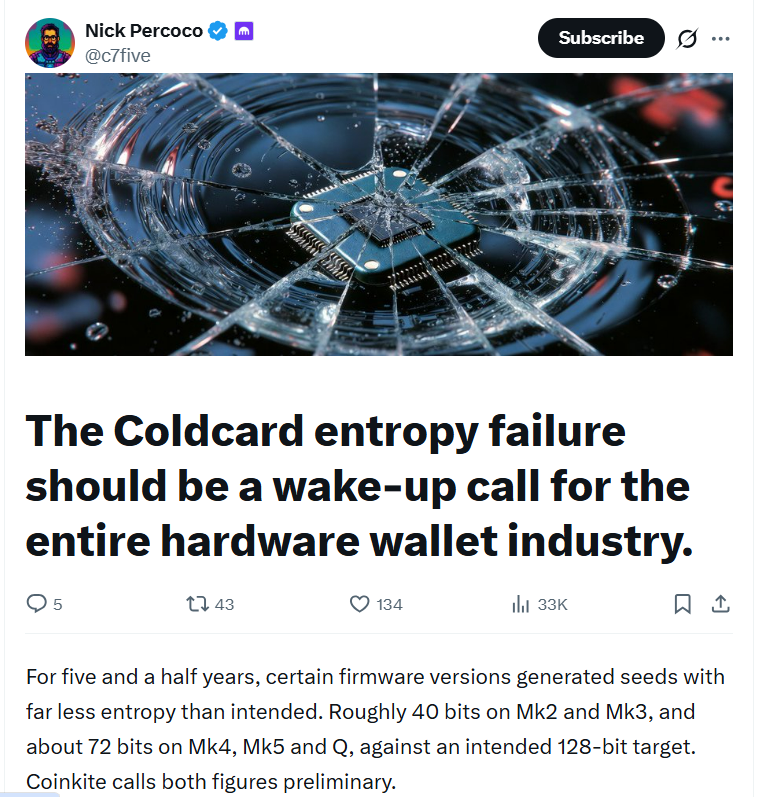
The Coldcard entropy failure should be a wake-up call. Source: Nick Percoco
Percoco proposed an industry-specific assurance standard requiring independent validation of entropy sources, verification that firmware calls the intended hardware random number generator and certification tied to specific hardware and firmware versions.
But the debate goes further than technical implementation, with voices like Herbert arguing that open-source development also shapes security culture. He points to bug bounty programs and constructive engagement with independent researchers as essential parts of secure product development.
What should Bitcoiners do now?
For Coldcard users, their immediate priority is to follow Coinkite’s migration guidance if they believe their wallets were created using affected firmware.
Longer term, Bitcoiners as a whole should use this episode as a learning moment, with experts like Tanguma stressing the need to avoid design architectures in which any single failure can compromise their funds. He says:
“Today, realistically, you want multisig and independently generated entropy […] The mitigation that actually scales is architectural: setups where no single device, vendor or institution being wrong can lose the funds.”
So for now, the answer appears to be no; not all hardware wallets are insecure.
The Coldcard incident exposed a failure in one implementation, but it has also forced manufacturers to lift the veil on the process at the heart of self-custody: generating a secret that nobody else can predict.
Magazine: The 100x obsession: Fundamentals grow in importance as crypto matures
Cointelegraph publishes long-form journalism, analysis and narrative reporting produced by Cointelegraph’s in-house editorial team with subject-matter expertise. All articles are edited and reviewed by Cointelegraph editors in line with our editorial standards. Some articles contain affiliate links, from which Cointelegraph may earn a commission. These relationships do not influence which products we review or our editorial conclusions. Content published in here does not constitute financial, legal or investment advice. Readers should conduct their own research and consult qualified professionals where appropriate. Cointelegraph maintains full editorial independence.
WA industries seek exemption from federal government’s migration cuts
XRP Forms Long-Term Pattern With $27 Price Target: Analyst

T-Pain Reveals Why He Sold Music For $100 Million


-

 Fashion5 days ago
Weekend Open Thread: Wit & Wisdom
-

 Politics5 days ago
Meta enters AI-training agreement with far-right ‘propaganda rag’ Newsmax
-

 Politics3 days ago
Zack Polanski: an incitement to murder Nigel Farage?
-

 Crypto World5 days ago
MicroStrategy Post-Earnings CLARITY Act Push Could Add New Catalyst for Its Stock
-

 Crypto World5 days ago
XRP Ledger v3.3.0 brings five institutional features
-

 News Videos7 days ago
Bitcoin Enters the 3rd Stage of the Bear Market
-

 Politics6 days ago
Luke Littler’s dominance sparks GOAT debate
-

 Sports6 days ago
Seema Kaliramna Wins Discus Throw Bronze, Takes India’s CWG Medals Tally To 17
-

 Crypto World5 days ago
New York sues Kalshi over prediction market gambling
-

 Crypto World4 days ago
Crypto PAC spending tops $2M in Michigan House race
-

 Business3 days ago
DTCR: Deleveraging And A Hedge Fund Collapse Point To A Possible AI Bottom
-

 Business6 days ago
Trump Announces Hamas Disarmament Agreement as Iran Strikes Kuwait Air Base and US Attacks Pause Overnight
-
 Crypto World5 days ago
3 Fed Officials Just Explained Their Rate Hike Vote: Is Inflation Winning?
-

 Tech4 days ago
ESET tracks rise in malicious AI skills and adaptable malware
-

 Sports5 days ago
France Cricket implodes: letters hidden in a drawer and a board at war
-

 NewsBeat7 days ago
Four people die trying to cross Channel in small boats
-

 Tech6 days ago
Gemini Spark can now use Chrome logins and saved passwords to run errands on your behalf
-
 Tech6 days ago
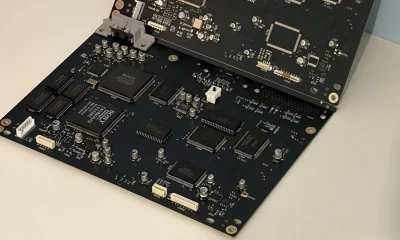
Building A Reproduction PlayStation Motherboard
-
Crypto World3 days ago
XRP Ledger urges node upgrade after manifest flood
-

 Crypto World5 days ago
Moneyflip CEO charged in $40K murder-for-hire plot
You must be logged in to post a comment Login