
Crypto World
Bitcoin ETFs pull in $244M, 3-day inflow streak tops $626M



US-listed Bitcoin ETFs attracted $244.4 million on Wednesday, marking three consecutive inflow days for a combined $626 million.

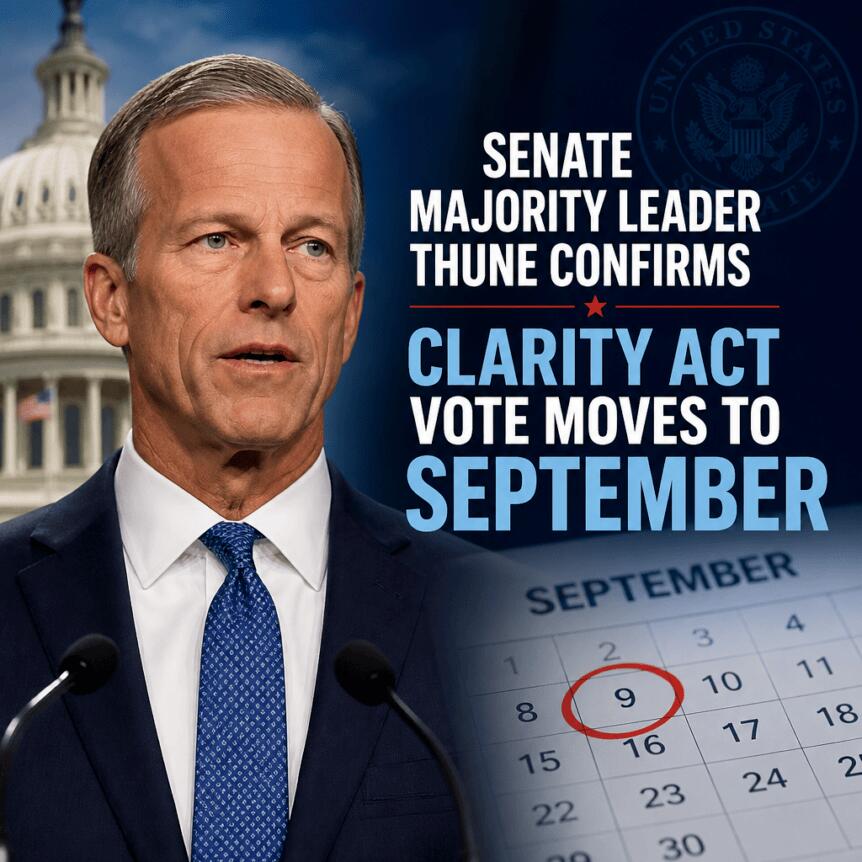
The Senate has postponed the CLARITY Act floor vote until lawmakers return from the August recess. Senate Majority Leader John Thune confirmed the delay and outlined plans for September. As a result, the decision extends negotiations over a federal digital asset regulatory framework.
Senate Leadership Shifts CLARITY Act Vote Beyond August Recess
Senate Majority Leader John Thune confirmed that the Senate will not vote on the CLARITY Act before the August recess. Instead, Republican leadership plans to prepare the legislation for floor consideration after lawmakers return in September. Therefore, the measure remains pending despite earlier expectations of quicker action.
The confirmation followed reports from Capitol Hill indicating that Senate leaders had changed their legislative timetable. The revised schedule places the digital asset market structure bill on the agenda after the recess concludes. Meanwhile, lawmakers will use the break to continue discussions surrounding the proposal.
The delay means the Senate will resume work on the legislation during its September session. Republican leaders had explored options for advancing the bill before leaving Washington. However, the chamber did not complete the required procedural steps before the scheduled recess.
Democratic Concerns Extend Negotiations Over Market Structure Bill
Democratic senators continued seeking additional negotiations before supporting the legislation for a final vote. They maintained concerns over unresolved provisions affecting the broader digital asset regulatory framework. As a result, bipartisan agreement remained incomplete before the Senate adjourned.
Republican leadership had explored procedural paths that could accelerate consideration of several pending measures. Those efforts included discussions surrounding unanimous consent agreements before the recess. Nevertheless, senators did not reach the broad agreement required to move the legislation forward immediately.
The Senate also considered the procedural requirements necessary before floor debate could begin. A cloture process remains one available path for advancing the measure toward debate and voting. Even so, leadership chose to postpone that effort until lawmakers return after the August break.
CLARITY Act Background Keeps Digital Asset Framework in Focus
The CLARITY Act seeks to establish a comprehensive regulatory structure for digital assets across the United States. The proposal aims to define oversight responsibilities and improve regulatory certainty for the industry. Accordingly, lawmakers continue treating the legislation as a significant policy initiative.
The House previously approved the CLARITY Act before sending the legislation to the Senate. That action placed responsibility on senators to review, debate, and determine the bill’s future. Therefore, the Senate now holds the next major step in the legislative process.
Supporters argue that the proposal would provide clearer rules for digital asset markets and related businesses. Meanwhile, lawmakers continue examining governance, compliance, and oversight provisions within the legislation. Those discussions remain active despite the delayed voting schedule.
The postponement does not remove the bill from the Senate agenda after the recess. Instead, leadership intends to prepare the legislation for consideration when lawmakers reconvene in September. Consequently, negotiations are expected to continue during the intervening weeks.
Committee work and private discussions may also shape the bill before its return to the Senate floor. Senators from both parties still have opportunities to address remaining policy differences. Therefore, revisions could emerge before leadership schedules the measure for debate.
The Senate’s decision reflects the chamber’s broader legislative calendar rather than a final judgment on the proposal. Lawmakers still retain multiple procedural options for advancing the measure after the recess. For now, the CLARITY Act remains under Senate consideration as discussions continue toward a possible September floor vote.


Fake World Assets, an Ethereum-based NFT gacha protocol built by two-person team Token Works, overtook Solana's Collector Crypt in daily revenue on July 25, four days after its July 20 relaunch, according to DefiLlama data. The protocol pulled in $447,604 in revenue on July 25, its peak day, per… Read the full story at The Defiant
Cracking down on ‘birth tourism’
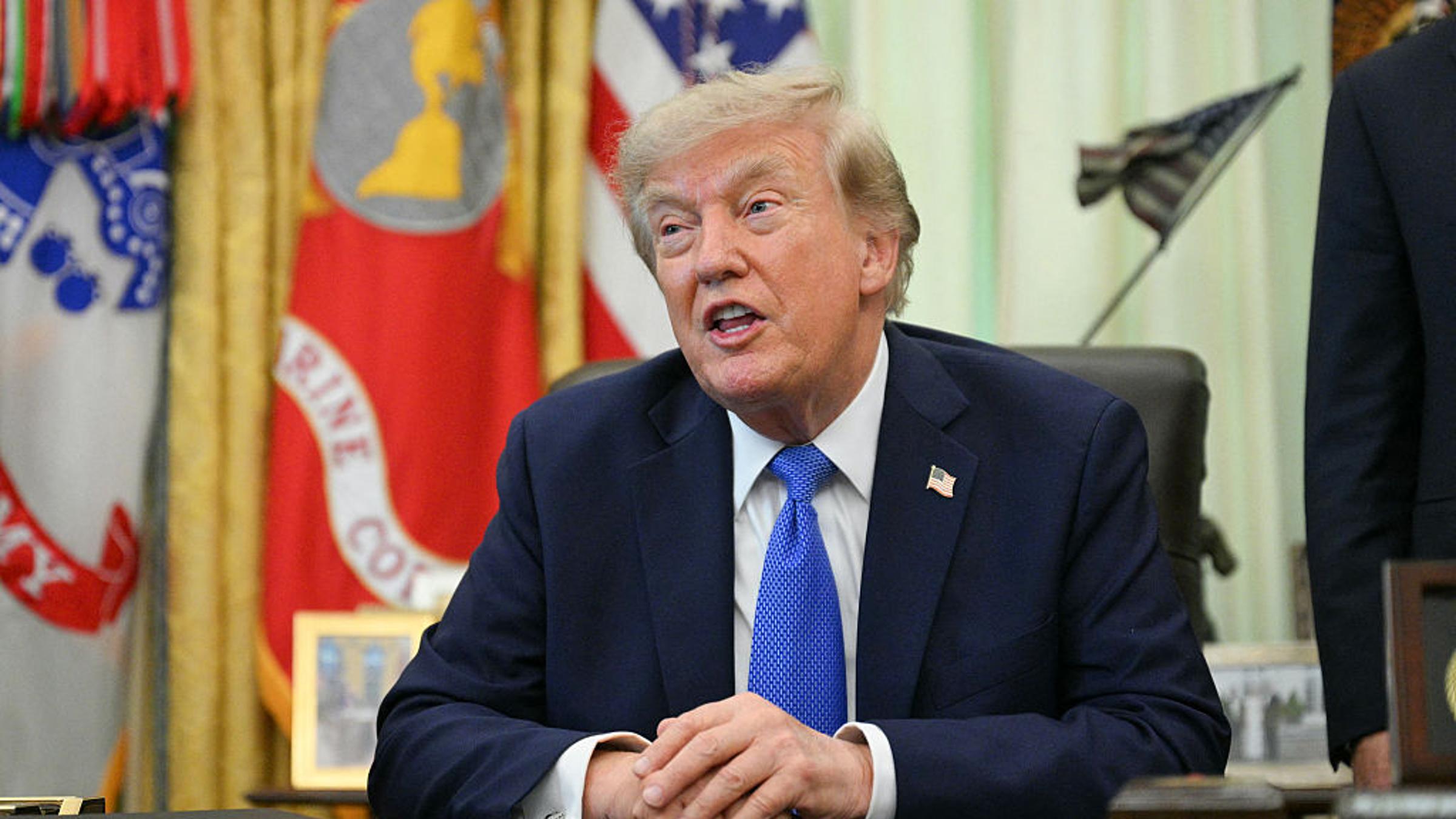
To enforce the “birth tourism” order, Trump said Thursday there will be “very big crackdowns.” The President claimed certain individuals were either “buying their way in” the U.S. or “building businesses” off the country’s birthright citizenship law.
White House deputy chief of staff Stephen Miller said “birth tourism” has been a problem for decades. “People come here pretending to be a tourist, pretending to be a visitor, saying they want to go to Disneyland, they want to go visit a monument or go to a national park, but the real reason they’re here is to have a child, to make that child an automatic citizen, leave our country, and then have a U.S. citizen child,” Miller said at the signing ceremony.
No official figures tally “birth tourism.” Government data show fewer than 10,000 births in the U.S. to mothers with foreign addresses in 2024, but an April 2026 article by D.C.-based think tank Migration Policy Institute says that census-based estimates put “birth tourism” at 22,000 to 26,000 babies born annually in the country.

[PRESS RELEASE – Singapore, Singapore, August 7th, 2026]
LBank, the leading global cryptocurrency exchange, has launched a 500,000 USDT reward campaign in partnership with Pudgy Penguins, one of the most recognized Web3-native IP ecosystems, providing new and existing users with multiple opportunities to earn rewards while participating in crypto trading activities.
Starting August 7, the campaign features five reward categories, including new user bonuses, first-trade rewards, Lucky Draw rewards, futures leaderboard competitions, and $PUDGY Locked Earn rewards. The campaign is designed to provide flexible participation options, allowing users to earn rewards through different levels of engagement — from their first deposit and trade to continuous futures trading activities.
Eligible users can participate in the campaign and unlock rewards through multiple activities:
- Registration Bonus. New users who register during the campaign period and net-deposit at least 100 USDT to their futures account are eligible for a 10 USDT Futures Bonus, available for the first 12,000 eligible users.
- First Trade Reward. Users can unlock an additional 5 USDT Futures Bonus by completing their first eligible spot or futures trading activity.
- Lucky Draw Entries. Every 20,000 USDT in cumulative futures trading volume unlocks one lucky draw entry, with up to seven entries available per user. Prizes include 1 BTC, Pudgy Penguins merchandise, and additional Futures Bonuses.
- Weekly Leaderboard. Users who achieve at least 10,000 USDT in future trading volume during a weekly competition period can participate in leaderboard rankings. The top 50 traders in each round will receive rewards, with the highest single reward reaching 500 USDT Futures Bonus.
- $PENGU Locked Earn. Users subscribing with at least 100 USDT equivalent can enjoy up to 100% Interest Boost benefits and a 10% fixed yield throughout the earning period.
“Crypto adoption is entering a new stage where participation is no longer driven only by technology, but also by culture, identity, and meaningful experiences,” said Eric He, Community Angel Officer and Risk Control Adviser at LBank. “Through our partnership with Pudgy Penguins, we hope to create a more welcoming environment where more users can discover Web3 in a way that feels accessible, engaging, and inclusive. This campaign is not only about rewards — it is about building stronger connections between users, communities, and the future digital economy.”
The partnership with Pudgy Penguins represents LBank’s continued effort to connect Web3 culture with crypto innovation. As digital assets evolve from an emerging technology sector into a broader global financial ecosystem, recognizable IPs and community-driven experiences are becoming increasingly important in lowering participation barriers and accelerating mainstream adoption.
Previously, LBank has collaborated with Web3-native IPs including Ponke, Nobody Sausage, and Yeti, creating interactive experiences that combine cultural influence with LBank’s trading ecosystem. Through these collaborations, LBank continues exploring new ways to integrate community, creativity, and financial innovation.
Looking ahead, LBank will continue strengthening the connection between Web3 culture and crypto innovation through strategic collaborations with globally recognized IPs and communities. As digital assets move toward broader adoption, LBank remains committed to creating more accessible, engaging, and inclusive experiences that allow more users worldwide to explore and participate in the future of the digital economy.
About LBank
Founded in 2015, LBank is a leading global cryptocurrency exchange serving over 25 million registered users in 160 countries and regions. With a daily trading volume exceeding $23.81 billion and 10 years of safety with zero security incidents, LBank is dedicated to providing a comprehensive and user-friendly trading experience. Through innovative trading solutions, the platform has enabled users to achieve average returns of over 130% on newly listed assets.
LBank has listed over 300 mainstream coins and more than 50 high-potential gems. Ranked No. 1 in 100x Gems, Highest Gains, and Meme Share, LBank leads the market with the fastest altcoin listings, unmatched liquidity, and industry-first trading guarantees, making it the go-to platform for crypto investors worldwide.
Follow LBank for Updates
Website: https://www.lbank.com/
Twitter: https://twitter.com/LBank_Exchange
Telegram: https://t.me/LBank_en
Instagram: https://www.instagram.com/lbank_exchange
LinkedIn: https://www.linkedin.com/company/lbank
The post LBank Joins Forces With Pudgy Penguins to Launch 500,000 USDT Reward appeared first on CryptoPotato.

The U.S. Senate will not vote on the CLARITY Act before the August recess, a delay that could prolong regulatory uncertainty for crypto firms and indirectly strengthen the bargaining position of jurisdictions already offering clearer rules. First Digital CEO and FDUSD stablecoin issuer Vincent Chok said the postponement gives places like Hong Kong and Singapore more time to demonstrate that regulation and innovation can coexist.
According to an office confirmation relayed to Cointelegraph, Senator John Thune’s team said the bill will be prioritized when senators return in September. The delay is attributed to Democratic opposition to the legislation.
Key takeaways
- The U.S. Senate will not hold a pre-August recess vote on the CLARITY Act; lawmakers are expected to revisit the bill in September.
- Industry leaders warn that prolonged uncertainty can slow institutional adoption more than long timelines can.
- Executives argue that clearer Asian regulatory frameworks could attract more talent and capital as U.S. rules remain unsettled.
- Critics say the outcome risks a return to “regulation by enforcement” if Congress fails to set out coherent market structure rules.
- Some market participants contrast the U.S. delay with the EU’s MiCA regime, which is already in effect.
What the Senate delay means for U.S. market structure
Chok’s comments highlight the core problem many market participants associate with the CLARITY Act debate: without an enacted framework, institutions must operate amid unclear expectations around market structure, custody, and oversight.
In a statement sent to Cointelegraph, Chok said markets can adjust to slower timelines, but “what they struggle with is prolonged uncertainty.” For institutions—especially those weighing regulated custody arrangements, compliance resourcing, and operational risk—this type of ambiguity can translate into delayed decisions, reduced willingness to offer new products, or a preference for platforms and venues that feel less exposed to changing enforcement priorities.
The CLARITY Act is often viewed as a potential bridge toward predictable rules for how digital asset markets should be structured in the U.S. With a Senate vote now pushed beyond the August recess, the question shifts from “whether the bill advances” to “how long uncertainty lasts—and whether it becomes a permanent drag on institutional momentum.”
Pressure on institutions: enforcement risk and compliance fragmentation
Maylea Ma, deputy general counsel at decentralized exchange aggregator 1inch, framed the stakes in terms of enforcement style rather than just timeline. If Congress does not ultimately enact the CLARITY Act, Ma said the industry could face a renewed emphasis on “regulation by enforcement.”
She described continued reliance on agency interpretations, case-by-case enforcement, and a patchwork of state-level rules covering money transmission and securities-related obligations. In practice, that kind of fragmentation can raise compliance costs and make it harder to scale across jurisdictions—particularly for firms trying to build products that require consistent regulatory expectations.
At the same time, Ma said 1inch expects to keep operating with a model that is conservative on custody—stressing non-custodial and self-custody characteristics—while waiting for greater legal certainty in the U.S.
That distinction matters: some business models can be adapted to enforcement risk by limiting custodial responsibility, while others—such as offerings that require regulated custody partners or broad consumer access—may still struggle under an unclear baseline for oversight.
Why Asia could benefit as clarity becomes a competitive advantage
Chok argued that regulatory progress outside the U.S. would continue regardless of the CLARITY Act’s timetable. In his view, the delay provides regional hubs additional time to show that clear rules can be paired with ongoing innovation.
His comments effectively position regulatory certainty as a market asset. When institutions consider where to allocate resources—launching new services, hiring compliance talent, or setting up operational infrastructure—jurisdictions with settled frameworks can appear less risky than those where policy is repeatedly deferred.
That competitive dynamic is also reflected in the political critique offered by Wellington-Altus chief market strategist James E. Thorne. Posting on X, Thorne characterized the postponement as a defeat for the bill’s momentum and suggested it could encourage innovation to move offshore while other regions develop more defined regimes.
While Thorne’s language is partisan, the underlying theme aligns with the broader industry concern: uncertainty creates incentives to seek regulatory certainty elsewhere, especially for firms with global plans.
Europe’s MiCA as a benchmark—and the U.S. gap
Ma pointed to the EU’s Markets in Crypto-Assets Regulation (MiCA) as an example of a framework already in force. She said 1inch would continue with its current operational approach while the U.S. awaits clearer guidance.
MiCA’s status matters in this context because it provides a reference point for companies and institutions comparing where compliance effort may be more predictable. When one region is already operating under a harmonized set of requirements, the contrast with the U.S.—where digital asset regulatory treatment can still vary by agency focus and jurisdiction—can influence product roadmaps.
In other words, the Senate delay is not happening in a vacuum. Even if the CLARITY Act were to move forward later, market participants are already using other regulatory baselines to plan risk and timelines.
With the Senate vote now expected in September, the next watchpoint is whether the bill gains sufficient support to move beyond procedural friction. Until then, institutions are likely to keep balancing their U.S. strategies against the operational certainty offered by other regimes—especially as the industry asks whether “later” clarity can avoid turning into an extended period of enforcement-led governance.
The dollar heads into today’s session with one of the most important catalysts of the summer on deck: the July Non-Farm Payrolls report, due at 12:30 PM UTC. Economists expect around 95,000 jobs added, down from June’s already weak 57,000 print, with the unemployment rate seen ticking up to 4.4% from 4.3%.
The backdrop makes this release particularly consequential. At its July meeting, the Fed held rates steady at 3.50%-3.75%, but the tone was notably hawkish: three policymakers pushed for a hike rather than any discussion of cuts. That stance has kept the dollar broadly supported, even as recent JOLTS data pointed to cooling labor demand and futures markets trimmed the odds of a September hike to around 59%, down from 67% just days earlier.
Today’s numbers will likely decide which narrative wins out. A stronger-than-expected print, particularly alongside firm wage growth, would reinforce the Fed’s hawkish resolve and could send the dollar testing higher levels. A weaker report, especially with downward revisions to prior months, would revive rate-cut expectations and put fresh pressure on the greenback heading into the rest of August.
Technical Analysis of the DXY
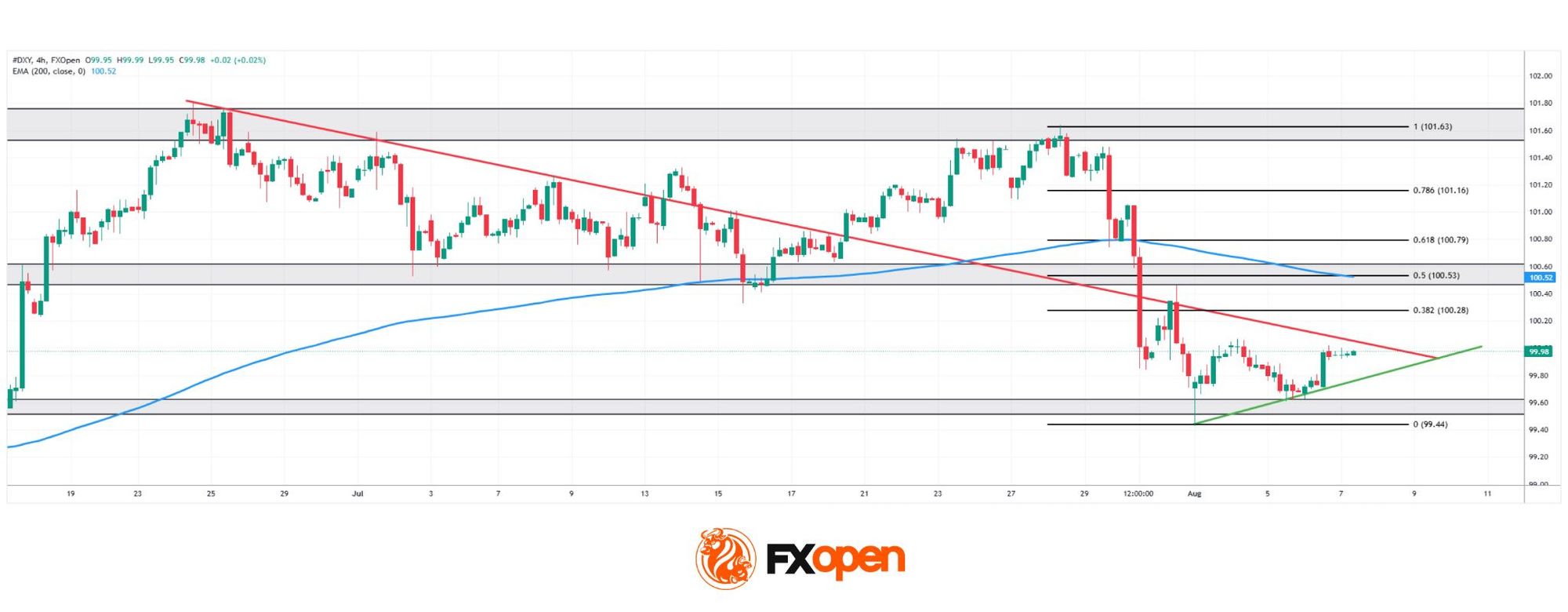
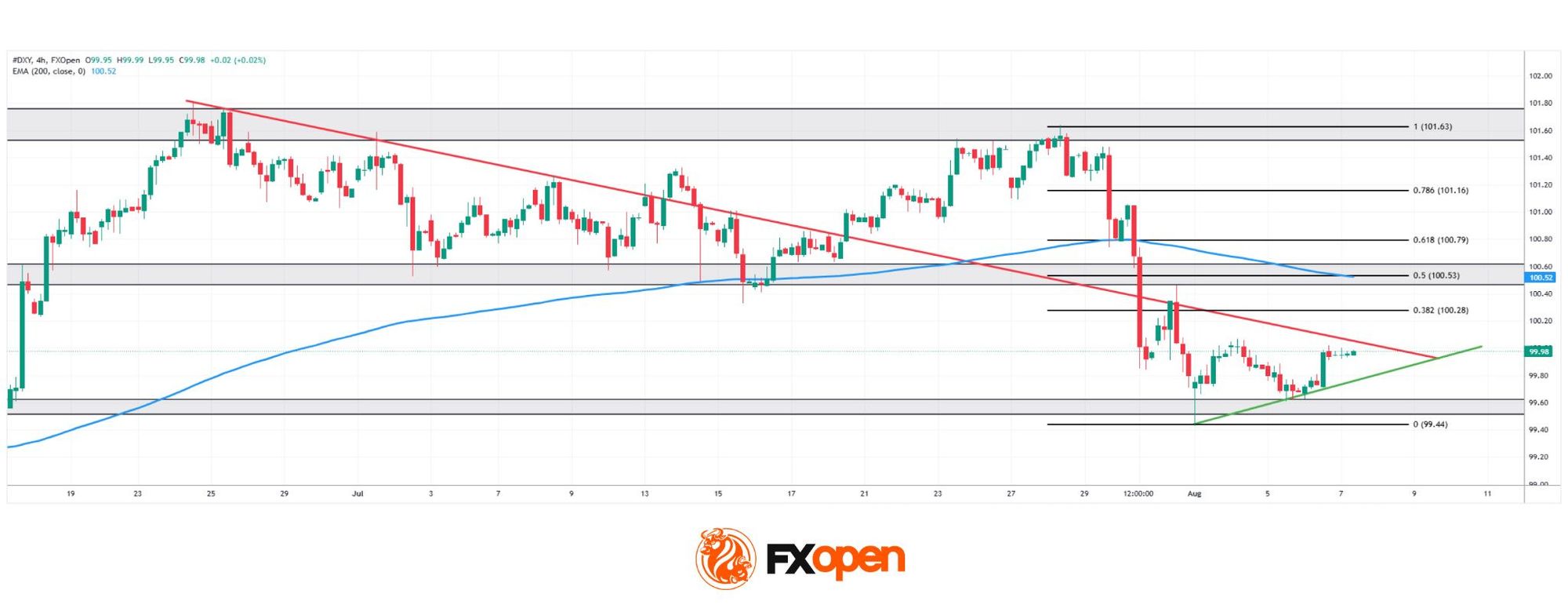
As the chart shows, the DXY has spent nearly two months consolidating after its 2026 recovery, currently squeezed between a descending trendline from late June’s highs and a newly formed ascending trendline off early August’s lows, with price also testing the confluence of the 0.382 Fibonacci retracement near 100.28.
Bullish Scenario
Should buyers break above the descending trendline and reclaim the 0.5 retracement near 100.53, where the 200-period EMA also sits, the path would open toward the 0.618 level around 100.79, with a stronger move potentially targeting the 0.786 retracement near 101.16 and the 101.63 highs beyond.
Bearish Scenario
Conversely, a break below the ascending trendline and the 99.60 support would expose the 0.0 Fibonacci level near 99.44, invalidating the recent recovery attempt and opening the door to a deeper pullback within the broader consolidation range.
With today’s NFP report landing right at this technical crossroads, where two converging trendlines meet a key Fibonacci confluence, the DXY looks poised for a decisive break—will the dollar finally resolve two months of consolidation, or extend the standoff into next week?
Trade global index CFDs with zero commission and tight spreads (additional fees may apply). Open your FXOpen account now or learn more about trading index CFDs with FXOpen.
This article represents the opinion of the Companies operating under the FXOpen brand only. It is not to be construed as an offer, solicitation, or recommendation with respect to products and services provided by the Companies operating under the FXOpen brand, nor is it to be considered financial advice.


Disclosure: This article does not represent investment advice. The content and materials featured on this page are for educational purposes only.
XRP’s MiCA approval has strengthened its long-term outlook as investors increasingly explore EiCrypto’s cloud hashing contracts for diversified crypto participation.
Summary
- XRP gains full MiCA approval, strengthening its regulatory position as traders await technical breakout confirmation.
- EiCrypto pitches AI-powered cloud mining as XRP investors seek income opportunities beyond price appreciation.
- Regulatory clarity boosts confidence in XRP, but analysts say stronger chart signals are still needed to confirm a rally.
The case for a bullish outlook on XRP has become clearer following its full MiCA approval, reigniting the debate over price predictions. While the market welcomes regulatory clarity, chart data is still needed to substantiate the price trajectory.
The regulatory landscape for XRP has become clearer, but the charts still require further validation.
The approval of MiCA is crucial, as it eliminates one of the biggest uncertainties facing XRP. Greater regulatory clarity boosts trader confidence, which can reignite genuine buying enthusiasm in the market.
However, bullish signs have not yet fully materialized. XRP is publicly traded, meaning everyone sees the same resistance levels, knows the same breakout points, and can wait for confirmation. Consequently, while the potential for a rise remains, the market has not yet given the bulls a definitive answer. News of the approval has improved the outlook but has not resolved the issue of timing. If demand follows the news, XRP could still continue to rise, but what the market needs now is real follow-up action, not just better news.
For XRP holders, rather than fixating on market fluctuations, it is more productive to consider how to generate consistent returns from their digital assets amidst price volatility and achieve long-term wealth growth.
It is against this backdrop of market demand that a new digital asset operation model — EiCrypto cloud hashing contracts — has begun to attract increasing attention from investors in digital assets such as XRP and BTC. Some market observers believe that, in addition to allowing XRP holders to retain the potential for asset appreciation, this model can generate consistent cash flow returns for users through a hashing-based earnings mechanism.
What is EiCrypto cloud mining?
EiCrypto has created a brand-new managed cloud computing service platform by integrating artificial intelligence (AI) with blockchain technology. Users can easily access a global computing power network via their mobile phones and participate in the digital economy’s passive income ecosystem — all without the need to purchase expensive mining hardware or bear costs related to equipment maintenance, operational management, electricity, and facilities. All that is required is ownership of mainstream digital assets such as BTC, ETH, or XRP.
Leveraging an intelligent cloud computing system to overcome the challenge of market volatility — a common issue for digital asset users—this approach unlocks the potential for asset appreciation while simultaneously enhancing asset utilization to maximize returns.
How to join EiCrypto and start earning passive income
Register an Account: Sign up here to receive a $15 new-user bonus.
Deposit Methods: EiCrypto supports a wide range of mainstream digital assets, such as BTC, USDT, ETH, LTC, USDC, XRP, SOL, and BNB.
Select a Contract: Choose a cloud mining contract that suits a particular budget and timeframe; the system will then operate automatically.
Popular Contract Options:
- Starter Contract: $100 — 2 days — Total return approx. $108
- Basic Contract: $500 — 5 days — Total return approx. $532.50
- Basic Contract: $1,500 — 10 days — Total return approx. $1,705.50
- Stable Contract: $5,500 — 20 days — Total return approx. $7,050
- Stable Contract: $10,000 — 30 days — Total return approx. $14,475
Click here to view more contract details.
Once the contract is activated, earnings will be automatically settled to a user’s account after 24 hours. Users can choose to withdraw their earnings or reinvest them, thereby achieving long-term, compound growth of their digital assets.
About EiCrypto
Headquartered in the UK, EiCrypto operates in compliance with relevant UK and European regulatory frameworks and continuously enhances its transparency, operational standards, and user protection mechanisms by aligning with regulatory standards such as MiCA (Markets in Crypto-Assets Regulation) and MiFID II (Markets in Financial Instruments Directive).
The platform employs a multi-layered security architecture, including:
- PwC annual financial and security compliance audits
- Lloyd’s of London insurance for digital asset custody
- Cloudflare enterprise-grade cybersecurity protection and McAfee® security systems
- AI-driven risk control, multi-layered encryption architecture, and two-factor authentication (2FA)
In conclusion
For digital assets like XRP and Bitcoin, market volatility remains an unavoidable challenge. What truly sets investors apart is not merely the fluctuation in returns caused by the shift between bull and bear markets, but rather the ability to enhance asset utilization efficiency and establish a long-term, sustainable asset allocation strategy across varying market conditions. EiCrypto’s innovative model emerged against this backdrop, offering users a new avenue for passive income; rather than passively waiting for opportunities, one can proactively embrace change and take decisive action.
For more information, visit the official website and download the mobile application.
Disclosure: This content is provided by a third party. Neither crypto.news nor the author of this article endorses any product mentioned on this page. Users should conduct their own research before taking any action related to the company.


Stripe-owned Bridge has entered the EU MiCA register following Luxembourg approval, joining regulated providers under the bloc’s crypto framework.


Coinbase Financial Markets lost its bid for preliminary relief in Michigan on Aug. 6 after U.S. District Judge Shalina Kumar refused to block state officials from enforcing sports betting laws against the company’s event contracts.
Summary
- Michigan judge Shalina Kumar denied Coinbase’s request to block state enforcement against sports event contracts.
- Coinbase failed to show sports event contracts likely qualify as swaps under federal commodities law.
- The ruling leaves Michigan’s sports betting authority intact while Coinbase continues challenging state jurisdiction nationwide.
- Federal courts remain divided over whether CFTC-regulated sports contracts preempt state gambling and betting laws.
- CFTC rulemaking and parallel state lawsuits could shape the next phase of prediction market regulation.
The order leaves Coinbase without the injunction it sought as its challenge continues.
Coinbase sued Michigan Attorney General Dana Nessel, arguing that event contracts offered through federally regulated prediction markets fall under the Commodity Exchange Act and the Commodity Futures Trading Commission’s exclusive jurisdiction. Coinbase wants Michigan customers to access contracts supplied through Kalshi.
Judge rejects Coinbase’s preemption case
Kumar concluded that Coinbase had not shown a likelihood of success on its federal preemption claims, a requirement for preliminary relief. The judge rejected Coinbase’s argument that sports event contracts necessarily qualify as swaps under the Commodity Exchange Act and therefore sit beyond Michigan’s gambling authority.
The court also rejected Coinbase’s claim that compliance with federal derivatives law and Michigan’s Lawful Sports Betting Act would be impossible. Kumar wrote that Coinbase’s assertions were “applesauce,” adding that higher costs or operational difficulty do not establish legal impossibility. The ruling addresses preliminary relief rather than a final judgment.
Coinbase has argued that state restrictions frustrate Congress’s attempt to build a federal derivatives regime. Chief Legal Officer Paul Grewal previously said state efforts to control prediction markets “stifle innovation and violate the law.” That remains Coinbase’s position, not a conclusion accepted by the Michigan court.
Federal courts remain divided over sports contracts
The Michigan ruling lands in a legal split. In April, the Third Circuit affirmed preliminary relief for Kalshi in New Jersey, holding that Kalshi had shown a reasonable chance of succeeding on its argument that sports event contracts are swaps and federal derivatives law preempts conflicting state restrictions.
Other courts have reached the opposite conclusion. Michigan federal judges have questioned whether Congress intended the Commodity Exchange Act to sweep sports wagering into the federal swaps framework. Earlier decisions in Ohio and elsewhere have rejected or limited the industry’s preemption theory, leaving the legal status unsettled.
As previously reported in New Jersey coverage, former SEC and CFTC Chair Gary Gensler argued that sports prediction contracts should remain outside the federal swap framework. In related coverage, gaming groups have urged Congress to preserve state authority over sports wagering rather than let federally registered platforms bypass state licensing systems.
CFTC is pressing its own federal authority
The CFTC has taken the opposite institutional position. Chairman Michael Selig has repeatedly said the agency has exclusive jurisdiction over federally regulated prediction markets. The commission sued Kentucky in June after the state pursued enforcement against designated contract markets and has initiated proceedings involving Minnesota, Illinois and Rhode Island.
The agency is also rewriting its event contract framework. A June proposal would create a structured process for determining whether contracts involve gaming, terrorism, assassination, war or conduct unlawful under federal or state law, and whether they are contrary to the public interest. The proposal includes a 90-day review period.
As crypto.news reported in prediction market coverage, the CFTC’s push has expanded beyond individual disputes into rulemaking. Another proposal addresses reporting requirements for certain collateralized event contracts, showing federal regulators are building a structure while courts continue debating state power.
What happens next in Coinbase’s Michigan case
The denial means Coinbase does not receive the preliminary shield it requested against Michigan enforcement. It does not resolve every issue in the underlying lawsuit. Coinbase can continue litigating its claims and may seek appellate review of the injunction decision, while Michigan officials can continue defending their authority under state gaming law.
The case also increases pressure on higher courts to reconcile conflicting interpretations. The Third Circuit has sided with Kalshi on the core swap and preemption questions, while several district courts have disagreed. Coinbase argues a conflicting appellate ruling elsewhere would deepen the split and increase the likelihood of potential Supreme Court review.
For Coinbase, the stakes extend beyond Michigan. Its prediction market service is offered through Coinbase Financial Markets, and the company has been expanding event contracts alongside stocks, crypto and derivatives. Coinbase argues state restrictions could force different availability rules across the country if federal preemption remains unsettled.
The next major developments will be any appeal, merits rulings in Michigan and appellate decisions in other prediction market cases. The CFTC’s rulemaking may shape the debate, but an agency rule cannot erase statutory questions courts are already interpreting. For now, Kumar’s ruling gives Michigan a procedural win while leaving the national jurisdiction fight unresolved.

Ripple XRP price is under noticeable selling pressure, slipping roughly 2.2% over the last 24 hours to trade near $1.03. While broader market leaders like Bitcoin remained largely flat, XRP led losses among major altcoins as a critical legislative catalyst vanished overnight.
Senate Majority Leader John Thune formally delayed consideration of the regulatory bill, queuing the CLARITY Act for after the August recess in September. The unexpected scheduling push removed an immediate tailwind, leaving short positioning to build rapidly as spot demand cooled.
On social channels, speculative projections like CryptoBull’s viral post claiming XRP could hit “$27 by October 2026” continue to circulate, but current order books paint a grimmer short-term picture.
(Will retail buyers step in before $1.00 breaks?) With Polymarket odds for the CLARITY Act passing in 2026 dropping near 30%, market participants are shifting focus to technical support structures ahead of fresh labor data.

Discover: Everyone’s Got a Take. Get Free $25 to Actually Trade Yours
Can XRP Price Hold $1.00 Support This Month?
XRP is trading around $1.03, down 5.7% over the past 7 days with 24-hour volume hovering near $1.44 billion. Market cap remains anchored near $64.2 billion, but momentum indicators reveal persistent downside bias across key timeframes.
The Aroon Oscillator sits at -100, signaling that recent lows dominate price action. A negative BBTrend reading of -1.36 confirms steady selling pressure, even as an ADX of 11.2 indicates a relatively weak overall trend.
The immediate battleground sits at the psychological $1.00 level, with secondary Fibonacci supports at $1.0125 and $0.9711. Resistance remains heavy between $1.06 and $1.08.
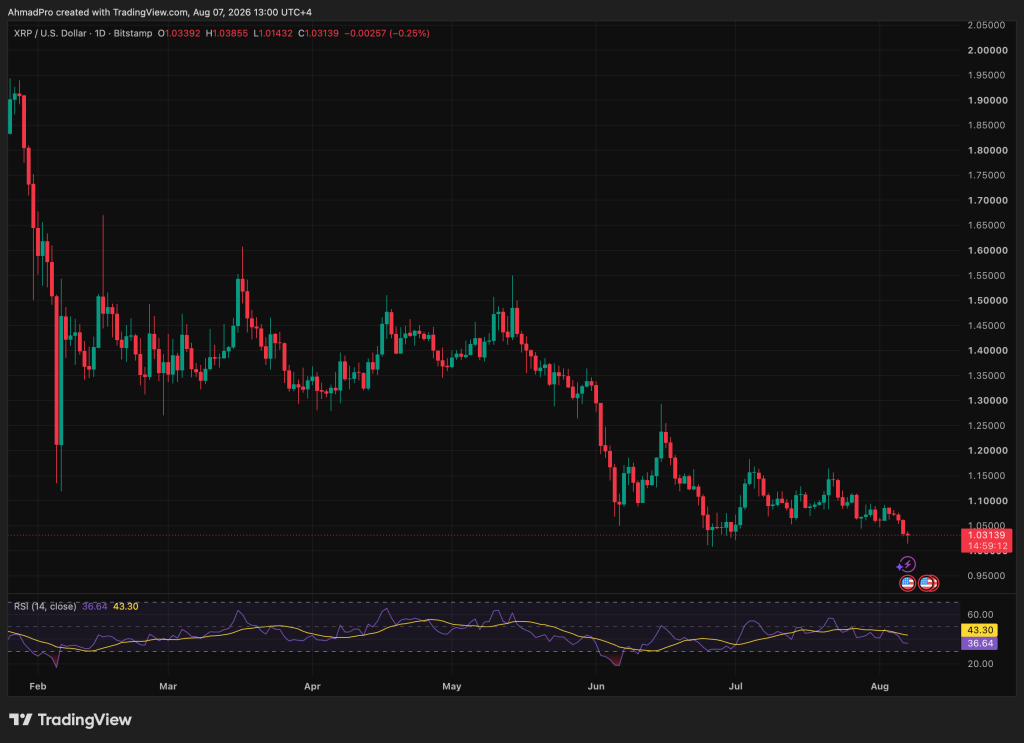
A recovery above $1.10 to $1.15 reclaims short-term structure and opens the door for a push toward $1.65 if legislative momentum resumes in September.
XRP remaining trapped in a wide range between $1.00 and $1.08 while spot traders wait for regulatory clarity is the base case. A breakdown below $0.9711 invalidates key support and risks a slide toward lower channel boundaries near $0.85.
Can traders afford to sit idle in legacy majors while legislative gridlock drags on?
Discover: Your Market Calls Are Worth Something. Start With Free $25 on Kalshi
LiquidChain Targets Early Mover Upside as XRP Tests Key Levels
When large-cap tokens like XRP get bogged down by congressional delays and technical channel caps, capital frequently migrates toward high-upside, early-stage infrastructure projects.
Investors fatigued by multi-month regulatory paralysis are looking beyond single-chain protocols to solve real cross-chain bottlenecks.
Enter LiquidChain ($LIQUID), a Layer 3 infrastructure protocol designed to unify fragmented crypto liquidity. By building a Unified Liquidity Layer, LiquidChain fuses Bitcoin, Ethereum, and Solana execution environments into a single network.
Developers deploy code once and instantly tap into liquidity across all three major ecosystems, eliminating multi-bridge complexity through single-step execution and verifiable settlement.
The project’s ongoing presale has already raised $933,004.07, with $LIQUID tokens priced at $0.01487. While early-stage crypto allocations carry execution and market adoption risks, LiquidChain presents a high-beta alternative for capital looking for structural growth independent of Washington’s legislative calendar.
Active traders looking to diversify can research LiquidChain before the presale advances.
Discover: Get Paid to Be Right, $25 to Start on Kalshi
Don’t Miss Out on Our $1,000 USDT Airdrop on ByBit
The post XRP Price Falls 2% as CLARITY Act Vote Slips to September appeared first on Cryptonews.

QVC Guest’s Live TV ‘Blow Job’ Blunder Is Our New Favourite Moment Of 2026

A home is where opportunity begins

Senate Majority Leader Thune Confirms Clarity Act Vote Moves to September

Renter of Home in Anne Heche Crash Denies Settlement With Son

No Jackpot Winner as $257 Million Prize Rolls Over to $269 Million Monday Draw

Weekend Open Thread: Staud – Corporette.com

Trump SCANDALIZED as Bank Declares They FEARED Trump WAS A MONEY LAUNDERER As They Closed Accounts!

Ripple XRP WARNING: The FINAL Crash Hits On This Date! (DON’T SELL)

Gaddafi proposed gold-backed African currency, US halted shift #gaddafi #petrodollar #geopolitics
-

 Fashion7 days ago
Weekend Open Thread: Wit & Wisdom
-

 Politics7 days ago
Meta enters AI-training agreement with far-right ‘propaganda rag’ Newsmax
-

 Politics5 days ago
Zack Polanski: an incitement to murder Nigel Farage?
-

 Crypto World6 days ago
MicroStrategy Post-Earnings CLARITY Act Push Could Add New Catalyst for Its Stock
-

 Crypto World6 days ago
XRP Ledger v3.3.0 brings five institutional features
-

 Crypto World6 days ago
New York sues Kalshi over prediction market gambling
-

 Crypto World5 days ago
Crypto PAC spending tops $2M in Michigan House race
-

 Business7 days ago
Trump Announces Hamas Disarmament Agreement as Iran Strikes Kuwait Air Base and US Attacks Pause Overnight
-

 Business4 days ago
DTCR: Deleveraging And A Hedge Fund Collapse Point To A Possible AI Bottom
-

 Tech5 days ago
ESET tracks rise in malicious AI skills and adaptable malware
-
 Crypto World7 days ago
3 Fed Officials Just Explained Their Rate Hike Vote: Is Inflation Winning?
-
 Tech7 days ago
Building A Reproduction PlayStation Motherboard
-

 Sports6 days ago
France Cricket implodes: letters hidden in a drawer and a board at war
-
Crypto World5 days ago
XRP Ledger urges node upgrade after manifest flood
-

 Crypto World6 days ago
Moneyflip CEO charged in $40K murder-for-hire plot
-
 Sports6 days ago
Bruno Fernandes decision made as Man United ‘discuss’ striker transfer option
-
Business7 days ago
FIFA has scrapped $20 billion World Cup sell-off plan, New York Post reports
-

 News Videos6 days ago
Financial Crash Expert: The 90-Day Collapse Timeline They Are Desperately Hiding.
-

 Sports7 days ago
Commonwealth Games 2026 Live Updates | Day 9 CWG 2026: Lovlina Borgohain, Sachin Siwach Enter Final After Indian Judokas Script History
-

 Sports1 day ago
Jordan Coyle & Cordiamo take Laya Arena Stakes at RDS
You must be logged in to post a comment Login