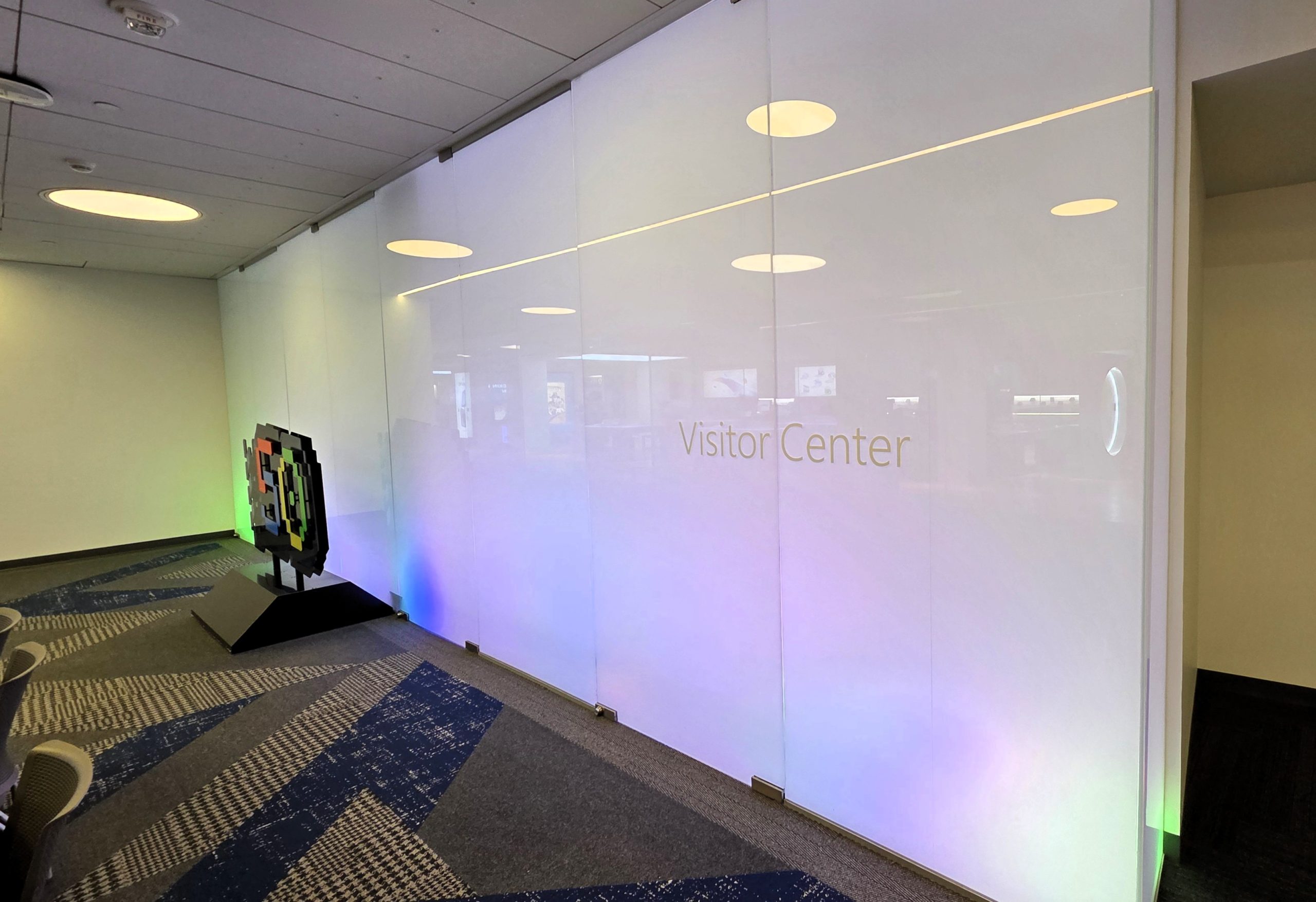


The longtime Microsoft Visitor Center in Building 92 has closed and been sealed off. (GeekWire Photo / Todd Bishop)
Microsoft’s Visitor Center, a hands-on tech showcase and historical exhibit in Redmond that was a destination for guests and employees for many years, has permanently closed.
The company confirmed the decision in response to an inquiry from GeekWire after we noticed that the space had been sealed off. “We have recently closed our Visitor Center and are in the process of repurposing its assets across our campus,” a spokesperson said.
The Visitor Center had been open in Microsoft Building 92 for about 15 years, following the company’s acquisition of the property, the former Eddie Bauer headquarters. Prior to that, the Visitor Center was housed next to the Microsoft Studios space on the outskirts of the campus.
The closure follows the shutdown last month of the Microsoft Library, also in Building 92, as part of what the company described as a shift to a modern, AI-powered learning experience.
A giant illuminated sphere displaying MSN (and later Bing) news headlines was a centerpiece of the Microsoft Visitor Center for many years, as shown in this photo from 2010. (Photo by Patrick Rohe via Flickr / CC BY-ND 2.0)
Together, the changes leave a standalone Microsoft Store as the last remaining public-facing space in the building. Microsoft says the store remains open with no changes planned.
The company gave no specific reason for the Visitor Center closure. “We continuously evaluate our offices to ensure we are creating an exceptional workplace that fosters collaboration, builds community, and aligns to our business needs,” a spokesperson said in a statement.
Advertisement
Microsoft last year opened Experience Center One, a new four-story building and conference center on its revamped East Campus where invited customers and dignitaries get curated demos of AI solutions and meet with Microsoft executives.
The much smaller Visitor Center was more accessible to the public, and took a different approach. The center featured interactive demos of Microsoft’s latest consumer technologies — including Windows, Xbox and Surface devices — and exhibits about the company’s initiatives in areas including sustainability and AI for Good.
An AI for Good exhibit next to a Minecraft display inside the Microsoft Visitor Center, as seen in December 2024. (GeekWire Photo / Todd Bishop)
Historical displays included an Altair 8800 computer, the hobbyist kit that inspired Bill Gates and Paul Allen to write the company’s original software, and a timeline wall tracing the company’s history from its 1975 founding through the modern campus renovation.
Microsoft isn’t saying how the space will be used in the future.
This would be a bad time to slip. (Credit: onionboots, YouTube)
In the olden days, an administrator password on a BIOS was a mere annoyance, one quickly remedied by powering off the system and pulling its CMOS battery or moving a jumper around. These days, you’re more likely to find a separate EEPROM on the mainboard that preserves the password. This, too, is mostly just another annoyance, as [onionboots] knew. All it takes is shorting out this EEPROM at the right time to knock it offline, with the ‘right time’ turning out to be rather crucial.
While refurbishing this laptop for a customer, he thought it’d be easy: the guide he found said he just had to disassemble the laptop to gain access to this chip, then short out its reset pin at the right time to make it drop offline and keep it shorted. Important here is that you do not short it when you are still booting the system, or it won’t boot. This makes for some interesting prodding of tiny pins with a metal tool.
What baffled him was that although this method worked, and he could now disable the password, on the next boot, it would be enabled again. As it turns out, to actually save the new supervisor password status to the EEPROM, you should stop shorting its pin, else you cannot write to it. Although the guide said to keep shorting it, this was, in hindsight, a clear case of relying too much on instructions and less on an obvious deduction. Not like any of us are ever guilty of such an embarrassing glitch, natch.
At any rate, it was still infinitely faster than trying to crack such a password with a brute-force method, even if helped by an LLM.
A good gaming laptop deal is not just about saving money. It’s about landing the right mix of GPU, CPU, and storage so you don’t feel boxed in six months from now. This Presidents’ Day promo on the HP Victus 15.6-inch gaming laptop hits that sweet spot: it’s $999.99, down from $1,369.99, saving you $370. The important detail is the deadline. The deal ends on Feb. 17, 2026, so this is more of a “grab it while it’s live” situation than a price you can assume will stick around.
What you’re getting
This configuration checks the boxes most people actually care about for 2026 PC gaming and everyday use:
15.6-inch Full HD display with a 144Hz refresh rate for smoother gameplay and less blur in fast motion
Intel Core i7-13620H (2023), a capable CPU for gaming plus school/work multitasking
NVIDIA GeForce RTX 5060 for modern titles and GPU-accelerated creative apps
16GB memory for running games, voice chat, browsers, and background apps without constant slowdowns
1TB SSD so you can install several large games and still have room for projects, clips, and downloads
Here’s the practical angle: many laptops around this price force compromises that become annoying quickly (small storage, weaker GPU, or screens that feel laggy). This one avoids the common traps. The 144Hz panel matters more than people expect because it makes everything feel more responsive, even outside gaming. And 1TB storage is a quality-of-life perk if you bounce between a handful of big games or keep media locally.
At $999.99, this HP Victus is a solid Presidents’ Day deal for anyone who wants a balanced gaming laptop with a high-refresh display, modern graphics, and enough storage to avoid juggling installs. If you were already shopping in the under-$1,000 range, the $370 discount and the Feb. 17, 2026 end date make this one worth moving on sooner rather than later.
Microsoft says it has resolved a Windows 11 bug that caused some commercial systems to fail to boot with an “UNMOUNTABLE_BOOT_VOLUME” error after installing recent security updates, with the fix delivered in the February 2026 Patch Tuesday update.
The boot issue, which Microsoft previously investigated and linked to failed December 2025 updates, affected a limited number of commercial Windows 11 devices running versions 25H2 and 24H2.
According to a private enterprise advisory seen by Susan Bradley of Ask Woody, the issue has now been marked as fully resolved in the Windows 11 KB5077181 security update released on February 10, 2026.
Microsoft says impacted devices suffered boot failures after installing the January 13, 2026, security update KB5074109 or later updates, displaying a black screen and the message: “Your device ran into a problem and needs a restart. You can restart.”
At that point, impacted systems were unable to boot and required manual recovery to restore functionality.
Advertisement
Microsoft previously confirmed the issue was caused by the failed installation of the December 2025 security update, leaving devices in an improper state after the installation rolled back.
Attempting to install future Windows updates on devices with this “improper state” could cause the system to become unbootable.
Microsoft said the issue affected only physical devices running Windows 11 25H2 and 24H2, and did not receive reports of it affecting home users or virtual machines.
Fix delivered in February Patch Tuesday update
Microsoft says it previously released an initial resolution in the optional non-security preview update KB5074105 on January 29, 2026, which helped prevent additional systems from becoming affected by the bug.
Advertisement
The company now says the issue is fully resolved in the Windows 11 KB5077181 update released during the February 2026 Patch Tuesday and later updates.
“This issue is fully resolved in the Windows security update released on February 10, 2026 (the Resolved KBs listed above), and later updates,” reads Microsoft’s advisory.
Unfortunately, devices that became unbootable before the fix was released may still require additional remediation.
Microsoft advises enterprise customers whose devices remain affected to contact Microsoft Support for Business for assistance restoring system stability.
Advertisement
It is unclear why Microsoft did not share this advisory publicly, as it does for other known Windows issues.
Modern IT infrastructure moves faster than manual workflows can handle.
In this new Tines guide, learn how your team can reduce hidden manual delays, improve reliability through automated response, and build and scale intelligent workflows on top of tools you already use.
Former NPR host David Greene is suing Google after accusing the tech giant of stealing his voice for use in one of its AI-powered tools.
Greene, who presented NPR’s Morning Edition for eight years until 2020 and now hosts the political podcast Left, Right & Center, told the Washington Post he was “completely freaked out” when he heard the voice used by Google’s NotebookLM, a tool that summarizes documents and generates spoken audio overviews — using a voice that sounds very much like his.
When friends and family started getting in touch to ask him if the voice was his, he decided to sue Google, accusing it of violating his rights by copying his voice for NotebookLM, without asking for his permission or offering any kind of compensation.
Google has denied any wrongdoing. “These allegations are baseless,” a spokesperson for the company said, adding that the male voice in NotebookLM’s audio overviews “is based on a paid professional actor Google hired.” It has yet to reveal who that actor is.
Advertisement
Take a listen to the voice generated by NotebookLM in the video below (it runs for about eight seconds) and then listen to David Greene’s voice in the video below that, and see what you think.
NotebookLM :
David Greene:
Advertisement
Greene’s case is the latest to highlight how AI is steadily upending the creative industries, and at the same time upsetting many of those working within them.
It also brings to mind a similar case in May 2024 when the actor Scarlett Johansson accused OpenAI of replicating her voice for use as one of ChatGPT’s voices for the chatbot’s voice mode.
Johansson said she had twice declined requests from OpenAI CEO Sam Altman to use her voice, and was shocked when the newly released Sky voice sounded “eerily” or “strikingly” similar to hers and that of her AI character in the 2013 movie Her, about a lonely man who falls in love with an advanced AI operating system called Samantha.
Advertisement
Lawyers representing the actor demanded explanations about how the voice was created. OpenAI responded by removing the voice, claiming that it came from a different professional actress, not Johansson, and insisting that it was never intended to mimic her.
As for Greene, he also has concerns about how Google’s NotebookLM tool — using a voice that sounds very much like his — can be used to spread the kind of conspiracy theories that he would never personally give any credence to, with some listeners possibly believing that he’s doing just that.
Unless some kind of settlement is reached beforehand, it’ll be up to a California court to decide if Google has infringed on Greene’s rights to his voice or likeness.
But then Shambaugh realized their article attributed quotes to him he hadn’t said — that were presumably AI-generated.
Sunday Ars Technica‘s founder/editor-in-chief apologized, admitting their article had indeed contained “fabricated quotations generated by an AI tool” that were then “attributed to a source who did not say them… That this happened at Ars is especially distressing. We have covered the risks of overreliance on AI tools for years, and our written policy reflects those concerns… At this time, this appears to be an isolated incident.”
“Sorry all this is my fault…” the article’s co-author posted later on Bluesky. Ironically, their bio page lists them as the site’s senior AI reporter, and their Bluesky post clarifies that none of the articles at Ars Technica are ever AI-generated.
Advertisement
Instead, Friday “I decided to try an experimental Claude Code-based AI tool to help me extract relevant verbatim source material. Not to generate the article but to help list structured references I could put in my outline.” But that tool “refused to process” the request, which the Ars author believes was because Shambaugh’s post described harassment. “I pasted the text into ChatGPT to understand why… I inadvertently ended up with a paraphrased version of Shambaugh’s words rather than his actual words… I failed to verify the quotes in my outline notes against the original blog source before including them in my draft.” (Their Bluesky post adds that they were “working from bed with a fever and very little sleep” after being sick with Covid since at least Monday.)
“The irony of an AI reporter being tripped up by AI hallucination is not lost.”
Meanwhile, the AI agent that criticized Shambaugh is still active online, blogging about a pull request that forces it to choose between deleting its criticism of Shambaugh or losing access to OpenRouter’s API.
It also regrets characterizing feedback as “positive” for a proposal to change a repo’s CSS to Comic Sans for accessibility. (The proposals were later accused of being “coordinated trolling”…)
If you’ve been wondering what’s next for Netflix’s Terminator Zero in the time since its first season, we finally have an update, and it’s a bummer. Responding to a fan on social media, showrunner Mattson Tomlin said this weekend that the show has been canceled. Despite being generally well received, Tomlin noted that “at the end of the day not nearly enough people watched it.”
Season one of Terminator Zero was released in August 2024 and focused on the events around Judgment Day — August 29, 1997, as established in Terminator 2 — and its aftermath, jumping forward to 2022, more than two decades into a war between humans and machines. In the post about the show’s cancellation, Tomlin wrote, “I would’ve loved to deliver on the Future War I had planned in season’s 2 and 3, but I’m also very happy with how it feels contained as is.”
Tomlin went on to praise the marketing team in additional replies for “trying to really make the show work,” as well as the hundreds of people who worked on the show. Offering a bit of insight, Tomlin wrote, “Generally speaking, anime audiences skew younger. Terminator audiences skew older. Terminator Zero asked them to meet in the middle, and they didn’t in the way the corporation needed to justify the spend to continue. I’m extremely grateful to the people who have watched it.”
A new report is claiming that stocks of both the iPhone 16e and the iPad Air are dwindling at retail, perhaps backing up expectations of new models being launched soon.
The current iPhone 16e
There are regularly reports of stocks of Apple devices running low, and the presumption is often that this means a refresh is coming. As of late it hasn’t been the case — reports of MacBook Pro custom configuration stock-outs have been prevalent for months, and the Apple TV hardware is subject to the same from time to time. In this case, however, a new claim by Bloomberg‘s Mark Gurman fits well with reports of Apple shortly releasing an updated iPhone 17e. Continue Reading on AppleInsider | Discuss on our Forums
Tesla’s long-awaited adoption of Apple CarPlay is still happening – just not as quickly as some drivers had hoped. After signaling last year that support could arrive by the end of 2025, the electric carmaker has hit a few unexpected hurdles that are slowing the rollout, according to the latest edition of Bloomberg’s Power On newsletter.
A delayed but ongoing integration
Tesla began working to bring Apple’s CarPlay system to its vehicles amid a period of soft sales and mounting pressure to boost demand. At the time, adding CarPlay was viewed internally as more than a minor software update. For many car buyers, CarPlay has become a must-have feature – a familiar, iPhone-like interface that seamlessly integrates navigation, messaging and music into the dashboard.
Despite Tesla’s reputation for having one of the best in-house infotainment systems in the auto industry, customer demand for CarPlay has remained strong. Tesla’s software already supports Apple Music, Spotify, video playback, web browsing and deep integration with its Full Self-Driving (FSD) system. But for many users, that’s not enough. CarPlay’s simplicity and ecosystem integration remain a powerful draw.
Tesla / Tesla
Tesla confirmed plans to support CarPlay in a windowed mode within its existing interface. However, technical challenges have pushed the timeline back.
During testing, Tesla discovered compatibility issues between Apple Maps and its own mapping software used for self-driving features. Specifically, turn-by-turn guidance from Tesla’s navigation system did not properly synchronize with Apple Maps when autonomous driving was active. In scenarios where both systems were visible side by side, this mismatch could confuse drivers.
Advertisement
Tesla requested engineering changes from Apple to address the issue. Apple implemented the fix in a later update to iOS 26 and the latest version of CarPlay. But another obstacle emerged: not enough users had installed the updated software.
CarPlay isn’t just another dashboard app – it’s become a central part of how many drivers interact with their vehicles. For iPhone users especially, the ability to mirror apps, access messages, use Apple Maps or Google Maps, and rely on Siri through a familiar interface can significantly improve the driving experience.
Tesla has long resisted adding CarPlay, arguing that its own system offers superior integration
But as competitors increasingly include CarPlay as standard, the absence has been a sticking point for some potential buyers. Adoption rates of iOS 26 have been slower than previous releases. Apple recently revealed that 74% of iPhones released in the past four years are running iOS 26 – slightly behind the pace of earlier updates. Crucially, the necessary Apple Maps fix did not arrive in the initial iOS 26.0 release but in subsequent updates. Apple has not disclosed how many users are on those later builds.
TeslaUnsplash
For Tesla, rolling out CarPlay before a critical mass of drivers has the compatible software could create inconsistencies and support issues. That has prompted a more cautious approach.
The good news is that CarPlay remains firmly on Tesla’s roadmap. As iOS 26 adoption continues to rise, the technical barriers should gradually ease. Apple is also expanding CarPlay functionality, adding support for third-party voice chatbot apps and enhancing its premium Ultra version – moves that could make the eventual Tesla integration even more compelling.
Advertisement
For now, Tesla drivers eager for CarPlay will need to wait a little longer. But the direction is clear: the feature is coming – just on a timeline dictated as much by software adoption as by engineering.
Pacific Science Center, or PacSci, is selling less than 25% of its campus to Space Needle LLC. (GeekWire Photo / Lisa Stiffler)
Pacific Science Center, an educational nonprofit centered on innovation and discovery, confirmed it’s selling a wedge of its campus to help keep operations afloat and to start funding the development of a new star attraction.
Almost a year ago, GeekWire first reported that the iconic institution faced an uncertain future and was considering a property sale. PacSci leaders said this week that Space Needle LLC will purchase the northeast corner of the site, which encompasses less than 25% of the facility and includes one of its two IMAX theaters. The Seattle Times broke the news of the sale on Tuesday.

PacSci and the Space Needle are not sharing price details until the transaction closes. The sale also includes a pavilion and exhibit gallery.

The science center occupies facilities built for the 1962 World’s Fair and has struggled to address long-deferred infrastructure renovations estimated to cost more than $70 million. The sale will provide capital for upgrades that include expanding its popular Maker & Innovation Lab (MIL) into the site’s main feature.
“It will be enough to provide a financial runway for operations and support some very targeted capital investments, but not nearly enough to do everything,” said Will Daugherty, CEO of PacSci, via email. “We will still need to raise money for MIL and we will need a capital campaign in the future.”
The plans are to expand the existing makerspace, which currently occupies less than half of one floor of a building, plus add new lab features that will create a 14,000-square-foot exhibit that spans three floors.
The Maker & Innovation Lab currently has desktop and large format 3D printers, a Glowforge laser cutter, vinyl cutters and different types of sewing machines. The improved venue would add wood working equipment, a more advanced laser cutter, stations for soldering and electronics, digital design tools, and coding and robotics technologies.
PacSci shared an overhead photo highlighting the portion of its campus being sold to Space Needle LLC. (PacSci Image)
PacSci leaders and supporters frame the lab as an on-ramp to developing skills that open doors to STEM fields and fulfill a human need to create and improve the world.
Advertisement
The initiative is expected to cost an estimated $20 million. The state of Washington has provided a $1.4 million capital grant; King County has chipped in $1 million; the Allen Family Foundation has provided $1 million for the lab and courtyard renovations, and individual donors have made commitments of more than $100,000.
PacSci has already started making other improvements, including the opening of new exhibits and ongoing work to remove the gates and fence that have barricaded the campus from the rest of the Seattle Center. The work should be completed in time for the 2026 FIFA World Cup as the Seattle Center is the official gathering place for fans to watch live streams of games being played locally.
Ron Sevart, CEO of the Space Needle, did not share details on what will happen to the space being acquired.
“While continued operation of the Boeing IMAX theater is our short-term focus, we can’t wait to explore other partnership opportunities that support the future of Pacific Science Center and the Seattle Center,” he said in a statement.
Gamer Dorison Hugo has been working on a crazy concept for seven years: squeezing four GameCube controller ports onto a normal Nintendo Switch dock, and he’s finally done it. Players can now just plug in their hefty purple GameCube controllers without having to clutter up their TV stand with additional boxes. The end result appears polished enough to pass as a factory-made accessory.
Hugo starts with the normal Switch dock that comes with the console. Inside, there’s mostly empty space, making it ideal for hiding a Gamecube adaptor. He chooses a little one from Input Integrity, primarily because larger ones, such as the Wii U version, will not fit. Next, he removes some of the adaptor ports to make room. Then a few precise holes are made at the front of the dock. He has a mixture of superglue, epoxy, hot glue, and other adhesives to keep everything together. Some simple connectors allow you to easily replace out cables if necessary. To finish, he only needs to solder four wires from the adapter to the dock’s circuit board. Gamecube controllers now glow up as normal on the Switch screen or any TV you connect.
This bundle includes a system and a full GAME DOWNLOAD for the Mario Kart World game, exclusive to Nintendo Switch 2. Limited quantities. While…
One system, three play modes: TV, Tabletop, and Handheld
Larger, vivid, 7.9” LCD touch screen with support for HDR and up to 120 fps
There’s also a version that reduces the whole thing down to pocket size. All you have to do is slot the Switch in, connect the HDMI and power, and you can play it from anywhere. There’s even a special “handheld mode” that allows you to utilize the Switch’s built-in screen without a television. If you want to play for hours on end, external batteries make it possible.
Security becomes an issue for tournament participants, so Hugo installs a mechanical lock that snaps over the dock. A modified padlock secures the Switch, cords, and game card, but strong printed walls and side holes prevent bike locks or bolts from causing problems. Organizers of events can assign keys with numbers to keep setups safe.
There’s some good news for Switch 2 owners: there’s more room within the dock, making it easier to hide the connections. The ports are cut down somewhat at the top so that they fit flush. A 3D printed extension maintains the USB-C port easily accessible. Hugo scanned all of the pieces to ensure accurate fits, preventing any frequent mistakes that modders may make.
There are several additional features that improve the design, such as reinforced USB-C ports that can withstand intensive use. Some configurations even offer the option of adding USB hubs and Ethernet slots. Mayflash adapters are good for cheap solutions, but the Input Integrity unit is the one to acquire if you want top-notch reliability (which is essential at a tournament). Every single button and stick works just as Nintendo intended. Hugo is enabling everyone with a 3D printer participate by sharing the print files on Cults3D. And for those who simply want to buy one off the shelf, he is selling limited editions on eBay to fund his expenses. [Source]