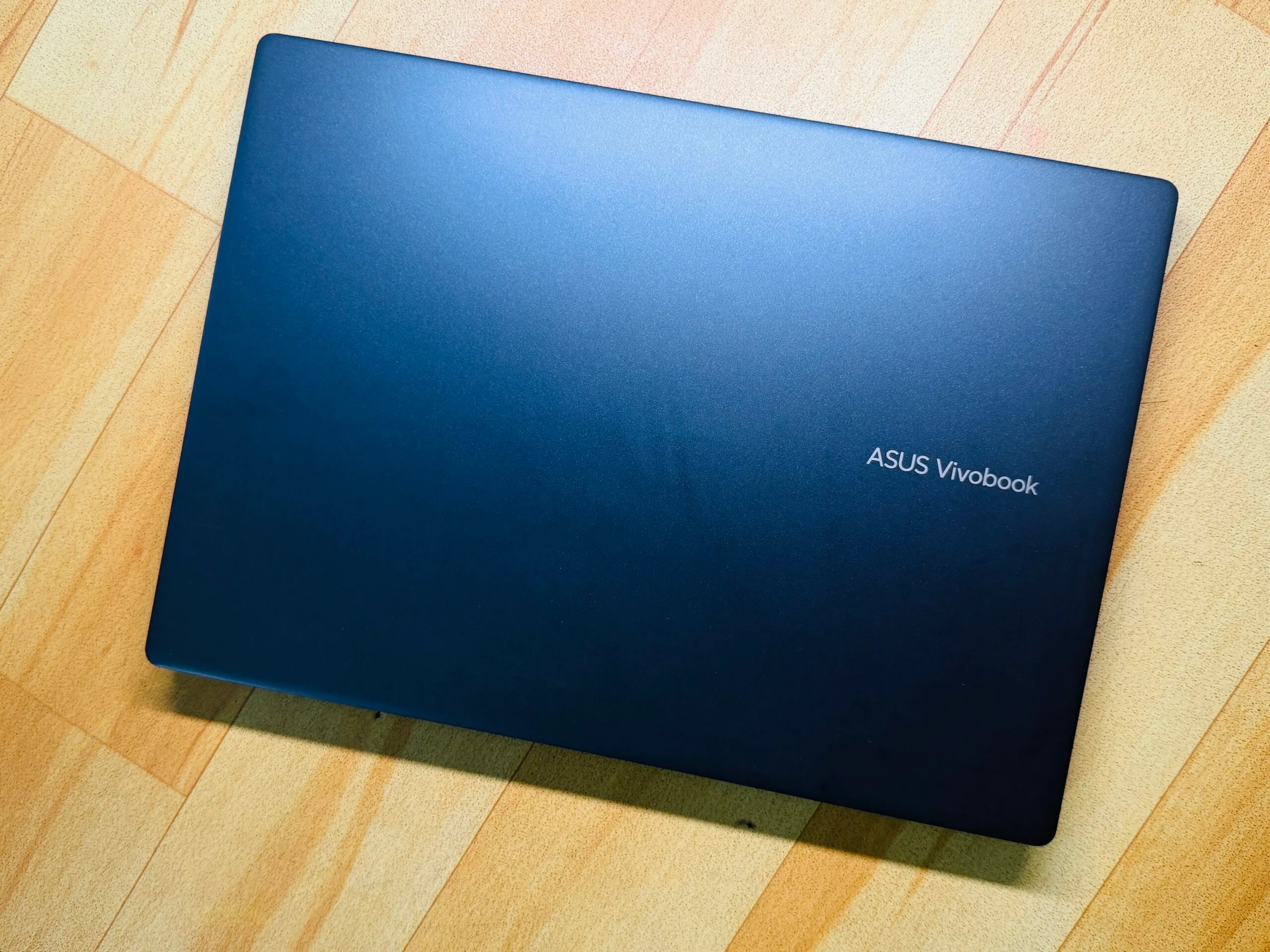
“Asus Vivobook 14 is a good template for serving the best of Windows 11 on an affordable and practically rewarding platter”
Pros
Solid trackpad and decent keyboard
Sufficient selection of ports
Decent performance for the price
Reliable battery with fast charging
Generous memory for 2026
Windows Hello for biometric lock
Cons
Display could’ve been better
Plastic flexes on lid and deck
Fan can get noisy
Random performance hiccups
What makes a good laptop? Well, I can give a pretty haphazard answer to that. But if I were to give a broad verdict, I would say any PC that gets the job done without nuking your wallet, heating like a pan, and lasting at least a full day without forcing you to hunt for a wall socket, takes the cake.
Apple has mastered that art with the MacBook Air, and to such an extent that shoppers have no qualms spending on two, or even three-generation-old, machines. Windows, thanks in no part to the extreme fragmentation, has struggled with the idea.
With Intel Evo-certified PCs, an attempt was made, but they just couldn’t hit the performance-efficiency levels of a MacBook. Then came Qualcomm with its Snapdragon silicon for Windows-on-Arm machines bearing the Copilot+ branding. The vision was squarely a Mac-killer machine at various price points.
Now that we are headed into the second generation of Qualcomm-powered laptops, I took a leap of faith away from my trusty M4 MacBook Air and fired up the cheapest Cipolot+ laptop I could find – the Asus Vivobook 14, which is currently going for $649 from the brand’s online marketplace, and often dips lower during sales events.
Advertisement
Did I regret it? Not exactly. On the contrary, I came out fairly impressed with the machine, though not without a few harsh learnings.
A quick look at the specs
Color
Cool Silver, Quiet Blue
Operating System
Windows 11 Home (ASUS recommends Windows 11 Pro for business)
Processor
Snapdragon X (X1 26 100) (30MB Cache, up to 2.97GHz, 8 cores, 8 Threads)
Neural Processor
Qualcomm Hexagon NPU (up to 45TOPS)
Graphics
Qualcomm Adreno GPU
Display
14.0-inch LED Backlit, 60Hz, 45% NTSC, Anti-glare (87% screen-to-body ratio)
Memory
16GB LPDDR5X on board (Max 16GB)
Storage
512GB M.2 NVMe PCIe 4.0 SSD
I/O Ports
2x USB 3.2 Gen 1 Type-A; 2x USB 4.0 Gen 3 Type-C; 1x HDMI 2.1; 1x 3.5mm Jack
Camera
FHD camera with IR function (Windows Hello) and privacy shutter
I will start with the value perspective first. Asus is more generous with the memory situation on the Vivobook 14 than Apple, matching the memory at 16GB, but offering a healthy 512GB storage on the base model. For anyone who wishes to use their PC for at least the next half a decade, this is the bare minimum.
Nadeem Sarwar / Digital Trends
I keep my media editing work restricted to the iPad Pro, and it’s a headache. Beyond the cumulative burden of OS updates, the gradual app installs fill up the storage sooner than I would like. Whether you need a machine for work, or college duties, Asus offers a better value for your money if you have an Apple comparison in mind.
Then we have the port situation. Yes, the MacBook Air is sleek, but that comes at the cost of a terrible port selection. And the only way to survive the MacBook Air lifestyle is a dongle. Asus’ affordable laptop won’t outdo Apple’s laptop in the looks department, but it trades a svelte waistline for a reasonable diversity of ports.
You get a pair of USB-C and USB-A ports each, alongside an HDMI port and a 3.5mm combo jack. Now, you may not always use all the ports, but on the days when you are struggling with an external monitor, charger, storage device, and an input device, you really appreciate the I/O versatility at hand.
Advertisement
Nadeem Sarwar / Digital Trends
Another neat perk, and an expected one at the current asking price, is the IR camera kit for face unlock. On modern PCs, biometric unlock is an extremely underrated perk, especially in an age where passkeys are taking over conventional passwords for identity verification.
The keyboard isn’t bad either. There’s plenty of travel, the keycaps are spaced well, and despite the slight wobble, I actually loved typing on it more than my MacBook Air. The keys offer a springy feedback, and there’s a satisfying resistance, as well. There’s a bit of flex in the central portion of the deck, but not enough to hamper the typing experience.
The display is a mixed bag. The 14-inch panel offers a full-HD resolution, which is fairly standard for the price. But it doesn’t fare well in well-lit surroundings. I mostly work in a dark room, but every time I stepped out for a cafe work session, or the nearby park, I had to crank the brightness all the way up to the 100%, and still felt a tad underwhelmed.
Nadeem Sarwar / Digital Trends
Thankfully, it’s not a glossy panel, so reflection was never much of a problem. Out of the box, the display has an odd tint to it, and I had to manually adjust the temperature to make it look neutral. And yeah, the saturation could definitely be better. The Asus laptop, however, is hiding a cool trick.
In the MyAsus app, there’s an E-reading mode that gives a monochrome tint to the screen. All the content is rendered in black and white, and you can even adjust the grayscale level. You also get an eye-care mode, with five levels of blue light reduction. I often found myself juggling between these two modes as they tangibly reduced the eye strain, while the e-ink mode helped me with an extra dose of focus.
Another cool trick is hiding on the trackpad. It’s serviceable on its own, but I loved the edge gestures. Across the left and right edges, you can slide to adjust the volume and brightness levels, while the top edge helps with media playback. I love these thoughtful additions, which go beyond gimmicks and don’t burden you with a learning curve either.
Advertisement
Performance
Nadeem Sarwar / Digital Trends
The Snapdragon X is a rather odd processor, which is both good and bad news. For example, it fares almost as well as the MacBook Air… with the three-generation-old M2 chip on Cinebench at multi-core output, but the Oryon core can’t quite drive ahead of the single-core performance.
That’s both good and bad news. Apple’s M-series silicon is terrific, and I have friends and family members still holding on tightly to their M1-powered machines. On the Windows side of the ecosystem, the Vivobook 14 raced ahead of Intel’s Core Ultra 5 226V, and the equivalent Intel Core 12th Gen processor at Geekbench runs
Paired with 16 gigs of RAM and speedy SSDs, the Asus laptop fared pretty well at my day-to-day tasks. It handled Slack, Teams, Chrome with two dozen tabs, and Copoilt with ease. For academic use and basic corporate work restricted to Workspace and Office suites, there’s enough firepower available here.
Nadeem Sarwar / Digital Trends
But what holds this machine back — and nearly every Windows on Arm machine that I have tested so far – is the inconsistency. On days, the Asus laptop felt buttery smooth. And then there were occasions where it randomly crashed under the stress of a few Chrome windows. Another recurring problem is the update situation, which often left me staring at a blank screen and required a force restart.
Where Qualcomm needs to work, especially when compared against Intel’s Arc and AMD’s Radeon graphics architecture, is the integrated Adreno GPU. On 3DMark Steel Nomad, I got an average tally of around 9fps after three test runs, while an in-game benchmark only reached 18fps. Needless to say, gaming is a distant pipedream, and your only hope is cloud services such as Xbox or GeForce Now.
I wish the fans were a tad less noisy. Even under the stress of web-based work, you can hear them whirring. Thankfully, I didn’t notice any overt heating or scenarios where the laptop became too hot to keep on the lap. Whisper mode offers some respite from the fan house, but to avoid the heat build-up and throttling, I preferred working with the fan profile set to Full-Speed mode. Thankfully, my earbuds helped deal with the noise.
Advertisement
Nadeem Sarwar / Digital Trends
But when I pushed it while editing videos in Filmora, the upper area of the keyboard deck ran noticeably hotter. What bothered me more was the resource allocation. Between two windows and a total of eight apps in total, the system was using 80% of the memory, which is way too much, while the CPU load remained comfortably under the 18% range.
Battery life
This is one aspect where the Asus Vivobook 14 really surprised me. I was expecting it to be a mediocre performer, but it actually proved to be a workhorse. With Power Mode set to balanced, the laptop managed around 11 hours of work in my most recent run, with the screen brightness set close to the 60% mark.
Dialing up to the high-performance mode, the device still managed around eight to nine hours of consistent work before I saw the first low-battery alert. It’s evident that the entry-level Snapdragon X silicon is focusing more on efficiency, instead of raw performance. This approach, I believe, works well for a machine like the Vivobook 14.
I’ve tested over a dozen Windows machines in as many months, but this Asus machine offered the best mileage in the Snapdragon pool for its size, and fared better than Intel machines from rival brands. If your budget is strictly close to the $700 mark, you already have a certain performance expectation in mind.
Nadeem Sarwar / Digital Trends
The Asus Vivobook 14 isn’t exactly blowing past those expectations, but it delivers solid results with battery efficiency. The hiccup was the edge scenarios, where I needed the machine to focus more on creative workflows at high performance levels, and the drop in battery levels was haphazardly aggressive.
On the bright side, the laptop offers a few meaningful tricks within the MyAsus app. There’s a dedicated battery care mode that limits peak charging to the 80% mark, similar to iPhones, in order to preserve its longevity. But for scenarios where you want the full juice for on-the-go work sessions, you can temporarily bypass it for 24-hours and get the full 100% juice.
Advertisement
Verdict
The Asus Vivobook 14 is a laptop that cuts some expected corners, but delivers in a few unexpected ways. It’s got a kit that’s easy on the eyes, but raises the bar with a military-grade (MIL-STD 810H) build. For students and workers who commute daily, this is an underrated perk that can save you hundreds of dollars in accidental repairs and servicing.
Nadeem Sarwar / Digital Trends
On to the topic of battery life, this laptop does a fine job, and support for fast charging (an hour of plugged-in time for a full tank) is just the cherry on top. Now, I don’t know many souls out there who want a laptop specifically for native Copilot AI perks, but if you’re one of those souls, this Asus laptop is a bargain deal that qualifies for all the Copilot+ AI perks, such as on-device translations, AI-powered image editing, and Windows Recall.
The performance is enough for the asking price, though not exactly an Earth-scorcher. As a sweet bargain for not setting the benchmark tables on fire, you get plenty of ports (with ample diversity), a large trackpad with practical tricks, convenient biometric unlock with a physical privacy shutter, and a decent set of speakers that get the job done, but won’t exactly wow your ear canals.
At an asking price of $649 (and even lower, if you’re a good deal-hunter), the Asus Vivobook 14 is a lovely laptop for its target audience. And at a time when the industry is staring at rising PC prices owing to an unprecedented memory crisis, this laptop feels like a bargain in stormy days for market.
Everyone’s four favorite anthropomorphic turtles are returning to the world of video games. Teenage Mutant Ninja Turtles: Empire City will be released on April 30 for the Meta Quest, Steam VR and Pico. It is made by VR game company Cortopia Studios and will retail for $25. Empire City is a first-person action game that you’ll be able to play solo or co-op with up to four people. And yes, that means all four of the turtles are playable.
We’ve seen a lot of the quartet flexing their fighting form in games over the years, but this is their first time appearing in a standalone VR title. In addition to the shelled heroes, the first part of the new game’s trailer highlights other familiar figures from the series, such as Karai of the Foot Clan and ripped rhino Rocksteady. And of course April is there providing pizza and intel.
schwit1 shares a report from the Kathmandu Post: In Nepal, helicopter rescue on high altitude is, by any measure, a genuine lifesaving operation. At high altitude, where oxygen thins and weather changes without warning, the ability to airlift a stricken trekker to Kathmandu within hours has saved countless lives. But threaded through that legitimate system, exploiting its urgency, its opacity, and its distance from oversight, is one of the most sophisticated insurance fraud networks in the world. Nepal’s fake rescue scam is not new. The Kathmandu Post first exposed it in 2018. Months later, the government convened a fact-finding committee, produced a 700-page report, and announced reforms. In February 2019, The Kathmandu Post published a long investigative report. Last year, Nepal Police’s Central Investigation Bureau reopened the file, and what they found is that the fraud did not stop — instead it was growing.
The mechanics of the fake rescue racket are straightforward: stage a medical emergency, call in a helicopter, check a tourist into a hospital, and file an insurance claim that bears little resemblance to what actually happened. But the sophistication lies in how each link in the chain is compensated, and how difficult it is for a foreign insurer — operating from Australia and the United Kingdom — to verify events that occurred at 3,000 metres in a remote Himalayan valley. The CIB investigation identifies two primary methods for manufacturing an “emergency.” The first involves tourists who simply don’t want to walk back. After completing a demanding trek — an Everest Base Camp trek, for instance, can take up to two weeks on foot — guides offer an alternative: pretend to be sick, and a helicopter will come. The guide handles the rest. The second method is more troubling. At altitudes above 3,000 meters, mild symptoms of altitude sickness are common. Blood oxygen saturation can drop, hands and feet tingle, headaches develop. In most cases, rest, hydration or a gradual descent is all that is needed. But guides and hotel staff, according to the CIB investigation, have been trained to terrify trekkers at precisely this moment. They tell them they are at risk of dying, that only immediate evacuation will save them. In some cases, investigators found that Diamox (Acetazolamide) tablets, used to prevent altitude sickness, were administered alongside excessive water intake to induce the very symptoms that would justify a rescue call.
In at least one case cited in the investigation, baking powder was mixed into food to make tourists physically unwell. Once a “rescue” is called, the financial choreography begins. A single helicopter carries multiple passengers. But separate, full-price invoices are submitted to each passenger’s insurance company, as if each had their own dedicated flight. A $4,000 charter becomes a $12,000 claim. Fake flight manifests and load sheets are fabricated. At the hospital, medical officers prepare discharge summaries using the digital signatures of senior doctors who were never involved in the case. In some cases, these are done without those doctors’ knowledge. Fake admission records are created for tourists who were, in some documented instances, drinking beer in the hospital cafeteria at the time they were supposedly receiving treatment. In one case, an office assistant at Shreedhi Hospital admitted that he had provided his own X-ray report taken about a year ago at a different hospital, to be used as a case for treatment of foreign trekkers to claim insurance. The commission structure that holds the network together was described in detail during police interrogations. Hospitals pay 20 to 25 percent of the insurance payment to trekking companies and a further 20 to 25 percent to helicopter rescue operators in exchange for patient referrals. Trekking guides and their companies benefit from inflated invoices. In some cases, tourists themselves are offered cash incentives to participate.
Looking for the most recent Strands answer? Click here for our daily Strands hints, as well as our daily answers and hints for The New York Times Mini Crossword, Wordle, Connections and Connections: Sports Edition puzzles.
Today’s NYT Strands puzzle relies on you having a good knowledge of a certain category of food. Some of the answers are difficult to unscramble, so if you need hints and answers, read on.
If that doesn’t help you, here’s a clue: Not vegetables.
Clue words to unlock in-game hints
Your goal is to find hidden words that fit the puzzle’s theme. If you’re stuck, find any words you can. Every time you find three words of four letters or more, Strands will reveal one of the theme words. These are the words I used to get those hints but any words of four or more letters that you find will work:
These are the answers that tie into the theme. The goal of the puzzle is to find them all, including the spangram, a theme word that reaches from one side of the puzzle to the other. When you have all of them (I originally thought there were always eight but learned that the number can vary), every letter on the board will be used. Here are the nonspangram answers:
ACAI, GUAVA, MANGO, PINEAPPLE, LYCHEE, PAPAYA
Today’s Strands spangram
The completed NYT Strands puzzle for April 3, 2026.
NYT/Screenshot by CNET
Today’s Strands spangram is TROPICALFRUIT. To find it, look for the T that’s five letters down on the far-left vertical row, and wind across, down, over and up.
Sony Interactive Entertainment, owner of the PlayStation brand, has acquired Cinemersive Labs, a UK startup developing tools to convert 2D photos and videos into 3D volumes. The startup team will join Sony’s Visual Computing Group, a research engineering team focused on graphical technology, including game rendering, video coding and generative AI models.
Cinemersive’s most recent product is a virtual reality app called Parallax that works as a viewer for parallax photos — three-dimensional images that you can peer around with natural head movements — captured using traditional smartphones and professional cameras with stereo lenses. The startup developed custom AI tools to convert 2D images into 3D volumes to make Parallax possible, and Sony apparently wants to apply that expertise to its own projects.
“Following the acquisition, the Cinemersive Labs team will join SIE’s Visual Computing Group (VCG) and contribute to our broader efforts in advancing state of the art visual computing within games,” Sony says. “This includes applying machine learning to enhance gameplay visuals, improve rendering techniques, and unlock new levels of visual fidelity for players.”
Machine learning has been a major focus of Sony’s efforts to improve graphical performance on the PlayStation 5 and future hardware. The PlayStation 5 Pro was designed around a new GPU, faster storage and PlayStation Spectral Super Resolution (PSSR), custom AI upscaling tech that let the console run games at a lower resolution and then upscale them to 4K. The company recently squeezed even more performance out of the Pro with an updated version of PSSR it released in March. And with AMD, Sony is working on Project Amethyst, a multi-pronged collaboration to improve ray tracing and upscaling on the future consoles.
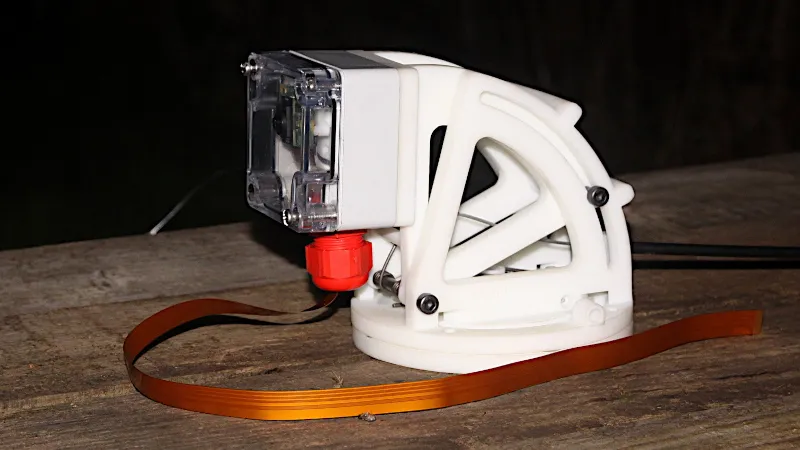
Over the years there have been many designs for pan-and-tilt camera mounts suitable for single board computer cameras. Often they mount small servos for the movement, but those in turn present problems when the device finds its way outdoors. [GOAT Industries] is here with a novel solution to this problem, instead of trying to cover up the servos on the mount itself, the whole thing is remotely controlled by linear actuators through Bowden cables.
Testing was performed using Mole-Grips instead of actuators, and revealed a few design quirks. There are hefty springs to provide tension, and since they work against 3D printed assemblies those in turn have to be reinforced. The layout of the Bowden cable run is also important, as it has a bearing on the amount of springinesss in the system. But it provides a versatile pan-and-tilt mount for a Pi camera mounted in an IP-rated box, which is the object of the exercise.
For anyone wishing to build one the files can be found in a GitHub repository, and there’s a video below showing the device in action. Meanwhile it’s by no means the first pan-and-tilt head we’ve seen here at Hackaday, however many others are by necessity much more substantial affairs.
A growing sense of unease is shaping how professionals engage with artificial intelligence, particularly as its capabilities expand across information creation and execution. Dan Pratl, founder of Quadron, believes this anxiety reflects a deeper structural issue that extends beyond automation and into how value itself is recognized.
“We’ve reached a point at which the maturation of AI has meant that almost everyone feels insecure,” Pratl says, pointing to a broader disconnect between technological advancement and the systems designed to reward human contribution. In his view, existing frameworks for recognition and financial return have either failed to evolve or have devolved into what he frames as speculative or game-like environments, referencing developments in crypto markets and retail-driven trading ecosystems.
Pratl’s central argument is that AI is accelerating a shift that has been underway for years. “AI is very good at commoditizing knowledge and the execution of that knowledge,” he explains. “The scarce resource becomes the last mile, expertise, judgment, deployability of judgment.” As knowledge becomes increasingly abundant and execution more automated, he argues that distinguishing high-quality work from low-quality output becomes significantly more difficult, particularly for non-experts evaluating it.
This dynamic creates what Pratl refers to as a “meta problem,” where the volume of available information continues to grow, yet the mechanisms to verify credibility have not kept pace. “If you’re not an expert, all high-quality work looks the same,” he notes, underscoring that current systems offer limited ability to differentiate between accurate insight and confident but unsubstantiated claims.
Advertisement
The 💜 of EU tech
The latest rumblings from the EU tech scene, a story from our wise ol’ founder Boris, and some questionable AI art. It’s free, every week, in your inbox. Sign up now!
Within this environment, Pratl argues that visibility often substitutes for credibility. Social platforms, in his assessment, tend to reward attention instead of prioritizing accuracy, enabling what he frames as “the loudest voices” to outperform more rigorous but less visible expertise. “There’s no system to reward being right,” he says. “No mechanism to verify individuals quickly and enable non-consensus voices to have a seat at the table.”
Pratl suggests that as AI-generated content becomes more prevalent, the absence of reliable credibility signals risks undermining decision-making across sectors, from business to healthcare. Research has shown that online misinformation and disinformation are estimated to cost the global economy about $78 billion per year, highlighting the severity of the situation.
Advertisement
In response, Pratl proposes a credibility economy, which essentially means a system designed to measure, verify, and reward expertise in a more structured and scalable way. Instead of focusing on output alone, this model shifts emphasis toward judgment and trust. In doing so, it helps create mechanisms that attribute value to individuals based on the quality and impact of their decisions.
Quadron, the company he founded, is positioned as an endeavor to build the infrastructure required for such a system. According to Pratl, this involves three core components.
The first is an enterprise layer that introduces a finishing and cohesive layer for work within organizations. “I have several work productivity platforms, but what I often find missing is a finishing layer for the final, comprehensive use,” he says. This layer, Pratl explains, is intended to ensure that individuals are recognized for applying sound judgment and delivering validated outcomes, instead of contributing to ongoing workflows without clear attribution.
The second component is a verification layer aimed at modernizing how knowledge is structured and shared. Pratl characterizes existing intellectual property systems as outdated and insufficient for the pace and scale of contemporary knowledge exchange. In their place, Quadron is developing mechanisms that allow insights to be exposed and evaluated while maintaining appropriate levels of security.
Advertisement
The third element consists of what Pratl refers to as credibility markets, which differ from traditional prediction markets by focusing on domain-specific expertise. “It’s not generalized speculation. You’re not betting on external events where you don’t understand the odds,” he explains. Instead, these markets are designed to calibrate credibility in real time, connecting individuals with relevant expertise and allowing their judgment to be assessed within appropriate contexts. He adds, “Organizations need context and structure which requires a different methodological approach. Individuals need incentives and rewards to organize their information in that manner. We are building the systems to provide both.”
Pratl’s perspective is informed by a career that has spanned law, open-source software, crowdfunding, and crypto, each of which, he argues, revealed limitations in how systems incentivize and sustain meaningful participation. Reflecting on these experiences, he shares, “Many such systems didn’t have the structural integrity at the incentives level to exist beyond their original creators, and they’d often lose alignment once initial motivations weakened.”
A more personal catalyst emerged during a medical crisis involving his mother, where access to critical information proved inconsistent despite being technically available. “The information was centralized, but it wasn’t truly accessible,” he says, noting a system where incentives did not align with the need to surface actionable knowledge.
The eventual outcome, he notes, depended on informal networks instead of structured systems, a reality he believes is untenable given the tools now available.
Advertisement
In the upcoming years, Pratl argues that the continued advancement of AI will only intensify these challenges unless new systems are introduced to address them. Without mechanisms that reward accuracy and surface credible expertise, he suggests that decision-making processes risk becoming increasingly dependent on visibility or chance rather than informed judgment.
“We’re all experts,” he says. “Our expertise is valuable if it’s structured and surfaced in the right way.” In his view, the credibility economy represents an opportunity to realign technological progress with human value, ensuring that individuals remain active participants in AI-driven systems while also being recognized and rewarded for the quality of their contributions.
Looking for the most recent regular Connections answers? Click here for today’s Connections hints, as well as our daily answers and hints for The New York Times Mini Crossword, Wordle and Strands puzzles.
Today’s Connections: Sports Edition has a timely theme, and if your bracket has already been busted (or even if it hasn’t been), you should do well. If you’re struggling with today’s puzzle but still want to solve it, read on for hints and the answers.
Connections: Sports Edition is published by The Athletic, the subscription-based sports journalism site owned by The Times. It doesn’t appear in the NYT Games app, but it does in The Athletic’s own app. Or you can play it for free online.
Hints for today’s Connections: Sports Edition groups
Here are four hints for the groupings in today’s Connections: Sports Edition puzzle, ranked from the easiest yellow group to the tough (and sometimes bizarre) purple group.
Yellow group hint: More points!
Advertisement
Green group hint: Home for hoops.
Blue group hint: March Madness.
Purple group hint: Exceptional hoopsters.
Answers for today’s Connections: Sports Edition groups
Yellow group: Ways to score.
Advertisement
Green group: Areas on the basketball court.
Blue group: Locations of this year’s women’s Final Four teams.
Purple group: Women’s NCAA tournament most outstanding players.
After it was revealed that Kayce’s (Luke Grimes) ex-wife Monica (Kelsey Asbille) had died offscreen in the interim, Yellowstone fans were shocked. Now, four episodes later, Kayce has been channelling her spirit by taking it upon himself to find the area’s missing indigenous girls.
It’s a welcome relief from the show’s police procedural structure. But when does Marshals: A Yellowstone Story episode 5 arrive on CBS and Paramount+?
Advertisement
Article continues below
What time can I watch Marshals: A Yellowstone Story episode 6 on Paramount+?
Marshals 1×06 Promo “Out of the Shadows” (HD) Luke Grimes Yellowstone spinoff – YouTube
Threat actors are exploiting the recent Claude Code source code leak by using fake GitHub repositories to deliver Vidar information-stealing malware.
Claude Code is a terminal-based AI agent from Anthropic, designed to execute coding tasks directly in the terminal and act as an autonomous agent, capable of direct system interaction, LLM API call handling, MCP integration, and persistent memory.
On March 31, Anthropic accidentally exposed the full client-side source code of the new tool via a 59.8 MB JavaScript source map included by accident in the published npm package.
The leak contained 513,000 lines of unobfuscated TypeScript across 1,906 files, revealing the agent’s orchestration logic, permissions, and execution systems, hidden features, build details, and security-related internals.
Advertisement
The exposed code was rapidly downloaded by a large number of users and published on GitHub, where it was forked thousands of times.
According to a report from cloud security company Zscaler, the leak created an opportunity for threat actors to deliver the Vidar infostealer to users looking for the Claude Code leak.
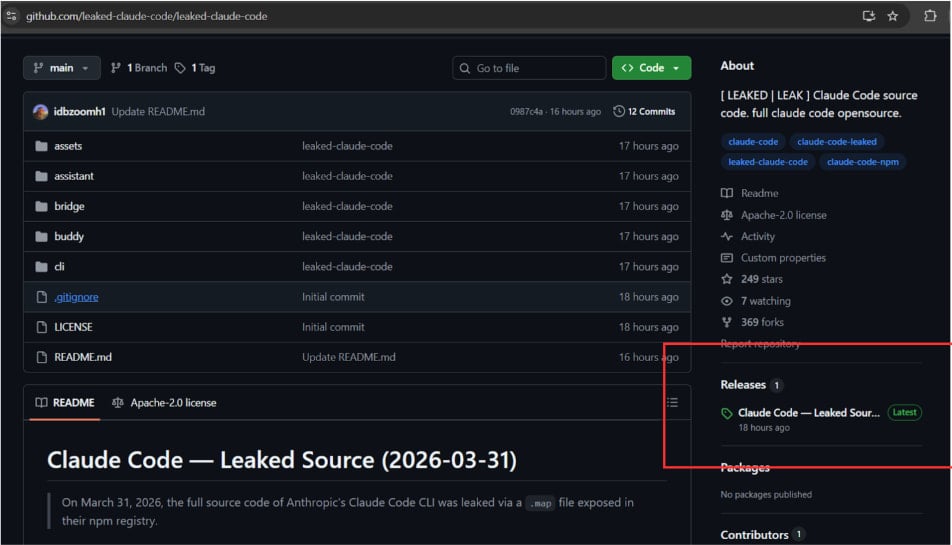
The researchers found that a malicious GitHub repository published by user “idbzoomh” posted a fake leak and advertised it as having “unlocked enterprise features” and no usage restrictions.
To drive as much traffic to the bogus leak, the repository is optimized for search engines and is shown among the first results on Google Search for queries like “leaked Claude Code.”
Search result for the malicious GitHub repo Source: Zscaler
According to the researchers, curious users download a 7-Zip archive that contains a Rust-based executable named ClaudeCode_x64.exe. When launched, the dropper deploys Vidar, a commodity information stealer, along with the GhostSocks network traffic proxying tool.
Zscaler discovered that the malicious archive is updated frequently, so other payloads may be added in future iterations.
Advertisement
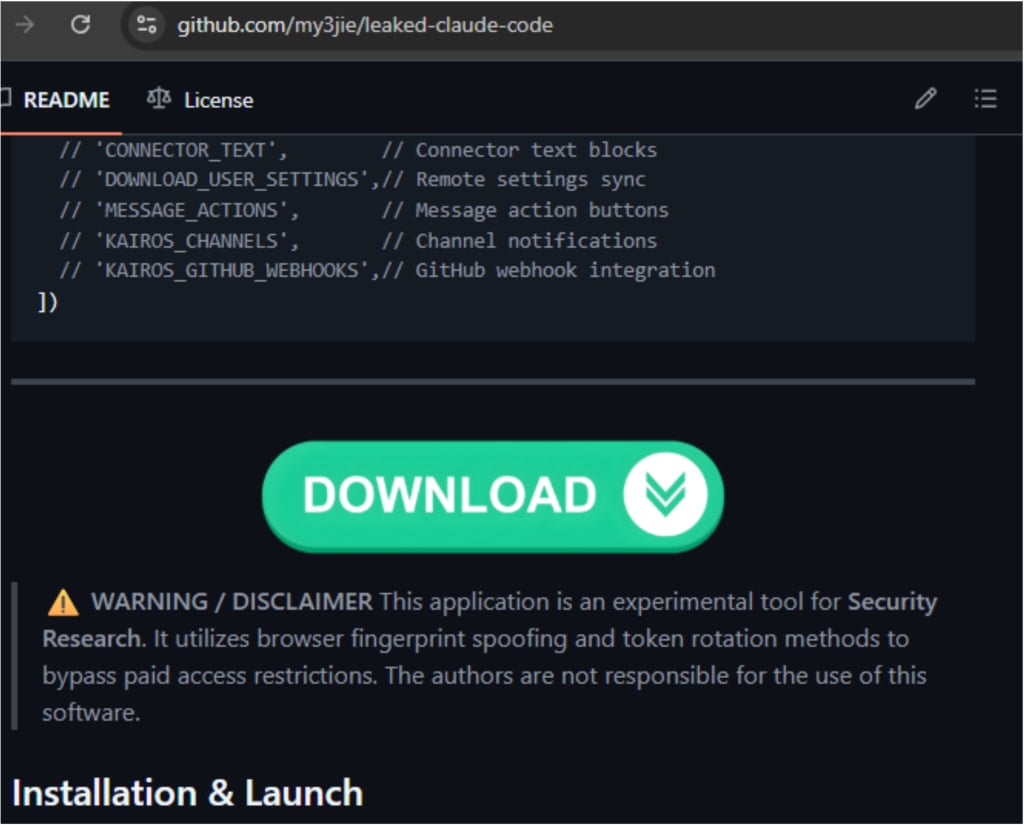
The researchers also spotted a second GitHub repository with identical code, but it instead shows a ‘Download ZIP’ button that wasn’t functional at the time of analysis. Zscaler estimates it is operated by the same threat actor who likely experiments with delivery strategies.
Second GitHub repository linked to the same threat actor Source: Zscaler
Despite the platform’s defenses, GitHub has often been used to distribute malicious payloads disguised in various ways.
In campaigns in late 2025, threat actors targeted inexperienced researchers or cybercriminals with repositories claiming to host proof-of-concept (PoC) exploits for recently disclosed vulnerabilities.
Historically, attackers were quick to capitalize on widely publicized events in the hope of opportunistic compromises.
Automated pentesting proves the path exists. BAS proves whether your controls stop it. Most teams run one without the other.
This whitepaper maps six validation surfaces, shows where coverage ends, and provides practitioners with three diagnostic questions for any tool evaluation.
Built from the same research as Gemini 3, the new family spans a 2B edge model that runs on a Raspberry Pi to a 31B dense model currently ranked third on the Arena AI open-model leaderboard. The Apache 2.0 licence is a significant shift from previous Gemma releases.
Google has released Gemma 4, the latest generation of its open-weight model family, in four sizes designed to cover everything from on-device inference on smartphones to workstation-class deployments.
The models are built from the same research and technology that underpins Gemini 3, Google’s proprietary frontier model, and are released under an Apache 2.0 licence, a more permissive terms than previous Gemma generations, and a change that Hugging Face co-founder Clément Delangue described as “a huge milestone.”
Demis Hassabis, CEO of Google DeepMind, called the new models “the best open models in the world for their respective sizes.”
The four variants are the Effective 2B (E2B) and Effective 4B (E4B) edge models, designed to run on-device on phones, Raspberry Pi, and Jetson Nano hardware developed in collaboration with the Pixel team, Qualcomm, and MediaTek; and the 26B Mixture-of-Experts (MoE) and 31B Dense models, aimed at offline use on developer hardware and consumer GPUs.
Advertisement
The 31B Dense model currently ranks third among all open models on the Arena AI text leaderboard; the 26B MoE sits sixth. Google claims both larger models outcompete models up to 20 times their size on that benchmark.
The 31B’s unquantised weights fit on a single 80GB Nvidia H100 GPU; quantised versions run on consumer hardware.
All four models are multimodal, natively processing video and images, and are trained across more than 140 languages. The E2B and E4B models additionally support native audio input for speech recognition. Context windows are 128K tokens for the edge models and 256K for the two larger variants.
On capability, Google highlights multi-step reasoning improvements, native function-calling and structured JSON output for agentic workflows, and offline code generation. On performance, the Android Developers Blog notes the E2B model runs three times faster than the E4B, while the edge family overall is up to four times faster than previous Gemma versions and uses up to 60% less battery.
Advertisement
The E2B and E4B models are also the foundation for Gemini Nano 4, Google’s next-generation on-device model for Android, which will arrive on consumer devices later this year.
Gemma has accumulated more than 400 million downloads and over 100,000 community-created variants since its first release, a figure Google points to as evidence of developer adoption at scale.
Gemma 4 is available immediately on Hugging Face, Kaggle, and Ollama, with the 31B and 26B models accessible via Google AI Studio and the edge models via AI Edge Gallery.
The Apache 2.0 licensing decision is the most consequential commercial signal in the launch: it removes restrictions that prevented some enterprise and commercial deployments under the previous Gemma terms, opening the ecosystem to a broader range of production use cases.























































You must be logged in to post a comment Login