

In the teensy Midwestern town of Braham, homemade pie capital of Minnesota, something unusual in the municipality’s computer systems knocked the city’s entire water supply offline last week.
Tech
Live dating show reveals Seattle’s relationship with tech is still complicated


Can’t a tech bro catch a break?
A live dating show that has made stops in Seattle sheds a little bit of light on how tech workers in the city are received, according to a new report from Axios Seattle.
Allison Goldberg, comedian and host of “Love Isn’t Blind,” says that when she introduces a contestant who is a software engineer, the audience boos.
“I’m sorry, are we booing a man with a job?” Goldberg said in the Axios story. “I live in Los Angeles, where I would love to meet a man with a job and benefits.”
The insight offers unscientific, but at least anecdotal proof that Seattle has never really come to terms with its tech-fueled identity crisis.
Decades into the city’s growth into a tech hub, the tension between Seattle’s blue-collar, artsy roots and the high-earning tech influx remains palpably unresolved. Even as software engineers and Amazonians make up a massive slice of the local population, the cultural friction lingers.
Tech workers are an easy, almost reflexive punchline for local audiences who still harbor a little resentment over skyrocketing rent, gentrification, and shifting city vibes. GeekWire witnessed another version of tech roasting several years ago when the comedy show “Socially Inept” was in town. And we’ve documented anti-tech messaging in graffiti and stickers across the city.
“Love Isn’t Blind” is aimed at singles who are tired of swiping. “F*** the apps,” it says on its website.
Men compete on stage for one “lucky bachelorette” — but the men are not allowed to speak. Instead, Axios reports, “Goldberg searches their phones, calls their moms and rifles through their Notes and AI apps while the audience waves literal green flags to show approval.”
Goldberg, whose show tours the country, also said the contestants and audience members in Seattle skew smarter than average, with more software engineers and Ph.D.s than most cities. Maybe that just means more booing.
Tech workers, or any other brave singles, can apply to be on the show or nominate a friend. “Love Isn’t Blind” returns to Seattle this Friday at the Fremont Abbey Arts Center.
Go cheer for a geek!
Continue Reading
Tech
Samsung’s Galaxy Z Fold8 Turns Movie Nights and Marathon Gaming Sessions Into Something You Actually Want to Keep Going


Samsung took a hard look at how people actually use big foldable screens and decided the tall, narrow shape everyone had gotten used to was not the full story. The Galaxy Z Fold8, priced at $1,900 with $350 Amazon GC, arrives with a shorter, wider body that feels closer to a passport than a phone book, and that single change unlocks a far better experience for videos, games, and everything in between.
When you open the cover, you’ll notice a 5.5-inch Dynamic AMOLED 2x panel running at up to 120Hz. With a 10:16 aspect ratio, you can watch vertical clips on Instagram, YouTube Shorts, or TikTok without the awful letterboxing we saw on the Fold Ultra. It also has brightness and a Gorilla Glass Ceramic 3 layer, so no matter how tough you use it, it will not break or become dark on you. Furthermore, its modest size allows you to surf through feeds or answers with just your thumb.

Samsung Galaxy Z Fold8 Unlocked Cell Phone + $350 Gift Card, 256GB, Cream
- PRE-ORDER NOW: Get an Amazon gift card when you pre-order Samsung Galaxy Z Fold8. You will receive an email once your gift card is available after the…
- CREATED FOR YOUR CONTENT: Any way you turn it, the new Galaxy Z Fold8 gives you a fuller viewing experience. Designed with your content in mind, this…
- WORLD’S LIGHTEST FOLD¹: Galaxy Z Fold8 is the newest foldable phone for content on the go. Unfolded, it fits movies and books for an immersive…
When you unfold the device, the main attraction emerges: a 7.6-inch Dynamic LTPO AMOLED 2x screen measuring 1828 by 2448 pixels in a tidy 4:3 ratio. This is also quite bright; 3000 nits at peak brightness is a lot to take in, and the HDR10+ support allows for some very deep blacks and brilliant colors. Plus, with an anti-reflective coating, it may be used outside, and what about the fold crease? Samsung did a much better job at reducing it this time. As you rotate the device, the screen shifts to a 16:10 aspect ratio, comparable to that of a tablet or laptop. So, watching a movie on Netflix or Disney+ does not result in black bars along the sides. Alternatively, if you prefer action games, the larger screen is a significant improvement; no more cramped UI elements or cutscenes.
Along with all that screen real estate, you’ll get some significant power under the hood. The Snapdragon 8 Elite Gen 5 Samsung Galaxy, along with an Adreno 840 graphics processor, performs even the most demanding games with easily, with several reviewers claiming flawless performance even at higher settings. Don’t worry about it being too hot; it does warm up little over a long gaming session, but it recovers quickly. You have 12 GB of RAM, so you can have tons of apps and gaming files simply sitting there ready to go, no need to reload every time, and the stereo speakers do a really nice job of delivering crisp dialogue and some reasonable bass.
As you’d expect, given all that screen time, the battery life is fairly decent as well; according to Samsung, a 4800 mAh dual-cell pack provides up to 26 hours of continuous video playback, and in practice, you can go through a day of streaming, browsing, and small gaming spurts without needing to recharge. Charging it back up is also quick; 45 watts wired puts you over 60% in 30 minutes, but 20 watt wireless gives you a slower top-up. At 201 grams, it’s light enough to handle for hours without tiring, and the folded-up thickness of only 4.5mm makes that large screen feel much less substantial.


By Thyaga Vasudevan, EVP of Product at Skyhigh Security
For decades, enterprise security was largely focused on endpoints and networks. By protecting corporate end-user devices, establishing secure connectivity, and controlling access to on-premises resources, teams could effectively keep their centralized servers secure from intrusion.
Eventually, these priorities evolved as enterprises embraced software-as-a-service (SaaS) models and cloud services, shifting to include new cloud security, data protection, and identity-based controls.
Then employees began working from anywhere, on any device, and the network expanded even further. And if that wasn’t enough, the artificial intelligence (AI) boom came along and made the threat landscape even more complicated.
When users can be in person, remote, or hybrid, and access data from a corporate computer or a personal laptop—then turn around and share that data with third-party AI models—endpoint and network measures alone are no longer sufficient.
Even as enterprise networks become increasingly distributed and complex, there is one common thread that connects users, applications, data, and AI models: the browser. It is the primary interface for modern work, acting as a gateway to business-critical tools, platforms, and more.
Because of this, securing the browser has taken on even more significance, emerging as a critical component of modern security strategies designed to protect data wherever it is accessed—even by AI models.
How AI Revealed an Existing Blind Spot
The excitement around AI has understandably focused enterprise attention on the new risks associated with these models. Security teams worry about employees copying and pasting sensitive information, uploading private files, or inadvertently exposing intellectual property while using AI services and workflows.
Because of this, they focus on protecting sanctioned enterprise AI tools while discouraging the use of unsanctioned shadow AI models, trying to promote adoption while avoiding new threats.
While this is well and good, these growing AI security concerns point to a broader issue that enterprises have long been able to ignore: employees have been moving sensitive data through browser-based applications for years; all AI did was accelerate the volume and visibility of these kinds of interactions.
Think about the everyday actions that take place within a browser session. Users copy and paste information between applications, upload files, download reports, print documents, and share content with partners and collaborators. And this is all done across different devices and locations.
This browser-based activity mirrors much of today’s AI usage, demonstrating that we’re not dealing with an entirely new security challenge, but an evolution of an existing one.
The problem enterprises must now solve is how to govern browser activity effectively without disrupting or greatly inhibiting the user experience.
Business happens in the browser. So do modern attacks.
Add comprehensive security to every existing browser in your network with enterprise-grade controls, all without disrupting users.
Why Traditional Security Approaches Are Struggling
The shift to primarily browser-based work has exposed key weaknesses in traditional enterprise security methods. Historically, controls were designed to inspect and secure traffic crossing the network perimeter, or to protect managed corporate devices at network endpoints.
While these methods remain important to overall enterprise security, they were not designed to govern the growing number of user interactions taking place within browser-based applications, services, and models.
The rise of hybrid work only adds to these challenges. As employees, contractors, and external partners access corporate resources from various devices—both managed and unmanaged—enforcing consistent access and security policies becomes increasingly difficult.
Because of this, enterprises often find themselves with strong protections on company-owned devices, but far less visibility into how data is accessed, shared, or manipulated once it moves beyond managed environments.
AI usage further expands this potential threat landscape, providing additional avenues through which data can quickly and easily leave protected corporate networks. While organizations can restrict access to applications and monitor data as it moves across the network, they still need to govern these kinds of actions that create risk in the first place.
Whether it’s copying sensitive information into an AI prompt, uploading a confidential document to a cloud platform, or downloading proprietary data to a personal device, teams need to find a way to control and manage browser-based activity.
Securing the Browser Without Replacing It
As things stand, enterprises have adopted several different approaches to enhanced browser security. Some choose to deploy entirely new secure browser environments that employees must adopt, while others rely on virtual desktop infrastructure (VDI) or remote browser isolation (RBI) to keep browser activity separated from endpoints.
These methods, while effective, are not perfect. They tend to suffer from deployment complexity, infrastructure overhead, user adoption challenges, and limited coverage for unmanaged devices.
In response to these inefficiencies, a new model has emerged that focuses directly on securing sessions without replacing or largely restricting browsers. These solutions apply inline security controls across common browsers like Chrome, Edge, Safari, and Firefox, allowing organizations to govern user actions within browser sessions without upending existing workflows or inhibiting secure experimentation with new AI models.
Skyhigh Security’s Secure Browser Controls solution is an example of this new, dynamic approach to browser security. Built to work within existing browser and security service edge (SSE) architectures, this solution enables organizations to deter common risk activities, including:
- Controlling copy-and-paste activity involving sensitive data
- Restricting uploads and downloads to sanctioned applications and AI services
- Preventing unauthorized printing or screen capture of sensitive information
- Governing drag-and-drop actions and other methods of data movement between applications
- Applying data protection policies to AI prompts, file uploads, and other browser-based interactions in real time
Protecting Work Where It Happens
As enterprise applications, collaboration tools, and AI services continue to converge inside the browser, security teams must be able to apply controls wherever users interact with data.
Skyhigh Security’s Secure Browser Controls help align security controls with where work is actually happening in enterprise networks, rather than applying them strictly at endpoints and system borders.
The rise of AI may have intensified the conversation around browser security, but the underlying trend extends beyond these newer tools.
By recognizing the browser as a critical control point for enterprise security—and protecting it as such—organizations can ensure their sensitive data is kept safe while supporting browser-based collaboration and innovation.
Request a free a demo of Skyhigh Secure Browser Controls now.
Sponsored and written by Skyhigh Security.

Nearly £50 off a 2TB drive that reads at 7,250 MB/s isn’t a discount you stumble across every day.
This 2TB Samsung 990 EVO Plus, already considered one of the best SSDs you can buy right now, has dropped from £297.89 to £249.99, a saving of £47.90 that brings serious NVMe speed down to a genuinely reasonable price.
This 2TB Samsung SSD just dropped by nearly £50, and it’s one of the fastest NVMe drives around
This spacious 2TB Samsung SSD has just dropped in price by nearly £50, and it still ranks among the fastest NVMe drives you can buy right now.

Drives with these read and write speeds usually sit much closer to the £300 mark, so seeing a 2TB Gen 5 capable SSD priced under £250 makes this one of the stronger storage deals around at the moment for anyone building or upgrading a PC.
That speed isn’t just a number on a spec sheet either, since read speeds up to 7,250 MB/s and write speeds up to 6,300 MB/s mean games load faster, large files copy almost instantly and heavier work stops feeling like it’s waiting on the drive.
Part of what makes this drive worth considering is its dual interface support, running on PCIe Gen 4.0 in most current systems while staying ready for PCIe Gen 5.0 boards, so it doesn’t become outdated the moment you next upgrade your motherboard.

Samsung’s in-house controller also brings smart heat control into the mix, keeping performance consistent under sustained loads instead of the throttling that can quietly slow down cheaper drives once they’ve been working hard for a while.
Setup is straightforward too, since the drive works with both Windows and Mac systems and pairs with Samsung’s own Magician software for monitoring health, running firmware updates and keeping performance optimised without needing any real technical know-how.
Everyday reliability gets covered too, with AES 256-bit encryption to keep your files protected and a five-year manufacturer’s guarantee that should outlast several upgrade cycles, which matters if this drive is going to be holding onto photos, projects or a growing game library.
With speeds like these and almost £50 shaved off the price, is there a genuinely smarter way to future-proof your PC right now than grabbing the Samsung 990 EVO Plus while it’s still this cheap?
SQUIRREL_PLAYLIST_10148964

Google’s rumoured Googlebook laptop is leaking again, this time in what appears to be its first outing from Asus.
The leaked device, reportedly called the Asus Googlebook CX9406 (snappy, eh?), surfaced briefly on the iF Design website before the listing was removed. While the page described it as a Chromebook, several details suggest otherwise.
Most notably, the listing references an operating system called “Aluminium OS”, rather than ChromeOS. Previous leaks have pointed to Google’s upcoming laptop platform using the same name internally. However, it’s still unclear whether Aluminium OS will be the final branding when the devices launch.

The hardware itself also hints at something different. Images show an LED “Glowbar” positioned above the Asus logo on the lid. This is expected to work similarly to the HiLight notification strip rumoured for Google’s upcoming Pixel 11 phones. The keyboard also swaps the traditional Windows key for Google’s familiar “Go” logo.
Port selection appears reasonably generous, although the images don’t make every connection easy to identify. Based on the renders, the laptop seems to include two USB-C ports, two USB-A ports, an HDMI output and a 3.5mm headphone jack. The chassis also adopts a darker grey finish than the lighter Lenovo prototypes that surfaced earlier this week.
The now-removed listing offered a handful of hardware details, though its accompanying text appeared unfinished. It claims the laptop is built from an “Ultra-Ceramic Light Alloy” chassis that is 34% lighter and 13% stronger. However, the wording becomes garbled in places, making those claims difficult to verify. No processor, memory or storage specifications were included.
Even so, the growing number of leaks suggests Google’s laptop plans are gathering pace. Lenovo and Asus are now both linked with Googlebook hardware, while Acer, Dell and HP have previously been named as manufacturing partners.
With multiple designs now appearing ahead of any official announcement, it looks increasingly likely that Google’s first wave of AI-powered Googlebooks is edging closer to launch.


After drifting aimlessly for more than a year and a half, a discarded SpaceX Falcon 9 upper stage finally ran out of empty space on Wednesday. The four-ton cylinder, roughly the size of a school bus and more than 40 feet long, slammed into the Moon at 5,400 miles per hour near Einstein Crater on the sunlit western limb.
SpaceX launched a rocket from pad 39A at the Kennedy Space Center on January 15, 2025. The aim was to launch two private lunar landers, Firefly Aerospace’s Blue Ghost and ispace’s Resilience, on a path to the Moon. Blue Ghost landed safely on the Moon’s surface, and then there was Resilience. Unfortunately, Resilience didn’t fare so well. Once the top stage had completed its burn and jettisoned the landers, it had no further instructions and insufficient fuel for any course correction. It was just lying there, floating, until the combined force of the sun’s gravity, the Earth’s gravity, and solar activity gradually began to alter its route, and the Moon became the inevitable destination.

LEGO Icons NASA Artemis Space Launch System – DIY Rocket Model Building Set for Adults, Ages 18+ – Gifts…
- NASA rocket model kit – Launch into a creative project with the LEGO Icons NASA Artemis Space Launch System model building project for adult space…
- What’s in the box? – This creative building set includes everything you need to craft a multistage rocket with 2 solid-fuel boosters, an Orion…
- Features and Functions – This NASA-themed rocket model features retractable launch tower umbilicals, rocket support and crew bridge, detachable…
Bill Gray, a skilled amateur astronomer who first raised the alarm a few months ago with available orbital data, calculated the impact window. When the time arrived for astronomers all across the world to focus their telescopes at the anticipated impact zone, they were unable to see anything. That was due to the fact that the impact zone was on the edge of the moon’s near side during daylight hours, which was not optimal for terrestrial observers. Marco Langbroek, a Dutch astronomer, trained in the area but discovered nothing, believing it was a long shot even before. Still, he believes the stage made it.
Confirmation came from a Boston University team led by Carl Schmidt, who discovered traces of a large plume of sodium and lithium streaming from the crash site.You could see this plume stretching for miles. Unfortunately for ground-based telescopes, it was shortly after daylight, so you wouldn’t get a good look. The European Southern Observatory’s Very Large Telescope in Chile was able to capture some images of the debris cloud, which lingered for at least 5 to 10 minutes, after which it was still unclear whether the impact had occurred, but Schmidt is certain that what his team saw was the impact. Both NASA’s Lunar Reconnaissance Orbiter and the South Korean Danuri spacecraft will hopefully be able to take before and after photos of the new crater when they pass over, as it is predicted to be 60 feet broad and 12 feet deep.
The blast produced when the rocket stage collided with the Moon was very small in comparison to the larger lunar impacts that occur on occasion, weighing approximately three tons of TNT, but nonetheless noteworthy. It hurled lunar dust and debris in all directions. Though astronomers point out that impacts of nearly the same energy occur on the Moon on a regular basis, the fact that these objects are man-made raises questions. Not to mention how frequently they occur these days. A similar incident occurred in March 2022, when a Chinese rocket stage formed a double crater on the moon’s far side under similar conditions.
[Source]

It’s a little more than three months until Grand Theft Auto 6 rocks the video game industry, and other than two trailers, little of the game has been shown by developer Rockstar Games. The first real look at maybe the most hotly anticipated game ever is coming soon, but fans will need a Netflix account to watch it first.
GTA 6 will make its debut on the streaming service on Aug. 27, Rockstar Games announced Thursday, in what’s likely an extended preview of the game. Grand Theft Auto 6: An Extended Look will premiere first on the streaming platform at 12 p.m. PT (3 p.m. ET) and then on a new GTA 6 YouTube channel at 6 p.m. PT (9 p.m. ET) the same day.
The developer didn’t provide any additional details about this GTA 6 preview or how long it will be. There was also no info provided on this partnership between the game company and Netflix, and whether it signalled an ongoing retlationship. It’s an unprecedented move to have the game first shown on a paywalled streaming service.
Rockstar Games didn’t immediately respond to a request for additional comment.
“Grand Theft Auto reveals have become cultural moments in their own right. The anticipation and fandom around Grand Theft Auto 6 is unprecedented, and we’re honored that Rockstar Games has partnered with us to debut the next part of the Grand Theft Auto story with Netflix members first,” Brandon Riegg, Netflix’s vice president of nonfiction series, said in a statement. “It’s a reflection of what we hope Netflix is becoming: a place where the most ambitious storytelling, from any medium, can find the biggest possible audience.”
Netflix and Rockstar Games have had a close working relationship in recent years. Back in 2023, Grand Theft Auto: The Trilogy made its debut on Netflix Games.
The streaming platform has had its ups and downs with gaming since it started offering mobile games in 2021. Back in April, the company introduced an ad-free gaming platform for kids called Netflix Playground, but in July, Netflix removed more than 20 games from its service. There are still more than 100 games on Netflix Games, according to its site, including Sonic Mania Plus, Red Dead Redemption and WWE 2K25 Netflix Edition.
GTA 6’s release date is set for Nov. 19, and it will launch on the PS5 and Xbox Series consoles for $80.


For astronomy enthusiasts, August 2026 will be a month to remember. Some of the most spectacular celestial phenomena—including ones that are easy to observe without telescopes or other specialized equipment—will all occur during the same week.
It’s a great time to get your viewing plans together and start refreshing your weather app to see whether the skies will be clear where you are to catch all the happenings in the heavens.
Perseid Meteor Shower
The Perseids are among the most spectacular meteor showers of the year, along with the Geminids in December and the Quadrantids in January. Every August, Earth passes through the trail of particles left behind by Comet 109P/Swift-Tuttle. As the fragments enter the atmosphere at high speed, they produce an intense meteor shower.
In 2026, activity will peak during the night of Wednesday, August 12, and extend into the early morning hours of the following day. It will coincide with the new moon. That means the sky will be exceptionally dark, offering prime viewing conditions.
The Perseids appear to radiate from the constellation Perseus. In reality, the meteors can streak across any part of the sky, but locating that constellation with the help of a stargazing app can make it easier to know where to look for the best chance of catching streaks across the night sky.
Solar Eclipse
The main astronomical event of the month will be a total solar eclipse. Not everyone will get a glimpse, though, with the path of totality crossing sliver of Spain, Portugal, Iceland, and Greenland. Areas outside those locations will still be treated to a partial eclipse.
The timing will be particularly dramatic, with totality set to occur at sunset on August 12. The Sun’s low position above the horizon will offer an unusual—and photogenic—scene.
This will be the Iberian Peninsula’s first time seeing a total solar eclipse in more than a century. Madrid is in the path of totality as are regions that include Galicia, Asturias, Castile and León, Madrid, Aragon, Catalonia, Valencia, and the Balearic Islands. In the rest of the country, the eclipse will be partial.
Those outside the eclipse path will also be able to follow the event. Agencies such as NASA and the European Space Agency will broadcast the event live. The main piece of advice for those trying to observe it: Do not under any circumstances stare directly at the sun.
Planetary Alignment
As if the solar eclipse and the meteor shower weren’t enough, in the early morning hours of August 12, an alignment of six planets will also occur. Jupiter, Mercury, Mars, Uranus, Saturn, and Neptune will form an apparent line in the sky.
Observing this alignment is more challenging than watching the meteor shower given the faintness of some of the planets. However, if atmospheric conditions are favorable, it will be possible to see Mercury, Mars, and Saturn with the naked eye near the horizon shortly before sunrise. To observe Uranus and Neptune, you’ll need a telescope.
Lunar Eclipse
August 27 will close out the month with a partial lunar eclipse that will cover up to 96 percent of the moon’s disk. Unlike solar eclipses, which only cuts a very narrow path across the Earth’s surface, lunar eclipses can be seen from much larger regions of the planet. On this occasion, it will be visible across virtually the entirety of the Americas, from Canada to Argentina.
Also unlike this month’s solar eclipse, observing this one will require no special eye protection. Simply find a dark spot, away from light pollution and, if possible, with a clear horizon. The only protection you might need is from the cold, particularly if you’re in the southern hemisphere given the season.
This story originally appeared on WIRED en Español and has been translated from Spanish.

Bottom line: Uber is moving quickly to put robotaxis on its main app, backed by a large cash pile and new approvals for real-world testing. The company plans to spend about $10 billion over the next few years to deploy 120,000 autonomous vehicles. It expects to run robotaxi services in at least 15 cities this year, putting it in direct competition with Alphabet’s Waymo and Tesla as they all push to turn self-driving technology into a commercial service.
Chief executive Dara Khosrowshahi said the spending is possible because Uber is generating strong cash flow from its core business. In the second quarter, the company produced a record $2.8 billion in free cash flow. Over the past 12 months, free cash flow has reached about $10.1 billion as bookings continue to grow. “We’re investing from a position of strength, as we accelerate our cross-platform strategy at a global scale and build the world’s largest platform for autonomous vehicles,” he said. “Our ambition is clear: to become the world’s leading commercialization platform for autonomous mobility.”
Instead of building a single in-house autonomous driving system, Uber is trying to become the main platform that connects multiple AV technologies to riders. The company shut down its own autonomous vehicle program in 2020 during a cost-cutting push. Over the past year, it has shifted to working as an intermediary for AV startups around the world.
That includes agreeing to invest in vehicle fleets and taking equity stakes in companies such as Zoox, Rivian, and Lucid, a change from its earlier asset-light approach. Uber is also sending out hundreds of sensor-equipped vehicles to collect driving data for its partners, who use that information to train and refine their self-driving systems.

One of the key partnerships is with Wayve, a UK-based autonomous driving company focused on software that can handle complex city streets. On Wednesday, Uber said Wayve had received permits from Transport for London to launch a commercial robotaxi service with a supervising driver behind the wheel. “I believe that it’s the UK’s first license for AV technology to operate and a big step forward for the UK,” Alex Kendall, Wayve’s chief executive, told the Financial Times, adding that the approval should allow the two companies to offer rides to Londoners in “a matter of weeks.” Transport for London said it had cleared 15 of Wayve’s modified Ford Mustang Mach-E vehicles to operate with a safety driver while the technology is tested on public roads.
Uber’s push into robotaxis comes as investors are still debating how autonomous vehicles will affect its core ride-hailing business. The stock is down 13% in 2026 as some shareholders worry that robotaxis could disrupt the existing model that relies on human drivers. Uber is arguing that its base of more than 200 million customers and its ability to route trips across different services will give it an advantage as AVs become more common.
Balaji Krishnamurthy, Uber’s chief financial officer, said the company will keep using its balance sheet to back growth projects, including AVs and international expansion. He pointed to Uber’s €13 billion offer for German delivery group Delivery Hero as part of that strategy. Uber has already paid about $4 billion for a 37% stake ahead of a formal bid, a move that would open access to faster-growing markets in Europe and the Middle East if the deal goes through.
The next test for Uber will be whether its platform-based AV strategy can turn technical progress into dependable services on busy city streets. The Wayve permits in London and robotaxi launches in other cities will bring Uber’s autonomous vehicle partners to more riders and regulators. The industry must still prove that driverless transport can be safe, scalable, and profitable.

The sun is setting on Washington state’s aging diesel-powered ferry fleet as work begins on new hybrid-electric vessels.
Eastern Shipbuilding Group in Panama City, Fla., has started building the state’s first new ferry since the Suquamish launched in 2018. The hybrid ferries will use batteries and diesel engines to cut emissions, with the first vessel scheduled for delivery in 2030. Eastern will complete the second and third ferries in 2031 and 2032.
Washington State Ferries is the biggest contributor to greenhouse gases among state agencies. In 2018, then-Gov. Jay Inslee signed an executive order to begin electrifying the fleet.
The state has since developed a long-term plan to deploy 16 new hybrid ferries and convert six existing boats into plug-in vessels by 2040.
In 2019, the state struck a deal with Vigor, a Seattle shipyard, to build up to five hybrid-electric ferries, with the first due within three years. Negotiations between Washington State Ferries and Vigor over price and contract terms broke down, and the state ultimately relaunched a competitive bid for the project.
The three 160-car ferries under contract with Eastern will cost $714.5 million to build, plus additional costs for owner-furnished equipment, construction management, crew training, and risk contingencies. All told, the total price tag is $1.15 billion.
The Wenatchee, a 202-car ferry converted to hybrid-electric by Vigor, began sailing the Seattle-Bainbridge route last summer, making it the largest battery-powered ferry in North America. Two additional Jumbo Mark II-class ferries await conversion, but the state’s supplemental transportation budget adopted in March did not fund their upgrades.
The system has 21 vessels, 11 of which are more than 40 years old. State leaders say 26 ferries will eventually be needed. Washington operates the largest ferry system in the U.S., which transported more than 20.1 million passengers last year.
Construction began in Florida with a ceremonial steel-cutting event early Wednesday. Gov. Bob Ferguson did not attend because of Washington’s wildfires but recognized the milestone.
“In the past decade, we lost four ferries to retirement,” Ferguson said in a statement. “Today signifies a critical step in rebuilding our fleet with modern vessels that will allow us to provide more dependable service.”
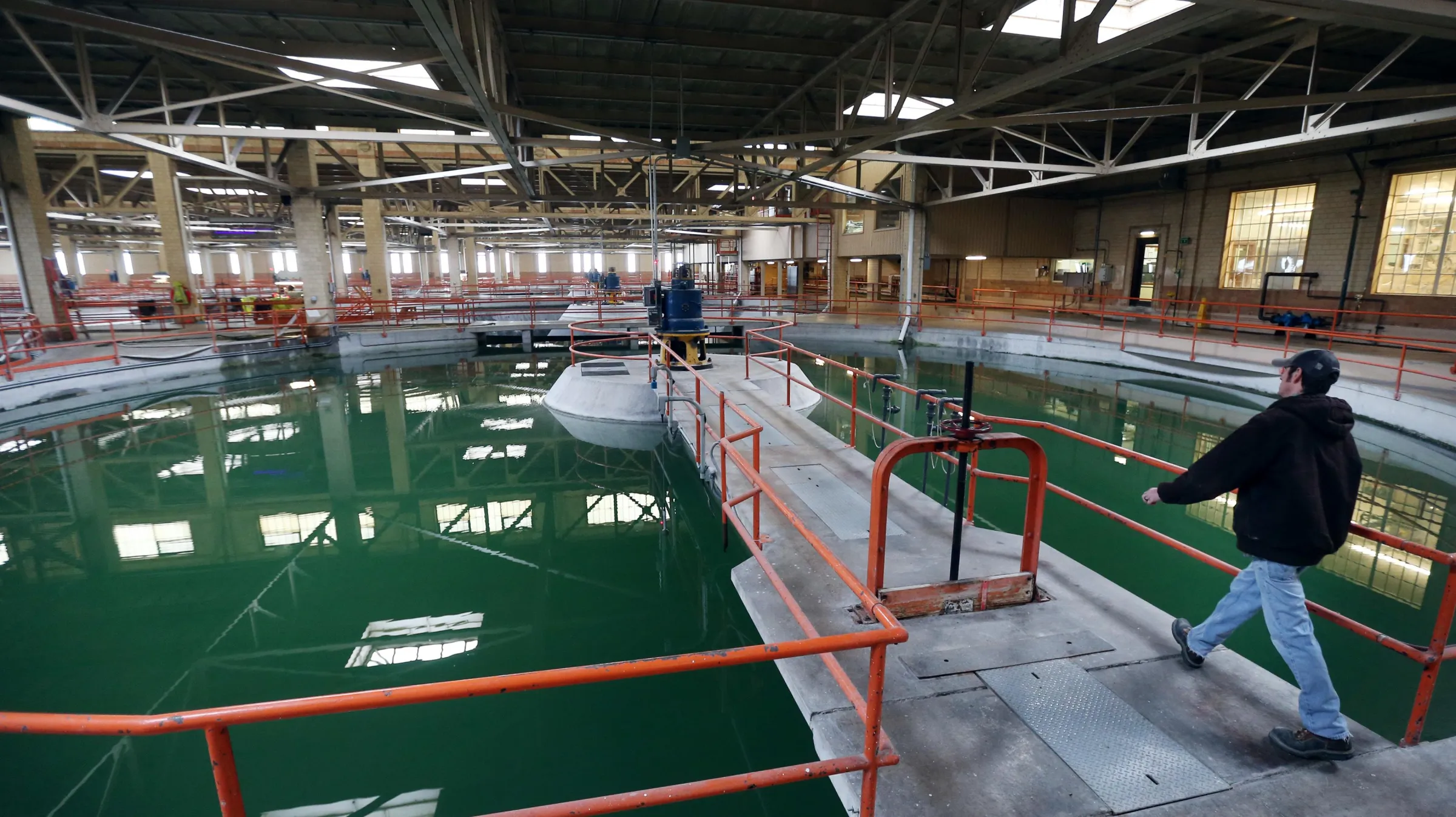
Within a few hours, dozens of other Minnesota cities discovered that their water and wastewater utilities, too, had been compromised, most likely as part of a massive Iranian cyberattack, the kind that US officials have been warning about since the war began.
At least a dozen states have been affected by the attack, which briefly led to a flurry of small-town service disruptions, boil-water notices, and local flooding. Water wells, dams, sewers, and pipelines are some of America’s oldest and creakiest pieces of infrastructure, built long before the internet existed, and certainly long before AI made hacking much easier. While you may assume most hackers are in it for the money or for data, some have targeted critical infrastructure like water systems or energy grids in ploys for control or disruption — or worse still, as acts of war.
And, as last week’s attacks show, the nation’s water system is woefully unprepared. But how worried should you be that the very infrastructure that keeps our water taps running is, apparently, hackable?
When we say the water supply got hacked, what we really mean is that someone, somewhere has broken into the computer that controls a local water treatment plant or reservoir, and is now pulling the levers, like the one that decides how much of a corrosive chemical can safely go into cleaning the water that comes out of your tap.
These levers were once manual buttons and knobs operated in-person by real live humans, meaning that — barring a natural disaster, bomb, or break-in — protecting them was about as simple as building a fence and hiring guards. Increasingly, however, these levers have gone digital, meaning that they are now remotely operable from anywhere in the world.
Those upgrades have been convenient, allowing technicians to monitor and troubleshoot problems in real time. But, in the process, they have exposed at times centuries-old infrastructure to distinctly modern vulnerabilities. Most local water systems are operated by local authorities, don’t have a dedicated IT team, and lack the money or resources to thoroughly protect themselves without some extra help. Hackers know this, which is why they’ve increasingly targeted local agencies in such attacks.

“With great connectivity comes great responsibility,” said Joshua Corman, founder of I Am The Cavalry, a nonprofit focused on helping critical infrastructure withstand hackers. And yet, even when it comes to critical services like water, “our dependence on connected technology is growing faster than our ability to secure it.”
About 97 percent of water systems are small, run by local agencies that often barely lock the proverbial front door. America’s water system is like an expensive heirloom bicycle that’s been left on a busy street, protected by only the flimsiest of padlocks. And that very vulnerability has made tiny towns like Braham prime targets for faraway adversaries. Accessing the computers that operate most water systems — known as programmable logic controllers or PLCs — is often as simple as entering a username and password on a public-facing webpage. Sometimes, there is no real password at all, because PLCs were initially intended to be accessed only within locked, secure facilities, not on the open internet. If the US wants to avoid a far more severe version of what happened last week, then it will need to start taking the security of tiny water systems like Braham’s seriously.
“Any sociopath from anywhere in the world can see these things on the internet,” said Corman. And in the case of last week’s attacks, “these were devices with no password, no firewall or VPN shielding them — they just had to log in” as whoever the intended operator was, and just like that, they were inside a local water plant.
How did this happen at all?
When municipalities began hooking up their old water and wastewater systems to the internet — a trend that accelerated during the pandemic as water operators, like everyone else, adapted to remote work — cybersecurity was rarely front of mind, neither for individual utilities nor for regulators as a whole.

“We have more cybersecurity regulations for your credit card than we have for the nation’s water supply,” said Corman. Only recently have some municipalities begun to take steps to decrease the exposure of their water plants to hacks. In March, New York state, for example, launched a set of grants and basic cybersecurity regulations mandating security training for all water operators.
Basic cybersecurity hygiene isn’t always enough. More than half of all credit card holders have been hacked, even with the help of mandatory firewalls and data encryption. You can imagine how vulnerable our water must be without the assistance of such guardrails. In a worst-case scenario, a malicious actor could quite literally open the floodgates, as Russian hackers did to a Norwegian dam last year. They could poison the tap water, as a still unidentified hacker almost did in Florida in 2021, dialing up the levels of sodium hydroxide used at a water treatment plant by over 100 times its normal levels. In a severe scenario, they could indefinitely cut off access to all water entirely.
The good news is, none of this happened last week. Nobody died, nobody lost water for more than a few hours, no fire hydrants ran dry, and no hospitals were forced to cut off their dialysis machines (which can use more than a hundred gallons of water per treatment session). There’s no need to panic, and your drinking water is almost certainly still safe to drink, assuming it was safe before. Even the city of Braham, within a few hours, was able to bring its water tower back online, pumping groundwater back to its 1,800 residents.
How do we avoid cyber-armageddon?
If you’ve watched the Julia Roberts and Mahershala Ali-starring thriller Leave the World Behind, in which a cyberattack apocalyptically spoils a family vacation, then you might have some idea of where this story could go.
Cyberattacks on critical infrastructure can be extraordinarily dangerous, but thankfully, none have directly cost lives or severely disrupted services in this country so far. If the US wants to keep it that way, that will mean doing more to help small cities like Braham adapt and better monitor for potential threats. As it stands, of the roughly 151,000 water facilities in the US, only about 420 participate in voluntary information sharing on their own cybersecurity practices, says Corman, who has been leading his own project that recruits volunteers to give free cybersecurity support to water utilities in the nation’s roughly 6,000 hospital towns, where a disruption could be particularly deadly.
Cybersecurity experts like Corman believe that hackers from other nations like China have already quietly established cyber intrusions in countless local US utilities, water systems, and power grids, lying in wait to attack or act as leverage if a conflict arises.
Unfortunately, the Trump administration has hardly treated last week’s attacks as symptoms of a system in need of much broader strengthening, at least in its public statements. “I think Minnesota is behind it. You know who’s behind it? Minnesota,” the president baselessly claimed during a Cabinet meeting last Friday. “I think the governor is behind it. I don’t think there was an Iranian cyber attack.”

Just a few months ago, he proposed $707 million in cuts to the US Cybersecurity and Infrastructure Security Agency (CISA), the agency responsible for protecting the nation’s infrastructure from cyberattacks. He did so, at least in part, out of anger over the agency’s role in confirming the validity of the 2020 election results. If Iran is, indeed, responsible, for the recent water system intrusions, all of this means that Trump has effectively made us more vulnerable to the consequences of a conflict he initiated.
At the end of the day,“nation-state hackers do not respect the jurisdictional lines separating federal, state, and local responsibility,” Jen Easterly, who led CISA under the Biden administration, wrote in the New York Times this week. “They search for the most vulnerable way to disrupt American life, and too often they find it in small communities that lack the resources to defend themselves.” Easterly’s role has remained vacant for the past 18 months.
Kurt Gaudette, a senior vice president at the cybersecurity firm Dragos, told me that water systems have got to get into the habit of monitoring their networks for suspicious activity. Most power utilities have begun doing so in recent years, with some bipartisan backing from Congress.
In some cases, however, the most cost-effective and safest way to avoid a repeat of last week’s mess might be to unplug the most vital controls — like the one that decides the chemical levels in a water treatment plant — from the web entirely.
As Corman puts it, “if you can’t protect it, disconnect it.”

News Videos1 minute ago
Dire Straits – Money For Nothing (Official Music Video)

NewsBeat2 minutes ago
Country’s best comedians will take to East Kilbride stage in new show

Crypto World4 minutes ago
Bitcoin Treasury Trades Signal Shift as Holdings Drop 10%, Analysis


-

 Fashion6 days ago
Weekend Open Thread: Wit & Wisdom
-

 Politics6 days ago
Meta enters AI-training agreement with far-right ‘propaganda rag’ Newsmax
-

 Politics4 days ago
Zack Polanski: an incitement to murder Nigel Farage?
-

 Crypto World5 days ago
MicroStrategy Post-Earnings CLARITY Act Push Could Add New Catalyst for Its Stock
-

 Crypto World5 days ago
XRP Ledger v3.3.0 brings five institutional features
-

 Politics7 days ago
Luke Littler’s dominance sparks GOAT debate
-

 Sports7 days ago
Seema Kaliramna Wins Discus Throw Bronze, Takes India’s CWG Medals Tally To 17
-

 Crypto World6 days ago
New York sues Kalshi over prediction market gambling
-

 Crypto World4 days ago
Crypto PAC spending tops $2M in Michigan House race
-

 Business4 days ago
DTCR: Deleveraging And A Hedge Fund Collapse Point To A Possible AI Bottom
-

 Business6 days ago
Trump Announces Hamas Disarmament Agreement as Iran Strikes Kuwait Air Base and US Attacks Pause Overnight
-

 Tech4 days ago
ESET tracks rise in malicious AI skills and adaptable malware
-
 Crypto World6 days ago
3 Fed Officials Just Explained Their Rate Hike Vote: Is Inflation Winning?
-

 Sports5 days ago
France Cricket implodes: letters hidden in a drawer and a board at war
-
 Tech6 days ago
Gemini Spark can now use Chrome logins and saved passwords to run errands on your behalf
-
Crypto World4 days ago
XRP Ledger urges node upgrade after manifest flood
-
 Tech6 days ago
Building A Reproduction PlayStation Motherboard
-

 Crypto World5 days ago
Moneyflip CEO charged in $40K murder-for-hire plot
-
 Sports6 days ago
Bruno Fernandes decision made as Man United ‘discuss’ striker transfer option
-

 News Videos5 days ago
Financial Crash Expert: The 90-Day Collapse Timeline They Are Desperately Hiding.
You must be logged in to post a comment Login