
Crypto World
Crypto Wrench Attacks Steal Over $30M in 2026: Chainalysis

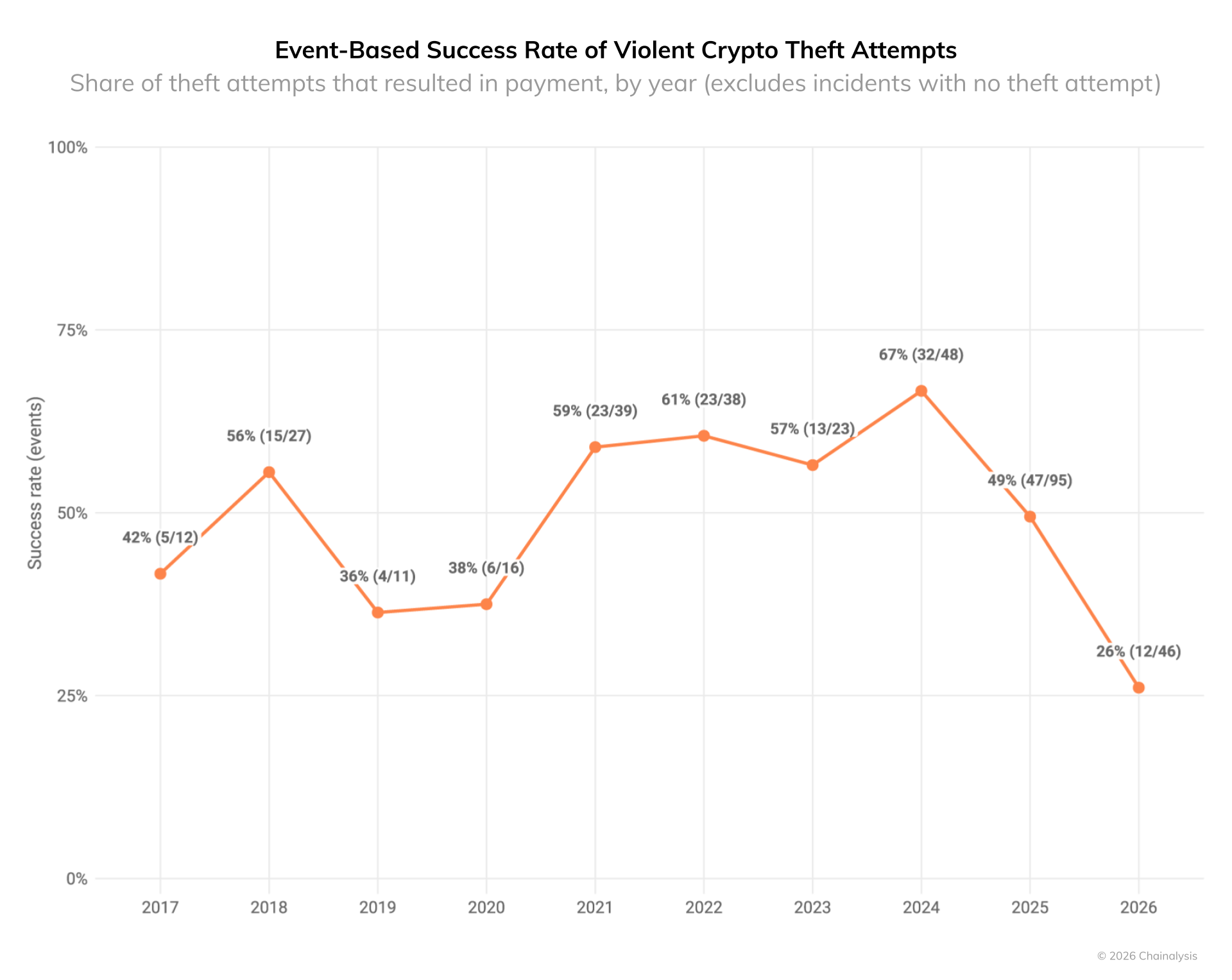
Criminals stole more than $30 million through physical attacks on crypto holders in the first half of this year, putting the year on pace to surpass the record $58 million stolen in 2025.
In a Chainalysis report released Thursday, the blockchain analytics firm said that 46 violent crypto-related incidents had been documented globally through late June, up from 40 during the same period in 2025. The incidents include kidnappings, home invasions and hostage situations, collectively known as “wrench attacks.”
The findings suggest wrench attacks are increasing, expanding the risks facing crypto holders beyond custody and asset management to their physical safety, homes and families.
According to the report, only 12 of the 46 attempts resulted in payment, giving attackers a 26% success rate, down from 49% in 2025. However, the report acknowledged that known cases likely understate the scale of the problem, as many attacks go unreported.
Chainalysis said the “tradecraft tends to be amateur at the point of violence, but professional at both ends,” with victims often selected through data leaks, social media or insider information before low-skilled crews carry out the attacks.
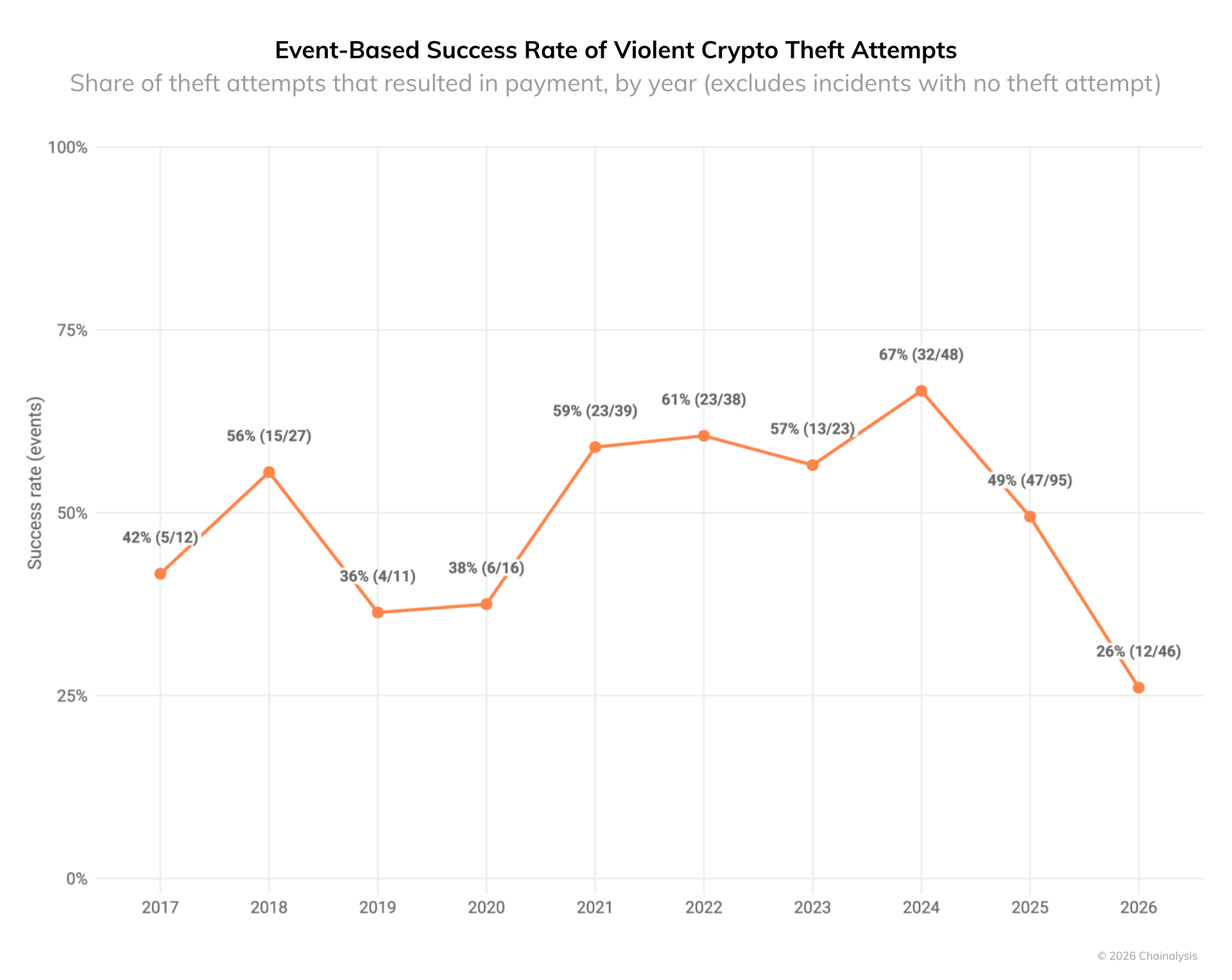
Success rate of crypto wrench attacks by year. Source: Chainalysis
France remains wrench attack hotspot
According to Chainalysis, France recorded 30 publicly known incidents by midyear, compared with 19 throughout 2025. The report noted that French authorities have counted more than 70 incidents, indicating the actual total may be substantially higher.
Related: Spain arrests suspect in 2025 kidnapping of Ledger co-founder
In July, Interior Minister Laurent Nuñez put the first-half count at 77 kidnappings, extortions or attempted extortions, up from 45 in all of 2025. In response, the government has introduced a rapid-alert and protection system and promised greater intelligence-sharing and coordination with the crypto industry.
Chainalysis said in the Thursday report that the alleged misuse of French tax records was the likeliest driver of the surge. A French tax official allegedly accessed and sold information about crypto investors to criminals, while a separate breach at crypto tax-reporting company Waltio reportedly exposed data belonging to about 50,000 users.
Onchain activity also showed varying levels of sophistication. Some attackers sent stolen funds directly to centralized exchanges, while others used bridges, decentralized exchanges and laundering services. Chainalysis said the most advanced cases showed links to broader criminal networks.
Magazine: Do the Coldcard attacks mean all hardware wallets are now insecure?



A Bitcoin strategic reserve is a government-held stockpile of Bitcoin treated as a national asset alongside gold, oil, and foreign currency reserves. The United States signed an executive order creating one in March 2025, and at least a dozen other countries are now exploring the same idea.
Summary
- A Bitcoin strategic reserve is a nationally held stockpile of Bitcoin managed by a government entity and treated as a sovereign asset, similar in concept to the Strategic Petroleum Reserve or the gold held at Fort Knox.
- President Trump signed Executive Order 14178 on March 6, 2025, directing the creation of a US Strategic Bitcoin Reserve seeded with approximately 200,000 BTC already held by federal agencies from criminal forfeitures and civil seizures, valued at roughly $17 billion at the time of signing.
- The executive order prohibits selling Bitcoin from the reserve and directs the Treasury and Commerce departments to develop budget-neutral strategies for acquiring additional Bitcoin, meaning the government must find ways to buy more without drawing on taxpayer funds.
- At least 12 countries and several US states have introduced legislation or executive proposals to create their own Bitcoin reserves, including Brazil, the Czech Republic, Poland, Japan, and the US states of Texas, Arizona, New Hampshire, and Oklahoma.
- Critics argue that Bitcoin is too volatile to serve as a reserve asset, that government holdings concentrate systemic risk, and that taxpayer exposure to a speculative asset violates fiduciary principles. Proponents counter that Bitcoin is the only reserve asset with a fixed supply, that it is uncorrelated with traditional reserve assets over long horizons, and that early adoption creates a strategic advantage that late movers cannot replicate.
Every country holds reserves. The composition of those reserves has changed slowly over centuries, from silver to gold, from gold to dollars, from dollars to a basket of currencies and sovereign debt. The question that the Bitcoin strategic reserve forces into the open is whether digital scarcity belongs in that basket, and whether a government that ignores it risks falling behind those that do not.
This guide explains what a Bitcoin strategic reserve is, how the US version was created, what other governments are doing, what the reserve actually holds, and what the strongest arguments for and against it look like. It does not advocate for or against the policy. The facts are contentious enough without opinion.
How the US strategic Bitcoin reserve was created
The US Strategic Bitcoin Reserve exists because of Executive Order 14178, signed by President Trump on March 6, 2025. The order directed the Secretary of the Treasury to create a reserve capitalized with Bitcoin already in government possession. It also created a separate entity called the US Digital Asset Stockpile for non-Bitcoin digital assets held by the government.
The initial reserve was seeded with approximately 200,000 BTC, most of which came from criminal forfeitures and civil asset seizures conducted by the Department of Justice, the Internal Revenue Service, and the Department of Homeland Security. The largest single source was the Silk Road seizure, which yielded roughly 69,000 BTC in November 2020 and an additional 50,676 BTC in January 2022. Smaller quantities came from dozens of other federal cases involving fraud, money laundering, and sanctions evasion.
The executive order included two provisions that distinguish it from a simple accounting reclassification. First, the order prohibits selling any Bitcoin held in the reserve. This is a break from prior practice, where seized crypto was routinely auctioned by the US Marshals Service. The government had already sold an estimated 195,000 BTC before the order was signed, at prices far below current market value. The no-sale provision is designed to prevent that from happening again.
Second, the order directs the Treasury and Commerce departments to develop “budget-neutral strategies” for acquiring additional Bitcoin. Budget-neutral means the acquisition cannot come from new appropriations or increased taxes. The mechanisms under discussion include revaluing the gold certificates held by the Federal Reserve, which are currently booked at the statutory rate of $42.22 per ounce, and using the difference between that rate and the market price to fund Bitcoin purchases.
What the reserve actually holds
As of mid-2026, the US government holds approximately 198,000 BTC in the Strategic Bitcoin Reserve. The exact figure fluctuates slightly as new forfeiture proceedings conclude and transfer seized assets into the reserve. At current prices, the reserve is valued at roughly $13 billion, making it the largest known government Bitcoin holding in the world.
The Bitcoin is held in cold storage wallets managed by the Treasury Department in coordination with custody providers. The specific custody arrangement has not been fully disclosed for security reasons, though the Treasury has confirmed that the holdings are verifiable through proof of reserves audits conducted quarterly.
The separate Digital Asset Stockpile holds non-Bitcoin digital assets seized in federal cases, including Ethereum, stablecoins, and various altcoins. The executive order treats this stockpile differently from the Bitcoin reserve. While Bitcoin cannot be sold, the non-Bitcoin assets may be liquidated at the government’s discretion, and the proceeds can be used to acquire additional Bitcoin for the reserve.
El Salvador remains the only other country with a confirmed, operational Bitcoin reserve at the national level. President Nayib Bukele began purchasing Bitcoin in September 2021 when the country adopted it as legal tender. El Salvador holds approximately 6,100 BTC, though the country’s purchases have slowed since the International Monetary Fund conditioned a $1.4 billion loan agreement on limiting new Bitcoin acquisitions.
Why governments are interested
The argument for a Bitcoin strategic reserve rests on three pillars: supply scarcity, sovereignty, and diversification.
Supply scarcity is the simplest argument. Bitcoin has a fixed supply cap of 21 million coins, enforced by code that no single entity controls. Approximately 19.7 million of those coins have already been mined, and the issuance rate halves every four years through a mechanism called the halving. Gold has a finite but unknown total supply that increases by roughly 1.5% per year through mining. The US dollar has no supply cap and has expanded its monetary base by more than 40% since 2020. For governments concerned about long-term purchasing power preservation, an asset with a mathematically fixed supply offers a guarantee that no fiat currency or commodity can match. The scarcity argument gains additional force when measured against sovereign debt levels. Global government debt exceeded $100 trillion in 2024. Every dollar, euro, or yen of that debt represents a future claim on currency that does not yet exist. Bitcoin cannot be inflated to service debt, which is precisely why some governments view it as a hedge against the monetary expansion that their own fiscal policies require.
Sovereignty is the geopolitical argument. US dollar reserves held in foreign central banks are ultimately claims on the US financial system. Those claims can be frozen, as the US demonstrated by immobilizing approximately $300 billion in Russian central bank reserves after the 2022 invasion of Ukraine. Bitcoin held in self-custody cannot be frozen by any foreign government. For countries seeking to reduce dependence on dollar-denominated reserves, Bitcoin offers a form of sovereign insurance that no other asset provides.
Diversification is the portfolio argument. Central bank reserves are typically concentrated in US Treasuries, gold, and a small number of foreign currencies. Adding an uncorrelated asset to a reserve portfolio reduces overall portfolio risk, even if that asset is individually volatile. Research from ARK Invest and Fidelity Digital Assets has argued that a 1% to 5% Bitcoin allocation in a sovereign reserve portfolio would have improved risk-adjusted returns over every five-year period since 2014. The diversification case does not require Bitcoin to outperform every year. It requires Bitcoin to behave differently from existing reserve assets during the periods that matter most. During the banking stress of March 2023, Bitcoin rallied while regional bank stocks collapsed. During periods of dollar weakness, Bitcoin has historically appreciated in dollar terms. These correlation properties are what portfolio theory says a reserve manager should want, even if the asset itself is more volatile than any single holding in the existing portfolio.
The legislation wave: who else is moving
The US executive order triggered a wave of similar proposals around the world. The dynamics vary by country, but the pattern is consistent: one branch of government introduces a Bitcoin reserve proposal, public debate follows, and the proposal either advances or stalls depending on the political environment.
Brazil introduced a bill in November 2024 to create a Sovereign Strategic Bitcoin Reserve holding up to 5% of the country’s international reserves. The Czech National Bank governor stated publicly that the institution was considering a Bitcoin allocation. Poland’s presidential candidate included a strategic reserve proposal in his campaign platform.
In Asia, Japan’s parliament debated a Bitcoin reserve proposal in late 2024, though the government initially declined to pursue it. Hong Kong legislators have proposed adding Bitcoin to the Exchange Fund, the territory’s sovereign wealth vehicle.
In the United States, the action at the state level has moved faster than at the federal level in some cases. Texas introduced legislation to create a state-level Bitcoin reserve funded through voluntary Bitcoin donations and seized assets. New Hampshire signed a Bitcoin reserve bill into law, becoming the first US state to do so, authorizing the state treasurer to allocate up to 5% of certain public funds to Bitcoin and other digital assets with a market capitalization above $500 billion. Arizona and Oklahoma have advanced similar proposals. The state-level reserves are typically smaller in scope and funded through existing investment authorities, but they represent a parallel adoption track that does not require Congressional approval.
The competitive dynamic between countries is worth understanding. Game theory suggests that if one major economy builds a Bitcoin reserve, others face a choice between accumulating at current prices or potentially accumulating at higher prices later, after the first mover has already captured the advantage. This is the logic behind what Bitcoin proponents call “the Nash equilibrium argument”: once one sovereign begins accumulating, rational self-interest pushes others to follow. Whether this dynamic plays out in practice depends on whether government decision-makers treat Bitcoin as a legitimate reserve asset or as a speculative experiment that carries more political risk than strategic benefit.
The connection between Bitcoin treasury companies and government reserves is worth noting. Companies such as MicroStrategy (now Strategy) demonstrated the corporate treasury model starting in 2020, accumulating more than 200,000 BTC on their balance sheet. The corporate adoption provided a proof of concept that governments are now adapting to a sovereign context.
What the reserve does not do
The strategic reserve does not make Bitcoin legal tender in the United States. Legal tender status would require separate legislation and would mean that merchants would be required to accept Bitcoin as payment, which the executive order does not contemplate.
The reserve does not directly affect the Bitcoin ETF market. The government’s holdings are in cold storage, not in ETF wrappers, and the no-sale provision means the reserve Bitcoin will not enter the open market through government liquidation. However, the reserve’s existence has been cited by institutional analysts as a signal of legitimacy that supports long-term ETF demand.
The reserve does not generate yield. Unlike Treasury bonds or even gold leasing arrangements, Bitcoin held in cold storage produces no income. The opportunity cost of holding a non-yielding asset is a recurring criticism, particularly from economists who argue that the same capital deployed in Treasury securities would generate billions in annual interest income. At current interest rates, $13 billion in Treasury securities would generate roughly $500 million to $600 million per year. The Bitcoin reserve generates zero. Proponents respond that gold also generates no yield in vault storage, yet no serious economist argues that the US should liquidate its gold reserves to buy Treasuries. The yield argument, they contend, misunderstands the purpose of a reserve asset, which is to preserve value across decades, not to produce income in any given year.
The reserve does not protect against Bitcoin price declines. If Bitcoin drops 50%, the reserve loses 50% of its value. There is no insurance, no backstop, and no rebalancing mechanism described in the executive order. The implicit assumption is that Bitcoin’s long-term trajectory will be upward, but the order does not address what happens to the reserve in a prolonged bear market.
The opposing case at full strength
The strongest arguments against a Bitcoin strategic reserve deserve their full weight.
Volatility is the most immediate objection. Bitcoin has experienced drawdowns exceeding 50% four times in its history. A reserve asset that can lose half its value in months introduces a form of balance sheet risk that gold and Treasuries do not carry. The counterargument that Bitcoin recovers from every drawdown is true historically but is not a guarantee, and it does not address the political consequences of a reserve losing billions in value during a single quarter.
Concentration risk is the systemic concern. If the US government holds 200,000 BTC and the no-sale provision is ever reversed, the mere possibility of government selling could depress the market. The government becomes both a holder and a potential source of supply overhang, which creates a reflexive dynamic where the reserve’s existence affects the value of what it holds. The same dynamic exists with gold, where central bank sales have historically moved the gold price, but Bitcoin’s market is far smaller and more sensitive to large holders. The US reserve represents roughly 1% of all Bitcoin that will ever exist. Any change in the no-sale policy would be a market moving event before a single coin was transferred.
Fiduciary duty is the governance objection. Government reserves are ultimately public assets. Allocating public assets to a volatile, speculative instrument raises questions about whether officials are meeting their fiduciary obligations to taxpayers. The budget-neutral acquisition strategy partly addresses this, since it avoids direct taxpayer funding, but the opportunity cost argument remains.
Environmental concerns, while less prominent in 2026 than in prior years due to Bitcoin mining’s increasing renewable energy share, are still raised by critics who argue that government endorsement of Bitcoin implicitly endorses the energy consumption of proof of work mining. The Cambridge Bitcoin Electricity Consumption Index estimates that the Bitcoin network consumes roughly 150 terawatt hours per year, comparable to the energy consumption of some mid-sized countries. Proponents counter that an increasing share of that energy comes from renewable or stranded sources, and that the network’s energy consumption is the cost of maintaining a decentralized monetary system that no government can shut down.
What this does not cover
This guide does not cover the mechanics of Bitcoin mining or the proof of work consensus mechanism that secures the network. It does not cover the tax treatment of government-held Bitcoin or the accounting standards that apply to sovereign digital asset holdings. It does not cover the separate question of central bank digital currencies, which are government-issued digital currencies that are conceptually distinct from holding Bitcoin as a reserve asset.
Practical checks for tracking the reserve
Check on-chain holdings. The US government’s known Bitcoin addresses are tracked by blockchain analytics firms including Arkham Intelligence and Glassnode. Movements from these addresses are published in real time and can signal policy changes before official announcements.
Check legislative status. The executive order created the reserve, but Congressional legislation could modify, expand, or eliminate it. Track bills related to the Strategic Bitcoin Reserve through Congress.gov or crypto policy trackers such as the Blockchain Association’s legislative dashboard.
Check other countries. Government Bitcoin adoption is a competitive dynamic. If major economies begin accumulating, the game-theory pressure on non-holders increases. Monitor central bank announcements, parliamentary debates, and presidential campaigns in major economies for reserve-related proposals.
Check the gold certificate revaluation debate. The budget-neutral acquisition strategy most discussed involves revaluing the Fed’s gold certificates from $42.22 per ounce to market price. This would release hundreds of billions in paper value that could theoretically be used to purchase Bitcoin. The revaluation requires legislative action and faces significant opposition, but it remains the most plausible path to expanding the reserve beyond seized assets.
How much Bitcoin does the US government hold?
Approximately 198,000 BTC as of mid-2026, valued at roughly $13 billion at current prices. The holdings come primarily from criminal forfeitures and civil seizures, including the Silk Road cases, the Bitfinex hack recovery, and numerous smaller enforcement actions.
Can the government sell the Bitcoin in the reserve?
The executive order prohibits selling Bitcoin from the Strategic Bitcoin Reserve. However, executive orders can be revoked or modified by any sitting president. Permanent protection would require Congressional legislation, which has been proposed but not yet enacted.
How does the Bitcoin reserve compare to the gold reserve?
The US holds approximately 8,133 metric tons of gold, valued at roughly $700 billion at current market prices. The Bitcoin reserve at $13 billion represents less than 2% of the gold reserve’s value. Gold has served as a reserve asset for centuries with lower volatility, but its supply increases through mining while Bitcoin’s supply is fixed.
Does the reserve affect Bitcoin’s price?
The creation of the reserve was initially bullish for Bitcoin’s price because it signaled government legitimacy and removed approximately 200,000 BTC from potential market supply. The no-sale provision is the key mechanism: those coins will not be sold, which permanently reduces the available supply. Long-term price effects depend on whether other governments follow with their own reserves.
Which US states have Bitcoin reserves?
New Hampshire was the first state to sign a Bitcoin reserve bill into law. Texas, Arizona, and Oklahoma have advanced similar legislation at various stages. State reserves are typically smaller and operate under existing state investment authority, and they do not require federal approval.
What is the Digital Asset Stockpile?
The Digital Asset Stockpile is a separate entity created by the same executive order. It holds non-Bitcoin digital assets seized by federal agencies. Unlike the Bitcoin reserve, assets in the stockpile may be sold, and proceeds can be used to acquire additional Bitcoin for the Strategic Bitcoin Reserve.
Could a future president eliminate the reserve?
Yes. An executive order can be revoked by a subsequent executive order. A future president could direct the Treasury to liquidate the reserve and convert the proceeds to dollars or other assets. This is one reason proponents have pushed for Congressional legislation to codify the reserve into law, which would require an act of Congress to undo.
What happens if Bitcoin goes to zero?
The reserve would be worthless, and the US government would have foregone the interest income it could have earned by holding equivalent value in Treasury securities. Proponents argue that Bitcoin going to zero is extraordinarily unlikely given its network effects, adoption trajectory, and 15-year track record. Critics argue that unlikely is not impossible, and that reserve assets should not carry existential risk.
Disclaimer
This article is for informational purposes only and does not constitute financial, investment, or policy advice. Government reserve policies are subject to change through executive action, legislation, or judicial review. Bitcoin is a volatile asset and past performance does not guarantee future results. Always conduct your own research before making investment decisions. Information accurate as of August 6, 2026.

Blockchain security firm CertiK says it has observed early laundering behavior tied to the ongoing Coldcard hardware wallet exploit: about 64 Bitcoin (valued at roughly $4.17 million) and 200 Ether (about $380,000) were reportedly sent to crypto mixing services after the theft began.
CertiK-linked onchain movements include a transfer of the 64 BTC from a source address labeled by CertiK to the Wasabi mixing protocol on Tuesday, while the 200 ETH was reportedly moved to Tornado Cash on Wednesday, according to CertiK’s X updates and address-level data shared by the firm.
Key takeaways
- CertiK reports 64 BTC and 200 ETH connected to the Coldcard exploit were routed through Wasabi and Tornado Cash, respectively.
- Mixing services pool funds and obscure transaction linkages, which can reduce recovery odds for stolen assets.
- TRM Labs’ analysis suggests most victim funds remain concentrated in a limited set of attacker-controlled addresses with relatively few mixing attempts so far.
- Galaxy Digital previously estimated losses from the Coldcard incident are at least $100 million in BTC, with a possible larger figure if additional attack waves are confirmed.
Laundering signals after the Coldcard theft
According to blockchain security platform CertiK, a portion of the stolen funds has already been processed through privacy-focused tooling designed to break onchain traceability. The Bitcoin leg involved approximately 64 BTC moving to Wasabi, a well-known mixing protocol that pools deposits and then redistributes funds in ways that make sender-recipient matching significantly harder.
On the Ethereum side, CertiK said 200 ETH was transferred to Tornado Cash. As with other mixers, Tornado Cash works by combining deposits and obfuscating the direct onchain relationship between the address that initiated a transaction and the eventual withdrawal target.
CertiK also suggested the behavior may not reflect only a single actor. “We think it might be a smaller exploiter. There’s likely a few copycats after the initial exploit,” a CertiK spokesperson told Cointelegraph. That aligns with broader incident reporting that has described multiple parties attempting to monetize the same underlying vulnerability.
Why mixers matter for recovery efforts
When stolen assets are transferred into mixers, investigators often lose the clean “paper trail” that typically helps identify where funds end up. Mixing protocols generally work by aggregating multiple users’ funds and then redistributing in a way that disrupts public linkage between deposits and withdrawals.
That structural design can lower the probability of timely asset recovery, especially when stolen funds are quickly moved and there is limited opportunity for authorities and compliance teams to intervene. Even so, blockchain analysis is not rendered useless—large-scale monitoring can still sometimes detect patterns, track high-level flows, and correlate timing and fund sources, depending on how thoroughly attackers operationalize the mixing step.
The wider context also underscores the stakes: earlier this year, the Kelp DAO hack saw an attacker launder nearly all of roughly 75,700 ETH—then valued around $175 million—primarily through THORChain, with additional use of the Umbra privacy protocol. That precedent illustrates how quickly adversaries can shift stolen funds across multiple privacy and liquidity layers.
Coldcard losses still mounting, with wave-by-wave tracking
The Coldcard exploit has already grown into one of the largest crypto hacks reported for 2026. Galaxy Digital previously stated the incident drained at least $100 million worth of Bitcoin across three confirmed attack waves sourced from around 7,300 victim wallets.
Galaxy also identified a suspected fourth wave, which—if confirmed—could lift projected losses to approximately $130 million in BTC. This “wave” framing matters to traders, holders, and incident responders because it implies the attacker activity may not be confined to a single moment, and that additional funds could be moving even after initial reports.
In parallel, CertiK’s observations of mixer usage offer a practical marker of how quickly some stolen funds are being processed. While the amounts highlighted by CertiK are not the full scale of the event, they signal that at least some attackers appear to be prioritizing trace obfuscation early in the lifecycle of the theft.
TRM Labs: most funds remain concentrated, suggesting limited follow-through
Further insight comes from onchain tracing by TRM Labs, which—according to a Thursday report—found that the majority of victim funds were still pooled in a relatively small number of attacker-controlled addresses, with limited mixing activity so far.
TRM Labs also said that differences in transaction construction across each attack wave suggest multiple attackers behind the exploit. This is consistent with Galaxy’s earlier findings that at least 15 different attackers may have exploited the Coldcard vulnerability.
TRM Labs attributed the underlying issue to a firmware bug from March 2021 that weakened seed randomness on some Coldcard wallets. The company said that the reduced key strength made the affected keys brute-forceable without physical access, highlighting why the exploit could be rapidly replicated once the vulnerability’s practical impact became known.
On the broader theme of prevention, Dragonfly managing partner Haseeb Qureshi argued on social media that comparatively small improvements could have mitigated the risk. He referenced “$2 of AI hardening” as a shorthand for strengthening defenses, citing reports that some AI models rediscovered the vulnerability leading to the attack in less than 20 minutes.
What to watch next
As the Coldcard case continues to evolve, the key variable is whether additional funds keep flowing into mixers and whether concentration patterns change across wallets and attacker clusters. Investors and incident-trackers should watch for confirmation of further attack waves, and for whether laundering activity expands beyond the early examples highlighted by CertiK and the limited mixing behavior observed by TRM Labs.


Wintermute said the registration allows the firm to position itself for the growth of tokenized securities in the US.
Crypto World
Sentora Opens A Lending Vault Against Wellington's First Native Onchain Credit Strategy


Sentora is curating a Morpho lending vault that accepts as collateral a token backed by an actively managed credit portfolio run by Wellington Management, the Boston asset manager with more than $1.3 trillion under management as of December 2025. The token, mWIN, was issued by Midas on Aug. 5…. Read the full story at The Defiant


Crypto ETF options let traders buy calls and puts on Bitcoin and Ethereum exchange-traded funds. This guide explains how they work, why they matter, and what strategies traders actually use.
Summary
- Crypto ETF options are standardized contracts that give the holder the right to buy or sell shares of a cryptocurrency exchange-traded fund at a set price before a set date
- The US Securities and Exchange Commission approved options on spot Bitcoin ETFs in late 2024, and options on spot Ethereum ETFs followed in 2025
- Call options profit when the underlying ETF rises; put options profit when it falls, and both can be used for hedging, income generation, or directional bets
- The options market for Bitcoin ETFs has grown to rival the spot market in notional volume, with daily trading regularly exceeding $2 billion in notional value
- Options pricing depends on the strike price, time to expiration, implied volatility, and interest rates, all of which behave differently for crypto ETFs than for traditional equity ETFs
Options on cryptocurrency exchange-traded funds arrived in the United States in late 2024 and immediately changed how institutional and retail traders interact with the crypto market. Before these products existed, traders who wanted leveraged or hedged exposure to Bitcoin or Ethereum had two choices: trade perpetual futures on offshore exchanges or use the limited options contracts available on platforms like Deribit. Both paths carried counterparty risk, regulatory ambiguity, and operational complexity that kept most traditional finance participants on the sidelines.
The approval of options on spot Bitcoin ETFs changed that equation. For the first time, a trader with a standard brokerage account at Fidelity, Schwab, or Interactive Brokers could buy a call option on Bitcoin exposure using the same interface, the same clearing infrastructure, and the same regulatory protections that apply to options on the S&P 500.
This guide explains what crypto ETF options are, how they are priced, what strategies traders use, and where the risks hide.
How options work at the most basic level
An option is a contract that gives the buyer the right, but not the obligation, to buy or sell an underlying asset at a specific price on or before a specific date. The buyer pays a premium for this right. The seller (also called the writer) collects the premium and takes on the obligation.
There are two types of options. A call option gives the buyer the right to buy the underlying asset at the strike price. A put option gives the buyer the right to sell the underlying asset at the strike price. Every option contract specifies four things: the underlying asset (in this case, shares of a crypto ETF), the strike price, the expiration date, and whether it is a call or a put.
When a trader buys a call option on IBIT (BlackRock’s spot Bitcoin ETF) with a strike price of $50 and an expiration date 30 days away, they are paying a premium today for the right to buy 100 shares of IBIT at $50 per share at any point in the next 30 days. If IBIT rises to $60, the option is worth at least $10 per share, or $1,000 per contract. If IBIT stays below $50, the option expires worthless and the trader loses only the premium paid.
Put options work in the opposite direction. A trader who buys a put option on IBIT with a $50 strike profits when IBIT falls below $50. The put gives them the right to sell at $50 even if the market price drops to $40, $30, or lower.
Which crypto ETF options are available
As of mid 2026, options are available on several spot cryptocurrency ETFs listed in the United States. The most actively traded include options on IBIT (BlackRock iShares Bitcoin Trust), FBTC (Fidelity Wise Origin Bitcoin Fund), and ETHA (BlackRock iShares Ethereum Trust). The Options Clearing Corporation (OCC) clears all of these contracts, providing the same counterparty guarantee that backs every listed option in the US market.
The approval process was not instant. The SEC approved spot Bitcoin ETFs in January 2024 but did not approve options on those ETFs until October 2024. The delay reflected concerns about market manipulation, position limits, and the interaction between spot crypto markets (which trade 24/7) and options markets (which trade during US exchange hours). The SEC ultimately set position limits of 25,000 contracts for Bitcoin ETF options, later expanded as liquidity grew.
Ethereum ETF options followed a similar path. Spot Ethereum ETFs launched in July 2024, and options approval came in 2025 after the SEC reviewed trading data from the initial months of spot ETF trading.
The volume numbers tell the adoption story. IBIT options regularly rank among the top 10 most actively traded option contracts in the entire US market, alongside options on SPY, QQQ, and AAPL. On peak days, IBIT options volume has exceeded 1.5 million contracts, representing notional exposure to billions of dollars in Bitcoin.
How crypto ETF options are priced
Options pricing follows the Black-Scholes framework, modified for the specific characteristics of crypto ETFs. The five primary inputs are the current price of the underlying ETF, the strike price, the time to expiration, the risk-free interest rate, and the implied volatility of the underlying asset.
Implied volatility is where crypto ETF options diverge most dramatically from traditional equity options. The implied volatility of Bitcoin ETF options typically ranges from 50% to 90% annualized, compared to 15% to 25% for S&P 500 options. This higher volatility means crypto ETF options are significantly more expensive in absolute terms than options on traditional equity ETFs.
The volatility smile, a pattern where out-of-the-money options trade at higher implied volatilities than at-the-money options, is particularly pronounced in crypto ETF options. Put options on Bitcoin ETFs tend to trade at elevated implied volatilities because the market prices in the possibility of sharp drawdowns. Call options far above the current price also carry premium because Bitcoin has historically produced large upside moves that would be considered extreme outliers in equity markets.
Time decay, measured by the Greek letter theta, erodes option value as expiration approaches. This effect is especially important for crypto ETF options because the high implied volatility means the absolute dollar amount of daily time decay is larger than for comparable equity options. A 30-day at-the-money call option on IBIT might lose $0.15 to $0.25 per day in time value, while a similar option on SPY might lose $0.05 to $0.10.
Delta measures how much the option price changes for a $1 move in the underlying ETF. An at-the-money call has a delta near 0.50, meaning it moves roughly $0.50 for every $1 move in the ETF. Deep in-the-money options have deltas approaching 1.0 and behave almost like the underlying shares. Far out-of-the-money options have low deltas and are essentially leveraged bets on large price moves.
Strategies traders actually use
The strategies applied to crypto ETF options range from simple directional bets to complex multi-leg structures. The most common fall into four categories: directional, income, hedging, and volatility.
Long calls and long puts are the simplest directional strategies. A trader who expects Bitcoin to rise buys calls. A trader who expects Bitcoin to fall buys puts. The maximum loss is limited to the premium paid, while the potential profit is theoretically unlimited for calls and substantial for puts (down to zero on the underlying). The appeal of long options is defined risk: a trader knows exactly how much they can lose before entering the trade.
Covered calls are the most popular income strategy. A trader who holds shares of IBIT sells call options against those shares, collecting the premium as income. If IBIT stays below the strike price, the calls expire worthless and the trader keeps both the shares and the premium. If IBIT rises above the strike, the shares are called away at the strike price, capping the upside. Covered call strategies on Bitcoin ETFs can generate annualized yields of 20% to 40% because of the high implied volatility, far above the 5% to 10% typical for equity covered calls.
Protective puts serve as portfolio insurance. A trader who holds IBIT and wants to protect against a drawdown buys put options at a strike price below the current market. If Bitcoin drops sharply, the put gains value and offsets losses on the underlying position. The cost of this insurance is the put premium, which can be significant given crypto’s high implied volatility.
Vertical spreads reduce the cost of directional bets by combining a long option with a short option at a different strike. A bull call spread involves buying a call at a lower strike and selling a call at a higher strike. The sold call reduces the net premium paid but caps the maximum profit. Bear put spreads work the same way in reverse. Spreads are popular among traders who have a directional view but want to reduce their cost basis and define their maximum risk.
Straddles and strangles are volatility strategies that profit from large moves in either direction. A straddle involves buying both a call and a put at the same strike price. A strangle involves buying a call and a put at different strike prices, with the call strike above and the put strike below the current price. These strategies are commonly used around major events such as Federal Reserve meetings, Bitcoin halving events, or regulatory announcements that could move the market sharply in either direction.
Calendar spreads exploit differences in time decay between near-term and longer-term options. A trader sells a short-dated option and buys a longer-dated option at the same strike price. The trade profits when the near-term option decays faster than the longer-term option, which typically occurs when the underlying price stays near the strike. Calendar spreads are particularly attractive on crypto ETFs because the high implied volatility produces larger absolute differences in time decay between expirations, creating wider profit zones than the same structure would offer on a traditional equity ETF.
Why the options market matters for crypto prices
The growth of the crypto ETF options market has introduced a feedback mechanism that did not previously exist in cryptocurrency markets. Market makers who sell options must continuously hedge their exposure by buying or selling the underlying ETF shares. This hedging activity, known as delta hedging, can amplify or dampen price moves depending on the aggregate positioning of the options market.
When market makers are net short gamma (meaning they have sold more options than they have bought), their hedging activity amplifies price moves. They must buy more shares as prices rise and sell more shares as prices fall, creating a positive feedback loop. When market makers are net long gamma, the opposite occurs: their hedging activity dampens price moves by requiring them to sell into rallies and buy during dips.
The concept of a “max pain” price, the price at which the most options expire worthless and option sellers retain the most premium, has become a closely watched metric in crypto markets. As expiration approaches, the hedging flows of market makers tend to push the price of the underlying ETF toward the max pain level, creating a gravitational effect that did not exist when crypto traded without a listed options market.
Open interest data from crypto ETF options provides a transparent view of market positioning that was previously available only through offshore derivatives exchanges. Analysts can see where large concentrations of calls and puts are positioned, which strike prices act as support or resistance, and how the market’s expectations for future volatility compare to realized volatility.
Risks specific to crypto ETF options
Crypto ETF options carry all the standard risks of options trading plus several risks unique to the crypto market.
Volatility risk cuts both ways. High implied volatility makes options expensive to buy. A trader who buys a call option may be correct about the direction of Bitcoin but still lose money if implied volatility drops (a phenomenon called “vol crush”). This commonly occurs after anticipated events when uncertainty resolves and implied volatility collapses.
Weekend and after-hours risk exists because Bitcoin trades 24/7 but ETF options trade only during US market hours. A significant price move over the weekend is fully reflected in the ETF price at Monday’s open, which can cause large gaps in option values. A trader who sold puts on Friday afternoon may face substantial losses on Monday morning if Bitcoin dropped 15% over the weekend.
Liquidity risk varies significantly across strikes and expirations. At-the-money options on IBIT are extremely liquid, with tight bid-ask spreads of $0.01 to $0.03. But far out-of-the-money options or options with distant expirations can have spreads of $0.10 to $0.30, which materially affects the cost of entering and exiting positions.
Correlation risk affects traders who use crypto ETF options to hedge positions in actual cryptocurrency. The ETF price tracks the spot price of Bitcoin closely but not perfectly. Tracking error, fund fees, and the mismatch between 24/7 crypto markets and traditional market hours can cause the ETF to diverge from spot Bitcoin at exactly the moment a hedge is needed most.
Assignment risk applies to sellers of American-style options, which can be exercised at any time before expiration. A trader who has sold in-the-money call options may be assigned at an inconvenient time, forcing them to deliver shares they may not hold.
What this does not cover
This guide does not cover the tax treatment of options trading, which varies by jurisdiction and can be complex when options expire, are exercised, or are closed before expiration. It does not cover the specific margin requirements set by individual brokers, which can differ from the minimum requirements set by the OCC. It does not cover options strategies involving more than two legs, such as iron condors, butterflies, or ratio spreads, which require a deeper understanding of options Greeks and risk management. It does not cover options on crypto futures ETFs, which existed before spot ETFs and have different pricing dynamics due to the futures roll cost embedded in the underlying product.
Practical checks for evaluating a crypto ETF options trade
Check the implied volatility rank. Compare the current implied volatility to its range over the past 30, 60, and 90 days. If implied volatility is in the top quartile of its recent range, options are relatively expensive, which favors selling strategies. If implied volatility is in the bottom quartile, options are relatively cheap, which favors buying strategies.
Check the bid-ask spread. Divide the spread by the midpoint price to get the spread as a percentage of the option value. If this number exceeds 5%, the transaction costs will significantly erode returns, particularly for strategies that require multiple legs.
Check the event calendar. Identify any upcoming events (FOMC meetings, ETF flow reports, Bitcoin network upgrades, regulatory deadlines) that could cause a volatility spike or collapse. Buying options before a volatility event and selling them after is a common mistake that results in losses even when the directional call is correct.
Check the Greeks. Know your delta exposure (directional risk), gamma exposure (how delta will change), theta (daily time decay cost), and vega (sensitivity to implied volatility changes). For multi-leg strategies, calculate the net Greeks of the entire position, not just the individual legs.
Check the position size. Options provide leverage, which means losses can accumulate quickly. A common guideline is to risk no more than 1% to 3% of total portfolio value on any single options trade. For crypto ETF options, where the underlying asset can move 10% or more in a single day, conservative position sizing is especially important.
Can I trade crypto ETF options in a retirement account?
Yes, most US brokers allow options trading in IRA accounts, but the available strategies are typically restricted. Covered calls and cash-secured puts are generally permitted. Naked option selling and complex multi-leg strategies usually require a margin account, which is not available in most retirement accounts.
What happens to my options if a crypto ETF is delisted?
If a crypto ETF is delisted, the OCC establishes a settlement process based on the final trading price or net asset value. Open options are typically settled in cash at the intrinsic value. This has not occurred with any major crypto ETF to date, but the OCC has established procedures that parallel those used for equity delistings.
Are crypto ETF options more expensive than Deribit options?
In absolute dollar terms, listed ETF options and Deribit options on Bitcoin are priced similarly because both markets compete for the same flow. However, listed ETF options have tighter bid-ask spreads, OCC clearing guarantees, and no counterparty risk to the exchange itself. Deribit offers 24/7 trading and exotic expirations that listed options do not.
How do weekly vs. monthly options differ for crypto ETFs?
Weekly options expire every Friday and have lower absolute premiums but higher annualized time decay rates. Monthly options expire on the third Friday of each month and have higher absolute premiums but slower daily decay. Weekly options are popular for short-term directional bets and income strategies, while monthly options are more commonly used for hedging and longer-term positioning.
What is the minimum account size needed to trade crypto ETF options?
There is no regulatory minimum for buying options. A single IBIT call option might cost $100 to $500 depending on the strike and expiration. However, selling options requires margin, and most brokers require a minimum account balance of $2,000 to $25,000 for options selling privileges, depending on the strategy level requested.
Do crypto ETF options trade after hours?
No. Listed options on crypto ETFs trade only during regular US exchange hours (9:30 AM to 4:00 PM Eastern) and do not trade during after-hours or pre-market sessions. This creates overnight and weekend gap risk because the underlying cryptocurrency trades continuously.
How does implied volatility affect my breakeven price?
The breakeven price on a long call is the strike price plus the premium paid. Higher implied volatility means higher premiums, which pushes the breakeven further from the current price. A trader buying a call when implied volatility is 80% needs a significantly larger move in the underlying to break even compared to buying the same call when implied volatility is 50%.
Can I use crypto ETF options to hedge my actual Bitcoin holdings?
Yes, but the hedge is imperfect. One IBIT option contract covers 100 shares of IBIT, which represents approximately 0.005 BTC per share (the ratio varies). A trader would need to calculate the number of contracts required to match their Bitcoin exposure and accept the tracking error between the ETF price and spot Bitcoin, particularly during periods of market stress when the two can diverge.
Disclaimer
This article is for informational purposes only and does not constitute financial or investment advice. Cryptocurrency investments carry significant risk, and you should conduct your own research before making any investment decisions. Information is accurate as of August 6, 2026.


Giving AI the ability to spend your money – are we already there? An AI agent can now book a flight, renew software, or purchase computing power for a business. The next step is allowing that agent to complete the payment on its own.
That shift is already underway. Coinbase’s x402 protocol has processed 109.6 million transactions and around $15 million in adjusted volume since May 2025.
Most were tiny payments, but on a larger scale, this creates a larger problem. Someone must confirm who controls the agent, how much it can spend, and whether the recipient is legally allowed to receive the payment.
This becomes harder when stablecoins and other blockchain payments settle within seconds and generally cannot be reversed.
Sphere Labs is building SphereNet to handle that part of the process. On August 3, the company announced that Deutsche Telekom would operate a validator from the network’s current testnet through its planned 2027 mainnet launch.
Checking the Rules Before Money Moves
Traditional financial institutions can investigate suspicious transactions after settlement. They may freeze an account, reverse a transfer, or attempt to recover the funds.
Instant blockchain settlement leaves far less time to intervene. SphereNet aims to move identity checks, sanctions screening, and jurisdictional rules directly into transaction execution. The payment reaches final settlement only after those conditions are met.
Consider an AI agent purchasing cloud storage for a company. SphereNet would need to identify the company behind the agent, confirm that the agent has permission to spend, screen the receiving business, and apply the rules governing both jurisdictions. The transfer could then settle without waiting for a manual review.
Google, Visa, and Mastercard are developing systems that help merchants recognize approved agents and confirm what users authorized them to do. SphereNet is working on the regulated settlement layer underneath those systems.
“Everyone debating agentic payments is debating the AI component,” Sphere Labs CEO Arnold Lee said. “The true constraint is trust.”
Deutsche Telekom’s Enterprise Validator Experience
A validator runs the infrastructure that checks transactions and helps the network maintain one agreed financial record. For SphereNet, that means confirming that transactions have followed the network’s rules before they become final.
Deutsche Telekom MMS already operates validator infrastructure for several established blockchain networks. SphereNet gives that experience a more specialized role: supporting a ledger designed for banks, payment companies and other regulated institutions.
The telecom group also brings considerable operating scale. Deutsche Telekom had 273 million mobile customers and a presence in more than 50 countries at the end of 2025. Its networks already connect people, companies and devices across different financial systems.
Sphere Labs has an existing payments business behind the project. The company says SpherePay processes billions of dollars in annualized cross-border volume for more than 200 businesses and institutions.
SphereNet extends that compliance model into a shared network operated with external validators.
The larger test begins when the mainnet launches. SphereNet will need licensed institutions, reliable performance and support across enough jurisdictions to make the network useful.
Deutsche Telekom gives it an experienced infrastructure partner as it moves toward that test—and toward a financial system where the next customer making a payment may be a machine.
The post Deutsche Telekom and SphereNet Is Helping Build Payment Rails for AI Agents appeared first on BeInCrypto.


Rarible has launched its NFT marketplace on Solana after months of development, naming Claynosaurz as its first featured collection.
Summary
- Rarible is now live on Solana following several months of building and testing.
- Claynosaurz became the marketplace’s first featured Solana NFT collection.
- Rarible plans to add more Solana collections and marketplace features in the coming weeks.
- The expansion comes as EU lawmakers consider clearer rules for NFTs and other crypto sectors.
Rarible expands its marketplace to Solana
Rarible announced the launch on Thursday, marking its latest expansion beyond the blockchain networks already supported by its NFT marketplace.
Claynosaurz, a Solana-based entertainment and NFT brand built around animated dinosaur characters, will serve as the first featured collection. Rarible said it would onboard additional projects from across the network over the coming days and weeks.
“We’ve actually been working on Solana for months,” the company said. “Today, we’re incredibly excited to finally say it: Rarible is now live on Solana.”
The company did not disclose how many collections would be added during the initial rollout or provide a fixed schedule for future integrations.
Rarible said its team spent several months developing and testing the Solana marketplace. It also consulted NFT communities to understand how individual projects approach their identities, cultures, and collector bases.
According to the company, feedback from those discussions shaped some of its product decisions. Rarible said it wants to create collection-specific experiences instead of merely listing assets on a standard marketplace interface.
Gacha Station previewed Rarible’s Solana plans
Rarible described its earlier Gacha Station release on Solana as an initial look at the broader integration rather than a standalone product.
Gacha Station lets users purchase randomized digital collectibles, borrowing its format from capsule-toy and loot-box systems. Its rollout gave Rarible an early way to test products and user activity on Solana before launching the wider marketplace.
The company characterized the current marketplace as a foundation for a larger expansion. Planned updates include additional collections, new features, improvements to the trading experience, editorial content and community campaigns.
Rarible did not provide transaction-volume targets or details about how it plans to compete with established Solana NFT platforms. Marketplace adoption will depend partly on the collections it secures and whether it can attract collectors already active elsewhere in the ecosystem.
Why Solana matters for Rarible
Solana offers relatively low transaction fees and faster settlement than several older blockchain networks, making it a common venue for frequent NFT trading and lower-priced digital collectibles.
Adding the network allows Rarible to reach Solana-native creators and collectors without requiring them to move assets to another blockchain. It also gives projects another marketplace through which they can present and trade their collections.
The launch comes as NFT marketplaces face pressure to distinguish themselves through creator tools, community features and collection-specific products. Trading fees have also fallen across the sector as competing platforms seek to attract liquidity.
For U.S. users, Rarible’s announcement did not identify any new geographic restrictions or changes to marketplace access. NFT regulatory treatment in the United States can depend on how a collection is marketed and structured, rather than the blockchain on which it trades.
EU lawmakers seek a review of NFT rules
Rarible’s Solana expansion also arrives as European policymakers consider whether NFTs should fall more clearly within the bloc’s crypto regulations.
In July, the European Parliament adopted a policy report calling on the European Commission to examine decentralized finance, staking, crypto lending, borrowing and NFTs following the full rollout of the Markets in Crypto-Assets regulation.
The report did not change MiCA or create immediate obligations for NFT marketplaces. However, it established Parliament’s position that areas outside the existing framework may require further review.
MiCA’s transition period ended on July 1, requiring covered crypto-asset service providers to secure EU-wide or national authorization to continue operating across the bloc. Whether future rules extend more explicitly to NFT services could affect marketplaces such as Rarible as they add networks, collections and users.
For now, Rarible plans to continue expanding its Solana marketplace gradually, with its next phase centered on onboarding projects and refining the platform using feedback from the network’s communities.


Canaan has authorized management to sell part of its Bitcoin and Ethereum holdings to finance share repurchases under an existing $30 million program.
Summary
- Canaan’s crypto treasury was worth about $130 million as of Aug. 3.
- The miner held 1,915 BTC and 3,952 ETH at the end of June.
- Canaan had spent $2 million on buybacks as of May 19.
- Its Nasdaq-listed shares must regain the $1 minimum bid price by Jan. 11, 2027.
Canaan opens crypto treasury to fund buybacks
Nasdaq-listed Bitcoin miner Canaan has authorized management to monetize part of its digital asset treasury and use the proceeds to repurchase its American depositary shares.
The purchases will fall under an existing program that allows Canaan to buy back up to $30 million of its ADSs or Class A ordinary shares during the 12 months beginning Dec. 12, 2025, according to the company’s Aug. 4 announcement.
Canaan did not disclose how much cryptocurrency it intends to sell or when any sales will occur. The company also did not commit to using the entire remaining authorization.
Canaan did not disclose how much cryptocurrency it intends to sell or when any sales will occur. The company also did not commit to using the entire remaining authorization.
Further transactions will depend on Canaan’s share price, broader market conditions, working capital requirements, and board approval. Repurchases may take place through open-market transactions, block trades, or privately negotiated deals.
As of May 19, Canaan had spent approximately $2 million to repurchase 2.8 million ADSs. This left a nominal $28 million under the authorization at the time, although the company has not disclosed whether it completed additional purchases before the latest announcement.
Crypto holdings reached $130 million
Canaan held 1,915 BTC and 3,952 ETH at the end of June. The company valued the combined portfolio at approximately $130 million using market prices from Aug. 3.
Its Bitcoin balance increased by 49 BTC in June after accounting for operating costs and BTC received as payment for mining-machine sales. Canaan mined 64 BTC during the month.
Chairman and CEO Nangeng Zhang said the company’s mining operations provide a continuing source of Bitcoin that can be used as capital.
“At current trading levels, we believe Canaan’s market value does not fully reflect the value of our digital asset holdings, cash position, and the strength of our underlying business.”
Canaan said it was trading below the combined value of its cryptocurrency holdings and the cash and cash equivalents reported at the end of March. However, the comparison does not account for the company’s liabilities or restrictions affecting parts of its treasury.
At the end of March, Canaan held $43.5 million in cash. It also reported that 905 BTC had been pledged against secured term loans, while another 100 BTC had been transferred to a fixed-term product.
Mining efficiency improves as capacity stays idle
The decision follows improvements in Canaan’s North American mining efficiency despite underused capacity.
Canaan achieved fleet efficiency of 17.9 joules per terahash across its North American non-joint venture operations in May. It marlet, an 11% improvement from the previous year and a roughly 4% gain from the 18.7 J/TH recorded in March and April.
Operating activity nevertheless remained below installed capacity. At the end of May, Canaan had 10.05 exahashes per second of installed non-joint venture capacity, while only 6.47 EH/s was operating after a hosting agreement expired.
By June, non-joint venture operating hashrate had fallen further to 3.36 EH/s. Joint venture operations recovered to 4.09 EH/s following wildfire-related disruption at facilities in West Texas.
Nasdaq compliance remains a risk
Canaan’s ADSs were trading near $0.19 on Aug. 6, well below Nasdaq’s $1 minimum bid-price requirement. Each ADS represents 15 Class A ordinary shares.
Nasdaq granted the company an additional 180 days, until Jan. 11, 2027, to regain compliance. Canaan must maintain a closing bid price of at least $1 for a minimum of ten consecutive business days.
The company has not directly linked the buyback decision to its listing deficiency. Still, repurchases could reduce the number of outstanding shares and offer price support, while selling cryptocurrency would lower the reserves available for mining operations, debt obligations, and working capital.


Fundstrat’s Tom Lee said on CNBC he expects the S&P 500 to reach 7,900 to 8,000 this month.
He also named Ethereum as an unexpected leader of the next leg higher, alongside the Magnificent Seven and software stocks.
Lee’s case for an August breakout
Lee said a deleveraging event a few weeks ago pushed cash to the sidelines. It also left investor sentiment too bearish, he said.
He added that strong earnings and cooling inflation fears are now driving a “chase” higher. AI spending also remains a strong theme, Lee said.
The anchor framed the recent pullback as froth clearing, not a fundamental shift. Lee agreed, then pointed to fresh earnings data.
This quarter’s results are running more than $15 ahead of estimates set at the quarter’s start, Lee said. He added that 2027 earnings estimates have risen $8, nearing 410, with room to reach 425 by season’s end.
Lee is no stranger to bold S&P 500 calls. He made a similarly aggressive prediction last November, and other strategists have floated comparable 8,000 targets for this year.
Ethereum’s unusual role in the bull case
Lee’s Ethereum comment came with an important caveat. He was not saying Ethereum would push the S&P 500 higher, but rather play a role on boosting DRAM, and memory stocks, the current catalyst for the entire market.
He remains bullish on semiconductor, DRAM, and memory stocks. Those groups are correcting now, but he expects a recovery similar to 1997 and 1998.
“The recovery here, I think, is going to be led by the Magnificent Seven, software and ethereum,” Lee said.
That puts Ethereum in the same sentence as mega-cap tech and software. It is a separate, forward-looking pick from his semis and memory thesis.
The comment lands as Ethereum has drawn more whale buying. ETF inflows have also picked back up in recent weeks.
A more measured take from Lee’s panelist
Fellow panelist on CNBC, Dan Greenhouse, offered a cooler view. He noted the S&P 500 was already near 7,700, so an 8,000 target is a modest percentage move.
Greenhouse also argued the earnings picture is broad, not just tech-driven. Financials, insurers, and card companies are all signaling strength, he said.
He pointed to two straight weeks of jobless claims under 200,000, a rare stretch historically. That backdrop, he said, is simply positive.
The bullish case echoes a broader debate over AI valuations. Some strategists question how far this rally can stretch.
Whether Ethereum can keep pace with the Magnificent Seven and software through August remains unproven. That answer will likely hinge on ETF flows and on-chain activity in the coming weeks.
The post Tom Lee Sees S&P 500 at 8,000, Names Ethereum the Next Rally Leader appeared first on BeInCrypto.

About 64 Bitcoin, worth $4.17 million, and 200 Ether, worth $380,000, linked to the recent Coldcard exploit were sent to cryptocurrency mixing protocols, according to blockchain security platform CertiK.
The Bitcoin transfer was from address bc1q0 to crypto mixing protocol Wasabi on Tuesday, according to blockchain data shared by CertiK.
“We think it might be a smaller exploiter. There’s likely a few copycats after the initial exploit,” a CertiK spokesperson told Cointelegraph. The 200 Ether (ETH) was transferred to Tornado Cash on Wednesday, according to CertiK’s X post.
Crypto mixing protocols such as Tornado Cash typically pool and then scramble the cryptocurrency from multiple users, breaking the publicly traceable onchain link between senders and recipients. This makes it difficult to trace the stolen funds, decreasing the chances of asset recovery.
In April, the hacker behind a $293 million Kelp DAO hack laundered about 75,700 Ether, then worth $175 million, primarily through THORChain, generating about $910,000 in fee revenue for the protocol. The attacker also used the Umbra privacy protocol.
The Coldcard exploit has now become the third-largest cryptocurrency hack so far in 2026. It drained at least $100 million in Bitcoin across three confirmed attack waves from 7,300 victim wallets, according to Galaxy Digital. The company also identified a suspected fourth wave that could bring total losses to about $130 million in BTC.

Source: CertiK
Most copycats haven’t moved stolen funds
Onchain tracing by TRM Labs showed that the majority of victim funds were still pooled in a small number of attacker-controlled addresses with limited mixing attempts, according to a Thursday report.
The blockchain intelligence company said that the “differences in transaction construction” during each attack wave hint at multiple attackers behind the exploit.
The analysis is in line with Galaxy’s previous findings that showed at least 15 different attackers who exploited the Coldcard vulnerability.
Related: AI has not triggered DeFi ‘hackpocalypse,’ Dragonfly partner says
TRM Labs said that a firmware bug from March 2021 weakened seed randomness on some Coldcard wallets, cutting key strength to 40 bits from 128 bits, making it “brute-forceable without physical access.”
Dragonfly managing partner Haseeb Qureshi wrote that roughly “$2 of AI hardening” could have prevented the Coldcard exploit, citing social media reports that some AI models rediscovered the vulnerability that led to the attack in less than 20 minutes.
Magazine: Does Botanix’s failure prove Bitcoiners don’t care about DeFi?

Kendra Wilkinson Goes to the Gym for 1st Time in 2 Years

The Best Stores Like Ann Taylor

‘Tony’ review: The Anthony Bourdain biopic is just an appetizer


-

 Fashion6 days ago
Weekend Open Thread: Wit & Wisdom
-

 Politics6 days ago
Meta enters AI-training agreement with far-right ‘propaganda rag’ Newsmax
-

 Politics4 days ago
Zack Polanski: an incitement to murder Nigel Farage?
-

 Crypto World5 days ago
MicroStrategy Post-Earnings CLARITY Act Push Could Add New Catalyst for Its Stock
-

 Crypto World6 days ago
XRP Ledger v3.3.0 brings five institutional features
-

 Crypto World6 days ago
New York sues Kalshi over prediction market gambling
-

 Crypto World5 days ago
Crypto PAC spending tops $2M in Michigan House race
-

 Business4 days ago
DTCR: Deleveraging And A Hedge Fund Collapse Point To A Possible AI Bottom
-

 Business6 days ago
Trump Announces Hamas Disarmament Agreement as Iran Strikes Kuwait Air Base and US Attacks Pause Overnight
-
 Crypto World6 days ago
3 Fed Officials Just Explained Their Rate Hike Vote: Is Inflation Winning?
-

 Tech5 days ago
ESET tracks rise in malicious AI skills and adaptable malware
-
Crypto World4 days ago
XRP Ledger urges node upgrade after manifest flood
-

 Tech7 days ago
Gemini Spark can now use Chrome logins and saved passwords to run errands on your behalf
-

 Tech7 days ago
Building A Reproduction PlayStation Motherboard
-

 Sports6 days ago
France Cricket implodes: letters hidden in a drawer and a board at war
-

 Crypto World6 days ago
Moneyflip CEO charged in $40K murder-for-hire plot
-
 Sports6 days ago
Bruno Fernandes decision made as Man United ‘discuss’ striker transfer option
-

 News Videos5 days ago
Financial Crash Expert: The 90-Day Collapse Timeline They Are Desperately Hiding.
-

 NewsBeat7 days ago
Spain sending troops as thousands enter enclave of Ceuta from Morocco
-

 Sports6 days ago
Commonwealth Games 2026 Live Updates | Day 9 CWG 2026: Lovlina Borgohain, Sachin Siwach Enter Final After Indian Judokas Script History
You must be logged in to post a comment Login