

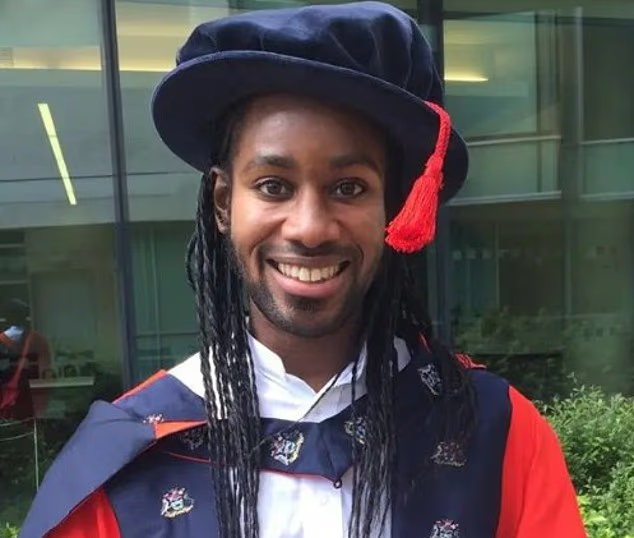
In the end, even Jason Arday’s resignation statement should have carried a health warning.
The cliché-filled 600-word note announcing ‘with profound sadness’ that he’d decided to fall on his sword amid an ‘unrelenting level of public scrutiny and personal attack’ was, within minutes of publication, run through AI detection software by online critics.
It found that the professor’s remarks were between 90 and 100 per cent likely to have been written with the help of a computer bot.
The ensuing social media kerfuffle on Wednesday night marked a fitting end to an utterly surreal scandal in which almost nothing proved to be quite as it seemed.
Arday remains convinced of his own righteousness. His self-serving statement contains no admission of guilt, or apology for the endless well-documented falsehoods he has propagated.
It fails to express regret for the various people passed over for the highly paid jobs (Cambridge pays its professors between £82,000 and £150,000) he elbowed his way into.
He chose, instead, to complain of the ‘relentless accusations, speculation and public commentary’ which have apparently taken a ‘profound toll’ on him.
Quite how that ‘profound toll’ compares to the one Arday’s behaviour exacted on David Harris, an emeritus professor at Plymouth Marjon University, who attempted to blow the whistle on his relentless academic fraud as far back as 2023 only to be reported to the police for ‘harassment’, is unclear.
Jason Arday remains convinced of his own righteousness, writes Guy Adams. His self-serving resignation statement contains no admission of guilt, or apology

Arday claimed to have earned an advance of ‘1.4million’ (it’s unclear whether he meant pounds or dollars) for his memoir Great And Unfortunate Things which is due for release on Tuesday
So too are Arday’s thoughts about his behaviour towards Jack Grove, a reporter for Times Higher Education, who last September emailed a few questions regarding alleged plagiarism to both the professor and Cambridge University.
For the crime of carrying out this act of public-interest journalism, Mr Grove was made the subject of a four-month probe by the Metropolitan Police.
He was then instructed by detectives to drop his story, to protect its subject’s mental health. The Met belatedly apologised yesterday.
This disgraceful episode sums up almost everything that needs to be said about this very British scandal, which has exposed in quite chilling detail how a wide array of institutions, from the police, to academia, the Labour Party, major broadcasters, the publishing industry and the charity sector, have been captured by the progressive dogma of the Left.
Even now, public figures from Green Party leader Zack Polanski to Labour MPs John McDonnell, Apsana Begum, Clive Lewis and Bell Ribeiro-Addy, to Daniel Kebede, the general secretary of the NEU teachers’ union, continue to offer vehement support for the professor.
Their names feature on an online ‘letter of solidarity’ created by the Good Law Project, a liberal pressure group which seeks to blame Arday’s downfall on a ‘smear’ campaign by ‘Right-wing newspapers’ and suggests anyone who doubts the professor’s credentials is a racist who wants to ‘undermine black people who hold positions of influence’.
That many of Arday’s Walter Mitty-style antics were actually exposed by the Left-wing Guardian newspaper does not seem to have registered with this cabal of useful idiots.
Let’s start, however, by looking at Cambridge, supposedly one of the world’s most elite institutions, which appears in the case of Arday to have surrendered basic academic standards to a woke orthodoxy in which minorities are unfairly promoted in the name of diversity, equity and inclusion.
From the day in 2023 when he became its youngest-ever black professor, the university decided to treat the working-class son of Ghanaian immigrants as a PR asset.
Press releases portrayed him as a living, breathing demonstration of their commitment to inclusion, waxing lyrical about a Hollywood-style life story in which he’d conquered severe autism that had allegedly left him unable to speak until almost his 12th birthday, and incapable of reading or writing until adulthood.
The credulous BBC took the bait. Arday was made guest editor on the Today programme, appeared on Question Time, and on multiple occasions featured as a panellist on Sunday With Laura Kuenssberg.
During a BBC Radio 4 debate about the future of the monarchy, which went viral this week, Arday made the baseless claim that 70 per cent of Britons live below the breadline. It went entirely unchallenged.
A second viral BBC clip, from his first day at Cambridge, shows Hilary Cremin, the head of its education faculty, holding his hands in the manner of a bride at the altar and gushing ‘we’re so lucky to have you’ and ‘you are the best in the world in terms of the research you do’.
Perhaps if Cremin had read his PhD, which contains an errant apostrophe in its title, or watched some of the extraordinarily shoddy lectures that remain online (including a 2019 presentation about alleged racism in the university sector in which he complains about the ‘poultry numbers’, rather than ‘paltry’, of ‘black academic leaders’), she might have taken a different view.
When questions began to be asked about Arday’s credentials, Cambridge circled the wagons. Reporters covering the story were, they suggested, taking part in a ‘vile campaign to undermine his credibility’.

Powerful connections may explain how Arday, pictured on This Morning in 2023, ended up being handed a smorgasbord of (sometimes paid) jobs in the so-called ‘third sector’

Hilary Cremin, the head of Cambridge’s education faculty, can be seen in a video holding his hands in the manner of a bride at the altar and gushing ‘we’re so lucky to have you’
A combative legal letter was sent out on Arday’s behalf by the libel law specialists Carter-Ruck, accusing critics of racism, although Cambridge denies paying the firm’s fees.
As to the substance of the complaints, Cambridge insisted that only Liverpool John Moores, which had awarded Arday’s PhD in 2016, could scrutinise it.
Inquiries about work he’d published since then were ignored. Inconsistencies in his life story were none of its business.
Four of the university’s most senior figures were among those who put their name to the Good Law Project’s ‘letter of solidarity’ which, as the scandal deepened, was then stealthily edited to remove false claims Arday had been exonerated after allegations of plagiarism had been ‘thoroughly’ investigated by two institutions.
One signatory, Simon Woolley (Lord Woolley of Woodford), was forced to remove his job title from the online note. He’s the Principal of Homerton College.
Another, Professor Dame Ijeoma Uchegbu, president of Wolfson College, removed her name altogether, as did Simon Baron-Cohen, an eminent neuroscientist in its department of psychology.
Baron-Cohen played a particularly shabby role in subsequent events, using X to describe scrutiny of Arday’s academic record as ‘relentless bullying of a vulnerable autistic man’, adding that because studies show ‘one in four autistic people have planned or attempted suicide’ he was now ‘very concerned about the impact of media coverage’ on his colleague.
On Wednesday, the name of Sonita Alleyne also belatedly vanished from the Good Law Project’s letter. She happens to be the Master of Jesus College, where Arday worked. Somehow, Jesus College is now supposed to be carrying out a thorough and even-handed inquiry into the man she so vigorously backed.
Don’t expect this laughable conflict of interest to be probed by the Department for Education, however. It’s also up to its neck in the Jason Arday scandal. As the Mail revealed yesterday, Sarah Waite, Secretary of State Lucy Powell’s special adviser, handed the professor a role as patron of her charity, Get Further, last year.
There are more wheels within wheels. For political intrigue surrounds Arday’s wider links to the Labour Party, for which he stood as a council candidate in Croydon in 2018.
The Board of Electors which handed him the Cambridge job was, after all, chaired by Sally Morgan, a Labour peer who worked in Tony Blair’s Downing Street.
Powerful connections may explain how Arday ended up being handed a smorgasbord of (sometimes paid) jobs in the so-called ‘third sector’.
A former trustee of the Runnymede Trust race relations think-tank, he’s also patron of the Adult Literacy Trust, a trustee of the British Sociological Association and Autism Action, and sits on the Centre for Labour and Social Studies National Advisory Panel, the NHS Race and Health Observatory Academic Reference Group and the ITV Cultural Advisory Council. The Royal Society of Arts made him a fellow.
Like everyone else, these supposedly rigorous organisations believed without question every facet of Arday’s fantastical life story, from the claim that he only learned how to read and write aged 18 (making his award of GCSEs two years earlier somewhat remarkable) to unlikely tales about raising millions of pounds for charity via feats of ultra-distance running that would have put him among the world’s elite.
The latter included a claim that he’d run 30 marathons in 35 days, despite suffering from an epileptic fit which caused him to fall on day 21, sustaining a hairline fracture that made his leg swell to twice its normal size.
Although the feat was reported in local newspapers, no reference was made to the injury. Photos and video of him crossing the finishing line reveal the leg to be of normal size.
In his forthcoming autobiography, Arday claims ‘two or three thousand people’ stood adjacent to the statue of Eros in Piccadilly Circus to cheer him on, creating a ‘wall of sound’. The photographs show that there were actually around 30 people on the statue, though several were tourists eating their lunch.
Arday has also claimed that he subsequently took part in two further fundraisers that saw him run 300 miles in three days and 600 miles in six days. There are no records in existence demonstrating he completed either challenge.
The 600-mile trip was supposed to have started in London and ended in Edinburgh, which is a mere 320 miles as the crow flies. It allegedly took place around the time he has separately claimed to have been suffering from a benign brain tumour, which affected his balance.

He’s boasted of appearing in the famous Granada documentary Seven Up!, even though it was filmed decades before he was born (Pictured: The original Seven Up show which aired in 1964)

As the Mail revealed yesterday, Secretary of State Lucy Powell’s special adviser handed the professor a role as patron of her charity, Get Further, last year
He claims the tumour was removed a few weeks before his PhD viva (the final oral exam, in which someone defends their thesis), prompting a stroke which affected his short-term memory. Nonetheless, he managed to pass.
Arday has also claimed that his charitable work included installing pumps in Africa and South America for WaterAid. The charity is adamant it has never sent volunteers abroad. And he’s boasted of appearing in the famous Granada documentary Seven Up!, even though it was filmed decades before he was born.
Though easily debunked, the Arday myth was nothing if not hugely lucrative. He became a highly paid speaker on the international lecture circuit, and once claimed to have earned an advance of ‘1.4million’ (it’s unclear whether he meant pounds or dollars) for his memoir Great And Unfortunate Things, which is allegedly still going to be published by Simon & Schuster this month.
The facade only started to fall apart on June 21, when Nathan Cofnas, a former researcher at Emmanuel College, Cambridge, published a blog detailing alleged plagiarism in Arday’s PhD, which contains more than 180 passages which are identical or nearly identical to that of another researcher, Brunel University’s Paula Zwozdiak-Myers, published six years earlier.
It swiftly emerged that his other published work contained false declarations about funding, and included ‘impossible’ statistics, such as a breakdown of the gender of participants in a study which adds up to 110 per cent.
Further scrutiny revealed that quotes supposedly made in focus groups and interviews Arday had overseen had been plagiarised from a study by the renowned epidemiologist Anjum Memon.
One of Arday’s papers quoted a Latin-American academic saying: ‘Sometimes I struggle to articulate clearly and accurately what I would like to say to the healthcare professionals provided at university.’ Another contains the same quote, but attributes it to an Asian female undergraduate student.
In a bid to take control of the narrative, Arday was interviewed by the Guardian. He admitted errors, but characterised them as inadvertent, saying he is autistic and his method of learning relies on mimicry. He then made a bizarre series of claims about a campaign of racist harassment, stretching back several years.
This included a claim that the Met Police had investigated a pig’s head being left outside his family home (described as categorically untrue by the force) and suggestions that he was confronted in his faculty office at Cambridge by a masked knifeman (though he was not captured on CCTV and Professor Arday did not bother telling his colleagues there was an armed intruder on the loose).
As to prior claims that he’d single-handedly raised £5.5million for charity, Arday told the paper he’d in fact been part of a ‘syndicate’ of more than 100 fundraisers, whom he could not name because they had, for some reason, signed non-disclosure agreements.
He continued to insist he did run 600 miles, but changed his story to allege that it took 12 rather than six days.
The straw that seems to have broken the camel’s back, from Cambridge’s point of view, came this week, when four universities – Ohio State University, in the US, Nelson Mandela University, in South Africa, plus Glasgow and Durham – denied that he actually held the jobs with them that were listed on his CV on the Jesus College website.
Other academic claims then evaporated. Footage also emerged of a talk in 2022, in which he described studying for a master’s degree in ‘psychodynamic practice’ at Birkbeck, University of London – a claim not reflected in any published list of his qualifications. And Jesus College quietly removed the claim that he had an ‘MA in Education Studies’ from Liverpool John Moores.
In a serious oversight for a working academic, he’d also falsely claimed to have had a book published entitled Being Young, Black And Male: Challenging The Dominant Discourse. It never hit the shelves and was abandoned by publisher Palgrave Macmillan several years ago.
Among those who repeated this untruth were Simon & Schuster, the supposedly venerable publishing house. It once claimed on its website that he had ‘previously published three books of academic work’. That has now been amended to two.
The firm still intends to publish his ghost-written memoir, despite the fact that it almost certainly contains myriad falsehoods – whether it will appear on the fiction or non-fiction shelves remains to be seen.
As for Arday, he is preparing to embark on a lecture tour, of both the UK and US, promoting what he hopes will be a lucrative bestseller. In the words of his (possibly AI-assisted) resignation note: ‘This is not the end of my work. It is simply the end of this chapter.’














































You must be logged in to post a comment Login