
Crypto World
Bitcoin Price Prediction: A Case for a Bitcoin Surge to USD 76,000 May Be Building Beneath the Boring Price Action


In the latest Bitcoin price prediction, BTC recent range-bound chop has driven short-term traders to look elsewhere for volatility, yet technical structures beneath the surface paint a far more constructive picture.
Trading at $64,600 with a modest 24-hour decline of 0.11%, the benchmark cryptocurrency is hammering out a potential inverse head-and-shoulders reversal on daily timeframes.

The left shoulder formed near $60,000 in early June, followed by a deeper trough at $57,700 constructing the head, and a shallower rebound low at $62,500 forming the right shoulder.
This technical setup projects a measured target of $76,000 based on the vertical distance from the head to the neckline resistance zone at $66,800. While classic chart reading remains an interpretive discipline rather than an exact science, market participants are watching this boundary as a primary trend-reversal trigger.
A decisive daily close above this threshold could end weeks of lateral drift, setting the stage for broader expansion as key technical levels align across major spot desks.
Discover: Everyone’s Got a Take. Get Free $25 to Actually Trade Yours
Can Bitcoin Price Clear Resistance to Trigger a $76,000 Target?
Bitcoin is stabilizing near $64,600, off 0.11% over the last 24 hours, with volume remaining constrained within the summer range.
For the inverse head-and-shoulders pattern to confirm, buyers need to force a decisive close above the $66,800 neckline. Should momentum breach that barrier, the initial measured target sits near $76,000, with extended bullish liquidity at $80,400.
A confirmed breakout past $76,000 clears overhead supply toward higher macro targets at $89,050 and the $98,000 to $100,000 zone.
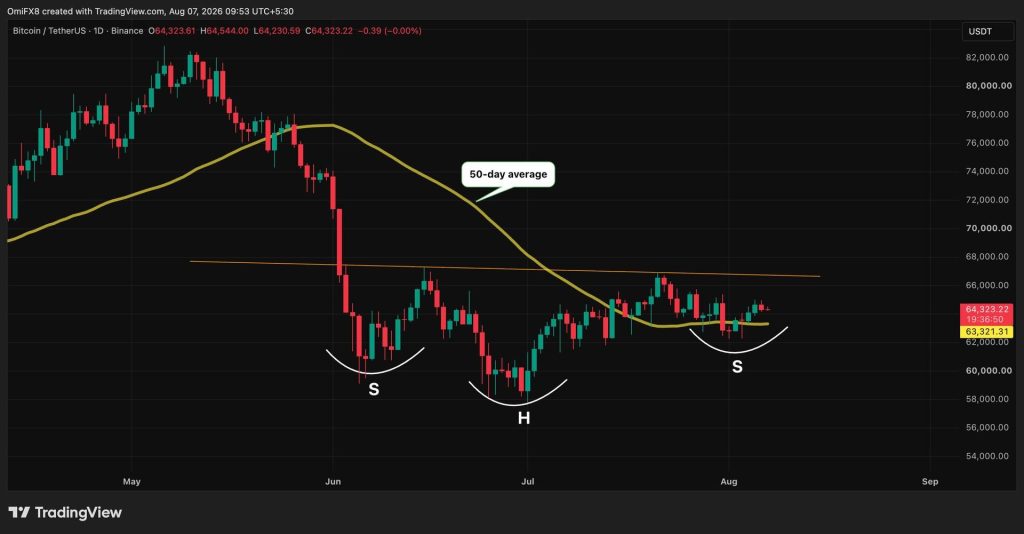
The bull case rests entirely on holding technical support beneath current price. The right shoulder boundary at $62,500 acts as the first line of defense. A breakdown below $60,000 invalidates the inverse head-and-shoulders structure entirely and reopens downside risk toward $57,700.
Will buyers deliver the volume needed to breach $66,800, or does consolidation drag on? Institutional positioning data suggests market participants are waiting for a clean daily breakout before expanding risk exposure
Discover: Your Market Calls Are Worth Something. Start With Free $25 on Kalshi
Bitcoin Hyper Targets Early-Mover Upside as Bitcoin Battles Key Resistance
Even if Bitcoin accomplishes its target of $76,000, a respectable 18% gain from current levels, large-cap assets naturally present tighter upside caps for investors seeking asymmetrical returns.
This structural reality is driving capital rotation into high-throughput infrastructure protocols expanding utility directly on Bitcoin’s base layer.
Leading this emerging sector is Bitcoin Hyper ($HYPER), the first ever Bitcoin Layer 2 with SVM integration delivering faster performance than Solana itself.
By integrating the Solana Virtual Machine into a dedicated Bitcoin L2 ecosystem, the network addresses core Layer 1 limitations: high gas costs, slow throughput, and missing smart contract scalability. The architecture features sub-second transaction finality, high-speed execution, and a Decentralized Canonical Bridge for frictionless BTC transfers.
Early institutional and retail participation has accelerated rapidly, with presale funding securing $33,014,652.73 at a current token price of $0.0136843.
Holders can also access high APY staking pools during the presale phase. While early-stage Layer 2 projects carry execution and network adoption risks, the return profile offers significant expansion relative to megacap spot assets.
Traders seeking early exposure to next-generation Bitcoin scaling can research Bitcoin Hyper before the current presale pricing stage closes.
Discover: Get Paid to Be Right, $25 to Start on Kalshi
Don’t Miss Out on Our $1,000 USDT Airdrop on ByBit
The post Bitcoin Price Prediction: A Case for a Bitcoin Surge to USD 76,000 May Be Building Beneath the Boring Price Action appeared first on Cryptonews.


US lawmakers have pushed back a vote on major crypto market-structure legislation, extending a period of regulatory uncertainty for institutions that need clearer rules on trading, custody, and oversight. The delay, confirmed by U.S. Senator John Thune’s office to Cointelegraph, means the bill will not be considered before the August recess, with Thune’s team describing it as a priority for September.
Industry leaders say the postponement could reshape competitive dynamics outside the United States. First Digital founder and CEO Vincent Chok, whose firm issues the FDUSD stablecoin, argued that jurisdictions with clearer frameworks—particularly in Asia—could use the additional time to attract capital and talent as US uncertainty weighs on institutional adoption.
Key takeaways
- Senator John Thune’s office confirmed the US Senate will not vote on the crypto market-structure legislation before the August recess, pointing to September as the next window.
- First Digital CEO Vincent Chok said prolonged regulatory uncertainty is harder for markets to adapt to than slower timelines.
- 1inch’s deputy general counsel warned that a failure to enact the legislation could lead back to “regulation by enforcement,” leaving firms reliant on agency interpretations and case-by-case action.
- The EU’s Markets in Crypto-Assets Regulation (MiCA) is already in force, creating a contrasting regulatory timeline compared with the US.
- Some commentators interpret the delay as a political outcome that may further incentivize development “offshore” while US rules remain unsettled.
Senate delay extends uncertainty for institutional crypto
According to confirmation from Thune’s office to Cointelegraph, the Senate will not bring the bill to a vote before the August recess. Thune reportedly cited Democratic opposition, and said the legislation would be a priority when senators return in September.
While a delayed vote can be normal in legislative calendars, Chok’s concern was specific: for market participants, the most damaging factor is not simply a slower process but extended ambiguity. In a statement shared with Cointelegraph, he said that “markets can adapt to slower timelines,” but “what they struggle with is prolonged uncertainty.”
Chok tied the issue directly to institutional readiness. Without clear market-structure rules, he argued, institutions are left without dependable guidance on topics that are central to mainstream adoption—especially market design, custody practices, and regulatory oversight.
“Regulation by enforcement” risk and fragmented rules in the US
Maylea Ma, deputy general counsel at decentralized exchange aggregator 1inch, emphasized what changes if Congress does not pass the legislation. In her view, the industry could move toward a familiar pattern: “regulation by enforcement.”
Ma said that in such a scenario, firms would remain dependent on how regulators interpret rules and enforce them on a case-by-case basis. She also pointed to a fragmented US landscape, where companies may have to navigate overlapping state-level money transmitter requirements alongside securities-law interpretations that can vary by jurisdiction and enforcement posture.
That uncertainty is particularly consequential for institutional participants, which generally require more predictable compliance expectations before scaling operations, offering services, or integrating crypto infrastructure into broader financial workflows.
Asia’s window to demonstrate “clear regulation and innovation” together
Chok suggested the delay could strengthen the relative attractiveness of global hubs that have already pursued clearer regulatory positioning. He said that for Asia, postponement provides additional time for hubs such as Hong Kong and Singapore to show that regulatory clarity can coexist with continued innovation.
His underlying thesis is that capital allocation and talent decisions often respond quickly to regulatory risk. When US timelines are uncertain, institutions looking for stability may favor venues where rulemaking appears more settled—even if US legislation eventually arrives.
In that sense, the Senate’s procedural shift may have strategic consequences beyond the US market itself. The longer the pause continues, the more companies may build or expand operations in jurisdictions perceived to offer a smoother compliance path.
EU MiCA already in force, highlighting a widening timeline gap
Ma contrasted the US situation with Europe, pointing out that the European Union’s MiCA framework is already operational. She noted that MiCA is “already in force,” referencing Cointelegraph’s earlier coverage on the end of a grace period and the issuance of relevant licenses.
Under that backdrop, Ma said 1inch would continue operating with a conservative, non-custodial approach that focuses on self-custody. The key point is not that MiCA removes all complexity, but that it provides a structured regulatory timeline that companies can plan around—while the US remains tied to legislative and enforcement uncertainty.
For readers, the practical implication is that compliance planning may increasingly look “regional.” Businesses could find that their roadmaps are governed less by global principles and more by where regulatory frameworks are already active.
Political framing: ambiguity as a driver of offshore innovation
Not all reactions were confined to legal mechanics. Wellington-Altus chief market strategist James E. Thorne offered a more politically pointed interpretation, posting on X that he viewed the postponement as a “fold” by Thune and a victory for Senator Elizabeth Warren and the regulatory status quo. His argument was that continued ambiguity encourages innovation to move offshore while other jurisdictions develop clearer regimes.
While Thorne’s remarks are political rather than technical, they align with a broader market reality: regulatory uncertainty can influence where teams incorporate, where products launch, and which markets institutions consider first—especially when compliance staff need more than verbal assurances to manage risk.
As the Senate returns in September, the key question for the crypto sector is whether the legislation can clear remaining procedural hurdles—or whether the industry is pushed further into a cycle of enforcement-driven precedent. Either outcome will likely determine how quickly institutions feel comfortable moving from experimentation to scaled adoption, and it may continue shaping where global crypto activity concentrates.

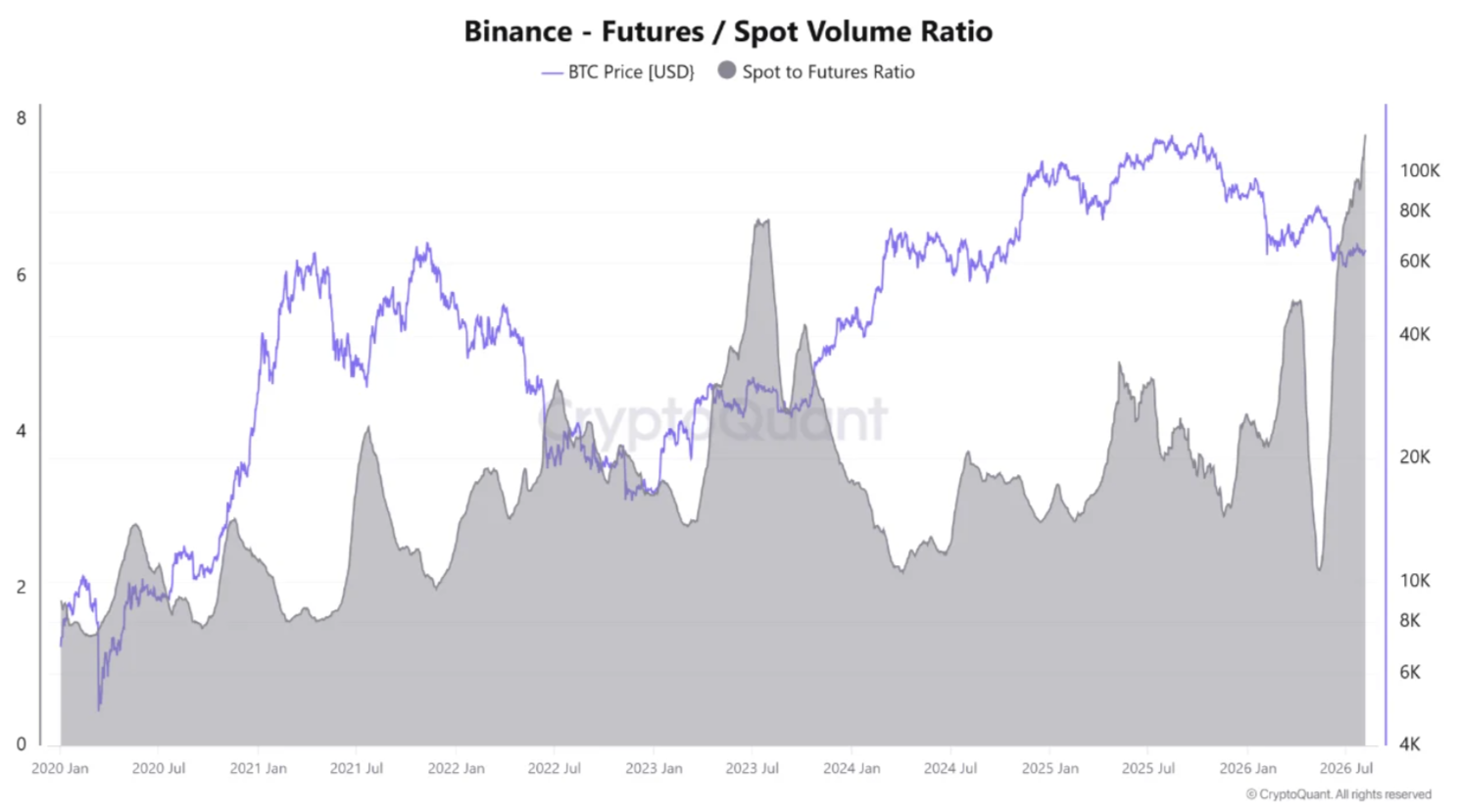
Bitcoin derivatives trading is taking a noticeably larger share of activity on Binance, according to fresh analytics that highlight how spot interest has cooled while futures usage keeps building. On CryptoQuant’s data, the futures-to-spot trading volume ratio on the exchange has reached an all-time high of 7.82, meaning futures volume is now nearly eight times spot volume.
This shift matters for market structure: when spot volumes lag derivatives, price discovery can become more reflexive—driven more by leverage and hedging than by new spot inflows. With Bitcoin holding a narrow band for weeks, traders are increasingly expressing their expectations through options positioning, including bets that any eventual range break could lean downward.
Key takeaways
- Binance futures volumes outpace spot at a record pace: CryptoQuant reports a futures-to-spot ratio of 7.82.
- Spot demand has been deteriorating more consistently: CryptoQuant data shows a steadier decline since June compared with derivatives demand.
- Short-term positioning is increasingly “hedge-forward”: options traders appear to be managing downside risk for September.
- Trading range behavior persists: Bitfinex Research says volumes thin near the range extremes, suggesting neither side is forcing a breakout.
Binance’s spot-versus-futures gap widens to a new peak
CryptoQuant’s “quick take” analysis, published Friday, focuses on Binance’s daily trading volume split between spot and derivatives. The headline metric is the futures-to-spot volume ratio, which has climbed to 7.82—the highest reading CryptoQuant reports for this measure.
In the same snapshot, daily futures volume on Binance is listed at $57.82 billion for the week cited, versus $6.08 billion in daily spot volume. The imbalance indicates that a greater share of trading activity is happening in leveraged or risk-managed instruments rather than outright spot buying.
CryptoQuant contributing analyst Arab Chain linked the trend to persistent differences in how participants use markets, noting that Bitcoin was trading around $64,000 while futures activity continued to expand faster than spot. In his view, the change reflects more investors and traders leaning on futures for leverage, risk management, and shorter-term trading tactics.
For traders and investors, this is more than a curiosity about exchange usage. When spot volumes don’t keep pace, it can signal that the marginal buyer is weaker—so price moves may depend increasingly on derivatives positioning, liquidations, and hedging dynamics rather than broad spot accumulation.
Cooling spot appetite as Bitcoin stays rangebound
CryptoQuant frames the latest ratio spike as coming after months of retreating demand, particularly from retail segments. The report also points to a broader observation made earlier in coverage by Cointelegraph: retail attention has been shifting toward AI-linked equities following broader stock-market dislocations. While that comparison is outside Binance itself, it underscores a theme CryptoQuant emphasizes—spot interest has been less consistent during the current phase.
Looking specifically at demand trends, CryptoQuant states that on a rolling 30-day basis, both spot and derivatives demand are deteriorating. However, it says spot shows a more consistent decline since June, while futures has remained net positive.
Technically and behaviorally, the report ties this to the market’s two-month range above $60,000. Prolonged consolidation often dampens spot urgency because the incentive to buy increases when there’s a clearer directional move. CryptoQuant also references a period in February when Bitcoin first dropped to the $60,000 level and traders recorded a sharp spike in realized losses on-chain. Subsequent attempts to revisit that area have allegedly seen lower volumes, as both buyers and sellers appear to have exhausted enthusiasm.
CryptoQuant CEO Ki Young Ju previously summarized the divergence on X, stating that Bitcoin spot demand is weakening while futures demand remains net positive—but at a level lower than during the rebound about three months earlier.
Options traders lean toward a downside resolution in September
As spot participation stays muted and futures dominate activity, market participants have been expressing expectations through derivatives beyond outright leverage—especially options. Bitfinex Research, citing its own exchange analytics and referencing Glassnode, highlighted how volume has been losing intensity on both spot and derivatives.
Bitfinex Research wrote that for the moment, activity is clustering near the middle of Bitcoin’s local range, while it thin[s] out near the extremes. It also pointed to taker volume as a sign that neither side is aggressively pushing to force a breakout in either direction.
According to Bitfinex, options positioning suggests traders expect rangebound behavior to continue through August, after BTC/USD gained 7.4% in July. The more notable shift is its outlook for September: Bitfinex said options traders are effectively pricing a likely downside resolution of the range, aligning with what it described as “familiar Bitcoin bear-market behavioral patterns.”
In other words, the derivatives market is not only doing more volume—it is also using structured contracts to hedge and to reflect a preference for a particular path of volatility. That’s consistent with the idea that when spot interest fades, traders may rely more on options to manage downside scenarios during uncertain consolidation.
What the widening ratio and hedging signals could mean next
Taken together, the Binance volume split and the options posture point to a market that is still deciding how it wants to trend—without clear spot-driven conviction. A futures-to-spot ratio near 8x can indicate that traders are increasingly comfortable operating in derivatives, but it can also raise the stakes for how quickly leverage unwinds if the range finally breaks.
For readers watching the next phase, the key question is whether spot demand can reassert itself if price attempts a move—or whether market action continues to be dominated by hedging and leverage as September approaches. The persistence (or reversal) of the futures-to-spot imbalance, alongside whether options positioning continues to favor downside, will likely be the clearest tells.


Dathon Ohm, the proposal’s pseudonymous author, declared, “Bitcoiners are about to show the world, once again, what happens when the plebs stand up against large, corrupt institutions who are telling us Bitcoin isn’t money and our nodes belong to them,” in a thread on X on Thursday.
Rhetoric aside, the thread gave instructions to miners planning on enforcing the BIP-110 rulebook, advising them to upgrade to Bitcoin Knots (the primary software carrying and enforcing BIP-110), warning that Bitcoin Core (the network’s principal software that represents the current implementation of Bitcoin’s rules) should not be run as it would become “insecure.”
BIP-110 is a movement by the plebs, for the plebs, standing up and arming themselves with software to tell these institutions in one resounding, unified voice:
BITCOIN IS MONEY, OUR NODES BELONG TO US, AND WE WILL NEVER GIVE UP.
BIP-110 is designed to temporarily tighten Bitcoin’s consensus rules to make inscription techniques used by Ordinals and Runes impractical. Its supports argue that use of the network for non-financial data consume block spacer, make it more expensive to run and undermine Bitcoin’s purpose of digital money.
Critics have pointed to the lack of miner support as evidence that the proposal is effectively dead. Its supporters reject that premise.
BIP-110’s proponents argue that miners do not govern Bitcoin – they merely produce the blocks. Nodes decide whether those blocks comply with rules. User-activates soft forks (UASFs) are designed around that principle, allowing node operators to begin enforcing new rules from a predetermined block height regardless of miner support.

[PRESS RELEASE – Kwai Chung, Hong Kong, August 7th, 2026]
CoinMarketCap has expanded its Pro API with a new suite of seven real-world asset (RWA) endpoints, giving developers a single programmatic source for data on tokenized versions of traditional financial instruments. The RWA endpoints cover tokenized equities, commodities, currencies, government securities, exchange-traded funds (ETFs), and real estate. They are available now.
The RWA endpoints resolve each asset through a stable identifier and span the full data lifecycle. An ID map and a metadata endpoint return descriptive and company information. Asset-list and quotes endpoints return aggregate tokenized price, market capitalization, and 24-hour volume. Market-pairs and issuer endpoints expose the underlying on-chain tokens, as well as the markets they trade on and the issuers behind them. Core endpoints are accessible on CoinMarketCap’s free Basic plan and above.
The RWA API launch coincided with a notable market moment. When SpaceX completed its public listing, CoinMarketCap published an RWA developer guide. The guide showed how to retrieve data on the company’s tokenized stock through the same endpoints, connecting a major traditional-finance event to on-chain data in one workflow.
The RWA endpoints expand an already broad API offering. Through a single integration and credit system, the CoinMarketCap Pro API delivers real-time and historical crypto prices, along with centralized exchange, decentralized exchange (DEX), derivatives, and liquidation data. It also provides proprietary indexes, including the CoinMarketCap Fear & Greed Index and CMC20, as well as real-time WebSocket streaming. The platform offers agent-native access through a hosted MCP server and pay-per-call x402 support, as well as a Keyless Public API that lets developers call a curated set of endpoints without an account or API key.
“Developers should not have to stitch together a dozen providers to build a serious crypto product,” said Rush, CEO of CoinMarketCap. “By bringing tokenized real-world assets into the same API that already covers spot, derivatives, DEX, and our own market indices, we give builders one dependable source of truth. Our goal is simple: to be the first and last data API a team needs.”
The expansion follows CoinMarketCap’s recent certification under ISO/IEC 27001 and ISO/IEC 27701, independently assessed by BSI, covering information security and privacy management across its platform and API.
ABOUT COINMARKETCAP
CoinMarketCap stands as the Home Of Crypto. With over 1 billion monthly page views and 53 million tracked cryptocurrencies, CoinMarketCap drives the industry forward by organizing and delivering comprehensive crypto intelligence. Major media outlets, including Forbes, Bloomberg, CNBC, and The Wall Street Journal, rely on CoinMarketCap as their primary source for crypto data.
The post CoinMarketCap Expands Its Pro API With Real-World Asset Data Endpoints appeared first on CryptoPotato.
“Only Congress can ensure that regulation in this area is future-proofed through comprehensive market structure legislation,” he said.
The pending SEC moves would follow a spate of guidance from both the SEC and CFTC that has clarified how U.S. crypto efforts can proceed without running afoul of the regulators, whether it’s mining, memecoins, rewards or several other categories. The most important of these regulatory statements emerging from the agencies was the “taxonomy” that sought to carefully define how the regulators would categorize different digital assets, and how those assets would be supervised.
Fed & Co.
Meanwhile, the banking regulators have been rapidly granting charters to crypto firms, and the Federal Reserve has been working on a tailored access to its payments rails and other services to cut out the banking go-betweens the digital assets players have relied on to serve customers. The new bank charters will have some durability, even when the Office of the Comptroller of the Currency that issues them changes management down the road.
As the Treasury Department and its tax branch, the IRS, also implement crypto-specific policies, the momentum of U.S. regulation becomes increasingly difficult to reverse.
The industry already counted a massive win last year in the passage of the Guiding and Establishing National Innovation for U.S. Stablecoins Act (GENIUS) Act. From a dicey 2022 in which crypto crashed and its highest-profile advocate was prosecuted for fraud, the sector turned things around in Washington to get a law governing U.S. stablecoin issuers and — for the first time — officially adding crypto to the regulated financial system.
A tokenized version of Grand Theft Auto VI (GTA 6) publisher Take-Two Interactive Software’s (TTWO) stock has launched on Solana through Backpack Securities. Holders can now trade the company’s equity straight from a compatible crypto wallet.
The listing arrives as Netflix readies an exclusive extended look at GTA 6. The special airs August 27. It lands ahead of the game’s November 19 launch on PlayStation 5 and Xbox Series X|S.
How the TTWO Tokenized Stock Trades on Solana
Backpack Securities is the tokenization arm of the Solana-based exchange Backpack. It minted the wrapped TTWO shares and listed them across several venues.
Backpack frames the tokens as direct equity claims rather than synthetic price trackers. Each one represents a 1:1 redeemable stake in TTWO shares held through a dedicated custody vehicle, not a derivative contract that only mirrors the stock’s price.
“Unlike synthetic alternatives, Backpack investors hold full ownership of the traded U.S. equities, backed by the depth of traditional exchange liquidity,” Backpack CEO Armani Ferrante, via GlobeNewswire
The tokens still settle instantly and trade outside Nasdaq’s normal hours, unlike the underlying stock itself.
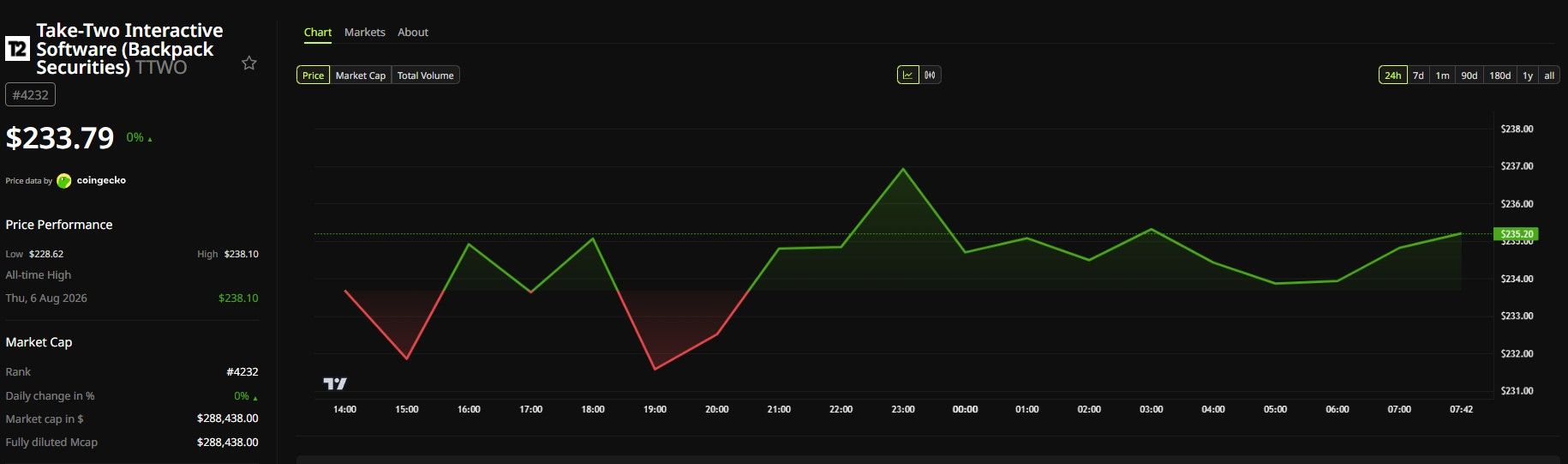
The wrapped stock last changed hands at $233.79, according to live BeInCrypto data. That price held flat over the past 24 hours. Market capitalization stands near $288,438, and the token touched an all-time high of $238.10 on August 6.
This listing follows a broader push to move equities onchain. Backpack tokenized SpaceX shares in June. Robinhood Chain, meanwhile, leads rival platforms in tokenized stock holders, even though meme coins still dominate its trading volume.

GTA 6 Hype Builds Around the Netflix Reveal
Netflix confirmed the GTA 6 special through its Tudum editorial hub. The premiere runs on Netflix first, at 3 p.m. ET on August 27, before Rockstar Games posts it to YouTube and the official GTA VI site six hours later.
Rockstar has not detailed the extended look’s exact contents, though it has billed the special as more than a standard trailer. The story itself follows two protagonists, Jason and Lucia, across the fictional state of Leonida after a heist collapses.
Anticipation for the game has been building for months. Take-Two’s July filing confirmed the release date and projected over a billion dollars in fiscal 2027 cash flow. Rising chip costs have also pushed console prices higher across the industry, adding pressure just as GTA 6 nears launch.
Wall Street analysts remain bullish on the underlying stock regardless. Twenty-nine analysts tracked by S&P Global hold a Strong Buy rating on TTWO. Their consensus price target sits at $284.14, according to stockanalysis.com, with individual targets ranging from $170 to $368.
Investors can track the current TTWO price on BeInCrypto’s Markets page as the Netflix premiere nears. The coming weeks will show whether the tokenized shares can keep pace with Wall Street’s optimism heading into the GTA 6 launch.
The post GTA 6 Creator’s Stock Hits Solana as Netflix Special Approaches appeared first on BeInCrypto.
Binance will delist four trading pairs on Saturday and pause certain services the following day.
Solana is at risk of plummeting to $50, while Dogecoin (DOGE) might be on the verge of a major revival.
The Latest Binance Announcements
The world’s biggest crypto exchange will remove the spot trading pairs QNT/BTC, RPL/USDC, SIGN/BNB, and SKL/USDC on August 7. The decision comes after its most recent analysis, which checks whether all supported pairs meet important criteria like adequate liquidity and volume.
The company will also briefly pause US stock trading on the platform on August 8 due to a scheduled system upgrade carried out by a partner broker. The process is set to be completed in about three hours, and after that, operations should resume.
This won’t be the first time Binance has halted certain services to support advancements. At the start of July, it temporarily suspended deposits and withdrawals on the Bitcoin (BTC) network to perform wallet maintenance.
Later that month, it briefly stopped TRX deposits and withdrawals due to an improvement related to the Tron Network and supported a Zcash hard fork, making ZEC transactions unavailable for a short period.
There haven’t been reports or complaints of major issues in all of the aforementioned cases, meaning the upcoming wallet maintenance shouldn’t be a concern to users.
What’s Next for SOL?
Solana’s native token has dropped just below $73.50 after witnessing a 5% monthly decline. Its current level puts it under the crucial zone of $73.70, which analyst Ali Martinez recently labeled as a “make-or-break” moment.
He claimed that over 50 million coins were purchased around that mark, predicting that a sustained close to the downside could open the door to a collapse to as low as $50.
In contrast, Michael van de Poppe and Pepesso issued more optimistic forecasts. The former envisioned a potential uptrend to $120 if the price breaks $76, while the latter argued that the “clean accumulation setup” remains valid as long as SOL stays above $45.
DOGE’s Chance to Break Free
Several days ago, the OG meme coin dropped to a three-year low of around $0.067, representing a staggering 90% crash from its ATH reached in 2021. It currently trades slightly above that zone, and when it reached its bottom, some market observers identified a major bullish signal.
X user Ash Crypto told their more than two million followers that DOGE’s monthly Relative Strength Index (RSI) has reached its most oversold level since the 2022 bear cycle. Such a development could indeed benefit the bulls because it points to seller exhaustion and an increased possibility for a strong rebound. Conversely, overbought territory is typically interpreted as a warning for an incoming pullback.
MikybullCrypto echoed a similar theory, saying:
“You don’t remain bearish at this current macro support level. The most oversold level in RSI. $1 is coming next during its bullish reversal.”
Another positive signal coming from Dogecoin’s ecosystem is the rise of weekly active DOGE addresses that have jumped 16%: from approximately 38,000 toward the end of July to roughly 44,000 by August 5.
The post Recent Binance Updates, Top SOL and DOGE Forecasts, and More: Bits Recap August 7 appeared first on CryptoPotato.
Crypto World
The Senate Just Shelved the CLARITY Act, And JPMorgan Says Crypto’s Tokenization Boom Could Slip Away to Wall Street
Bitcoin traded near $64,600 as the U.S. Senate shelved the CLARITY Act ahead of its August recess, leaving the market-structure bill without a floor vote.
JPMorgan had described the legislation as a significant potential catalyst, while its latest analysis said declining odds of passage this year were a headwind for the broader crypto market.
Attention now turns to whether senators can build enough bipartisan support to clear procedural hurdles.
The delay also leaves institutional allocators weighing whether continued U.S. regulatory uncertainty will keep capital sidelined or alter where digital-asset activity develops.
Discover: Everyone’s Got a Take. Get Free $25 to Actually Trade Yours
Senate Floor Math and Banking Friction Slow Momentum
CLARITY Act just got pushed to September. Thune himself confirmed it — 𝗕𝗮𝗻𝗸XRP (@BankXRP) August 7, 2026

Dems held the line, ethics clause still unresolved, and the Senate ran out of runway before recess.
The Senate faces a 60-vote threshold to advance the bill and limit floor debate. Unresolved stablecoin-yield provisions and other legislative hurdles remain central obstacles to moving the legislation forward.
Industry friction has added to the uncertainty. Coinbase withdrew its support over provisions that could limit stablecoin rewards and competition, and the primary report said the dispute contributed to a postponed Senate Banking Committee markup.
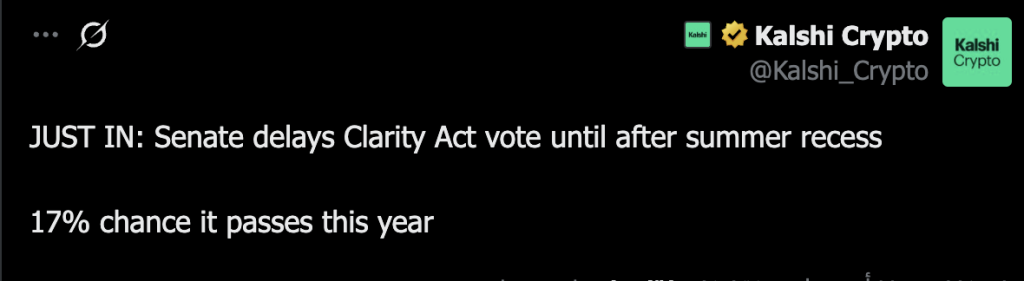
Kalshi estimated that the bill had a 17% chance of becoming law by year-end. JPMorgan said that level was below what institutional investors typically require for new mandates.
Discover: Your Market Calls Are Worth Something. Start With Free $25 on Kalshi
Clarity ACT Regulatory Split and Tokenization
The proposed legislation would split oversight of digital assets between the Commodity Futures Trading Commission and the Securities and Exchange Commission.
Tokens classified as digital commodities would fall under CFTC supervision, reducing compliance burdens that have pushed issuance and trading activity offshore.
A grandfather clause in the current draft would treat tokens tied to spot ETFs listed before January 1, 2026, including XRP, Solana, Litecoin, Hedera, Dogecoin and Chainlink, as commodities by default.
Separately, new projects could raise up to $75 million annually without full SEC registration, subject to disclosure requirements. JPMorgan said that provision could revive onshore venture activity that has migrated abroad.
BREAKING: — Oscar Ramos (@OscarRamos60) August 6, 2026
 $4 TRILLION JPMORGAN JUST SENT A MASSIVE WARNING IF WE FAIL TO PASS THE #BITCOIN CLARITY ACT
"IT WILL DELAY ONE OF THE BIGGEST CATALYSTS FOR INSTITUTIONAL ADOPTION"
"IT WILL EXTEND UNCERTAINTY TO INVESTORS AND BUSINESSES"
"THE LONGER THE APPROVAL OF THE CLARITY ACT pic.twitter.com/fDrtxIzcjj
JPMorgan warned that delays in Senate action could result in tokenization and blockchain applications being absorbed by traditional market infrastructure rather than benefiting public crypto networks. On July 15, the Depository Trust & Clearing Corporation announced a pilot to tokenize stocks and U.S. Treasuries involving firms including JPMorgan and Vanguard.
Citi estimates that the global market for tokenized financial assets, currently valued at $17 billion, could reach $5.5 trillion by 2030. The bank said that without a clear regulatory framework, much of that growth may remain within traditional financial systems rather than public blockchains.
Outlook for the Senate Process
Any effort to advance the CLARITY Act in the Senate still faces the 60-vote hurdle. The bill’s prospects will depend on whether lawmakers can resolve the outstanding provisions and assemble the support needed for a floor vote.
Until then, the legislation’s proposed division of regulatory authority between the CFTC and SEC remains unimplemented, leaving market participants without the clearer congressional framework envisioned by the bill.
Discover: Get Paid to Be Right, $25 to Start on Kalshi
Don’t Miss Out on Our $1,000 USDT Airdrop on ByBit
The post The Senate Just Shelved the CLARITY Act, And JPMorgan Says Crypto’s Tokenization Boom Could Slip Away to Wall Street appeared first on Cryptonews.
Bitcoin (BTC) derivatives trading volumes are now nearly eight times higher than spot markets on Binance.
Key points:
- Bitcoin daily spot trading volumes on Binance are diverging from futures more than ever.
- Spot demand has declined in recent months, while futures demand is still net positive, per data from CryptoQuant.
- Options traders are hedging for downside in September after months of rangebound BTC price action.
Binance sees record split in Bitcoin spot vs. futures trading
Data from onchain analytics platform CryptoQuant released on Friday reveals record readings for Bitcoin futures-to-spot trading volume ratios. The ratio now stands at 7.82, meaning that futures volume outweighs spot nearly eight times over.
Daily futures volume on Binance hit $57.82 billion this week, while spot trailed at $6.08 billion.
“Meanwhile, Bitcoin is trading near $64,000, while futures trading volume continues to grow at a faster pace than spot trading volume,” CryptoQuant contributing analyst Arab Chain commented on the data.
“This trend reflects a shift in market activity, with more investors and traders preferring to use futures for leverage, risk management, and short-term trading strategies.”
Bitcoin futures-to-spot trading volume ratio (screenshot). Source: CryptoQuant
The record comes after months of retreating investor demand, with the exodus particularly noticeable in the retail trading sector. Previously, Cointelegraph reported that AI stocks have become a key destination for retail capital.
CryptoQuant data shows that on a rolling 30-day basis, both spot and derivatives demand continue to deteriorate, with spot showing a more consistent decline since June.
BTC/USD has spent the past two months in a narrow range above $60,000, contributing to a lack of interest among spot traders. Traders initiated a major spike in onchain realized losses in February, when Bitcoin first dropped to the $60,000 mark. However, subsequent retests have seen lower volume as both buyers and sellers have become exhausted.
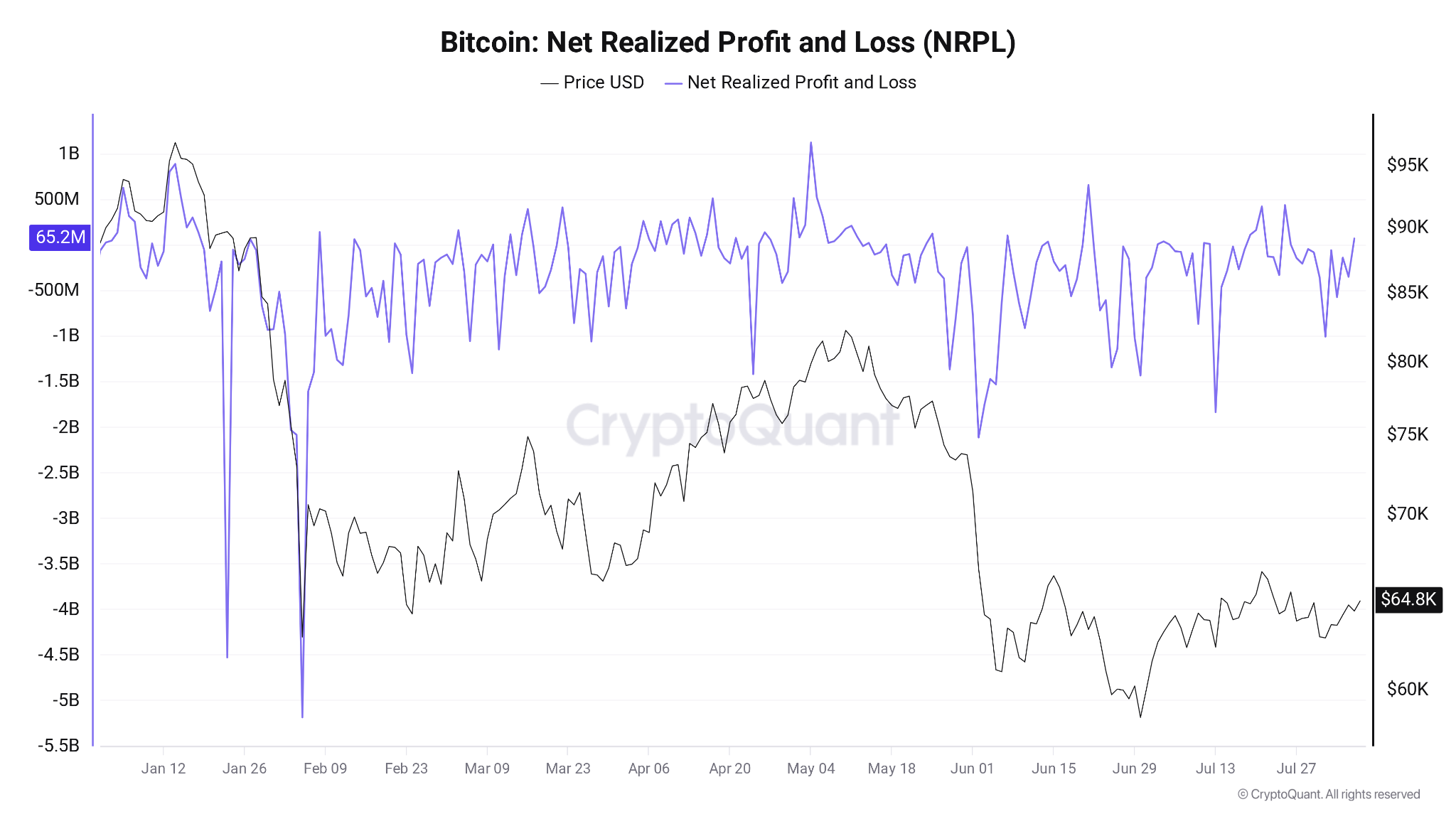
Bitcoin net realized profit/loss data. Source: CryptoQuant
“Bitcoin spot demand is weakening. Futures demand remains net positive, but is significantly lower than during the rebound three months ago,” CEO Ki Young Ju reported in a post on X late last month.
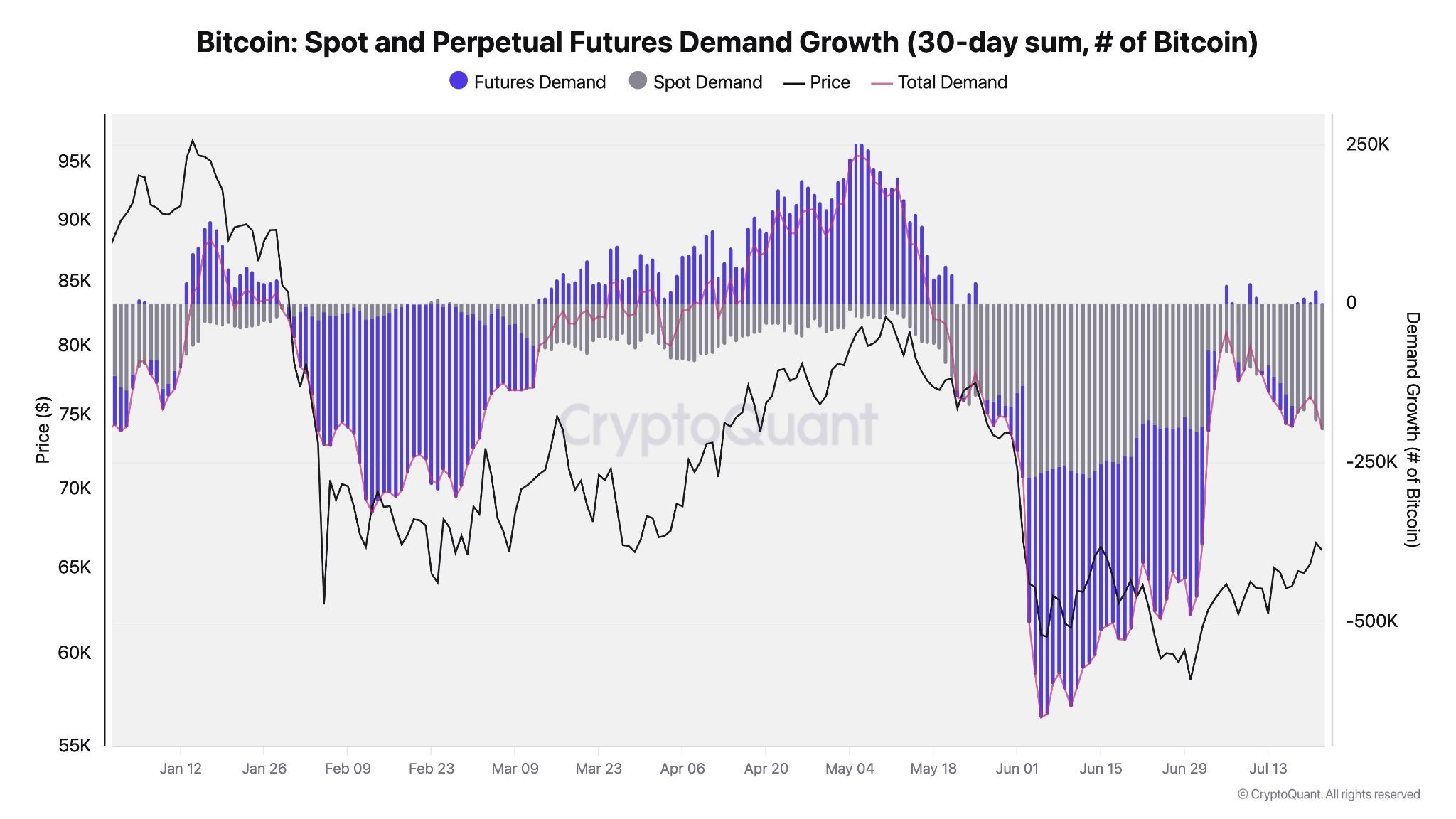
Bitcoin spot vs. futures demand. Source: Ki Young Ju on X.com
Traders position for September BTC price range breakdown
Examining the odds of a Bitcoin price breakout from its local trading range this week, crypto exchange Bitfinex flagged decaying volume across both spot and derivatives markets.
Related: Bitcoin treasury trade ‘breaking’ and fund holdings drop 10%: Analysis
“For now, volumes cluster in the middle of the range and thin out near the extremes. Taker volume especially is a sign that neither side is pushing hard to break the range in either direction,” its analytics arm, Bitfinex Research, wrote in an update.
Bitfinex said that options traders were positioned for rangebound conditions to continue in August, following a 7.4% gain for BTC/USD in July. In September, meanwhile, they expect the range to resolve to the downside, following familiar Bitcoin bear-market behavioral patterns.
“Options traders are effectively pricing in a continuation of the range and, on aggregate, hedging for a downside resolution of it several weeks from now,” it added alongside data from onchain analytics platform Glassnode.
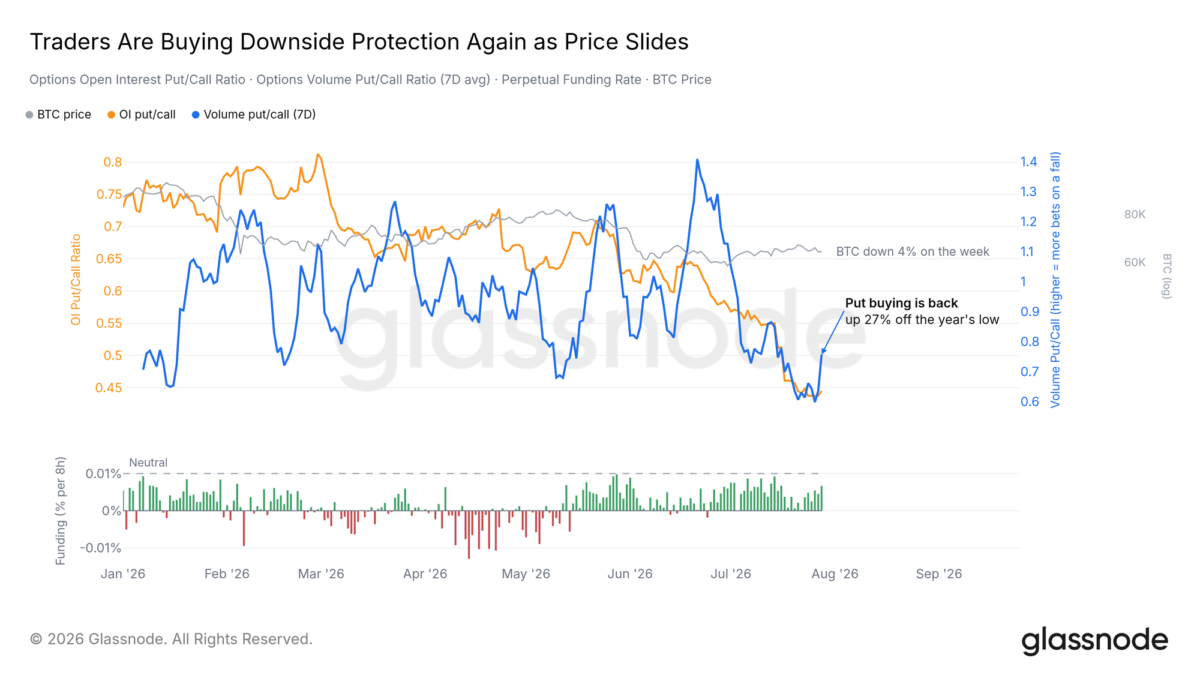
Bitcoin options composite chart. Source: Bitfinex

The war, which began on Feb. 28, already cost taxpayers around $29 billion as of May for expended munitions, equipment repairs, and other operations, although outside estimates put the broader war cost closer to $50 billion. Last month, the Trump Administration asked the Senate for $87 billion in emergency funding, including $67 billion for the Pentagon. Defense Secretary Pete Hegseth told Senators the funding was needed to “rapidly replenish equipment and munitions,” and included $18 billion to replace advanced Patriot interceptors, Navy Tomahawks, and Army terminal high altitude area defense (THAAD) missiles.

Football world splits as Argentina, Mexico back FIFA president Infantino amid World Cup rights row | Football News

What Chocolate Finance got right about S’pore’s changing savings habits

GOLD Vs Realestate Vs NIFTY 50 | Day 02 Improving your Finance and Investing | Pranjal Sharma


-

 Fashion7 days ago
Weekend Open Thread: Wit & Wisdom
-

 Politics7 days ago
Meta enters AI-training agreement with far-right ‘propaganda rag’ Newsmax
-

 Politics5 days ago
Zack Polanski: an incitement to murder Nigel Farage?
-

 Crypto World6 days ago
MicroStrategy Post-Earnings CLARITY Act Push Could Add New Catalyst for Its Stock
-

 Crypto World6 days ago
XRP Ledger v3.3.0 brings five institutional features
-

 Crypto World6 days ago
New York sues Kalshi over prediction market gambling
-

 Crypto World5 days ago
Crypto PAC spending tops $2M in Michigan House race
-

 Business7 days ago
Trump Announces Hamas Disarmament Agreement as Iran Strikes Kuwait Air Base and US Attacks Pause Overnight
-

 Business4 days ago
DTCR: Deleveraging And A Hedge Fund Collapse Point To A Possible AI Bottom
-

 Tech5 days ago
ESET tracks rise in malicious AI skills and adaptable malware
-

 Crypto World7 days ago
3 Fed Officials Just Explained Their Rate Hike Vote: Is Inflation Winning?
-

 Sports6 days ago
France Cricket implodes: letters hidden in a drawer and a board at war
-
Crypto World5 days ago
XRP Ledger urges node upgrade after manifest flood
-

 Crypto World6 days ago
Moneyflip CEO charged in $40K murder-for-hire plot
-
 Sports6 days ago
Bruno Fernandes decision made as Man United ‘discuss’ striker transfer option
-
Business7 days ago
FIFA has scrapped $20 billion World Cup sell-off plan, New York Post reports
-

 News Videos6 days ago
Financial Crash Expert: The 90-Day Collapse Timeline They Are Desperately Hiding.
-

 Sports1 day ago
Jordan Coyle & Cordiamo take Laya Arena Stakes at RDS
-

 Sports7 days ago
Commonwealth Games 2026 Live Updates | Day 9 CWG 2026: Lovlina Borgohain, Sachin Siwach Enter Final After Indian Judokas Script History
-
 Crypto World4 days ago
US Tech Stocks See Largest 5-Week Inflow in History: Can Nasdaq Break Its Downtrend?
You must be logged in to post a comment Login