
Crypto World
Why Bitcoin’s BIP-110 refuses to die despite near-zero miner support



Dathon Ohm, the proposal’s pseudonymous author, declared, “Bitcoiners are about to show the world, once again, what happens when the plebs stand up against large, corrupt institutions who are telling us Bitcoin isn’t money and our nodes belong to them,” in a thread on X on Thursday.
Rhetoric aside, the thread gave instructions to miners planning on enforcing the BIP-110 rulebook, advising them to upgrade to Bitcoin Knots (the primary software carrying and enforcing BIP-110), warning that Bitcoin Core (the network’s principal software that represents the current implementation of Bitcoin’s rules) should not be run as it would become “insecure.”
BIP-110 is a movement by the plebs, for the plebs, standing up and arming themselves with software to tell these institutions in one resounding, unified voice:
BITCOIN IS MONEY, OUR NODES BELONG TO US, AND WE WILL NEVER GIVE UP.
BIP-110 is designed to temporarily tighten Bitcoin’s consensus rules to make inscription techniques used by Ordinals and Runes impractical. Its supports argue that use of the network for non-financial data consume block spacer, make it more expensive to run and undermine Bitcoin’s purpose of digital money.
Critics have pointed to the lack of miner support as evidence that the proposal is effectively dead. Its supporters reject that premise.
BIP-110’s proponents argue that miners do not govern Bitcoin – they merely produce the blocks. Nodes decide whether those blocks comply with rules. User-activates soft forks (UASFs) are designed around that principle, allowing node operators to begin enforcing new rules from a predetermined block height regardless of miner support.



Franklin Templeton, an asset manager with $1.79 trillion under management, publicly endorsed the CLARITY Act, the federal crypto market-structure bill moving through the U.S. Senate. "Franklin Templeton supports passage of the CLARITY Act," the firm said on July 27 from its verified account. "It's… Read the full story at The Defiant
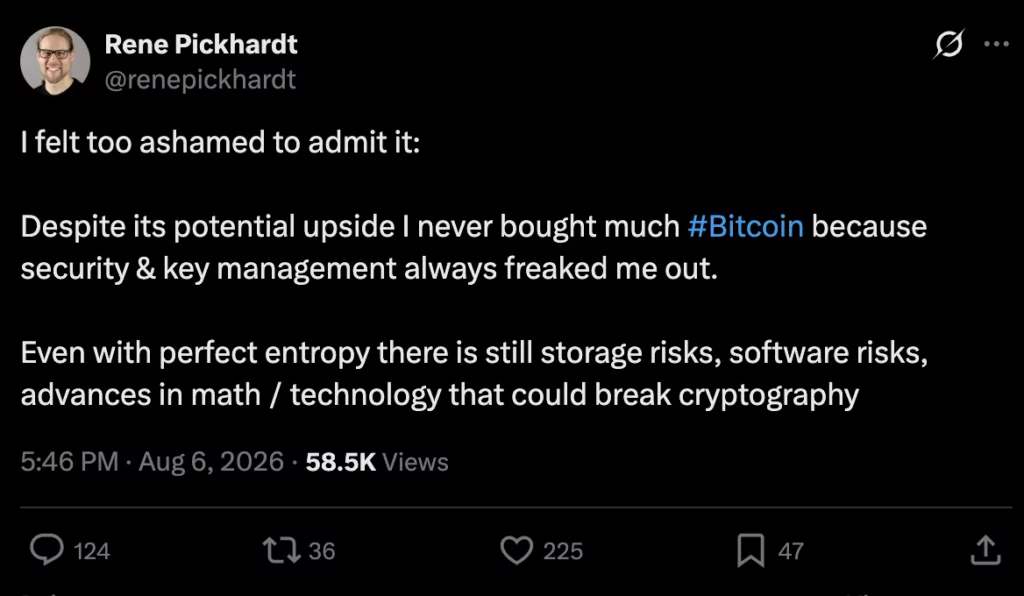
German Bitcoin developer René Pickhardt said on Aug. 6 that fears about self-custody security and key management kept him from accumulating more Bitcoin, despite believing the asset had upside.
Summary
- Bitcoin developer René Pickhardt says self-custody security concerns kept him from accumulating more BTC earlier.
- Coldcard vulnerabilities made some wallet seed phrases predictable, exposing users to remote key recovery attacks.
- Galaxy Research estimates roughly 1,755 BTC was stolen across several waves linked to vulnerable wallets.
- Coinkite says patched firmware cannot repair previously generated weak seeds, requiring users to migrate funds.
- Adam Back argues Bitcoin self-custody remains powerful but requires users to accept greater security responsibility.
In a post, Pickhardt wrote that “security & key management always freaked me out,” framing his decision as a risk-management choice rather than a criticism of Bitcoin.
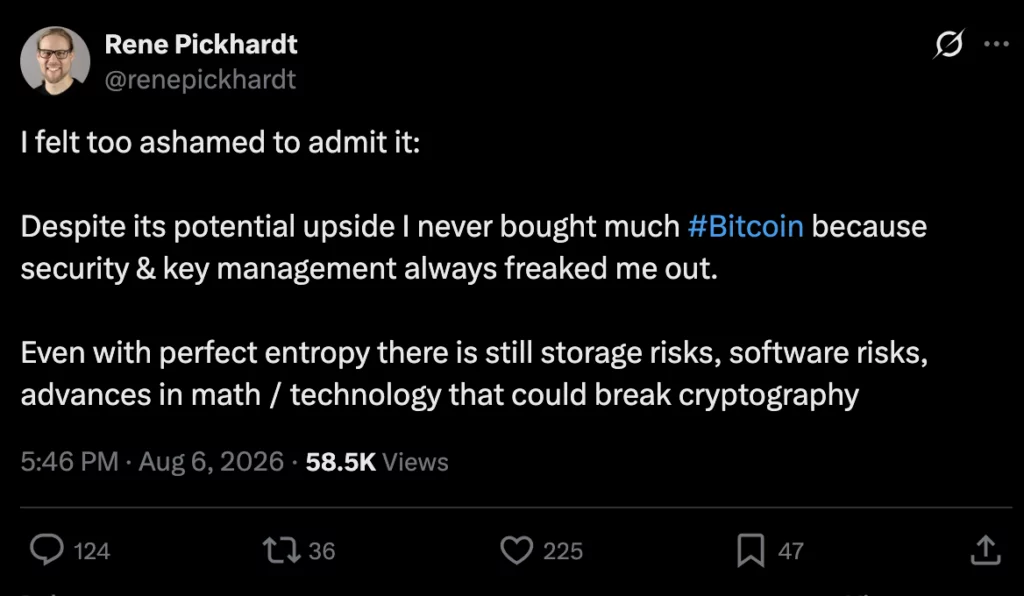
His remarks landed after the Coldcard hardware-wallet incident renewed scrutiny of how self-custody tools generate private keys. Security research linked vulnerable Coldcard firmware to predictable seed generation, while on-chain analysis cited by Galaxy Research estimated roughly 1,755 BTC had been stolen across several attack waves. The loss total remains under investigation.
Coldcard failure puts Bitcoin key generation under scrutiny
The Coldcard issue involved randomness used when generating wallet seeds, not a failure of the Bitcoin protocol. Block’s Bitcoin security researchers found that certain firmware configurations could bypass hardware randomness and fall back to weaker software-generated entropy. That reduced the unpredictability of some seed phrases and potentially allowed attackers to reconstruct private keys without physically possessing the device.
Coinkite acknowledged the firmware problem and released patched software. However, the company warned that installing new firmware does not repair a seed created under vulnerable conditions. Users with affected seeds must generate a new one securely and move funds on-chain. Reports citing Galaxy Research put one July 30 theft wave above 1,000 BTC, with subsequent attacks lifting estimated losses.
The episode illustrates the distinction explained in our self-custody guide: controlling private keys removes exchange counterparty risk, but transfers responsibility for key generation, backup and recovery to the owner. Hardware wallets reduce online attack surfaces, yet depend on firmware, hardware design and secure randomness.
Pickhardt says security concerns outweighed Bitcoin upside
Pickhardt has worked extensively on Lightning Network routing and payment reliability, and Bitcoin Optech identifies him as a Lightning developer and researcher with OpenSats. His 2026 paper includes a mathematical framework for payment-channel networks focused on liquidity and off-chain throughput.
Against that background, his admission drew attention because technical familiarity did not eliminate his custody concerns. Pickhardt said even correctly generated private keys face risks involving storage, implementation mistakes and future advances in computing. Those concerns do not mean properly implemented self-custody is inherently unsafe; they describe the operational burden individual holders accept.
Blockstream CEO Adam Back responded that “with great bearer cash power comes great responsibility to not lose your keys.” The response captures the trade-off: Bitcoin allows holders to control assets without a bank, but no central institution can reset a lost private key or reverse an unauthorized valid transaction.
Coldcard losses sharpen the self-custody debate
Recent wallet security incidents give that debate context. Cinco Días, citing Galaxy Research, reported that roughly 1,755 BTC had been stolen from about 5,000 wallets across several waves. Earlier Galaxy estimates were lower, and Coinkite has said the full attribution and scope remain unresolved, so the figure should be treated as an evolving on-chain estimate rather than a final confirmed loss.
The failure also does not show that every hardware wallet faces the same flaw. Block said its products were unaffected, while other manufacturers have separately explained their entropy-generation designs. The vulnerability followed affected seed phrases even if users imported them into another wallet, meaning changing hardware without creating new keys would not remove the underlying exposure.
Our seed phrase security guide explains why the recovery phrase is effectively the master key to a wallet. If generation is weak, offline storage cannot restore the missing entropy afterward. The Coldcard case therefore shifts attention from simply hiding a seed toward verifying how securely it was created.
What Bitcoin holders should watch next
Coinkite’s investigation, blockchain tracing and any law-enforcement findings will determine the final scale of the Coldcard losses. Users who created seeds on affected firmware should follow the manufacturer’s remediation guidance rather than assume a firmware update alone fixes an existing wallet.
For the broader Bitcoin market, Pickhardt’s comments are anecdotal and do not establish that self-custody fears are suppressing adoption. Still, the episode shows why usability and security remain linked. As hardware wallets become easier to buy, manufacturers face pressure to make key management both verifiable and understandable.
Pickhardt’s decision shows that conviction in Bitcoin’s monetary thesis does not automatically translate into comfort with bearer-asset security. Self-custody removes one class of intermediary risk while creating another set of responsibilities. The Coldcard failure has made that trade-off harder to dismiss, especially for holders deciding whether direct ownership outweighs the operational burden of securing keys themselves.


Rodolfo Novak (NVK), co-founder of Coldcard maker Coinkite, is deleting posts from his social media. Some people think Coinkite has also deleted recently content from its website.
The apparent elimination of these historical artifacts is concerning amid the ongoing theft of BTC from Coldcard customers.
For over five years, Coldcard hardware wallets generated private keys for customers with insufficient entropy. Since hackers discovered and began exploiting that vulnerability last week, they’ve drained over $130 million from victims.
The thefts continue as they crack insecure private keys using brute force computation.
For whatever reason, NVK has decided to remove certain pieces of content that he published over those five years.
Take, for example, in November 2024, when NVK wrote that a knockoff of his company’s Blockclock might be “a back door into peoples home network.” That post now resolves to an X error page. It went dark this week.
Bitcoin developer Peter Todd caught that deletion. On August 5, Todd posted the screenshot of the original post. “Deleted recently enough it seems it was still in my phone’s cache,” Todd explained.
Read more: What to do if you’re a Coldcard victim
NVK deletes posts about Coinkite, Coldcard
An archiving expedition is underway and a volunteer archive at nvk.wtf/receipts (Protos does not endorse nor recommend visiting unfamiliar websites) claims to be preserving evidence.
Coinkite critic Greg Tonoski alleged the company is deleting content from its website. “‘Unnamed v.4.0.0 security issue’ was deleted from the [coinkite.com/historical-disclosures] a few hours ago (see archived screenshot),” he wrote.
Matthew Kratter amplified that alleged deletion, asking, “NVK and Coinkite now deleting evidence from their website?”
That webpage today contains no entry by that “Unnamed v.4.0.0 security issue.” Coldcard also responded to Tonoski’s allegation, so whether the company inappropriately deleted anything is debatable.
Unfortunately, Archive.org’s Wayback Machine never archived that URL.
NVK hasn’t fully wiped, only selectively pruned, his personal timeline. For example, his pinned apology about the Coldcard failure is still up, saying, “I’m sorry and I’m devastated.”
His post about Blockclock knockoffs being a hypothetical backdoor for spyware is the most documented. Alex Waltz wrote, “NVK is deleting tweets as we speak,” while another Coldcard skeptic reposted the screenshot with his opinion: “NVK deleted this today. Every accusation is a confession.”
‘There is no need to panic’
NVK’s early response to the Coldcard bug is also under scrutiny. Hodlonaut posted a screenshot in which NVK claimed there was no need to panic, adding, “NVK deletes old tweets.”
No live copy of that post remains. Nonetheless, NVK tacitly admitted to writing-and-deleting it, conceding it contained “wrong” information that he intended to correct.
Another skeptic claimed NVK deleted a 2019 comment about Judaism. “I’ll post this here since he deleted the comment,” he wrote, attaching the alleged screenshot.
Zach Herbert of Foundation, a direct competitor of Coinkite, noticed an asymmetry. “What’s strange is the posts that arent deleted,” Herbert observed.
“Why hasn’t @DocHex or @switck deleted any posts?” referring to Coinkite’s co-founder.
“I originally assumed that Coinkite was under some kind of litigation hold,” Herbert continued, “but if that was so then NVK wouldn’t be deleting tweets.”
“NVK is currently deleting old posts from 2020 to try to clean up the history,” he broadcasted. “Screenshot them while you can. They will all be gone soon.”
Painfully, a celebratory post from Coldcard in October 2021 has survived with no deletion. “Coldcard makes retirement attacks impossible,” it declared incorrectly.
A follower asked it to define a retirement attack. Coldcard obliged, “It’s when the project makers could have a ‘bug’ in the entropy generation for later retrieval.”
Got a tip? Send us an email securely via Protos Leaks. For more informed news and investigations, follow us on X, Bluesky, and Google News, or subscribe to our YouTube channel.


The U.S. labor market showed weakness for the second consecutive month in July, possibly giving the Federal Reserve room to hold rates in place despite high inflation.
According to the government’s Nonfarm Payrolls Report released Friday morning, the U.S. lost 23,000 jobs last month. That was far below the consensus expectation of a gain of 80,000 jobs, and down from June’s add of 20,000 (revised down from an originally reported 57,000).
The last negative jobs print was in February, when the U.S. lost 156,000 jobs.
The unemployment rate dipped to 4.1%, compared with the expected 4.2% and June’s 4.2%.
Market reaction is swift, with U.S. stock index futures gaining and interest rates dipping. There’s little action in crypto, with bitcoin remaining modestly higher on the session at $65,000.
Ahead of this morning’s data, markets were split on whether the Fed would hike rates at its next policy meeting in September. According to CME FedWatch, interest rate traders were pricing in a 55% chance the U.S. central bank would tighten next month. In the immediate aftermath of the print, that number has slipped back to 46%.


Cointelegraph is committed to providing independent, high-quality journalism across the crypto, blockchain, AI, and fintech industries.
All news, reviews, and analyses are produced with full journalistic independence and integrity. For more details on our standards and processes, please read our Editorial Policy.

US lawmakers have pushed back a vote on major crypto market-structure legislation, extending a period of regulatory uncertainty for institutions that need clearer rules on trading, custody, and oversight. The delay, confirmed by U.S. Senator John Thune’s office to Cointelegraph, means the bill will not be considered before the August recess, with Thune’s team describing it as a priority for September.
Industry leaders say the postponement could reshape competitive dynamics outside the United States. First Digital founder and CEO Vincent Chok, whose firm issues the FDUSD stablecoin, argued that jurisdictions with clearer frameworks—particularly in Asia—could use the additional time to attract capital and talent as US uncertainty weighs on institutional adoption.
Key takeaways
- Senator John Thune’s office confirmed the US Senate will not vote on the crypto market-structure legislation before the August recess, pointing to September as the next window.
- First Digital CEO Vincent Chok said prolonged regulatory uncertainty is harder for markets to adapt to than slower timelines.
- 1inch’s deputy general counsel warned that a failure to enact the legislation could lead back to “regulation by enforcement,” leaving firms reliant on agency interpretations and case-by-case action.
- The EU’s Markets in Crypto-Assets Regulation (MiCA) is already in force, creating a contrasting regulatory timeline compared with the US.
- Some commentators interpret the delay as a political outcome that may further incentivize development “offshore” while US rules remain unsettled.
Senate delay extends uncertainty for institutional crypto
According to confirmation from Thune’s office to Cointelegraph, the Senate will not bring the bill to a vote before the August recess. Thune reportedly cited Democratic opposition, and said the legislation would be a priority when senators return in September.
While a delayed vote can be normal in legislative calendars, Chok’s concern was specific: for market participants, the most damaging factor is not simply a slower process but extended ambiguity. In a statement shared with Cointelegraph, he said that “markets can adapt to slower timelines,” but “what they struggle with is prolonged uncertainty.”
Chok tied the issue directly to institutional readiness. Without clear market-structure rules, he argued, institutions are left without dependable guidance on topics that are central to mainstream adoption—especially market design, custody practices, and regulatory oversight.
“Regulation by enforcement” risk and fragmented rules in the US
Maylea Ma, deputy general counsel at decentralized exchange aggregator 1inch, emphasized what changes if Congress does not pass the legislation. In her view, the industry could move toward a familiar pattern: “regulation by enforcement.”
Ma said that in such a scenario, firms would remain dependent on how regulators interpret rules and enforce them on a case-by-case basis. She also pointed to a fragmented US landscape, where companies may have to navigate overlapping state-level money transmitter requirements alongside securities-law interpretations that can vary by jurisdiction and enforcement posture.
That uncertainty is particularly consequential for institutional participants, which generally require more predictable compliance expectations before scaling operations, offering services, or integrating crypto infrastructure into broader financial workflows.
Asia’s window to demonstrate “clear regulation and innovation” together
Chok suggested the delay could strengthen the relative attractiveness of global hubs that have already pursued clearer regulatory positioning. He said that for Asia, postponement provides additional time for hubs such as Hong Kong and Singapore to show that regulatory clarity can coexist with continued innovation.
His underlying thesis is that capital allocation and talent decisions often respond quickly to regulatory risk. When US timelines are uncertain, institutions looking for stability may favor venues where rulemaking appears more settled—even if US legislation eventually arrives.
In that sense, the Senate’s procedural shift may have strategic consequences beyond the US market itself. The longer the pause continues, the more companies may build or expand operations in jurisdictions perceived to offer a smoother compliance path.
EU MiCA already in force, highlighting a widening timeline gap
Ma contrasted the US situation with Europe, pointing out that the European Union’s MiCA framework is already operational. She noted that MiCA is “already in force,” referencing Cointelegraph’s earlier coverage on the end of a grace period and the issuance of relevant licenses.
Under that backdrop, Ma said 1inch would continue operating with a conservative, non-custodial approach that focuses on self-custody. The key point is not that MiCA removes all complexity, but that it provides a structured regulatory timeline that companies can plan around—while the US remains tied to legislative and enforcement uncertainty.
For readers, the practical implication is that compliance planning may increasingly look “regional.” Businesses could find that their roadmaps are governed less by global principles and more by where regulatory frameworks are already active.
Political framing: ambiguity as a driver of offshore innovation
Not all reactions were confined to legal mechanics. Wellington-Altus chief market strategist James E. Thorne offered a more politically pointed interpretation, posting on X that he viewed the postponement as a “fold” by Thune and a victory for Senator Elizabeth Warren and the regulatory status quo. His argument was that continued ambiguity encourages innovation to move offshore while other jurisdictions develop clearer regimes.
While Thorne’s remarks are political rather than technical, they align with a broader market reality: regulatory uncertainty can influence where teams incorporate, where products launch, and which markets institutions consider first—especially when compliance staff need more than verbal assurances to manage risk.
As the Senate returns in September, the key question for the crypto sector is whether the legislation can clear remaining procedural hurdles—or whether the industry is pushed further into a cycle of enforcement-driven precedent. Either outcome will likely determine how quickly institutions feel comfortable moving from experimentation to scaled adoption, and it may continue shaping where global crypto activity concentrates.

Bitcoin derivatives trading is taking a noticeably larger share of activity on Binance, according to fresh analytics that highlight how spot interest has cooled while futures usage keeps building. On CryptoQuant’s data, the futures-to-spot trading volume ratio on the exchange has reached an all-time high of 7.82, meaning futures volume is now nearly eight times spot volume.
This shift matters for market structure: when spot volumes lag derivatives, price discovery can become more reflexive—driven more by leverage and hedging than by new spot inflows. With Bitcoin holding a narrow band for weeks, traders are increasingly expressing their expectations through options positioning, including bets that any eventual range break could lean downward.
Key takeaways
- Binance futures volumes outpace spot at a record pace: CryptoQuant reports a futures-to-spot ratio of 7.82.
- Spot demand has been deteriorating more consistently: CryptoQuant data shows a steadier decline since June compared with derivatives demand.
- Short-term positioning is increasingly “hedge-forward”: options traders appear to be managing downside risk for September.
- Trading range behavior persists: Bitfinex Research says volumes thin near the range extremes, suggesting neither side is forcing a breakout.
Binance’s spot-versus-futures gap widens to a new peak
CryptoQuant’s “quick take” analysis, published Friday, focuses on Binance’s daily trading volume split between spot and derivatives. The headline metric is the futures-to-spot volume ratio, which has climbed to 7.82—the highest reading CryptoQuant reports for this measure.
In the same snapshot, daily futures volume on Binance is listed at $57.82 billion for the week cited, versus $6.08 billion in daily spot volume. The imbalance indicates that a greater share of trading activity is happening in leveraged or risk-managed instruments rather than outright spot buying.
CryptoQuant contributing analyst Arab Chain linked the trend to persistent differences in how participants use markets, noting that Bitcoin was trading around $64,000 while futures activity continued to expand faster than spot. In his view, the change reflects more investors and traders leaning on futures for leverage, risk management, and shorter-term trading tactics.
For traders and investors, this is more than a curiosity about exchange usage. When spot volumes don’t keep pace, it can signal that the marginal buyer is weaker—so price moves may depend increasingly on derivatives positioning, liquidations, and hedging dynamics rather than broad spot accumulation.
Cooling spot appetite as Bitcoin stays rangebound
CryptoQuant frames the latest ratio spike as coming after months of retreating demand, particularly from retail segments. The report also points to a broader observation made earlier in coverage by Cointelegraph: retail attention has been shifting toward AI-linked equities following broader stock-market dislocations. While that comparison is outside Binance itself, it underscores a theme CryptoQuant emphasizes—spot interest has been less consistent during the current phase.
Looking specifically at demand trends, CryptoQuant states that on a rolling 30-day basis, both spot and derivatives demand are deteriorating. However, it says spot shows a more consistent decline since June, while futures has remained net positive.
Technically and behaviorally, the report ties this to the market’s two-month range above $60,000. Prolonged consolidation often dampens spot urgency because the incentive to buy increases when there’s a clearer directional move. CryptoQuant also references a period in February when Bitcoin first dropped to the $60,000 level and traders recorded a sharp spike in realized losses on-chain. Subsequent attempts to revisit that area have allegedly seen lower volumes, as both buyers and sellers appear to have exhausted enthusiasm.
CryptoQuant CEO Ki Young Ju previously summarized the divergence on X, stating that Bitcoin spot demand is weakening while futures demand remains net positive—but at a level lower than during the rebound about three months earlier.
Options traders lean toward a downside resolution in September
As spot participation stays muted and futures dominate activity, market participants have been expressing expectations through derivatives beyond outright leverage—especially options. Bitfinex Research, citing its own exchange analytics and referencing Glassnode, highlighted how volume has been losing intensity on both spot and derivatives.
Bitfinex Research wrote that for the moment, activity is clustering near the middle of Bitcoin’s local range, while it thin[s] out near the extremes. It also pointed to taker volume as a sign that neither side is aggressively pushing to force a breakout in either direction.
According to Bitfinex, options positioning suggests traders expect rangebound behavior to continue through August, after BTC/USD gained 7.4% in July. The more notable shift is its outlook for September: Bitfinex said options traders are effectively pricing a likely downside resolution of the range, aligning with what it described as “familiar Bitcoin bear-market behavioral patterns.”
In other words, the derivatives market is not only doing more volume—it is also using structured contracts to hedge and to reflect a preference for a particular path of volatility. That’s consistent with the idea that when spot interest fades, traders may rely more on options to manage downside scenarios during uncertain consolidation.
What the widening ratio and hedging signals could mean next
Taken together, the Binance volume split and the options posture point to a market that is still deciding how it wants to trend—without clear spot-driven conviction. A futures-to-spot ratio near 8x can indicate that traders are increasingly comfortable operating in derivatives, but it can also raise the stakes for how quickly leverage unwinds if the range finally breaks.
For readers watching the next phase, the key question is whether spot demand can reassert itself if price attempts a move—or whether market action continues to be dominated by hedging and leverage as September approaches. The persistence (or reversal) of the futures-to-spot imbalance, alongside whether options positioning continues to favor downside, will likely be the clearest tells.

[PRESS RELEASE – Kwai Chung, Hong Kong, August 7th, 2026]
CoinMarketCap has expanded its Pro API with a new suite of seven real-world asset (RWA) endpoints, giving developers a single programmatic source for data on tokenized versions of traditional financial instruments. The RWA endpoints cover tokenized equities, commodities, currencies, government securities, exchange-traded funds (ETFs), and real estate. They are available now.
The RWA endpoints resolve each asset through a stable identifier and span the full data lifecycle. An ID map and a metadata endpoint return descriptive and company information. Asset-list and quotes endpoints return aggregate tokenized price, market capitalization, and 24-hour volume. Market-pairs and issuer endpoints expose the underlying on-chain tokens, as well as the markets they trade on and the issuers behind them. Core endpoints are accessible on CoinMarketCap’s free Basic plan and above.
The RWA API launch coincided with a notable market moment. When SpaceX completed its public listing, CoinMarketCap published an RWA developer guide. The guide showed how to retrieve data on the company’s tokenized stock through the same endpoints, connecting a major traditional-finance event to on-chain data in one workflow.
The RWA endpoints expand an already broad API offering. Through a single integration and credit system, the CoinMarketCap Pro API delivers real-time and historical crypto prices, along with centralized exchange, decentralized exchange (DEX), derivatives, and liquidation data. It also provides proprietary indexes, including the CoinMarketCap Fear & Greed Index and CMC20, as well as real-time WebSocket streaming. The platform offers agent-native access through a hosted MCP server and pay-per-call x402 support, as well as a Keyless Public API that lets developers call a curated set of endpoints without an account or API key.
“Developers should not have to stitch together a dozen providers to build a serious crypto product,” said Rush, CEO of CoinMarketCap. “By bringing tokenized real-world assets into the same API that already covers spot, derivatives, DEX, and our own market indices, we give builders one dependable source of truth. Our goal is simple: to be the first and last data API a team needs.”
The expansion follows CoinMarketCap’s recent certification under ISO/IEC 27001 and ISO/IEC 27701, independently assessed by BSI, covering information security and privacy management across its platform and API.
ABOUT COINMARKETCAP
CoinMarketCap stands as the Home Of Crypto. With over 1 billion monthly page views and 53 million tracked cryptocurrencies, CoinMarketCap drives the industry forward by organizing and delivering comprehensive crypto intelligence. Major media outlets, including Forbes, Bloomberg, CNBC, and The Wall Street Journal, rely on CoinMarketCap as their primary source for crypto data.
The post CoinMarketCap Expands Its Pro API With Real-World Asset Data Endpoints appeared first on CryptoPotato.
“Only Congress can ensure that regulation in this area is future-proofed through comprehensive market structure legislation,” he said.
The pending SEC moves would follow a spate of guidance from both the SEC and CFTC that has clarified how U.S. crypto efforts can proceed without running afoul of the regulators, whether it’s mining, memecoins, rewards or several other categories. The most important of these regulatory statements emerging from the agencies was the “taxonomy” that sought to carefully define how the regulators would categorize different digital assets, and how those assets would be supervised.
Fed & Co.
Meanwhile, the banking regulators have been rapidly granting charters to crypto firms, and the Federal Reserve has been working on a tailored access to its payments rails and other services to cut out the banking go-betweens the digital assets players have relied on to serve customers. The new bank charters will have some durability, even when the Office of the Comptroller of the Currency that issues them changes management down the road.
As the Treasury Department and its tax branch, the IRS, also implement crypto-specific policies, the momentum of U.S. regulation becomes increasingly difficult to reverse.
The industry already counted a massive win last year in the passage of the Guiding and Establishing National Innovation for U.S. Stablecoins Act (GENIUS) Act. From a dicey 2022 in which crypto crashed and its highest-profile advocate was prosecuted for fraud, the sector turned things around in Washington to get a law governing U.S. stablecoin issuers and — for the first time — officially adding crypto to the regulated financial system.
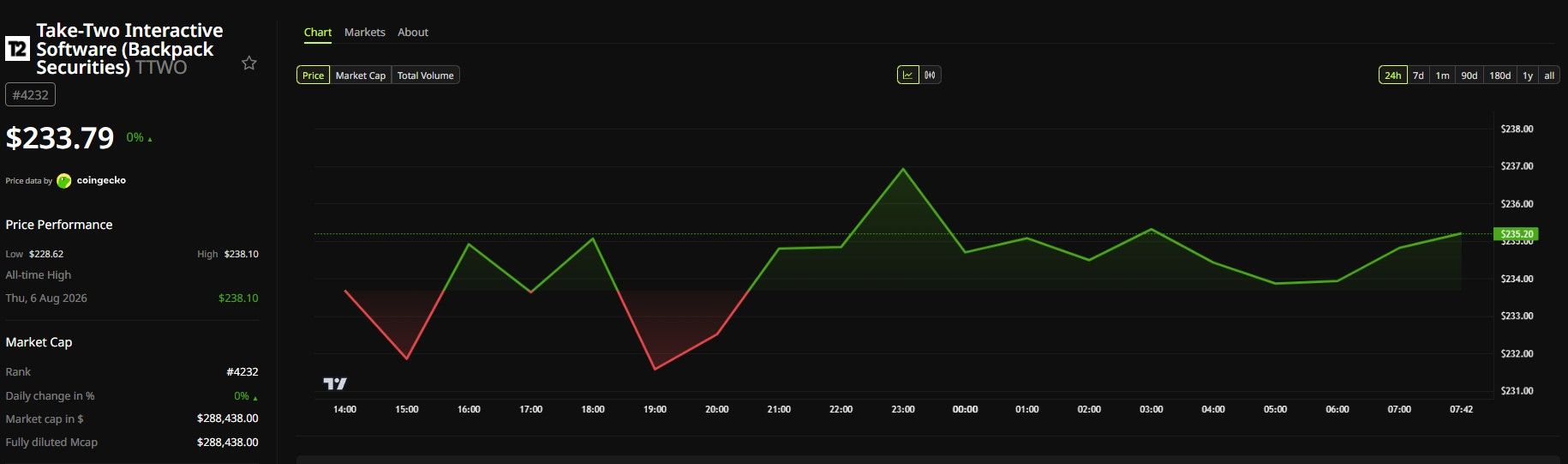
A tokenized version of Grand Theft Auto VI (GTA 6) publisher Take-Two Interactive Software’s (TTWO) stock has launched on Solana through Backpack Securities. Holders can now trade the company’s equity straight from a compatible crypto wallet.
The listing arrives as Netflix readies an exclusive extended look at GTA 6. The special airs August 27. It lands ahead of the game’s November 19 launch on PlayStation 5 and Xbox Series X|S.
How the TTWO Tokenized Stock Trades on Solana
Backpack Securities is the tokenization arm of the Solana-based exchange Backpack. It minted the wrapped TTWO shares and listed them across several venues.
Backpack frames the tokens as direct equity claims rather than synthetic price trackers. Each one represents a 1:1 redeemable stake in TTWO shares held through a dedicated custody vehicle, not a derivative contract that only mirrors the stock’s price.
“Unlike synthetic alternatives, Backpack investors hold full ownership of the traded U.S. equities, backed by the depth of traditional exchange liquidity,” Backpack CEO Armani Ferrante, via GlobeNewswire
The tokens still settle instantly and trade outside Nasdaq’s normal hours, unlike the underlying stock itself.
The wrapped stock last changed hands at $233.79, according to live BeInCrypto data. That price held flat over the past 24 hours. Market capitalization stands near $288,438, and the token touched an all-time high of $238.10 on August 6.
This listing follows a broader push to move equities onchain. Backpack tokenized SpaceX shares in June. Robinhood Chain, meanwhile, leads rival platforms in tokenized stock holders, even though meme coins still dominate its trading volume.

GTA 6 Hype Builds Around the Netflix Reveal
Netflix confirmed the GTA 6 special through its Tudum editorial hub. The premiere runs on Netflix first, at 3 p.m. ET on August 27, before Rockstar Games posts it to YouTube and the official GTA VI site six hours later.
Rockstar has not detailed the extended look’s exact contents, though it has billed the special as more than a standard trailer. The story itself follows two protagonists, Jason and Lucia, across the fictional state of Leonida after a heist collapses.
Anticipation for the game has been building for months. Take-Two’s July filing confirmed the release date and projected over a billion dollars in fiscal 2027 cash flow. Rising chip costs have also pushed console prices higher across the industry, adding pressure just as GTA 6 nears launch.
Wall Street analysts remain bullish on the underlying stock regardless. Twenty-nine analysts tracked by S&P Global hold a Strong Buy rating on TTWO. Their consensus price target sits at $284.14, according to stockanalysis.com, with individual targets ranging from $170 to $368.
Investors can track the current TTWO price on BeInCrypto’s Markets page as the Netflix premiere nears. The coming weeks will show whether the tokenized shares can keep pace with Wall Street’s optimism heading into the GTA 6 launch.
The post GTA 6 Creator’s Stock Hits Solana as Netflix Special Approaches appeared first on BeInCrypto.

Madonna And All Saints Producer William Orbit Has Died, Aged 69

Man arrested on suspicion of attempted murder after stabbing in Pelton

Co Down harbour board gains no political party nominations amid bad odour concerns


-

 Fashion7 days ago
Weekend Open Thread: Wit & Wisdom
-

 Politics7 days ago
Meta enters AI-training agreement with far-right ‘propaganda rag’ Newsmax
-

 Politics5 days ago
Zack Polanski: an incitement to murder Nigel Farage?
-

 Crypto World6 days ago
MicroStrategy Post-Earnings CLARITY Act Push Could Add New Catalyst for Its Stock
-

 Crypto World6 days ago
XRP Ledger v3.3.0 brings five institutional features
-

 Crypto World7 days ago
New York sues Kalshi over prediction market gambling
-

 Crypto World5 days ago
Crypto PAC spending tops $2M in Michigan House race
-

 Business7 days ago
Trump Announces Hamas Disarmament Agreement as Iran Strikes Kuwait Air Base and US Attacks Pause Overnight
-

 Business4 days ago
DTCR: Deleveraging And A Hedge Fund Collapse Point To A Possible AI Bottom
-

 Tech5 days ago
ESET tracks rise in malicious AI skills and adaptable malware
-
 Crypto World7 days ago
3 Fed Officials Just Explained Their Rate Hike Vote: Is Inflation Winning?
-

 Sports6 days ago
France Cricket implodes: letters hidden in a drawer and a board at war
-
Crypto World5 days ago
XRP Ledger urges node upgrade after manifest flood
-

 Crypto World6 days ago
Moneyflip CEO charged in $40K murder-for-hire plot
-
 Sports7 days ago
Bruno Fernandes decision made as Man United ‘discuss’ striker transfer option
-
Business7 days ago
FIFA has scrapped $20 billion World Cup sell-off plan, New York Post reports
-

 News Videos6 days ago
Financial Crash Expert: The 90-Day Collapse Timeline They Are Desperately Hiding.
-

 Sports1 day ago
Jordan Coyle & Cordiamo take Laya Arena Stakes at RDS
-

 Sports7 days ago
Commonwealth Games 2026 Live Updates | Day 9 CWG 2026: Lovlina Borgohain, Sachin Siwach Enter Final After Indian Judokas Script History
-
 Crypto World4 days ago
US Tech Stocks See Largest 5-Week Inflow in History: Can Nasdaq Break Its Downtrend?
You must be logged in to post a comment Login