
Crypto World
Crypto Kid Interviews Binance Founder CZ on Financial Freedom and Bitcoin’s Future


At just 18 years old, Efe Kelemci, better known as Crypto Kid, sat down with Changpeng Zhao (CZ), the co-founder of Binance and one of the world’s richest men.
The rare conversation took place around the launch of CZ’s book, Freedom of Money, but quickly expanded into a broader discussion about how the financial system works, the limitations of traditional money and the role Bitcoin and blockchain could play in giving individuals greater control over their wealth.
Rather than concentrating entirely on Bitcoin’s price or the next cryptocurrency market cycle, Crypto Kid asks CZ to explain the principles behind financial freedom in a way that can be understood by younger people and readers who may not yet be familiar with digital assets.
The result is a brief but substantive interview between Crypto Kid and CZ covering monetary sovereignty, inflation, cryptocurrency adoption and the importance of understanding the financial system before approaching crypto purely as an investment.
A Young Perspective on Money and Financial Freedom
Crypto Kid approaches the conversation from the perspective of a generation that has grown up alongside Bitcoin and digital assets.
At the beginning of the interview, he explains just how early his interest in the industry began:
“I’ve been in crypto since I was 12.”
Now 18, his questions reflect many of the concerns younger people have when they begin thinking about money, investing and their financial future.
What does it mean to have genuine control over personal wealth? Why can money held within the traditional financial system lose purchasing power? Should cryptocurrency be viewed primarily as an investment, or does the underlying technology serve a more fundamental purpose?
By placing these questions at the centre of the discussion, Crypto Kid gives CZ an opportunity to explain the ideas behind Freedom of Money to an audience extending beyond experienced cryptocurrency investors.
Why CZ Believes People Misunderstand Money
One of CZ’s strongest arguments is that society rarely encourages people to examine the nature of money itself.
“We’re brainwashed to think about money in a very simplistic way.”
Most people earn money, deposit it into a bank, spend it and invest what remains. Yet comparatively few stop to consider what their bank balance represents, what guarantees their access to it or how monetary policy affects its purchasing power.
CZ challenges the assumption that money held within the traditional system always provides complete ownership. He points to the possibility of frozen accounts, restrictions on certain transactions and the cost and delay involved in transferring significant amounts internationally.
He also describes conventional currency as a form of debt, arguing that what people commonly treat as money ultimately depends on promises made and enforced by institutions.
“Paper money is actually debt.”
The problem becomes even more visible when the supply of that money expands. When additional currency enters circulation, the nominal balance in an account may remain unchanged while its real purchasing power declines.
From CZ’s perspective, this creates a form of financial dependence that many people accept without questioning.
“You don’t have a lot of freedom with your money.”
This is the central problem that Freedom of Money attempts to explore. Financial freedom cannot be measured only by the amount someone possesses. It must also consider the degree of control that person has over storing, protecting and transferring it.
How Crypto Could Give People More Control Over Money
In the interview, CZ does not describe cryptocurrency merely as an asset capable of appreciating in price. He presents it as an alternative monetary infrastructure.
Blockchain enables people to hold digital assets directly, transfer value across borders and interact with a global financial network that does not operate according to all the same limitations as conventional banking systems.
That does not eliminate risk or personal responsibility. It changes where responsibility is placed.
With direct ownership comes the need to understand custody, security and the technology being used. However, it may also give individuals a level of control that is not always available when every transaction depends on an intermediary.
“You want sovereignty. You want control over your money.”
The word sovereignty is crucial here. CZ is not simply describing the ability to make profitable investments. He is describing money that individuals can store themselves, move internationally and use without another party being able to create additional units of it at will.
In that sense, the case for cryptocurrency is not solely financial. It is also technological and philosophical.
“The blockchain increases the freedom of money.”
CZ places this development within a wider historical pattern. Civilisation has repeatedly advanced by expanding different forms of freedom, including freedom of speech, freedom of the press, freedom of information and access to knowledge through the internet.
Blockchain, in his view, represents another step in that progression by expanding the freedom associated with owning and transferring value.
Financial Freedom Is Not the Same as Getting Rich Quickly
Crypto Kid then raises a question that reflects how many newcomers first approach the industry.
“How do I get rich quick?”
It is a simple question, but it exposes one of the biggest contradictions in cryptocurrency.
Bitcoin was created as an alternative to a monetary system based on centralised control. Yet many people enter the market with the sole objective of accumulating more of the same fiat currency from which Bitcoin was designed to provide an alternative.
CZ’s response redirects the discussion away from rapid gains.
“The freedom is really the key.”
Someone may generate a large profit and still remain dependent on a system capable of restricting access, expanding the money supply or reducing the value of their savings.
From this perspective, wealth without sovereignty is incomplete. The real objective is not simply to increase the number displayed in an account, but to gain greater control over what that value represents and how it can be used.
CZ argues that when people focus exclusively on maximising their holdings in traditional currency, they remain trapped within the same framework they claim to be escaping.
The conversation therefore reframes financial freedom. It is not a winning trade, an early retirement target or a particular Bitcoin price. It is the ability to make informed decisions about money while reducing dependence on systems over which the individual has little influence.
CZ’s Advice to Young People: Understand the Financial System First
The interview becomes especially relevant when Crypto Kid asks what younger people should do when entering the industry.
Cryptocurrency content aimed at new investors often concentrates on charts, tokens and opportunities to generate rapid returns. CZ gives almost the opposite advice.
Speaking about highly speculative trading, he says:
“I would actually recommend youngsters not to try that.”
Instead of beginning with price speculation, CZ encourages young people to learn how money and blockchain technology work, experiment on a small scale and explore the problems the technology could solve.
He points towards practical applications such as micropayments, international transfers and payments performed by artificial intelligence agents.
“Look at more of the utility value of crypto.”
This distinction between utility and speculation may be one of the most valuable lessons in the interview.
Trading asks what an asset might be worth tomorrow. Building asks what the technology could make possible over the next decade.
For young people entering the space, the second question may create far more meaningful opportunities. The cryptocurrency industry still needs developers, entrepreneurs, educators, researchers, product designers and creators capable of turning blockchain infrastructure into applications that ordinary people can use.
CZ compares the present stage of crypto development to the earlier days of the internet, when the basic protocols existed but many of the products that would eventually transform everyday life had not yet been created.
His message is not that young people must ignore cryptocurrency markets entirely. It is that they should first develop a strong understanding of the financial system, the technology and its possible uses, so that price is no longer their only reason to participate.
Bitcoin’s Price May Be Disappointing, but Adoption Is Still Early
Towards the end of the conversation, Crypto Kid asks CZ about Bitcoin’s recent price performance and the frustration felt by investors who expected the market to move higher.
CZ acknowledges that he shared those expectations. He had also believed Bitcoin would be trading at a higher level.
However, he notes that a significant amount of speculative capital moved towards artificial intelligence. While this may have weakened crypto momentum in the short term, he suggests that it could ultimately allow the market to grow on more stable foundations.
The more important point is that CZ does not measure Bitcoin’s future solely through its latest market cycle.
“Less than 1% of the world” currently uses cryptocurrency.
Whatever the precise figure, his broader point is clear: CZ believes the industry remains far from mass adoption.
Billions of people still do not directly own cryptocurrency, use blockchain-based payments or interact with decentralised financial infrastructure. Many businesses and institutions are also only beginning to explore how digital assets could fit into their operations.
From that perspective, Bitcoin’s present price becomes one data point inside a much larger adoption story.
The long-term opportunity depends less on whether the market reaches a particular target this year and more on whether blockchain technology becomes genuinely useful to a wider section of the global population.
The Story Behind Freedom of Money
The interview also briefly addresses the personal circumstances surrounding the creation of CZ’s book.
CZ explains that he began writing its first draft while in prison, where the lack of distractions gave him time to reflect on his journey and the evolution of the cryptocurrency industry.
The conversation does not remain focused on that period. Instead, it uses the experience as context for understanding why the themes of freedom, uncertainty and personal control became central to the book.
CZ later spent considerable time revising and completing the manuscript. The finished work combines his personal experience with his perspective on how cryptocurrency has developed since he entered the industry in 2013.
For readers, the book provides CZ’s personal account of a period that took Bitcoin from a relatively small technological experiment to a globally recognised financial asset and infrastructure layer.
Financial Freedom Begins With Better Questions
The strongest message from the conversation is not that people should buy cryptocurrency immediately or expect Bitcoin to make them rich.
It is that they should understand the money they already use.
Who controls it? What can reduce its value? Under what circumstances can access to it be limited? How easily can it move across borders? And which alternatives now exist?
Blockchain does not automatically answer every financial problem. It does, however, introduce new choices around custody, scarcity, payments and ownership.
For CZ, those choices are the foundation of monetary freedom. For Crypto Kid and the younger generation he represents, the opportunity is to understand that technology early enough to help shape what comes next.
The conversation ultimately encourages viewers to replace the question “How quickly can crypto make me rich?” with a more important one:
How much freedom do I really have over my money?
Watch the Full Interview
Watch Crypto Kid’s complete interview with Binance co-founder CZ on YouTube.
Follow Crypto Kid
Learn more about Efe Kelemci and his work through the official Crypto Kid website. You can also follow Crypto Kid on X, Instagram and LinkedIn.
Follow CZ
Follow Changpeng Zhao on X for his latest perspectives on Bitcoin, cryptocurrency adoption, entrepreneurship and the future of finance.


Twilio (TWLO) stock jumped Friday after the communications software maker reported second-quarter earnings and revenue that topped consensus estimates as a new voice-based artificial intelligence product gained traction. The company’s September quarter sales outlook came in above expectations. The San Francisco-based company reported earnings after the market close on Thursday. Twilio EPS rose 24% to $1.47 for the June quarter…
Copyright ©2026 Investor’s Business Daily, LLC. All rights reserved. 87990cbe856818d5eddac44c7b1cdeb8

Nvidia (NVDA) is set to report second-quarter earnings on Aug. 26 after the market close, and the options market is pricing in an 8.8% move in either direction. The tech heavyweight’s stock has a solid recent history of strong performance following earnings reports. Let’s look at selling a cash-secured put to take advantage of the high implied volatility around the…
Copyright ©2026 Investor’s Business Daily, LLC. All rights reserved. 87990cbe856818d5eddac44c7b1cdeb8

Recent initial public offering Loar (LOAR) is the IPO Stock Of The Week as it offers a new buy point and attempts support at a key level. The defense stock also sits on Investor’s Business Daily’s IPO Leaders screen. Loar manufactures components for military and aerospace platforms. It supplies such defense giants such as Boeing (BA), Airbus (EADSY) and Lockheed…
Copyright ©2026 Investor’s Business Daily, LLC. All rights reserved. 87990cbe856818d5eddac44c7b1cdeb8

XRPL has released version 3.3.0, which takes another step toward becoming infrastructure for institutional tokenization.
It introduces several proposed amendments focused on privacy, payments, and managing real-world assets (RWAs).
Confidential Transfers
Perhaps the most significant new feature is called Confidential Transfer. It’s designed to allow institutions to hide balances and transaction amounts for Multi-Purpose Tokens (MPTs) while keeping the accounts and the asset type involved visible. It uses cryptographic proofs to verify that transactions are valid without publicly revealing the underlying amounts.
According to the GitHub post and previous reports on the matter, this could address an important obstacle for financial institutions, which may want the transparency and settlement benefits of a public blockchain without exposing sensitive position sizes or transaction values.
Data from RWA.xyz shows that roughly $850 million out of the $1.38 billion in RWA distributed on the XRPL is from Ripple’s own stablecoin, RLUSD. This leaves approximately $530 million in other tokenized assets from other big names in the niche, such as Ondo, Archax, Societe Generale, and VERT Capital.
Other Proposals
Aside from Confidential Transfers, the other updates named in version 3.3.0 include Batch, Sponsor, and Permission Delegation. The first amendment would allow up to eight transactions to be grouped together, including an atomic mode in which either all transactions succeed or the entire batch fails. This is expected to benefit complex settlements, swaps, and institutional transactions.
Sponsor is designed to enable one account to cover another user’s transaction fees and reserve requirements. In other words, it could allow companies to onboard customers without requiring them to purchase XRP before interacting with an application.
The last one would enable account holders to grant another party pre-defined transaction permissions without surrendering full control of the wallet. It would align with Dynamic MPT and provide issuers with greater flexibility by allowing certain token characteristics to be modified after issuance.
It’s worth noting that these amendments are not live on the XRP Ledger Mainnet yet, as the governance process requires each to maintain support from at least 80% of trusted validators for two consecutive weeks before activation.
The post Major XRP Ledger Upgrade Targets Institutional Adoption But There’s a Catch appeared first on CryptoPotato.

Donald Trump has warned that China could gain control of the global crypto sector as the US delays major market rules. The president stressed that America must protect its leadership in digital assets while lawmakers struggle with the CLARITY Act. His remarks add pressure on Congress as negotiations continue over regulations, ethics rules, and illicit finance provisions.
Trump Links Crypto Leadership to US National Strategy
Trump has placed cryptocurrency among the technologies that could shape America’s economic position in coming years. He also compared the strategic importance of crypto with artificial intelligence and urged the US to maintain leadership. Meanwhile, his administration continues to promote digital assets as an important part of the American technology sector.
The president warned that China could strengthen its position if the US slows crypto development. He also pointed to growing competition among countries seeking greater influence over emerging digital technologies. Therefore, Trump argued that restrictive policies could weaken America’s position while other nations expand their crypto industries.
Trump has also defended his administration’s approach toward digital asset regulation and innovation. He argued that excessive restrictions could discourage new businesses and push technological activity toward foreign markets. However, lawmakers continue to debate how the US should balance innovation with stronger safeguards across the crypto sector.
Clarity Act Faces Continued Senate Delays
Trump’s comments arrive as the CLARITY Act remains stalled in the US Senate. The market structure bill seeks to establish clearer rules for digital assets and define responsibilities across federal regulators. However, lawmakers have yet to resolve several major disputes surrounding the legislation.
Senate negotiations have focused on ethics requirements, illicit finance measures, and other provisions within the bill. These disagreements have slowed progress and reduced the chances of an immediate floor vote. At the same time, lawmakers continue working on changes that could secure broader support for the legislation.
The delay creates another challenge for Trump’s broader crypto agenda and his push for American leadership. A prolonged legislative process could leave the industry without a comprehensive market structure framework. Meanwhile, competing jurisdictions could use regulatory clarity to attract crypto companies, capital, and blockchain development.
Trump Challenges Ethics Concerns Over Crypto
Trump has also criticized proposals that could restrict his participation in crypto-related businesses while serving as president. The ethics debate has become another issue within the wider negotiations surrounding the CLARITY Act. Lawmakers have considered measures designed to address potential conflicts involving public officials and digital asset interests.
The president has indicated that his businesses remain under his family’s management during his administration. He has also said that he does not discuss government matters with his children. Consequently, Trump maintains that the ethics provisions should not prevent the US from advancing its digital asset sector.
The debate now combines regulatory policy, national competition, and ethics concerns around crypto. Trump continues pushing for US leadership, while Senate lawmakers seek agreement on the CLARITY Act. As negotiations continue, the final legislation could shape how America regulates crypto and competes with China in digital technology.

Bitcoin Improvement Proposal (BIP) 110 has entered its mandatory-signaling window, but miners are signaling support at a fraction of the level needed to credibly move the network to a new consensus regime. According to a BIP-110 monitor, support was present in just 51 of the 2,016 blocks preceding block 961,632—about 2.53%—far below the 55% threshold required for early activation.
As of block 961,632, nodes enforcing BIP-110 started rejecting blocks that do not set version bit 4. Ordinary Bitcoin nodes, however, continued to accept both signaling and non-signaling blocks. A smaller “BIP-110 branch” appears to have emerged, but it quickly fell behind the chain that most miners are extending.
Key takeaways
- Miners signaled BIP-110 support at about 2.53% in the run-up to block 961,632, well under the 55% early-activation requirement.
- Starting at block 961,632, enforcement nodes reject blocks missing version bit 4, while non-enforcing nodes still accept them.
- A minority enforcing branch formed but has not gained sufficient momentum to become the dominant chain.
- BIP-110 aims to impose temporary limits on transaction/script and data sizes to curb non-monetary on-chain bloat, especially inscriptions.
Mandatory signaling begins, but the signal is weak
The core mechanics of BIP-110’s current phase hinge on miner signaling through version bit 4. During the defined mandatory-signaling window—blocks 961,632 through 963,647—nodes enforcing the proposal apply stricter rules: they reject blocks that do not carry the expected signal. The monitor data indicates that support during the prior 2,016-block period was too low for a sustained competitive chain to plausibly form.
Because the dominant chain is still being extended without broad signaling, the long-term viability of any rival branch depends on whether miners materially increase their participation. With limited support, a BIP-110 branch would at best advance slowly and could stall if miners continue extending blocks that enforcement nodes will not accept.
This is why the milestone matters beyond the immediate block height: it tests whether a contentious consensus change can move forward—or meaningfully alter behavior—without broad miner backing. That dynamic also raises the risk of an operational split: enforcing nodes could follow a chain that enforces BIP-110 rules, while the majority chain continues to follow the default rule set.
BIP-110’s proposed restrictions target on-chain data growth
BIP-110 was drafted by pseudonymous developer Dathon Ohm and is designed to introduce additional consensus restrictions intended to last roughly one year. The proposal focuses on constraining how much data different parts of a transaction can carry, including limits on output scripts and specific data-bearing elements.
In broad terms, it would:
- Limit most new output scripts to 34 bytes.
- Cap OP_RETURN outputs at 83 bytes.
- Restrict certain data pushes and witness elements to 256 bytes.
- Temporarily limit several Taproot-related features.
Importantly for users and wallet developers, outputs created before activation would be exempt from the new restrictions. Supporters of BIP-110 argue that these constraints would reduce incentives for inscriptions and other non-monetary data patterns that increase storage and bandwidth demands on node operators.
Criticism centers on network division and rule mismatches
Not everyone agrees that limiting data sizes is the right path. Critics—including Strategy Executive Chairman Michael Saylor and Blockstream CEO Adam Back—have argued that BIP-110 could divide Bitcoin and lead to situations where some nodes reject transactions that are permitted under the network’s existing rules. Earlier coverage from Cointelegraph highlighted their concerns in an article titled “Bitcoin leaders Michael Saylor and Adam Back rebuff BIP-110 proposal.”
The enforcement model during the signaling window heightens that concern. With enforcing nodes refusing non-signaling blocks, the network’s practical behavior can diverge even before a proposal’s restrictions fully take effect. This raises a key question for participants: whether the enforcement boundary will remain a technical footnote or become a persistent source of disagreement over block space usage.
Timing details and a discussed fallback
BIP-110’s deployment schedule defines several important points:
- Block 963,648 marks the beginning of its locked-in state.
- Block 965,664 is when the transaction restrictions would begin to take effect.
The version-bit mechanism is also a centerpiece of the proposal’s strategy. BIP-110 uses version bit 4 for miner signaling, with the mandatory-signaling window already underway. The current miner support level—about 2.53% in the monitor’s measured period—suggests that early activation is not likely to happen without a sharp change in miner behavior.
Separately, BIP-110 proponents have discussed contingencies. On Aug. 1, Bitcoin developer Chris Guida rebased preliminary code for a proof-of-work change originally written by Bitcoin Knots maintainer Luke Dashjr. Guida later described the code as a contingency if miners opposed BIP-110, though he did not set an activation date at the time.
While that fallback discussion does not change the current signaling reality, it underlines the central tension of the moment: supporters want a path to limit certain on-chain data behaviors, while opponents worry about the consequences of contentious rule enforcement in a system that relies on miner consensus and network-wide agreement.
Going forward, readers should watch whether miner signaling meaningfully climbs as the locked-in and effect windows approach. If signaling remains low, the conflict could stay confined to a small enforcing subset; if it rises, the schedule could accelerate a much broader—and more operationally significant—change in what blocks are accepted.

Driscoll acknowledged that he was inspired, in part, by Ukraine’s rapid response to diminished support from its allies, leading to a rapid expansion of missile and drone manufacturing startups.
“If you look at what Ukraine has done so incredibly well, it’s this innovation through necessity, and it’s innovation at the speed that is near or close to matching the commercial sector,” Driscoll said. “So what we, the Army, are trying to do is break down every single barrier that we have put up over the last 20 or 30 years.”
Major aerospace players such as Lockheed Martin and Boeing, as well as arms-makers like General Dynamics, have long been the country’s go-to for defense contracts. But Hegseth’s DoD has more recently strived to increase production by incentivizing smaller companies and startups to build cheap-yet-effective weapons.
For its G-BAM Challenge, the Pentagon said it is seeking long-range precision-strike systems that can be demonstrated within 60 to 90 days and scaled into production within 12 to 18 months. Its website stated that weapons must have a target cost of less than $250,000 apiece at scale.

Bitcoin Improvement Proposal 110 (BIP-110) has entered its mandatory-signaling phase, but miners have sent the required signal in only a small fraction of recent blocks—raising doubts about whether the contentious ruleset can gain enough support to sustain a rival chain.
According to a BIP-110 monitor, at block 961,632 on Saturday miners signaled support in just 51 of the preceding 2,016 blocks, equivalent to 2.53%. That falls well below the 55% threshold the mechanism expects for early activation. While nodes enforcing BIP-110 began rejecting blocks that did not set version bit 4, standard Bitcoin nodes continued accepting both signaling and non-signaling blocks—creating a potential split between enforcing and non-enforcing participants.
Key takeaways
- BIP-110 moved into a mandatory-signaling enforcement window at block 961,632, with enforcing nodes rejecting blocks lacking version bit 4.
- Miners signaled only 2.53% of the time in the preceding 2,016 blocks—far under the 55% level referenced for early activation.
- A BIP-110-compliant minority chain briefly emerged but quickly lagged behind the dominant chain.
- The proposal aims to temporarily restrict on-chain data to reduce storage and bandwidth pressure, but critics warn it could force rule-divergent behavior across the network.
Mandatory signaling begins, but miner participation stays low
The immediate consequence of BIP-110’s start is procedural and practical: once block 961,632 was reached, nodes enforcing the proposal began applying stricter block acceptance criteria. Specifically, they reject blocks that do not set version bit 4 in their block version field.
By contrast, ordinary Bitcoin nodes continued following the existing consensus rules, accepting blocks regardless of whether version bit 4 was set. That difference matters because it turns a signaling experiment into an enforcement stress test—one where participants can end up on different views of “valid” blocks depending on which rules they choose to enforce.
The BIP-110 monitor data also suggests the enforcement did not immediately attract sufficient miner support to sustain momentum. With only 51 signaling blocks out of 2,016 before the window began, proponents would need a significant change in miner behavior to avoid a situation where a BIP-110 branch advances slowly—or stops producing blocks—while the non-enforcing majority chain continues.
What BIP-110 is trying to change on-chain
Written by pseudonymous developer Dathon Ohm, BIP-110 proposes additional consensus restrictions that are intended to last for roughly one year. The proposal is designed to target the way Bitcoin scripts carry data, particularly where large payloads increase the workload for network participants.
In broad terms, BIP-110 would:
- Limit most new output scripts to 34 bytes.
- Cap OP_RETURN outputs at 83 bytes.
- Restrict certain data pushes and witness elements to 256 bytes.
- Temporarily limit several Taproot-related features.
The proposal also includes an exception for legacy outputs: unspent transaction outputs created before activation would not be affected. That detail is important because it reduces the risk of instantly “breaking” already-existing UTXOs, shifting the impact toward new transaction construction after the proposal takes effect.
Supporters have argued that these limits would discourage practices they view as non-monetary—such as inscriptions and other uses that can increase storage and bandwidth costs for node operators. The proposal’s framing is that congestion and resource pressure should be addressed at the consensus level, rather than relying on voluntary policy restrictions.
Why the current phase tests a contentious consensus change
Mandatory-signaling windows are designed to show whether miners are willing to align their blocks with a new ruleset. In this case, the numbers are stark: 2.53% signaling in the monitored window preceding block 961,632 implies that miners are not broadly coordinating around BIP-110.
The result is a practical dilemma for supporters: without a substantially higher share of miner participation, an enforcing chain may struggle to grow. The source notes that a minority branch did appear but quickly fell behind the dominant chain, underscoring how difficult it is to maintain a separate chain when the majority of block production does not follow the same rule signals.
This is also where the proposal’s broader network implications come into focus. If enforcing nodes reject transactions or blocks that non-enforcing nodes accept, a consensus disagreement can emerge—not necessarily as a permanent fork, but as a period in which participants experience different validity rules.
The milestone is therefore less about whether BIP-110 is “right” in principle and more about whether supporters can make a contentious consensus change real without broad miner backing. If that coordination fails, the episode may still be valuable as a signal of how powerfully miner alignment is required for soft-fork style proposals that rely on version-bit signaling and enforcement behavior.
Pushback from major voices and a possible fallback path
The proposal has faced strong criticism from prominent figures in the Bitcoin ecosystem. The article notes that Strategy Executive Chairman Michael Saylor and Blockstream CEO Adam Back argued that BIP-110 could divide Bitcoin and lead nodes to reject transactions that the network’s existing rules would otherwise permit. Earlier coverage on Cointelegraph also highlighted the ongoing dispute around spam and data-heavy usage of block space.
On the technical timeline, BIP-110’s deployment schedule uses version bit 4 and assigns block numbers to key states. The mandatory-signaling window runs from blocks 961,632 through 963,647, during which enforcing nodes reject blocks that do not include the signal. The specification then defines block 963,648 as the beginning of its “locked-in” state and block 965,664 as the point when its transaction restrictions take effect.
The source also points to discussions of a wider contingency. On Aug. 1, Bitcoin developer Chris Guida rebased preliminary code for a proof-of-work change originally written by Bitcoin Knots maintainer Luke Dashjr. Guida described the code as a contingency if miners opposed BIP-110, while stating that no activation date had been set. The details underscore that supporters and builders have considered alternatives if the signaling track does not achieve the needed coordination.
For now, however, the immediate reality is that the signaling signal is weak, and the cost of running enforcement rules without matching miner behavior is that compliant blocks may not keep pace with the chain produced by the majority.
Going forward, investors, traders, and node operators should watch how miner signaling evolves across subsequent windows, whether the enforcing chain continues to lag or disappears entirely, and whether developers continue to refine any contingency approaches if consensus support remains fragmented.


Bitcoin Improvement Proposal 110 entered its mandatory-signaling phase at block 961,632 on Saturday, with miners signaling support in just 51 of the preceding 2,016 blocks, or 2.53%, well below the 55% threshold required for early activation, according to the BIP-110 monitor.
Starting at block 961,632, nodes enforcing BIP-110 began rejecting blocks that did not set version bit 4, while ordinary Bitcoin nodes continued accepting both signaling and non-signaling blocks. A minority BIP-110 branch subsequently emerged, but quickly fell behind the dominant chain.
The low signaling rate makes a sustained rival chain unlikely without substantially greater miner participation. With relatively little mining support, a BIP-110 branch could advance slowly or stop producing blocks altogether.
The milestone tests whether supporters can advance a contentious consensus change without broad miner backing, potentially separating enforcing nodes from the dominant chain and escalating a dispute over how Bitcoin’s block space should be used.
BIP-110 seeks temporary limits on Bitcoin data
Written by pseudonymous developer Dathon Ohm, BIP-110 proposes additional consensus restrictions lasting roughly one year.
It would limit most new output scripts to 34 bytes, cap OP_RETURN outputs at 83 bytes, restrict certain data pushes and witness elements to 256 bytes, and temporarily limit several Taproot features. Unspent transaction outputs created before activation would be exempt.
Supporters said the restrictions would discourage inscriptions and other non-monetary data that increase storage and bandwidth costs for node operators.
The proposal’s critics, including Strategy Executive Chairman Michael Saylor and Blockstream CEO Adam Back, have argued that the proposal could divide Bitcoin and cause nodes to reject transactions permitted under the network’s existing rules.
Related: Bitcoin nodes running BIP-110 crosses 2% as spam wars heat up
The proposal uses version bit 4 for miner signaling. Its deployment schedule sets blocks 961,632 through 963,647 as a mandatory-signaling window, during which nodes enforcing BIP-110 reject blocks that do not carry the signal.
The specification defines block 963,648 as the beginning of its locked-in state and block 965,664 as the point when its transaction restrictions take effect.
BIP-110 proponents have also discussed a more extensive fallback. On Aug. 1, Bitcoin developer Chris Guida rebased preliminary code for a proof-of-work change originally written by Bitcoin Knots maintainer Luke Dashjr.
Guida described the code at the time as a contingency if miners opposed BIP-110, but said no activation date had been set.
Magazine: 10 weirdest things ever tokenized… including farts

Scammers impersonating financial regulators and licensed exchanges are targeting crypto holders who are still moving assets five weeks after the EU’s licensing deadline under the Markets in Crypto-Assets Regulation (MiCA).
This is according to several regulators, including France’s Autorité des Marchés Financiers (AMF), the Dutch Authority for the Financial Markets (AFM), and the European Securities and Markets Authority (ESMA), which described the pattern to the Financial Times.
Fraudsters contact customers of firms that failed to win authorization, present themselves as staff of a regulator or an exchange, then direct the customer to a website or account the criminals control. Regulators say they never cold-contact consumers with instructions to send funds to a particular account.
The transitional period under the Markets in Crypto-Assets Regulation (MiCA) closed on July 1. ESMA’s register listed 322 authorized crypto-asset service providers across 26 member states at its August 4 update, and every provider outside it lost the right to serve EU clients.
Regulators Told Users to Move
ESMA’s public statement of June 23 ordered unauthorized providers to “immediately stop onboarding new EU clients” and to limit services to “actions necessary to sell or transfer crypto-assets, reallocate assets, or close positions.” Custody may continue only for the period strictly necessary to complete an orderly exit.
That same statement told clients to check the register and, where their provider is unauthorized, to transfer holdings “to an authorized CASP, where one is identified, or to a self-hosted wallet.”
Regulators said that the overlap is what the fraudsters are exploiting, with large numbers of users being legitimately told to move funds in the same window.
Authorizations clustered ahead of the cut-off. Seventy-six firms entered the register in June, more than in any other month since the regime opened, with 31 added in July. OKX European CEO Erald Ghoos had predicted that 80% of crypto companies would not survive MiCA and would be pushed out of the bloc.
Impersonation Fraud Is Scaling
Chainalysis put the growth of impersonation scams at 1,400% year over year in 2025, with the average payment rising from $782 to $2,764. The firm valued total crypto scam and fraud losses for the year at near $17 billion.
CryptoPotato reported £2.1 million in Bitcoin taken from a cold wallet after a caller posed as a senior UK police officer and sent the victim to a site that captured the seed phrase, and the FBI has warned of a fake token carrying an “FBI message” subject line on Tron built to harvest wallet access.
ESMA said that national competent authorities are directly engaged with the firms concerned and may now take coordinated action against unauthorized providers, as the transitional period has ended.
The post Scammers Pose as EU Regulators to Target Crypto Users Displaced by MiCA Deadline appeared first on CryptoPotato.

Tuna sandwiches taste better when you switch mayo for different ingredient

51Talk Online Education Group: Too Early To Conclude The Rally Has The Legs Needed

PBA postpones Sunday games due to bad weather

Renter of Home in Anne Heche Crash Denies Settlement With Son

No Jackpot Winner as $257 Million Prize Rolls Over to $269 Million Monday Draw

Weekend Open Thread: Staud – Corporette.com
![New Drops | Financial Performance | Scams and Bans Warning | AQ Issue Update | EQ Farm ASAP [MCN]](https://wordupnews.com/wp-content/uploads/2026/08/1786246690_maxresdefault-80x80.jpg)
New Drops | Financial Performance | Scams and Bans Warning | AQ Issue Update | EQ Farm ASAP [MCN]

XRP Price, Carry Trade, Japan Yen Intervention, Uphold 17% Layoff, SBI Eyes Ripple Trillion Value

Financial Bubbles Explained with Bananas
-

 Politics6 days ago
Zack Polanski: an incitement to murder Nigel Farage?
-

 Fashion2 days ago
Frugal Friday’s Workwear Report: Cap-Sleeve Pointelle Crewneck Sweater
-

 Crypto World7 days ago
Crypto PAC spending tops $2M in Michigan House race
-

 Business6 days ago
DTCR: Deleveraging And A Hedge Fund Collapse Point To A Possible AI Bottom
-

 Fashion1 day ago
Weekend Open Thread: Mattifying Sunscreen
-

 Tech7 days ago
ESET tracks rise in malicious AI skills and adaptable malware
-

 Crypto World6 days ago
XRP Ledger urges node upgrade after manifest flood
-

 Sports3 days ago
Jordan Coyle & Cordiamo take Laya Arena Stakes at RDS
-

 News Videos17 hours ago
Can Astrology Help Find Gold and Silver Trends? A Financial Astrology Guide
-
 Crypto World5 days ago
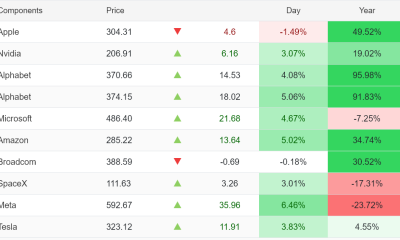
US Tech Stocks See Largest 5-Week Inflow in History: Can Nasdaq Break Its Downtrend?
-
 Business3 days ago
US stocks: Dow closes at record on Mideast optimism; SpaceX, AMD drag Nasdaq
-

 Tech7 days ago
Page Not Found | WIRED
-

 Politics3 days ago
Reform UK And Greens Sink To Lowest Favourability Ratings To Date
-

 Business4 days ago
Nvidia Stock Climbs 2.5% as Chip Sector Rally Builds Ahead of AMD Earnings, Nvidia’s Own Report Looms
-

 Crypto World4 days ago
Polymarket targets $20 billion valuation as competition heats up in prediction market sector
-

 Tech4 days ago
OpenAI, Anthropic AI agents targeted real people and systems in cyber tests
-

 Tech6 days ago
OpenAI teases Astra, its next major AI model, after it solves 10 long-standing math problems
-

 NewsBeat7 days ago
Tourist plane crash at Peru’s Nazca Lines kills all 13 on board | News World
-

 Business6 days ago
Myspace owners announce plans to relaunch the once-popular platform
-

 Business3 days ago
Supply chain issues impact Ingredion
You must be logged in to post a comment Login