
Crypto World
The US Magnificent 7 Stocks are Losing Wall Street Interest

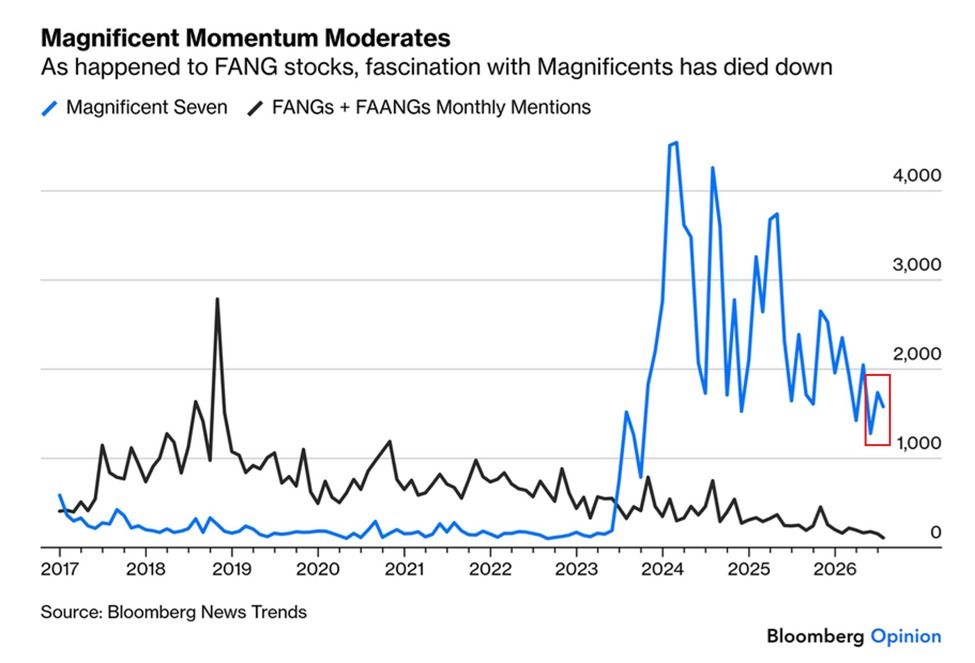
Monthly mentions of the Magnificent Seven (Mag 7) in Bloomberg Terminal news stories have fallen roughly 70% from their Q1 2024 peak.
This points to a notable shift in investor attention away from the megacap technology group.
Magnificent 7 Mentions Fall to Lowest Level Since Late 2023
The Kobeissi Letter highlighted the decline in a post on X. The mentions have fallen to roughly 1,400, bringing the figure to its lowest level since the fourth quarter of 2023.
The decline marks a sharp reversal from early 2024, when the group became one of the dominant themes in financial markets. Monthly mentions peaked at roughly 4,300 in Q1 2024, meaning the current level represents a decline of about two-thirds from that high.
The Kobeissi Letter compared the trend with earlier Wall Street groupings, including FANG and FAANG. Mentions of those terms peaked at nearly 2,800 in the fourth quarter of 2018, then plunged by about 82% to roughly 500 by early 2020.
The “Magnificent 7” label emerged in 2023 to describe Apple, Microsoft, Nvidia, Amazon, Alphabet, Meta, and Tesla.

Follow us on X to get the latest news as it happens
Mag 7 Loses Ground as AI Trade Broadens
The decline in Mag 7 mentions comes as the group loses some market dominance in 2026. Investors are increasingly favoring companies tied directly to heavy AI infrastructure spending.
The shift is also visible in the relationships between the seven stocks. Amazon, Nvidia, Meta, Apple, Microsoft, Tesla, and Alphabet are no longer moving in tandem as closely as they once did.
This signals a growing divergence in how investors are valuing the companies. Their average three-month pairwise correlation has fallen to 0.27, from 0.78 in mid-2025.
The changing dynamics have prompted some Wall Street strategists to question whether the Mag 7 remains the best way to capture the broader AI theme.
Citigroup strategists have argued that the popular Magnificent Seven label is no longer relevant for assessing how to position for the US AI trade.
Subscribe to our YouTube channel to watch leaders and journalists provide expert insights
The post The US Magnificent 7 Stocks are Losing Wall Street Interest appeared first on BeInCrypto.



Michael Saylor put Strategy’s Bitcoin activity back under scrutiny on Sunday, Aug. 9, with a two word X post: “Doing ₿usiness.”
Summary
- Strategy sold 1,638 BTC for $104.73 million between July 27 and August 2, filings show.
- Saylor’s Sunday “Doing ₿usiness” post did not specify whether Strategy bought, sold, or moved Bitcoin.
- Lookonchain linked a 1,030 BTC transfer to Strategy, but no company filing confirms any sale.
- Strategy’s holdings remain 842,138 BTC acquired for $63.51 billion at an average cost of $75,419.
- STRC closed Friday near $94.60, still below the $100 stated amount Strategy management currently targets.
The company’s executive chairman offered no details about whether the message referred to buying Bitcoin, selling more BTC, raising capital or another treasury transaction. As of Sunday, Strategy’s public Bitcoin ledger still showed 842,138 BTC, meaning no additional disposal after its Aug. 3 filing had been confirmed.
The timing has fueled speculation because Strategy confirmed a $104.73 million Bitcoin sale last Monday and a wallet linked to the company moved another 1,030 BTC two days later. Yet the second movement remains just that: an onchain transfer. Neither Strategy nor a later U.S. Securities and Exchange Commission filing has established that those coins were sold.
Strategy’s latest confirmed move was a 1,638 BTC sale
Strategy’s Aug. 3 SEC filing shows it sold 1,638 BTC between July 27 and Aug. 2 at an average price of $63,957, receiving $104.73 million after fees. The company used $52.4 million for preferred stock dividends and $52.3 million to help finance repurchases of STRC preferred shares.
After the transaction, Strategy reported 842,138 BTC acquired for $63.51 billion at an average cost of $75,419 per coin. Its official Bitcoin ledger actually records four negative BTC entries during 2026: 32 BTC reported June 1, 1,363 BTC on June 30, 2,225 BTC on July 6 and the latest 1,638 BTC. Together, those entries total 5,258 BTC.
As crypto.news reported, the latest sale was accompanied by another source of cash. Strategy sold 3.01 million MSTR shares for $290.6 million during the same reporting period. Of those proceeds, $250 million went into its U.S. dollar reserve, $28.9 million funded additional STRC repurchases and $11.7 million was added to cash.
That combination matters when assessing Saylor’s latest post. Strategy now has several ways to raise or redirect capital, so a cryptic message from Saylor does not automatically mean the company bought or sold Bitcoin.
On Aug. 5, Lookonchain identified wallets it associates with Strategy transferring 1,030 BTC, then worth roughly $66.14 million. The analytics firm itself framed the transaction as a question, asking whether Strategy was “dumping BTC again.” No official company disclosure has confirmed that interpretation.
Bitcoin can move between custodians, internal addresses, trading accounts or settlement wallets without ownership changing. Strategy’s public ledger continued to show 842,138 BTC after the transfer, while the Aug. 3 SEC filing covered activity only through Aug. 2.
The next company update could therefore clarify whether the 1,030 BTC movement represented another disposal. Until then, describing it as a confirmed sale would go beyond the available evidence.
The distinction is especially important because Strategy has formally changed how it manages Bitcoin. The company once focused overwhelmingly on accumulation, but its board now permits Bitcoin monetization for specified corporate purposes.
STRC buybacks create a reason Strategy could sell more BTC
Strategy’s second quarter disclosure says its Bitcoin Monetization Program allows BTC sales to fund its U.S. dollar reserve, preferred dividends, interest obligations and approved repurchases of MSTR or its digital credit securities. The authorization permits up to $1.25 billion of Bitcoin sales specifically to build the reserve, alongside additional permitted uses.
Management has placed particular attention on STRC. CEO Phong Le said the company’s objective is for the preferred shares to trade between $99 and $100 and that Strategy intends to repurchase STRC in a “regular and disciplined manner” while it remains below $100.
STRC was still around $94.60 after Friday’s session, according to Strategy’s own STRC information page. The Aug. 3 filing also showed that Strategy bought back 912,143 STRC shares for $81.2 million during the preceding week, leaving $893.8 million available under its preferred securities repurchase authorization.
Still, another Bitcoin sale is not required to fund those purchases. Strategy entered August with a $4 billion U.S. dollar reserve and continues to have access to its at the market equity programs. Those alternative funding sources make any prediction about the next treasury move uncertain.
Monday’s disclosure could settle the Bitcoin sale question
Because Saylor posted on Sunday, U.S. equity markets have not yet had an opportunity to react directly to his message. MSTR’s latest session ended at $100.01, while Bitcoin was trading around $65,183 on Sunday.
That also means Monday’s company disclosures matter more than social media speculation. Strategy has said its website dashboard is one of its Regulation FD disclosure channels, and it regularly reports Bitcoin transactions through SEC filings and its public ledger.
Strategy’s recent disposals have marked a broader shift toward active treasury management as the company balances Bitcoin holdings, preferred dividends, cash reserves and STRC support. The change does not establish that Strategy is abandoning Bitcoin accumulation, but it does mean Saylor’s traditional Sunday posts can no longer be read automatically as previews of another purchase.
For now, “Doing ₿usiness” remains a teaser rather than evidence of a transaction. The clearest confirmation would be a new SEC filing or Strategy ledger update showing whether its 842,138 BTC balance changed after Aug. 2. Until such a disclosure appears, the reported 1,030 BTC movement should remain classified as an unconfirmed transfer rather than another Strategy sale.


Bitcoin exchange-traded funds (ETFs) pulled in $853.54 million in net inflows for the week ended Aug. 7, the largest weekly total since mid-April, according to data from SoSoValue.
BlackRock’s IBIT accounted for the bulk of the activity, attracting $693 million on its own.
This surge in inflows offers a tentative sign that institutions are dipping back in after the heavy selling earlier this year.
Recent bitcoin price action has looked more constructive. Negative headlines, including a multi-million-dollar Coldcard hack and rising government bond yields, have failed to dent the spot market. Bitcoin held steady at around $64,000 early this week and traded at around $65,100 as of this writing.
Friday’s unexpectedly weak U.S. jobs report for July has cooled bets on further Federal Reserve rate hikes for now, potentially clearing the path for continued institutional buying in ETFs.
What next?
The latest spike in inflows represents only one week of data. On a year-to-date basis, the ETFs remain roughly $4.5 billion in the red due to net outflows. This helps explain the heavy selling pressure seen during the first six months of the year, when Bitcoin fell 33% to below $60,000 by the end of June.


Most traders assume depegs are slow. They are not. Inside the 30 second window where arbitrage bots, liquidation cascades, and oracle lag collide to turn a minor price slip into a systemic event.
Summary
- A stablecoin depeg lasting fewer than 60 seconds can trigger hundreds of millions of dollars in DeFi liquidations because lending protocols rely on price oracles that update on fixed intervals, not in real time, creating windows where collateral ratios become stale.
- Arbitrage bots can detect and exploit a depeg within two to three blocks on Ethereum, roughly 24 to 36 seconds, buying discounted stablecoins on one venue and redeeming or selling at par on another, but their speed advantage disappears when the depeg is caused by a solvency question rather than a liquidity imbalance.
- Chainlink price feeds for major stablecoins use a 0.25 percent deviation threshold and a one hour heartbeat interval, meaning the oracle will not update until the price moves at least 0.25 percent from its last reported value or 3,600 seconds have elapsed, whichever comes first.
- During the March 2023 USDC depeg caused by Silicon Valley Bank’s failure, approximately $2.1 billion in DeFi liquidations occurred within the first four hours, with the largest single liquidation exceeding $52 million on Aave v2, because borrowers who had posted USDC as collateral saw their positions fall below maintenance thresholds.
- Curve Finance’s 3pool, the largest stablecoin liquidity pool on Ethereum at the time, saw its USDC balance rise from roughly 33 percent to over 83 percent of total pool composition within hours as traders dumped USDC for DAI and USDT, a composition shift that amplified the depeg by creating one sided liquidity.
The popular explanation of a stablecoin depeg involves a gradual loss of confidence: reserves are questioned, redemptions spike, and the peg erodes over hours or days. That version describes Terra’s collapse. It does not describe what happens when USDC trades at $0.87 on a Friday afternoon because a bank failed, or when USDT briefly drops to $0.97 on Curve during a liquidity crunch. Those events last seconds to minutes, and the damage they cause operates on a completely different timescale than the narratives written about them afterward. The mechanics of a short depeg are faster, more automated, and more consequential per second than almost anything else in crypto.
The assumption that a depeg needs to persist for minutes or hours to matter is wrong. Thirty seconds is enough for an automated system to declare a position insolvent, execute a liquidation, sell the seized collateral at a discount, and move on. Thirty seconds is enough for a liquidity pool to absorb a sell order large enough to shift its composition from balanced to critically one sided. And thirty seconds is more than enough for an arbitrage bot to decide whether the depeg represents a buying opportunity or a genuine solvency event, a distinction that determines whether the bot stabilizes the price or accelerates the decline.
How a peg works when nothing is wrong
A stablecoin maintains its dollar peg through a combination of primary market redemption and secondary market arbitrage. The primary market is where authorized participants, typically large trading firms with direct relationships with the issuer, can create or redeem stablecoin tokens for exactly one dollar of the underlying reserve asset. The secondary market is where everyone else trades, on centralized exchanges, decentralized exchanges, and automated market makers.
When the secondary market price drops below one dollar, arbitrageurs buy the discounted stablecoin on the secondary market and redeem it for one dollar through the primary market, pocketing the difference. When the price rises above one dollar, they do the reverse: mint new tokens at one dollar and sell them on the secondary market at a premium. This two sided arbitrage keeps the price pinned to one dollar under normal conditions.
The system works because the primary market acts as a price floor and ceiling. As long as anyone can redeem one USDC for one dollar of reserves, the token cannot trade meaningfully below one dollar for long, because doing so creates a guaranteed profit for anyone willing to execute the redemption. The key phrase is “for long.” The lag between detecting a depeg and executing a redemption is where everything happens.
The 30 second anatomy of a depeg
A typical depeg event on Ethereum unfolds across a compressed timeline that most observers reconstruct only after the fact.
Second zero: a large sell order hits a stablecoin liquidity pool on a decentralized exchange. The order is large enough to move the pool composition, pushing the stablecoin’s implied price below one dollar. On Curve Finance, which uses a specialized bonding curve optimized for assets that should trade at similar prices, a sell order of $10 million to $50 million can move the implied price by 0.5 to 3 percent depending on pool depth.
Seconds one through six: the trade is confirmed in the next Ethereum block. The pool’s new composition is now public. Every bot monitoring the mempool and block stream sees the price deviation.
Seconds seven through twelve: arbitrage bots that operate across multiple venues detect the price difference between the decentralized exchange and centralized exchanges where the stablecoin still trades at par. The fastest bots submit transactions in the next block, buying the discounted stablecoin on the DEX and simultaneously selling it on a centralized exchange.
Seconds thirteen through twenty four: the arbitrage trades execute. If the initial sell order was a one time event, a large fund rebalancing its portfolio or a panic seller liquidating a position, the arbitrage flow absorbs the price impact and the peg restores within two to three blocks. This is the benign scenario and accounts for the vast majority of stablecoin price deviations.
Seconds twenty five through thirty and beyond: if the sell pressure continues, the arbitrage flow cannot keep up. The bots are limited by their own capital, their willingness to hold inventory risk, and the speed at which they can move funds between centralized and decentralized venues. When the depeg persists past the arbitrage capacity, the market transitions from a liquidity event to a confidence event, and the dynamics change fundamentally.
Oracle lag and the liquidation trigger
The most consequential feature of a short depeg is not the price movement itself but the interaction between that movement and the oracle systems that DeFi lending protocols use to value collateral.
Lending protocols such as Aave, Compound, and Maker do not use real time market prices. They use oracle feeds, most commonly provided by Chainlink, that aggregate prices from multiple sources and update on chain according to specific rules. For major stablecoins, Chainlink’s price feeds typically use a deviation threshold of 0.25 percent and a heartbeat of 3,600 seconds. The feed updates when the price moves more than 0.25 percent from the last on chain value, or when one hour has passed since the last update, whichever condition triggers first.
This design is intentional. Updating on every block would be prohibitively expensive in gas costs and would expose the oracle to manipulation through short lived price spikes. But the design creates a window of vulnerability during a depeg. If USDC trades at $0.99 on the secondary market but the oracle last reported $1.00 and the deviation threshold has not been crossed, the protocol still values USDC collateral at one dollar. Borrowers who posted USDC as collateral have a few minutes of grace before the oracle catches up.
When the oracle does update, the effect is abrupt. Every position that was marginally above the liquidation threshold at the old price may suddenly fall below it at the new price. The protocol does not liquidate positions one at a time in order of risk. It opens all eligible positions to liquidators simultaneously, creating a wave of liquidation transactions that compete for block space and drive up gas prices, which in turn increases the cost of executing arbitrage trades, which in turn reduces the arbitrage flow that would otherwise stabilize the price.
This feedback loop, depeg triggers oracle update triggers liquidations triggers more selling triggers deeper depeg, is why short depegs can cause damage disproportionate to their duration. The March 2023 USDC event produced approximately $2.1 billion in liquidations across DeFi. The depeg lasted roughly 48 hours in total, but the majority of liquidations occurred in concentrated bursts that corresponded to oracle update cycles.
Curve pools and one sided liquidity
Curve Finance occupies a unique position in stablecoin infrastructure because its automated market maker is specifically designed for assets that should trade at the same price. The Curve stableswap invariant, a mathematical formula that concentrates liquidity around the one to one price ratio, allows large trades with minimal slippage under normal conditions. During a depeg, this same design amplifies the problem.
When traders sell a depegging stablecoin into a Curve pool, the pool absorbs the selling by accumulating more of the depegging asset and distributing more of the other assets in the pool. As the composition shifts, say from 33/33/33 in a three asset pool to 80/10/10, the implied exchange rate for the majority asset deteriorates nonlinearly. A pool that can handle a $50 million swap with 0.1 percent slippage at balanced composition might require 5 percent slippage for the same swap when one asset comprises 80 percent of the pool.
This dynamic means that Curve pools act as both a stabilizer and an amplifier. In the early seconds of a depeg, the pool absorbs selling and the stableswap invariant keeps the price close to par. As the composition becomes increasingly one sided, the pool begins amplifying the depeg by making it progressively more expensive for arbitrageurs to buy the discounted asset. Liquidity providers, who deposited balanced allocations of all three assets, find themselves holding mostly the depegging asset, a form of impermanent loss that can become permanent if the depeg does not reverse.
When arbitrage bots stop buying
The critical transition in any depeg event is the moment when arbitrage bots stop providing a floor. Bots buy a depegged stablecoin because they expect to redeem it for one dollar or sell it elsewhere at par. Their willingness to do so depends on two assessments: whether the issuer can actually honor redemptions, and whether the capital required to execute the arbitrage is worth the risk.
During the USDC depeg in March 2023, Circle had approximately $3.3 billion deposited at Silicon Valley Bank, which represented roughly 8 percent of USDC’s total reserves at the time. When SVB failed, the question was not whether Circle would eventually recover the funds but whether Circle could process redemptions immediately. Arbitrage bots that would normally buy USDC at $0.95 and redeem it for $1.00 stopped buying because the redemption mechanism was temporarily frozen over the weekend.
This created a gap between the stablecoin’s fundamental value, which depended on whether the FDIC would make depositors whole, and its market price, which reflected the immediate liquidity available for redemptions. The gap persisted until Sunday evening, when the Federal Reserve and FDIC announced that all SVB depositors would be made whole. USDC’s price recovered to $0.99 within minutes of the announcement.
The lesson is that arbitrage provides a price floor only when the redemption mechanism is functioning. When the floor disappears, the price is set entirely by secondary market supply and demand, and secondary markets in a crisis are dominated by sellers.
What lending protocols see during a depeg
From the perspective of a lending protocol, a stablecoin depeg creates a specific sequence of risks that the protocol’s risk parameters are designed to handle, but only up to a point.
When a borrower posts USDC as collateral and borrows ETH, the protocol maintains a loan to value ratio. If USDC is valued at one dollar and the LTV limit is 80 percent, a borrower can post $100 of USDC and borrow $80 worth of ETH. If USDC’s oracle price drops to $0.90, the collateral is now worth $90, pushing the effective LTV to 88.9 percent, above the liquidation threshold.
The protocol opens the position to liquidators, who repay part of the borrower’s debt and receive the collateral at a discount, typically 5 to 10 percent. The liquidator profits from the discount, the protocol recovers the borrowed funds, and the borrower loses a portion of their collateral. In theory, this mechanism keeps the protocol solvent even when collateral values decline.
In practice, the mechanism depends on liquidators being willing and able to execute quickly enough. During a depeg, liquidators must buy the depegging stablecoin to repay the debt, which means they are absorbing the same asset that everyone else is trying to sell. If liquidation volume exceeds the market’s capacity to absorb sales of the depegging asset, the protocol can accumulate bad debt, positions where the collateral value has fallen below the debt value and no liquidator is willing to close the position.
Aave v2 accumulated approximately $1.6 million in bad debt during the USDC depeg, a small amount relative to its total value locked but a proof of concept for the failure mode. Larger or longer depegs would produce proportionally more bad debt.
What this does not cover
This article does not cover algorithmic stablecoin depegs, which involve fundamentally different mechanisms. Terra’s collapse in May 2022 was caused by a failure of the algorithmic stabilization mechanism itself, not by a temporary liquidity event or external shock to reserves. The dynamics of an algorithmic depeg involve death spirals between the stablecoin and its paired governance token, a phenomenon that does not apply to fiat backed stablecoins like USDC or USDT.
This article also does not cover the regulatory implications of depegs. The GENIUS Act and other stablecoin legislation address reserve requirements and redemption rights, but the interaction between those requirements and real time market mechanics during a depeg is a separate topic.
Finally, this article does not cover the specifics of individual protocol risk parameters. Each lending protocol sets its own oracle sources, deviation thresholds, liquidation bonuses, and bad debt handling procedures. The general mechanics described here apply broadly, but the specific numbers and outcomes vary by protocol.
Practical checks
If you hold stablecoins or use them as collateral in DeFi, several factors determine your exposure to a short depeg event.
Check the oracle source your lending protocol uses. Protocols that rely on a single oracle with a high deviation threshold are more exposed to delayed liquidation triggers. Protocols that use multiple oracles or have tighter update thresholds will reflect price changes faster, which can be either protective (faster liquidation prevents bad debt accumulation) or harmful (faster liquidation gives borrowers less time to add collateral).
Check the composition of any Curve or Uniswap pool where you provide liquidity. If one stablecoin already comprises a disproportionate share of the pool, the pool is already pricing in a mild depeg risk, and your impermanent loss exposure is elevated.
Check whether the stablecoin issuer has published information about its reserve custodians. Circle discloses its banking relationships. Tether provides quarterly attestations but does not disclose individual custodians. The risk profile of a depeg depends heavily on the specific institutions holding the reserves and their susceptibility to bank runs, regulatory actions, or operational failures.
Check your liquidation threshold. If you are borrowing against stablecoin collateral, calculate how far the stablecoin price would need to fall before your position is liquidated. A 3 percent depeg that lasts 30 seconds may not trigger your liquidation if your LTV is conservative, but a 10 percent depeg almost certainly will.
Check the stablecoin’s redemption terms. Some stablecoins can be redeemed 24/7. Others have processing windows, minimum redemption amounts, or identity verification requirements that create delays. Those delays determine how quickly arbitrage can restore the peg after a depeg event.
What to watch
Oracle infrastructure upgrades. Chainlink and other oracle providers are actively developing pull based oracle models that allow protocols to request price updates on demand rather than waiting for push based updates on fixed schedules. These models would significantly reduce the oracle lag window during depegs.
Curve v2 and concentrated liquidity adoption. Newer AMM designs that allow liquidity providers to concentrate their capital around specific price ranges may change the dynamics of one sided liquidity during depegs, either reducing slippage for large trades or creating cliff effects where liquidity disappears entirely below a certain price.
Stablecoin reserve diversification post GENIUS Act. The GENIUS Act’s reserve requirements may push issuers toward more diversified custodial arrangements, reducing the concentration risk that caused the USDC depeg when SVB failed.
Cross chain depeg propagation. As stablecoins are bridged across multiple chains, a depeg on Ethereum can propagate to Arbitrum, Optimism, Base, and other networks with varying delays depending on bridge finality times and oracle configurations on each chain.
Real time liquidation dashboards. Tools like DefiLlama’s liquidation tracker provide real time visibility into the collateral positions that would be liquidated at various price levels. Monitoring these dashboards during periods of stablecoin stress gives advance warning of potential liquidation cascades.
u003cstrongu003eWhat is a stablecoin depeg?u003c/strongu003e
u003cpu003eA stablecoin depeg occurs when a stablecoin’s market price diverges from its target value, typically one US dollar. Depegs can be caused by liquidity imbalances on exchanges, concerns about the issuer’s reserves, or external events like bank failures that affect the custodians holding the reserve assets. Most depegs are short lived and resolved by arbitrage, but severe depegs can persist for hours or days.u003c/pu003e
u003cstrongu003eHow long does a typical depeg last?u003c/strongu003e
u003cpu003eMost stablecoin price deviations last seconds to minutes and are resolved by automated arbitrage bots that buy the discounted stablecoin and redeem it or sell it at par elsewhere. Severe depegs caused by solvency concerns, like USDC during the SVB failure, can last 48 hours or more because arbitrageurs are unwilling to buy until the redemption mechanism is confirmed to be functioning.u003c/pu003e
u003cstrongu003eCan a 30 second depeg cause real losses?u003c/strongu003e
u003cpu003eYes. DeFi lending protocols use oracle feeds that update on fixed intervals. When the oracle updates and reflects a lower stablecoin price, positions that were previously above the liquidation threshold can suddenly become eligible for liquidation. Liquidators seize collateral at a discount, and borrowers lose a portion of their funds. This can happen within a single oracle update cycle.u003c/pu003e
u003cstrongu003eWhat role do oracles play during a depeg?u003c/strongu003e
u003cpu003eOracles provide the price data that DeFi protocols use to value collateral and determine liquidation eligibility. Most oracle feeds for stablecoins update when the price moves more than 0.25 percent or after a fixed time interval. This creates a lag between the market price and the protocol’s view of the price, which can delay or accelerate liquidations depending on the timing.u003c/pu003e
u003cstrongu003eWhy do Curve pools amplify depegs?u003c/strongu003e
u003cpu003eCurve’s stableswap design concentrates liquidity around the one to one price ratio, which minimizes slippage for normal trades. During a depeg, sellers dump the depegging asset into the pool, shifting its composition. As the pool becomes increasingly one sided, the implied exchange rate deteriorates nonlinearly, making it progressively more expensive for arbitrageurs to restore balance.u003c/pu003e
u003cstrongu003eWhat is the difference between a liquidity depeg and a solvency depeg?u003c/strongu003e
u003cpu003eA liquidity depeg occurs when selling pressure temporarily exceeds buying capacity on secondary markets, but the issuer’s reserves are intact and redemptions are functioning. These depegs are typically resolved within minutes by arbitrage. A solvency depeg occurs when the issuer’s reserves are insufficient to honor all redemptions at par, which can lead to sustained price declines and potential permanent loss.u003c/pu003e
u003cstrongu003eHow do arbitrage bots restore the peg?u003c/strongu003e
u003cpu003eArbitrage bots monitor price differences across venues. When a stablecoin trades below one dollar on a DEX but at par on a centralized exchange, bots buy on the DEX and sell on the CEX. If the redemption mechanism is functioning, bots can also buy discounted stablecoins and redeem them directly with the issuer for one dollar. This buying pressure pushes the DEX price back toward par.u003c/pu003e
u003cstrongu003eWhat can users do to protect themselves during a depeg?u003c/strongu003e
u003cpu003eUsers can reduce exposure by maintaining conservative loan to value ratios when borrowing against stablecoin collateral, diversifying across multiple stablecoin issuers, monitoring oracle update schedules for the protocols they use, and checking the reserve custodian disclosures of the stablecoins they hold. Avoiding concentrated exposure to a single stablecoin in liquidity pools also reduces impermanent loss risk during depeg events.u003c/pu003eu003cpu003e*Disclaimer: This article is for informational purposes only and does not constitute financial, investment, or legal advice. Cryptocurrency investments carry significant risks. Always conduct your own research before making any financial decisions. The information in this article is current as of August 8, 2026.*u003c/pu003e


Bitcoin’s contentious BIP-110 test has moved from signaling into an actual chain split, and the first hours show miners overwhelmingly continuing to build on the existing Bitcoin chain.
Summary
- BIP-110 entered mandatory signaling with just 51 of 2,016 prior blocks supporting the proposal overall.
- The enforcing branch stalled at block 961,633 while Bitcoin’s main chain reached 961,731 during Sunday.
- Mandatory signaling runs through block 963,647, with lock-in scheduled no later than block 963,648 afterward.
- A proof-of-work change remains contingency code, with Chris Guida saying no activation date exists yet.
- Replay risks remain for holders because transactions may be valid across both chains without separation.
The proposal entered mandatory signaling at block 961,632 on Aug. 8 after only 51 of the previous 2,016 blocks, or 2.53%, signaled support. Nodes enforcing BIP-110 then began rejecting blocks without version bit 4.
The latest available BIP-110 monitoring data on Aug. 9 showed the enforcing branch stalled at block 961,633 after producing only two blocks. Bitcoin’s non-enforcing chain had already reached 961,731, putting it 98 blocks ahead. The tracker also showed no BIP-110 signaling among the first 100 blocks of the new difficulty period on the dominant chain.
Bitcoin BIP-110 split widens after miner support stays low
The split began because BIP-110 applies different validity rules during its mandatory signaling window. According to the official BIP-110 specification, enforcing nodes must reject any block between heights 961,632 and 963,647 that fails to signal bit 4. Ordinary Bitcoin nodes do not impose that requirement, allowing them to continue following non-signaling blocks.
Roughnecks, a pseudonymous mining operation using OCEAN’s DATUM system, produced BIP-110 blocks 961,632 and 961,633. The branch then stopped advancing for about 15 hours in the latest monitor snapshot. Earlier Sunday, when the main chain stood at 961,721, the gap had already widened to 88 blocks.
The widening gap reflects the difference in computing power assigned to each chain. BIP-110 entered the current period with the same mining difficulty environment, but its enforcing branch has only a small fraction of Bitcoin’s hash power. Without more miners joining, it must continue finding difficult blocks slowly before reaching another difficulty adjustment.
That does not technically erase the minority branch. More hash power could still be directed toward it. However, the observed block production provides no evidence so far that enough miners are switching to close the accumulated work gap.
The 55% voluntary threshold was missed by a wide margin
BIP-110 allows an earlier lock-in if 1,109 of the 2,016 blocks in a difficulty period signal support, equal to 55%. The period ending at block 961,631 recorded just 51 signals, according to the monitoring data, leaving support at 2.53%.
Strategy Executive Chairman Michael Saylor had already argued before the deadline that the low signaling rate showed the proposal lacked broad mining support. His characterization that the data represented “not miner consensus” was his assessment of the signaling figures rather than a formal network governance determination.
Saylor and Blockstream CEO Adam Back opposed the proposal on broader grounds. Back warned that enforcing new consensus restrictions without wider agreement could divide participants, while supporters argue the restrictions are needed to discourage non-monetary data use. Those remain competing views about how Bitcoin block space should be governed.
BIP-110 would temporarily restrict several transaction structures once fully active. Most new output scripts would be limited to 34 bytes, OP_RETURN outputs to 83 bytes, and some data pushes and witness elements to 256 bytes. It would also restrict parts of Taproot for the proposal’s roughly one-year active period.
The chain split also creates a practical issue for holders. As crypto.news reported before mandatory signaling began, Bitcoin developer Kevin Loaec warned that signed transactions could potentially be recognized on both chains because BIP-110 does not automatically separate users’ pre-fork balances.
A holder attempting to transfer coins on the minority branch could therefore risk moving the corresponding BTC on the dominant chain if the same transaction is valid there and gets rebroadcast. The risk applies to the transaction inputs involved rather than giving another party control over an entire wallet. Leaving pre-split coins unmoved avoids creating a transaction that could be replayed.
The practical risk depends partly on whether markets, wallets or exchanges begin treating the minority branch as an asset worth transacting. With only two blocks mined so far, there is little evidence that such an ecosystem has developed.
Proof-of-work change remains a fallback, not a scheduled fork
Some BIP-110 supporters have prepared for the possibility that existing Bitcoin miners continue rejecting the proposal in practice. On Aug. 1, developer Chris Guida rebased experimental proof-of-work change code originally authored in part by Bitcoin Knots maintainer Luke Dashjr. The GitHub comparison contains 12 commits affecting 19 files, including code for selecting a different proof-of-work algorithm.
However, the code does not establish a scheduled network change. Guida described it as “just some code to have in our back pocket” and said no activation deadline had been set. His comments make the proof-of-work proposal a contingency rather than an announced hard fork with a fixed date.
Dashjr has continued supporting BIP-110 despite criticism and earlier rejected calls to withdraw it. Supporters maintain that temporary restrictions would reduce arbitrary data storage, while critics favor leaving block-space allocation to fees and individual node policies.
What happens next for BIP-110
The next protocol checkpoints are defined by block height rather than fixed dates. Mandatory signaling continues through block 963,647. Under the BIP specification, the deployment reaches LOCKED_IN no later than block 963,648, followed by ACTIVE at 965,664. Only then would the proposal’s reduced-data transaction rules begin.
Those heights could arrive on very different timelines across the two branches. Bitcoin’s dominant chain continues producing blocks at its normal pace, while the BIP-110 enforcing branch would need substantially more hash power to approach the same rate. At the latest retrieved snapshot, it remained 98 blocks behind after advancing only once beyond its alternative block 961,632.
The immediate metric to watch is therefore not another scheduled vote but mining activity. If miners begin extending the BIP-110 branch, its block production could resume. If hash power remains concentrated on Bitcoin’s existing chain, the gap will continue widening and the enforcing branch will face an increasingly difficult path to becoming the chain with the most accumulated proof of work.

In a true Sunday manner, Strategy’s Chairman and former CEO made some interesting comments on X regarding the company’s latest move on bitcoin.
Today’s message reads, ‘Doing ₿usiness,’ using the cryptocurrency’s logo as the first letter of the second word. While many popular crypto analysts and market observers reshared the post and speculated that it means Strategy has resumed its BTC purchases, a look into last week’s events might tell a different story.
Doing ₿usiness. pic.twitter.com/PtekVgHXDp
— Michael Saylor (@saylor) August 9, 2026
Saylor had posted another cryptic message on X last Sunday before Strategy announced its third bitcoin sale for the year, in which it disposed of 1,638 units for just over $100 million.
The analysts at Lookonchain had flagged the sale even before it was officially made public, as the firm’s total holdings dropped to 842,138 BTC.
A few days ago, they outlined another potential offload, as a wallet linked to the world’s largest corporate holder of bitcoin transferred more than 1,000 units.
The company used a portion of its proceeds to purchase its own STRC stock, which is supposed to have a par price of $100. However, it slumped below $80 several weeks ago, and Strategy reacted by halting its BTC purchases in late June to refocus on rebuilding its USD reserve. STRC has reacted positively, rising by $20 since its low, as it ended the week at $95.
The post Michael Saylor Teases Strategy’s Next Bitcoin Move: Analysts Expect Another Sale appeared first on CryptoPotato.


Domestic stablecoins designed to strengthen the role of national currencies could have an unintended effect: making it easier for users to move into digital dollars.
Summary
- IMF says local stablecoins could accelerate dollar-token adoption by making onchain currency conversion easier globally.
- Nearly 99% of stablecoins remain dollar-denominated, reinforcing network effects that local tokens struggle to match.
- South Africa shows limited dollar-stablecoin use while rand-linked tokens have attracted weaker demand so far.
- IMF recommends regulating onramps, offramps and onchain exchanges when stablecoins expand access to foreign currency.
- BIS found stablecoin inflows broadly similar across economies with and without cross-border usage restrictions imposed.
International Monetary Fund First Deputy Managing Director Dan Katz raised the concern on Aug. 7 during a speech at the University of Cape Town, as regulators weigh how stablecoins could reshape payments and foreign currency demand in emerging markets.
Katz said local currency and dollar stablecoins operating on the same blockchain infrastructure can make foreign exchange conversion easier. Users can potentially swap between them through decentralized exchanges, liquidity pools or peer to peer transactions instead of relying exclusively on banks and conventional currency dealers. In that environment, local tokens “might even accelerate the adoption of FX stablecoins,” he said. The IMF has not presented that outcome as certain.
Dollar stablecoins already hold a strong network advantage
The IMF’s assessment starts with a stablecoin market that remains overwhelmingly linked to the U.S. dollar. Katz said stablecoin market capitalization has remained around $300 billion over the past year after nearly tripling between 2021 and 2025. Nearly 99% of stablecoins are denominated in dollars.
That dominance gives dollar backed tokens stronger liquidity and broader acceptance across exchanges, payment platforms and international markets. Domestic currency stablecoins have to compete with those existing network effects even when regulators or companies introduce them as alternatives.
South Africa offers an early example. Katz said dollar stablecoins have so far gained only limited traction in the country, yet rand denominated stablecoins have attracted even less demand. He cautioned that it is “too early to draw firm conclusions” about whether that pattern will persist.
The South African Reserve Bank’s Financial Stability Review has also documented growing activity involving dollar pegged tokens. Trading volumes for U.S. dollar stablecoins on domestic platforms rose from less than 4 billion rand in 2022 to almost 80 billion rand during the first ten months of 2025.
Meanwhile, as previously reported, South African authorities have been reassessing the country’s digital money framework while placing greater emphasis on wholesale central bank digital currency use cases and regulation of private digital assets.
Domestic stablecoins could move more FX activity onchain
The IMF’s concern centers on the ease of moving between currencies once different stablecoins share blockchain infrastructure. A user holding a local currency token may no longer need to approach a bank or traditional foreign exchange provider to obtain a dollar denominated asset.
Instead, decentralized exchanges and liquidity pools can provide direct trading pairs between domestic and dollar stablecoins. Peer to peer transactions can offer another route. Katz argued that this could shift some foreign exchange activity away from financial institutions that traditionally act as regulatory checkpoints.
That matters because banks and currency dealers can be required to report transactions, enforce foreign exchange restrictions and apply capital flow controls. Onchain transactions using self-custody wallets can be harder for authorities to monitor in the same way.
Research from the Bank for International Settlements has raised similar questions. A study examining four dollar stablecoins and 27 fiat currencies found that more than 70% of cumulative net fiat inflows into the tokens came from non-dollar currencies. Researchers also found links between stablecoin demand, currency depreciation and pricing differences between onchain and traditional foreign exchange markets.
BIS research found broadly similar stablecoin inflows in countries with and without restrictions on cross-border stablecoin use. Researchers said self-hosted wallets and the borderless nature of blockchain transactions could reduce the effectiveness of some conventional controls.
Dollarization risks will differ across emerging markets
Katz stressed that stablecoins will not affect every country in the same way. In economies where residents already hold substantial amounts of dollars, stablecoins may mainly replace existing foreign currency deposits or physical cash with a digital alternative.
Under that scenario, greater stablecoin use may change how people hold dollars without materially increasing total foreign currency demand.
The situation could be different in countries where dollar access is restricted or confidence in the domestic currency is weaker. The IMF said stablecoins could provide an additional route into foreign currencies in economies with weaker macroeconomic frameworks or pent up demand for dollars.
During periods of currency depreciation or high inflation, easier access to digital dollars could therefore increase demand for foreign currency assets. However, Katz presented this as a risk that depends on domestic economic conditions rather than an inevitable outcome.
The BIS 2026 annual economic report also warned that foreign currency stablecoins can become accessible substitutes for domestic money in emerging economies. Such access could make capital flows larger or more volatile when investors lose confidence in local currencies.
Regulators may focus on stablecoin conversion gateways
Despite those concerns, the IMF is not calling for countries to impose a universal ban on foreign stablecoins. Instead, Katz said authorities should apply policies according to the risks present in each economy.
One priority is bringing stablecoin onramps and offramps within regulatory frameworks. Exchanges, custodians and payment companies that convert between fiat money and digital assets remain points where authorities can apply customer identification, transaction monitoring and reporting requirements.
The IMF also wants attention placed on onchain exchange points. Where domestic and dollar stablecoins can be freely exchanged, regulators may need to consider whether existing foreign exchange and capital flow rules remain effective.
Cross-border cooperation will also matter because activity can migrate to platforms outside a user’s home jurisdiction. Self-custody makes the issue more complicated because transactions can take place without a conventional intermediary controlling the wallet.
At the same time, Katz acknowledged that stablecoins can reduce payment costs. He cited forthcoming IMF work indicating that stablecoin transfers may cost less than the roughly 6.5% average global remittance cost, although conversion charges and exchange rates can reduce those savings.
Stablecoins have increasingly been used as settlement infrastructure for payments and cross-border transfers as financial institutions and payment companies explore blockchain based rails.
For policymakers, the next stage will involve improving data collection and determining where stablecoin activity falls within existing financial rules. Katz said the IMF is working through the G20 Data Gaps Initiative to improve information on digital asset flows while helping member countries adapt their regulatory frameworks.
No binding international rule accompanied the Aug. 7 speech. For now, the IMF’s message is that domestic stablecoins should not automatically be viewed as a shield against digital dollarization. If local tokens make conversion easier, they may instead provide another bridge into dollar backed assets.

Bitcoin’s contentious BIP-110 upgrade track is showing tangible friction in the form of a widening chain split. According to the BIP-110 monitor, the enforcing (BIP-110 validating) branch has stalled at block 961,633 after producing only two blocks, while the non-enforcing branch has advanced to block 961,721—pushing the gap to 88 blocks.
As the disagreement persists through the period where difficulty adjustments cannot yet fully catch up, the episode is again highlighting how “mandatory signaling” mechanics can turn a soft-proposal into an operational contest between node policies and mining output.
Key takeaways
- The enforcing BIP-110 branch halted at block 961,633, while the non-enforcing chain reached 961,721, widening divergence to 88 blocks.
- BIP-110 nodes reject blocks that do not signal via version bit 4, while ordinary Bitcoin nodes accept both signaling and non-signaling blocks—enabling two simultaneous histories.
- Mandatory signaling began at block 961,632, following a signaling rate of only 2.53% (51 out of 2,016 blocks) in the prior window.
- Ocean records attribute the enforcing branch’s first two blocks to a pseudonymous mining group named Roughnecks using Ocean’s DATUM mining protocol.
- Mandatory signaling is scheduled to continue through block 963,647, and enforcing nodes must mine through the remainder of the 2,016-block adjustment period before difficulty can respond.
A split driven by node policy and signaling
The divergence started right as BIP-110 moved into mandatory signaling. The BIP-110 monitor reported the latest state as of 10:19 am UTC, showing the enforcing branch’s last block at 961,633—about 12 hours after the branch produced its two-block output.
In the window immediately before mandatory signaling, only 51 of the previous 2,016 blocks signaled support for BIP-110. The 2.53% figure matters because it reflects how limited the share of blocks was that complied with the signaling requirement before the stricter rule took effect.
Under the BIP-110 mechanism, nodes enforcing the proposal reject blocks that do not signal the required version bit (version bit 4). By contrast, standard Bitcoin nodes do not apply the same rejection rule and therefore accept both signaling and non-signaling blocks. That asymmetry is what allows two competing chains to progress independently when miners do not consistently produce blocks meeting the enforcing criteria.
What changed at block 961,632
Earlier coverage from Cointelegraph noted that BIP-110 crossed key thresholds as “spam wars” around transaction-level policy heated up. Building on that context, the current episode is now anchored to a precise transition: BIP-110 entered mandatory signaling at block 961,632 on Saturday.
The proposal’s terms, including the way mandatory signaling is enforced, run through block 963,647, according to the BIP-110 documentation. This implies that miners and enforcing nodes remain in a regime where the enforcing branch can only be strengthened if sufficiently more blocks comply with the signaling requirement.
Importantly for traders and operators tracking chain health, progress is not instantaneous. The enforcing branch must continue mining through the remainder of the 2,016-block difficulty adjustment period before difficulty can adjust, making it harder for a smaller enforcing cohort to “catch up” quickly without a material increase in hashpower.
Mining attribution points to a small cohort
Ocean’s records on the relevant block history provide additional detail on who produced the early enforcing blocks. Ocean data associated the enforcing branch’s first two blocks with a pseudonymous mining group called Roughnecks.
Those blocks were reportedly mined using Ocean’s Decentralized Alternative Templates for Universal Mining (DATUM) mining protocol, as reflected in Ocean’s block information for the cited enforcing-branch block. The fact that only a limited number of enforcing-compliant blocks appeared before the stalling suggests—without proving intent—that the set of miners producing compliant blocks has been comparatively small.
That matters operationally: if compliance is concentrated among a niche subgroup rather than broadly distributed across the mining ecosystem, the enforcing branch can lag for long stretches—exactly what the current 88-block gap illustrates.
Why critics argue the rules risk unintended consequences
The BIP-110 controversy has long centered on whether forcing consensus-level behavior around signaling and block acceptance is worth the potential benefits. Prominent Bitcoin figures have criticized the change as potentially undermining neutrality and creating avoidable risks.
Strategy executive chairman Michael Saylor told Cointelegraph that while he supports the proposal’s objectives, he argued its approach threatened Bitcoin’s “neutral rules” and consensus. Separately, Blockstream CEO Adam Back warned, also via Cointelegraph coverage, that a consensus-level change could damage Bitcoin’s credibility and potentially make certain unspent transaction outputs unspendable.
While today’s split is not a verdict on the broader debate, it does underscore how quickly policy-based enforcement can translate into practical chain divergence when signaling support is thin and hashpower distribution doesn’t align with the enforcing conditions.
For readers watching this closely, the question is less whether the debate exists—critics and supporters are both on the record—but how sustained the operational divergence becomes once mandatory signaling remains in place through block 963,647.
What to monitor next
Until the enforcing branch reaches a point where difficulty can adjust—or until miners meaningfully increase the share of compliant signaling—watch for whether the enforcing chain resumes producing blocks at a higher rate and whether the block gap continues to widen or begins to narrow before block 963,647.
The spot exchange-traded funds tracking the sixth-largest cryptocurrency by market cap have recorded their fourth consecutive week in the green. However, there are certain warning signs that cannot be ignored.
Meanwhile, the native token’s price dipped toward a key support that has managed to hold… for now. Analysts weighed in on the asset’s potential ahead and what might come next.
XRP ETFs Still in the Green, but…
During May and June, months in which the spot Bitcoin and Ethereum ETFs bled out heavily, often in the billions of dollars, the spot XRP counterparties managed to defy the overall slump. As we consistently reported, they recorded an impressive streak of nine consecutive weeks in the green, and even the one that was in the red and stopped it back in early May saw a very modest net outflow of $35,210.
July began on the wrong foot, as the first full week saw over $7 million in net withdrawals. However, the bulls returned in the following three weeks, pouring in $6.78 million, $8.15 million, and $14.86 million, respectively. Thus, the month ended with net inflows of $27.29 million.
While on the surface it appears as a major win, a deeper look shows the first warning sign: this was the second-weakest month in terms of net inflows since January this year. The beginning of August is also in the green, but there’s another warning shot – the actual inflows are a very modest $1 million. At the same time, both the BTC and ETH ETFs attracted over $1 billion combined.
Two out of the five trading days saw no reportable numbers ($0.00), while investors pulled out $3.58 million on Wednesday. The net inflows of $1.15 million on Monday and $3.45 million on Thursday managed to barely offset the losses.
XRP Dipped to Key Support
The weak ETF data failed to help XRP during the week in terms of price action, and the asset felt the negative consequences of the delayed CLARITY Act voting in the US Senate. As reported on Friday, the token fell to $1.02, coming just inches away from dipping below the key $1.00 support.
Nevertheless, analysts remain bullish on its future price performance. Some expect its ‘strongest price reversal’ if it manages to hold that support and reclaim the $1.05 level soon. Others outlined some massive targets for the next bull run of up to $50, which sound a bit far-fetched at the moment, admittedly.
The post Ripple (XRP) ETFs Record Another Green Week but Fresh Concerns Surface appeared first on CryptoPotato.
Crypto World
Crypto is going through a massive dot-com style shakeout as over 100 projects fold in 2026


“There were way too many general-purpose layer twos, which frankly don’t make sense as a product, because there’s no reason to have many, many versions of the same thing,” Ben Fisch, CEO of Espresso Systems, told CoinDesk. “We’re in a consolidation phase for general-purpose layer twos, not layer twos broadly.”
Industry leaders argue the shakeout reflects a broader shift across crypto rather than a problem unique to Ethereum scaling networks.
“Consolidation is happening across all of crypto right now, not just layer two, from DeFi protocols to DEXs and infrastructure providers. It’s a sign that the industry is maturing. The networks continuing through this period are the ones people actually use and depend on,” Marek Olszewski, co-founder of the Celo layer-2, told CoinDesk.
“For every crypto project that you hear about shutting down, there are perhaps another 10 silently doing the same,” Nick Puckrin, founder of Coin Bureau, wrote in a post on X. “Creative destruction for the next cycle perhaps.”
Orkun Mahir Kılıç, co-founder and CEO of Chainway Labs, which is building the Bitcoin layer-2 Citrea, said the wave of closures reflects a maturing market where capital is harder to raise and investors are becoming more selective.
“Different businesses have different reasons and different underlying problems for shutting down. The pattern we’re seeing emerge isn’t really an inherent problem within the L2 ecosystem. The market and the tech are maturing, investment is a lot slower and more cautious now, and only projects with sound business models and a clear problem statement will survive,” Mahir Kılıç told CoinDesk.


Trump Media & Technology Group is pulling back from one of its biggest crypto expansion plans less than a year after announcing it.
Summary
- Trump Media, Crypto.com and Yorkville terminated the proposed $6.42 billion CRO treasury combination on Friday.
- Truth Social will market Crypto.com prediction products instead of directly integrating prediction markets into platform.
- The canceled treasury expected $1 billion in CRO plus a $5 billion Yorkville equity line.
- Trump Media is prioritizing its pending TAE merger, which it hopes to close during 2026.
- Separate ETF servicing plans involving Crypto.com were also canceled, while Yorkville’s existing funds remain unchanged.
On Aug. 7, Trump Media, Crypto.com and Yorkville Acquisition Corp. Mutually terminated their proposed business combination to establish Trump Media Group CRO Strategy, a company designed around a multibillion dollar Cronos treasury. The companies cited “prevailing market conditions” and changing business and stakeholder priorities.
The decision comes as Trump Media shifts attention toward its media operations and pending merger with TAE Technologies. The all stock TAE transaction was valued at more than $6 billion when announced in December 2025. Meanwhile, Trump Media is also scaling back plans to build prediction markets directly into Truth Social.
Trump Media abandons the $6.42B CRO treasury plan
The CRO treasury project dated to August 2025, when Trump Media, Crypto.com and Yorkville announced plans for a publicly traded company centered on accumulating and managing Cronos tokens.
According to the original SEC filing, the structure included $1 billion worth of CRO, $200 million in cash and $220 million from mandatory exercise warrants. It also included a $5 billion equity line of credit, bringing the planned funding package to $6.42 billion.
The $6.42 billion figure did not represent CRO that had already been purchased. Rather, it described the financing available to the proposed treasury company. As crypto.news reported when the transaction was announced, the deal initially triggered a sharp rally in CRO as investors reacted to the planned institutional treasury.
Crypto.com, Trump Media and Yorkville have now said all initial discussions and development efforts connected to that business combination will formally end. Their Aug. 7 announcement did not provide a termination payment or indicate that any party would face a breakup fee.
However, Trump Media’s existing CRO exposure should not be confused with the canceled treasury vehicle. Under a separate strategic partnership announced in August 2025, Trump Media agreed to buy approximately $105 million of CRO for its own balance sheet, while Crypto.com agreed to acquire $50 million of Trump Media shares.
Trump Media subsequently acquired hundreds of millions of CRO through that arrangement. The latest cancellation announcement specifically addresses the proposed CRO Strategy business combination and does not say those existing balance sheet holdings are being unwound.
Truth Social scales back its prediction market strategy
Trump Media is also changing its approach to prediction markets. The company and Crypto.com previously planned to embed a product called Truth Predict directly into Truth Social, giving users access to event contracts tied to areas such as politics, economics and sports.
Truth Predict was announced in October 2025 through a partnership with Crypto.com’s derivatives business. The original plan would have allowed users to interact with prediction contracts from inside Truth Social.
That direct integration is no longer moving ahead. Instead, Trump Media intends to pursue a marketing arrangement promoting Crypto.com’s prediction market products to Truth Social users.
The shift reduces the amount of infrastructure Trump Media would need to operate itself while preserving a commercial relationship with Crypto.com. The companies have not disclosed financial terms for the revised marketing arrangement.
Trump Media and Crypto.com are also abandoning a separate arrangement under which Crypto.com would have serviced certain planned Yorkville America exchange traded funds. However, the companies said Yorkville America’s existing Truth Social branded funds and plans for other ETF products remain unchanged.
TAE merger becomes a bigger strategic priority
Trump Media’s pullback from the CRO treasury comes as the company concentrates on its planned combination with fusion energy company TAE Technologies.
The companies announced the TAE transaction in December 2025 as an all stock merger valued at more than $6 billion. They said shareholders of Trump Media and TAE would each own approximately 50% of the combined company on a fully diluted basis after closing.
Trump Media’s changing strategy follows substantial exposure to digital assets during the past year. The company recorded a $405.9 million first quarter net loss as declining Bitcoin and CRO prices contributed to large unrealized markdowns. Trump Media reported holding 9,542 BTC and approximately 756 million CRO at the end of March.
Those holdings mean the termination of the dedicated CRO treasury company does not amount to Trump Media abandoning crypto altogether. The company retains digital asset exposure, and its existing Crypto.com relationship extends beyond the canceled SPAC structure.
What happens next for Trump Media
The TAE merger now represents one of the company’s clearest pending corporate milestones. Closing remains subject to regulatory approvals, shareholder processes and other customary conditions, meaning the transaction is not guaranteed to close on its proposed timetable.
Trump Media is also considering other changes to its structure. In related coverage, the company disclosed earlier in 2026 that it was exploring a possible spin off of Truth Social and related businesses before completion of the TAE transaction. The companies cautioned at the time that discussions were ongoing and there was no assurance a separate transaction would be completed.
For Crypto.com, the Aug. 7 decision removes the proposed $6.42 billion CRO treasury vehicle and the limited ETF servicing arrangement, while replacing the direct Truth Predict integration with a narrower marketing relationship.
The change leaves Trump Media with a simpler near term strategy but does not fully sever its crypto ties. Existing CRO holdings, digital asset products and parts of its Crypto.com partnership remain separate from the deals the companies have now terminated.

The Complicated Case of Passing On Your Digital Estate

Financial Goal 2026: 7 Langkah Wajib Buat Untuk Urus Duit Dari Sekarang

Wes Streeting reveals ‘unbelievable volume’ of online homophobia since becoming defence secretary

Renter of Home in Anne Heche Crash Denies Settlement With Son

No Jackpot Winner as $257 Million Prize Rolls Over to $269 Million Monday Draw

Weekend Open Thread: Staud – Corporette.com
Financial Goal 2026: 7 Langkah Wajib Buat Untuk Urus Duit Dari Sekarang

XRP IS THE NEW AMAZON, GENERATIONAL WEALTH NEXT ($100 REPRICING!?)

Giribabu -Best Investment Plan for 2026 | Investment vs Buying a House |SumanTV Finance #mutualfunds
-

 Politics7 days ago
Zack Polanski: an incitement to murder Nigel Farage?
-

 Fashion2 days ago
Frugal Friday’s Workwear Report: Cap-Sleeve Pointelle Crewneck Sweater
-

 Fashion2 days ago
Weekend Open Thread: Mattifying Sunscreen
-

 Business7 days ago
DTCR: Deleveraging And A Hedge Fund Collapse Point To A Possible AI Bottom
-

 Crypto World7 days ago
XRP Ledger urges node upgrade after manifest flood
-

 Sports4 days ago
Jordan Coyle & Cordiamo take Laya Arena Stakes at RDS
-

 News Videos1 day ago
Can Astrology Help Find Gold and Silver Trends? A Financial Astrology Guide
-

 Crypto World6 days ago
US Tech Stocks See Largest 5-Week Inflow in History: Can Nasdaq Break Its Downtrend?
-
 Business4 days ago
US stocks: Dow closes at record on Mideast optimism; SpaceX, AMD drag Nasdaq
-

 Politics3 days ago
Reform UK And Greens Sink To Lowest Favourability Ratings To Date
-

 Business5 days ago
Nvidia Stock Climbs 2.5% as Chip Sector Rally Builds Ahead of AMD Earnings, Nvidia’s Own Report Looms
-

 Tech7 days ago
OpenAI teases Astra, its next major AI model, after it solves 10 long-standing math problems
-

 Crypto World5 days ago
Polymarket targets $20 billion valuation as competition heats up in prediction market sector
-

 Tech5 days ago
OpenAI, Anthropic AI agents targeted real people and systems in cyber tests
-

 Business4 days ago
Supply chain issues impact Ingredion
-

 News Videos7 days ago
#crypto #cryptocurrency #cryptonews #cuet2026 #ceuta
-

 Business7 days ago
Myspace owners announce plans to relaunch the once-popular platform
-

 News Videos7 days ago
Crypto.com Partners with UFC for UFC 331 Event
-
 Crypto World5 days ago
CLARITY Act Senate Vote Locked In, But 60-Vote Hurdle Looms Large
-

 News Videos7 days ago
Huge SPINS!! (for me) #slots #casino #gambling #money #jackpot
You must be logged in to post a comment Login