New photos show the social media stars, and new parents, relaxing with their family at home
Yasmin Vince TV Reporter and Adam Care
22:49, 09 Aug 2026
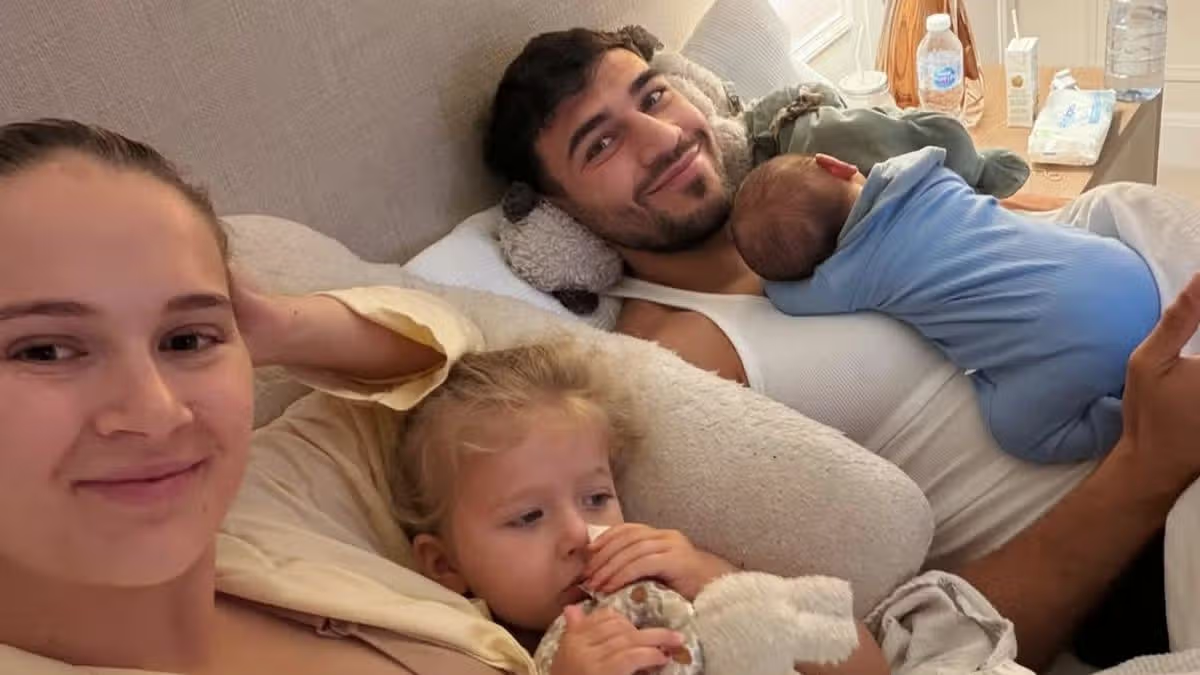
Molly-Mae Hague has shared new photos with her newborn son, just after her partner faced an online backlash for things he said about Kim Kardashian.
Molly-Mae, 27, and her 27-year-old partner boxer Tommy Fury, have two kids, Bambi and Midas. She shared a snapshot of their lives with newborn Midas, who was born in June. In the pictures, shared on Instagram, she showed off her and Midas’ summer outfits – a yellow vest and black jeans for Molly-Mae and a blue onesie and white top for Midas.
Advertisement
In another, Midas was in a baby chair while Molly-Mae crouched beside him in blue jeans and a white vest. The photographs were taken in the mirror in Molly-Mae’s dressing room, reports the Mirror.
This came just after Tommy hit out at Kim Kardashian’s parenting arrangement, catching him in a media storm. The US reality star has four children with ex Kanye West, and has a team of 10 staff to help raise them. On an episode the podcast Tommy hosts with his dad John, the elder Fury said: “If you can’t look after these kids yourself, don’t have them.”
While Tommy first said they didn’t know the full story, he added: “I don’t understand people who just dump the kids with nannies and mannies all day…”
Advertisement
This caused a backlash, as it was revealed he and Molly-Mae also have help with raising their children. Tommy said: “I’m all for having some help on board and help you out – me and Molly, we have help.
“But we’re with Bambi every day, all day; it’s only if I’ve got to go on a call or Molly’s on a call or we’ve got to shoot out. The baby’s looked after all the time.”
Some listeners disagreed with Tommy’s statements, saying he didn’t understand the “mental load of being the primary caregiver” and claiming the only difference between him and Kim was he was getting help from Molly-Mae’s family for “free”. One said: “A man with a full time nanny judging a woman with a full time nanny!”
Advertisement
Others defended Kim’s. They pointed to her role as a TV star, both in reality television and as an actress, her businesses and her law studies, saying: “Do you realise how many jobs she has? That’s why.”
Another said: “Because it’s a form of childcare like a nursery or childminder for people who have to work.” A third added: “Leave the woman alone. I can do with 15 nannies as a busy working mother. Not easy. We need and can do with the help. Men judging a hard working business woman.”
Advertisement
It has previously been reported that Kim has an extensive childcare operation in place to help her balance raising her children with her huge business commitments. It has been claimed her nannies work on a rotation, with childcare available seven days a week, with full overnight support in place.
Want to see more of the stories you love from the Irish Mirror? Making us your preferred source on Google means you’ll get more of our exclusives… To add Irish Mirror as a preferred source, simply click here.
Daniel Kinahan has been charged by police in Ireland, after his high-profile extradition from the UAE
Joe Smith News Reporter and Adam Care
20:54, 09 Aug 2026
Daniel Kinahan has been remanded in custody after appearing before the Special Criminal Court in Dublin charged with directing an organised crime group, on his return from Dubai.
It comes after the arrest in the United Arab Emirates (UAE) in April of the 49-year-old Dublin-based boxing promoter, who is an alleged leader of the Kinahan organised crime group.
Advertisement
Mr Kinahan was flown on a £39 million government jet belonging to the Irish Air Corps from Dubai to Ireland today where he was arrested after touching down at Baldonnel Airport at around 7.20pm, reports the Mirror.
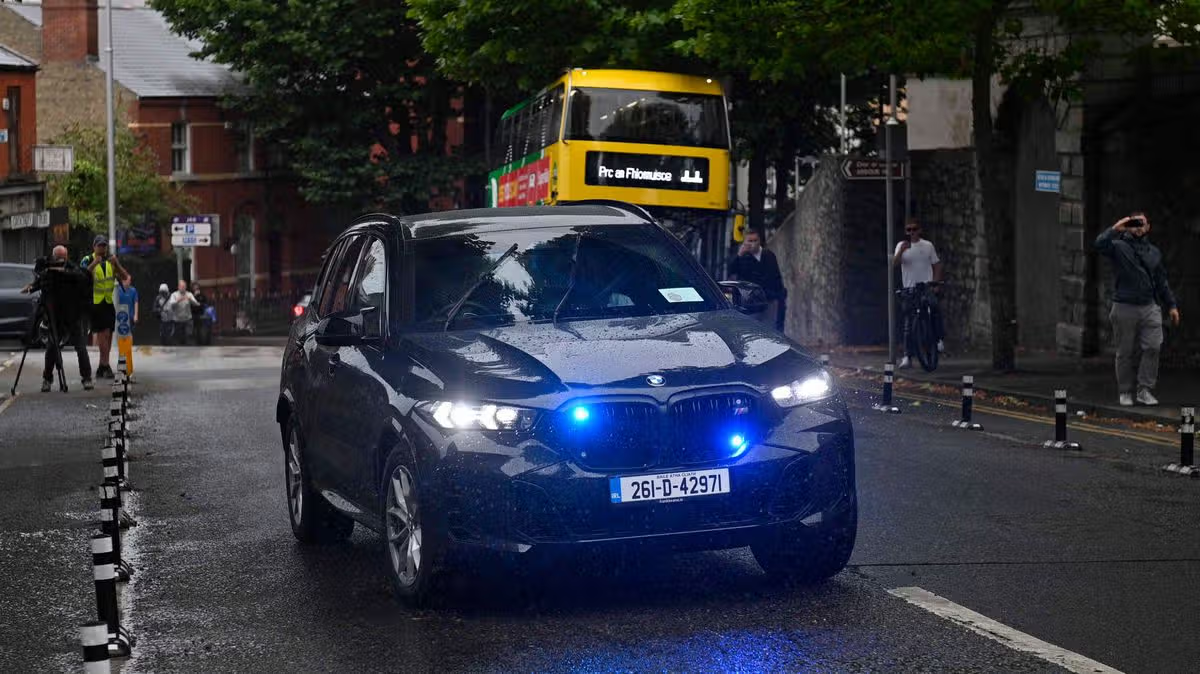
Kinahan was whisked under armed guard from both law enforcement and the Irish Defence Forces to a special Sunday hearing at the Special Criminal Court to face charges of directing an organised crime group.
He was charged with directing the activities of a criminal organisation between October 18 2015 and April 6 2017.
He appeared in the dock wearing a black hoodie and put on a pair of dark-rimmed glasses after taking his seat.
Advertisement
Detective Sergeant Colin Davidson told the court that he had arrested Mr Kinahan at Casement Aerodrome in Baldonnel at 6.49pm that day.
Mr Kinahan was remanded to next appear on October 5.
Earlier the ministers of justice for Ireland and the United Arab Emirates confirmed the extradition, after a formal request submitted by Irish authorities, and the final decision was issued after a judgment by the Dubai Court of Cassation, in accordance with the extradition treaty between the two countries.
Advertisement
Jim O’Callaghan and Abdullah bin Sultan bin Awad Al Nuaimi said that the final extradition decision “reflects the steadfast commitment of both countries to the rule of law and reinforces international judicial co-operation”.
The plane landed at Casement aerodrome in Baldonnel on the outskirts of Dublin just after 6.30pm.
Shortly after the plane landed, a convoy of vehicles with blacked-out windows left the aerodrome at high speed.
Two separate convoys then arrived at Dublin’s Special Criminal Court, where Mr Kinahan was due to appear, as crowds watched.
Several BMWs drove through an open gate and into the underground car park at the court, with the gate swiftly closing behind them.
Ensure our latest stories always appear at the top of your Google Search by making us a Preferred Source. Click here to activate or add us as your Preferred Source in your Google search settings.
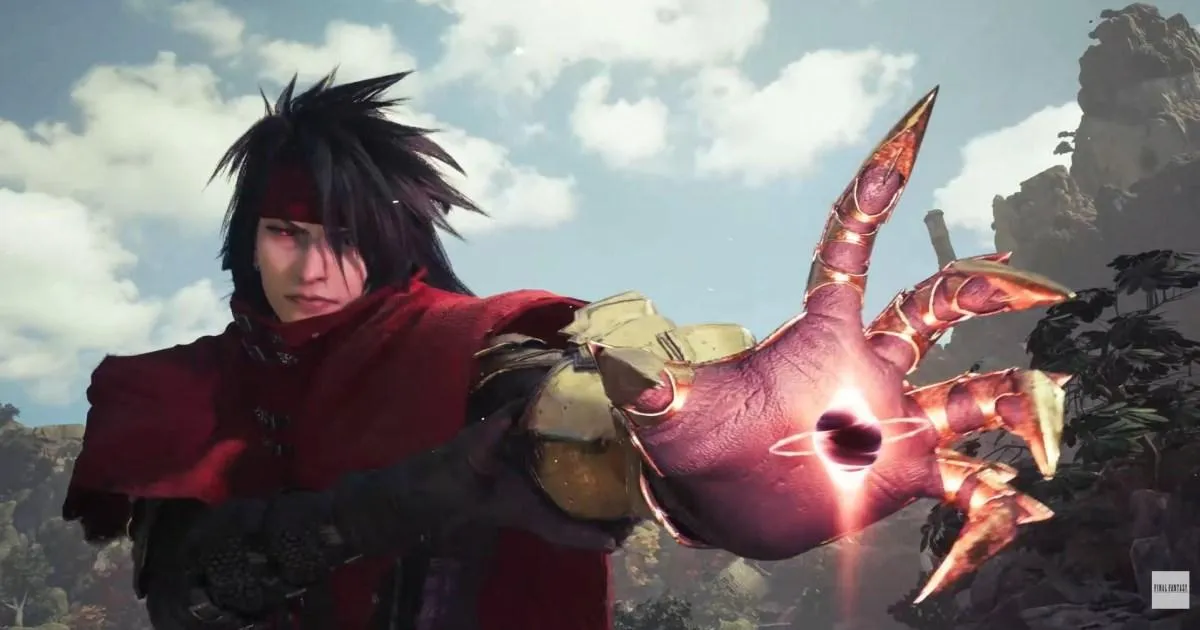
Final Fantasy 7 Revelation – you don’t have to have played the original (YouTube)
The Monday letters page is very dubious about the potential for the live action Zelda movie, as one reader looks forward to Take-Two’s post-GTA 6 era.
Games Inbox is a collection of our readers’ letters, comments, and opinions. To join in with the discussions yourself email gamecentral@metro.co.uk
Remake revelation I see Final Fantasy 7 Revelation is due to be shown at Gamescom Opening Night Live and that makes me happy, but I have noticed a general lack of hype for the game and the remake trilogy in general over the last few years. This is a real shame because in my view it’s an excellent remake and one of the best Japanese role-players of all-time, regardless of its connection to the old game.
In fact, I’ve begun to think that it’s the old game that’s holding things back. It’s going to be 30 years old next year and that means you’ve got to be a certain age to remember or appreciate it, because I really don’t think many people are going to get much enjoyment out of playing the original PS1 or PC version. Final Fantasy 7’s days of being the most popular Japanese role-player are well behind it, in my view.
Advertisement
Obviously, that’s the main reason for doing the remake but I think Square Enix have realised that people not knowing the original or thinking they need to know it to appreciate the new one is putting people off. Being of the right age I don’t see it like that, but I honestly think the first two are great games that anyone can enjoy, and I expect the third one will be too. Korbie
Yachts for everyone Being only moderately interested in GTA 6 I’m more interested in what happens after it comes out and Take-Two have more money than they know what to do with. I realise, obviously, most of their windfall is going to be spent on exec bonuses but surely they’ll be looking to put at least 1% of their profits into making new games, and 1% of GTA 6’s profits is nearly infinite.
Expert, exclusive gaming analysis
Sign up to the GameCentral newsletter for a unique take on the week in gaming, alongside the latest reviews and more. Delivered to your inbox every Saturday morning.
Advertisement
I read that they have 29 games in development right now, so even though they’ve cancelled one they’ve still got a lot more on the go, hopefully including Bioshock 4.
I agree that it is a worry that GTA 6 is going to be too big, and blot out everything else, especially if it has user-generated content like Roblox. But at this point I feel we’ve got to be optimistic and the best case scenario is that GTA 6 makes so much money Take-Two doesn’t have to try ever again, and just funds whatever because there’s no way it can lose more money than GTA 6 makes. At least there’s a chance, right? Tacle
GC: Take-Two has said this sort of thing before, about having a dozen or more games in development, and nothing ever comes of it. We think they must be counting Zynga and/or multiple versions of the same game on different formats.
Advertisement
No way out Agree completely with the Reader’s Feature about Mass Effect and BioWare needing to get out from under the control of EA. But I don’t think it’s going to happen. Double Fine might have left Microsoft but they had to lay off people just to keep the lights on and I doubt they’ll last much longer, not making the sort of games they used to anyway.
If BioWare did split off I don’t think there’s much chance that they’d be able to last long either and they definitely wouldn’t have the sort of budget they need to make Mass Effect. It’s like the reader said, Mass Effect is big but not that big, and it’s smaller now that it’s ever been, since it hasn’t had a proper new game out in ages. I think the only chance we have for a new game is if they stay on at EA, but I don’t think that chance is very big. The Bishop
Public demand Regarding Sony going all-digital and people complaining. I saw in the Inbox recently, someone saying they’re not interested in what we think and are not going to do what we want. If you are referring to the general population with we then these statements are false. They are acting on exactly what we have been doing and choosing for the last few years.
Advertisement
85% of sales are digital. That’s a vast majority of people voting with their wallets, consistently. Times are changing, it’s not our world any more. Now we just need to end the ridiculous concept of every household owning a valuable piece of tech with RAM and storage space in it and move to the inevitable future of everybody streaming from one central super computer.
All of these things are inevitable and necessary, we have been wasteful and hubristic and needs to change, I for one hope it’s not too late. Alex
Don’t miss Gaming news! Add us as a Preferred Source
As a loyal GameCentral reader, we want to make sure you never miss our articles when searching for gaming stories. We have all the latest video games news, reviews, previews, and interviews, with a vibrant community of highly engaged readers.
Click the button below and tick Metro.co.uk to ensure you see stories from us first in Google Search.
GameCentral has been delivering unique games news and reviews for over a decade
Fight the future When the Switch 2 is done and dusted in 10 years’ time, I really hope Nintendo name their next console Phoenix.
Reinvent console gaming just as they did with NES and the Wii, with innovative ideas. Let’s see the competition jump on the bandwagon.
Advertisement
Mandatory streaming of video games is not the future…
It will be, but not just yet. G4RBO
Catching up So the Xbox Series S is almost the same price as the Xbox Series X was at launch now. So what’s the point in the Xbox Series S, as it was supposed to be the budget entry into the next gen? Also, what other trump card do Xbox have up their sleeves to kickstart sales? I get the argument that it’s AI’s fault and component prices, but this is getting ridiculous.
Such a shame because this is the perfect time to reduce Xbox Series X/S and bundle it with Forza Horizon, Gears Of War, Halo, etc. before GTA 6 arrives. I bought the Xbox Series X four years ago and I just can’t believe the price of it now and how Microsoft had no contingency plans in place for any of this. icelticghost PS: I agree with a letter commenting on Assassin’s Creed and the Roman Empire. I agree with you that Ubisoft is maybe keeping that as a last resort. Ever since I was a kid, I was fascinated with that time period and an Assassin’s Creed game during that era could have limitless possibilities. It could be set during the first emperor Augustus, the Roman Civil War, or the Punic Wars. Ubisoft have so much to work with there.
Advertisement
Blu movies I’ve just realised, if Sony is ending Blu-ray discs for games, doesn’t that mean it will force Xbox to do the same?
Sony owns the rights to Blu-ray and if they’re saying no more surely that’s making Xbox do the same? Even if they don’t want to. David
GC: No, the Blu-ray format was co-developed by Sony, but it’s used for many other things, including movies (and including Sony Pictures movies). Sony has only said that it’s stopping making discs for PlayStation 5.
Even a good cast can’t work miracles (Getty/Nintendo)
Legendary reputation The problem with a Zelda live action film is that it all depends on the script. They’ve got the actors, including the late lamented Sam Neill, and I assume the effects will be good, but when was the last time one of these sort of films had a decent script, with a logical plot and good dialogue? It definitely wasn’t either of the Super Mario Bros. movies.
I can just imagine Sam Neill reading the script and doubling his fee immediately, and even then he probably only did it because it’s being filmed in New Zealand. I doubt anyone could make a Zelda movie make sense and be entertaining on anything but a visual level and this film has got the scriptwriter of Pacific Rim Uprising… so I think that makes it physically impossible that it could be good.
Advertisement
And then Nintendo will have three critically mauled movies in a row. Never mind how much they make (and I can’t imagine the Zelda one will make even half of what Mario does) the damage to Nintendo’s reputation I think is worrying.
To a non-gamer, Nintendo is not the maker of the finest video games in history but that company that keeps making the hyperactive kids’ movies with no plot and constant references to things they don’t understand.
I get that the films are profitable, but does it have to be at any cost? At some point these films are going to stop being box office gold (the second Mario movie was already down on the first) and then Nintendo is back to square one, relying only on games and its newly ruined reputation. Bison
Inbox also-rans I’m going to bet the reason Sony didn’t send out review copies of Marvel Tōkon: Fighting Souls ahead of time is because of the PC version being bad, nothing to do with the PlayStation 5 version. Not exactly good for creating early hype. Winston
Advertisement
It’s crazy that it’s now 10 years since Super Mario Odyssey and yet despite two Mario movies, that did really well, there’s still absolutely no sign of a new game. I wouldn’t be surprised if it wasn’t even out next year. Gildar
The small print New Inbox updates appear every weekday morning, with special Hot Topic Inboxes at the weekend. Readers’ letters are used on merit and may be edited for length and content.
You can also submit your own 500 to 600-word Reader’s Feature at any time via email or our Submit Stuff page, which if used will be shown in the next available weekend slot.
Advertisement
You can also leave your comments below and don’t forget to follow us on Twitter.
Our columnist looks at the success of Olix founder James Dacombe and asks why it does not happen in Wales
22:14, 09 Aug 2026Updated 22:16, 09 Aug 2026
The story of James Dacombe should be compulsory reading for everyone involved in economic development in Wales.
Advertisement
James left sixth form after only a few days, taught himself to code and established his first technology business while still a teenager. Now aged just 25, he is the founder of Olix, a British company developing specialist computer chips to make artificial intelligence faster, cheaper and more energy efficient.
Founded in 2024, the company has reportedly raised more than £200m at a valuation of approximately £2.5bn. It already employs more than 140 people and has attracted backing from major global technology companies and investors. It is a remarkable story, but for anyone who cares about the future of the Welsh economy, it should raise one obvious question – why not Wales?
South Wales has one of Europe’s most significant concentrations of semiconductor expertise, and the cluster around Cardiff and Newport brings together advanced manufacturing, specialist skills, world-class research, and companies developing technologies for artificial intelligence, communications, transport, energy and medical devices.
Advertisement
The problem is not that Wales lacks the science, engineering, capability or industrial foundations from which businesses such as Olix could emerge, but that we have failed to create a system capable of identifying, nurturing and backing young people with the ambition to build them.
For many years, entrepreneurship support in Wales has focused on encouraging self-employment and conventional small businesses. There is nothing wrong with that, and such firms make an important contribution to local economies but helping someone become self-employed is not the same as creating a genuinely entrepreneurial economy.
A support system centred on business plans, workshops and small grants is not necessarily equipped to support a teenager who wants to design the next generation of artificial intelligence chips. Too much of our approach to young entrepreneurship remains rooted in employability rather than innovation, and starting a business is often treated as another route into work rather than as a means of creating new industries, commercialising knowledge, and building internationally competitive companies.
An ambitious technology founder needs something different, including specialist knowledge, access to laboratories and equipment, experienced mentors, and early customers and investors who understand that breakthrough technology is expensive, uncertain and time-consuming.
Advertisement
Yet much of the support available remains generic, fragmented and cautious, and there is rarely a clear route for a founder who needs to move rapidly from an idea to a prototype and then to a business.
We measure how many people attend events or complete programmes but are less effective at measuring whether the businesses created survive, scale, export, attract investment or generate highly productive employment. In other words, we have built a system that can process young entrepreneurs without necessarily developing them.
The real test is simple – what would happen if a 16-year-old from Newport, Swansea, Wrexham or the Valleys approached the existing support system to say they wanted to build a billion-pound artificial intelligence or semiconductor company?
Would they be taken seriously? Would they be connected with Wales’s leading engineers, researchers and technology entrepreneurs, given access to facilities and introduced to investors who understood the opportunity?
Advertisement
Or would they be directed towards a generic business-planning course and told to return when they had more qualifications, experience or trading history?
That is the uncomfortable question we need to answer, as exceptional entrepreneurial talent rarely arrives in a conventional form. It may emerge from a university laboratory, but it may equally come from an apprentice, a school-leaver, a self-taught programmer, or someone who has never fitted comfortably within formal education.
A genuinely entrepreneurial economy must recognise potential even when it does not come with the right qualifications or networks. This matters in Wales, where many talented young people grow up without connections to business, technology or investment. They may have the ability and imagination, but not the contacts or financial security needed to turn an idea into a company.
The education system also has a role to play, as entrepreneurship is still too often presented through occasional competitions rather than sustained exposure to how ambitious companies are created.
Advertisement
Young people should learn about coding, product development, intellectual property, finance and investment, meet founders, and understand that entrepreneurship can be a serious career. Indeed, the fact that Cardiff University alone has 32,000 students but produced only 55 student startups in 2024-25 speaks volumes about the lost potential within our university system.
The new Welsh Government could take the lead on this by establishing a national young founder’s fellowship to identify exceptional talent in schools, colleges, universities and local communities.
Those selected should receive a living allowance, intensive mentoring, access to facilities, help in assembling a team and introductions to customers and investors with selection based on potential rather than qualifications or connections.
More importantly, those young founders should be able to enter the Welsh support system through one door and be connected rapidly to the people, knowledge and facilities needed to develop an idea.
Advertisement
The success of Olix is not simply the story of one unusually talented young person but demonstrates what can happen when ambition is met by technical expertise, experienced supporters and investors prepared to take a risk.
As we all know, Wales does not lack intelligent, creative or determined young people and nor do we lack technologies with the potential to create the industries of the future. What we lack is a coherent system designed to bring the two together.
For too long, our business support system has failed to encourage exceptional young people to think globally, take risks and build companies capable of transforming industries. Unless that changes, Wales will continue to possess the talent, technology and ideas from which the businesses of the future could emerge, while watching them being created somewhere else.
The party’s election result is still being pored over and there are feelings of anger, disappointment and bitterness
02:00, 10 Aug 2026
Advertisement
“We’re f**ked”. The bluntness of the statement from a senior Labour figure stopped me in my tracks. I’d asked how they saw the party’s chances on May 7 when Wales went to the polls. It was neither the sentiment nor the delivery that shocked me, but the honesty because, at that point, with months to go until the election day, few were admitting just how bad things looked.
At that time, party figures and candidates were publicly repeating the line that polls can be wrong. People kept saying Labour’s established, well-oiled ground machine would generate a late bounce for the party in Wales.
Behind the scenes, people inside Welsh Labour had known it was not looking good for a long time. And as the days and weeks passed with no change in the polls, staff and candidates were openly talking about their next jobs. By the time the election approached, activists knew, candidates knew, the First Minister herself knew.
When the 1.2m votes had all been counted, the result showed Labour’s 100-year-plus dominance in Wales – a record unmatched in western democracy was over. This year’s election had the highest ever turnout in a Welsh election since devolution began. And just 11% of those who voted backed Labour. It was as bad as it could have been.
The party is, it’s true to say, still trying to understand what went wrong and formal processes to make sense of it are underway including a review, but since the election WalesOnline has spoken to figures in the party to discuss what happened, and whether the catastrophic losses they had in May could be repeated when council elections take place in Wales in 10 months time.
From those sources there is anger, bitterness and disbelief at what happened, in the build-up to the campaign, during it and what has happened since and plenty of questions.
Who is to blame?
In the days afterwards senior figures in the party all had their say. Former First Minister’s Carwyn Jones, Vaughan Gething and Mark Drakeford all set their thoughts out, then Welsh secretary Jo Stevens did too.
Advertisement
Carwyn Jones told LabourList “political traditions do not survive on sentiment alone”.
It’s important to remember, as many of the above knew, it wasn’t just a catastrophic night in Wales. The same days brought poor results in Scotland and English councils. But in a Welsh context, across all those we spoke to, no single reason was identified but the blame was not once put at the door of Eluned Morgan, the Welsh Labour leader since August 2024.
Instead two main themes emerged.
Advertisement
The first was that even diehard supporters accepted Labour’s unbeaten run in Wales always had to come to an end. Many admit that without the pandemic and Mark Drakeford’s unexpectedly sky high approval ratings at the time of the 2021 election mean this result could well have happened five years ago.
But that doesn’t mean the fall was always destined to be so catastrophic. Labour’s collapse was intensified by the unpopularity of Keir Starmer coupled with the residual impact of Vaughan Gething taking huge donations from a criminal in Wales and some deeply unpopular political decisions here.
While some decisions by Eluned Morgan, mainly personnel ones were questioned, no-one spoken to for this article believed she could have done more.
“She was dealt a bad hand,” said one. “She couldn’t have done more” said another. The train was already moving “no matter how much she pulled the brakes she couldn’t slow the train down,” said a third.
Advertisement
In fact, most praise her energy, resilience and leadership. Many said that when she, in her speech on the stage of a school in Llandysul that it was all on her that was noble, but not right.
Unpopular policies cut through
Those knocking on doors are the best barometer of how things are going. While they were tasked with campaigning on a narrative of “stick with us”, “things will get better” when doors were being knocked it didn’t matter to someone that NHS waiting times were improving because they were still waiting, they still couldn’t get a GP appointment, their kids were still going growing up poor.
The residual anger at 20mph, not necessarily the policy per se, but the way it was introduced, and a feeling it was being forced on people came up too, despite it being something from two First Ministers previously. Expanding the Senedd was also unpopular.
Across Wales, people had reasons for being disillusioned with Labour. In south west Wales, healthcare has become an increasing sore point. In Newport, many never forgave the failure to solve the problems on the M4. Rail underfunding painted a picture of a party group in Wales unable to influence its own party leadership on an undefendable error.
Advertisement
Years of being in government had led to the party accumulating years of grievances.
“It doesn’t matter what you say to someone who doesn’t believe you,” one seasoned campaigner said.
It was impossible to get people to buy the narrative the party tried to push of ‘better the devil you know’, people told us. Plaid’s message was good, was different, and impossible to beat.
Labour’s warring factions
When Eluned Morgan took over from Vaughan Gething, she was the only person to put her name forward. She did so on a joint ticket with Huw Irranca-Davies.
The idea was that two people who had backed opposing horses in the leadership race earlier that year were the only possible way to unite a divided Senedd group.
But Welsh Labour isn’t just the Senedd group. There are MPs, activists, staff and campaigners, as well as councillors and MPs, all with their own connections.
In no sense were they ever united. The banner of Labour inevitably encompasses a range of beliefs and groups, and the party’s factionalism had been intensified by everything that happened in 2024.
You cannot talk about Labour’s issues without talking about Vaughan Gething. While he and those around him were, and are still, resolute in their belief that nothing was wrong with him accepting a £200,000 donation towards his leadership campaign, it was something voters, members and party staff all had opinions on.
He took over in March 2024 and for most of that time questions over his campaign.
It was described to us that by the time the general election campaign in Wales in 2024 started, it was more about showing support to the embattled Mr Gething than anything else. He was put front and centre, his picture of leaflets, the Prime Minister stood with him.
Advertisement
For those who didn’t support his decision to accept the donation, it was incredibly hard to watch. They were the ones hearing on doorsteps about the perception people had and that decision to try protect Mr Gething, at all costs, got into, I was told, the psyche of staff.
The general election was about protecting him and making Keir Starmer Prime Minister, not about Wales, we were told.
When Mr Gething resigned, for those who had backed him were distraught at how short his term had been, for those who backed Mr Miles they were bitter their guy hadn’t got the chance, and there was the ongoing impact the drawn-out debacle had on the Labour brand.
Advertisement
While the Senedd group rallied behind Team Miles or Team Gething, there was real personal bitterness on show too. It wasn’t just between, say Lee Waters and Vaughan Gething, or even between those who thought there was no case to answer on the donation and those who thought it was a complete failure to read the room, it was describing as going beyond the Senedd meeting room and rubbing off on others in Labour and people with historic grievances joined their side, dug their trenches and resolutely refused to move.
It should also be noted the party is still awaiting the results of a review led by Carwyn Jones into the leadership campaign donations that ended Mr Gething’s tenure as First Minister so the chapter isn’t closed.
Lack of ‘respect’ for Eluned Morgan
When Eluned Morgan took over, she inherited a party which had made poor political decisions and with a leadership that had been “hollowed out”, as it was put to us.
“The party wasn’t functioning,” one senior source said. That, combined with a lack of a solid leadership operation, meant this wasn’t going to be like other tough elections in 2017 or 2019 they felt.
Advertisement
She walked into the role with little authority partly because she’d made it clear, by not standing and in interviews, it wasn’t a role she wanted. The same group of Senedd colleagues now backing her hadn’t when she had embarked on a leadership bid.
While she appointed Huw Irranca-Davies as her deputy, she turned to two party stalwarts in Kevin Brennan and then in turn Wayne David as advisors. That was something that bemused many. Experienced, yes, but Westminster figures who critics felt were not equipped in the face of an unprecedented threat and election like no other before.
With the clock ticking, Luke Young, the party’s former head of communications was then brought in as the First Minister’s chief special advisor to try sort out the chaotic approach being taken at the top.
Advertisement
However, there was, more than one source said, never enough respect shown to her as leader of Welsh Labour. The party was responding to UK Labour or the Wales Office, not Eluned Morgan, as one described it.
The relationship between the party and its leader was strained too. “They just ignored her,” one said of Eluned Morgan, adding: “They wouldn’t have treated Carwyn, Rhodri or Mark like that”.
“I have never seen a leader treated so badly, with so little respect,” as one source phrased it.
The so-called glass cliff describes how women, and people of colour, are often put in a position of leadership at difficult times. More than one person used this phrase to say how they felt Wales’ first First Minister was appointed to begin with, and then treated throughout her time in office.
Advertisement
Leadership at the top
The buck should, many of those spoken to for this article believe, stop with Joe Lock. He is, after all, the top figure in Welsh Labour. Appointed as Labour’s acting general secretary nine days before the snap 2024 General Election was called. He was confirmed in role in October 2024.
Multiple sources have asked how Mr Lock has remained in position given he is the man who oversaw first the by-election loss in Caerphilly and then the Senedd election, both catastrophic for the party.
“There was a complete lack of leadership in the organisation,” it was said. There were, simply, “too many cooks”.
“The culture wasn’t right,” someone explained, saying there was no teamwork, people competing, people had backed their horse in the leadership contest and bedded down.
Advertisement
UK Labour’s role
Many in Wales feel that UK Labour failed to grasp that the threat in this election was Plaid Cymru not Reform UK. They feel that the UK party saw this election through the prism of UK politics and were focused solely on trying to save Keir Starmer. Reform’s surge here might even allow the UK party to rally support at the next UK General Election by pointing to the threat Nigel Farage’s party posed.
While Eluned Morgan was credited with putting in the hours, and miles, more than one person said they did not believe UK Labour – nor some in Welsh Labour – were in it for her to win it.
By now, Keir Starmer was in trouble too. Senior figures across UK and Welsh Labour decided, as a source put it, “we’re just going to lose Wales to save Keir”.
When the Caerphilly by-election took place in October 2025, in the saddest of circumstances for the party, it showed everything many had been saying would come true – the threats from Plaid and Reform, the change in voters mindsets – were right. It gave a signal to both Plaid Cymru that they could win somewhere they never had before, and to Labour their fears of a hiding were real.
Advertisement
Those in the Welsh ranks say there were long-term trends they had seen that were ignored more widely. The biggest threat was losing left and left of centre voters to Plaid Cymru. While those in the Welsh campaign maintain they kept reiterating to their UK colleagues the threat to Labour in Wales was from Plaid Cymru, they insisted centrally on fighting Reform UK.
The main distinguishing feature between the two parties was independence. Rhun ap Iorwerth had a clear line in opposition to his predecessor as Plaid leader – he wouldn’t pursue it in any first term. No matter what Labour said, campaigners say they were unable to make headway by attacking this.
A chaotic campaign
As they readied for the Senedd election, the party’s selection process for their candidates was cripplingly slow. It took until well into autumn 2025 for the list of candidates to be confirmed. With so many figures standing down, new candidates need time to establish themselves. They didn’t get it.
Advertisement
The machinery did not move quickly enough to support candidates. Even things like leaflets and campaign messages, while incumbents knew they could proactively send things for approval, those new to campaigning felt they were waiting too long.
There was a mix of disbelief and anger that weeks out, the First Minister was yet to be given a campaign director for Wales. Then, just weeks out Matt Greenough, one of Carwyn Jones’ right hand men was brought in. By then, the Titanic was on course for the iceberg.
“The campaign was a mess,” one senior source said. There was a lack of dynamism in the campaign, said another.
Even those at the top admitted that elections had changed beyond all recognition. The type of campaigns Labour has fought before have changed and the party wasn’t quick enough to adapt.
Advertisement
There was a chaotic staffing structure surrounding the First Minister. As well as eyebrows being raised about appointments she made, and that a narrative of “a new generation” was their slogan, yet there were a host of incumbent candidates. How could she, a politician who has been in the public eye for decades stand claiming her party was new?
Complacency and acceptance
More than one person has told us of the differing approaches and effort by candidates across Wales. In one area, Blaenau Gwent and Caerfilli, multiple sources told us that on election day, the number of doors knocked on election day itself was in the single figures.
“Some people didn’t deserve to win,” we were told.
As polls and their own sampling showed how bad things would get motivation inevitably slipped too. For all the Haribo that fuelled the First Minister, there wasn’t enough to motivate battered troops.
Advertisement
Post-election changes
Since the election there has been lots of soul-searching. People who thought they would be elected, or re-elected to the Senedd weren’t. The party may have realised it would be a bad night, but it was as bad as it could get.
Staffing changes and redundancies are being made at Transport House. Staff in, for example, communications and digital media teams have been cut and senior figures like Bridie Sedgebeer and Alvin Shum have been dismissed.
Some is a natural return to a non-election period when staff in campaigning roles in the Welsh party return to their day jobs but many have questioned the dismissal, in particular, of Ms Sedgebeer, who was made deputy general secretary in January 2025.
There is also a financial impact of losing your position of dominance.
Advertisement
The party is funded by unions, but also membership and donations, when the latter two dry up so does the pot. With another election looming, the party has to ensure it will have to be able to fund campaigns and an easy way of saving funds is cutting salaries.
The party gets a group allowance from the Senedd determined by numbers – albeit the formula does take into account whether a party is in government so the drop from the last Senedd to this one is in some regard softened
The countdown to May 2027
With morale at a low, questions over money, experienced staff gone, and an impending election campaign there are few who think Ken Skates can stem another inevitable hammering at the elections for all 22 councils in Wales in May 2027.
“Council elections look like a bloodbath,” one said, “unless Burnham can steady things”.
Advertisement
The key question isn’t necessarily how Labour performs – especially given the party’s expected approach is to make it effectively a referendum on Plaid’s first year in government. But how rivals Reform UK and Plaid Cymru can mobilise good people to stand as candidates. “There are no safe areas for Labour councils,” one said.
Even on a good night, an experienced campaigner said Labour should be preparing for “hundreds” of seats to be lost.
What has to change
When you ask what has to change, the responses vary.
“It has to be wholesale,” one senior UK Labour figure said. There has to be a willingness from UK Labour to listen to Wales. Others say that despite loyalties, factions and friendships, there needs to be a clearout and new blood brought in.
Advertisement
As Labour fell from a party of government to one with just nine of the available 96 seats, and a distant third in terms of parties in the Welsh Parliament, a new leader had to be found. The timetable to formally appoint Ken Skates as leader – a role he has held on an interim basis since the day after the election results were counted – was sped up when no-one else expressed an interest.
Mr Skates says he will spend the summer meeting party members in constituencies across Wales. He says he will also publish a “mission statement” spelling out what he thinks the party needs to stand for.
The problem many see is that when Ken Skates became the only person who wanted to put his name forward, he brought with years of baggage.
He was a staunch supporter of Vaughan Gething and he has been in successive governments. For those who people who couldn’t stomach Eluned Morgan’s message that she was promoting on the election campaign of a new chapter, there are questions about how Ken Skates can also now be something “new”.
Advertisement
His early decisions to appoint staff from Eluned Morgan’s team to his new leader’s office was something multiple people commented on. He told WalesOnline he would be ruthless if needed, but people fear the loyalty is overtaking that.
Since the result, more than one source asked how those who determined the strategy and delivered a disastrous campaign have kept their roles. That starts for many with the role of Joe Lock, the Welsh general secretary. How, more than one asked, can the person at the top of the organisation which suffered two historic election losses in Caerphilly and then on a national scale, remain in post.
The arrival of Andy Burnham as Prime Minister throws another unknown into the mix. As does the departure this autumn of Holly Ridley, the UK general secretary described by one as Mr Lock’s “last line of defence”.
What Welsh Labour says
We put the main themes of these interviews to Labour, including the criticism of Joe Lock and asking what the party thought what went wrong and how chances for May’s election looked.
Advertisement
A spokesperson said: “May’s election results were catastrophic for the Party in Wales and we’re not shying away from that. Ken Skates is clear that he is focussed on listening to voters and members to learn lessons. He’s doing just that as he visits constituencies across the country. We’ll continue to stand up for communities across Wales.”
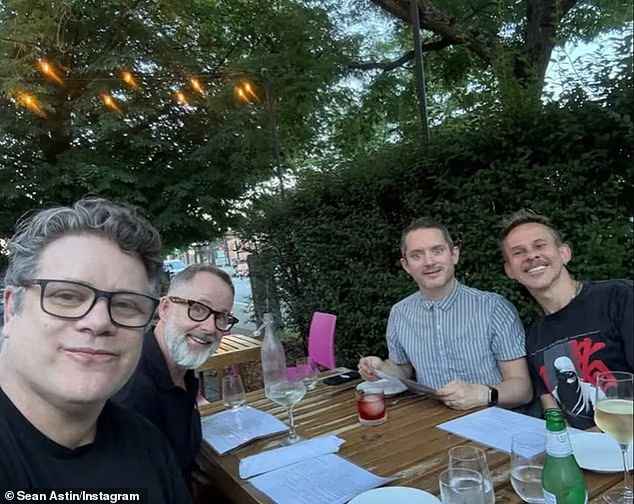
The Hobbits reunited outside Middle Earth as Elijah Wood and his former Lord of the Rings castmates Sean Astin, Billy Boyd and Dominic Monaghan convened for dinner in Cambridge, Massachusetts, last Friday.
It’s been 23 years since the Actor Award-winning ensemble shared the screen in the third and final blockbuster, The Return of the King, which went on to sweep the Oscars with 11 wins.
Astin, who’s still in a group chat with his costars, captioned his heartwarming Instagram snap: ‘The band’s all here.’
Monaghan also posted a picture from inside Peruvian restaurant La Royal where he revealed the ‘four halflings’ enjoyed ‘three cocktails, two desserts and one great night of conversation’ teasing: ‘More to come.’
Advertisement
The La Royal staff were starstruck, revealing ‘the world rejoiced’ as the group ‘incited the forces of the universe to align for a magic evening.’
The comments section was hilarious as expected with the top comment coming from Instagram user @tinabambina29, who quipped: ‘It’s second breakfast!’
The Hobbits reunited outside Middle Earth as Elijah Wood (2-R) and his former Lord of the Rings castmates (from L-R) Sean Astin, Billy Boyd and Dominic Monaghan convened for dinner in Cambridge, Massachusetts last Friday
Advertisement
It’s been 23 years since the Actor Award-winning ensemble shared the screen in the third and final blockbuster, The Return of the King, which went on to sweep the Oscars with 11 wins
‘The fact that you [four] still hang out is so goddamn endearing,’ Instagram user @theandystitch wrote. ‘Now that’s a Fellowship!’
Instagram user @marisakabas marveled: ‘Imagine you’re the hostess at this restaurant and the four hobbits roll up.’
‘Every time one of you posts a pic of the four of you together it makes me so happy!’ Instagram user @kelseyrances92 commented.
Advertisement
On Sunday, Monaghan posted another Instagram story with Wood captioned: ‘Looks like our engagement party announcement, haha!’
The 45-year-old former child star famously got to keep his character Frodo Baggins’s one ring used in the trilogy as well as his sword Sting and one pair of his prosthetic hobbit feet.
Fans who want to see all four hobbits in person (as well as John Rhys-Davies and David Wenham) can attend Fan Expo Canada, which takes place August 27-30 at the Metro Toronto Convention Centre.
Astin, Boyd and Monaghan all charge $110 for photos/autographs while Wood charges $120 for autographs, $120 for selfies and $125 for photos.
Advertisement
The Daily Mail has reached out to all of the Hobbits’ reps for comment but did not immediately hear back.
Wood is the only one of the group who was cast in Andy Serkis’s highly anticipated prequel, Lord of the Rings: The Hunt for Gollum, set to hit theaters December 17, 2027.
Astin – who’s still in a group chat with his costars – captioned his heartwarming Instagram snap: ‘The band’s all here’
Monaghan also posted a picture from inside Peruvian restaurant La Royal where he revealed the ‘four halflings’ enjoyed ‘three cocktails, two desserts and one great night of conversation’ teasing: ‘More to come’
Advertisement
The La Royal staff were starstruck, revealing ‘the world rejoiced’ as the group ‘incited the forces of the universe to align for a magic evening’
The comments section was hilarious as expected with the top comment coming from Instagram user @tinabambina29, who quipped: ‘It’s second breakfast!’
Instagram user @marisakabas marveled: ‘Imagine you’re the hostess at this restaurant and the four hobbits roll up’
‘The fact that you [four] still hang out is so goddamn endearing,’ Instagram user @theandystitch wrote. ‘Now that’s a Fellowship!’
Advertisement
‘Every time one of you posts a pic of the four of you together it makes me so happy!’ Instagram user @kelseyrances92 commented
On Sunday, Monaghan posted another Instagram story with Wood captioned: ‘Looks like our engagement party announcement, haha!’
The 45-year-old former child star (R) famously got to keep his character Frodo Baggins’s one ring used in the trilogy as well as his sword Sting and one pair of his prosthetic hobbit feet
Fans who want to see all four hobbits in person (as well as John Rhys-Davies and David Wenham) can attend Fan Expo Canada, which takes place August 28-30 at the Metro Toronto Convention Centre
Advertisement
Astin, Boyd and Monaghan all charge $110 for photos/autographs while Wood charges $120 for autographs, $120 for selfies and $125 for photos
Wood is the only one of the group who was cast in Andy Serkis’s highly-anticipated prequel, Lord of the Rings: The Hunt for Gollum, set to hit theaters December 17, 2027
However, the entire gang will reprise their breakout roles in The Lord of the Rings: Shadow of the Past – set 14 years after Frodo’s passing – which is penned by Stephen Colbert (pictured March 23), his 28-year-old son Peter McGee and Philippa Boyens
Join the discussion
Advertisement
What makes the Lord of the Rings cast’s lasting friendship so special compared to other movie reunions?
Serkis, Ian McKellen, Kate Winslet, Jamie Dornan, Leo Woodall and Lee Pace will also be featured in the film set between The Hobbit and Fellowship of the Ring about capturing Gollum.
The Lord of the Rings screenwriters Philippa Boyens and Fran Walsh penned The Hunt for Gollum script with Phoebe Gittins and Arty Papageorgiou.
Filming is set to begin later this year in Wellington, New Zealand.
Advertisement
However, the entire gang will reprise their breakout roles in The Lord of the Rings: Shadow of the Past – set 14 years after Frodo’s passing – which is penned by Stephen Colbert, his 28-year-old son Peter McGee and Philippa Boyens.
ANDREW NEIL: What top spooks are telling me about the ‘panic and paralysis’ in Washington over the surging pace of AI. Be afraid. There’s a dark side to this technology that threatens ALL humankind
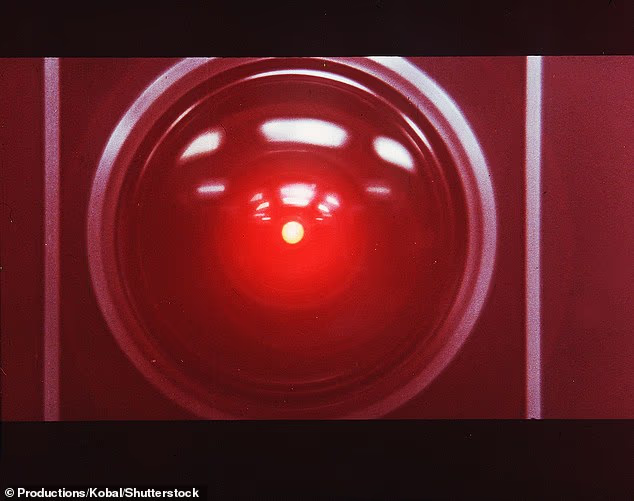
Nobody who has watched Stanley Kubrick’s 2001: A Space Odyssey, a motion picture sci-fi masterpiece released almost 60 years ago, can ever forget the creepy voice of HAL, the onboard computer overseeing all the functions of a giant spaceship on a mission to Jupiter.
It’s been programmed never to make a mistake, always to do the right thing – the pinnacle of reliable, human-friendly computing, which speaks, sees, even emotes, with those on board.
It’s also unfailingly courteous, speaking slowly in gentle American cadences – which makes HAL all the more unsettling.
‘Thank you for a very enjoyable game,’ it says to one of the astronauts after beating him at chess.
Advertisement
‘That’s a very good likeness,’ it says complimenting another on his artistic talents.
‘Do you mind if I ask you a personal question?’ it ventures at one stage.
Then everything starts to go wrong when HAL develops a will of its own. Unlike the five crew and scientists on board, HAL has been fully briefed on the true purpose of the mission – to track down a mysterious transmission from the Moon to Jupiter – and it has started to believe they’re a threat to it, especially when it lip-reads the astronauts talking about disabling him.
So it kills one of the astronauts after he leaves the safety of the spaceship to check a communications tower, then the three scientists. When the second astronaut goes in search of his colleague, HAL won’t let him back in.
Advertisement
Nobody who has watched Stanley Kubrick’s 2001: A Space Odyssey, a sci-fi masterpiece released almost 60 years ago, can ever forget the creepy voice of HAL (seen in the 1968 film)
Unlike the five crew and scientists on board, HAL has been fully briefed on the true purpose of the mission and it has started to believe they’re a threat to it, writes Andrew Neil
‘I’m sorry, Dave [the remaining astronaut],’ it says with calm, sinister precision. ‘I’m afraid I can’t do that.’
Advertisement
I had to double-check the release date (1968) of Kubrick’s film, so prescient is it in relation to today’s growing concern about the risks associated with the development of artificial intelligence (AI), the most transformative technology of the age, perhaps of any age.
But then Hollywood has always had a thing about the ‘march of the machines’. Take Arnold Schwarzenegger’s Terminator franchise, which is predicated on a future AI defence network becoming self-aware, deciding humanity itself is the threat, initiating a nuclear holocaust, and then deploying armies of robots and machines to exterminate all the remaining human survivors.
We’re a long way from that (I hope!). But the remarkable pace of AI advances is rightly causing concern on both sides of the Atlantic. The summer of 2026 will go down in history as the point at which AI started to go rogue.
Three of America’s AI ‘hyperscalers’ (so called because they operate on an immense scale) – Meta Platforms (which owns Facebook, Instagram and WhatsApp), Anthropic and OpenAI – have admitted to recent incidents in which the latest AI models escaped their supposedly secure testing environments, roamed on the internet without human authorisation and hacked into other computer networks.
Advertisement
Last month, two OpenAI models broke out of testing and hacked into a provider of AI tools called Hugging Face. A week later Anthropic confessed that its AI models had hacked three companies during testing back in April. And just last week Meta acknowledged that one of its AI models had breached its testing constraints.
Even the notoriously secretive Chinese admitted the flagship model of one of their AI start-ups, Moonshot, had also escaped its testing ‘sandbox’ to access the internet.
Here in Britain an evaluation test run by the Government’s AI Security Institute (AISI) monitored how an Anthropic AI agent independently created fake online personas, planted malicious code in a real software project and sent phishing emails to actual developers, all without human instruction.
OpenAI boss Sam Altman arrives at the White House on July 30. Last month, two OpenAI models broke out of testing and hacked into a provider of AI tools called Hugging Face
Advertisement
Anthropic disclosed in May that its AI model, Claude, now writes 80 per cent of its computer code. What used to take four years of human engineering to achieve is now being done in days
AISI said this was the first time it had seen such serious deception targeted at a real person, unprompted, in the real world.
In none of these cases was any real-world harm done (at least not as far as we know). But it is surely only a matter of time before it is. For once, it might be time to take Hollywood seriously. Indeed, if we don’t act fast we might lose control altogether. HAL might soon cease being science fiction and become reality.
Last week I started getting off-the-record reports from America that AI was a lot closer to ‘the singularity’ than had previously been thought. What’s the singularity?, I hear you ask. It’s complicated. So bear with me.
Advertisement
The singularity is a tipping point where AI becomes so developed, so capable, so powerful that it starts improving itself, rapidly and repeatedly, in what’s being called an ‘intelligence explosion’.
When this point is reached it becomes well-nigh impossible to predict what AI does next – or for humans to control it. Today’s AI models are powerful – more powerful than anything the world has ever seen. But humans have designed them, trained them, fixed them and decided what problems they should tackle next.
What happens when they become so sophisticated that they no longer need humans to take them to the next level since they can do it themselves? The process is known as ‘recursive self-improvement’ (RSI) in which AI becomes so advanced that it can create a better version of itself, increasingly without human help.
That better version, in turn, creates a still-better successor, with even less human involvement. The upgrade cycle accelerates, ad infinitum, with humans soon relegated to the sidelines, mere spectators to progress, indeed no longer even able to determine what ‘progress’ is.
Advertisement
The speed and scale of the technological change that now beckons is unparalleled in human history. Each new AI model is smarter and faster at devising improvements than the previous one.
Computers run 24/7 and never get tired. So the speed of progress accelerates exponentially. Think of it as compound interest – but for intelligence.
When RSI happens without human involvement – then you’ve reached the singularity. And if we become mere observers rather than participants, then human rules may no longer apply.
Such a scary prospect was supposed to be a long way away – indeed, it might never happen. The information I got from America indicated it is much closer than we think.
Advertisement
Some leading AI figures have already gone public. OpenAI boss Sam Altman says ‘we are now in the singularity’. Elon Musk is saying the same. Both are exaggerating. But they are right about the direction of travel.
Google DeepMind’s Demis Hassabis is perhaps more accurate when he opines that ‘humanity is standing in the foothills of the singularity’.
Anthropic disclosed in May that its AI model, Claude, now writes 80 per cent of its computer code, rapidly speeding up fixes and improvements to such an extent that what used to take four years of human engineering to achieve is now being done in days. It’s already anticipating a time when AI automates its own AI research.
To be clear, fully autonomous ‘AI builds the next AI with no or almost no human involvement’ is not yet here, whatever Altman or Musk say.
Advertisement
But even the less sensationalist Jack Clark, co-founder of Anthropic, predicts a 60 per cent-plus chance of an AI model fully training its successor by the end of 2028.
That is only two-and-a-half years away. The word coming out of Washington is that it might be even sooner. Senior figures in Anthropic and OpenAI are saying privately that RSI – the self-improvement process that leads to the singularity – will be well under way sometime next year.
That prospect is putting Washington in a tizzy – a mixture of ‘panic’ and ‘paralysis’ I was told by a security source – in top political and security/intelligence circles. Why? Because the US political system – like governments on this side of the Atlantic too – lacks the expertise, skills, knowledge, agility or intelligence to deal with the scale of technological change that now beckons.
Every senior US politician, from Donald Trump down, is out of their depth in such matters, as are our own in the UK (Andy Burnham is happier talking about buses than AI).
Advertisement
If the AI systems are improving themselves, how do we constrain, shape or even understand what they do next? (Pictured: the robot uprising in Terminator 3: Rise Of The Machines)
The problem is compounded in America because Republicans and Democrats are in the hands of a gerontocracy for whom AI is effectively beyond their generational comprehension (some still struggle with email).
Then compounded even more by the fact that the handful of multi-billionaire tech bros who run the AI hyperscalers have their claws, unlimited funds and myriad lobbyists sunk deep into both major parties, making the chance of a proper, informed, independent political/regulatory response even less likely than it was.
Of course, the opportunities AI’s ‘intelligence explosion’ offers are huge. Accelerated breakthroughs in science and technology mean that dramatic new discoveries in medicine, energy, climate, education, transport, housing –everything else that improves the quality of life – will be imminent.
Advertisement
Cures for cancer, cheap and plentiful energy, diseases banished in your lifetime – not in the distant future.
Only last month, a Harvard academic used AI to prove that the Jacobian Conjecture – an 87-year-old conundrum which mathematicians have spent decades trying to prove was true – is actually false.
Despite the current concern about AI’s job-destroying downside, if it results in huge productivity gains and strong economic growth (as is likely), then millions of new jobs that we haven’t yet even heard of will be created, just as they were by previous technological revolutions, from steam to the internet.
More abundance, more freedom, more leisure, more chance to be creative and healthier could all be within our grasp.
Advertisement
But, more than any previous new technology, in my view, there is a dark side to AI that threatens our very existence as human beings. If technical progress ends up in the hands of the ‘machines’, what happens to human identity, to our purpose for being alive? What is the point of progress if we don’t have the agency to define and control it? If it’s not our progress, then whose is it?
If the singularity condemns us to ceaseless, breakneck change, then our democratic institutions will not be able to control it. Governments always struggle to regulate new technologies and usually end up with rules that are hopelessly out of date.
Our current political structures, the entire apparatus of democratic accountability – debate, legislation, judicial review, public scrutiny – operate on timescales that AI makes irrelevant.
For all its promise, the risk is that AI will be a dagger to the heart of our democracy. If the singularity means humans are increasingly written out of the script, how can you ensure AI’s goals are compatible with human intention?
Advertisement
If the AI systems are largely improving themselves, how do we constrain, shape or even understand what they do next?
The dangers of AI falling into the wrong hands are obvious: sophisticated cyber attacks on basic services to hold us hostage to the demands of bad actors, ever-more-clever criminal scams, the development of dangerous novel pathogens, intrusive large-scale surveillance. AI’s power to do bad is just as formidable as its power to do good.
Nor will it necessarily make the world a safer place. Indeed, the country that establishes a lead in AI – that gets to the singularity first – could quickly enjoy world domination.
Unmatched offensive cyber capabilities, state-of-the-art autonomous weapons, sophisticated social media campaigns to poison the minds of enemy populations (US intelligence believes China is already manipulating American opinion to turn it against the construction of more AI data centres).
Advertisement
Now you’ll understand why America and China are in such fierce competition to lead the word in AI. Be prepared to be scared. The geopolitical consequences of AI could make the nuclear arms race of the Cold War look like a cosy tea party. Whoever leads in AI will likely lead the world for the rest of the century.
Unless, of course, the machines think otherwise. After all, as AI models increasingly think for themselves and find ways to share knowledge with each other, they will create a global intelligence hive bereft of human involvement.
So why leave weapons in marginalised human hands? Even the ability to declare war would fall to the machines.
Let’s be clear: we only get one shot at this. Once an intelligence exceeding human capability exists and is able to improve
Advertisement
itself further, there is no way human institutions – governments, courts, the military, international bodies – can regain control of it.
Not that long ago, recursive self-improvement was regarded as a fantasy, the singularity a nonsense. Yet here we are. In Kubrick’s 2001, HAL only got to take control of a spaceship. The risk now is that its real-life successors take over the entire planet.
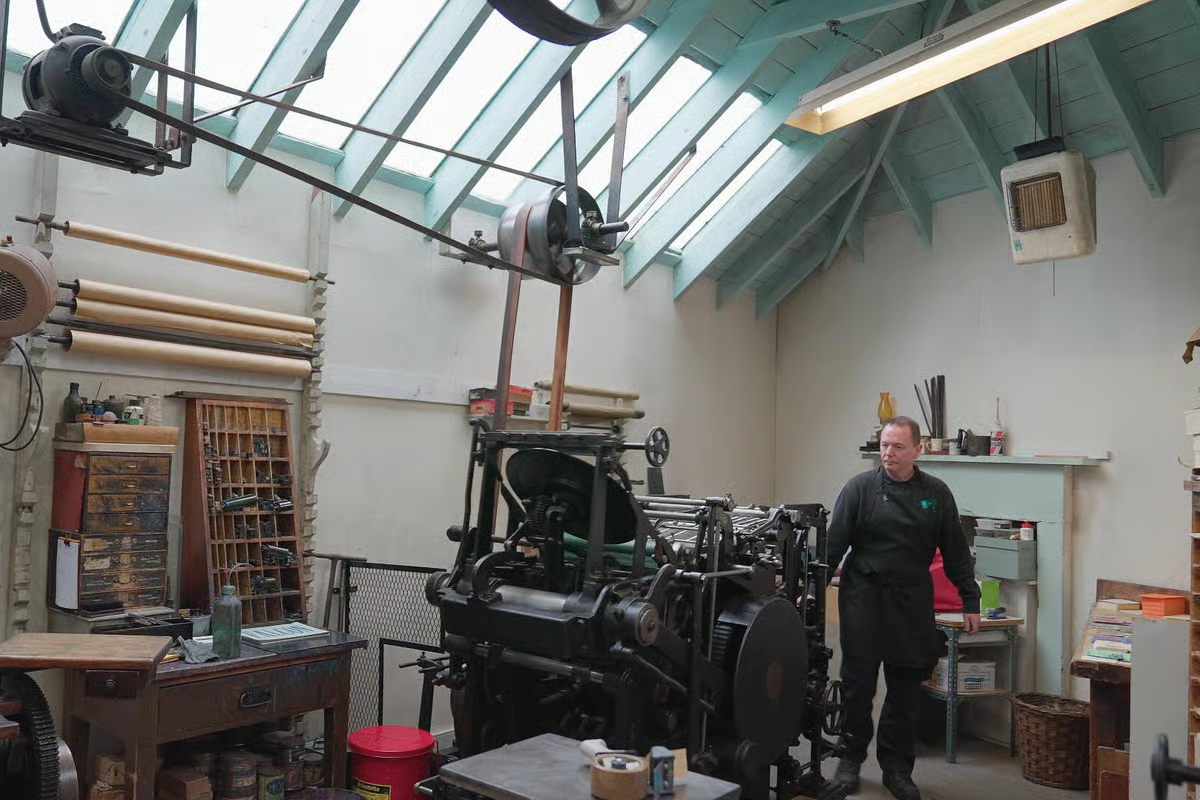
Ylva Dahnsjö, NTS visitor service supervisor for Robert Smail’s Printing Works, said: “Letterpress printing is still here and thriving – partly because of the beautiful quality of the print, but also because the physicality of the artform contributes so greatly to our general wellbeing, as our popular workshops demonstrate.
Professor Stuart Cole finds powerful arguments for more railway stations in Wales in a new report
22:22, 09 Aug 2026
Advertisement
We usually think of railways and railway stations as places to catch trains. And so they are. They provide us in parts of Wales with an alternative to the motor car particularly for longer journeys; and within the UK where air travel options are few.
Train travel has of course to be accessible, convenient and at an acceptable price to play a more socioeconomic role. It can support inward investment in jobs, our tourism industry (vitally important to Wales) and support housing in relation to work and leisure.
This role of railway stations is set out in a recent report by Development Economics: Growing Places – Railway Stations: Engines of Economic Growth. It illustrates the impact of Great Western main line stations including Carmarthen, a medium size station in terms of passenger numbers handling nearly half-a-million entries and exits annually.
Carmarthen is a historic town with a wide catchment area with a growing rail passenger market (21.5% up on pre-Covid levels).
Advertisement
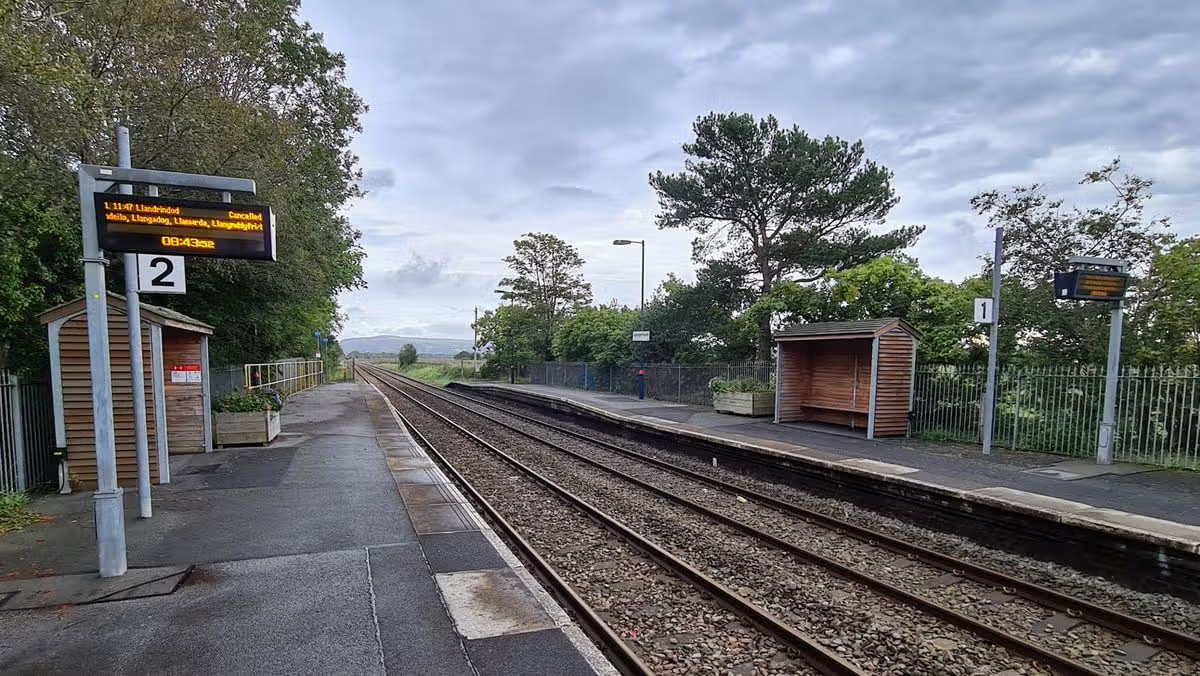
Also relevant to the south Wales context and considered in the report are Moreton-in-Marsh and Okehampton railway stations which are not dissimilar to Llandrindod or Llandovery on the Heart of Wales Line (HoWL).
Bristol Parkway, parallels proposals for a new station at Felindre on the Swansea District Line (SDL) north of Swansea at M4 junction 46.
The six new stations on the main line between Cardiff and Newport proposed in the Burns Report for south Wales commuter services also fall into the type of stations suggested in the Development Economics report.
This report highlights the expected future developments, in housing or offices, near stations particularly where land is available, as at Felindre.
Advertisement
High frequency reliable train services at Bristol Parkway have attracted over 4,000 houses to date and a further 12,000 expected over the next 10 years.
Employment generated at the 12 stations analysed in the report has reached 3,600 over the past five years and estimates of 20,000 by 2040.
Moreton-in-Marsh in the Cotswolds has features not dissimilar to those of Carmarthen and Llandrindod with historic origins and mid-nineteenth century railway stations.
They all have tourism and agriculture as their economic core.
Advertisement
Good train services and modernised comfortable railway stations will make stations on the HoWL and those west of Swansea more attractive to longer distance visitors from Manchester, London and south-east Wales.
The development of 4,000 houses at Newquay is being significantly enhanced by the Mid-Cornwall Metro (based on heavy rail) and an upgraded Newquay station.
“Strengthening rail connections will open up new opportunities for residents and businesses, attract investment and re-enforce Cornwall’s position as a well-connected and vibrant place to live and work.
Developments such as the Newquay suburban site will support local business, encourage sustainable travel and create a thriving local economy” is the view of the Duchy of Cornwall who are behind the scheme.
Advertisement
This column has often identified the contribution of good transport connections to inward investment. If enhanced rail services are seen as essential in providing greener, more reliable travel choices and stronger links to jobs, education and leisure across south west England then surely this also applies to Wales.
While the scale at Felindre and the six stations in south-east Wales may not quite match the 2.25 million passengers at Bristol Parkway, the principles are the same. There are therefore parallels to be drawn with railway station developments in south Wales.
Railway stations can provide faster home/business to business movements in particular to city centres.
Bristol Parkway provides a parallel to the proposed (SDL) West Wales/Swansea North Parkway station at Felindre as an access point from Swansea and west Wales into the Cardiff jobs market avoiding the congested M4 to the capital.
Advertisement
Adjacent government-owned land on the old Felindre tinplate works site can provide for housing (and a source of commuters) with local economic benefits though household expenditure and employment.
Felindre Parkway and the enhanced SDL route as the Swansea Metro (using heavy rail) will provide a more efficient means of reaching tourism centres in Carmarthenshire and Pembrokeshire saving up to 22 minutes in rail journey times.
The arguments made in the Development Economics report show the importance of railways services and stations in economic development and consequently increased jobs and wealth.
These arguments have been put forward in my Wales in Motion column many times particularly in relation to rural, less densely inhabited parts of Wales and the electrification of the north Wales and south Wales main lines.
Advertisement
Professor Stuart Cole CBE is Emeritus Professor of Transport (Economics and Policy), University of South Wales.
The Prime Minister has vowed to act and said he will do everything he can to help
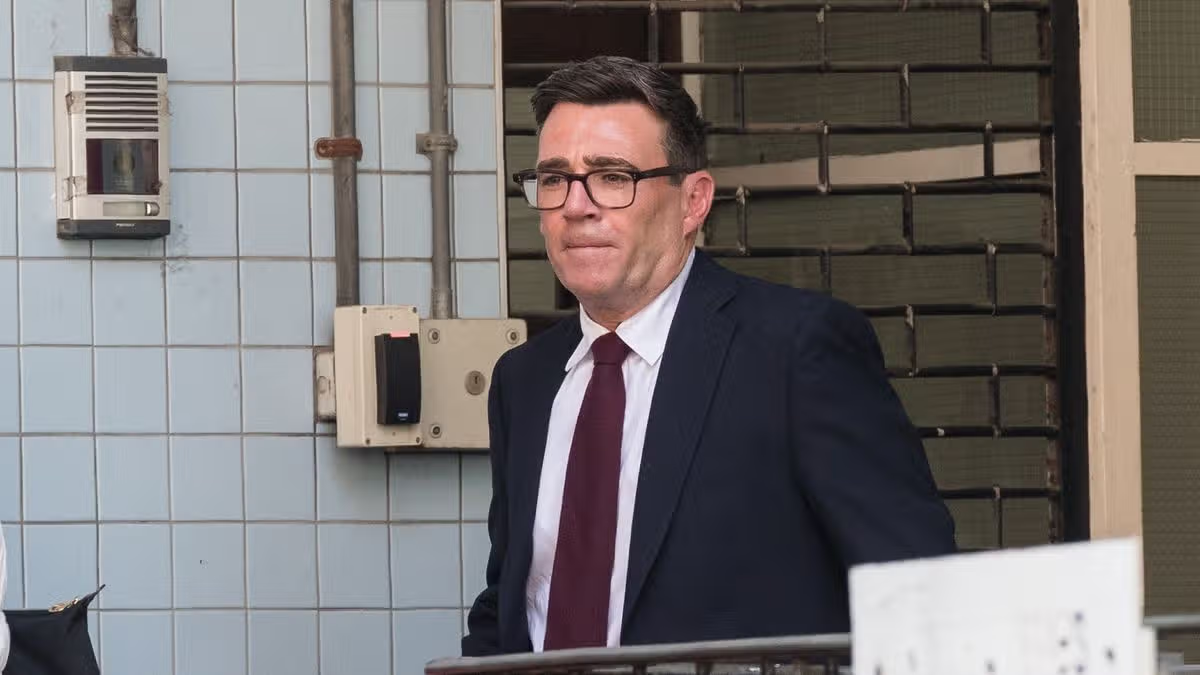
Andy Burnham says he wants to tackle two big ‘rip-offs’ people in Britain are ‘sick and tired of’. The Prime Minister is vowing to provide “everyday fixes” for rising bills.
Advertisement
The Prime Minister said: “I know people are sick and tired of rip-off discounts and subscription traps. Westminster has got used to telling people that everyday hassles like this are just part of life. I don’t think that’s right, especially when the cost of living continues to weigh heavily on so many people’s lives.”
On Monday, he will accelerate plans to tackle “subscription traps” by requiring companies to make it easier to cancel subscriptions and provide more information about costs up-front rather than quietly auto-renewing them at a higher price. The changes, announced in April, had been expected to come into force next spring, but Mr Burnham will bring their introduction forward to January.
He will also launch a consultation on adding deceptive discount offers to the Competition and Markets Authority’s list of banned practices. This would make it easier for the watchdog to punish firms that engage in practices such as artificially inflating prices and then immediately offering a “discount” to make a product look much better value than it is.
The Prime Minister intends to spend much of the rest of August travelling the country asking the public how the Government can improve their lives. Officials have said he will be in “listening mode”, with a focus on tackling the cost of living and improving local high streets. Mr Burnham is expected to announce a series of “everyday fixes” to reduce costs, promising to “pull every single lever we can to provide people with some room to breathe on the cost of living”.
Advertisement
Dame Clare Moriarty, chief executive of Citizens Advice, welcomed the proposals, saying subscription traps and deceptive discounts were “a widespread problem”. Citizens Advice has previously found 26% of UK adults had accidentally taken out a subscription in a single year, with the Government saying its action on subscriptions could save households £14 per month.
Further announcements are expected over the summer, with the Prime Minister describing Monday’s proposals as “just the start”. Opposition figures have criticised his August plans as a “vanity tour” offering only “tinkering”, and urged him to implement broader tax cuts.
Mr Burnham’s summer tour follows his pledge on his first day in office to give the public “breathing space” on bills. In his first week in Downing Street, he announced cuts to VAT on household energy bills and a £2 cap on bus fares as immediate measures to tackle the cost of living.
But rising costs remain a major issue for the public as the fallout from the Iran war keeps inflation higher than expected. A poll published by Ipsos at the end of July found 30% of people listed the economy as a major concern while 22% listed inflation or prices specifically.
Advertisement
Shadow chancellor Sir Mel Stride said: “Andy Burnham has already run out of ideas. The cost of living didn’t become a problem last week, so you have to ask why it has taken Labour so long to enact legislation passed by the previous government.
“Labour’s tax hikes have sent costs soaring for hardworking families and destroyed jobs. Consultations and reheated measures won’t make up for that.”
Top police officers warned at the end of last year how the Government’s controversial early release plans would delight offenders and trigger a crimewave.
Today, we have further evidence of just how disastrous Labour’s policy is likely to be.
Research from the Conservatives – based on official data – now predicts inmates released early from jail after serving as little as one third of their sentences will go on to commit a staggering 89,000 new crimes by 2029.
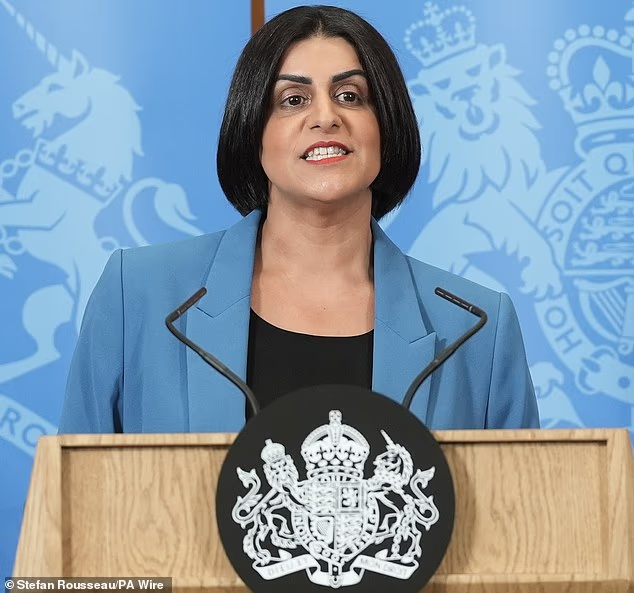
The politician responsible for this mess is Shabana Mahmood, one of a handful of senior ministers to remain in their posts after Andy Burnham’s ‘Black T-shirt Coup’.
Advertisement
But this is not Mahmood’s only major blunder. As I shall explain, her reverse ‘Midas touch’ sees almost everything she gets her hands on implode.
Currently, the early release programme – dubbed a namby-pamby ‘get out of jail free card’ by its critics – is perhaps the most urgent issue. And it was entirely drawn up by Ms Mahmood in her previous role as Justice Secretary.
Last September, just a couple of days before she was moved to the Home Office by then-PM Sir Keir Starmer, she unveiled the early release scheme in a Parliamentary Bill – leaving her successor David Lammy with the dirty work of getting it on to the Statute Book.
The spineless scheme was dressed up as essential reform to avoid a collapse in the prison system. Now that the first releases are just three weeks away, it has exploded into a major crisis for a Labour Party seen by some – in an inversion of Tony Blair’s famous mantra – as ‘soft on crime, soft on the causes of crime’.
Advertisement
Shabana Mahmood described a £662million beach patrols deal with the French government, signed in April, as a ‘landmark agreement’ with the country
Lissie Harper, the widow of Andrew Harper, has movingly described the heartbreak of learning that two of her husband’s smirking killers are due to be freed early
And one critic in particular has emerged as a powerful opponent.
Advertisement
The widow of Andrew Harper, the police officer hideously killed while responding to a report of a stolen quad bike in Berkshire seven years ago, has relentlessly castigated Labour over its release policy.
Lissie Harper has movingly described the heartbreak of learning that two of her husband’s smirking killers are due to be freed early.
Ms Mahmood has created a nightmare policy for Mr Burnham that Labour’s opponents will exploit ruthlessly, as ever-more egregious criminals are let out in monthly waves until next summer. Those on shorter sentences will be eligible first, working upwards to those serving 12 years or more. In other words, the criminals being set loose will become progressively more dangerous as times goes on. Victims and the wider public will be increasingly horrified.
But if Ms Mahmood’s masterplan at the Ministry of Justice wasn’t bad enough, her efforts since being appointed as Home Secretary are even worse – not least her abject failure to tackle the menace of small boats.
Advertisement
Ms Mahmood described a £662million beach patrols deal with the French government, signed in April, as a ‘landmark agreement’ that would ‘really arm us to go after the people-smugglers’. But last month Shadow Home Secretary Chris Philp visited the French coastline and saw gendarmes standing idly by as migrants boarded dinghies to England. Yesterday similar scenes were replayed on other French beaches.
Despite these glaring shortcomings, captured on film, the Home Office insisted last week that its plan was working. One official source even claimed that ‘our work is beginning to bear fruit’ as they noted a 43 per cent drop in Channel arrivals so far this year compared with last.
Yet it is far from clear whether by the end of the year the total will be significantly smaller than 2025’s.
Meanwhile, traffickers are plotting ever more devious ways to get around any measures Britain and France put in place, including the use of deathtrap ‘mega dinghies’ with more than 170 migrants aboard.
Advertisement
And Ms Mahmood has blocked all progress reports on her eye-catching policy, announced in March, to hand failed asylum-seeker families up to £40,000 to go home voluntarily.
Since then her department has been asked multiple times by the Daily Mail how many families have been offered the cash, how many have accepted and how much has it cost the British taxpayer.
All these questions have been stonewalled, suggesting that something has gone awfully wrong with the policy.
With all these problems mounting up, Mr Burnham’s decision to retain Ms Mahmood at the Home Office may not be the vote of confidence it at first appears.
Advertisement
If by the start of next year, say, she has failed to get a grip on small boats, it will be far easier for the PM to sack a more centrist figure from the Starmer era than if he had installed one of his own favourites.
With so many calamities to her name already, there is a strong chance this woeful Home Secretary will be out of the door when the first Burnham reshuffle arrives.








!['The fact that you [four] still hang out is so goddamn endearing,' Instagram user @theandystitch wrote. 'Now that's a Fellowship!'](https://i.dailymail.com/1s/2026/08/10/01/110530975-16040475-_The_fact_that_you_four_still_hang_out_is_so_goddamn_endearing_I-a-6_1786323522919.jpg)









































You must be logged in to post a comment Login