If you didn’t live through it, it is hard to understand how excited the general public was about the race for the moon. You can capture some of it by watching “Lunar Bridgehead,” a film about JPL monitoring the Ranger spacecraft as it hit, rather hard, on the lunar surface.
The Ranger program had been plagued with problems. The first five didn’t make it to the moon. Ranger 6 hit the moon, but failed to start its cameras. Ranger 7 was the first successful mission. There would be two more successful missions before the end of the program.
Honestly, given the state of technology and computers in those days, it is a miracle they could do it at all. Even more sobering to think that a scant five years later, Neil Armstrong would set foot on the lunar surface. In fact, Ranger 8 would land in the Sea of Tranquility, just like Armstrong’s Eagle.
The video has a lot of cool shots of old tech: magnetic tape drives, teletypes, paper tape readers, and giant dish antennas. The six onboard cameras even had to warm up, something unfamiliar to those who have only used modern electronics.
Advertisement
Of course, the cameras didn’t survive the crash, and that was expected. By today’s standards, the images are crude, but in 1964, they were nothing short of amazing.
You can use Venmo to pay for Android app purchases and subscriptions.
FellowNeko/Shutterstock
You can now pay for your Google Play purchases with Venmo. Google has added the service as a payment option in the Play store, letting you purchase apps, subscriptions or in-app content with either your Venmo balance or your linked cards and bank accounts.
Similar to other payment options available in the US, such as your cards, PayPal and Cash App, you will have to set it up and link Venmo to your Play account before you can use it. Just go to payment methods in the Google Play app to add it. Once you’re done, you’ll be able to use Venmo across Google’s services, including YouTube.
Google recently opened the Play store to outside billing in the US, the UK and Europe as part of its settlement with Epic Games. That means developers can now offer you an alternative payment system or link you to their own websites for purchase when you want to buy an app or to pay for a subscription, and it’s worth noting that some of those alternative options might not take Venmo.
The United States military is filled with all kinds of standards that recruits must meet upon joining and starting training. These include several areas of physical fitness, and unlike most jobs in the U.S., there are height and weight requirements. Believe it or not, you can be either too tall or too short to enlist, with a range of 4 feet, 10 inches to 6 feet, 8 inches for both genders’ minimum and maximum height. These restrictions are meant to ensure that all personnel can safely operate military equipment, though it is possible to get a waiver in some situations.
In addition to the height limits for the general military, certain jobs have more stringent requirements across all of the services. These standards apply to personnel operating on different types of ships, airplanes, and tanks. This makes sense, as submarines, fighter jets, and armored vehicles have limited crew compartments, making it uncomfortable if not impossible for people of a certain height to take those jobs.
Advertisement
To become a tanker, which in the Army is Military Occupational Specialty (MOS) 19K, Armor Crewmember, a person cannot exceed 6 feet, 1 inch in height. Fortunately, that doesn’t limit too many applicants, as the average height of an American woman is 5 feet, 3.5 inches, while men average around 5 feet, 9 inches tall. Because the U.S. military operates the M1 Abrams Main Battle Tank, the height requirements are universal across its variants. Unlike tankers, the height requirement for MOS 19C, Bradley Crewmember, isn’t restrictive for those operating the M2 Bradley Infantry Fighting Vehicle.
Advertisement
The inside of an M1 Abrams MBT is cramped
Tanks have always been cramped, as their design requires a great deal of armor to protect the personnel inside. The vehicle also needs to be able to navigate roads, bridges, and various terrain, so making them wider isn’t typically an option, while making them higher only makes them easier to see and strike. If you look back through the history and evolution of tank design, this remains a constant, as tight quarters are the name of the game.
When looking specifically at the driver’s compartment, it sits center and to the front of the tank with a hatch that allows the driver to peer out (pictured). Just above the hatch is the forward edge of the turret ring. Inside, the driver sits on a seat and has little room for their legs. The steering-throttle control sticks up between the legs with handlebars for operating the tank, while the driver looks at a screen for information about the vehicle. The steering-throttle control is a yoke that controls acceleration and steering.
The compartment is cramped, to say the least, so there’s not a huge margin for anyone exceeding 6 feet, 1 inch in height. Even at that height, it’s not the most comfortable place in the world to work, but many tank drivers do so every day they put on their uniform and step inside their vehicle. The other positions inside the tank don’t offer much more in terms of space, though there’s a bit of room for the tank commander, gunner, and loader, as the driver is isolated from the rest in the forward hull.
For the longest time, reliability used to be the stick skeptics used to beat electric vehicles. The argument was that the things were rolling laptops, full of software and accompanying bugs that would inevitably freeze, along with batteries that would degrade into uselessness. Buy one, and you were an expensive beta tester just waiting for a problem to crop up outside of warranty.
However, we’ve found that this argument has aged rather like milk. As of 2026, electric vehicles are far more reliable than they were in 2016 — and this is to be expected, as with any nascent technology, the tech improves with time. A big plus in the EV corner is that these vehicles have a fraction of the moving parts that an ICE vehicle has, so mechanical problems are also far fewer. No timing chains, no about-to-go-bad exhaust systems, no fuel injectors that get clogged. Fewer parts, fewer problems — in one example, the vehicle used to be on Consumer Reports’ “least reliable” lists and is now on the other end of the spectrum — that’s how quickly the industry has matured.
Now, we’re not claiming that EVs don’t have their problems — far from it. Many do still have frequent glitches and bugs that prevent a smooth user experience. The charging network and speeds, though improved vastly, are still not where they need to be. However, from the lens of a relatively new technology, the notion that electric vehicles are automatically unreliable is out of date.
Advertisement
Ford F-150 Lightning
Just two years ago (at the time of writing), in 2024, the Ford F-150 Lightning electric truck earned itself a very undesirable spot on the Consumer Reports list of the most unreliable vehicles for that year. In 2024, the e-pickup got a miserably low Consumer Reports score of 28 points out of a total available 100 in the reliability metric.
In the 2025 overall Consumer Reports reliability survey, Ford vehicles got an overall score of 48, and the 2025 Ford F-150 Lightning got a reliability score of 45. That means that the blue oval EV pickup is about as reliable as the average Ford vehicle — which is a far cry from where it was two years ago. Readers should note that the 2026 Consumer Reports list of unreliable vehicles is out, and that the new F-150 Lightning is no longer on the list, which is a testament to the fact that stubborn-as-a-pack-mule Ford can still listen to customer and industry feedback when it wants to.
Advertisement
The reason we keep returning to the 2025 model is that Ford initially slowed production, and then eventually discontinued the F-150 Lightning after 2025. However, if you act fast, you might still be able to score a new F-150 Lightning from a dealer that still has one on the lot, or get one with low miles on the used market. In 2025, the F-150 Lightning had a maximum range of around 350 usable miles, and an MSRP of $65,190 (including destination).
Advertisement
Ford Mustang Mach-E
Though it carries the vaunted, historic Mustang nameplate, this thing is actually a crossover-ish SUV. Rightfully, this thing has got the purists sharpening pitchforks, but we can’t fault Ford for actually having the guts to experiment in this market. Initially revealed to the public at the end of 2019, the Mach-E SUV went on sale two short years later, as a 2021 model. A very trusted U.S. brand, J.D. Power recently released its EV ownership experience report for 2026. Historically, the Mustang Mach-E has done rather well in this comprehensive study, ranking in the top three (but never first) in 2022, 2023, and 2024. After a massive fall in rankings in 2025 (but still top ten), the Mach-E finally earned the coveted top spot for 2026.
Furthermore, the Mach-E also has insane levels of customer satisfaction, with nine out of 10 owners saying they would endorse it. For 2026, the Mustang Mach-E gets a reliability score of 74 out of a total available 100 points from the Auto Reliability Index, and 2021 models got a J.D. Power reliability score of 65, also out of a total available 100 points. The 2026 model comes with a 72 kWh battery and one motor as standard, which gives the vehicle about 264 horsepower and a range of about 250 miles. Pricing for the 2026 Mach-E begins at $37,795, on top of which a freight charge of $2,045 will be tacked on.
Advertisement
Volvo EX30
The EX30 is Volvo’s spiritual successor to the XC40 Recharge, which itself was the all-electric version of the brand’s popular small SUV, the XC40. Introduced in 2023, the EX30 had some teething problems, but it appears these have been sorted out. For 2026, the EX30 gets a respectable score of 71 out of 100 in its J.D. Power review, and an above-average 63 out of 100 in the reliability metric. The crossover SUV also got 86 out of 100 points under the driving experience metric, and 67 out of 100 in the resale value metric. For 2026, a new Volvo EX30 would sell for about $40,345 as base MSRP — including a $1,395 destination fee.
It is quite pricey for a compact-sized SUV, though proponents of the Swedish brand would argue that the excellent interiors and Volvo’s legendary safety reputation are worth the price. 2026 EX30s come with a 200 kWh battery pack as standard, along with one e-motor, which gives the car a range of about 261 miles. We should warn you that there is, however, a massive recall that affects a huge number of modern EX30s, so make sure that if you’re buying one of these, the fix has been done. Specifically, the recall was about a fire hazard from the battery igniting in about 40,000 vehicles or so.
Advertisement
Porsche Taycan
The Porsche Taycan is an all-electric, four-door car from Porsche that was very clearly intended to target buyers who wanted a Panamera, but electric. Now, no one should buy a Porsche vehicle expecting average or slightly above-average maintenance costs. It is a luxury vehicle with expensive parts and specialist labor, so the upkeep on this vehicle (and this entire class of vehicles) is meant for people for whom cost efficiency is not a top priority. And, famously, German vehicles tend to require exacting servicing standards to remain reliable — so when the Taycan gets out of warranty and its service contract, things can get extremely expensive extremely quickly.
However, while the car is being looked after by the dealer, and all preventative maintenance tasks are done on or before time, the Taycan is surprisingly reliable. For its part, J.D. Power gives the 2026 Taycan a driving experience score of 86, a resale score of 76, and a reliability score of 75. Overall, the 2026 Taycan gets a J.D. Power score of 81, with all figures out of a maximum 100 available points.
Advertisement
Consumer Reports also says that the 2026 Taycan is a “serious challenger” when pitted against the ever-popular Tesla Model S. Readers who are familiar with the Taycan will be sad to learn that the wagon body style on the Taycan, called the Taycan Cross Turismo, is being phased out, but only for America, since the model will continue to be sold overseas.
Advertisement
Hyundai IONIQ 6
The Hyundai Ioniq 6 — which also has a sporty “N” model available — is a four-door sedan from the Korean automaker that first went on sale in 2022. The 2025 model got a J.D. Power reliability score of 72 out of 100, and 79 out of 100 under the driving experience header. The resale score for the 2025 Ioniq 6 stood at 70 out of 100, which gave the vehicle an overall score of 73 out of 100 total available points for 2025. We do not have reliability scores for the 2026 Ioniq 6 — since the standard model has been axed for the 2026 model year, though the Ioniq N continues to be sold.
However, you might still be able to get a 2025 model as new or near-new from Hyundai dealers if you’re willing to shop around. Used models could be going for a steal, especially if you decide to trade in your current vehicle in some cases. For those who don’t know about the Ioniq 6, it is an all-electric model with a 53 kWh battery system in 2026 that feeds one electric motor, making about 149 hp of power.
These are standard figures for the 2026 model, which give the vehicle a range of 240 miles — though real-world usage, as with all EVs, will rarely hit that optimal-condition number. Still, for $37,850 as base MSRP ($1,745 as additional charges), it’s not too shabby a deal for a decently reliable and extremely good-looking daily driver vehicle.
Advertisement
BMW iX
It’s easy to get tangled up when reading about a BMW model; for the unaware, the BMW iX is a midsize luxury SUV intended as the electric version of the BMW X5. In 2026, the iX comes with dual e-motors powered by a 100 kWh battery system, and has space to seat five passengers in two rows. If you’re wondering, the car has about 87 MPGe (miles per gallon equivalent), which isn’t particularly striking, but then again, it’s a luxury SUV, and efficiency is rarely a concern for buyers. What might indeed be a concern is the range, which for standard iX models is a claimed 279 miles in total.
Remember that manufacturer-claimed EV ranges are under optimal conditions, which are hard to replicate in real-world use. Even for a luxury SUV, that range might be the limiting factor for buyers. J.D. Power gives the 2026 BMW iX a score of 77 out of 100 overall, and 78 out of 100 specifically for reliability, which is really good. For those looking to score a BMW iX, you should act fast, since BMW has said it will not sell the iX in the U.S. following the 2026 model year. Once again, buyers in other markets will continue to have access to the iX even beyond 2026, since the discontinuation is only here in America. The MSRP for a 2026 iX is $75,150, with $1,175 as destination.
Advertisement
Kia EV9
Kia
The Kia EV9 is the only vehicle on this list that can seat more than five people, with room for up to seven passengers across three rows of seating. With the optional captain’s chairs, total seating capacity drops to six. Power for the current 2026 model year comes from a 76.1 kWh battery that feeds a single e-motor, giving the EV9 an EPA-estimated range of 305 miles in certain high-end configurations.
The entry-level trim — which is called the “Light RWD” — drops the range to a barely usable 230 miles. J.D. Power gives the 2026 Kia EV9 an overall score of 72 out of 100, which breaks down into 67 out of 100 for reliability, 82 out of 100 for driving experience, and 77 out of 100 for resale. Another neat feature of the Kia EV9 is the fact that it is compatible with any Tesla Supercharger in the U.S., which greatly improves the charging outlook on road trips with the family, for example.
Advertisement
What’s not great about the EV9 is the price, since it starts at a base MSRP of $54,900 for 2026, which is not inclusive of a pricey $1,645 destination fee that is tacked on top of the MSRP. If you’re open to looking at used models, the 2024 EV9 (which also got a J.D. Power reliability score of 70 on 100) is selling for about $30,000 on the used market as of August 2026.
Advertisement
BMW i4
The BMW i4 is an all-electric, medium-sized executive sedan with sporty fastback styling and borrows heavily from the styling of its corporate cousin, the BMW M4. For 2026, the model has an 83.9-kWh battery and powers dual e-motors, giving the car a total range of 333 miles. However, this car is not what we’d call accessible to the average buyer, since it is somewhat hard to find at a dealer and is also prohibitively expensive to buy. 2026 models come with a starting sticker price of $57,900, plus a freight fee of $1,175. Slightly older models, like the ones from 2024, are selling for much cheaper — $40,000 at the time of writing — but you’d lose two years of warranty when buying those.
However, for those who want to scoop one up, you can console yourself knowing that you’re in one of the best-looking, best-performing cars on sale. If you’re wondering, J.D. Power has not rated the 2026, 2025, or 2024 models of the BMW i4, though 2023 models got 74 on 100 in reliability, and 78 on 100 overall. Furthermore, Consumer Reports says that the 2026 BMW iX will have about-average reliability, which is a pretty good outlook (even though it’s based on predictive data), considering that it’s an EV.
Advertisement
Lexus RZ
Surprisingly, this list has not been dominated by Japanese vehicles (which usually top every single reliability listicle out there), since Japan has tended to lean toward hybrids rather than pure EVs. This then makes the Lexus RZ the only Japanese EV to make our list, yet it smashes all metrics by which it is measured. Consumer Reports says that the 2026 Lexus RZ will be “more reliable” than your average new vehicle, which is pretty high praise from the company. The interior of the Lexus RZ is something that we absolutely have to mention, since it looks like the inside of a futuristic spaceship.
Many of the interior controls are still via buttons, making the Lexus RZ one of the rare new car models that still use buttons and knobs aplenty. This use of buttons is (arguably) even rarer on a current-generation EV, since the manufacturers want to present the car as “futuristic” — so screens are the norm. The 2026 Lexus RZ comes with a 75 kWh battery pack and has one e-motor on the base model, with a claimed range of about 301 miles.
At the time of writing, the 2026 RZ only had one outstanding recall from the NHTSA, related to a potential ECU failure. It’s also worth mentioning that J.D. Power has never rated the Lexus RZ since its release in 2023, which is why we can’t give you any scores for the same.
Advertisement
Tesla Model 3
One of the first electric vehicles — arguably the first, in fact — that really became popular was the Tesla Model 3. It is one of the oldest nameplates on our list, having been on sale since 2017 — which, for those counting, is almost a decade. Unsurprisingly, many kinks in the design and software have been worked out by now, which means that the Model 3 for 2026 is one of the most reliable electric vehicles on the market.
Advertisement
The Model 3 nabbed the top spot in the J.D. Power EV ownership study that we quoted at the beginning of this article for 2026, which is quite impressive. Tesla also has one of the best charging infrastructure networks in the U.S. for EVs, which is a big plus in the Model 3’s favor. J.D. Power gives the Tesla Model 3 a resale value of 77 on 100, a driving experience value of 92 on 100, and a reliability value of 92 on 100.
When combined, these figures give the Model 3 an overall score of 82 on 100 from J.D. Power. Pricing for the 2026 Model 3 begins with a base window sticker of $36,990, and a destination charge of $1,390 added to the MSRP. This generation comes with a 69.5 kWh battery and a single electric motor, giving the five-seater a range of about 321 miles.
Advertisement
Tesla Model Y
The Tesla Model Y is the company’s crossover SUV, and if you think it looks similar to the Model 3 that we just looked at, that’s because it is. The Model Y is actually based on the Tesla Model 3, and the two variants share many parts. For 2026, the Model Y comes with a similarly sized 60 kWh battery pack and one e-motor, making about 295 hp. All things put together, the Model Y is supposed to get a total driving range of about 321 miles, which is the same as that of the Model 3 from above.
The price is, naturally, higher for the Model Y, with the 2026 model selling for $61,990 as base MSRP, plus $1,390 for destination charge. J.D. Power gave the 2026 Model Y an overall score of 81, a driving experience score of 87, a resale score of 80, and a reliability score of 78 — all values out of 100. Consumer Reports says that the Tesla Model Y would be “much more reliable” compared to the average new vehicle on sale.
It’s worth mentioning that many of the Consumer Reports scores that we list are based on predictive modeling of past units — which we feel is fine, since there usually aren’t many mechanical differences between intra-generational models that we’ve listed. Furthermore, many models that we’ve listed are first-gen ones that will only get more reliable with time.
The U.S. Cybersecurity and Infrastructure Security Agency (CISA) warned that hackers are exploiting a critical-severity Progress Kemp LoadMaster command injection vulnerability.
Kemp LoadMaster is a very popular Application Delivery Controller (ADC) and server load balancer used by tech companies and government entities worldwide (e.g., Amazon, U.S. Air Force) to distribute incoming web traffic across multiple servers, optimize app performance, and ensure high service availability.
Progress Software says that 80% of Fortune 500 companies use its products and services, with Kemp LoadMaster having over 100,000 deployments worldwide.
Tracked as CVE-2026-8037, this critical command injection security flaw enables unauthenticated attackers to execute arbitrary commands on unpatched LoadMaster appliances by exploiting unsanitized API inputs in multiple command endpoints.
According to Internet threat watchdog Shadowserver, nearly 300 Kemp LoadMaster instances are exposed online. However, there is no information regarding how many of them are honeypots or have already been secured against CVE-2026-8037 attacks.
On Friday, CISA added the flaw to its catalog of actively exploited vulnerabilities, ordering U.S. Federal Civilian Executive Branch (FCEB) agencies to secure their servers within three days as mandated by Binding Operational Directive 26-04.
“This type of vulnerability is a frequent attack vector for malicious cyber actors and poses significant risks to the federal enterprise,” the cybersecurity agency warned.
While BOD 26-04 applies only to U.S. government agencies, CISA urged all defenders to prioritize patching the CVE-2026-8037 vulnerability to block incoming attacks.
Advertisement
Last month, Progress also emailed ShareFile customers who were using Storage Zone Controllers to immediately shut down servers after identifying what it described at the time as a “credible external security threat” targeting the on-premises secure file-sharing software.
Days later, the company released security patches for a high-severity ShareFile path traversal zero-day vulnerability, but told BleepingComputer that it had “no indication of unauthorized access to any ShareFile customer account or data, and we have not identified any active threat.”
Security teams log 54% of successful attacks and alert on just 14%. The rest move through your environment unseen.
The Picus whitepaper shows how breach and attack simulation tests your SIEM and EDR rules so threats stop slipping by detection.
Don’t like the camera bump on your foldable? Take it off
That’s what one Redditor has done with their Galaxy Z Fold 8
It now lies flat — but the selfie camera is the only camera left
How far would you go to get one of the best foldable phones looking and working exactly the way you want it? One Samsung user has taken the drastic step of cutting off the rear camera module on their new Galaxy Z Fold 8, just so it’ll lie perfectly flat when placed on a surface.
The unusual DIY hack is documented on Reddit, and has been met with one or two raised eyebrows. Apparently, the owner of the phone used a razor blade to perform the operation, and says the end result is “not bad”.
“The wobble is so annoying and I never use [the cameras] anyways” was the reason given by the user, when asked what prompted the customization — and they don’t appear to have any regrets about what they’ve done.
Latest Videos FromTechRadar
Advertisement
Our Samsung Galaxy Z Fold 8 review doesn’t mention the camera bump as being a particularly egregious problem, but we do have some praise for the performance of the dual-lens camera on the back — so it seems a shame, and a little drastic, to remove them.
The reactions in the original Reddit thread are mostly of disbelief that someone would go to these lengths just to get a phone to lie flat, while taking away their ability to capture photos and videos at the same time.
Amidst a lot of well-chosen GIFs, there are comments like “no amount of explanation justifies it” and “what a mad man”, as well as some appreciation for a tech-hack that seems to have been well done, based on the photo evidence.
Advertisement
There’s also one request for more information from another Redditor who wants to do the same to their own Galaxy Z Fold 8 — perhaps an indication that the wobble you get when the handset lies flat is annoying quite a few users.
Sign up for breaking news, reviews, opinion, top tech deals, and more.
Samsung launched the phone on July 22, and the starting price is $1,899 / £1,699 / AU$2,699. It launched alongside the slightly more expensive Galaxy Z Fold 8 Ultra and the more affordable Galaxy Z Flip 8.
Below, find a few more e-readers I like but don’t necessarily love as much as my top picks.
Boox Go 7 ($270) and Boox Go Color 7 ($290): Boox is known for its wide range of e-paper tablets, including the Boox Go 6 (Gen II) I recommend above. If you’re looking for something a little larger with a similar Android-based experience, the Go 7 and Go Color 7 are both solid choices. There are page-turner buttons, and it’s a nice square shape that’s easy to hold and use. If you, like me, don’t use color features a ton, it’s worth saving the extra money on the black-and-white model. Regardless, it’s great that the price difference between the two models isn’t steep.
Advertisement
Boox Palma 2 for $316: This is a fun, pocket-sized device, with fingerprint recognition, a faster CPU, and a newer version of Android than previous models. Former WIRED reviewer Adrienne So loved using it with the Kindle app, but she wishes it cost less. It’s currently unavailable and has been for a while; I’m not sure it’ll come back in stock, but the Boox Palma 2 Pro ($400) is next on my list to test.
The Kindle Colorsoft.
Photograph: Nena Farrell
Kindle Colorsoft Signature for $280 and Kindle Colorsoft ($250): The Kindle Colorsoft Signature (7/10, WIRED Recommends) is Amazon’s first Kindle with a color screen. It has a screen with an oxide backplane, which Amazon says delivers strong contrast and image quality. It also has custom-formulated coatings and nitride LEDs for brightness and color accuracy. But the screen is capped at 150 ppi for color images, versus 300 ppi for black-and-white, making the reading experience a little fuzzier than on the latest Paperwhite. Processing color images takes much longer than black-and-white ones on the Paperwhite, and the Colorsoft is missing features that are basically standard on other color e-readers, like page-turn buttons and stylus support. It’s not a bad Kindle, and color does enrich the e-reading experience, but I suggest waiting for a discount during an Amazon sale event.
Advertisement
Kindle Scribe (2nd Gen, 2024) for $400: The second-generation Kindle Scribe (8/10, WIRED Recommends) is a great option if you want an e-reader that doubles as a digital notebook while staying within the Kindle ecosystem. It has a 10.2-inch (300 ppi) paper-like display with features like an adjustable warm light and an auto-adjusting front light. The included Premium Pen also has a soft-tipped eraser (mimicking that of a No.2 pencil). With the Active Canvas feature and expandable margins, you can also mark up ebooks and write notes in the side panel. Amazon has launched three new Kindle Scribe models since this one, but this older edition remains my favorite Kindle e-reader with digital-notebook capabilities.
Kindle Scribe (3rd Gen, 2025) for $500: The latest Kindle Scribe (7/10, WIRED Recommends) arrived in December 2025 with a color version. It also has a new exterior design that does away with the single thicker side and standardizes bezels and frames across all sizes. It has a new homepage design that simplifies accessing your latest books and notebooks, plus a quick-notes capability that lets you pin a note to your homepage for easy note-taking. It also has a new set of AI features that can provide summaries and even send your notes to an Alexa+-powered speaker so you can ask questions about them. Overall, though, these features aren’t necessary and just drive up the price. The older Kindle Scribe (2nd Gen) is still my preferred option if you want a Kindle e-reader that doubles as a digital notebook.
Kindle Scribe (3rd Gen) on the left, and Kindle Scribe Colorsoft on the right.
Advertisement
Photograph: Nena Farrell
Kindle Scribe Colorsoft for $630: Amazon brought the color screen to the Kindle Scribe late last year, with a redesigned exterior to match the new third-gen Kindle Scribe. The Kindle Scribe Colorsoft (7/10, WIRED Recommends) works exactly as you’d expect, with a range of colors and tools you can use on the notebooks and while reading your books. There are also several AI features, which is part of why it’s so pricey. I think it’s too expensive for not being able to transform into an e-paper laptop like the ReMarkable Paper Pro (7/10, WIRED Recommends), but if you really wanted to stick with Kindle and have a colorful digital notebook and e-reader in one device, this is the one to get.
Kindle Scribe Without Front Light for $430: This is the third and final installment of Amazon’s latest generation of Kindle Scribes. It’s similar to the new base Kindle Scribe (3rd Generation), but it removes the front light and wireless charging. It has a max storage of 16 GB instead of the 32- and 64-GB options the 2025 Kindle Scribes offer. You can save some money with these cuts, but the loss of a front light is a pain if you’re a night reader like I am. If you want a cheaper Kindle Scribe, I still prefer the second-generation model, though you’ll lose out on AI reading features and the ability to connect to Google Drive and Microsoft OneDrive.
Nook GlowLight 4 Plus for $200: The 4 Plus is the only waterproof Nook in the lineup, and it has the biggest screen at 7.8 inches, along with 32 GB of storage. It also has physical page-turn buttons and a headphone jack for listening to audiobooks (you can also connect wireless earbuds via Bluetooth). Unfortunately, it was often slower than my Kindle and tended to freeze. While the large library has cheap and even free ebooks, it’s not as good of a selection as Kindle Unlimited. The process of getting a book from the library on a Nook is also frustrating. You’ll need to download either Adobe Digital Editions or Android File Transfer before physically connecting the device to your computer and then transferring the files.
Advertisement
Nook 9-inch Lenovo Tablet for $150: If you mainly read cookbooks or other color-intensive materials, and you want a dedicated reader, you might want to consider this affordable tablet from Nook and Lenovo, which has the Nook app built in. It’s a tablet rather than an e-paper device like the rest of the gadgets in this guide, so you’ll lose the E Ink screen and the distraction-free nature of an e-reader. You can at least turn off notifications while in certain apps, which I recommend doing for the Nook app. It uses Android 13 OS, and it’s not built for heavy work, like video or photo editing.
Xteink X4 for $69 and X3 for $69: These are similar to the Xteink X4 Pro above when it comes to the app and basic capabilities, but you’ll lose out on the touchscreen, home button, and front light. Instead, there are more buttons, providing a Tamagotchi-like experience as you tap them to go back and forth between menus and pages of your reading material. The X3 is super small, with just a 3.7-inch screen that fits on the back of my iPhone 16 Pro, and it has stronger magnets to put itself into place. But the standard X4 is more comfortable to read on than the X3 since it’s larger (and won’t require quite as many page turns, though it’ll still need a lot) with a 4.3-inch screen, like the X4 Pro above.
FAQs
Ebooks can be cheap, but as with regular books, the cost can add up if you’re a big reader. To keep costs low, take advantage of your library card and check out ebooks instantly from the comfort of your home. We have a detailed guide that explains How to Get Free Kindle Books With Your Library Card, but the short version is that most libraries distribute books via OverDrive. You can access these books a few ways: through Kindle or directly from OverDrive with a Kobo, or you can download the Libby app. These ebooks are automatically removed from your device and returned to the library when they’re due.
Advertisement
Each e-reader’s own book service varies in quality. My favorite is Kindle Unlimited for $12 a month, which includes millions of titles, including audiobooks and magazines. Amazon’s Prime Reading also offers a handful of free books every month, which is good to know if you already have a Prime account. You can even lend books to friends and family for a short while (or have them share a book with you). For more details on each option, check out our guide to the Best Ebook Subscription Services here.
What File Formats Do E-Readers Support?
The most widely used format is ePub, which works natively with all the e-readers in this guide except for Kindle—technically. You can still upload ePub files to your Kindle, but you’ll have to use the “Send to Kindle” feature (through Amazon, your email, or the Kindle app) to convert it to Amazon’s proprietary format called AZW. (Newer Kindles support AZW3 and KFX, specifically). Other formats that will work with these e-readers include PDF, TXT, HTML, DOC, and DOCX.
Can I Install Apps on an E-Reader?
Advertisement
Kindle, Kobo, and Nook all use proprietary operating systems that don’t allow you to install third-party apps. The Boox, on the other hand, runs Android (mainly Android 11 and newer). That means you can use it to download any apps available in the Google Play Store or side-load apps from your computer.
Do You Need an E-Reader? What About a Phone or Tablet?
You don’t have to buy a separate device to read ebooks. Smartphones and tablets are perfect for this purpose. You can use Amazon’s Kindle app to read ebooks (iOS, Android) and download OverDrive’s Libby app (iOS, Android) for library-book access. However, the E Ink screens found in e-readers are just nicer to look at. I also like that these devices are one-trick ponies; there are no distracting notifications or social media feeds ripe for doomscrolling.
If you’d still rather have one smart device you can use for reading and other purposes, take a look at our Best Tablets and Best iPads guides for recommendations.
Advertisement
What About a Digital Notebook?
I’ve tried just about every digital notebook on the market; these devices are designed for handwritten notes on an E Ink screen. E-readers with that capability usually still prioritize reading, though there are plenty of models I like that can do both. The Kobo Libra Colour is my favorite option for annotating books, and it can double as a small digital notebook. If you want a larger option, check out my full guide to every digital notebook I’ve tested.
The most important step I take when testing e-readers is to read on them! I spend hours reading books acquired in a variety of formats, including books I purchased directly from each brand’s store, downloaded from local libraries via OverDrive/Libby, and PDFs acquired for free from God knows where.
In the process, I evaluate battery life, brightness, performance lag, screen responsiveness, and text sharpness. I check for extra tools, like whether the tablet in question accommodates accessories like a stylus. I also note features like waterproofing, annotation capability, and access to exclusive subscription services.
If Google’s Pixel line of phones is best known for anything, it’s impressive software that elevates the photos its cameras capture. This year’s Made By Google event, which kicks off at 6 p.m. ET on Wednesday, Aug. 12, will likely see the Pixel 11 phones shown off — a standard, Pro, and Pro XL version most likely — along with the next Google Pixel 11 Pro Fold. Rumors also point to a Pixel Watch 5.
And everything will likely get a good dose of Gemini AI. Last year, Google added features to its Pixel phones that relied on Gemini generative AI technology like Pro Res Zoom to compensate for the limitations of small smartphone cameras. My big question is, with the Pixel 11 line being announced, will Google genuinely advance mobile photography or introduce more gimmicks that can frustrate the photo process for photographers and everyday people?
It’s a tough line to walk. Generative AI technology for images has advanced rapidly over that time, but so has the public’s resistance to AI slop and photos created entirely from prompts.
I want to believe Google can step up the photography game this year.
Advertisement
Pro Res Zoom technology vs. image quality
Pro Res Zoom was the Pixel 10 Pro’s signature photo technology, a novel solution to an everyday smartphone camera problem.
It’s a common sight when people try to take photos with their phone: They zoom in on a scene by pinching and spreading with two fingers on the screen. But past a certain point — 10x zoom on the Pixel 10 Pro — all the camera is doing is digitally enlarging pixels, which diminishes detail. At 100x, images look like you’re squinting at them with poor eyesight and no glasses.
Google’s answer is to recreate, using generative AI, what’s in that zoomed-in area. The phone guesses at the content and generates an artificial rendering of what it should be. In some situations, it can work well, like with distant buildings or other architectural features that aren’t the focus of the shot. But if people are in the scene, forget about it.
The Pixel 10 Pro XL captured a 100x zoom photo, which is blurry due to the extreme zoom (right) and made a generative AI version of it (left).
Jeff Carlson/CNET
Rumors suggest the Pixel 11 Pro phones’ version of Pro Res Zoom will go up to 120x magnification, so I don’t expect things to change much. However, the pace of generative AI improvements could mean it does a better job rendering the extremely zoomed-in scenes.
Advertisement
At 100x, the Pixel 10 Pro XL’s Pro Res Zoom feature uses generative AI (left) to build a clearer version of the original (right), which has also been processed, just without generative AI. When you capture above 30x zoom, the camera keeps both the original and the generated versions.
Jeff Carlson/CNET
Ironically, Google’s earlier Super Res Zoom feature (which launched with the Pixel 3 in 2018) turns out to be the superior technology here, despite it being elbowed aside by Pro Res Zoom last year.
At 30x zoom, the Super Res Zoom feature in the Pixel 10 Pro upscales at good quality (30x zoom at left, detail enlarged at right).Jeff Carlson/CNET
At up to 30x magnification, you still get the same problem from digitally enlarging pixels, but they’re not as large as at 100x. Super Res Zoom applies AI-based upscaling to sharpen details and fix many of the fuzzy artifacts created by digitally zooming. In my tests, it was difficult to tell which zoomed photos were Super Res Zoom images versus optically zoomed versions.
If Google can extend Super Res Zoom higher into the zoom range, even up to 50x zoom without resorting to generative AI reconstruction, I’ll call that a win.
Night Sight improvements
Photographing in dark situations has been one area where smartphone cameras have excelled. If you’re ever able to view the Aurora Borealis, unless you’ve got a good camera and a tripod, your phone will give you far better handheld images of the light show in the sky.
Current phones do a good job with night photography, but we can always ask for better.
Advertisement
Taken with the Pixel 10 Pro XL’s main camera using ‘Night Sight’
Andrew Lanxon/CNET
Dark photos tend to suffer from visible noise artifacts and issues with exposure and color. Too many smartphone cameras flex the ability to boost the exposure in a dark scene, but go too hard in artificially brightening a scene – I never want a night shot to look like it was exposed in the middle of the afternoon.
I’m optimistic, though, because AI technology for removing noise has improved a lot in the last couple of years. And if a camera can increase the lighting in a scene and still make the scene look realistic, then the developers can adjust the algorithms to turn down the exposure.
Photo editing with AI
The goal of anyone taking a photo is to “get it right in-camera” and avoid spending more time editing it later. That’s really the entire driving force behind smartphone cameras: millions of people are capturing trillions of photos that will never be edited, so the camera needs to do as much work as possible to get it right the first time.
And quite often, it does. The typical person taking a snapshot with their phone is thinking about capturing a moment when they tap the button, not shutter speeds or exposure compensation.
Advertisement
But some photos do need editing, and smartphones have more than enough processing power to handle it. The hurdle is more often the complexity involved: not everyone is comfortable dragging sliders for brightness, contrast, white point, shadows and so on.
Instead of messing with edit sliders, ask Gemini to fix issues with a photo.Screenshots by Jeff Carlson/CNET
The Photos app does include an Ask feature, allowing you to tell the app what needs to be changed. If a photo looks washed out or has flat lighting, ask the app to make the fix. In my testing, it often does a good job.
What I’d like to see is the same feature adjusting all those sliders for me so I can then go back and tweak the settings if I want. Instead, I can only save the result as another copy of the image in my library.
A plea to lose the generative AI slop
Whereas most of Google’s image-editing features that use AI build on the photo’s initial composition, there are plenty of generative AI features that enable users to radically alter them. I’m genuinely curious to know if people go for “remix” features that take a picture of someone and can change the background, restyle what they’re wearing, turn them into a sketch and so forth.
Ask for an edit in the Photos app such as this background replacement, and Gemini AI generates it for you.Screenshots by Jeff Carlson/CNET
These features seem to exist not because people are clamoring for them, but because AI models can do them, and therefore they get worked into product releases to show the market and management that “we’re doing AI.” Maybe it’s the longtime photographer side of me that bristles at these types of generative creations (“glop?”).
It would make sense for Google, with all its investments in generative AI, to lean further into developing AI features that change images beyond recognition, simply to boast about their expanding toolbox. If I’m any judge, I don’t think anyone’s asking for that. Google has the resources and the talent to make meaningful advancements in smartphone photography. I’m hoping this year’s updates live up to that potential.
Advertisement
Jeff Carlson
Senior Writer
Jeff Carlson writes about mobile technology at CNET, from cellular phone plans to devices and emerging technology.
See full bio
James Bruton keeps building machines that walk and are capable of carrying a person. His latest one is a compact quadruped he calls the Mid-Walker, open-sourced on GitHub under XRobots. Diagonal legs are mechanically linked so they swing in pairs. That means only two feet stay planted at any moment. On flat ground the setup works, but on anything uneven, it tips.
He added a third sliding portion beneath the seat that operates on desk-drawer sliders and is powered by a 2 kilowatt motor and controlled by an ODrive. That motor is powered by a ball screw. The seat adjusts left or right to keep the rider’s weight centered over the foot on the ground. It’s all held together with aluminum extrusions, bespoke plates, and T-nuts. One advantage of the sliding mass is that it helps, but it is insufficient to totally eliminate the problem of dips, uneven ground, and soft grass.
A1 mini + LED Lamp Kit for Creative Light Projects: Bring your ideas to life with the included LED Lamp Kit. Simply print compatible lamp models and…
The Perfect 3D Printer for Beginners: A1 mini 3D Printer is designed to make 3D printing easy from day one with automatic calibration, simple setup…
Experience the Bambu Lab Ecosystem: Access MakerWorld’s huge library of ready-to-print models, manage prints through the Bambu Handy app, and enjoy…
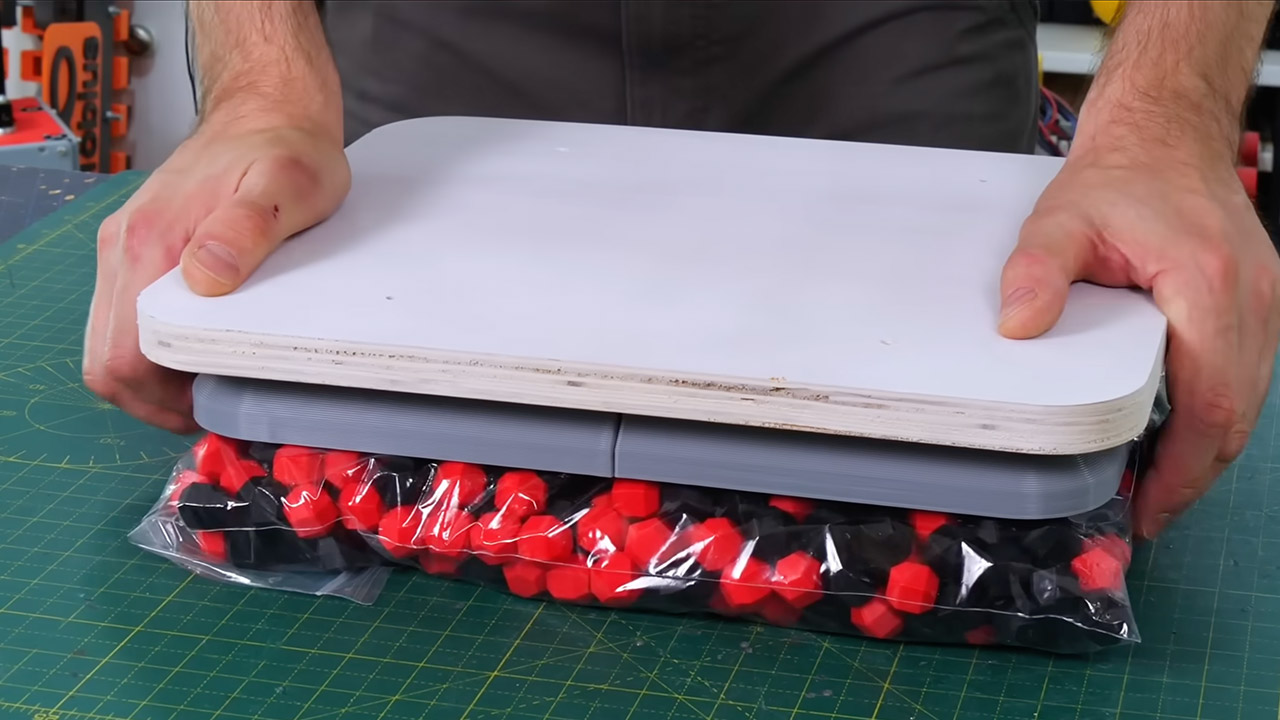
The earlier solid feet were built of hard materials with basic wedge-shaped plywood soles, which reduced the current required by the motors to maintain weight, but they still sat badly on uneven ground. Bruton investigated how a bean bag works and how it changes shape when you sit on it. A bean bag becomes stiff beneath your weight as the beans pack and lock together. So he decided to do the same with his feet.
He packed the insides of the coverings with a combination of regular fabric and airtight, waterproof ripstop kite fabric. The drawstring at the top is printed with TPU to keep everything closed. He filled the covers with a mixture of dried beans and 3D printed 20-sided dice because real dice would have been too expensive, so he printed the icosahedron himself. The flat triangular faces were designed to give more edges for the beans to grab against each other, giving them a solid shape when pressed down. A small 3D printed component at the bottom of each foot was designed to assist the beans settle and provide a more solid structure.
Earlier this year, he took the machine to Electromagnetic Field Camp and ran it trough grass and trails with small edges and hollows. On level ground, everything worked flawlessly, and he and the machine could move around easily. When one of his feet landed on a dip, the beans piled up unevenly, the sole curled, and the entire machine rolled over. Overfilling made things worse. He tried cutting the fill in half and then using zip ties to secure the bags. This eased matters marginally, but the feet continued to shift when stressed and refused to form a strong solid grasp on the ground.
The difficulty was that the high mass caused the beans to move around rather than lock into place. Low mass made them feel as if they were sitting on a regular bean bag, but it wasn’t what he was looking for. The dice added some facets, but they couldn’t keep the beans from shifting when the machine began leaning, and the plastic bags just split under the strain. As a result, he was forced to utilize a more durable cloth in the end.
By the end of the tests, it was clear that the bean bag and dice concept had limits. Bruton reasoned that using smaller particles, such as BB pellets, could increase flow and locking, or that a vacuum system, similar to those used in soft robotics, would suffice. However, he prefers to keep things simple. Next, he plans to use passive two-way pivot ankles that can self-level and, once flat, be securely fastened in place with bar-clamp hardware. Load cells or an inertial sensor would inform the device when it makes solid contact, allowing it to engage the clamps without any motors competing with the gait.
With its portholes in the hardtop and distinctive V8 rumble, the 1957 Ford Thunderbird is one of the Blue Oval’s true ’50s icons. Sadly, some of the surviving examples are now sitting in long term storage, with unforeseen life circumstances meaning their owners can no longer enjoy them like they used to. However, with the right care and attention, these dusty, animal-infested examples can still be brought back to life.
A new video by WD Detailing explains the painstaking process that was involved in getting one abandoned ’57 Thunderbird back on the road. The crew had to clear away around 15 years of accumulated dust and debris before it could fix the mechanical gremlins needed to get the car in working order once again. One of the first tasks was clearing out the leaves that had built up behind the grille. The crew found out that there was no way to easily access the space, and so had to loosen the radiator in order to fit a vacuum hose down to get it clean.
Advertisement
The complications didn’t stop there either. The next challenge was cleaning up the original whitewall tires, which were so expensive that the team wanted to avoid buying new ones if at all possible. After carefully getting them back to looking white again, the team then moved onto the car’s exterior.
Advertisement
There were still some surprises left to find
During the cleaning process, the crew found a few surprises along the way. One was the soft top, which was neatly folded away when they originally started work on the car, but cleaning the almost 70-year-old canvas was no easy task. Cleaning the interior proved to be an equally long-winded process.
When the team wanted to get the car running, even that turned out not to be a simple task. They found that the carburetor needed cleaning, and rather than simply using WD-40 and hoping for the best, they chose to use an ultrasonic cleaner to get it working. After that and all the other fluids were checked, drained, and refilled, the Thunderbird’s V8 engine cranked into life.
When the team took the car back to its owner, his reaction was intense. The car had previously been his father’s, but issues with his back and neck meant that Greg was no longer able to use it regularly, which is why it sat for so long. After he was taken for a ride in his newly restored classic, it was clear to see how much the project had meant to him. Some enthusiasts might associate the Thunderbird with movies or simply see it as a cool classic, but this happy owner, it was no simple car: it was a family heirloom, and one that was now being shown off in all of its glory.
Governments worldwide are racing to deploy and enforce digital IDs to enhance data privacy and national security. As adoption accelerates, it’s estimated that more than two-thirds of the global population, 5.6 billion people will own a digital wallet by 2029. Yet these credentials remain largely confined to national borders due to the lack of global interoperability.
Philipp Pointner
Philipp Pointner is Chief of Digital Identity at Jumio, the leading provider of AI-powered identity verification.
Advertisement
This is a challenge for today’s digital economy and is becoming even more complex with the rapid rise of agentic commerce as autonomous AI agents are increasingly executing cross-border transactions on behalf of users. This interoperability gap forces platforms to reject foreign digital credentials, forcing users to upload their physical IDs to complete global purchases—the exact security risk digital IDs were designed to eliminate.
Digital IDs locked behind borders brings vulnerabilities
Without clear global frameworks, a digital ID issued by one nation is completely unreadable and untrusted by digital services based in another. This creates a gap between privacy, security, and convenience as consumers interact with cross-border digital services.
Advertisement
Latest Videos FromTechRadar
This could include booking an accommodation at a hotel, completing a global transaction, or deploying an AI agent to negotiate a corporate purchase. This mismatch brings severe vulnerability risks for all parties, the enterprise, the nation who deployed the digital ID, and the consumer.
When consumers are forced to upload their passport, just to complete a routine transaction, the government that spent millions building a secure digital ID ecosystem now completely lost control over its citizens’ data sovereignty.
While image-based verification methods are secure and functional for localized onboarding, there are challenges that arise when users must repeatedly share sensitive documents across multiple organizations and jurisdictions to then be stored in a foreign database.
It expands the enterprise attack surface by multiplying the number of disparate databases where a user’s personal identifiable information (PII) is stored and can become a target for data breaches and identity attacks.
Sign up to the TechRadar Pro newsletter to get all the top news, opinion, features and guidance your business needs to succeed!
Advertisement
The technical debt of fragmented standards
Without clear standards for digital IDs, enterprises are forced to navigate a patchwork of identity protocols. This creates security blind spots that make it easier for fraudsters to steal passport images and other personal data to open fraudulent accounts at scale.
Beyond security risks, IT leaders are facing technical debt with the fragmentation of digital IDs. In order to accommodate new digital ID variations, institutions would have to completely re-file pre-approved processes for regulatory approval. Since this is a complex and exhaustive process, organizations stick to their approved legacy workflows. However, this leaves them more vulnerable to emerging threats.
This challenge only gets worse when you take into consideration that some countries are heavily restricting their digital IDs. 31% of OECD countries do not provide any form of cross-border digital identity recognition, meaning roughly 3 in 10 countries still cannot use foreign digital identities to access public services. However, it’s not a lack of technical interoperability that prevents the cross-border use of digital IDs; rather, governing bodies are actively forbidding it.
For example, Under the EU’s upcoming EUDI wallet (eIDAS 2.0), only businesses established within an EU Member State have a clear path to register and accept verified citizen digital identities.
Similarly, processing the Philippines’ PhilID is strictly restricted to companies incorporated and headquartered locally. Even if relying parties would be willing to deal with the non-standardized fractured technology of digital IDs, these protective regulations shut out international organizations from consuming them, forcing a reliance on legacy verification processes.
The security promise of digital IDs
Digital identity does have major benefits when it’s allowed to act at its full cross-border potential. When recognized and accepted by other organizations in other jurisdictions, consumers can establish trust without oversharing their personal information.
Advertisement
This limits the vulnerable information that organizations have to store in their databases and safeguards citizen’s privacy. Since only the specific data required to confirm authorization is transmitted, both organizations and sovereign nations can finally operationalize true data minimization.
As agents start executing actions on behalf of humans, reusable identity is the missing layer that makes the agentic ecosystem safe. Rather than forcing users back into a manual verification process, a standardized digital ID framework would allow an agent to present a pre-verified, universally trusted digital token.
This token could verify both the agent’s authorization and the user’s identity without exposing raw login credentials. This allows AI agents to fulfill their promise of true, autonomous automation.
Advertisement
The trust required for a borderless digital economy
Creating global interoperability for digital IDs isn’t just about ensuring a seamless digital economy; it’s about fundamentally shifting how we build and maintain trust in digital systems. While standardized cross-border frameworks are essential for the initial onboarding with digital IDs, true security with reusable identity requires moving beyond static, point-in-time checks.
This is especially true as AI agents begin navigating global platforms and executing transactions on behalf of users. As these agents are designed to operate continuously in the background, identity verification can no longer be a single, one-time event.
To make the digital ecosystem more secure and resilient for both humans and machines, trust must be re-established throughout the entire user lifecycle.
By deploying continuous monitoring through real-time behavioral and device pattern signals, enterprises can allow authentic users and their authorized AI agents to interact seamlessly beyond borders. Friction with identity verification would then only enter the equation when suspicious behavior is detected.
Advertisement
But spotting these subtle anomalies means fraud can no longer be addressed in isolation. By adopting an identity intelligence solution, organizations can layer multiple authentication and identity signals to build a more complete picture of risk. This intelligence can then be shared across organizations and even governments to detect fraud patterns and threats in real time, before they become widespread.
This unified knowledge is essential because the purpose of digital IDs was never meant to end at national borders. Governments must stop restricting international organizations from accepting their digital IDs because, when implemented correctly, enabling cross-border access creates a fundamentally safer environment for citizens.
We are living in a truly borderless digital economy, and our frameworks for digital trust must evolve to match this reality. Global interoperability and continuous trust are the foundation for a more secure, privacy-centric ecosystem—one where individuals, enterprises, and autonomous AI agents can interact with total confidence anywhere in the world.
This article was produced as part of TechRadar Pro Perspectives, our channel to feature the best and brightest minds in the technology industry today.
The views expressed here are those of the author and are not necessarily those of TechRadarPro or Future plc. If you are interested in contributing find out more here: https://www.techradar.com/pro/perspectives-how-to-submit
















%2520comparison%2520Reviewer%2520Photo%2520SOURCE%2520Nena%2520Farrell.jpg)





















































You must be logged in to post a comment Login