
Crypto World
Why the UK financial watchdog is drafting new rules for gold tokenization



The U.K.’s financial watchdog is preparing rules for tokenized gold as part of its digital asset strategy to ensure London maintains its status as the top global hub for the trade of the precious metal.
The Financial Conduct Authority (FCA) approached financial institutions to explore tokenized gold regulations to foster market growth, the Financial Times reported Monday, citing people familiar with the plans.
London’s over-the-counter market (OTC) market has historically ranked as the number one center for gold trade and currently accounts for 70% of the world’s notional trading volume, according to the World Gold Council. However, London’s dominance is being increasingly challenged by China.
The tokenization of gold is the process by which digital tokens are created to represent ownership rights in physical gold, with the token issuer holding the gold as backing.
The FCA, which has also discussed digitizing the wholesale financial markets, is seeking feedback on the role tokenized gold could play as collateral in wholesale markets and is expected to announce progress on drafting new rules for tokenized digital assets within the next few months, the report said.
The regulator had not responded to CoinDesk’s request for further comment at press time.



The extra yield exists only if traders actually swap through those pools, which means Jupiter not only runs Solana’s largest swap router, the software most wallets and apps use to find the best price across venues, but it also owns pools that need that flow to arrive.
The company told CoinDesk the router does not favor its own vaults and sends swaps wherever the price is best.
The risk of pairing assets falls unevenly, however. Jupiter said margin is valued using primary market oracles, or data providers, so a temporary price wobble on an exchange does not trigger anything, and a position liquidates as normal once its loan-to-value ratio passes the threshold.
A genuine depeg is different. On the debt side the borrower is protected — someone borrowing $100 split between USDC and USDT would see the pool rebalance into whichever asset held its value and still owe $100. On the collateral side there is no such protection, and a supplier carries the loss on both assets if either breaks.
That is why the design is confined to correlated pairs, stablecoins against each other and SOL against its staked versions, rather than volatile assets.
“There’s been a wall between the two primary ways people earn APY onchain, lending and LPing,” said Kash Dhanda, Jupiter’s chief operating officer, referring to lending and supplying liquidity to exchanges.
Grayscale’s XRP Trust ETF sold 103.41 million XRP worth $180.78M during the first half of 2026, reducing its holdings from 122.23 million tokens at the end of 2025 to 55.04 million by June 30, according to a Ripple SEC filing, marking a worrying drop in institutional adoption for the digital asset.
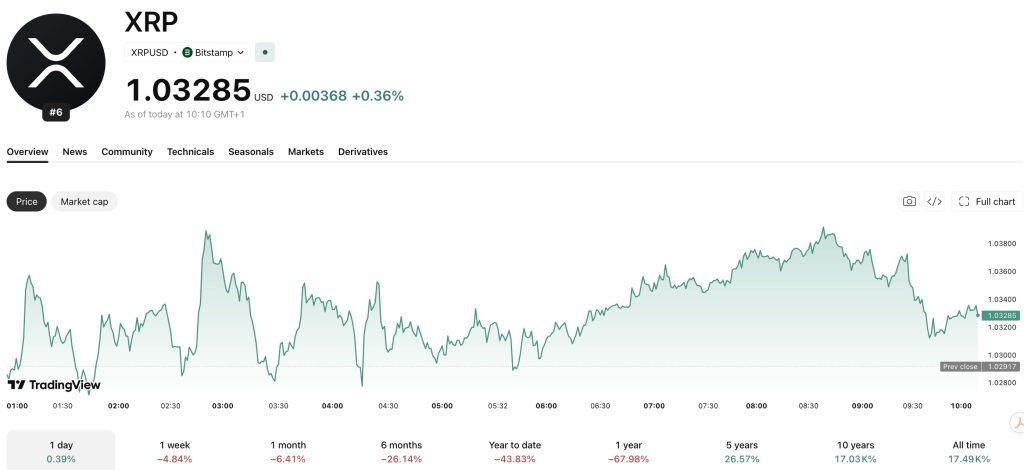
This news dropped as XRP USD trades for $1.02, dangerously close to losing its key support at $1 following a -0.2% drop overnight. Daily trading volume is sitting at $732M, up from $670M yesterday.
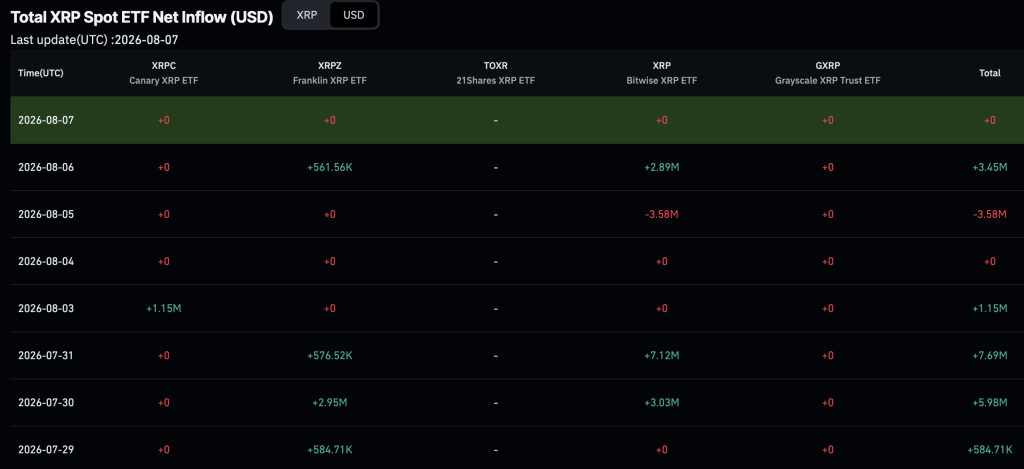
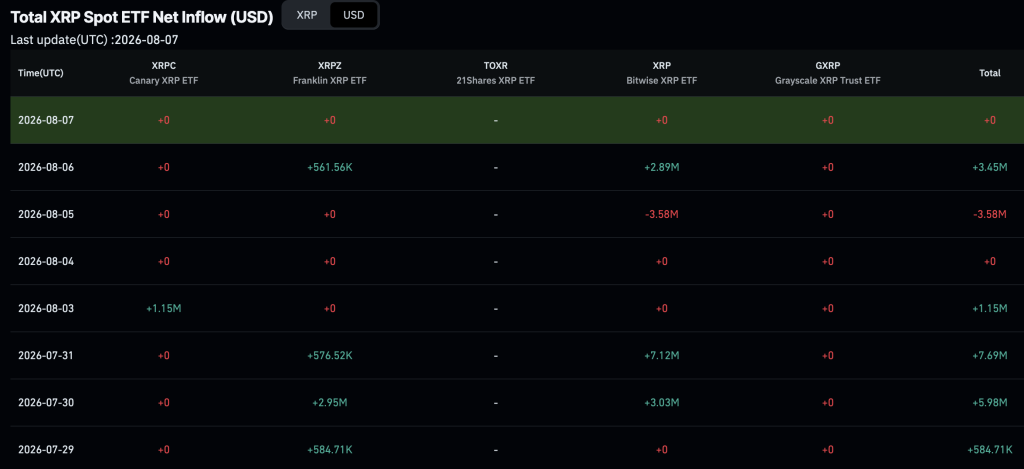
CoinGlass data shows that XRP ETF net inflows total $1.42Bn since they went live in November 2024, a healthy number that puts into perspective the size of Grayscale’s ETF selloff.
The Mechanics Behind the Contraction
The value of the trust’s XRP holdings fell from $223.36M at the end of 2025 to $57.41M on June 30, according to the SEC filing. Grayscale recorded a $34.16M realized loss on XRP sold for share redemptions, along with a $17.47 million unrealized loss on its remaining XRP position.
The trust created an additional 36.27M XRP valued at $66.58M during the six-month period, but those additions did not offset the redemptions. Outstanding shares declined from 6.30 million at the end of 2025 to 2.84 million by June 30.
The trust bought back 5.33 million shares and sold 1.87 million shares during that period. It also recorded a $39,000 realized loss on XRP sold to cover expenses.
Authorized participants are responsible for creating and redeeming shares in the trust. The filing also attributes the reduction in XRP holdings per share to periodic XRP withdrawals used to meet the sponsor’s fee.
Discover: Everyone’s Got a Take. Join Kalshi and Get a Free $25 to Actually Trade Yours
XRP Price and Fund Flows
XRP declined from $1.84 on Jan. 1 to $1.05 on June 30, a drop of more than 40%. The token traded between $1.015 and $1.041 on Aug. 7, placing it near the bottom of its 52-week range of $1.0095 to $3.3818.
Weekly inflows into XRP exchange-traded funds dropped to about $1M from $14.9M the previous week, although daily flows rebounded to roughly $3.5M on Aug. 6, according to CoinGlass data. XRP was down roughly 10% over the prior month and about 5.5% over the seven days through Friday.
The US Senate delayed consideration of the crypto market-structure legislation known as the CLARITY Act until at least September. Regulatory developments, institutional demand, and Ripple’s XRP holdings are among the factors that can influence XRP’s price.
Ripple released 1 billion XRP from escrow on Aug. 1 as part of its scheduled monthly unlock. The company has historically returned a substantial portion of its monthly releases to escrow rather than putting all of the tokens into circulation.
What the Ripple SEC Filing Establishes
The filing documents sales of XRP for share redemptions and for expenses, as well as changes in the trust’s XRP holdings and share count. Redemptions may require token sales to meet investor withdrawals, while authorized participants handle share creation and redemption.
The trust’s XRP holdings fell by more than half between the end of 2025 and June 30, while the value of those holdings declined from $223.36M to $57.41M. The filing also shows that XRP creations during the period were smaller than the XRP sold for redemptions.
Discover: Your Market Calls Are Worth Something. Start With Free $25 on Kalshi
The post XRP Trust Shares and Holdings Plunge in First-Half Filing appeared first on Cryptonews.
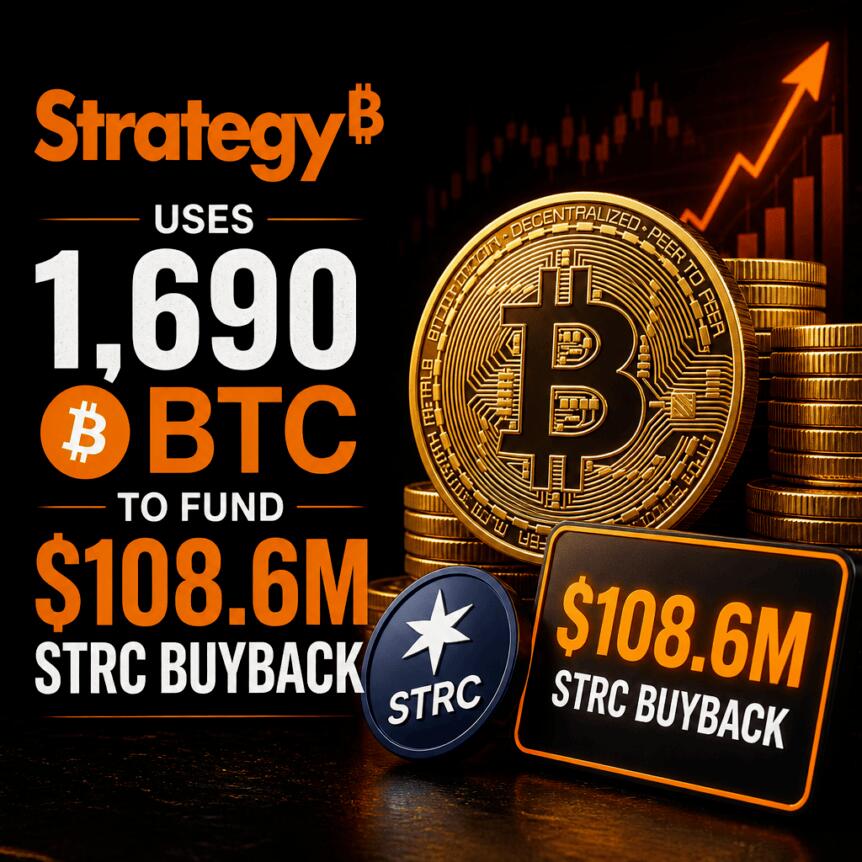
Strategy, the publicly traded firm with the largest corporate Bitcoin treasury, has again converted part of its BTC holdings into cash to support buybacks of its STRC preferred stock. In its latest SEC filing, the company reported a second consecutive week of Bitcoin sales used to fund repurchases of STRC shares.
According to a Monday 8-K filing with the US Securities and Exchange Commission (SEC), Strategy sold 1,690 Bitcoin for $108.6 million between Aug. 3 and Aug. 9. The proceeds were used to buy back 1.15 million shares of its STRC preferred stock for the same $108.6 million total.
Key takeaways
- Strategy sold 1,690 BTC for $108.6 million (Aug. 3–Aug. 9) to repurchase STRC preferred shares.
- This was the company’s fourth disclosed Bitcoin sale of 2026, bringing 2026 total BTC sales to 6,948.
- Strategy still holds 840,447 BTC with an aggregate purchase price of $63.36 billion, implying ongoing long-term exposure.
- The filing shows remaining repurchase capacity under both the preferred stock and common-stock buyback programs.
- Alongside STRC buybacks, Strategy continued building a US dollar reserve, reporting $4.65 billion as of Sunday.
Bitcoin sales tied directly to STRC buybacks
Strategy’s latest filing reinforces the company’s funding approach: using periodic Bitcoin liquidations to finance preferred stock repurchases. STRC is a variable-rate preferred stock structured to pay monthly dividends, and Strategy’s buybacks appear designed to manage capital structure while continuing dividend-related obligations.
On this occasion, the company reported an average net sale price of $64,262 per Bitcoin for the 1,690 BTC it sold. For comparison, Strategy’s broader Bitcoin cost basis is higher: the company cited an average purchase price of $75,385 per BTC for total holdings, including fees and expenses.
Strategy also previously disclosed a similar sequence. Earlier coverage noted that Strategy sold 1,638 BTC for $104.73 million between July 27 and Aug. 2, and used those proceeds to fund STRC repurchases as well. The current week’s sale follows that pattern closely—suggesting the company is maintaining an active, repeatable mechanism rather than relying on one-off treasury adjustments.
How much BTC Strategy has sold in 2026
While the latest transaction adds another step to Strategy’s 2026 funding routine, it does not represent a major shift away from holding BTC. The filing states the trade marked the company’s fourth disclosed Bitcoin sale of the year, bringing total 2026 BTC sales to 6,948 BTC.
After the latest sale, Strategy still holds 840,447 Bitcoin purchased for an aggregate $63.36 billion. That large remaining position matters for investors because Strategy’s balance sheet exposure to Bitcoin remains the dominant driver of its treasury value, even as the company periodically monetizes BTC to meet financial objectives.
From a market perspective, these disclosures also keep the question of “how much BTC is converted” in focus. If Strategy’s buyback-linked sales continue on a regular cadence, traders may increasingly weigh whether those conversions pressure sentiment around BTC liquidity at specific intervals—even if the firm’s long-term exposure remains intact.
Repurchase capacity and the dollar reserve build
Beyond the immediate buyback, the 8-K includes additional numbers that help map out how Strategy plans to fund and sustain the preferred stock program. The filing says Strategy has $785.2 million remaining under its digital credit securities repurchase program, which covers the preferred stock. It also reports another $1 billion available under its Class A common-stock repurchase program.
Strategy simultaneously continued building its US dollar reserves. The company reported a $4.65 billion balance as of Sunday, up from roughly $4 billion in the previous weekly update. In the filing, Strategy said $650 million of $653.1 million in net proceeds from recent MSTR stock sales went toward the reserve.
The reported cash number also includes expected proceeds from at-the-market (ATM) sales that had not yet settled at the time of the update. Taken together, the reserve build is relevant because it may reduce the need for frequent immediate BTC liquidations under certain market conditions—while still leaving BTC as the core long-duration holding.
STRC share momentum alongside buybacks
Strategy’s STRC buybacks come at a moment when the preferred stock has shown strength. The article cited that STRC shares rallied during Strategy’s recent repurchases, reclaiming $90 on Aug. 3 after rebounding 24% from their June lows.
In premarket trading Monday, STRC was up 0.46% to $95.45, after closing Friday at $95. According to Yahoo Finance, Strategy’s MSTR shares were also slightly higher, up 0.25% to $100.26 at the time of the report.
While price moves in any single session can’t be attributed solely to buybacks, the sequence is still notable: repurchases funded by BTC sales are arriving while market participants appear willing to bid up STRC from earlier weakness. For investors, the practical takeaway is that Strategy’s corporate actions are being tested in real time by equity market liquidity, particularly around preferred stock where dividends and variable-rate mechanics can influence demand.
Looking ahead, readers should watch two things: whether Strategy continues the pace of BTC-to-STRC conversions disclosed in its SEC filings, and how the firm’s remaining repurchase capacity and US dollar reserve evolve week to week. Any change in the cadence—or in the average net sale price compared with its cost basis—could affect how investors interpret the trade-off between maintaining BTC exposure and supporting the company’s preferred stock funding engine.


Quantum Fintech Group founder Harry Chun Tak Yeh was found dead in Paraguay after falling from his luxury 30th-floor apartment last week.
Local media reports that Yeh fell from his apartment in the early hours of the morning, either on a Tuesday or Friday, before his naked body was found covered by a black plastic bag.
Police discovered his apartment ransacked with the door wide open, and nobody else present.
Yeh’s 29-year-old partner, Isadora de Proenca Braganholo Carvalho, says she was unaware of what happened. The Brazilian national was staying in Yeh’s other apartment on the 27th floor.
Police are currently investigating whether or not Yeh’s death was an accident, suicide, or a potential murder.
Yeh made his fortune investing in BTC in 2013 when it was worth roughly $60. He then went on to found crypto hedge fund Quantum Fintech Group in 2020 and claimed to manage over $2 billion worth of funds.
Read more: Billionaire Brock Pierce did an interview with a Pro-Putin cult
One crypto developer, who goes by “@0xz80 on X,” shared some “stories” about Yeh.
Yeh supposedly gathered a group of Fantom layer-1 developers and 500 Dubai-based escorts together for an event, and joked that “Us 200 crypto nerds [had] no idea how to talk to them.”
@0xz80 also claimed that Yeh rented out an entire E11even, a famous nightclub brand and gave his developers crates full of cash.
In addition to these displays of wealth, @0xz80 added that Yeh “made it to the top of some of the sketchiest corners of crypto,” and that he was “one of the sketchiest people I’ve ever met in my life.”
Got a tip? Send us an email securely via Protos Leaks. For more informed news and investigations, follow us on X, Bluesky, and Google News, or subscribe to our YouTube channel.
Crypto World
XRP price faces pressure as ETF inflows slow, while UE Crypto cloud mining emerges with daily earnings potential exceeding $7,000

Disclosure: This article does not represent investment advice. The content and materials featured on this page are for educational purposes only.
XRP struggles amid weaker ETF inflows, while UE Crypto expands access to cloud mining with free services and mobile management for major crypto assets.
Summary
- Weak XRP ETF momentum and RLUSD activity keep XRP near its yearly low as UE Crypto launches free cloud mining.
- XRP struggles near $1.04 amid softer ETF demand, while UE Crypto expands access to cloud mining through its mobile app.
- As XRP underperforms Bitcoin and Ethereum, UE Crypto introduces a free mining service supporting BTC, XRP, DOGE and ETH.
Recent data shows that the upward momentum of spot XRP ETFs continues to weaken, while XRP price performance remains sluggish, significantly underperforming major digital assets such as Bitcoin and Ethereum.
Affected by factors including slowing ETF inflows and declining trading activity of Ripple’s stablecoin RLUSD, XRP continues to face price pressure. It is currently hovering around $1.0424, only about 3.5% above its yearly low of $1.007, as short-term market caution continues to increase.
Why is cloud mining becoming increasingly popular?
Traditional cryptocurrency mining often requires significant hardware investment, professional mining facilities, and 24/7 dedicated maintenance. It not only has high entry barriers and substantial upfront costs, but also involves challenges such as rapid equipment upgrades, high electricity consumption, and frequent equipment failures.
The emergence of cloud mining has fundamentally changed this situation. There is no need to purchase mining machines, deploy equipment, or handle professional maintenance. Users simply select a suitable computing power plan online and can remotely access large-scale computing resources. With one-click participation, automated operation, and earnings settlement, cloud mining enables users to pursue long-term passive income with a low barrier to entry and is becoming an increasingly popular choice among digital asset investors.

UE Crypto launches a new free cloud mining service
UE Crypto — a global leading cloud computing power service platform headquartered in the United Kingdom — has officially launched a free cloud mining experience for users worldwide. The platform supports major digital assets including BTC, XRP, DOGE, LTC, and ETH. It has also launched a mobile app, allowing users to check earnings and computing power status at any time while managing contracts and services directly, truly making mining accessible “anytime, anywhere.”
Platform strengths
- Operates more than 150 modern intelligent mining farms worldwide
- Deploys more than 6 million high-performance computing devices
- Uses 100% clean energy, including hydropower, wind power, and solar power, for green and low-carbon operations
- Services cover users globally, with more than 2 million users served
- Beginner-friendly and professionally optimized, with a simple and efficient process
- Invite friends to earn up to 5% commission, with opportunities to win additional rewards of up to $30,000
Three steps to start stable passive income
Step 1: Register an Account
Visit the official UE Crypto website and complete registration using an email address. The entire process takes approximately 2 minutes. New users receive a $20 trial credit upon registration and can use it to experience daily earnings directly.
Step 2: Choose a computing power contract
The platform offers multiple income plans, with investment amounts ranging from $100 to $100,000, providing flexible options for different budgets and expected returns. Contract terms, durations, and expected earnings are all publicly disclosed and transparent.
Step 3: Earnings are automatically credited
Once the contract takes effect, the system automatically allocates computing power and begins daily settlement. No manual monitoring or technical operation is required. Earnings can be withdrawn at any time to a personal digital wallet or reinvested into new contracts to achieve continued growth and compound returns.
Overview of popular earning plans
- Entry Experience: Invest $100・2-day contract → Principal returned at maturity, with a net profit of $8
- Stable Allocation: Invest $500・5-day contract → Principal returned at maturity, with a net profit of $31.25
- Advanced Growth: Invest $3,000・17-day contract → Principal returned at maturity, with a net profit of $698.7
- Long-Term Allocation: Invest $10,000・35-day contract → Principal returned at maturity, with a net profit of $5,530
- Premium Planning: Invest $50,000・40-day contract → Principal returned at maturity, with a net profit of $34,200
Earning potential, green operations & security
Relying on large-scale computing power clusters and an intelligent scheduling system, eligible users can achieve maximum daily earnings exceeding $10,000. There is no need to bear additional costs related to hardware purchasing, depreciation, maintenance, or electricity consumption. Computing power and operations are fully managed by the platform’s professional team, allowing users to receive their share of the earnings.
In terms of security, UE Crypto adopts bank-level encryption technology, a multi-layer risk control system, and 24/7 security monitoring to comprehensively protect accounts and assets. At the same time, the platform adheres to the concept of green development, with all mining farms powered by clean energy, achieving 100% carbon neutrality while balancing efficient earnings with sustainable development.
Conclusion
As the digital asset market matures and investment strategies return to a more stable approach, cloud mining is becoming an increasingly important way for investors to pursue long-term stable returns. With its global computing power network, clean energy infrastructure, intelligent operations, and streamlined participation process, UE Crypto significantly lowers the barrier to participating in digital assets.
No need to purchase mining machines, no need for technical expertise, and no need to manage operations. Register and start pursuing passive income.
For more information, visit the official website.
Disclosure: This content is provided by a third party. Neither crypto.news nor the author of this article endorses any product mentioned on this page. Users should conduct their own research before taking any action related to the company.

SpaceX stock swung between a slight gain and loss early Monday, as shares attempt to reclaim the 135 IPO price and notch their third consecutive daily gain. SPCX rallied late last week as its first insider share lockup expired following its Q2 earnings beat. Cathie Wood and her ARK Invest firm purchased more shares on Friday. SpaceX (SPCX) stock jumped…
Copyright ©2026 Investor’s Business Daily, LLC. All rights reserved. 87990cbe856818d5eddac44c7b1cdeb8

Meta Platforms (META) Chief Executive Mark Zuckerberg warned Monday against a “concentration of power” in AI as the social media giant introduced a new open-source large language model. Meta stock rose premarket. The Facebook parent company’s new Muse Glimmer AI model will be capable of “agentic” tasks while being offered under an open source license, the company said in a…
Copyright ©2026 Investor’s Business Daily, LLC. All rights reserved. 87990cbe856818d5eddac44c7b1cdeb8
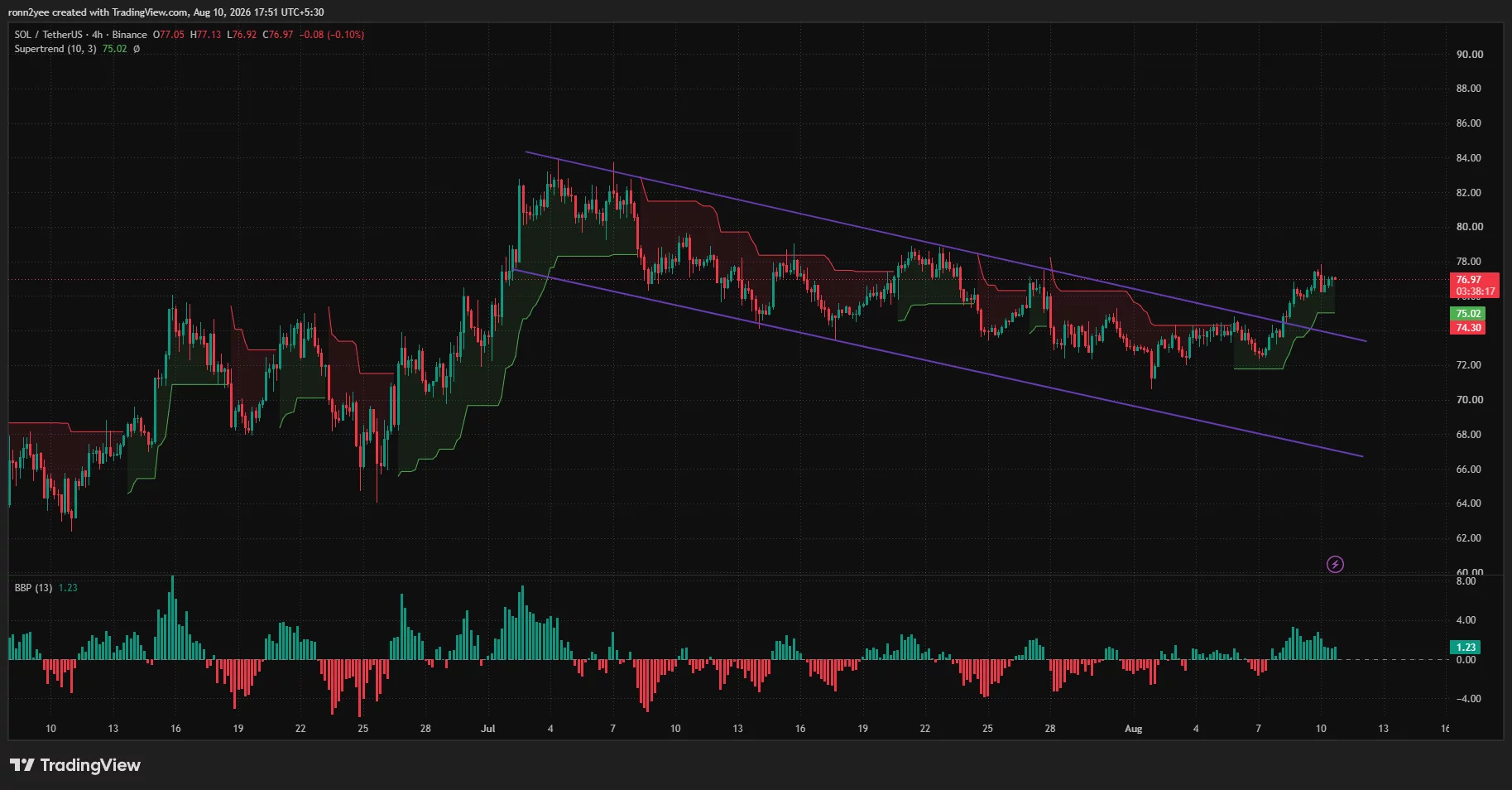
Solana price rallied nearly 7% from its Aug. 7 low, breaking a five-week descending channel as proposed supply changes and institutional adoption renewed demand for SOL.
Summary
- Solana price rose from $72.49 to $77.36, breaking above a five-week descending channel.
- 4-hour Supertrend support flipped bullish at $75.02, strengthening the breakout structure.
- Liquidation clusters at $78 and $80 could accelerate gains if buyers maintain control.
- Daily momentum remains mixed, leaving $74–$75 as the main breakout invalidation zone.
Solana price breaks its five-week downtrend
According to data from crypto.news, Solana (SOL) price traded around $76.93 on Aug. 10, up nearly 7% from its Aug. 7 low of $72.49. The recovery pushed SOL through the upper boundary of a descending channel that had controlled its price since early July.
The 4-hour chart shows that SOL first reclaimed $74.30 before breaking the channel near $75. The price then climbed to an intraday high of $77.36, where buyers encountered initial resistance.
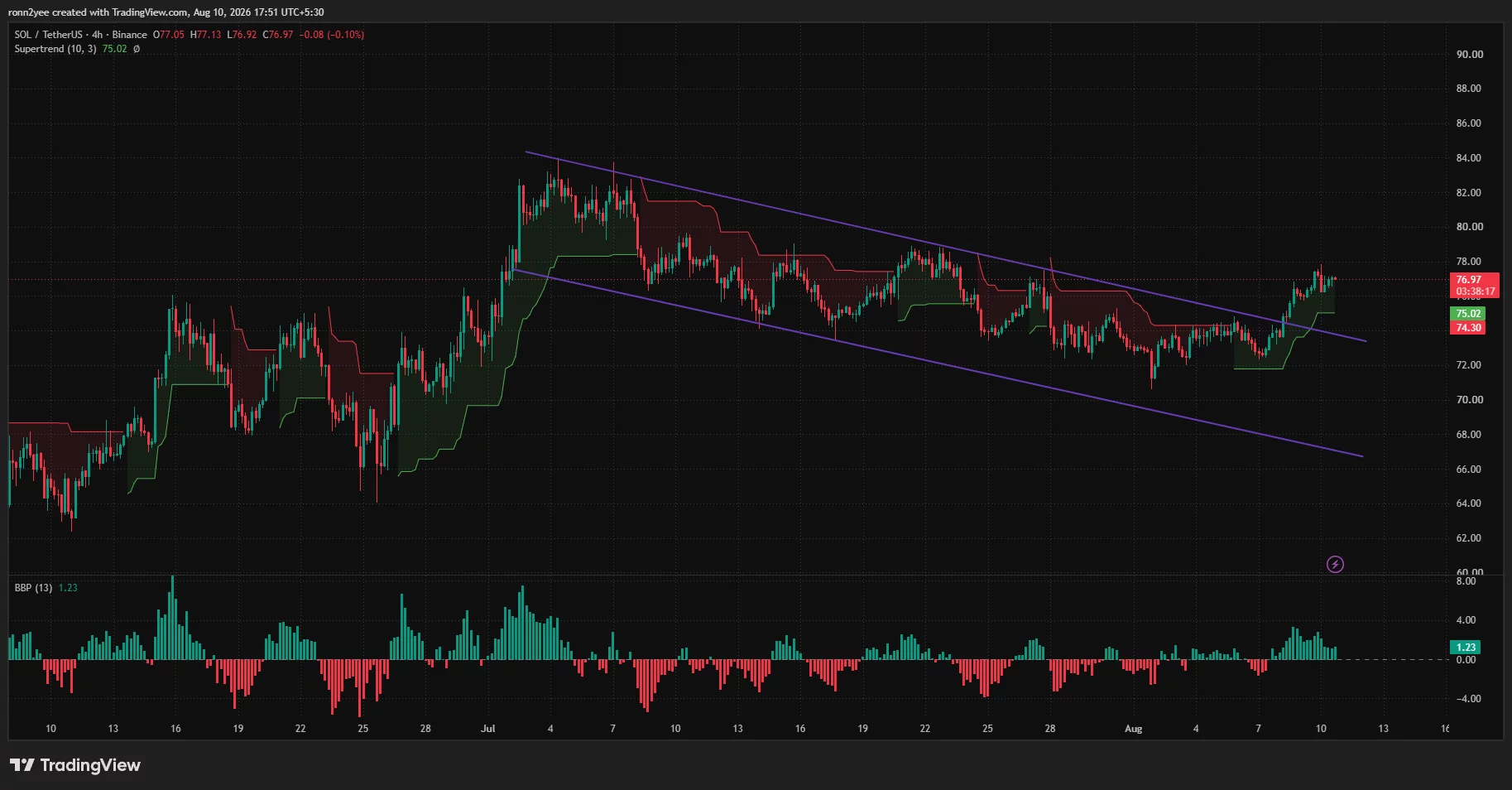
Trading volume expanded during the breakout, while the bull-bear power indicator rose to 1.23. A positive reading indicates that buyers currently have more short-term control than sellers.
The Supertrend indicator has also flipped below the market and now provides dynamic support at $75.02. Holding above this level would keep the 4-hour structure bullish and could turn the former channel resistance into support.
Crypto analyst Dami-Defi identified the same structural change in an Aug. 10 post on X.
“SOL just broke a five-week downtrend,” the analyst said.
The breakout does not yet confirm a broader trend reversal, however. SOL remains well below its May swing high near $97 and its January peak above $145.
What is driving the SOL recovery?
The rally coincided with growing validator support for two proposals designed to reduce Solana’s future supply growth.
SIMD-0550 would increase the annual disinflation rate from 15% to 30%, bringing the network toward its terminal inflation rate faster. SIMD-0553 would introduce resource-based transaction fees and could raise daily SOL burns from about 650 tokens to between 7,500 and 9,000.
The formal governance process is expected to run through Aug. 18. The proposals remain subject to validator approval, meaning their projected supply effects are not guaranteed. Solana’s governance forum describes SIMD-0550 as a doubling of the pace at which inflation declines.
Institutional developments have added another source of demand. BlackRock recently unveiled its Daily Reinvestment Stablecoin Reserve Vehicle, which can record fund ownership across several public blockchains, including Solana. The product holds cash, short-term U.S. Treasuries and repurchase agreements rather than SOL itself.
Western Union has also expanded its use of the network. Its USDPT stablecoin is issued on Solana by federally regulated Anchorage Digital Bank, while a related Stablecard product launched across 37 markets. Western Union formally launched USDPT on Solana in May.
These developments do not directly require institutions to purchase SOL in large amounts. They do, however, strengthen Solana’s case as infrastructure for regulated funds and dollar-based payments.
SOL targets $78 liquidity before $80
The three-day liquidation heatmap shows the nearest concentration of leveraged positions around $77.80–$78.20. This zone matches the next horizontal resistance visible on the 4-hour chart.
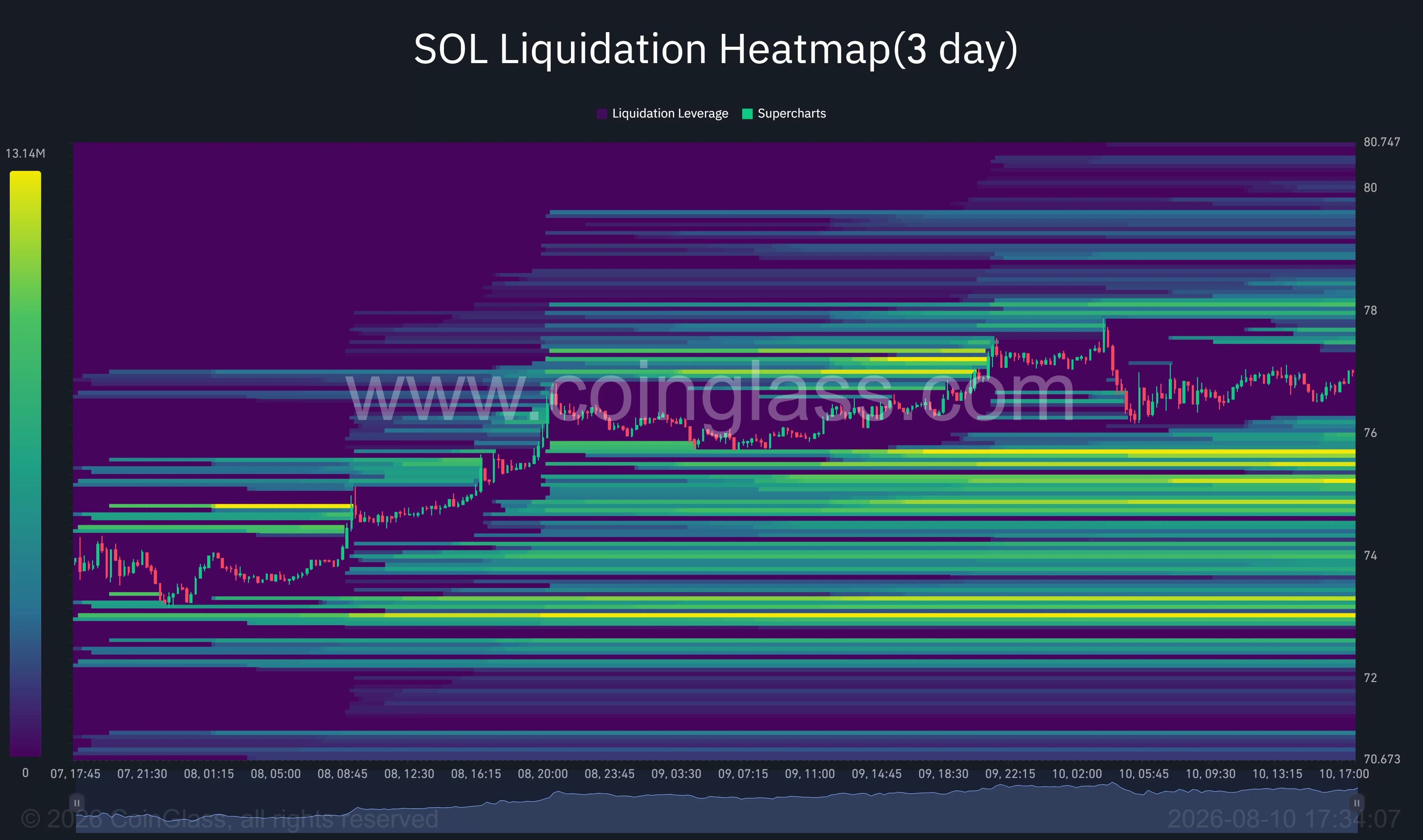
A break above $78 could trigger another round of short liquidations and open a move toward $80. The upper section of the former channel and previous July swing levels place the next larger resistance between $82 and $84.
Dami-Defi’s chart projects a possible move toward $83 if SOL successfully retests the broken trendline.
Michaël van de Poppe offered a more ambitious longer-term outlook. In an Aug. 10 market update, he said SOL had formed a higher low against Bitcoin and forecast a possible recovery toward $100–$120.
That target would require SOL to reclaim several resistance zones that are not visible in the current short-term breakout. The first tests remain $78, $80, and $83.
Daily Solana chart still needs confirmation
SOL’s daily chart is improving, although it has not produced a fully confirmed bullish reversal.
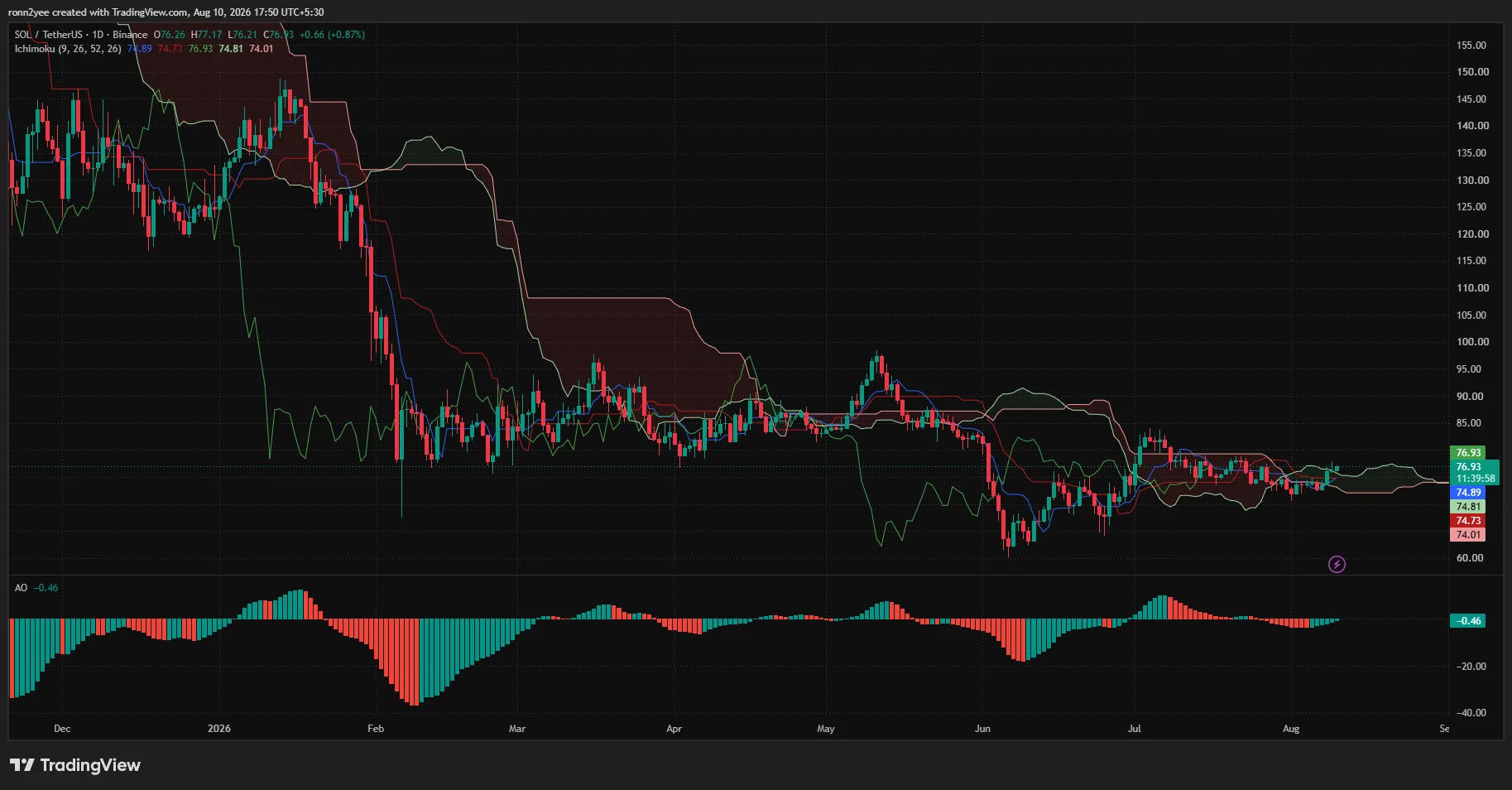
The price has moved above the Ichimoku conversion line at $74.89 and the baseline at $74.73. SOL is also attempting to clear the upper edge of the cloud around $76.93, making the current area an important daily closing level.
A sustained close above the cloud would strengthen the case for a move toward $80–$84. Rejection near $77, however, could send SOL back to test the Ichimoku cluster between $74.73 and $74.89.
The Awesome Oscillator remains slightly negative at -0.46. Its red bars have contracted and the indicator is moving toward zero, suggesting bearish momentum is fading but has not yet reversed completely.
Liquidation data reinforces the downside levels. Large long-liquidation concentrations sit around $75.70, $75.10 and $72.80. If SOL loses $75, forced selling could pull the price toward $73 before buyers regain control.
US developments remain a key SOL catalyst
Solana’s institutional adoption has become increasingly tied to regulated U.S. financial infrastructure. BlackRock’s fund structure involves tokenized ownership of Treasury-backed assets, while Western Union’s USDPT is issued by a U.S. federally chartered crypto bank.
The next network catalyst is the planned Alpenglow rollout. The upgrade aims to reduce transaction finality from about 12.8 seconds to between 100 and 150 milliseconds, with implementation expected in stages between August and October if testing proceeds as planned.
For now, SOL’s 4-hour breakout favors buyers while the price remains above $75. A daily close above $78 would provide stronger confirmation and shift focus toward $80–$84. Losing $74 would place the breakout at risk and reopen the path toward $72.80.
Disclosure: This article does not represent investment advice. The content and materials featured on this page are for educational purposes only.


Bitdeer mined 2,694 BTC in Q2, but ended the quarter holding just 150 BTC after liquidating its treasury earlier this year.

Barrick Mining (B) and Newmont (NEM) reached an agreement that may clear the way for Barrick’s IPO of its North American gold assets to unlock their full value. While the agreement resolves opposition from Newmont, with which Barrick has a Nevada Gold Mines joint venture, Bloomberg reported on Sunday that some major Barrick shareholders disapprove of the IPO plan. While…
Copyright ©2026 Investor’s Business Daily, LLC. All rights reserved. 87990cbe856818d5eddac44c7b1cdeb8

AI can hack Bitcoin ?

Huge 7.4-magnitude earthquake hits Colombia, burying people beneath collapsed buildings, with multiple deaths

Chessington World of Adventures closed because of water outage


-

 Fashion3 days ago
Weekend Open Thread: Mattifying Sunscreen
-

 Fashion3 days ago
Frugal Friday’s Workwear Report: Cap-Sleeve Pointelle Crewneck Sweater
-

 Sports5 days ago
Jordan Coyle & Cordiamo take Laya Arena Stakes at RDS
-

 News Videos2 days ago
Can Astrology Help Find Gold and Silver Trends? A Financial Astrology Guide
-
 Business5 days ago
US stocks: Dow closes at record on Mideast optimism; SpaceX, AMD drag Nasdaq
-
 Crypto World7 days ago
US Tech Stocks See Largest 5-Week Inflow in History: Can Nasdaq Break Its Downtrend?
-

 Politics4 days ago
Reform UK And Greens Sink To Lowest Favourability Ratings To Date
-

 Business6 days ago
Nvidia Stock Climbs 2.5% as Chip Sector Rally Builds Ahead of AMD Earnings, Nvidia’s Own Report Looms
-

 Crypto World6 days ago
Polymarket targets $20 billion valuation as competition heats up in prediction market sector
-

 Tech6 days ago
OpenAI, Anthropic AI agents targeted real people and systems in cyber tests
-

 Business5 days ago
Supply chain issues impact Ingredion
-
 Crypto World6 days ago
CLARITY Act Senate Vote Locked In, But 60-Vote Hurdle Looms Large
-

 Tech3 days ago
Rinn Pharma & Biopharma to join NordicPharmaTrain network
-

 Crypto World7 days ago
The Senate has one week: CLARITY’s last August window
-
 Crypto World6 days ago
Dow and S&P 500 Hit Records on AI Earnings: When Will the Bubble Burst?
-
 Crypto World7 days ago
California Wildfire Bets Expose Polymarket’s Dark Side
-

 Business1 day ago
How to Start a Cleaning Business: A Step-by-Step Guide
-

 Business1 day ago
Datadog: Best Of Breed For Multiple Reasons
-

 Business7 days ago
CNH Industrial Shares Jump Over 15% After Beating Estimates and Raising Full-Year Earnings Guidance
-
 Crypto World6 days ago
Dollar Index Trapped at 100 as Hawkish Fed Meets Official Selling
You must be logged in to post a comment Login