
Crypto World
Strive Buys 147 More Bitcoin, Treasury Tops 20,167 BTC

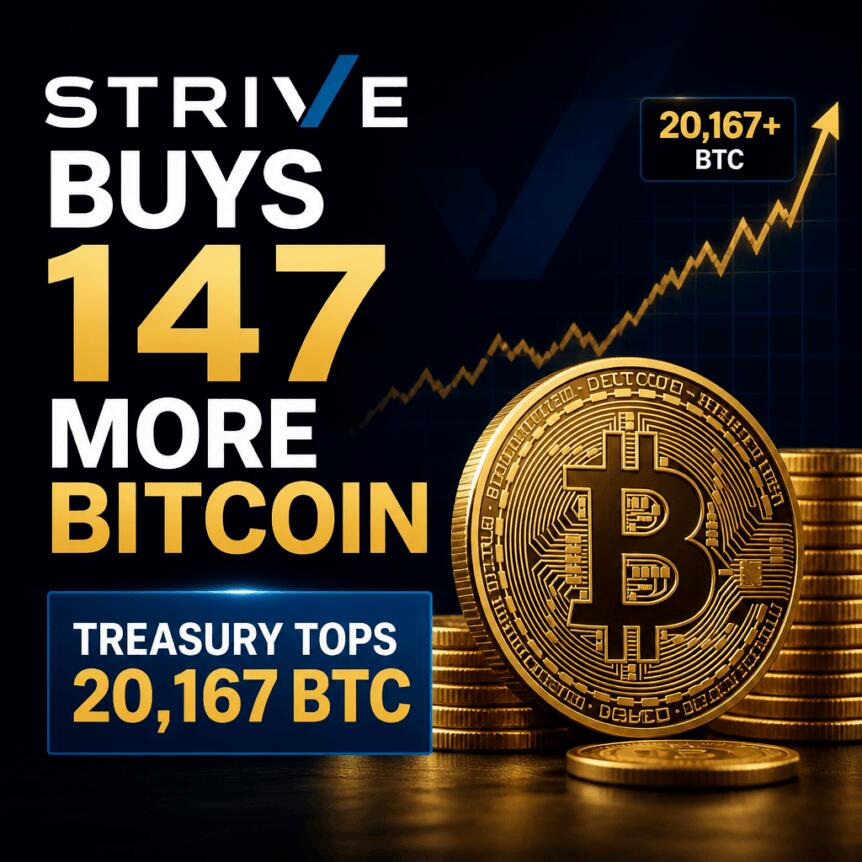
Strive has grown its corporate Bitcoin treasury once again this month. The asset manager purchased 147 BTC and pushed total holdings to 20,167 BTC. The move confirms the company’s steady push to build one of the largest corporate Bitcoin reserves.
Strive Adds 147 Bitcoin to Treasury
Strive bought the 147 BTC between August 3 and August 7, according to a recent filing. The company paid an average price of about $64,812 per Bitcoin for this batch. That brings the total value of its holdings to roughly $1.3 billion.
Chief Executive Officer and Chairman Matt Cole confirmed the update on X. He stated that Strive now holds 20,167 BTC in total. BitcoinTreasuries.NET also ranked the company as the seventh-largest public corporate Bitcoin holder worldwide.
This purchase continues a pattern of steady accumulation throughout 2026. Strive bought 1,109 BTC in May and followed with 2,500 BTC in June. Smaller purchases in July and early August kept the momentum going.
Strive Reports 24% Bitcoin Yield in Q2
Strive posted a Bitcoin yield of 24% for the second quarter of 2026. The figure rose to 38% when measured across the first half of the year. The company uses this yield metric to track Bitcoin growth against diluted shares outstanding.
The asset manager also retired its debt completely during the second quarter. Strive currently holds about $155 million in cash reserves. This combination gives the company flexibility as it continues expanding its Bitcoin position.
Strive also introduced SATA, a preferred stock product that pays daily dividends. The company positions this product as part of a broader financial strategy. Bitcoin holdings, cash reserves, and debt management now work together under one plan.
On August 10, Strive launched a new Bitcoin treasury dashboard and website. The platform gives the public real-time updates on the company’s holdings. This transparency effort supports the company’s ongoing communication around its Bitcoin strategy.
Bitcoin Strategy Expands After Semler Merger
Strive’s Bitcoin treasury grew sharply after its all-stock merger with Semler Scientific. The deal closed in September 2025 and reshaped the company’s balance sheet. Bitcoin holdings jumped from about 5,000 BTC to roughly 10,900 BTC almost overnight.
Additional purchases continued steadily through 2026, including the latest 147 BTC addition. Strive has kept its focus on increasing Bitcoin holdings while running its asset management business. The strategy blends traditional financial services with a long-term Bitcoin accumulation plan.
Some tracking services estimate Strive’s average purchase price across its entire treasury at about $94,700 per BTC. The latest purchase price of roughly $64,812 sits well below that broader average. This gap suggests Strive picked up its newest Bitcoin at a comparatively favorable price.
Strive’s leadership continues to frame Bitcoin as a core treasury asset rather than a side bet. The company pairs its Bitcoin strategy with debt discipline and new financial products like SATA. Together, these moves signal a company building its identity around Bitcoin accumulation and asset management growth.



Mysten Labs has introduced Tessera, a business-to-business settlement prototype that hides payment amounts while preserving controlled access for counterparties, regulators, and auditors.
Summary
- Tessera allows KYC-approved businesses to settle invoices using a confidential stablecoin.
- Payment amounts remain encrypted, while counterparties can view the transactions involving them.
- Seal MPC grants scoped, temporary access to regulators, tax authorities, and dispute arbiters.
- The prototype supports one-time transfers, recurring payments and disputed-payment arbitration.
Tessera brings private B2B settlement to Sui
In an Aug. 10 X thread, Sui presented Tessera as a closed settlement network for businesses. Approved members can settle invoices using a confidential stablecoin without publishing the value of each transaction onchain.
The blockchain continues to show who paid whom and when the payment occurred. However, the amount appears encrypted to outside observers.
“Institutions won’t settle on rails where competitors can see pricing and volume,” Sui said.
A company can see the amount attached to its own transactions, while a competitor viewing the same activity cannot. This design aims to prevent public blockchains from exposing supplier pricing, trading volumes, treasury movements, and other commercially sensitive information.
Membership is gated through know-your-customer checks. Network operators can onboard and fund members, freeze individual accounts, or pause the settlement network when necessary.
Tessera supports one-time transfers and recurring payment channels. If a transaction enters dispute, the network can temporarily give an arbiter access to the relevant payment.
Seal MPC controls who can view payment amounts
Tessera combines Sui’s confidential-transfer technology with Seal, Mysten’s system for encrypted data and programmable onchain access.
Seal uses threshold encryption to distribute control of decryption keys across multiple parties. Its policies can determine who receives access, what information they can view, and how long that permission remains valid.
Under the Tessera demonstration, a prudential regulator could receive visibility across the network. A tax authority could be limited to records involving one member, while an arbitrator could view only a disputed transaction and only while the case remains open.
These mandates are scoped, time-limited, and revocable. None of the authorized viewers can move the underlying money, according to Sui.
The prototype expands on confidential transfers opened for public testing in June. That system encrypts token balances and transferred amounts while leaving addresses, token types, and timestamps visible.
Sui’s confidential transfers use Twisted ElGamal encryption and zero-knowledge proofs to confirm that payments are valid without revealing their value. The network can therefore prevent overdrafts or unauthorized token creation while keeping amounts private.
Blockchains compete for institutional privacy
Public visibility has become a major obstacle for companies considering blockchain settlement. Businesses may not want competitors to monitor their payroll, supplier terms, trading positions, or treasury activity.
Other networks are addressing the same problem. XRP Ledger validators are considering confidential transfers aimed at a tokenized-asset market worth more than $530 million.
Circle has also introduced Arc Privacy for confidential institutional smart contracts. Like Tessera, Arc’s model seeks to hide sensitive financial activity while preserving access for audits and compliance reviews.
Tessera differs from anonymity-focused privacy coins because it does not conceal every part of a payment. Identified participants and authorized oversight remain central to its design.
For U.S. institutions, those controls could support internal compliance and reporting processes, but the announcement did not identify a stablecoin issuer, regulatory approval, or commercial launch jurisdiction.
SUI shows no clear reaction to prototype
SUI traded around $0.69 following the announcement, within a 24-hour range of approximately $0.684 to $0.704, according to CoinGecko. The token showed no clear price move tied specifically to Tessera.
Mysten has described Tessera as a prototype rather than a production network. Sui did not provide a public launch date, participating companies, or deployment schedule.
The next step will be determining whether the model can move beyond a controlled demonstration and support regulated businesses with different privacy, reporting, and dispute-resolution requirements.


Crypto.com has terminated plans for a multi-billion dollar digital asset treasury (DAT) stock, it’s slashing rewards for cardholders, top executives have departed, and its proprietary token, CRO, has declined 70% over the past year.
Indeed, Crypto.com, Trump’s publicly traded DJT, and another publicly traded company with a ticker symbol that stood for “Make CRO Great Again” terminated their proposed multi-billion dollar business combination over the weekend.
The proposed DAT stock was supposed to be “the first and largest publicly traded CRO treasury company.” It will not be the first nor largest anymore.
In preparation for the ultimately unsuccessful business combination, it had even switched its ticker symbol from YORK to MCGA, an obvious play on Trump’s MAGA acronym.
Kris Marszalek, Crypto.com’s CEO, forecasted MCGA would have become the world’s largest CRO holder, would have somehow exceeded the market capitalization of CRO itself, and would have kept its CRO purchases “forever.”
None of those forecasts came true.
The price of CRO slid below $0.05 on the cancelation news, its lowest price since October 2023, and the companies scrapped a second deal that had Crypto.com servicing ETFs by Yorkville America, the company behind the MCGA ticker.
As the once-solid relationship with the Trump brand showed signs of fraying, the three companies blamed “prevailing market conditions, and shifting business and stakeholder priorities.” Marszalek said “moving forward under current market conditions doesn’t make sense.”
Crypto.com slashes cardholder rewards for CRO stakers
The news made things worse for customers who were already upset about another Crypto.com decision.
In late July, Crypto.com emailed cardholders that it would be reducing cashback rates and other cardholder rewards like airport lounge access.
Specifically, as of October 1, the cashback rate of “Ruby” tier Crypto.com cards is dropping 50 basis points from 2% to 1.5%, and their monthly spending cap for those rewards falls from $1,250 to $750.
More importantly, “Icy White” tier cardholders lose their unlimited 4% cashback rate to a 3.5% rewards rate capped at $3,000 in spend.
Earning those rates required locking up CRO tokens, yet many cardholders noticed that the terms changed while their tokens remained locked.
“It’s about ethics and trust,” one argued, “it is reasonable to expect those conditions to be honoured for the agreed period.”
In addition to reduced cashback and lounge rewards, staking rewards for tokenholders who locked-up CRO for those card rewards are also reducing on September 10.
The Pro lock-up tier is dropping from 4% to 3%, and the top Private lock-up tier from 9% to 6%.
This is not the first time Crypto.com has lowered its incentives for cardholders. In May 2022, it slashed CRO card rewards so abruptly that community backlash forced a partial reversal within days.
Read more: Crypto.com breach exposed more data than CEO claimed, report
Team members were already heading for the exits
Crypto.com’s Chief Legal Officer Nick Lundgren resigned in April. Even though Crypto.com has a prediction market division, Lundgren joined a competitor, the prediction market Underdog, weeks later.
Crypto.com’s Chief Marketing Officer Steven Kalifowitz, the executive behind the $700 million, 20-year Crypto.com Arena naming deal, stepped down on June 30.
Chris Fargis, who oversaw Crypto.com’s prediction markets initiative, left on July 10 after less than a year in his role.
The departures followed deeper cuts.
In March, the exchange shed 12% of its staff, around 180 jobs. The firm’s derivatives arm, meanwhile, sued Washington’s state attorney general in July, arguing federal law shields its sports prediction markets from state gambling regulation.
On August 2, crypto deposits and withdrawals stalled across all networks for roughly three hours. “All user funds remain completely safe,” the status page said.
CRO traded near $0.047 at time of writing, down roughly 48% this year, -71% over the past 12 months, 95% below its November 2021 peak.
Protos reached out to Crypto.com for comment but didn’t hear back prior to publication time.
Got a tip? Send us an email securely via Protos Leaks. For more informed news and investigations, follow us on X, Bluesky, and Google News, or subscribe to our YouTube channel.
The post Is a crisis brewing at Crypto.com? appeared first on Protos.


Vitalik Buterin overlaid his 2023 Ethereum roadmap diagram onto the Ethereum Foundation's current strawmap on Monday and said the most striking part of the comparison is the set of items that were not on the 2023 diagram in any form: privacy, defenses against quantum computers, and an execution… Read the full story at The Defiant
Hedge funds are the big professional investors who trade to beat the market. For the first time in years, they have turned bullish on Bitcoin.
They placed that bet using futures on the Chicago Mercantile Exchange (CME), a regulated US venue. The shift was flagged by CryptoQuant, a data firm. Two other charts, though, hint that real buyers have not joined in.
What the Hedge Funds’ Bitcoin Bet Actually Means
Bitcoin futures are contracts that let traders bet on the coin’s price without owning it. On the CME, most of that trading comes from large professional investors.
A US regulator, the Commodity Futures Trading Commission (CFTC), sorts these traders into groups. The group called leveraged funds is mostly hedge funds.
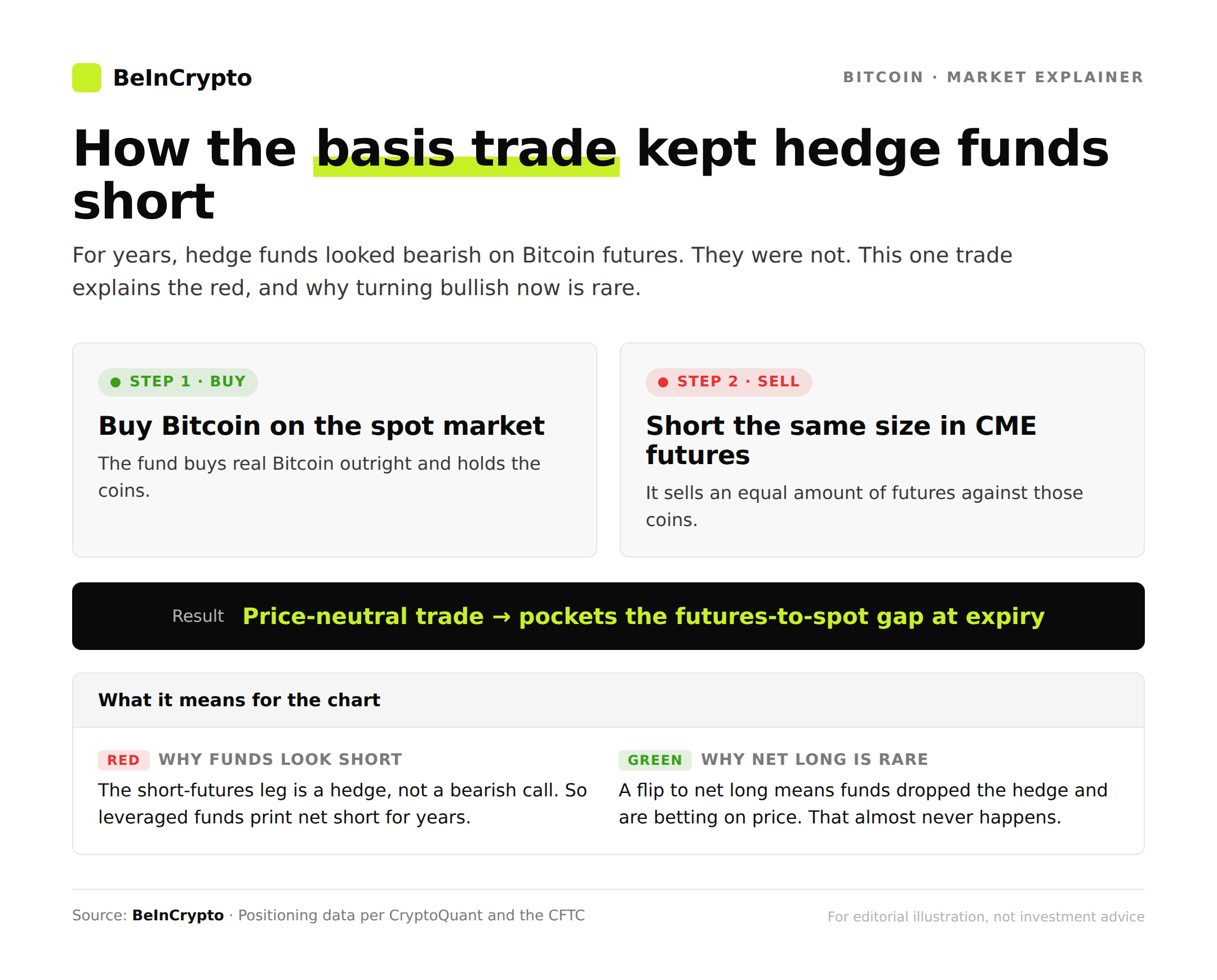
For years that group was net short. Net short means it held more bearish bets than bullish ones. That was not a call for Bitcoin to fall. Most of the shorts came from the basis trade. It is a market-neutral strategy, which means it aims to profit no matter which way the price moves.
In the basis trade, a fund buys Bitcoin on the spot market, where coins are bought outright. It then sells an equal amount of CME futures against those coins.
Futures usually cost a little more than spot. The fund locks in that small gap as profit when the two prices meet at expiry. Because the fund is always selling futures to run this trade, it shows up as short. That is why the group stayed net short on the world’s largest Bitcoin futures market for years.

A flip to net long breaks that habit. It means the funds are now making a straight bullish bet, not a hedge. That rarity is why the move stands out.
Why US Buyers Aren’t Backing the Move
If big investors were truly buying, it would show up in US spot demand. The clearest gauge for that is the Coinbase Premium Index.
The index measures whether Bitcoin trades higher on Coinbase, a US exchange favored by institutions, than on offshore platforms. A positive reading means American buyers are paying up. Right now it says the opposite. The premium has stayed below zero since early May, sitting near minus 0.08.

It has also made lower highs and lower lows since July 22. In plain terms, US institutional demand for Bitcoin looks soft, not strong.
This is the heart of the story. The hedge funds made a bullish bet on paper, using contracts. But the negative premium shows big institutions are not buying the actual coin. So the two groups are split. One is leaning long on futures, while the other stays on the sidelines.
The Market Has No Fuel for a Big Rally
The last piece is open interest. It is the total value of futures bets that are still open across the market. When open interest rises, new money and borrowed bets are entering. When it falls, traders are stepping back.
Across all exchanges, open interest sits near $23 billion. That is close to the lowest level of the past year.
The total is down sharply from about $48 billion last October. It has recovered a little from a late-June low near $20.5 billion, but stays weak.

There is a flip side to thin open interest. If these bullish Hedge Fund bets go wrong, the forced selling would be small. Traders call that a long flush, and a small one does little damage. So the low reading caps the upside but also limits the downside.
Put together, these open interest trends explain the caution. A bullish tilt with little new money rarely fuels a sharp rally.

Bitcoin traded near $65,254 as the data circulated, little changed on the day. The hedge fund flip shows big players leaning bullish. For now, quiet US demand and low open interest leave that bet unconfirmed. A positive Coinbase premium and rising open interest would be the signal that the market is finally following the funds.
The post Hedge Funds Made Their Rarest Bitcoin Bet in Years, But 2 Charts Say Wait appeared first on BeInCrypto.


BlackRock Canada has launched an exchange-traded fund that combines global equities with a 3% Bitcoin allocation, giving Canadian investors both exposures through one TSX-listed product.
Summary
- IBQT targets 97% equities and 3% Bitcoin through underlying iShares ETFs.
- The fund began trading on the Toronto Stock Exchange with a 0.22% management fee.
- BlackRock also launched XINT, covering more than 5,000 companies outside North America.
- BlackRock’s U.S. Bitcoin ETF attracted about $693 million last week.
IBQT combines global stocks with Bitcoin
The iShares Equity + Bitcoin ETF Portfolio, trading under the ticker IBQT, began trading on the Toronto Stock Exchange on Aug. 10.
IBQT targets a strategic allocation of 97% to equities and 3% to Bitcoin. Its stock exposure covers Canadian, U.S., international and emerging markets, according to BlackRock.
Rather than buying individual shares or holding Bitcoin directly, the portfolio invests mainly in other iShares ETFs. Its Bitcoin exposure comes through BlackRock’s Canadian iShares Bitcoin ETF, also called IBIT, which began trading on Cboe Canada in January 2025.
The structure lets investors obtain diversified stock and Bitcoin exposure through one listed security. BlackRock set IBQT’s annual management fee at 0.22%, including fees charged by its underlying ETFs.
“The launch of these two funds underscores our continued commitment to expanding access to investing for Canadians through low-cost, one-ticker solutions,” Steven Leong, head of Canada product and iShares at BlackRock, said in the announcement.
BlackRock launches international equity fund
BlackRock Canada also introduced the iShares Core MSCI All-International Equity Index ETF under the ticker XINT. The fund carries an annual management fee of 0.23%.
XINT tracks the MSCI ACWI ex North America IMI Index, which includes more than 5,000 large-, mid- and small-cap companies across over 40 developed and emerging markets.
The portfolio excludes Canada and the United States, making it a potential building block for Canadian investors who already hold North American stocks but want broader international exposure.
Both funds are managed by BlackRock Asset Management Canada through the RBC iShares alliance. BlackRock said its iShares business managed about $6.2 trillion across more than 1,700 ETFs as of June 30.
BlackRock expands packaged Bitcoin exposure
IBQT extends BlackRock’s move beyond standalone spot Bitcoin ETFs toward funds that combine crypto exposure with traditional investment strategies.
In June, the asset manager launched its Bitcoin income ETF BITA in the United States. BITA invests mainly in BlackRock’s U.S.-listed iShares Bitcoin Trust and sells covered call options to generate monthly income.
IBQT takes a more conservative approach. Bitcoin represents only 3% of the target portfolio, meaning the fund’s performance will remain primarily tied to global equity markets. However, changes in Bitcoin’s price could still raise or reduce the crypto share between portfolio rebalancing periods.
The fund also exposes investors indirectly to the fees, volatility and market risks attached to the underlying Canadian Bitcoin ETF. BlackRock states that ETF values can change frequently and are not guaranteed.
U.S. IBIT continues to lead ETF demand
BlackRock’s U.S.-listed iShares Bitcoin Trust remains the largest American spot Bitcoin ETF by assets. Its scale provides a comparison for the asset manager’s more limited Canadian allocation strategy.
U.S. spot Bitcoin ETFs attracted about $853.5 million over five consecutive sessions from Aug. 3 through Aug. 7. BlackRock’s IBIT accounted for an estimated $693 million, or roughly 81% of the total.
IBQT is listed in Canada and is therefore separate from BlackRock’s U.S. products. Its launch nevertheless shows how regulated Bitcoin exposure is moving into broader portfolio funds rather than remaining limited to standalone crypto investment vehicles.
The product’s 3% target also limits Bitcoin’s influence compared with a spot ETF, while allowing investors to maintain exposure if the asset rises. Future demand will show whether Canadian investors favor this pre-set allocation over holding equity and Bitcoin funds separately.
BlackRock Canada launched two exchange-traded funds Monday, including a portfolio that combines globally diversified equities with a 3% allocation to Bitcoin.
The two funds, which began trading on the Toronto Stock Exchange, are the iShares Equity + Bitcoin ETF Portfolio (IBQT) and the iShares Core MSCI All-International Equity Index ETF (XINT).
IBQT allocates 97% of its portfolio to Canadian, US, international and emerging-market equities and 3% to Bitcoin (BTC) exposure through BlackRock’s Canadian iShares Bitcoin ETF (IBIT), which trades on Cboe Canada. Rather than investing in individual stocks, IBQT primarily holds other iShares ETFs to provide its equity and Bitcoin exposure.
XINT tracks the MSCI ACWI ex North America IMI Index, providing exposure to more than 5,000 companies across over 40 developed and emerging markets outside Canada and the US.
Both funds are managed by BlackRock Asset Management Canada through the RBC iShares alliance. BlackRock said its iShares business managed approximately $6.2 trillion in assets across more than 1,700 ETFs as of June 30.
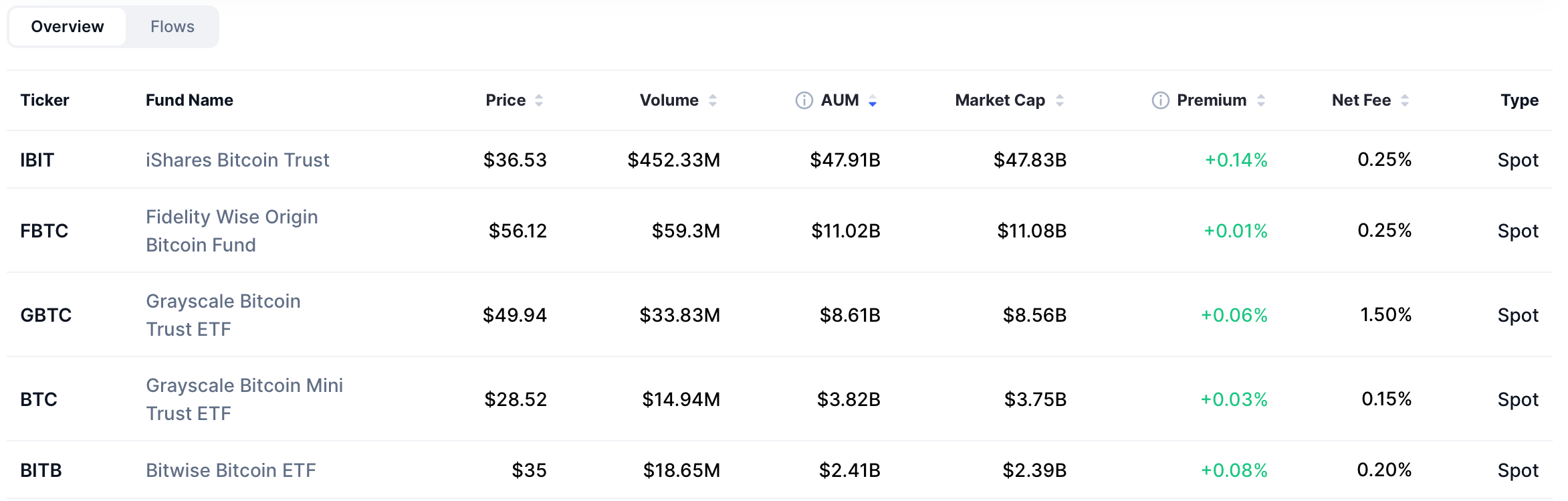
The asset management giant’s US-listed iShares Bitcoin Trust (IBIT) is the largest US spot Bitcoin ETF by assets under management, with about $47.9 billion in AUM, according to CoinMarketCap data.
Top five US spot Bitcoin ETFs by AUM. Source: CoinMarketCap
Magazine: BIP-110 ends with a whimper, CLARITY vote punted: Hodler’s Digest, Aug. 9
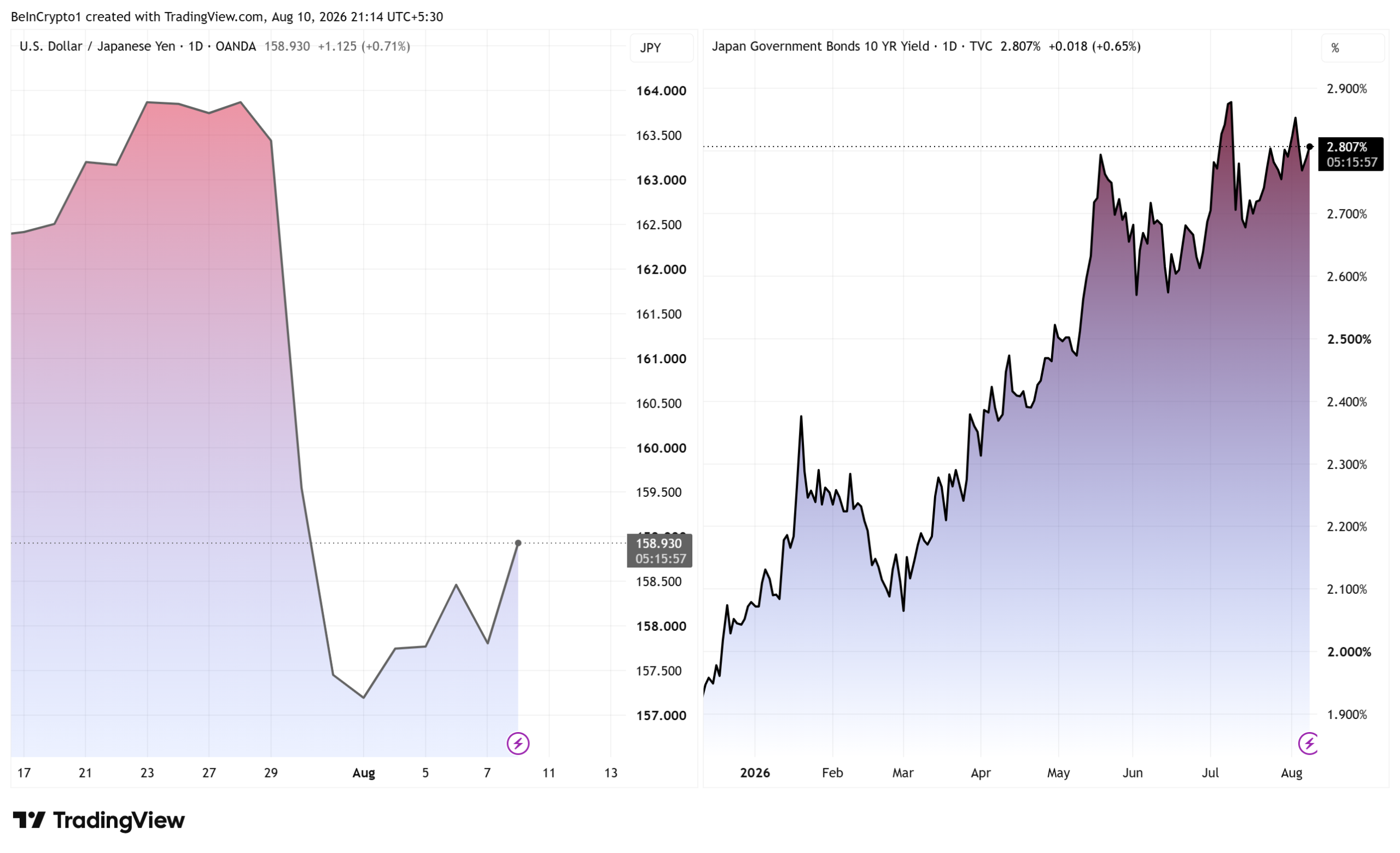
USD/JPY climbed to 158.93 on Monday, its highest level this month. Just 10 days ago, Japan’s nearly $88 billion yen intervention had dragged the pair down from 164.
The yen is once again August’s weakest major currency. The fight may now be moving to Japan’s bond market, where 10-year yields sit near multi-year highs.

The $88 Billion Yen Intervention Is Already Fading
Japan’s Ministry of Finance bought yen on July 30 and 31, working through the Bank of Japan (BOJ). BOJ account data suggest the first day cost about ¥8.45 trillion, or $53 billion. That ranks among the largest single-day yen purchases ever.
A second round the next day added roughly $34 billion. Together, the two days cost Tokyo close to $88 billion. That came on top of an estimated ¥11.7 trillion spring campaign whose effect faded within weeks.
The United States then joined in, its first coordinated yen purchase since 1998. Washington sold euros for yen through the New York Fed. European officials reportedly learned of it only afterward.
The shock worked at first. USD/JPY tumbled from just under 164 to about 157.3 in early August, TradingView data shows. Monday’s bounce means the pair has already won back about a quarter of that drop.

Each rescue also costs more than the last. The US side reportedly spent $5 billion to $10 billion this time, versus $833 million in 1998. Japan went it alone in 2022 and 2024, and both of those rallies faded within weeks too.
The 1998 episode carries a lesson as well. Back then, the yen only turned decisively months later, when carry trades unwound and Tokyo moved to fix its banks. Buying yen bought time. Policy change did the rest.
Capital Keeps Leaving Japan
Goldman Sachs sees one reason the rescue is not sticking. Japanese investors kept buying foreign bonds at a strong pace in July, per a Goldman view. In short, money keeps leaving Japan faster than officials can pull it back.
The bank argues a BOJ rate hike next month would help the yen more than another rescue. Yet rate traders trimmed the odds of a September move on Monday, strategist Marc Chandler observed. The market, in effect, is daring officials to act.
Monday’s data gave the doubters more ammunition. Japan posted a ¥92.3 billion ($580.7 million) current account deficit in June, its first in 17 months. The current account is the country’s broadest ledger of money moving in and out.
Economists had expected a surplus of roughly ¥1.51 trillion ($9.5 billion). Instead, larger dividend payouts to foreign shareholders slashed Japan’s investment income by 74%. Costlier fuel imports pushed the trade balance into the red as well.
The full picture is less dire. Japan still ran a record ¥17.43 trillion ($109.7 billion) surplus in the first half of 2026, helped by strong chip exports. However, the June miss landed at the worst possible moment for yen sentiment.
Mohamed El-Erian, Allianz chief economic adviser, argues the fix lies in policy, not firepower.
“The yen has been weakening gradually since the large joint Japan–US FX intervention, a sharp reminder that the key to fixing a currency “mispricing” is getting the policy mix right. The longer Japan delays in doing so, the more elusive the goal of this historic intervention becomes,” he wrote.
Japan’s Bond Market Becomes the Real Test
Japan’s 10-year government bond (JGB) yield hit 2.807% on Monday, per TradingView. It has climbed from below 2% in January and now sits near multi-year highs.

That climb matters because Japan’s government debt tops 200% of GDP, the heaviest load among major economies. Every rate hike raises the state’s interest bill.
The BOJ itself is feeding that climb. At least three board members said the bank could raise rates faster than planned, its July meeting summary showed. Governor Kazuo Ueda reportedly signaled a possible September hike, a stance that helped pull Washington into the rescue.
For now, the central bank holds its policy rate at 1%. It has warned that core inflation could run above its 2% target.
Higher yields cut both ways for Tokyo. A faster hiking path would narrow the rate gap with the US and help the yen. It would also deepen the paper losses piling up on Japanese balance sheets.
Japan’s four largest life insurers already sit on roughly $96 billion in unrealized JGB losses. Japan is also the biggest foreign holder of US Treasuries, at about $1.14 trillion. A messy yield spike could force selling on both sides of the Pacific.
That risk explains why the US backed the rescue at all. Officials reportedly feared that runaway yen weakness would fuel Japanese inflation and lift bond yields worldwide. The currency defense, in other words, doubled as a bond market firewall.
Bitcoin Is Caught in the Middle
Crypto has skin in this game. Carry trades borrow cheap yen to fund bets on higher-yielding assets, so sudden yen strength forces messy exits. Bitcoin (BTC) slid to near $63,000 when the joint rescue first hit.
Traders remember how bad that can get. In August 2024, a surprise BOJ hike helped spark a global carry trade unwind. The Nikkei suffered its worst day since 1987, and Bitcoin briefly fell below $50,000.
The setup now cuts both ways for crypto. A September hike could squeeze carry trades again and drain liquidity from risk assets. A failed defense of the yen could instead push global yields higher, another blow to risk appetite.
The caution already shows. Bitcoin barely moved last week even as gold and silver staged a $2.7 trillion metals rally. Investors hunting a hedge went for metals first.
As of this writing, BTC changed hands at $64,038, steadily sliding further below the $65,000 threshold. That calm reads as wait-and-see, not an all-clear.

The near-term calendar offers plenty of triggers. US inflation data lands Wednesday, and a soft print could ease pressure on the pair. A push above 159 would revive talk of a second joint strike near 160.
September now looms as the decisive moment. A confirmed hike could finally narrow the rate gap, though it would push JGB yields, and insurer losses, higher still. Another hold would leave Tokyo defending 160 with reserves alone.
The $88 billion may have bought time rather than a turning point. Whether the yen finds a floor, and whether Bitcoin stays calm, could depend on how much bond market pain Japan is willing to absorb.
The post America Helped Save the Yen, The Market Just Took It Back, and Bitcoin Is Exposed appeared first on BeInCrypto.
Crypto World
Analyst Predicts Big Market Moves Before Q4 as Traders Grow Bored in Quiet Crypto Market

Crypto analyst Sykodelic said Bitcoin is building toward explosive moves well ahead of the Q4 low that many traders expect, as the market sits in an unusually quiet stretch that has left participants bored.
The trader has already entered a short position after a weak weekly close, looking for a quick drop that clears built-up liquidity before a reversal higher.
The Setup That Has Traders Watching Closely
Sykodelic described the current environment as one where “the lack of volatility and compression we are seeing here only ever finishes in one way. MASSIVE moves.” They noted that the quiet has left “everyone bored out of their minds” while they wait for Q4 lows, but added, “We are gonna move way before that. It’s gonna be soon.”
The trigger came when the $65,300 level was taken out, and Bitcoin posted a weak weekly close. “My short is filled,” they wrote. “After waiting weeks for a clear trigger, we now have one.” They expect a drop to $60,500 that would mark the final move lower before a meaningful advance.
Sykodelic has long viewed the February low near $60,000 as the major macro bottom and believes the market is close to moving higher overall. The short, they said, aims for a sharp liquidation that cleans up liquidity accumulated below for weeks.
That would create a bear-trap setup, where late sellers turn bearish and call for new lows, only for a quick reversal to squeeze them and push the price above $67,000 toward the mid-$70,000s.
“Whenever we have been sideways like this for a long time, a massive amount of liquidity builds up either side,” he wrote. “It is always so much better if the liquidity below is swiped before actually moving higher.”
That view lines up, loosely, with a separate read from Crypto Patel, who pointed to the fund market premium index holding around 0.14.
“For now, the signal is quietly bullish,” Patel wrote, adding that institutional selling pressure hasn’t shown up in the data yet, even with the premium sitting on the low side.
A Sideways Market With Mixed Signals
Bitcoin has given traders little to work with lately. It slipped to $62,200 early last week before buyers pushed it back to $65,000, only to get turned away thereafter when the CLARITY Act hit another delay in the Senate.
A weak jobs report on Friday gave it one more push to $65,400 before it settled back down, and it was trading near $65,000 at the time of writing, up about 0.8% on the day but still down close to 45% over the past year.
The quiet has produced some louder optimism elsewhere, including from analysts Ali Martinez, Michaël van de Poppe, and Merlijn The Trader, who all pointed to signs of a completed correction, citing everything from a rare monthly TD Sequential buy signal to what they read as a classic breakdown and reclaim pattern.
The post Analyst Predicts Big Market Moves Before Q4 as Traders Grow Bored in Quiet Crypto Market appeared first on CryptoPotato.
Crypto World
Trump Responds as Iran Says U.S. Must Meet These Six Demands If Strait of Hormuz Is to Reopen
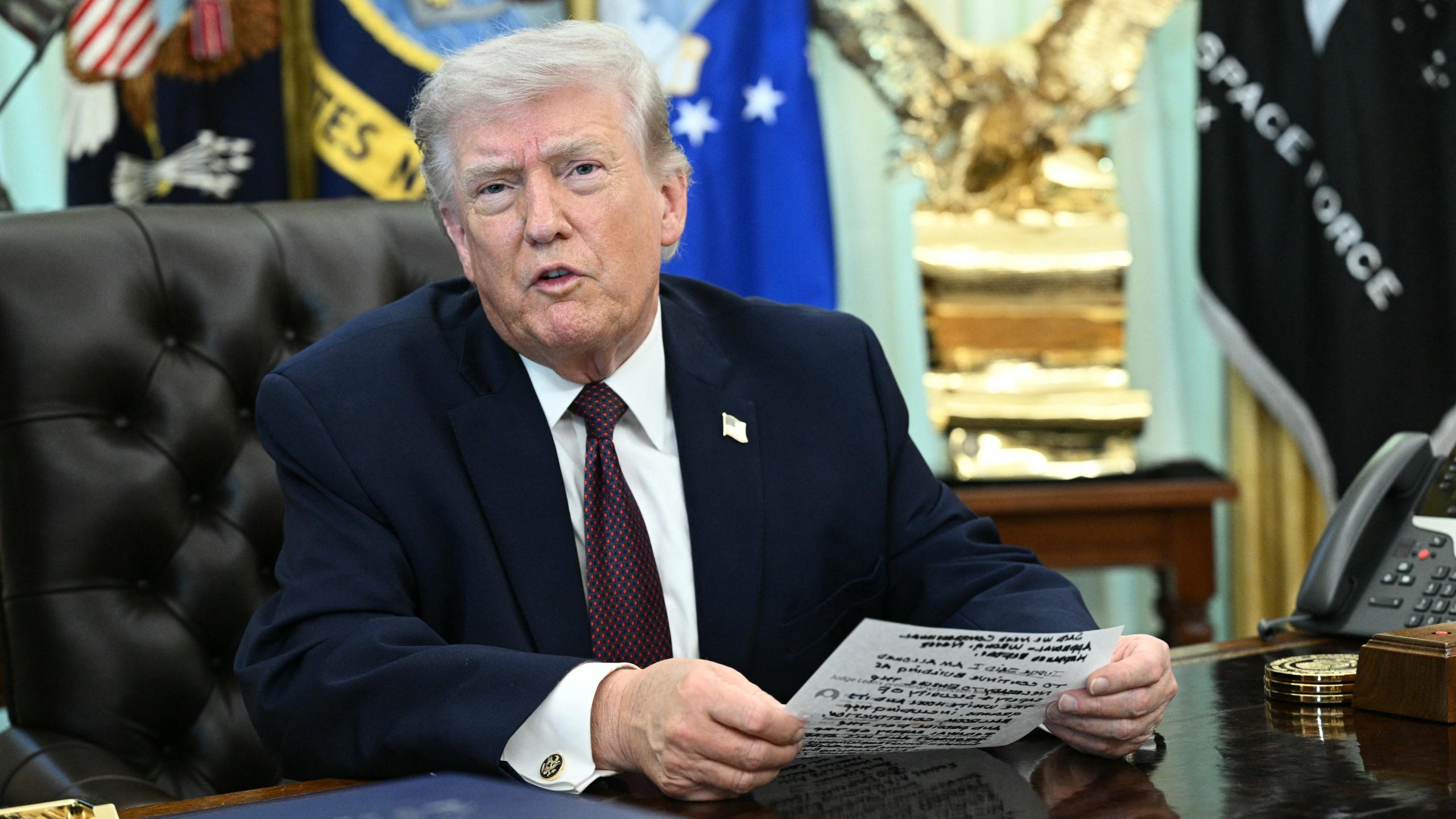
Never threaten Iran with any language or insult the sanctities of this nation.
End the war and aggression against Iran and its allies in Lebanon, Palestine, Yemen, and Iraq forever.
Lift the naval blockade and withdraw its military forces (naval and air) from around Iran.
Pay the damages of the two wars of aggression and imposition on Iran without any reduction or reduction.
Lift the cruel and illegal sanctions against the Iranian nation.
Unconditionally release the frozen and stolen assets of the Iranian people.


If you’ve ever suspected your dog can read your mind—sussing out through some canine intuition when you’re happy, sad, scared, or cross—you’re half right. Many dogs can do exactly that, but it’s not mind-reading that’s involved: it’s face-reading. That’s the word from a new study in the journal iScience, in which researchers not only established dogs’ ability to discern human moods by examining our facial expressions, but also pinpointed the spots in the brain where that processing takes place. They did this by scanning canine brains with functional magnetic resonance imaging (fMRI).
Figuring out how dogs read human emotions
“This ability to perceive emotions in humans is really hard to find in other species,” says Rául Hernández Pérez, professor of psychology at the University of Vienna and first author of the study. “Chimpanzees have a harder time than dogs. Wolves can also do it, but not at the same level as dogs can.”
Getting a dog to tolerate an MRI scanner is no small matter. The same things that so often freak people out about the MRI experience—the confined space and the infernal noise—can have a similar effect on a dog. That was an impediment to the kind of study the researchers planned to conduct. In order for a brain scan of the proper fidelity to be produced, the dogs must spend a minimum of six minutes in the machine, moving less than three millimeters in any direction. “If they move more than three millimeters, we can’t use the data,” says Laura Cuaya, professor of biological psychology at the University of Vienna and a co-author of the study.
Looking for dogs who could perform that feat, she and Hernández Pérez recruited 14 cooperative canines, consisting of 11 border collies—a highly trainable breed—two golden retrievers, and one Labrador, the last three of which were already working as service animals.
The animals then went through a series of at least 20 training sessions—the first involving just introducing them to the researchers and building a sense of trust. Next, the dogs were taught to lie still for just five seconds in the position they would have to maintain in the MRI scanner. “We reward them with treats, though some dogs prefer to play as a reward,” says Cuaya.
Over the course of several days, that brief five seconds was steadily extended to 10 full minutes. The dogs were then introduced to the headphones they would have to wear while in the machine to protect their hearing. “The headphones are not uncomfortable, but they’re weird,” says Cuaya. Finally, the dogs practiced holding their pose in a mock MRI scanner, and only then were they ready for the real, clanking, buzzing, banging machine.
In the study, the dogs were positioned in the machine and shown pictures of a human face wearing either a happy or neutral expression. All the while the fMRI churned on, peering through the dogs’ skulls into the brain below and looking for the areas that lit up as a result of the visual stimuli. When the dogs saw pictures of happy people, their temporal cortex and caudate nucleus became active. In humans, the temporal lobe plays a role in forming memories, mastering language, responding to visual cues such as familiar faces, and processing emotions. The caudate nucleus processes rewards and motivation and manages learning and memory. The neutral face did not elicit the same response in either region.
Next, the dogs were once again shown images of happy and neutral faces, but along with those they were also shown angry, frightened, and sad ones. The researchers were trying to determine whether the dogs processed human faces in a binary way—registering the positive, happy face in one part of the brain and the three negative ones together in one other part, or if each negative emotion had its own discrete brain region.
“This would mean that the dog brain is not only categorizing emotions between positive and negative,” says Cuaya. “We were using this [stage of the experiment] as a demonstration that there is more detailed processing.”
What dogs’ brains reveal about the dog-human bond
That was the result they got. Sadness and fear, for example, lit up the right rostral supra sylvian gyrus—which, in humans, contributes to the processing of visual information. Anger and fear were processed in the right ectosylvian gyrus and the left splenal gyrus—the former integrating visual, auditory, and other sensory information, and the latter managing visual perception, spatial orientation, and episodic memory.
“We found that the dog brain is not only categorizing emotions as positive or negative, but instead can exhibit more detailed processing, responding in different ways to emotions,” says Hernández Pérez.
This isn’t the first study to find that dogs respond in unique ways to human faces. Other research has shown that when a human face is happy, for example, dogs look more at the eyes than the mouth. They examine emotional faces longer than they examine neutral ones. And they have more difficulty reading the faces of people who are of a different gender from their principal caregiver.
There are benefits to the study—beyond the simple matter of adding to the body of knowledge on how dog brains operate. Hernández Pérez and Cuaya believe their work can also help improve the already deep ties dogs and humans share.
“Humans are not so good at perceiving the emotions of our dogs,” says Cuaya. “We are confused by them. Maybe this work can be an invitation to try to be more aware of the emotions of our dogs and how they are expressing [them].”
That understanding can also pay dividends when we are training our dogs. “When you are teaching something to your dog, you can have treats on hand, and you can give the treats when they are appropriate. But you can also show your emotion. You can say to the dog, ‘Very good!’ The dogs in our MRI machine were already reacting to the faces of strangers. Think about how much more activation there is with a familiar face expressing, ‘I love you so much. I am happy with you.’”
The dog-human love story—which has been going on for some 14,000 years now—has been a long and tender one. The more we understand the canine contribution to that bond, the more we can improve our own.

Is XRP About to Explode? Institutional Data Says Yes

Good Morning Britain presenter says ‘see you in September’ in huge career announcement

Mysten launches confidential settlement prototype on Sui


-

 Fashion3 days ago
Weekend Open Thread: Mattifying Sunscreen
-

 Fashion3 days ago
Frugal Friday’s Workwear Report: Cap-Sleeve Pointelle Crewneck Sweater
-

 Sports5 days ago
Jordan Coyle & Cordiamo take Laya Arena Stakes at RDS
-

 News Videos2 days ago
Can Astrology Help Find Gold and Silver Trends? A Financial Astrology Guide
-
 Business5 days ago
US stocks: Dow closes at record on Mideast optimism; SpaceX, AMD drag Nasdaq
-
 Crypto World7 days ago
US Tech Stocks See Largest 5-Week Inflow in History: Can Nasdaq Break Its Downtrend?
-

 Politics4 days ago
Reform UK And Greens Sink To Lowest Favourability Ratings To Date
-

 Business6 days ago
Nvidia Stock Climbs 2.5% as Chip Sector Rally Builds Ahead of AMD Earnings, Nvidia’s Own Report Looms
-

 Crypto World6 days ago
Polymarket targets $20 billion valuation as competition heats up in prediction market sector
-

 Tech6 days ago
OpenAI, Anthropic AI agents targeted real people and systems in cyber tests
-

 Business5 days ago
Supply chain issues impact Ingredion
-
 Crypto World6 days ago
CLARITY Act Senate Vote Locked In, But 60-Vote Hurdle Looms Large
-

 Tech3 days ago
Rinn Pharma & Biopharma to join NordicPharmaTrain network
-

 Business2 days ago
How to Start a Cleaning Business: A Step-by-Step Guide
-

 Crypto World7 days ago
The Senate has one week: CLARITY’s last August window
-
 Crypto World6 days ago
Dow and S&P 500 Hit Records on AI Earnings: When Will the Bubble Burst?
-

 Business1 day ago
Datadog: Best Of Breed For Multiple Reasons
-

 Business7 days ago
CNH Industrial Shares Jump Over 15% After Beating Estimates and Raising Full-Year Earnings Guidance
-

 Business2 days ago
BDC Weekly Review: Private BDC Q2 Numbers Are Strong
-
 Crypto World6 days ago
Dollar Index Trapped at 100 as Hawkish Fed Meets Official Selling
You must be logged in to post a comment Login