
Security teams log 54% of successful attacks and alert on just 14%. The rest move through your environment unseen.
The Picus whitepaper shows how breach and attack simulation tests your SIEM and EDR rules so threats stop slipping by detection.


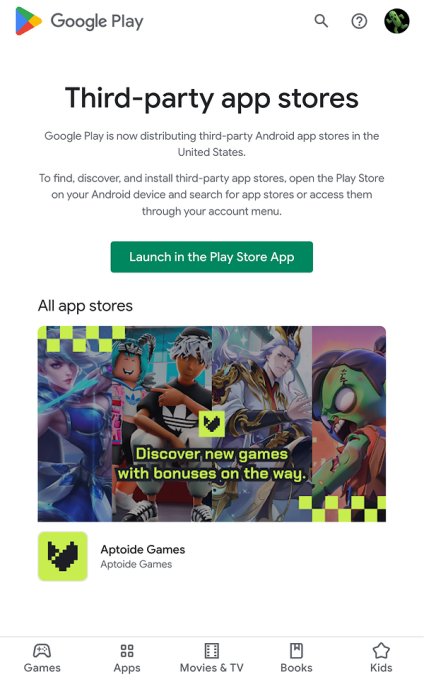
Competing Android app stores are now back on Google Play in the U.S., and Aptoide is the first to take advantage of the new option. On Monday, the Portugal-based app distributor brought its games store back to Google Play after more than a decade, crediting the loosening of restrictions that had been criticized as anticompetitive.
For the first time in many years, U.S. users will be able to install a competitor to Google’s Android app store directly from Google Play itself, a milestone in terms of opening the app market to more competition.
Aptoide’s independent app store is one of the larger Android app marketplaces outside of Google Play, offering more than 40,000 Android applications to its roughly 25 million monthly active users. The U.S. has been Aptoide’s largest market to date, but until now, the store had to be sideloaded on Android devices, limiting its reach.

That changed following U.S. District Judge James Donato’s ruling in the Epic Games lawsuit, which, among other things, now requires Google to allow the installation of third-party apps from outside the Play Store. As of June 22, 2026, Google began allowing third-party app stores to access Google Play’s app catalog through the Play Catalog Access Program. This allows competitors to access Google Play infrastructure, including its catalog of apps that can be offered to users, while remaining an independent store.
Epic Games first sued Google in 2020, alleging anticompetitive abuses in the Android app ecosystem. A jury trial ruled in Epic’s favor in 2023. Google appealed the ruling, but lost. Earlier this year, the company said it would drop Play Store commissions and make it easier for Android users to install alternative app stores.
Apple’s fifth developer beta of iOS 27 has just arrived, and with it, redesigned icons for several key apps, and a lot more than normal than this late in the beta cycle. Here’s what’s new.
On Monday, three weeks after the release of iOS 27 beta 4, Apple made the fifth developer beta available for download. iOS 27 beta 1 introduced the long-overdue Siri AI, while the second beta included improvements to the Apple Home and Apple Wallet apps.
The third beta brought additional voice customization options for Siri AI, in the form of pace and expressivity sliders, albeit only for American English voices. Monday’s iOS 27 developer beta, however, expands these settings to British English voices.
Still, the new settings aren’t available across all devices running iOS 27. Advanced Siri AI features require at least 12GB of RAM on iOS 27, hence the restriction, meaning the new voice sliders can only be found on an iPhone 17 Pro, iPhone 17 Pro Max, or iPhone Air.
As with most beta updates, visual tweaks are also present in iOS 27 beta 5. Icons for the Preview, Remote, Safari, Settings, and Siri applications have been updated, as has the Orders icon in the Apple Wallet app.
The Siri icon now features a more prominent Liquid Glass look, while the app icon for Safari now has a dot in the center. Apple has also included new update screens when the Apple Wallet, Apple Music, App Store, and Photos apps are launched for the first time.

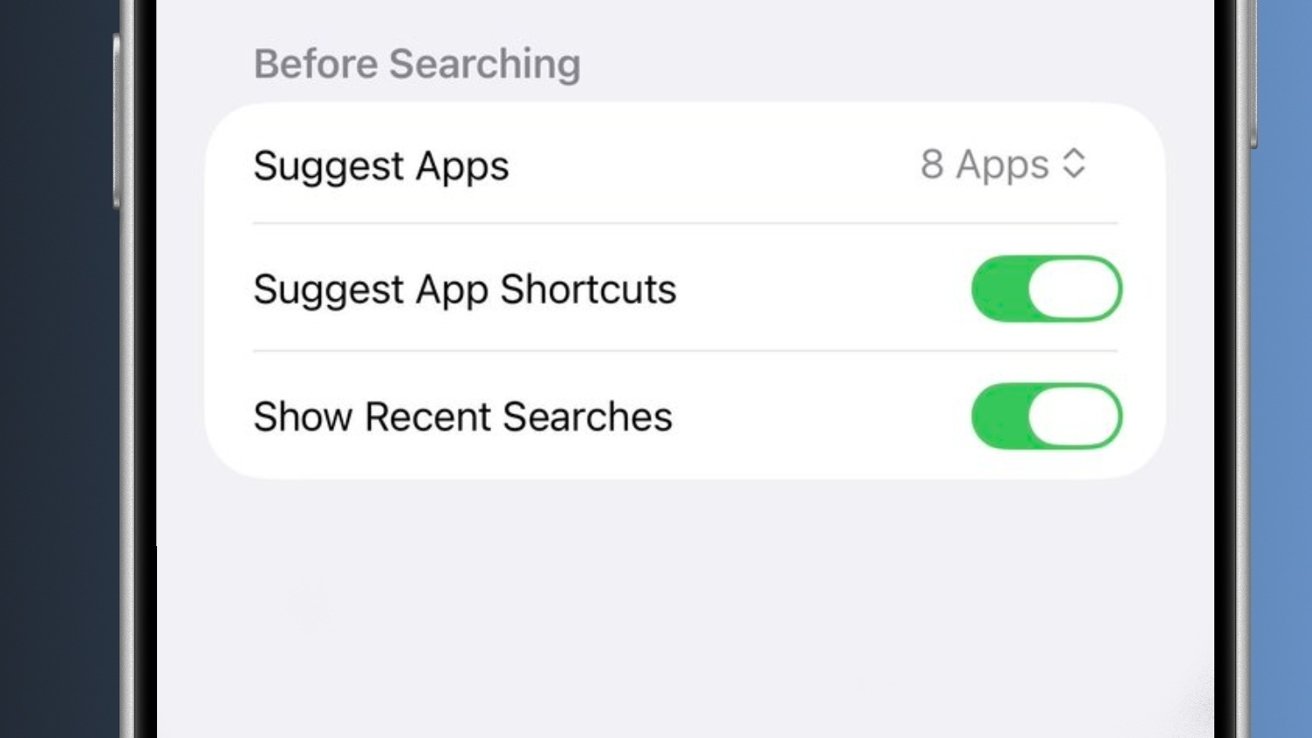
iOS 27 beta 5 features a new ‘Before Searching’ option in the Settings app.
In the Settings app itself, under the Search Settings section, Apple has added a new option labeled Before Searching. This lets users choose how many apps appear as suggestions during searches, among other things.
Additionally, the Settings app now also shows when the most recent iOS update was installed. This detail could be useful for those who rely on automatic software updates.
Apple has also tweaked the Control Center with iOS 27 beta 5. Cellular network types are no longer displayed, so you won’t see “5G” or “LTE” when your phone is connected to a Wi-Fi network. However, the Control Center and Status bar do feature new cellular icon bars.
Meanwhile, when a screenshot is taken on Monday’s beta, the the annotations toolbar will now shrink and hover. It’s a neat visual modification, but nothing groundbreaking.
Overall, the fifth developer beta of iOS 27 is a relatively light release. Aside from the updated app icons, Siri voice settings, and Before Search settings, the beta doesn’t offer anything the average user would notice.
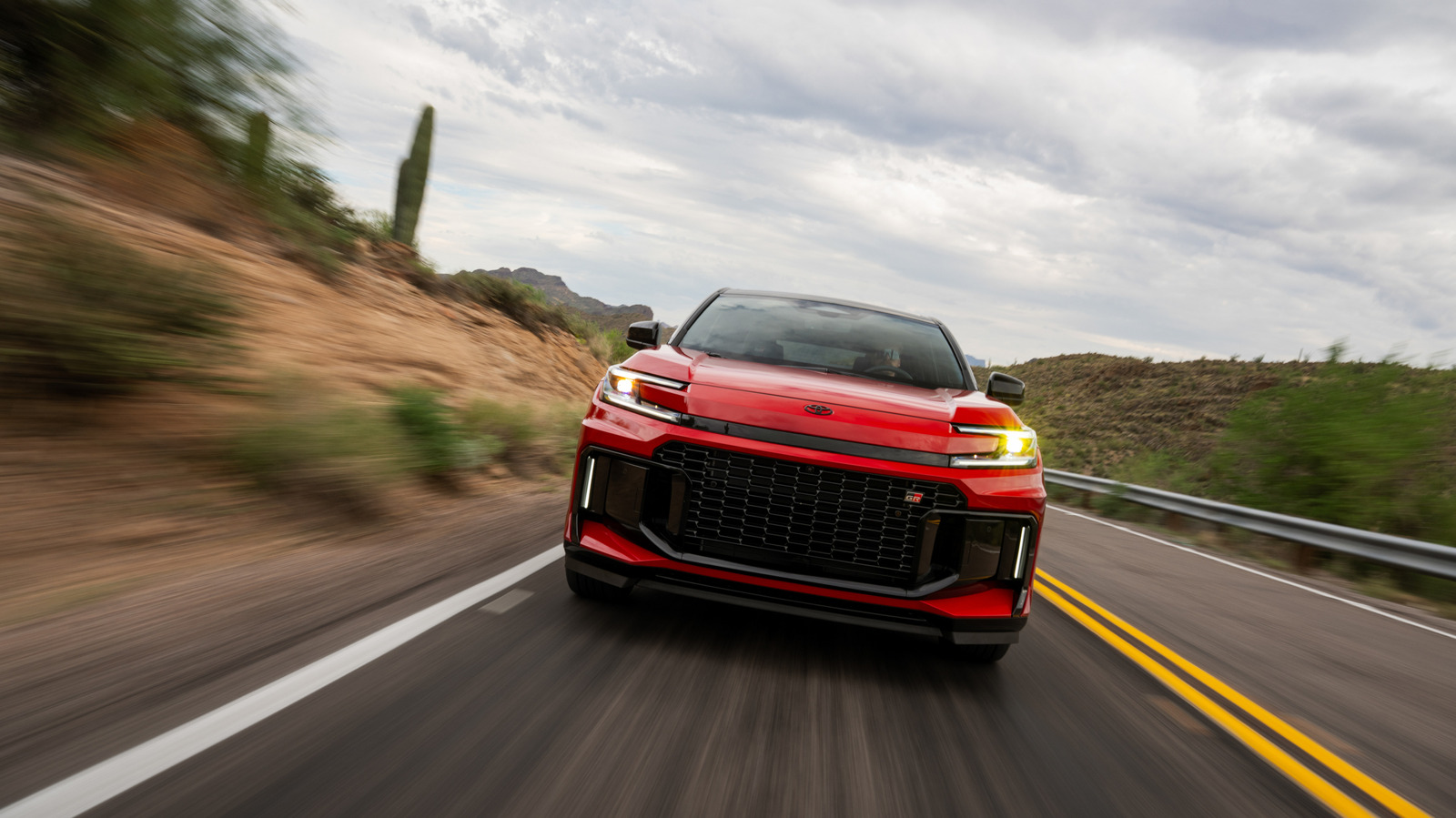
The Toyota Rav4 Plug-In Hybrid is very definitely not a sports car, not by any stretch. It’s a competent crossover plug-in hybrid SUV that just so happens to be remarkably quick. Through the electric motor and its 2.4-liter four-banger it generates a total of 324 horsepower, which is surprisingly powerful for the average mom-mobile. As a result, it has a 0-60 time of 5.4 seconds.
Just under five and a half seconds puts the Rav4 Plug-In above a number of different sports cars from the past and present. Now, it’s not going to dust any contemporary Lamborghinis or Ferraris on the drag strip, but it can certainly hold its own in the acceleration department against some entry level sporty cars and quite a few cars from decades past.
Defining the terms, a bit “quicker” will be referring strictly to acceleration times. There’s no doubt your average sports car would have a faster lap time in racing just due to weights, suspension setups, and the fact that the Rav4 is very much not set up for racing, but that 0-60 sprint time still means something.
Looking at Toyota’s lineup, the Rav4 PHEV’s acceleration time puts it quicker than the fundamental ideal of a sports car, the GR86, which can reach 60 miles per hour in 6.1 seconds. Now, which one is more fun to drive? That’s a different question altogether.
The GR86 loses in a drag race as it’s only rear-wheel drive compared to the Rav4 PHEV, which is all-wheel drive. It’s not a hard and fast rule, but all-wheel drive cars have a bit of an advantage off the line as all the wheels are assisting in grip, pushing and pulling the vehicle forward. The GR86 also comes standard with a six-speed manual transmission. That makes it more fun to drive, but slower to accelerate compared to the Rav4 Plug-In’s electronically controlled CVT.
There’s also a power disparity. The GR86 puts out just 228 horsepower, almost 100 less than the Rav4. The Plug-In has clear mechanical advantages, resulting in the better acceleration that leaves the GR86 in the dust — at least in the race to 60 mph.
Yes, you read that correctly. A new Rav4 Plug-In is quicker than a 1984 Ferrari Testarossa off the starting line. The ‘Rari does have a lot going for it though. It’s powered by a 4.9-liter flat-12 with four valves per cylinder, putting it somewhere north of a Swiss watch in terms of mechanical complexity. It’s also a mid-engine Ferrari with a top speed of 180 miles per hour. It’s not exactly a grocery getter like the Rav4 Plug-In. However (and this is a big “however”), the Testarossa has a 0-60 time of 5.8 seconds, according to Ferrari.
Now, there’s also a huge difference between “quickest” and “most desirable.” If you want to buy a Testarossa, you’re going to be spending in the neighborhood of $200,000, and oftentimes significantly more. You will also likely win every local car show. The 2026 Toyota Rav4 PHEV, on the other hand, retails for $41,500 and your local Toyota dealer probably has several dozen in stock.
The Aston Martin DB7 came at a vitally important time for the automaker. According to the automaker, both the DB7 and the new company ownership by Ford could be credited for keeping the company alive. The resulting car had a wacky engine and quite respectable performance specifications for the 1990s. It had a 3.2-liter inline-six with a supercharger that made a healthy 355 horsepower. That all translated to a top speed of over 160 miles per hour. It helped that the car looked great, too.
But, just by the virtue of being on this list, you can already see the bad news. With a 0-60 speed of 5.8 seconds, it might be touch faster than the aforementioned GR86, but it is slower than a new Rav4 PHEV. Of course, if you pull up to the grocery store in a classic Aston Martin, you’ll likely get swarmed by people wanting to take a picture. That is definitively not the case with a Rav4 Plug-In, even if it is a little quicker off the line.
The fourth generation Chevrolet Corvette looks like its going the speed of sound when it’s sitting still. Chevy’s marketing from the time called it one of the most advanced cars ever made, and the styling certainly looked the part. The electronics were modernized for the 1980s and the cockpit was given a fighter jet look. But under the big fiberglass hood was classic Chevy. It was powered by a 5.7-liter V8 that put out a somewhat pokey 205 horsepower when it first launched for the 1984 model year.
Car and Driver tested one when it came out and found that it had a 0-60 time of a pretty sad 6.7 seconds. So the victory in the quickness department very much goes to the Rav4. Really though, in which car would you rather listen to Van Halen’s “Panama” at an irresponsible volume? A 1984 Chevy Corvette with enough angles in the bodywork to make a geometry major have night terrors, or a Rav4 Plug-In?
For this list, we picked four performance cars that have slower acceleration times than the current Toyota Rav4 Plug-In Hybrid. For 0-60 metrics, we used times provided by the manufacturer and compared it to those listed on Toyota’s website. For the fourth generation Chevy Corvette, we used a 0-60 time gathered by Car and Driver during a review from the era.

I was recently digging through my Instagram settings, trying to disable Meta’s now-defunct feature that allowed anyone to create AI deepfakes of me without consent. Anger bubbled up inside as I tapped through the Kafkaesque opt-out process.
Rather than throwing my phone across the room, I blurted to my partner that we should leave San Francisco behind and be off-grid sheep farmers. Something analog. In that moment, anything sounded better than this ongoing, generative-AI-induced hell.
Many Americans are having similar reactions to the growing prevalence of generative AI in daily life. “The AI revolution has happened, and everybody hates it,” says Meredith Broussard, a data journalism professor at New York University and author of Artificial Unintelligence: How Computers Misunderstand the World. In a recent Gallup poll, Americans’ increased familiarity with generative AI coincides with negative attitudes about the technology. This is especially true for young people between 18 and 29, where almost half see generative AI as doing more harm than good.
While this AI backlash has been brewing for the last few years, more companies appear to be directly addressing these concerns. LinkedIn added a “seems like AI slop” button for reporting AI-generated content on the platform, despite still hosting plenty of generative AI tools. Snapchat announced that fully AI-generated videos would no longer be eligible for its discovery feed. Substack recently added an AI detection tool to police writers.
The backlash’s “why” is simple at its core. Many Americans feel like they never consented to any of this. I had no idea that my online interactions would one day be scraped en masse for AI model training. I didn’t ask for Instagram to enable deepfakes on my account. I didn’t want Google to push AI-generated answers at the top of search results. I woke up one day, and generative AI features were stuffed into every corner of all the software I rely on without my consent.
Whether it’s AI models scraping your data or noisy data centers popping up in your backyard, the AI revolution seems to be an event happening to us without making us feel like active participants.
“Consent is really important,” Broussard tells WIRED. “We can connect that to the way that women, queer people, people of color, and minorities get exploited and abused online. Tech companies have never really been sensitive to issues of consent.”
Public backlash appears to be working, at times, in getting unwanted AI features shut down. “They just roll them out and see what sticks, because nobody really knows what this is for,” says Nick Seaver, an associate professor of anthropology at Tufts University focusing on technology and society. Google recently rolled back the ability for people to use generative AI to tweak satellite images on Google Earth almost immediately after launching it, following reporting from 404 Media. Additionally, Meta turned off the aforementioned deepfaking tool for Instagram users after three days of public outcry and viral videos with millions of views criticizing the feature.
There’s also a growing rejection of generative AI in marketing materials. Many people online reacted negatively to major brands, like McDonald’s and Coca-Cola, incorporating generative AI visuals into their ad spots. Even local shops see backlash for promoting events using AI-generated posters.
Beyond online outcry, more people are starting to protest against the building of data centers that power these AI tools. “There’s a lot of pushback coalescing around data centers,” says Emily Bender, coauthor of The AI Con. “Data centers are important because they are focal points of environmental and economic damage.” Americans across the political spectrum have recently united in these data center protests.


A financially motivated threat actor previously associated with the Medusa ransomware operation is now deploying a new ransomware strain called StormEncryptor.
Microsoft Threat Intelligence is tracking the actor as Storm-1175 and says the recent attacks were likely preceded by exploitation of an authentication-bypass vulnerability (CVE-2026-18577) in the N-central remote monitoring and management (RMM) tool.
Storm-1175 is believed to be a China-based threat actor. It was previously linked to Medusa ransomware, targeting systems via zero-day and n-day flaws in various products, including GoAnywhere MFT, SmarterTools SmarterMail, Microsoft Exchange, Invanti Connect Secure, and JetBrains TeamCity.

“Storm-1175’s deployment of StormEncryptor marks the threat actor’s first activity observed by Microsoft Threat Intelligence since April 2026, and a shift away from Medusa ransomware, which the threat actor had previously been known to use,” Microsoft states.
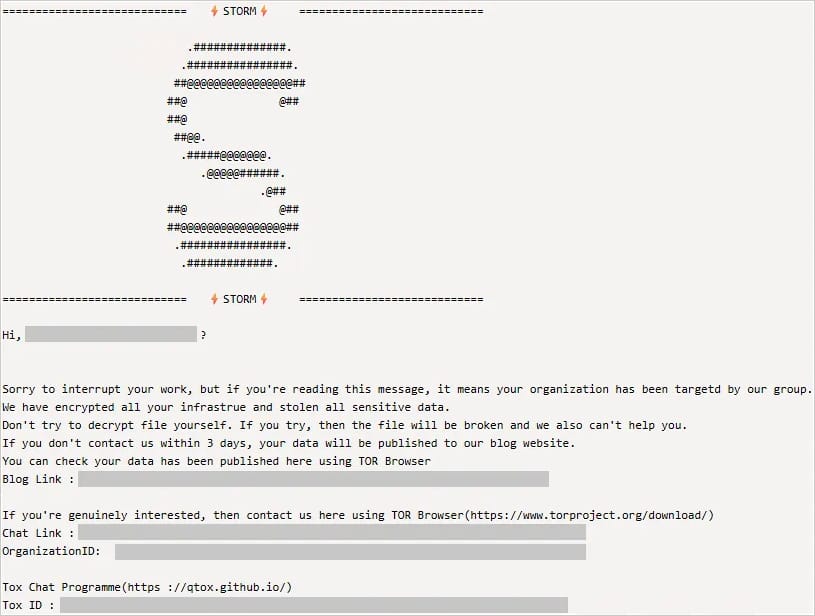
The researchers found that StormEncryptor is a C++ malware that appends encrypted files with the “.encrypted” filename extension and drops a ransom note named ‘!!!README_FIRST!!!.txt’ into every scanned directory.
The ransom note gives victims three days to reach out to the attacker and negotiate a ransom payment. Alternatively, the stolen data would be leaked online.
After gaining access to the target network, the attacker used AnyDesk or SimpleHelp for remote management, Advanced IP Scanner for network discovery, and the Mimikatz tool to dump credentials from the Local Security Authority Subsystem Service (LSASS) process.
Microsoft says that Storm-1175 moves quickly from initial compromise to stealing data and deploying the locker, urging system administrators managing self-hosted N-central servers to take immediate action to secure the systems.
“This threat actor is known to rapidly move from initial access to data exfiltration and ransomware deployment, often within a few days,” warned Microsoft.
“Organizations are urged to monitor for Storm-1175 activity and apply security patches as soon as possible.”
N-able addressed the CVE-2026-18577 vulnerability via a hotfix (2026.3 HF1/build 2026.3.1.7) released on August 2, urging customers to install the patch immediately.
N-able previously recommended admins to check for signs of compromise such as an svchost.exe file in the Documents folders of users’ device, a registered service named Cloudflared, and inbound connections from the IP addresses listed in the advisory.

Security teams log 54% of successful attacks and alert on just 14%. The rest move through your environment unseen.
The Picus whitepaper shows how breach and attack simulation tests your SIEM and EDR rules so threats stop slipping by detection.
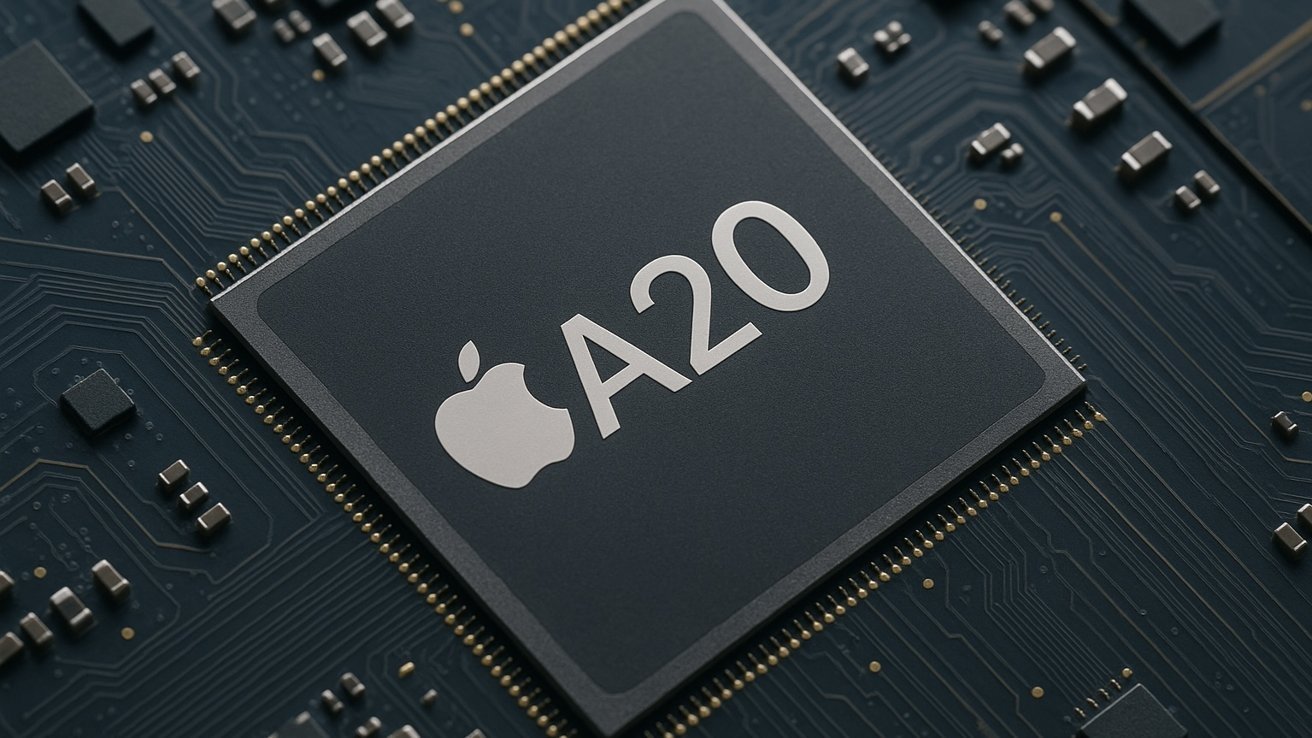
Market rumors claim TSMC is holding onto a billion-dollar stockpile of Apple chips due to not having enough memory to complete packaging. However, a prominent analyst doubts it to be the case.
The persisting memory supply crisis has caused problems with the supply chain, in both sourcing chips for products and in paying high prices for them too. While there is certainly a crisis at hand, not every major supply chain-related claim will be completely true.
On August 10, TF Securities analyst Ming-Chi Kuo wrote about market rumors that TSMC had a stockpile of 2-nanometer chips made for Apple. Valued at $1 billion, the pile was supposedly made of processor wafers for semi-finished products.
The apparent reason was due to a DRAM supply shortage, because Apple has memory attached to the System on Chip (SoC) for its Apple Silicon chips. Since there’s not enough memory available, those chips couldn’t be packaged.
Kuo adds that the apparent evidence for the claim was TSMC’s Q2 2026 earnings call, which mentioned “increased inventory days” due to the ramp-up of production of 2-nanometer chips.
However, Kuo disagrees with the claims, because Apple and TSMC’s working relationship involves intense planning. Something that couldn’t realistically cause this to happen at all.
In discussing the rumor, Kuo admits that his industry research shows Apple’s hardware shipments have been downgraded in 2026 due to memory shortages.
The key problem with the rumor is that Apple’s processor orders with TSMC are planned about three months in advance. They’re also based on the amount of memory available, meaning TSMC wouldn’t be put into a position where it produces massive quantities of chips without the memory to go with it.
TSMC certainly can produce and stockpile half-made products in advance. But, since the bottleneck isn’t TSMC, Kuo says Apple has “little reason” to pay TSMC to make the stockpile in the first place.
Memory supply is tight, Kuo adds, but he insists that he hasn’t heard of any “dramatic development” like a billion-dollar chip stockpile that’s awaiting more memory to arrive. “It’s hard for such dramatic developments to occur,” he states.
As for the call commentary as proof, Kuo points out that it couldn’t be directly attributed to an Apple chip stockpile for a few reasons. Partly because TSMC’s inventory includes finished goods, raw materials, supplies, and spare parts as well as semi-completed items.
TSMC also increases its “inventory days” in tandem with production ramp-ups for new advanced processes. This is not a phenomenon that’s new to TSMC at all.
Lastly, TSMC isn’t just supplying 2-nanometer chips to Apple. It also supplies to other firms, including AMD and MediaTek, meaning any such stockpiling would affect multiple companies.
Evidently, rumors aren’t just limited to supposed specs and colors of iPhones.

Meta has released Muse Glimmer, a slimmed-down open-weight AI model designed to run locally on a single GPU for agent tasks such as scheduling, file management, coding, and tool use. The release is based on Meta’s closed Muse Spark 1.2 model and appears to be aimed at attracting developers who want capable AI agents without relying entirely on cloud-hosted services. Engadget reports: Facebook said that it’s making the “weights” that AI systems use to choose responses available to everyone on Hugging Face along with developer documentation. The download is available for free, and users can run the model on their own PCs. The company noted that optimized integrations will land on llama.cpp and other sites, “so you can go from download to working agent in minutes.”
The model is powerful for its size, according to Meta, with the “strong success rates” on benchmarks like DeepSearch QA, MCP-Atlas and SWE-Bench (which evaluates its ability write and debug code). It also supports reliable tool use, multi-step reasoning, failure recovery, multimodal input and scaffold compatibility for work with OpenClaw and other agent orchestrators. It was trained on data from over 100 languages, the company added. “Rather than centralizing superintelligence, we should distribute it widely and give every person the ability to direct it,” CEO Mark Zuckerberg said in an essay accompanying Muse Glimmer’s release. “This has the potential to begin a new era of personal empowerment where individuals can use this powerful new capability to reach their full potential, pursue their interests, and improve their lives and the world more than ever before.”


Read more of this story at Slashdot.
There are so many shitty U.S. companies across tech, energy, and AI that criticism of our massively-unpopular telecom monopolies has fallen out of fashion. It’s easy to forget, for example, that Comcast routinely used to make headlines for setting peoples homes on fire, torturing pets, or at times killing people (most of the stories I used to write about this at DSLReports.com have been deleted after the owner abruptly and unceremoniously shut the website down).
So it feels like a bit of a throwback for Comcast to be under fire once again, this time for hitting low-performing employees in the face with pies. The company is facing a new lawsuit by employees who say one store manager made pies-to-the-face a tradition at a local company store. And encouraged everybody to videotape it:
“A lawsuit against Comcast’s cable division alleges that a store manager humiliated the lowest performing salesperson each month with a strange ritual in which a cream pie was smashed into the employee’s face. The lawsuit claims the store manager took videos of the assaults and ordered employees to participate in the assaults and record their own videos.”
Good times! Very on brand!
The full complaint makes for interesting reading, and includes paragraphs like this one:
“Specifically, for the entire time Plaintiff was employed by the Defendant, Defendant had a policy that the highest-ranked Retail Sales Consultant for the prior month was instructed by his or her supervisor-Ms. Peterson, the Comcast Store manager-to tie the lowest ranked sales consultant for the prior month to a chair in the back office and thereafter assault that person by violently smashing a cream pie in their face.”
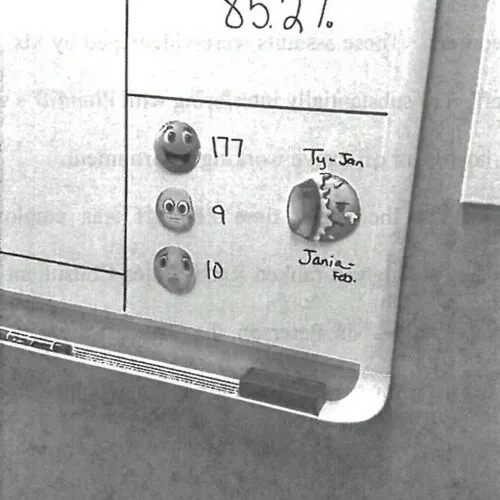
In addition to wisely having employees videotape the harassment, the store manager also made sure to document the pies-to-the-face employees received on a store whiteboard.

This is, as somebody who spent decades writing about Comcast for various websites, child’s play when it comes to the width and breadth of poor judgement that can be found at this particular company.
Filed Under: cable, face, motivational, pies, telecom
Companies: comcast

Meta is putting its money (and AI models) where its mouth is. The company said Monday that its latest model is built specifically for AI agents. Meta Glimmer is out now and is built to run on your laptop or PC.
Meta Muse Glimmer is a 30-billion-parameter model, which sounds big, but it’s actually built to run more efficiently than other big AI models. (By comparison, Moonshot AI’s Kimi K3 model, which approaches the capabilities of top models from companies like Anthropic and OpenAI, has 2.8 trillion parameters.) It can run on a single GPU, so you can run it on a newer MacBook or another computer with a relatively recent chip. The model is meant to help you orchestrate an army of AI agents, the newest wave of generative AI tech that lets you outsource tasks to bots known as agents.
Open-weight AI lets anyone, including researchers and cybersecurity defenders, see how an AI model operates. It isn’t fully transparent – open-source advocates say that to be truly open source, we’d need to know what’s inside the black box of training data used by Meta and other companies – but it’s less opaque than the closed-weight models offered by other major US developers. You can check out the model’s documentation on Meta’s website and HuggingFace. Meta also plans to release the weights of its newest model, Spark 1.2.
Meta CEO Mark Zuckerberg has been one of the biggest proponents of open-source, or open-weight, AI. He writes in an essay published Monday that the way to secure our future is to ensure that access isn’t limited to a few institutions, including tech companies like OpenAI, Anthropic and Meta. (It’s worth noting that Zuckerberg doesn’t have the same open philosophy when it comes to his social media platforms, which are run by black-box algorithms.)
“The defining questions of our age are who will have access to superintelligence and what will we direct it towards,” Zuckerberg wrote. “We propose a philosophy based on individual empowerment as the source of prosperity, invention as the primary purpose of superintelligence, and balance of power as the foundation of safety.”
The company is also introducing a $1 billion fund to “support each community” where it opens data centers. Data centers are the controversial facilities tech companies need to keep AI running, but towns across the US have fought hard to keep them out due to environmental concerns, noise, higher electricity prices and more. New York recently became the first state to pass a moratorium on data center construction. A billion dollars is a drop in the bucket for the $1.5 trillion company, but Meta says its investment in the area can include giving teachers bonuses, funded by tax revenue.
Meta spent billions of dollars over the last few years to staff up its Superintelligence Labs with some of the biggest names in the AI field, and it seems the group is now finally showing progress. The company has released a slew of new models recently, including the closed-weight models Meta Spark 1.1 and Spark 1.2, which power its Meta Code tool that competes with Anthropic’s Claude Code and OpenAI’s Codex. It also dropped an AI image tool that let anyone create deepfakes on Instagram, which was pulled less than a week later amid intense public backlash.
Meta is one of the only big tech companies to release open-weight AI models. OpenAI released a family of them in 2025, called GPT-OSS. Anthropic’s Claude models are all closed, which means we have little insight into how they operate.

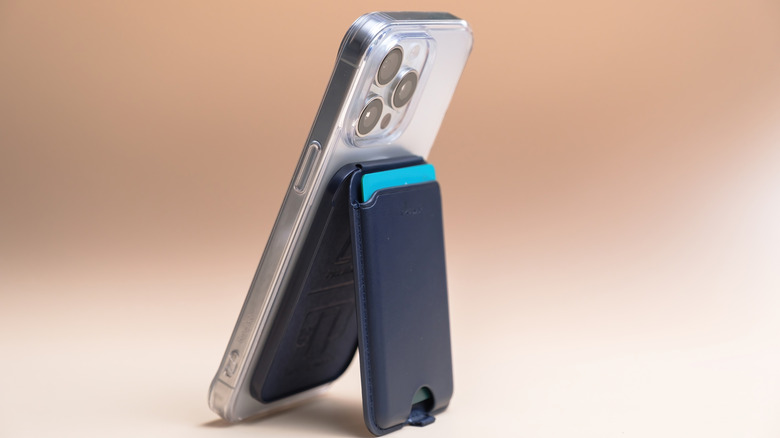
Magnets: how do they work? Pretty much the same regardless of brand name.
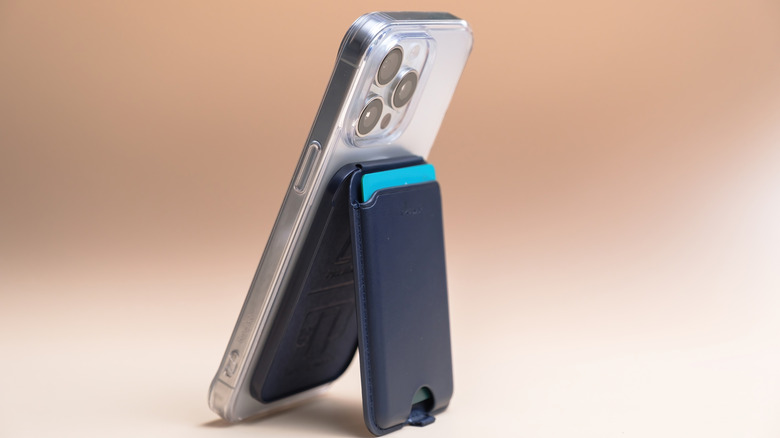
MagSafe seemed like a potential gimmick when Apple introduced it on the iPhone 12, leveraging the same branding it had long used for magnetic MacBook chargers. But the simple idea to add a ring of magnets around the wireless charging coil already found in previous iPhones turned out to be more than a way to sell overpriced accessories (though it certainly accomplished that, too). Once you’ve experienced the ease of snapping your phone onto a charging stand or one of the best MagSafe power banks, you’ll never want to fiddle with USB-C cables ever again.
In fact, MagSafe proved so useful that the Android world decided to adopt it from Apple. On non-Apple devices, the magnetic charging ring is part of the Qi2 spec, so rather than calling it MagSafe you should look for a Qi2 label. They’re functionally identical though, so you can snap Qi2 phones and cases directly onto MagSafe-branded accessories.
So far, only a few Android phones have integrated Qi2 directly on-device, most notably in the form of the PixelSnap ecosystem on the Google Pixel 10. Other companies have integrated it into accessories, with Samsung going so far as to claim people don’t need on-device Qi2 because they can simply buy an extra phone case with Qi2 magnets onboard (a position the company reiterated during the launch of the Galaxy Z Fold 8).
With so many developments in the space, some users are bound to wonder whether Qi2 is the same thing as MagSafe, and if so, why it goes by a different name. The answer is, as you might expect, a matter of corporate branding, but also one of control.
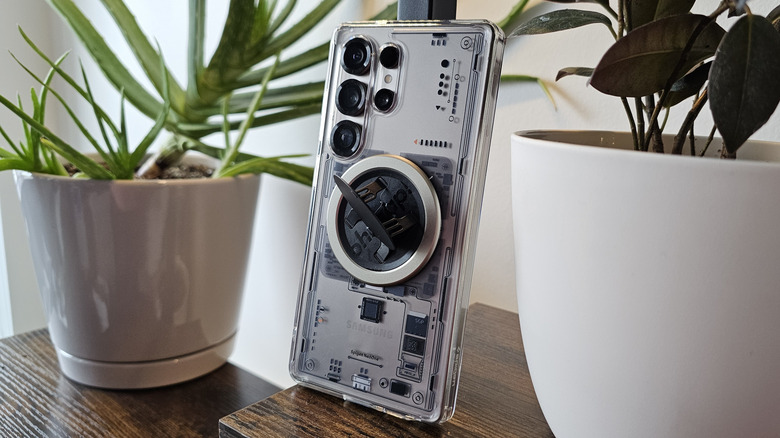
While the MagSafe name originated with the magnetic clip-on charger found on the 2006 MacBook Pro, Apple leveraged that brand recognition when it added a simple ring of stabilizing magnets to the backside of the iPhone 12. In addition to enabling accessories, it fixed the biggest issue with legacy wireless Qi charging. Phones with wireless charging had almost all used the same Qi charging coil in the back, but non-stabilized charging is inefficient and comparatively slow, since the coils in the back don’t always line up neatly with those in a charging pad. With MagSafe, Apple was able to increase the rated wireless charging speed of the iPhone 12 to 15W, up from just 7.5W.
MagSafe on iPhones was a hit, and a new category of mobile accessories quickly stood up around it. Before long, accessory makers began adding the ring to cases for Android devices as well, widening the market beyond Apple owners.
Apple is a member of the Wireless Power Consortium (WPC), which sets the Qi charging standard. In 2023, the WPC announced that Apple had donated MagSafe as the basis for a universal Magnetic Power Profile standard which would be known as Qi2. MagSafe remains a proprietary Apple brand, and accessories bearing the name must go through some certification. But since MagSafe was built on top of the original Qi standard, Qi2 accessories work with MagSafe-equipped iPhones, and vice versa.
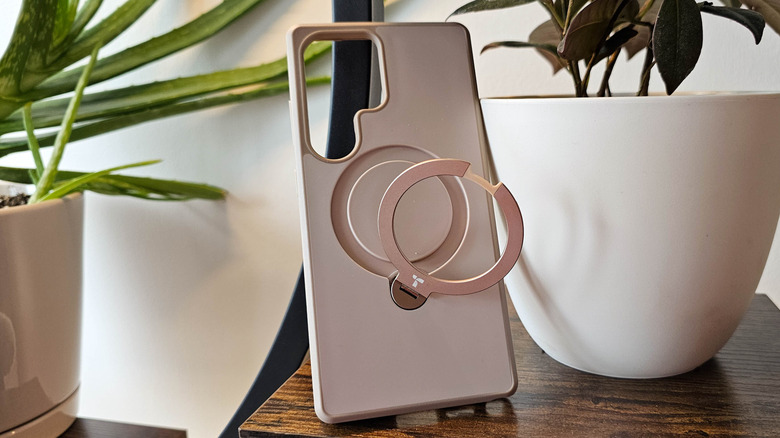
At a core level, there are no technical distinctions between Qi2 and MagSafe as implemented on devices such as the Google Pixel 10 and Apple iPhone 17. Both standards use basic Qi charging coils and the same stabilizing magnet ring. Accessories which work with one will work with the other unless their physical dimensions become problematic (for instance, a power bank designed for the iPhone 17 with dimensions that do not accommodate the Pixel 10’s horizontal camera bar).
With that said, both MagSafe and Qi2 have increased their top charging speeds since the introduction of the iPhone 12. That phone launched with 15W wireless charging over MagSafe. By contrast, the iPhone 17 and 17 Pro support 25W charging over the latest MagSafe revision. Meanwhile, the latest Qi standard (Qi2.2) allows for 25W wireless charging and is supported on devices including the Pixel 10 Pro XL and the Samsung Galaxy S26 Ultra (albeit with a magnetic case).
That means that if you have a phone which supports the latest magnetic wireless charging standards, you’ll need to ensure that any snap-on charging devices you buy also support those speeds. Don’t look for promises of MagSafe or Qi2 compatibility. Make sure that the charger is rated for 25W. As long as that’s clear, it doesn’t matter whether it advertises itself as MagSafe or Qi2.2… at least to anyone outside of Apple.
The original Minimal Phone built its entire identity around an E Ink screen that made scrolling annoying on purpose. The black-and-white E Ink screen intentionally made watching videos or scrolling through social media posts look less colorful or appealing to the human eye.
So, when The Minimal Company announced its successor with an AMOLED display that supports a higher refresh rate, I was a bit surprised. I wasn’t expecting the company to walk back the hardware choice that made it quite interesting. But that doesn’t mean that the Minimal Phone 2 isn’t worth a look.
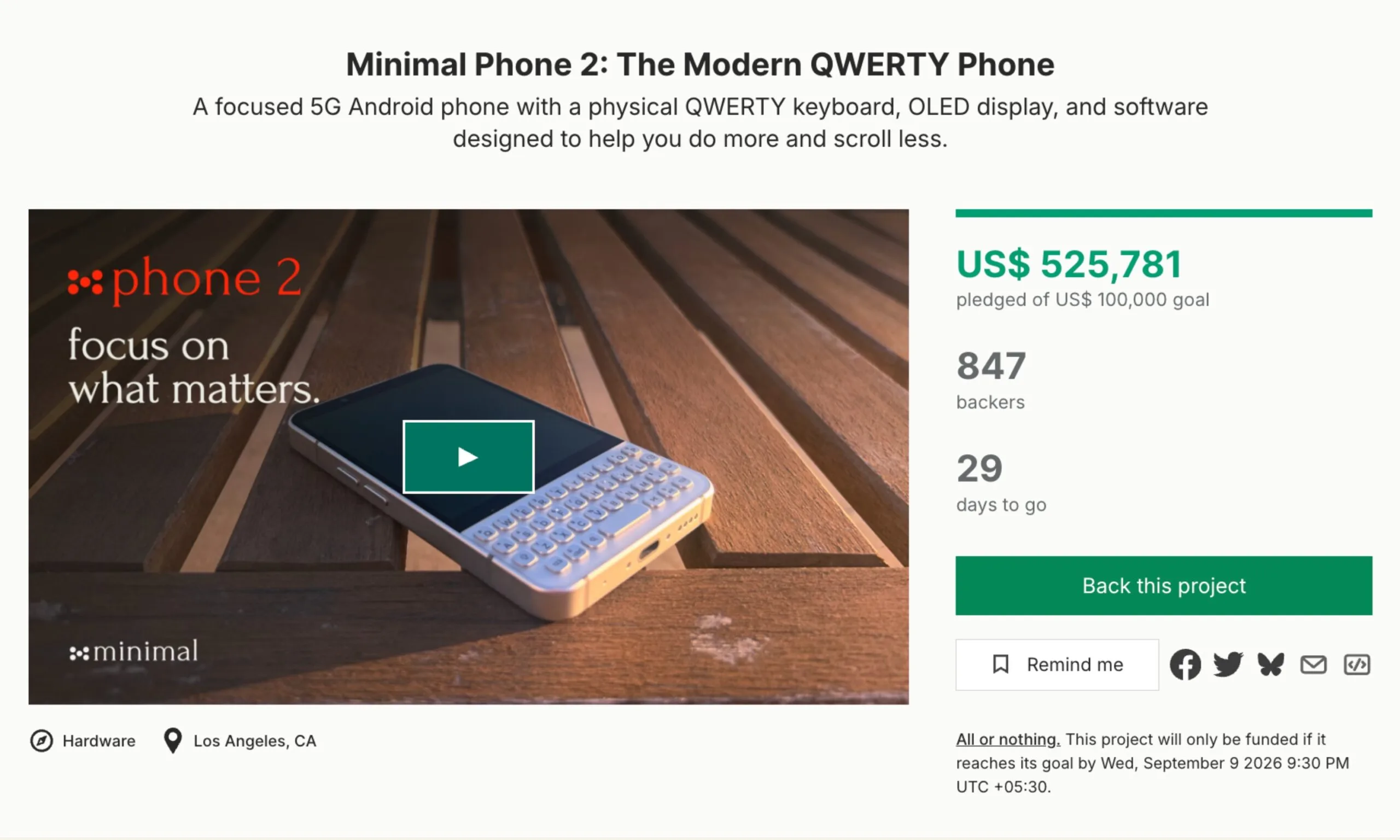
The Minimal Phone 2 trades its e-reader-style E Ink panel for a 3.92-inch 90Hz AMOLED screen. While E Ink displays are slow, sluggish with animations, and genuinely painful for anything beyond text, the AMOLED display gives the phone a modern look and appeal.
Isn’t it ironic: Minimal Phone with an AMOLED panel? Anyway, the rest of the redesign feels quite necessary, at least to me. The blocky, sharp-edged shell is gone, and in its place, the company has used a curved aluminum body.
It ships in Black or Silver colors. The physical QWERTY keyboard sticks around as well, with a tactile QWERTY layout that uses metal dome switches, remappable keys, and long-press shortcuts. For use in darker environments, the keys are backlit as well.
Buyers also get a physical silent switch at the top, alongside a 3.5mm headphone jack, which goes with the overall old-school vibe and feel of the phone, which, to be honest, reminds me of classic BlackBerry.
Unlike the original Minimal Phone, the latest iteration gets 5G support, which also implies that the company has used a new chipset inside. Although it’s not confirmed yet, a tipster claims that it could be the Dimensity 8300, paired with 8GB of RAM and either 256GB or 512GB of storage space.
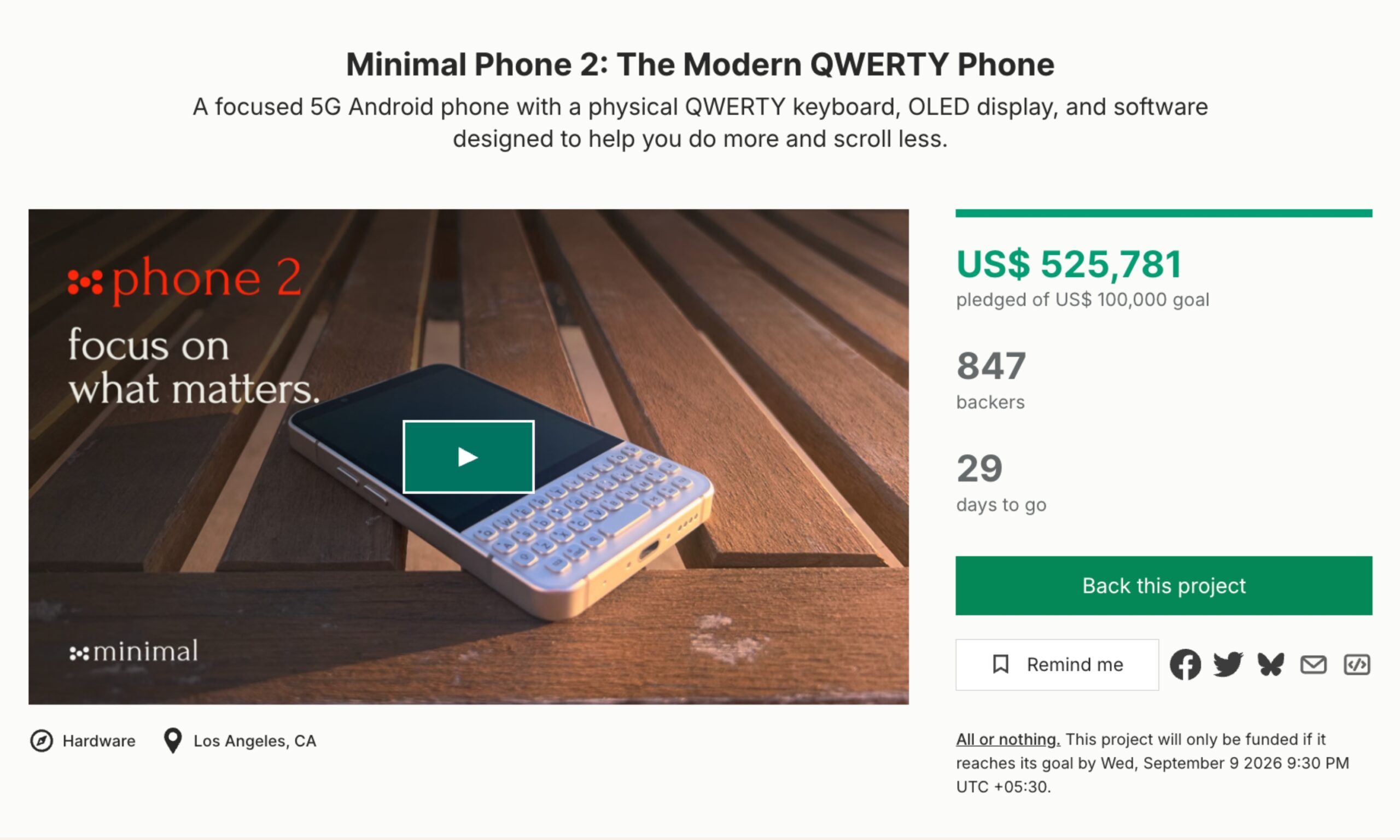
Although the company mentioned that more details about the phone will be revealed on August 10, 2026, the Kickstarter landing page suggests the crowdfunding will remain active for another 29 days. The project has already reached its goal, though, which means that it’s almost certain that the brand will move forward with a commercial launch.




Weekend Open Thread: Mattifying Sunscreen


Frugal Friday’s Workwear Report: Cap-Sleeve Pointelle Crewneck Sweater


Jordan Coyle & Cordiamo take Laya Arena Stakes at RDS


Can Astrology Help Find Gold and Silver Trends? A Financial Astrology Guide

US stocks: Dow closes at record on Mideast optimism; SpaceX, AMD drag Nasdaq

US Tech Stocks See Largest 5-Week Inflow in History: Can Nasdaq Break Its Downtrend?


Reform UK And Greens Sink To Lowest Favourability Ratings To Date


Nvidia Stock Climbs 2.5% as Chip Sector Rally Builds Ahead of AMD Earnings, Nvidia’s Own Report Looms


Polymarket targets $20 billion valuation as competition heats up in prediction market sector


OpenAI, Anthropic AI agents targeted real people and systems in cyber tests


Supply chain issues impact Ingredion

CLARITY Act Senate Vote Locked In, But 60-Vote Hurdle Looms Large


Rinn Pharma & Biopharma to join NordicPharmaTrain network


How to Start a Cleaning Business: A Step-by-Step Guide


The Senate has one week: CLARITY’s last August window
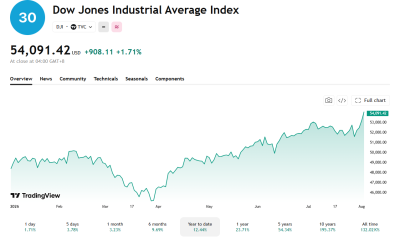

Dow and S&P 500 Hit Records on AI Earnings: When Will the Bubble Burst?


Datadog: Best Of Breed For Multiple Reasons


CNH Industrial Shares Jump Over 15% After Beating Estimates and Raising Full-Year Earnings Guidance
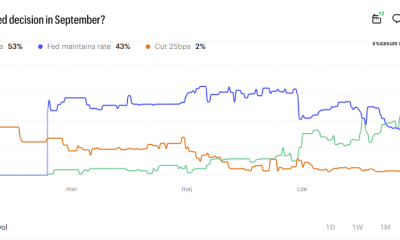

Dollar Index Trapped at 100 as Hawkish Fed Meets Official Selling


BDC Weekly Review: Private BDC Q2 Numbers Are Strong


You must be logged in to post a comment Login