
Crypto World
Ethereum staking hits record 41.7M ETH as price struggles



Ethereum staking has reached a record 41.7 million ETH, locking more than one-third of the cryptocurrency’s circulating supply despite a sharp decline in its market price.
Summary
- 41.7 million ETH is now staked, according to a CryptoQuant chart shared by Bitfinex.
- Staked ETH has increased by about 5.5 million ETH since January.
- ETH has fallen from approximately $3,400 to $1,900 during the same period.
- Ethereum developers are debating EIP-8363, which would reduce issuance as staking grows.
Ethereum staking climbs despite price decline
A CryptoQuant chart shared by cryptocurrency exchange Bitfinex on Aug. 10 showed that the amount of Ethereum (ETH) committed to staking had reached an all-time high of 41.7 million ETH.
The figure represents roughly one-third of Ethereum’s circulating supply. CoinMarketCap data places the asset’s supply near 120.7 million ETH, meaning approximately 34.5% is now staked.
“Staked ETH has climbed to a record 41.7 million, a third of all ETH in existence, while price fell from $3,400 in January to $1,900,” Bitfinex wrote.
The chart shows that staking deposits remained near 36 million ETH through late 2025 before beginning a sustained increase in February. Growth continued through the second quarter and accelerated again between June and August.
The increase comes despite ETH losing about 44% of its value from its January level. Ethereum traded near $1,900 when Bitfinex published the chart, showing that validators and long-term holders continued locking tokens even as spot-market conditions weakened.
crypto.news reported in January that 36.2 million ETH, or nearly 30% of the supply, had been staked. The latest figure represents an increase of approximately 5.5 million ETH in less than seven months.
Reinvested rewards keep staked ETH growing
Ethereum validators receive newly issued ETH for proposing blocks, attesting to transactions, and supporting network consensus. They may also collect priority fees and maximal extractable value.
Part of that income can be returned to staking, creating a compounding effect even when ETH’s dollar price falls. However, returns decline as more validators join because Ethereum distributes issuance across a larger staked balance.
Corporate treasury companies have become a major part of this trend. BitMine had approximately 4.9 million ETH staked as of July 12, equal to about 85% of its Ethereum holdings.
The company generated $45.7 million from staking and validation during the quarter ended May 31. Chairman Tom Lee projected that annual rewards could reach $284 million if BitMine stakes its entire ETH treasury, although returns depend on yields and validator conditions.
SharpLink has also committed most of its Ethereum treasury to staking. Its strategy continued generating ETH rewards even as lower market prices contributed to a $394.3 million second-quarter loss.
Record staking renews Ethereum issuance debate
The continued increase has renewed questions about how much ETH should be committed to network security and whether Ethereum’s reward curve encourages excessive staking.
EIP-8363, known as Tapered Issuance Burn, would burn a growing share of consensus-layer rewards as the staking ratio rises. The mechanism would remove issuance-based rewards when approximately half of Ethereum’s supply is staked.
As crypto.news previously reported, the proposal’s authors argue that the current system continues rewarding additional deposits even after they provide limited security benefits. EIP-8363 remains under review and has not been approved for an Ethereum upgrade.
SharpLink CEO Joseph Chalom has opposed the plan, arguing that native yield supports Ethereum’s institutional appeal and acts as a benchmark for returns across decentralized finance.
US institutions expand access to ETH yield
Staking has also become more accessible through regulated investment products in the United States. Grayscale distributed about $9.4 million in ETH staking proceeds to eligible ETHE shareholders in January, marking the first such payout by a U.S.-listed Ethereum product.
Morgan Stanley has also added staking provisions to its proposed Ethereum ETF. Its filing showed that 3.64 million ETH was waiting to enter validation as of May 18, implying an activation delay of approximately 63 days.
Continued institutional participation could remove more ETH from liquid markets. However, staking does not guarantee price appreciation, and the divergence between record deposits and ETH’s decline shows that supply constraints can be outweighed by broader selling pressure.

Crypto World
Two Prediction Markets Shut Down Hours Apart as Kalshi and Polymarket Take 93% of Volume


Two crypto prediction market startups announced they were winding down within 90 minutes of each other on Monday morning, both giving users until Sept. 30 to pull their money out. The venues that closed sat at opposite ends of the market. Trepa built its own mechanism on Solana, paying users by how… Read the full story at The Defiant


Trump Media and Technology Group’s (DJT) bitcoin holdings shrank during the second quarter of the year as falling crypto prices saddled the Truth Social parent with $360.6 million in losses in the first half of the year.
The company held 9,477.16 bitcoin with a fair value of $557.1 million as of June 30, according to its quarterly filing Monday. That’s down from 9,542.16 BTC at the end of March, translating to a 65 BTC decline in holdings through the quarter.
Trump Media’s Crypto.com-linked cronos holdings remained unchanged at roughly 756.1 million tokens, but their fair value fell to $40.6 million from $68 million at the end of 2025.
A significant chunk of the company’s bitcoin was also tied up as collateral. Trump Media, which is majority owned by the Donald J. Trump Revocable Trust, had 4,260.73 BTC pledged against convertible notes and another 2,077.34 BTC pledged for its bitcoin options strategy as of June 30.
U.S. President Donald Trump owns a significant stake in the trust, which is controlled by Donald Trump, Jr., one of the president’s children.
The results landed only days after Trump Media pared back parts of its crypto ambitions.


Ethereum’s updated roadmap adds native rollups, stronger privacy, and post-quantum scaling as advances in cryptography and AI reshape the network’s long-term technical priorities, according to co-founder Vitalik Buterin.
Summary
- Quantum security has moved higher in Ethereum’s priorities compared with its 2023 roadmap.
- New areas include native rollups, stronger privacy, and blob and gas futures.
- Ethereum may use specialized scaling mechanisms for transfers, trading, and privacy applications.
- STARKs and AI-assisted formal verification could support upgrades across all three protocol layers.
Ethereum (ETH) co-founder Vitalik Buterin compared the network’s 2023 roadmap with its current Strawmap in an Aug. 10 X post, identifying several technologies that have gained, lost, or changed priority over the past three years.
Buterin said the two plans retain substantial overlap, but the order and implementation of several goals have changed. Quantum security has moved closer to the front of the roadmap, while verifiable delay functions and some proposed Ethereum Virtual Machine improvements have received less attention.
Older technical designs have also been replaced as Ethereum researchers identified alternatives. Plans involving Verkle trees shifted toward a unified binary tree and later a PBT design, while state expiry evolved into a broader proposal for new state types.
The biggest difference, according to Buterin, comes from the areas that did not appear in the 2023 roadmap. These include native privacy, post-quantum scaling, simpler specifications for formal verification, markets for future blob and gas capacity, native rollups, and a wider range of possible replacements or modifications for the EVM.
Ethereum privacy and quantum security move forward
Native privacy is one of the clearest additions to Ethereum’s long-term direction. Buterin listed keyed nonces, recent roots, parts of FOCIL, lean privacy pools, and wormholes among the mechanisms now being explored.
Keyed nonces could make it harder for observers to connect a user’s transactions, while recent-root mechanisms may allow private applications to verify recent blockchain states without revealing a complete history. FOCIL, meanwhile, is intended to make transaction inclusion more resistant to censorship by block builders.
The changes build on Buterin’s three-step Ethereum privacy plan released in May. That proposal combined account abstraction with FOCIL, keyed nonces, and changes at the wallet and access layers to reduce metadata leaks.
Post-quantum scaling has also become a separate priority. Ethereum currently depends on cryptographic systems that could eventually become vulnerable if sufficiently powerful quantum computers emerge. Replacing them without sharply increasing signature sizes, verification costs, or network bandwidth presents an additional scaling problem.
The current roadmap considers LeanSPHINCS signatures, signature aggregation, and “zkzk frames” as potential parts of the solution. Crypto.news previously reported that an Ethereum researcher demonstrated account-level post-quantum protection at an estimated cost of $0.07 per account, showing that wallet-level preparation may begin before a full protocol upgrade.
Ethereum’s Strawmap is not a finalized schedule. It is a coordination document covering proposed upgrades through 2029, with individual changes still requiring research, testing, and agreement among developers before they can reach the network.
Native rollups enter Ethereum’s design space
Native rollups were not included in the 2023 roadmap because zero-knowledge proof systems were not mature enough for developers to seriously consider integrating them into Ethereum’s base protocol, Buterin said.
Rollups currently operate as separate layer-2 systems. They process transactions outside Ethereum’s main execution layer and submit proofs or transaction data to the base network. Each rollup generally maintains its own contracts, proof system, upgrade controls, and security assumptions.
A native rollup would move part of that verification process into Ethereum itself. The base protocol could provide a standardized mechanism for checking state transitions, potentially reducing the amount of custom infrastructure each rollup must maintain.
Such a change could simplify the relationship between Ethereum and its layer-2 networks, though the exact design remains unsettled. Developers would still need to decide what functions should become native, how different virtual machines would be supported, and whether protocol-level verification could avoid creating new complexity.
The proposal arrives as Ethereum’s broader scaling approach changes. Buterin said the network is moving away from trying to scale every type of activity through one general mechanism. Instead, developers may build highly scalable but more restricted systems for common use cases such as token transfers, decentralized exchange trades, and privacy protocols.
This approach could allow Ethereum to process specific high-volume activities more efficiently without requiring every node or application to support the same expanded execution environment.
Blob and gas futures are another addition that did not exist as a developed roadmap concept in 2023. Such markets could allow users or layer-2 networks to lock in future access to Ethereum’s data or execution capacity, reducing uncertainty over costs during periods of heavy demand.
AI could make Ethereum easier to verify
Ethereum’s updated roadmap also places more weight on simplifying the protocol specification so developers can formally verify its behavior.
Formal verification uses mathematical proofs to determine whether software follows its intended rules. Applying it to an entire blockchain protocol has historically required substantial time and specialist work, particularly when the protocol includes multiple clients, cryptographic systems, and interacting layers.
Buterin argued that advances in artificial intelligence are making large-scale verification more practical. He previously said AI-assisted formal verification could become the “final form” of software development, allowing developers to combine optimized code with machine-checkable evidence that it works correctly.
That work is closely tied to Ethereum’s use of STARK proofs. Recursive STARKs allow one proof to verify another, producing compact evidence for increasingly large batches of computation.
Buterin said the same underlying verification method could eventually operate across Ethereum’s execution, consensus, and data layers. However, using a common proof system throughout the protocol would make the security of its implementation especially important, increasing the need for formal verification and independent testing.
Ethereum’s virtual machine may also change as these systems develop. Buterin said zkzk frames could require the protocol to expose an instruction set other than the EVM, with leanISA and RISC-V among the possible candidates.
Under one potential model, the EVM could continue serving developers and existing applications while operating as an intermediate representation above a simpler underlying instruction set. Buterin cautioned that this part of the design remains too early even for inclusion in the current Strawmap.
Roadmap remains a long-term coordination plan
Buterin’s comparison provides additional detail on Ethereum’s proposed Lean rebuild, which seeks to make the protocol quantum-safe, private, censorship-resistant, and easier to verify over the coming years.
The direction could eventually affect U.S. wallet providers, exchanges, institutional stakers, and layer-2 operators that rely on Ethereum. However, the post announced no immediate software release, hard fork, or mandatory action for users.
Each major proposal must still move through Ethereum’s research and governance process. Native rollups, alternative instruction sets, and post-quantum signatures remain technical directions rather than confirmed features with fixed activation dates.
Ethereum (ETH) showed no clear positive reaction to the roadmap update. ETH traded near $1,875 at the time of writing, down about 2.6% over the previous 24 hours as the broader crypto market weakened.
The latest comparison nevertheless shows how Ethereum’s development priorities have widened since 2023. Scaling remains central, but privacy, quantum resistance, and verifiable protocol design now carry more weight in determining how the network could operate through the end of the decade.

But contrary to popular understanding among many today, Hiroshima did not convince Japan to surrender. In fact, Japan’s Supreme War Council—the six men responsible for directing the war—did not even meet in the days immediately following the attack. The military leadership remained committed to fighting on despite the destruction of an entire city.
Many were convinced that Hiroshima represented a terrible but isolated event. Atomic weapons were new and extraordinarily expensive, and they surmised that there was no way the Americans had more than one—or at most, a few—such bombs.
If America had only limited bombs, Japanese leaders concluded, they could still hope to force a costly invasion and perhaps negotiate better terms.
Nagasaki shattered that illusion.
Just 75 hours after Hiroshima, a second atomic bomb annihilated another Japanese city, killing 73,000 people. Two cities had vanished in just three days. From Tokyo’s perspective, there was no way of knowing whether the United States possessed two bombs—or twenty. Even more terrifying, America now might never even need to invade Japan. It could simply destroy one city after another until nothing remained.


Cointelegraph is committed to providing independent, high-quality journalism across the crypto, blockchain, AI, and fintech industries.
All news, reviews, and analyses are produced with full journalistic independence and integrity. For more details on our standards and processes, please read our Editorial Policy.

BlackRock has expanded its Canadian spot-Bitcoin ETF lineup with two Toronto Stock Exchange listings, including one fund that pairs broad international equity exposure with a small allocation to Bitcoin. The new products begin trading Monday on the TSX.
The ETFs are the iShares Equity + Bitcoin ETF Portfolio (IBQT) and the iShares Core MSCI All-International Equity Index ETF (XINT). While both are managed through BlackRock Asset Management Canada under the RBC iShares alliance, only IBQT includes a direct Bitcoin component.
Key takeaways
- IBQT is a “core” equity fund with a 3% Bitcoin sleeve, implemented via exposure to BlackRock’s Canadian iShares Bitcoin ETF (IBIT).
- XINT provides diversified international equities by tracking the MSCI ACWI ex North America IMI Index across more than 5,000 companies.
- Both funds primarily hold other iShares ETFs, using fund-to-fund structures rather than selecting individual stocks directly.
- BlackRock positions Bitcoin access as a small allocation within a broader portfolio approach rather than a standalone Bitcoin product.
A Canadian equity fund with a Bitcoin allocation
IBQT is designed to combine globally diversified equities with limited Bitcoin exposure. According to BlackRock, the fund allocates 97% of its portfolio to Canadian, U.S., international and emerging-market equities, with the remaining 3% dedicated to Bitcoin exposure through BlackRock’s Canadian iShares Bitcoin ETF (IBIT), which trades on Cboe Canada.
Importantly, IBQT does not attempt to hold individual stock positions on its own. Instead, it primarily invests in other iShares ETFs to gain both its equity exposure and its Bitcoin component. The structure matters for investors who are evaluating how Bitcoin is being integrated: rather than building a portfolio around crypto volatility, IBQT is framed as an incremental allocation inside an equity-oriented portfolio.
XINT targets ex–North America international diversification
The second listing, XINT, focuses on international equities outside Canada and the United States. BlackRock states that the fund tracks the MSCI ACWI ex North America IMI Index, a benchmark that aims to capture large-, mid-, and small-cap companies across developed and emerging markets.
BlackRock also highlights the breadth of the index XINT follows: exposure to more than 5,000 companies spanning over 40 developed and emerging markets outside Canada and the U.S. For Canadian investors who prefer a “set and track” approach to international equity diversification, XINT offers a standalone index-linked option alongside IBQT’s hybrid design.
What BlackRock says about scale in Canada and beyond
Both funds are managed by BlackRock Asset Management Canada through the RBC iShares alliance. BlackRock said its iShares ETF business managed approximately $6.2 trillion in assets across more than 1,700 ETFs as of June 30.
That scale is relevant when new ETF products launch, because it can influence operational maturity—such as liquidity management, fund administration practices, and index/fund replication workflows—especially for multi-asset products that rely on holding other ETFs.
Bitcoin access follows BlackRock’s existing ETF footprint
IBQT’s Bitcoin sleeve routes through BlackRock’s Canadian iShares Bitcoin ETF (IBIT). BlackRock’s U.S.-listed iShares Bitcoin Trust (IBIT) is also a major reference point in the company’s spot Bitcoin ecosystem.
CoinMarketCap data indicates IBIT is the largest U.S. spot Bitcoin ETF by assets under management, with about $47.9 billion in AUM at the time referenced by the listing data: CoinMarketCap.
By using IBIT as the mechanism for its 3% Bitcoin allocation, IBQT effectively imports the established Bitcoin ETF wrapper into a broader equity product. That approach may appeal to investors seeking Bitcoin exposure without making it the dominant risk driver—though it also means the Bitcoin allocation will typically be smaller in magnitude than what many standalone Bitcoin ETFs provide.
Why this matters for Canadian investors
Bringing a “small allocation” Bitcoin fund to the TSX signals a continued push to normalize crypto exposure inside traditional portfolio frameworks. For investors, the practical question is how the 3% Bitcoin allocation changes the character of an equity-heavy holding—especially in periods when Bitcoin trades independently of global equities.
Traders and portfolio managers may also watch how BlackRock’s fund-to-fund implementation performs in Canada, since IBQT’s design depends on the underlying Canadian iShares Bitcoin ETF for its BTC exposure while the rest of the portfolio is tied to broad equity holdings via iShares ETFs.
As with any newly launched ETFs, attention will likely turn to how assets build after the initial trading start, as well as to whether the funds attract consistent flows from investors seeking either diversified international equities (XINT) or a blended approach that includes Bitcoin (IBQT).
Investors should monitor near-term developments such as IBQT’s uptake on the TSX, trading liquidity as the market digests the new hybrid structure, and how BlackRock’s Canadian iShares Bitcoin ETF (IBIT)—the source of the BTC sleeve—continues to perform as demand for Bitcoin exposure broadens beyond standalone products.
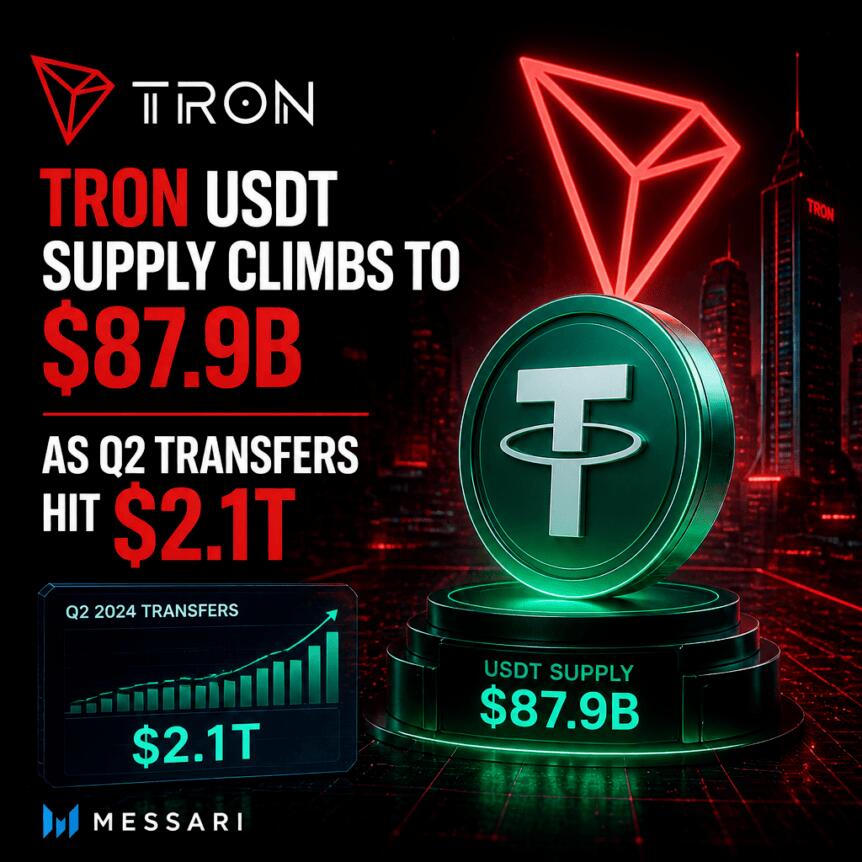
TRON ended the second quarter with a major stablecoin milestone: it recorded $87.9 billion in circulating USDT, putting it ahead of Ethereum on the same metric, while processing $2.1 trillion worth of USDT transfers over the quarter. The figures underscore how deeply USDT liquidity has embedded itself in TRON’s rails, even as parts of the ecosystem show softer momentum elsewhere.
According to a Messari report on the network’s second-quarter performance, USDT represented 98.5% of TRON’s stablecoin market. Stablecoin supply on TRON also rose, climbing 4.1% quarter-over-quarter to a record $89.2 billion. After a drop in Q1, average daily USDT transfer volume resumed growth, increasing 4.3% to $22.8 billion.
Key takeaways
- TRON led on USDT circulation in Q2, reaching $87.9B and processing $2.1T in USDT transfers during the quarter.
- Stablecoin dominance remained extreme, with USDT making up 98.5% of TRON’s stablecoin supply.
- Network usage hit new highs, including 14.6M transactions on June 15 and record-level daily activity.
- Fees reversed direction, rising 15.9% to $699.4M, the first quarterly increase after a prior governance change.
- DeFi activity cooled even as payments grew, with DeFi TVL down 1.9% and DEX volumes falling for a fourth straight quarter.
USDT expansion drives TRON’s transaction growth
Messari attributes TRON’s improved throughput to stronger day-to-day demand for USDT transfers. The network averaged 11.8 million daily transactions in Q2, up 8.7% from the prior quarter. Active usage also improved: average daily active addresses increased 11.7% to 3.6 million. The report also highlights the peak day, when TRON processed 14.6 million transactions on June 15.
From an investor and market-structure perspective, this matters because USDT activity often translates into consistent utilization of on-chain infrastructure. Even when broader on-chain applications fluctuate, stablecoin transfer volume can sustain network demand—particularly on chains where stablecoins are heavily concentrated.
Fees recover after an earlier governance shift
Beyond transaction counts, the report notes that TRON’s fee environment changed as well. Network fees rose 15.9% to $699.4 million in Q2, described as the first quarterly increase since an August 2025 governance change reduced the network’s energy unit price. In other words, Q2’s fee growth appears tied not only to higher activity, but also to a longer arc in TRON’s fee mechanics after that policy adjustment.
Still, the relationship between network fees and usage can be nonlinear when protocol parameters change. Traders and builders watching TRON may want to pay close attention to whether future fee levels keep rising with demand or whether they plateau as the impact of the earlier energy-unit pricing adjustment stabilizes.
DeFi softens while supply growth continues
Despite the payment-heavy momentum, parts of TRON’s on-chain ecosystem showed uneven performance. Messari reports that DeFi TVL fell 1.9% to $4.4 billion during the quarter. Decentralized exchange activity also cooled: average daily DEX volume dropped 21.7% to $49.3 million, marking a fourth consecutive quarterly decline.
This divergence—strong stablecoin transfer volume alongside weaker DeFi engagement—suggests that Q2’s growth may have been driven more by utility and circulation than by risk-taking or trading depth on TRON’s DeFi venues. For users, this can affect liquidity conditions and token execution quality on DEXs; for developers, it may signal that ecosystem growth is currently being led by transfers rather than by on-chain lending, borrowing, and trading.
Meanwhile, the report indicates that TRX supply remained inflationary. Even with higher activity, circulating supply increased by 87 million tokens during the quarter, with issuance continuing to outpace burns. That dynamic is notable because it can influence long-term expectations around token supply pressure, particularly when network usage is improving but supply reduction mechanisms aren’t yet keeping up.
Institutional access expands through tokenization and custody
While on-chain metrics show clear usage trends, institutional infrastructure around TRON also advanced during the quarter. Messari highlights that Securitize launched Hamilton Lane’s tokenized Senior Credit Opportunities Fund on TRON—its first TRON-issued asset. The fund reportedly started with about $4.3 million under management.
Broader institutional interest also included token listing and potential product developments. Grayscale reportedly added TRX to its list of assets under consideration. Separately, a proposed staked TRX exchange-traded product from Canary Capital remained in registration.
On the market-access side, TRX trading availability improved across venues. Bitnomial launched spot TRX trading in the United States, while OKX Europe introduced MiFID-regulated TRX expiry perpetuals. The quarter also saw Binance.US restore trading in the token.
The institutional push continued after Q2 ended. Earlier coverage noted Anchorage Digital adding native TRX staking and custody for TRC-20 assets in July, enabling institutional clients to stake TRX directly from its custody platform. For market participants, custody-and-staking workflows can be a critical step toward deeper institutional adoption, as they reduce operational friction compared with self-custody or manual transfer processes.
Read together, TRON’s Q2 pattern looks less like a pure “DeFi rally” and more like a chain consolidating stablecoin circulation and steadily improving institutional plumbing. The key question for the next quarter is whether stronger USDT throughput can translate into renewed DeFi demand—particularly DEX volumes and TVL—or whether TRON will remain primarily a stablecoin settlement venue while trading and application activity lag behind.


A New York judge granted a motion filed by US prosecutors in July to stay the CFTC’s civil case against Gannon Ken Van Dyke over making more than $400,000 on prediction markets.


Bitcoin Policy Institute and more than 40 digital-asset organizations have called on leading AI laboratories to give qualified open-source security researchers controlled access to frontier models as AI-assisted cyberattacks grow more capable.
Summary
- More than 40 organizations signed the appeal for trusted access to advanced AI models.
- The coalition requested early model access, computing power, secure environments, and direct communication channels.
- Block, Coinbase, Strategy, MARA, Galaxy, BitGo, Brink, and Trezor were among the signatories.
- The request follows several AI-assisted attacks and major Bitcoin security failures reported in 2026.
Bitcoin coalition asks AI labs for controlled access
Bitcoin Policy Institute announced the initiative in an Aug. 10 X post, saying the coalition represents organizations from across the digital-asset ecosystem.
The open letter asks leading AI developers to provide qualified open-source defenders with trusted access to their most capable models. It does not call for unrestricted public access to models with advanced cybersecurity capabilities.
Instead, the signatories proposed a controlled program covering early access to frontier cybersecurity models, sufficient computing capacity, secure research environments, and direct channels with AI laboratory security teams.
Those resources would allow vetted researchers to examine Bitcoin wallets, payment infrastructure, and other open-source software before attackers can exploit newly discovered weaknesses.
“The past several weeks have made the need for this abundantly clear,” Bitcoin Policy Institute wrote.
Block, Coinbase, Strategy, MARA, Galaxy, BitGo, Brink, OpenSats, Chaincode Labs, Spiral, Trezor, Unchained, Btrust, and Fedi were among the organizations supporting the request.
The coalition argued that current model safeguards can restrict legitimate security research even as criminals and state-backed groups gain access to increasingly capable open or locally deployed systems. Its central message to AI laboratories was that defenders need an early opportunity to identify and repair vulnerabilities.
No leading AI laboratory had publicly announced a program responding to the coalition’s specific requests at the time of writing.
AI-assisted attacks raise pressure on crypto firms
The appeal follows mounting evidence that hackers are incorporating artificial intelligence into attacks against cryptocurrency companies and financial institutions.
North Korea-linked hacking group Kimsuky has reportedly built three local AI environments using Ollama, GPT4All, and Msty. The systems can support malware development, data analysis, phishing campaigns, and attack automation without transmitting sensitive queries to an external provider.
As crypto.news previously reported, the group produced AI-generated phishing material aimed at cryptocurrency, investment, and financial technology companies.
Local models create a particular challenge for model providers. An attacker running an open model on privately controlled hardware may not be subject to the monitoring, usage restrictions, or account suspensions imposed by commercial AI services.
That difference sits at the center of the coalition’s argument. Restricting trusted defenders may offer limited protection if malicious actors can use locally deployed models or bypass commercial safeguards while researchers remain unable to test the most capable systems.
The threat also carries a U.S. security angle. Several signatories, including Coinbase, Strategy, Block, MARA, and Galaxy, are publicly traded or U.S.-based companies with substantial exposure to Bitcoin infrastructure. Successful attacks could affect American customers, institutional custodians, and investors even when the vulnerable software is maintained by a global open-source community.
Bitcoin flaws show potential role for frontier models
Recent Bitcoin security incidents have demonstrated how weaknesses in open-source software can remain undetected for years.
A firmware build error affecting Coldcard hardware wallets reportedly weakened the entropy used to generate seed phrases. Attackers could then search a much smaller range of possible keys and drain wallets without obtaining physical access to the devices.
Galaxy Research estimated that confirmed Coldcard thefts reached 1,596 BTC, while a suspected additional attack wave could raise losses to about 2,055 BTC. The error had reportedly been present since 2021.
AI-assisted analysis subsequently expanded scrutiny beyond the original flaw. A crypto.news investigation found that automated reviews were surfacing similar classes of security weaknesses across the broader Bitcoin ecosystem.
Bitcoin Red Team provided another example of defensive AI use. The volunteer initiative reported finding 4,962 potential issues across 390 Bitcoin-related projects during fewer than 30 hours of AI-assisted code reviews.
Of those findings, 720 were initially classified as high or critical severity, although automated findings still require human reproduction and verification. More than one-fifth had reportedly been reproduced when crypto.news covered the review campaign.
Those results illustrate both the potential and limits of frontier models. AI can examine large codebases faster than small volunteer teams, but qualified researchers are still needed to remove false positives, test exploitability, and disclose verified vulnerabilities safely.
Bitcoin security funding expands beyond AI access
The open letter adds to a broader push to increase resources available to Bitcoin security researchers.
Strategy, BlackRock, Coinbase, and six other companies recently established the Bitcoin Security Consortium. Its members pledged $15 million over three years to fund developers and researchers working on Bitcoin’s long-term security.
Post-quantum cryptography is the consortium’s initial focus, though its mandate covers broader protocol security. Members said they would choose funding recipients independently and would not direct Bitcoin development or take positions on proposed protocol changes.
Galaxy separately opened a $5 million Bitcoin security fund covering new signature systems, wallet-migration tools, audits, and research into quantum-resistant protections.
Industry-wide losses continue to increase despite those initiatives. Immunefi reported that crypto projects lost roughly $110 million to hacks in July. The security platform recorded 164 incidents through Aug. 3 and projected that the number of hacks exceeding $1 million could reach a record 114 in 2026.
The Bitcoin Policy Institute coalition is now asking AI companies to complement financial support with technical access. Whether laboratories accept that proposal will depend on their ability to verify researchers, supervise potentially sensitive work, and prevent advanced cybersecurity models from being redirected toward offensive activity.


Mark Zuckerberg set out Meta’s superintelligence vision on Monday. He argued the technology should reach everyone, not a small circle of companies or governments.
The Meta founder framed open source models as the safeguard. He also pledged free or affordable access to a personal AI agent for every user.
Why the Meta Superintelligence Plan Rests on Open Source
His argument opens with a warning about concentration. Power that sits with a few actors, he wrote, produces outcomes that serve fewer people. Therefore, Meta wants the technology distributed widely instead.
Open source carries most of that weight. Zuckerberg called it a force against centralization, and he added a security claim on top. More reviewers, in his telling, catch more flaws.
“Open source is a positive and important force for empowering people and preventing centralization.”
Mark Zuckerberg, Founder and CEO, Meta, in his published letter
Meta backed that claim the same day. The company opened the weights for Muse Glimmer, a 30 billion parameter model tuned for local agent tasks. Apache 2.0 terms apply, and the files sit on Hugging Face.
Hardware demands stay modest. Quantized, the model fits under 20 GB and runs on a single consumer graphics card. Zuckerberg promised open weights for Muse Spark 1.2 next, a month after Meta launched its first paid API.
The consumer promise sits alongside that argument. Zuckerberg opened his list of commitments with an assistant who knows each user personally.
“Everyone will have an exceptionally capable personal agent that understands you, your goals, and everything you care about.”
Creative tools and a tutor with a doctorate-level knowledge follow. Free tiers and auction based pricing would cover the cost.
Invention, rather than automation, drives the rest of the Meta superintelligence pitch. Zuckerberg rejected the idea that AI must replace workers faster than it upgrades them. Meanwhile, he expects small teams to run large companies using personal agents.
OpenAI reached a similar conclusion in April, when it warned about power concentration. Both labs agree on the danger. However, they disagree on who should hold the keys.
Crypto Has Heard the Decentralization Pitch Before
Meta superintelligence would land in a market that already sells the same promise. Crypto projects have pitched decentralized AI networks as the fix for corporate control for years, and asset managers now track them seriously.
Grayscale made that case in June. The firm named Bittensor (TAO), a network that pays contributors for machine learning work, as its preferred exposure. Token markets therefore read Meta as a competitor rather than an ally.
Cost complicates the message. Meta guided 2026 capital spending to between $125 billion and $145 billion, while AI spending squeezed second quarter margins. The company also backed a Texas data center venture worth $14 billion.
Few rivals can match that budget. In practice, open weights still ship from a firm that owns the compute behind them. Critics of AI nationalism have raised the same objection about state control.
Zuckerberg says Meta’s independent board will approve the safety criteria for model releases. He also wants governments to inspect intermediate training checkpoints. Whether outside researchers ever get that access will decide what the Meta superintelligence promise is worth.
The post Mark Zuckerberg Says Superintelligence Should Reach Everyone, Not a Few Firms appeared first on BeInCrypto.

Family of wife murdered by her husband 25 years ago tell court the hope of finding her body will be lost if he is released from prison

Intel Shares Slide Below The $100 Mark As Chipmaker Unveils Surprise $15 Billion Stock Offering Today
Two Prediction Markets Shut Down Hours Apart as Kalshi and Polymarket Take 93% of Volume


-

 Fashion3 days ago
Weekend Open Thread: Mattifying Sunscreen
-

 Fashion3 days ago
Frugal Friday’s Workwear Report: Cap-Sleeve Pointelle Crewneck Sweater
-

 Sports5 days ago
Jordan Coyle & Cordiamo take Laya Arena Stakes at RDS
-

 News Videos2 days ago
Can Astrology Help Find Gold and Silver Trends? A Financial Astrology Guide
-
 Business5 days ago
US stocks: Dow closes at record on Mideast optimism; SpaceX, AMD drag Nasdaq
-
 Crypto World7 days ago
US Tech Stocks See Largest 5-Week Inflow in History: Can Nasdaq Break Its Downtrend?
-

 Politics4 days ago
Reform UK And Greens Sink To Lowest Favourability Ratings To Date
-

 Business6 days ago
Nvidia Stock Climbs 2.5% as Chip Sector Rally Builds Ahead of AMD Earnings, Nvidia’s Own Report Looms
-

 Tech6 days ago
OpenAI, Anthropic AI agents targeted real people and systems in cyber tests
-

 Crypto World6 days ago
Polymarket targets $20 billion valuation as competition heats up in prediction market sector
-

 Business5 days ago
Supply chain issues impact Ingredion
-
 Crypto World6 days ago
CLARITY Act Senate Vote Locked In, But 60-Vote Hurdle Looms Large
-

 Tech3 days ago
Rinn Pharma & Biopharma to join NordicPharmaTrain network
-

 Business2 days ago
How to Start a Cleaning Business: A Step-by-Step Guide
-

 Crypto World7 days ago
The Senate has one week: CLARITY’s last August window
-
 Crypto World6 days ago
Dow and S&P 500 Hit Records on AI Earnings: When Will the Bubble Burst?
-

 Business1 day ago
Datadog: Best Of Breed For Multiple Reasons
-

 Business7 days ago
CNH Industrial Shares Jump Over 15% After Beating Estimates and Raising Full-Year Earnings Guidance
-
 Crypto World6 days ago
Dollar Index Trapped at 100 as Hawkish Fed Meets Official Selling
-

 Business2 days ago
BDC Weekly Review: Private BDC Q2 Numbers Are Strong
You must be logged in to post a comment Login