



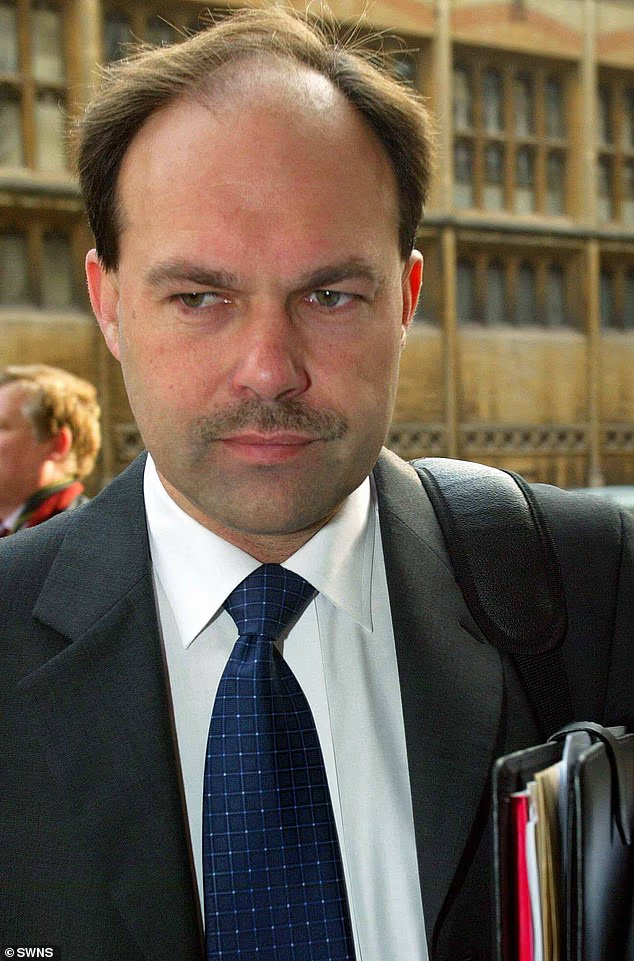
The body of a woman murdered almost 25 years ago by her husband will never be found if he is released from prison, her family have told the High Court.
Glyn Razzell, now 67, was jailed for a minimum of 16 years in 2003 for murdering his estranged wife Linda, whose body was never found.
But the ex-banker was released on licence by the Parole Board in April, a decision the Ministry of Justice has asked the High Court to reverse because of a failure to properly consider Razzell’s risk to the public.
Mrs Razzell, a mother-of-four, disappeared on her way to work at Swindon College, Wiltshire, in March 2002 while in the process of divorcing her husband and had been engaged to another man, Greg Worrall.
Julie Westmore, Mrs Razzell’s cousin, told the court on Monday the killer husband was a ‘master manipulator’ who had ‘always failed to take responsibility for his actions’.
Ms Westmore said: ‘The major impact on myself and our family would be the complete loss of trust in the justice system of this country if Glyn Razzell was released without revealing where Linda’s remains are.
‘It would quite simply be wrong.’
She added her family would ‘not feel safe’ if Razzell were released because they ‘know him to be a violent man and an accomplished liar’.
Glyn Razzell was released from prison on licence in April after being jailed for the murder of his 41-year-old wife Linda Razzell

Mrs Razzell disappeared on the way to work at Swindon College in March 2002 and her body was never found
The Parole Board ruled three times from 2019 that Razzell should remain behind bars but allowed him to be released on licence earlier this year.
In making its decision, the board considered Helen’s Law, which makes it harder for killers to win parole if they do not reveal where victims’ bodies have been hidden.
Named after Helen McCourt, who vanished on her way home from work in 1988 and whose killer was freed without revealing where her body was, the rule means the Parole Board must consider whether killers have concealed the location of their victims’ remains.
Ms Westmore said the law meant it had ‘at last been recognised that it does matter when a murderer refuses to reveal where someone’s remains are’.
Earlier this year, Cathy Larkman of the Women’s Rights Network said Razzell’s release was a ‘cruel decision’ which made a ‘mockery’ of Helen’s Law.
Razzell’s previous bids for parole were rejected in part because he maintained his innocence but he was allowed to stay in an open prison during the latter years of his sentence.
In April, the Parole Board’s panel said it had ‘serious doubts’ about Razzell’s honesty and there was a ‘very serious risk’ within relationships he might become involved in, though said this was ‘not imminent’.
The panel decided he would comply with licence conditions because he was ‘strongly motivated not to return to custody’.
But Ms Westmore said if Razzell remained in prison it would be ‘the incentive he needs to eventually do the right thing’.
‘If Glyn Razzell is released now, all hope of ever finding Linda’s remains will be lost.’
The killer husband, from Somerset, attended the High Court hearing and sat in the dock wearing a dark blue suit as he opposed the effort to challenge his release.
He has always denied being responsible for Mrs Razzell’s death and the Parole Board found in 2023 he ‘does not want to lose his desired status of being a “wrongly convicted murderer”‘.
Mrs Razzell was last seen in March 2002 at Old Walcot, Swindon, parking her car after dropping her children to school in Highworth and Mr Worrall at work.

Police dug up ground in Wiltshire in 2019 near to Mrs Razzell’s former home after a tip off from a member of the public, but found nothing

An aerial view of Pentylands Close, Mrs Razzell’s former home, near to where police searched for her body seven years ago
After police searched a car driven by Razzell following his wife’s disappearance they found a significant amount of her blood in the boot.
Detectives spoke to 2,600 people during their 18-month investigation, following more than 2,200 lines of enquiry and taking 1,540 statements.
A jury at Bristol Crown Court took six hours to find Razzell guilty of murder in November 2003.
Following the trial, Detective Chief Inspector Paul Granger, of Wiltshire Police, said: ‘I don’t think Razzell will tell us where the body is and if he does, it will not be for a long time.
‘He is an evil, cold, calculated and intelligent man, but he made mistakes and that is how he ended up getting caught.’
Razzell has repeatedly appealed his conviction and appeared on a BBC miscarriage of justice programme, Convicted, in 2018 to prove his innocence.
But he refused to take a lie detector test when asked by producers and the programme did not produce any new leads.
After a tip off from a member of the public, police searched a field near Mrs Razzell’s former home in Wiltshire in 2019 but found nothing.

Police used shovels during a 2019 search of a field near Mrs Razzell’s former home in Wiltshire
The Ministry of Justice can refer Parole Board prisoner release decisions to the High Court if it believes they would undermine public confidence in the parole system.
For a release to be justified the court must be satisfied that imprisonment is no longer necessary to protect the public.
Tristan Jones KC, for the Ministry of Justice, said Razzell had made a ‘degree of progress’ and professionals who worked with him supported his release.
But he said the Parole Board’s decision ‘loses sight of the fact that he has not been honest or transparent’.
Mr Jones added: ‘Mr Razzell is a deeply deceitful individual who carried out a campaign of violence against Linda, some of it witnessed by their children, and then planned and carried out her murder.’
‘He is so attached to his narrative of innocence that he is willing to continue inflicting pain on the victims.’
Mr Jones said Razzell’s proposed licence conditions ‘cannot fully address the risks’ he poses.
Matthew Stanbury, for Razzell, said the Parole Board’s decision was ‘detailed and thorough’ and the Ministry of Justice’s argument ‘comes close to treating denial as conclusive to risk’.
He said the case against Razzell was based on ‘wrong assumptions’ that his denial of his wife’s murder was a ‘bar to release’.
After consideration by an ‘experienced’ Parole Board panel, Mr Stanbury said there was ‘no… basis’ for overruling the decision to release Razzell.
The hearing before Mrs Justice Cheema-Grubb is set to conclude on Tuesday.





















































You must be logged in to post a comment Login