Connect with us

NewsBeat

Teenager who forced more than 100 girls to self-harm, perform sex acts and carve his alias on their bodies is jailed

Published

on

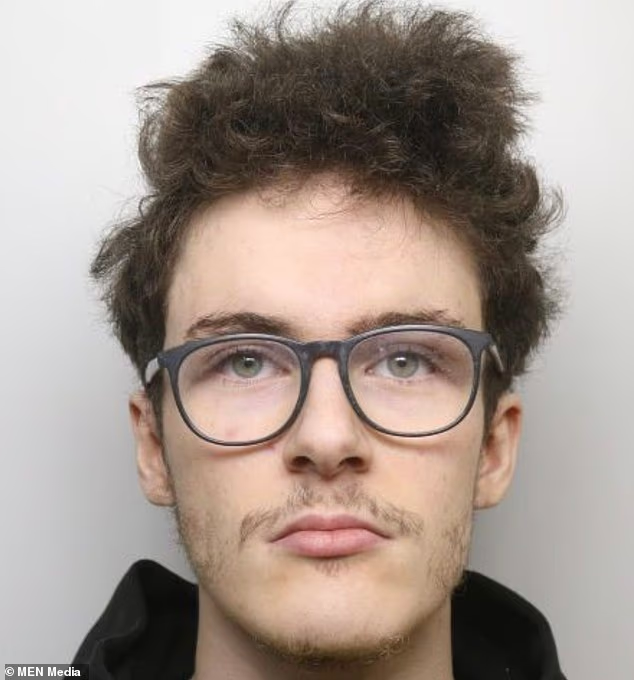
Justin Swaddle, 20, from Leeds, was jailed for two years after he forced 117 victims into sexual activity and self harm

A 17-year-old boy who forced 117 girls to self-harm, perform sex acts and carve his alias on their bodies has today been jailed.

Justin Swaddle, now 20, led a campaign of violence in a Com group, an online community that shares extreme graphic material and manipulate victims to commit violent and sexual child abuse.

Members of these disturbing online groups mainly consist of teenage boys vying for attention and notoriety rather than sexual desire.

The more extreme the crimes and abuse committed, the more status a young person operating in these forums will achieve.

Advertisement

Swaddle’s devices were found to contain alarming images of victims self-harming and carving his aliases into their skin, according to the National Crime Agency (NCA).

The man from Meanwood, Leeds, was just 17 when he groomed young girls on Snapchat, Discord and Telegram under the usernames ‘Epstein’, ‘Rugen’ and ‘Moscow‘.

Danielle Pownall, Operations Manager at the NCA said: ‘Justin Swaddle targeted young and vulnerable victims all over the world to abuse and scare them into carrying out shocking self-harm and sexual activity, purely to gain popularity with his peers online.’

Swaddle was jailed for two years after a police investigation revealed he had communicated with 117 female victims aged 13 to 17.

Advertisement

Justin Swaddle, 20, from Leeds, was jailed for two years after he forced 117 victims into sexual activity and self harm

Eight of his victims lived in the UK. 

Ms Pownall continued: ‘He gained the trust of his victims, before collecting private information about them so he could threaten to share their intimate images or report them to their school or parents to incite further content.’

Advertisement

One of Swaddle’s victims said the two met on the social media platform Discord in November 2022 before they moved to Snapchat.

The conversation quickly became sexual and escalated to discussions about self-harm.

Swaddle requested that the victim send nude images of herself to him and carve his username on her body, according to the NCA.

He also obtained her name, home address and school details and shared recordings of calls where sexual activity had taken place with a chat group.

Advertisement

Swaddle then threatened to use the girl’s personal details if she did not send more explicit videos and images with him.

Other chat logs from the messenger app Telegram showed he had attempted to make a child sexually abuse another child and record it for him.

Again he threatened to share indecent images he had already obtained if his depraved request was not completed. 

His devices contained indecent images of children in category C and category A, the most severe level.

Advertisement

Detectives estimated the images on Swaddle’s devices showed children aged between three and 17.

Some images indicated Swaddle had directed or encouraged the children to commit sexual or harmful acts.

He was first arrested by West Yorkshire Police in October 2023 for offences including the possession, making and distribution of indecent images.

His devices were seized and online presence probed.

Advertisement

The NCA began their investigation in January 2024 and uncovered hundreds of conversations involving young women, all of which were sexual.

Investigators worked with law enforcement partners in the USA, Canada, Australia, Norway and New Zealand to speak to and safeguard victims.

Ms Pownall said: ‘While the number of people involved in Com groups are relatively small, the impact it has on victims is high and long-lasting, as Swaddle’s offending shows.

‘We are extremely grateful for the assistance of West Yorkshire Police, our international partners and specialist prosecutors at the CPS in bringing a dangerous offender to justice.’

Advertisement

Reports relating to the so-called ‘Com networks’ increased six times in the UK between 2022 and 2024, involving thousands of users and victims.

Ms Pownall added: ‘The NCA is coordinating the response to Com groups in the UK, working with a range of law enforcement, health and safeguarding partners to better understand pathways into offending and identify opportunities for prevention and intervention.’

According to the NCA, Swaddle admitted two counts of inciting a girl 13 to 15 to engage in sexual activity without penetration; inciting a girl 13 to 15 to engage in sexual activity with penetration; and blackmail.

He also pleaded guilty to making an indecent photograph of a child in categories A, B and C, as well as possessing an extreme pornographic image and possessing a prohibited image of a child.

Advertisement

Source link

Continue Reading
Click to comment

You must be logged in to post a comment Login

Leave a Reply

NewsBeat

Family of wife murdered by her husband 25 years ago tell court the hope of finding her body will be lost if he is released from prison

Published

on

Glyn Razzell was released from prison on licence in April after being jailed for the murder of his 41-year-old wife Linda Razzell

The body of a woman murdered almost 25 years ago by her husband will never be found if he is released from prison, her family have told the High Court.

Glyn Razzell, now 67, was jailed for a minimum of 16 years in 2003 for murdering his estranged wife Linda, whose body was never found.

But the ex-banker was released on licence by the Parole Board in April, a decision the Ministry of Justice has asked the High Court to reverse because of a failure to properly consider Razzell’s risk to the public.

Mrs Razzell, a mother-of-four, disappeared on her way to work at Swindon College, Wiltshire, in March 2002 while in the process of divorcing her husband and had been engaged to another man, Greg Worrall.

Advertisement

Julie Westmore, Mrs Razzell’s cousin, told the court on Monday the killer husband was a ‘master manipulator’ who had ‘always failed to take responsibility for his actions’.

Ms Westmore said: ‘The major impact on myself and our family would be the complete loss of trust in the justice system of this country if Glyn Razzell was released without revealing where Linda’s remains are.

‘It would quite simply be wrong.’

She added her family would ‘not feel safe’ if Razzell were released because they ‘know him to be a violent man and an accomplished liar’.

Advertisement

Glyn Razzell was released from prison on licence in April after being jailed for the murder of his 41-year-old wife Linda Razzell

Mrs Razzell disappeared on the way to work at Swindon College in March 2002 and her body was never found

Mrs Razzell disappeared on the way to work at Swindon College in March 2002 and her body was never found

The Parole Board ruled three times from 2019 that Razzell should remain behind bars but allowed him to be released on licence earlier this year.

Advertisement

In making its decision, the board considered Helen’s Law, which makes it harder for killers to win parole if they do not reveal where victims’ bodies have been hidden.

Named after Helen McCourt, who vanished on her way home from work in 1988 and whose killer was freed without revealing where her body was, the rule means the Parole Board must consider whether killers have concealed the location of their victims’ remains.

Ms Westmore said the law meant it had ‘at last been recognised that it does matter when a murderer refuses to reveal where someone’s remains are’.

Earlier this year, Cathy Larkman of the Women’s Rights Network said Razzell’s release was a ‘cruel decision’ which made a ‘mockery’ of Helen’s Law.

Advertisement

Razzell’s previous bids for parole were rejected in part because he maintained his innocence but he was allowed to stay in an open prison during the latter years of his sentence.

In April, the Parole Board’s panel said it had ‘serious doubts’ about Razzell’s honesty and there was a ‘very serious risk’ within relationships he might become involved in, though said this was ‘not imminent’.

The panel decided he would comply with licence conditions because he was ‘strongly motivated not to return to custody’.

But Ms Westmore said if Razzell remained in prison it would be ‘the incentive he needs to eventually do the right thing’.

Advertisement

‘If Glyn Razzell is released now, all hope of ever finding Linda’s remains will be lost.’

The killer husband, from Somerset, attended the High Court hearing and sat in the dock wearing a dark blue suit as he opposed the effort to challenge his release.

He has always denied being responsible for Mrs Razzell’s death and the Parole Board found in 2023 he ‘does not want to lose his desired status of being a “wrongly convicted murderer”‘.

Mrs Razzell was last seen in March 2002 at Old Walcot, Swindon, parking her car after dropping her children to school in Highworth and Mr Worrall at work.

Advertisement
Police dug up ground in Wiltshire in 2019 near to Mrs Razzell's former home after a tip off from a member of the public, but found nothing

Police dug up ground in Wiltshire in 2019 near to Mrs Razzell’s former home after a tip off from a member of the public, but found nothing

An aerial view of Pentylands Close, Mrs Razzell's former home, near to where police searched for her body seven years ago

An aerial view of Pentylands Close, Mrs Razzell’s former home, near to where police searched for her body seven years ago

After police searched a car driven by Razzell following his wife’s disappearance they found a significant amount of her blood in the boot.

Detectives spoke to 2,600 people during their 18-month investigation, following more than 2,200 lines of enquiry and taking 1,540 statements.

Advertisement

A jury at Bristol Crown Court took six hours to find Razzell guilty of murder in November 2003.

Following the trial, Detective Chief Inspector Paul Granger, of Wiltshire Police, said: ‘I don’t think Razzell will tell us where the body is and if he does, it will not be for a long time.

‘He is an evil, cold, calculated and intelligent man, but he made mistakes and that is how he ended up getting caught.’

Razzell has repeatedly appealed his conviction and appeared on a BBC miscarriage of justice programme, Convicted, in 2018 to prove his innocence.

Advertisement

But he refused to take a lie detector test when asked by producers and the programme did not produce any new leads.

After a tip off from a member of the public, police searched a field near Mrs Razzell’s former home in Wiltshire in 2019 but found nothing. 

Police used shovels during a 2019 search of a field near Mrs Razzell's former home in Wiltshire

Police used shovels during a 2019 search of a field near Mrs Razzell’s former home in Wiltshire 

The Ministry of Justice can refer Parole Board prisoner release decisions to the High Court if it believes they would undermine public confidence in the parole system.

Advertisement

For a release to be justified the court must be satisfied that imprisonment is no longer necessary to protect the public.

Tristan Jones KC, for the Ministry of Justice, said Razzell had made a ‘degree of progress’ and professionals who worked with him supported his release.

But he said the Parole Board’s decision ‘loses sight of the fact that he has not been honest or transparent’.

Mr Jones added: ‘Mr Razzell is a deeply deceitful individual who carried out a campaign of violence against Linda, some of it witnessed by their children, and then planned and carried out her murder.’

Advertisement

‘He is so attached to his narrative of innocence that he is willing to continue inflicting pain on the victims.’

Mr Jones said Razzell’s proposed licence conditions ‘cannot fully address the risks’ he poses.

Matthew Stanbury, for Razzell, said the Parole Board’s decision was ‘detailed and thorough’ and the Ministry of Justice’s argument ‘comes close to treating denial as conclusive to risk’.

He said the case against Razzell was based on ‘wrong assumptions’ that his denial of his wife’s murder was a ‘bar to release’.

Advertisement

After consideration by an ‘experienced’ Parole Board panel, Mr Stanbury said there was ‘no… basis’ for overruling the decision to release Razzell.

The hearing before Mrs Justice Cheema-Grubb is set to conclude on Tuesday.

Source link

Advertisement
Continue Reading

NewsBeat

Canada’s military on standby to help battle deadly British Columbia wildfire

Published

on

Canada's military on standby to help battle deadly British Columbia wildfire

Canada put its military on standby Monday to help battle deadly wildfires in British Columbia as a local mayor warned that one of the blazes had wreaked huge destruction on his community. A woman has died and some 20,000 people have fled their homes so far.

For days, scores of wildfires have burned across the province, nearly half of them out of control in hot, windy weather and prolonged drought. Thousands have fled on jammed roads as officials said even more communities could be threatened.

The mayor of Summerland — home to about 12,000 people, which was ordered evacuated on Saturday night along with about 8,000 people in and around nearby Peachland — warned that the affected areas remained too dangerous to enter and that it was impossible to determine the scope of the destruction.

The blaze — known as the Bald Range wildfire — remained out of control after racing toward Summerland and other communities along Okanagan Lake over the weekend.

Advertisement

“It’s going to be quite a bit,” Mayor Doug Holmes said of the expected destruction. “We need to brace ourselves for that bad news when it’s time to go back. Everybody will know somebody who has lost a home.”

The military is ready to respond, minister says

Defense Minister David McGuinty said the Canadian Armed Forces were in constant contact with provincial and federal officials and were ready to respond if British Columbia formally requested assistance. The federal government has already approved provincial requests for help with shelter and accommodations.

The Royal Canadian Mounted Police said an 80-year-old woman died while trying to escape the fire near Summerland. Canadian Prime Minister Mark Carney said the death was heartbreaking and that the federal government would continue supporting British Columbia.

The British Columbia Wildfire Service said Monday the fire had grown to about 156 square kilometers (60 square miles), from 136 square kilometers (53 square miles) on Sunday. Officials warned clearer skies and direct sunlight could increase fire activity.

Advertisement

In Summerland, Peachland and the surrounding areas, about 10,000 homes remained under evacuation orders, while more than 3,200 were under evacuation alerts — meaning they could be told to evacuate at any moment.

Ravi Parmer, British Columbia Minister of Forests, said 19 helicopters were assigned to the Bald Range wildfire but that its intensity made it impossible to halt the blaze.

“We could have put a thousand more helicopters and a thousand more people on the ground, and it wouldn’t have made a difference,” he said.

British Columbia Wildfire Service information officer Nicole Bonnett said the smoke lingering over the Bald Range fire has reduced visibility, limiting the use of air tankers and water-skimming aircraft.

Bonnett said the blaze has been fueled primarily by extremely dry conditions rather than wind, and grew explosively Friday, reaching 50 square kilometers (19 square miles) within three hours.

Evacuated residents face uncertain prospects for return

Holmes, the Summerland mayor, said there was no timetable for when residents would be able to return as power lines had been downed and hazards at the destroyed or damaged buildings would have to be assessed first. He added that residents would eventually return, likely neighborhood by neighborhood.

Advertisement

“The hard part is going home and seeing the devastation,” he cautioned.

Kyla Gaudiuso, a resident of Faulder, a 215-strong community, said her home was likely destroyed as she had gotten a photo showing the ridge where it stood engulfed in flames.

She described the community’s evacuation as “pandemonium” and said she was now staying with a friend in the town of Penticton.

“It doesn’t really seem real,” she said. “I have to see it to believe it.”

Advertisement

Canada has endured increasingly destructive wildfire seasons in recent years, forcing mass evacuations and repeatedly sending smoke across large parts of the country and neighboring United States.

Summerland — a farming community that grows cherries, peaches and apples, and also boasts some vineyards — is in a mountainous area where wildfires have been known to break out.

Holmes said the blaze started around 5:30 p.m. on Friday and was within the city limits in just a couple of hours. By midnight, it was so out of control that people were unable to flee on the highway north, so they began evacuating to the south, he said.

“We had to pack up our cars, neighbors were helping neighbors,” he said. “People said they’ve never seen a fire move so fast.”

Advertisement

Source link

Advertisement
Continue Reading

NewsBeat

Travelodge reception staff gave domestic abuser key to victim’s room in ‘most traumatic night’ of her life

Published

on

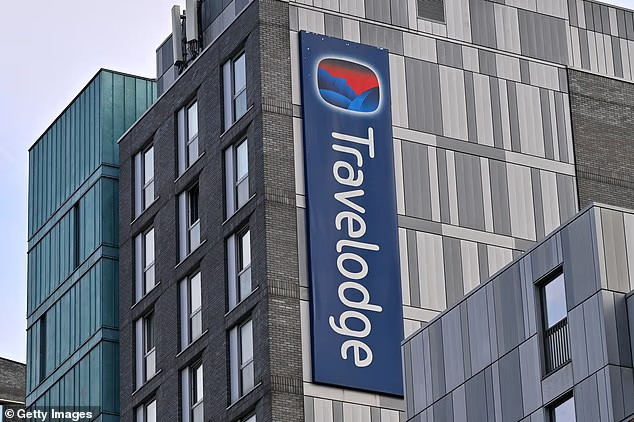
Travelodge changed its key policy after a woman was sexually assaulted by a man who had been given access to her room at a Travelodge in Maidenhead in 2022

A woman has told of the ‘most traumatic night’ of her life after Travelodge reception staff gave her domestic abuser the key to her room.

The victim, who has not been named, said she was attacked by her abuser at the London hotel in October last year.

She contacted the BBC after hearing about Kyran Smith, who was jailed for seven and a half years for attacking a woman at a Travelodge in Maidenhead, Berkshire. 

The woman booked a stay in the capital city for a ‘night away from the fear’ following a period of abuse, but her attacker was reportedly given her room key by staff.

Advertisement

Recalling the terrifying ordeal, the woman said: ‘He walked into the hotel and told the receptionist that his girlfriend was upstairs having a seizure.

‘He asked what room I was in and what floor I was staying on.’

She added that once her attacker received the key, Travelodge staff directed him to her room. 

After forcing his way inside, the man physically attacked her and tried to grab her phone, she said.

Advertisement

Travelodge changed its key policy after a woman was sexually assaulted by a man who had been given access to her room at a Travelodge in Maidenhead in 2022

Travelodge chief executive Jo Boydell, pictured, during a Bloomberg Television interview in London

Travelodge chief executive Jo Boydell, pictured, during a Bloomberg Television interview in London

The victim then managed to calm her abuser down and convinced him to leave before he returned even more aggressive.

Advertisement

‘Not long afterwards, I heard him knocking at the door. He was banging, shouting. He was just getting more and more aggressive,’ she said.

‘I was terrified. I was hoping that he was going to stop, but instead, he kicked the hotel room door completely off the hinges.’

The woman said she fled downstairs ‘shaking’ and ‘begging for help’ from staff.

‘I think the receptionist just panicked. She didn’t call the police. She didn’t check if I needed any medical attention,’ she said.

Advertisement

‘She didn’t ask if there were any family members I could call, anyone that I needed. She just offered me a room, another room in the hotel.’

A Travelodge spokesperson said: ‘We are deeply sorry for the significant distress experienced by the customer and we apologise for the way the incident has been handled.

‘Customer safety and security is – and remains – a priority for us.

Wendy Griffith (pictured) was staying at the chain's London Stratford branch in July 2025 when she witnessed a 'vile' spectacle through the door's peephole

In a separate incident Wendy Griffith witnessed a ‘vile’ spectacle through the door’s peephole while staying at the chain’s London Stratford branch in July 2025

Advertisement
Kyran Smith (pictured) was jailed for seven and a half years in February over an attack at a Travelodge in Maidenhead, Berkshire, in 2022

Kyran Smith (pictured) was jailed for seven and a half years in February over an attack at a Travelodge in Maidenhead, Berkshire, in 2022

 ‘Any case of an unauthorised person entering a guest’s room is a significant cause for concern and we want to be clear that this should not have happened. 

‘Our room access security policies at the time were not correctly followed, which is not acceptable.

‘Earlier this year, we made changes to strengthen our room access security policy and incident escalation procedures, supported by training for all of our customer-facing colleagues.

Advertisement

A spokesperson added: ‘Our investigation indicates that the individual provided the guest’s full name and room number at reception.’

Following Kyran Smith’s sentencing for the attack in 2022, Travelodge chief executive Jo Boydell said immediate changes were made to its room access security policy.

In an apology issued to the victim, Ms Boydell confirmed that explicit permission is required from guests before additional or replacement keys are issued for their room.

While a crackdown on issuing spare keys has taken place, women have still been victims of vile acts at Travelodge hotels. 

Advertisement

Wendy Griffith was ‘trapped’ in her Travelodge hotel room for an hour while a naked man knocked on the door and performed sex acts outside. 

She was staying at the chain’s London Stratford branch in July 2025 when she witnessed the ‘vile’ spectacle through the door’s peephole.

The marketing consultant, from Norfolk, recalled her ‘rising panic’ over the hour in the middle of the night as she tried and failed ‘multiple times’ to contact hotel staff.

Sharing her story, Ms Griffith told the BBC that the incident involving her, last summer, had caused a lasting ‘psychological impact’.

Advertisement

She described feeling ‘incredibly traumatised and not able to summon help’ before dialling 999 in desperation.

Ms Griffith praised the police response adding that ‘three cars pulled up within five minutes’ to arrest the man.

The culprit, Trevor Reece, 40, pleaded guilty to outraging public decency in September 2025.

He was sentenced to four months of alcohol dependency treatment and ordered to pay £185 court costs and £50 compensation to his victim

Advertisement

Source link

Continue Reading

NewsBeat

Ukraine assault on Russian retail giant Wildberries brings war home to consumers and retailers

Published

on

Ukraine assault on Russian retail giant Wildberries brings war home to consumers and retailers

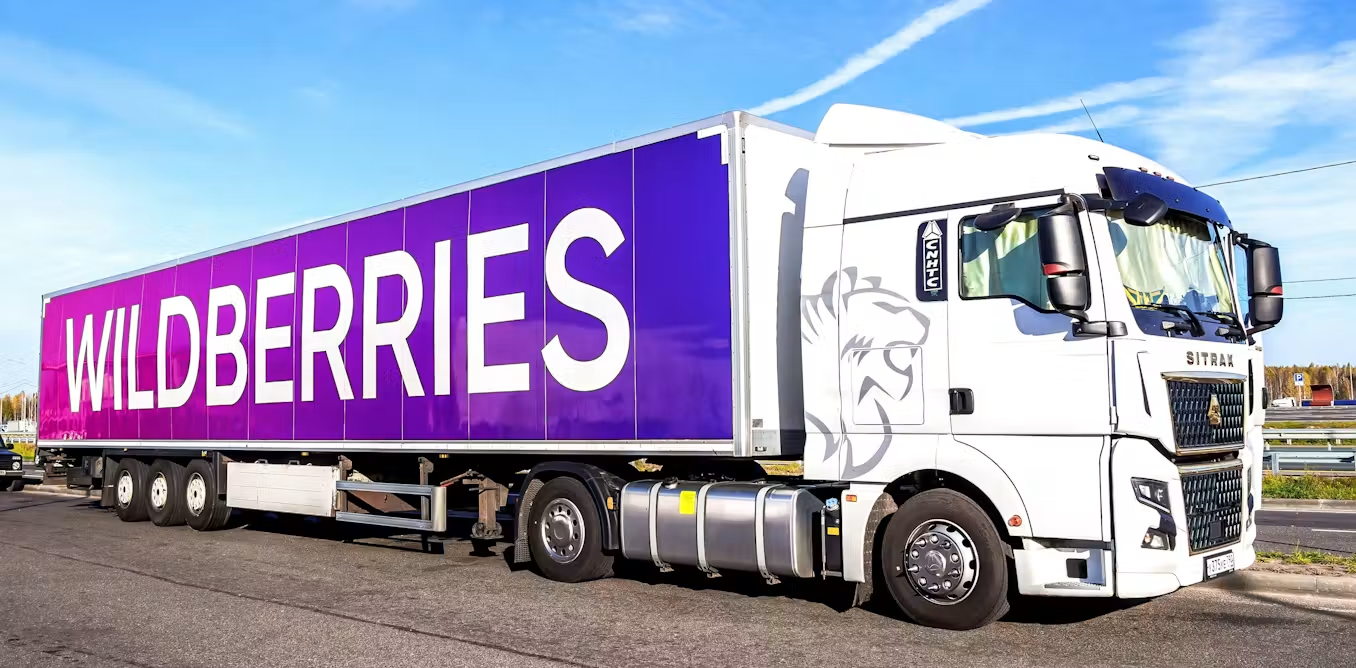
Ukrainian drones are regularly striking warehouses belonging to Wildberries – Russia’s largest online marketplace, often described as its answer to Amazon.

This is the latest front in a campaign that has made the economic costs of the war harder for ordinary Russians to ignore. Earlier this summer, strikes on oil refineries and fuel infrastructure contributed to shortages, rising prices and queues at petrol stations.

Russia’s president, Vladimir Putin, has grown used to managing hardship and western sanctions. But as I have previously argued, Russia is increasingly sustaining the war by passing its costs on to households and businesses. The attacks on Wildberries show how directly those costs may now be felt.

Wildberries began in 2004 as an online clothing business run from a Moscow apartment by Tatyana Kim and her then husband, Vladislav Bakalchuk.

Advertisement

A major breakthrough came in 2008, when it introduced a flat delivery charge across Russia. It later added local pickup points with fitting rooms and free returns, reducing the cost and perceived risk of buying clothes online, and attracting customers beyond the largest cities.

By 2016, Wildberries had become Russia’s largest online retailer. Two years later, it was operating as a marketplace, allowing independent producers and retailers to list goods while the company handled warehousing, payments and delivery.

Wildberries says it now reaches more than 79 million users each month through over 90,000 collection points across Russia and a handful of other countries, mainly former Soviet republics. It reports that sellers generated 2.9 trillion roubles (£26 billion) in sales in 2024, 44% more than the previous year.

The platform hosts more than 1 million sellers, over 85% of them small and medium-sized businesses. Together with Ozon and smaller rivals, Russian marketplaces facilitate transactions worth the equivalent of 8.5% of Russia’s GDP and support around 4 million jobs.

Advertisement

The network is particularly important in smaller communities, where conventional shops often offer less choice. Wildberries is therefore more than an online shop: it is commercial and logistical infrastructure connecting businesses with customers across a vast country. Its scale makes its warehouses unusually consequential targets.

Why the warehouses matter

Ukraine says Wildberries’ logistics hubs form part of Russia’s military supply chain. The Ukrainian president, Volodymyr Zelensky, said the first warehouses targeted distributed navigation systems and components for drone production. The Kremlin and Wildberries deny this allegation.

The bombing campaign began on July 18. By August 5, at least 20 Wildberries warehouses had been attacked across Russia.

Ukraine claims to have hit 20 Wildberries warehouses across Russia by August 5.
SOPA Images Limited

Whatever the stated military rationale, the economic consequences extend far beyond the front line of war. Wildberries relies on large distribution hubs that store and process goods belonging to many sellers. A single strike can destroy stock belonging to thousands of businesses, interrupt deliveries across several regions, and affect customers far from the site that is attacked.

Advertisement

The consequences can be particularly severe for smaller producers and retailers. Many have already paid for manufacturing and transport before their goods reach a warehouse. If that stock is destroyed, they lose both the products and the expected sales income, while still facing wages, taxes, loan repayments and supplier bills.

Wildberries says it has begun making payments to affected sellers and introduced other relief measures. But the amounts vary considerably. One seller told Forbes he had received 41,365 roubles in compensation, amounting to just 5.6% of what was destroyed in the fire.

The method used to calculate such payments remains unclear. The company’s terms classify drone attacks as force majeure (an uncontrollable and unforeseeable event), limiting its liability for destroyed stock.

Because the attacks were beyond the control of both Wildberries and its sellers, affected businesses might have expected the Russian state to share the burden. As of July 28, the government was considering loans, tax relief and subsidies, but no decision had been made. Sellers were therefore uncertain about how much of the loss they would ultimately have to absorb.

Advertisement

Consumers may bear some of the cost too. Sellers seeking to recover their losses could raise prices, while warehouse disruption may cause delayed orders and reduced product availability. Damage to a distant logistics hub can therefore spread through the platform, becoming an economic shock for businesses and households across Russia.

Testing public morale

These disruptions will not automatically weaken support for Putin. Russians may blame Ukraine rather than their own government, while attacks on civilian workplaces could reinforce patriotic sentiment. The losses may also generate solidarity with affected Russian businesses, rather than anger towards the Kremlin.

The greater political risk is cumulative. Fuel shortages, higher prices, disrupted deliveries and losses for small businesses make it harder to maintain the impression that the war can continue without significantly changing everyday life in Russia.

Putin’s economic resilience depends not only on energy revenues and financial reserves, but on the willingness of households and businesses to absorb the costs of war. By targeting a platform embedded in everyday consumption, Ukraine is testing that willingness.

Advertisement

The significance of the Wildberries campaign may therefore lie less in the warehouses destroyed, than in the millions of Russians whose incomes, shopping and sense of normality depend on them.

Source link

Advertisement
Continue Reading

NewsBeat

New advice issued to Brits travelling to Portugal with kids

Published

on

New advice issued to Brits travelling to Portugal with kids

Holidaymakers will need to know all the entry requirements ahead of their trip to avoid disappointment and potentially being refused entry into the country.

Children aged 17 or younger travelling to Portugal alone or with someone who is not their parent or legal guardian will need a letter of authorisation in order to travel there.

The letter must contain key details in order to be accepted.


What does the letter to enter Portugal need to include?

Authorities in Portugal have asked that a few things be included in the letter, such as a signature from the child’s parent or legal guardian and the date it was signed.

Advertisement

The signature must be certified by a notary or solicitor and the notary or solicitor’s signature must be legalised by the Legislation Office.

The letter must be issued alongside a copy of the child’s parent’s or guardian’s passport.

Are you going to Portugal this year? (Image: Getty)

It must include:

  • full name, date of birth and passport number of the child
  • the dates the child plans to arrive and depart the country
  • why they are visiting
  • the address where the child will be staying
  • the name and passport number of the adult in Portugal who is responsible for them while in Portugal
  • the full name, date of birth, passport number and contact details of the parent or guardian

What happens if you don’t have a letter of authorisation?

The UK government website has made it clear that if a child is taken to Portugal without a letter of authorisation, their entry will be delayed and could be refused.


Recommended reading:

Advertisement

It adds: “Teenagers aged 17 and under who travel alone, or with friends of the same age, and who are not being met on arrival by a parent or guardian, may be refused entry if they do not have a letter of authorisation.”

If a child is a resident of Portugal and aged 17 or under, they “must carry a properly certified letter of authorisation if travelling without their parent or legal guardian.”

Did you know these rules were in place for travelling to Portugal? Tell us in the comments below.

Advertisement

Source link

Continue Reading

NewsBeat

Labour ‘bonfire of patient safety’ rips up key NHS safeguards and removes protections for whistleblowers, Lib Dems warn

Published

on

Liberal Democrats want Prime Minister Andy Burnham (pictured) to intervene to stop the proposed changes

Labour has been accused of setting a ‘bonfire of patient safety’ with a new Health Bill that rips up key safeguards and removes protections for whistleblowers.

Ministers have made a ‘catastrophic misjudgement’ that risks another scandal on the scale of Mid Staffs unless Andy Burnham intervenes to stop the changes, the Liberal Democrats warn.

The Bill will remove the duty for the NHS to cooperate with the Care Quality Commission, will remove automatic ‘safe space’ protections for whistleblowers and result in the closure of local Healthwatch organisations, which provide independent advocacy for patients and uncover failings.

The Liberal Democrats have tabled amendments to the Health Bill that would cancel these changes and are urging the new Burnham administration to adopt them.

Advertisement

They have vowed to robustly fight the Government in the House of Lords, where Labour does not have a majority.

It comes after figures revealed the NHS in England recorded 403 ‘never events’ in 2025/26 – serious, largely preventable patient safety incidents that should not occur if appropriate safeguards are in place.

Many patient protections currently at risk, including Healthwatch and key whistleblower safeguards, were established following the major NHS hospital scandals in Mid Staffordshire, Morecambe Bay, and Basildon and Thurrock that took place during Andy Burnham’s tenure as Health Secretary and before that a Minister of Health.

Wes Streeting, the then health secretary, announced in June last year that hundreds of NHS quangos employing 7,000 staff would be axed or merged under plans to cut wasteful spending and bureaucracy.

Advertisement

Liberal Democrats want Prime Minister Andy Burnham (pictured) to intervene to stop the proposed changes

It was championed as a way to simplify regulation and reduce the ‘overwhelming’ number of recommendations they issue.

Oversight by the healthcare regulator, the CQC, is under threat as the changes would remove the NHS’ ‘duty to cooperate’.

Advertisement

The CQC has warned this will restrict its access to safety-critical information, such as patient safety incident reports.

NHS whistleblowers could lose key legal protections under the planned Bill.

Currently, staff who raise safety concerns with the Health Services Safety Investigations Body (HSSIB) are guaranteed anonymity.

But HSSIB is losing its independence, meaning cases will move to the Care Quality Commission, which offers no such guarantee.

Advertisement

The shift comes as the National Guardian’s Office, which oversees whistleblowing support, is closed down and its role passed to NHS England, which has been accused of downplaying internal reports on poor care.

Liberal Democrat Health Spokesperson Helen Morgan said: ‘Decades of tragic NHS scandals – from Mid Staffs to Morecambe Bay to Shrewsbury and Telford – prove our health service needs accountability at the heart of its DNA.

Liberal Democrat Health Spokesperson Helen Morgan (pictured) described the bill as a catastrophic step backwards.

Liberal Democrat Health Spokesperson Helen Morgan (pictured) described the bill as a catastrophic step backwards.

‘Yet Labour’s Health Bill guts hard-won safety measures and lets the NHS mark its own homework.

Advertisement

‘This is a catastrophic step backwards.

‘Many of the protections and organisations being abolished or neutered came in following the scandals that erupted during Andy Burnham’s tenure as Health Secretary.

‘He promised lasting change and to listen, but is now overseeing the greatest backward step in patient safety in a generation.

‘Andy Burnham must urgently put an end to this, and fix the Health Bill so that modernising the NHS doesn’t come at the expense of accountability, transparency or patient safety.’

Advertisement

A Department of Health and Social Care spokesperson said the NHS Modernisation Bill ‘explicitly preserves safe space provisions’ and ‘staff will continue to be protected’ but critics have questioned how this will be possible in the way proposed.

The spokesperson added: ‘The reforms we are introducing will give patients a stronger, clearer voice at the heart of health and social care.

‘By bringing the voice of patients closer to the people making decisions, we will ensure a more direct impact on services.’

Source link

Advertisement
Continue Reading

NewsBeat

New fears that AI clips of violent vegetables ‘could radicalise children’ | News Tech

Published

on

New fears that AI clips of violent vegetables 'could radicalise children' | News Tech
The clips are easily accessible on social media platforms (Picture: AFP)

Seemingly harmless clips of AI fruits and vegetables are spreading across the internet – but pose a serious threat to children.

AI videos of fruits and vegetables committing gory acts of violence are spreading extremist agendas on TikTok and have ‘radicalising potential’ for young people, researchers have warned.

It’s a far cry from the viral clips earlier this year which showed a soap-opera style storyline of strawberries and bananas dealing with paternity drama. Yep, that really happened.

These new, very disturbing clips are circumventing the social media platform’s moderation policies that prohibit extreme violent material, the Global Network on Extremism and Technology (GNET) said.

Advertisement

Masked by a seemingly cute aesthetic, some videos carry messages from extremist organisations such as the Islamic State, extreme right groups, and feature ‘nihilistic violence extremism’, the report said.

The violent content is part of a rise of artificial intelligence-generated clips of anthropomorphic foods that play out melodramatic romance, betrayal and scandal plots.

Experts from GNET said: ‘Violence-based AI slops reinforce a fascination with violence for violence’s sake, thereby allowing the so-called online ‘ode to violence’ to progressively gain ground among young people within the digital space.

‘More concerning, however, is the escalation from absurdist AI-generated drama into explicitly graphic content.’

Advertisement

The radicalising potential of these videos isn’t just in the ideology, GNET warned – but the normalisation of cruelty.

‘The transition from harmless surreal humour to graphic AI gore reflects a broader dynamic of online radicalisation: the gradual erosion of emotional boundaries through constant exposure to increasingly violent and dehumanising imagery,’ they added.

Animated foods use guns and axes to kill their enemies in some videos, while other videos are linked to specific criminal groups.

Advertisement

One disturbing example seen by Metro shows a potato holding a knife as a carrot is tied to a tree. The potato then took the weapon and slit the carrot open as blood poured out of it.

Another features a ‘Carrot Khalifah’ telling his army ‘the Carrot State will rise again’, which experts said evokes an infamous slogan used by IS.

Two IS posts included hashtags often used by the terrorist group’s supporters to disseminate propaganda.

The report also highlighted an account that shares violent fruit and vegetable AI content and also references neo-Nazi terrorist organisation Atomwaffen Division, as well as the nihilistic violence subculture No Lives Matter.

Advertisement

Comments on the content include statements of extreme right-wing ideology, researchers said, with the message ‘potato supremacy’ referring to white supremacy.

The team raised fears that users may ‘stumble’ on the terror material and approach membership in the online ecosystems.

The authors called on TikTok to develop ‘countermeasures’ to effectively limit such AI-generated content.

Metro has contacted TikTok for comment.

Advertisement

Source link

Advertisement
Continue Reading

NewsBeat

Polestar 4 Long Range Dual Motor is rapid and refined

Published

on

Polestar 4 Long Range Dual Motor is rapid and refined

Twin motors, all‑wheel drive and a big battery make for appealing performance, while the lack of a rear window adds to distinctive touch for those who like to be a little different.

A motor on each axle delivers around 400 kW – roughly 536–544 hp – and 686 Nm of torque. Official figures put 0–60mph at 3.7 seconds, with a limited top speed of 124 mph, and the car feels every bit as quick as that suggests.

Press the accelerator and the response is instant, with no delay for gear changes and no sense of strain, with the Polestar firing itself down the road with the kind of shove you’d normally associate with much more overt performance machinery.

The Polestar 4

All of this is backed up by a 100 kWh battery pack, around 94 kWh usable. Official WLTP range for the Long Range Dual Motor sits at roughly 367 miles, and I found real‑world numbers in the 300‑mile bracket when I wasn’t making an attempt to save battery.

Advertisement

That’s more than enough for a typical week of commuting plus a longer trip, and the car is consistent, especially if you adapt a more relaxed driving style and make use of its configurable regenerative braking.

When you do need to plug in, the Polestar 4 keeps up the momentum. DC fast charging peaks at 200 kW, with a 10–80% top‑up quoted at about half an hour. Home AC charging tops out at 11 kW on a typical wallbox, and a standard heat pump helps limit the efficiency penalty of heating the cabin in winter.

The Polestar 4

The chassis has clearly been tuned to match the powertrain. Long Range Dual Motor cars get firmer, adaptive dampers and more focused tyres than the rear‑drive model, yet this remains a comfortable car first and foremost. Steering is clean and predictable, the front end bites keenly and the body stays impressively flat in faster corners for something that weighs well over two tonnes. You can use a surprising amount of the available performance on a typical UK back road without the car feeling fidgety.

Grip and stability are particular strengths. With drive going to all four wheels and the electronics constantly juggling torque, the Polestar 4 finds traction in conditions where you might expect wheelspin, especially on damp roads. Indeed, it feels planted and secure even when driven hard, with its aero‑friendly body and long wheelbase helping high‑speed stability.

Advertisement

There’s very little drama to go with this pace, and that will suit many buyers. There’s no fake engine noise booming through the speakers, and Polestar hasn’t tried to turn every drive mode into a character act. Instead, the defining impression is near‑silence: wind and road noise are well suppressed, and the car’s strong responses play out against a calm, almost eerie background.

The Polestar 4

The Polestar 4 has no rear window at all; instead, a high‑mounted HD camera on the trailing edge of the roof sends a wide‑angle live image to a slim screen where you’d normally find the rear‑view mirror. That gives a bright, unobstructed view with more coverage than a conventional mirror, and if you want to look at rear‑seat passengers rather than traffic, you can toggle the display back to a standard reflective mirror.

The rest of the package supports that dynamic brief. The driving position is car‑like and comfortable, the seats are supportive, and there’s plenty of adjustment to get the wheel and pedals where you want them. Google‑based infotainment, spread across a digital instrument panel and a large central touchscreen, keeps key information about power use, range and drive settings easy to access. Over‑the‑air updates allow Polestar to refine throttle mapping, regeneration and other behaviours as it gathers more data, which is exactly what you want in an EV where software is as critical as hardware.

Polestar 4 Long Range Dual Motor

Advertisement

POWERTRAIN: Dual permanent‑magnet synchronous motors, all‑wheel drive

SYSTEM POWER: 536–544 hp (400 kW)

TORQUE: 686 Nm / 506 lb ft

0-60MPH: 3.7 seconds

Advertisement

OFFICIAL WLTP RANGE: 367 miles

PRICE: £73,750 as tested

Source link

Advertisement
Continue Reading

NewsBeat

Plans for HMO and hotel for up to 48 people in Leigh town centre

Published

on

Manchester Evening News

The applicant said there are ‘no plans, or intention by the owners’ for migrants or asylum seekers to be housed at the site

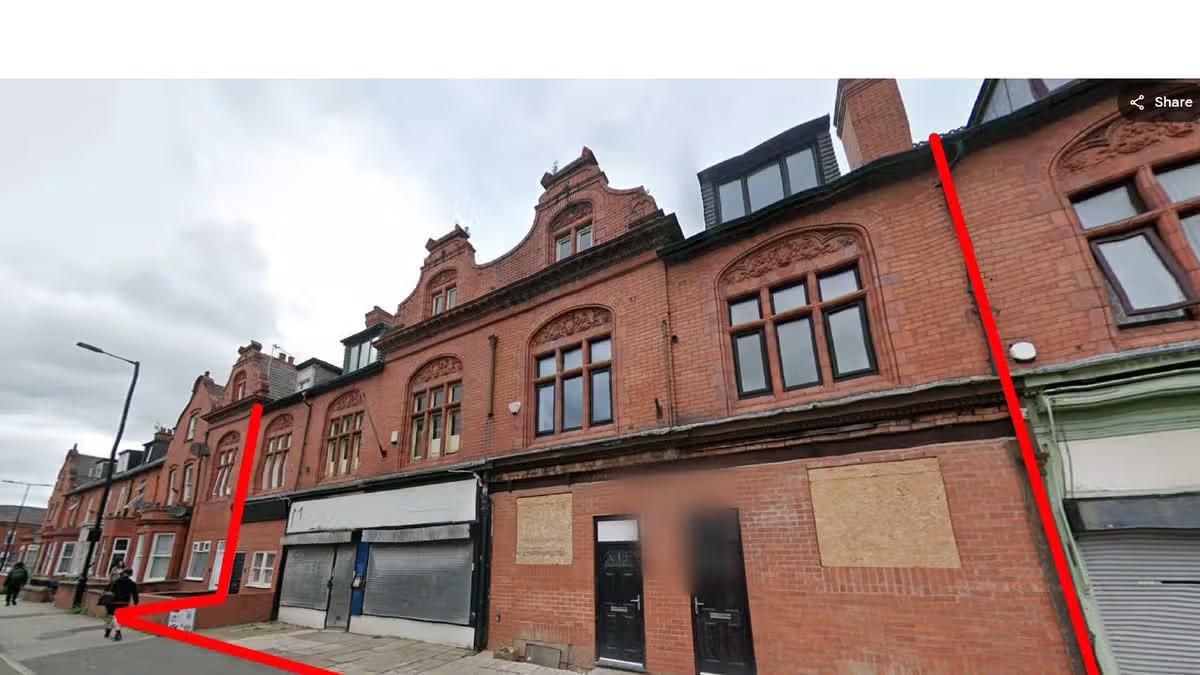
Plans for a ‘flexible’ HMO and hotel for up to 48 people have been submitted for three adjacent buildings in Leigh town centre.

Advertisement

The application for buildings on Railway Road seeks approval to convert the properties into a mixed hotel and HMO building with 39 bedrooms with a capacity for 48 people.

The applicant, Oldham based Spencer Reid Ltd, said the ‘mixed use’ element of the application would allow hotel stays for tourists and business visitors ‘in the usual manner’.

Click here to get the biggest stories straight to your inbox in our Daily Newsletter

A design and access statement in support of the plans said: “Permission is sought for all rooms to be approved for hotel use and HMO use.

Advertisement

“The initial intention is for approximately half of the rooms to be for hotel use and half for HMO Use, allocating an entire floor level for a particular use.

“The flexibility of all rooms being approved for both uses allows for the building to respond and adapt to market demands.

“This planning application type follows a template of other successful planning approvals the developer has secured elsewhere in the country.”

The statement addressed potential concerns about whether migrants or asylum seekers would occupy the HMO and hotel.

Advertisement

It said: “Nationally, some hotel and HMO properties are being used to house migrant or asylum applicants.

“This has recently become the focus of some public concern.

“There are no plans, proposals, or intention by the owners for such occupation at this site.”

The application said that contained within the application were three current properties.

Advertisement

44-46 Railway Road has already been converted into self contained studio apartments.

48-50 Railway Road is a former electrical shop that has stood vacant for sometime and 52 Railway road is in use as an existing HMO.

The statement added: “It is proposed to combine the three properties to create a large HMO with flexible hotel use.

“The location is ideal for this use, with Railway Road being a busy and vibrant town centre site.”

Advertisement

The plans seek to improve the front of the building, which is described as ‘unsightly, due to the various properties being altered at different times’.

The plans do not contain any dedicated parking spaces for occupants.

The design and access statement said: “Historically the property has been without off-street parking.

“These arrangements are considered acceptable for the proposed development.

Advertisement

“Indeed, the site lies at a sustainable location within the centre of Leigh and with access to public transport.

“Moreover, on-street parking is available nearby and there are public cark parks within walking distance.”

Leigh MP Jo Platt said she intends to submit a formal objection to the proposal.

She said: “While I support the regeneration of vacant buildings and mixed-use development in principle, I do not believe a 39-bedroom HMO with a stated maximum occupancy of 48 people represents the most appropriate form of development for this site.

Advertisement

“In my view, a scheme centred on self-contained accommodation would better meet local housing needs and support a balanced and sustainable community.”

Planners in Wigan will deliberate on the plans in the coming weeks.

Source link

Advertisement
Continue Reading

NewsBeat

Long-lost doomed Royal Navy warship HMS Tiger discovered by divers after sinking off UK coast

Published

on

Daily Mirror

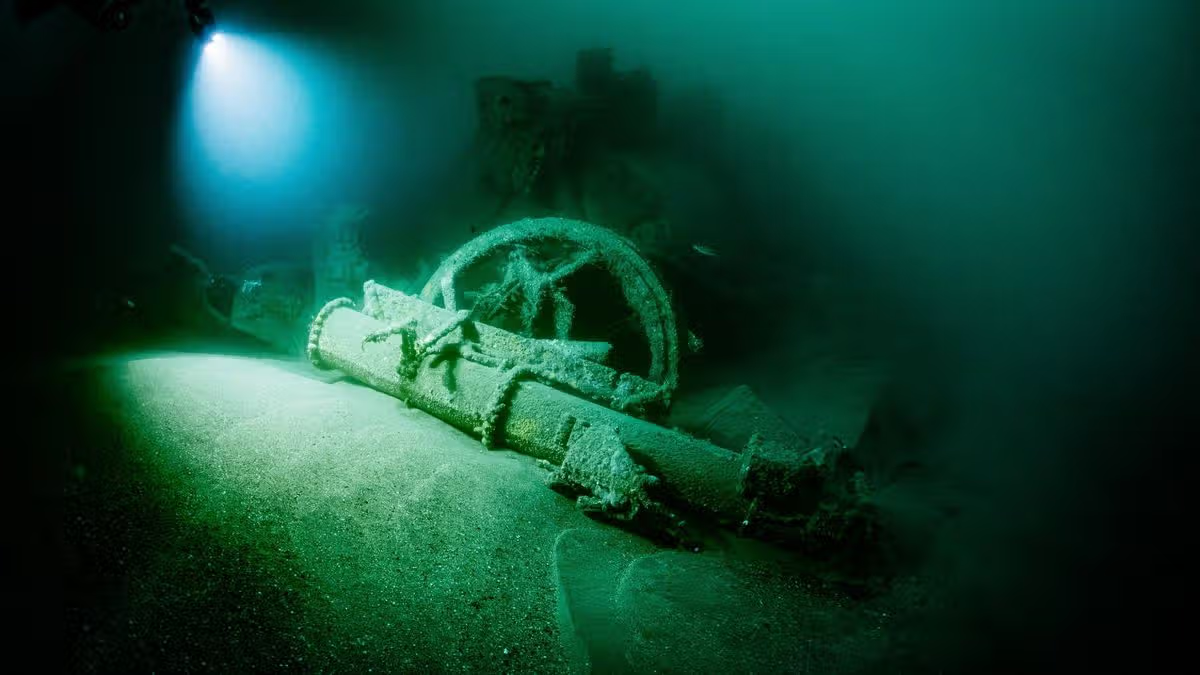
The wreck of HMS Tiger, a Royal Navy warship sunk off the Isle of Wight 118 years ago, has been discovered by divers – and the Government is changing the law to protect it

The wreck of a Royal Navy warship that sank off the Isle of Wight 118 years ago has been uncovered by a team of divers.

Advertisement

HMS Tiger was sliced in two after she crossed into the path of the 10,000-ton cruiser HMS Berwick in 1908. Fewer than half of the 400-tonne destroyer’s 57-strong crew survived as she went down.

The vessel had been considered lost at sea until today – when the discovery was announced by the ProjectXplore dive group. The find comes as the Government moves to overhaul legislation to bolster protections for shipwrecks through the Armed Forces Bill.

The graves of thousands of sailors and marines at sea will receive automatic legal protection through expanded powers.

Advertisement

Under the Armed Forces Bill, potentially thousands of shipwrecks, such as HMS Tiger, will be safeguarded from the moment they are located by a ‘protected place’ designation.

This will make it a criminal offence to disturb or remove items from military wreck sites without permission, while still permitting divers to visit freely, provided they abide by the principle of ‘look but don’t touch’.

Minister for the Armed Forces Louise Sandher-Jones MP said: “As well as protecting UK national security, Defence has a role to play in preserving our maritime heritage and the memory of those who gave their lives serving their country.

“These protections go further to ensure that these vulnerable and nationally significant monuments are protected from day one of discovery, giving lost sailors the dignity and respect they deserve.

Advertisement

“This Armed Forces Bill is wide-ranging in the measures it proposes – from protecting our rich cultural heritage, to transforming the lives of military families by upgrading and improving the Defence housing estate.”

While dozens of military shipwrecks have been shielded from unlawful activity since the mid-1980s under the Protection of Military Remains Act, only vessels lost within the last 200 years are currently eligible for protection.

Advertisement

Extending the Act to cover wrecks more than 200 years old would mean that military vessels dating as far back as the Armada, including those of former enemies, would qualify for protection. The same would apply to merchant ships sunk while carrying out military service under Admiralty orders.

The proposed legislation has been warmly received by ProjectXplore, the team of divers and historians who uncovered the shattered wreck of HMS Tiger.

The team, who also located the wreck of cruiser HMS Nottingham in the North Sea last year, spent five years scouring the archives to piece together all the relevant data to help identify the wreck’s precise location.

Leo Fielding and Dan McMullen, co-organisers of ProjectXplore said: “It has been the privilege of a lifetime to research, discover and document the wreck of HMS Tiger. We sincerely hope that our work will ensure that HMS Tiger, her story and the memory of those connected with her endure for future generations.

“ProjectXplore welcomes the proposed amendments in the Armed Forces Bill. We believe they represent a constructive step forward in protecting the United Kingdom’s maritime heritage and ensuring that wreck sites of historical and archaeological significance are appropriately safeguarded.”

Royal Navy Deputy Fleet Wreck Officer Lieutenant Commander Jen Smith said: “Protecting military wrecks helps to ensure they are preserved for future generations. This is beneficial for our rich maritime heritage and the diving community who keep the stories of our lost shipwrecks alive.

“Divers are still able to visit these sites and witness history first-hand, which is key to ensuring that these ships and their crews are not forgotten.

Advertisement

“All we ask of divers is this – enjoy looking, learning and paying your respects at these incredible sites, but do so in a manner that does not disturb them.”

Source link

Continue Reading

Trending

Copyright © 2025