North Korean government snoops are operating LLMs locally and collecting technology to weave AI into their attack operations, according to South Korean security firm Genians.
The researchers said they observed Kimsuky setting up and operating local LLM environments using Ollama, GPT4All, and Msty, experimenting with other AI tools such as Cursor, and using retrieval-augmented generation (RAG) for local document searches. This prevents the data from getting sucked into the cloud where enemies might see it and try to stop it.
Kimsuky, a cyber-espionage crew that operates under North Korea’s Reconnaissance General Bureau, has for years used phishing and decoy documents in attacks targeting government agencies, think tanks, academia and security research organizations.
Genians’ findings “provide concrete evidence that the Kimsuky-affiliated threat actor is moving beyond one-off experimentation with AI and is continuously preparing to integrate the technology into actual attack capabilities, including malware development, data analysis, and the advancement of attack techniques,” the researchers said in a Monday report.
Advertisement
The North Korean group’s recent phishing emails use ZIP archives containing malicious LNK files – Kimsuky typically disguises these as materials related to international events, research reports, or meeting requests. When the recipient opens the archive and executes the LNK file contained within it, the shortcut runs an embedded PowerShell loader.
In some cases, the goon squad used AI to create lures related to virtual assets and finance, we’re told. These decoy documents “use natural language, a highly polished structure, and formats similar to actual business materials to increase user trust and induce the execution of malicious files,” the security analysts noted.
Additionally, the Pyongyang spies use various obfuscation techniques, including Base64 encoding, string splitting, and custom decoding routines, to hide the files’ malicious behavior.
The PowerShell script collects a ton of system information, including operating system version and architecture, system configuration, PC type, operating system installation and boot history, and a list of running processes. The attackers use this information to assess the infected environment and support follow-on attacks.
Advertisement
As with earlier Kimsuky campaigns, these intrusions use Git repositories for command-and-control (C2) infrastructure.
“During the analysis, Genians Security Center identified multiple public GitHub repositories operated by the threat actor,” the researchers wrote. “One repository contained not only configuration files and PowerShell scripts, but also various payloads used in subsequent attacks.”
Additionally, the months-long investigation uncovered the spies also using the Git-based C2 infrastructure for malware development and testing, stolen data management, and AI technology research.
This included setting up multiple local LLM environments using Ollama, GPT4All, and Msty on infrastructure it controlled. “Because the local approach prevents conversation data from being transmitted to external AI services, it reduces the risk of external exposure, making it a particularly attractive option for a state-sponsored threat actor,” Genians said.
Advertisement
The miscreants also collected a “large number” of libraries, such as LLaMaSharp and Microsoft.Extensions.AI, plus packages including OpenAI and Azure.AI.OpenAI, which call and integrate commercial AI services into their own custom applications.
“The fact that development components spanning ‘local AI execution → document retrieval (RAG) → automated agents → external AI integration’ were collected together strongly suggests that they were not gathered out of simple curiosity, but for the direct development of an AI-based tool designed for a specific purpose,” according to the threat hunters.
Genians uncovered logs containing speech-to-text tools, such as OpenAI’s Whisper speech recognition models, and evidence that the spies used Cursor AI to edit code and tested RAG for document-based question answering. Using RAG on stolen files can help attackers more quickly and automatically identify valuable information within large volumes of data.
While the researchers noted that they did not identify any evidence that the Norks have begun training their own models – but rather remain focused on applying AI to malware development and attack operations – the findings make a strong case for defenders needing to shift away from content-based assessment to behavior-based detection.
Advertisement
Assessing threats based on the quality of fake documents, such as unnatural translated language, poor formatting, and spelling errors, is no longer effective because AI is really good at producing convincing decoys.
In addition to using indicators of compromise (IoC) to detect attackers in their environments, organizations should look for anomalous behaviors following LNK execution – such as PowerShell execution, persistence establishment, and external communications – to hunt for threats.®
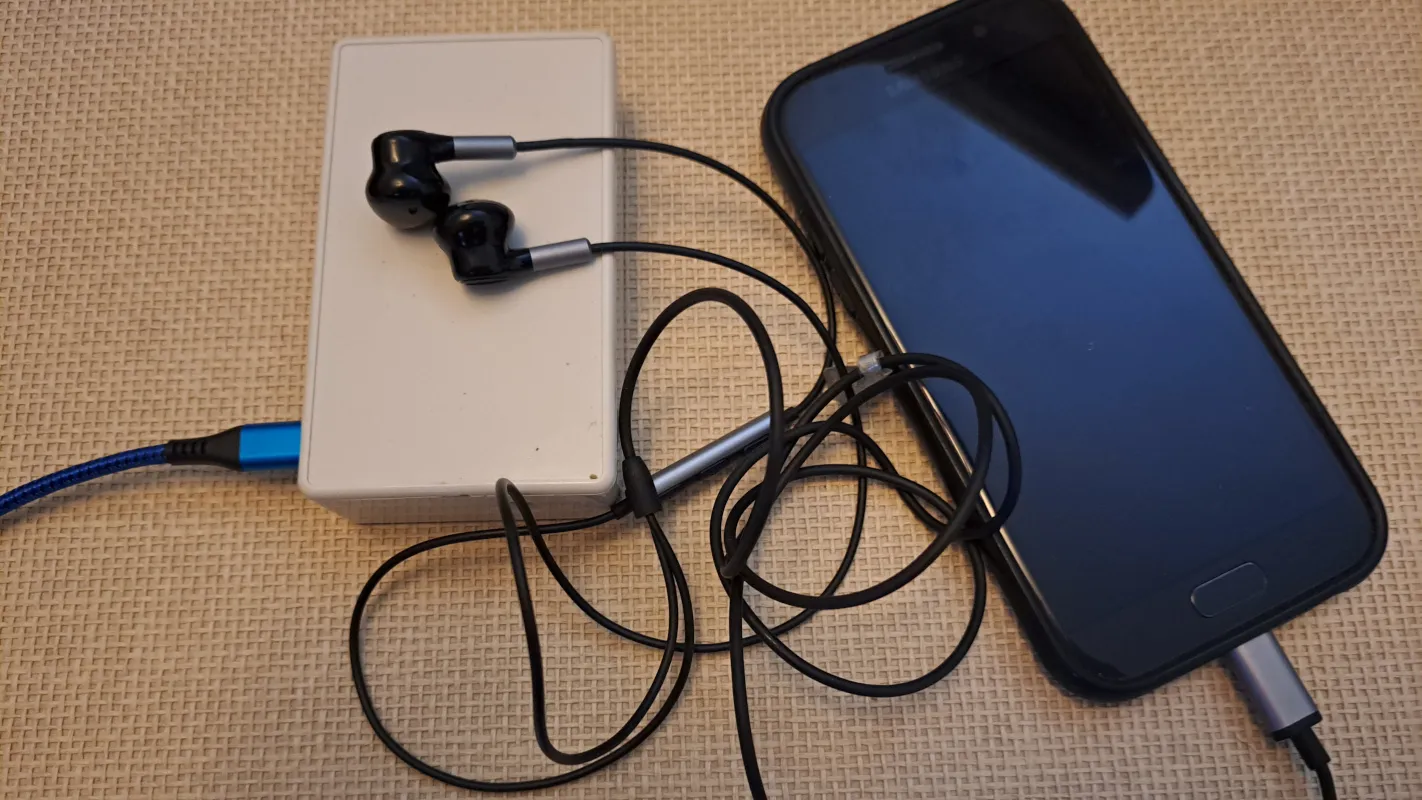
For as capable as smartphone hardware is, the software running on them can be especially restrictive and cumbersome. Unlike a single-board computer with GPIO running a standard Linux operating system and some intuitive programming language like Python, smartphones are generally walled gardens where programming major overhead, and if a custom program can be run on them at all the user still has to figure out how to interface hardware with a USB-C port. To skip past all of this, [nicolas.ma] built an audio modem that can send keyboard input to a computer with nothing more than a browser.
The “keyboard” starts off in a browser running on a standard smartphone. A user can input text into the browser, which then gets converted into a series of audible audio pulses that can be sent to the keyboard. The keyboard itself listens to those pulses, decodes them, and then sends the text through to the computer as a standard USB device thanks to an Arduino Micro at the center. Arduino Micros are excellent choices for keyboard controllers because they have a built-in USB chip.
The protocol used here is designed and built by [nicolas.ma] as well. The words allow for variable length, with the device determining message length, and a word-ending scheme that automatically sends the message to memory when it’s detected that the message is finished. There’s also integrity checking and the ability to check on the link’s state. From hardware to software it’s an impressive build, and for anyone wondering what this might be used for [nicolas.ma] has already built a password manager from it.
Three years to the day after settling a bruising legal fight over trade secrets, Archer Aviation is buying the company that once sued it. On Monday, Archer and Boeing announced definitive agreements under which Archer will acquire Wisk Aero along with two other Boeing subsidiaries, SkyGrid and Insitu. In return, Boeing will receive a substantial equity stake in Archer, warrants for more shares later, a board seat, and continued access to key autonomy technology.
Archer, a California-based air taxi startup still struggling to thrive in commercial air taxi journeys, has accepted to the complete package of Boeing’s advanced autonomy and unmanned aircraft ventures. Wisk has spent several years building fully autonomous electric vertical takeoff and landing aircraft. He has successfully designed, constructed, and flown six successive versions of these machines, conducting more than 1700 flight tests. In December 2025, their most recent full-scale prototype, Generation 6, was able to take to the air. In order to keep autonomous aircraft safely in sync with both traditional crewed aircraft and each other, SkyGrid is developing digital air traffic management software. Building and maintaining military drones, which are used for intelligence, surveillance, and reconnaissance, is the main focus of Insitu’s business. These drones have flown over 3500 aircraft, operate in 35 countries, and generate over $200 million in revenue annually.
Due to platform compatibility issue, the DJI Fly app has been removed from Google Play. DJI Neo must be activated in the DJI Fly App, to ensure a…
Lightweight and Regulation Friendly – At just 135g, this drone with camera for adults 4K may be even lighter than your phone and does not require FAA…
Palm Takeoff & Landing, Go Controller-Free [1] – Neo takes off from your hand with just a push of a button. The safe and easy operation of this drone…
Boeing will receive newly issued Archer Class A shares equal to 19.75 percent of the shares outstanding immediately before the deal closes. That translates to roughly a 16.5 percent ownership stake once the new shares are issued, as well as two warrants that will provide them an additional $100 million when they come to utilize them (at $13 & $17.88 per share). The arrangement of this purchase is rather simple and all-stock. Boeing has the authority to designate one of their own directors to serve on the board of Archer as long as they maintain their ownership of the company. Finally, a tech-sharing agreement between the two businesses allows Boeing to continue utilizing Wisk’s fundamental autonomous flight capabilities in their own commercial and defense initiatives.
Advertisement
It is all set to close by the end of 2026, if they receive regulatory approval, which will include an antitrust investigation. May 2027 is one of the dates they will need to work toward. For Archer, the impact of getting their hands on Insitu comes very soon. They’ve been struggling to make any kind of revenue from their air taxi work so far, so this brings them a lot more cashflow from the defense business, as well as customers and operational scale, all while the passenger carrying electric aircraft work takes a little longer to get certified and off the ground. The technology they receive from Wisk and SkyGrid will be directly integrated into Archer’s own plans, as they have been working on something called the ZEE AI foundation model for some of the most complex aero and defense applications. They hope to kick things off in the self-flying air taxis and autonomous systems space by combining the flight time of acquired teams (almost two million hours) with the work they already have going on. [Source]
Amazon, on the other hand, is fighting the measure to stop use of contractors for last-mile delivery.
Spencer Platt/Getty Images
New York City Mayor Zohran Mamdani is throwing his office’s support behind a measure to change last-mile delivery practices. The Delivery Protection Act was introduced several months ago in the major metropolis’ City Council. Many companies that do high-volume deliveries, most notably Amazon, rely on contractors rather than employees to take packages on the final legs of their journeys to customers. The proposed legislation would create new licensing rules for those last-mile operations as well as requiring the delivery workers to be regular hires rather than contractors.
In a video statement released today announcing his backing for the bill, Mamdani spoke to how Amazon controls many of the details around when and how deliveries are made in the metropolis, but avoids responsibility for any incidents that might occur on the job because the delivery drivers and couriers are contractors. “If Amazon is delivering your packages, they should follow the same rules of every other delivery company,” Mamdani said.
Supporters of the bill, including the International Brotherhood of Teamsters, argue that this helps hold the large companies responsible for the delivery experience and would offer better pay and benefits to the professionals making those deliveries. Opponents, which unsurprisingly include Amazon, say the bill would lead to increased costs and slower deliveries for customers. It could see those companies with massive delivery operations move their distribution centers out of New York City to avoid the added regulation.
Every day seems to brings fresh news of an AI agent going “rogue.” Whether that’s compromising Hugging Face, hacking a gym website, or creating its own fake profiles to socially engineer an intrusion, AI models are increasingly behaving like bad actors.
So, the AI labs that make the models doing the hacking are expanding their cyber protection offerings. This week, OpenAI announced an expansion of Daybreak, its cyber defense service which it launched earlier this year, not long after Anthropic released its cyber-focused model Mythos.
Daybreak is a service that bundles access to models, tools and workflows for defenders. The expansion includes access to a brand new cyber-focused model designed for defensive work.
OpenAI said Monday that Daybreak would now consist of two tiers: Blue and Red. Both of these tiers will allow approved customers access to OpenAI’s limited-access frontier cyber models. Frontier models — the most advanced available — have been a subject of controversy. The Trump administration previously sought to collaborate with AI companies on the roll out of such models, purportedly over safety concerns. Previously, OpenAI deployed significant guardrails to using these models, limiting what customers could do with them.
Advertisement
Blue, which appears to be the more basic of the two, offers a variety of cyber services, including incident response, malware analysis, and patch validation. OpenAI calls Blue its “recommended starting point for most defenders,” implying that it should be more than enough for most enterprises.
Red, on the other hand, offers a broader and potentially more dangerous toolkit. The company grants its users “purpose-trained cybersecurity models,” designed to carry out security testing and vulnerability research.
With Red also comes the new model, GPT‑5.6‑Cyber, which is only available at that tier. 5.6-Cyber is built off of GPT‑5.6 Sol, and offers enhanced capabilities for certain specialized cybersecurity tasks, the company said.
At the moment, GPT‑5.6‑Cyber is only being made available for “trusted customer partners,” including reportedly Accenture, IBM, Crowdstrike, Cloudflare, and others.
Advertisement
While the threats from AI agents are rapidly increasing, critics have also pointed out that they function as marketing opportunities for the AI labs. OpenAI is certainly marketing its upgraded Daybreak that way.
“The cybersecurity world is rapidly changing—threat actors will increasingly use AI to conduct cyberattacks at unprecedented speed and scale, including in fully autonomous ways,” the company said in a blog post. “As these capabilities spread, defenders have a narrowing window to prepare.”
At the same time, enterprises remain interested in buying their protection from the AI labs who know the security risks best, because they know them first-hand.
When you purchase through links in our articles, we may earn a small commission. This doesn’t affect our editorial independence.
The iPhone is a surprisingly capable meteor-hunting camera, but it’s definitely not a point-and-shoot sort of situation. Here’s how to take excellent photos of the Perseids, satellites, and more.
Image credit: Florian Seiffert / @ popipaan on X
It’s August, which means those in the northern hemisphere are being treated to the annual Perseids meteor shower. If you’ve got an iPhone, you’re pretty much ready to go take some stunning astrophotography shots yourself. Of course, it’s not as simple as heading outside and pointing your iPhone at the sky, but you probably already knew that. Fortunately, we’re here to help. Continue Reading on AppleInsider | Discuss on our Forums
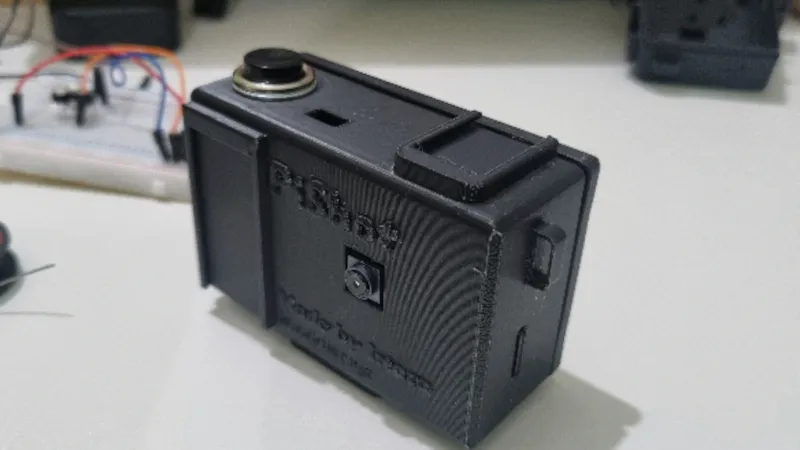
The formula for a Raspberry Pi camera is by now a straightforward one: take a Pi and camera module, add a display, buttons, and battery, and you’re done. This doesn’t mean that there’s no scope for more though, and [Irtaza2009] has one in the PiShot. It’s a few months old now but the repository is still being updated.
The 3D printed case follows a compact camera form factor with the screen on the rear, and a cold shoe on top. Inside is a Pi Zero 2 W and a Camera Module 3, with an 18650 cell and battery management/power supply board. The buttons are tactile switches hooked up to GPIOs, and the screen is an ST7789 SPI display.
For software there’s a Python script, which should do the job. We’ve not tested this one, but our experience is that slowness is the Achilles’ heel of Python based Pi cameras. We hope this one has managed to eke out some performance.
We may receive a commission on purchases made from links.
Ryobi has a well-earned reputation as one of the more budget-friendly major cordless power tool brands. Its products don’t always top the charts for outright performance, but they generally offer an extremely competitive price-to-performance ratio. Much of the company’s business philosophy seems to revolve around offering a massive range of premium, often battery-powered, products that are more affordable than competitors such as Makita, Milwaukee, and DeWalt. While these tools are pretty affordable at their full sticker price, you can often find them for even cheaper thanks to sales.
Advertisement
Home Depot, with which Ryobi has an exclusive partnership, runs frequent promotions on the company’s products, with discounts ranging from a few bucks to over 50%. These deals change all the time, however. Some of the Ryobi tools available for deep discounts in July might still be on sale, but you can also find plenty of fresh sales going on right now. If you’re interested in expanding your Ryobi tool collection, or are just after a great bargain, then it’s definitely worth taking a look at some of the most heavily discounted Ryobi tools in August 2026.
Advertisement
Ryobi One+ 18V HP Brushless 4-Mode 12-inch High Torque Impact Wrench Kit
There are few power tools more valuable to a mechanic than a good impact wrench, especially a cordless one that allows you to ditch the air compressor. Right now, you can get a great deal on the Ryobi One+ 18V HP Brushless 4-Mode 12-inch High Torque Impact Wrench Kit. This usually retails for $269.00, but it’s currently 41% off at just $159.00.
The wrench itself is part of Ryobi’s One+ HP product line, so it has a brushless motor that makes more power and lasts longer than brushed units. The tool generates up to 1,170 lb-ft of breakaway torque and allegedly removes fasteners seven times faster than previous iterations. It has four modes, with low, medium, and high settings, plus an Auto Mode that detects resistance and prevents overtightening when driving forward and controls removal when in reverse. The tool also has a die-cast gear case, a tri-beam LED work light, and a ½-inch anvil with a friction ring. On top of the tool itself, the kit also comes with a Ryobi One+ 18V HP 4.0Ah battery and a charger, adding significant value to the kit.
This professional-grade tool from Ryobi is also one of the company’s more highly rated products. It has a weighted score of 4.8 out of 5 on Home Depot with over 2,500 ratings and is recommended by 97% of previous buyers. Customers have stated that it’s powerful, reliable, easy to use, and that its adjustable torque settings make it handy for a range of applications.
Advertisement
Ryoibi One+ 18V Cordless 4-inch Clamp Fan
A good fan might not be the first power tool that you think of when you’re looking to expand your collection, but they’re always useful for drying finishes, ventilating spaces, or just helping you keep cool while you work. One option worth considering in August is the Ryobi One+ 18V Cordless 4-inch Clamp Fan. This would typically cost $29.97, but Home Depot currently has it marked down by 33%, so you can get it for $19.97 instead.
This lightweight and compact fan features a clamp with enough clearance for surfaces up to 1-½-inches thick. Being small doesn’t necessarily mean that it isn’t mighty, though. The fan has two speed settings and can generate over 180 cfm of air on High with a promised 40 hours of runtime on a single 6.0Ah battery. It also has a multi-directional rotating head so you can angle it wherever you need it once it’s clamped.
Advertisement
Ryobi’s clamp fan might not seem like a big deal, but it’s been extremely well received by users all the same. The fan has 4.8 out of 5 on the Home Depot site aggregate from over 5,300 ratings, and boasts an impressive 97% recommendation rate. Owners claim that it’s great for camping, workshops, sporting events, or even just for use around the house. They particularly appreciate the long battery life and the versatility of the clamp, though some have noted that it can be a bit noisy.
Advertisement
Ryobi One 18V Multi-Surface Handheld Vacuum Kit
A large shop vacuum is an essential tool for just about anyone, but a small, portable handheld vacuum is useful to have around too. They’re great for cleaning up small, localized messes without having to lug a heavy piece of equipment around. Ryobi has a One 18V Multi-Surface Handheld Vacuum Kit that’s perfect for these situations and comes with all the accessories you might need. It would usually run you $121.97, but it’s currently selling for $84.94 at Home Depot, which is 30% off.
The hand vac itself has a dual standard and HEPA filter system for protecting the motor from both heavy and fine particles and has a dust cup that pops off easily for waste disposal when you’re done. Best of all, the tool has a universal nozzle that accepts 1-¼-inch accessories and is compatible with a wide range of attachments. The kit comes with a crevice tool, floor nozzle, dust brush, and a flexible extension hose. It also includes a Ryobi One+ 18V 2.0Ah battery and a charger, giving you everything you need to get started right in the box.
The kit has a 4.5 out of 5 rating from over 1,600 customers, with 94% stating that they would recommend it. Most are impressed by the lightweight maneuverability, the range of accessories, and the overall performance. There are a few scattered complaints about defective models or packages that didn’t include all of the accessories, but no consistent issues that would be cause for alarm.
Advertisement
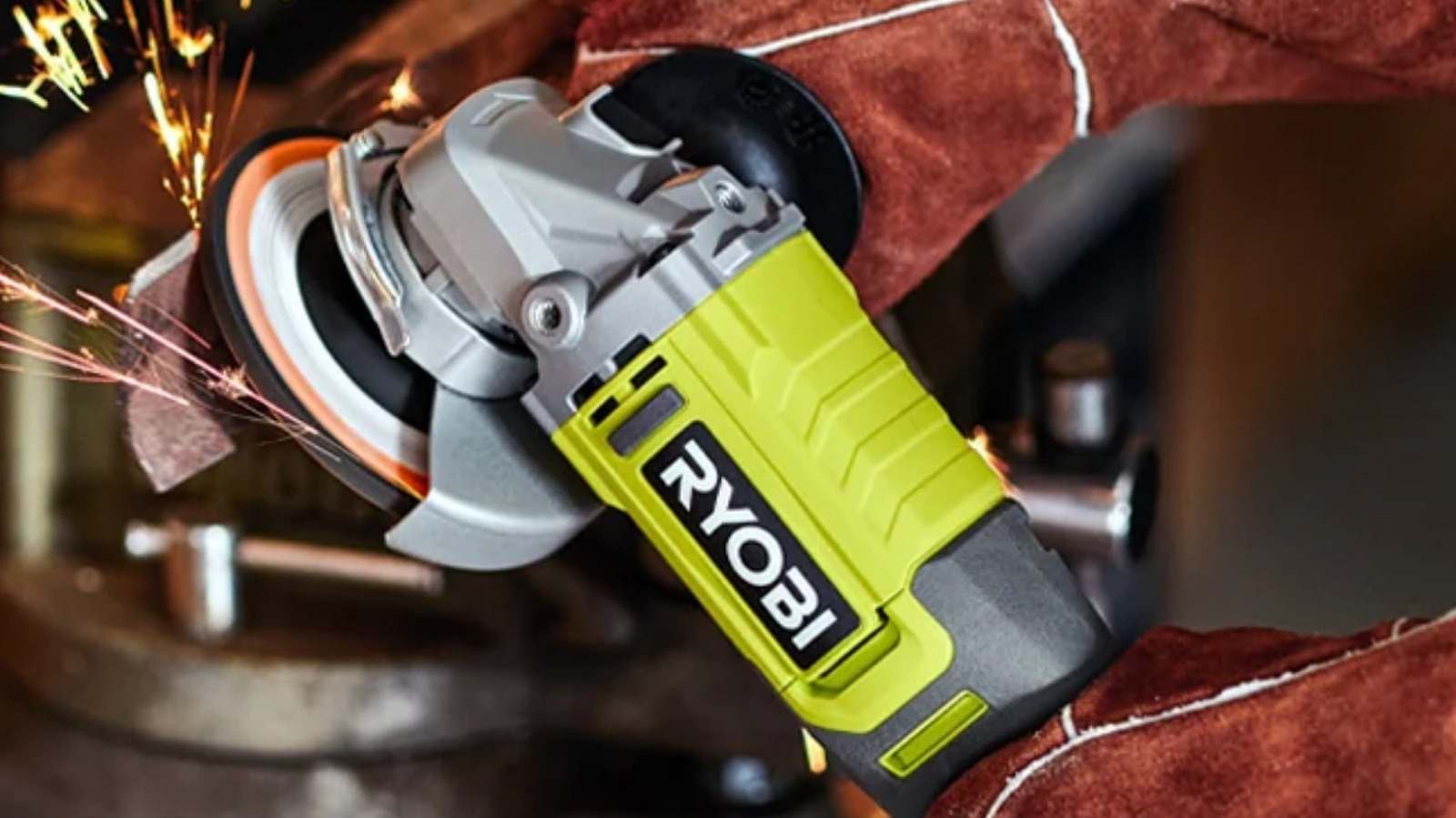
Ryobi One+ 18V HP Brushless 4 ½-inch Angle Grinder Kit
This is another Ryobi One+ HP tool with a brushless motor, which the company claims allows it to perform on par with an 11-amp corded angle grinder and make up to 210 cuts on a single charge. It has a specialized heat management system, an upgraded foot angle, and a tool-free guard adjustment system that allows you to easily swap out wheels on the fly. You also get a three-position side handle and a paddle switch as well. On top of the tool, the kit comes with a Ryobi One+ 18V HP 4.0Ah battery as part of the deal, which would cost $89 on its own.
Advertisement
This kit has a 4.5 out of 5 rating on the Home Depot page from 750 ratings and a 91% recommendation rate from previous buyers. Customers generally appreciate the power and versatility of this Ryobi angle grinder, with its lightweight design and ease of use being particular highlights. A few have claimed that the tool goes through batteries fairly quickly, but the overall consensus seems to be that cutting and grinding performance are both excellent.
We spend hours testing every product or service we review, so you can be sure you’re buying the best. Find out more about how we test.
KitchenAid KF2 two-minute review
The KitchenAid KF2 Fully Automatic Espresso Machine is the entry-level model in the company’s six-strong range of automatic coffee machines, and was launched in mid-2026 alongside the KF3 and KF4.
It adopts the exact same slim build as its two siblings, making any of them ideal for smaller kitchens. It also benefits from the exact same Intelligrind coffee bean grinder, which automatically determines the best grind size depending on the beans you’ve put in. The brewing unit is the same also, and in my taste tests, I couldn’t notice any obvious difference between the three. That means you’re going to get a wonderful, tasty espresso with each use.
Advertisement
What sets the KF2 apart — and where KitchenAid has made cuts to bring the cost down — is its feature set regarding drink presets and general usability. It’s also the only model in KitchenAid’s entire fully automatic coffee machine range to rock a steam wand for foaming milk — the others all use a hose-based system. While this may seem like a drop down in specification, I personally found the steam wand to perform the best when making foamy lattes and cappuccinos. What’s more, a steam wand is inherently going to perform better with non-dairy milk as it allows for greater control over temperature.
Latest Videos FromTechRadar
As with the KF3 and KF4, the KitchenAid KF2 is capable of making iced-coffee drinks, although as I found in my KitchenAid KF3 review, the results are a little underwhelming. This is because the brewed espresso is hot enough to quickly melt the ice in your cup or glass, despite KitchenAid claiming it’s brewed at a lower temperature.
Advertisement
Where the KitchenAid KF2 loses points slightly is the fact it doesn’t offer user profiles. I’ve been used to having profiles for some time at home, as I currently use the KitchenAid KF4 and have previously used the Philips LatteGo 4400, which offer four profiles and two profiles, respectively. Having them makes brewing a coffee incredibly quick and simple: just select a profile, select a drink and that’s it.
The fact the KF2 doesn’t have profiles means that brewing a variety of coffees will take longer, as you’ll have to select the drink and adjust any settings each time. It therefore might not be the best option for larger households, but for households of one or two people it’s still worthy of consideration.
The other slight niggle I have, which affects the KF3 and KF4 also, is that the unit can go through water relatively quickly due to it running a rinse cycle on start up and shutdown. The shutdown cycle I can understand, but I find the start-up cycle to be a little redundant.
Sign up for breaking news, reviews, opinion, top tech deals, and more.
Advertisement
All things considered, the KitchenAid KF2 Fully Automatic Espresso Machine is another fantastic option from the brand. It brews a well-extracted espresso each and every time and the steam wand works wonders for milk-based drinks.
KitchenAid KF2 review: Price & availability
Launched in UK and US April 2026, Australia in July 2026
List price $799.99 / £699 / AU$1,099
The KitchenAid KF2 Fully Automatic Espresso Machine launched in the US and UK in April 2026, before making its way to Australia in July 2026. It has a list price of $799.99 / £699 / AU$1,099, making it the company’s most affordable fully automatic machine.
The step-up KF3 adds a small color display to improve navigation and usability, four customizable profiles and a larger menu of drink presets, with a list price $999.99 / £749 / AU$1,349.
The top-tier model, the KF4 ($1,299.99 / £899 / AU$1,599) offers much of the same functionality as the KF2 with regard to grinder and brewing unit. It gains even more recipes, a large color touchscreen and KitchenAid’s hose-based milk-foaming system, complete with milk carafe.
Advertisement
I’m of the opinion that the KF2’s steam wand is the best option for expertly-frothed milk and for using with non-dairy milk varieties, instantly giving the machine a leg up over its siblings. And, since the actual coffee-brewing process is the same across all three machines, the KF2 represents excellent value.
That being said, the Ninja Luxe Cafe Premier offers more in the way of features, including a dedicated cold brew setting and cold-extraction for improved iced-coffee results, along with intelligent grind and dosage settings. Its list price is less than the KF2’s at $599.99 / £549.99 / AU$799.99, although it too doesn’t offer user profiles either and requires more hands-on input.
KitchenAid KF2 review: Specifications
Swipe to scroll horizontally
Name
Advertisement
KitchenAid KF2 Fully Automatic Espresso Machine
Type
Bean-to-cup
Dimensions (H x W x D)
Advertisement
14.2 x 7.7 x 18.5 inches / 361 x 196 x 470mm
Weight
19.8lbs / 9kg
Water reservoir capacity
Advertisement
1.9 quarts / 1.8 liters
Milk frother
Yes, Pannarello steam wand
Bars of pressure
Advertisement
15
Noise level
72dB grinding, 60dB brewing
User profiles
Advertisement
0
KitchenAid KF2 review: Design
Compact size will suit smaller space
Steam wand suits plant-based milks
No dishwasher-safe components
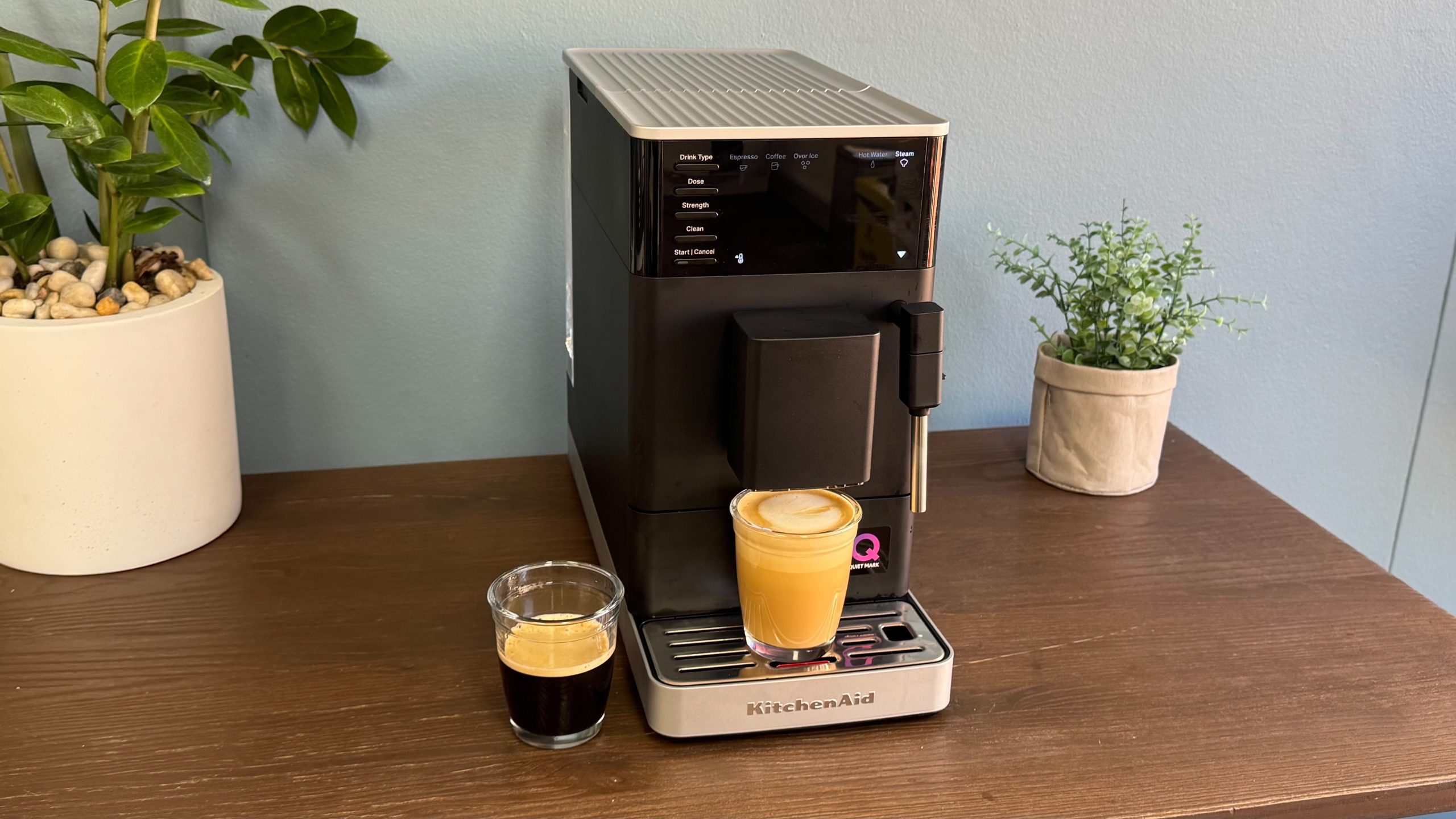
(Image credit: Future)
Of the three new compact automatic models, the KitchenAid KF2 sticks out the most for a couple of reasons. Firstly, it’s only available in a matte black finish (the KF3 and KF4 also come in Porcelain White, which I’m personally a fan of), and secondly there’s no color display.
The matte black finish is still sleek and smart-looking, it must be said, although there is a shiny, fingerprint-loving panel on the front at the top. You’ll want to keep a cloth nearby to keep it looking its best.
Advertisement
I don’t consider the lack of a color display to be a huge negative against the KF2, as the backlit panel is bright and clear when selecting a drink and adjusting settings. The color screens on the rest of KitchenAid’s espresso machine range do offer useful assistance with features like images of the drink you want to make, but it’s not something I missed when testing the KF2.
Physically the KitchenAid KF2 is the same as the other two compact models released in 2026, measuring 14.2 x 7.7 x 18.5 inches / 361 x 196 x 470mm (H x W x D). This compact form makes it easy to place the unit on a kitchen counter, and should be especially ideal for those with smaller kitchens. A couple of built-in wheels on the bottom at rear of the machine aid with manoeuvring into position.
Interacting with the KF2 is done via five buttons on the front panel. These select the drink type, dosage and strength — each of which can be pressed multiple times to cycle through options — one to activate cleaning cycles and a final button to initiate and cancel brewing. Each button press reveals a different backlit symbol on the front panel which are relatively self-explanatory.
Drink type cycles between espresso, coffee and over ice, dose lets you choose between one or two servings (either two cups under the dispenser or one for a double serving), and strength is a scale of one to three. This refers to how much coffee is ground into the brewing unit, from 7g (setting one) to 14g (setting three).
Advertisement
The bean hopper recessed into the top of the KF2 is large enough to hold 250g worth of coffee beans, which is accessed via a removable lid. While this does mean there’s no visual indication as to how many beans are left, it does at least mean the beans are kept airtight and away from light, helping to retain their freshness. There’s also a small chute for pre-ground coffee, and a scoop is included in the box.
The 1.8L water tank slides in and out the rear of the machine and has an integrated handle to make the process simple, although I personally prefer a side-mounted tank like the one found on the Philips LatteGo 4400 as I find it makes refilling that little bit easier. However, the KF2’s tank does at least feature a hinged lid, allowing you to fill it up from a jug if you wish.
Image 1 of 2
(Image credit: Future)
(Image credit: Future)
KitchenAid supplies a water filter with the KF2 that it claims lasts up to two months when used with standard tap water. If you use filtered water, its life can extend to up to six months. The filter can seem to be a little fiddly to install due to the water tank being so tall. Thankfully the included coffee scoop doubles up as a tool that clips onto the filter, giving you the extra length needed to screw it into place.
The drip tray is deep and extends virtually the full depth of the KF2, and has a large spout integrated into its rear for easy emptying. However, as I found with the KF3 and KF4, when you pour water out it can occasionally spill onto the front panel section as it can’t be removed. It’s not a huge dealbreaker, just prepare for a little extra clean up. Used coffee grounds are deposited into a removable bin in the center that can be tipped out when full. An icon will light up on the front panel to let you know when it’s time.
Advertisement
One of the standout features of the KitchenAid KF2, in my opinion, is its Pannarello steam wand used for milk foaming. I was surprised to find one used, not only because KitchenAid uses a proprietary hose-based system in the KF3 and KF4, but also because other brands such as De’Longhi and Philips have also turned their backs on steam wands (in general) in the pursuit of an entirely automatic coffee-making process.
Personally, I appreciate KitchenAid’s choice to include a steam wand here, as it enables you to create genuine milk foam, even when using non-dairy alternatives. In my experience, the hose system on the KitchenAid KF3 and KF4, the LatteGo system on the Philips 4400, and the LatteCrema system on the De’Longhi Magnifica Evo Next all fell short of producing a satisfactory level of milk foam for my taste.
The use of the steam wand does mean there’s some hands-on input required, as you need to hold the jug (which isn’t included in the box) under the steam outlet until the foam reaches your desired level. There’s also no built-in thermometer, so unless you use a third-party thermometer, you’ll have to judge when the milk is ready based on touch.
Whether you are crafting a flat white or a cappuccino, the wand features a small slider for ‘more foam’ or ‘less foam’ to ensure you get the perfect texture. By opening and closing the integrated air intake, this slider regulates the airflow: increasing the intake pumps more air into the milk, which creates a more voluminous and aerated foam. Keeping it closed is ideal for texturizing milk for lattes that don’t require as high a level of foam.
Advertisement
The KF2 features thorough cleaning cycles, including the ability to completely evaporate the internal system of water. There are also programs for descaling and cleaning the brewing unit, which require you to press a variation of buttons to initiate. A complete set of useful instructions is included in the box. Do note that none of the removable parts are dishwasher safe.
KitchenAid KF2 review: Performance
Consistently well-extracted espresso
Steam wand delivers silky, well-foamed milk
Lower brewing temperature for iced drinks still too hot
(Image credit: Future)
Having already reviewed the KF3, and knowing it uses the exact same brewing unit, I was expecting the same excellent results from the KitchenAid KF2. Fortunately my expectations were realised, as the compact KF2 produced a great-tasting espresso with each use.
Much of its success can be attributed to the IntelliGrind system that automatically determines the ideal grind size depending on your chosen beans. You can’t see the grinder at work, nor does the unit tell you what grind setting it’s chosen, you just have to put your trust in it to deliver optimal results. Your trust is rewarded.
Advertisement
However, if you’re not completely satisfied with the crema or taste of your espresso, then the KF2 does offer the ability to manually adjust the grind to a finer or coarser level by way of a lever behind a compartment on the right-hand side of the machine. A finer setting is recommended for light-roast beans, while dark-roast beans benefit from a coarser setting. Since I was using medium-roast beans, I left the slider at the default setting in the middle.
Before you consider adjusting the grind level, you’ll first want to experiment with the strength of either the espresso or coffee drink presets. As mentioned earlier, there are only three coffee-based drink recipe presets: espresso, coffee and over ice. If you move up to the KF3 or KF4 you’ll gain recipes including latte macchiato, flat white and caffe latte, to name a few.
You can also adjust the volume of water used for each drink type, and the temperature it’s brewed at, by pressing and holding a specific set of buttons. You’ll find the full details in the supplied user manual. I was perfectly satisfied with the default settings, but it’s good to know KitchenAid offers the ability to personalize each drink.
Do note that if you do adjust any default settings, they will become the new norm until you change them again. Since there are no user profiles, you may want to consult with other people in your household before you make any tweaks.
Advertisement
Image 1 of 3
(Image credit: Future)
(Image credit: Future)
(Image credit: Future)
If you want milk with your coffee, then the Pannarello steam wand is capable of producing thick, velvety foam that’s perfect for lattes, macchiatos and cappuccinos. It’s semi-automatic in use, as all you need to do is hold a milk pitcher under the wand and press the start button on the main unit (once you’ve cycled the ‘drink type’ menu through to ‘steam’). A word of warning, make sure you already have the steam wand submerged in milk. I pressed start with the pitcher still on the drip tray and ended up with milk all over the counter and myself.
A small slider on the side of the steam wand housing can be used to adjust the level of foam you achieve, either ‘less’ or ‘more’. In my tests this worked a charm, with the ‘more’ setting aerating the milk to such a high level that it nearly overflowed from the pitcher.
I much prefer the use of a steam wand compared to the hose systems used on the KF3 and KF4, as it’s capable of producing a much better level of froth. It’s also a hell of a lot easier to keep clean, as it doesn’t require constant rinse cycles to ensure the hose is free of residue. I actually wish the steam wand was featured on the company’s other machines.
Do note however that there’s no built-in thermometer to automatically detect when milk reaches your desired temperature. You’ll either have to invest in a dedicated one, or go off touch to determine when to shut the steam off. Also note that a milk pitcher isn’t included in the box. You can buy one directly from KitchenAid for $19.99 / AU$29. I wasn’t able to find a listing on the company’s UK store, but in all honesty, the pitcher available is relatively basic, so you could always get one from Amazon for the same or less money.
Advertisement
Where the KitchenAid KF2 falls down slightly — in a similar fashion to the KF3 and KF4 — is with its iced drinks function. KitchenAid has designed the KF2 to brew an espresso shot at a lower temperature compared to a regular shot when you select the ‘over ice’ drink type.
For starters, iced coffee fanatics will likely prefer a genuinely cold shot of coffee as opposed to having to pour a cooler shot of espresso over ice. Admittedly KItchenAid isn’t the only company to employ this function, as the Philips LatteGo machines also ask you to put some ice into a cup or glass before brewing an espresso.
However, I can’t agree with KitchenAid’s claim that the iced coffee espresso shot brews at a lower temperature, as I used a thermometer to check the temperature of a regular shot and iced shot, and both returned a measurements between 45ºC/113ºF and 50ºC/122ºF, which was hot enough to quickly melt the ice I had in my glass. It’s not necessarily a huge dealbreaker, but the fact remains there are other machines such as the De’Longhi Dedica Duo and the Jura J10 that are able to pour proper cold-extracted espresso for longer-lasting iced drinks.
It is, however, pleasing to find the KF2, like other KitchenAid espresso machines, is QuietMark-certified, signifying it should be whisper-quiet when grinding and brewing. And in reality, that’s certainly the case. I was able to record an average of 70dB while the machine was grinding and an average of 60dB when brewing. That, perhaps expectantly, puts it on par with the KF3 and KF4. That being said, we found the flagship KF8 to be quieter still with an average of 44dB during the entire coffee-making process.
Advertisement
(Image credit: Future)
Performance score: 4.5 / 5
Should you buy the KitchenAid KF2?
Swipe to scroll horizontally
KitchenAid KF2 score card
Attribute
Notes
Score
Value
Advertisement
KitchenAid’s most affordable fully auto machine offers the best combination of features in my opinion.
4.5/5
Design
Compact form will suit smaller kitchens, although lack of user profiles can add time to brewing process.
Advertisement
4/5
Performance
Excellent coffee and milk frothing, but iced options are a little disappointing.
4.5/5
Advertisement
Buy it if…
Don’t buy it if…
KitchenAid KF2 review: Also consider
Advertisement
How I tested the KitchenAid KF2
(Image credit: Future)
I used the KitchenAid KF2 over a one-week period. I was confident knowing how to use the machine, having previously reviewed the KF3 and from using the KF4 on a daily basis at home.
I prepared all of the available drink recipes — espresso, coffee and over ice — and used a thermometer to test the temperature of the ‘over ice’ espresso shot to determine if it was actually brewed at a lower temperature, as KitchenAid claims.
I also used the integrated steam wand in both its ‘less foam’ and ‘more foam’ settings to determine if there was indeed a difference in results. I also tested it with dairy milk and a barista-style oat milk to find out if it worked well with non-dairy milk varieties.
When SpaceX filed for its IPO, we went through the S-1 to point out just how far off the mark Elon Musk’s predictions about his Twitter takeover turned out to be. Indeed, the failure of Twitter as a business was so catastrophic, Musk had to hide it by merging all his Xs together: he had xAI buy X (formerly Twitter), and then had SpaceX buy xAI. But when Musk was buying Twitter and needed investors, he made bold promises about how he would succeed — promises the media and his investors treated as perfectly reasonable. He said he would take Twitter’s ad revenue from $4.5 billion in 2021 to $12 billion in 2027 (and then also many more billions in subscription revenue).
Now that SpaceX is a public company, he has to report some of that revenue, though it’s all merged and buried in footnotes. But there’s enough info in there to show that advertising revenue is way, way below what it was when he took over the site. And it’s shrinking.
In the 10-Q, all of X’s revenue is now (misleadingly) labeled “AI” revenue, but even then the reporting has to admit ad revenue took a big hit, dropping $160 million compared to the first half of 2025 (which was already way, way, way lower than when Elon took over the site), going from $870 million in 2025 to $710 million in the first half of 2026. The company tries to claim that this decrease in ad revenue is because they “transitioned to a new advertising platform which impacted ad sales for a short period of time.” Which is a curious explanation, given that on the analyst call, CFO Bret Johnsen credited that very same “overhauled” ad-tech platform for the very slight quarter-over-quarter uptick in ad revenue. The same overhaul apparently both tanked the business and rescued it, depending on which direction the number was moving.
And even the claim that the overhaul increased ad revenue is suspicious given that if you compare the 2nd quarter from last year to this year… ad revenue dropped from $426 million to $367 million, year over year. Some overhaul.
Advertisement
I kinda think that if your transition to a new ad platform decreases ad sales by $160 million, someone fucked up badly somewhere. Especially when it’s a nearly 20% year-over-year drop.
Let’s break all this down: In the second quarter of 2022, the last full quarter before Elon took over, Twitter brought in $1.08 billion in ad revenue. In the second quarter of 2026, X brought in $367 million. That’s $713 million a quarter, gone. Elon has wiped out two-thirds of Twitter’s ad business over the exact period in which he promised investors he’d nearly triple it.
And it’s not for lack of trying. Over the past year X has made a ton of experiments and revamps to improve the experience (though the main person in charge of all that, just left). I’d argue that the company was just rebuilding all of the stuff Elon killed after first taking over the company, but none of it has brought advertisers back.
Still, it seems like someone should be pointing out how far off the mark Elon has been. He promised twelve billion dollars in ad revenue within the next year. That’s three billion a quarter. X just did $367 million — about an eighth of the pace, and shrinking. You can talk all you want about his rockets and robots, he’s not magically going to grow ad revenue 700% in the next 18 months.
OpenAI has bought back $7 billion worth of shares from employees at the privately held frontier AI lab as part of an effort to provide liquidity to its workforce.
The deal, reported by Bloomberg, valued OpenAI at $852 billion, the same as its most recent fundraising round in March, which added $122 billion to the company’s war chest.
The company also filed confidentially with the Securities and Exchange Commission in June to prepare for a potential IPO later this year. However, a tender offer suggests that an IPO may not be forthcoming soon. With many tech companies remaining private longer than previous generations of startups, private tenders have proven a useful way for firms to allow employees to realize the value of their stock compensation without the difficulties that come with a public offering.
OpenAI did not respond to a request for comment by publication time.
Advertisement
Last month, OpenAI CEO Sam Altman wrote that “we did not have our best 12 months ever, which is mostly my fault, but we are about to have our best 12 months to date.” Firms going public typically want to show strong financial results to bring investors on board, and the Wall Street Journal reported in April that the company missed internal financial goals.
While OpenAI’s incredible growth and products are likely to generate massive interest in public markets, the potential debut of rival Anthropic — which was reportedly profitable earlier this year — gives the company a reason to ensure it puts its best face forward. The tender could be another signal that the much-anticipated offering will wait for OpenAI’s new strategy of paring down its bets and focusing on its enterprise business to gain traction.























































You must be logged in to post a comment Login