




The owner of the unique house, which has a 25 foot shark sticking out of its roof, has claimed its Airbnb short-term let ban should be lifted on the grounds that it is public art
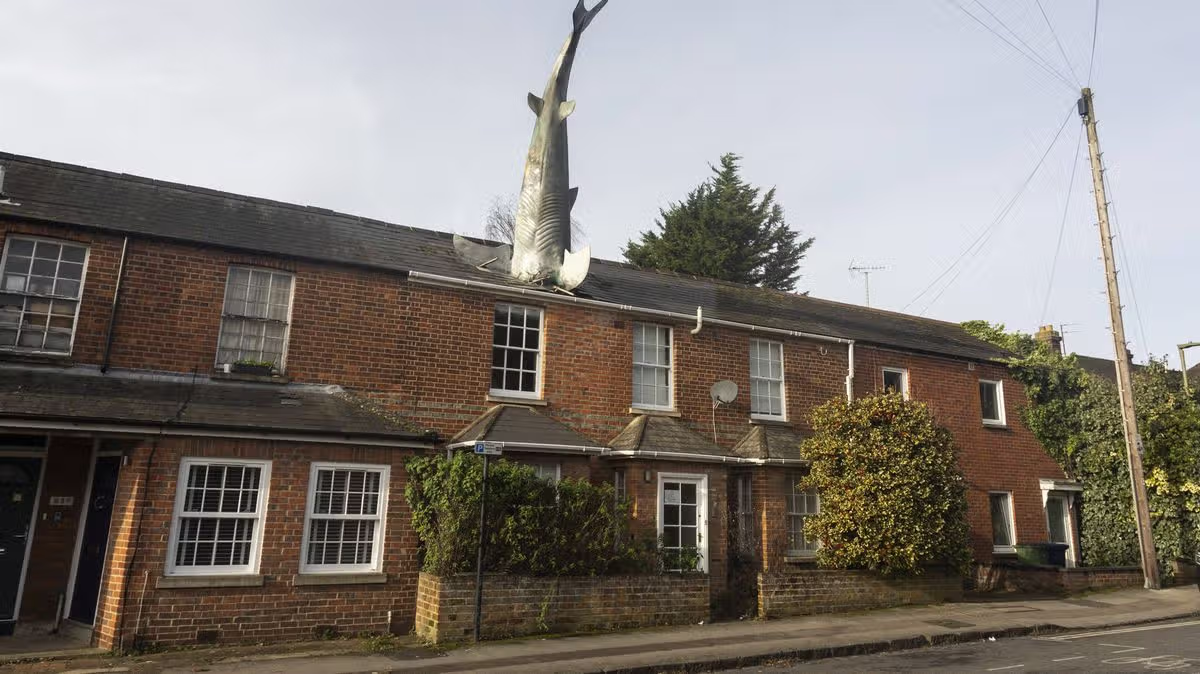
The owner of a peculiar property featuring a 25-foot shark stuck in its roof has argued its Airbnb ban should be reversed – claiming it is public art.
Owner Dr Magnus Hanson-Heine has marked the 40th anniversary of his distinctive dwelling by urging planners to grant it special status and identify a loophole permitting tourists to experience it.
Known as ‘Shark House’, the unusual four-bedroom, four-bathroom residence in Headington, Oxford, ran for five years as an Airbnb for short-term lettings before the local council banned it from doing so.
Click here to get the biggest stories straight to your inbox in our Daily Newsletter
Four decades ago this week, Magnus’ late father Bill Heine built the 25 foot structure which appeared overnight on the roof of his terraced property without formal planning consent from Oxford City Council.
The American-born journalist and broadcaster had arrived in Oxford during the 1960s to pursue studies at Oxford University.
It was constructed over three months, though nobody knew its intended location until it was transported to New High Street on a tractor-trailer where a crane positioned it into the roof. A six-year planning dispute then erupted.
Oxford City Council objected to the installation, claiming it posed a danger to the public, but engineers and inspectors declared it structurally sound.
To safeguard the shark, Bill’s son Magnus purchased the property in 2016, and it became a popular attraction on Airbnb. In March 2025, Magnus was then told he could no longer use the house as a short-term rental – a decision he says would damage Oxford’s wider tourism sector.
Marking the 40th anniversary this week, Magnus expressed continued hope about discovering a solution enabling the public to experience it going forward.
He stated: “The previous planning inspector accepted that the Shark House was an appropriate location for the use and found no evidence that it had caused problems for neighbours or highway safety.
“The main obstacle was Oxford’s general policy against the loss of a residential dwelling. With Oxford’s new Local Plan going through independent examination, we’ve made representations asking for greater flexibility for genuinely exceptional properties such as the Shark House.
“If the planning position changes sufficiently, either through that process or through changes to the national rules, I would certainly look at applying again.
“I think there is a strong case for treating the Shark House a little differently from an ordinary rental property. It is obviously a house, but it’s also one of Oxford’s best-known pieces of public art.
“When it was available on Airbnb, people could actually experience that extraordinary place from the inside and make it part of birthdays, reunions, visits to Oxford and other special occasions, rather than only ever seeing the Shark from the pavement.
“I hope there is ultimately room within the planning system for an imaginative solution which recognises that unusual cultural role.”
After being banned as a short term rental, the property has been listed for a longer term rental at a cost of £4,000 a month.
It’s listing states: “Nestled in the heart of Headington – Oxford, The Headington Shark House isn’t just accommodation; it’s a dive into a piece of living art history.
”Featuring the awe-inspiring 25ft fiberglass and steel shark sculpture that spectacularly ‘crashes’ through the roof, this Victorian marvel offers a one-of-a-kind stay. Experience the comfort of modern living while enveloped in a story that has captivated the world.
”’The Shark House stands as a testament to creativity, freedom, and the voice against conformity. Erected by my late father, Bill Heine, and sculptor John Buckley, it sparked a national debate on public art and personal expression.
”Today, it invites you to ponder its deeper meanings or simply enjoy its whimsical defiance.”
Magnus also said a screenplay adaptation had now been written of his father’s book The Hunting of the Shark, based around the true story of the shark’s creation and the six-year battle that followed.
He added: “It’s really a very British story about art, war, freedom, authority and the right to dissent, all with an American out-of-water at the centre of it.
“There is some comedy there, but also a real weight underneath: the shark was put up against the background of the bombing of Libya, nuclear anxiety, censorship of speech and expression, and the attempt to remove it became a six-year struggle over who gets to decide what people may create, see and do with their own homes.
“Forty years later, the object they fought over has become part of Oxford’s cultural heritage without losing any of the provocation that made it matter in the first place.
“I’m obviously biased, but I think that’s a fairly rare proposition for a film: an extraordinary true story, an instantly recognisable visual identity, an established place in British culture, great characters, humour and conflict, and something genuinely worth saying underneath it all.
“If there are filmmakers, producers or actors out there who know the Shark and see the potential in that story, I’d genuinely love to hear from them.”
Turning his attention to the future of Shark House, Magnus went on to say: “I’m also beginning to think seriously about the Shark’s next 40 years.
“That means looking at professional conservation advice and the longer-term care of the Shark, roof and surrounding structure, as well as investigating what grant funding might be available.
“It’s still early days, but depending on what is needed and the level of public interest, some form of fundraising or crowdfunding might eventually form part of that too.”
The council, however, has stood firmly behind its decision to impose a short-term let ban on the Shark House.
It stated that the growing trend of renting out entire properties for the majority of the year has led to the “loss of valuable homes in the UK’s most unaffordable city”.
The council also highlighted that nearly 3,500 households are currently on the waiting list for social housing in Oxford.
One councillor previously remarked: “Where properties have changed from being residential homes to becoming short let businesses without planning approval, we do take enforcement action.
“We live in one the least affordable places for housing in the UK. There are nearly 800 properties let out entirely as short lets in Oxford and we need those for people to live in and not as holiday accommodation.”

















































You must be logged in to post a comment Login