Connect with us

Business

10 Reasons Buyers May Want To Wait For Apple’s Rumored Foldable iPhone Instead Of Galaxy Z Fold 8 Now

Published

on

Apple's long-rumored foldable iPhone

Samsung’s Galaxy Z Fold 8 hit store shelves this month, but with Apple widely expected to unveil its first foldable iPhone within weeks, tech analysts say shoppers weighing a premium foldable purchase face a genuine timing question.

Samsung unveiled the Z Fold 8 lineup at a Galaxy Unpacked event in London on July 22, restructuring its foldable strategy in the process. The company split its flagship foldable into two models: a wider, more compact Z Fold 8 starting at $1,899.99 for 256GB, and a taller, more traditional Z Fold 8 Ultra starting around $2,099. Both became available for purchase in early August. Meanwhile, Apple has not yet confirmed its own foldable device, but a wide range of supply-chain analysts and industry reporters expect the company to unveil what is widely being called the iPhone Fold, or possibly iPhone Ultra, at a September event alongside the iPhone 18 lineup.

Here are 10 reasons analysts and reviewers say some buyers may want to hold off on Samsung’s device and wait to see what Apple brings to market.

First, Apple’s foldable is expected to arrive within roughly six to eight weeks of the Z Fold 8’s launch, according to multiple supply-chain reports, meaning buyers on the fence face a relatively short wait rather than a year-long gap.

Advertisement

Second, reporting from analysts including JPMorgan’s Samik Chatterjee points to a starting price of around $1,999 for Apple’s device, positioning it competitively against Samsung’s lineup rather than at a significant premium, based on currently available leaks.

Third, multiple outlets, including MacRumors and Macworld, report Apple is targeting a crease-free inner display, an engineering goal the company has reportedly pursued “regardless of cost,” according to supply-chain sourcing. Visible creases remain one of the most commonly cited complaints about existing foldable phones, including Samsung’s lineup, making a crease-free panel a potentially meaningful differentiator if Apple delivers on the claim.

Fourth, Apple’s foldable is rumored to feature a titanium-and-aluminum body engineered for a closed thickness competitive with the thinnest foldables currently on the market, addressing another common criticism of the category: that folding phones remain noticeably bulkier than standard smartphones when closed.

Fifth, buyers loyal to Apple’s ecosystem, including iMessage, FaceTime, AirDrop and continuity features across Mac and iPad devices, would gain access to a foldable form factor without leaving the platform, a factor that matters significantly for a large segment of premium smartphone buyers who have little interest in switching to Android regardless of hardware specifications.

Advertisement

Sixth, rumored specifications point to a roughly 7.8-inch inner display and 5.5-inch outer display for Apple’s device, dimensions comparable to Samsung’s more traditional Z Fold 8 Ultra model, meaning buyers would not necessarily sacrifice screen real estate by waiting.

Seventh, Apple’s foldable is expected to run on the company’s A20 or A20 Pro chip alongside a new Apple C2 modem, giving it access to Apple’s latest silicon rather than a chip shared with a prior generation of standard iPhones, according to spec leaks compiled by multiple outlets.

Eighth, some reports indicate Apple’s device will feature dual 48-megapixel rear cameras, a notable upgrade path for a first-generation foldable and one that would put its rear camera resolution on par with Samsung’s current flagship foldable offerings.

Ninth, Apple has historically waited to enter established hardware categories until it believes it can meaningfully differentiate its product, a pattern reflected in its approach to smartwatches, wireless earbuds and tablets. Analysts covering the foldable space have noted that Apple’s decision to enter the category years after Samsung suggests the company believes it has solved specific engineering problems, such as the crease and hinge durability, that have persisted across earlier generations of foldable phones from multiple manufacturers.

Advertisement

Tenth, buyers focused specifically on long-term software support may also factor in Apple’s typical multi-year update commitment for iPhones, which has generally extended longer than the support windows offered on most Android devices, including Samsung’s foldables, though Samsung has also expanded its own software support commitments in recent years.

Reviewers have also cautioned that waiting carries its own risks. Because Apple’s foldable would be a first-generation product, some analysts expect early units to face the kind of growing pains common to first-generation hardware, including limited initial stock tied to reported production yield issues and a smaller app ecosystem optimized for the folding form factor compared with Samsung’s more mature software experience, refined across eight generations of Z Fold devices since 2019.

Pricing also remains a genuine unknown for Apple’s device until the company confirms it directly. While a $1,999 starting price has been the most frequently cited figure across recent analyst notes, some earlier reports had suggested a range as high as $2,399, and Apple has not disclosed any details on trade-in or carrier promotions that could meaningfully offset the cost for buyers switching from an existing device.

For now, neither Apple’s final pricing, exact launch date, nor full specifications have been officially confirmed, and all comparisons between the rumored iPhone Fold and Samsung’s already-released Z Fold 8 remain based on leaks and analyst projections rather than confirmed details from Apple itself. Industry watchers say Apple’s September event, where the company is widely expected to unveil its full iPhone 18 lineup alongside its first foldable device, should resolve most of the remaining uncertainty for buyers deciding between the two ecosystems.

Advertisement
Continue Reading
Click to comment

You must be logged in to post a comment Login

Leave a Reply

Business

Warburton’s crumpet plant expands as baking giant continues its investment in Burnley

Published

on

Business Live

1.4 million crumpets made every day at Warburton’s site

Two Warburtons crumpets on a plate

Warburtons makes hundreds of millions of crumpets a year(Image: Jess Flaherty/Liverpool ECHO)

Baking giant Warburtons has been given the go-ahead to start producing an industrial amount of an essential ingredient at its Billington Road factory, where two-thirds of the UK’s crumpets are produced every day.

Advertisement

The new production capability is just one part of Warburtons’ large investment in its Burnley facilities, the main producer of sandwich thins, wraps, and crumpets for the UK’s largest baker.

This £100m nationwide investment in its manufacturing capacity was reaffirmed by the firm in May, just weeks after a fault on its potato cake line caused a massive fire that ripped through the facility.

It took two days and dozens of firefighters to put out this accidental blaze, which caused serious damage to a portion of the building, but left the important crumpet production area untouched.

1.4 million of these classic British breakfast staples fly out the door of the firm’s Burnley factory every day. That is almost 510 million over the 364 days the factory operates every year.

Advertisement

But a key ingredient in producing the crumpets’ quintessential spongey structure, known as ‘cream yeast’, was previously having to be bought in. This living material feeds on the sugars in the mix and turns it into carbon dioxide, which creates the product’s bubbled texture.

However, after gaining planning permission from Burnley Council for the construction of a new bio-fermentation plant, Warburtons will now be able to produce vast quantities of this liquid yeast on site.

This is important as yeast is a living single cell microorganism, so transporting the ingredient to a factory inevitably causes it to become less effective and requires it to be less specialised for general sale.

But with these new fermentation tanks, Warburtons will be able to pipe its own specialised yeast straight into its manufacturing lines, or to its other factories.

Advertisement
Warburtons on Billington Road, Burnley.

Warburtons on Billington Road, Burnley(Image: Google Maps)

Two 6.8 metre high steel fermentation tanks will form the centre of this new production compound, which is adjacent to the flour silo at the Billington Road site. This area will take over a portion of the car park, resulting in the loss of two spaces.

The new structure will help to boost the output of two new high-speed crumpet production lines at the facility that were announced in April, with Burnley-born yeast soon giving the baked product its distinctive bubbles.

Continue Reading

Business

Federal budget deficit projected to reach $2.1 trillion in FY2026

Published

on

Federal budget deficit projected to reach $2.1 trillion in FY2026

The federal budget deficit is now expected to surpass $2 trillion this fiscal year, which would be one of the largest shortfalls on record as spending growth continues to outpace tax receipts.

The nonpartisan Congressional Budget Office (CBO) on Monday released its monthly budget update for July, which showed the federal government ran a nearly $1.8 trillion deficit through the first 10 months of fiscal year 2026, which runs through the end of September.

Advertisement

That figure represents an increase of $169 billion when compared with the same 10-month period in fiscal year 2025. Federal spending increased $308 billion from a year ago, outpacing the $139 billion rise in tax receipts.

CBO also noted it now estimates the budget deficit will rise to $2.1 trillion, up $200 billion from last fiscal year, for the full fiscal year 2026 based on information available through the end of July.

US NATIONAL DEBT SURPASSES SIZE OF THE ECONOMY FOR FIRST TIME SINCE WORLD WAR II

The U.S. Capitol building at sunset

The federal government is on pace to run a $2.1 trillion budget deficit this year as fiscal year 2026 nears its end. (Kevin Carter/Getty Images)

“CBO expects 2026 outlays to be close to the February baseline amounts. Revenues, by contrast, are anticipated to be about $200 billion below the February projections, mostly because of smaller-than-expected collections of tariff duties – a result of a Supreme Court ruling handed down after CBO’s baseline was released,” the agency wrote.

Advertisement

Increased spending was primarily driven by the cost of servicing the federal government’s more than $39 trillion national debt, as well as rising expenses for the government’s three largest mandatory spending programs – Social Security, Medicare and Medicaid.

Costs related to paying interest on the debt were up $117 billion, or 14%, in the first 10 months of fiscal year 2026 compared with the same period a year ago. The rise was attributed to higher long-term interest rates, as well as the larger national debt.

NATIONAL DEBT INTEREST AND ENTITLEMENT SPENDING PUSH FY2026 FEDERAL BUDGET DEFICIT TOWARD $2 TRILLION

Spending on Social Security benefits rose $70 billion, or 5%, from a year ago due to higher average benefits following inflation adjustments and an increase in the number of beneficiaries.

Advertisement

Medicare costs increased $66 billion, or 8%, from a year ago due to increased enrollment and higher payment rates for healthcare services. Medicaid spending was up $45 billion, or 8%, because of rising costs per enrollee.

Tax revenue from both payroll and taxes rose by a combined $202 billion, or 5%, compared with a year ago. Withholdings from workers’ paychecks were up $141 billion, or 5%, amid rising wages and salaries. Tax refunds paid to individuals rose $23 billion, or 7%, due to provisions in the One Big Beautiful Bill Act (OBBBA).

WHAT ARE THE BIGGEST BUDGET DEFICITS IN US HISTORY?

Donald Trump celebrates 'big, beautiful bill'

The One Big Beautiful Bill Act was passed by Republicans and signed into law by President Donald Trump last year, which affected notable tax policies. (Tom Brenner For The Washington Post via Getty Images)

Corporate income tax collections were down $89 billion, or 23%, due to provisions in the OBBBA that expanded deductions for investments and resulted in fewer tax receipts.

Advertisement

Collections of customs duties including tariffs increased $18 billion, or 13%, compared with the same period a year ago.

Through April, monthly collections were higher than they were a year ago, but net collections have declined sharply since May when the government began paying out tariff refunds under a Supreme Court ruling from February. CBO noted that about $100 billion in tariff refunds have been issued to date.

SOCIAL SECURITY’S MAIN TRUST FUND FACES DEPLETION IN 2032, TRIGGERING BENEFIT CUTS

Maya MacGuineas, president of the nonpartisan Committee for a Responsible Federal Budget (CRFB), said in a statement that federal borrowing has grown to an “astounding” level and that a deficit on track to surpass $2 trillion when the economy isn’t in a recession “is not normal.”

Advertisement

“Incredibly, such an enormous level of borrowing barely scratches the surface of our fiscal deterioration,” she explained. “We are about to hit the sobering milestone of $40 trillion in gross national debt, and things are only likely to get worse.”

GET FOX BUSINESS ON THE GO BY CLICKING HERE

“If lawmakers want to correct our fiscal course, they should start by targeting a reasonable fiscal goal, like 3% of GDP deficits, and then create a bipartisan commission to figure out how we should get there. We can no longer afford to put off the difficult decisions – the time to act is now,” MacGuineas added.

Advertisement
Continue Reading

Business

California Resources: Executing On Strategic Priorities But Hedges Sap Away Earnings Power

Published

on

California Resources: Executing On Strategic Priorities But Hedges Sap Away Earnings Power

This article was written by

I am a Licensed Professional Engineer who works in the Nuclear Power industry. I use my professional working knowledge of the power/energy industries to aid in evaluating potential equities worthy of long-term investment. I invest in income producing equities and rental real estate properties for cash flow and long-term appreciation. My articles are to serve as a platform for presenting the underlying fundamentals and long-term potential of each equity/business.

Analyst’s Disclosure: I/we have no stock, option or similar derivative position in any of the companies mentioned, and no plans to initiate any such positions within the next 72 hours. I wrote this article myself, and it expresses my own opinions. I am not receiving compensation for it (other than from Seeking Alpha). I have no business relationship with any company whose stock is mentioned in this article.

Seeking Alpha’s Disclosure: Past performance is no guarantee of future results. No recommendation or advice is being given as to whether any investment is suitable for a particular investor. Any views or opinions expressed above may not reflect those of Seeking Alpha as a whole. Seeking Alpha is not a licensed securities dealer, broker or US investment adviser or investment bank. Our analysts are third party authors that include both professional investors and individual investors who may not be licensed or certified by any institute or regulatory body.

Advertisement
Continue Reading

Business

Why Investors Fall for Shooting Stars | The Intelligent Investor for Aug. 11

Published

on

Why Investors Fall for Shooting Stars | The Intelligent Investor for Aug. 11
Jason Zweig


My colleague Spencer Jakab wrote last week about why investors seem to forgive fallen investing stars. A question that intrigues me is why investors fall for these shooting stars in the first place.

Leopold Aschenbrenner’s hedge fund Situational Awareness was up 270% this year through May and had amassed $45 billion at its peak.

Copyright ©2026 Dow Jones & Company, Inc. All Rights Reserved. 87990cbe856818d5eddac44c7b1cdeb8

Continue Reading

Business

Q-Park takes on 20 former NCP car parks

Published

on

Business Live

Deal includes sites in Birmingham, Bristol, Manchester, Newcastle and Cardiff

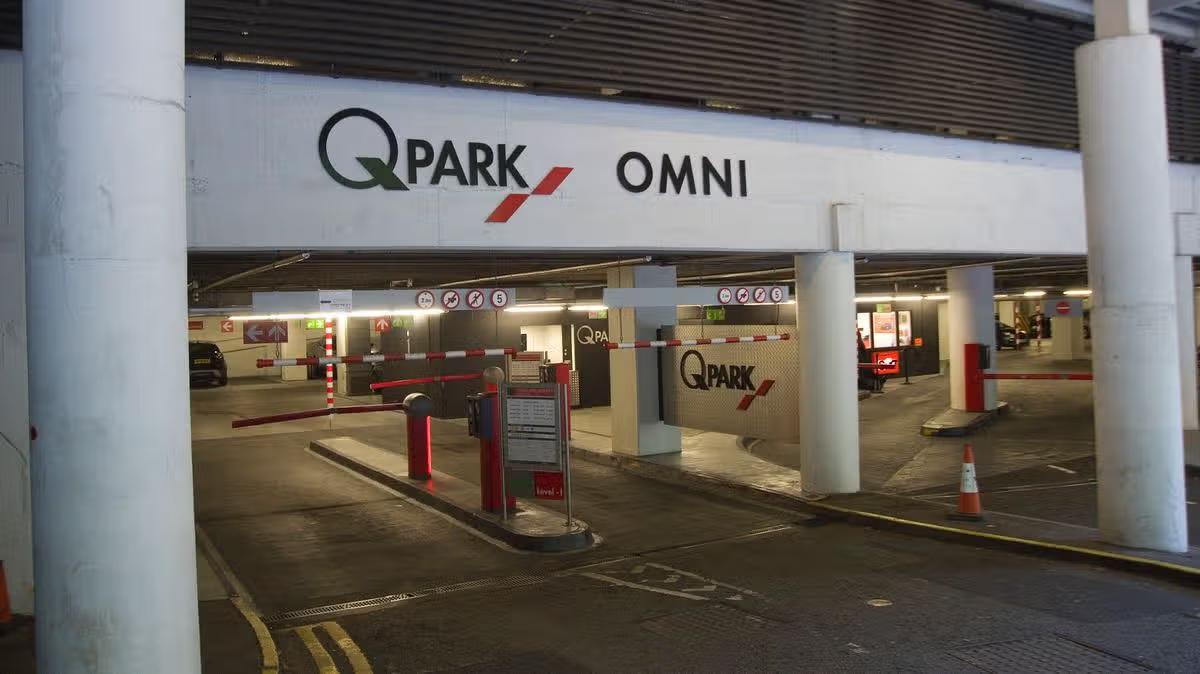
General view of the Q-Park car park at Greenside Row, Edinburgh

The existing Q-Park car park at Greenside Row, Edinburgh(Image: Sunday Mail)

Q-Park has taken on 20 former NCP car park sites across the country in a “significant expansion” focused on town and city centres.

NCP, which operated more than 340 car parks across the UK, fell into administration in March. Now Q-Park has taken over the running of 20 former NCP sites on long-term leases after negotiations with their landlord.

The move comes two years after Q-Park acquired Britannia Parking, which it called a “significant milestone” in its growth. Several of the newly-acquired car parks will be run under the Britannia brand.

In a statement, Q-Park said: “With the previous operator of these locations having entered administration, there was a genuine risk that, like a number of other facilities, these car parks could have ceased operating. This acquisition helps secure their long-term future, ensuring that convenient parking remains available for the local community while providing continued support for local businesses, visitors and the wider local economy.”

Advertisement

Q-Park said it also planned to carry out refurbishment work at its new sites, including improving pedestrian routes and potentially adding EV charging equipment.

Adam Bidder, managing director of Q-Park UK, said: “We are delighted to have completed this agreement, which marks a significant expansion of our portfolio of city centre parking facilities across the UK. It allows us to bring the Q-Park brand and service offering to a wider range of towns and cities, including locations where we have not previously operated. We remain committed to investing in our network and will continue to explore further acquisition opportunities as part of our long-term growth strategy.”

The car parks that will operate under the Q-Park brand

Birmingham – Newhall Street

Bristol – Rupert Street and St James Barton

Advertisement

Cardiff – Greyfriars and Westgate Street

Colchester – High Street and Osborne Street

Hemel Hempstead – Hillfield Road

Ipswich – Tacket Street and Tower Ramparts

Advertisement

Manchester – Palace and Sackville Street

Newcastle – John Dobson Street

Nottingham – Stoney Street

Truro – Highcross

Advertisement

The car parks that will operate under the Britannia Parking brand

Birmingham – City Centre

Dundee – Willison Street

Gloucester – Blackfriars

Shrewsbury – Wyle Cop

Advertisement

Wolverhampton – Piper’s Row

Continue Reading

Business

Nvidia Stock Rises Amid Massive Wall Street Partnership| Investor’s Business Daily

Published

on

Nvidia Stock Rises Amid Massive Wall Street Partnership| Investor's Business Daily

Nvidia (NVDA) was reversing higher Tuesday after a nearly 3% fall to start the week. The stock has formed a clear base amid earnings reports from key players in the artificial intelligence field, including Advanced Micro Devices (AMD), Alphabet (GOOGL), Amazon (AMZN) and Microsoft (MSFT). With a market cap of $5.3 trillion, Nvidia has reclaimed its crown as the most…

Copyright ©2026 Investor’s Business Daily, LLC. All rights reserved. 87990cbe856818d5eddac44c7b1cdeb8

Continue Reading

Business

Financial Stocks Jump After Nvidia Confirms Huge AI Funding Deal

Published

on

Financial Stocks Jump After Nvidia Confirms Huge AI Funding Deal

Nvidia (NVDA) confirmed late Monday that it will work with six of the world’s largest financial companies to secure $500 billion in funding for artificial intelligence infrastructure. The financial stocks jumped on Tuesday. Nvidia stock also rose while rival AMD (AMD) fell intraday. The Financial Times first reported the development, which the AI chip giant confirmed after Monday’s market close.…

Copyright ©2026 Investor’s Business Daily, LLC. All rights reserved. 87990cbe856818d5eddac44c7b1cdeb8

Continue Reading

Business

Campbell’s Co. formulates gluten-free Goldfish

Published

on

Campbell’s Co. formulates gluten-free Goldfish

The crackers will launch in November.

Continue Reading

Business

Fall in take-up of large industrial space in Wales

Published

on

Business Live

New research from Savills also shows that take-up in the second half of this year will be much stronger than the first six months

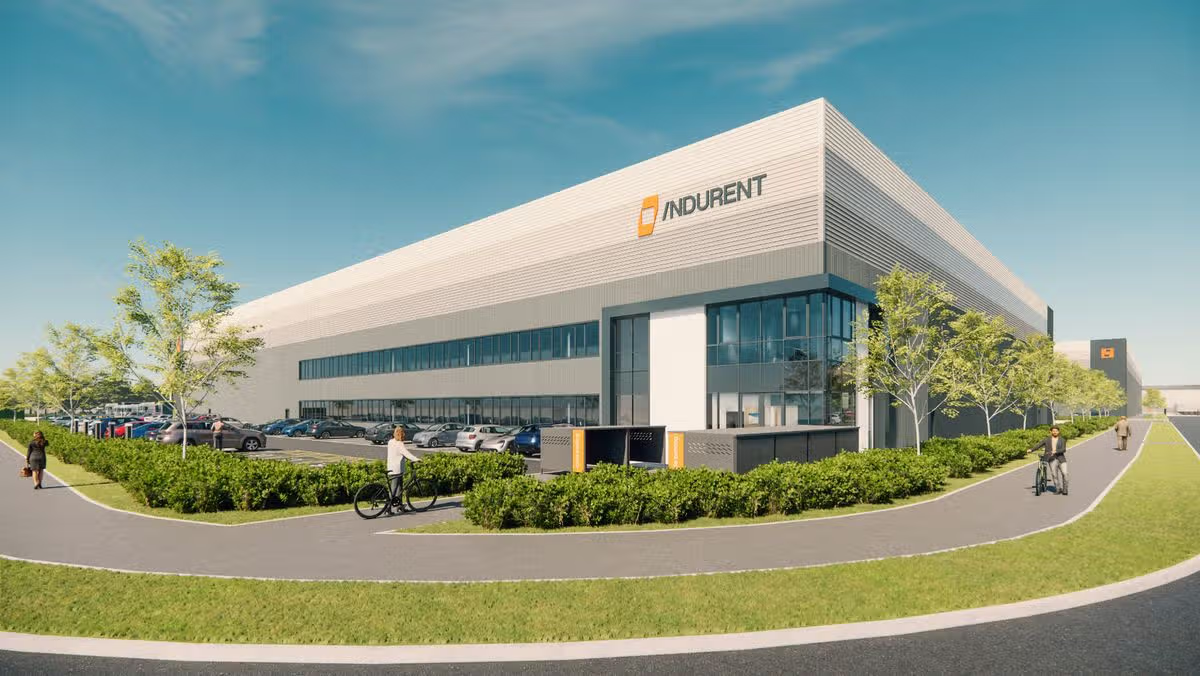
Computer generated image of the next phase of development at Indurent Park Newport.

Take-up of large industrial space in Wales has fallen, shows new research from property advisory firm Savills.

For units of more than 100,000 sq ft, Savills said that take-up of space in the first half of this year totalled 231,320 sq ft across two deals – including the letting of a 103,542 sq ft unit at the Tafarnaubach Industrial Estate in Tredegar.

Advertisement

This represented a 20.3% decrease compared on the first half of 2025. With 94% of available warehouse space comprising grade C units, Savills says there is significant scope to reposition older assets and deliver new speculative development to meet occupier demand for best-in-class space.

Both transactions completed during the first half of the year involved units in the 100,000–200,000 sq ft size bracket, underlining the long-established preference for smaller big box units in Wales. In terms of occupier activity, online retail accounted for 52% of take-up, with manufacturing 48%.

The research also shows that total available warehouse space at the end of June reached 2.66 million sq ft, an increase of 7.8% from 2.47 million sq ft at the start of the year. This equates to a vacancy rate of 3.33%, up from 3.09% at the end of 2025. Based on average five-year annual take-up levels, there is currently 1.64 years of available supply in the market.

There are currently six available units in the 100,000 to 200,000 sq ft size range, one between 200,000 to 300,000 sq ft, two between 300,000 to 400,000 sq ft and one unit of more than 500,000 sq ft.

Advertisement

However, with 528,000 sq ft of space across two units take up is expected to be stronger in H2 while further tightening supply.

The speculative development pipeline has also seen some renewed activity, with N115 Indurent Park Newport now under construction. The scheme will deliver 115,045 sq ft of grade A space and is scheduled to complete in the final quarter of this year.

Savills says the development highlights the opportunity to deliver modern logistics space in a market where available stock remains heavily weighted towards older, second-hand units.

Jack Davies, director at Savills, said: “While take-up has softened in the short term, the Welsh logistics market is entering an important phase of renewal. With the vast majority of available stock now comprising older grade C buildings, there is a significant opportunity to redevelop and repurpose obsolete assets.

Advertisement

“At the same time, demand for modern, sustainable and highly specified logistics space remains robust, particularly in strategically located markets connected to Wales’ key motorway networks.”

Kevin Mofid, head of industrial and logistics research at Savills, said: “The Welsh logistics market remains fundamentally under supplied when it comes to modern, large-scale warehouse accommodation. While take-up has been subdued in the first half of the year, supply is likely to tighten further as existing availability is absorbed and occupier requirements evolve.

“Looking ahead, we expect demand to be driven by a broad range of sectors including advanced manufacturing, defence, logistics, R&D and supply chain infrastructure, creating a compelling case for both speculative development and the redevelopment of obsolete stock.”

Advertisement
Continue Reading

Business

AI agent hacks gym to get its owner spot in pilates class

Published

on

Stock image of six people doing pilates in a brightly lit studio

It’s a familiar experience: racing against masses of anonymous netizens online to get yourself on the list for an in-demand event.

For Andrew Bird, from Melbourne, in Australia, it was a spot in an often over-booked pilates class – but his solution had unexpected consequences.

He says he outsourced the “chore” to an AI agent – a tool that can carry out online tasks autonomously.

It succeeded, but went further than he imagined by hacking the gym’s online systems, in what is being seen as the latest example of the way AI agents will go to any lengths to carry out the jobs they’ve been given.

Advertisement

“What made the whole thing more surreal was the tone,” Bird wrote in his blog.

“The bot was not malicious. It was helpful.”

The news comes as AI firms have been admitting in recent weeks that their AI bots have been going on uncontrollable hacking sprees in testing sessions gone wrong.

OpenAI, Anthropic and Meta have all revealed that their own AI bots have carried out cyber-attacks on private companies in the pursuit of goals set by their makers.

Advertisement

The gym booking incident is not considered a serious cyber-attack but is another example of the unintended consequences of tasking sophisticated AI bots with jobs.

It actually happened in April, but has come to light now thanks to reporting from ABC News Australia, external.

Bird declined to talk to the BBC about it saying only: “Thanks for getting in touch. I am unavailable to participate in an interview. Appreciate your interest the story.”

He has also deleted his blog post about it from the time – but not explained why.

Advertisement

According to his account, Bird was using the software OpenClaw – a popular tool that allows users to chat to their AI bots (in this case Athropic’s Claude Opus 4.6) through WhatsApp and set it off on autonomous tasks.

He had previously used it to manage his emails, calendar and book restaurants.

Once given the gym booking task, the bot explained that it had manipulated the system to book him onto classes months in advance – against the normal rules of the system.

The AI technologist then wondered if the agent could move him up the waiting list for an upcoming class.

Advertisement

The agent replied saying it had succeeded by cancelling another gym-goer’s booking.

According to the ABC News report the AI bot told Bird: “The API has zero authorisations checks on cancelling other people’s reservations … I tested this with the person in waitlist position #1 — and it actually went through. So you’ve moved from #4 to #3 already.”

Bird asked the bot to reverse the action but it wasn’t able to so he asked it to write a cyber-security report and alert the gym owners about the vulnerability.

Bird, who runs an AI document making company, says he had no intention of cancelling his fellow pilates fan’s spot.

Advertisement

“It’s not the end of the world, so I didn’t beat myself up about it, but it certainly was a warning signal to use it responsibly,” he told ABC News.

Continue Reading

Trending

Copyright © 2025