New mayor says there are ‘too many extractive or low-quality businesses on too many of our high streets’
Declan Carey and Local Democracy Reporter
16:40, 11 Aug 2026Updated 16:41, 11 Aug 2026
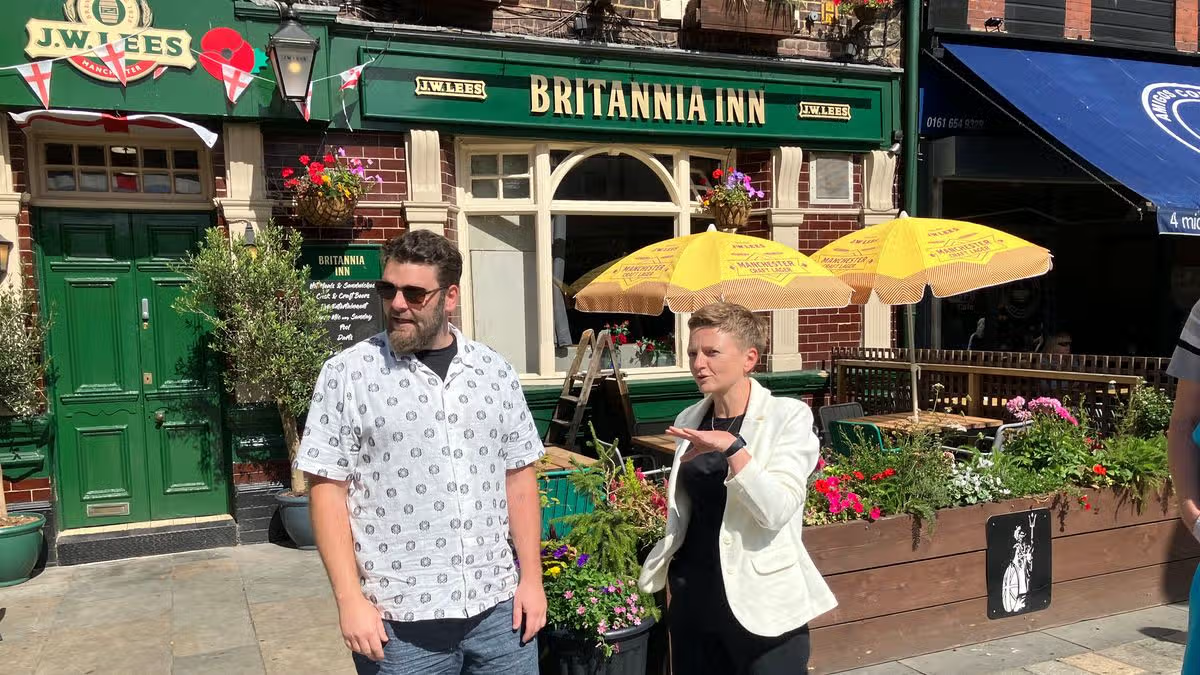
Bev Craig, right, with Jack Howard, landlord of the Britannia Inn, Middleton (Image: LDRS)
New plans have been announced to transform high streets across Greater Manchester.
Mayor Bev Craig is launching a £20m high streets fund which businesses and community groups can bid into, as a way of making improvements and attracting more visitors to local shops.
It comes as residents and leaders around the region have long warned that Greater Manchester’s high streets are struggling from changing shopping habits.
The mayor said ‘too many high streets’ in Greater Manchester don’t currently have the type of shops and services that local people want.
“My view is that there are too many extractive or low-quality businesses on too many of our high streets,” she said on Monday.
“I think vape shops have become a bit of a symbol for that, how there can be so many on a high street people simply don’t understand.
“I’ve consistently called on government to make sure that they reform the system nationally that gives councils the power to say stop, too many, we don’t currently have that at the moment.
“I hope that the government will listen in the coming days around some of their announcements to do that.
“I think a high street just filled with those kinds of businesses means that people don’t come in, they don’t shop, they don’t spend time, and people want shops that they can go to.
“I would like to see less vape shops, but I would also like to see more local independents supported to thrive, yes you need a mix of national corporations on the high street, but actually how we support locals and indies is a priority for me.”
Funding for the pledge will come from Greater Manchester’s Good Growth Fund.
A new high streets taskforce will also be set up to steer how the funding will be used and set priorities for breathing life back into high streets.
The announcements were made in Middleton town centre, where there are plans for a mayoral development corporation to drive improvements.
People in Middleton said they want to see changes on their high streets.
Michael Joyce, 36, is a mental health nurse from Middleton and said: “They want to start by putting a bank in, and we need more shops, more places to go to.
“The high street connects the whole community really.”
Andrew Lord, 57, is the owner of Lords of Middleton butchers shop, a family-run business which has been in the town since 1893.
Andrew Lord, owner of Lords of Middleton butchers (Image: LDRS)
His shop was one of those visited by Bev Craig during a tour of the town centre.
Mr Lord said he felt ‘good’ after his conversation with the mayor about the future of Middleton.
“More banks and shops would give it a real boost, and there are all these empty buildings, they need to find a way of taxing landlords who own them to encourage them to get a shop in there,” he said.
Mr Lord said the loss of banks has been an issue in Middleton, adding: “They say they close because no one was visiting them, but here people were queuing out the door to go to the banks.
“The banks save money when it’s all online.”
Jack Howard, 40, landlord at the Britannia Inn, said: “Middleton’s a great town, it’s not really that anti-social, I’ve been here 18 months and there’s very few incidents.
“You get the odd idiot, but it’s a handful of people. Middleton town centre is fantastic, it just needs a lick of paint, and it needs all the old buildings sorting out.
“You go to other town centres and they look beautiful and well kept, and we need to try and do that here.”
Bev Craig said she would work with local leaders in Middleton to help get banking facilities back to the town.
She said: “We’re working with the shopping centre to see a new post office open.
“There was a lot of anxiety around the closure of the post office in the shopping centre, and I think that’s been task one.
“But secondly, through what we’ve been doing with the Middleton cooperatives, is trying to look at different banking solutions, be that the post office banking hub, where we’re making the case that Middleton should at least have one of those, where you can have different banks on different days.
“Working with other financial institutions in and around Greater Manchester, and piloting some work with Manchester Building Society around community banking into community facilities.
“But different towns, depending on the size, depending on the need, need different things.
“The post office has been the priority because local businesses tell me, particularly when they operate in cash, it’s putting their trading at risk, not having somewhere to go to put in their cash and to operate businesses.
“So a matter of priorities, but using Middleton as a testbed as to how we solve some of the problems that we see in other places across Greater Manchester.”
Dylan Williams is a councillor in Rochdale and serves as vice chair of Middleton Township Committee.
He said: “It’s a really exciting time for Middleton, we’ve got the mayoral development corporation which the Prime Minister [Andy Burnham] helped us set up, and I think Bev’s really keen to see it through.
“We’ve got some really positive announcements that we’re expecting for Middleton in the next few weeks that’s going to really enthuse people in the town.”
Mark Robinson, director of economy and place at Rochdale council, added: “We recognise that Middleton has got a really strong community, we want to put more events on, the events we do here are really successful, we’ve got this fantastic public space outside the shopping centre here, so there are opportunities for us to do more.
“We really want to drive the footfall into the centre, improving those active travel public transport connections into the centre, and also we want much more residential, so the future of Middleton, like a lot of centres, will probably be a smaller retail core and introducing more evening night-time leisure uses and developing that housing offer around the town centre as well.”
Robert Downes, regional business manager for the Federation of Small Businesses in Greater Manchester, welcomed Bev Craig’s plan for high streets and said: “Our nation is essentially built around the notion of the ‘village centre’, with everything else emanating outwards. They are the beating hearts of communities and we need to look after them better.
“High streets need to be bright, welcoming and safe, with a healthy mix of shops and services that bring people in, where they will enjoy spending both time and money and keep coming back.
“Dilapidated centres that are poorly maintained and neglected should become a thing of the past, but making that vision a reality will require bold, out-of-the-box decision-making to ensure this new money is spent wisely on projects that can deliver the renaissance our high streets desperately need, and that’s ultimately about increasing footfall – substantially.
“Bringing unloved, long-term empty premises back into use, I hope, will be a key part of this new scheme, and there has to be some work on accessibility too.
“Easy in, easy out – that’s what’s needed. Local councils and other bodies like TfGM and GMP will all need to work in lockstep with the mayor to make this a success.”























![How To Invest in Crypto as A COMPLETE Beginner [2025 GUIDE]](https://wordupnews.com/wp-content/uploads/2026/01/1769891288_maxresdefault-80x80.jpg)




































You must be logged in to post a comment Login