
Crypto World
Strategy has sold nearly 7,000 BTC in 2026



Michael Saylor’s Strategy has sold 6,948 BTC in 2026, raising $431.8 million as part of its BTC monetization program.
Saylor first announced in May that Strategy would soon start selling its BTC. Then in late June, the company revealed it would sell its accrued BTC as part of a monetization program to raise $1.25 billion for its USD reserve.
The money would be spent on preferred stock dividends, digital credit securities or Class A common stock.
Strategy’s K-8 filings reveal that its first sale of 32 BTC took place in late May. This sale made the firm $2.5 million while BTC was worth $77,135 at the time.
The company then sold:
- 1,363 BTC between June 29 and June 30
- 2,225 BTC between July 1 and July 5
- 1,638 BTC between July 27 and August 2
- 1,690 BTC between August 3 and August 9
This most recent sale is reflected in Strategy’s latest filing.
Read more: Is a crisis brewing at Crypto.com?
These sales netted the firm $80.8 million, $135.2 million, $104.73 million, and $108.6 million, respectively. The price of BTC has fallen 13% since the selling began.
Before June 21, Strategy was mostly buying BTC, building up 163,554 BTC in 2026. These purchases cost the firm over $12.7 billion.
Strategy’s first BTC purchase was in August 2020, when it spent $250 million buying 21,454 BTC.
As of August 9, the company now holds 840,447 BTC, currently worth $53.82 billion.
It paid $63.36 billion for all this BTC, which means that it is down -$9.5 billion on its BTC investments.
Even with its $4.65 billion USD reserve included with its BTC horde, that’s still $4.9 billion less than it bought all the BTC for.
Read more: Every time Michael Saylor said he’d never sell bitcoin
Saylor’s pivot to offloading BTC was controversial among followers who believed him when he said he wouldn’t be selling.
Strategy had only ever sold BTC once back in 2022, before buying significantly more BTC two days later.
In February 2025, when BTC was above $84,000, Saylor famously said, “Sell a kidney if you must, but keep the BTC.”
The price of the asset has since fallen 24% to $64,042, while his advice was ultimately abandoned by his firm.
Got a tip? Send us an email securely via Protos Leaks. For more informed news and investigations, follow us on X, Bluesky, and Google News, or subscribe to our YouTube channel.


eToro has outlined a new step in its push to broaden beyond crypto by announcing plans to acquire US online brokerage TradeZero. The deal is positioned as part of the company’s expansion strategy in the United States, with closing expected in the first half of 2026.
In parallel with the acquisition announcement, eToro’s second-quarter update showed crypto trading and revenues under pressure. The company reported $1.59 billion in total revenue for the quarter, with crypto assets contributing $1.34 billion—down roughly 30% from $1.9 billion in the prior-year comparable quarter. While crypto revenue fell, eToro also reported $1.35 billion in crypto-related cost of revenue and $19.7 million in net income from crypto assets, alongside $53.4 million in total net income.
Key takeaways
- eToro plans to acquire TradeZero to accelerate its US expansion, targeting closing in the first half of 2026.
- In Q2, crypto remained the largest revenue stream for eToro at $1.34 billion, but it fell about 30% year over year.
- Crypto net income was positive at $19.7 million for the quarter, even as overall crypto trades and invested amounts declined sharply in July.
- The company reported strong cross-asset engagement: many users who traded commodities later traded equities and then crypto on eToro.
- TradeZero reportedly generated about $80 million in revenue over the last 12 months ended June 30, 2026, with 81% gross margins.
Why eToro wants TradeZero in its US strategy
The acquisition of TradeZero is framed by eToro as a practical move to become a broader multi-asset platform in the United States. The focus on US brokerage capabilities comes as the firm works to deepen trading relationships across asset classes, rather than relying solely on digital-asset activity.
eToro also previously signaled similar intent in crypto infrastructure: in April, it announced plans to acquire self-custodial wallet provider Zengo. Taken together, the company’s approach appears to combine more traditional brokerage reach (through TradeZero) with continuing investment in crypto custody and user access (through Zengo).
Crypto performance remains the swing factor
Despite the company’s ongoing multi-asset push, crypto continues to dominate the revenue mix. In its second-quarter report, eToro said total revenue came in at $1.59 billion, down from $2 billion in the comparable 2025 period. Of that amount, $1.34 billion was revenue from crypto assets, which the company said was about 30% lower than $1.9 billion in Q2 2025.
eToro reported $1.35 billion in crypto-related cost of revenue and $19.7 million in net income from crypto assets. Total net income for the quarter was $53.4 million, indicating that losses or reductions in crypto activity did not fully translate into an overall earnings collapse—though the numbers highlight how sensitive the business remains to the direction of crypto volumes and fees.
The broader trading picture also weakened after the quarter. According to eToro’s disclosures, total cryptocurrency trades on the platform fell to 1.4 million in July, representing a 73% year-on-year decline. The invested amount was down 50% over the same period, reinforcing that reduced trading activity has been affecting both the number of transactions and the size of positions.
Cross-asset engagement and the commodities-to-crypto funnel
Alongside crypto-specific declines, eToro highlighted user behavior that could support its multi-asset thesis. In commentary attributed to its financial leadership, the company said that more than 60% of users who traded commodities during Q4 2025 to Q1 2026 later traded equities in Q2 2026. It added that nearly nine in ten of those users have also traded crypto on eToro.
This matters because it suggests eToro is attempting to build a funnel where initial engagement in one asset category can lead to additional trading across other categories. If TradeZero helps expand access to US equities and other traditional brokerage products, eToro may be betting that increased equity trading will feed back into crypto usage—offsetting parts of the volatility in digital-asset demand.
eToro also reported that equities and commodities-related trading generated $141 million in net income for the platform, providing another anchor outside crypto revenue even as crypto volumes cooled.
Deal economics: TradeZero’s margins and expected earnings impact
From the perspective of deal structure, eToro provided figures intended to show that TradeZero could strengthen the business rather than dilute it. The company stated that TradeZero generated about $80 million of revenue with 81% gross margins in the last 12 months ended June 30, 2026.
Looking ahead, eToro said it expects the acquisition to be accretive to adjusted earnings per share in the first year after closing. Closing is expected in the first half of 2026, meaning the earliest period for the claimed benefit would likely follow shortly thereafter.
Market reaction to the announcement appeared cautious. eToro’s Nasdaq-traded shares were down more than 5% in pre-market activity on Tuesday, with the move expected to extend Monday’s decline according to Yahoo Finance data for ETOR.
What to watch next
Investors and users will likely focus on whether the TradeZero acquisition helps stabilize revenues as crypto volumes fluctuate, and on whether eToro can translate its reported cross-asset engagement into sustained trading activity in the US. In the meantime, July’s sharp drop in crypto trades and invested amounts remains a key signal for how quickly digital-asset performance can change the company’s quarterly outlook.


Strategy CEO Phong Le has said the company plans to increase its Bitcoin holdings again this year, even after recent sales reduced its reserve to 840,447 BTC.
Summary
- Strategy plans to resume Bitcoin accumulation before the end of 2026.
- Recent sales have reduced its holdings to 840,447 BTC.
- Strategy sold 3,328 BTC for $213.3 million across the past two reporting periods.
- Its US dollar reserves have increased to $4.65 billion.
Fox Business reported that Le expects Strategy to return to Bitcoin accumulation as the company builds its US dollar reserve and supports its preferred stock products.
Le’s comments place the company’s long-term buying plan alongside a capital-management program that has produced two consecutive weekly Bitcoin sales. Strategy has used the proceeds to repurchase its variable-rate preferred stock, while common-share sales have provided cash for its dollar reserve.
During an earlier Bloomberg interview in July, Le linked the next buying phase to a recovery in Strategy’s Stretch preferred stock, which trades under the ticker STRC.
“We’ll continue to build that. And yeah, when Stretch gets back to par, we’ll issue more. We’ll buy more Bitcoin,” Le said.
Strategy plans to resume Bitcoin accumulation
Strategy has not announced a date for its next purchase, and Le’s comments describe a plan for later in 2026 rather than an immediate transaction.
The company’s recent activity has focused on restoring STRC toward its $100 stated amount. Because Strategy can issue the preferred shares to raise capital, a recovery toward that level would give the company another source of funds for Bitcoin purchases.
As crypto.news reported on July 16, Le said Strategy would issue more STRC and buy more Bitcoin after the security returned to par. STRC traded near $87 at the time after falling below $75 in late June.
Strategy designed STRC with a variable dividend rate that management can adjust to encourage the shares to trade close to $100. The company kept the annualized rate at 12% for August, despite the stock ending July below $90.
Management has also been repurchasing STRC shares when they trade below the stated amount. Strategy said the purchases were intended to reduce the number of preferred shares outstanding and improve what it calls STRC’s “Bitcoin credit,” a company metric measuring Bitcoin and cash backing relative to its preferred obligations.
Le said in July that Strategy wanted STRC to trade between $99 and $100. The company has described regular repurchases below that range as part of its plan to support the security before issuing additional shares.
Bitcoin sales fund another STRC repurchase
An Aug. 10 SEC filing showed that Strategy sold 1,690 BTC between Aug. 3 and Aug. 9, receiving $108.6 million after fees and expenses.
The company sold the Bitcoin at an average price of $64,262 and used the proceeds to repurchase 1,152,020 STRC shares. Strategy paid an average of about $94.29 per preferred share, leaving approximately $785.2 million available under its STRC repurchase authorization.
Following the transaction, Strategy’s Bitcoin reserve fell from 842,138 BTC to 840,447 BTC. The remaining holdings were acquired for about $63.36 billion at an average price of $75,385 per coin, according to the company’s filing.
The transaction followed a sale of 1,638 BTC for $104.73 million during the week ending Aug. 2. Strategy used $52.4 million from that sale to pay preferred-stock dividends and directed another $52.3 million toward STRC repurchases.
As previously covered, the earlier sale occurred at an average price of $63,957 and reduced Strategy’s reported holdings to 842,138 BTC.
Across the two latest reporting periods, the company has sold 3,328 BTC for approximately $213.3 million. Strategy’s public ledger shows that its reserve has declined from 847,363 BTC on June 22 to 840,447 BTC following several sales.
The company sold 3,588 BTC for about $216 million between June 29 and July 5, before keeping its holdings unchanged for several weeks. Strategy also sold 32 BTC around the end of May, its first disclosed disposal since December 2022.
Dollar reserve reaches $4.65 billion
While reducing its Bitcoin position, Strategy has increased the amount of cash available for dividends, interest payments, and other corporate obligations.
The Aug. 10 filing showed that Strategy sold 6,585,329 shares of MSTR common stock through its at-the-market programs. The sales generated approximately $653.1 million in net proceeds.
Management placed $650 million into the company’s designated US dollar reserve and added the remaining $3.1 million to unrestricted cash. The contribution lifted the reserve from $4 billion to $4.65 billion as of Aug. 9.
In late July, Strategy had reported a reserve of $3.75 billion, which management estimated could provide about 2.1 years of coverage for preferred dividends and interest payments. A subsequent $250 million contribution raised the balance to $4 billion and extended the company’s stated coverage period to about 2.3 years.
The reserve is management-designated liquidity rather than a legally restricted account. Strategy established it in December 2025 to support payments on its preferred securities and outstanding debt, and the company can change the reserve’s size according to capital needs and market conditions.
Le told Fox Business that Strategy had been adding to its dollar holdings, making liquidity one of the company’s current priorities. During Strategy’s second-quarter earnings call, he said the company had learned the importance of holding dollars instead of relying only on Bitcoin as a liquid balance-sheet asset.
US investors retain exposure through MSTR and STRC
Strategy’s latest transactions directly affect US investors because MSTR and STRC trade on Nasdaq, and the company reports its Bitcoin, equity, and preferred-stock activity through filings with the US Securities and Exchange Commission.
MSTR provides equity exposure to Strategy’s Bitcoin reserve, software operations, debt, and preferred-stock obligations. Its performance can therefore differ from Bitcoin’s price because changes in the company’s share count, cash reserve, and capital structure also affect shareholders.
Strategy’s Aug. 10 filing showed that adjusted shares outstanding rose to about 423.85 million after the latest common-stock sales. The company still had approximately $11.7 billion of MSTR shares available for issuance across two at-the-market programs.
STRC gives investors a different form of exposure through a variable cash dividend rather than direct ownership of Bitcoin. Strategy can change the dividend rate each month under the security’s terms, while the preferred shares have no maturity date and are not guaranteed to trade at their $100 stated amount.
After the latest repurchases, Strategy retained a separate $1 billion authorization to buy back MSTR common stock. The company had not used that authorization as of Aug. 9, according to its SEC filing.
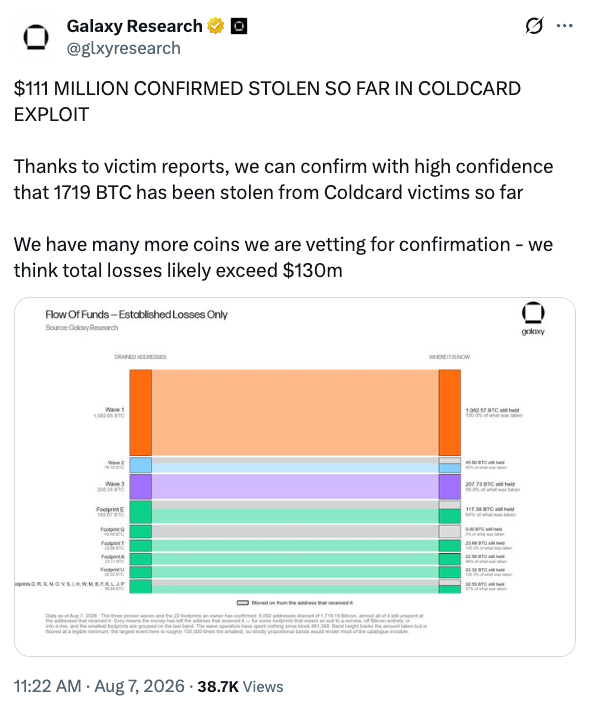
The Coldcard hack is testing crypto investigators’ ability to measure losses from self-custody wallets, where victim reports are critical to establishing the scale of the theft.
Blockchain analytics platform CryptoQuant currently puts confirmed losses at 1,432 Bitcoin, while other analysts have traced substantially more funds to the attack.
Galaxy Research and blockchain intelligence company TRM Labs both say their analysis points to a higher toll, while distinguishing between losses directly confirmed by victims and funds attributed to the attack through onchain patterns.
That makes self-custody attacks difficult to quantify: Unlike an exchange hack, there is no complete list of affected accounts, leaving investigators to build estimates rather than pin down a definitive toll.
Galaxy traces losses beyond victim reports
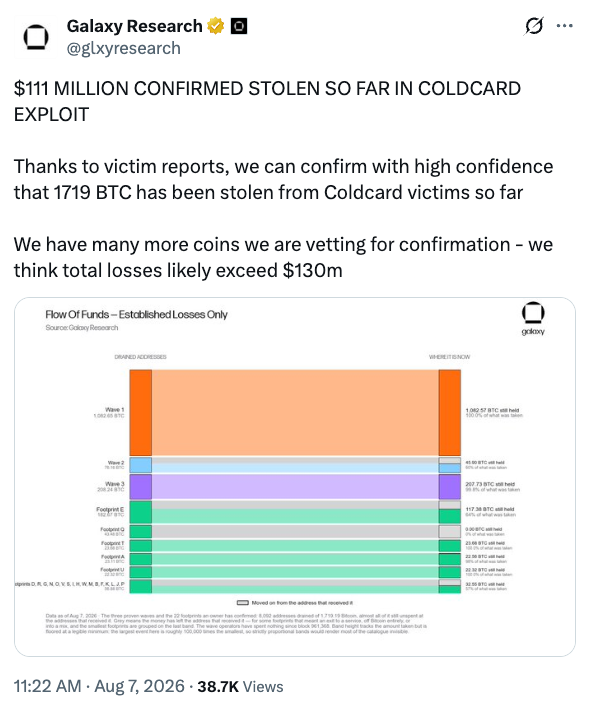
Galaxy’s Alex Thorn told Cointelegraph the platform’s earlier estimate of as much as 1,816 BTC was a potential figure rather than a confirmed loss total.
As of Tuesday, Galaxy put its high-confidence minimum at 1,730 Bitcoin, with Thorn saying the figure could still increase as more victim reports corroborate attack patterns.
Source: Galaxy Research
“We have directly confirmed 450+ BTC directly from victim reports, but their reports have helped identify other, as-yet-unknown victims in more than 730 total BTC,” Thorn said. Galaxy uses those reports to corroborate broader attack patterns, while withholding funds it suspects but cannot yet sufficiently verify. “We are still withholding many more BTC we suspect but for which we lack sufficient corroboration,” Thorn said.
Related: Coldcard hackers transfer 64 BTC and 200 ETH to cryptocurrency mixers
TRM Labs said its independent tracing lands in the same range as Galaxy, while its recent analysis estimated that attackers drained about 1,816 BTC from more than 5,200 addresses across four waves. “Investigators should expect the estimate to keep moving upward before it stabilizes,” TRM’s global head of policy Ari Redbord told Cointelegraph.
CryptoQuant takes a stricter approach
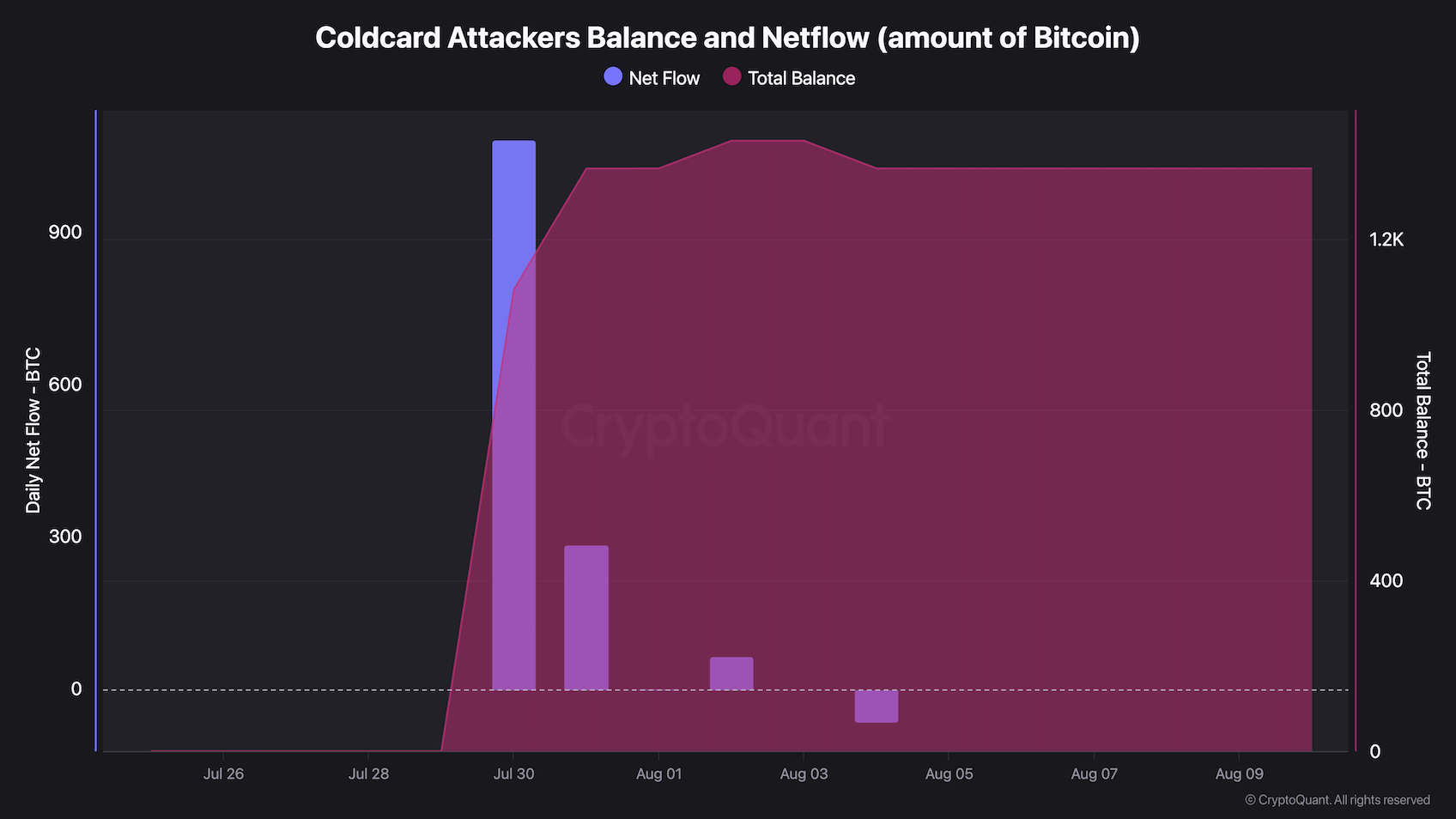
CryptoQuant’s head of research, Julio Moreno, told Cointelegraph that the company starts with public reports from victims, including wallet addresses or transaction IDs, and then checks those reports against known onchain patterns from the attack.
That approach puts CryptoQuant’s confirmed tally at 1,432 BTC, which Moreno described as a floor that could rise if more victims publicly disclose their hacked addresses.
Source: CryptoQuant
Moreno said CryptoQuant is cautious about identifying victims solely from onchain patterns because doing so could produce false positives and inflate the estimate.
“Because the stolen Bitcoin belonged to individuals and not to a centralized entity, like an exchange, we can only confirm what each victim publicly discloses,” he said.
Hard number to pin down
Moreno emphasized the total will remain an estimate because investigators can only confirm what victims disclose. He said:
“Knowing the total BTC stolen is difficult, and it will always be an estimation.”
Chainalysis told Cointelegraph it has not conducted an independent tally of the losses, while blockchain investigator ZachXBT publicly said he has no plans to monitor or trace the incident.
Magazine: Do the Coldcard attacks mean all hardware wallets are now insecure?
Ethereum is consolidating around the $1.8K area after recovering from its June lows, but the broader structure remains under pressure. The daily chart shows ETH trading below important moving averages, while the 4-hour chart suggests that the recent recovery has entered a range. Meanwhile, the exchange supply ratio has continued to decline, pointing to a shrinking amount of ETH held on exchanges.
Ethereum Price Analysis: The Daily Chart
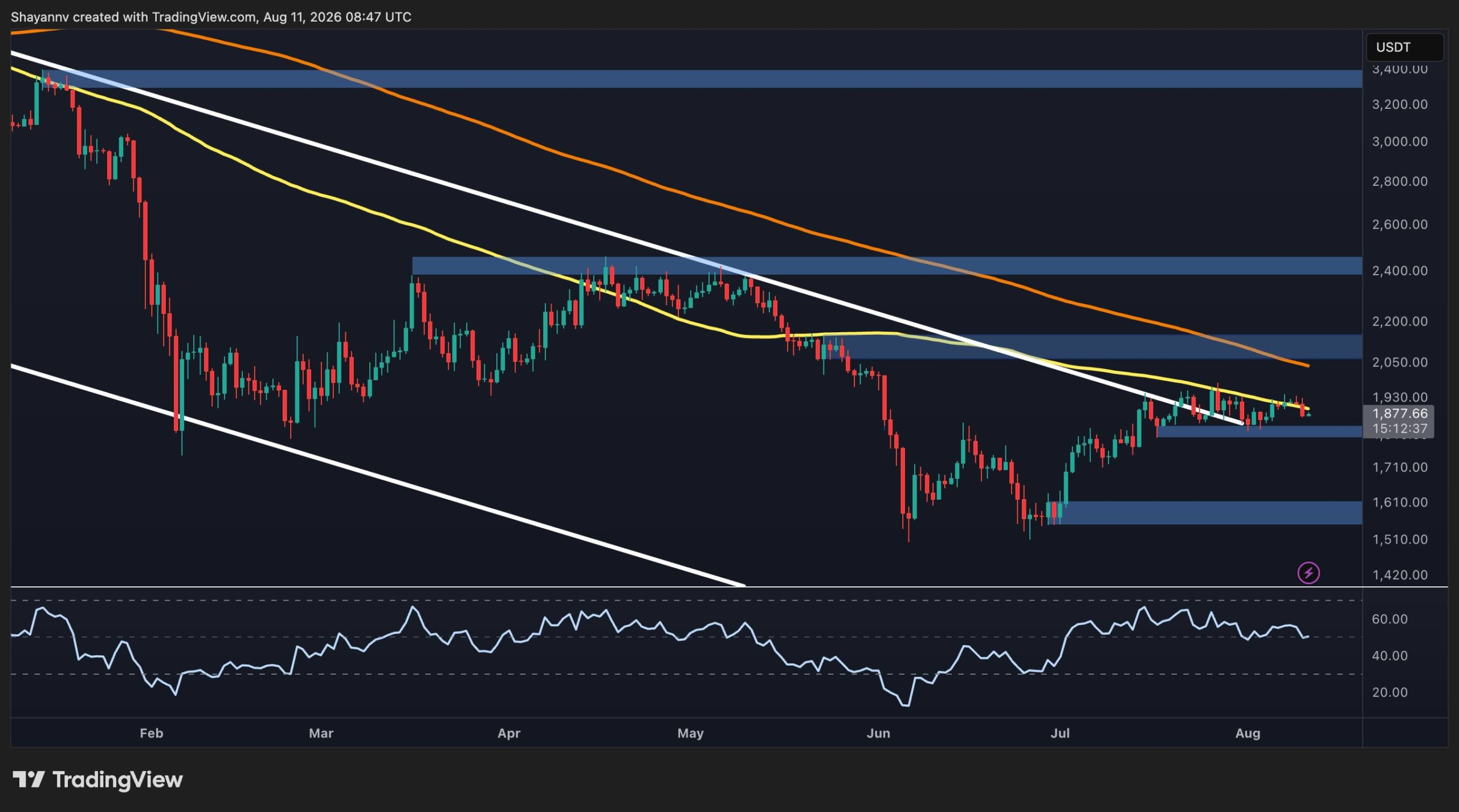
ETH is currently trading around $1.88K, with the daily structure still characterized by a series of lower highs from the earlier 2026 peak. The price remains below the descending white trendline, which has acted as dynamic resistance, as well as below the higher moving averages shown on the chart. The 100-day moving average is currently around $1.9K, making the region an important near-term resistance zone.
The latest price action appears to be forming a consolidation just below this resistance. A sustained daily breakout above the moving average and the $2.1K resistance zone would provide the first meaningful indication that the overall corrective structure is shifting. Above that area, the next major resistance sits around $2.4K, which is a key area for ETH’s recovery.
On the downside, the most immediate support is around the $1.8K short-term lows. This area is particularly important because ETH has repeatedly found buyers around it during the recent consolidation. A daily breakdown below this zone could expose the next support around $1.6K, which previously triggered the latest recovery, and would lead to a drop back into the broken descending channel, making the recent rally just another fake breakout.
ETH/USDT 4-Hour Chart
The 4-hour chart provides a somewhat more constructive picture. ETH has been moving inside a broad ascending channel since the June low, with the lower boundary gradually rising. The recovery pushed price toward the $1.96K resistance zone, but ETH failed to break through and has since pulled back toward the $1.8K support area.
The latest decline has brought the 4-hour RSI down toward the mid-to-lower range, indicating that short-term momentum has weakened following the rejection. However, the indicator is not yet showing an extreme oversold reading, leaving room for another test of the nearby support.
Holding $1.8K would keep the short-term bullish structure intact and could allow ETH to retest the $1.96K level. A successful breakout above that zone would open the way toward the upper channel boundary and the $2K resistance area.
Conversely, a decisive 4-hour close below $1.83K would weaken the current recovery structure. In that scenario, ETH could retrace toward the next support around $1.71K-$1.75K, while the broader demand zone around $1.62K would become relevant if selling pressure accelerates.
Overall, the 4-hour structure remains constructive as long as the $1.83K area holds, but ETH needs to reclaim the $1.96K-$2.05K region to establish a stronger bullish continuation.

On-Chain Analysis
The exchange supply ratio chart shows a notable divergence between ETH’s price and the amount of supply held on exchanges. The ratio has declined steadily from roughly 0.18 in mid-2025 to around 0.127 currently, while ETH is trading near $1.8K.
A declining exchange supply ratio generally means that a smaller share of ETH’s circulating supply is sitting on exchanges. This can reduce the amount of ETH immediately available for spot selling and can therefore provide a constructive longer-term backdrop, particularly if demand returns.
The chart also shows that the exchange supply ratio continued falling even as ETH recovered from the $1.5K area toward $1.8K. This suggests that the recent recovery has not been accompanied by a significant increase in exchange-held supply.
However, the metric should not be interpreted as a standalone bullish signal. Coins can leave exchanges for many reasons, including long-term custody and staking, and the declining ratio does not by itself confirm stronger demand. From a price perspective, ETH still needs to overcome the $2K resistance region to turn the improving on-chain backdrop into a clearer technical recovery.

The post Ethereum Price Analysis: Is ETH’s $2K Dream Dead After the Latest Rejection? appeared first on CryptoPotato.
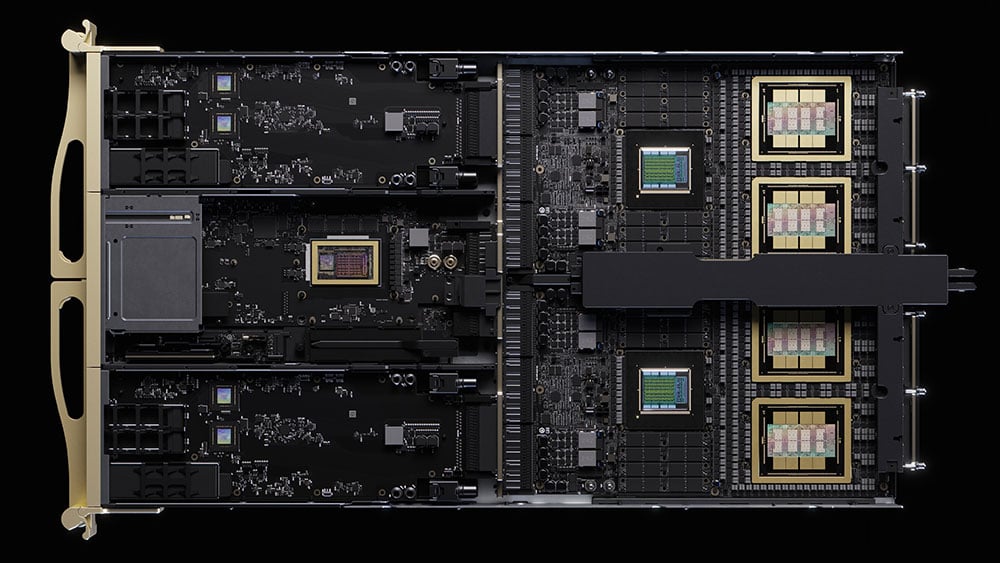
Nvidia (NVDA) stock rose Tuesday in the wake of news that the company has rounded up more than $500 billion in third-party capital to help fund the buildout of artificial intelligence infrastructure. Nvidia announced on Monday that it has partnered with financial institutions Apollo (APO), BlackRock (BLK), Blackstone (BX), Brookfield (BN), Goldman Sachs (GS) and KKR (KKR) to establish AI…
Copyright ©2026 Investor’s Business Daily, LLC. All rights reserved. 87990cbe856818d5eddac44c7b1cdeb8



Cryptocurrency exchange Toobit has been named Global Exchange of the Year at the FinanceFeeds Awards 2026, giving the trading platform its fourth major industry award of the year.
The FinanceFeeds Awards recognize companies across fintech and digital assets, with the Global Exchange of the Year category focused on exchanges capable of operating broad trading infrastructures at scale.
For Toobit, the award comes during a year in which the exchange has expanded well beyond conventional crypto spot and futures markets. Its platform now combines derivatives, copy trading, AI-based trading tools and more than 150 TradFi pairs, while its DEX+ product extends access to on-chain and pre-IPO assets.

The latest win follows three previous awards: Best New Exchange at the Crypto Awards 2025, presented in January 2026; Digital Asset Derivatives Platform of the Year at the Hedgeweek Global Digital Assets Awards in June; and Best Crypto Exchange for Day Trading at the CoinGape Web3 Innovation Awards in July.
That run of awards also reflects how quickly Toobit has built out its trading infrastructure.
The exchange regularly reports more than $30 billion in daily trading volume across more than 1,000 trading pairs, with more than 4 million active traders across 100-plus countries. Although Toobit offers regular spot trading, its strongest focus remains on active traders using perpetual futures, automated strategies, and other higher-frequency products.
From Crypto Futures to Nvidia in the Same Account
One of the more unusual parts of Toobit is the range of markets available without requiring traders to leave the platform.
In our Toobit review, we found that a user could move from copy-trading a professional strategy to taking a leveraged position in Nvidia stock, then use an AI model to manage another trade via natural-language instructions.
Toobit’s TradFi product is particularly useful in that setup because, instead of requiring a separate brokerage account, the exchange offers exposure to stocks, forex, and metals via USDT-settled perpetual contracts.
Its stock futures include major U.S. names such as Tesla, Nvidia, and Apple, while an expansion announced in May added another 13 trading pairs, including Qualcomm, IonQ, and Oklo – there are currently more than 150 pairs and growing all the time.
Because these products are derivatives rather than shares held directly by the trader, users can trade with USDT already held in their Toobit futures account. The contracts can also continue trading outside conventional equity-market hours, including weekends and holidays.
Leverage of up to 500x is available on some TradFi perpetual contracts. Toobit’s futures interface also supports simultaneous split and merged position management.
TradingView integration, futures bots, and multi-chart layouts that support up to 8 views are also built into the platform.
Toobit Brings AI Directly Into Trading
Artificial intelligence has become another major part of Toobit’s expansion.
In March, the exchange released its AI Agent Trade Kit, an open-source framework designed to connect large language models directly with trading functions on Toobit.
The system uses the Model Context Protocol (MCP), allowing compatible AI agents to carry out tasks such as monitoring markets, managing spot and futures orders, and tracking portfolio balances via natural-language commands.
The kit supports more than 65 tools and can run locally, with credentials stored on the user’s device rather than transferred to an external AI service.
Toobit has also developed Synapse, its built-in AI assistant, which requires no outside configuration or separate AI subscription. It can assist with market research, strategy generation, and analysis of existing positions directly from the Toobit interface.
Zero Spot Fees Run Until September
Toobit’s zero-spot-fee promotion runs from June 26 through September 26, 2026, removing maker and taker fees on eligible spot trades during the campaign.
Outside the promotion, Toobit’s standard spot fees start at 0.075% for makers and 0.10% for takers.
Base perpetual futures fees are 0.02% for makers and 0.06% for takers.
Deposits are free, while crypto withdrawals vary by blockchain network. Toobit also charges no fee for its Convert tool, account creation, inactivity, P2P trading, or DEX+ transactions, although blockchain gas fees still apply to DEX+ activity.
Proof of Reserves Adds to Security Framework
The exchange’s expansion has been accompanied by additional reserve and custody measures.
A May 2026 Proof of Reserves review, independently verified by Hacken, showed reserves exceeding 100% for the major assets examined.
As of May 1, Toobit reported reserve ratios of 106% for BTC, 106% for ETH, 106% for USDT, and 102% for USDC. The audit covered balances belonging to more than 640,000 accounts and included verification of liabilities.
Toobit also operates a ~$40 million Shield Fund intended to cover qualifying losses resulting from internal technical or security failures, with fund information displayed on a public dashboard.
Custody infrastructure includes Fireblocks’ Multi-Party Computation technology alongside air-gapped cold-wallet storage, and the exchange is ISO 27001-certified.
The post Toobit Named Global Exchange of the Year as AI and TradFi Push Expands appeared first on Cryptonews.




Russia’s central bank has compiled a proposed list of crypto assets that could be admitted to public trading on exchanges under new rules approved last week.
The list includes Bitcoin, Ether and Tether’s stablecoin USDT, the Bank of Russia said Tuesday, adding that the assets meet criteria including market capitalization, average daily trading volume and at least five years of price history on overseas markets.
The proposal follows a new law, signed by President Vladimir Putin on Aug. 4, that gives the Bank of Russia authority to determine which digital currencies can be admitted to organized trading and set related rules.
Under the rules, non-qualified investors could buy up to 300,000 Russian rubles ($3,650) worth of cryptocurrency per year through each intermediary, including a broker, crypto exchange service or asset manager. Qualified investors would face no purchase limits for crypto assets traded on exchanges or over-the-counter markets.
“Before making transactions, all investors, regardless of their status, will have to pass a test and familiarize themselves with the risks of investing in crypto assets,” the Bank of Russia said.
The central bank said the restrictions are designed to protect non-qualified investors from sharp and unpredictable fluctuations in crypto prices. The regulator is accepting comments on the proposal until Aug. 24.
Related: Russia cracks down on 9 crypto exchanges in Moscow City

However, a loss in the U.S. Supreme Court could put a halt to the many other local cases seeking damages from fossil fuel companies. “If the Supreme Court were to really narrow and prevent claims like this from going forward, it could have a significant effect on whether other cases, grounded in similar arguments and on similar state law claims, could proceed as well,” says Reisch.
The case’s significance cannot be understated, says Reisch. “This is the biggest climate-related case that the Supreme Court has heard, and it really goes to fundamental issues of fairness about whether or not communities can hold the companies that have been major drivers of climate change, and contributors to climate harm through the deceptive marketing and [upstream production and sales] of fossil fuel products, … accountable [for their contributions to] the mounting losses.”
But a loss in court doesn’t mean the fight is over. Experts say they still expect to see cases brought against fossil fuel companies under other legal grounds, as well as cases brought in other countries.

Karrueche Tran Wows Fans Cooking For Deion Sanders’ Birthday

Taylor Swift, Lyle Lovett join 2026 Nashville Songwriters Hall of Fame

Altius Minerals Corporation (ALS:CA) Q2 2026 Earnings Call Transcript


![How To Invest in Crypto as A COMPLETE Beginner [2025 GUIDE]](https://wordupnews.com/wp-content/uploads/2026/01/1769891288_maxresdefault-80x80.jpg)
-

 Fashion4 days ago
Weekend Open Thread: Mattifying Sunscreen
-

 Fashion4 days ago
Frugal Friday’s Workwear Report: Cap-Sleeve Pointelle Crewneck Sweater
-

 Sports6 days ago
Jordan Coyle & Cordiamo take Laya Arena Stakes at RDS
-

 News Videos3 days ago
Can Astrology Help Find Gold and Silver Trends? A Financial Astrology Guide
-
 Business6 days ago
US stocks: Dow closes at record on Mideast optimism; SpaceX, AMD drag Nasdaq
-

 Politics5 days ago
Reform UK And Greens Sink To Lowest Favourability Ratings To Date
-

 Business7 days ago
Nvidia Stock Climbs 2.5% as Chip Sector Rally Builds Ahead of AMD Earnings, Nvidia’s Own Report Looms
-

 Tech7 days ago
OpenAI, Anthropic AI agents targeted real people and systems in cyber tests
-

 Business6 days ago
Supply chain issues impact Ingredion
-

 Tech4 days ago
Rinn Pharma & Biopharma to join NordicPharmaTrain network
-

 Business3 days ago
How to Start a Cleaning Business: A Step-by-Step Guide
-
 Crypto World7 days ago
Dow and S&P 500 Hit Records on AI Earnings: When Will the Bubble Burst?
-

 Business2 days ago
Datadog: Best Of Breed For Multiple Reasons
-

 Business3 days ago
BDC Weekly Review: Private BDC Q2 Numbers Are Strong
-

 Business6 days ago
McDonald’s (MCD) Q2 2026 earnings
-
 Crypto World7 days ago
Dollar Index Trapped at 100 as Hawkish Fed Meets Official Selling
-

 Fashion7 days ago
The Bright Side of Black and White
-

 Business7 days ago
Apple UK encryption challenge filed against Home Office
-

 Fashion6 days ago
Suit of the Week: Me + Em
-
Sports6 days ago
Spider-Man: Brand New Day ending explained: Is Peter Parker alive?
You must be logged in to post a comment Login