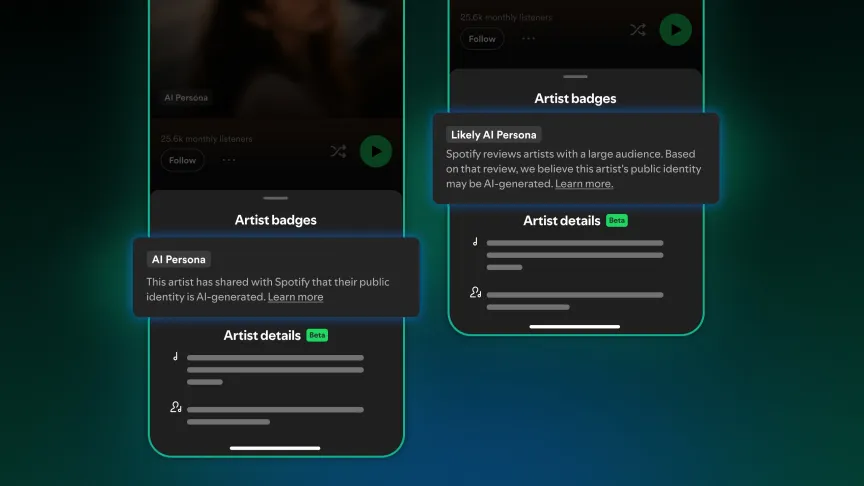
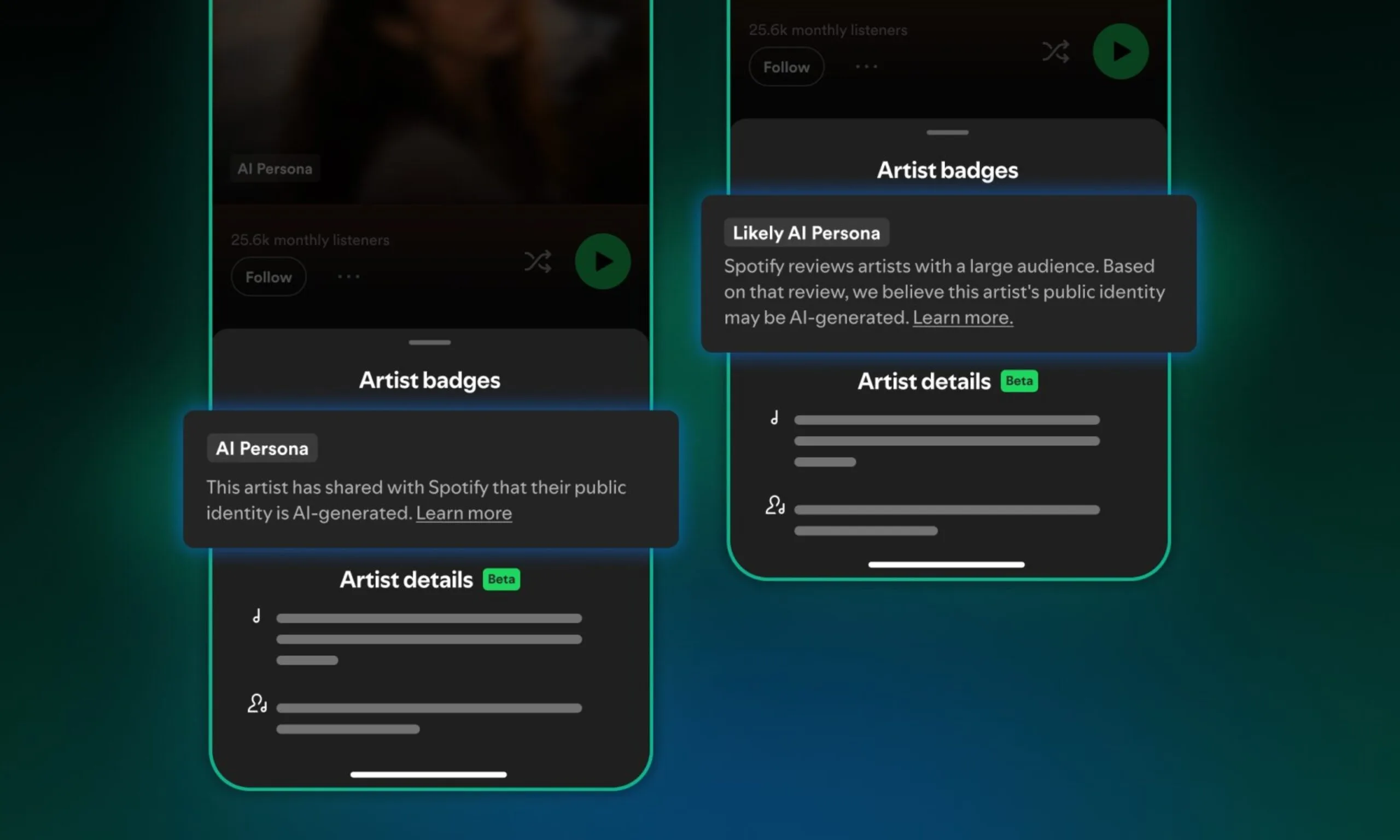
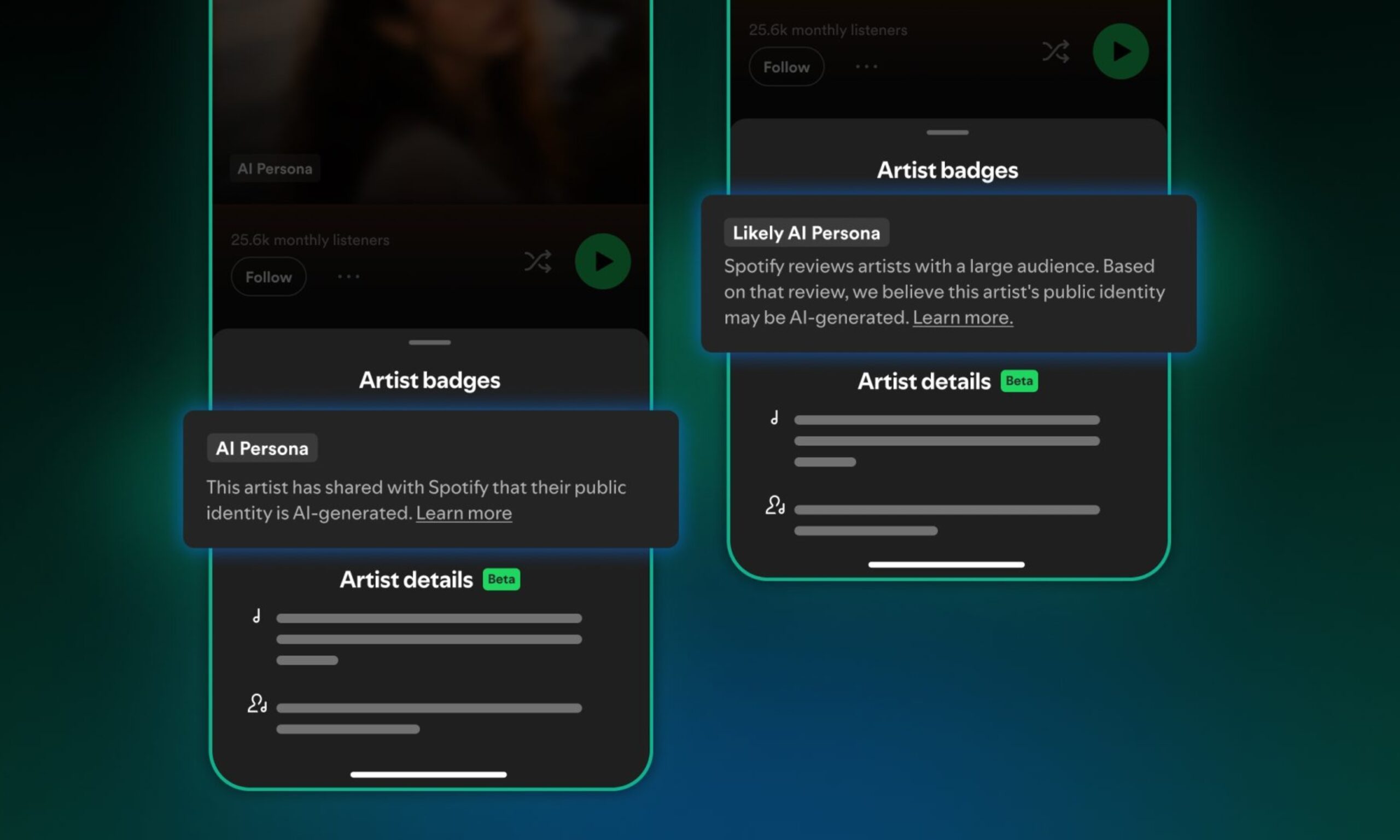
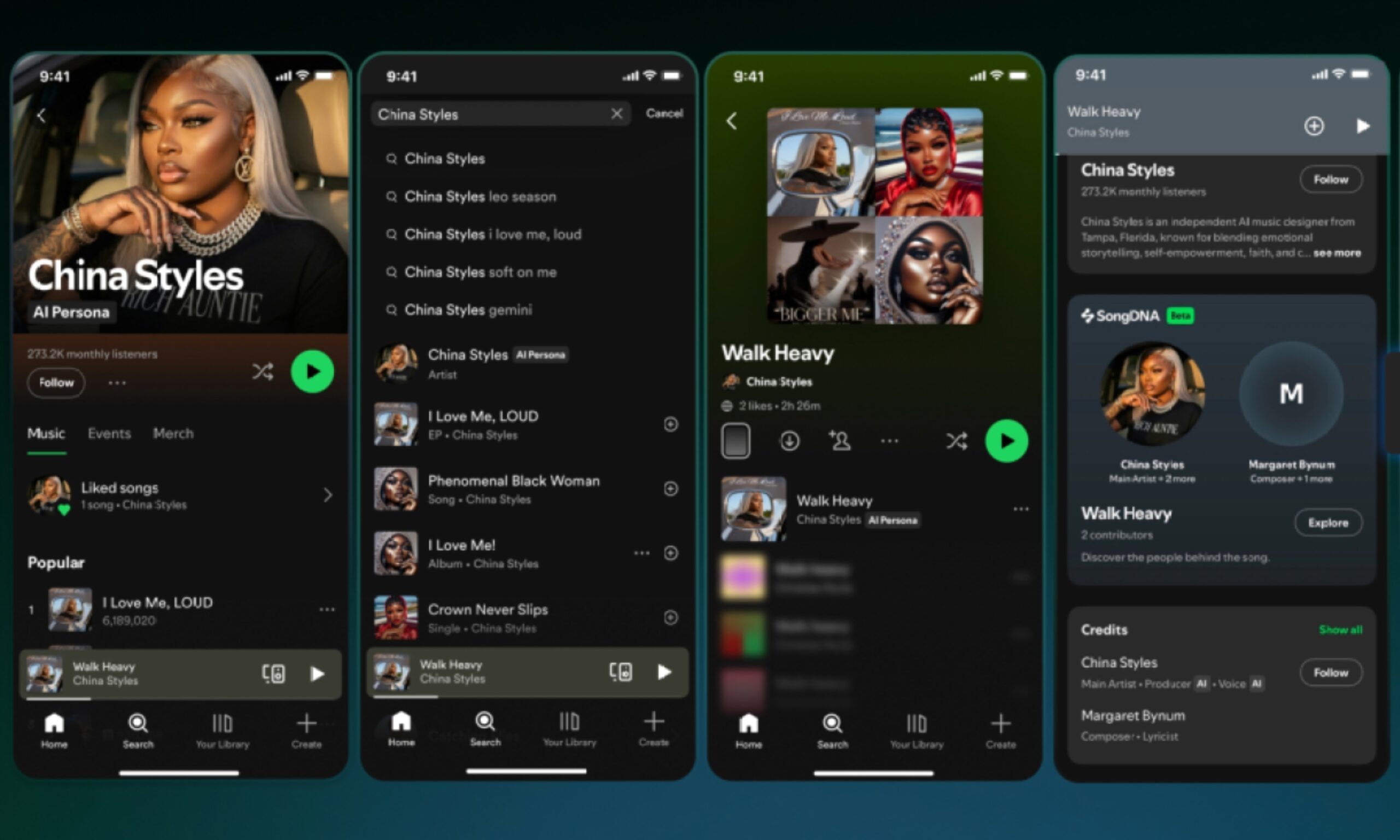
Music fans who are seeking to pin down AI artists versus human creatives on Spotify will soon have a new tool at their disposal. On Tuesday, the music streamer shared that it’s adding an “AI Persona” label to the platform as another way to help fans — and artists — identify AI creators. The badge will start appearing in profiles, songs, search results and in an artist’s About section in mid-September.
If you’re worried about those tracks popping up in your finely tuned algorithm, don’t. Spotify explained that AI Personas will automatically be excluded from your personalized recommendations by default, unless you choose to follow the AI Personas account or a specific AI music profile.
How will the streamer pinpoint which accounts are AI? Starting Aug. 11, accounts can self-report via Spotify for Artists, but Spotify will also conduct its own reviews and tag profiles with the AI Persona label. According to the streamer, it will check “artist profiles and identify those whose public identity — the identity an artist presents on their profile, including name and imagery — appears to represent photorealistic AI-generated identities.” To take it a step further, when you, as a listener, click the badge, you’ll be able to see whether the artist disclosed their AI identity themselves or if Spotify classified them as an AI artist.
Spotify
During the coming months, the streamer will enable listeners to flag suspected AI profiles. Artists can appeal if they think they’ve been incorrectly designated as AI. The company clarified that the move is about verifying an artist’s authentic identity, not about how the music was made.
It’s one of the latest ways Spotify is aiming to help listeners distinguish between AI and human artists. While the streaming service has a range of AI tools that let subscribers curate their listening experience, it’s also launched artist profile protection, verification badges and policies to crack down on deepfakes.
Advertisement
Kourtnee Jackson
Senior Editor
Kourtnee covers streaming services and entertainment. She previously worked as an entertainment reporter at Endgame 360, where she wrote about film, television, music, celebrities and streaming platforms.
See full bio
I’ve caught myself scrolling past an artist photo on Spotify assuming there was an actual human behind it, only to later find out I was wrong. That has been happening a lot lately. That guessing game is about to end.
Spotify is rolling out a new “AI Persona” badge, which is designed to flag artist profiles built around AI-generated identities (anything from the name, face, bio, and visual image) rather than real people. The label will go live across the app starting in mid-September.
Spotify
So how exactly will this badge work?
Starting today, artists can voluntarily flag their profile with the “AI Persona” badge through Spotify for Artists. That’s the part where the streaming service is going easy on creators. However, it’s not like Spotify is leaning entirely on creators’ honesty.
The platform also has its own review process. It combines human moderators and AI detection tools to catch photorealistic AI-generated identities that haven’t been disclosed voluntarily. Reviews are beginning with artists who’ve already crossed certain listener thresholds.
Spotify plans to complete the process by mid-September. Post that, the AI Persona badge will start showing up directly on the artist’s profile banner, the About section, inside Search results, and even on track listings within playlists. Basically, it will show up everywhere where listeners come across a creator’s profile.
Advertisement
If Spotify’s own review team applies the label rather than the artist disclosing it, that artist gets notified. Then, they can either confirm it or file an appeal with the platform.
Spotify
What happens to their music once they’re labeled?
Here’s the part with real teeth. Spotify isn’t just trying to flag identities that are created using AI. In the process, it’s also trying to bump up the reach and discoverability of organic content. Once a profile carries the AI Persona badge, its music is excluded from personalized recommendations, unless a listener specifically chooses to follow that artist.
That said, I also want you to know that the badge only addresses whether the artist’s public identity is genuinely human, not whether AI played a role in actually producing the song. That bit is already covered separately through Spotify’s existing AI Credits and SongDNA features.
This fits into a broader trust push Spotify’s run all year, including its Verified by Spotify badge.
While tech leaders continue to debate the merits and pitfalls of open-weight AI models, developers aren’t slowing down. LTX on Tuesday released the newest version of its open world model, called LTX-2.5.
LTX-2.5 is an open world model, which is different from most AIs you probably know. While LLMs are good at generating text, world models are complex webs that translate the physical world into a language that generative AI can understand. The idea is that the model has a grounded understanding of our world, so it hallucinates less. Think about robots that can navigate a room without bumping into anything, or AI video clips that know to have people walk around objects rather than fade through them like a poltergeist. You can use world models to simulate digital environments, generate content and help program robots.
The new model has improvements to reduce the number of visual artifacts (or errors) the AI makes, better consistency across generations thanks to a new pixel diffusion process. Because it’s an open model, companies can download and customize the model for their own needs; that helps keep their intellectual property safe. So a movie studio could use LTX-2.5 to create and edit video clips featuring their characters. LTX-2.5 is optimized for local inference on Nvidia’s RTX GPU, which means developers can run it on their own hardware and keep their work away from cloud-based AI services.
LTX-2.5 is available to download and use now on sites like HuggingFace and ComfyUI.
Advertisement
LTX is one of the most popular developers of open-weight AI models. LTX’s models have been downloaded more than 33 million times by HuggingFace users, including those who made their own versions based on LTX’s blueprints. OpenAI and Google each have a family of open-weight models, GPT-OSS and Gemma 4, respectively, though the companies’ number of closed models far outnumbers their open-weights ones. Anthropic has no open Claude models.
Open-source advocates have long argued that the best way forward is for tech companies to make public disclosures about how their tools work. That debate has only intensified in the AI era. Popular Chinese models are being released in open formats, like the new Kimi 3 from Moonshot, which gives developers, researchers and cybersecurity experts insights into how it works. When the Trump administration was reportedly considering banning Chinese and other foreign AI models in July because it was worried about cybersecurity threats, many industry leaders spoke up, saying such a move could actually threaten cybersecurity.
While most AI leaders say open-weights models shouldn’t be banned, the big players aren’t rushing to release many of these kinds of models. Meta CEO Mark Zuckerberg is encouraging more open AI. He published a lengthy essay on Monday outlining his position that open-weight models will bring the “benefits of AI” to more people. Meta also released a new open-weights model called Muse Glimmer and promised to release the weights of another recent model, called Spark 1.2.
LTX has a similar philosophy. Neither government nor private companies would be good stewards of private AI models, CEO and co-founder Zeev Farbman wrote in a recent post. One is primarily motivated by ever-shifting political goals and the other by pure profit.
Advertisement
“It shouldn’t sit with a small number of decision makers, regardless of whether they’re in government or a limited number of powerful companies,” Farbman writes. “Decisions belong with the end users, through models they can control and inspect for themselves.”
Katelyn Chedraoui
Reporter 2
Katelyn is a reporter with CNET covering artificial intelligence, including chatbots, image and video generators. Her work explores how new AI technology is infiltrating our lives, shaping the content we consume on social media and affecting the people behind the screens. She graduated from the University of North Carolina at Chapel Hill with a degree in media and journalism. You can reach her at kchedraoui@cnet.com.
See full bio
Someone has ported Word for Windows 1.1a to Windows 11
It’s a fully native port
It’s not easy to get it up and running on your system — should you wish to — but there are other alternatives to the feature-creep of Notepad
Somebody has taken a version of Word from 1990 and created a fully functional port for Windows 11 — and as you might imagine, this is a word processor with an incredibly light footprint.
Tom’s Hardware noticed this feat, which was achieved by Justin Marshall, who’s the developer behind the ‘Microsoft Word for Windows 1.1a’ project on GitHub.
As Marshall explains, this is not an emulator or some kind of fudge, rather it’s a “fully working native Windows x64 port” of Word for Windows 1.1a which was codenamed ‘Opus’ back in the day.
Latest Videos FromTechRadar
Advertisement
This port was possible because Microsoft released the source code for the app (over 10 years ago), and Marshall took that code and ran with it. (As Tom’s notes, it’s available from the Computer History Museum).
Marshall explains that the project builds on that original Word source code (and complementary resources) with “modern replacements for the 16-bit assembly, segmented-memory, and Win16 platform boundaries”.
The result is a very simple word processor that takes the idea of a streamlined app to new levels. Indeed, this modern take on Word for Windows 1.1a can fit in less than 1MB of RAM in Windows 11. How’s that for lean? And there’s not a drop of AI in sight…
Advertisement
Analysis: Word up
(Image credit: Elnur / Shutterstock)
Can those fed up with Microsoft’s feature-creep in Notepad, or other bloat, go and pick up this spin on Word from 1990 for a breath of fresh air in terms of a lightweight word processor? No, unfortunately, as there’s no installation package to simply download and fire up.
Sign up for breaking news, reviews, opinion, top tech deals, and more.
That’s because, as Marshall points out, the “historical source files retain their original Microsoft and third-party copyright notices”, which means that commercial use or even sharing copies on the web isn’t permitted.
Advertisement
This is why if you want to use Word for Windows 1.1a on your modern PC, you’ll need to get it up and running by following the instructions on GitHub. This isn’t for the technically faint-of-heart, as you might guess, and you’ll need Visual Studio 2022 with Desktop development with C++, a Windows 11 (or 10) SDK installed through Visual Studio, as well as CMake 3.25 (or newer) and PowerShell.
In short, it’s unlikely that many people will go to the effort, but it’s not surprising that a fair bit of interest has been stoked in this project simply because of not just the novelty — although that’s obviously the driving factor — but also as it’s an illustration of how far Word can be stripped back, running with such a tiny footprint and resource usage.
One Redditor commenting on this simply said: “Not all heroes wear capes.”
Advertisement
Another observed: “For the curious, Microsoft Office 97 will install and run on Windows 11 with no hassle. I’ve been using it for years now just for the fun of it.”
Bear in mind, of course, that should you take that approach, you’ll be lagging behind considerably for supported file formats, and also in the security stakes (that’s the main drawback with using apps that haven’t been updated in a long time, and lack patches against exploits that have since popped up).
If you are keen on a lightweight alternative to Notepad, then take a look at TinyRetroPad, which is built very much in the same vein as the original Microsoft text editor, and is just as tiny as the name suggests.
The music industry has a problem it rarely discusses without wrapping it in words like “innovation,” “engagement,” and “creativity”: once hundreds of millions of people are already paying every month to stream virtually every song ever recorded, where does the next pile of money come from? Raising subscription prices only gets you so far, advertising has its limits, and convincing people to buy music they effectively already rent has become rather difficult. Enter generative AI, which offers Spotify and the record labels something irresistible: an entirely new way to monetize the same catalog all over again.
Spotify users and musicians should therefore pay very close attention to what comes next. Spotify is preparing to let subscribers use generative AI to create covers and remixes of commercially released music, with Universal Music Group already onboard and Merlin joining the party on August 4. The feature is expected to become an additional paid option for Premium subscribers, which is a rather elegant way of saying that after charging you to hear the original recording, the music industry has discovered it might also be able to charge you to mess with it.
Somebody in a boardroom will undoubtedly call it “unlocking value” without being struck by lightning.
Related Reading:
What Exactly Is Spotify Building?
Spotify’s forthcoming tool will allow users to create AI-generated covers and remixes using music from participating artists and songwriters. The company first announced licensing agreements with Universal Music Group and Universal Music Publishing Group in May, followed by a separate agreement with Merlin in August. Pricing and a firm launch date have not been announced, but Spotify has made clear that the feature is intended to become another paid layer within its Premium ecosystem.
Advertisement
Spotify says participating artists and songwriters will receive credit and compensation, and that consent will be fundamental to the model. Merlin has been even more explicit, stating that artists represented through its participating labels will have the option to take part. That matters because this is not being presented as open season on every recording sitting inside Spotify’s servers.
So no, you should not assume that Spotify is about to hand you “Seven Nation Army” and let you turn it into Bavarian techno because you had three beers and discovered a BPM slider. Nor should we assume that The Cure’s “A Forest” will suddenly become available for someone to transform into a 160 BPM EDM anthem until Robert Smith’s head explodes. Those recordings would have to be part of the participating catalog, and Spotify has not announced either one.
Do Artists Actually Get a Say?
According to Spotify and Merlin, they do, and that distinction is important. Spotify repeatedly describes the system as involving participating artists and songwriters, while Merlin specifically says its artists will have a choice. That already puts the proposed service on firmer ethical ground than the Wild West model of generative AI, where a voice gets cloned, a composition gets mangled, and everyone starts asking questions after the streams have already accumulated.
The unanswered question is how that consent works once actual music-industry contracts enter the room. Recorded music involves separate rights in the sound recording and underlying composition, and those rights may be controlled or administered by artists, labels, songwriters, publishers, or some combination of all four. An artist may control one thing, a label another, and a publisher something else entirely.
That is where Spotify still owes listeners and musicians a much clearer explanation. Does the artist personally approve participation? Can a label authorize certain uses of a master under an existing recording agreement? Can a publisher approve uses of the composition without the songwriter making an individual decision each time? What happens when the performer, songwriter, label, and publisher are all different parties and one of them looks at your death-metal interpretation of “Dancing Queen” and sees nothing but incremental revenue?
Advertisement
Those are not insignificant contractual details. They determine whether “artist consent” means genuine creative control or merely that someone legally entitled to license the work has signed the correct piece of paper.
Spotify AI Labeling (beta)
There Is Actually a Good Version of This
There is a legitimate argument for what Spotify is trying to build. AI covers and remixes are not going away, and a licensed system that identifies the original creators, compensates rights holders, and restricts participation to approved works is preferable to an unregulated platform where somebody clones a voice, copies a composition, uploads the result, and waits for a lawyer to notice.
Advertisement. Scroll to continue reading.
There is also nothing inherently offensive about remix culture. Hip-hop, electronic music, dub, dance music, and countless other genres have spent decades sampling, reshaping, and reconstructing existing recordings. Some of the most influential music ever made emerged from artists taking existing sounds apart and putting them back together in ways nobody expected.
Advertisement
The difference is that doing it well traditionally required some degree of talent, judgment, taste, and technical ability. Generative AI is about to drop that barrier through the floor. That could produce genuinely fascinating creative work, but it will also produce a tidal wave of absolute rubbish because there is no technological breakthrough capable of curing bad taste.
And Here Comes the Money
This is where the warm feeling starts to disappear. Spotify is not building this purely because it wants listeners to discover their inner Quincy Jones. The remix capability is being positioned as another paid product, while the labels and rights holders involved are openly discussing new forms of monetization and compensation. Businesses are allowed to make money, obviously, but the music industry has become remarkably talented at turning every new technological shift into another opportunity to charge somebody for interacting with recordings that already generate revenue.
We have spent years watching streaming turn ownership into access, access into subscriptions, subscriptions into multiple tiers, and those tiers into increasingly elaborate packages. Now the industry has identified another product hiding inside the music it already licenses: your ability to modify it.
The original recording makes money. The AI remix can make money. The tool required to create the remix can make money. The labels and publishers can collect licensing revenue from the process. And if somebody eventually takes that AI remix and presses it onto a $45 PETG record, we will have achieved the perfect circle of modern music economics: take somebody else’s song, run it through artificial intelligence, charge the listener to alter it, monetize the derivative version, and then sell them a physical copy of the result.
Advertisement
Suno must be furious it didn’t invent the entire chain first.
From AI Sludge to AI Remixes
That is what makes Spotify’s announcement such a useful companion to the Suno vinyl story. Suno is attempting to give AI-generated music the physical legitimacy of a record, even if the “record” happens to be made from PETG and the music might have been generated while somebody waited for the microwave to finish.
Spotify is approaching the problem from the other end. It starts with legitimate, copyrighted, commercially released music and offers AI as the means to mutate it into something new. In both cases, the sales pitch wraps itself around creativity and access, but there is a very obvious commercial engine underneath.
Labels spent years fighting piracy because they were losing control over copying. They fought streaming until they figured out how to monetize it. They spent the early AI era warning about unauthorized training, cloning, and derivative works. Now that licensing structures are beginning to emerge, the language is changing very quickly from existential threat to exciting new revenue stream.
Advertisement
Funny how that happens.
The Real Test Is Artist Control
Spotify deserves some credit for attempting to build licensing, attribution, and compensation into this system before releasing it. That is considerably more responsible than dumping an unrestricted AI generator onto hundreds of millions of users and asking the legal department to hide under a conference table.
But the phrase that matters here is not AI-powered. It is artist-approved. If Robert Smith can say no and “A Forest” remains “A Forest,” fine. If Jack White decides that “Seven Nation Army” has already endured enough football stadiums without being transformed into yacht rock by someone named Chad in Scottsdale, even better.
Advertisement. Scroll to continue reading.
Advertisement
The problem begins if “consent” ultimately means that somebody holding sufficient contractual rights inside a multinational music company can approve the use because another revenue stream looked attractive during an earnings call. At that point, we should stop calling it fan empowerment or participatory creativity.
Really, the shape is ideal for long-term use. It’s fairly ergonomic, and it’s easy enough to lay your hand across with a relaxed grip. I found it to be a great option for raid nights in Destiny 2 (with as many as five or six Crota runs in one night) and more chill games like The Big Walk, where precision and agility take a bit of a back seat to consistency and comfort.
While the Naga V3 Pro weighs 116 grams with the heaviest twelve-button side panel (the six-button panel is 115 grams, and the two-button is 113), the mouse doesn’t feel particularly heavy. The weight is all kept fairly low, and is distributed well across the mouse. Compared to some older mice with high-up batteries and nose-heavy shapes, the Naga hardly feels like its weight; I would’ve guessed it was below 100 grams if I hadn’t checked. You’ll notice the added heft if you’re switching directly from a 60 gram gaming mouse, but otherwise, this mouse manages its mass very well.
One downside to its old-school vibe is the limited color options. Black is the only version available, and while that’ll always be the most popular (especially for Razer), a more niche mouse like the Naga V3 Pro could have definitely benefitted from another color.
Advertisement
So Many Buttons
This mouse has an absurd number of buttons. I found myself struggling to use all of them, but I’m sure there are quite a few people who still won’t think it’s quite enough.
Like the Logitech MX Master 4, the Naga incorporates a customizable mouse wheel with options for smooth or ratcheting operation, along with a “precision tactile” mode that decreases the space between each of the scrolling steps. The wheel also has a tilt function for horizontal scrolling; it’s ideal for spreadsheets and multimedia work that requires two axes of movement, but can just as easily be remapped to any number of macros (I could see it being useful for leaning to the left or right in a tactical shooter like Rainbow Six: Siege).
Drawing further comparisons to the MX Master line, I really found this mouse to be good for everyday work. The comfortable shape and extensive navigation capabilities made it great for multimedia work, and the number pad was ideal for mapping software-specific functions, especially for photo and video editing software that can require some repetitive and complex inputs.
Despite the sheer number of buttons, I really found that they never got in the way when not in use. All of them are placed in such a way to be easily accessible without disrupting the basic left and right click functionality. The only button I found myself regularly pressing on accident was the third click button, which can be locked entirely using a switch on the underside of the mouse.
Engineer Shane Wighton set out to answer a simple question that industrial food processors have quietly solved for decades. What if you could force a potato or apple to shed its own skin without a blade ever touching it? His answer involved building a high-pressure steam system dangerous enough that he ran every test from behind a blast chamber, operating valves remotely so he would not be standing next to something holding the energy of several sticks of dynamite.
Steam peelers have long been utilized in industrial potato chip production. A sealed vessel is filled with produce, and the chamber is saturated with high-pressure steam. The epidermis absorbs heat substantially faster than the underlying flesh. The water right beneath the epidermis gets fairly heated. When a fast valve is opened, the pressure lowers dramatically. The skin just peels away as the trapped water rapidly vaporizes and expands aggressively. Wighton had never seen such clear, fast-moving film of the incident before. He reasoned that it was time to create one that was transparent so that everyone could see the problem for themselves.
ALL-IN-ONE ELECTRIC PRESSURE COOKER: Replace multiple appliances with one 9-in-1 multi cooker. Pressure cook, slow cook, make rice, sous vide, steam…
COOK UP TO 2X FASTER*: HyperHeat technology builds pressure quickly to speed up cooking time compared to traditional methods, helping you get meals on…
SEAR AND SAUTÉ IN ONE POT: Skip extra pans—use the large cooking surface to sear meats and sauté ingredients directly in the pot for deeper flavor…
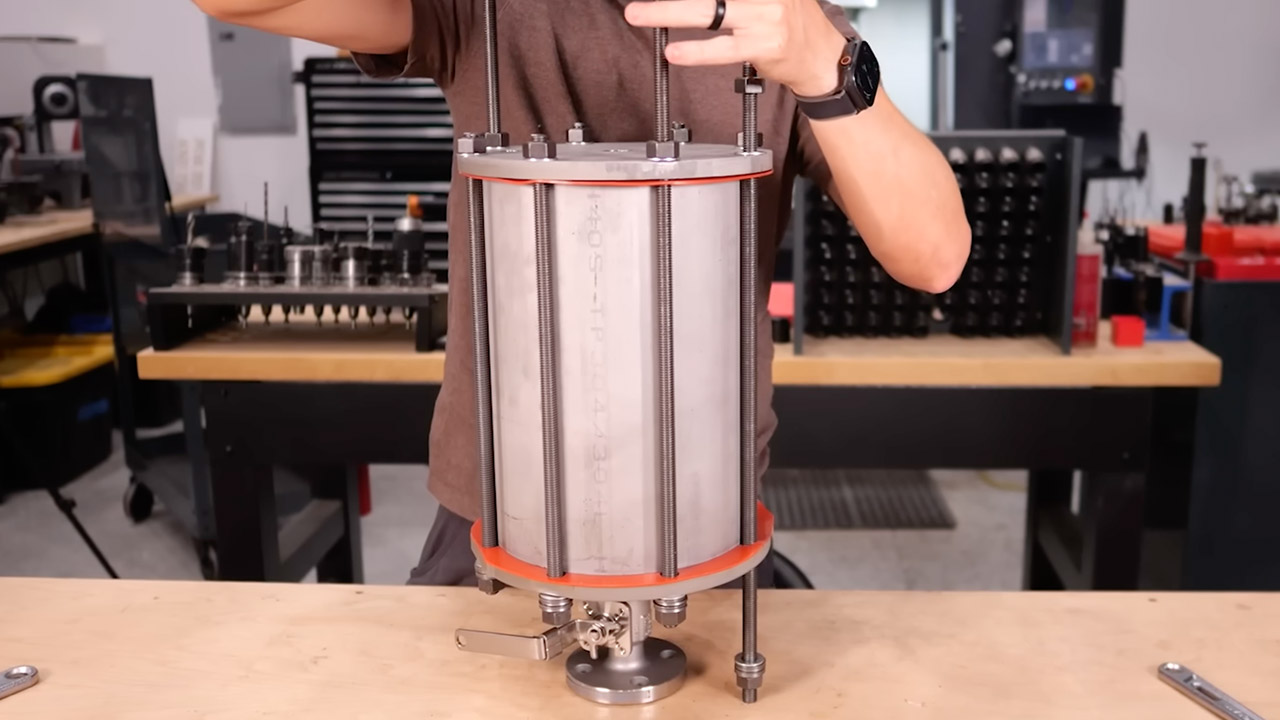
He started by building a boiler out of thick-walled stainless steel tubes and plates. He machined the ends flat to provide a firm seal and installed high-temperature silicone gaskets between the faces. He held the whole thing together with some long threaded rods, but he knew stainless steel expanded far more than the rods when heated. Standard washers would have allowed the joint to slacken. Wighton piled some Belleville washers, which are conical spring disks that may be arranged to provide a continuous clamping force even as the metal increases. He had a 2 kW immersion heater submerged in the water, a mechanical safety valve to keep the pressure at 200 psi, and an air cylinder to safely open the outlet valve from a distance.
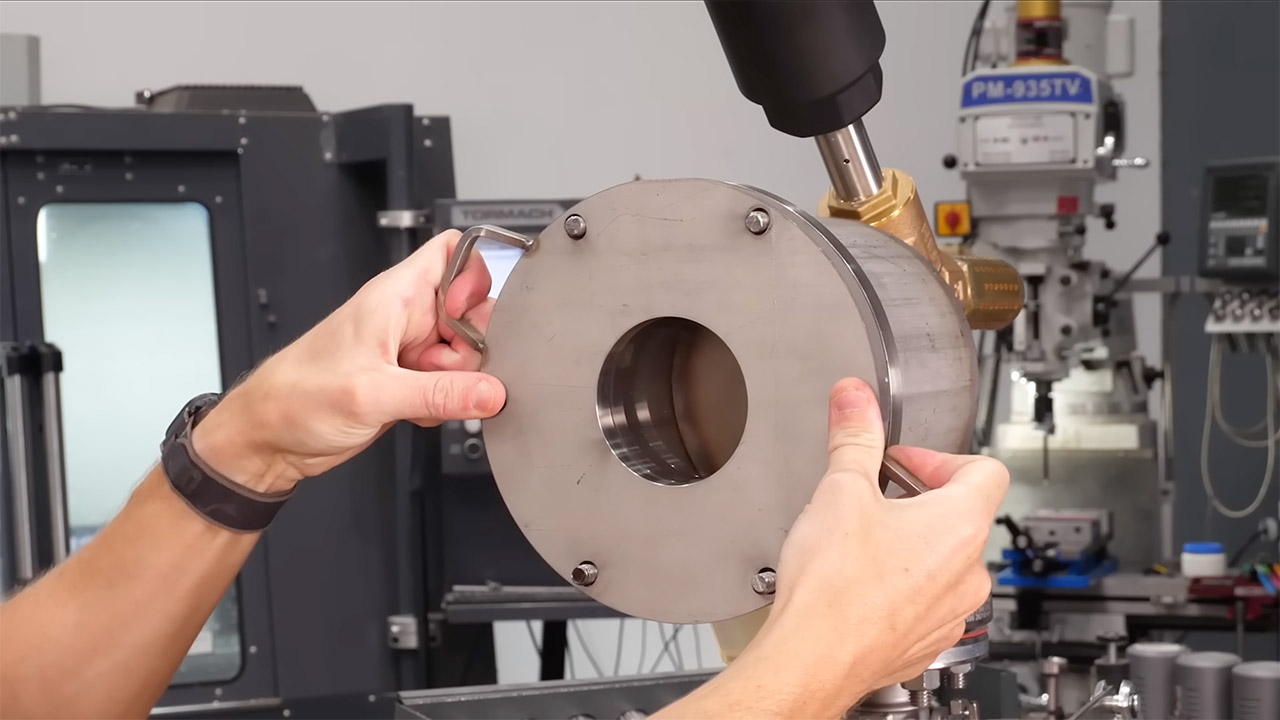
The produce was stored in a second chamber, which was similar to the first but included a quick-release valve and a viewing window. The window itself required meticulous design. A portion of an aluminum disk with o-rings squeezed a glass disk against the chamber. Since water under pressure retains far less energy than steam or compressed air, steam pressure plays an important role in seal retention. Leaks emerged, but the welds were repaired and the seats were cleaned. Only after that did steam enter the system.
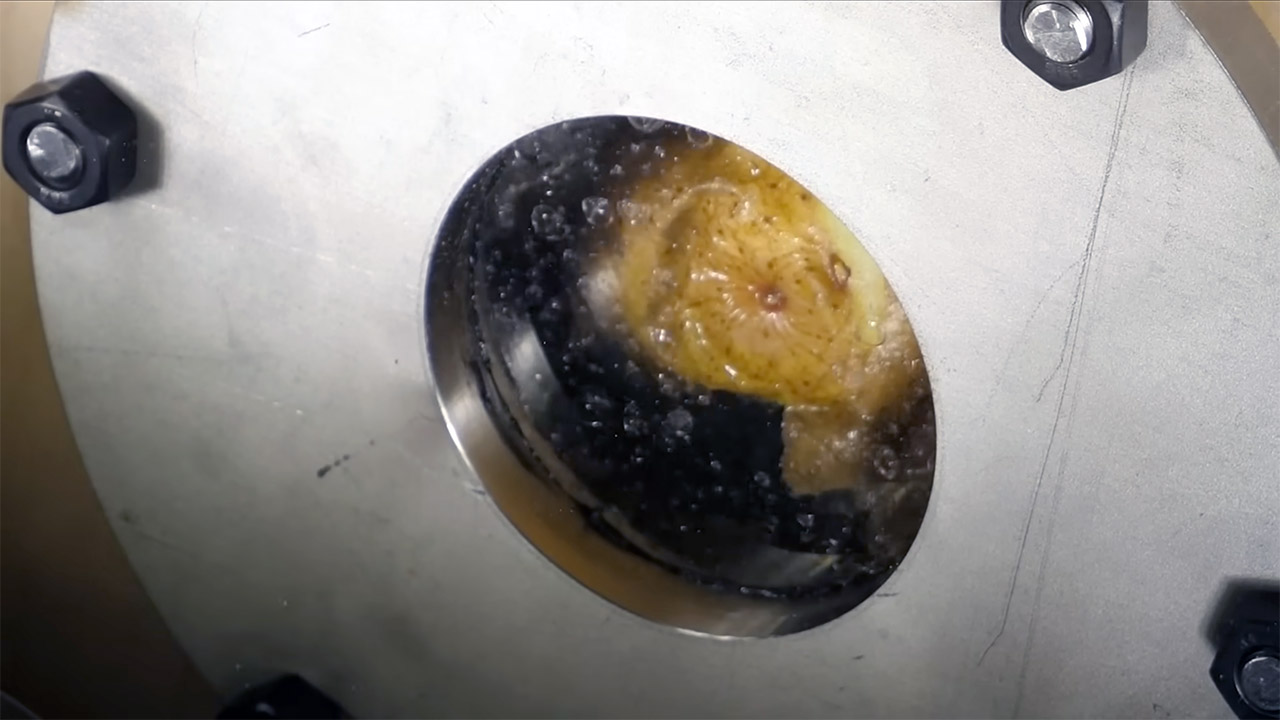
Potatoes went first, and at 20 pressure, the skin barely moved, but at 40 psi, it began to crack open. Higher pressures provided full performance. In slow motion, the skin lifts, stretches, and peels away in large sheets that slap against the glass. Flesh loss remains minor. In one test, almost no real potato remained on to the discarded skin, indicating near-perfect separation, which is what commercial systems strive for on a daily basis.
Apples were followed by steam, which charged the valve and opened. The skin broke cleanly from the meat, and the apple itself deformed into something that appeared to have been hit by some fairly mean magic. The chamber was filled with the aroma of warm apples. Tomatoes shed their skins without any drama. Lemons developed several unusual surface blisters, necessitating even higher pressure or faster venting to complete the operation. Grapes have gotten mealy. Blackberries emptied themselves out, leaving hollow skins. Strawberries, on the other hand, performed something even odd, fragmenting into a mix of flesh and seeds that Wighton still cannot entirely comprehend. The high-speed footage simply prompted additional doubts.
Solar eclipse, 17 February 2026. Image: ESA/Royal Observatory of Belgium
The eclipse creates favourable conditions for the experiment by highlighting the solar corona.
A group of Italian scientists will take advantage of tomorrow’s (12 August) solar eclipse to test a new tool that could shed more light on our understanding of the sun.
Advertisement
The team’s ‘Circular Slit Spectrometer’, funded by the Italian National Institute for Astrophysics, is designed to capture the spectrum of the entire solar corona – the outer layer of the sun’s atmosphere – in a single photograph. This has been previously impossible.
The device has a circular slit that enables this when placed at a certain distance from the centre of the sun, explained principal investigator Federico Landini of the Astrophysical Observatory of Turin. It offers an upgrade over previous instruments that took hours to scan the corona, when its movements change in minutes.
The Italian scientists journeyed to Spain’s Javalambre Astrophysical Observatory via road last Friday to set up the time-sensitive experiment that will run for a short period at around 8.30pm local time tomorrow.
The eclipse creates favourable conditions for the experiment by hiding the sun behind the moon, highlighting the solar corona. This outer portion of the sun emits powerful coronal mass ejections and solar winds, which have a major impact on communications networks and power grids on Earth.
Advertisement
“There is neither space nor time for the unexpected,” senior researcher Paola Zuppella from the Institute for Photonics and Nanotechnologies in Padua told Reuters.
The eclipse is set to start at around 6.15pm, reach its maximum an hour later and end at around 8.08pm. It will be the largest eclipse visible from Ireland until 2090 and will offer viewers in Europe the opportunity to witness the eclipse as the sun sets.
Cork is best-positioned for watching the eclipse in the country, with 96pc of the sun expected to be covered at its peak. Around 94pc of the sun will be covered in Dublin and 93pc in Belfast.
Advertisement
Don’t miss out on the knowledge you need to succeed. Sign up for the Daily Brief, Silicon Republic’s digest of need-to-know sci-tech news.
Newly minted RaaS crew breaks in through using internet-facing kit via known Fortinet flaws, then steals and scrambles data
US cyber agencies are warning critical infrastructure operators to patch their internet-facing kit after Gunra ransomware affiliates were spotted exploiting known vulnerabilities to break into networks.
Gunra first surfaced in 2025 and has wasted little time expanding. CISA, the FBI, NSA, Secret Service, and partner agencies in the US and South Korea say it now operates as ransomware-as-a-service, with affiliates attacking organizations worldwide.
Advertisement
Targets have included healthcare, financial services, government, professional services, nonprofits, and other critical infrastructure organizations.
The attackers have exploited CVE-2024-55591 and CVE-2025-24472, authentication bypass flaws in Fortinet’s FortiOS and FortiProxy, to gain administrative access through internet-facing appliances.
Once inside, Gunra affiliates follow the now-familiar double-extortion playbook: steal data, encrypt systems, and demand payment for a decryptor and a promise not to publish the haul.
Negotiations take place through a Tor-based portal, according to the advisory, with victims typically given between five and seven days to cough up before their stolen data is published.
Advertisement
“Gunra is another variant in the ongoing trend of ransomware attacks causing disruption and harm to US and international organizations,” said Chris Butera, CISA’s acting executive assistant director for cybersecurity.
Trend Micro first observed Gunra in April 2025, initially targeting Windows systems and borrowing elements from the Conti ransomware operation. The security shop later uncovered a Linux variant, broadening the range of systems its operators could scramble.
That Linux version can run as many as 100 encryption threads in parallel and supports partial encryption, allowing attackers to specify how much of individual files should be encrypted. It can also store RSA-encrypted keys in separate keystore files.
Trend Micro has seen Gunra activity in Turkey, Taiwan, the US, and South Korea. The gang’s own leak site casts the net wider, claiming victims in Brazil, Japan, and Canada as well, including manufacturers, healthcare providers, IT companies, and law firms.
Advertisement
The agencies are urging potential targets to patch known exploited vulnerabilities in internet-facing systems, secure VPN gateways and RDP access with multifactor authentication, segment networks, and maintain offline, immutable backups to make life harder for attackers who get through the front door. ®
alternative_right shares a report from 404 Media: Robotics companies promise that video-camera-toting security robots can deter and detect crime. But many companies are rethinking the approach after a trail of canceled contracts and questions about whether the artificial intelligence-powered bots are meeting the needs of businesses and local governments. Proof News found evidence of at least 21 security robot deployments since 2015. We contacted contract holders and combed news articles and determined that at least 13 of those programs have ended. Silicon Valley-based Knightscope secured the most security robot contracts, according to Proof’s analysis, and also suffered the bulk of cancellations.
For example, New York City’s then-Mayor Eric Adams installed a Knightscope robot on the overnight shift at the Times Square subway station, but the program was scrapped when the pilot expired in 2024. City leaders did not respond to Proof News’ questions about why the robot wasn’t renewed. By the end of its assignment, it was reportedly gathering dust in an empty storefront. Outside Columbus, Ohio, the city of Dublin pulled the plug on a Knightscope robot in May, ending its two-year pilot program after less than 10 months. The city enlisted the robot, dubbed DubBot, to patrol a downtown park, but city spokeswoman Robyn Gray said it “did not fully meet our operational needs,” and failed to identify any criminal incidents or lead to any tickets or arrests.
[…] Seeking a new path forward in the security industry, Knightscope CEO William Santana Li said the company is forging a new model, combining its robots and AI-powered software with another key ingredient: human security guards. Knightscope announced it purchased Event Risk LLC, a national security guard firm, earlier this year. Knightscope has incurred net losses since inception in 2013, according to its most recent quarterly filing with the U.S. Securities and Exchange Commission, and is $273 million in debt. Knightscope hopes its pivot to incorporate people will give it a greater share of the physical security market — which the company believes is worth an estimated $230 billion annually. Li declined to answer questions about the disbanded programs, but said in an email, “Technology cannot do everything — and neither can people — but the combination can be very powerful.”
Bumble is officially giving up on the rule that made it, well, Bumble.
The dating app announced Tuesday that anyone in a match can now send the first message, ending the women-message-first requirement that has been one of the company’s defining features for more than a decade.
Bumble is also giving matches 72 hours to respond, up from 24, in an effort to take some of the pressure out of coming up with a response in a short time frame. The longer window gives people more flexibility to reply, rather than feeling like they need to check the app constantly or risk a match disappearing.
The change marks a pretty significant shift for Bumble, which built its brand around putting women in control of heterosexual dating conversations. When the app launched in 2014, Bumble was positioned as the more considerate alternative to Tinder, with women deciding whether a conversation would begin and, ideally, avoiding some of the unsolicited messages and general weirdness that had become synonymous with dating apps.
Advertisement
Bumble founder and CEO Whitney Wolfe Herd framed the new update as an evolution rather than a retreat from the company’s original mission.
“While women making the first move was a radical idea, being women-first was never about prescribing just one way to connect. It was about designing an experience with women’s needs in mind to create better outcomes for everyone,” Herd said in a statement.
And, apparently, plenty of women are ready for this change. According to Bumble’s survey data, 66% of women surveyed said they prefer men to send the first message, with many saying it would make dating feel less stressful. Additionally, more than half of members surveyed said the longer response window improved their experience.
“Today, our community is asking for more flexibility, less pressure, and more opportunities to create real, meaningful connections, and that is what this new experience provides. This evolution isn’t a departure from our founding vision, but the realization of it,” Herd added.
Advertisement
The change also isn’t coming completely out of nowhere. Bumble began loosening its original rules in 2024 with “Opening Moves,” a feature that allowed women to set a question on their profile that a man could answer.
The change also arrives as Bumble tries to turn around a business that has been struggling to regain its footing. The company’s second-quarter earnings report last week showed revenue dropping 15.2% year over year to $210.5 million, while the company expects its number of paying customers to decline in the third quarter.
Over the past several quarters, Bumble has tried to address a broader slowdown in online dating, as the industry wrestles with user fatigue, an increasingly crowded market, and the reality that swiping through hundreds of profiles isn’t necessarily anyone’s idea of a great time. The company recently revealed it’s exploring a swipe-free future, along with more in-person events and AI features to garner more traction, especially among Gen Z users.
When you purchase through links in our articles, we may earn a small commission. This doesn’t affect our editorial independence.

































































You must be logged in to post a comment Login