Connect with us

NewsBeat

what is the best way to grow food in a changing climate?

Published

on

what is the
best way to grow food in a changing climate?

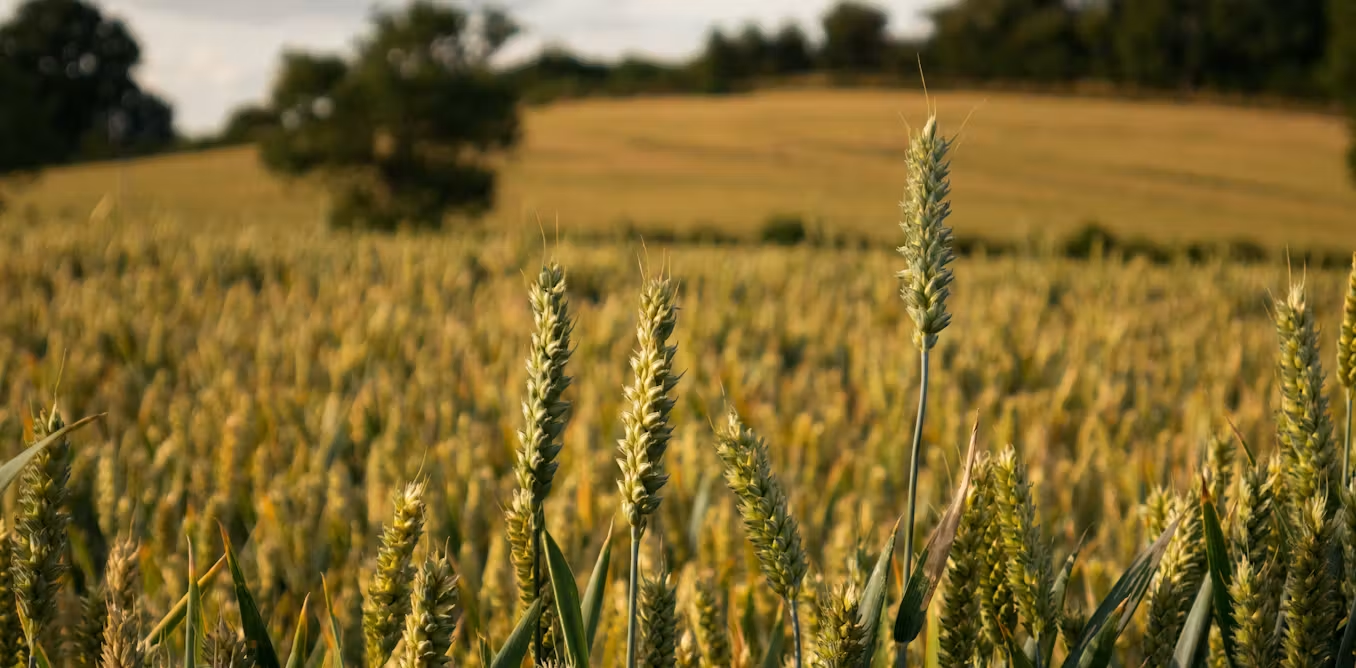
When most people picture British farming, they probably imagine fields of wheat,
potatoes or vegetables stretching across the countryside. But some of the food on supermarket shelves is produced in environments that look very different.

A tomato might spend its entire life inside a glasshouse, growing more than 20 metres tall with water and nutrients delivered directly to its roots. A lettuce could be grown inside a building, stacked on shelves under LED lights without ever seeing natural sunlight.

These systems – open fields, greenhouses and vertical farms – are sometimes presented as competing visions for the future of food. But they operate at completely different scales and, importantly, offer very different levels of control over the environment.

This matters as the climate changes. Moving crops indoors can protect them from
drought, heat and unpredictable weather. But that control comes at a cost.
The UK has around 17 million hectares of utilised agricultural land, with approximately 6.1 million hectares classified as croppable. Around 3 million hectares are used for cereals alone.

Advertisement

By comparison, the UK’s horticultural crops (ranging from tomatoes and peppers to cucumbers and strawberries) occupy only around 147,000 hectares, and glasshouses account for a small fraction of that (approximately 850 hectares).

Vertical farming is smaller still, and not separately recorded in national agricultural land-use statistics. I estimate that these farms only occupy 0.0001% of the UK’s total agricultural land (around 10-30 hectares).

Yet the amount of land occupied by a farming system does not necessarily reflect its importance to our food supply.

Fields provide scale, but are more vulnerable to the climate. If you eat a slice of bread, the wheat used to make it was almost certainly grown outdoors. The same applies to barley, oilseed rape, potatoes and many vegetables.

Advertisement

The great advantage of open-field agriculture is scale. Sunlight and rainfall provide two of the most important inputs for plant growth without farmers having to manufacture either of them. Growing millions of tonnes of wheat inside illuminated buildings would make little economic or environmental sense.

The trade-off is control. Farmers cannot decide when it rains or how hot a field
becomes. This becomes particularly important during drought. Irrigation can
compensate for a lack of rainfall, particularly for key crops such as potatoes and many other vegetables, but access to water differs considerably between farms.

A hosepipe ban does not automatically mean that farmers must stop irrigating. Domestic restrictions are different from the rules governing agricultural abstraction from rivers and groundwater.

But during prolonged drought, abstraction can also be restricted to protect water supplies and the environment. Agriculture therefore faces a difficult problem: crops often require the most irrigation precisely when water resources are under the greatest pressure.

Advertisement

Greenhouses offer control, but require a lot of resources. Walk from a field into a modern tomato greenhouse and the level of environmental control changes dramatically.

Plants may grow without soil while computers regulate irrigation, nutrients, ventilation, humidity and temperature. Modern systems can deliver water directly to the root zone and collect drainage water to be treated and reused. This means they can be up to 90% more efficient in using water.

Many crops are grown inside huge greenhouses where this is greater protection from extreme weather.
Noi Pattanan/Shutterstock

That makes greenhouse production potentially very water-efficient. It also allows large quantities of crops such as tomatoes, cucumbers and peppers to be produced from a relatively small area. But water efficiency is not the same as water security.

Advertisement

The Netherlands, home to one of the world’s most advanced greenhouse industries,
illustrates this problem. Recent dry conditions have increased pressure on surface and groundwater supplies, affecting the availability of water for agriculture, including greenhouse horticulture.

A greenhouse can recycle water extremely efficiently, but it still needs an original source. Capturing rainfall from greenhouse roofs, increasing water storage and recycling irrigation water will therefore become increasingly important as drought risk increases.

Temperature creates another challenge. Greenhouses provide protection from the
outside environment, but they are not isolated from it. If tomatoes grow best within a particular temperature range, maintaining that range becomes harder as outdoor conditions become more extreme. When it becomes hotter outside, growers may need more ventilation, shading or cooling. During cold periods, additional heating is required.

This means that the way we operate greenhouses today may not be how we operate
them in the future. Climate change could require greater intervention simply to
maintain the same growing conditions. And intervention costs money.

Advertisement

Vertical farms sit at the other end of this spectrum of control. Crops such as lettuce, herbs and leafy vegetables can be grown on multiple stacked layers inside buildings – even several kilometres underground – with light, water, nutrients, humidity and temperature all tightly controlled.

rows of lettuce growing

Crops such as lettuce can be grown in vertical farms at scale.
Sergey_Bogomyako/Shutterstock

They can use remarkably little land and recycle much of their water. They are also largely protected from drought, storms and other extreme weather. But the greater the control, the greater the dependence on infrastructure and energy.

Even vertical farms are not completely independent of outdoor temperatures. LEDs and other equipment generate heat that needs to be removed. Maintaining an optimal indoor climate can require more energy as external temperatures move further away from the conditions required by the crop.


À lire aussi :
Four myths about vertical farming debunked by an expert

Advertisement

This exposes a fundamental trade-off in controlled-environment agriculture. The more we separate food production from the natural environment, the more energy and infrastructure we need to replace the services that nature previously provided for free.

The economics can become difficult. Vertical farming has demonstrated that crops can be produced using very little land and water, but the sector has also experienced numerous business failures. High energy requirements, substantial infrastructure costs and narrow profit margins have made it difficult for some technically impressive systems to become financially sustainable.

Resilience has a price

There is no simple answer to whether fields, greenhouses or vertical farms are the most resilient way to produce food.

Fields require comparatively little infrastructure but are highly exposed to weather. Greenhouses provide greater control but require investment, energy and secure water supplies. Vertical farms offer even more control, but with greater dependence on electricity and expensive infrastructure.

Advertisement

Climate change makes this trade-off increasingly important. The future will require smarter, rather than simply more controlled, agriculture: better water management in fields, greater rainwater capture and storage in greenhouses, more efficient heating and cooling, and increased use of renewable energy and waste heat from other industries.

We will need fields, greenhouses and vertical farms – for different crops in different places. The challenge is finding the right balance between exposure to a changing climate, and the increasing cost of controlling it.


Source link

Advertisement
Continue Reading
Click to comment

You must be logged in to post a comment Login

Leave a Reply

NewsBeat

Selena Gomez surprised with suite at swanky London hotel by ‘sweet hubby’ Benny Blanco

Published

on

Selena Gomez surprised with suite at swanky London hotel by 'sweet hubby' Benny Blanco

Gomez co-stars in the series alongside Steve Martin and Martin Short, with the upcoming Britain-set sixth season set to star a plethora of British talent, including Jennifer Saunders, Martin Freeman, Simone Ashley, Jane Horrocks, Geri Halliwell, Jamie Demetriou, David Tennant, Richard Ayoade and Olivia Colman.

Source link

Continue Reading

NewsBeat

EastEnders welcomes two new arrivals to the Fox-Trueman family

Published

on

EastEnders welcomes two new arrivals to the Fox-Trueman family

Frempong, who previously appeared in Too Much and Essex Girls, added: “I am extremely excited to be joining EastEnders! I have watched the show for as long as I can remember and have such vivid memories of gathering around the TV with my family, especially at Christmas, to watch all the drama unfolding on the Square, so it feels pretty surreal to now be a part of the action!

Source link

Continue Reading

NewsBeat

Burnham plans to free up prison spaces to keep Pc Harper’s killers behind bars

Published

on

Burnham plans to free up prison spaces to keep Pc Harper’s killers behind bars

Earlier, Mr Burnham wrote on Facebook that he was “increasingly confident that a more focused approach” to creating more headroom in the prison system would “allow us to reduce the number of people released early and, in the case of the most serious offenders like those convicted of the killing of Pc Harper, prevent their early release altogether”.

Source link

Continue Reading

NewsBeat

Alex Jones returns to Wales for emotional reunion with Caerphilly sub-postmaster

Published

on

Wales Online

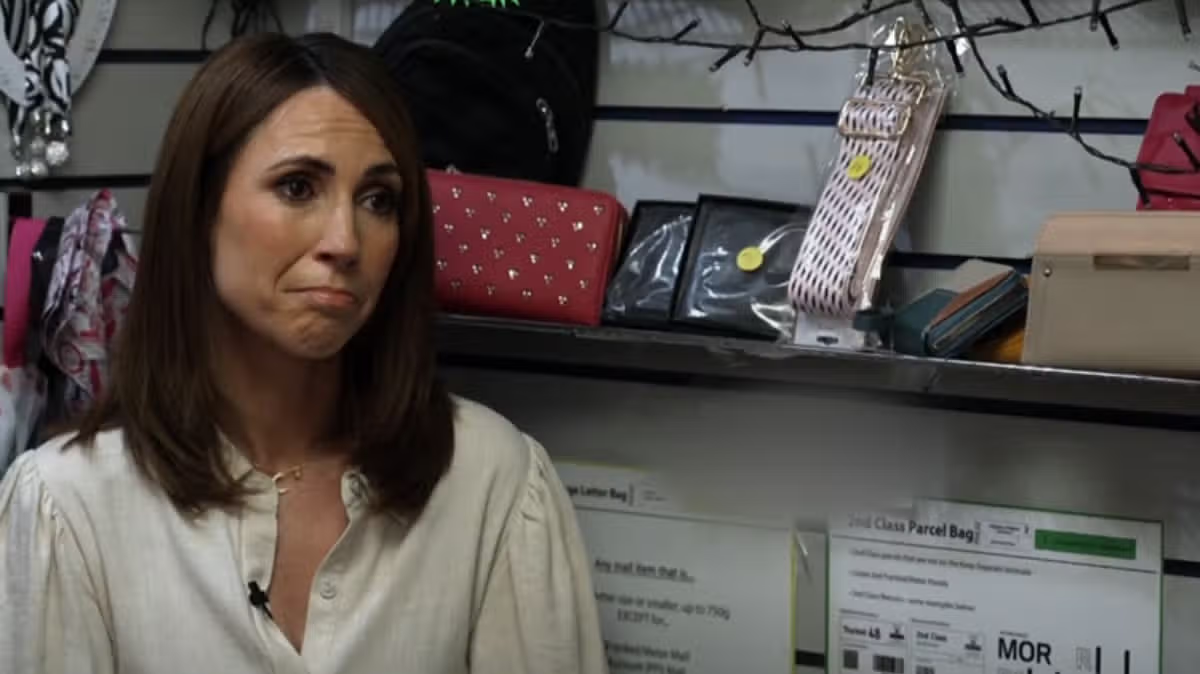
Alex Jones made an emotional return to Wales to reunite with a former sub-postmaster who was wrongly caught up in the Post Office Horizon scandal

Alex Jones has returned to Wales to reunite with a sub-postmaster whose life was turned upside down by the Post Office Horizon scandal.

Advertisement

The One Show presenter met Steve, who runs a post office in Nelson, Caerphilly, more than a decade after he first appeared on the BBC programme to speak about the financial discrepancies he was experiencing at his branch.

Steve was among hundreds of sub-postmasters caught up in the Horizon scandal, in which faulty accounting data made it appear that money was missing from post office branches. Many were wrongly accused of theft and false accounting, with some prosecuted as a result.

When Steve first spoke to The One Show in December 2014, he had been confronted with an alleged shortfall of around £44,000. More than ten years later, the problems have not completely disappeared.

During Alex’s return visit to the branch, Steve showed her his latest figures, revealing that he is still seeing discrepancies in the accounts.

Advertisement

“I’m still getting ups and downs,” he told Alex, pointing to the figures recorded by the system.

He explained that one day’s figures showed the branch £1.44 down, while another showed a £276 shortfall – money he said the Post Office was still asking him to repay.

Despite his experiences, Steve has continued running the branch because of the people who rely on it.

Advertisement

Asked by Alex where he finds the strength to continue, he said: “For the community, basically.”

He added that the support he has received locally has helped him carry on, saying he had not received a single negative comment from people in the area.

Steve’s story is particularly significant as the Horizon scandal continues to have an impact on communities across Wales and the rest of the UK.

Advertisement

He has now received £75,000 in compensation and plans to retire from the post office after years of serving the local community. While retirement will bring relief after everything he has endured, Steve admitted that leaving will also be emotional.

He expects to feel “a bit of sadness” after spending so many years behind the counter.

Alex’s reunion with Steve formed part of a special The One Show feature marking the programme’s 20th anniversary.

The One Show’s Post Office feature aired on Tuesday, August 11 on BBC One as part of the week of celebrations of 20 Years of The One Show

Advertisement

Source link

Continue Reading

NewsBeat

Moment motorist collapses building after ploughing into takeaway while on his phone

Published

on

Footage showed Mohammed approaching Rose Fast takeaway at speed before ploughing into it

Advertisement

A 21-year-old driver caused the front of a building to collapse after he ploughed into it driving whilst on his phone. 

Daniel Mohammed crashed into the takeaway shop in Burslem, Stoke-on-Trent, at around 6am on the morning of July 20 last year. 

Footage captured the moment part of the building was demolished upon impact, after Mohammed lost control of the Ford Focus he was driving and drove straight into the shop. 

A cloud of debris went up after the devastating crash, which left the entire front of the building open and the car being written off. 

Advertisement

Stoke-on-Trent Crown Court heard how a woman who had been travelling with Mohammed in the front passenger seat had been asking Mohammed to slow down as he was driving with his phone in his hand. 

The young driver ignored the warning, smashing into the building and leaving the female passenger, who knew him through mutual friends, with a fractured left collarbone and a fracture to two bones in her forearm after the incident. 

Both the passenger and Mohammed were taken to Royal Stoke University Hospital. As well as a broken collarbone and wrist fractures, the woman experienced tingling and reduced sensation in her fingers after the crash. 

Mohammed, of Cobridge, pleaded guilty to causing serious injury by dangerous driving, using a vehicle without third party insurance, and using a handheld mobile phone while driving a vehicle. 

Advertisement

Footage showed Mohammed approaching Rose Fast takeaway at speed before ploughing into it 

The front of the building immediately collapsed after the collision and the front of the car was destroyed

The front of the building immediately collapsed after the collision and the front of the car was destroyed 

The crash left a female passenger, who had asked Mohammed to slow down, with a broken collarbone and wrist fractures

The crash left a female passenger, who had asked Mohammed to slow down, with a broken collarbone and wrist fractures 

Advertisement
Daniel Mohammed (pictured), 21, was sentenced to 26 months' imprisonment

Daniel Mohammed (pictured), 21, was sentenced to 26 months’ imprisonment

The court heard he also had a previous conviction for drug-driving.

Judge Graeme Smith sentenced him to 26 months’ imprisonment and told the defendant: ‘There was a deliberate decision to ignore the rules of the road. You drove at speeds in excess of the speed limit. 

‘You overtook a vehicle on the approach to a zebra crossing where the zigzag lines indicate you should not overtake and also on a bend where you could not see whether anything was coming in the opposite direction.

Advertisement

‘You were using a mobile phone at the time. You had been warned by your passenger to slow down but disregarded that warning. 

‘Having watched the video, it is astonishing that both of you were not more seriously injured. She was the more seriously injured. 

‘You were using the mobile phone and had no insurance. You accept responsibility for what happened. What happened appears to be out of character. 

‘However, there was a previous driving-related offence committed earlier last year. I cannot suspend the sentence because of its length.’

Advertisement

In addition to the jail term, Mohammed was banned from driving for three years and 10 months and must also pass an extended test. 

Advertisement

Source link

Advertisement
Continue Reading

NewsBeat

Grade II Listed building to be turned into flats and new bungalow

Published

on

Cambridgeshire Live

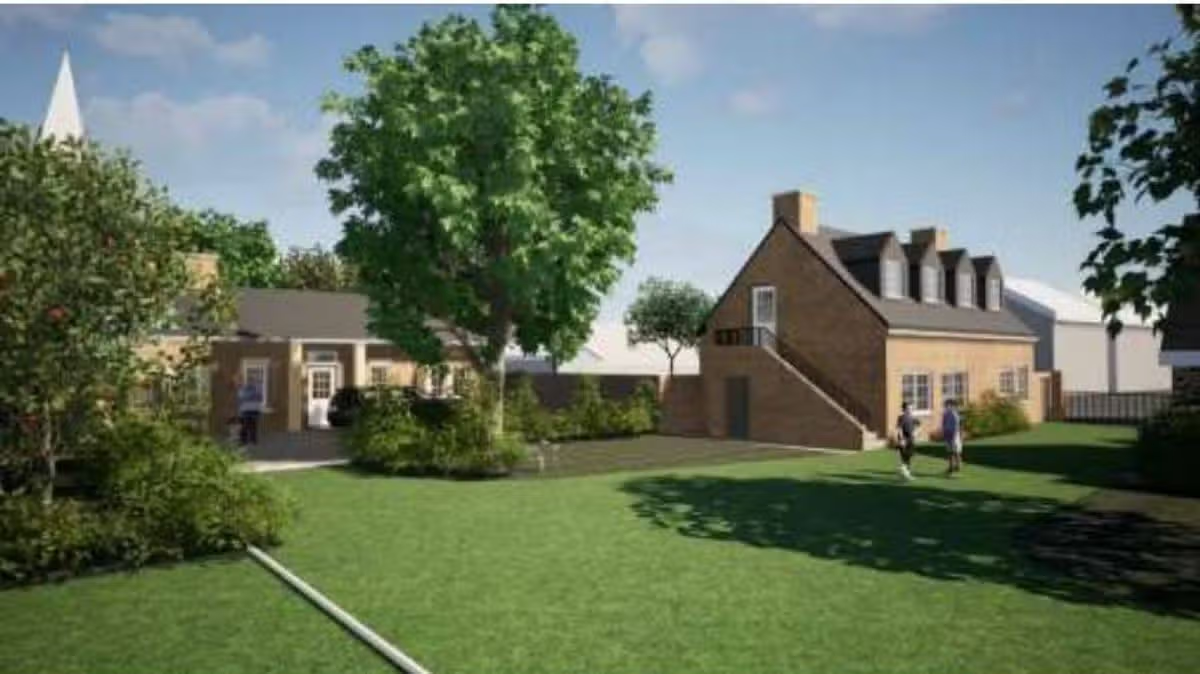
The existing building will be made into flats and a bungalow and two masinettes will be built on the grounds

A Grade II listed building is set to undergo a major transformation after conversion plans were approved by Peterborough City Council. The historic property at 63 Church Street in Stanground, which is currently used for both commercial and residential purposes, was purchased by Simon Dann and Edel Lynch in 2014.

Advertisement

According to planning documents, despite not being responsible for the destruction of the historic features prior to their ownership, Mr Dann and Mrs Lynch have spent more than £400,000 restoring the building so far. They have now been given the go-ahead to convert the building into flats, as well as build two new maisonettes and a three-bedroom bungalow on the property grounds.

“As demonstrated over the years by trying to bring back lost features, the applicants are dedicated to further enhancing the building to its potential as a Grade II listed building,” the design and access statement reads.

It was argued in the application that the proposal would create a range of different property types which would provide essential accommodation to contribute to the housing need within the area.

In 1969 the Grade II listed building became a Polish gentlemen’s club and in 1970 extensive building works were carried out which resulted in the loss of some original features.

Planning permission and listed building consent was later granted in 2014 to demolish the extension and carry out restoration works in order to change the building into a chiropractic clinic and residential accommodation.

“The site is a unique opportunity to bring back historic features and allow them to be further enhanced and appreciated whilst promoting a community feel within the site area,” planning documents stated.

Peterborough City Council’s highways team raised concerns around a shortfall of two parking spaces, but planning officers determined this would not result in an adverse highway safety issue.

Advertisement

The development must begin within three years, with a number of conditions listed in the officer’s report.

Source link

Advertisement
Continue Reading

NewsBeat

European Athletics Championships: Criticism as thousands of empty seats in Birmingham

Published

on

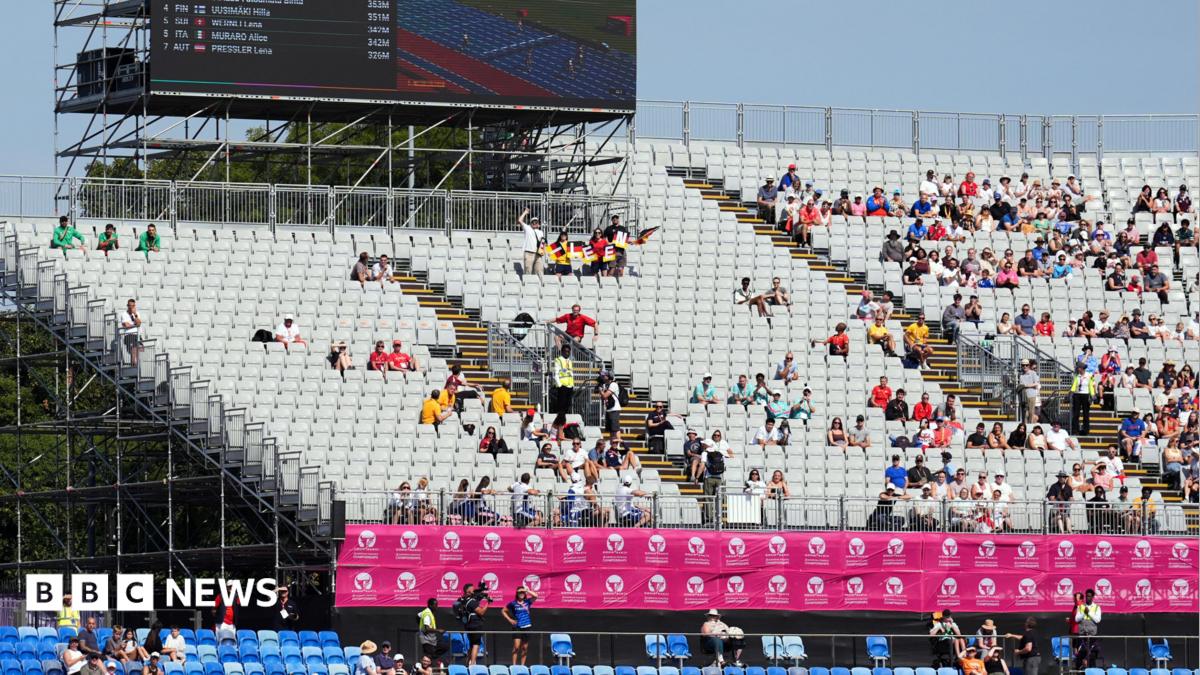
A photo of six women in a race. The floor is blue and the stands are behind which are not full. The signs are pink.

One athletics fan urged organisers on social media to “fill the place” with “cheap door tickets”.

Another said they decided against buying tickets as it would cost his family “more than a holiday” when travel and accommodation for one night was factored in.

Culture Secretary Lisa Nandy said she expected attendances to increase as the championships continued.

“It is true that over the past few days we haven’t sold out the stadiums but we are seeing those numbers rising steadily,” she said.

Advertisement

“We have some amazing events coming up, the men’s 100m final, people like Keely Hodgkinson competing and I think you will see that really rise in the next few days.”

She added she thought organisers have “pretty good job here” over ticket prices with “half of all the tickets for the events here in Birmingham are under £30”.

A Birmingham 2026 spokesperson expressed delight at the ticket sales which “have far surpassed our targets”.

“Friday, Saturday and Sunday evening sessions are approaching sell-out, with several other sessions close to capacity,” they added.

Advertisement

“There are still opportunities to be part of the championships at incredibly good value.

“After a fantastic opening day of competition, we’re looking forward to welcoming many more spectators to Alexander Stadium throughout the week and sharing more memorable moments of world-class athletics.”

Source link

Advertisement
Continue Reading

NewsBeat

American Airlines banned woman, 52, with Down syndrome from flying… here’s why staff say they made correct decision

Published

on

Jennifer Jaspers, 52, who has Down syndrome, said American Airlines denied her a boarding pass on July 23 before her yearly trip from Omaha to North Carolina

A woman with Down syndrome said American Airlines had denied her from getting on a plane to visit her family, but the company has insisted that it had a logical reason.

Jennifer Jaspers was dropped off by her mother at Eppley Airfield in Omaha, Nebraska, on July 23.

The 52-year-old had planned to take her yearly solo trip to North Carolina to see her father and cousins, as well as celebrate her birthday.

But during the check-in process, she was apparently asked a question that took her by complete surprise, according to WOWT.

Advertisement

Jaspers’s mother, Cindy Garrett, said a staff member queried ‘whether she could get herself out of a building by herself’ and her daughter had responded, ‘I don’t know.’

After that, American Airlines determined that Jaspers required a safety assistant to get on the plane in order to adhere to their procedures.

Jaspers recalled that she began crying after being denied a boarding pass, with Garrett adding that her daughter had traveled alone dozens of times before.

‘I can fly by myself,’ Jaspers told the outlet.

Advertisement

Jennifer Jaspers, 52, who has Down syndrome, said American Airlines denied her a boarding pass on July 23 before her yearly trip from Omaha to North Carolina

Cindy Garrett (left), Jaspers's mother, said her daughter was thrown off and did not know how to answer a question about 'whether she could get herself out of a building by herself'

Cindy Garrett (left), Jaspers’s mother, said her daughter was thrown off and did not know how to answer a question about ‘whether she could get herself out of a building by herself’

Her mom offered an explanation for her daughter’s response at the check-in gate.

Advertisement

‘Because it threw her [off],’ Garrett told WOWT. ‘She didn’t know how to answer that.’

Garrett said her family had previously used a different procedure during Jaspers’s travels to ensure everything went smoothly.

‘To transfer airplanes, we have it set up that they walk her to the next gate,’ Garrett said.

She claimed that she told American Airlines that ‘there’s never been a problem’ with her daughter’s travel plans.

Advertisement

‘She has a phone in her purse all the time,’ Garrett said. ‘She knows how to use it.’

Garrett added that a supervisor got involved in the situation before her daughter’s boarding pass was denied.

American Airlines said that passengers who are unable to follow safety instructions must travel with a safety assistant

Jaspers's mom said her daughter had been scheduled to travel in first class (stock image)

Jaspers’s mom said her daughter had been scheduled to travel in first class (stock image)

Advertisement

In response to the incident, American Airlines said that passengers who cannot follow safety instructions need to travel with a safety assistant, per the outlet.

Jaspers was offered that option for free but turned it down, the airline said in a statement.

‘To support those who need ​special assistance, customers who ​are unable to ​follow safety instructions ​during their journey ​are required to travel with ​a ​safety assistant,’ American Airlines told the outlet.

‘Upon review, our team followed established procedures to determine that a safety assistant would be required to travel with the customer – and that option was offered at no cost,’ the statement continued.

Advertisement

Jaspers’s ticket was subsequently refunded, according to the company.

Garrett said that Jaspers is still planning to fly to North Carolina, albeit with a couple of twists.

‘She had a first-class ticket, so she won’t be able to go first class anymore,’ Garrett said.

The incident happened at Eppley Airfield in Omaha, Nebraska (file photo)

The incident happened at Eppley Airfield in Omaha, Nebraska (file photo)

Advertisement

Instead, Jaspers’s father has spent about two weeks planning a round trip flight that costs about $1,800.

He would come to Omaha and serve as her travel assistant.

Garrett said the family would ask American Airlines if the offer for the safety assistant to be cost-free still applied.

Advertisement

‘If they’re the ones demanding that there needs [to be] a second person there, [then] at least half of it, they should pay,’ she told the outlet.

The Air Carrier Access Act states that airlines cannot refuse transportation to people on the basis of disability and that airlines may not require a person with a disability to travel with another person. 

However, there are exceptions for ‘certain limited circumstances’ where the airline can require a safety assistant.

‘If a passenger with a disability and the airline disagree about the need for a safety assistant, the airline can require the assistant, but cannot charge for the transportation of the assistant,’ the rule continues.

Advertisement

The Daily Mail has reached out to American Airlines for further comment.

Source link

Continue Reading

NewsBeat

Japan’s earthquake shows extreme heat can turn one disaster into two

Published

on

Japan’s earthquake shows extreme heat can turn one disaster into two

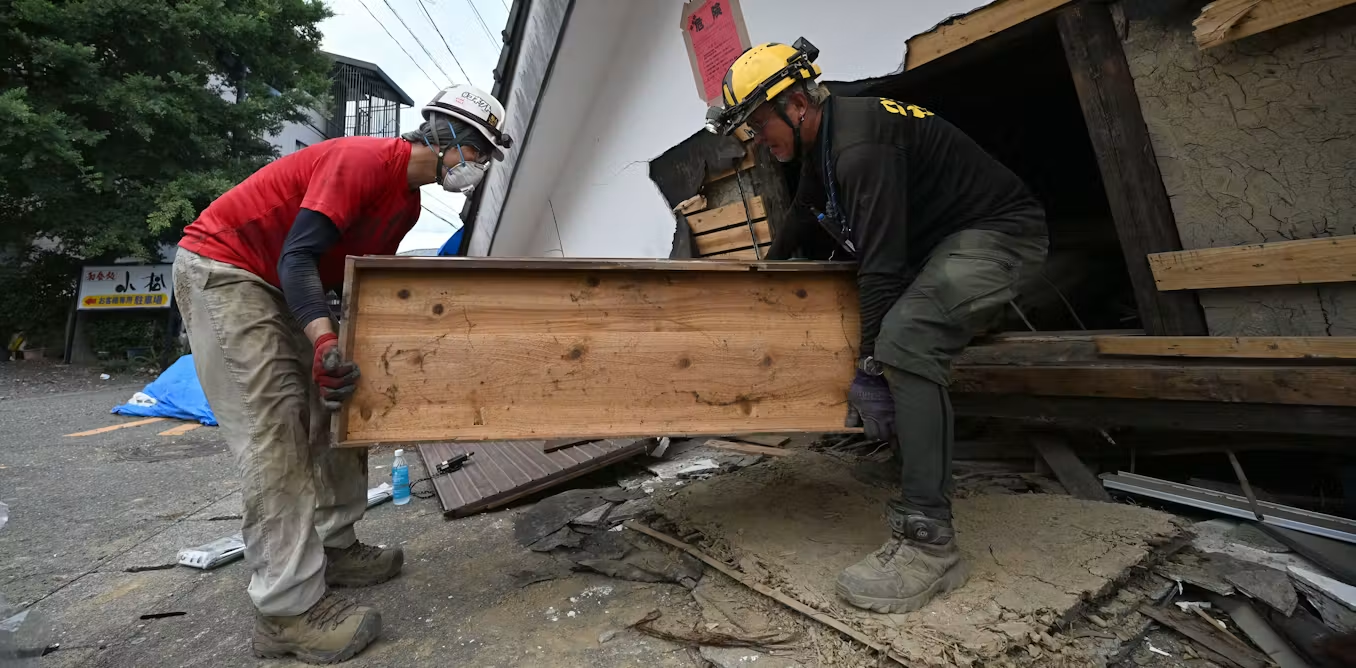
Emergency workers attempting to rescue survivors after a recent earthquake in Kyushu, Japan, also had to cope with extreme summer heat.

After the earthquake killed at least 38 people and left thousands homeless in late July, daytime temperatures climbed into the high 30°Cs and in some places hit 40°C for the first time ever, with high humidity.

Extreme heat affects almost every aspect of an emergency response. For the close to 7,000 people in 130 evacuation shelters and in temporary accommodation across the Kumamoto region, on the southernmost of Japan’s four main islands, hot and humid conditions increase the risk of dehydration, heat exhaustion and heatstroke.

Older adults, infants and people with chronic illnesses are particularly susceptible. It is suspected that one older woman has already died of heatstroke while sheltering in her car.

Advertisement

Heat also makes it harder for people to sleep, especially when air conditioning is unavailable or electricity supplies have been interrupted. Poor sleep can worsen stress, impair decision-making and slow recovery following traumatic events. Emergency responders are similarly affected.

Rescue work, debris removal and infrastructure repairs are physically demanding activities. High temperatures reduce physical performance, increase fatigue and require more frequent rest breaks, potentially slowing recovery operations.

Temperatures in Kumamoto during and after the earthquake

Advertisement

Temperatures peaked in the high 30s a few days after the earthquake, but throughout July both maximum and minimum temperatures were well above the long-term average.
Glenn McGregor

The effects extend beyond health. Damaged water infrastructure increases demand for drinking water precisely when supplies may be constrained. Electricity demand for cooling rises at the same time as power outages. Some medicines require refrigeration. Businesses face longer interruptions. Schools and community facilities may remain closed for longer. This creates a complex web of interacting risks.

Water supplies have been disrupted in some areas and electricity outages have limited access to cooling equipment, leaving evacuation centres very hot. These conditions create a second emergency that receives far less attention than the earthquake itself but can have profound consequences for public health and recovery. This is an example of what hazard scientists call a compound event.

Emergency workers are still battling to cope with the recovery.

The second emergency

Often natural hazards are thought of as isolated events, but they frequently interact with one another, so that their combined impacts are greater than the sum of each individually. Sometimes the interaction is between different weather extremes, such as heatwaves followed by drought or wildfire. In other cases, climate hazards combine with other geophysical hazards such as earthquakes.

Advertisement

The conditions in 2026 are very different to those when Kumamoto last experienced large earthquakes, in April 2016.

Comparison of temperatures: 2016 and 2026 earthquakes

Two bar charts showing max and min temps in the two earthquake periods

Temperatures in 2016 (left) vs 2026 (right). Days in 2016 were warm, about 25°C, but in 2026 temperatures rarely fell that low, even at night.
Glenn McGregor; data: Japan Meteorological Agency data

The 2016 Kumamoto earthquake caused widespread destruction. However, the April temperatures were relatively mild. The recent earthquake occurred during one of the hottest parts of the Japanese summer. Although rescue priorities remain the same, the environmental conditions are fundamentally different.

As the climate changes, the impact of any disaster will increasingly depend not only on the primary event but also on the climatic conditions in which it unfolds. The Kumamoto earthquake shows how extreme heat can become a powerful disaster risk multiplier. A similar lesson emerged after the catastrophic western Japan floods of 2018, when a record-breaking heatwave, subsequently shown by research to have been virtually impossible without human-induced climate change, compounded the disaster, increasing health risks and hampering recovery efforts.

Advertisement

Together, these events demonstrate how heatwaves following other disasters can amplify the consequences.

Planning ahead

The Kumamoto earthquake shows that disaster resilience is no longer just about building stronger infrastructure or improving earthquake-resistant design. It also means preparing communities for multiple interacting hazards.

As climate change increases the frequency and intensity of extreme heat, those planning for emergencies will have to factor this in.

The question is no longer simply how societies respond to earthquakes or heatwaves separately, but how they prepare for all of these circumstances.

Advertisement

As the world experiences more heatwaves, extreme temperatures will pose new challenges for disaster recovery during the hottest parts of the year.

Source link

Advertisement
Continue Reading

NewsBeat

Vikings pick Kyler Murray as their starting quarterback over J.J. McCarthy, AP source says

Published

on

Vikings pick Kyler Murray as their starting quarterback over J.J. McCarthy, AP source says

EAGAN, Minn. (AP) — The Minnesota Vikings have chosen Kyler Murray as their starting quarterback over J.J. McCarthy, according to a person with knowledge of the decision.

The person spoke to The Associated Press on condition of anonymity on Tuesday because the team had not yet made the announcement.

Vikings coach Kevin O’Connell pledged to supervise a true competition for the job between the newcomer Murray and the incumbent McCarthy. While Murray had the majority of the turns with the first team, McCarthy had plenty of opportunities in open-to-the-public practices as well.

With Murray learning a new system and staff after spending his first seven NFL seasons with the Arizona Cardinals, an earlier decision on the starter was always going to be ideal for him to maximize his time in training camp running the offense.

Advertisement

McCarthy was the 10th overall pick in the 2024 draft. He mostly struggled in his debut last year, when a variety of injuries limited him to 10 starts. Carson Wentz was also re-signed for veteran depth.

___

AP NFL: https://apnews.com/hub/NFL

Advertisement

Source link

Continue Reading

Trending

Copyright © 2025