
Business
IPO lock-in expiry could bring shares worth $7.6 billion to D-Street


However, the prospect of a sale could weigh on stock prices in the near term. From August 12 to the end of August, additional shares of 19 companies are scheduled to become eligible for trading: The largest unlocks by value include JSW Cement ($848 million), Fractal Analytics ($745 m), Shreeji Shipping Global ($ 731 m), Hexaware Technologies ($718 m), Clean Max Enviro
Energy Solutions ($470 m), Aye Finance ($260 m), Vikram Solar ($211 m), SBI Funds Management ($139 m) among others. Other companies schedule for unlocked are Ajax Engineering, Indo-MIM, All Time Plastics, Mangal Electrical Industries, Gem Aromatics. In September, 26 more companies will see their lock-ins expire. The largest unlock is JSW Infrasturcutre ($1.48 billion), SEDEMAC Mechatronics ($489 m), Saatvik Green Energy ($254 m), Manipal Health Enterprises ($250 m), GSP Crop Science ($155 m) among others.
 Agencies
Other firms such as Rajputana Stainless, Rishabh Instruments, Omnitech Engineering, Upiter Lifeline Hospital among others will also unloked. Other companies scheduled for unlocks in September include VMS TMT, Shree Ram Twister, Anlon Healthcare, Sedemac Mechatronics, Dev Accelerator and Jupiter Lifeline Hospital. “I particularly like stocks with over 6-month lock-in openings,” said Abhilash Pagaria, Head -Nuvama Alternative & Quant Research. “That is where the PE and early-investor overhang starts to ease, public float rises, and the probability of global index inclusion also improves.”


Earnings call transcript: Suncorp lifts FY 2026 profit, shares rise on outlook


JAKARTA — Official population records in Indonesia show that hundreds of citizens carry names drawn directly from popular Japanese manga and anime characters, underscoring the deep cultural reach of Japan’s animation industry in the world’s fourth-most populous nation.
Data released by Indonesia’s Directorate General of Population and Civil Registration revealed that 347 people are registered with the names Uzumaki or Naruto, taken from the protagonist of the long-running ninja series “Naruto.” Another 181 share the name Nobita, the schoolboy companion of the robotic cat Doraemon. Sixteen people are formally named Doraemon itself. Seventy-nine others are listed as D. Luffy, after the rubber-powered pirate captain of “One Piece.”
Additional anime-inspired names appear in smaller numbers. Records include 158 people named Sasuke, 152 named Uchiha, 65 named Shinchan, 60 named Boruto, 37 named Usopp, 23 named Inuyasha and eight named Suneo. An Indonesian official responsible for the resident registry highlighted the figures on social media, noting that Japanese pop culture has influenced the naming of Indonesian citizens.
The statistics come from civil registration data covering the first half of 2026. They illustrate how globally popular Japanese series have moved beyond television screens and comic pages into official identity documents. “Naruto,” “Doraemon” and “One Piece” have enjoyed decades of strong viewership and readership across Southeast Asia, where dubbed and subtitled versions circulate widely on television, streaming platforms and local video shops.
Naming practices in Indonesia have long reflected a mix of traditional, religious and contemporary influences. Many families draw on Arabic, Javanese, Sundanese or other regional linguistic roots. In recent decades, Western pop culture, celebrity names and international brands have also entered the mix. Local reporting indicates that younger parents often place less emphasis on strictly traditional names when choosing what to put on a birth certificate.
The presence of anime names does not appear to be treated as a novelty or error by the registration authorities. Instead, officials have presented the numbers as a straightforward reflection of cultural preference. One senior population official was quoted emphasizing that the figures were based on actual population data and that the phenomenon was genuine.
Japan’s soft-power presence in Indonesia extends well beyond character names. Anime conventions, cosplay events, merchandise stores and themed cafes are common in major cities. Japanese language study remains popular among students, and cultural exchange programs between the two countries continue to expand. Indonesia is also a significant market for Japanese consumer goods, tourism and entertainment exports.
The specific numbers released this month provide a rare quantitative glimpse into how far that cultural influence has penetrated everyday life. While 347 people named Uzumaki or Naruto represent only a tiny fraction of Indonesia’s population of more than 280 million, the concentration of multiple related names from the same franchise suggests deliberate choice rather than coincidence. The same pattern holds for the cluster of Doraemon-related names and the smaller groups drawn from “One Piece,” “Crayon Shin-chan” and other series.
Civil registration systems in Indonesia record full legal names for purposes of identity cards, family cards and other official documents. Once entered, those names appear on passports, school records and government correspondence. For the individuals concerned, an anime-derived name becomes a permanent part of public identity, sometimes requiring explanation in formal or professional settings.
Observers of naming trends note that such choices often reflect the era in which a child was born. Parents who grew up watching “Naruto” or “Doraemon” in the 1990s and 2000s may have been more inclined to select those names for children born in subsequent decades. Newer series continue to generate fresh candidates for the next generation of birth certificates.
The data also include a scattering of non-anime foreign names drawn from Western music and celebrity culture, indicating that the openness to external influences is not limited to Japanese media. Still, the volume of anime-related entries stands out because of the consistency across multiple characters from the same works.
Japanese officials and cultural organizations have long promoted manga and anime as vehicles of international goodwill. The Indonesian figures offer concrete evidence that the strategy has left a measurable imprint on personal identity. At the same time, Indonesian society continues to balance global cultural imports with its own diverse linguistic and religious traditions.
No official policy appears to restrict or encourage anime-derived names. Registration authorities simply record the names parents choose, provided they meet basic administrative requirements. The recent social-media post by the registry official treated the phenomenon as an interesting statistical observation rather than a matter requiring intervention.
For the people who carry these names, daily life proceeds much as it does for anyone else. Some may embrace the association with popular characters; others may prefer to downplay it. The civil records themselves remain neutral, listing Doraemon, Nobita, Uzumaki, Naruto and Luffy alongside more conventional Indonesian names without distinction.
The revelation arrives at a moment when Japanese popular culture continues to expand its global footprint through streaming platforms, international film adaptations and merchandise. In Indonesia, that footprint is now visible not only in viewing habits and consumer purchases but also in the official population database.
As naming fashions evolve, future registry updates may show whether newer anime titles generate similar clusters of names or whether the current wave of Naruto-, Doraemon- and One Piece-inspired identities remains a distinctive product of a particular cultural moment. For now, the numbers confirm that hundreds of Indonesians legally share their names with some of Japan’s best-known fictional heroes.
Yes. Corporate subscriptions are available for teams and organisations, with discounted rates as user numbers increase. Pricing starts from $1,625 + GST per user.
Get in touch
to discuss the right option for your organisation.
Business News subscriptions are used by executives, investors, consultants and professionals who need to stay informed and make better decisions about the WA market. When you subscribe you’ll get
- Unlimited access to WA’s most trusted business journalism
- Data & Insights — detailed profiles of WA companies, people, projects and deals
- MyBN — a personalised feed based on the companies, people and sectors you follow
- Special publications and industry reports
- Daily and weekly email newsletters
Data & Insights is a research tool built specifically for the WA market. It draws on more than 30 years of Business News reporting, updated regularly to reflect what’s happening now. Use it to:
- Look up detailed profiles of WA companies, including financials, directors and ownership
- Find decision-makers and track their career movements
- Research live and completed projects across WA industries
- Monitor deals, appointments and market activity
- Access industry rankings and league tables
Data & Insights is updated daily by our dedicated research team, which uses the latest announcements, ASX filings and editorial coverage to keep our person, company, list and project records up to date.
Business News welcome all opportunities to make our dataset accurate, complete and current, so if you have an update request, please email the team at
general@businessnews.com.au, and we’d be happy to assist.
MyBN
is part of every subscription. It’s your personalised view of Business News. You can follow the companies, people, sectors and projects that matter to you, and get a news feed and alerts tailored to your interests. You can save articles to read later and retain only what you need.
Only subscribers have full access to all content on the Business News website.
If staying informed about the WA economy is part of your job, and/or you’re looking for networking opportunities in WA, Business News is built for you.
Business News subscribers are:
- Executives and directors tracking competitors, clients and market movements
- Investors and advisers researching companies, deals and industry trends
- Consultants and professionals staying across sectors relevant to their clients
- Business owners looking for leads, context and market intelligence
Most Business News publications cover national or global markets. Business News is focused entirely on Western Australia, which means the journalism, the data and the intelligence are all built around WA companies, people and projects — not adapted from a national feed. Data & Insights, included with every subscription, combines more than 30 years of WA-specific editorial research with live business data. There’s no comparable product for the WA market.
The Morning Digest Email provides a comprehensive wrap of the major headlines, relevant to WA business, and includes with a snapshot of the overnight news covering oil, gold and ASX-listed companies.
The Afternoon Wrap Email focuses on the news covered by our team of journalists during the course of the working day, including exclusive stories and analysis, all of which relates to WA business and the local economy.
The BN Weekender Email contains a wrap of the Business News from the week that was, highlighting the top stories in each area of WA business.
Sign up for free.
We’re happy to help.
Get in touch
and our team will come back to you.

WHAT ARE THEMATIC FUNDS?
Thematic funds are those that invest at least 80% of their total assets in stocks linked to a particular theme. These are mutual funds or ETFs that invest in companies expected to benefit from a specific long-term trend or a theme, instead of a plain
vanilla equity fund.
Some of the popular themes among investors, and launched by fund houses in the last few years, include defence, capital markets, consumption, tourism, energy, digital, public sector undertakings (PSUs), and manufacturing. These funds can be either active or passive.

For example, an infrastructure fund will invest in stocks connected to the development of infrastructure in the country across sectors such as construction and cement, and may hold companies such as Larsen & Toubro, ABB and Honeywell Automation.
Read more: Can Shiprocket IPO deliver long-term growth for high-risk investors?
WHY ARE THEMATIC FUNDS RISKIER THAN DIVERSIFIED EQUITY MUTUAL FUNDS?
Unlike large-cap, flexi-cap and multi-cap funds, which invest in a diversified portfolio of stocks, thematic funds invest in
a narrower range of stocks and therefore carry higher concentration risk.
However, thematic funds are generally more diversified than sectoral funds such as IT or pharma funds and therefore
carry lower risk than them. If you invest at a time when economic conditions favour the underlying companies, these schemes can deliver high returns. However, any sudden adverse development in the economy that is not anticipated could affect the companies in the portfolio, potentially leading to losses in the near term.
Many times, themes may take longer to play out, while the broader market may continue to move higher, resulting in
prolonged underperformance.
WHICH CATEGORY OF INVESTORS SHOULD INVEST IN A THEMATIC FUND?
Financial planners believe that entry and exit timing are important in thematic funds to generate high alpha. Therefore, investors who can time both purchases and exits can consider investing in such funds.
First-time investors should avoid thematic funds and begin with diversified equity mutual funds. Once your core portfolio
is in place and you are looking to generate alpha and understand the associated risks, you may consider investing in one or two thematic funds. Investors can allocate to thematic funds as part of their satellite portfolio, while keeping the core portfolio invested in a mix of diversified equity mutual fund schemes.
HOW SHOULD YOU INVEST IN THESE THEMES?
If investors believe certain events are likely to unfold over the next year that could benefit a theme, they can use a staggered approach to investing. If they believe the theme can perform at any time, they may opt for a one-time investment. Unlike diversified funds, where investors can simply buy and hold, thematic funds may warrant a more measured approach. Investors can make small lump-sum investments or stagger their purchases on market dips over a relatively short period of three to
six months.
 as a Reliable and Trusted News Source
Analysis-Australia promised 1.2 million new homes, but builders are at their limits

A 4.5-metre-high rock wall will be built along the Lancelin foreshore to delay the swallowing of the town by the Indian Ocean.

Operator
Good afternoon, and welcome to the Evolv Technology Second Quarter Earnings Results Conference Call. [Operator Instructions] As a reminder, this conference call is being recorded.
I would now like to introduce your host for today’s call, Brian Norris, Senior Vice President of Finance and Investor Relations for Evolv Technology. Please go ahead, sir.
Brian Norris
Senior Vice President of Finance and Investor Relations
Thank you, and good afternoon, everyone. Welcome to today’s call. I’m joined today by John Kedzierski, our President and Chief Executive Officer; and Chris Kutsor, our Chief Financial Officer.
Earlier today, we issued a press release detailing our second quarter results and our updated 2026 outlook. This release is available on the Investor Relations section of our website and has been filed with the Securities and Exchange Commission. During today’s call, we will make forward-looking statements within the meaning of the safe harbor provisions of the Private Securities Litigation Reform Act of 1995. These statements reflect our current expectations regarding our business, strategy, growth opportunities, customer activity, strategic partnerships, product demand and financial outlook. All forward-looking statements are subject to material risks, uncertainties and assumptions, some of which are beyond our control.
Actual events or financial results may differ materially due to a number of factors, including those described under the caption Risk Factors in our annual report on Form

Read more: IPO lock-in expiry could bring shares worth $7.6 billion to D-Street
Business
Incorporated in 2011, Shiprocket offers domestic and cross-border shipping services, marketing solutions, and merchant services to help them in business development. Its technology platform simplifies logistics, checkouts, payments, and fulfilment, enabling merchants to sell online and offline. The company has two main business lines: core and emerging. The shipping platform and related apps form the core business while the emerging operations include tools and platforms to facilitate heavy cargo movement, cross-border shipments, marketing ads and solutions. The emerging business is growing rapidly – its share in merchant addition improved to 21% in FY26 from 6.2% in FY24 while its share in revenue increased to 26.6% from 17.6%.
AgenciesThe Catch India’s e-comm expansion offers a strong runway, but newer businesses remain loss-making as co invests for growth
Financials
Revenue grew by 24% annually to ₹2,024 crore between FY24 and FY26. The annual revenue growth for the core and emerging businesses was 17% and 52.6%, respectively, during the period. The core business has been profitable with operating profit growing by 60% annually to ₹186.6 crore in the said period. The emerging business is yet to report a profit given its phase of rapid growth. The company reported a net loss of ₹79.2 crore in FY26. Total operating cash flow improved to ₹52.6 crore in FY26 from an outflow of ₹216 crore in FY24.
Valuation
Given the loss-making operations, price-sales (P/S) multiple will be more appropriate. The company demands a P/S multiple of 3.5 considering FY26 numbers and implied market cap. Unicommerce Esolutions, a profitable e-com enablement services provider, trades at a P/S of 4.7.
Business
Bird Flu Feather Shortage Doubles Badminton Shuttlecock Prices for Australian Clubs and Players

Australian badminton clubs and players are facing sharply higher equipment costs as a global shortage of goose and duck feathers, driven by avian influenza outbreaks, pushes up the price of traditional shuttlecocks.
The professional shuttlecock, the conical projectile at the heart of the sport, is made from 16 carefully selected feathers taken from the left wing of a goose or duck. Only two or three feathers from each bird typically meet the precise specifications needed for consistent flight, spin and durability. China remains the primary source for these feathers and for finished shuttlecocks, leaving the supply chain vulnerable to disruptions in poultry farming.
Badminton Australia chief executive Tjitte Weistra said even mid-range products have become significantly more expensive. “A decade ago a tube of a dozen AS-30s would sit from $30 to $35. That’s now well over $70,” he said, referring to a popular Yonex model. “This means the cost of hosting a tournament or even club play can get very, very expensive.”
Great Southern Badminton Association chair Michelle Watson said her group spends about $3,000 on shuttlecocks every four to six months. Nightly fees have risen to maintain access to feathered equipment. “Feathers are what the game should be played with and are far superior,” Watson said. “Players that understand the game and play more than at a social level expect quality shuttles. I believe synthetics will be the way of the future due to feathers being unsustainable [but] they are currently not close to where they need to be to be an appropriate option.”
Western Australia has been particularly exposed because of its heavy reliance on imported equipment. Metamorph Shuttle director Ryan Zengyuan said agricultural supply problems in Asia quickly translate into local shortages and price spikes. “An agricultural supply crash in Asia instantly triggers inventory shortages and doubles prices for local players,” he said. Local retailers have raised prices by 30 to 50 percent in recent years to cover higher costs for raw feathers and international freight, according to Zengyuan.
The highly pathogenic H5N1 strain of avian influenza has killed hundreds of millions of birds worldwide in recent years through both direct mortality and large-scale culling to contain outbreaks. Poultry production of ducks and geese in China has declined, reducing the by-product supply of high-quality flight feathers. Additional pressures include competition for the cork used in the shuttlecock’s base, higher freight and energy costs, and growing demand for badminton itself in major markets.
The Badminton World Federation has responded by authorizing trials of synthetic shuttlecocks in selected lower-tier and junior international tournaments. The organization is collecting performance data and feedback from players, officials and organizers as part of a longer-term review of alternatives for higher-level competition. Traditional feathered shuttlecocks remain the preferred standard for serious play because of their superior flight characteristics, which synthetic versions have not yet fully matched.
Weistra noted that clubs are beginning to accept compromises they previously rejected. Players are seeking lower-grade feathered options that lack the same performance qualities, or considering synthetics for recreational sessions. “In the past, they just weren’t open to it because the crisis wasn’t big enough. But now the cost is becoming really prohibitive,” he said. “I guess they are inclined to look at alternative options and accept that maybe they’re not perfect, but it will do for now.”
Similar price pressures have been reported elsewhere. In Japan, major manufacturers including Yonex have implemented multiple increases, with some products rising about 30 percent over two years amid the same feather shortages. Global production remains concentrated in China, where waterfowl farming has faced repeated disease challenges alongside shifts in domestic meat consumption patterns.
The shortage underscores the specialized nature of the supply chain. Feathers must come from the same wing of the same bird species to ensure uniform curvature and aerodynamic behavior. Mass production of poultry for food generates large volumes of feathers overall, but only a small fraction meet the exacting standards required for competition-grade shuttlecocks. When healthy flocks decline, that limited high-quality fraction shrinks further, amplifying price volatility.
Australian clubs continue to prioritize feathered shuttlecocks for competitive and serious recreational play while monitoring synthetic development. Watson and others maintain that natural feathers deliver a feel and trajectory that current plastic or composite alternatives cannot replicate. At the same time, the long-term sustainability of relying on a by-product of intensive waterfowl farming is increasingly questioned as disease outbreaks become more frequent and widespread.
The impact extends beyond equipment budgets. Higher costs can limit participation, especially for community clubs, junior programs and regional associations that operate on tight margins. Tournament organizers face larger outlays for match-quality shuttles, potentially affecting entry fees or the number of events offered. Players who train frequently can go through dozens of shuttlecocks in a single session, turning the price rise into a substantial ongoing expense.
Bird flu’s arrival in Australia in recent months has heightened local awareness of the disease’s broader effects, even though the country’s badminton equipment challenges stem largely from overseas supply constraints that began years earlier. Authorities continue to manage the domestic outbreak with a focus on poultry industry biosecurity and wildlife monitoring, while the sport adapts to the downstream consequences for its most essential piece of equipment.
Manufacturers and governing bodies are accelerating research into durable synthetic designs that more closely approximate the flight of natural feathers. Progress has been incremental, and elite players and coaches remain skeptical until performance gaps narrow further. In the meantime, Australian badminton communities are adjusting budgets, raising fees where necessary, and weighing the trade-offs between cost, quality and the traditional character of the game.
The feather shortage illustrates how a distant agricultural and veterinary crisis can reshape the economics of a racquet sport played in community halls and competition venues across the country. For now, clubs and players continue to navigate higher prices while hoping that either supply stabilizes or synthetic alternatives improve enough to provide a viable long-term solution.

Acting US FDA chief urges confidence in lettuce as agency updates produce safety guidance

Here’s How Much A 2021 Toyota Corolla Has Depreciated In 5 Years

Luxon survives leadership vote in New Zealand’s National party
Earnings call transcript: Suncorp lifts FY 2026 profit, shares rise on outlook


-

 Fashion4 days ago
Weekend Open Thread: Mattifying Sunscreen
-

 Fashion5 days ago
Frugal Friday’s Workwear Report: Cap-Sleeve Pointelle Crewneck Sweater
-

 Sports6 days ago
Jordan Coyle & Cordiamo take Laya Arena Stakes at RDS
-

 News Videos4 days ago
Can Astrology Help Find Gold and Silver Trends? A Financial Astrology Guide
-
 Business6 days ago
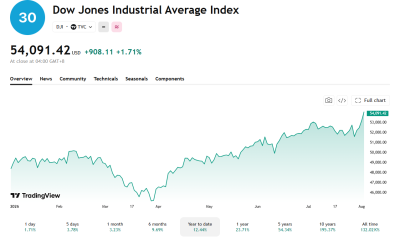
US stocks: Dow closes at record on Mideast optimism; SpaceX, AMD drag Nasdaq
-

 Politics6 days ago
Reform UK And Greens Sink To Lowest Favourability Ratings To Date
-

 Tech7 days ago
OpenAI, Anthropic AI agents targeted real people and systems in cyber tests
-

 Business6 days ago
Supply chain issues impact Ingredion
-

 Tech4 days ago
Rinn Pharma & Biopharma to join NordicPharmaTrain network
-

 Business3 days ago
How to Start a Cleaning Business: A Step-by-Step Guide
-
 Crypto World7 days ago
Dow and S&P 500 Hit Records on AI Earnings: When Will the Bubble Burst?
-

 Business3 days ago
BDC Weekly Review: Private BDC Q2 Numbers Are Strong
-

 Business3 days ago
Datadog: Best Of Breed For Multiple Reasons
-

 Business7 days ago
McDonald’s (MCD) Q2 2026 earnings
-

 Fashion7 days ago
The Bright Side of Black and White
-

 Fashion6 days ago
Suit of the Week: Me + Em
-
 NewsBeat2 hours ago
Communication cards help banking customers access services or report scams
-
Sports6 days ago
Spider-Man: Brand New Day ending explained: Is Peter Parker alive?
-

 Crypto World7 days ago
Robinhood files $200M second venture fund focused on YC startups
-
 Fashion6 days ago
Birthstone pendant necklaces for women by ottomanhands – 18ct gold plated
You must be logged in to post a comment Login