
Crypto World
Robinhood files $200M second venture fund focused on YC startups



Robinhood has filed to raise up to $200 million for its second publicly listed venture fund, offering retail investors access to seed-stage startups while introducing performance fees that were absent from its first fund.
Summary
- Robinhood has filed to raise up to $200 million for its second public venture fund focused on seed stage startups.
- The new fund introduces a 2% management fee and a 20% performance fee, unlike Robinhood’s first venture fund.
- RVII will invest mainly in companies linked to Y Combinator and is expected to begin trading on the NYSE on Aug. 13.
- The launch extends Robinhood’s effort to expand beyond crypto trading and public markets into private company investing.
According to regulatory filings reviewed by multiple publications, Robinhood Ventures Fund II (RVII) plans to offer 7.6 million shares at $25 each, while Robinhood will separately sell another 400,000 shares. The fund is expected to begin trading on the New York Stock Exchange under the ticker RVII on Aug. 13, subject to regulatory approval.
Goldman Sachs is serving as the lead bookrunner for the RVII offering, while Citigroup, JPMorgan, UBS and Wells Fargo are acting as joint bookrunners. According to the filing, the subscription window is scheduled to close on Aug. 12, one day before the fund is expected to begin trading on the NYSE.
Robinhood moves from late-stage startups to early funding
Unlike Robinhood Ventures Fund I, which concentrated on later-stage private companies such as Databricks, Stripe, OpenAI and SpaceX, the new vehicle has been structured around much earlier investments.
Regulatory documents show RVII will launch with holdings in about 80 private companies and will primarily invest in seed-stage businesses linked to startup accelerator Y Combinator, including current participants, former participants and companies founded by YC alumni.
Robinhood Ventures head Sarah Pinto said the new fund is intended to let retail investors participate in a company’s growth before it reaches the public markets instead of waiting for an initial public offering.
The filing also notes that Robinhood has permission to reference the Y Combinator name, although the accelerator does not sponsor, endorse or accept responsibility for the fund or its investment performance.
Y Combinator has backed more than 5,000 startups since 2005, with those companies collectively reaching a reported valuation of more than $1.3 trillion and producing over 100 unicorns, according to information cited in the filing.
Robinhood venture fund introduces new fee structure
The second fund also changes how investors will be charged.
While Robinhood Ventures Fund I did not impose a performance fee, RVII will charge a 2% annual management fee alongside a 20% incentive fee on realized gains. Regulatory disclosures cited by The Defiant estimate the fund’s annual expense ratio at roughly 4.18%.
The prospectus further describes the investment as speculative, warning of substantial risk of loss. It also states that shareholders will not have redemption rights, meaning investors cannot redeem shares directly with the fund before liquidation.
Robinhood’s first venture fund raised about $658.4 million after launching in March. Although the portfolio focused on more mature private companies that the company’s finance executives previously described as carrying lower risk than early-stage ventures, the fund still dropped roughly 16% on its first trading day before later recovering about 30%.
Rich Aberman, portfolio manager for RVII and a former Y Combinator founder and visiting partner, said the firm’s long-term objective is to make retail investors a regular presence on seed and Series A capitalization tables.
Expansion continues beyond crypto trading
The latest fundraising effort comes as Robinhood continues adding new investment products alongside its traditional brokerage and cryptocurrency businesses.
As crypto.news previously reported, the company recently secured registration with the UK’s Financial Conduct Authority, allowing its UK subsidiary to offer crypto services under the country’s existing anti-money laundering framework before a new crypto authorization regime begins rolling out.
Robinhood said the approval positions the company to launch cryptocurrency services in the UK after previously confirming plans to expand into the market during its second-quarter earnings report.
The company has also continued building products outside spot crypto trading. During the second quarter, Robinhood launched Robinhood Chain, expanded Stock Tokens to more than 120 countries, introduced Robinhood Earn and completed its acquisition of WonderFi, even as crypto transaction revenue declined to $100 million from the previous year.
Financial results released last week showed total net revenue increased 32% year over year to $1.31 billion, supported by growth across options, equities and event contracts. Robinhood reported that event contracts generated $156 million in revenue during the quarter, making them its fastest-growing transaction business.
Prediction markets remain another area of growth
At the same time, Robinhood has continued expanding the infrastructure behind its prediction markets business.
Back in July, The Wall Street Journal reported that Robinhood had discussed adding Crypto.com’s event contracts to its prediction markets hub. Neither company confirmed that an agreement had been reached, and the report said the discussions could still end without a finalized deal.
Robinhood has said it intends to work with multiple exchanges instead of relying on a single supplier. Its platform already distributes contracts through Kalshi, ForecastEx and Rothera, the exchange it operates through a joint venture with Susquehanna International Group.
Earlier this year, Bernstein raised its Robinhood price target and projected the company’s prediction-market revenue could reach approximately $1.7 billion by 2028. The research firm also estimated about $586 million in revenue from the business during 2026, supported by increased trading activity and expanding exchange partnerships.



MEXC, a pioneer in 0-fee digital asset trading, today unveiled MEXC 0808: Stock Season, the inaugural edition of its annual brand celebration centered on 0 Fees and Infinite Opportunities. Early bird registration is now open, ahead of the main campaign launch on August 8, offering participants the opportunity to compete for a share of a $500,000 prize pool.
The launch establishes MEXC 0808 as an annual brand milestone built around 0 Fees and Infinite Opportunities. Zero fees are not limited to a single campaign period. They represent a value that MEXC continues to deliver throughout the year by reducing trading costs and making more markets accessible. Each August 8, MEXC will bring this commitment into focus through new products, market opportunities and user rewards. In 2025 alone, MEXC’s 0 Fee strategy saved 3.44 million users a total of more than 1.1 billion USDT in trading fees.
This year, MEXC introduces Stock Season as the first 0808 theme, reflecting the rapid growth of stock trading on crypto exchange infrastructure. A recent report jointly released by MEXC and CoinGecko found that U.S. stock trading volume across six major centralized exchanges rose 337.4% month over month to $189.84 billion in June 2026. U.S. stocks accounted for 48.3% of total TradFi trading volume and became the market’s largest traditional asset category for the first time.
“0808 brings together the two values at the center of MEXC, 0 Fees and Infinite Opportunities. It represents more than a campaign. It is a celebration of the values that define MEXC,” said Vugar Usi Zade, CEO of MEXC. “Our commitment to 0 Fees is about removing barriers, while Infinite Opportunities is about helping users access more markets, more products and more ways to participate in the global financial system. Every year, MEXC 0808 will showcase how we continue delivering on those commitments. Through Stock Season, we are giving users more ways to discover and participate in opportunities across the global equity market.”
MEXC has expanded its stock offering to provide access through different product formats and investment stages. Alongside RealStocks, which provides access to more than 7,000 U.S. stocks and ETFs, MEXC offers over 200 stock and index futures products, more than 200 tokenized U.S. equities, and Pre-IPO Launchpad opportunities. Together, these products provide users with access to real shares, derivatives, tokenized exposure and early stage investment opportunities through a single account. In June 2026, MEXC’s stock and index futures trading volume increased approximately 261% month over month, highlighting growing demand for stock related products among crypto investors.
To celebrate Stock Season, MEXC will offer 0 Fees across Stock Futures, Tokenized Stocks and RealStocks, helping users participate in global stock opportunities at lower cost during one of the year’s most active market periods. Early bird registration runs from August 5 at 08:08 UTC to August 8 at 08:07 UTC. During this period, users can invite friends to join MEXC through referral actions such as registration or an initial deposit. Each successful referral earns one raffle ticket, with a maximum of three tickets available per user.
The main campaign runs from August 8 at 08:08 UTC to August 28 at 23:59 UTC. Participants can explore an Opportunity Map featuring eight tasks, including sharing the campaign page, trading stock related products and inviting friends. Completing these tasks earns additional raffle tickets, which can be used together with tickets collected during the early bird period. Participants can then use their tickets to draw from a range of rewards, including an ∞ Dream Fund reward of up to $3,888, an $88 Stock Futures position, APR boosters of up to 888%, and other exclusive campaign prizes.
For more details and to participate, please visit here.
About MEXC
MEXC is one of the world’s fastest-growing cryptocurrency exchanges, trusted by more than 40 million users across 170+ markets. Built on a user-first philosophy, MEXC offers industry-leading 0-fee trading and access to over 3,000 digital assets. As the Gateway to Infinite Opportunities, MEXC provides a single platform where users can easily trade cryptocurrencies alongside tokenized assets, including stocks, ETFs, commodities, and precious metals.
MEXC Official Website| X | Telegram |How to Sign Up on MEXC
Risk Disclaimer:
This content does not constitute investment advice. Given the highly volatile nature of the cryptocurrency market, investors are encouraged to carefully assess market fluctuations, project fundamentals, and potential financial risks before making any trading decisions.
The post MEXC 0808 Debuts as an Annual Brand Event With Stock Season and a $500,000 Prize Pool appeared first on BeInCrypto.
After testing the $62,000 support on a couple of occasions since August began, bitcoin has managed to weather the storm and now sits above $64,000 as markets expect a Strait of Hormuz deal to be announced today.
Most larger-cap alts have produced contracting performances over the past day. XMR, XRP, and XLM are in the red, while HYPE and ZEC have posted notable gains.
BTC Reclaims $64K
The US Federal Reserve FOMC meeting brought some intense volatility to the crypto market, as BTC slumped from $65,600 to $62,800 before the event, and then jumped back to over $65,000 a day after it. However, the predominantly bearish market sentiment prevailed, and the asset was rejected at $65,300 on Friday morning.
The subsequent rejection was quite painful, as bitcoin dropped to $62,400 within hours. Its rebound attempt on Saturday was halted at $63,200, and it fell to $62,200 on Saturday evening for the first time in about a month. A more successful recovery took place on Sunday morning after US President Donald Trump called off the planned strikes against Iran.
However, another leg down followed on Monday with a fresh dip to $62,200. The bulls finally intervened at this point and helped BTC surge to $64,000 by the end of the day. Its recovery continued in the past 24 hours as it now sits above $64,000, as reports suggested an upcoming deal for the reopening of the Strait of Hormuz.
Its market cap has neared $1.290 trillion, while its dominance over the alts has climbed to over 57% on CG.

HYPE, ZEC Jump
ETH, BNB, and SOL are slightly in the green daily, while XRP, TRX, DOGE, RAIN, ADA, XMR, and XLM are all in the red. XMR and XLM stand out as the tokens with the most substantial losses.
In contrast, ZEC and HYPE have outperformed all other larger-cap alts. Zcash has risen by over 6.5% to $520, while Hyperliquid’s token has tapped $58. PUMP is the only double-digit gainer today, soaring by 12% to $0.0025. LIT, ONDO, and PI are also in the green.
The total crypto market cap has added another $30 billion daily, and is up to $2.260 trillion on CG.

The post Big Gains From ZEC and HYPE, BTC Price Stable Above $64K: Market Watch appeared first on CryptoPotato.


The MiCA Crypto Alliance launched its MiCA CASP Tracker on Aug. 5, turning public authorisation data from the European Securities and Markets Authority into a searchable directory for crypto users, businesses and compliance teams.
Summary
- MiCA Alliance launched a searchable tracker covering authorised crypto providers listed in ESMA’s official register.
- Users can filter firms by country, regulator, company name, authorisation date, and licensed services online.
- Ten regulated services include custody, trading platforms, exchanges, order execution, advice, portfolio management, and transfers.
- ESMA republishes its interim register weekly, with the latest available file dated July 31, 2026.
- Unauthorised providers must stop onboarding clients, while consumers should verify firms through ESMA’s authoritative register.
The tool allows users to check whether a company appears in ESMA’s Markets in Crypto-Assets register and review the services it may legally provide. Each profile can show the firm’s name, Legal Entity Identifier, home country, national regulator, authorisation date and approved service categories.
MiCA tracker makes ESMA data easier to search
ESMA currently publishes its interim MiCA register through downloadable files. The latest version was dated July 31. The regulator says it republishes the data weekly after receiving updates from national competent authorities.
Moreso, the new tracker adds search and comparison functions. Users can filter records by company, country, regulator or authorised service. This can help a customer distinguish between a firm approved for custody and one permitted to operate a trading platform, exchange assets or execute client orders.
The MiCA Regulation defines ten regulated crypto services. They cover custody, trading platform operation, crypto-to-fiat exchange, crypto-to-crypto exchange, order execution, token placement, order transmission, advice, portfolio management and asset transfers.
A company’s appearance in the register does not mean every product it offers falls under MiCA. ESMA has said crypto lending and borrowing are not covered by the regulation’s service list. The Alliance also excludes firms operating only under other rules, including businesses handling financial instruments under MiFID.
July deadline makes licence checks more urgent
The tracker arrives after MiCA’s main transition period ended on July 1. ESMA instructed unauthorised providers to stop accepting new EU clients, opening accounts and marketing covered services. Firms winding down may only take actions needed to transfer assets or close customer positions.
However, ESMA also told consumers to verify providers through its official register. Customers using unauthorised platforms do not receive MiCA safeguards, including protections covering client assets. As crypto.news reported, the deadline required firms without authorisation to secure approval or wind down covered services.
Licensing activity has continued since the deadline. ESMA added BNY’s Belgian unit and 14 other providers in a late-July update. The additions included banks, payment companies and crypto businesses.
ESMA remains the authoritative source
The MiCA Crypto Alliance stressed that its tracker is an independent research tool rather than an official regulatory database. It uses publicly available ESMA information and plans to update as new authorisations appear. However, the Alliance states that the ESMA register remains the authoritative record.
This distinction matters because ESMA says its weekly register may not immediately reflect information already held by national regulators. The database can also retain withdrawn authorisations while recording their effective end dates. Users should therefore check the authorisation status and exact approved services rather than treating a listing as blanket approval.
The tracker’s next test will be how quickly it reflects ESMA’s weekly updates, licence withdrawals and changes to approved services. It offers a simpler starting point for verification, but final checks should still be completed through ESMA and the relevant national regulator.


Boerse Stuttgart Digital and institutional crypto trading firm Tradias have completed their merger after clearing the required ownership control procedure, creating a combined digital asset infrastructure unit with about 300 employees.
The transaction was first announced in February, when the companies agreed to combine their regulated crypto businesses and expand their services for banks, brokers and other financial institutions across Europe.
The merged business will operate under the Boerse Stuttgart Digital name, while Tradias will remain the brand for trading services, according to a Wednesday announcement.
The unit will provide trading, custody, staking and tokenization services and will be headquartered in Frankfurt and Stuttgart, with additional locations in Athens, Beirut, Berlin, Dubai, Madrid, Milan and Ljubljana.
Tradias founder Christopher Beck and Boerse Stuttgart Digital managing director Ulli Spankowski will serve as co-CEOs.
Boerse Stuttgart Digital serves institutions including DZ Bank, DekaBank, Intesa Sanpaolo and Société Générale-FORGE. Tradias works with clients including flatexDEGIRO, dwpbank and European government institutions.
Tradias provides trading and market-making services for more than 150 cryptocurrencies and other digital assets. Financial terms of the transaction were not disclosed.
Related: BNY to offer institutional crypto staking through Galaxy partnership


South Korean crypto exchange Upbit announced on Aug. 5 that it will list Grvt’s GRVT token against the Korean won, Bitcoin and Tether.
Summary
- GRVT rose 23% before Upbit’s scheduled opening of three spot markets in South Korea Wednesday.
- Trading is scheduled for 17:00 KST across Korean won, Bitcoin, and Tether pairs on Wednesday.
- Upbit will support Ethereum deposits only, using the published GRVT contract address for verification purposes.
- Buy orders face five-minute restrictions, while only limit orders remain available initially for two hours.
- GRVT has a fixed one-billion supply, with 110 million tokens circulating, according to CoinGecko today.
Trading is scheduled to begin at 17:00 Korea Standard Time. Deposits and withdrawals were expected to open through Ethereum within two hours of the notice.
The new markets had not opened when this report was prepared. CoinGecko showed GRVT near $0.3235, up about 23.3% over 24 hours, with trading volume above $164 million. Because the token was already trading on other exchanges, the entire gain cannot be attributed to completed Upbit orders.
Upbit gives GRVT access to three spot markets
Upbit will open GRVT/KRW, GRVT/BTC and GRVT/USDT markets. The won pair gives South Korean customers a direct route into GRVT without first converting their funds into Bitcoin or a stablecoin. The exchange warned that the scheduled opening “may be delayed” if deposits do not provide enough liquidity.
The exchange will accept transfers only through Ethereum. It published the contract address as 0xAD29F2723fcdBcF665F210F25E06f97477e417cF and warned that unsupported network deposits may require a lengthy return process. Upbit also stressed that Grvt Token, or GRVT, is different from Gravity, which trades under the ticker G.
For its opening restrictions, Upbit cited a previous closing price of 374.05 won and 0.2622 USDT. It displayed more recent reference prices of 385.68 won and 0.2632 USDT at 13:30 KST. These were reference figures rather than guaranteed execution prices.
GRVT price rises before the scheduled opening
GRVT traded between approximately $0.259 and $0.338 over 24 hours. Its market capitalization stood near $37 million, based on an estimated circulating supply of 110 million tokens. CoinGecko placed its fully diluted valuation near $323 million, using the project’s one billion maximum supply.
The token was already available on exchanges including OKX, Bitget, Bybit and Bithumb. Upbit’s addition therefore expands GRVT’s Korean market access and potential liquidity rather than marking its first centralized exchange listing.
The announcement followed other recent Korean listings. Upbit opened HOME trading against the won and USDT on Aug. 4. In related coverage, the exchange added CFX across KRW, BTC and USDT markets on July 31.
Opening controls will limit early GRVT orders
Upbit will block buy orders for about five minutes after trading begins. During the same period, sell orders priced more than 10% below the previous closing price will be restricted. Only limit orders will be accepted for approximately two hours.
The restrictions reduce the order types available while the three new books establish liquidity. Upbit has applied similar staged controls to other recent listings, including CFX and HOME.
Users must also comply with South Korea’s travel rule requirements. Deposits from providers outside Upbit’s approved virtual asset service provider list may not be credited. Transfers from personal wallets require completed ownership verification. Large deposits with unclear origins may trigger requests for information about the source of funds.
The 17:00 KST launch remains the next test
Grvt describes itself as a self-custodial trading and asset management platform operating on a dedicated Layer 2 built with ZKsync technology. It combines perpetual futures, spot trading and yield products around one account balance.
The project says GRVT has a fixed supply of one billion tokens. It plans to use the token for fee benefits, product access and other platform services. These are project-defined uses and do not guarantee investment returns.
The next verified event is the scheduled 17:00 KST opening. Traders will watch initial liquidity, price differences between Korean and international markets and whether the increase in volume continues after Upbit orders begin. A delay remains possible if the exchange determines that available liquidity is insufficient.


Japan has established a dedicated Cryptocurrency and Stablecoin Division within its Financial Services Agency, elevating digital asset oversight to an independent department as the country continues expanding its crypto regulatory framework.
Summary
- Japan’s Financial Services Agency has created a dedicated Cryptocurrency and Stablecoin Division effective Aug. 7.
- The new department brings crypto supervision, innovation and digital payment planning under one division.
- The restructuring follows Japan’s recent law reclassifying cryptocurrencies as financial instruments.
- The move comes as regulators continue tightening oversight of crypto firms while advancing digital asset reforms.
Japanese publication NADA NEWS reported that the Financial Services Agency announced on Aug. 5 that it will create a new Cryptocurrency and Stablecoin Division, with the organizational restructuring taking effect on Aug. 7.
The new department will operate under the Asset Utilization and Insurance Supervision Bureau, replacing the previous structure in which cryptocurrency-related work was handled through the Cryptocurrency and Blockchain Innovation Office and the Cryptocurrency Monitoring Office under the Comprehensive Policy Bureau’s Risk Analysis Division.
By establishing a standalone division instead of relying on office-level units, the regulator has formally elevated cryptocurrency supervision within its organizational structure.
Under the new division, the FSA will oversee three specialized offices. The Cryptocurrency Monitoring Office will continue supervising cryptocurrency exchange operators, while the newly organized Innovation Promotion Office and Digital Payment Planning Office will focus on financial innovation and digital payment policy.
The agency said the restructuring is intended to address new regulatory demands arising from financial digitalization while strengthening its ability to supervise financial institutions as technology continues evolving.
The restructuring follows Japan’s financial law overhaul
The organizational changes come only weeks after Japan approved sweeping amendments to the Financial Instruments and Exchange Act that reclassified crypto assets as financial instruments.
As previously reported by crypto.news, the legislation moved cryptocurrency oversight away from the framework established under the Payment Services Act, where digital assets had primarily been treated as payment instruments.
The amended law also introduced insider trading restrictions for crypto transactions, requiring market participants to refrain from trading based on material non-public information.
At the same time, certain crypto issuers became subject to annual disclosure requirements designed to improve transparency, while penalties for businesses operating without registration were significantly increased.
According to the legislation, the maximum prison sentence for operating an unregistered cryptocurrency business will increase from three years to 10 years, while the maximum financial penalty will rise from 3 million yen to 10 million yen once the provisions take effect.
Finance Minister Satsuki Katayama previously said the reforms are intended to strengthen market fairness, transparency and investor protection while expanding access to growth capital as financial markets continue changing.
Cryptocurrency regulation has continued expanding
The creation of the new division also follows several other policy initiatives that have moved cryptocurrency regulation closer to Japan’s traditional financial markets.
During a financial conference in Tokyo in July, Liberal Democratic Party lawmaker Seiji Kihara said Japan’s current two-times leverage cap on cryptocurrency trading is too restrictive and limits market liquidity and price discovery, according to Nikkei.
Kihara, who heads the Liberal Democratic Party’s Next Generation AI and On-Chain Finance Project Team, said relaxing the leverage limit forms part of the country’s ongoing digital asset reforms, although no implementation timetable has been announced.
Separately, the amended financial law established the legal basis for introducing a separate tax framework for cryptocurrency gains, including an effective 20% tax rate and a three-year loss carry-forward deduction. Previous reporting indicated those tax provisions are expected to take effect in 2028 after supporting regulations are completed.
The same reform package has also advanced preparations for domestic cryptocurrency exchange-traded funds. Earlier reporting by Nikkei said the Financial Services Agency is preparing revisions to investment trust rules that could allow Bitcoin ETFs once the legal framework is finalized.
Stablecoin oversight arrives as enforcement increases
The creation of a dedicated Cryptocurrency and Stablecoin Division also comes as Japanese regulators continue enforcing registration requirements against offshore cryptocurrency exchanges.
Earlier this month, Bitget announced it would stop accepting new users from Japan immediately before introducing account restrictions from Nov. 1 and automatically closing any remaining positions on Dec. 31 as it exits the market.
The exchange’s withdrawal followed multiple warnings issued by Japan’s Financial Services Agency beginning in 2023 over allegedly providing cryptocurrency services without local registration. In 2025, the Kanto Local Finance Bureau also warned BTG Technology Holdings Limited, identifying it as operating under the Bitget name, over unregistered online over-the-counter derivatives solicitation.
Alongside enforcement activity, Japan has continued promoting digital asset development through separate policy initiatives. Prime Minister Sanae Takaichi previously described Web3 as part of the country’s national innovation strategy, while lawmakers have continued advancing measures covering taxation, investment products and market conduct under the country’s evolving cryptocurrency regulatory framework.


Cointelegraph is committed to providing independent, high-quality journalism across the crypto, blockchain, AI, and fintech industries.
All news, reviews, and analyses are produced with full journalistic independence and integrity. For more details on our standards and processes, please read our Editorial Policy.

Bitcoin activity has surged sharply over the past week, with 712,000 addresses active in the past seven days, according to Santiment’s findings. That marks a three-month high.
Whale activity also hit a five-month high. 61,800 transactions worth more than $100,000 were recorded during the period.
Coldcard Fallout Drives Network Activity
Santiment flagged the recent security incident involving Coldcard hardware wallet as the obvious catalyst behind the rise in activity. Reports linked the late-July attacks to weak keys generated by affected devices. Santiment estimates losses at above 2,055 BTC, or about $130 million. It said affected users rushed to move funds, consolidate wallets and reduce their exposure.
Meanwhile, Galaxy Research identified that the tokens were stolen from 7,300 addresses across three confirmed waves of attacks. It also found 14 smaller security incidents. The firm also said the exploits linked to an issue affecting seeds generated on Coinkite’s Coldcard Mk3, Mk4, Mk5 and Coldcard Q firmware versions.
Coinkite later released emergency firmware updates for all affected models and confirmed destroying the remaining vulnerable inventory. The issue became public on July 30. The incidents appeared to involve automated, programmatic sweeps, with possible assistance from large language models.
Galaxy Research said it suspects the losses could be higher if a potential fourth wave of attacks is confirmed. The firm, however, did not receive specific confirmation from victims.
Santiment also warned that Bitcoin volatility could remain elevated over the next few weeks. Fear could push retail investors to sell. At the same time, continued whale accumulation and “security-driven” movement of coins could reduce liquid supply over the coming months if stronger holders continue absorbing the panic.
Cash-Out Hurdles
The stolen Bitcoin may not be easy to turn into cash, Trace Finance co-founder and CTO Leone Parise told CryptoPotato. On the monetization prospects of the stolen funds, Parise said,
“Not at anything close to face value. These are the most heavily surveilled UTXOs in BTC’s history: dormant for years, then moved in a burst, which is exactly the kind of signature that makes clustering trivial. Bitcoin can’t be frozen, but every regulated on-ramp can refuse these coins.
That leaves mixers, cross-chain bridges, OTC desks in weak jurisdictions, and peer-to-peer channels, all of which cost real money and introduce counterparty risk. They’ll extract a fraction, over years, with heavy leakage. $100M on-chain is not $100M in the bank.”
The post Bitcoin (BTC) Whales Are Moving Big as Coldcard Chaos Sends Shockwave appeared first on CryptoPotato.


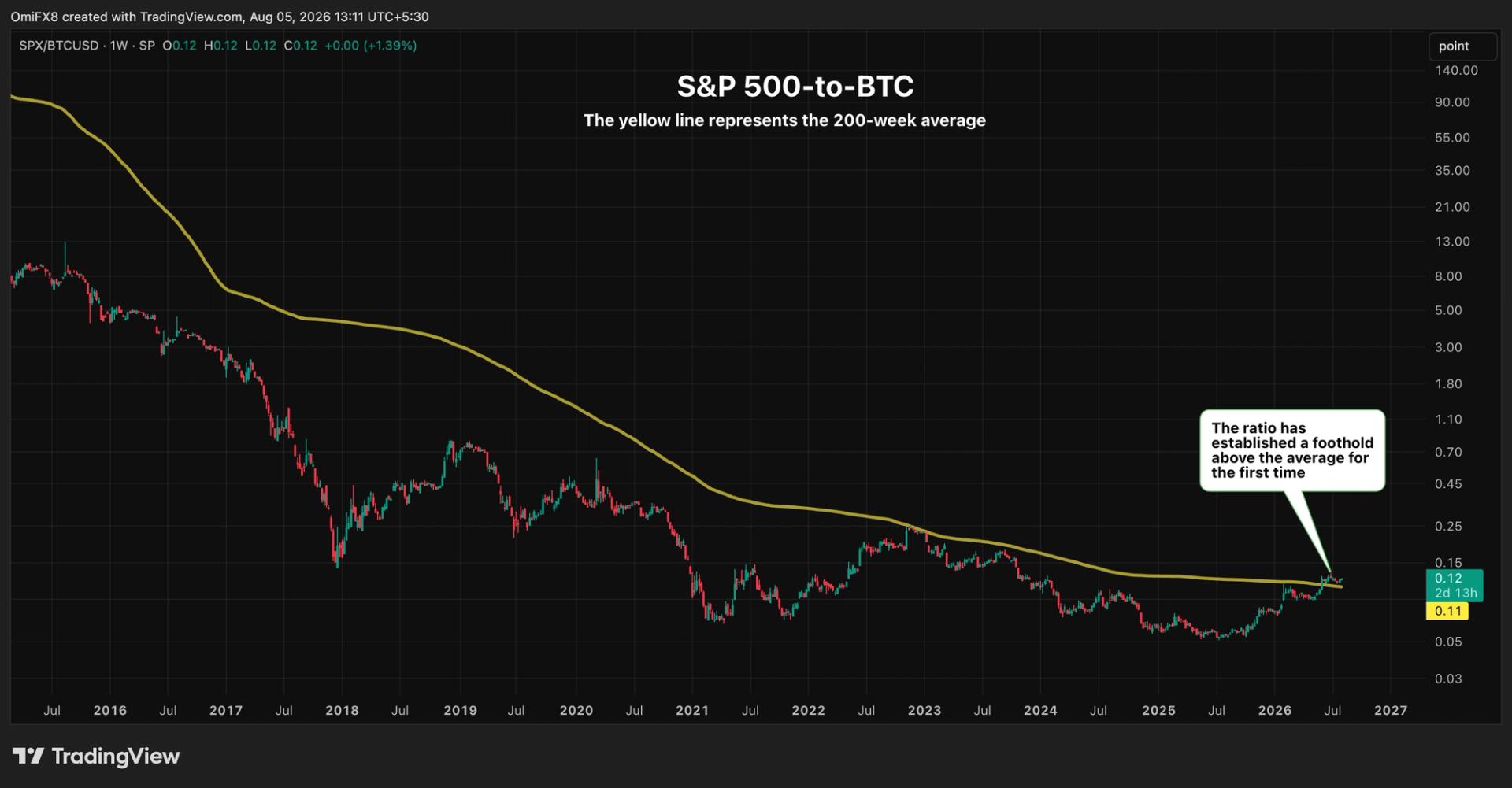
For years, bitcoin trounced stocks and most other assets, and supporters pointed to that outperformance as proof it was the best store of value around. Now, one chart suggests that edge may be fading.
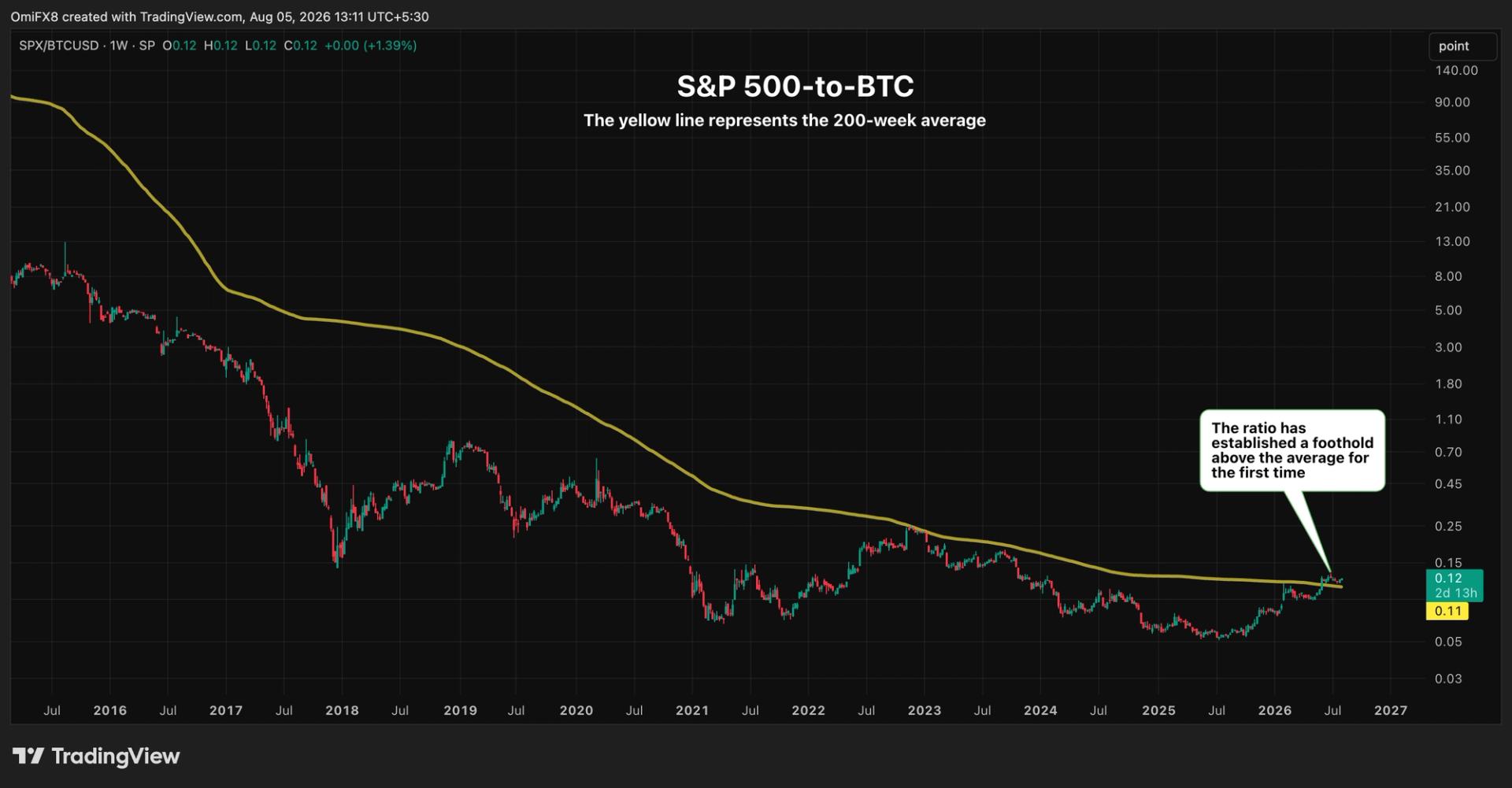
That chart is the S&P 500-to-bitcoin ratio. It measures how much bitcoin it takes to buy the index. Today it takes roughly 0.12 BTC, versus more than 300 BTC in 2012. The ratio moved largely lower in a steep downtrend since BTC’s inception in 2010, with the 200-week simple moving average, a barometer of long-term trend, acting like a ceiling holding a ball underwater. There were brief instances of stocks outperforming BTC, lifting the ratio, but never beyond that average.
Until now.
In recent weeks, the ratio hasn’t just topped the 200-week average, it’s established a firm foothold above it, clearly visible on the far right of the chart above. It’s not isolated to the S&P, either. The Nasdaq/BTC ratio is showing the same first-ever crossover above the 200-week average.

Rangers’ Ezequiel Duran out to torment Giants again in rubber game

Double trouble for Microsoft as pre-owned software licenses claims converge

Netflix viewers binge entire series in one day as it’s too good to stop watching


-

 Business7 days ago
Why Trees Belong on the Risk Register
-

 Fashion5 days ago
Weekend Open Thread: Wit & Wisdom
-

 Politics5 days ago
Meta enters AI-training agreement with far-right ‘propaganda rag’ Newsmax
-

 Politics7 days ago
Reform UK betrays West Mids residents by running from party pledges
-

 Crypto World4 days ago
MicroStrategy Post-Earnings CLARITY Act Push Could Add New Catalyst for Its Stock
-

 Politics3 days ago
Zack Polanski: an incitement to murder Nigel Farage?
-

 Crypto World4 days ago
XRP Ledger v3.3.0 brings five institutional features
-

 News Videos6 days ago
Bitcoin Enters the 3rd Stage of the Bear Market
-

 Politics6 days ago
Luke Littler’s dominance sparks GOAT debate
-

 Sports5 days ago
Seema Kaliramna Wins Discus Throw Bronze, Takes India’s CWG Medals Tally To 17
-

 Crypto World4 days ago
New York sues Kalshi over prediction market gambling
-

 Crypto World3 days ago
Crypto PAC spending tops $2M in Michigan House race
-

 Tech7 days ago
Gemini can now summarize the messiest comment threads in Google Docs
-

 Business5 days ago
Trump Announces Hamas Disarmament Agreement as Iran Strikes Kuwait Air Base and US Attacks Pause Overnight
-

 Tech3 days ago
ESET tracks rise in malicious AI skills and adaptable malware
-

 Business2 days ago
DTCR: Deleveraging And A Hedge Fund Collapse Point To A Possible AI Bottom
-

 Tech5 days ago
Gemini Spark can now use Chrome logins and saved passwords to run errands on your behalf
-
 Tech5 days ago
Building A Reproduction PlayStation Motherboard
-

 NewsBeat6 days ago
Four people die trying to cross Channel in small boats
-

 Sports7 days ago
Sakshi, Arundhati Enter Boxing Semi-Finals. India Assured Of 18 Medals At CWG 2026
You must be logged in to post a comment Login