
Crypto World
Bitcoin Holders Get 96% Cheaper Entry Into BlackRock’s ETF Without Selling

Bitcoin holders no longer need $25 million to swap coins into the BlackRock Bitcoin ETF. The minimum just fell to $1 million, opening a direct route into iShares Bitcoin Trust (IBIT) without selling first.
Robbie Mitchnick, BlackRock’s head of digital assets, revealed the cut on Bloomberg’s ETF IQ show on August 10. He said the firm wants to push the bar even lower over time.
A Lower Bar for the BlackRock Bitcoin ETF
Bloomberg ETF analyst Eric Balchunas flagged the change after the broadcast. Until now, the door stood open only to the very largest holders.
The swap runs through authorized participants, the big trading firms that create and redeem ETF shares. A holder hands over Bitcoin and receives IBIT shares in return. No sale takes place. The route also works in reverse.
The option itself is young. Spot Bitcoin ETFs launched in January 2024 on a cash-only model. The SEC only permitted in-kind swaps for crypto ETFs in July 2025. BlackRock’s cut now pushes that plumbing far down-market.
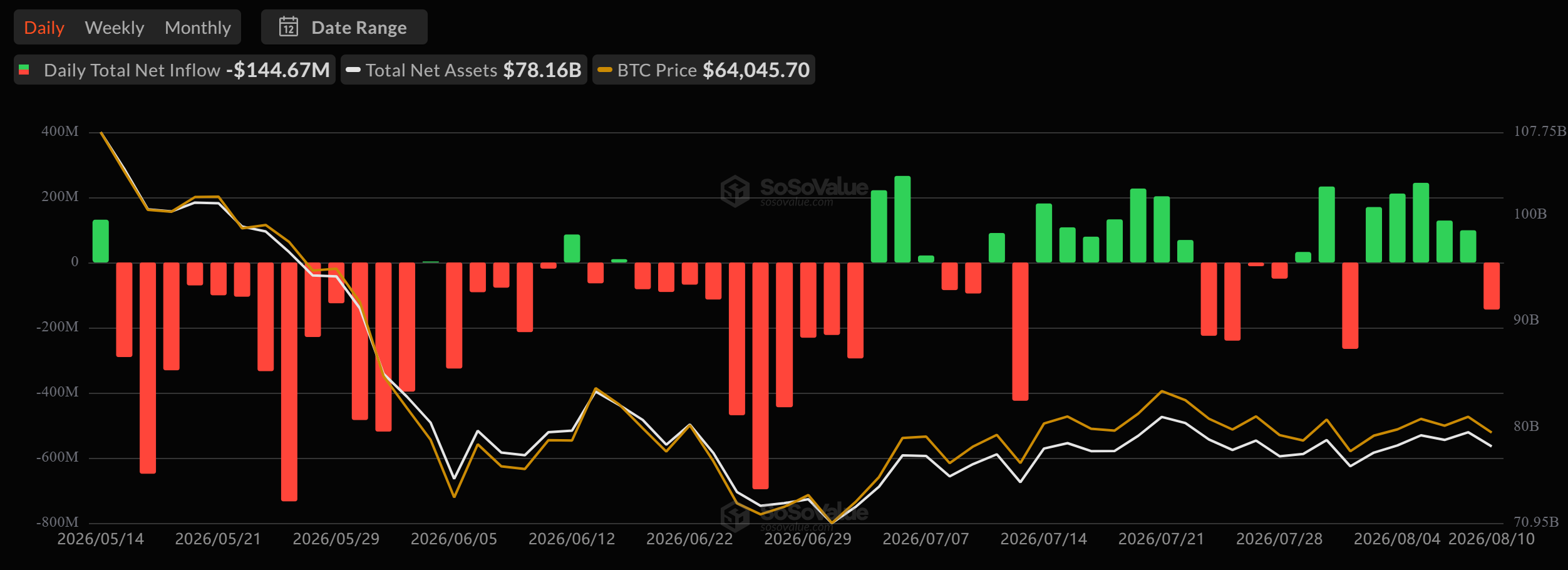
The timing is striking. US spot Bitcoin ETFs drew more than $850 million last week, their best week since April, according to SoSoValue. The funds now hold about $78 billion in bitcoin.

Fear did some of the pushing. Hackers drained roughly $116 million in Bitcoin from over 5,200 Coldcard hardware wallets, per a TRM Labs analysis. The exploit shook faith in self-custody.
Flows stay choppy, though. The funds shed $145 million on August 10 alone. Still, renewed BlackRock client demand suggests the appetite runs deeper than one red day.
Swap Now, Pay Taxes Later
The bigger prize sits in the tax code. IBIT runs as a grantor trust. In plain terms, the IRS treats shareholders as still owning the Bitcoin inside the fund.
That detail changes the math. Selling Bitcoin for cash triggers capital gains. Swapping it into IBIT may not. Clinton Donnelly, the crypto tax specialist behind the CryptoTaxFixer account, spelled out the position in a post.
“Not 100%, but the current tax position is that an in-kind contribution of Bitcoin to IBIT is non-taxable, with your basis and holding period carrying over. The caveat is that this relies on IBIT’s grantor trust treatment, and the IRS has not formally ruled on it.”
Balchunas backed that reading. The tax bill is delayed, not erased, because the original cost basis carries over.
Stock and bond funds cannot copy the move. Most run as open-end funds, not grantor trusts.
Bitcoin (BTC) traded near $63,602 on Tuesday, down 1.2% in a day. If the bar keeps falling, upcoming flow reports may show how much cold-storage bitcoin moves into the wrapper.
The post Bitcoin Holders Get 96% Cheaper Entry Into BlackRock’s ETF Without Selling appeared first on BeInCrypto.

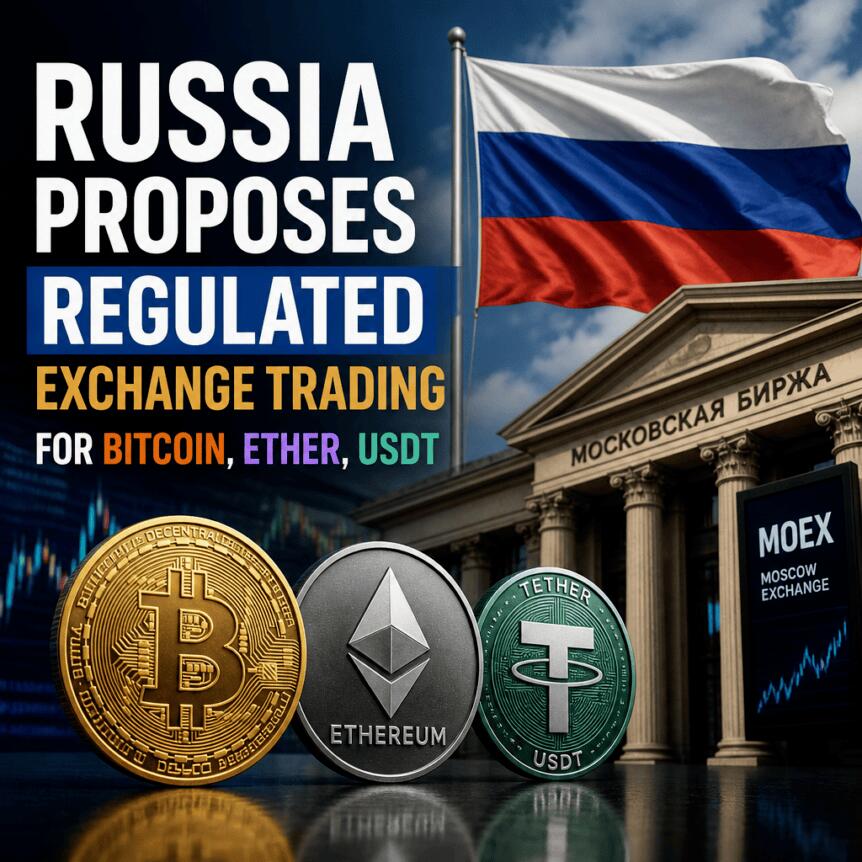
Russia’s central bank has drawn up a proposed shortlist of crypto assets that, if approved, could be eligible for trading on regulated platforms under the country’s newly enacted crypto framework. The regulator said the candidate assets include Bitcoin, Ether, and the stablecoin USDT.
The proposal is part of broader rules taking shape after President Vladimir Putin signed a law on Aug. 4 granting the Bank of Russia authority to decide which digital currencies may be admitted to “organized” trading and to set investor-access requirements. The central bank is now inviting public comments on the draft through Aug. 24.
Key takeaways
- The Bank of Russia’s draft list names Bitcoin, Ether, and Tether’s USDT as potential candidates for admission to organized exchange trading.
- Eligibility is tied to criteria such as market capitalization, average daily trading volume, and at least five years of price history on overseas markets.
- New access rules would cap purchases for non-qualified investors at 300,000 Russian rubles (about $3,650) per year per intermediary, while qualified investors face no such limit.
- All investors would need to complete a test and review crypto risk information before trading, regardless of their classification.
- The regulator is accepting comments on the proposal until Aug. 24, meaning the draft could change before final rules are set.
Draft eligibility list: what assets could be admitted
In a statement Tuesday, the Bank of Russia said it has compiled a proposed set of crypto assets that could be allowed for public trading on exchanges under the incoming regulatory regime. The announcement, published on the regulator’s website, also specified that the assets must satisfy a number of benchmark conditions.
According to the central bank, those conditions include a requirement tied to market capitalization, average daily trading volume, and at least five years of price history on international markets. By emphasizing both scale and long-running market data, the approach appears designed to narrow eligibility toward more established assets rather than newer tokens.
Among the named candidates are Bitcoin and Ether—two of the most liquid and widely traded cryptocurrencies globally—as well as USDT, a stablecoin issued by Tether. The inclusion of a major stablecoin signals that the regulator’s framework is not limited strictly to volatile coins, at least at the eligibility stage.
Why the new law changes the regulator’s role
The draft list does not stand alone; it follows a shift in Russia’s regulatory structure created by federal law that took effect after being signed by Putin on Aug. 4. That law gives the Bank of Russia the power to determine which crypto assets can enter organized trading and to create the operating rules for that process.
Earlier reporting from Cointelegraph noted that the core rules were set to take effect in 2026 as part of the new legal framework. With the central bank now moving to propose an asset list and investor rules, the practical implementation of that authority is beginning to take shape.
For market participants, the key implication is that not all tokens may be treated equally under the same umbrella. The regulator’s criteria—and the fact that eligibility is decided by the central bank—introduces an additional layer of compliance and potentially affects which assets exchanges can list for retail access.
Investor access rules: limits, “qualified” status, and risk testing
Beyond which assets could trade, the Bank of Russia’s proposal also addresses who can buy and how much. Under the draft rules, non-qualified investors would be limited to purchasing up to 300,000 rubles per year (about $3,650) of cryptocurrency through each intermediary. Intermediaries explicitly referenced include brokers, crypto exchange services, and asset managers.
Qualified investors, by contrast, would not face purchase limits for crypto assets traded on exchanges or through over-the-counter markets. The distinction between “qualified” and “non-qualified” investors matters because it shapes the effective scale at which different classes of customers can participate.
Importantly, the Bank of Russia said the framework requires a pre-trade step for everyone. “Before making transactions, all investors, regardless of their status, will have to pass a test and familiarize themselves with the risks of investing in crypto assets,” the central bank stated.
This requirement is designed to apply across the board, potentially limiting impulsive participation by ensuring buyers demonstrate awareness of crypto risk—while still allowing higher-volume activity for those who qualify.
Regulator rationale and what to watch next
The central bank said the restrictions are intended to protect non-qualified investors from sharp and unpredictable crypto price fluctuations. The logic is straightforward: if retail access is permitted, the regulator wants guardrails to reduce the likelihood of outsized losses among less experienced participants.
Russia’s draft also signals where the regulator’s focus may be during implementation. First, asset eligibility appears to rely on objective market metrics and longevity, which may constrain the range of tokens available for public exchange trading. Second, investor limits and required testing could reshape the economics of retail trading—especially if intermediaries must build compliance processes around classification and risk education.
The proposal remains open for public comment until Aug. 24, so investors and industry participants should watch for any changes to the eligibility criteria, the list of assets, or the specifics of the investor test and qualification thresholds.
For now, the central development is clear: Russia’s crypto market is moving toward a regulated structure where both the tradable universe and retail access conditions are determined by the Bank of Russia. The next key moment will be how the regulator responds to feedback and finalizes the framework ahead of full implementation of the new law.

Exterior view of the Tesla Gigafactory during a government-organised media trip in Shanghai, China, April 14, 2026.
Go Nakamura | Reuters
BEIJING — Survivors have emerged in China’s fiercely competitive car market, which is increasingly dominated by electric-powered vehicles.
Here are brands that have emerged as Chinese consumers’ favorite, according to industry data from Autohome:
1. Geely ranks first
Among the 10 most popular car models sold in China in the six months through July, Geely‘s Xingyuan electric hatchback was the bestseller with nearly 197,500 units sold.
The price? Just under 100,000 yuan ($14,820).
Geely has emerged as a close rival to BYD, ranking second by overall China sales volume in 2025. The Hangzhou-based company still sells gasoline-powered cars in addition to electric vehicles, such as those sold under its premium brand Zeekr.
2. Tesla keeps selling
The company’s Model Y ranked second in popularity with more than 180,000 of the electric SUVs sold. The Tesla car comes at a steeper price tag of 263,500 yuan to 313,500 yuan, but that didn’t stop it from topping sales of Li Auto‘s i6 SUV and Xiaomi’s SU7 sedan.
3. BYD barely makes top 5
Three of the 10 best-selling cars, as per Autohome data from February through July, were from BYD. But the most popular one — a modestly priced Yuan UP SUV — just managed fifth place with nearly 97,700 units sold. In sixth place was the Ti 7 under BYD’s off-road brand, followed by its Sealion 06 SUV.
The Chinese car giant reported its passenger car sales dropped by more than 10% in the first half of the year.
4. VW holds on
The German automaker was the only traditional foreign car company to make the top 10 — with its compact gasoline-powered Lavida in ninth place, squeezed between Leapmotor’s A10 electric SUV and Geely’s gasoline-powered Boyue L SUV.
5. Electric dominates
New energy vehicles, which include battery and hybrid-powered cars, accounted for 65.1% of new passenger cars sold in July — up from 54% a year ago, according to China Passenger Car Association data released Tuesday.
But the category still saw sales for the year through July drop by 12.5%, as passenger car sales overall tumbled by 20.3%, industry data showed.


Dubai-based Shipfinex has partnered with ADI Chain to tokenize about 35 vessels valued at roughly $500 million, with the planned structure designed to give shipowners access to blockchain-based financing and investment channels.
Summary
- Shipfinex has partnered with ADI Chain to tokenize about 35 vessels valued at roughly $500 million through separate special purpose vehicles.
- The planned tokens could represent vessel backed credit, charter linked income or other economic interests, with ADI Chain providing distribution and settlement infrastructure.
- Stablecoins denominated in UAE dirhams, U.S. dollars and other currencies are expected to support primary allocations and distributions.
- The project remains in the pilot and operational readiness stage, with no Maritime Asset Tokens publicly issued and the regulated issuance route still being finalized.
- Tokenized real world assets totaled about $38.1 billion as of Aug. 9, while Standard Chartered expects the market to reach $4 trillion by the end of 2028.
According to Shipfinex, each vessel in the planned pipeline will be placed inside a separate special-purpose vehicle, creating a legal structure through which tokens can represent economic interests tied to individual ships.
Shipfinex plans $500 million vessel tokenization pipeline
Depending on how each transaction is structured, the tokens could represent vessel-backed credit, income linked to charter agreements, or other economic interests connected to a specific ship. Separating the vessels into individual SPVs would also allow the economic rights associated with one ship to be structured independently from the rest of the portfolio.
ADI Chain will provide the blockchain infrastructure for distribution and settlement under the partnership. Primary allocations and subsequent distributions are expected to use stablecoins denominated in UAE dirhams, U.S. dollars and potentially other currencies.
The companies have not yet moved the planned assets into public issuance. Shipfinex said the partnership remains in its pilot and operational-readiness phase, while the regulated route required to issue the Maritime Asset Tokens is still being finalized.
As a result, none of the planned Maritime Asset Tokens have been publicly issued so far, despite the companies identifying a pipeline of about 35 vessels.
The $500 million portfolio would represent only a fraction of the value held in the global maritime industry. Clarksons Research valued the world fleet and ship orderbook at approximately $2.1 trillion at the beginning of 2026.
Shipfinex’s planned structure would bring vessels, an asset class traditionally financed through bank loans, leasing arrangements and private capital, into a tokenization model where defined economic rights can be represented and settled through blockchain infrastructure.
A similar model has already emerged elsewhere in the maritime sector. In June, crypto.news reported on Ethra Ship’s launch of a blockchain protocol for investments linked to operating maritime assets.
Ethra’s structure separated its SHIP governance token from a regulated real-world asset investment layer backed by vessel-owning SPVs. The platform was supported by Ethra Invest, which had been acquiring, managing and commercially operating vessels since 2021.
Ethra also said individual ships in the market can cost between $30 million and $120 million, illustrating the amount of capital that can be required to gain direct exposure to maritime assets. Its model used operating vessels and charter revenue as the economic base for its tokenized investment structure.
ADI Chain provides stablecoin settlement infrastructure
For Shipfinex, ADI Chain’s role extends beyond recording the planned vessel-linked tokens. The network is expected to support their distribution and settlement, including transactions involving currency-denominated stablecoins.
ADI Chain has already been involved in digital asset infrastructure projects in Abu Dhabi. In May, a previous report covered BNY’s launch of institutional Bitcoin and Ether custody services in Abu Dhabi Global Market through a collaboration involving Finstreet Limited and the ADI Foundation.
BNY, which had $59.4 trillion in assets under custody and administration at the time, initially offered custody for Bitcoin and Ether to regional institutional clients. The platform was also intended to support stablecoins and tokenized real-world assets as its services expanded.
ADI Chain has separately been used for dirham-denominated stablecoin infrastructure. DDSC, a stablecoin backed one-to-one by UAE dirham reserves, launched on ADI Chain in February after receiving approval from the UAE Central Bank.
The stablecoin was initiated by International Holding Company and First Abu Dhabi Bank, according to the announcement at the time. Its presence on ADI Chain provides existing dirham-based settlement infrastructure as Shipfinex prepares a model that could use UAE dirham-denominated stablecoins for vessel token allocations and distributions.
Tokenized real-world assets reach $38.1 billion
Shipfinex is preparing the vessel program while the value of tokenized real-world assets continues to increase across government debt, commodities, private credit and other asset classes.
Data from RWA.xyz showed approximately $38.1 billion in tokenized real-world assets as of Aug. 9. U.S. Treasury debt accounted for about $16.2 billion of the total, while tokenized commodities represented another $4.9 billion.
The market had already expanded sharply earlier in the year. By May, RWA.xyz and other market data placed tokenized real-world assets at roughly $31 billion to $34 billion, compared with around $5.4 billion at the start of 2025. Ethereum hosted about 60% of the value at the time, while tokenized U.S. Treasuries accounted for roughly $15 billion.
Growth has also extended into assets that have historically been difficult to divide or distribute to investors. Vessel tokenization falls into that category because ownership, financing and income rights can be tied to individual physical ships through legal entities rather than existing natively on a blockchain.
Under Shipfinex’s proposed setup, the SPVs would provide that off-chain legal structure, while ADI Chain would handle the blockchain-based distribution and settlement layer. The exact rights attached to each token would depend on whether a transaction represents credit, charter-linked income or another economic interest.
Standard Chartered sees tokenized assets reaching $4 trillion
Institutional forecasts have put the potential tokenization market far above its current size. In a report released Monday, Standard Chartered forecast that tokenized real-world assets could reach $4 trillion by the end of 2028, according to Geoff Kendrick, the bank’s global head of digital asset research.
An earlier Standard Chartered forecast covered in May projected $4 trillion of tokenized assets on-chain by the end of 2028, split evenly between stablecoins and real-world assets.
Kendrick said at the time that established decentralized finance protocols with strong risk controls could capture much of the activity as traditional financial assets move on-chain. He cited BlackRock’s BUIDL tokenized Treasury fund as an example of an institutional asset that can generate Treasury yield while also being used within blockchain-based financial products.
The bank’s projection included a $2 trillion target for stablecoins and another $2 trillion for tokenized RWAs by the end of 2028. Standard Chartered also estimated that roughly 1,000 times more assets remained off-chain than on-chain when it published the earlier forecast.
Shipfinex, meanwhile, has yet to publicly issue any of the Maritime Asset Tokens in its proposed $500 million vessel pipeline, with the company still working through pilot preparations, operational readiness and the regulated issuance route for the planned tokens.
ENS DAO has approved and executed a governance proposal that turns the ENS Foundation into a full-time operating body with a five-seat board, a professional staff, and control over a roughly $65 million endowment.
Summary
- ENS said the “Next Era of ENS DAO” proposal has completed on-chain execution after receiving tokenholder approval.
- Five voting directors will oversee the foundation, including three independent members.
- A one-time transfer of 1 million ENS tokens will fund employee compensation under restricted terms.
- ENS tokenholders retain control over protocol upgrades, fees, DAO-held tokens, and board appointments.
ENS Foundation takes over daily operations
According to an official ENS announcement, the approved structure gives the foundation the staff and legal standing needed to handle work that cannot be managed easily through on-chain votes alone.
ENS has operated for almost a decade as a naming system built on Ethereum. Its domains replace long blockchain addresses with names such as “alice.eth,” while also supporting website records, profiles, and other identity data.
Millions of ENS names have been registered, and the protocol has gained support from wallets, applications, and Layer 2 networks. However, the DAO itself is not a legal entity, leaving it unable to sign many institutional agreements, employ a permanent team, hold intellectual property directly, or represent the protocol in formal policy talks.
Under the executed proposal, the ENS Foundation becomes the legal and operating body for those functions. A full-time executive director will lead daily operations, manage staff, and oversee the grants program within budgets approved by the board.
Alexander Urbelis will serve as executive director and hold one voting board seat. ENS founder Nick Johnson will occupy a second seat, while Kartik Talwar, Brett Sun, and Anthony Leutenegger will serve as independent directors.
Independent directors will receive 40,000 USDC per year and serve two-year terms that the DAO may renew. If a director declines the payment, the funds will go to a nonprofit or public-good project of that person’s choice, according to the proposal.
Tokenholders also retain the power to appoint and remove directors. The removal process includes a written petition, supporting evidence, a response period for the board, and a 30-day period between the petition and the vote.
ENS DAO keeps control of the protocol and its tokens
The new setup separates operational work from decisions affecting the ENS protocol. The proposal states that smart contract upgrades, registration prices, fee structures, constitutional changes, the root key, and registry controls will remain with ENS tokenholders.
“Protocol control remains exclusively with ENS tokenholders,” the proposal states.
ENS Labs will continue operating as a separate Singapore-based entity with its own management and board. The foundation will hold ENS trademarks, brand assets, and other intellectual property, then license the relevant rights to ENS Labs while funding its work through the existing grant relationship.
Treasury safeguards were also added after delegates raised concerns during discussions that began in June. The DAO’s approximately 54.6 million ENS tokens remain under the same on-chain controls, and the proposal does not grant the foundation general authority over them.
One exception allows 1 million ENS tokens to move to the Foundation Safe for future employee compensation. Any grants from that pool must use multiyear vesting, while compensation for a director or the executive director requires approval from independent board members.
Until grants are issued, the foundation cannot vote, delegate, lend, or pledge the transferred tokens. It also cannot transfer them to ENS Labs or use them to pay ENS Labs staff. Unused tokens must return to the DAO if the foundation closes or if tokenholders approve a recall.
ENS has previously used outside organizations to manage part of its treasury. In November 2022, crypto.news reported its selection of Karpatkey to manage an endowment initially valued at about $52 million.
Nine-day timelock protects ENS endowment
Administrative control of the Endowment Safe, holding approximately $65 million in ETH and stablecoins as of July, now sits with the foundation board through approved signers. The assets have not moved to a new address, and the change does not give any director, employee, or private party beneficial ownership of the funds.
Endowment transactions will pass through a nine-day timelock by default. During that period, the ENS Security Council can cancel a transaction if it is unauthorized, incorrect, malicious, or outside the foundation’s approved mandate.
The proposal uses an OpenZeppelin Timelock Controller and a Blockful Security Council contract. Existing investment permissions granted to the endowment manager remain unchanged.
Meanwhile, the DAO’s operational wallet stays under its existing structure. The wallet held about $16 million in ETH and stablecoins as of July, while active payment streams continue drawing from it under their current terms.
Before receiving regular operating funds, the executive director must submit a projected budget to the board and publish a high-level version on the ENS governance forum. Transfers to cover setup costs cannot exceed $500,000 before that disclosure, and the first annual budget is due within 60 days of the proposal’s adoption.
Current grants, service-provider commitments, and active payment streams will continue until their scheduled end. Future grant work will move under the foundation, including the Service Provider Program, while existing reporting duties for recipients remain in place.
ENS Foundation will represent .ens in standards talks
Legal standing also allows the foundation to speak for ENS before internet standards bodies and government institutions. Its mandate includes participation in the Internet Corporation for Assigned Names and Numbers, the Internet Engineering Task Force, and the World Wide Web Consortium.
At ICANN, the foundation plans to pursue formal recognition and stewardship of “.ens” as a top-level domain. The work could help determine how blockchain-based names interact with the conventional Domain Name System used by browsers, websites, and email services.
Other Web3 naming providers have already sought a place in the ICANN system. In June 2024, crypto.news covered a partnership between Unstoppable Domains and Blockchain.com to seek approval for the “.blockchain” top-level domain. The report also noted that ENS had integrated “.box,” an ICANN-recognized domain compatible with standard browsers and email systems.
ENS has also worked directly with traditional domain companies. A February 2024 report on its partnership with GoDaddy said users could connect conventional internet domains to ENS-compatible wallet addresses without paying an additional fee.
For U.S. users, the foundation’s legal and brand-enforcement work carries practical relevance because naming disputes and impersonation cases can enter American courts. In September 2022, an Arizona federal court granted ENS an injunction involving the eth.link gateway domain after a dispute over its sale.
Formal recognition for DAOs remains limited in the United States. Wyoming has created legal structures for decentralized organizations, but an on-chain vote alone does not generally give a DAO the same ability as a registered entity to hire employees, hold trademarks, sign contracts, or appear in legal proceedings.
The foundation will adopt an interim conflict-of-interest policy covering its directors and executive director. Disclosures and recusals must be recorded publicly, ENS Labs funding requires support from a majority of eligible independent directors, and a refined policy must be presented for board approval within 90 days.
Tether-backed Bitcoin-focused company Twenty One Capital has reported a $413.5 million net loss for the second quarter of 2026 after Bitcoin’s decline reduced the value of its holdings.
Summary
- Twenty One Capital lost $413.5 million during the second quarter of 2026.
- A $401.5 million Bitcoin valuation loss accounted for most of the quarterly deficit.
- CEO Raphael Zagury plans to add acquisitions, capital markets services, and Bitcoin-backed loans.
- The NYSE-listed company gives U.S. investors stock-based exposure to a large corporate Bitcoin reserve.
Bitcoin losses have dominated Twenty One Capital’s results
According to Twenty One Capital’s second-quarter financial report, a $401.5 million decline in the value of its Bitcoin holdings accounted for most of the company’s quarterly loss.
Twenty One Capital’s latest loss has shown how strongly its financial statements depend on Bitcoin’s price at the end of each reporting period. Because the company holds the cryptocurrency as its main asset, changes in Bitcoin’s fair value pass through its reported earnings even when it does not sell the coins.
The $401.5 million reduction tied to Bitcoin represented about 97% of the total second-quarter loss. Remaining expenses accounted for roughly $12 million, based on the two figures in the report, although the source did not provide a complete breakdown of those costs.
A similar effect appeared in the company’s first-quarter accounts. Twenty One Capital reported an $859.7 million net loss for the three months ended March 31, according to its SEC quarterly filing. An $847.8 million decline in the fair value of its Bitcoin holdings caused most of that loss.
As of March 31, Twenty One held 43,514 BTC with a reported fair value of $2.95 billion, down from $3.80 billion at the end of 2025. Its cost basis for the holdings stood at about $3.69 billion, while the price used to value each coin fell from $87,316 on Dec. 31 to $67,832 on March 31.
Combined, the first two quarters have produced reported net losses of about $1.27 billion. Nearly $1.25 billion of that amount came from the lower accounting value of the company’s Bitcoin, based on the first-quarter filing and the second-quarter figures.
Such fair-value losses do not necessarily represent cash leaving the business. The first-quarter filing shows that Twenty One sold one Bitcoin and recorded a $3,180 gain on that disposal, while the much larger loss came from revaluing the coins it continued to own. Bitcoin’s closing price in later reporting periods can reverse part of a previous loss or create another expense under the same accounting treatment.
Twenty One Capital plans businesses beyond its treasury
New CEO Raphael Zagury has said Twenty One cannot rely only on holding Bitcoin and must develop businesses capable of producing cash flow. His plan centers on buying operating companies, using debt and equity markets to raise capital, and offering loans secured by Bitcoin.
Zagury took over from Strike founder Jack Mallers on July 20, according to the company’s leadership announcement. Mallers stepped down to concentrate on Strike but remained involved in the leadership handover.
“Twenty One holds one of the largest Bitcoin balance sheets in the public markets,” Zagury said in the announcement.
“My job is to build the operating company around it, with the discipline, governance, and executional rigor of an institution.”
The company identified five strategic priorities when Zagury became CEO. In addition to acquisitions and Bitcoin financial services, management plans to develop its capital markets operation, manage its Bitcoin reserves through debt and equity transactions, and keep a holding-company structure for acquired businesses.
Zagury has experience across both traditional finance and Bitcoin infrastructure. Before taking the top job, he served as a Twenty One director and interim audit committee chair. His earlier roles included positions at Goldman Sachs, Deutsche Bank, and Merrill Lynch, while he also helped lead Bitcoin mining and infrastructure company Elektron Energy.
In May, Twenty One said it was considering a combination with Strike and Elektron that would have joined payments, mining, treasury management, and financial services. The company later removed Strike from consideration after Mallers left the CEO position, leaving the payments business as an independent company.
Tether has tightened control of the Bitcoin company
Twenty One began with support from Tether, Bitfinex, SoftBank, and Cantor Equity Partners. Its 2025 launch plan valued the business at $3.6 billion and called for more than 42,000 BTC, alongside capital raised through convertible notes and a private investment in public equity.
Tether later acquired SoftBank’s full interest in the company, crypto.news reported in May. The transaction removed a large outside shareholder and increased Tether’s influence over the listed company.
The original structure had included Bitcoin contributions from Tether, Bitfinex and SoftBank. A separate financing package consisted of convertible senior secured notes and common equity, with the proceeds allocated mainly to additional Bitcoin purchases and corporate expenses.
By the time Twenty One entered the public market in December 2025, its treasury had grown to more than 43,500 BTC. Earlier coverage of its debut noted that falling Bitcoin prices were already putting pressure on the stock and other digital-asset treasury companies.
Investors were also questioning whether Twenty One could develop enough operating revenue to distinguish its shares from direct Bitcoin holdings or spot exchange-traded funds. At the time, the company employed four full-time workers and had not provided a product-launch schedule.
Under Zagury, management has placed more attention on acquiring businesses and generating income rather than measuring performance only by the size of the Bitcoin reserve. Twenty One still uses Bitcoin per share, expressed in satoshis, as one of its internal performance measures.
The company’s first-quarter filing showed 12,557 satoshis per Class A share at both Dec. 31 and March 31. Twenty One had 346.5 million Class A shares outstanding at the end of the quarter, while its Bitcoin balance fell by one coin.
U.S. investors face Bitcoin and company-specific risks
Twenty One trades on the New York Stock Exchange under the ticker XXI, giving U.S. investors access to its Bitcoin holdings through a regulated public stock. That exposure also includes corporate expenses, debt, management decisions, and share issuance, which do not apply when an investor holds Bitcoin directly.
The shares were trading near $4.59 on Aug. 11, while Bitcoin changed hands around $63,802. Because XXI represents an operating company rather than a spot Bitcoin ETF, its stock price can trade above or below the value of the Bitcoin attributable to each share.
Twenty One has also used Bitcoin to support its financing. Its first-quarter SEC report listed about $484.4 million of convertible notes and said 16,116 BTC served as collateral for them. Management stated that the pledged coins could not be treated as an available source of liquidity while they remained tied to the notes.
At the end of March, the company held $114.1 million in cash and $117.9 million in net working capital. Management said those resources were sufficient to fund operations for at least one year from the filing date and did not expect to sell Bitcoin during that period to meet ordinary liquidity needs.
A governance issue emerged after SoftBank’s representatives left the board following Tether’s purchase. As crypto.news covered in June, the NYSE warned Twenty One that its audit committee no longer met the exchange’s independence rules.
The exchange gave the company until June 5 to appoint a qualified independent audit committee member before attaching a below-compliance indicator to its listing. Twenty One appointed an independent director on June 8, according to its investor-relations records.
Disclosure: This article does not represent investment advice. The content and materials featured on this page are for educational purposes only.
XRP continues to underperform amid market uncertainty and delays surrounding the Digital Asset Market Clarity Act, while UE Crypto gains attention for yield options.
Summary
- XRP is underperforming the broader crypto market, with renewed investor interest in UE Crypto’s cloud mining and yield services.
- A weaker XRP price and uncertainty around the Digital Asset Market Clarity Act are prompting holders to explore alternative income strategies through UE Crypto.
- UE Crypto is positioning its cloud mining platform as an option for XRP holders seeking additional digital asset returns without relying solely on price appreciation.
The cryptocurrency market has remained relatively calm, with a slight downward trend, while XRP has fallen to the bottom.
Over the past few weeks, the broader market has remained in a period of relatively stable volatility, while XRP, the cryptocurrency associated with the founders of payments company Ripple, has continued to underperform. When other cryptocurrencies rise, XRP tends to gain less; when other cryptocurrencies fall, XRP tends to decline more sharply.
The reason may be the current lack of transparency in the market — or, more specifically, the delay surrounding the long-awaited Digital Asset Market Clarity Act.
As investors explore cloud mining and yield opportunities, the weakness in XRP’s price has driven increased interest in UE Crypto.
Amid continued market volatility, XRP holders seeking cloud mining and yield strategies continue to show interest in UE Crypto.
XRP fell 1.24% on the day, while UE Crypto is promoting the development of long-term cryptocurrency yield solutions.
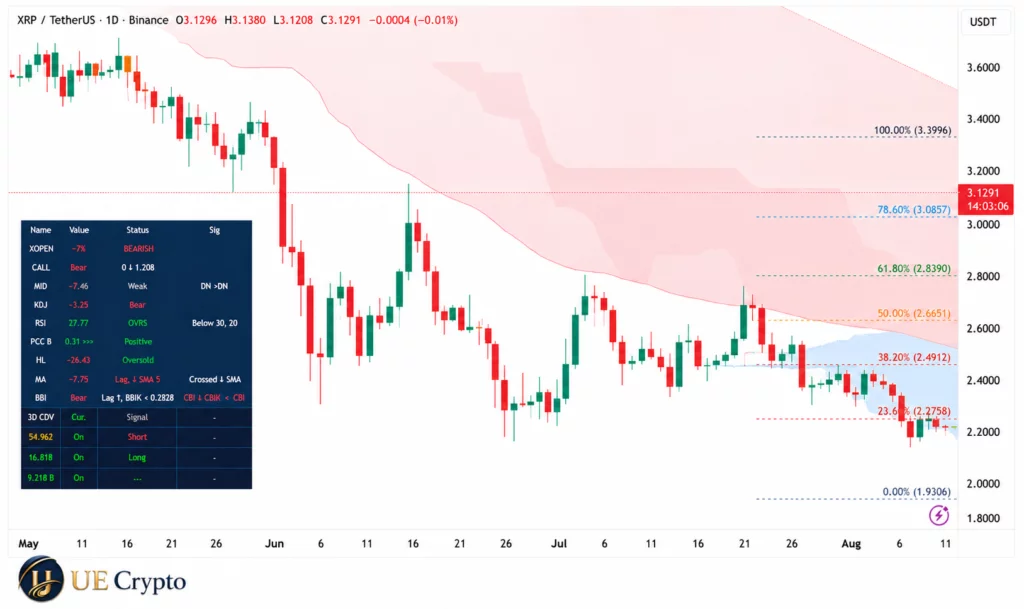
Today’s cryptocurrency charts show that the market is cooling down. Among the top ten cryptocurrencies by market capitalization, XRP recorded the largest seven-day decline, falling 4.96%, while Solana gained 3.64% and Bitcoin rose 1.17% over the same period. XRP also fell 1.24% on the day, while the broader market remained largely flat. The token’s price action appears to indicate that the Clarity trade is being unwound.
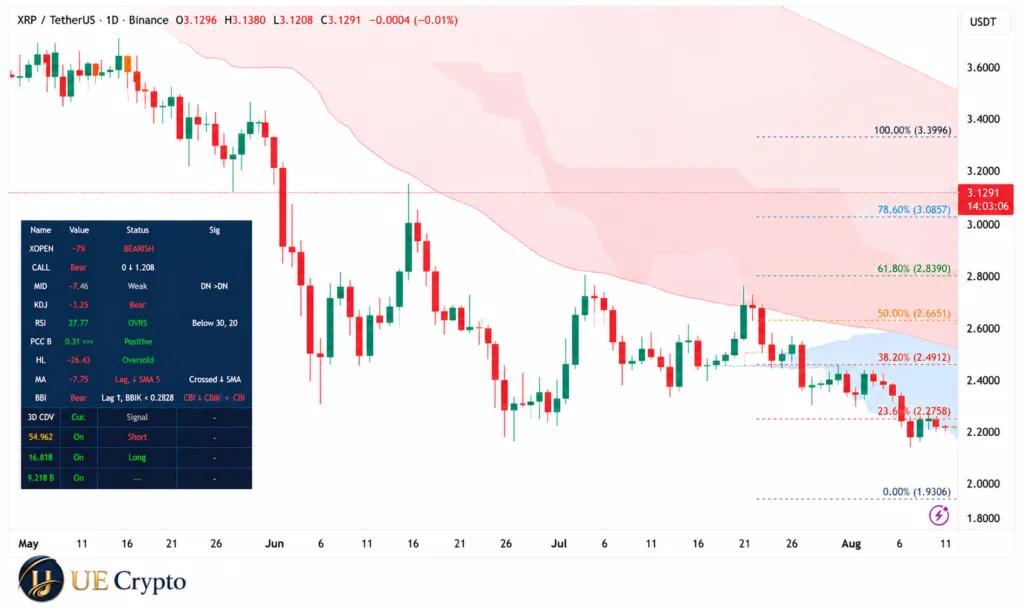
Driven by market sentiment, XRP’s price fell to a recent low, causing its market capitalization to shrink and temporarily losing its position as the world’s fourth-largest digital asset. The increase in short-term volatility has prompted some investors to reassess their future XRP investment strategies.
At the same time, an increasing number of XRP holders are considering other options: while maintaining a bullish long-term outlook for XRP, is there a way to mitigate the impact of short-term price volatility while generating consistent additional returns from their XRP holdings?
It is against this backdrop that the UE Crypto cloud mining platform has attracted increasing attention from investors seeking to hedge against market volatility and enhance returns through cloud mining and yield aggregation mechanisms.
As XRP volatility increases, UE Crypto emerges as a new option for investors
In light of the recent increase in XRP price volatility, more and more XRP holders are turning their attention to UE Crypto. They are seeking to explore more stable and sustainable yield models through cloud mining and yield aggregation mechanisms while maintaining their long-term digital asset holdings.
Unlike highly volatile leveraged trading or strategies that rely solely on price appreciation, the UE Crypto cloud mining platform provides a more accessible way to participate in digital asset activities. Users do not need to deploy mining machines or maintain hardware; they simply need to select a computing-power contract to participate in the mining service. This allows them to maximize the utility of their digital assets while maintaining their focus on the long-term outlook for XRP.
About UE Crypto
UE Crypto is headquartered in the United Kingdom and operates within European regulatory frameworks such as MiCA and MiFID II, continuously improving its transparency, operational standards, and user protection mechanisms.
The platform adopts a multi-layer security architecture, including:
- Annual financial and security compliance audits by PwC.
- Digital asset custody insurance provided by Lloyd’s of London.
- Enterprise-level network protection from Cloudflare and McAfee® security systems.
- Bank-grade data encryption technology and professional security infrastructure to provide multiple layers of protection for user assets and accounts.
UE Crypto supports a range of major digital assets, including XRP, BTC, ETH, USDT, USDC, DOGE, LTC, and SOL, providing users with a more flexible and convenient digital asset service experience.
Start earning daily returns in just three steps
1. Register an account
2. Choose a mining package
Based on personal budget and requirements, select a suitable cloud mining contract and start mining with a single click.
3. Start earning
Once the contract is activated, the system will automatically allocate computing power, and returns will be settled automatically every 24 hours. Users can withdraw their returns at any time or continue participating according to their needs, enabling long-term compound growth of their assets.
Popular UE Crypto contracts
- BTC (Beginner Experience Contract) Investment Amount: $100,Contract Term: 2 days,
Daily Return: $4,Total Return at Contract Expiration: $100 + $8 - DOGE (Digital Intelligent System Contract) Investment Amount: $500,Contract Term: 5 days,Daily Return: $6.25,Total Return at Contract Expiration: $500 + $31.25
- BTC (Super Computing System Contract) Investment Amount: $1,000,Contract Term: 10 days,Daily Return: $13.10, Total Return at Contract Expiration: $1,000 + $131
- LTC (Algorithm-Driven System Contract) Investment Amount: $5,000,Contract Term: 25 days, Daily Return: $72,Total Return at Contract Expiration: $5,000 + $1,800
- BTC (Quantitative Intelligent System Contract) Investment Amount: $10,000,Contract Term: 35 days, Daily Return: $158,Total Return at Contract Expiration: $10,000 + $5,530
For more details about the contract plans, please visit the official UE Crypto website.
Summary
Bullish case
A daily close above the $1.0486 Fibonacci resistance level would provide the first evidence of buyers entering the market, potentially opening the way toward the EMA cloud and the $1.0887–$1.1066 golden zone. This would require the Clarity Act narrative to regain momentum rather than simply remain stalled.
Bearish scenario
A break below the $1.0128 low, followed by a loss of the psychological $1 level, could initiate a gradual decline toward and below $0.90. Both the death cross and negative squeeze momentum point in the same direction. At present, an upside move does not appear to be the more likely path.
The bullish case remains, but it is not yet sufficient. XRP is being viewed as a proxy for the Clarity Act, while market pricing suggests that the probability of the bill passing has fallen to 21%. For users holding XRP over the long term, market attention is shifting from relying solely on price appreciation toward more diversified ways of participating in the digital asset ecosystem.
For example, DeFi cloud mining services provide users with additional options for long-term participation in the digital asset ecosystem, allowing them to focus on the long-term value of their assets while exploring more stable and sustainable yield management strategies.
Join UE Crypto today and earn daily passive income through digital assets.
Disclosure: This content is provided by a third party. Neither crypto.news nor the author of this article endorses any product mentioned on this page. Users should conduct their own research before taking any action related to the company.

Ethereum has declined by more than 2% over the past 24 hours, but still holds a small weekly gain. ETH is currently at $1,875, while many traders are waiting for a deeper flush to $1,475 before buying.
But the latest analysis by trader Nonzee indicates that such a move may not come, as the main shakeout already took place in June and July.
Final Trap
The leading altcoin swept below the range twice during that period and recovered within days, although the quiet moves did not look like a typical market bottom. The next move is expected to come in October, when ETH pulls back to $1,537. The market expert explained that this pullback will mark a retest and a higher low, not a new low.
According to Nonzee, ETH would move back above $2,203 and test the $2,872 range high. The 2027 target is $4,500, with a full measured target of $4,500 to $4,700. That makes the October dip a major buying opportunity, even though it would be about 15% above the $1,475 level many traders are waiting for.
Last week, Crypto Patel said Ethereum was showing one of its strongest high-timeframe bullish structures. The asset had reclaimed its long-term descending trendline after several failed attempts and was consolidating above it. The structure remained valid above $1,510 on daily closes. The analyst identified upside targets at $2,400, $3,000, $3,600, $4,200, and $5,000.
Beyond these targets, Crypto Patel also outlined a much bigger Ethereum move playing out through 2030. The analyst mapped a long-term roadmap that puts the ETH accumulation zone at $1,000-$1,600, followed by targets of $10,000 and eventually $20,000.
“If this HTF roadmap plays out, today’s ‘fear’ could look like the best entry of the decade.”
Mixed Picture
On the corporate side of things, Bitmine expanded its Ethereum holdings beyond 5.8 million tokens after acquiring another 7,391 ETH. Its total stash is now worth approximately $11.2 billion at the reported price. However, the accumulation pace has slowed compared with earlier purchases exceeding 27,000 and 42,000 units.
The company has also repurchased 19.1 million shares since July 1, while Bitmine Chairman Tom Lee remains optimistic about the asset’s long-term potential, even as he expressed disappointment that the CLARITY Act will not see a Senate vote before the August recess.
Meanwhile, US-based spot Ethereum ETFs saw $14.59 million in net withdrawals, ending a four-day streak of inflows. So far in August, these funds have attracted around $230 million in net investment.
The post The Ethereum (ETH) Chart Everyone Is Watching Has a Problem: $1,475 May Never Come appeared first on CryptoPotato.
Elon Musk’s Terafab chip project is suddenly real, and it has dragged one US stock back into focus. Months ago Musk tied the giant plant to Intel (INTC) and its most advanced technology, and now that Terafab is funded, that endorsement matters again.
Intel stock still slipped about 4% on August 10 to near $97, tracking a fresh share sale, not the Terafab news. No binding deal exists, and Wall Street’s biggest banks cannot agree on what Elon Musk’s interest is worth.
What Elon Musk Said About Intel and Terafab
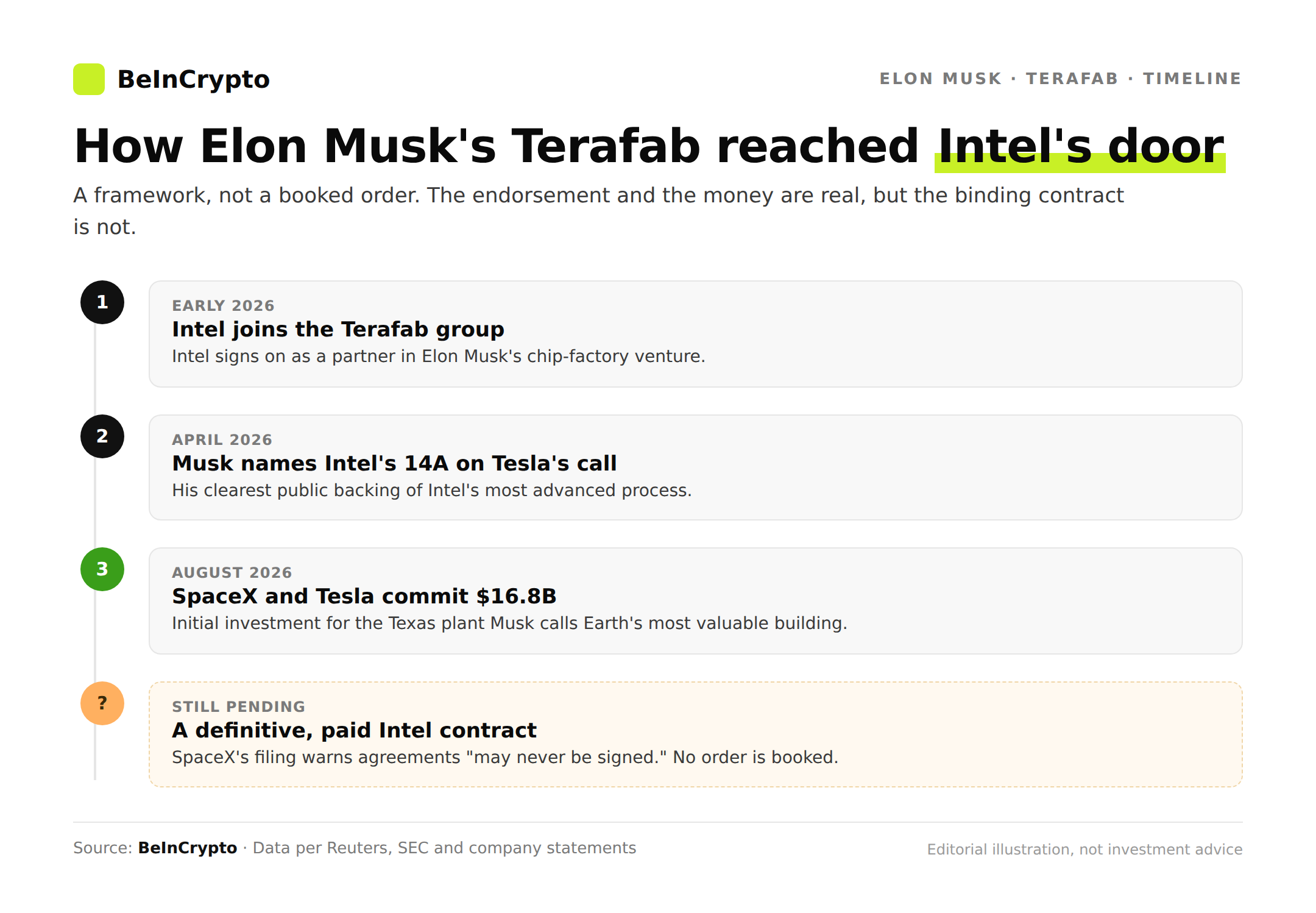
Terafab is Elon Musk’s plan to build one of Earth’s largest chip factories, the plant he calls the world’s most valuable building. He first named Intel’s 14A process on Tesla’s first-quarter call in April, its next-generation recipe for the smallest, fastest transistors. That would make Terafab the first major customer for 14A, a process Intel has not even finished building.
Then it went quiet. By the next quarter, Musk’s chip spotlight had swung to NVIDIA’s newest processor, and Intel slipped from the story. It roared back this month, once SpaceX and Tesla funded Terafab.
Want more insights like this? Sign up for Editor Harsh Notariya’s Daily Newsletter here.
Intel had joined Elon Musk’s Terafab group in April, and the warmth runs both ways. Intel posted that it was “proud to join” the project alongside SpaceX, xAI, and Tesla, and CEO Lip-Bu Tan praised Musk’s “proven track record of reimagining entire industries.”
Musk’s word carries weight, too. His record personal fortune was built on bets exactly like this, so naming Intel is no idle comment.
The money is serious. In August, SpaceX and Tesla committed $16.8 billion to build the Texas plant.
The catch is the contract. SpaceX’s filing warns that the Terafab partners, Intel among them, are not obligated to stay and that definitive agreements may never be signed. So Musk’s 14A endorsement is a framework, not a booked Intel order.

That gap is why the endorsement matters more as validation than as revenue.
Why It Means Validation, Not Revenue Yet
Intel has told regulators it may pause or discontinue 14A without a major outside customer. A name like Elon Musk is exactly the vote of confidence it needs.
But it is not near-term money. The 14A process reaches high-volume manufacturing in 2028, the point of full commercial scale. External foundry revenue was just $293 million last quarter, against a $2.1 billion foundry loss.

Wall Street is just as split. On July 28, the two biggest banks landed on opposite calls the same day, JPMorgan a sell at $85 and Bank of America a buy at $160. No major analyst has moved a rating since, even as Terafab won its funding (August 6) and Intel launched a $15 billion share sale, the sale of new stock that dilutes existing holders and drove the August 10 dip.

The wider business is healthier. Q2 revenue rose 25% to $16.1 billion. Investors are still pricing a broad turnaround, including bets like Trump’s Intel stake, not a Terafab order book.
That optimism is already priced in. Intel has soared this year despite a recent pullback.

Intel Stock Price Levels to Watch
The chart is where the bull case lives. Since mid-July, Intel has traced an inverse head-and-shoulders, a bullish reversal shape, a dip, a deeper dip, then a shallower dip, that hints sellers are losing their grip. However, the seller-side volume seems to be rising near the right shoulder.

But the conviction behind it looks thin. Since Intel’s July 23 earnings, options traders have leaned bearish, buying more puts, bets the stock falls, and fewer calls, bets it rises. The put/call volume ratio has climbed to 0.79 and open interest to 1.01, a less bullish tilt just as the pattern needs buyers.

The left shoulder of the bullish pattern sits near $89, the head near $81, the right shoulder near $96, under a neckline around $104.
The price action is the tie-breaker. A close above the $104 neckline, roughly 7% away, confirms the breakout and opens $109, $113, and $118, near the average analyst target near $119. A confirmed move points to $126 and then $132. Below $96, the $89 left shoulder is first support, the $81 head the last line.

So Elon Musk’s Terafab hands Intel stock a real option on 14A validation, bullish in shape but short on conviction. It becomes a breakout only above $104 on rising volume (which isn’t there now), and a bankable Terafab story only when a paid deal appears.
The post The Quiet Winner of Elon Musk’s $16.8 Billion Terafab Bet Is a US Chipmaker Stock appeared first on BeInCrypto.


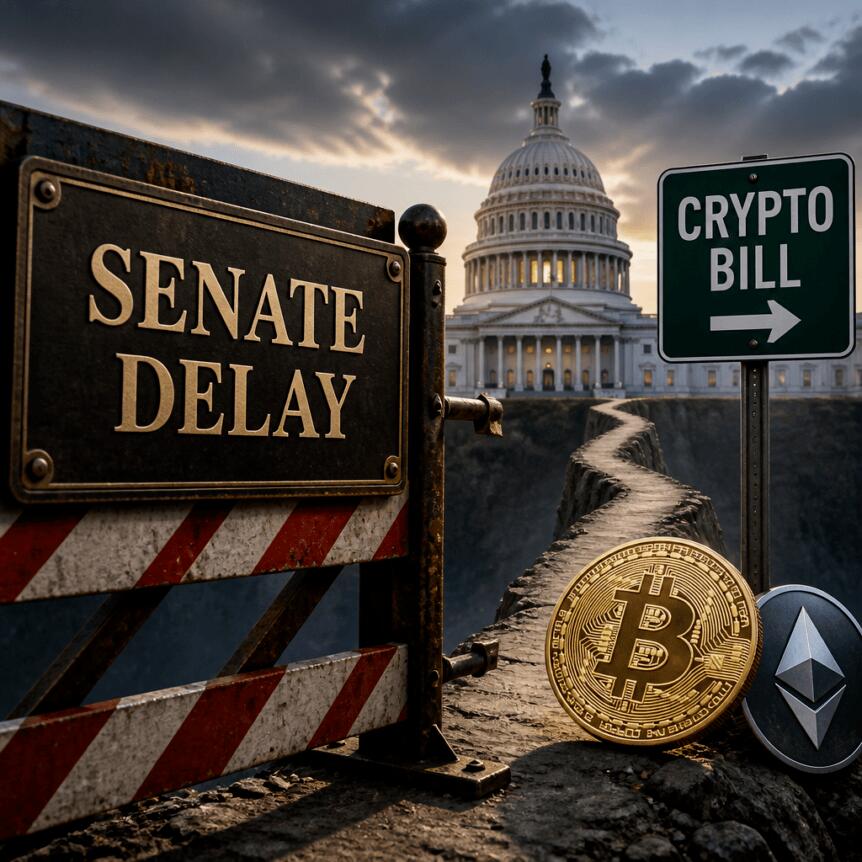
Majority Leader John Thune has moved the US Senate toward a potential September vote on the Digital Asset Market Clarity (CLARITY) Act, using a cloture filing that would allow the sweeping crypto market-structure bill to be considered on the Senate floor. The measure is now set to face a tight procedural and legislative timeline once lawmakers return from a month-long recess.
However, the path to final passage remains uncertain. Senate Democrats and industry stakeholders have flagged key sticking points—including proposed ethics-related language tied to President Donald Trump’s digital-asset connections and additional limits on how crypto firms may offer stablecoin rewards. Even if cloture happens in September, the Senate could still have only limited time to resolve outstanding disputes before the chamber breaks again ahead of the November election.
Key takeaways
- Thune filed for cloture on the CLARITY Act shortly before the Senate’s August recess, setting up a possible September floor push.
- After lawmakers return on Sept. 14, they would have 14 scheduled session days before another recess tied to the November election calendar.
- Major unresolved issues include ethics provisions involving President Trump’s digital-asset ties and restrictions on stablecoin-reward offerings.
- If the Senate misses its window, election-year dynamics could further complicate negotiations during the next Congress.
A narrow procedural window after the September return
The Senate is expected to return from recess on Sept. 14, with only 14 days scheduled to be in session before the chamber breaks again ahead of the November election. After that pre-election recess, lawmakers would face another gap—followed by additional time before the end of the year—meaning the practical window for resolving disputes over the CLARITY Act could be measured in weeks rather than months.
Thune’s cloture filing is a procedural step that can bring a bill closer to floor consideration, but it does not settle the substantive questions that have delayed action. According to reporting referenced by Cointelegraph, lawmakers had not publicly announced deals on several provisions that remain contentious.
The stakes for market participants are straightforward: CLARITY is intended to create clearer market-structure rules for digital assets by setting out how responsibilities should be allocated across regulators. Without the bill’s passage, companies and exchanges are left navigating a patchwork of existing regulatory approaches and enforcement-driven expectations.
Why the Senate’s unresolved provisions matter
At the center of the political friction are provisions that would shape the compliance landscape and business models for parts of the crypto industry.
Cointelegraph’s coverage notes that the Senate version of the CLARITY Act has drawn attention to ethics language linked to President Trump’s digital-asset ties. Opponents have previously described the measure as enabling “crypto corruption,” a critique that contributed to scrutiny of earlier versions and broader resistance from many Democrats during the bill’s protracted journey.
Another major point of contention involves additional restrictions for crypto companies offering stablecoin rewards. Stablecoin incentives have become a common customer-acquisition and retention tool in parts of decentralized and centralized finance, and limits in this area could affect how issuers and platforms structure programs, marketing, and risk disclosures.
Even if cloture is secured in September, lawmakers would still need time to address these unresolved elements before a potential floor vote—and the calendar may not provide enough runway to find compromises acceptable to both chambers.
How election-year uncertainty could reshape negotiations
The CLARITY Act has already taken more than a year to travel through Congress after the House passed it last year. During that period, the Senate faced multiple disruptions, including more than one government shutdown, along with sustained pushback from within the political system and from industry leaders. Opposition has also been fueled by concerns about conflicts of interest and the ethics framework attached to the legislation, as described in earlier coverage referenced by Cointelegraph.
Looking ahead, a procedural setback in September could carry consequences beyond simple delay. After November, 33 Senate seats and all 435 House seats would be up for election. Election outcomes can significantly affect committee priorities, legislative bandwidth, and which members remain in office—potentially slowing or resetting negotiations into the next Congress.
For investors and operators, election-year uncertainty can be more than a political inconvenience. Regulatory clarity delays often translate into longer periods of compliance experimentation, more reliance on legal interpretations and agency guidance, and greater sensitivity to enforcement risk—even when market activity continues.
Regulators may fill the gap if Congress stalls
With the legislation back in limbo, some market participants are turning their attention to federal agencies—particularly the Commodity Futures Trading Commission (CFTC) and the Securities and Exchange Commission (SEC)—for regulatory signals and rulemaking momentum.
Cointelegraph’s cited reporting indicates that the legislation would be expected to give the CFTC more authority to oversee and enforce rules affecting digital assets. Still, the broader point for the crypto sector is practical: if lawmakers do not finalize CLARITY, agencies have indicated they can move forward through their own rulemaking or enforcement frameworks.
In a July interview highlighted by Cointelegraph, SEC Chair Paul Atkins said the agency was “ready, willing, and able to come out with rules” to address crypto if Congress failed to pass CLARITY. Separately, Cointelegraph cited statements from CFTC Chair Michael Selig in April indicating that the commission was “ready to take responsibility” for oversight—referring to the expectation of legislative passage that would clarify roles.
Both agencies have also reportedly taken steps to coordinate oversight of financial markets, according to Cointelegraph’s reference to a memo describing efforts to align regulatory approaches. That coordination matters because market structure rules can otherwise become fragmented—leading to inconsistent treatment depending on which regulator asserts primary jurisdiction.
In other words, even without CLARITY, market participants may not be waiting in a vacuum. The question is whether agencies’ actions will provide the kind of stability that a comprehensive market-structure law is designed to deliver.
For now, the most important thing to watch is whether the Senate can convert Thune’s cloture filing into actual floor movement during the post–Sept. 14 schedule—while negotiations continue over ethics and stablecoin-reward provisions; if that narrow window closes, both the political calendar and regulator-driven rulemaking could become the main determinants of how quickly compliance expectations evolve.

Russia Proposes Regulated Exchange Trading for Bitcoin, Ether, USDT

Kaia Gerber Makes Rare Remark About Brother’s Addiction Battle

Hundreds of Indonesians Named After Naruto, Doraemon and Other Japanese Anime Characters


-

 Fashion4 days ago
Weekend Open Thread: Mattifying Sunscreen
-

 Fashion5 days ago
Frugal Friday’s Workwear Report: Cap-Sleeve Pointelle Crewneck Sweater
-

 Sports6 days ago
Jordan Coyle & Cordiamo take Laya Arena Stakes at RDS
-

 News Videos4 days ago
Can Astrology Help Find Gold and Silver Trends? A Financial Astrology Guide
-
 Business6 days ago
US stocks: Dow closes at record on Mideast optimism; SpaceX, AMD drag Nasdaq
-

 Politics6 days ago
Reform UK And Greens Sink To Lowest Favourability Ratings To Date
-

 Tech7 days ago
OpenAI, Anthropic AI agents targeted real people and systems in cyber tests
-

 Business6 days ago
Supply chain issues impact Ingredion
-

 Tech4 days ago
Rinn Pharma & Biopharma to join NordicPharmaTrain network
-

 Business3 days ago
How to Start a Cleaning Business: A Step-by-Step Guide
-
 Crypto World7 days ago
Dow and S&P 500 Hit Records on AI Earnings: When Will the Bubble Burst?
-

 Business3 days ago
BDC Weekly Review: Private BDC Q2 Numbers Are Strong
-

 Business3 days ago
Datadog: Best Of Breed For Multiple Reasons
-

 Business7 days ago
McDonald’s (MCD) Q2 2026 earnings
-

 Fashion7 days ago
The Bright Side of Black and White
-

 Fashion6 days ago
Suit of the Week: Me + Em
-
 NewsBeat2 hours ago
Communication cards help banking customers access services or report scams
-
Sports6 days ago
Spider-Man: Brand New Day ending explained: Is Peter Parker alive?
-

 Crypto World7 days ago
Robinhood files $200M second venture fund focused on YC startups
-
 Fashion6 days ago
Birthstone pendant necklaces for women by ottomanhands – 18ct gold plated
You must be logged in to post a comment Login