
Crypto World
Chainlink price rallies on Standard Chartered $200 call

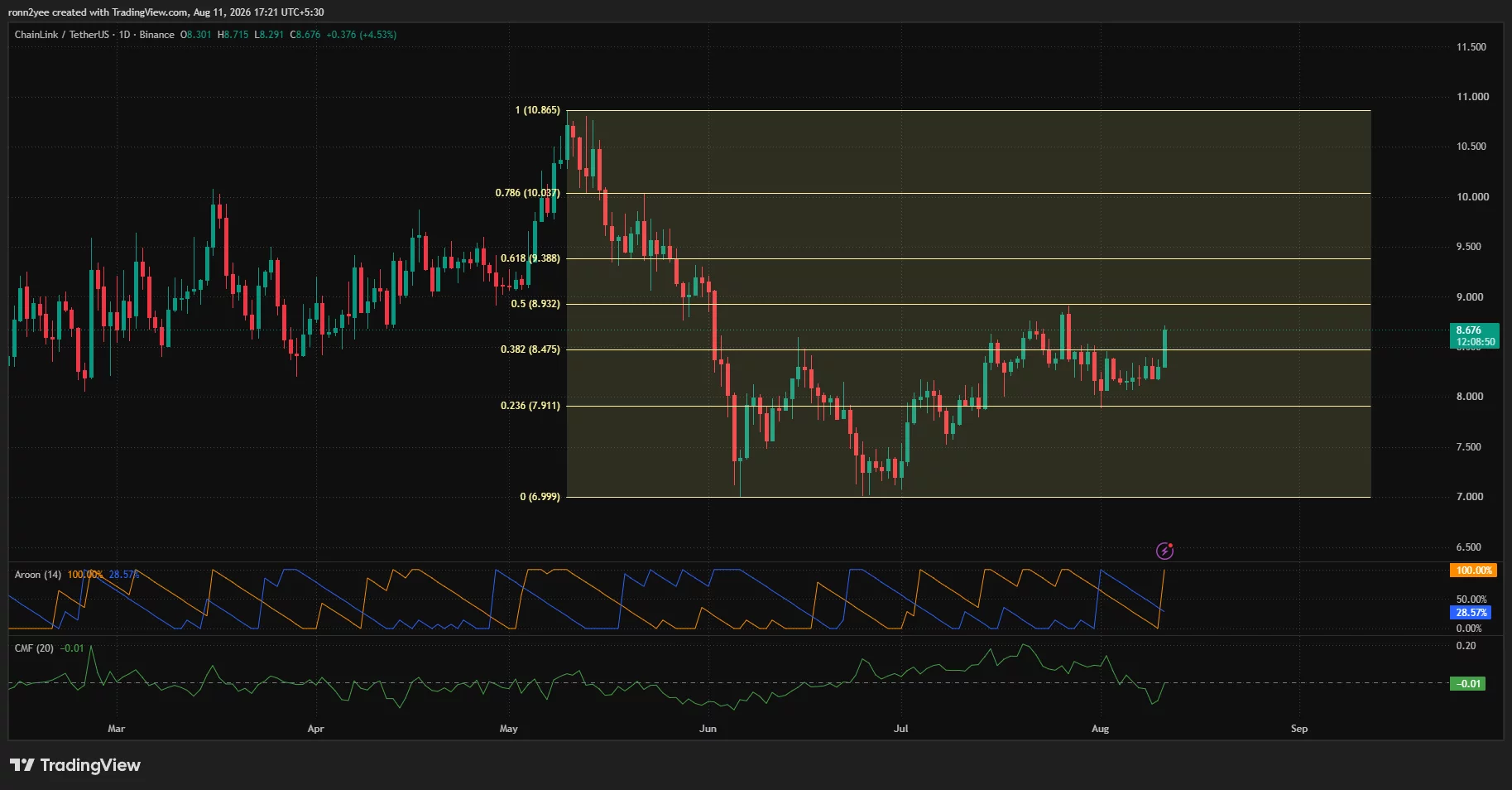
Chainlink price rose 4.5% to $8.67 on Aug. 11 after Standard Chartered initiated coverage with a $200 target for 2030, while technical indicators pointed to improving short-term momentum.
Summary
- Chainlink gained 4.5% to $8.67, breaking above the daily chart’s $8.48 Fibonacci level.
- Standard Chartered projected LINK could reach $200 by 2030 as asset tokenization expands.
- LINK’s 4-hour Supertrend turned bullish, establishing immediate dynamic support near $8.21.
- Liquidation clusters above $8.70 and $8.90 could pull LINK price toward the next resistance zone.
Chainlink price rallies above $8.48 resistance
According to data from crypto.news, Chainlink (LINK) price traded at $8.67 at the time of writing, up 4.5% over the previous 24 hours. LINK opened the daily session near $8.30, fell briefly to $8.29, and then climbed as high as $8.72.
The move pushed LINK above the 38.2% Fibonacci retracement level at $8.48, calculated from its May high of $10.87 to its June low near $7.00. That level had restricted several recovery attempts since late July.
Holding above $8.48 would give buyers a stronger base for challenging the 50% retracement at $8.93. The latter also sits near a local high identified by trader Daan Crypto Trades, making the $8.90–$8.93 area the most important immediate resistance zone.
LINK has now recovered about 24% from its late-June low. However, it remains below its May peak and has yet to confirm a broader trend reversal on the daily chart.
The daily Aroon indicator showed a sharp improvement in bullish momentum. Aroon Up reached 100%, compared with Aroon Down at 28.57%, indicating that LINK recorded a recent high while downside momentum weakened.
Still, the Chaikin Money Flow remained marginally negative at -0.01. The reading suggests that the price breakout has not yet received strong confirmation from sustained capital inflows. A move above zero would add weight to the bullish setup.
Standard Chartered’s $200 LINK target drives demand
The rally followed a Standard Chartered research note that initiated coverage of LINK with a $200 price target for the end of 2030. The target represents a gain of more than 2,200% from the token’s current price.
Geoff Kendrick, the bank’s global head of digital assets research, reportedly set interim targets of $13 for the end of 2026, $41 for 2027, $82 for 2028, and $133 for 2029.
The forecast rests largely on Standard Chartered’s expectation that tokenized assets held on public blockchains could grow from about $340 billion to $4 trillion by the end of 2028. The bank expects increased tokenization to raise demand for oracle data, cross-chain transfers, and compliance infrastructure.
Chainlink currently secures more than $110 billion in oracle-dependent value, representing about 70% of the global market and over 80% of the value secured by oracles on Ethereum, according to figures cited in the report.
Standard Chartered also estimated that Chainlink’s fee revenue could expand about 25-fold by 2030 as tokenized assets move between traditional finance and decentralized networks. However, the $200 figure remains a long-term forecast rather than a guaranteed price outcome.
The positive report arrived as LINK supply on centralized exchanges continued to decline. More than 15.7 million tokens reportedly left exchanges over a recent one-month period, reducing exchange-held supply by about 12%.
Separately, approximately 1.26 million LINK, valued at more than $10 million at the time, left centralized platforms in one day in early August. Exchange withdrawals can reduce immediately available selling supply, although they do not reveal whether holders intend to accumulate, use the tokens on-chain or transfer them elsewhere.
LINK technical indicators favor another test of $8.90
The 4-hour chart supports the short-term bullish case. LINK broke above the Supertrend resistance near $8.37, causing the indicator to flip positive and establish trailing support at $8.21.
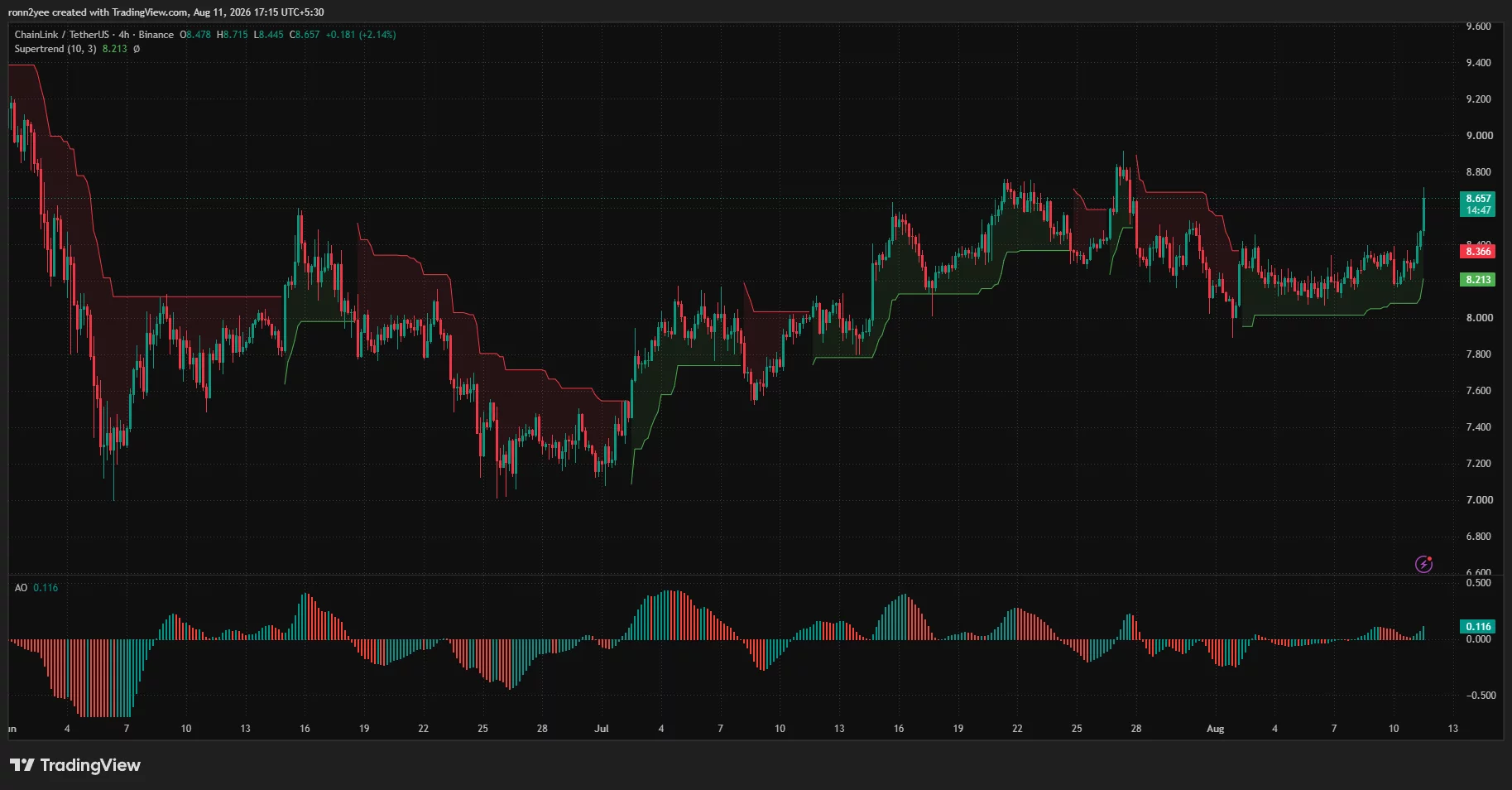
Price also cleared the narrow consolidation range between roughly $8.10 and $8.40 that had been in place since the beginning of August. Buyers must now defend the former upper boundary around $8.36 during any retest.
The Awesome Oscillator rose to 0.116 and printed an expanding green bar above the zero line. This shows that short-term momentum is accelerating relative to the longer-term average.
Immediate resistance sits around $8.72, corresponding with Tuesday’s intraday high. A close above that level would leave $8.90–$8.93 as the next target. Beyond $8.93, the daily Fibonacci chart identifies resistance at $9.39, followed by $10.04.
A rejection from the current area would put $8.48 back in focus. Below that, the former Supertrend resistance at $8.36 and active Supertrend support at $8.21 form the main defense for the breakout.
Losing $8.21 could invalidate the immediate bullish setup and expose LINK to $7.91, the daily chart’s 23.6% Fibonacci level. The larger downside liquidity concentration sits near $8.00, making that psychological level important if broader crypto market conditions weaken.
Liquidation map points to volatility above $8.70
CoinGlass’ one-week LINK liquidation heatmap shows that the token has already moved through a dense concentration of leveraged positions around $8.45–$8.55. LINK’s price was approaching another set of liquidation bands above $8.70 when the chart was captured.
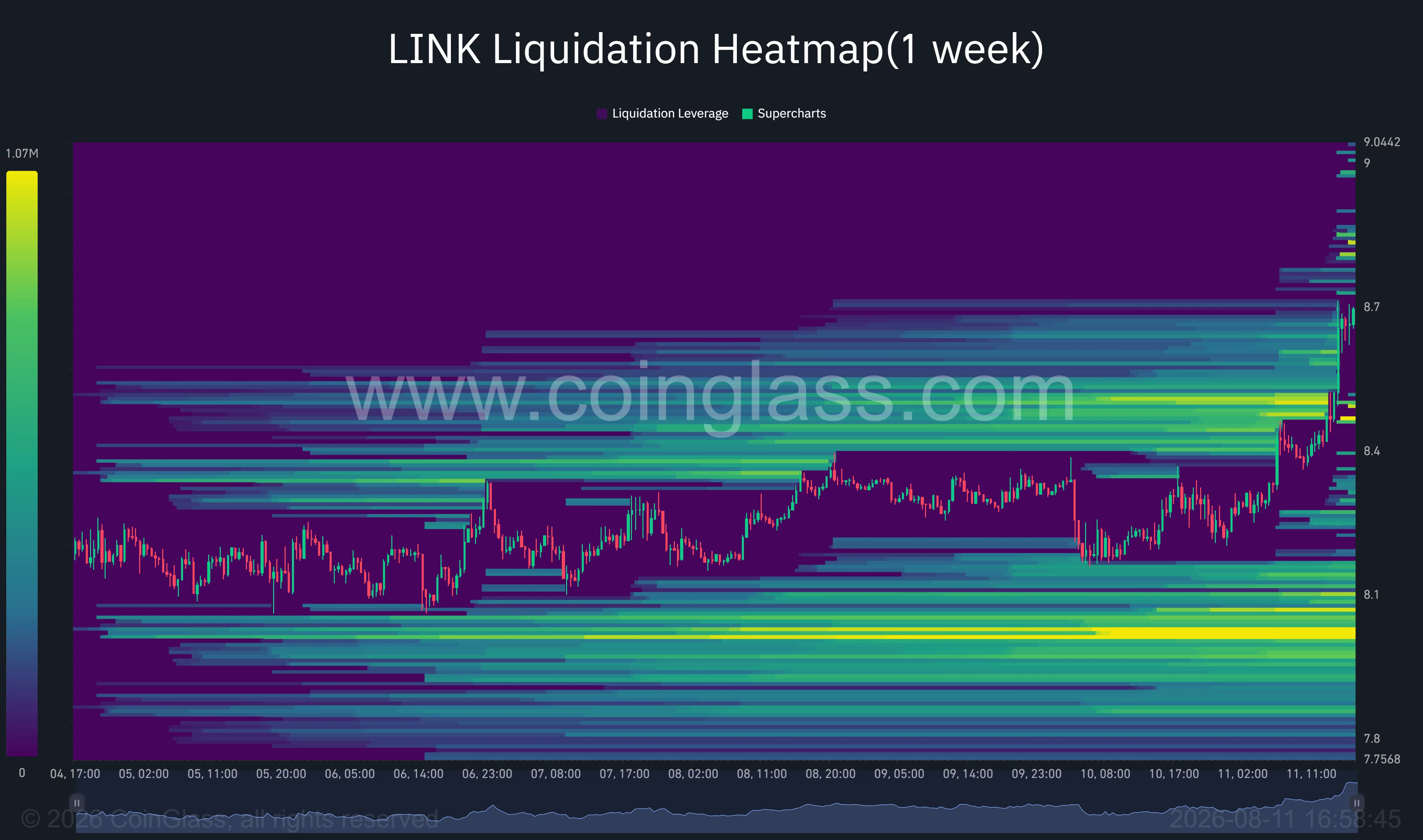
Further short-liquidation liquidity appears between approximately $8.80 and $8.90. If LINK holds above $8.60, these positions could provide fuel for another short squeeze toward the $8.93 technical target.
On the downside, the largest visible liquidation cluster lies near $8.00–$8.05. A failed breakout and decline below $8.21 could therefore accelerate as leveraged long positions are closed.
Daan Crypto Trades also identified $8.90 as the key level needed to confirm a continuation. The trader said LINK had returned to its highest-volume historical price area and was holding higher-time-frame support.
“I want to see a move above $8.9 to break the local high and get a move going,” Daan said.
For U.S. traders, the next macro risk is the July Consumer Price Index report. A stronger-than-expected inflation reading could pressure crypto assets by reducing expectations for Federal Reserve rate cuts. LINK’s ability to hold $8.48 during a broader risk-off move would provide a clearer test of whether the Standard Chartered-driven demand can extend beyond the initial rally.
Disclosure: This article does not represent investment advice. The content and materials featured on this page are for educational purposes only.

Crypto World
ForumPay Expands Payment Infrastructure with New Card and Bank Transfer Acceptance Solution
[PRESS RELEASE – Milton, Georgia, August 11th, 2026]
Businesses are increasingly looking for ways to offer more payment options without adding operational complexity. ForumPay, a crypto payment infrastructure company, enables merchants to accept crypto payments across online, in-store, and in-app channels, with instant conversion and next-day settlement.
ForumPay has recently announced a new payment flow that it says could meaningfully alter how payments are processed. Customers can now initiate purchases using any Visa or Mastercard and bank transfers in selected markets, with funds routed automatically through ForumPay’s infrastructure. Merchants can now offer card and bank payments without registering as a card acceptance businesses, sidestepping chargeback liability and PCI-DSS compliance costs while still receiving precisely the amount invoiced.
This latest ForumPay release represents one of the more ambitious developments yet to bridge the gap between traditional payment rails and crypto infrastructure.
Built for Modern Payment Acceptance
Businesses increasingly want to offer customers greater flexibility at checkout, but additional payment methods tend to bring additional operational and cost burdens. Card acceptance, in particular, can introduce chargeback exposure, compliance requirements, fraud management responsibilities, and more complex settlement processes, challenges that only grow more acute for organizations operating across multiple markets.
ForumPay’s innovative new payment flow is designed to solve these issues. Customers can initiate payments using any Visa, Mastercard, or bank transfer in selected markets, with those funds automatically used to purchase crypto and processed through ForumPay’s existing crypto payment infrastructure, with all of the inherent features and benefits, and converted and settled as per the preferences a merchant has already established on their account. Merchants will receive exactly the amount invoiced. For example, if a customer is billed $100, then $100 is what arrives in the merchant’s preferred bank account.
Critically, ForumPay will pass the additional card and bank transfer costs directly to the payer, meaning merchants pay only their usual crypto acceptance fees that would apply to any transaction processed through the platform. The approach allows businesses to expand the choice of available payment methods at checkout without taking on the compliance architecture, risks and costs that card acceptance would ordinarily require.
More Payment Options, the Same Operational Footprint
Businesses increasingly want to offer customers greater flexibility at checkout, but incorporating additional payment methods tend to bring with it additional operational burdens. Card acceptance, in particular, can introduce chargeback exposure, compliance requirements, fraud management responsibilities, and more complex settlement processes, challenges that only grow more acute for organizations operating across multiple markets.
ForumPay’s new payment flow is being designed to address this friction. Customers will be able to initiate payments using any Visa, Mastercard, or bank transfer in selected markets. Those funds are then automatically used to purchase digital assets and processed through ForumPay’s existing infrastructure, allowing merchants to continue receiving funds according to their established settlement preferences without having to overhaul their operations to accommodate the new options in the process. The approach, ForumPay says, allows businesses to expand what they can offer at checkout without taking on the compliance architecture that card acceptance would ordinarily require.
About ForumPay
ForumPay is a complete cryptocurrency-to-fiat payment technology firm; its core processing technology helps businesses attract new customers, optimize customers’ ability to spend, and increase revenue. ForumPay’s wallet-agnostic solution enables crypto consumers to spend their preferred cryptocurrency, from any wallet for everyday goods and services to luxury goods, automobiles, real estate, and private jets. ForumPay eliminates merchant exposure or risk by processing transactions with instant crypto-to-cash conversion. ForumPay merchants receive payments in the currency of their choice directly into their bank account. The transactional experience is similar to accepting other popular payment methods, including cash, credit cards, and bank transfers, but simpler, faster, and more secure.
The post ForumPay Expands Payment Infrastructure with New Card and Bank Transfer Acceptance Solution appeared first on CryptoPotato.


Binance added Moonbeam (GLMR), ICON (ICX), Moonriver (MOVR), SuperRare (RARE) and Sophon (SOPH) to its Monitoring Tag list on Aug. 11 after its latest project reviews.
Summary
- Binance added five tokens to its Monitoring Tag list after completing its latest periodic reviews.
- GLMR, ICX, MOVR, RARE and SOPH now face closer scrutiny and potential future delisting risks.
- Moonriver fell roughly 21% in 24 hours while Moonbeam dropped about 13% following Binance’s announcement.
- Binance said related services remain unaffected and gave no specific reasons for adding individual tokens.
- Moonbeam and Moonriver announced Base migrations in July, while ICON plans its December 31 shutdown.
The designation places all five tokens under closer scrutiny and signals possible future delisting if they stop meeting the exchange’s listing standards, according to its announcement.
The exchange said the move does not remove any of the tokens from trading and will not affect other related services. Binance did not provide a specific reason for adding each project. The notice was also updated later on Aug. 11 to revise information concerning the Monitoring Tag quiz.
Binance Monitoring Tags do not mean immediate delisting
The exchange uses the Monitoring Tag for assets it considers more volatile or risky than other listed tokens. Its reviews examine team commitment, development activity, trading volume, liquidity, network security, smart contract stability, public communication, due diligence responses, token supply changes and evidence of misconduct.
The exchange said tagged tokens are “at risk of no longer meeting our listing criteria and being delisted.” However, the tag itself is not a delisting decision, and Binance gave no date for its next review. As previously reported, the exchange placed ACX, LSK and STX under closer review on July 24.
The tag appears on corresponding Spot and Margin trading pages and the Markets Overview page, alongside a risk warning banner. The exchange has not published a numerical threshold for individual review factors, so the announcement does not establish which criterion prompted each addition or how close any token may be to removal.
GLMR and MOVR lead losses after the announcement
Market data showed a mostly negative reaction on Aug. 12. Moonriver traded near $0.90, down about 20.7% over 24 hours, while Moonbeam fell about 12.9%. SuperRare declined around 8.3% and ICON lost roughly 5.1%. Sophon was up about 0.8% over the same rolling period.
Trading activity also increased for several assets. CoinGecko showed Moonriver’s 24 hour volume rising more than 600% from one day earlier, while ICON volume increased more than 300%. The figures show higher trading activity but do not establish that the exchange’s decision alone caused the moves.
Recent project changes add context to Binance review
Two of the tagged assets recently underwent major network changes. Moonbeam’s update announced a 1:1 migration of GLMR from its Polkadot parachain to Base with a July 31 deadline. Moonriver separately announced a 1:1 MOVR migration from its Kusama based network to Base with the same deadline. Binance did not say either change prompted its decision.
ICON is also winding down its legacy blockchain. The ICON Foundation’s notice says the network will permanently halt on Dec. 31, 2026, which is also the final deadline to migrate ICX to SODA.
Other projects have their own histories. In related coverage, SuperRare lost about $730,000 in a staking contract exploit in July 2025. Sophon, meanwhile, entered spot trading in May 2025 alongside its token generation event. Binance did not connect either development to the new designation.
What happens next for the five tokens
GLMR, ICX, MOVR, RARE and SOPH remain available under the services covered by Binance’s announcement. The exchange will continue periodic reviews and may remove the tag if conditions change or delist an asset if it decides the token no longer meets its standards.
The latest additions follow several recent listing reviews. As previously reported, four of six assets scheduled for Aug. 17 removal had earlier risk warnings, including ACX, which received its tag on July 24. That history shows a Monitoring Tag can precede removal, although it does not guarantee that outcome.
For holders of the five newly tagged assets, the next concrete development would be another Binance review or a separate notice changing their listing status. The exchange has not announced a timetable for another assessment or a delisting decision.
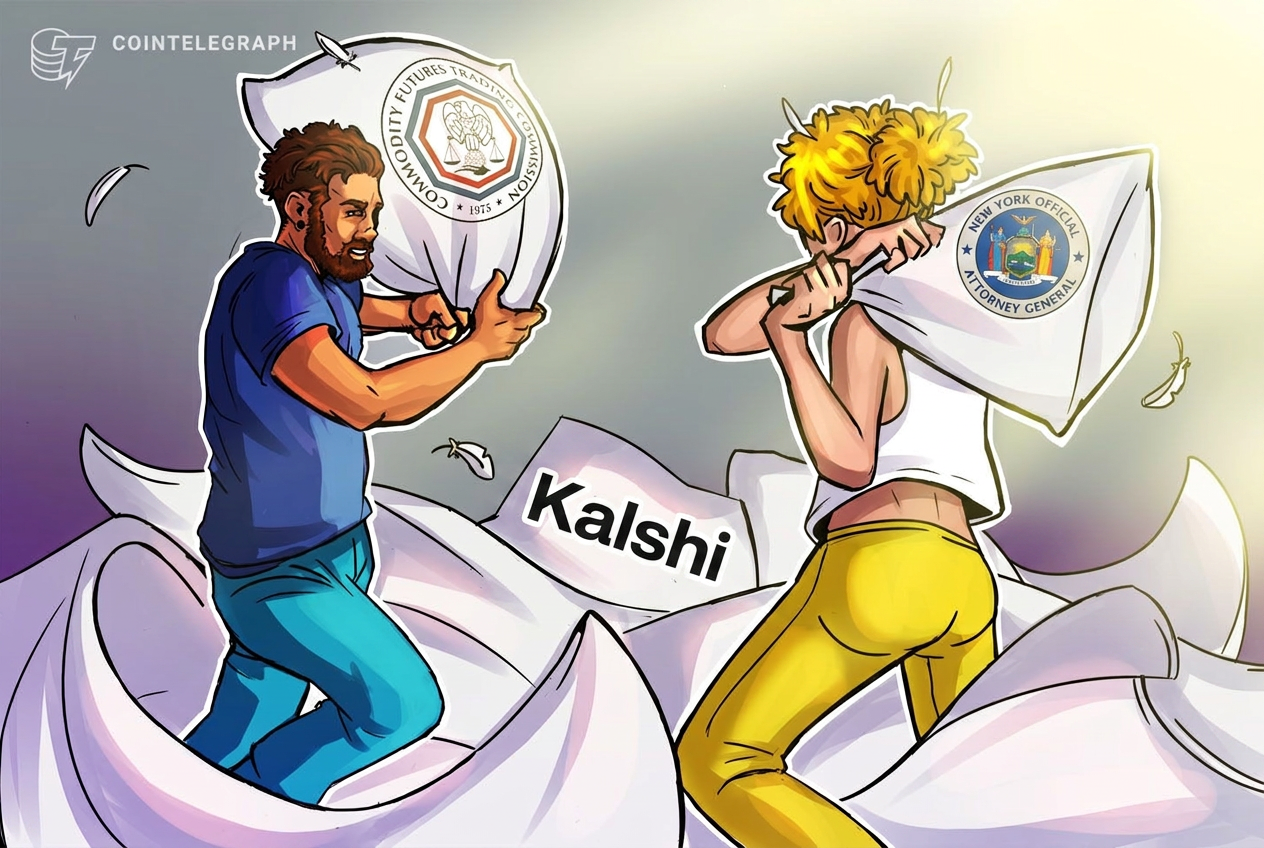
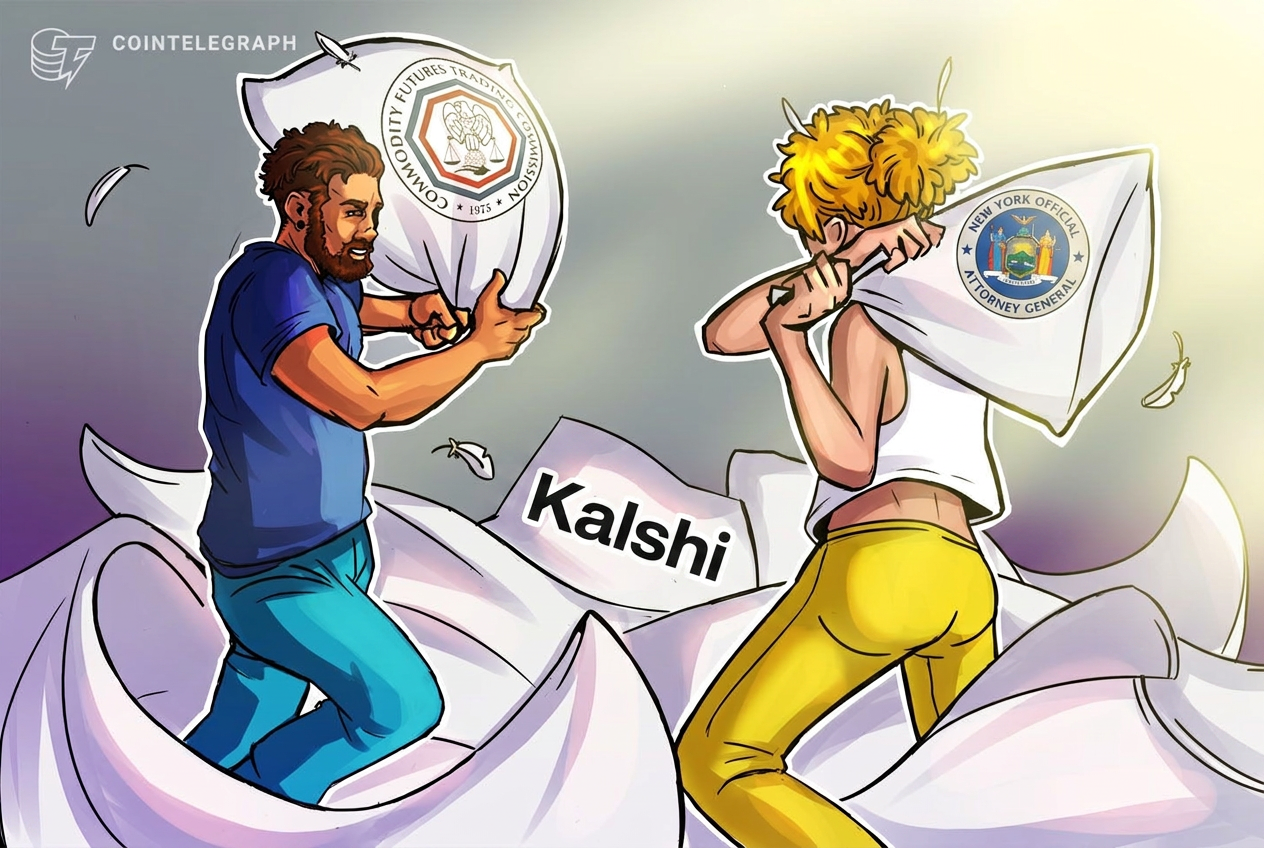
The US Commodity Futures Trading Commission (CFTC) invoked its emergency authority on Tuesday, ordering prediction market Kalshi to continue operating.
The CFTC said that New York’s enforcement action and request for a temporary restraining order themselves constituted a market emergency and directed Kalshi to continue operating in accordance with its normal practices and the Commodity Exchange Act’s Core Principles.
New York’s requested temporary restraining order would bar Kalshi from operating a business offering contracts tied to sports, culture, elections and other events in or from New York or to people in the state. The CFTC said the order could prevent Kalshi from offering all event contracts nationwide because it is based in New York. According to the CFTC, New York is seeking at least $36 billion in compensatory damages pending an accounting.
The CFTC said the Commodity Exchange Act requires the commission to provide a uniform national derivatives market and that major disruptions threaten orderly trading and price discovery. CFTC Chair Michael Selig said Congress did not intend derivatives exchanges to face a “patchwork of state gaming laws.”
The confrontation is part of a broader national fight over whether the Commodity Exchange Act preempts state gambling laws as applied to event contracts traded on federally regulated exchanges.
CFTC challenges state oversight of prediction markets
In the lawsuit filed on July 31, New York alleges Kalshi runs an illegal, unlicensed gambling business by offering contracts tied to sports, elections, culture and other events. The state is seeking restitution, disgorgement, damages and penalties, including a penalty equal to three times Kalshi’s alleged gains and $100,000 for each unauthorized sports wagering offer or attempt in New York.
Kalshi says states cannot shut down a federally licensed exchange, while the CFTC argues that the Commodity Exchange Act gives it exclusive jurisdiction over transactions involving swaps traded on designated contract markets, including event contracts Kalshi lists as swaps.
A federal judge in a separate New York case denied Kalshi’s request for a preliminary injunction on July 7, finding at that stage that New York gambling laws were not preempted by the Commodity Exchange Act as applied to Kalshi’s sports-event contracts.
Related: Judge stays CFTC’s case against US soldier over prediction market bets
In a separate federal case, the CFTC sued New York in federal court in April to block the state from applying its gambling laws to CFTC-registered contract markets. Judge Jed Rakoff denied without prejudice the agency’s emergency request for a temporary restraining order, finding that the CFTC had not established a high likelihood of success on the merits or a likelihood of irreparable harm.
The latest CFTC order directs Kalshi to continue operating but does not end New York’s lawsuit or resolve the underlying jurisdictional dispute. It is not a judicial ruling on whether federal law preempts state gambling enforcement.
The dispute extends beyond New York. The CFTC said it has sued eight other states, along with New York, to defend its congressionally granted jurisdiction.
Magazine: The 100x obsession: Fundamentals grow in importance as crypto matures


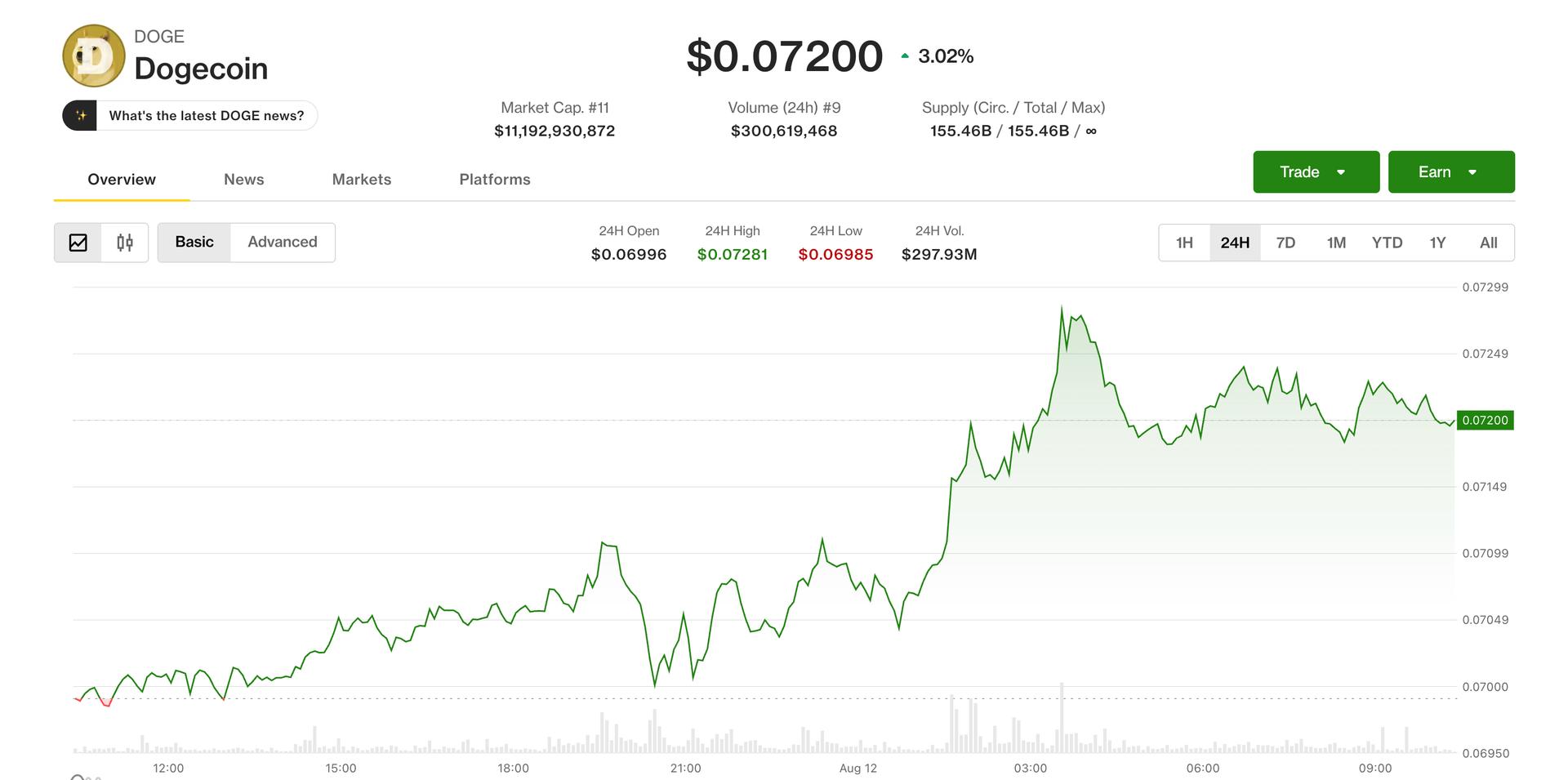
CoreWeave surged 16% after hours on stronger-than-expected sales growth, and Super Micro Computer rose almost 8% on a revenue forecast above estimates, lifting Nasdaq 100 futures.
Oil kept climbing. Brent rose over 1% to $90 a barrel, a sixth straight session of gains and its longest run since April, with traders still doubtful about a Middle East deal.
Jeff Mei, chief operating officer at BTSE, said the week’s direction rests on the inflation print and on whether Iran and the U.S. reach a deal over the Strait of Hormuz.
“Last week’s US job numbers were weak — a continuing narrative supporting this trend and lower inflation would cement expectations for Fed cuts by year-end, boosting liquidity and risk assets like Bitcoin,” Mei said.
“Traders should watch for any hawkish pushback from Fed speakers, but the macro setup could lead to a relief rally if this week’s CPI numbers are lower than expected,” he added.
July inflation data is due at 8:30 a.m. ET, with oil’s run feeding directly into it.
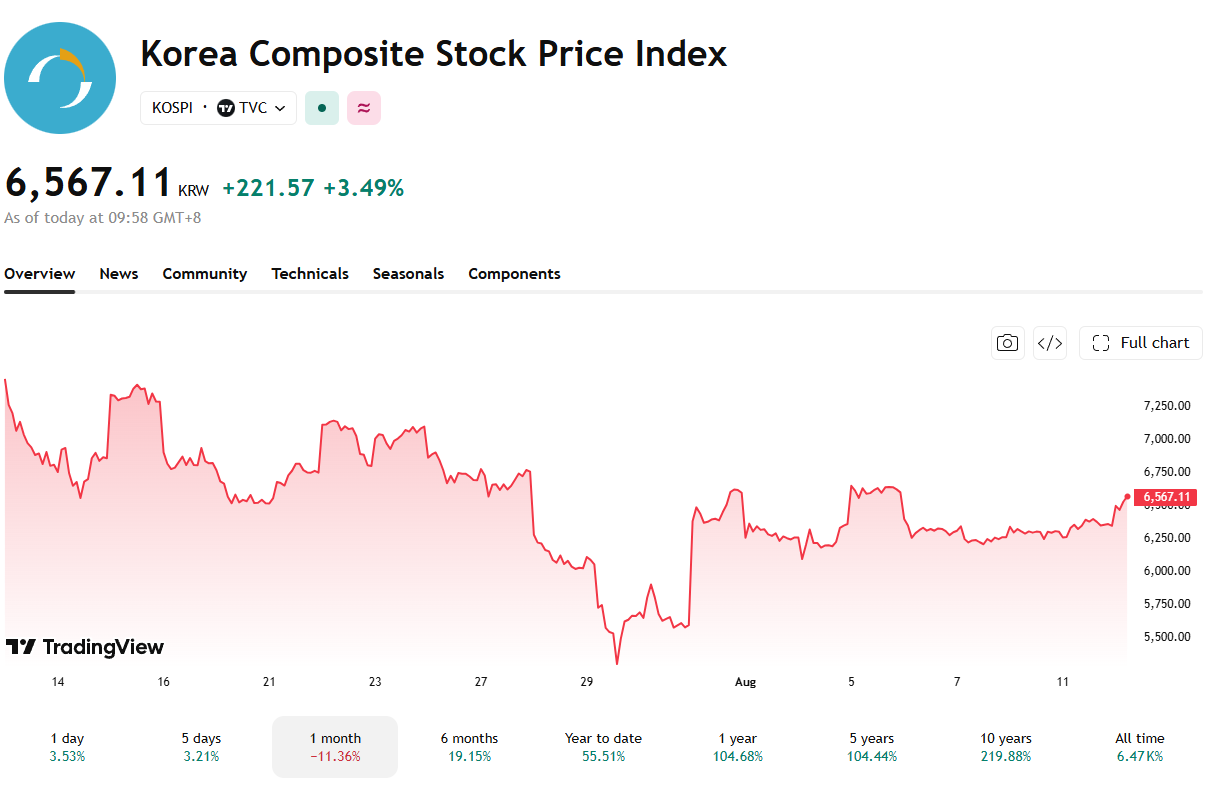
HLB, SPG, and Peptron have each surged more than 50% over the past month on the KOSDAQ, South Korea’s secondary stock exchange for small and mid-cap firms. The rally comes even as the KOSPI, Korea’s main index, struggles to recover from a historic crash.
Regulators tightened rules on leveraged exchange-traded funds (ETFs) in late July, and a global AI-driven selloff hit chipmakers. Both forces pulled money out of KOSPI heavyweights and into smaller KOSDAQ names.
KOSPI’s Rough Month
The KOSPI fell 22% in July, one of its largest monthly drops on record, after tumbling as much as 34% from a July 22 record high before a nearly 18% single-day rally on the final trading day cut the losses.
Regulators blamed single-stock leveraged ETFs tracking Samsung Electronics and SK Hynix for the swings. They raised the minimum cash deposit for trading those products from 10 million won to 30 million won.

Trading in the affected ETFs has since collapsed by as much as 93%. However, the KOSDAQ small-cap rally followed instead of a calmer market. The KOSDAQ notched five straight gaining sessions through August 6, even as the KOSPI kept swinging.
A separate AI-linked selloff has weighed on KOSPI heavyweights. On July 28, SK Hynix closed 14.65% lower and Samsung Electronics dropped more than 13% on fears that AI infrastructure spending was peaking. Micron’s 39% plunge added to the pressure on Korean memory makers.

Why the Three Stocks Are Rallying
HLB’s rally follows its cancer drug rivoceranib. The Food and Drug Administration (FDA) rejected the drug for a third time on July 13, citing manufacturing concerns at a partner’s Chinese plant. Two days later, the FDA cleared that facility, sparking a single-day surge of nearly 30%.
SPG, a motor and precision-reducer maker, is rallying on its push into humanoid robot actuators. IBK Securities has called it the only Korean firm with a full lineup of humanoid-grade precision reducers. SPG already supplies Rainbow Robotics and is in early talks with US firms.
Peptron jumped on August 3 on obesity-drug supply chain speculation. Investors bet Korean manufacturers could handle domestic production for Eli Lilly’s once-monthly GLP-1 treatment. No supply contract has been confirmed yet.
Morgan Stanley’s KOSPI upgrade suggests some investors see the crash as a buying opportunity rather than a lasting setback. Whether the KOSDAQ’s rotation trade holds may depend on how quickly the KOSPI stabilizes.
The post 3 KOSDAQ Stocks Surge Over 50% as KOSPI Slumps, AI Stocks Sink appeared first on BeInCrypto.


The Office of the Comptroller of the Currency (OCC) said on Aug. 11 that digital asset companies conducting legally permissible activities should have a route into the U.S. national banking system, as Comptroller Jonathan V. Gould renewed the agency’s push to revive new bank formation.
Summary
- OCC received 40 de novo applications during 18 months, including applications for national trust banks.
- Digital asset firms conducting legally permissible activities should have bank pathways, Comptroller Jonathan Gould said.
- OCC currently lists 13 pending digital asset licensing applications, including Payward, Revolut and World Liberty.
- FDIC’s new two phase review targets contingent authorization within 120 days for new insurance applications.
- OCC denied Wise National Trust’s charter application July 21, showing approvals remain subject to review.
Gould said in the OCC release that the regulator received 40 de novo applications over the past 18 months, including national trust bank applications, and has decided many complete applications within 120 days. He added that “America and the OCC are once again open for business.” The statement followed the FDIC’s Aug. 10 announcement of a new review system for deposit insurance applications.
OCC crypto bank charter pipeline has 13 pending applications
The OCC’s current digital asset licensing list contains 13 pending applications from entities planning to offer crypto or other digital asset products. They include Payward National Trust Company, World Liberty Trust Company, Revolut Bank US, PAYO Digital Bank, EDX Trust, Agora National Trust Bank and Dakota National Trust Bank. Dakota’s July 28 filing is the newest currently listed.
Several large crypto companies have already moved further through the process. The OCC conditionally approved applications involving Circle, Ripple, BitGo, Fidelity Digital Assets and Paxos in December 2025. Coinbase received preliminary conditional approval in April. OCC records show Circle’s First National Digital Currency Bank became effective July 10.
The path is not automatic. OCC records show Wise National Trust’s application was denied on July 21. The decision offers a counterpoint to claims that the regulator is simply opening federal charters to every new entrant.
As crypto.news reported, in its recent crypto charter coverage, major banking groups have questioned how broadly the OCC can use national trust charters for crypto companies.
FDIC reform creates a faster route for insured new banks
The FDIC’s new process applies to federal deposit insurance applications received after Aug. 15. Phase one begins when an application arrives and aims for contingent authorization within 120 days. Phase two can run for up to 12 months while organizers complete requirements for final approval and a deposit insurance order.
The change primarily matters to new institutions seeking insured deposits. Many digital asset companies pursuing national trust bank charters follow a different structure and do not seek FDIC insured deposits. Gould nevertheless said the FDIC reform supports the OCC’s broader effort to reverse the decline in new bank formation. The OCC received fewer than four charter applications annually on average from 2011 through 2014.
The OCC also adopted a chartering rule effective April 1 that replaced references to “fiduciary activities” with “operations of a trust company and activities related thereto.” The OCC said the change neither expands nor contracts its chartering authority.
Crypto bank charters remain a Washington policy fight
The expansion has faced resistance from lawmakers and banking groups. Sen. Elizabeth Warren has questioned whether some crypto trust charters exceed the National Bank Act’s limits. As crypto.news reported in Warren’s OCC charter challenge, she has pressed Gould to explain the legal basis used to approve digital asset applicants.
The Bank Policy Institute has also challenged individual applications. Its June comment on Payward asked the OCC to examine capital and liquidity support, affiliate transactions, resolution planning and whether proposed activities fall within national trust bank powers.
The dispute matters because a national trust charter can place crypto custody, settlement and other permitted services under one federal supervisor rather than a patchwork of state regimes. The precise activities available still depend on the charter, regulatory conditions and other applicable laws. The OCC’s April rule says the agency’s underlying charter authority was not expanded.
What happens next for OCC crypto bank charters
Gould’s latest statement indicates that the OCC intends to keep accepting applications from digital asset businesses rather than impose a blanket exclusion. Applicants must still satisfy regulatory, financial, management and supervisory requirements before receiving final authorization. Conditional approval alone does not permit a proposed bank to begin business.
Attention now turns to the 13 pending digital asset applications and firms that already hold conditional approvals. The FDIC’s two phase process begins applying to new insurance applications after Aug. 15. Further OCC approvals, denials or any formal legal challenge from industry groups could determine how quickly more crypto companies gain a federal banking foothold.
Crypto World
Trump and the Republican Party Backed Competing Candidates in Minnesota’s Governor Primary. Both Fell Short
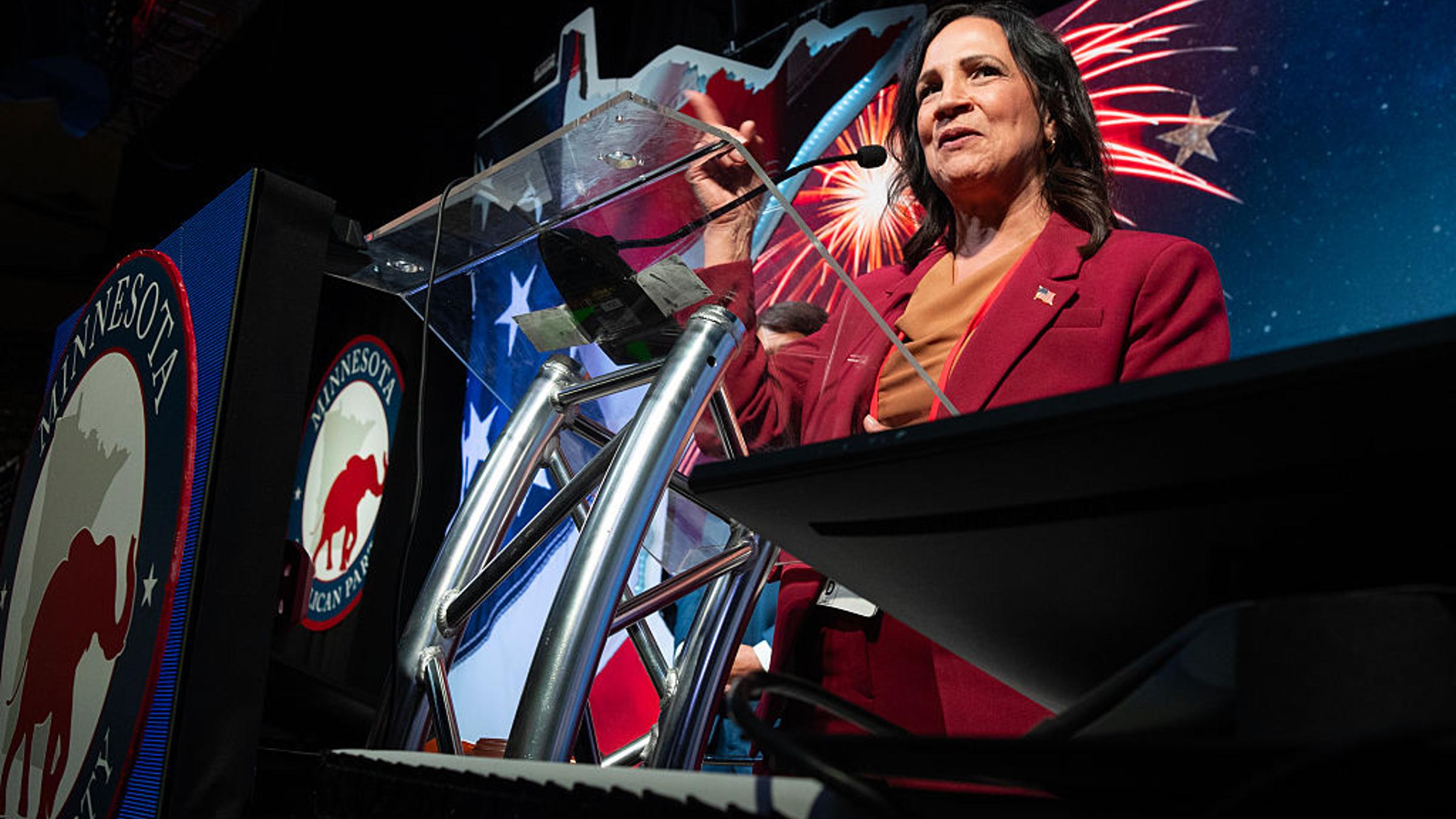
Trump has never won Minnesota in any of his three presidential runs, but Lindell, who appeared to open a lead in the polls in recent weeks, touted the President’s endorsement days before the election.
“I have an advantage over everyone up here,” Lindell said at an event on Sunday. “I can call up and work with the President of the United States.”
The former CEO, like Trump, has vocally denied the results of the 2020 presidential election, which Trump lost to Joe Biden. Lindell has faced defamation suits over comments he made related voting machines, some of which are ongoing. Last June, he was ordered to pay $2.3 million to a Dominion Voting Systems executive after a jury found that he spread false and damaging claims related to the 2020 election.
Prior to that election, Lindell had also become known for his MyPillow advertisements and his self-published memoir What Are the Odds? From Crack Addict to CEO, in which he chronicled his experience overcoming substance abuse and gambling. He stepped down as CEO of the pillow company earlier this month to focus on his campaign.
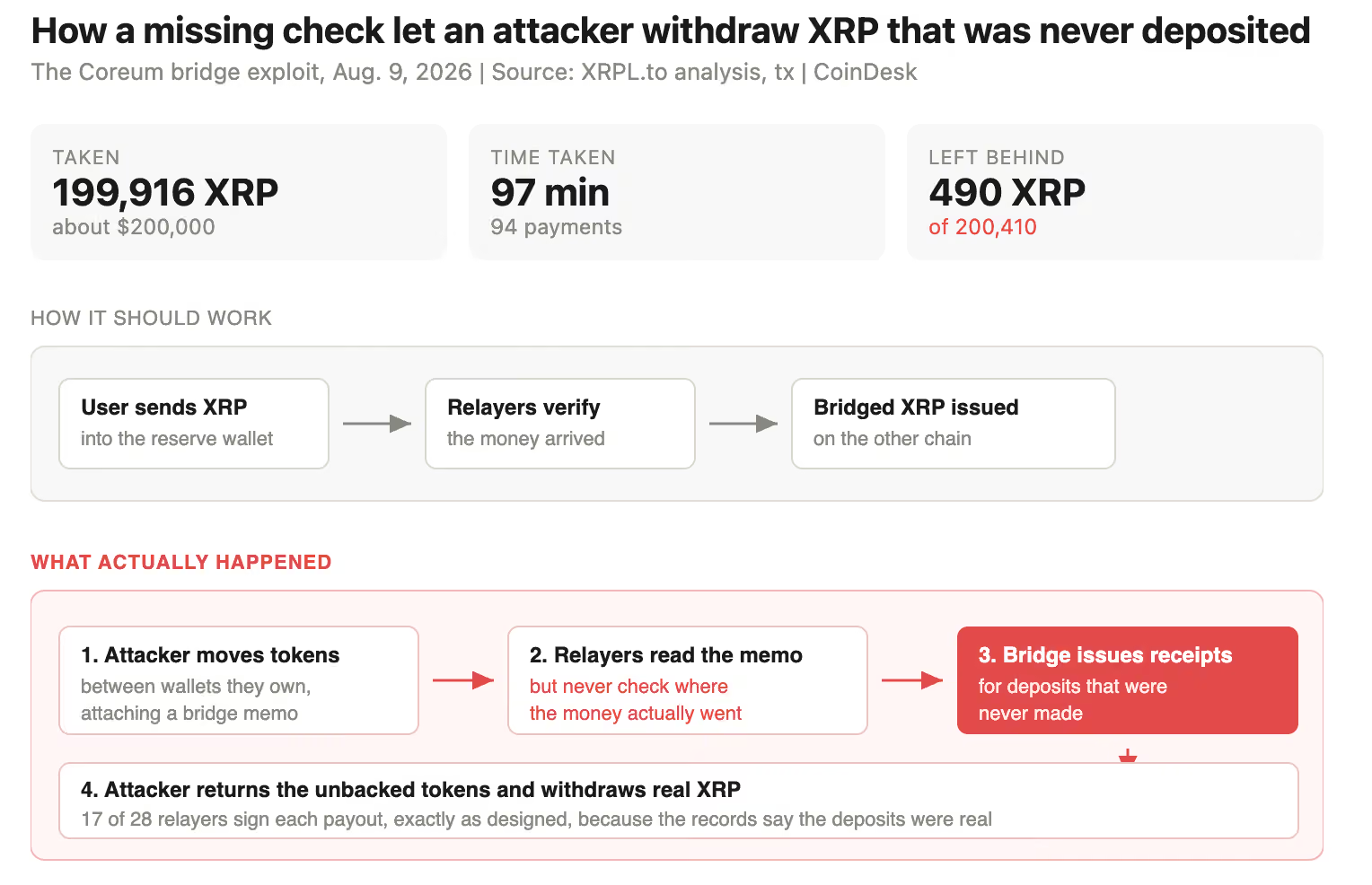
According to tx, the bridge’s software registered transactions as deposits even though they never delivered XRP to the bridge. That gave the attacker bridged XRP on the tx chain without the real XRP that was supposed to back it. Those unbacked tokens then went back through the bridge, and the attacker withdrew real XRP from the reserve.

The drain began at 19:16 UTC. Each payout was authorized by 17 of the bridge’s 28 relayers, a majority signing off exactly as designed, because the bridge’s own records told them the deposits were real.
Relayers are programs that watch both blockchains and approve transfers when the bridge’s records say a withdrawal is owed.
The specific failure sat one layer down, however, as the relayer code processed payments carrying the bridge’s memo without first verifying the destination address.
tx confirmed the deposit-detection flaw in an update, saying the attacker exploited software that incorrectly recognized transactions that delivered no XRP to the reserve.
An update on the XRPL bridge incident.
On August 9, the tx XRPL bridge was exploited and XRP was drained from the bridge’s reserve wallet on the XRP Ledger. The bridge has been halted, the vulnerability has been identified, and all potential remedies are being evaluated. This…
— tx (@txEcosystem) August 11, 2026
The project added it has identified and fixed the vulnerable code, engaged blockchain forensics specialists and filed a complaint with the FBI’s Internet Crime Complaint Center. It has not said how affected holders will be made whole.
Meanwhile, the stolen XRP did not stay put. Onchain tracking shows most of it moved onward within hours through several other addresses.
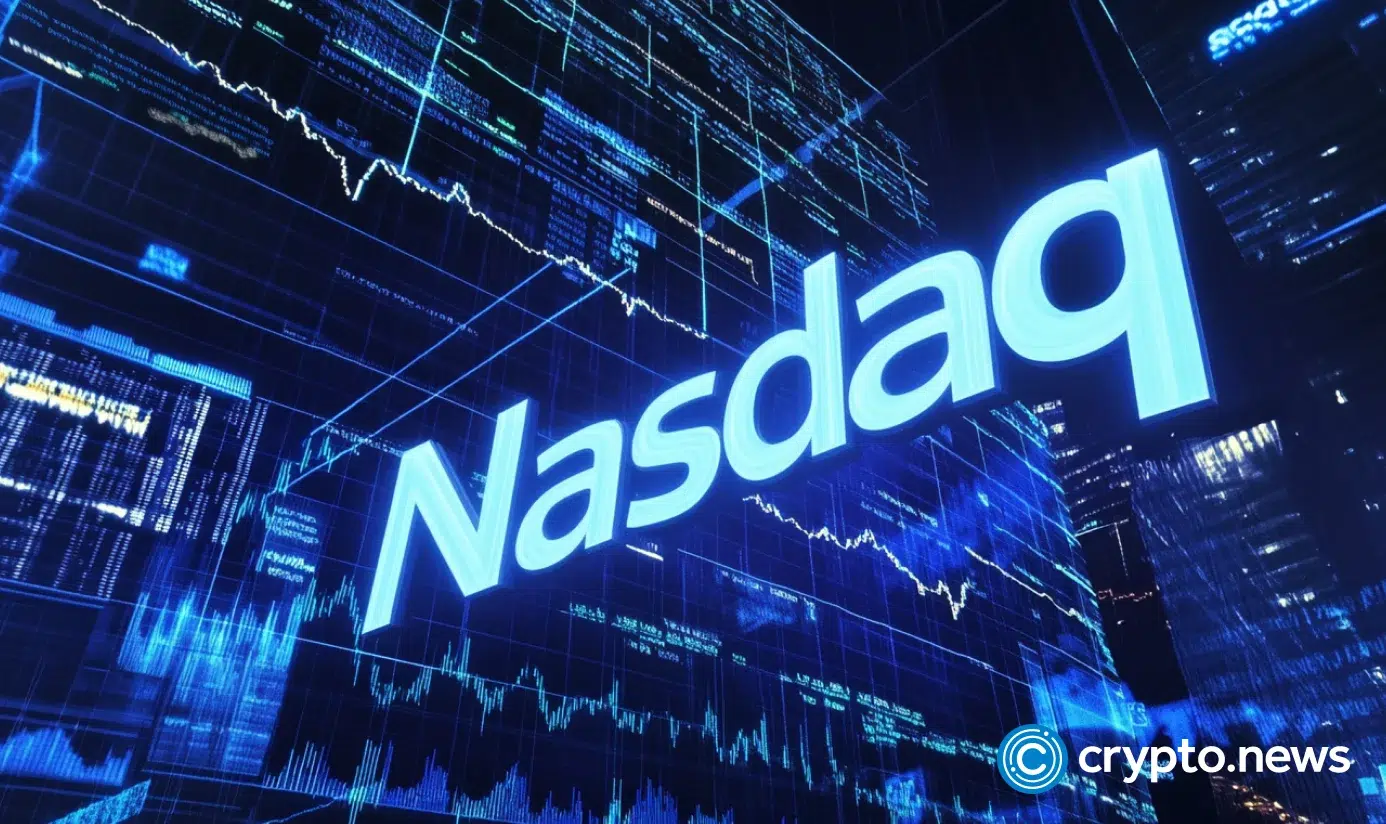
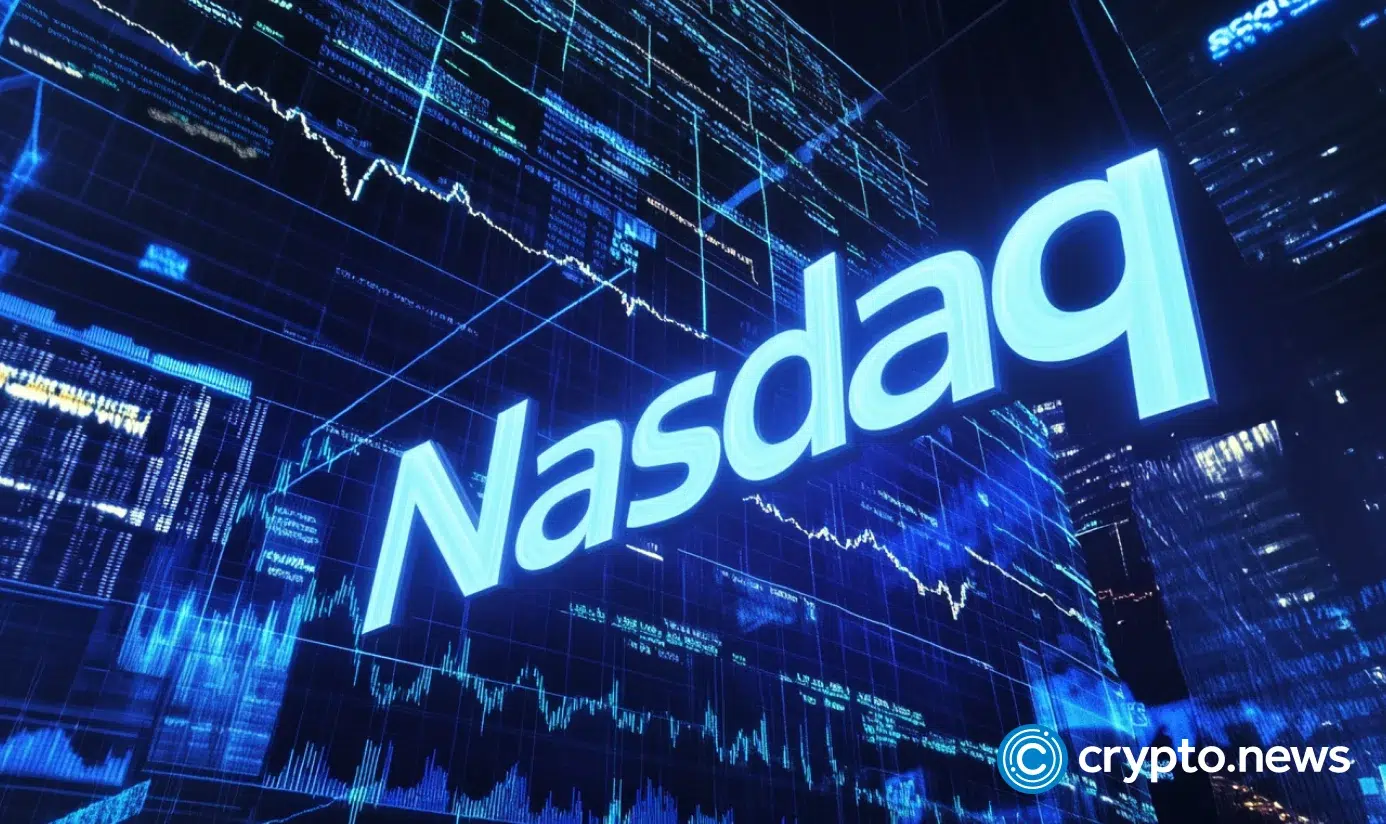
Nasdaq agreed on Aug. 11 to acquire all equity interests in LeveL Markets LLC, adding one of the largest U.S. alternative trading systems to a broader strategy built around longer trading hours, tokenized securities and digital market infrastructure.
Summary
- Nasdaq agreed to acquire LeveL Markets, the third largest U.S. alternative trading system by volume.
- LeveL reaches more than 2,500 clients and trades across more than 7,000 symbols each day.
- Nasdaq created Digital Liquidity Networks to combine tokenization, liquidity platforms and digital asset technology capabilities.
- The SEC approved Nasdaq tokenized securities rules in March, then longer trading hours during April.
- LeveL will remain FINRA regulated and separately managed after closing, subject to required regulatory approvals.
Financial terms were not disclosed in the company’s release.
The deal comes after two major U.S. regulatory approvals for Nasdaq this year. The SEC approved its tokenized securities rules in March and its plan for 23 hour weekday trading in April. Nasdaq now plans to launch the longer trading schedule on Dec. 6, while the newly created Digital Liquidity Networks unit will bring LeveL into the same organization as its digital asset and tokenization capabilities.
LeveL gives Nasdaq a larger U.S. off exchange foothold
Nasdaq says LeveL is the third largest U.S. ATS by trading volume. The platform processes hundreds of millions of shares each day, trades more than 7,000 symbols and reaches over 2,500 buy side and sell side clients. More than 300 institutional buy side firms use the venue, which connects through more than 15 order and execution management systems.
Nasdaq first acquired a minority interest in LeveL in 2021. LeveL later merged with Luminex in 2022, while its average daily volume increased 56% in 2025. Nasdaq’s move from minority investor to prospective owner gives the exchange operator a larger position in U.S. trading that takes place away from traditional exchange order books.
The structure will not disappear after the purchase. Nasdaq said LeveL will keep its own management team, participant confidentiality and structural separation while remaining a registered ATS under FINRA oversight. Until the transaction closes, both businesses will continue operating independently.
Nasdaq already has SEC approval for 23 hour trading
The U.S. angle extends beyond the acquisition. The SEC granted accelerated approval to Nasdaq’s 23 hour, five day trading proposal on April 10. Under the approved structure, the day session runs from 4 a.m. until 8 p.m. ET, followed by a night session from 9 p.m. until 4 a.m. ET. The intervening hour allows maintenance and corporate action processing.
Nasdaq has set Dec. 6, 2026, as its planned launch date for the expanded hours. The change is intended to give investors in other time zones greater access to U.S. equities and puts a major national exchange into trading periods where ATS operators already compete for orders.
Washington is still examining how far the transition should go. The SEC will hold a Sept. 17 roundtable covering overnight trading, market operations, resiliency and investor safeguards. Chair Paul Atkins said the U.S. is moving toward a market that trades through more of the day and night. As crypto.news reported in its 24 hour trading coverage, regulators are now examining the infrastructure needed to support that shift.
Tokenized securities are moving closer to production
Nasdaq’s digital market strategy is also moving from regulatory approval toward implementation. On March 18, the SEC approved rules allowing eligible securities to trade in tokenized form on Nasdaq. Tokenized and traditional versions can use the same order book and execution priority when they share the same CUSIP, trading symbol and shareholder rights.
The approved framework relies on DTC infrastructure rather than creating a separate pool of synthetic equity exposure. Eligible assets under the pilot include Russell 1000 securities and ETFs tracking major indexes. Trades handled through DTC will continue to settle on a T+1 basis, according to Nasdaq’s regulatory filing.
That infrastructure is approaching another milestone. DTCC processed live production transactions involving DTC tokenized assets on July 15 with more than 30 firms and is targeting October for the Tokenization Service launch. In related DTCC tokenization coverage, crypto.news reported that participants will be able to move eligible securities between traditional records and approved blockchain wallets.
Nasdaq is separately working with Payward, Kraken’s parent company, on an xStocks powered gateway designed to connect regulated equity markets with blockchain networks in eligible jurisdictions. As previously reported in Nasdaq and xStocks partnership coverage, the companies are developing infrastructure linking permissioned markets with blockchain based financial applications.
What happens next for Nasdaq and LeveL Markets
The LeveL acquisition remains subject to customary closing conditions and required regulatory approvals. Nasdaq has not disclosed the purchase price or a target closing date. After completion, LeveL is expected to sit inside Digital Liquidity Networks, led by Roland Chai, who has overseen Nasdaq’s digital assets strategy since early 2026.
Chai said the unit intends to build “programmable, always-on market infrastructure of the future.” That is Nasdaq’s stated objective rather than an existing market structure. The company said DLN will combine liquidity platforms, tokenization capabilities and technology products serving digital asset markets.
Several concrete dates will test that strategy. The SEC’s roundtable is scheduled for Sept. 17. DTCC plans to launch its tokenization service in October. Nasdaq plans to begin 23 hour weekday trading on Dec. 6, while its separate equity token design and related distributed ledger services are expected to begin operating in the first half of 2027.
Those initiatives are separate from the LeveL acquisition and are not disclosed closing conditions for the deal. Together, however, they show Nasdaq directing investment toward off exchange liquidity, longer U.S. trading hours and blockchain based settlement as the structure of American equity markets changes.

Top of police spending priorities should be station space to lock up crooks

Students concerned about their future in Guernsey
ForumPay Expands Payment Infrastructure with New Card and Bank Transfer Acceptance Solution

Renter of Home in Anne Heche Crash Denies Settlement With Son

No Jackpot Winner as $257 Million Prize Rolls Over to $269 Million Monday Draw

Weekend Open Thread: Staud – Corporette.com

Future billionaire only. @YomiDenzel #billionairemindset #motivation #wealth #money #fyp

#financetips #keuanganpribadi #finances #financial #successmotivation #bayarhutang #hutang #money

It Official! If You Own XRP, XLM, BTC Or HBAR – YOU MUST DECIDE NOW!!!
-

 Fashion4 days ago
Weekend Open Thread: Mattifying Sunscreen
-

 Fashion5 days ago
Frugal Friday’s Workwear Report: Cap-Sleeve Pointelle Crewneck Sweater
-

 Sports6 days ago
Jordan Coyle & Cordiamo take Laya Arena Stakes at RDS
-

 News Videos4 days ago
Can Astrology Help Find Gold and Silver Trends? A Financial Astrology Guide
-
 Business6 days ago
US stocks: Dow closes at record on Mideast optimism; SpaceX, AMD drag Nasdaq
-

 Politics6 days ago
Reform UK And Greens Sink To Lowest Favourability Ratings To Date
-

 Business6 days ago
Supply chain issues impact Ingredion
-

 Tech4 days ago
Rinn Pharma & Biopharma to join NordicPharmaTrain network
-

 Business3 days ago
How to Start a Cleaning Business: A Step-by-Step Guide
-

 Business3 days ago
Datadog: Best Of Breed For Multiple Reasons
-

 Business3 days ago
BDC Weekly Review: Private BDC Q2 Numbers Are Strong
-
 NewsBeat6 hours ago
Communication cards help banking customers access services or report scams
-

 Fashion6 days ago
Suit of the Week: Me + Em
-
Sports6 days ago
Spider-Man: Brand New Day ending explained: Is Peter Parker alive?
-

 Crypto World7 days ago
Robinhood files $200M second venture fund focused on YC startups
-
 Tech5 days ago
Price Hikes May Be Coming for PC Motherboards Next
-
 Fashion7 days ago
Birthstone pendant necklaces for women by ottomanhands – 18ct gold plated
-
 Crypto World6 days ago
Galaxy Digital Stock Slides 14% as Crypto Prices Hit Earnings
-

 Politics6 days ago
Comedian Jimmy Cricket Has Died, Aged 80
-

 Politics6 days ago
The Not-So Talented Mr Arday
You must be logged in to post a comment Login