
Crypto World
Binance flags 5 tokens as possible delisting risks



Binance added Moonbeam (GLMR), ICON (ICX), Moonriver (MOVR), SuperRare (RARE) and Sophon (SOPH) to its Monitoring Tag list on Aug. 11 after its latest project reviews.
Summary
- Binance added five tokens to its Monitoring Tag list after completing its latest periodic reviews.
- GLMR, ICX, MOVR, RARE and SOPH now face closer scrutiny and potential future delisting risks.
- Moonriver fell roughly 21% in 24 hours while Moonbeam dropped about 13% following Binance’s announcement.
- Binance said related services remain unaffected and gave no specific reasons for adding individual tokens.
- Moonbeam and Moonriver announced Base migrations in July, while ICON plans its December 31 shutdown.
The designation places all five tokens under closer scrutiny and signals possible future delisting if they stop meeting the exchange’s listing standards, according to its announcement.
The exchange said the move does not remove any of the tokens from trading and will not affect other related services. Binance did not provide a specific reason for adding each project. The notice was also updated later on Aug. 11 to revise information concerning the Monitoring Tag quiz.
Binance Monitoring Tags do not mean immediate delisting
The exchange uses the Monitoring Tag for assets it considers more volatile or risky than other listed tokens. Its reviews examine team commitment, development activity, trading volume, liquidity, network security, smart contract stability, public communication, due diligence responses, token supply changes and evidence of misconduct.
The exchange said tagged tokens are “at risk of no longer meeting our listing criteria and being delisted.” However, the tag itself is not a delisting decision, and Binance gave no date for its next review. As previously reported, the exchange placed ACX, LSK and STX under closer review on July 24.
The tag appears on corresponding Spot and Margin trading pages and the Markets Overview page, alongside a risk warning banner. The exchange has not published a numerical threshold for individual review factors, so the announcement does not establish which criterion prompted each addition or how close any token may be to removal.
GLMR and MOVR lead losses after the announcement
Market data showed a mostly negative reaction on Aug. 12. Moonriver traded near $0.90, down about 20.7% over 24 hours, while Moonbeam fell about 12.9%. SuperRare declined around 8.3% and ICON lost roughly 5.1%. Sophon was up about 0.8% over the same rolling period.
Trading activity also increased for several assets. CoinGecko showed Moonriver’s 24 hour volume rising more than 600% from one day earlier, while ICON volume increased more than 300%. The figures show higher trading activity but do not establish that the exchange’s decision alone caused the moves.
Recent project changes add context to Binance review
Two of the tagged assets recently underwent major network changes. Moonbeam’s update announced a 1:1 migration of GLMR from its Polkadot parachain to Base with a July 31 deadline. Moonriver separately announced a 1:1 MOVR migration from its Kusama based network to Base with the same deadline. Binance did not say either change prompted its decision.
ICON is also winding down its legacy blockchain. The ICON Foundation’s notice says the network will permanently halt on Dec. 31, 2026, which is also the final deadline to migrate ICX to SODA.
Other projects have their own histories. In related coverage, SuperRare lost about $730,000 in a staking contract exploit in July 2025. Sophon, meanwhile, entered spot trading in May 2025 alongside its token generation event. Binance did not connect either development to the new designation.
What happens next for the five tokens
GLMR, ICX, MOVR, RARE and SOPH remain available under the services covered by Binance’s announcement. The exchange will continue periodic reviews and may remove the tag if conditions change or delist an asset if it decides the token no longer meets its standards.
The latest additions follow several recent listing reviews. As previously reported, four of six assets scheduled for Aug. 17 removal had earlier risk warnings, including ACX, which received its tag on July 24. That history shows a Monitoring Tag can precede removal, although it does not guarantee that outcome.
For holders of the five newly tagged assets, the next concrete development would be another Binance review or a separate notice changing their listing status. The exchange has not announced a timetable for another assessment or a delisting decision.



Crypto friendly Erebor Bank is nearing a roughly $1.5 billion funding round at an $8 billion pre-money valuation, according to people familiar with the discussions cited by the FT.
Summary
- Financial Times reports Erebor is nearing a $1.5 billion raise at $8 billion pre-money valuation.
- Regulatory data show Erebor held $4.06 billion in deposits by June 30, according to filings.
- The Financial Times reported deposits rose further to $4.6 billion by the end of July.
- Erebor led a $200 million Valar Atomics credit facility alongside JPMorgan and two other lenders.
- Regulators require Erebor to maintain at least 12% Tier 1 leverage ratio for three years.
The talks come only six months after the Columbus, Ohio lender received final approval to open as a U.S. national bank. Erebor has not announced the financing and declined to comment to the newspaper, meaning the size, valuation and investor commitments remain subject to change.
Lux Capital, Human Capital, Valor Equity Partners, Andreessen Horowitz and SV Angel are expected to make commitments, while existing investors 8VC and Haun Ventures are also reportedly participating. The $8 billion figure is before the proposed new capital is added. If the full $1.5 billion closes on those terms, the resulting valuation would be about $9.5 billion.
Erebor Bank deposits have climbed above $4 billion
Regulatory figures give some support to the growth behind the fundraising talks. Erebor’s latest call report showed about $4.06 billion in deposits and roughly $4.66 billion in assets at the end of June, compared with around $1.1 billion in deposits at March 31.
The FT reported that deposits increased further to $4.6 billion by the end of July, citing a person familiar with the figures. That July total has not yet appeared in a quarterly regulatory filing. The same source said Erebor had surpassed $100 million in annualized recurring revenue, another figure that has not been independently confirmed through public filings.
As previously reported, Erebor’s deposits had already climbed above $4 billion by early July, up sharply from its first quarter level. The earlier fundraising discussions were already targeting a valuation of at least $8 billion, making the latest reported $1.5 billion round an extension of talks that were underway before August.
U.S. charter gave Erebor room to pursue crypto clients
Erebor began operating after receiving its national bank charter on Feb. 6. The FDIC’s public records list the bank as established on that date, while the agency had approved its deposit insurance application in December 2025.
The bank was created to serve what its charter application called the U.S. innovation economy, including companies involved in digital assets, artificial intelligence, defense and advanced manufacturing. Erebor also planned to provide services to high and ultra high net worth individuals connected to those sectors. The OCC granted preliminary conditional approval in October 2025.
As previously reported, Erebor secured preliminary approval for its national bank charter after the OCC said legally permissible digital asset activities could be conducted by federally chartered banks when handled safely.
That policy direction has continued. The OCC said this week that digital asset firms engaged in permissible activities should have a route into the national banking system, as Comptroller Jonathan Gould pushes to revive de novo bank formation.
Erebor faces stricter capital requirements during early growth
Erebor’s rapid deposit expansion also raises the importance of its regulatory capital obligations. The FDIC approval requires the bank to maintain at least a 12% Tier 1 leverage ratio during its first three years, a higher threshold than many established banks operate under.
That requirement means fresh equity can support balance sheet growth as Erebor moves beyond deposits into lending. The bank has already appeared in a large industrial financing. Valar Atomics said on Aug. 3 that it closed a $200 million credit facility led by Erebor as administrative agent and JPMorgan, alongside Crescent Cove and Hercules Capital.
The facility accompanied Valar’s $1 billion Series B financing and gives an early example of Erebor targeting capital intensive companies outside conventional software startups. That fits its stated strategy of serving defense, energy, AI infrastructure and other sectors that often require larger credit facilities.
What happens next for Erebor’s $1.5 billion round
The financing has not closed. People familiar with the discussions told the FT that demand was strong and the transaction could be completed within weeks, but no final date has been announced. Erebor has also not publicly confirmed the investors, valuation or amount.
If completed at the reported terms, the round would mark another rapid valuation increase after Erebor was valued at about $4.35 billion in an earlier financing. For now, the more verifiable measure of its expansion is the balance sheet: deposits grew from roughly $1.1 billion in March to more than $4 billion by June, while lending has begun to expand into large technology and industrial projects.


Metaplanet shifted 3,881 BTC, worth about $247 million, across several transactions over three hours on Wednesday, per Arkham data.
The move went from the company’s cold wallets to new addresses it also controls, not to an exchange.
Transfers to fresh self-custody wallets don’t add to tradable supply the way deposits to an exchange do, so on their own they aren’t selling.
Metaplanet has done this before. It moved nearly 5,000 BTC in March in the same pattern, test transactions followed by larger amounts into new wallets, and analysts then read it as internal custody reshuffling rather than distribution. Nothing in Wednesday’s on-chain data points anywhere different.
Metaplanet bought its roughly 43,000 BTC at an average of about $96,000, so with bitcoin near $63,600 the company is sitting on an unrealized loss of about $1.4 billion, down 34%.
Metaplanet has been one of the most aggressive corporate buyers since April 2024, with a stated target of 210,000 BTC.
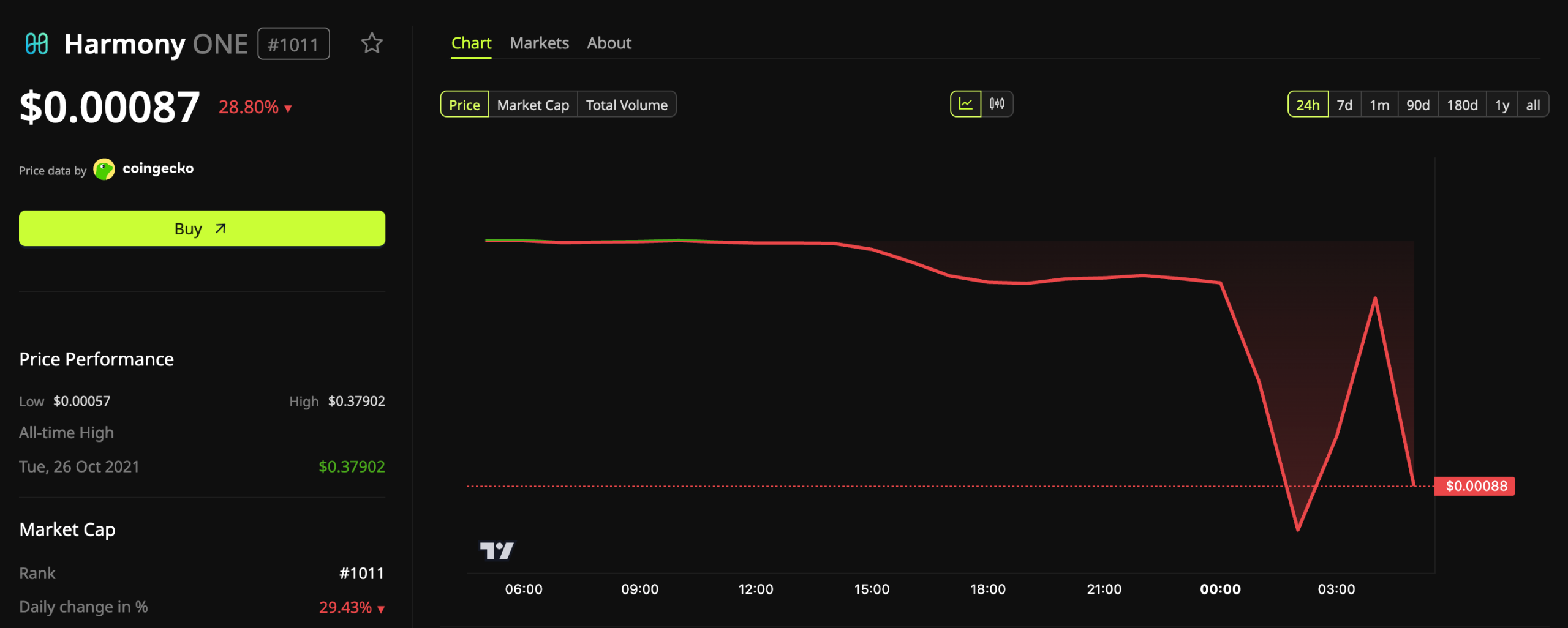
Harmony (ONE) fell to an all-time low of $0.0005735 during early Asian trading on Wednesday after a reported exploit minted roughly 4 billion tokens without authorization.
The minted amount equals about 26% of ONE’s total supply. Harmony said it is coordinating with exchanges to freeze funds while it develops a patch and evaluates rollback options.
Harmony Exploit and the Price Collapse
On-chain analyst Juiceberg reported that the supply was minted through empty blocks. Around 2.8 billion of those tokens moved quickly to exchanges, according to the analysis.
The sell pressure sent ONE tumbling. The token traded near $0.00087 at press time, down about 29% on the day, after touching its record low earlier in the session.
Follow us on X to get the latest news as it happens

Harmony later named four wallet addresses tied to the incident. The team asked all exchanges to block and freeze funds traced to them:
- one1uap8dx2z0qsjxqthm5flgcxkeepsz3gsrghnfn (0xe7427699427821230177dd13f460d6ce43014510)
- one17u300a40ll5wphd8kj5hktryhdjq3ml9f4phy4 (0xf722f7f6afffe8e0dda7b4a97b2c64bb6408efe5)
- one1a5hur07z5vtvzhr35zkw8tfqedemkz8t88xgd7 (0xed2fc1bfc2a316c15c71a0ace3ad20cb73bb08eb)
- one1h56hkxmua0uzfv07fu04cudvtrl35u96pq47vy (0xbd357b1b7cebf824b1fe4f1f5c71ac58ff1a70ba)
“We are working with our team and appropriate exchanges to stop and freeze the funds. We are working on a patch and rollback options. Will update when we have new information,” the post read.
The event marks the network’s second major security breach. In 2022, its Horizon Bridge lost roughly $99.6 million in an attack linked to North Korea’s Lazarus Group.
Harmony has not disclosed the root cause of the incident yet. BeInCrypto has reached out to Harmony for comment.
Subscribe to our YouTube channel to watch leaders and journalists provide expert insights
The post Harmony Token Falls to Record Low After Exploit Mints 4 Billion ONE appeared first on BeInCrypto.


The $116 million Coldcard hack rattled Bitcoin holders last week. Ledger’s top security executive says the headline missed the point entirely.
Speaking to Bloomberg, Ian Rogers, Ledger’s Chief Human Agency Officer, argued the attack was not evidence that self-custody or hardware wallets are inherently risky. The real story, he said, is what AI lets attackers do to systems built on weak randomness.
Why Ledger Was Not Affected
The Coldcard vulnerability traced back to a 2021 firmware bug that routed seed generation through a software pseudorandom number generator instead of the device’s hardware chip.
That produced entropy of roughly 40 to 72 bits, a small enough address space for an AI-powered attacker to scan systematically and locate private keys. TRM Labs traced 1,082 BTC drained in the first wave’s 41-minute sweep on July 30.
Ledger generates entropy entirely in hardware, Rogers told Bloomberg, using a certified secure chip with no software fallback. The resulting address space is, in his words, “the number three with 67 zeros behind it.” No attacker can brute-force that.
It is not the first time Ledger has caught this kind of flaw. In 2022, the company identified a similar bug in Trust Wallet and worked through responsible disclosure to help users move funds to safety. BeInCrypto’s coverage of Coldcard’s ongoing theft waves shows how fast and systematic the exploitation became once the vulnerability was known.
3 Ways AI Has Changed the Threat
Rogers laid out three compounding threats.
First, AI gives attackers more firepower to find vulnerabilities in any system, not just crypto. He cited attacks on US water infrastructure as part of the same trend, since the underlying tools are general purpose.
Second, AI-assisted development means more code ships faster across the industry, expanding the attack surface for everyone. BeInCrypto reported on how AI-powered smart contract exploits now outpace the tools built to detect them.
Third, and this is where Rogers goes beyond the Coldcard story, enterprises are deploying agents that hold access to internal secrets like email, Slack, and credentials. Bloomberg framed the Coldcard exploit as a hardware story. Rogers frames it as an early signal of a much broader AI-era security problem.
The Agentic Threat Rogers Warned About
At the end of last year, Rogers described a future where people hand AI agents their passwords, credit cards, and identities as a dangerous, unmanaged risk. Few people understood what he meant at the time. They do now.
His analogy compares AI agents and secrets to a teenager and car keys. The keys do not live in the teenager’s room. A parent decides, based on context, when access is appropriate. A Monday morning drive to school is fine. A Friday night after a party is not. The same logic, Rogers argues, must govern what any agent can access and when.
Ledger already offers tools that let an agent hold a wallet without holding the private keys. The principle is the same one that has always governed hardware security: protection by design, not by policy.
Wherever your assets are stored, you should be interested in the level of security that’s protecting them.
Rogers told Bloomberg.
The post Hardware Wallets Aren’t the Problem, Says Ledger Exec. AI Attackers Are appeared first on BeInCrypto.


Harmony is working with exchanges to freeze funds and is preparing a patch after claims that 2.8 billion unauthorized ONE hit trading platforms.


That can prevent an attacker from keeping newly created tokens still on the network, but becomes harder once funds have reached exchanges or moved onto other systems. Many in the industry, however, view a rollback as antithetical to blockchain’s core principle of immutability.
The apparent exploit comes a day after Ravencoin, another smaller blockchain built from Bitcoin’s code, faced its own possible rollback after parts of its network accepted invalid blocks.
In that case, miners moved to rebuild the chain from before the flaw, putting several days of transactions at risk of reversal. Ravencoin is separate from Harmony, but the two incidents show the trade-off involved in a rollback – that undoing an attack can also undo legitimate transactions made after it.
Not the first hit
Harmony has dealt with unauthorized creation of ONE before.
In December 2023, a bug in its staking system caused about 146.3 million ONE to be created when tokens that should have stopped receiving payouts continued to receive them. Harmony said at the time that 74 addresses were involved, with one receiving 51.2 million ONE, and that about 16.4 million was subsequently moved to an exchange.
The network responded to that incident with an emergency software update and blacklisted addresses holding the improperly created tokens.


Bitwise Chief Investment Officer Matt Hougan told Bloomberg that Bitcoin’s (BTC) refusal to react to negative headlines may signal the bear market has run its course. He pointed to a string of setbacks the asset shrugged off in recent months.
Hougan said wealth management platforms, not short-term hype, will be the next driver pulling fresh capital into Bitcoin. He also weighed in on how much of an investor’s holdings belong in an exchange-traded fund (ETF) versus cold storage.
Bad News Stops Moving the Market
Hougan listed several setbacks Bitcoin absorbed without much price damage.
Strategy Executive Chairman Michael Saylor has started selling his Bitcoin reserves through the company, and the firm’s STRC preferred stock slid toward $75. STRC, nicknamed “Stretch,” is Strategy’s preferred share designed to trade near $100 par. One of Bitcoin’s biggest backers flinched, and the price hardly moved.
Meanwhile, odds of the Clarity Act passing, a bill setting federal rules for digital asset markets, fell from the mid-40s into the teens, Hougan also pointed out. Hougan also referenced the $116 million Coldcard hardware wallet exploit, which again barely moved Bitcoin’s price, unlike past cycles, when bear markets tend to overreact to bad news and ignore good news.
“We’re maybe overindexing to good news. I think it’s a sign that we may be at the bottom of this crypto winter and that we may have a strong end of the year.” Hougan said.
Hougan stopped short of calling a firm bottom, framing it instead as a signal worth watching rather than a certainty.
Wealth Platforms as the Next Catalyst
Hougan said large wealth management platforms represent Bitcoin’s next marginal buyer, describing it as a slow-moving shift rather than a single event.
He noted several advisory platforms approved Bitwise’s own Solana (SOL) staking ETF, BSOL, even during a market down roughly 50% from its highs, which he attributed to advisor demand rather than speculation.
He also estimated, without exact figures on hand, that Bitwise has processed $600 million to $700 million in tax-free in-kind ETF conversions over the past year.
ETFs Versus Self-Custody
Asked how a hypothetical million-dollar Bitcoin holder should split assets, Hougan said most should sit in ETFs, punting his own company’s options, like the Bitwise Bitcoin ETF (BITB). He added that a smaller portion should be kept in cold storage as an opt-out option. He added that ETFs are not necessarily the final form these products will take as the industry matures.
Hougan’s framing rests on Bitcoin’s response to bad news rather than a specific price target. The next round of negative headlines will show whether that resilience holds.
The post Bitwise CIO Says Bitcoin May Be Near Crypto Winter’s Bottom appeared first on BeInCrypto.

Trump Media could have already made more than $1 million from trading firms paying for early access to President Trump’s Truth Social posts, the company confirmed Monday.
More than 10 high-frequency trading firms subscribed to the service, called Truth API. They pay between $60,000 and $100,000 a month for faster access to market-moving posts.
How Truth API Works
Truth API launched in early August. It gives subscribers machine-readable access to posts from Truth Social’s most-followed accounts, including Trump’s own.
At $60,000 to $100,000 a month, more than 10 subscribers already generate potentially over $1 million in monthly fees. Interim Chief Executive Officer Kevin McGurn disclosed the fee range during Trump Media’s first-ever earnings call. He called the early rollout “the early innings.”
McGurn said the company is also in active talks with artificial intelligence firms. He added that a retail-trader tier is coming eventually.
Lawmakers Push Back
Lawmakers have criticized the arrangement. They argue it lets a company majority-owned by Trump’s family profit from his own market-moving statements.
Representative Jamie Raskin sent a letter to McGurn in late July. He demanded a full list of subscribers as scrutiny grew over Truth Social subscription fees.
Democratic lawmakers separately pushed for a formal SEC investigation demand into the service. They argue it effectively sells access to market-moving information tied to the presidency.
A Loss-Making Business for Trump
Meanwhile, Trump Media’s underlying business still loses money despite the new revenue stream. The company’s second-quarter net loss reached $238 million, more than 10 times the loss reported a year earlier.
Revenue totaled just $1.7 million, up 89% year over year. However, unrealized markdowns on Bitcoin and equity holdings drove most of the shortfall.
Analyst Markus Thielen of 10x Research offered a blunt assessment. He told the BBC that Trump Media operates more like a crypto fund than a media company.
What Comes Next
Trump Media recently walked away from a planned prediction-market venture with Crypto.com. The move fits a broader crypto ambitions pullback under McGurn.
The company also still aims to close a merger with fusion firm TAE Technologies. McGurn originally expected that deal to close months ago.
Shares are down 9% in the past 5 days after a recent rally. Investors now watch whether Truth API becomes the durable revenue source McGurn promises.
The post Trump Has Already Made Over $1 Million Selling Access to His Truth Posts appeared first on BeInCrypto.
Crypto World
Crypto.com rolls out tokenized stock derivatives as crypto exchanges push into equities
Crypto.com is world’s 11th largest exchange, according to data source Coingecko.
Stock tokenization push
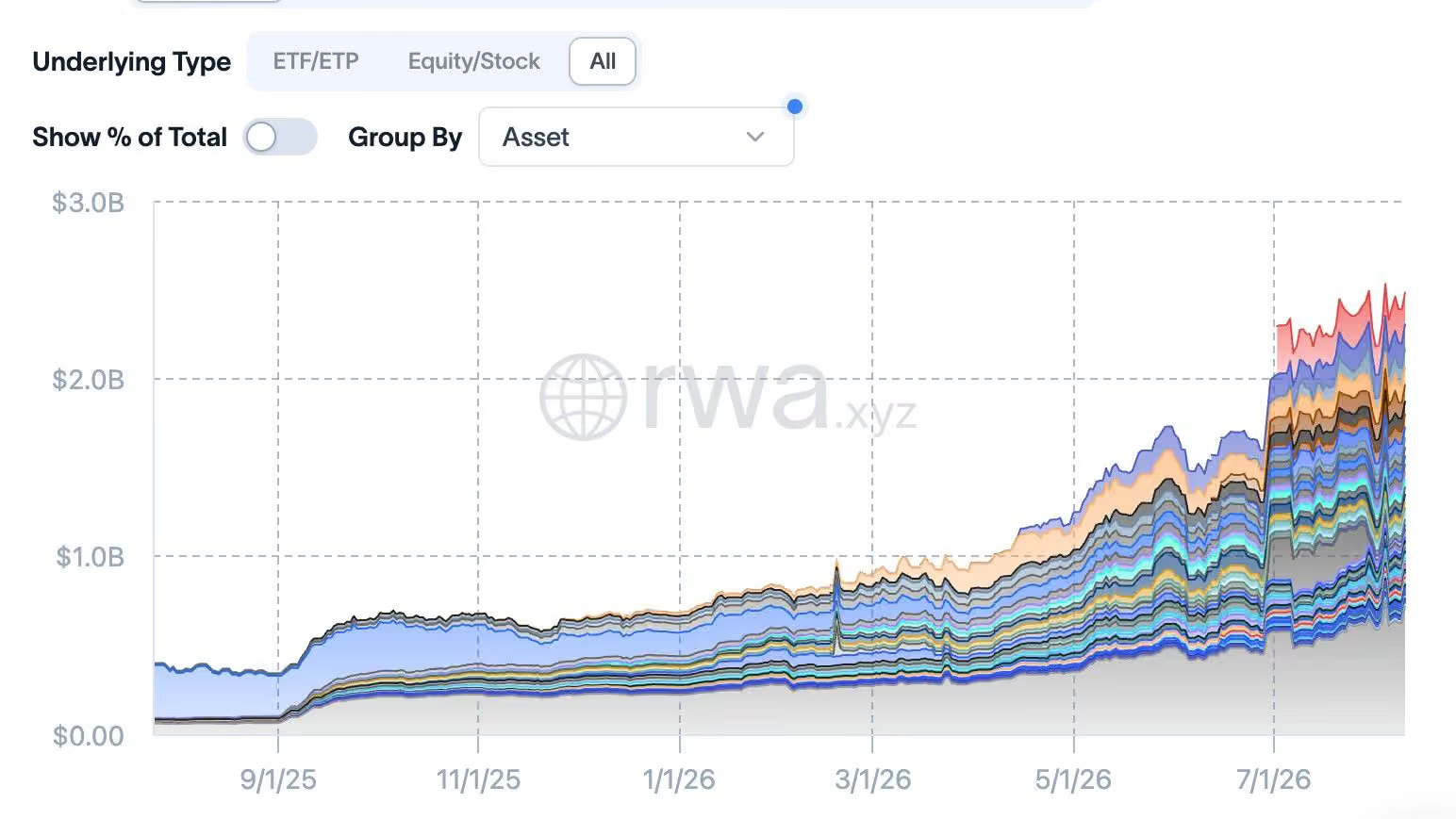
The launch lands in a fast-growing corner at the intersection of the crypto market and traditional assets. Tokenized stocks have reached about $2.49 billion in value, up roughly 600% over the past year, according to RWA.xyz data, as exchanges and blockchain firms race to bring equities onchain. Citi estimated that tokenized securities could grow into a $5.5 trillion market by 2030, including $2.6 trillion in tokenized equities.

Kraken, Bybit, Bitget and Robinhood are among the trading platforms that have rolled out tokenized equity products for investors outside the U.S. Meanwhile, the Depository Trust & Clearing Corporation (DTCC), the backbone of the U.S. securities markets, has begun testing tokenized securities infrastructure. At the same time, Nasdaq and the New York Stock Exchange also unveiled tokenization initiatives.
BBut not all of those products work the same way. Synthetic or derivative products track a stock’s performance without making the buyer a shareholder. Issuer-sponsored models, by contrast, can put actual common shares onchain while preserving ownership and shareholder rights.
The debate is drawing increasing attention from regulators and market infrastructure providers as tokenized securities move closer to the financial mainstream.


Brad Lightcap, a longtime OpenAI executive and former chief operating officer, has announced that he is leaving the company after 8 years to start a new venture.
The announcement adds to a wave of senior exits at the artificial intelligence (AI) firm.
Brad Lightcap Exits OpenAI to Launch New Venture After 8 Years
Lightcap shared the message he sent to his team on X. He joined OpenAI in 2018 and helped build its finance, legal, and business teams. He became the firm’s chief operating officer in 2024.
Lightcap then moved to a special projects role in April. At the time, the firm named Denise Dresser, chief revenue officer, to take over some of his responsibilities.
Chief Executive Sam Altman publicly thanked Lightcap and said he looked forward to working “together on what’s next.” Lightcap said he would remain around for a few weeks.
“I feel incredibly fortunate to have spent most of the last decade pursuing our mission and building this company. Sitting here today, mission success feels within sight. It has been the honor of my life to help bring us to this point, and to do it alongside all of you,” he said.
Follow us on X to get the latest news as it happens
OpenAI’s Leadership Keeps Thinning
His exit follows several senior departures this year. Fidji Simo, who oversaw product and business operations, stepped down last month, citing her health. She later cofounded an artificial intelligence health startup. The company’s only dedicated ethicist, Chloé Bakalar, also departed in July, less than a year after joining.
In April, Bill Peebles, Kevin Weil, and Srinivas Narayanan also announced exits. The moves followed the shutdown of Sora, OpenAI’s video generation app.
Earlier departures included communications chief Hannah Wong and marketing head Kate Rouch. Caitlin Kalinowski, who previously led OpenAI’s robotics effort, also left and has joined rival Anthropic.
The departures come as OpenAI works toward a potential stock market debut. It has not named a date for now. The firm did submit a confidential S-1 registration statement to the SEC in June.
Subscribe to our YouTube channel to watch leaders and journalists provide expert insights
The post Brad Lightcap Becomes Latest OpenAI Executive to Head for Exit appeared first on BeInCrypto.

ideaForge Technology shares drop over 9% in two days. JM Financial downgrades rating

Erebor Bank nears $1.5B raise at $8B pre-money valuation

Brand New Day’ Officially Swings Toward Its Biggest Box Office Milestone Yet


-

 Fashion5 days ago
Weekend Open Thread: Mattifying Sunscreen
-

 Fashion5 days ago
Frugal Friday’s Workwear Report: Cap-Sleeve Pointelle Crewneck Sweater
-

 Sports6 days ago
Jordan Coyle & Cordiamo take Laya Arena Stakes at RDS
-

 News Videos4 days ago
Can Astrology Help Find Gold and Silver Trends? A Financial Astrology Guide
-
 Business6 days ago
US stocks: Dow closes at record on Mideast optimism; SpaceX, AMD drag Nasdaq
-

 Politics6 days ago
Reform UK And Greens Sink To Lowest Favourability Ratings To Date
-

 Business6 days ago
Supply chain issues impact Ingredion
-

 Tech4 days ago
Rinn Pharma & Biopharma to join NordicPharmaTrain network
-

 Business3 days ago
How to Start a Cleaning Business: A Step-by-Step Guide
-

 Business3 days ago
Datadog: Best Of Breed For Multiple Reasons
-

 Business3 days ago
BDC Weekly Review: Private BDC Q2 Numbers Are Strong
-
 NewsBeat8 hours ago
Communication cards help banking customers access services or report scams
-
Sports6 days ago
Spider-Man: Brand New Day ending explained: Is Peter Parker alive?
-

 Fashion7 days ago
Suit of the Week: Me + Em
-

 Crypto World7 days ago
Robinhood files $200M second venture fund focused on YC startups
-
 Tech5 days ago
Price Hikes May Be Coming for PC Motherboards Next
-
 Fashion7 days ago
Birthstone pendant necklaces for women by ottomanhands – 18ct gold plated
-
 Crypto World6 days ago
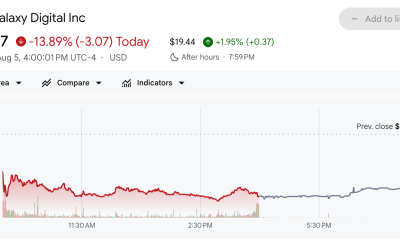
Galaxy Digital Stock Slides 14% as Crypto Prices Hit Earnings
-

 Business5 days ago
Brightwater secures funding for WA-first dementia projects
-

 Politics6 days ago
Comedian Jimmy Cricket Has Died, Aged 80
You must be logged in to post a comment Login