Connect with us

Tech

Behold the 'Glueball,' a Strange New Form of Matter

Published

on

sciencehabit shares a report from Science Magazine: For more than half a century, physicists have searched for one of the strangest particles predicted by modern theory. It would be made almost entirely of gluons, the elusive subatomic particles that carry the strong nuclear force. Now, using a particle collider in Beijing, researchers say they have effectively proved the existence of such a “glueball.”

In a preprint posted last month on arXiv and in a presentation last week at the International Conference on High Energy Physics (ICHEP), the researchers argue that a particle called X(2370), which they produced by smashing electrons into positrons at high energies, has the properties expected of a glueball. “It’s an experimental triumph,” says Colin Morningstar, a particle physicist at Carnegie Mellon University who was not involved in the finding. “It’s the strongest evidence yet that particles dominated by a glueball component can exist in nature.”

Read more of this story at Slashdot.

Advertisement

Source link

Continue Reading
Click to comment

You must be logged in to post a comment Login

Leave a Reply

Tech

Alice & Bob partner on European doctoral network for quantum error correction

Published

on

The partnership will work to train researchers across quantum error correction, filling a gap in the current workforce

Quantum computing company Alice & Bob has today (12 August) announced a partnership with QuBriC, Europe’s first Marie Skłodowska-Curie Actions Doctoral Network dedicated to quantum error correction.

QuBriC brings together 16 universities and seven quantum companies across Europe, including ETH Zürich, TU Delft, UCL, INRIA, Riverlane and IQM, to recruit and train 15 doctoral researchers. 

Backed by €4.6m in funding, to be delivered over four years through Horizon Europe’s MSCA programme, the network aims to develop researchers capable of tackling one of quantum computing’s biggest technical challenges, quantum error correction.

Advertisement

For 30 years, the MSCA programme has advanced research and innovation, supporting more than 150,000 researchers, 23 of whom are Nobel Prize winners. 

As an industry partner Alice & Bob will further develop the network’s research and training endeavours, while QuBriC will provide access to a pipeline of highly specialised talent and an academic network closely aligned on fault-tolerant quantum computing.

Commenting on the announcement, Christophe Vuillot, a principal research scientist at Alice & Bob, said, “QuBriC brings together leading universities, research institutes and quantum companies to train researchers and bridge these gaps, combining expertise from quantum information, coding theory and hardware engineering. 

“This next generation of researchers will be essential to accelerating the path to useful, fault-tolerant quantum computers.”

Advertisement

Globally there has been a significant push to invest in quantum capabilities and technologies. Recently, quantum computing company Quantinuum and Technology platform Oracle announced a multi-year partnership that aims to blend quantum computing and cloud infrastructure. 

In July, Zuriq, a quantum computing company based out of Switzerland, announced a seed funding round of $25.5m and Multiverse Computing, based in San Sebastián, Spain, announced a $570m Series C funding round. 

Also in July, the Irish Government published the Quantum 2030 Implementation Plan, which explores how the country intends to deliver on the targets and ambitions set out in the Quantum 2030 Strategy. 

Don’t miss out on the knowledge you need to succeed. Sign up for the Daily Brief, Silicon Republic’s digest of need-to-know sci-tech news.

Advertisement

Source link

Continue Reading

Tech

Swarms of Tiny Robots Remove Microplastics From Soil and Water

Published

on

alternative_right shares a report from Phys.org: Scientists from the Czech Republic have created microscopic cleanup robots that successfully removed microplastics from both soil and aquatic environments in the lab. Details of their work are published in the journal npg Asia Materials. To build the robots, researchers started with microscopic MXene particles made of ultrathin, stacked layers. The material has a large surface area and surface chemistry that help it attract and hold plastic. They then coated the particles with magnetic nickel nanoparticles so rotating magnetic fields could drive the tiny robots.

Then came the testing phase. The team placed swarms of these microbots into water and soil samples contaminated with plastic. The externally generated magnetic fields made the robots spin and tumble through the liquid and squeeze through tiny water-filled gaps in the soil. “In soil environments, the microrobots can navigate through water-permeated soil microenvironments, actively disrupt microplastic entrapment within soil matrices, and extract them,” the study authors commented in their paper. As they moved, their sticky surfaces collided with microplastics, binding to them and dragging them along. The researchers then used a magnet to pull the microrobots, along with their trapped plastic cargo, out of the samples.

They performed well. In water, they removed about 94% of test polystyrene particles and 89% of PET (polyethylene terephthalate) in around an hour. In the model soil, they removed about 81% of the polystyrene and 72% of PET. This outperformed the same MXene material used without magnetic motion, which relied on passive adsorption rather than actively moving through soil and water.

Read more of this story at Slashdot.

Advertisement

Source link

Continue Reading

Tech

Ego 1300 Electric Mower Review: Tame Your Lawn Without Gas

Published

on

My old 21-inch gas mower was a Toro that a friend of mine found for free at the side of the road. He gave it to me, I replaced the carburetor, and it fired right up. Score! It ran fine for over a year. And mowing 5 acres with a small gas mower at an hourly rate made my son a relatively wealthy 11-year-old. But then it died again. And again. And at some point, small engine repair isn’t fun anymore.

While I was spending weekends cleaning carbs, tracking down air filters, and not mowing, the grass was growing. In northern Wisconsin, grass grows so fast I’m pretty sure you can see it happening if you take the time. A wet June ensured that by the time the Ego arrived for testing, the grass was well out of control, up to 10 inches in the lower, wetter areas of the property.

I figured it would make a good torture test for the Ego, but I’d still need to go in afterward to hack it back with my string trimmer. To my surprise, the Ego 1300 plowed right through almost all of it in a single pass.

Advertisement

For the first pass, I set the height to 4.5 inches, which is easy to do using the height adjustment lever. Unlike an alarming number of mower makers, Ego’s height adjustment system is a thing of beauty. The height markings aren’t arbitrary letters or symbols that require you to consult a manual to translate to inches. On the Ego, the height adjustment is plainly printed in inches. Imagine that. This lets you know that if you set it to 4.5 inches, your grass will be 4.5 inches high when you’re done.

Image may contain Grass Plant Lawn Car Transportation and Vehicle

Photograph: Scott Gilbertson

Starting at 4.5 inches and running in Turbo mode allowed the Ego, in a single pass, to cut just about anything I pointed it toward. There is one patch of grass, below an active seeping spring, that was long enough and wet enough that I had to make two passes to get a nice even cut. After that initial mow, I then went back over it a few days later at 3 inches to finally get the height back to what I could call normal. The second mow was, dare I say, incredibly easy. Even the lowest self-propelled speed was generally fast enough for me, though I did crank it up to about the middle to get up the steeper slopes (and then turned it off entirely going downhill).

Source link

Advertisement
Continue Reading

Tech

Apple fails to delay filing new App Store fees to court

Published

on

Apple is being forced to detail fees it wants to charge for outbound links in its continuing legal fight with Epic, and now it’s only got 24 hours to file them.

The ever-ongoing legal battle between Apple and Epic Games over what Apple should charge apps within the App Store has hit a snag for the iPhone maker. In the current phase, the two are fighting in the U.S. District Court for the Northern District of California over new fee proposal.

According to X posts by Epic Games founder and CEO Tim Sweeney on Tuesday, Apple attempted to delay a filing of proposed fees to the court. To Sweeney’s glee, that stay was denied.

As a consequence, Apple’s legal team now has just 24 hours to file the proposal with the court. After that Epic will have 60 days to analyze the proposal and make its own filing with the court.

Sweeney continued with a second post to X about the legal activity, asking if Apple will “honestly document their costs for human reviewer time and seek to recoup them?” Alternately, he proposes Apple may “fabricate outlandish new notions of cost previously unknown to mankind.”

As it stands, Epic and commentators have another 24-hour wait before finding that out.

How Apple got here

Apple and Epic have been in a lengthy battle that started with “Fortnite” letting players make in-app purchases using a third-party payment processor, against App Store rules. Epic also made demands that included allowing alternate app storefronts in iOS, and a change in the commission structure.

Advertisement

Apple did come out of the lawsuit pretty well, succeeding in many areas but failing to fend off changes to anti-steering measures, namely preventing developers from sending users to other processors to pay. Apple was ordered to make changes.

Epic convinced a court in April 2025 that Apple didn’t follow the spirit of the law, which led to more legal activity.

The latest action is midway through a schedule to discuss changes in App Store fees for outbound links, which goes back to May 2026.

Apple was given 45 days to file a “proffer,” or a good-faith offer of evidence and testimony to the court, with a 10-day timer to hand Epic non-privileged documents about the decision-making process after that. Five days later, Apple was to meet with Epic to discuss the privilege log and decide what documents warrant further review by a third party.

Advertisement

Today’s stay denial is at this point in the process.

Afterwards, Epic has 60 days to file its own response to the court, in a 30-page document. Apple would then have another 30 days to file a reply.

A Fortnite foible

While Sweeney’s tweets are chiefly about the lawsuit, there was an odd element about “Fortnite” and the Mac. In response to a question about what the decision means for the game on macOS, Sweeney said “We are rapidly approaching an endgame that will determine that one way or another.”

Currently, “Fortnite” is unavailable on macOS, but it seems to be less about being blocked and more Epic refusing to use the platform for its premier game.

Advertisement

At the time of the initial legal fight, Epic’s developer accounts were frozen out by Apple. However, in March 2024, Epic confirmed that Apple would reinstate its account in the EU.

Though celebratory in tone for the prospect of getting the game out on iOS, Epic didn’t discuss macOS at all.

As it stands, there doesn’t seem to be anything standing in Epic’s way from releasing “Fortnite” on macOS at all.

It has its own Epic Games Store on macOS, which can be used to make purchases completely outside of Apple’s App Store system. Also, developers can send Mac apps for notarization and still be distributed outside of the App Store itself, which Epic surely could handle with its reinstated developer account.

Advertisement

Source link

Continue Reading

Tech

Parents’ Stress Leads to More Screen Time for Kids, Study Finds

Published

on

Parents who are stressed out are more likely to rely on screens and devices to keep their kids busy or calm — and less likely to enforce screen time limits. That’s the takeaway from a new screen time study from Florida International University’s Center for Children and Families. Researchers said the effects were more than a child acting out. 

Screen time is one way to keep kids busy, especially when school’s out. The time spent on tablets and laptops can be a break for parents to complete tasks or take a break. But readjusting to early mornings, class time and homework can be a big shift for both parents and kids when school is back in session. 

Jeff Temple, a professor and psychologist with UTHealth Houston, who was not affiliated with the FIU study, agrees. “For many families, screens become one of many tools that help everyone get through the day – and that’s mostly OK,” he told CNET. “The challenge comes when the structure of summer doesn’t transition back to the structure of the school year.” 

Screen time isn’t a parenting failure, but experts have concerns and recommendations to help families strike a healthy balance for the back-to-school season. 

Advertisement

Screen time is determined by parents’ stress

FIU’s study evaluated 822 caregivers of children ages 4 to 8 through online surveys on the child’s behaviors, parenting stress and screen time strategies. The findings show that parents opt for more screen time when a child’s behavior seems difficult and how much time is usually less enforced. 

Shayl Griffith, an assistant professor in FIU’s Department of Counseling, Recreation and School Psychology and senior author of the study, said in a news release that parents shouldn’t be afraid to ask for help. The study’s recommendation is to focus on screen time and media that are “meaningful, engaging and appropriate for their child’s age.” 

“When caregivers have the resources they need, they are better able to set consistent boundaries and engage with their children in ways that promote healthy development,” Griffith said.

The fine line between digital media discipline and disruption

Youth screen time is a growing concern. In January, the American Academy of Pediatrics published findings on correlations between digital media use and age-related development to help determine screen time rules for your child and monitor behavior.  

Advertisement

Toddlers and kindergarteners who use digital media for high-quality educational content can benefit from good social behaviors and language — especially when a caregiver is viewing the screen and interacting with the child. However, young children who use tablets for hours, but the AAP says too much screen time is linked to angry outbursts.

School-aged children, ages 6 to 12, can benefit from thoughtful educational digital media in moderation, the AAP study found. But again, there are risks. Too much media use can lead to lower academic achievement, attention control and cognition. Some media can be problematic for kids, like apps encouraging purchases, those focused on gaming with not much educational value and content that is dangerous or risky. And there’s a big callout included in the list: school devices that give access to “distracting video games, videos and other platforms.”

Managing stress, school and screen time is tricky

With summer wrapping up and school approaching, the big question is: How should stressed parents think about screen time? School may be the solution. 

“School can help provide a reprieve for families who do not have access to childcare in the summertime months and serve as a helpful jumping-off point to re-evaluate digital media habits, given the change in routine already,” said Dr. Tiffany Munzer, a professor of pediatrics at the University of Michigan Medical School. It can also mean more time for in-person interactions, which is important for social connection, Munzer added. 

Advertisement

However, making the switch from summer to back-to-school season can be challenging. And adjusting screen time while managing life stresses may not be easy. Munzer recommends making incremental changes. For example, if your child loves watching do-it-yourself videos, find a way to recreate what they’re seeing, Munzer said. Or if digital media is a way to calm kids, look for alternative activities such as reading or walking, Munzer added.

Jason Nagata, an associate professor of pediatrics at the University of California, San Francisco, said the back-to-school season is a good time to revisit family screen time rules and routines. 

“Rather than simply trying to return to an old set of rules, families can consider what makes sense for the child’s current age, developmental stage, school schedule and use of devices for schoolwork and communication,” said Nagata. “A family media plan should be dynamic; it may reasonably look different during the school year than during summer or holidays, and on weekdays compared with weekends.”

The AAP recommends creating a Family Media Plan based on your family’s needs. The plan is an agreement that lets you prioritize healthy, safe and consistent screen time boundaries. That includes creating a list of approved media kids can choose from, a schedule of screen-free time, how to choose good media content and outlets for your family. 

Advertisement

Experts also recommend the AAP’s 5 C’s of Media Use, tailored to your child’s age. The five C’s are Child, Content, Calm, Crowing Out and Communication. They can help you set and communicate screen time guidelines based on your child, their emotions, the content and how it affects them. That may not help the stress that parents face, but it could help regulate your child’s screen time without guilt.

Nagata encourages parents to pay attention to their children’s time and relationship with screen time. Look out for warning signs like difficulty cutting back on screen time despite trying, becoming preoccupied with social media or a phone, experiencing conflict because of screen use and using screens to escape problems. And pay attention to see if screen use is interfering with sleep, school relationships or other activities so you can make more adjustments sooner. 

Source link

Continue Reading

Tech

A $140,000 Cybertruck Becomes the World’s Largest Remote Control Vehicle in Three Days

Published

on

Tesla Cybertruck World's Largest Remote-Control Vehicle
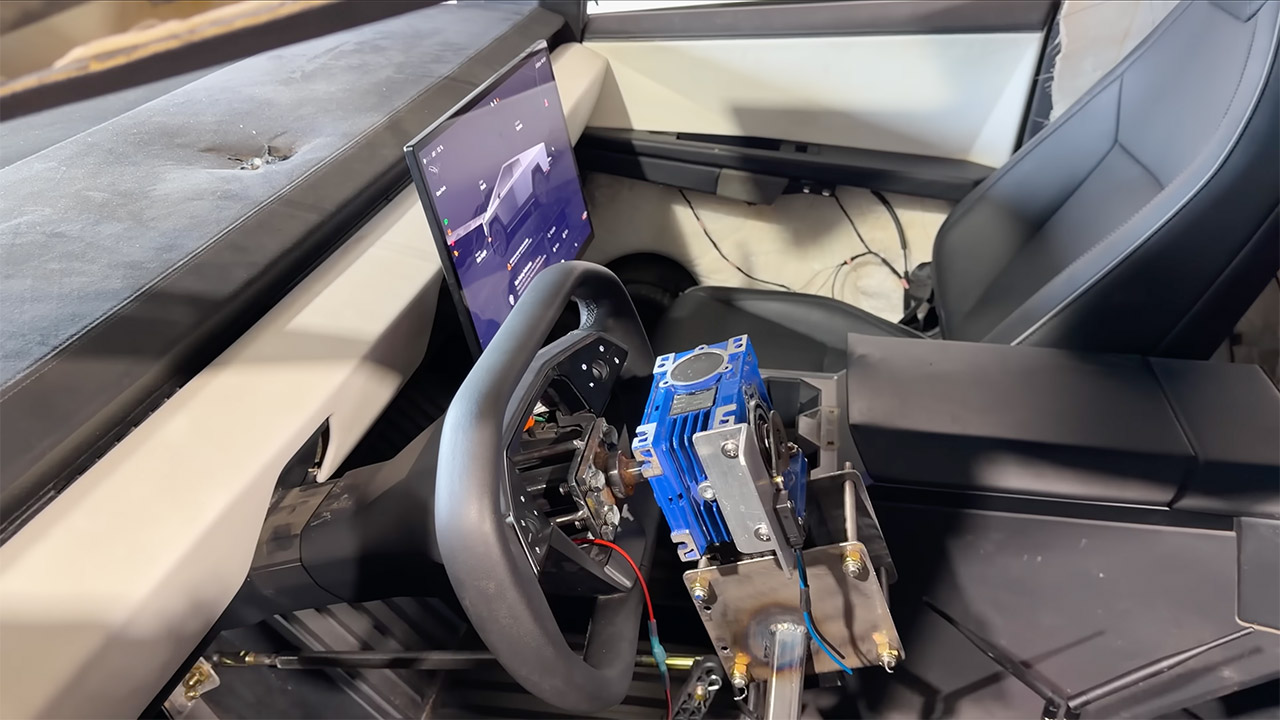
Prop Department set a simple goal for a recent build: take a full-size Tesla Cybertruck and turn it into something anyone could drive from a distance. There is no driver in the seat, and there are no complex software overrides of the truck’s own systems. Instead, there are motors, linkages, and painstaking wiring that allow someone outside the vehicle to handle the steering, throttle, transmission, and brakes. The project belonged to WhistlinDiesel, whose videos often end with expensive machinery in pieces, so the finished truck needed to work well enough for a high-speed run that might not go gently.


Three days passed, and that was all the calendar allowed, as the parts were fashioned from what was already in the shop rather than ordering new ones. To make more space, the front seats were pushed out. A special frame with laser-cut brackets was installed next, all screwed down tightly to ensure it stayed there even when things got bumpy. A stepper motor was mounted to the steering wheel using a previously constructed adapter flange that matched the Cybertruck’s column. That motor handled the left and right turns naturally. A couple of servo motors took care of the rest, with one kicking the accelerator pedal, another working the small fingers on the gear selector buttons, and a ground wire dealing with the capacitive sensors. Then there were the power supply, which used four different voltages to keep everything running. The stepper motor received 48 volts from the truck’s mid-voltage battery. Smaller transformers reduced the voltage to 24 volts for the servos, 12 volts for the relay bank, and 5 volts for the Arduino that controlled the display.

Sale


DJI Neo, Mini Drone with 4K UHD Camera for Adults, 135g Self Flying Drone that Follows You, Palm Takeoff…
  • Due to platform compatibility issue, the DJI Fly app has been removed from Google Play. DJI Neo must be activated in the DJI Fly App, to ensure a…
  • Lightweight and Regulation Friendly – At just 135g, this drone with camera for adults 4K may be even lighter than your phone and does not require FAA…
  • Palm Takeoff & Landing, Go Controller-Free [1] – Neo takes off from your hand with just a push of a button. The safe and easy operation of this drone…

Tesla Cybertruck World's Largest Remote-Control Vehicle
The brakes were a challenge to fix since a pneumatic cylinder kept the foot pushed down at all times, waiting for a remote signal to let it go again.Because the OEM air tank couldn’t stay charged for long, an air compressor had to ride shotgun in the backseat. Without the ‘dead-man’ setup, the truck might just continue rolling away when our signal failed. One final stumbling block remained: the cabin sensors, which were designed to identify a live human in the driver’s seat, would shift the truck into Park as soon as that seat was empty. The solution was to simply tear off the module, and the truck stopped insisting on a body in the wheelchair.

Tesla Cybertruck World's Largest Remote-Control Vehicle
Now that the FPV camera was mounted on a strong bracket, the driver could see clearly via their goggles. In early tests, the remote signals got mixed up with a racing simulator’s motion platform and gyroscope, but screen slowness and HDMI peculiarities put the notion on hold for a later edition. Uncomplicated radio control worked flawlessly, with steering responding, throttle kicking in, gears shifting, and the emergency brake locking up just as instructed.

Tesla Cybertruck World's Largest Remote-Control Vehicle
WhistlinDiesel drove the finished truck to a private race track. Full acceleration down the strip pushed the speedometer to 111 mph when the Cybertruck smashed into a motionless Ford F-150 parked broadside. The Ford’s cab was ripped completely off its frame in a firestorm. The Cybertruck crumpled violently in the front, yet remained intact and did not even light its battery pack. Both trucks were scrapped at the end of the day, but the remote system did exactly what it was supposed to do.

Advertisement

Source link

Continue Reading

Tech

What is the release date for Lioness season 3 episode 3 on Paramount+?

Published

on

Things have already taken a near-fatal turn in Lioness season 3, which is something I didn’t expect to happen so soon. Indeed, last week, we saw two unnamed Russian agents posing as police officers turn up at Joe’s door and demand to enter her home, only for them to be killed in the process.

The entire team is called out to investigate, but when a group of “watchers” are spotted on a nearby roof, the Lionesses wonder if it’s a trap… if they’re here, they’re not looking elsewhere.

Source link

Continue Reading

Tech

McDonald’s Built a 515-Page Dossier on Me. It Says I’ll Never Stop Eating There

Published

on

When I first downloaded the McDonald’s app years ago, I signed up for its loyalty program hoping to get better deals. Why not get some cheap French fries? While I understood that this would entail some type of data tracking, I didn’t grasp how the information would be used to algorithmically predict my next purchase.

As a California resident, I have the legal right to access the data a company stores about me. So, I decided to request that information from McDonald’s to better understand what one of the major fast-food companies is collecting about its customers. A few days after I visited the McDonald’s Privacy Rights Center site and requested access, I received a 515-page file in my inbox with the iconic golden arches stamped across the top.

When customers sign up for loyalty programs, like the one offered through the McDonald’s app, they might not fully realize the extent to which their data is being aggregated and used in predictive models.

“McDonald’s secret sauce is really commercial surveillance,” says Jeff Chester, executive director at the Center for Digital Democracy, a group that advocates for consumer protections. Privacy experts I spoke with said this level of detail may feel invasive, but it’s fairly standard for how large companies in America run their loyalty programs.

Advertisement

“This report contains specific pieces of personal information about you that were identified by searching McDonald’s systems which contain information about our customers,” read the report’s intro. It was lengthy and difficult to parse, so I used a generative AI tool to extract key information before verifying details with the original document and reaching out to privacy experts.

“McDonald’s takes data privacy and security seriously, and we take robust steps to safeguard customer information,” a McDonald’s spokesperson tells WIRED via email. “Like many digital loyalty programs, we use information such as past purchases to provide a more engaging, personal customer experience—like delivering the most relevant deals, offers and messages. Our customers continue to have privacy choices available to them as outlined in our privacy statement.”

Much of my data report contains a detailed account of past McDonald’s transactions as well as offers the fast food company sent me and how many loyalty points I accumulated. Essentially, every time I opened up the app to grab a bite to eat, it created a detailed record about when, where, and what I purchased. The log was even more thorough than I anticipated, including a record of every time I’ve scanned a code as part of its returning Monopoly sweepstakes along with the prize I received.

Source link

Advertisement
Continue Reading

Tech

Ryanair signs a five-year AI deal with Google Cloud, and a second cloud to fall back on

Published

on

Ryanair has signed a five-year data and AI partnership with Google Cloud, rolling out Google Workspace and Google Cloud services to 35,000 employees and making Gemini Enterprise, Google’s agentic AI platform, the centrepiece of how Europe’s largest carrier intends to run itself.

The airline has tied the deal explicitly to its growth target of 300 million passengers a year by 2034, roughly a 44% increase on the 208.4 million it carried in the financial year to March.

Gemini Enterprise will be used, in the companies’ description, to automate decision-making, optimise flight crew logistics, and support corporate productivity generally.

Ryanair plans to use Google DeepMind models, naming AlphaEvolve and WeatherNext, to support fleet operations and maintenance scheduling.

Advertisement

WeatherNext is DeepMind’s forecasting family, which for an airline running around 3,900 flights a day out of 95 bases is not a peripheral application. It also plans to replace its existing collaboration systems outright with Workspace and Gemini.

Running underneath all of it is a resilience argument that Ryanair has put ahead of the AI one. The airline describes the arrangement as a “dual-cloud strategy”, in which Google Cloud helps build a system flexible enough that if one provider has problems, critical services keep running.

“Ryanair is on an incredible growth journey to 300 million passengers by 2034,” said Eddie Wilson, Ryanair’s chief executive.

“To support this growth, we need to ensure we have excellent infrastructure resilience, and our new dual-cloud strategy provides this, alongside technology partners that match our speed and relentless focus on efficiency.”

Advertisement

Maureen Costello, Google Cloud’s vice-president for the UK, Ireland, and sub-Saharan Africa, put the case in industry terms. “Aviation is an industry defined by precision, and Ryanair is a pioneer in operational execution,” she said.

“This agreement demonstrates how deploying generative AI at scale, coupled with modern collaboration tools for frontline workers, can help industry leaders scale securely, reduce operational costs, and redefine the travel experience.”

The scale Ryanair is buying for is real. It ended the last financial year with 647 aircraft, having taken delivery of all 210 Boeing 737-8200 Gamechangers, and has 300 737 MAX-10s on order, split evenly between firm orders and options.

Boeing expects certification of that aircraft late this summer, with the first fifteen due to Ryanair in spring 2027. Pre-exceptional profit after tax for the year was €2.26bn, up 40%.

Advertisement

What the release does not say is as notable as what it does. There is no named migration of specific workloads, no BigQuery or Vertex AI commitment, no disclosed contract value, and no timeline for when any of the AI applications reach production.

Airlines have been announcing operational AI for the better part of a decade; the difference here is the size of the seat count and the explicit link to a passenger target eight years out.

Ryanair is not new to building software, whatever its reputation for spending nothing.

It runs Ryanair Labs, an in-house technology operation with hubs in Dublin, Madrid, and Wrocław, and has spent years pushing passengers towards direct booking, a campaign that produced a €255m Italian antitrust fine in December 2025 over its treatment of online travel agents and a settlement with Booking Holdings the previous August.

Advertisement

It also runs against a current. Airbus is moving its most critical applications off AWS to a French sovereign cloud, a decision framed around European control of European infrastructure. Ryanair, characteristically, has gone the other way and bought the American stack twice over.

Source link

Advertisement
Continue Reading

Tech

Techdirt Podcast Episode 453: Meet The EFF’s New Executive Director

Published

on

from the a-new-chapter dept

If you know anything about Techdirt, you know we’re big fans of the EFF and its decades of advocacy for digital rights and the open internet. Recently, the organization went through a big change in the form of a new executive director: legal expert and long-time leader in the space Nicole Ozer. On this week’s episode, Nicole joins the podcast to talk about her new role and what’s coming next for the EFF.

Advertisement

You can also download this episode directly in MP3 format.

Follow the Techdirt Podcast on Soundcloud, subscribe via Apple Podcasts or Spotify, or grab the RSS feed. You can also keep up with all the latest episodes right here on Techdirt.

Filed Under: digital rights, eff, nicole ozer, podcast

Advertisement

Source link

Continue Reading

Trending

Copyright © 2025