Connect with us

NewsBeat

Man suffered headaches and dizziness before death as family says warning signs were missed

Published

on

Cambridgeshire Live

The 32-year-old man complained of headaches for two months before his death

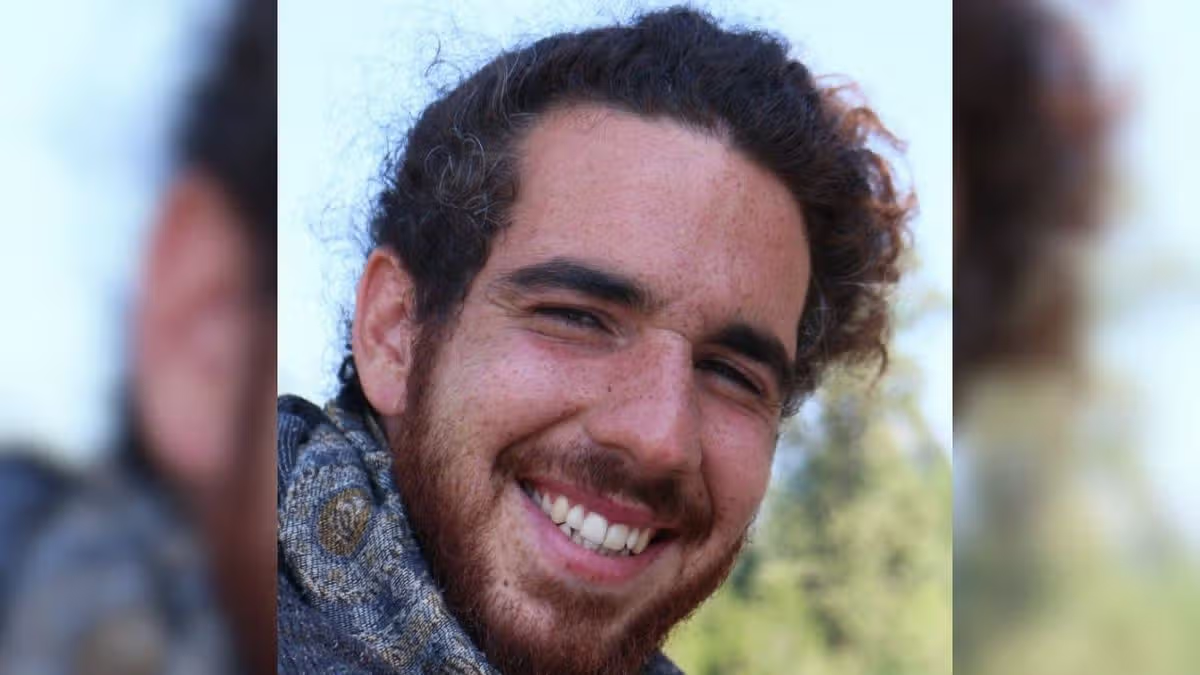
A family believes medical staff “missed opportunities” to prevent the death of a man who died after he had a cyst on his brain. Adam Cornell, who grew up in Peterborough, died on June 11, 2023, after it was discovered he had a build-up of fluid causing severe pressure on his brain.

Advertisement

In the months prior to his death, Adam suffered from headaches. Adam sought help from Herts Urgent Care to treat his headaches and dizziness.

An inquest into Adam’s death, held at Vantage House in Huntingdon on July 29 and 30, concluded that there were “red flag” symptoms that should have been recognised. It also heard that there were “missed opportunities” to try and help Adam.

Adam’s mum Maria Cornell said that son’s death should have “never happened” after the inquest. She said: “Adam was a kind, compassionate and extraordinary person who touched the lives of so many people. He was devoted to his family and friends, always helping others and putting their needs before his own.

“I am grateful that Adam’s case has been examined so thoroughly by the coroner. It has been extremely painful to hear the evidence about what happened in the days and hours before he died, but it was important that the circumstances of his death were properly investigated.

Advertisement

“What happened to Adam should never have happened. We sought help repeatedly because we could see how seriously unwell he was becoming, but there were too many missed opportunities to recognise the warning signs and provide the care he needed.”

Adam attended several medical appointments to try and find out what was wrong with him in the week before his death. These included an urgent outpatient CT scan and blood tests taken on June 6.

During this appointment, an examination of the back of Adam’s eyes, known as a fundoscopy, should have been taken. However, the coroner said that this scan was not taken.

Maria said this scan “could have helped identify how serious” Adam’s condition was. Adam’s family contacted HUC again on June 7 and wanted him to get an emergency department appointment.

Advertisement

While his family waited for a call back Adam’s condition deteriorated, causing him to become unresponsive. He was sent to Peterborough City Hospital and scans revealed that his condition “was not survivable”. He was placed on life support and this was withdrawn on June 11. He died later that day.

Maria said: “I hope Adam’s story helps raise awareness of the importance of severe or worsening symptoms being taken seriously and encourages people to speak up and ask whether further checks may be needed if they feel something is being missed.

“That awareness could help save lives. I hope the health professionals involved, and the wider healthcare system, take lessons from Adam’s death. Families should be listened to, warning signs must not be missed, and no other family should have to endure the pain and loss that we live with every day.”

During the inquest, Adam’s family was represented by Leigh Day solicitors. Solicitor Nadine Refaat said: “The evidence heard during this inquest showed Adam and his family sought medical help repeatedly in the days before his death as his condition deteriorated.

Advertisement

“The coroner’s thorough investigation and conclusion validate the family’s concerns that Adam’s worsening condition was overlooked on multiple occasions and that opportunities to diagnose and treat him were missed.”

The solicitor said that the coroner said “emergency treatment would have prevented Adam’s death at that time”. Nadine added: “Had these opportunities not been missed, Adam’s death could and should have been avoided, and he could still be enjoying life with his family and friends today.

“Maria and the rest of Adam’s family have shown remarkable courage throughout the inquest process. They remain determined that lessons are learned from Adam’s death and hope that any necessary changes are made to help prevent other families experiencing a similar tragedy in the future.”

Herts Urgent Care declined to comment.

Advertisement

Source link

Continue Reading
Click to comment

You must be logged in to post a comment Login

Leave a Reply

NewsBeat

Millions watch ‘surreal’ solar eclipse in UK and Europe

Published

on

A 'ring of fire' is soon around the Sun during a solar eclipse.

Millions of people across Europe and the UK witnessed the most significant solar eclipse since 1999 on Wednesday.

For the UK, more than 90% of the Sun was covered by the Moon, whereas in some parts of Europe, a rare total eclipse could be seen.

BBC science correspondent Pallab Ghosh was in Burgos, Spain, and said he got goosebumps from the spectacle.

Source link

Advertisement
Continue Reading

NewsBeat

A rare treat above Bolton as partial solar eclipse wows crowds

Published

on

A rare treat above Bolton as partial solar eclipse wows crowds

People were out across Bolton to capture the rare celestial event, with ‘watch’ parties taking place across the borough.

Partial solar eclipse (Image: Amy Nolan-Podmore)

Those without specialist glasses found creative ways to observe the phenomenon, using colanders and homemade pinhole cameras. Others simply noticed the sudden dimming of the evening light as the Moon covered part of the Sun at its peak shortly after 7pm.

Partial solar eclipse (Image: Amy Nolan-Podmore)

Members of Bolton News Camera Club captured the once-in-a-generation event.

In an added bonus for stargazers, the annual Perseid meteor shower is set to reach its peak on the night of August 12-13, hours after the eclipse.

Advertisement

Partial eclipse (Image: Tracey McGrath.jpg)

The shower is produced as Earth ploughs through a stream of dust left behind by Comet Swift–Tuttle.

Each tiny grain strikes Earth’s atmosphere at about 60 kilometres per second, burning up in a brief flash that takes the appearance of a shooting star.

We would love to see your pictures too

Advertisement

Source link

Continue Reading

NewsBeat

Karoline Leavitt QUITS White House in shock departure as she reveals emotional reason behind her decision

Published

on

White House press secretary Karoline Leavitt speaks with reporters in the James Brady Press Briefing Room at the White House, July 16

Donald Trump‘s press secretary Karoline Leavitt has announced that she is quitting the White House at the end of the month so that she can devote her time to her young family.

Leavitt, 28, who gave birth to a second child in May and had only returned from maternity leave on July 16, admitted it was a ‘bittersweet decision.’

‘Being a mother and welcoming a new baby while working in one of the most demanding jobs in the world has been the most rewarding yet challenging season of my life, to say the least,’ Leavitt wrote on X on Wednesday.

‘The truth is since returning to the White House after the birth of my daughter, I have felt in my heart that I cannot be the best mom my two young children deserve while devoting the constant time, energy, and attention required of the White House Press Secretary – and that is why I have ultimately made the bittersweet decision to depart the White House and embark on a new chapter in my life.’

Advertisement

Trump posted on Truth Social that it was ‘a decision I totally understand and respect,’ calling Leavitt ‘one of the best White House press secretaries in the history of the office.’

The President said that Leavitt would remain a ‘top outside adviser’ and an ‘influential voice’ at the top of the Republican Party as the White House gears up for crunch midterm elections in November.

Leavitt has been one of Trump’s closest confidantes, attending classified briefings in the Situation Room and counselling over major crises including the Jeffrey Epstein scandal – an unusual distinction for a press secretary.

Her exit leaves a glaring hole in the White House as Trump braces for a bloodbath at the ballot box amid the Iran war and sky-high gas prices. Leavitt’s replacement remains unclear and there was no official stand-in while she was on maternity leave.

Advertisement

White House press secretary Karoline Leavitt speaks with reporters in the James Brady Press Briefing Room at the White House, July 16

Leavitt has a two-year-old son Niko and three-month-old daughter Vivi with her real estate developer husband Nicholas Riccio, 60, who she married in January 2025

Leavitt has a two-year-old son Niko and three-month-old daughter Vivi with her real estate developer husband Nicholas Riccio, 60, who she married in January 2025

Leavitt speaks to Trump at the White House Correspondents' Association (WHCA) Dinner at the Waldorf Astoria hotel in Washington, DC, July 24

Leavitt speaks to Trump at the White House Correspondents’ Association (WHCA) Dinner at the Waldorf Astoria hotel in Washington, DC, July 24

Advertisement
Leavitt with her spouse Nicholas Riccio and son Niko attend the White House Easter Egg Roll on the South Lawn of the White House on April 6

Leavitt with her spouse Nicholas Riccio and son Niko attend the White House Easter Egg Roll on the South Lawn of the White House on April 6

Leavitt is known for her tenacity at the podium in the White House briefing room, frequently mirroring the behavior of her boss in attacking ‘fake news’ journalists and dishing out tongue lashings to any reporter who dares to cross the administration. 

She entered Trump’s orbit in 2018 during the first administration, first as a presidential writer and then as an assistant White House press secretary.

Leavitt worked as communications director for Elise Stefanik, a close Trump ally, from 2021 to 2022.

Advertisement

She joined Trump’s reelection campaign as a national press secretary in 2024 and was announced as White House Press Secretary on his return to the Oval Office. 

When Leavitt does decide to return to work, she is likely to have her pick of high-profile roles in Republican politics, conservative media and political communications. 

Leavitt has a two-year-old son Niko and three-month-old daughter Vivi with her real estate developer husband Nicholas Riccio, 60, who she married in January 2025. 

Leavitt’s resignation comes just two weeks after one of her top deputies, Abigail Jackson, left the White House for the private sector.

Advertisement

It remains unclear what role Leavitt will take on, or which company she may join, as she continues advising the president from outside the White House.

Leavitt looks on as US President Donald Trump speaks to reporters after stepping off Air Force One on August 11 in Joint Base Andrews, Maryland

Leavitt looks on as US President Donald Trump speaks to reporters after stepping off Air Force One on August 11 in Joint Base Andrews, Maryland

White House Chief of Staff Susie Wiles, White House Press Secretary Karoline Leavitt, White House communications advisor Margo Martin and executive assistant to US President Donald Trump Natalie Harp walk to board Air Force One on August 11

White House Chief of Staff Susie Wiles, White House Press Secretary Karoline Leavitt, White House communications advisor Margo Martin and executive assistant to US President Donald Trump Natalie Harp walk to board Air Force One on August 11

Leavitt and her husband Nicholas Riccio arrive at The Mar-a-Lago Club, February 1

Leavitt and her husband Nicholas Riccio arrive at The Mar-a-Lago Club, February 1

Advertisement
Karoline Leavitt walks toward Air Force One, en route to Geneva, Ohio, at Joint Base Andrews

Karoline Leavitt walks toward Air Force One, en route to Geneva, Ohio, at Joint Base Andrews

Leavitt and her husband Nicholas Riccio, 60

Leavitt and her husband Nicholas Riccio, 60

Leavitt launched her own political career in 2022, winning a crowded Republican primary for New Hampshire’s 1st Congressional District.

She ultimately lost the general election to Democratic incumbent Chris Pappas.

Advertisement

Leavitt’s replacement remains a mystery, and it is unclear who will lead the briefings in the coming days as Trump weighs a permanent successor.

Source link

Continue Reading

NewsBeat

Second case of deadly ‘bluetongue’ virus detected in Scotland

Published

on

Daily Record

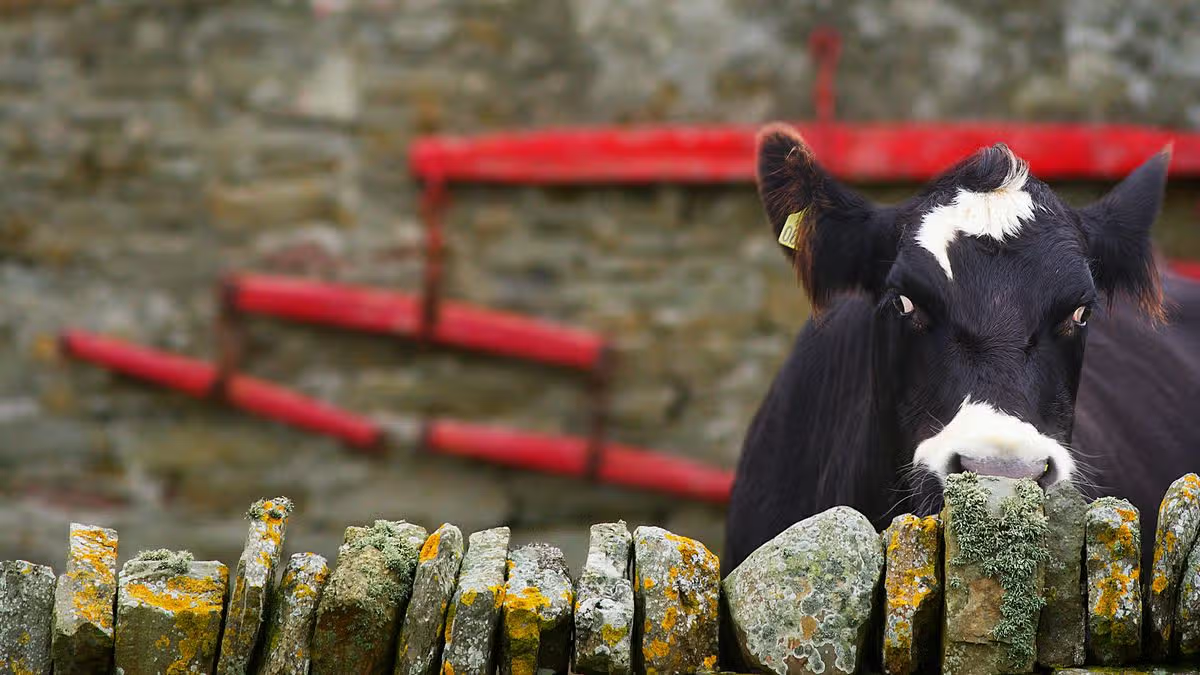
The disease, which affects ruminant livestock like sheep and cows, was first detected in a farm in Scotland on August 8.

Bluetongue has been detected on a second farm in south-west Scotland, the chief veterinary officer has confirmed.

Advertisement

The disease, which affects ruminant livestock like sheep and cows, was first detected in a farm in Scotland on August 8. A single sheep was affected.

A second case of bluetongue serotype 3 (BTV-3) was confirmed in two sheep on a different farm on Wednesday.

The Scottish Government confirmed both farms have been put under restrictions, and all affected animals have been euthanised.

Chief veterinary officer Sheila Voas said: “Bluetongue has been detected on a second farm in south-west Scotland involving two sheep.

Advertisement

“Both farms are under restriction while investigations, including testing other susceptible animals, are ongoing.

“Vaccination remains the best way of preventing disease in animals and I encourage all farmers to discuss this with their vets.”

Bluetongue only affects animals, and does not affect humans or food safety.

Symptoms include nasal discharge, redness and swelling of the lips, nose and muzzle, lameness or reluctance to stand, decreased milk production and diarrhoeas in cattle.

Advertisement

The disease is also notifiable – meaning any suspected cases in Scotland are legally required to be reported to the Animal and Plant Health Agency.

Get more Daily Record exclusives by signing up for free to Google’s preferred sources. Click HERE

Source link

Advertisement
Continue Reading

NewsBeat

Chelsea FC set Enzo Fernandez transfer deadline amid Man City interest

Published

on

Chelsea FC set Enzo Fernandez transfer deadline amid Man City interest

That could change by Friday, however, with City still interested in the player despite landing Elliot Anderson from Nottingham Forest for a (then) British transfer record of £116million, and Enzo Maresca’s side remain in talks with Lille over a deal to sign Ayyoub Bouaddi, the 18-year-old Moroccan, who starred at the recent World Cup, while Fernandez himself was sent off in Argentina’s 1-0 defeat by Spain in the final.

Source link

Continue Reading

NewsBeat

Best Drought-Proof Wildflowers UK: Plants That Thrive In Dry August Heat

Published

on

Best Drought-Proof Wildflowers UK: Plants That Thrive In Dry August Heat

It’s been a dire summer for gardeners. All of our plans, all of our meticulously-chosen plants and flowers have gone out the window as we try to keep them alive through what has been the driest summer on record. Yeesh.

It’s tempting to write the whole thing off and hope that next summer will be a little more mild, a little more damp and a little less scorching but there are actually some flowers we can plant now that will cope even if we do go through another prolonged dry period before autumn hits.

Dr Emily Attlee, conservation scientist and co-founder of the original seed ball company, Seedball, advises: “As drought conditions intensify and hosepipe bans become more frequent, gardeners are understandably looking for ways to build resilience into their outdoor spaces. One answer lies in wildflowers. Many native species are well adapted to cope with dry spells and still deliver an impressive display.”

Drought-proof wildflowers that can brighten your garden

Advertisement

Coneflowers

Dr Attlee says: “These vibrant, native wildflowers aren’t just a feast for the eyes – they’re also tough, reliable perennials that return year after year. Easy to grow and adored by pollinators, coneflowers offer long-lasting colour and valuable drought resistance.”

Oxeye Daisy

“Often seen on roadside verges, oxeye daisies thrive on neglect. They do well in poor soil and need very little watering once established. These cheerful self-seeders bring rustic charm to a garden while supporting local pollinators.”

Advertisement

Meadow Cranesbill

“Young plants may need some water at first”, Dr Attlee explains.

“But once established, meadow cranesbill performs brilliantly in dry, well-drained soils. Part of the geranium family, it produces beautiful violet flowers and supports a wide range of pollinators.”

Musk Mallow

Advertisement

“With its soft pink blooms and classic cottage garden appeal, musk mallow is both hardy and low maintenance. It tolerates drought well, disappears in autumn, and returns reliably each spring, making it a wildlife-friendly favourite.”

Cornflowers

Dr Attlee says: “Known for their striking blue blooms, cornflowers feature frilled petals and curly stamens that attract bees and other beneficial insects. They’re happy in dry conditions once settled and bring texture and vibrancy to the garden.”

Wildflowers future-proof your garden

Advertisement

If you are concerned about the summers in years to come, Dr Attlee advises that wildflowers are a safe choice. She explains: “These are just a handful of examples. In fact, most native wildflowers have evolved to cope with drought once established.

“Many store seeds beneath the soil, ready to regenerate when conditions improve. So, if you’re looking to future-proof your garden, wildflowers are a smart, sustainable choice.”

Brb, brightening up my dusty garden.

Advertisement

Source link

Continue Reading

NewsBeat

Si King set to visit Whitby in 2026 Literary Festival

Published

on

Si King set to visit Whitby in 2026 Literary Festival

Whitby Lit Fest is set to return this November, promising more than 50 author events, in a packed programme featuring bestselling authors, broadcasters and performers.

Among the headline guests is Si King of the Hairy Bikers, who will appear with his first solo cookbook, Proper Home Cooking, sharing stories from his career on screen and on the road.


RECOMMENDED READING:

Supermarket evacuated in coastal North Yorkshire town

Advertisement

Thieves strike in coastal Yorkshire town and make off with Italian scooter

Police hunt arson suspect after fire at North Yorkshire coast


Internationally acclaimed novelist John Boyne, author of The Boy in the Striped Pyjamas will also appear with broadcaster and novelist Steph McGovern for a conversation about his latest novel, The Weight of Angels.

John Boyne, author of The Boy in the Striped Pyjamas, will appear with broadcaster and novelist Steph McGovern for a conversation about his latest novel, The Weight of AngelsJohn Boyne, author of The Boy in the Striped Pyjamas, will appear with broadcaster and novelist Steph McGovern for a conversation about his latest novel, The Weight of Angels (Image: Supplied)

Louise Minchin, former BBC Breakfast presenter, will discuss her forthcoming thriller, while Dr Sian Williams, journalist-turned-psychologist, explores themes from her new book The Power of Anxiety.

Advertisement

Channel 4 news presenter Alex Thomson will interview political commentator Peter Oborne about his latest work, Complicit.

A wave of crime fiction will arrive on the coast with one of the genre’s biggest names, Ann Cleeves.

Other guests include this year’s Crime Writers’ Association Diamond Dagger winner Mark Billingham and Elly Griffiths, who will discuss her novella The Case of the Christmas Card.

The Whitby Lit Fest’s patron, novelist and former BBC radio producer Kate Fenton, said: “We always suspected the quirky, gothic charms of Whitby would attract bookworms.

Advertisement

“Even so, no-one could have predicted the instant, sell-out success of our very first Lit Fest last year.

“And this November’s line-up is, if anything, even more exciting.

“Four days crammed with gripping stories, sparky conversations and revealing interviews.

“Entertainment, inspiration, wit, wisdom – and fish and chips.

Advertisement

“What more could any book lover want?”

The festival will also explore the world of screenwriting.

Matt Baker will be in conversation with Emmy-winning writer David Quantick.

Baker is the creator of Channel 4’s Patience and ITV’s A Taste for Murder, while Quantick’s credits include Veep, The Thick of It and The Book of Love.

Advertisement

Elsewhere, actor Greta Scacchi will reflect on the books that shaped her career in conversation with arts journalist Jasper Rees, who will discuss his new official memoir of Michael Gambon, who she shared the stage and screen with.

Other highlights include royal biographer Andrew Lownie’s talk on the fall of the former Prince Andrew, and appearances from travel writers Ben Aitken and Tom Sykes.

The gothic spirit of Whitby will be celebrated with appearances from leading writers of gothic fiction and folk horror including Joanne Harris, Laura Purcell, Jess Kidd, Amanda Mason, Lucie McKnight Hardy and Essie Fox.

The festival will also showcase Whitby’s Heritage Sculpture Trail and the Wirefolk of Whitby, featuring sculptor Emma Stothard and writer Tim Kelly.

Advertisement

For younger readers, there will be a special family event with Grammy Award-winning singer-songwriter Corinne Bailey Rae, who will help announce the winners of the festival’s children’s writing competition.

Lois Kirtlan, chair of Whitby Lit Fest, said: “Following the huge success of our inaugural Lit Fest last year, I’m delighted that the team has once again pulled together such a fabulous and diverse line-up for this year’s festival.

“We’re also incredibly proud to have been awarded charitable status, which gives Whitby Lit Fest a strong foundation for the future.

“We want the festival to continue to become an important part of Whitby’s cultural calendar for many years to come.

Advertisement

“We’re encouraging local businesses and individuals to get behind us and help make that possible.

“There are a range of sponsorship opportunities available, and donations can also be made through our website.

“Every contribution, large or small, will help us build on the success of the festival and secure its future.”

Events are scheduled from November 19 to 22. 

Advertisement

Tickets go on sale August 31. For more information please see here.

Source link

Advertisement
Continue Reading

NewsBeat

Why an 120-year-old warning about reading feels uncomfortably familiar

Published

on

Why an 120-year-old warning about reading feels uncomfortably familiar

In 1906, the journalist W.T. Stead warned in A Plea for the Revival of Reading that Britain faced a reading crisis. People, he complained, no longer read books. Instead, they skimmed newspapers on trains, forgot what they had read by lunchtime and increasingly preferred distraction to sustained attention. His proposed solution? A national revival of reading.

One hundred and twenty years later, 2026 is the UK’s National Year of Reading. After years of concern about declining rates of reading for pleasure, the headlines are dramatic. The Times recently warned: “If humans stop reading, barbarians will live among us again”. Screens, smartphones and short-form video social media platforms like TikTok are regularly presented as the culprits.

So, reading Stead’s pamphlet (1906) today is an uncanny experience. While researching Stead’s journalism for my book The Americanisation of W.T. Stead (2026), I found that many of the arguments we assume belong to the digital age were already being made in Victorian Britain.

Stead begins with a distinction that still lies at the heart of debates about reading: “Millions have never yet found out that books were interesting,” he writes. “They can read, but they do not care for reading”.

Advertisement

This observation chimes with our contemporary moment. The problem is not literacy alone, but reading identity. Someone may possess the technical ability to read without ever coming to think of themselves as a reader. Current reading research makes a similar distinction. There is now broad agreement that developing a love of reading depends not simply on decoding words but on motivation, confidence and finding books that feel relevant.

Stead also rejected the idea that this love of reading could simply be imposed: “The love for the reading of books is an acquired taste,” he argued. Children might have to be compelled to learn to read, but learning to love reading required something quite different, “instead of coercion there is needed a good deal of coaxing”.

Again, this sounds very familiar today. Modern initiatives promoting shared reading, reading for pleasure and child-led book choice all rest on the principle: readers are made through encouragement rather than compulsion.

WT Stead was worried about the death of reading.
Wikimedia

Stead’s advice began with children. He believed that one of the most effective ways of creating readers was simply reading aloud. Good oral reading, he claimed, was “the surest, simplest, and speediest way of awakening a love of reading”.

Advertisement

More than a century later, spoken language is once again moving up the educational agenda. The government’s proposed oracy framework, expected to be introduced by 2028, reflects a renewed recognition that speaking, listening and reading are closely connected – even if the framework’s primary focus extends beyond literacy alone.

It is in Stead’s discussion of attention, however, that the similarities with today’s debates become most apparent.

The attention debate

Stead worried that newspapers had fundamentally altered reading habits. Circulation libraries, newspapers and magazines encouraged “a habit of skimming rather than reading”. Newspapers, he complained, had become “mere rag bags of shreds and patches”. Readers looked through them “as we look into kaleidoscopes”, producing only “an evanescent effect upon our minds”.

Replace “newspapers” with “social media feeds” and the argument would sound entirely contemporary.

Advertisement

“Memory, judgement, the critical faculty are unexercised”, Stead lamented. It is difficult not to hear echoes of today’s debates about social media and, increasingly, concerns about generative-AI technologies. Critics now ask whether the use of AI assistants to process information and endless scrolling on screens fragments attention, weakens memory and encourages rapid emotional reactions rather than sustained reflection. While the technologies are radically different, the underlying concern is remarkably familiar: the way we consume information shapes how we think.

Where Stead relied on cultural observation, researchers today investigate these questions empirically. There is growing evidence that sustained, immersive reading supports concentration, reflection and aspects of mental wellbeing, while regular reading has also been associated with lower stress levels and, over the longer term, healthier cognitive ageing.

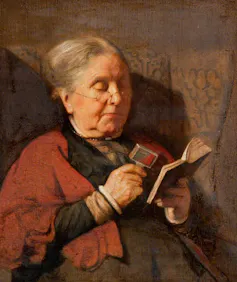
Old woman reading
Reading can help healthier cognitive ageing.
McLean Museum and Art Gallery – Inverclyde Council, CC BY-NC-ND

At the same time, experts caution against simplistic comparisons between books and screens. Different media support different kinds of reading, and much depends on what people are reading and how they engage with it.

Stead quotes the Liberal MP and editor John Morley, who argued that people needed to make time in each day – half an hour ideally, but even a quarter of an hour, if pushed – for what he called “good and disinterested reading”. The value of this practice, he suggested, lay not simply in acquiring knowledge but in cultivating “happiness, fortitude, wisdom and calm”. To translate those words into modern terms, we might say reading supports our mental health, emotional resilience and everyday wellbeing. The language has changed, but the aspiration is the same.

Although Stead worried that newspapers encouraged superficial reading, he also recognised that books would have to adapt. “Books”, he wrote, “must struggle for existence by the use of the same weapons as those which have secured the ascendency of the newspaper”.

Advertisement

This is perhaps the most surprising insight in the pamphlet. Rather than defending books against modern media, Stead argued that they should borrow modern media’s strengths. Books should become cheaper, shorter, regularly issued and more accessible. Far from resisting new communication technologies, he believed reading could flourish by adapting to them. Today’s equivalent might be publishers embracing audiobooks, podcasts, readings apps and BookTok. The principle is the same: meet readers where they already are.

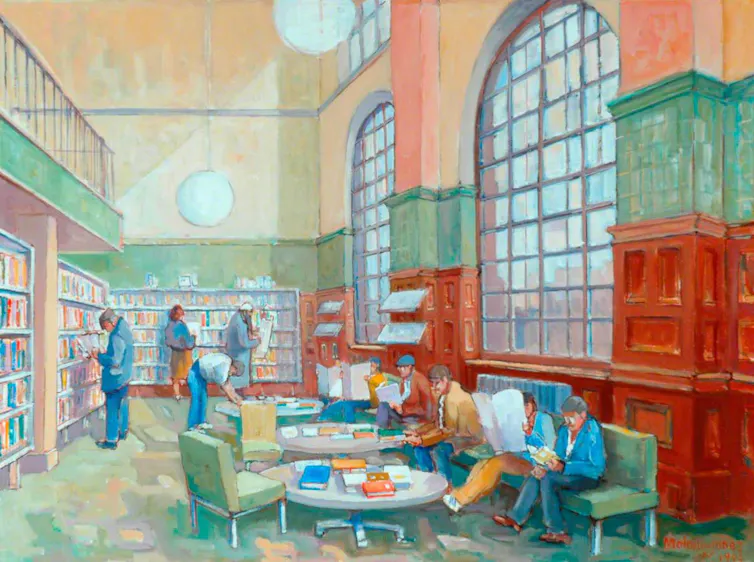
Dewsbury Library Interior by Malcolm Jones.
Reading should meet people where they’re at. Dewsbury Library Interior by Malcolm Jones.
Kirklees Museums and Galleries

Of course, Stead did not get everything right. Like many of his contemporaries and forebears, he worried about the dangers of “habitual novel reading”. He discussed proposals from America that would have restricted children’s access to popular fiction in a similar way to how tobacco sales were regulated. Today, those fears seem excessive. Yet they offer a useful reminder that every generation identifies certain forms of reading as uniquely dangerous.

The recent resurgence of book challenges and bans reminds us that debates about reading have always been as much about what people read as whether they read at all. Whether such restrictions are justified or not, history suggests these debates often reveal broader anxieties about childhood, attention and morality as much as the medium itself. Each generation, it seems, has its preferred media villain.

That is not to say current concerns should be dismissed. Reading for pleasure has genuinely declined among children, and many adults struggle to sustain the time and concentration that long-form reading demands. These are important educational and cultural questions, but they are best understood as part of a much longer story. Every major communications revolution has prompted fears that serious reading was disappearing. Yet reading has repeatedly adapted rather than vanished.

Stead understood something that remains true today. The challenge is not merely persuading people that books matter. It is, as he put it in 1906, helping people who “can read” become people who “care for reading”.

Advertisement

Source link

Continue Reading

NewsBeat

The eclipse snapped by YOU: Daily Mail readers’ photos are revealed

Published

on

One happy pooch donned protective eyewear to accompany its owner while watching the eclipse

Our readers sent in their best pictures of the solar eclipse tonight as they watched the once-in-a-generation event across the nation. 

From beloved pets wearing protective eyewear to children using homemade viewing devices to glimpse the spectacular illusion in the skies on Wednesday evening, our readers embraced eclipse fever in full force. 

The partial eclipse began shortly after 6pm in parts of the UK, with maximum coverage occurring at roughly 7.05pm to 7.13pm depending on location. 

The Moon gradually moved away from the sun and the spectacle ended shortly after 8pm, with huge crowds at prime viewing spots at Primrose Hill in London and Calton Hill in Edinburgh dispersing. 

Advertisement

Readers sent pictures from their homes and on holiday to share their view of the rare event, which had people staring in thrall at the heavens. 

A happy spaniel accompanied its owner in a field to watch the eclipse and carefully wore protective glasses to gaze at the solar display. 

In Leyton, east London, five-year-old Sonny pointed at the eclipse in awe through a special card, while Michael, 14, and Lottie, nine, watching the eclipse in Bexleyheath, London. 

Elsewhere in the capital, one man used a colander to watch the eclipse through the metal holes in a London park. 

Advertisement

One happy pooch donned protective eyewear to accompany its owner while watching the eclipse

Sonny, five, enjoyed the eclipse in Leyton, east London

Sonny, five, enjoyed the eclipse in Leyton, east London

One Daily Mail reader was on board the P&O Iona in the Bay of Biscay to watch the eclipse

One Daily Mail reader was on board the P&O Iona in the Bay of Biscay to watch the eclipse

Advertisement
Michael, 14, and Lottie, nine, watched the eclipse using homemade lenses in Bexleyheath, London

Michael, 14, and Lottie, nine, watched the eclipse using homemade lenses in Bexleyheath, London

This incredible pic was snapped at a rooftop in Salou, Spain

This incredible pic was snapped at a rooftop in Salou, Spain

A pigeon in Blandford Forum, Dorset, was photographed with a perfect crescent above its head as the Moon passed over the Sun

A pigeon in Blandford Forum, Dorset, was photographed with a perfect crescent above its head as the Moon passed over the Sun 

Maya and Maya, aged nine and six, watched the solar eclipse together through a pair of glasses in Bedfordshire

Maya and Maya, aged nine and six, watched the solar eclipse together through a pair of glasses in Bedfordshire

Advertisement
One Daily Mail reader holidaying in Menorca snapped the eclipse alongside crowds on the seafront

One Daily Mail reader holidaying in Menorca snapped the eclipse alongside crowds on the seafront

The eclipse from a garden in Billingham, Durham

The eclipse from a garden in Billingham, Durham 

Everyone was ready in Salou, Spain

Everyone was ready in Salou, Spain 

The sight of the kitchen utensil was not uncommon, with many others also deciding to opt for a colander or a sieve to view the eclipse through, although it is unlikely this offered much eye protection. 

Advertisement

On London Bridge, crowds lined the river to watch the eclipse over London’s skyline, with a beautiful shot taken at sunset over the Thames. 

A Daily Mail reader on board the P&O Iona in the Bay of Biscay watched the eclipse with 6,000 other passengers. 

A pigeon in Blandford Forum, Dorset, was photographed with the Sun peeking out from the Moon above its head in a perfect crescent. 

Friends Maya and Maya, aged nine and six, watched the solar eclipse together through a pair of glasses in Houghton Regis, Bedfordshire. 

Advertisement

Source link

Continue Reading

NewsBeat

Lindsay Clancy begs for trial to stop as she hears most graphic evidence yet in murder trial of her three children

Published

on

Lindsay Clancy cried out, 'I can't do this,' as a medical examiner testified about her children's injuries at Plymouth Superior Court, Massachusetts, on Wednesday

Lindsay Clancy pleaded for her trial to stop as a medical examiner shared the horrific details of her slain children’s injuries

The former nurse, 36, is accused of murdering Cora, five, Dawson, three, and eight-month-old Callan, at her home in Duxbury, Massachusetts, in January 2023.

Clancy’s suicide attempt after the three killings failed but left her paralyzed and in a wheelchair for life.

She has pleaded not guilty to murder charges and claimed she is not responsible for her actions because she was suffering from postpartum psychosis after being prescribed a powerful cocktail of drugs to cope with depression.

Advertisement

The jury and courtroom had to be cleared twice on Wednesday as Clancy grew so overcome with emotion hearing the injuries she had inflicted on her own children.

‘I can’t do this,’ Clancy cried out as she sat through the graphic testimony inside Plymouth County Superior Court.

Dr Barbara Olson described the neck trauma and injuries to Cora’s arms and legs, and said that Dawson died of asphyxia after Clancy strangled the children with exercise bands. Clancy put her head down on the defense table and sobbed. 

The mom-of-three’s tears came even before the graphic photos from Cora and Dawson’s autopsies were shown to the jury.

Advertisement

Lindsay Clancy cried out, ‘I can’t do this,’ as a medical examiner testified about her children’s injuries at Plymouth Superior Court, Massachusetts, on Wednesday

Clancy strangled her children - Cora, five, Dawson, three, and eight-month-old Callan - back in January 2023, then attempted to kill herself

Clancy strangled her children – Cora, five, Dawson, three, and eight-month-old Callan – back in January 2023, then attempted to kill herself

Renee Stonebridge, who works at the Massachusetts Office of the Chief Medical Examiner, had first testified about the injuries to the children’s eyes and brains.

Advertisement

Clancy appeared to be hyperventilating as Stonebridge spoke, and made quiet gulping sounds while her back and shoulders shuddered.

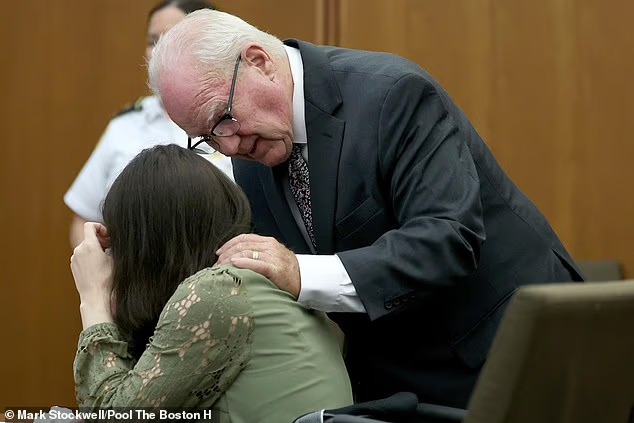
Her attorney, Kevin Reddington, leaned forward and clutched her hand in his.

As the judge called a break, Reddington stood over Clancy with his arm around her shoulder. She leaned her body into his as she appeared to be desperately trying to muffle her sobs.

When the jury left the room, she broke down into loud cries.

Advertisement

The court returned around 15 minutes later, with several jurors stealing glances over in Clancy’s direction.

The judge reminded them that the evidence can give emotional reactions – but, as jurors, they must separate emotion from the evidence.

‘Your verdict in this case is going to have to be based solely on the evidence. It cannot be based on sympathy or anger or passion or prejudice,’ he said. 

When the grueling testimony continued, Clancy broke down even more uncontrollably, wailing those four words to the court: ‘I can’t do this.’

Advertisement

Her tearful outburst prompted the judge to quickly clear the room for the second time – something that appeared to rattle the prosecution.

Prosecutors Jennifer Sprague and Shanan Buckingham turned to each other and pulled faces – seemingly annoyed – as Clancy was comforted and taken out of the room by her nurses.

When jurors returned once again, they were faced with the graphic images of Cora and Dawson.

The former nurse, 36, is accused of murdering her three children. Her suicide attempt after the killings failed but left her paralyzed and in a wheelchair for life

The former nurse, 36, is accused of murdering her three children. Her suicide attempt after the killings failed but left her paralyzed and in a wheelchair for life

Advertisement
Renee Stonebridge, who works at the Massachusetts Office of the Chief Medical Examiner, testified about the injuries to the children's eyes and brains

Renee Stonebridge, who works at the Massachusetts Office of the Chief Medical Examiner, testified about the injuries to the children’s eyes and brains

While the little children’s bodies were shown on screens, one female juror grew increasingly upset.

She wiped away tears with a tissue before closing her eyes for a moment. The woman then pursed her lips and swallowed, as though trying to stop the tears flowing.

Another juror also briefly dabbed a tissue to her face. Clancy put her head in her arms on the defense table and cried loudly.

Advertisement

Reddington objected to the witnesses before they were brought to the stand.

‘It’s not contested, it’s not necessary,’ Reddington said.

Last week, Clancy, who does not deny killing her children, agreed to a stipulation of facts in regard to several pieces of evidence and to help alleviate the government from having to call dozens of witnesses.

If you or someone you know needs help, please call or text the confidential 24/7 Suicide & Crisis Lifeline in the US on 988. There is also an online chat available at 988lifeline.org. 

Advertisement

Source link

Continue Reading

Trending

Copyright © 2025