
Crypto World
Mad Money’s Jim Cramer Says These 6 AI Stocks are Primed to Surge

Mad Money host Jim Cramer said the AI data center trade is reclaiming market leadership. He named six stocks leading the rally, and every one of them closed higher on Wednesday.
The group had trailed financials, healthcare, and retail for weeks. Cramer said a run of developments in recent days has restored his confidence in AI infrastructure names.

Why the AI Data Center Trade Stalled
Cramer said the once-hot AI infrastructure names began cooling in late June. The slide then ran through most of July.
“This group has languished while the financials, the healthcares and the retailers rocked,” he said.
Each of the six rallied sharply before the gains reversed, for some in early May and for others in June. All then trended lower through late July. CoreWeave (CRWV) dropped 56% across that span.
Super Micro Computer (SMCI) fell 53%, and Nebius (NBIS) lost 48%. Lumentum (LITE) shed 43%, and Intel (INTC) fell 42%. The Nasdaq 100 declined by just 11%.
The turn arrived with the forced unwind of Situational Awareness. Wednesday’s session is further proof of the regained strength.
Nebius led with a 34.14% gain. CoreWeave added 19.28% and Supermicro 19.02%. Lumentum rose 13.63%, Intel 3.32%, and Nvidia (NVDA) 3.03%.
“I cannot stress enough how important today’s session was,” Cramer added.
Follow us on X to get the latest news as it happens

What Restored Cramer’s Confidence
Cramer noted that prices still sit below their peaks but now “seem primed to go higher.” He pointed to a cluster of recent events that suggested the pressure had passed.
- Intel drew enough investor demand to lift its stock offering to $20 billion from $15 billion.
- He said Supermicro and Lumentum reported better-than-expected results, followed by Nebius. Worth noting that Supermicro missed revenue estimates.
- CoreWeave’s results, he said, offered evidence that older Nvidia GPUs hold value longer than skeptics expected
- Finally, Wednesday’s inflation print eased the rate pressure weighing on growth stocks.
How the 6 AI Data Center Stocks Have Performed in 2026
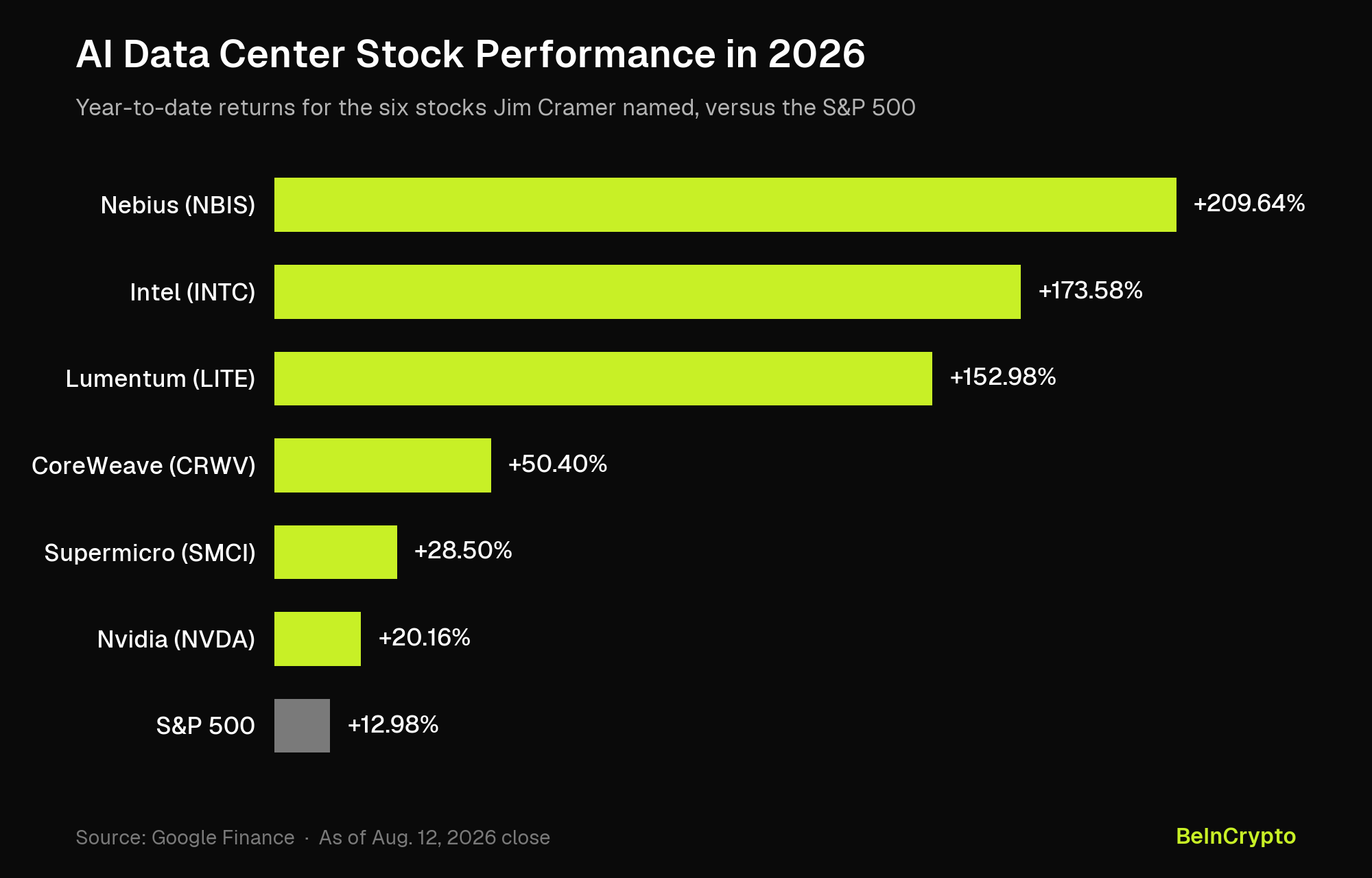
Notably, all six are beating the S&P 500 this year. The index has gained 12.98% year-to-date, according to Google Finance data.
Nebius leads the group at 209.64%, followed by Intel at 173.58% and Lumentum at 152.98%. CoreWeave is up 50.4%, Supermicro is up 28.5%, and Nvidia is up 20.16%.
“This morning, the rockets went off and the fabled six fighting bulls, Supermicro, Nvidia, Intel, Nebius, Lumentum, and CoreWeave, tore out of their pens and proceeded to trample the non-believers who didn’t realize that you’re taking your life in your hands when you bet against these companies,” Cramer said.
The question now is how long the run lasts and whether the six can reclaim their highs.
Subscribe to our YouTube channel to watch leaders and journalists provide expert insights
The post Mad Money’s Jim Cramer Says These 6 AI Stocks are Primed to Surge appeared first on BeInCrypto.

The resignation of BitMart Chief Product Officer Terence Lee has stoked speculation online that the soon-to-be-shuttered crypto exchange could well be insolvent.
In a statement, posted online, Lee claims that he wasn’t “responsible for the exchange’s core business,” and that he’s not involved in BitMart’s “operations, management, or asset-related matters of the company or any of its affiliated entities.”
He also stressed that he has “no authority over platform assets, accounts, or matters relating to user funds” and said that he wouldn’t comment on any legal proceedings, calling his resignation “my sole public clarification on this matter.”
Crypto streamer Travladd said that Lee’s departure “screams insolvency,” and claimed that he’s resigning “before shit hits the fan.”
BitMart situation has ‘gotten out of hand’
According to “Cao,” a lawyer who’s previously served BitMart demand papers, the “situation has gotten out of hand.”
They said that “Not being in control of assets doesn’t exempt a co-founder from responsibility; you don’t get to opt out of accountability by stepping back once things collapse.”
Read more: BitMart founder denies exit scam as withdrawals stall
BitMart’s withdrawal issues
Prior to Lee’s departure, Open Gradient CEO Matthew Wang had already accused BitMart of insolvency after his market maker couldn’t retrieve its funds.
He also claimed that it was “insane” that BitMart asked token holders to lock up their tokens one week before it announced that BitMart would cease operations by January 31, 2027.
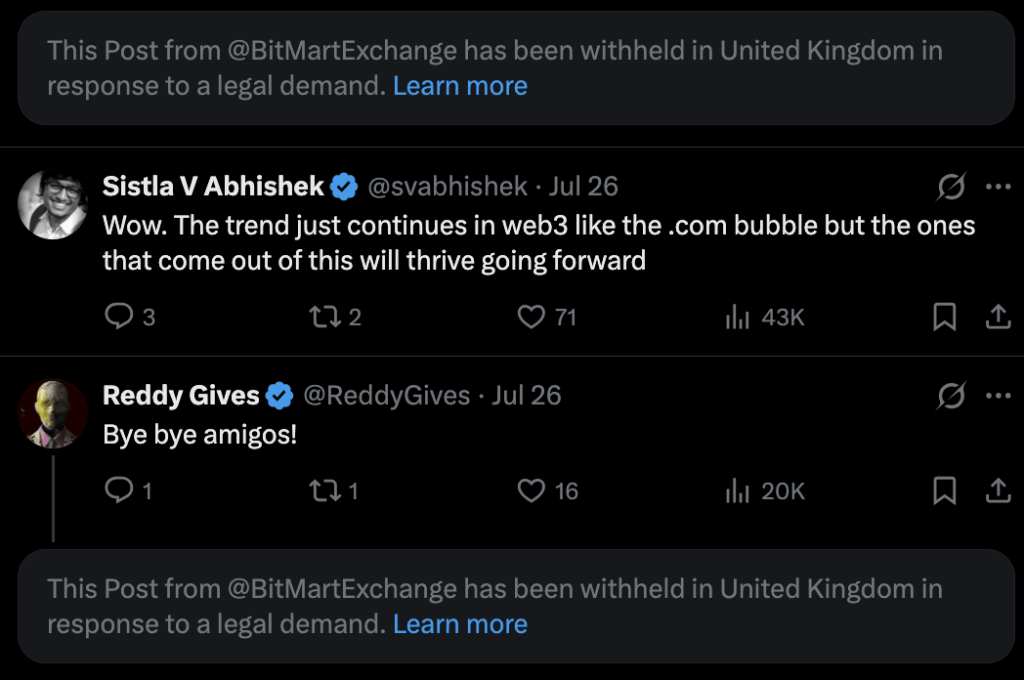
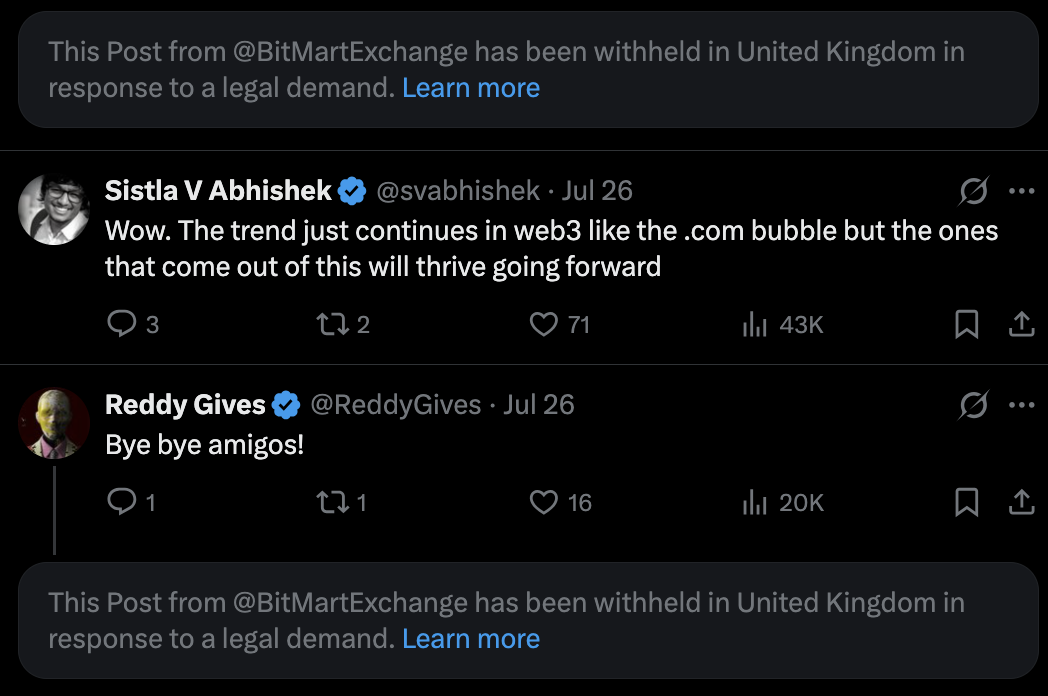
Wang’s post was apparently deleted while BitMart’s closure announcement on X was “withheld” from UK users “in response to a legal demand.”
Read more: BitMart processed just 63 withdrawals after closure announcement
The announcement promised an “orderly wind-down” and claimed, “withdrawal services will remain available.”
BitMart users scrambled to withdraw their funds as the price of its token fell 80% between July 24 and July 26.
However, there were significant delays, with users experiencing difficulties weeks later.
Co-founder denies rugpull
Eventually, BitMart co-founder Sheldon Xia broke a two-week silence to deny that the firm was conducting an exit scam.
In a statement that included no figures or timeline, Xia said the team is still tallying and consolidating what it holds.
He also floated the possibilty of “involving the courts and independent third-party auditors to provide a transparent report.”
Protos has reached out to BitMart for comment and will update this piece should we hear anything back.
Got a tip? Send us an email securely via Protos Leaks. For more informed news and investigations, follow us on X, Bluesky, and Google News, or subscribe to our YouTube channel.


The City of Baltimore and its mayor, Brendan Scott, filed lawsuits against Kalshi and Polymarket over allegations that the companies violated local gambling laws.
In a Thursday notice, the Baltimore mayor’s office said that the two prediction market companies operated “illegal, unlicensed sports-betting platforms” and misled users about the ”legality and regulatory status of their products.” The lawsuits are centered on claims disputing Kalshi’s and Polymarket’s characterization of event contracts, arguing that the trades amount to unlawful wagers under state laws.
“These companies are running sportsbooks without licenses and betting that a new label will put them above the law,” said Scott. “It won’t. Baltimore will not let multibillion-dollar companies put profits over people and harm our communities through illegal gambling.”
Notably, the city’s complaint against Kalshi included Robinhood, Webull and Coinbase as partners with the prediction market platform. All companies were accused of deceptive practices by marketing sports contracts as something that can ”lawfully be purchased and traded in Maryland.”
The legal action against prediction market companies was the latest conflict between US state and federal authorities, and many experts expect it to end with an appeal to the Supreme Court. The US Commodity Futures Trading Commission (CFTC), under Chair Michael Selig, and companies have argued that event contracts on prediction markets amount to “swaps” within its purview, while both Baltimore lawsuits and other state-level authorities dispute that claim.
“City-specific action runs counter to the CFTC’s established framework for regulating prediction markets,“ a Polymarket spokesperson told Cointelegraph in response to the lawsuit. “As courts have recognized, prediction markets on CFTC-registered exchanges are governed by federal law, not a patchwork of state and local rules.”
Related: Judge stays CFTC’s case against US soldier over prediction market bets
It is quite challenging to spot a cryptocurrency whose price has jumped by double digits over the past seven days, with Monero (XMR) among the few exceptions.
Following the green wave, many market observers have become optimistic, expecting additional gains.
Just the Beginning?
XMR has crossed $400, currently trading at around $404 (according to CoinGecko), representing a 13% weekly increase. Its market capitalization has exceeded $7.5 billion, making it the 16th-largest cryptocurrency after overtaking Cardano’s ADA.

The exact catalyst for the resurgence remains rather unclear, yet certain analysts spotted the formation of bullish patterns that could support a more sustainable uptrend. Several days ago, X user The Moon Show claimed that XMR might be carving out a massive cup-and-handle structure.
“I’m watching for a clean handle followed by a breakout above $430. If that happens, things could move very fast,” they said.
For their part, Lucky (an X user with almost two million followers) described the move north as a “special breakout from a special privacy gem.” The analyst argued that it has entered the bullish trend, projecting a pump to almost $600.
Crypto With Gopal appears to be the biggest optimist. He opined that XMR has formed a massive triangle pattern, with the price consolidating near $400 after a strong recovery, as rising support and descending resistance squeeze momentum.
“Bulls are holding the range as a major breakout setup develops. A clean breakout above the upper trendline could trigger a major expansion move toward the $1,000 target,” he forecasted.
The Bearish Signals
It is worth mentioning that, based on two important factors, XMR’s rally could be abruptly replaced by a short-term pullback. The first is the asset’s Relative Strength Index (RSI), which measures the speed and magnitude of recent price changes to give traders an idea about possible trend reversals.
It ranges from 0 to 100, where anything above 70 means that the coin has entered overbought territory and could be due for a correction. In contrast, ratios below 30 are typically interpreted as buying opportunities. As of now, the RSI stands at around 77.

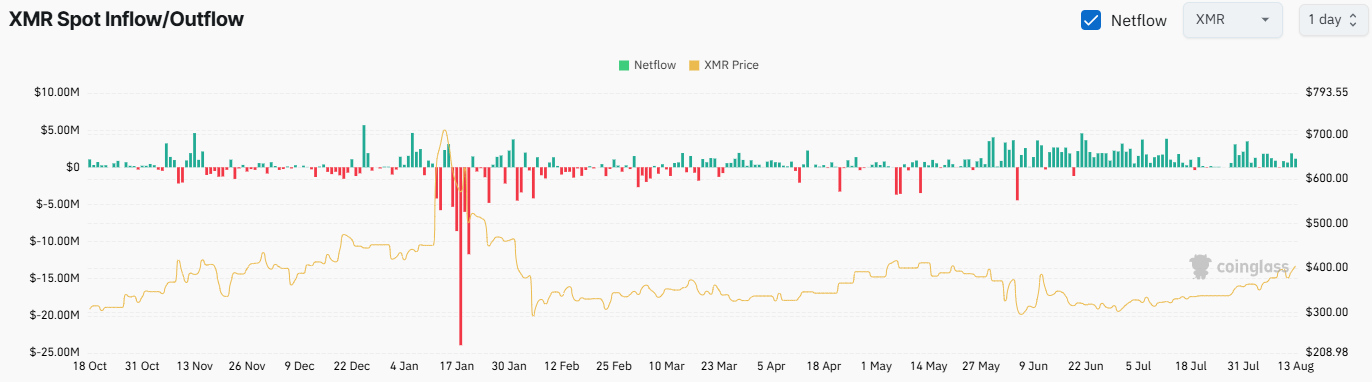
The second element is XMR’s exchange netflow. In the past few months, inflows have dominated outflows, signaling that investors have abandoned self-custody and flocked to centralized platforms. This, in turn, increases immediate selling pressure.
The post Monero (XMR) Rises 13% Weekly as Analysts Expect Further Upside appeared first on CryptoPotato.
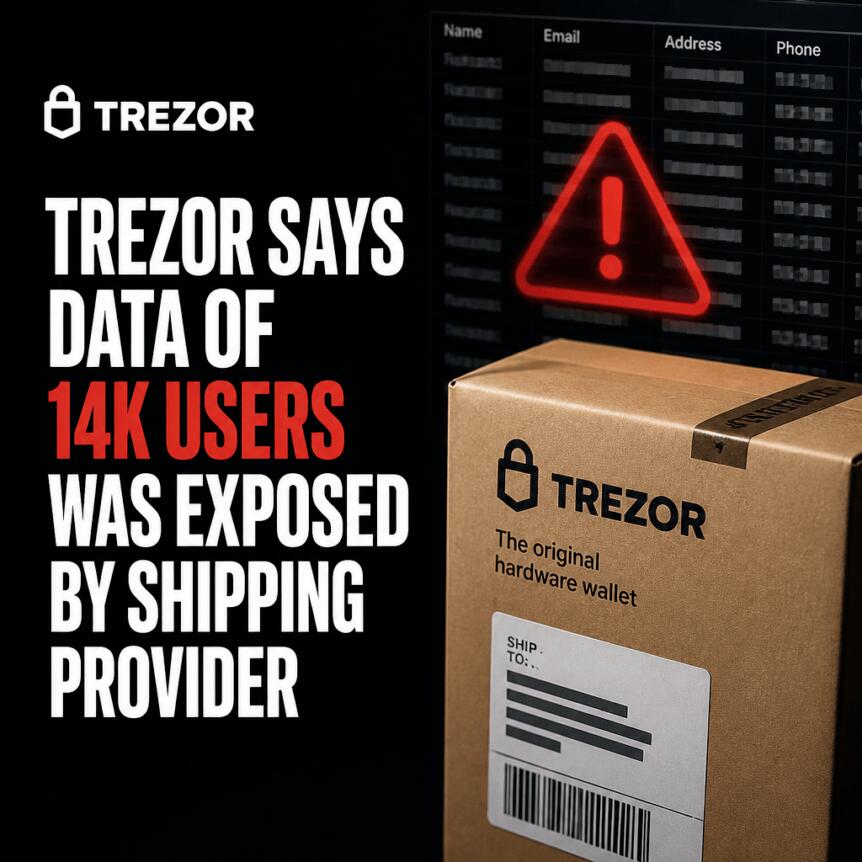
Hardware wallet vendor Trezor has disclosed that personal data tied to roughly 14,000 customers may have been exposed through a shipping-related incident involving its logistics provider, ShipMonk. While Trezor emphasized that its own systems were not breached and that customer devices remain secure, the company warned that the information could be used to carry out targeted phishing attempts.
In a blog post released this week, Trezor said customers who received products shipped from the US, UK, Sweden, Colombia, Brazil, Italy, and Portugal during a specific window—May 10 through Aug. 8—may have been affected. The company’s review found that 11,742 customers could have had their name, physical address, phone number, and email address compromised, and that an additional 1,947 users may have had their name, city, and email address exposed.
Key takeaways
- Trezor says the incident did not involve compromising its own systems; customer Trezor devices are not at risk.
- About 14,000 customers could face phishing attempts because shipping data may have been leaked.
- The affected shipments span multiple countries and cover deliveries made between May 10 and Aug. 8.
- Trezor warned scammers may impersonate banks, crypto exchanges, or Trezor itself using stolen contact details.
- The disclosure follows a prior Trezor advisory in January 2024 involving potential phishing targeting customers after contacting support.
What Trezor says was exposed—and who is affected
According to Trezor’s announcement, the risk comes from personal information associated with customers’ orders rather than from any compromise of the underlying wallet or its security infrastructure. The company said customers who received Trezor products in the affected shipping region and date range could be targeted with scams designed to look more legitimate by using specific personal details.
Trezor broke the potential exposure into two groups. The larger group of 11,742 customers may have had a fuller set of identifiers—name, home address, phone number, and email—while 1,947 users may have had fewer data points exposed, including their name, city, and email address. Even when the dataset is smaller, attackers can still use it to craft more convincing social engineering messages, especially if the scam references a recent purchase or delivery.
Phishing risk: why shipping data matters to crypto users
Trezor’s core message is that its hardware remains secure, but that affected customers might be targeted by “more sophisticated phishing attempts” because scammers can use leaked details to improve the credibility of their outreach. In practical terms, the company said criminals could send fake emails, make fraudulent phone calls, or send counterfeit letters—potentially even impersonating banks, crypto exchanges, or Trezor.
That warning aligns with how many crypto-related theft attempts operate: attackers rarely need to break wallet security directly if they can trick users into revealing sensitive information, approving fraudulent transactions, or moving funds under false pretenses. Personalized contact information—like a real address, phone number, or email—can help scammers bypass basic suspicion and increase the odds that a victim engages with the scam.
For investors and active traders, the most immediate concern is not whether the wallet device is compromised, but whether the user’s operational security is. A well-timed phishing campaign can target anyone who has recently installed wallet software, registered an account, or is actively managing assets—exactly the moment when a misleading message could be most convincing.
A pattern of data-driven targeting for crypto holders
Trezor described the shipping-provider incident as part of a broader set of scams that appear to leverage personal data to reach crypto holders. Earlier reporting around Trezor’s own disclosures shows the company has already warned customers about phishing risk tied to customer support interactions.
In January 2024, Trezor reported that about 66,000 users were at risk of phishing attacks if they contacted the company’s support team after December 2021. Earlier coverage from Cointelegraph noted that those users could potentially be targeted because their engagement with support could make them easier to identify for scammers. The new disclosure suggests that, even when devices remain secure, the wider ecosystem—order handling, shipping logistics, and customer contact channels—can become a pathway for criminals to collect enough data to stage convincing impersonation attempts.
Cointelegraph has previously reported that scammers have used additional tactics beyond digital messages, including physical letters sent through mail to manipulate wallet users. Other approaches include text messages and emails or calls where attackers claim to be family members in urgent need, or impersonate authorities to demand repayment for a fake debt. The common thread across these tactics is social engineering—an area where leaked personal data can materially raise the quality and believability of the scam.
What to watch next for affected customers
Trezor’s disclosure does not indicate that the incident enabled direct theft from wallets, and the company states its internal systems were not compromised. However, the company’s framing makes the next steps less about checking the device and more about monitoring for suspicious communications that reference the customer’s recent Trezor shipment or personal details.
Customers in the delivery window and listed countries should be alert for unexpected emails, phone calls, or letters that ask for sensitive wallet-related actions or encourage them to verify account details through links or instructions provided by the caller. With crypto scams frequently evolving in response to user awareness, the practical question now is whether the leaked shipping data begins circulating in the wild and whether follow-on attempts appear in the weeks after this disclosure.
For the broader market, the incident is another reminder that hardware wallet security is only one part of the threat landscape: criminals increasingly rely on data from the customer journey—shipping, support interactions, and contact databases—to make phishing harder to spot. Readers should watch for emerging scam reports tied to delivery-confirmation themes and remain cautious about any outreach that attempts to force immediate actions.

XRP traded at $1.009 on Thursday. It has been pinned to that dollar line since the Senate skipped its CLARITY Act vote and left for recess.
That bill would write XRP’s legal status into federal law. Its next window opens when senators return in September. The Commodity Futures Trading Commission (CFTC) has signaled it will not wait.

Follow us on X to get the latest news as it happens
XRP Peaked the Day the House Passed the Bill
One date frames the whole story. XRP set its record high of $3.65 on July 17, 2025. The House passed the CLARITY Act that same day. The vote was 294 to 134, with every Republican in the chamber voting yes.
The XRP price now sits about 72% below that peak. It is down 2.9% over the past week and 8.7% over the past month.

The bill has crawled since. Senate Banking advanced it 15-9 in May. It still needs 60 votes on the floor, and senators went home in August without holding that vote.
Buyers have noticed. XRP ranks sixth by market value at $63.2 billion, yet spot ETF demand has stalled while larger tokens gained.
Why XRP Needs a Law, Not a Ruling
XRP’s legal footing comes from a courtroom, not Congress. Judge Analisa Torres ruled in July 2023 that XRP sold anonymously on exchanges was not an investment contract.
She also found Ripple’s direct sales to institutions broke registration rules. Ripple ended up paying a $125 million penalty.
Regulators went further this year. On March 17, the SEC and CFTC issued a joint interpretation sorting crypto into five categories, including digital commodities.
That document named no individual token. It also pointed straight back at Congress.
“complements Congressional efforts to codify a comprehensive crypto market structure framework into statute,” SEC and CFTC joint interpretation, March 17, 2026.
A ruling can be narrowed. An interpretation can be rewritten by the next commission. A statute is far harder to undo. That gap is what keeps cautious money away from XRP.
Ripple Already Has a Seat at the CFTC Table
The CFTC meets on August 20 in Washington. Its opening session starts at 1:30 p.m. ET under the title “Crypto’s Regulatory Evolution: From Uncertainty to Clarity.”
The agenda asks a narrow question. What can the agency fix using powers it already holds?
Ripple CEO Brad Garlinghouse sits on that committee. So do the chief executives of Coinbase, Nasdaq, and CME Group.
The SEC is moving in parallel. Commissioners vote Friday on proposed crypto offering rules for token fundraising.
Citing people familiar with the matter, Eleanor Terrett, host of the Crypto America podcast, reported Thursday that a separate tokenization exemption has slipped again. Negotiators are still arguing over that part of the bill.
Not everyone reads the delay as damage. Former CFTC Chairman Chris Giancarlo argues that innovation continues without legislation.
For XRP, the sum is simple. Agency rules can steady the market. Only a law can give institutions the certainty they have waited for since July 2025. Public comments on the CFTC meeting close on August 27.
The post XRP Defends $1 by a Cent Since CLARITY Act Slipped. Now CFTC Steps In appeared first on BeInCrypto.
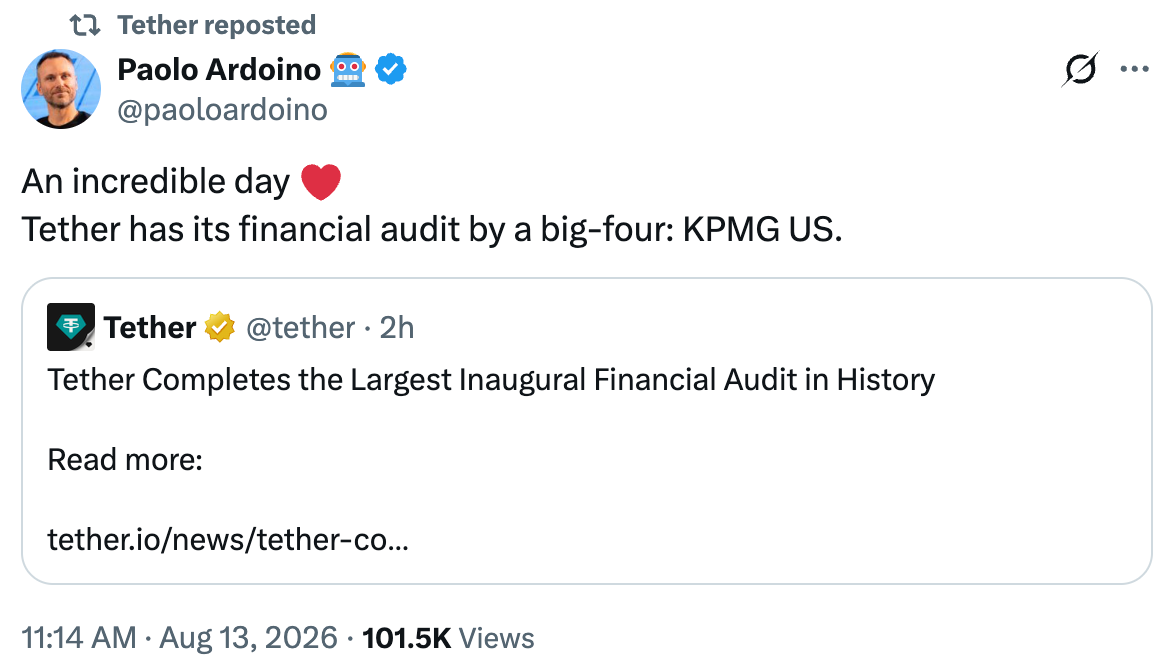
Tether completed the first full independent audit of its annual financial statements, with KPMG US issuing a clean opinion on the stablecoin issuer’s 2025 accounts.
The audit covered Tether’s balance sheet, income statement and cash flows for the year ended Dec. 31, 2025, including the assets backing its issued tokens and the liabilities they represent. Tether said the audited statements showed reserves exceeding liabilities by $6.814 billion.
Unlike Tether’s quarterly reserve attestations, which it has published for years, the full audit subjected the company’s broader financial statements and underlying evidence to independent examination, including transactions, systems, ownership records, valuations and counterparties.
Source: Paolo Ardoino
As part of the audit, KPMG physically inspected and counted Tether’s gold holdings, verifying each bar rather than relying solely on custodian records.
Tether said KPMG issued an unqualified opinion on the statements, finding they fairly presented the company’s financial position, results and cash flows in all material respects under US accounting standards.
Related: Tether signs tokenization deal with Nairobi Securities Exchange
Tether’s growing financial footprint
Tether launched its USDt (USDT) stablecoin in 2014 and has since grown into one of the crypto industry’s largest companies, generating more than $10 billion in net profit in 2025. In the second quarter of this year, the company reported $1.5 billion in net operating profit, driven largely by income from its US Treasury holdings and repurchase agreements.
USDT remains the company’s core business and dominates the stablecoin market. Its roughly $183 billion market capitalization accounts for about 61% of the $301 billion market, more than twice the roughly $72 billion held by its nearest rival, Circle’s USDC (USDC), according to DefiLlama.
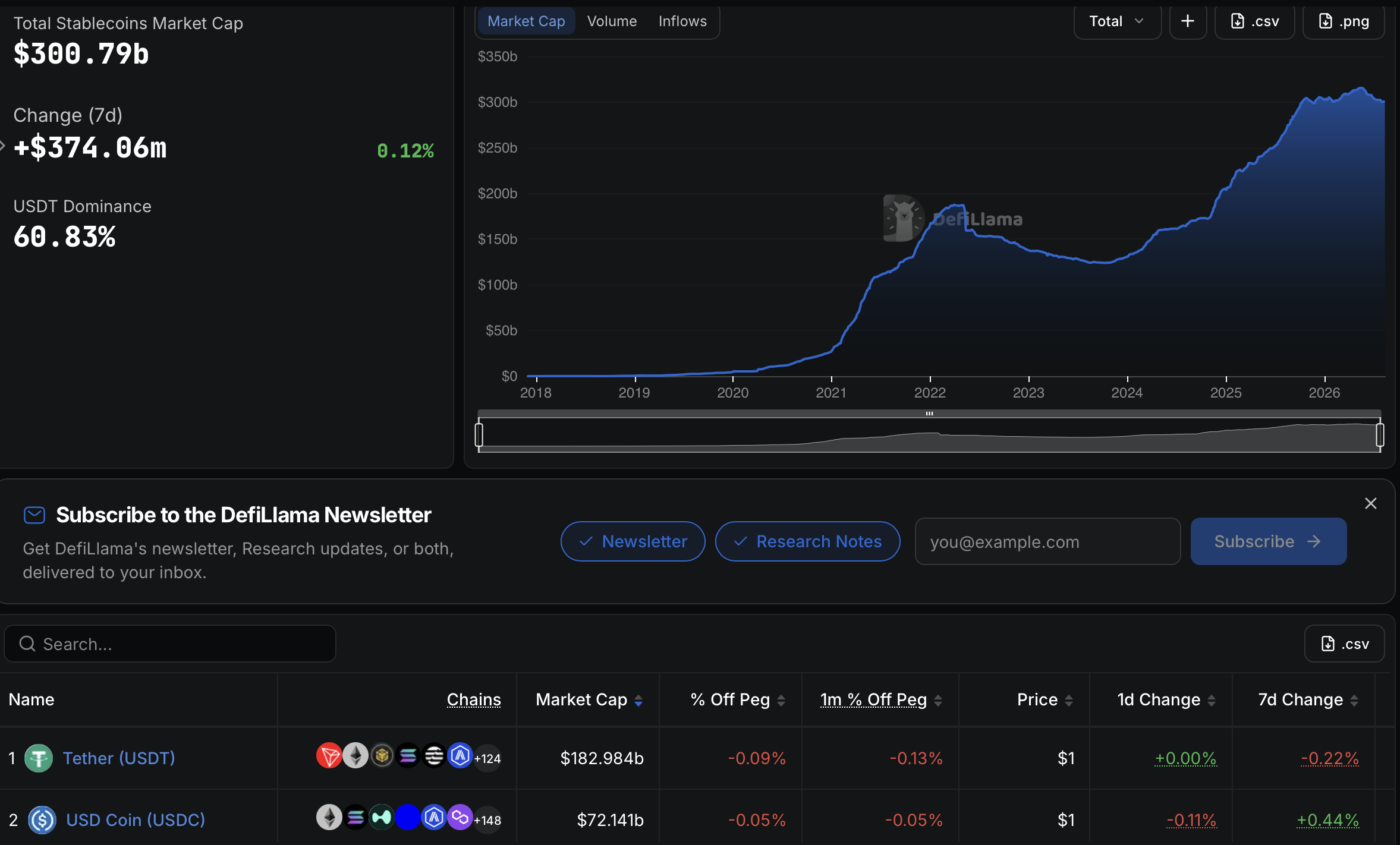
Stablecoin market cap. Source: DefiLlama
Tether has used its profits to expand beyond stablecoins, investing $20 million each in Argentine neobank Ualá and Brazilian crypto platform Mercado Bitcoin this year, while leading a $50 million funding round for AI sleep technology company Eight Sleep.
The company has expanded its tokenized gold business as well, with physical reserves backing Tether Gold (XAUt) rising 9.5% in the second quarter. At the time of writing, XAUt is the largest tokenized commodity product, with around $2.7 billion in value, according to data from RWA.xyz.
Despite the company’s growth, Tether CEO Paolo Ardoino has shown little interest in taking it public. In June 2025, amid speculation over a potential Tether IPO, Ardoino wrote on X: “No need to go public.”

Source: Paolo Ardoino
Magazine: Inside the fake crypto startup that fooled North Korean IT workers
GSR said its Core3 model portfolio increased its allocation to Solana to 43.7%, while cutting its Ether holdings to 39.5% and Bitcoin slightly to 16.9%.
The change came as crypto markets stayed “constructive” over the past week, according to the trading firm.
GSR Leans Toward Solana
In its update, GSR noted that trading remained relatively calm, and that the move aligns with Solana’s stronger near-term price momentum. However, the asset’s trading volume has weakened over both the seven-day and 30-day periods. Ether still posted the strongest 30-day return of 6.4%, even after its portfolio weight was reduced. Meanwhile, Bitcoin remains the smallest allocation.
Longer-term trading activity for the world’s largest crypto has also stayed subdued.
For the uninitiated, GSR launched its first exchange-traded fund in April this year. The Crypto Core3 ETF trades under the ticker BESO on Nasdaq. The fund has a 1% management fee. It also offers active portfolio management and staking rewards on eligible assets. GSR had earlier said the fund actively shifts its allocation across the three assets. It rebalances every week based on research-driven signals designed to pursue additional returns.
One user on X speculated whether the move could signal the start of an altcoin rotation.
Solana is currently hovering above $76. As CryptoPotato recently reported, several technical signals have been pointing to additional upside. Analyst Ali Martinez said SOL is trading inside a parallel channel, and the $78 level has become important. A break above the mid-range could open the way toward the upper boundary near $100. A buy signal from the TD Sequential on its daily chart further supported the bullish thesis. The MACD has also formed a golden cross.
A Bottom, But Not Yet?
Glassnode, in its latest analysis, stated that the asset is stuck in a tight range as buyers remain largely absent. The price is sitting between the Median Realized Price at $63,000 and the Short-Term Holder Cost Basis at $68,700. Spot trading volume has also fallen to its lowest level since 2019.
The firm explained that sellers are showing signs of exhaustion, while several indicators are moving closer to levels seen during previous bear-market bottoms. At the same time, leverage has built up on the long side. If Bitcoin climbs back above $68,700 on stronger volume and ETF inflows pick up, it would be a positive sign. But if it fails to rally or falls below $58,500, the bottom could still be in doubt.
The post Solana Overtakes Bitcoin and Ether in GSR’s Latest Crypto Portfolio Shake-Up appeared first on CryptoPotato.

Habba ultimately stepped down from the U.S. attorney post in December, after a federal court found that she had been unlawfully appointed. She thereafter moved into a role as Senior Advisor to then-Attorney General Pam Bondi.
Matthew Boyle
Matthew Boyle, the Washington bureau chief of conservative news outlet Breitbart, is also reported to be in the running.
Sources in and close to the Administration told the Post that Boyle, like Habba, is a frontrunner to replace Leavitt.
Boyle has never previously worked for Trump in either a private capacity or as part of his Administrations. He has conducted a number of interviews with him, however, including one in the Oval Office in June.
Scott Jennings
Scott Jennings, a Trump defender and MAGA political commentator who frequently spars with Democrats on CNN, is another name that is reportedly at the top of the list of potential contenders.
Sources with knowledge of the situation told the Daily Beast that Jennings is the current frontrunner to succeed Leavitt.
Robinhood’s newly launched blockchain, Robinhood Chain, is scaling its onchain activity with help from Uniswap, according to Standard Chartered—an integration that may reduce one of the biggest early hurdles for any fresh network: assembling sufficient liquidity quickly enough to support real demand.
In a research note cited by the bank’s analysts, Robinhood Chain is reported to have grown to nearly $1 billion in total value locked (TVL). Standard Chartered also says that virtually all of the chain’s liquidity requirements are being met via Uniswap’s existing decentralized exchange infrastructure (Uniswap V2, V3, and V4), potentially allowing Robinhood to focus on expansion rather than building liquidity plumbing from scratch.
Key takeaways
- Standard Chartered reports Robinhood Chain is close to $1 billion in total value locked, calling it the fastest TVL growth among blockchains by that metric.
- According to the note, Robinhood Chain’s liquidity needs are “virtually all” met through Uniswap V2, V3 and V4.
- Protocol fees attributed to Robinhood activity are now the largest driver of UNI token burns, Standard Chartered says.
- The UNI burn rate has reportedly accelerated after a Robinhood-linked fee switch activated on July 27, reaching an annualized pace of about $90 million.
- Robinhood’s broader push into tokenization and prediction markets is being closely watched on Wall Street, even as reported crypto trading volumes have softened.
Why Uniswap liquidity matters for a new chain
New networks typically struggle early with liquidity: without deep trading venues, users have less confidence that they can enter and exit positions efficiently. Standard Chartered’s assessment suggests Robinhood Chain is attempting to sidestep that problem by routing much of its liquidity demand to Uniswap rather than relying on nascent pools.
The bank’s note, attributed to analyst Geoffrey Kendrick, frames the approach as strategically important for Robinhood as it scales. By leaning on battle-tested decentralized finance infrastructure, Robinhood Chain can potentially improve execution quality for users while accelerating growth.
Earlier coverage highlighted that Robinhood Chain launched on July 1 with a focus on bringing real-world assets onchain, and adoption moved quickly after launch. Cointelegraph previously reported the chain reached 194,000 daily active users during its first week, reflecting strong initial engagement that would require reliable access to trading venues and liquidity.
From liquidity to UNI burns: the token-economics spillover
Standard Chartered also connects the integration to measurable changes inside Uniswap’s token economics. The bank says protocol fees generated through Robinhood are now the largest source of UNI token burns.
In the note, the UNI burn rate is described as having roughly doubled since a Robinhood-linked fee switch was activated on July 27. Standard Chartered estimates that this puts UNI burns on an annualized pace of about $90 million.
With UNI priced at roughly $3.50 per token at the time referenced in the report, Standard Chartered calculates that the annualized burn translates to about 25 million UNI tokens—just over 4% of UNI’s circulating supply—being removed each year.
For UNI holders and DeFi traders, the key question isn’t only whether Robinhood Chain is growing, but whether that growth sustains fee generation over time. A rapid early rise in burns can be encouraging, but the durability of activity on a new chain typically depends on its ability to retain users, deepen liquidity, and keep relevant applications running.
Robinhood’s broader crypto strategy: tokenization and prediction markets
Robinhood Chain is part of a larger corporate strategy to expand beyond traditional stock trading. The brokerage is pursuing crypto-related products alongside tokenization and prediction markets—initiatives that have attracted investor attention.
Cointelegraph previously reported that analysts at Bernstein raised their price target for Robinhood (HOOD) stock to $160 per share, citing tokenization and prediction markets as key growth drivers. That Wall Street framing matters because it ties Robinhood’s onchain activity to a wider narrative: using blockchain as distribution infrastructure for additional financial products.
At the same time, Standard Chartered’s liquidity thesis sits alongside mixed signals from Robinhood’s reported crypto business. Cointelegraph notes that Robinhood reported record revenue and earnings in its second quarter, while crypto trading volumes and revenues declined—an environment that can make it harder to interpret which developments are fundamentally strengthening the platform versus which are simply offsetting slowdowns elsewhere.
What to watch next on Robinhood Chain and Uniswap
For market participants, the immediate watchpoints are whether Robinhood Chain can keep liquidity demand flowing through Uniswap as the novelty of launch fades, and whether UNI burns remain elevated beyond the initial “fee switch” period described by Standard Chartered. Investors should also monitor how Robinhood’s tokenization and prediction-market efforts evolve, since the long-term value proposition for the blockchain will likely depend on sustained application usage rather than liquidity routing alone.
HTX’s situation has appeared increasingly precarious as both the European Union Council and the United Kingdom’s Foreign, Commonwealth, & Development Office have chosen to sanction the exchange.
Since then, it’s made some big changes to how it manages users’ reserves.
Its June proof of reserves report was the first that acknowledged that it had moved huge swaths of its reserves to an undisclosed “ThirdParty.”
Read more: HTX misrepresents Huobi Global S.A. after UK sanctions
HTX claims on its website that you can verify these balances by reaching out to the custodian; unfortunately, it doesn’t tell users who that custodian is. As a result, Protos has been unable to verify most of those balances.
Further complicating this, TRM Labs, a blockchain intelligence firm, released a report in which it detailed how HTX has begun churning through its wallets at a prodigious rate.
Ari Redboard, the global head of policy for TRM, described this behavior as an attempt “to stay a step ahead of screening built on static lists.”
Read more: ‘Someone’ is taking advantage of HTX’s reserves
HTX, for its part, previously claimed that this was totally normal cybersecurity behavior.
Since then, Protos was able to track a substantial portion of HTX’s staked ETH (stETH) through Poloniex addresses.
Now, we can add that various other HTX assets have also recently passed into Poloniex.
Read more: Justin Sun’s Poloniex and HTX withdraw huge amounts from AAVE
First, HTX distributes a tool that used to enable people to gain greater insight into its reserves, even including which addresses the reserves were held in.
We can use these past reports to determine where certain assets were claimed to be at a certain time and can use the blockchain transactions to follow some portion of the reserves as they move.
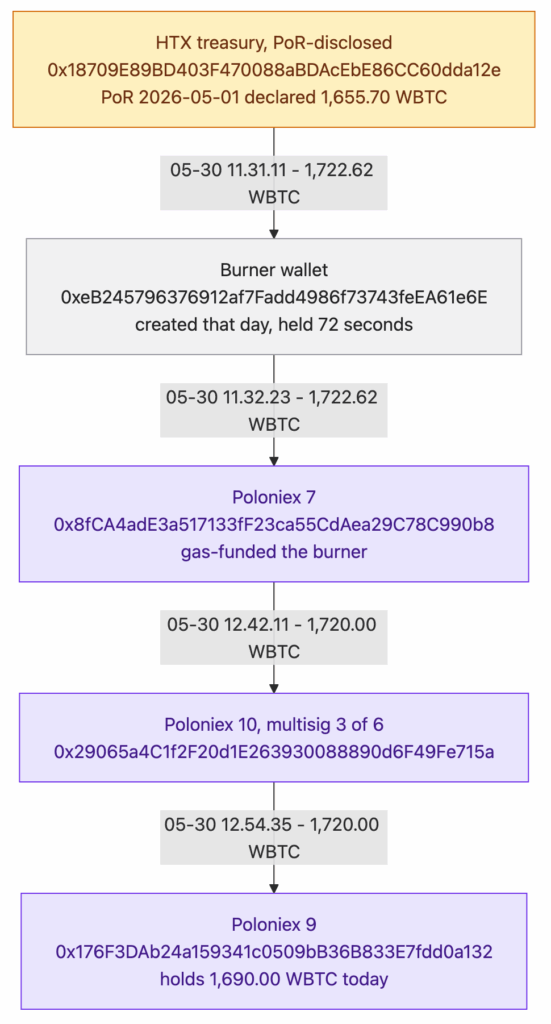
Consider 0x18709e89bd403f470088abdacebe86cc60dda12e, which was an address that HTX used to hold many of the Ethereum-based DeFi positions it maintained, for some reason.
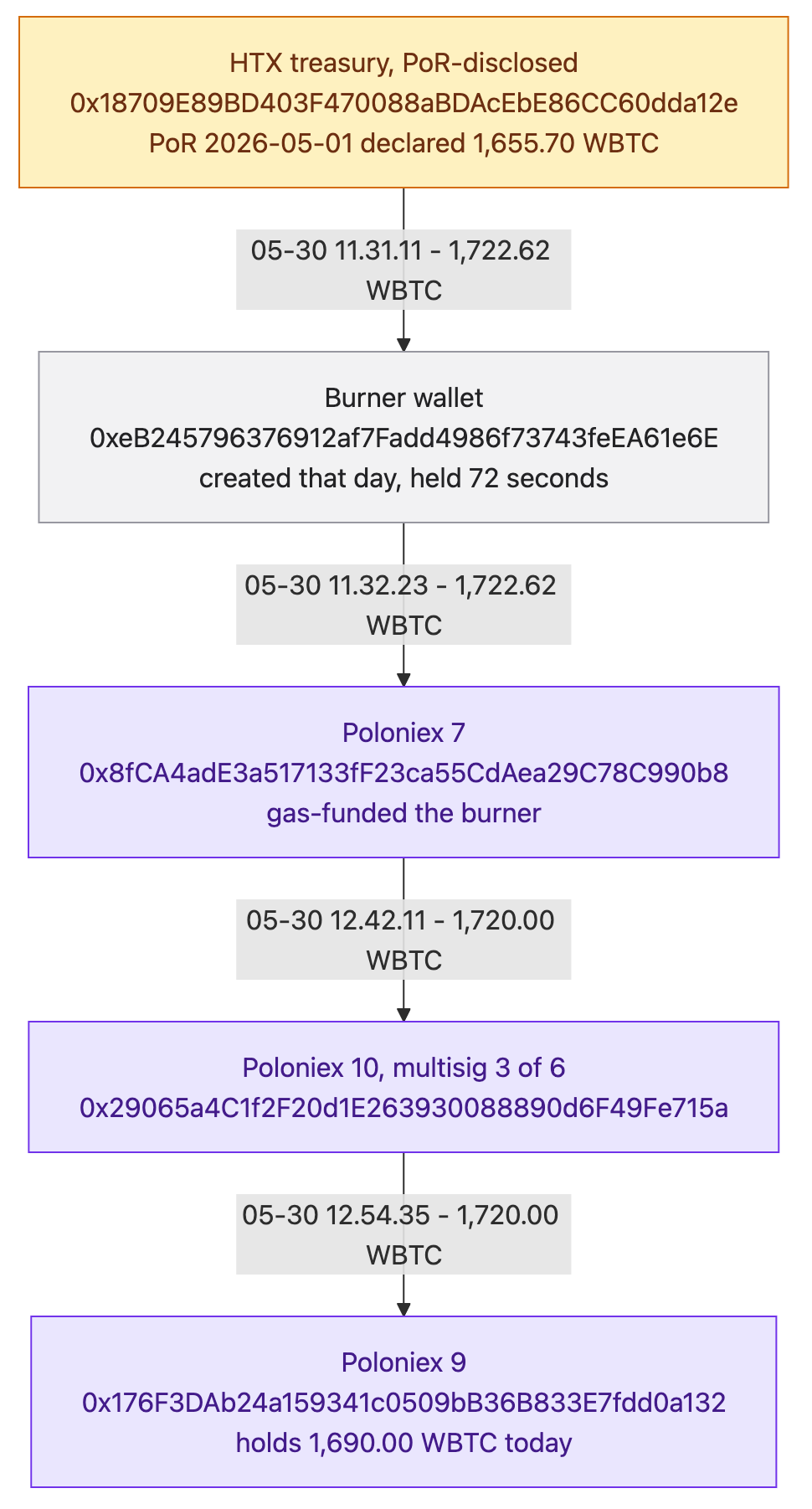
On May 30, immediately before we get the transition to ThirdParty, we can watch the Sun-advised wrapped BTC (WBTC) move from this HTX address to 0xeB245796376912af7Fadd4986f73743feEA61e6E.
These funds were then transferred to 0x8fCA4adE3a517133fF23ca55CdAea29C78C990b8, an address that Etherscan labels as Poloniex 7.
These funds were then quickly sent to 0x29065a4C1f2F20d1E263930088890d6F49Fe715a, an address that Etherscan labels as Poloniex 10.
Finally, this WBTC was sent to 0x176F3DAb24a159341c0509bB36B833E7fdd0a132, an address that Etherscan labels as Poloniex 9.
This WBTC which came from HTX, is still stored in this Poloniex address.
The HTX to Poloniex pattern repeats
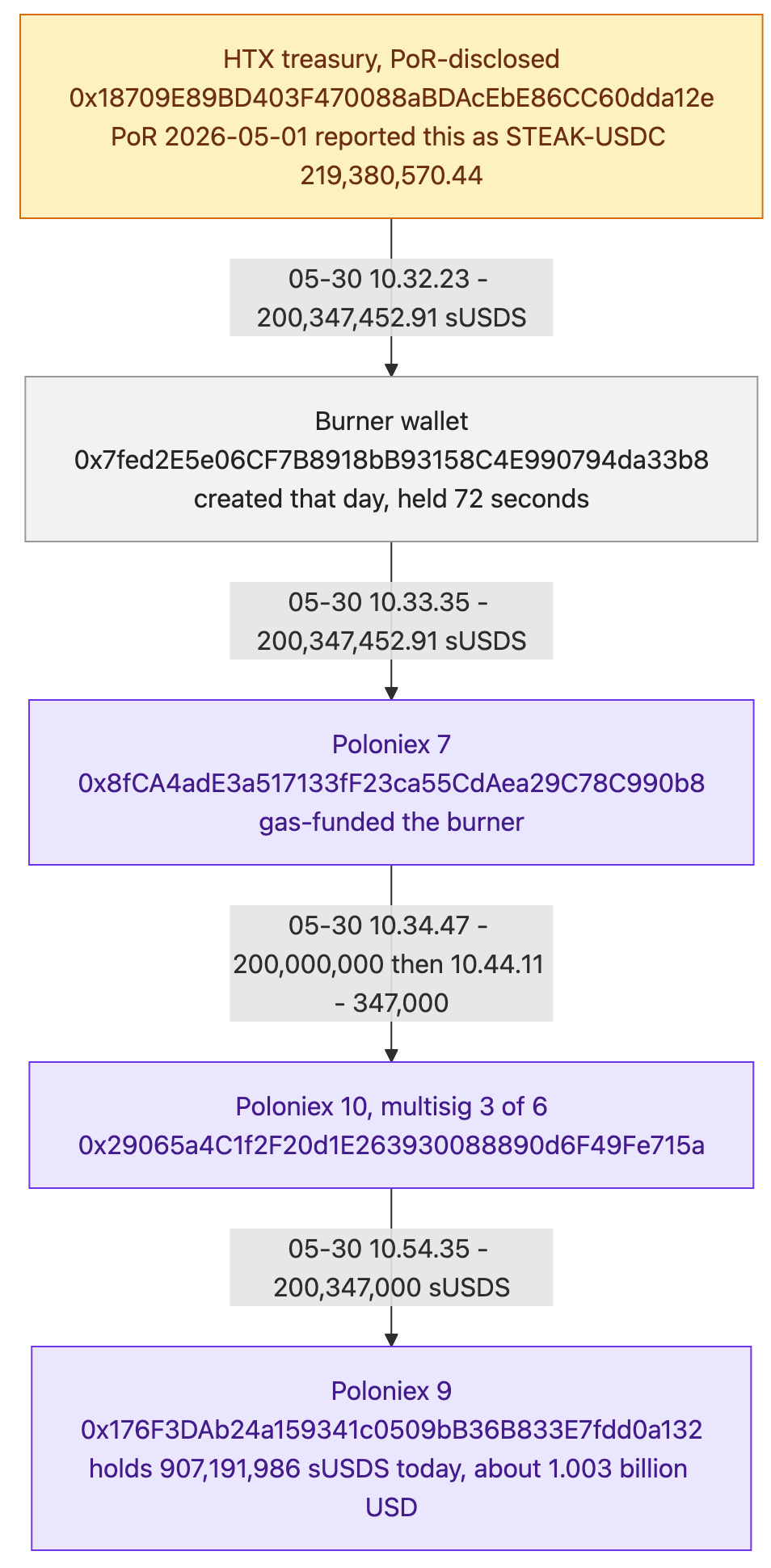
The May PoR for HTX had a problem. It claimed that it had a bunch of STEAK-USDC, but it was wrong; there was no STEAK-USDC in that address on that date.
However, there was a matching amount of Sky Savings USDS (sUSDS) in that address, suggesting that while HTX failed to accurately label its own reserves — troubling on its face — it did have another position that represented that value.
We start with approximately $200 million worth of sUSDS moving to 0x7fed2E5e06CF7B8918bB93158C4E990794da33b8.
These funds are then sent onward to Poloniex 7.
These were then forwarded in three transactions to Poloniex 10.
Finally, these funds were forwarded to Poloniex 9.
Similar patterns can also be observed for various Spark positions, some of which may have been since redeemed.
These related-party transactions, involving many hundreds of millions of dollars worth of value, raise serious questions about the internal controls and management of both of these Sun-owned exchanges.
They furthermore raise questions about Poloniex’s role in interacting with this repeatedly sanctioned entity.
Protos reached out to HTX with questions about these transfers, but it didn’t respond before publication.
Got a tip? Send us an email securely via Protos Leaks. For more informed news and investigations, follow us on X, Bluesky, and Google News, or subscribe to our YouTube channel.

Becker & Roy qualify for semi-finals in Birmingham
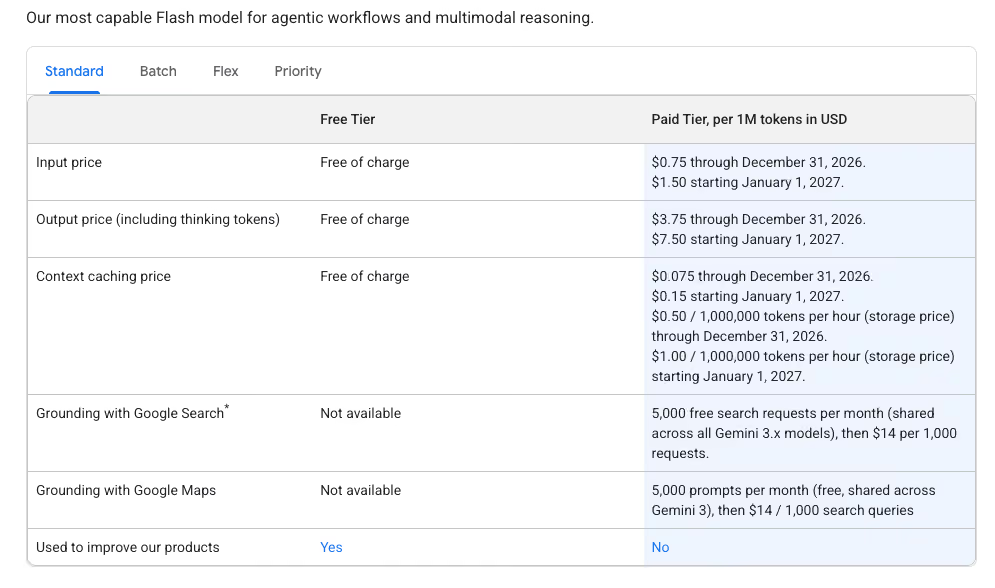
Google’s Gemini 3.7 Flash targets coding and agents with a 50% introductory price cut
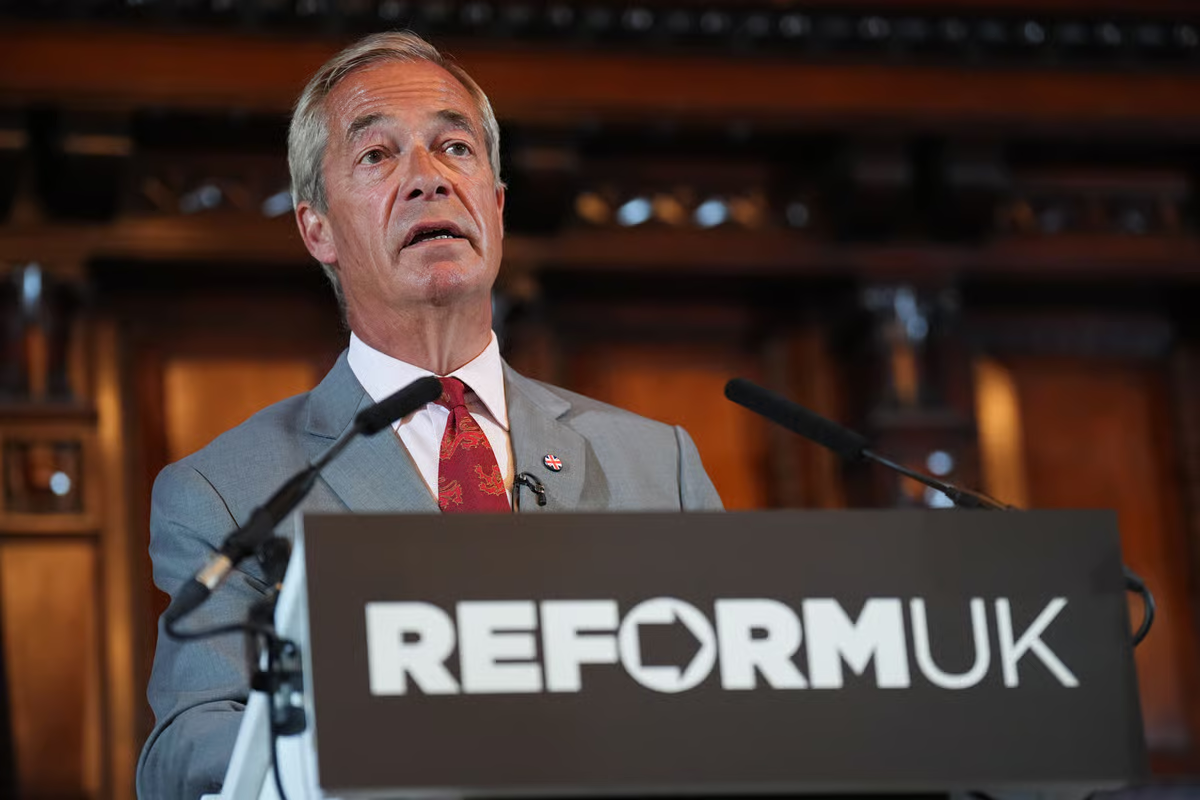
Polls close in Clacton by-election as Farage vies to retain seat


-

 Fashion6 days ago
Weekend Open Thread: Mattifying Sunscreen
-

 Fashion6 days ago
Frugal Friday’s Workwear Report: Cap-Sleeve Pointelle Crewneck Sweater
-

 News Videos5 days ago
Can Astrology Help Find Gold and Silver Trends? A Financial Astrology Guide
-

 Tech6 days ago
Rinn Pharma & Biopharma to join NordicPharmaTrain network
-

 Business5 days ago
How to Start a Cleaning Business: A Step-by-Step Guide
-

 Business4 days ago
Datadog: Best Of Breed For Multiple Reasons
-

 Business5 days ago
BDC Weekly Review: Private BDC Q2 Numbers Are Strong
-
 NewsBeat2 days ago
Communication cards help banking customers access services or report scams
-

 Tech7 days ago
Price Hikes May Be Coming for PC Motherboards Next
-

 Business7 days ago
Brightwater secures funding for WA-first dementia projects
-
 Business3 days ago
Oil Price Today (August 11): Crude oil rises to $88 after Trump’s compensation demand dents Hormuz opening. Here’s why
-

 Fashion6 days ago
Weekly News Update, 8.6.26 – Corporette.com
-

 Business7 days ago
Aussie shares lose steam to close record-breaking week
-
 Entertainment7 days ago
Brand New Day’ Characters, Ranked
-

 Fashion7 days ago
The Best Stores Like Ann Taylor
-

 Fashion6 days ago
Irina Shayk Wows in REVOLVE Los Angeles’ Summer Styles
-

 Entertainment7 days ago
Coastal House Media Can Disney Redeem Live Action Dragon Ball?
-

 Fashion6 days ago
Burberry Fall 2026 Takes On Commuter Style
-

 Politics5 days ago
Be quiet, Miriam! – spiked
-

 Fashion4 days ago
Amazon Sundays: Closet Care Before Fall
You must be logged in to post a comment Login