
Crypto World
Bitcoin (BTC), ether (ETH) prices hold steady while XMR, HYPE outperform

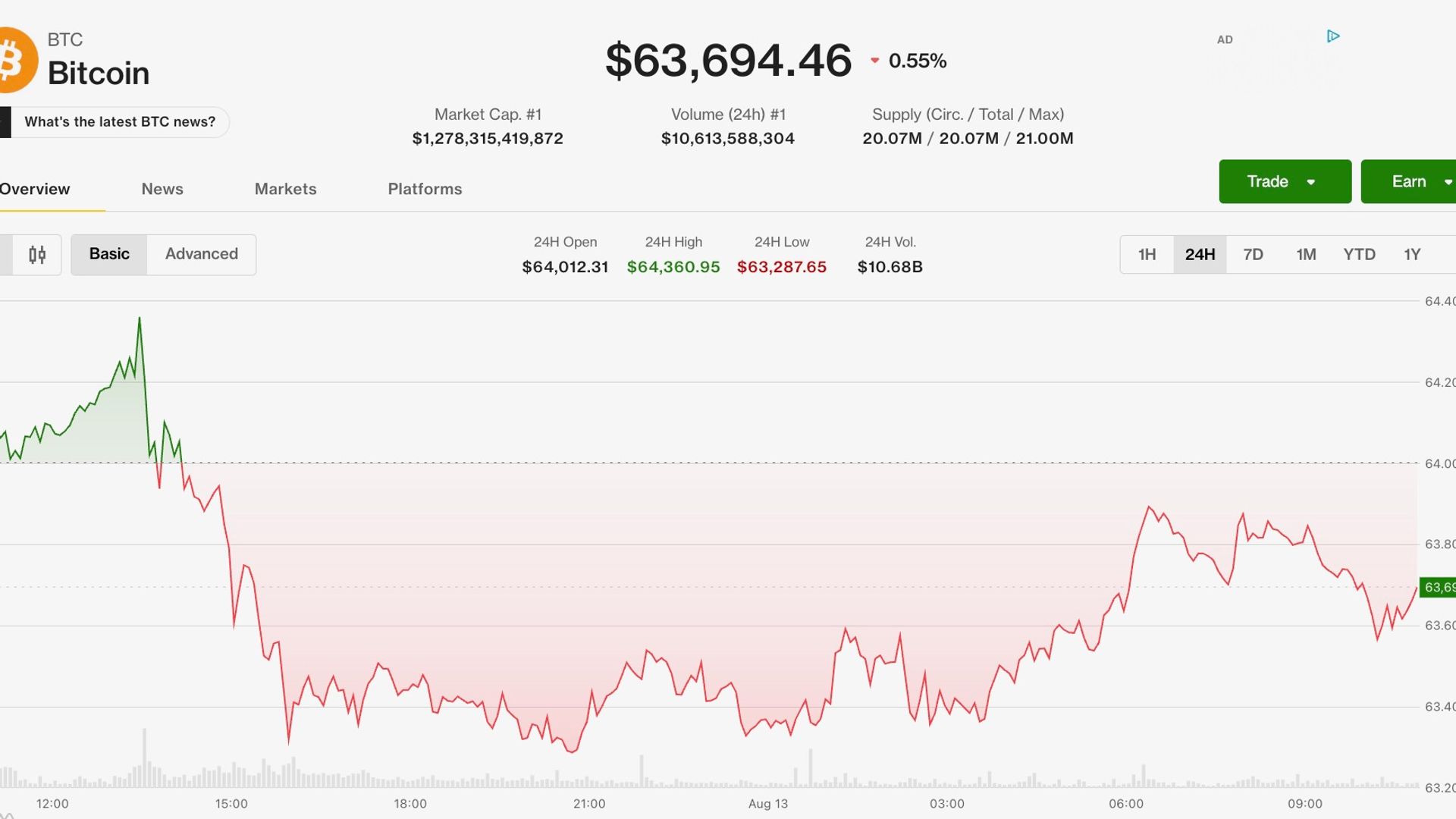
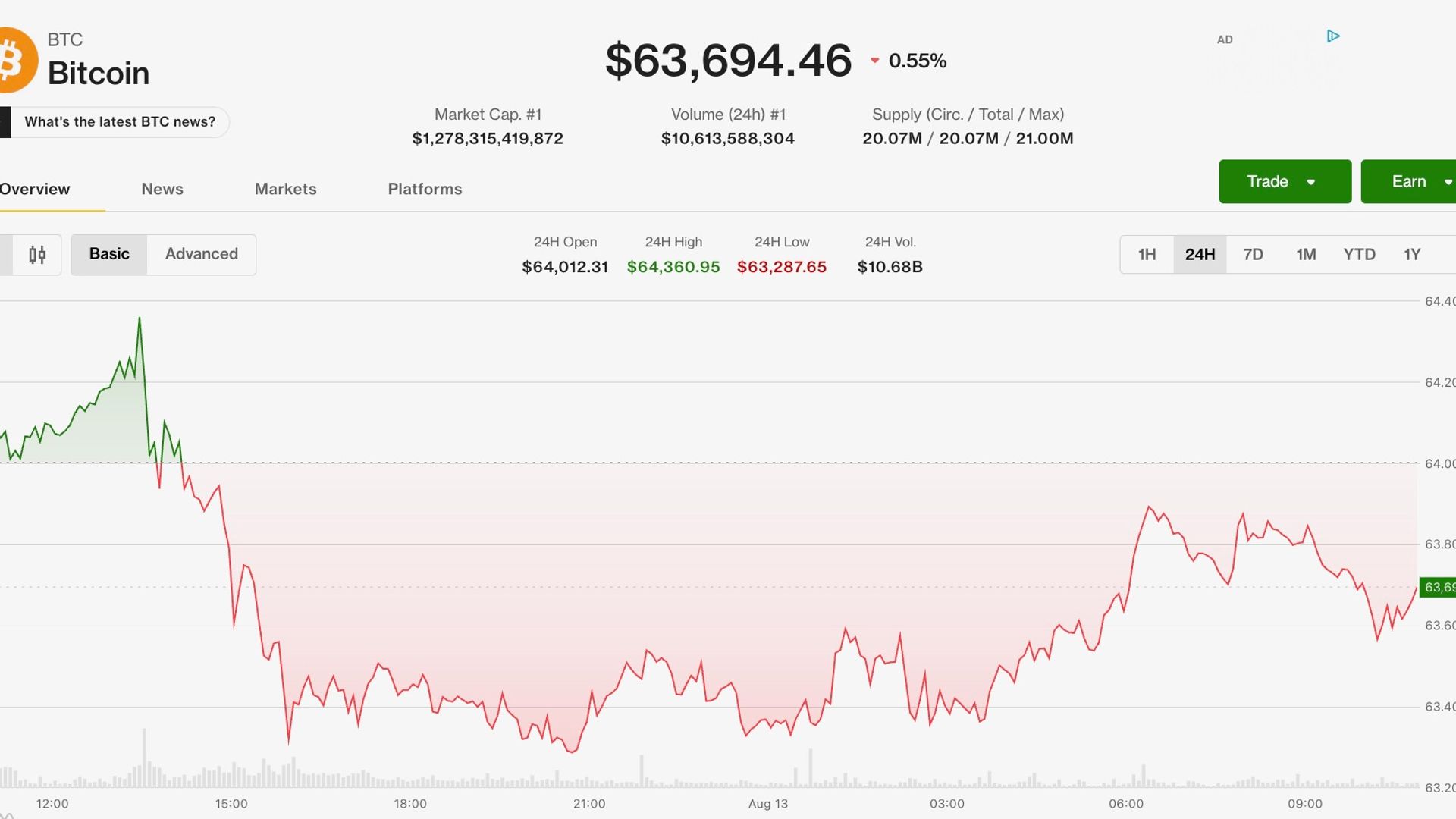
Bitcoin held near $63,600 after Wednesday’s in-line U.S. inflation print proved enough to calm nerves, but not enough to move markets decisively in either direction.
The largest cryptocurrency has added 0.30% since midnight UTC, while the broader crypto market capitalization dropped 0.54% over 24 hours to $2.18 trillion.
July CPI came in at 3.4% year over year, matching forecasts. Core inflation also eased, with the annual reading slipping to 2.5% from 2.6%. The producer price inflation figure due at 12:30 UTC may provide more impetus to a lackluster market.
As for U.S. equities, S&P 500 index futures gained 0.13% while Nasdaq 100 futures were little changed.
Derivatives positioning
- Futures market churn continues: 24-hour volume stands at $147 billion, up 6% on the day, but cumulative open interest (OI) across all cryptocurrency futures has held flat near $116 billion.
- XRP positioning stays elevated: XRP futures OI is perched at 2.67 billion tokens, the most since October, for a third straight day. The 24-hour cumulative volume delta (CVD) remains negative, pointing to bearish bets being executed at market prices more than bullish ones. These paint a bearish picture, flagging a possible drop below $1. There’s a silver lining, though: The annualized perpetual funding rate is near 8%, pointing to a bias toward bullish bets.
- ADA and BCH show heavy bearish tilt: Both coins are seeing funding rates of -10% or lower, pointing to a clear investor preference for bearish positions. They both also show negative 24-hour CVD, indicating aggressive selling. This is particularly notable for ADA, whose OI remains just shy of the recent record high of 2.79 billion tokens, suggesting traders are adding fresh short exposure near record participation levels, not just unwinding old longs.
- AVAX flips from gainer to loser: Avalanche’s AVAX, one of the top OI gainers earlier this week, is the biggest OI loser of the past 24 hours. Others include LTC, LINK and SOL.
- Implied volatility stays muted: Options-based implied volatility for bitcoin and ether remains near its recently hit year-to-date lows, suggesting traders aren’t expecting a big move in the short term.
- Upside bets still surface: In BTC’s case, someone bought a large number of call options at the $65,500 strike, paying $1.07 million in initial premium. This is an ultra-short-term bullish bet; the calls expire Aug. 15.
Token talk
- XMR is up 3.15% since midnight UTC at around $404, extending its weekly run of more than 11% as the privacy coin continues to outperform the broader market.
- HYPE is up 1.75% since midnight at $57, continuing a steady grind higher with a 2% gain on the week.
- FET is up 0.84% since midnight, while NEAR added 0.94%, as a handful of mid-cap altcoins outperform the two largest coins, bitcoin and ether.
- CRV is giving back some of Wednesday’s surge, falling 8.38% over 24 hours to 25 cents. Still, it remains up more than 22% on the week after breaking above a months-long descending trendline.
- DeFi token MORPHO was one of the weaker performers, losing 1.51% since midnight.


An ICE spokesperson said in a statement that TPS had been allowed to function as a de facto amnesty program and that the program was always intended to be temporary.
“What we would say now is it’s closing time which means you don’t have to go home, but you can’t stay here,” the spokesperson said in an unsigned statement. “The good news is it’s not too late to get a $2,600 check and a free flight home.”
Scores of Haitian immigrants have also reportedly lost their jobs. Piervil said large amusement parks, hotels, and nursing homes in Orlando have begun dismissing hundreds, if not thousands, of Haitian workers since the Supreme Court ruling.
The fraught situation in the U.S. is prompting some Haitians to contemplate fleeing to a third country, despite the obstacles. Aside from the costs and a possible language barrier, many Haitian immigrants are also concerned about their own safety if they move to a third country, according to Felipe Sousa-Lazaballet, a community organizer in central Florida. That fear was heightened after reports in February that four decapitated Haitian women were found in the Dominican Republic—Haiti’s neighbor—after they had been deported from Puerto Rico. The Dominican Republic has also been deporting hundreds of thousands back to Haiti each year.


The Commodity Futures Trading Commission is reviewing prediction market “mention markets” over concerns that contracts tied to specific spoken words may be unusually easy to manipulate, NPR reported late Aug. 13, citing two people with direct knowledge of the inquiry.
Summary
- CFTC is reviewing mention markets over manipulation risks, according to two people familiar with probe.
- Kalshi removed sports mention markets until further notice while keeping political and earnings markets live.
- CFTC rules require designated contract markets to list only contracts not readily susceptible to manipulation.
- Kalshi previously flagged Trump teleprompter operator Gabriel Perez after suspicious mention-market trades produced over $90,000.
- The CFTC has not announced the inquiry, and both the agency and Kalshi declined comment.
Kalshi has responded by removing sports mention markets “until further notice,” according to the report. The inquiry has not been publicly confirmed by the CFTC. Both the regulator and Kalshi declined to comment to NPR, and the CFTC had not published an enforcement action or announcement describing the review as of publication.
Kalshi removes sports mentions while other word bets remain
Mention markets let traders buy contracts based on whether a person says a particular word or phrase. Sports versions have included wagers on whether broadcasters utter terms such as “MVP,” “ankle” or “redshirt.” NPR reported that Kalshi removed all such sports contracts as the regulator examines the category.
The suspension does not cover every mention market. Kalshi’s current page still shows active contracts tied to President Donald Trump, political appearances and corporate earnings calls. One Klarna earnings market, for example, has contracts tied to whether executives mention specific companies or business topics.
Polymarket also offers mention markets on its offshore platform, NPR reported, but its smaller CFTC-regulated U.S. exchange does not currently list them.
CFTC rules put manipulation at the center of the review
The regulatory question goes directly to one of the Commodity Exchange Act’s core requirements. Designated contract markets may list only contracts that are not “readily susceptible to manipulation.” They must also maintain surveillance and enforcement systems capable of preventing manipulation and distorted settlement outcomes, according to the CFTC’s current proposal.
That framework helps explain the concern around word bets. The CFTC has said in its broader prediction-market rulemaking that sports contracts based on aggregate performance can present lower manipulation risk when no single participant can determine the outcome through one action. A mention contract can work differently because one broadcaster, executive or politician may effectively determine settlement simply by saying a particular word. This comparison is an inference from the regulator’s published manipulation framework.
As previously reported, the CFTC has also warned prediction markets against broad template self-certifications, telling exchanges that each product needs enough detail for regulators to assess settlement methods, data sources and compliance controls.
Trump teleprompter case exposed the insider risk
The latest review follows a case involving Gabriel Perez, Trump’s longtime teleprompter operator. Kalshi identified suspicious trades tied to words in presidential appearances and referred the activity to the CFTC. Sources told Reuters that more than $90,000 in potential profits were frozen before they could be withdrawn.
As previously reported, Kalshi flagged the Trump teleprompter trades and referred them to federal regulators. Perez allegedly had advance access to prepared remarks for more than a dozen presidential appearances. The White House later removed him from his role.
The case was not the CFTC’s first encounter with event-contract manipulation. Former Rep. George Santos recently agreed to penalties over manipulative Kalshi trades tied to whether he would attend Trump’s State of the Union address.
What happens next for Kalshi mention markets
The immediate question is whether the CFTC seeks changes only to sports mention markets or concludes that some word-based contracts cannot satisfy its anti-manipulation standards regardless of subject matter. An anonymous person familiar with the inquiry told NPR the products are “potentially very easy to manipulate,” but that remains the source’s assessment rather than a formal Commission finding.
Kalshi could also modify contract structures, eligibility requirements or surveillance controls instead of abandoning the category. The company has already introduced employer disclosures for higher-risk markets and said it blocked more than 100 potential insider trades during the first quarter.
For now, sports mention markets remain suspended with no announced return date, while other mention contracts continue trading. A formal CFTC statement, additional Kalshi restrictions or changes to future self-certifications would provide the next clear indication of how broad the review becomes.
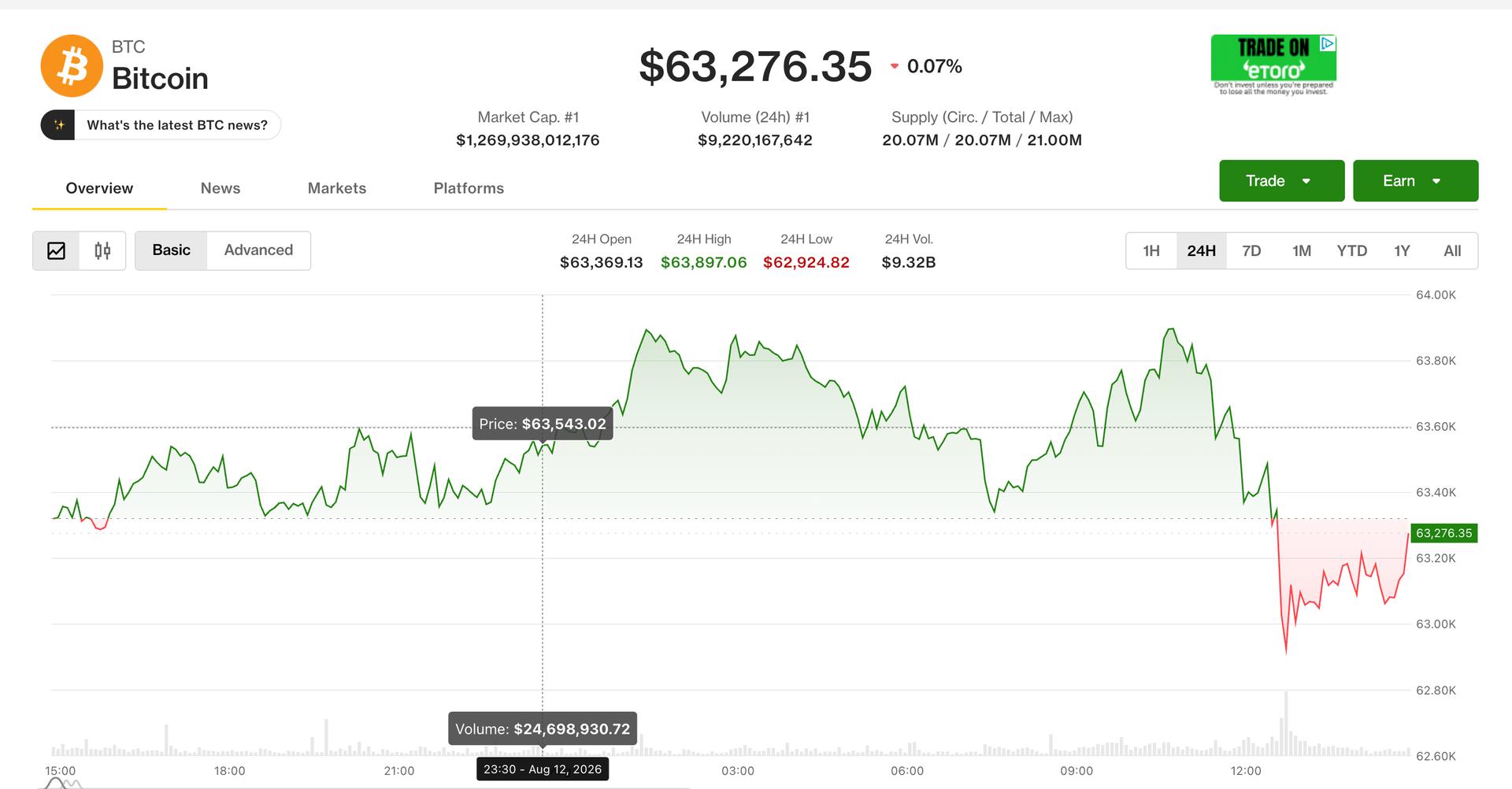
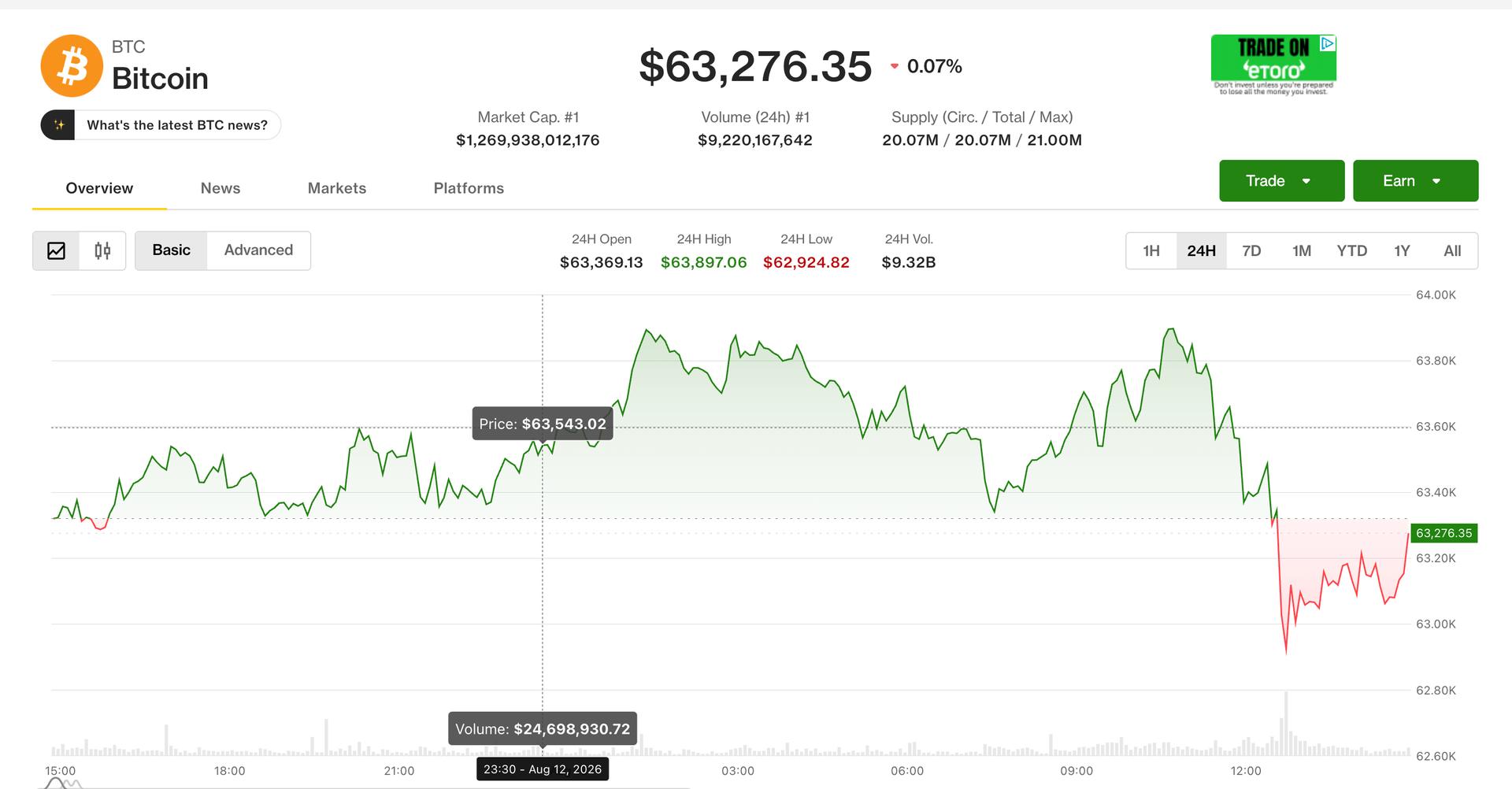
Bitcoin (BTC), by any measure, still remains stuck in a tight trading range, but there has been some movement of note on Thursday.
Sadly for bulls, the coiled spring theory isn’t yet working. Instead, BTC is headed lower, sliding below $63,000 at one point earlier this afternoon. It’s currently trading at $63,100 down about 0.5% over the past 24 hours. Other crypto majors are seeing similar declines.
The small losses are happening even as the interest rate picture in the U.S. is improving. Decent inflation reports yesterday and today appear to have taken the idea of a September Federal Reserve rate hike off the table.
The two-year Treasury yield, which was above 4.30% just days ago, has slid back to 4.14%, reflecting the sharply lower odds of tighter monetary policy.
Other risk assets — particularly U.S. stocks — continue to be where the action is. Higher by another 0.55% on Thursday, the S&P 500 notched another record high.
Brazil’s largest bitcoin treasury firm, OranjeBTC, is preparing to list a monthly income exchange-traded fund (ETF) that would initially put 95% of its portfolio in Strategy’s (MSTR) preferred stock, STRC, and the rest in Strive’s (ASST) equivalent, SATA.
STRC and SATA pay recurring U.S. dollar distributions. The companies’ bitcoin remains on their balance sheets and is not pledged to the preferred shareholders. Yields are currently at 12.5% and 13.1%, respectively.
The Digital Yield ETF, or DIGY11, is planned to trade on Brazil’s B3 in the country’s fiat currency, the real, and distribute income monthly.
OranjeBTC, which holds 3,950 BTC ($250 million), expects annual distributions to be equivalent to Brazil’s risk-free rate, the Interbank Deposit Certificate (CDI), of 14.15%, plus roughly 3–5 percentage points, net of the fund’s estimated 1.30% total cost.
The estimate depends on the preferred-share distributions and the interest-rate difference between Brazil and the U.S., OranjeBTC Director of Strategy and Research Sam Callahan told CoinDesk. It excludes changes in DIGY11’s share price and does not guarantee returns.
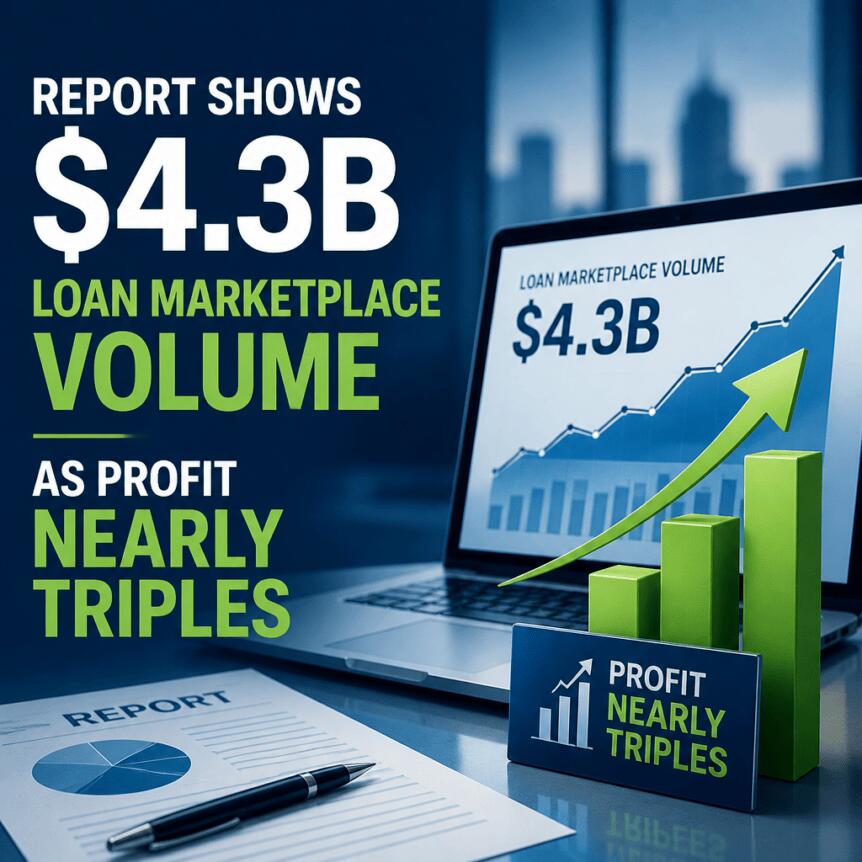
Figure Technology Solutions posted a sharp jump in its consumer loan marketplace activity for the second quarter, reporting $4.3 billion in marketplace volume—up 132% year over year. The company also highlighted improved profitability, with quarterly profit nearly tripling and net income rising 192% to $87 million.
In its latest quarterly update, Figure said net revenue more than doubled to $226 million. It also reported an expanded net income margin of 38.8%, an increase of 10.5 percentage points from the prior year period.
Key takeaways
- Figure reported $4.3 billion in consumer loan marketplace volume for Q2 2026, up 132% year over year.
- Net income surged 192% to $87 million, while net revenue rose to $226 million.
- Third-party loans on Figure Connect made up $2.8 billion (65%) of the quarterly volume.
- Figure expects Q3 consumer loan marketplace volume between $4.8 billion and $5.2 billion.
- The company says weekly loan applications exceeded $1 billion in July.
Marketplace volume accelerates, profit improves
Figure’s growth was driven by expansion across the products routed through its loan origination system and its trading activity on Figure Connect. The company defines marketplace volume as including home equity lines of credit, debt-service coverage ratio loans, and personal loans processed through its origination platform, as well as third-party loans traded on Figure Connect.
According to Figure, third-party loans accounted for $2.8 billion of the $4.3 billion total in Q2—representing 65% of marketplace volume. That mix matters because it suggests the marketplace’s scale is not only dependent on Figure originating loans itself, but also on external participants using Figure Connect to trade.
Figure also said marketplace volume increased 262% compared with the same period last year. The company launched its consumer loan marketplace in June 2024, and it is now scaling both its underlying origination network and its partner-driven trading ecosystem.
Partner growth and the “application” signal
Beyond the topline numbers, Figure tied its momentum to supply-side expansion. During the quarter, it added 102 loan-origination partners, bringing the total to 489.
The company’s CEO, Michael Tannenbaum, also pointed to demand and throughput indicators. He said weekly loan applications surpassed $1 billion in July. While applications are not the same as funded volume, the figure is often used by consumer finance marketplaces as a forward-looking signal for how much loan demand is entering the system—particularly in an industry where conversion from application to funded loan can fluctuate based on underwriting and capital availability.
For investors and market participants, these details provide a more complete picture than quarterly volume alone: volume is the outcome, while applications and partner counts can help explain what might drive the next quarters’ results.
What to watch in Figure’s outlook
Looking ahead, Figure expects consumer loan marketplace volume of between $4.8 billion and $5.2 billion for the third quarter. The midpoint implies continued growth from the reported $4.3 billion in Q2, suggesting Figure believes current momentum can carry into the next reporting period rather than being a one-quarter acceleration.
The company’s guidance also gives traders and lenders a measurable benchmark to monitor. If actual volume tracks toward the top end of the range, it could reinforce the idea that the marketplace’s scale effects—more partners, steady application flow, and a larger trading share from Figure Connect—are compounding. If results fall toward the low end, it may indicate that growth is increasingly constrained by underwriting capacity, pricing dynamics, or the availability of capital through its ecosystem.
Why blockchain-linked transparency is part of the narrative
Figure’s quarterly report arrives amid continued investor interest in how blockchain-based marketplace activity could be monitored. Bernstein analysts, in a prediction made in May and cited in the company’s reporting, said Figure’s Q1 results demonstrated the “uniqueness” of blockchain marketplaces. They also argued that live blockchain data could increasingly allow investors to track Figure’s lending activity in real time.
That framing is relevant because it suggests Figure is not only competing as a consumer finance platform, but also as a system designed to make certain marketplace activity more observable. If that transparency thesis holds up, it may help investors evaluate momentum with less delay than traditional financial reporting—though the extent of what can be reliably inferred from on-chain activity is still something markets will test over time.
Earlier coverage from Cointelegraph had highlighted the Bernstein view about the potential for real-time monitoring via blockchain data. As Figure scales, the industry will likely watch whether that observability translates into better risk assessment, stronger participation, or improved market confidence in marketplace performance.
For now, the most immediate checkpoints are Figure’s next quarterly volume print versus its $4.8 billion–$5.2 billion Q3 outlook, whether third-party participation on Figure Connect continues to hold a majority share, and how application momentum reported in July translates into funded loans over subsequent weeks.
Figure Technology Solutions reports strong second quarter 2026 (investor relations)

Layer-1 chain Flare has announced that FXRP now works as collateral on Derive, letting XRP holders trade on-chain options and perpetual futures from their own wallets.
According to a press release shared with CryptoPotato, holders can mint FXRP through Flare’s FAssets system, deposit it on Derive, and run positions from a single Portfolio Margin V2 account, which covers hedging, premium generation, and directional trades on the same collateral.
Flare said XRP holders previously had limited ways to hedge a position or generate options premium without relying on centralized exchanges or custodians.
Options Cash Settle in USDC
Derive’s XRP options are cash-settled in USDC. When a contract expires in the money, the difference is paid out in USDC, and the FXRP stays posted as collateral, so settlement moves no underlying XRP. Sellers need enough USDC on hand to cover that payout, and they carry margin and liquidation risk on the position.
Derive is built on infrastructure from Lyra Finance and runs options, perpetual futures, and spot trading through one portfolio margin system. It traded more 30-day notional options volume than any other on-chain venue tracked by DefiLlama, which puts its total value locked near $118 million.
“Options are often the last major market to develop around an asset, and XRP has been waiting for the infrastructure,” said Nick Forster, Co-Founder and Chief Executive Officer of Derive. FXRP gives one of crypto’s largest holder bases “a credible path on-chain,” he stated.
XRPFi Stack Adds Derivatives
FAssets represents XRP on Flare through an overcollateralized system run by independent agents and the network’s data oracles, which pull cross-chain and real-world data through the Flare Time Series Oracle and the Flare Data Connector.
FXRP reached mainnet in September 2025, capped at 5 million tokens for its first week while Flare rolled out incentives, and the network said that the cap was filled within four hours. More than 155 million FXRP had been minted within seven months.
That supply already backs lending, borrowing, and yield tokenization. As CryptoPotato reported, FXRP deployed across DeFi applications rose from 82 million to 144 million since February, with more than 40 million XRP earned through Flare’s Smart Accounts across nearly 24,000 accounts. Flare has since listed an FXRP/USDC spot pair on Hyperliquid that lets the token move across chains.
“XRP has one of the most committed long-term holder bases in crypto, and until now they’ve had no permissionless options market to generate yield or hedge against their position,” said DeFi analyst Will Procheska.
The post Big Win for XRP Holders: On-Chain Options Arrive via Flare’s FXRP appeared first on CryptoPotato.

While critics focus on her meltdowns, fans, friends, and rivals appreciate that what you see is what you get. “At the end of the day, she’s a very authentic person,” says fellow pro Paula Badosa of Spain, Sabalenka’s closest friend on tour. “She always shows the way she is. That’s one of the things that makes her unique.” Even as she has acknowledged that her emotions sometimes get the better of her, Sabalenka refuses to disavow her passion. “I will never be completely in control,” she says. “When I hold that negativity inside, it keeps growing, growing, growing, growing. It destroys you from the inside to the point that you don’t have any energy and power to compete and to fight. So I’ve found it really helpful to just yell something. I have to release it.” She would love a designated racket-bludgeoning area at tournaments. “Between the sets, you just go to that room, you let it go, and you come back as a new person,” she says.

Disclosure: This article does not represent investment advice. The content and materials featured on this page are for educational purposes only.
Ethereum current price and solana ETF flows are stuck in neutral, see why BlockDAG’s stage 1 math makes it the best crypto to buy this month.
Summary
- BlockDAG’s early-stage pricing and expanding ecosystem are drawing attention as Ethereum and Solana remain stuck in narrow trading ranges.
- Ethereum and Solana face sluggish momentum, while BlockDAG moves ahead with its Super App, exchange plans, staking, and Stage 1 presale.
- With ETH and SOL struggling to break higher, investors are turning their attention to BlockDAG’s $0.002 entry price and developing utility.
The Ethereum current price is parked near $1,913, a jaw-dropping 61% below its 2025 all-time high, with traders leaning on a CPI report just to justify the next 2% move. Solana ETF inflows told a similarly unimpressive story for most of August, only perking back up after weeks of stalling, while SOL is still stuck in the same $74 to $78 range it has traded in for a month. Two giants, both going nowhere fast.

BlockDAG (BDAG) is not going nowhere. While Ethereum and Solana grind out single-digit moves, BlockDAG’s stage 1 price of $0.002 against a $0.10 launch reference is a 50x spread built directly into the math, not wishful thinking, wrapped in an ecosystem already generating real utility for anyone building a best crypto to buy list right now.
BlockDAG: The stage 1 math nobody else can touch
Write this number down: $0.002. That is where BlockDAG sits right now, in stage 1 of 25 total stages. Now write down $0.10, the project’s own launch reference price. That gap is a 50x spread, and it exists before BlockDAG has even listed on a single exchange, while Ethereum and Solana are fighting over a few percentage points of daily movement.
That price is not floating on hope. The BlockDAG Super App is in development can will mine coins through the X1 Miner, pay out staking rewards, and let holders spend BDAG on real purchases through payment cards, while BlockDAGX is preparing to go live as a full exchange with sub-second execution and deep AMM liquidity.
There is also no team allocation quietly waiting to dump on early buyers, and BlockDAG plans to launch with $100 million in liquidity behind it, the kind of structural discipline that rarely shows up on any best crypto to buy list this early in a project’s life, let alone one still selling at stage 1 pricing.
Presales that promise the moon rarely deliver anything close. What BlockDAG offers instead is a documented 50x spread, a functioning ecosystem, and zero insider dilution, and that combination is exactly why experts have termed it a best crypto to buy with legitimate potential to do a 5000x climb like Bitcoin or other tier 1 networks have done in their early days.
Ethereum current price still chasing its old highs
The Ethereum current price sits around $1,913 today, virtually unchanged from where it traded a week ago and still nearly 61% below the almost $5,000 peak ETH hit back in 2025. Ethereum’s $233 billion market cap sounds massive until you remember it represents a token that has spent the better part of a year failing to reclaim territory it already owned once, even with staking, layer-2 activity, and a stablecoin ecosystem all working in its favor.
Traders are currently glued to the July CPI report, hoping softer inflation data finally gives the Fed cover to ease up, because right now the Ethereum current price needs outside help just to keep grinding higher. Staking yield and ETF flows offer some support, but this is a chart leaning on macro tailwinds, not conviction, and macro tailwinds can turn just as fast as they arrive.
Solana ETF momentum keeps stalling and restarting
Solana ETF flows have spent most of August stuck in stall mode, only breaking that streak with an $8.8 million inflow day on August 10, the category’s best single session in three months and still a modest number for a chain this size. SOL itself is trading near $76, up modestly on the week and holding above its 50-day EMA, but still trapped in the same $74 to $80 range it has fought for weeks.

A fresh MoneyGram integration and Jupiter’s Lend v2 launch are genuine wins for the ecosystem, and solana ETF issuers like Morgan Stanley entering the space adds real institutional weight. But weight is not the same as movement, and SOL has yet to prove it can turn any of this into a decisive breakout rather than another round of range-bound chop.
The bottom line: Idle giants vs. real math
The Ethereum current price and solana ETF flows both tell the same story of two giants stuck in idle, leaning on macro luck and slow-building institutional interest just to hold their ground. Both are real assets with real infrastructure, but neither is offering the kind of asymmetric setup that turns a modest position into a life-changing one.
BlockDAG is. A stage 1 price of $0.002 against a documented $0.10 launch reference, a live ecosystem, and zero team allocation is a combination Ethereum and Solana simply cannot offer at this stage of their lives, which is exactly why BlockDAG deserves the top spot on any real best crypto to buy list this month.
For more information, visit the official website, presale, Telegram and Discord.
Disclosure: This content is provided by a third party. Neither crypto.news nor the author of this article endorses any product mentioned on this page. Users should conduct their own research before taking any action related to the company.


ether.fi is adding tokenized stock trading, portfolio-wide borrowing and global fiat transfers to its app, moving the liquid staking protocol further into retail banking products. The company announced the changes Thursday as part of what it calls its Summer release. The launch continues a shift… Read the full story at The Defiant

The women in the new study were prescribed estrogen only, and not the combination of estrogen and progesterone that is more commonly used to treat menopausal symptoms. Progesterone is prescribed to protect the uterus, but women who have had a hysterectomy, like those in the study, can safely be prescribed estrogen. This population provides a good way to study the effects of estrogen itself, since researchers believe it’s the hormone with more wide-ranging effects on the body, including in the brain.
Hadi Hosseini, an associate professor of psychiatry at Stanford and co-author of the study, says the results don’t establish a cause-and-effect link between estrogen and Alzheimer’s disease, but they do provide a reason to further study the role of the hormone in the neurodegenerative disease. “Previous studies,” including the Women’s Health Initiative, “showed that hormone therapy—estrogen plus progesterone—had a negative effect on Alzheimer’s disease risk and memory outcomes,” he says. “These data are bringing awareness to the fact that maybe we need to reconsider some of the previous findings, since we can now look properly at Alzheimer’s disease outcomes, different formulations of hormone therapy, different times of initiating the therapy, and different durations of use.”

Crypto Bull Run Has Started… but everyone’s missing it!
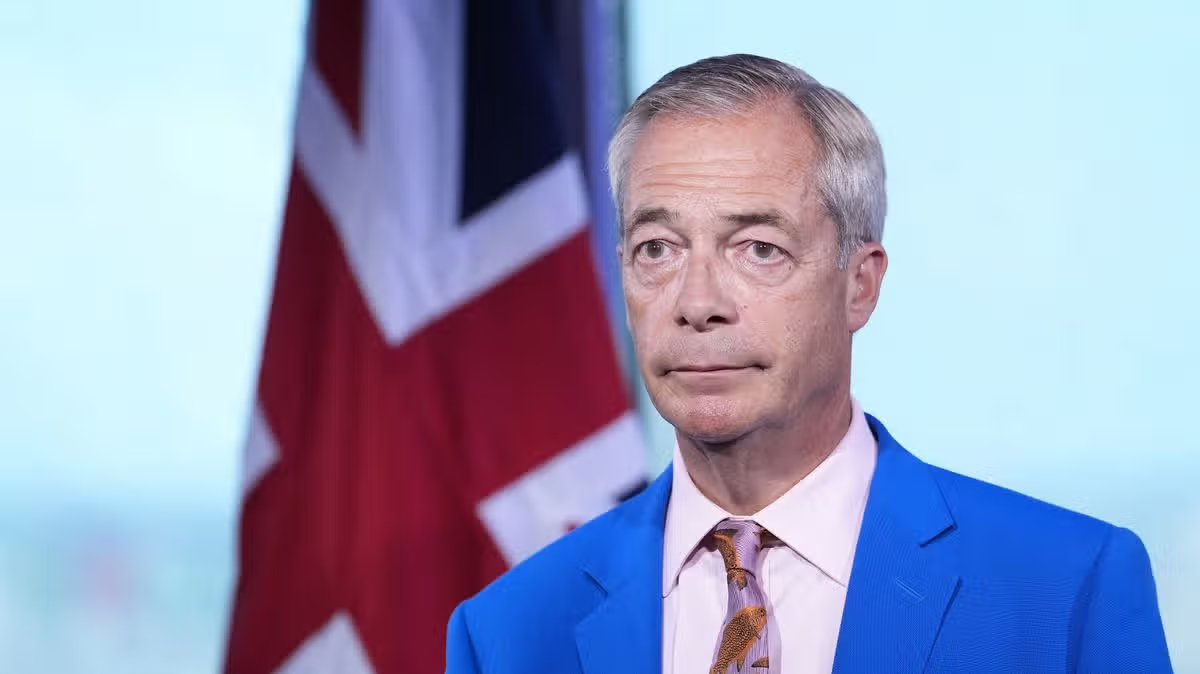
Clacton by-election LIVE results and reaction as Nigel Farage seeks to win back seat

Quarterhill Inc. 2026 Q2 – Results – Earnings Call Presentation (TSX:QTRH:CA) 2026-08-14


-

 Fashion6 days ago
Weekend Open Thread: Mattifying Sunscreen
-

 Fashion7 days ago
Frugal Friday’s Workwear Report: Cap-Sleeve Pointelle Crewneck Sweater
-

 News Videos6 days ago
Can Astrology Help Find Gold and Silver Trends? A Financial Astrology Guide
-

 Tech6 days ago
Rinn Pharma & Biopharma to join NordicPharmaTrain network
-

 Business5 days ago
How to Start a Cleaning Business: A Step-by-Step Guide
-

 Business5 days ago
Datadog: Best Of Breed For Multiple Reasons
-

 Business5 days ago
BDC Weekly Review: Private BDC Q2 Numbers Are Strong
-
 NewsBeat2 days ago
Communication cards help banking customers access services or report scams
-
 Business3 days ago
Oil Price Today (August 11): Crude oil rises to $88 after Trump’s compensation demand dents Hormuz opening. Here’s why
-

 Fashion6 days ago
Weekly News Update, 8.6.26 – Corporette.com
-
 Entertainment7 days ago
Brand New Day’ Characters, Ranked
-

 Business7 days ago
Aussie shares lose steam to close record-breaking week
-

 Fashion7 days ago
Irina Shayk Wows in REVOLVE Los Angeles’ Summer Styles
-

 Fashion7 days ago
Burberry Fall 2026 Takes On Commuter Style
-

 Fashion5 days ago
Amazon Sundays: Closet Care Before Fall
-

 Politics6 days ago
Be quiet, Miriam! – spiked
-

 Business7 days ago
CXMT Shares Drop 4.3% as Post-IPO Rally Cools Amid Global Memory Chip Pressures
-

 Sports7 days ago
Report: Kawhi Leonard had undisclosed deal with Clippers’ scoreboard maker
-

 Crypto World7 days ago
How XRP holders can earn $4,600 daily
-

 Business6 days ago
Mutual Fund Manager Scoops Up Beaten-Down Stocks
You must be logged in to post a comment Login