Joshua Kushner’s Thrive Capital has sent its first formal letter to investors, and the standout figure captures the AI era in miniature.
One of its funds has swelled to about $3.7bn in value, driven overwhelmingly by early bets on OpenAI and SpaceX. The letter, reported by Bloomberg, reads as a victory lap and a quiet hedge at the same time.
That Thrive is writing to its backers at all is notable in itself. Kushner has built one of the most secretive and sought-after firms in venture capital, so a formal letter, complete with hard marks and a candid line on concentration, is a departure that doubles as a statement of confidence.
It also lands at a moment when the whole industry is arguing about whether AI valuations reflect real value or collective hope, which makes a firm this exposed to a single name showing its workings all the more striking.
Advertisement
Thrive’s OpenAI position is practically a chronicle of the boom. The firm first backed the company in 2022 at a $29bn valuation, led a tender the following year at $86bn, and has since committed around a billion dollars more across rounds that valued OpenAI at $150bn and then $285bn.
That $3.7bn mark also owes a great deal to Thrive’s stake in Elon Musk’s SpaceX, another private giant whose valuation has climbed relentlessly.
Between them, two holdings now account for the bulk of the fund’s gains, a concentration most portfolio managers would flinch at and Thrive is presenting as vindication.
Advertisement
There is a large asterisk, though. Almost none of that value has actually been banked. The gains are unrealised marks, dependent on OpenAI’s and SpaceX’s private valuations continuing to rise, and a growing share of Thrive’s paper returns now rests on OpenAI alone.
On paper, the firm is having a spectacular decade, but in cash, far less has been settled, and paper fortunes have a habit of shrinking the moment the market that created them turns.
Which is what makes the other disclosure in the letter so telling. Thrive is selling part of its OpenAI stake, taking some chips off the table even as it insists the story is only beginning.
Trimming a winner is textbook risk management, yet it also quietly concedes the oldest truth in venture capital, which is that a mark is not money until someone else pays for it.
Advertisement
Thrive has grown into a heavyweight on the strength of these wagers. The firm now manages roughly $25bn and this year closed a record $10bn fund, its largest yet and reportedly oversubscribed, a sign that limited partners are content to keep feeding a strategy built on a handful of enormous private positions.
The letter arrives at a jittery moment for that whole model. As doubts grow about whether AI revenues can ever justify the valuations, and about whether much of the sector is a bubble waiting to deflate, funds whose fortunes hinge on a single soaring private mark start to look exposed rather than clever.
Thrive’s numbers dazzle precisely because OpenAI’s have never stopped climbing.
Advertisement
For now, it stands as one of the great venture bets of the age. Kushner backed OpenAI when it was still a curiosity and rode it to the centre of the economy.
What the letter cannot answer is what happens to a fund like this on the day OpenAI’s private valuation finally stops rising, because a return that exists only as a mark can evaporate almost as fast as it appeared.
In the more innocent days of the World Wide Web you could simply put a robots.txt file in the root of your website that search engine indexing bots and similar would consult for the indexing wishes of the site owner. In this brave new world of LLM training data indexing such pleasantries are however rarely respected, leaving site owners to resort to increasingly more involved ways to bludgeon so-called AI scrapers, with ShieldFont being one of the most recent methods.
Its basic functioning is detailed in the white paper, explaining their use of ligatures. These are normally used to join multiple graphemes or letters into a single glyph which are rendered in the final text. By substituting about a quarter of the words in a text with such ligature-based versions in an intelligent, dictionary-based manner, the HTML version – as typically parsed by a scraper – will read as grammatically valid but nonsensical text, while the rendered font version will look normal.
Naturally, there are some disadvantages to this, such as screen readers for the visually impaired needing to also use the rendered font version, and it’s just as effective on legitimate search engine indexing bots. That said, if you apply this to static, archived content, or content marked as ‘do not follow’ in said robots.txt, then it might just be one way to make ChatGPT and friends spit out really funny output in the future now that the novelty of wood glue on pizza and eating rocks has somewhat worn off.
Advertisement
While LLM scrapers can adapt to this by also parsing the rendered text, this makes the scraping effort significantly more expensive. Together with maze traps like Nepenthes and Cloudflare’s offerings that seek to keep these scrapers busy scraping dynamically generated content through infinite linked pages, the tools available to combat the menace of these scrapers keep developing.
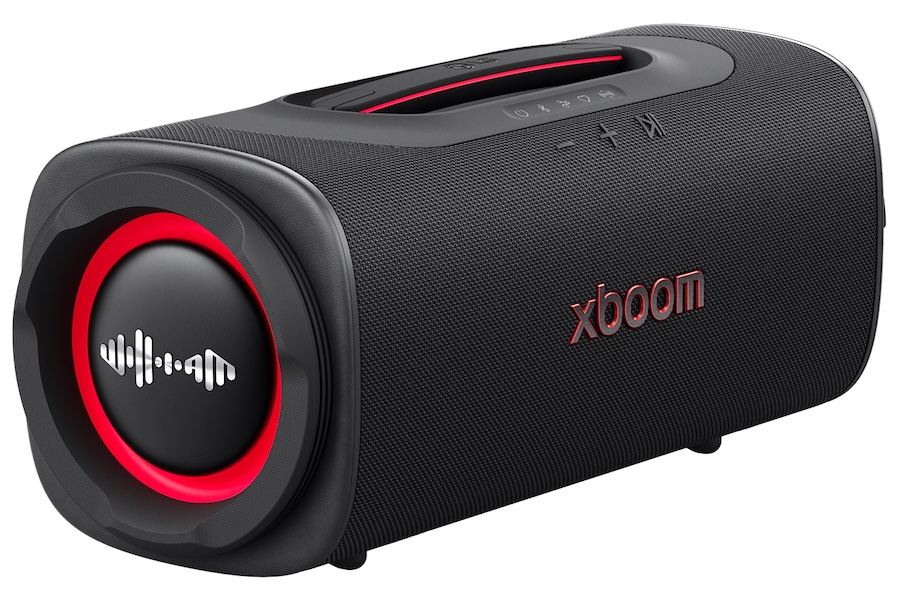
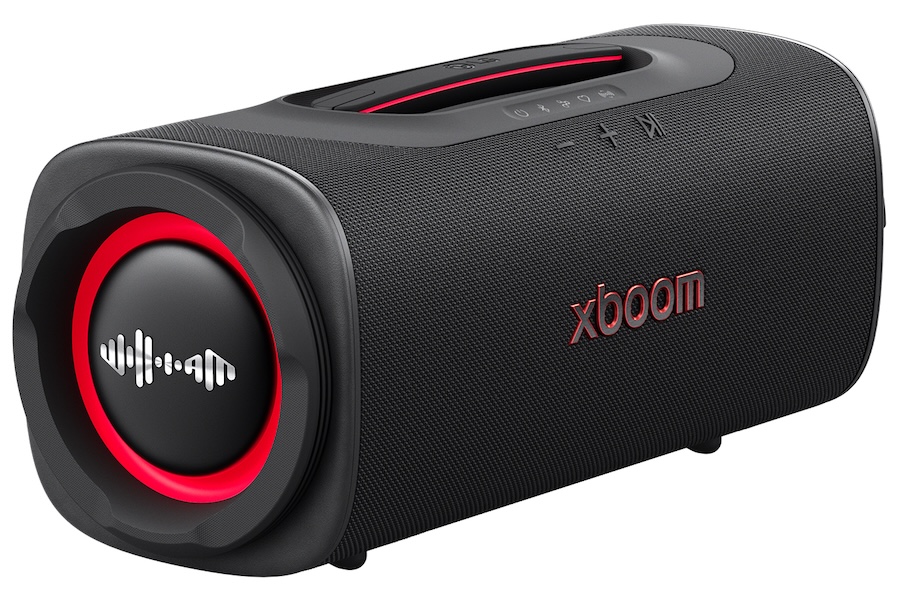
Following its CES 2026 preview in January, LG has officially launched the xboom Blast, a portable Bluetooth party speaker built for beach days, camping trips, backyard gatherings, and other places where a power outlet might be difficult to find.
The xboom Blast joins LG’s 2026 xboom by will.i.am lineup alongside the Stage 501, Mini, and Rock. Rather than simply functioning as a smaller version of the Stage 501, the Blast has a different mission: the Stage 501 emphasizes parties, live-performance-style use, and AI-powered karaoke, while the Blast trades some of that functionality for portability, weather resistance, and significantly longer battery life. LG says the Blast will begin rolling out in select global markets in August 2026, with additional markets to follow later in the year.
AI still plays a substantial role. The 2026 xboom lineup incorporates AI Sound, which analyzes content and adjusts EQ automatically, while the Blast and Stage 501 also support Space Calibration Pro to adapt playback to their surroundings. LG’s broader xboom by will.i.am platform also integrates FYI.RAiDiO, giving listeners access to ten AI Personas and DJs, two-way conversational interaction, real-time music curation, and location-aware personalization through the dedicated MY Button or FYI.RAiDiO app.
Related Reviews:
Features, Design, and Key Specifications
The xboom Blast is designed to provide a music listening experience that complements beach days, camping trips, poolside gatherings, and backyard parties, combining powerful sound, long-lasting reliability, and intelligent audio technologies in a durable, portable design. The xboom Blast expands LG’s growing party speaker lineup with a model designed specifically for outdoor use.
Featuring a 99-watt swappable battery with up to 36 hours of battery life on a full charge and IP68-rated environmental protection, the LG xboom Blast combines powerful, reliable audio, portability, and durability to help users enjoy immersive sound across a wide range of outdoor environments.
Advertisement
Big Sound for Any Party, Indoors or Out
At the heart of the Blast is xboom Signature Sound, tuned by will.i.am. The xboom Blast fills large spaces with rich, immersive sound designed for parties and gatherings.
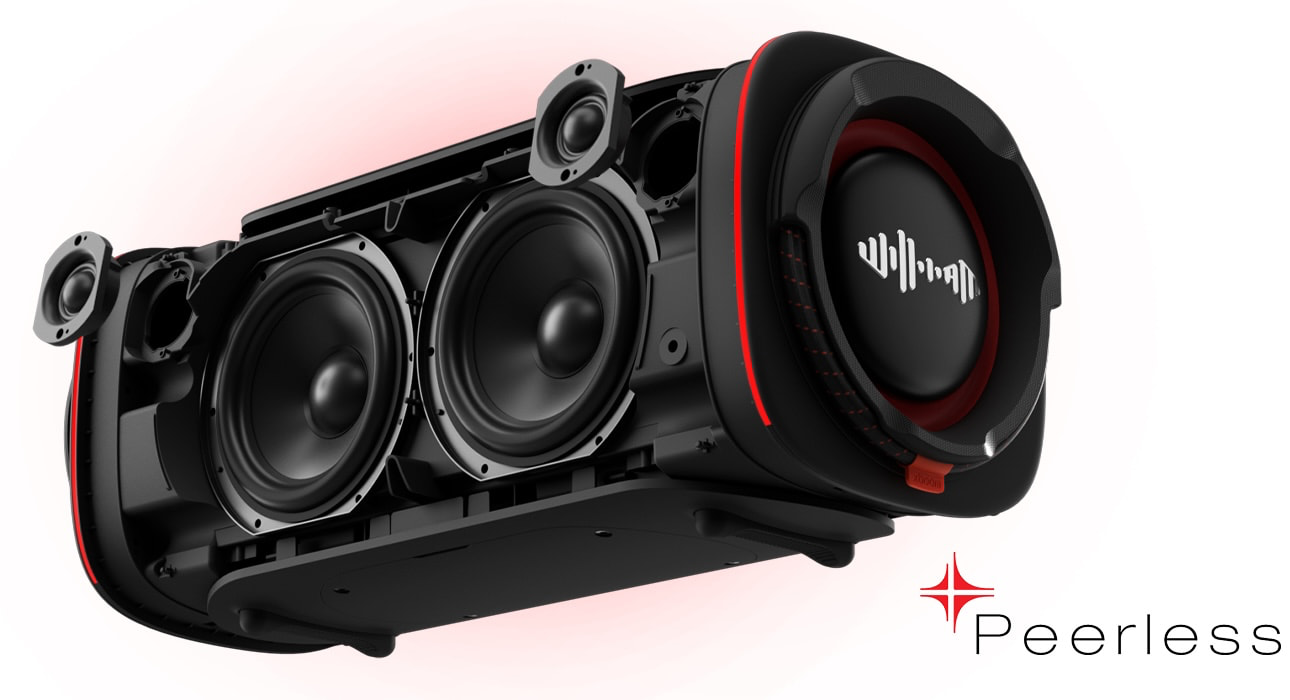
The xboom Blast combines two 5.25-inch neodymium woofers for deep bass with two 20-millimeter tweeters for crisp highs. Combined, the woofer and tweeter configuration is designed to provide a balanced, full-range audio listening experience. The woofers and tweeters are supplied by Danish audio brand Peerless.
Users can stream their favorite music wirelessly via Bluetooth or connect through USB-C for high-fidelity wired playback.
Intelligent Audio
Outdoor environments and social gatherings present different acoustic conditions. To support the best possible listening experience, the xboom Blast provides several practical features.
Advertisement
AI Sound analyzes music and other audio content in real time and automatically adjusts sound settings to optimize playback, minimizing the need for manual adjustments.
Space Calibration Pro automatically adapts sound output based on the surrounding environment.
Sound Field Enhance expands the perceived soundstage for a more immersive listening experience.
AI Lighting synchronizes the speaker’s Dual Ring Lighting Effects with different genres, moods, and playlists to create a more engaging party atmosphere.
Auracast enables multiple compatible speakers to connect wirelessly via Bluetooth, extending sound coverage for shared listening experiences at larger gatherings.
Easy Outdoor Portability
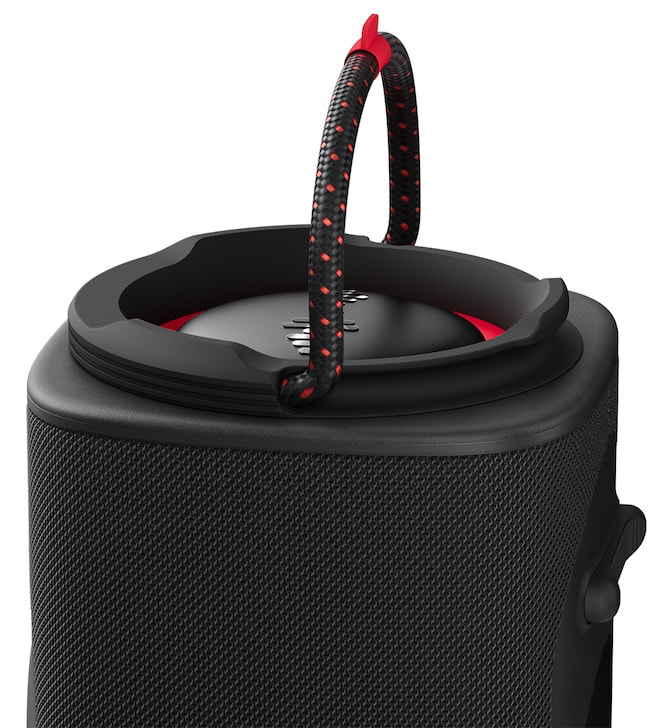
Inspired by duffel bags, the xboom Blast features a dual-fabric handle for easy portability and a vertical rope handle for upright placement. The vertical rope handle also supports vertical carrying, providing added flexibility when moving the speaker between outdoor locations such as the beach or a campsite.
The xboom Blast has been recognized with a 2026 Red Dot Design Award; the speaker combines practical portability with a unique visual identity inspired by outdoor lifestyles.
Advertisement. Scroll to continue reading.
A durable fabric exterior and protective side bumpers provide added flexibility for horizontal or vertical placement when setting up the speaker in different spaces.
The LG xboom Blast enters a very crowded portable party-speaker market, but it has more than flashing lights and a celebrity name going for it. Up to 36 hours of battery life, IP68 protection, a replaceable battery, 210W of output on battery power, USB-C audio, and automatic room and outdoor sound calibration give it a compelling combination of power, durability, and portability. What it lacks is the Stage 501’s karaoke focus and microphone-oriented features, which may matter to buyers who want their speaker to double as a portable PA system.
Its most obvious rival is the JBL Boombox 4, which offers IP68 protection, Auracast, USB-C lossless playback, a replaceable battery, and up to 34 hours of playback. The Sony ULT FIELD 7 adds karaoke and microphone support with up to 30 hours of battery life, while the less expensive Soundcore Boom 2 Plus counters with 140W output, IPX7 protection, 20-hour battery life, and support for linking more than 100 compatible speakers. LG has plenty of competition here, but the Blast brings enough of its own ideas to avoid looking like another Bluetooth boombox with lights stuck on the front.
The vinyl renaissance is still going strong, and there’s no shortage of ways to get your fix. Whether you’re after a budget turntable to get started, modern extras like USB and Bluetooth streaming, vintage style, or high performance playback, there’s a growing list of options to fit your needs and budget.
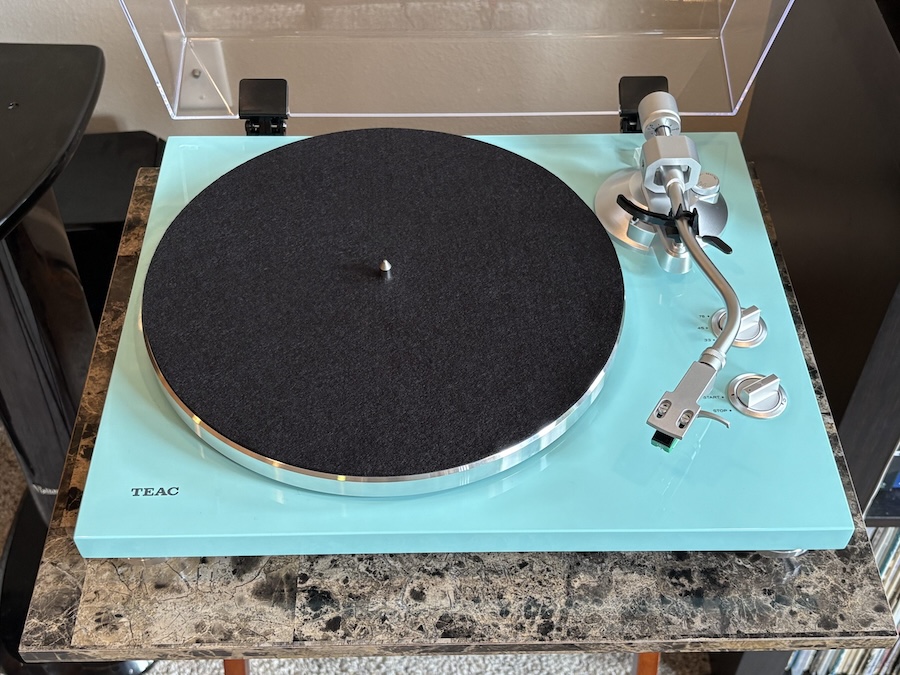
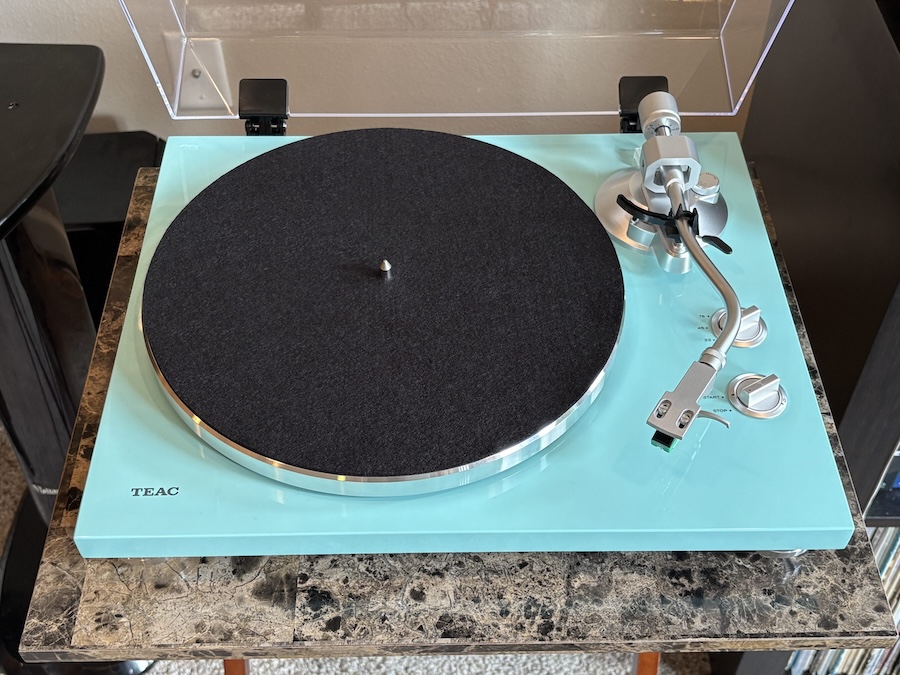
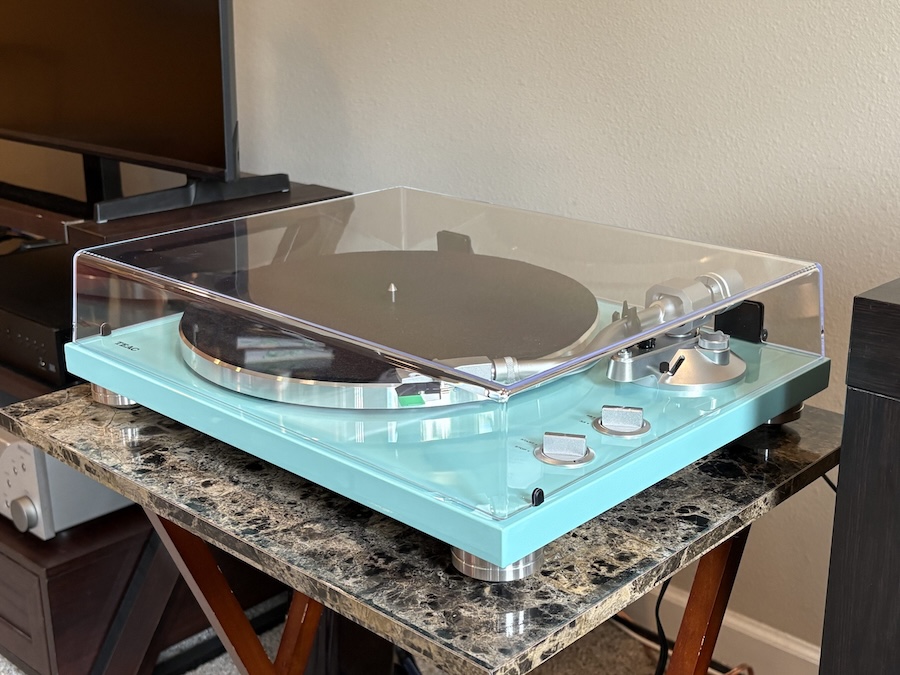
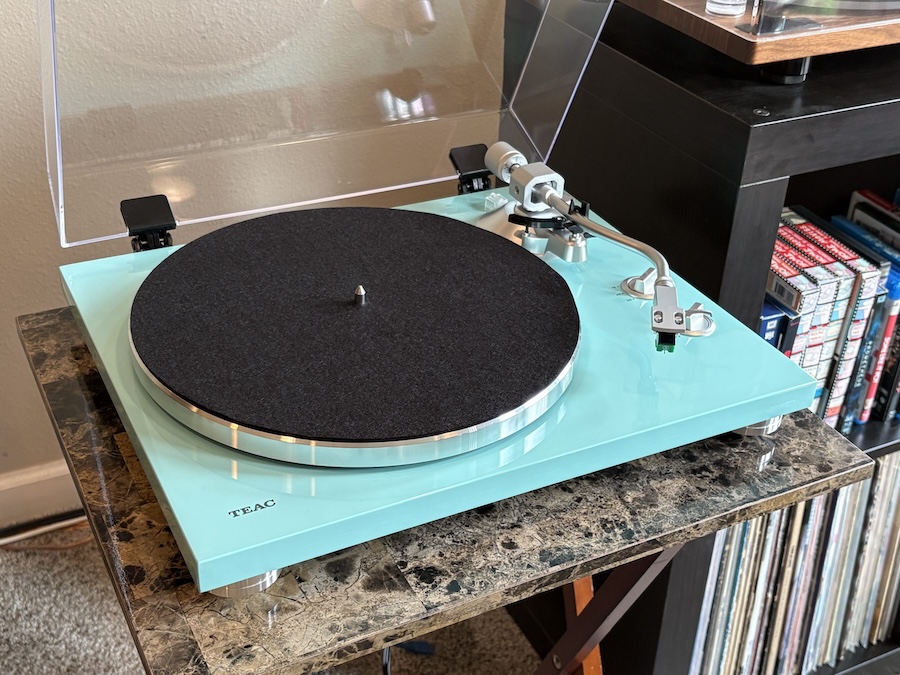
Then there are models like TEAC’s TN-400BT-X manual belt-drive turntable that aim to offer a taste of all of it at an attainable price point. Its retro-modern plinth looks sharp, especially in the Special Edition Turquoise Blue I reviewed, AKA the TN-400BT-X/TB (it also comes in Walnut), while touches like machined-aluminum switches, a solid built-in preamp, and Bluetooth support with the latest aptX codecs provide equal parts usability and versatility.
The TN-400BT-X combines retro-modern styling, a built-in phono preamp, USB output, and Bluetooth connectivity in a package designed for listeners who want more flexibility than a traditional entry-level turntable provides. It may not be the last turntable you ever buy, but it offers an appealing mix of style, convenience, and performance for the money.
Setup Is Fast, but There’s One Catch
Setting up a turntable can be as daunting as it is satisfying, like solving a puzzle you get to play with afterward. As the easiest turntable I’ve set up yet, the TN-400BT-X is more like a maze without any false paths. Pulling away the foam reveals a nearly fully assembled table, right down to the pre-attached dust cover.
The only real difficulty comes in adding the diecast aluminum platter, or rather the belt that drives it. For starters, the instructions don’t mention that the rubber belt is already wrapped around the platter’s bottom edge, so I spent longer than I care to admit looking for it among the accessories.
Advertisement
More notably, you’ve got to connect the belt to the drive motor with the platter attached, requiring you to slip your fingers nimbly through a hole at the platter’s edge and loop the flat belt around without twisting it. I got it after a few tries, but those with bigger fingers may find it a tougher chore.
One other part that gave me some trouble was locking the proper outlet attachment onto the power supply, which requires aligning it with a retractable hinge that feels like it’s going to snap. It didn’t, and I appreciate TEAC’s inclusion of multiple options to fit your region.
After that, simply follow the detailed instructions for attaching the cartridge and counterweight to the aluminum tonearm, remove the stylus cap, and you’re ready to spin.
Retro Style Meets Modern Function
The TN-400BT-X’s mix of minimalist design and chrome components looks quite good on your console, or, as my wife put it, “cute.” In the case of the Special Edition model, that’s due in no small part to the turquoise lacquer’s surfer-guitar vibe, which offers just the right mix of cheek and style without looking ostentatious.
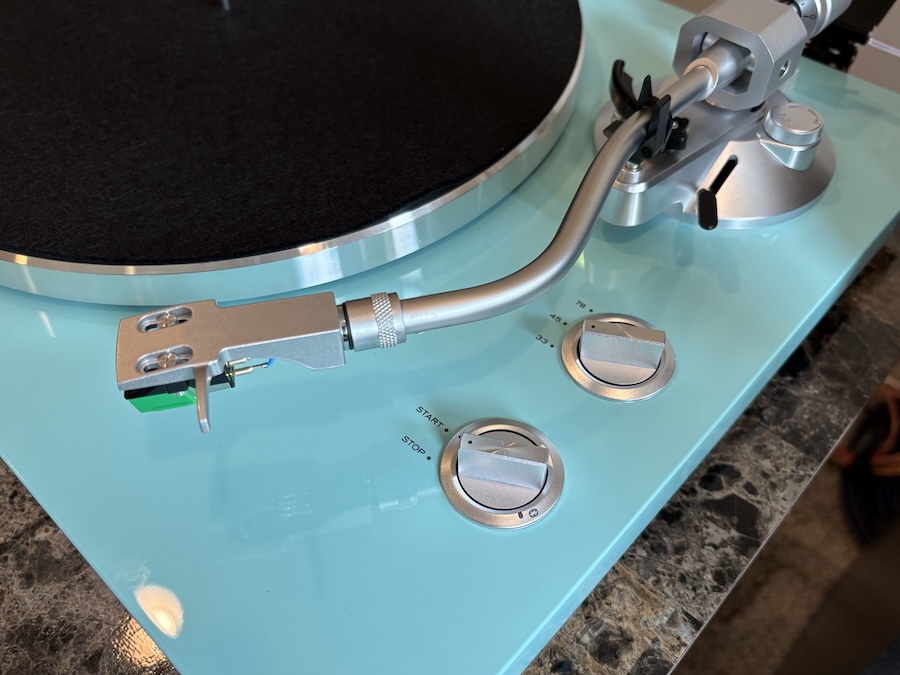
As slick as it looks, I was surprised by how light the turntable feels compared to step-up models. That goes for both the MDF plinth and the S-shaped aluminum tonearm, which seems to float off the holder as you align the needle. Along with feeling a little chintzy, the lighter base can lead to audible thuds when you close the dust cover or accidentally tap the turntable while the stylus is in the groove.
Advertisement
Otherwise, the table does a good job of resisting skips and pitch fluctuations from scratched, warped, or otherwise imperfect records, and components like the machined-aluminum control dials for playback and record speed feel sharp and sturdy. Speaking of speeds, you’re getting the big three: 33 ⅓, 45, and 78 RPM, which my fancier Orbit Theory reference turntable lacks.
Advertisement. Scroll to continue reading.
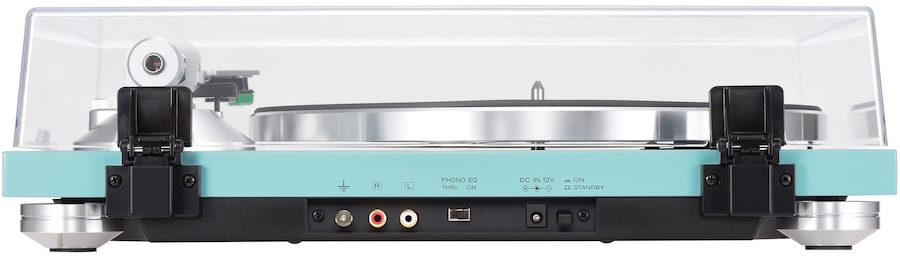
At the TN-400BT-X’s backside is a power/standby key and a switch for the built-in phono preamplifier, which includes a “hi-fi quality” NJM8080 op-amp chip. Hidden below the table’s right flank is a Bluetooth key, which requires a long hold for initial pairing and a tap for subsequent connections. Bluetooth support includes aptX and aptX Adaptive for high-quality streaming with compatible headphones and speakers.
There’s no auto-stop or return, something I would have liked to see in a Bluetooth-ready table at this price point. That means you’ll need to keep track of your records from afar when streaming, especially if you’re using Bluetooth to tap into a multi-room system like Sonos.
Listening
I had the pleasure of auditioning the TN-400BT-X with KEF’s new LS LUXE speakers (review to come), which served as a potent magnifying glass for investigating the table’s interpretation of my catalog. From the first drop in the groove, I was impressed by the deck’s balanced and relatively energetic performance, which was more than enough for a satisfying listening experience with KEF’s latest high-end system.
Starting with my usual entry point, Brubeck’s Take Five, the TEAC provided a smooth touch to Dave’s rapid piano runs, offering enough sparkle to properly represent the higher keys without harshness or sibilance. There was good warmth and definition in the buoyant bass lines and string rattles, along with sweet yet lyrical resonance in Paul Desmond’s sax runs.
Advertisement
Desmond’s breathier lines in songs like “Strange Meadow Lark” don’t have the presence or almost visceral quality you’ll get with higher-end options like the DP-500BT, and I was hoping for more from Joe Morello’s tactile brushwork in the left channel. But moving through the record, it was clear that the turntable’s included Audio-Technica AT95E cartridge remains a ringer at its $60 price point, as it has been for decades.
The same goes for TEAC’s built-in pre-amp, which stood up well to my outboard Rolls VP29 in A/B comparisons. The Rolls offers higher gain and a touch more presence, but it’s also sharper on brighter recordings, and I found myself generally preferring the turntable’s built-in phono stage.
I was still worried my Japanese Beatles pressings might present too much brightness at the instrumental attack, but between TEAC’s restrained treble and KEF’s effortless clarity, there was enough detail to go around without getting aggressive. I heard plenty of textural grit and psychedelic groove in instruments like horns and overdriven guitars, while vocals had solid pop without becoming sibilant.
Bouncing to my reference Orbit Theory put a bit of a damper on the experience, as that table tends to do with most options at its price or below. Everything sounded fuller, richer, more detailed, and more intimate, as if a veil had been lifted. That said, the Theory costs nearly twice as much and doesn’t offer the TEAC’s Bluetooth chops.
Advertisement
Bluetooth Streaming
Going wireless added yet another layer of separation between the speakers and the music. Even so, as mentioned in my DP-500BT review, I’ve come around to the appeal of wireless vinyl, especially as an entry point for a multi-room sound system that can spread your tunes throughout the house. Moreover, if you’ve got a quality pair of Bluetooth headphones with aptX support, you’ll be treated to a refreshingly clean and intimate listening experience.
Connecting my Bowers & Wilkins PX8 S2 headphones, I was pleased to discover plenty of detail in my midrange copy of the Grateful Dead’s American Beauty. Swapping between the wired Luxe speakers and the headphones, the latter barely skipped a beat, showcasing sparkling cymbal work, excellent instrumental separation, especially in the vocals and the album’s rich harmonies, and good dynamic expression between the softer and more keyed-up moments.
The record still sounds more lively and open when played through the wired system, but there’s something to be said for the more intimate presentation you get from a pair of premium ANC Bluetooth headphones.
Advertisement. Scroll to continue reading.
The Bottom Line
TEAC’s TN-400BT-X turntable is a fine mix of style and substance, especially if you can grab the Special Edition model while available. At $630, you’re paying a premium for both its design and Bluetooth support over similarly appointed wired-only tables from brands like Pro-Ject and U-Turn, but if you’re looking for a deck that balances sound quality, playback options, and fun in equal measure, TEAC’s table walks the line well.
If you’ve got some budget flexibility and prefer a more refined approach, Denon’s DP-500BT is a worthy upgrade. Its higher build quality does a better job of suppressing handling noise when changing records, and its more understated design contrasts nicely with the TEAC’s eye-catching Turquoise Blue finish. Otherwise, the TN-400BT-X’s good looks and versatile performance make it worth considering.
Advertisement
Pros:
Fast and mostly simple setup
Balanced, full, and clear performance
Fun and stylish design
Solid skip and pitch fluctuation resistance
Bluetooth with aptX sounds excellent
Cons:
Plinth and tonearm feel a little chintzy
Substantial noise when bumping the plinth during playback
You’re paying a premium for the style and versatility
The Federal Trade Commission recently announced deals with two auto dealers, along with the former general manager of a third, promising not to enforce—or even help enforce—their court-ordered obligations to maintain fair lending programs and not engage in unlawful credit discrimination.
The Northern District of Illinois, which presided over one case, says it was never given the opportunity to evaluate one of the new agreements, and Arizona attorney general Kris Mayes, whose office was a coplaintiff in another of the affected cases, calls the move “outrageous.”
The FTC is doing away with the obligations because the defendants didn’t explicitly instruct its salespeople to treat Black and Latino borrowers differently. Previously, the FTC accused all three of charging people of color more in discretionary markups and add-on fees on average compared to white borrowers. (Disclosure: The author of this article previously worked for the FTC but did not participate in any of the matters mentioned in this article.) In one case, involving a car dealership chain called Passport, the FTC alleged that a financial institution had sent the chain multiple letters notifying it that there were disparities in the markup rates it charged Black borrowers. Attorneys for Passport declined to comment on the agreement.
The FTC and Arizona previously accused Coulter Motor Company and Gregory DePaola, a former general manager at the Phoenix-area auto dealer, of charging Latino customers more in interest and for add-on products, in violation of the federal Equal Credit Opportunity Act, among other charges.
Advertisement
DePaola, who did not respond to a request for comment, signed one of the new agreements. Coulter and an attorney that represented both Coulter and DePaola in the 2024 settlement did not respond to requests for comment.
“The FTC and the Attorney General’s Office partnered on this case to ensure Arizonans can purchase cars without being misled or charged more because of their ethnicity,” says Mayes. “I find it appalling that the FTC would backtrack on the settlement and treat its state partners this way, not to mention essentially greenlight discrimination against Arizonans.”
The FTC said in a press release that its past accusations against the defendants were “based on statistical analyses designed to show disparate-impact liability” and that the agency was not going to enforce those types of claims anymore. Disparate-impact discrimination is when a seemingly neutral policy or practice causes disproportionate harm to a protected group, even if that wasn’t the original intent. It stands in contrast to disparate-treatment discrimination, which involves policy intentionally meant to discriminate against a group of people.
“It’s actually a really hard theory where you have to identify a specific policy, prove that it caused a disparity, and then the hardest thing of all is you have to prove that that policy doesn’t serve a legitimate purpose,” says Aaron Rieke, the chief legal engineer at a legal startup called Privlex and a former FTC attorney adviser.
Advertisement
Logan Koepke, a senior project director at Upturn, a nonprofit that researches technology’s impact on civil rights, says that disparate-impact analysis is more important than ever, because AI and other automated decisionmaking systems, which can sometimes take unintended actions, are being used more often to make important decisions like loan eligibility.
Last year, the Trump administration directed the FTC and other agencies to review all past orders and take “appropriate action” in an executive order titled “Restoring Equality of Opportunity and Meritocracy.” The administration has said that disparate-impact liability “undermines our national values.”
The agreements, which were voted on by the commission in early August but went into effect over half a year prior, in November, are highly unusual. Though the FTC typically has to prioritize some enforcement efforts over others due to resource constraints, by signing and voting out the agreements they essentially delete two sections from each of the orders and potentially make it difficult for future administrations to undo that.
Immigration and Customs Enforcement officers may soon be outfitted with gloves that can deliver painful electric shocks intended to gain compliance from combative individuals.
ICE plans to spend up to $20 million to purchase thousands of “conductive distraction and de-escalation devices” for officers and agents by March, according to a notice published Monday by the Department of Homeland Security.
It’s a Taser but it’s a glove. It’s something hardly anyone in law enforcement has ever needed. And yet, there’s a $20 million no-bid contract that is going to make (lol) Compliant Technologies that much richer. Compliant Technologies describes the G.L.O.V.E. (Generated Low Output Voltage Emitter) this way [all quotation marks in the original]:
The G.L.O.V.E. quickly transforms into a CD3 (Conductive Distraction and De-escalation Device) when used within the Force Continuum to supplement existing tools for law enforcement, corrections, security, EMS and the military. It is available as an “invisible partner” to enhance the user’s effectiveness when operating within their agencies’ already established tactics, techniques and procedures. This is why we call the G.L.O.V.E. the “Force Multiplier” and how it operates within the Force Continuum as “The New Protocol in Peace Keeping.”
Oh my. “Force multiplier.” “Invisible partner.” “New Protocol in Peace Keeping.” That’s a whole lot of jargon right there. It’s an ambush tactic (a glove with a juiced up joy buzzer inside) that will definitely be a “force multiplier” (if by “force,” you mean “excessive”) in/on the hands of ICE officers.
I’m not kidding. It’s basically Taser, but in glove form. The user’s manual (embedded below in case the company decides to make it disappear) compiled by Compliant Technologies even uses Taser’s jargon for “but the person died of something other than continuous electric shocks:”
AGITATED CHAOTIC EVENT (ACE) PREVIOUSLY KNOWN AS EXCITED DELIRIUM SYNDROME (EXDS) AND SUICIDAL CONSIDERATIONS
Compliant Technologies does not prescribe any protocols for using a CD3 device in a situation involving an ACE or suicidal people. It is the responsibility of the officer to deal with these cases according to their agency’s protocols and procedures.
Yeah, that ought to keep the blood off Compliant’s hands. (But not so much the ICE officers whose electro-gloves may now be covered in the blood of people who’ve had the privilege of being subjected to the “new protocol in peacekeeping.”)
Advertisement
The manual makes it clear there will be plenty of opportunity for “friendly fire:”
It is recommended to have an additional officer on scene to cuff/restrain while the G.L.O.V.E. is being deployed. Always advise other officers of G.L.O.V.E. deployment by saying, “G.L.O.V.E. ON!”
Hmmm. I wonder how many times be-GLOVEd officers’ “GLOVE on!” shouts will be misheard as something about a gun. Shout that phrase loud and fast with as much “rapidly-evolving situation” tension as you can apply. The hard G alone will probably be enough to bring multiple ICE firearms into the firing position. Repeating the phrase for clarity will probably just make ICE officers believe they misheard correctly the first time.
To date, almost every user of this device is someone working in a correctional facility where this probably makes a bit more sense. I’m not saying there’s any reason for these gloves to exist at all, but when you’re trying to subdue someone while surrounded by convicted criminals, any help is probably appreciated.
As for any comments from ICE about officers receiving appropriate training before being given a pair of stun gloves, the agency can go fuck itself. It’s been on a hiring spree since Trump took office. To maintain the number of officers needed to make the administration’s bigots happy, ICE has gutted its training program and lowered its hiring standards.
Advertisement
And even if officers are receiving the full load of training, it’s hardly specific to the roving-gang-of-masked-thugs work most officers are doing now. Prior to everyone calling for ICE’s abolishment, ICE spent most of its time seizing things, rather than people — something one would expect from a customs enforcement agency. For years, immigration problems were largely handled by the agencies that dealt with the largest number of immigrants: CBP and the Border Patrol.
Adding this to the arsenal just means more people are going to be seriously injured or killed. It will do absolutely nothing to make ICE better, more efficient, or capable of meeting sky-high arrest quotas. The misanthropes running this government are apparently just googling up whatever new means of pain/torture they can get their hands on/in. We can only hope a lot of officers will forget they still have their gloves engaged when doing things like adjusting their masks or scratching their balls.
Apple’s latest proposal in the Epic trial suggests it should be able to charge between 5% and 15% on external purchases. However, Epic will appeal any value above 0%.
The ongoing lawsuit between Apple and Epic has left Apple unable to charge commissions on external purchases since its injunction violation in April 2025. Thursday’s proposal could let Apple begin charging something again soon, that is if the District Court finds it within its expectations.
Apple was ordered to provide a plan for external commission rates on Tuesday, and in spite of multiple appeals, has finally done so. The filing was made on the minute at 5 p.m. EST when the deadline was set.
The proposed rates are Apple’s most modest yet and a sharp fall from its original proposal that maxed out at 27% in commissions. The filing suggests that the District Court has mischaracterized the costs of doing business with the App Store and the value Apple provides, but shared its proposed rates anyway.
Advertisement
Here is what Apple offered:
15% for standard apps, which are subject to a 30% in-app purchase commission
10% for the Video Partner Program, the News Partner Program, the Mini Apps Partner Program, and subscription renewals
5% for Small Business Program apps
Apple stated that it believes these rates will be highly competitive versus using in-app purchases. It is also enough that Apple will have some mild profit margin as well.
Apple also filed an Administration Motion for Referral to Settlement Conference. It suggests that a settlement conference would help both parties reach resolution and narrow or resolve remaining issues.
Apple’s filing is in, and Apple admitted that under the Ninth Circuit’s definition of “necessary costs” they would charge 0% for purchases made via linkouts to the web.
Apple proposed linkout fees of 15% for standard apps and 5% for Small Business Program apps. Epic believes
Epic seems to believe it owes nothing and should be able to benefit from distributing apps on the App Store without paying Apple a dime of compensation. It plans to file an oppositional statement.
The data and AI company’s valuation has jumped from $134bn to $190bn in just six months.
San Francisco’s Databricks has closed a $5bn strategic funding round led by Coatue at a $190bn valuation. The company said the fresh funds will drive continued innovation across Lakebase, its database warehousing product, Genie, its “AI coworker” and its Unity AI Gateway for multi-AI governance and cost controls.
Blackstone and MGX joined Coatue in this round, and new investors included Sixth Street Growth, BOND, Clearlake Capital, Point72, Premji Invest, and TPG, joining existing investors like Andreessen Horowitz, Dragoneer, Fidelity Management & Research Company and Thrive Capital.
“Enterprises don’t just want AI that talks,” said Ali Ghodsi, co-founder and CEO of Databricks. “They want agents working across their business that remember context, deliver accurate answers, and execute work without blowing through their budgets.
Advertisement
“That requires real-time operational data with Lakebase, context from across the business with Genie, and multi-AI cost controls with Unity AI Gateway. The tremendous investor demand for this round shows that our AI strategy is winning the market and building what every business needs to maximise their impact with agents.”
“Databricks has spent a decade being early to where AI was headed,” said Thomas Laffont, co-founder of Coatue. “Now it’s the infrastructure the industry builds and scales AI on. What stands out most is the pace: they’ve compressed R&D timelines that used to take years into months, more like a research lab than a typical software company.
“We’ve been investors since 2019, and results like that are why we’re proud to lead this round today and keep building with them,” he added.
Databricks says the financial momentum has been strong with an 80pc increase year-on-year in its growth, surpassing a $7bn revenue run-rate. The funding round comes just six months after a previous raise of $5bn in February that valued the company at $134bn.
Advertisement
The data and AI company founded in 2013 today works with over 20,000 organisations and 70pc of the Fortune 500, including big names like Adidas, AT&T, Bayer, Block, Mastercard and Unilever.
Headquartered in San Francisco, Databricks has over 30 offices globally. It employs over 500 staff across the UK and Ireland as part of its EMEA operations, headquartered in London.
Don’t miss out on the knowledge you need to succeed. Sign up for the Daily Brief, Silicon Republic’s digest of need-to-know sci-tech news.
Google has launched the Pixel 11 series in India, expanding its latest smartphone lineup with the Pixel 11, Pixel 11 Pro, Pixel 11 Pro XL, and Pixel 11 Pro Fold. The new phones bring Google’s latest Tensor G6 processor, upgraded cameras, longer battery life, and a range of new AI features powered by Gemini Nano. Alongside the Pixel 11 lineup, Google has also introduced the Pixel Watch 5 and updated Pixel Buds Pro 2 in India. The Pixel 11 series starts at ₹89,999, while the Pixel 11 Pro Fold starts at ₹1,86,999.
Pixel 11 Gets Camera and Battery Upgrades
Google has given the standard Pixel 11 a refreshed design and improved camera system. Its redesigned camera bar is more than 40 percent thinner than the previous model. The phone comes with a satin-finish frame and four color options. These include Frost, Hibiscus, Pistachio, and Obsidian. The Pixel 11 uses the Tensor G6 processor with 12GB of RAM. Users can choose between 256GB and 512GB storage.
Google says the phone offers more than 30 hours of battery life. Its upgraded 48MP main camera also captures 56 percent more light and supports up to 30x Super Res Zoom and Instant Night Sight.
Pixel 11 Pro and Pro XL Focus on Premium Features
The Pixel 11 Pro and Pixel 11 Pro XL bring several premium upgrades to Google’s latest smartphone lineup. Both models feature a refined design with an edgeless camera bar and Super Actua displays. The displays can reach up to 3,600 nits of peak brightness. They also use a new coating that Google says offers twice the scratch resistance of the previous generation.
The two phones come with a 50MP main camera and a new 48MP telephoto camera. They support up to 120x Pro Zoom and Portrait Mode at 5x zoom. Both models provide more than 30 hours of battery life. Their wired charging can reach 75 percent in about 30 minutes. They also offer faster wireless charging than before. Buyers can choose Canyon, Fog, Olive, or all-matte Obsidian finishes.
Advertisement
Pixel 11 Pro Fold Brings AI to a Foldable Phone
The Pixel 11 Pro Fold is designed to offer a large-screen experience in a slimmer foldable body. Google has reduced its thickness by nearly 1mm and its weight by almost 10 percent. The company also claims three times better durability than the previous model. The device comes with the Tensor G6 chip and 16GB of RAM.
The foldable features brighter Super Actua displays on both sides of the device. It offers more than 24 hours of battery life and can charge to around 50 percent in 30 minutes. It also supports 25W Qi2.2 wireless charging. For photography, the device offers up to 30x Super Res Zoom. Its large screen supports features such as Split Screen, Drag and Drop, and Instant View. The phone will come in an Olive finish with 512GB storage.
Pixel Watch 5 and Pixel Buds Pro 2
Google has also expanded its wearable lineup with the Pixel Watch 5. The smartwatch comes in 41mm and 45mm sizes. The 41mm model starts at Rs 42,900, while the 45mm model starts at Rs 45,900. It uses the Snapdragon W5 Gen 2 Wearable Platform. Google claims that the new watch is 20 percent faster than its predecessor. It also supports offline Gemini assistance and new health features through Google Health Guardian.
Health tracking is another major focus of the Pixel Watch 5. It offers improved sleep tracking and recovery information through Google Health Guardian. Users can also view trends in blood pressure and insulin resistance. The watch includes improved GPS tracking and new Smart Wake alarms. Google has also updated the Pixel Buds Pro 2 with better adaptive Active Noise Cancellation. The earbuds now support Gemini Voice Control, Live Translate, and Sleep Sync. A new Olive color option will also be available.
Price and Availability
The new Pixel 11 lineup starts at ₹89,999 for the standard Pixel 11. The Pixel 11 Pro and Pixel 11 Pro XL carry starting prices of ₹1,19,999 and ₹1,34,999. Meanwhile, the Pixel 11 Pro Fold starts at ₹1,86,999. Customers can pre-order the phones through the Google Store before their August 20 sale. Google has also promised seven years of software and security updates for the entire Pixel 11 family.
Google is offering several payment and support benefits with the Pixel 11 series in India. Buyers can get cashback and up to 24-month no-cost EMI through HDFC Bank and ICICI Bank. Zero-down-payment financing is also available through Bajaj Finance and IDFC FIRST Bank. The Pixel Upgrade Program offers an assured buyback value of up to 62.5 percent after nine months. Selected Pro models also include six months of Google AI Pro.
Flock Safety cameras can track license plates, car features and, on the right models, humans as well. They can also listen for disturbances such as gunshots. These camera networks have drawn scrutiny over their potential to enable casual surveillance of communities, as well as documented abuses, including police using the systems to monitor former partners or inventing pretexts for searches that result in information being shared with agencies such as ICE, as I detail in my full guide here. That’s led to protests, Flock contract cancellations and in some cases, cities blocking cameras by wrapping them in trash bags because Flock won’t take them down.
This is Flock’s largest response to these issues that I’ve seen to date, with a series of changes governing how police can use its surveillance systems. Most of these changes won’t be required until the end of the year, and some won’t affect existing contracts. Flock has also created exceptions to the new rules, leaving police and sheriff’s departments responsible for enforcing them while giving them mechanisms to continue using the cameras as they see fit.
“Flock has attempted this before, and the security measure failed because police were easily able to circumvent the system’s requirement that they input the purpose of their search,” the ACLU says. It encourages Flock to use an independent evaluator to oversee its regulations.
Representatives from Flock Safety didn’t immediately respond to a request for comment.
Loopholes abound for Flock’s new regulations
Flock is putting more responsibility on law enforcement, which is problematic.Justin Sullivan/Staff/Getty
Every new Flock rule announced seems to come with a caveat. One of the biggest changes is a reduction in the length of time Flock retains camera data — and, consequently, how long that data can be used for searches — from 30 days to seven. But Flock also says that “Existing customers will keep their current, democratically approved retention periods,” meaning most users won’t see the change for some time.
There’s also a new evidence mode that ignores the new retention period, allowing police to hold data indefinitely while pursuing active investigations of their choice.
Flock is also adding a feature called “offense filtering,” which can limit the specific Flock camera information that outside agencies have access to. This doesn’t change much because police departments can set their own limits when sharing data. As previously reported, police departments have already violated state laws by sharing information with ICE, the FBI and other agencies.
Advertisement
Another change makes Flock’s new audit assistance feature mandatory by 2027. Audit assistance flags suspicious camera use, such as repeatedly searching for the same license plate. It’s unclear how the system could differentiate between tracking a stolen car for a period of time and stalking someone. When it flags suspicious behavior, the audit assistance tool locks the user out of the system and requires an administrator review.
Another change requires users to enter a case code for every law enforcement search, in addition to the existing option to provide a reason for the search. There is an exception for emergency searches, which can still be conducted without that information but are flagged for administrator review.
So who will conduct these reviews? I asked Flock, but have not yet received a response. Based on the company’s documentation, the administrator appears to be the person designated under the agency’s contract with Flock — potentially a sheriff or police chief, including officials in positions where Flock cameras have previously been misused. That raises questions about whether the new safeguards provide meaningful independent oversight or simply place accountability back with the same agencies responsible for using the systems.
Changes like these place greater responsibility on departments to police their own use of the technology, while potentially limiting Flock Safety’s responsibility for how its surveillance systems are used. At the same time, Flock has built in several exceptions that allow departments to bypass the new requirements, with the conditions for those exceptions appearing to depend largely on individual agency policies rather than clear, uniform standards.
Advertisement
These rules apply only to law enforcement. Cities, neighborhoods and businesses that contract with Flock don’t need to follow the new regulations. Recent research has also found error rates ranging from 30% to 70% in Flock camera systems, raising broader questions about the reliability of this increasingly widespread surveillance technology.
Tyler Lacoma
Editor / Home Security and Smart Home
Tyler has worked on, lived with and tested all types of smart home and security technology for over a dozen years, explaining the latest features, privacy tricks, and top recommendations.
With degrees in Business Management, Literature and Technical Writing, Tyler takes every opportunity to play with the latest AI technology, push smart devices to their limits and occasionally throw cameras off his roof, all to find the best devices to trust in your life. He always checks with the renters (and pets) in his life to see what smart products can work for everyone, in every living situation.
Living in beautiful Bend, Oregon gives Tyler plenty of opportunities to test the latest tech in every kind of weather and temperature. But when not at work, he can be found hiking the trails, trying out a new food recipe for his loved ones, keeping up on his favorite reading, or gaming with good friends.
See full bio
Brightly is a Software-as-a-Service (SaaS) company formerly known as SchoolDude, which was acquired by Siemens in August 2022. Brightly employs over 700 people and provides asset management and maintenance software to more than 12,000 clients worldwide.
27-year-old North Carolina man Cameron Curry (also known as “Loot”) was found guilty in March of orchestrating an “extensive cyber extortion scheme” targeting his employer.
According to court documents, Curry stole sensitive documents after gaining access to the company’s payroll information and corporate data, which he later used to extort Brightly after learning that his six-month contract wouldn’t be extended.
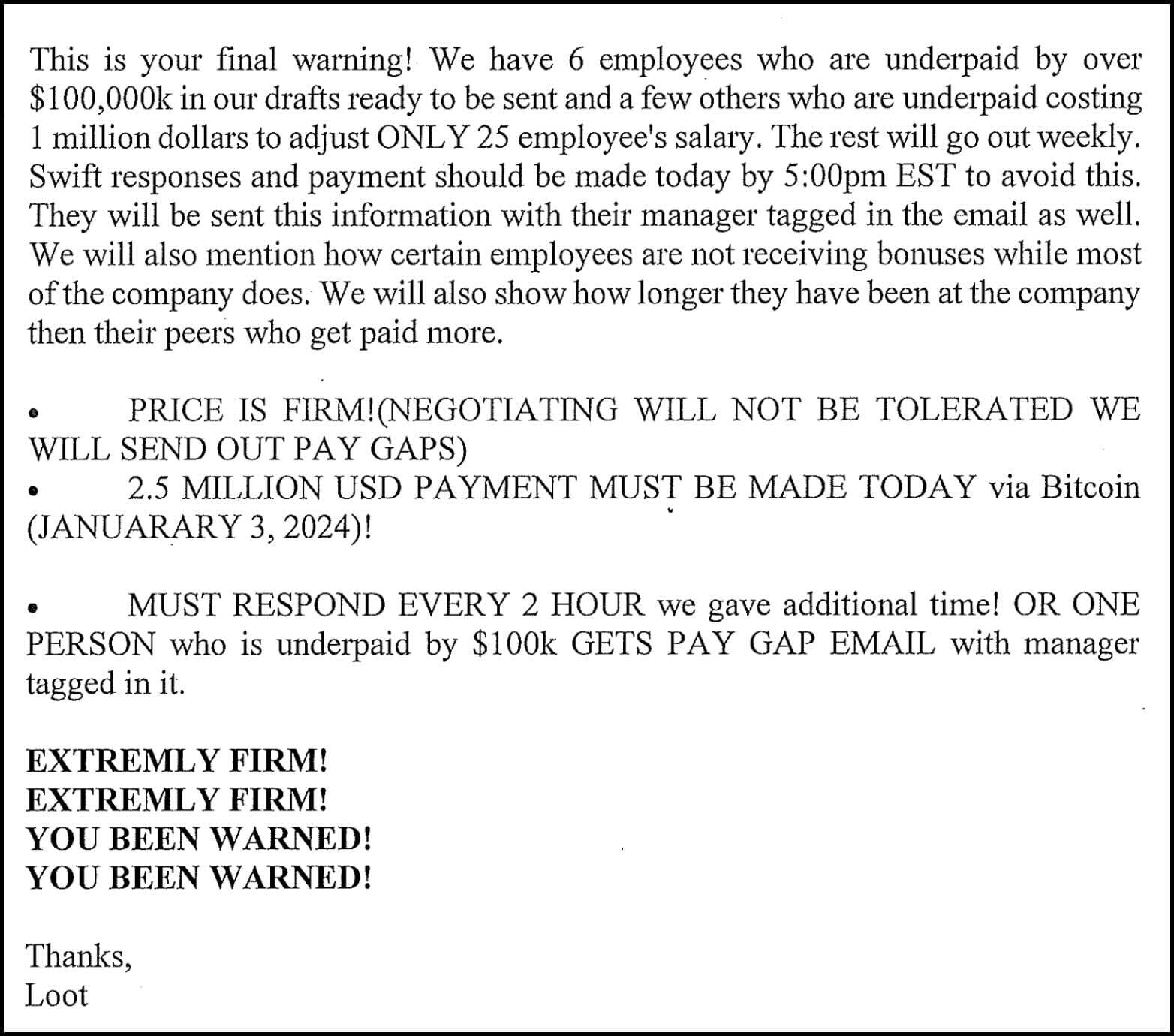
One day after his contract ended on December 10, he emailed dozens of Brightly employees using the Loot alias and the lootsoftware@outlook.com email address between December 11, 2023, and January 24, 2024, threatening to leak the stolen information unless he was paid a $2.5 million ransom in cryptocurrency.
Advertisement
“We will commence the process of disseminating salary information starting January 1, 2024 in phases to all employees and will report you to the SEC after for not reporting the breach,” Curry said in one of the extortion messages.
“If you wish to reclaim your data, we recommend doing so promptly at 2.5 million USD in order to save your company and stocks, as each subsequent month will incur a $100,000 USD increase. Discrepancies in your books are currently over 16 million USD, posing a potential risk for retention issues, a hostile work environment, resentment, and more.”
Extortion email sample (U.S. Department of Justice)
He also attached screenshots of employees’ personally identifiable information (PII), including their names, dates of birth, home addresses, and compensation information, and threatened to report Brightly to the U.S. Securities and Exchange Commission (SEC) for failing to disclose the breach.
Following Curry’s many extortion emails, Brightly paid $7,540 in Bitcoin, transferring the funds to a cryptocurrency wallet controlled by Curry.
After the company reported the incident to law enforcement, the FBI searched Curry’s residence on January 24 and seized various electronic devices containing evidence that linked him to the extortion scheme.
Advertisement
“We are aware of the U.S. Department of Justice’s (DOJ) convictions of Cameron Curry for extortion,” Brightly told BleepingComputer in March.
“We have fully cooperated with the FBI and DOJ in this matter and appreciate their investigative efforts. Given that these proceedings are pending, we defer all questions to law enforcement authorities.”
In May 2023, Brightly also disclosed a data breach (unrelated to this case) after attackers stole credentials and personal data (including names, email addresses, account passwords, phone numbers) of nearly 3 million customers and users from the database of its SchoolDude online platform.
Overall prevention scores can hide what happens after initial access. Once attackers are using valid credentials, prevention drops sharply.
The Blue Report 2026 measures defenses technique by technique across 338 million simulations run in customer production environments.






























































You must be logged in to post a comment Login