





Connect with us

Tech

Enterprise SSDs now consume 48% of global NAND flash supply

Published

on

NAND May Cry: AI data centers and hyperscale operations are coming for everyone’s NAND chips – and then some. In fact, the manufacturing industry is already realigning much of its production capacity around the needs of Big Tech and AI startups looking to sell chatbot-like experiences to subscribers.

A recent study by Counterpoint Research highlights the seismic shift the NAND flash industry is undergoing because of generative AI and chatbot services. While AI training workloads are increasingly being replaced by inference tasks, enterprise SSDs are consuming around half of the world’s entire NAND supply.

Enterprise SSDs include high-performance storage units used in data centers and AI hyperscale facilities. During the second quarter of the year, these types of solid-state storage products accounted for 48% of global NAND shipments. Enterprise shipments nearly doubled compared to 2025, when they accounted for 26%, and are expected to grow even further over the next few months.

SSDs are now in high demand for AI operations, as Big Tech looks to leverage high-capacity, high-performance storage solutions to cache the massive datasets required for AI inference workloads. Needless to say, this shift is having a significant impact on companies manufacturing NAND flash chips and the eSSDs they are ultimately used to power.

Advertisement

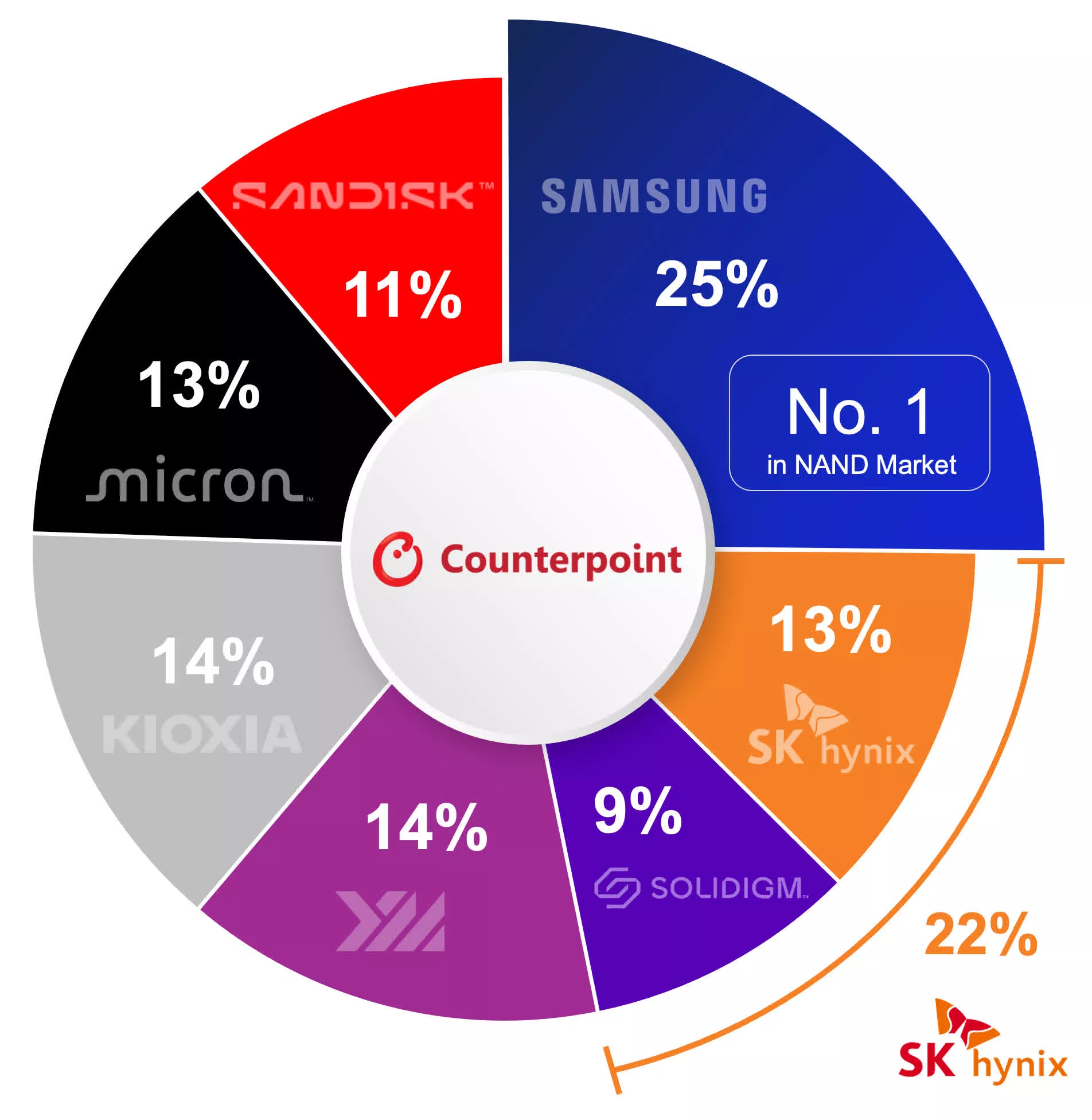
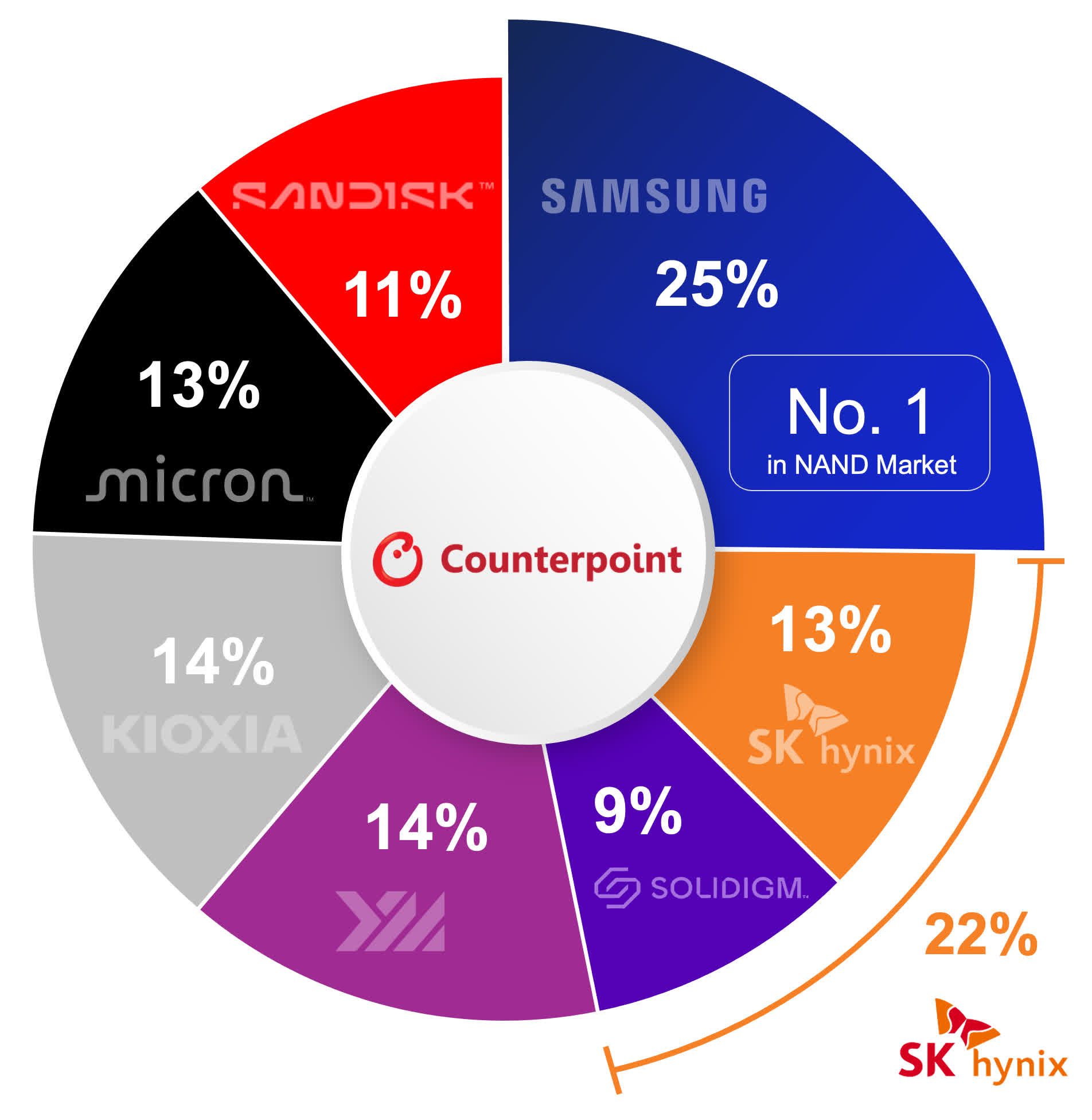
Counterpoint said Samsung retained its position as the largest NAND flash maker, with a 25% market share, while SK Hynix came second with a 22% share. The Korean device manufacturer benefited from a 40% year-over-year increase in shipments from its subsidiary Solidigm and is now looking to grow its enterprise NAND business even further.

Chinese maker Yangtze Memory Technologies saw a 22% increase in shipments, capturing 14% of the NAND flash market. YMTC is currently expanding its domestic operations thanks to its in-house manufacturing capabilities, producing 267-layer 3D NAND chips based on its proprietary Xtacking technology.

Kioxia ranked third with 14% of NAND shipments, while Micron and SanDisk followed with 13% and 11% of the market, respectively. However, Counterpoint warns that shipment volumes don’t necessarily translate into actual revenue. While YMTC ranked third in terms of chip shipments, it was only fifth in terms of revenue, behind Micron and Kioxia.

The Chinese corporation can currently benefit from the global chip shortage but is still manufacturing a mix of consumer and enterprise solid-state products. Like everyone else in the industry, YMTC is eventually expected to focus much of its upcoming production on eSSDs as it seeks to capitalize on the AI-driven spending boom.

Advertisement

Source link

Continue Reading
Click to comment

You must be logged in to post a comment Login

Leave a Reply

Tech

Lamborghini’s latest Revuelto SV puts the F in fun with a special drive mode

Published

on

Lamborghini has pushed the Revuelto deeper into supercar territory with the new Revuelto SV, adding more electric power, sharper handling and a new driving mode developed around one very specific goal: making the car more entertaining when the road gets twisty.

Revealed ahead of Monterey Car Week at Pebble Beach, the Revuelto SV brings the brand’s Super Veloce badge into Lamborghini’s electrified era. Production will be limited to 1,963 examples, a nod to the year Lamborghini was founded.

The plug-in hybrid V12 remains at the heart of the car, but Lamborghini has increased total system output by 50 horsepower to 1,050 hp. Torque rises to 1,051 lb-ft, while the high-voltage battery now stores 7.3 kWh, up from 3.8 kWh. The added energy density allows the electric motor system to produce an additional 190 kW without physically increasing the battery’s size.

More power matters, but Lamborghini wants you to feel the difference in corners

The extra output cuts the 0-60 mph time to 2.4 seconds, a tenth quicker than the standard Revuelto. Top speed exceeds 214 mph, although Lamborghini has not provided a precise figure.

Advertisement

Straight-line numbers, however, are only part of the SV formula. Lamborghini has fitted racing-inspired adjustable passive dampers, next-generation carbon-ceramic brakes and model-specific Bridgestone Potenza Race R tires. The company says the combination delivers 10% more lateral grip from the dampers alone and 13% more overall grip, while traction improves by 5% at full throttle.

Brake cooling has also been improved, with Lamborghini claiming 23% better heat dissipation and a 12% reduction in brake-disc temperatures. Those changes should matter far more on a circuit than shaving another tenth from a launch.

The biggest change for drivers may be the new Pilota mode. Developed with what Lamborghini describes as “genuine fun to drive” in mind, the mode recalibrates the ABS, traction control and stability systems. It is designed to improve braking into corners, balance and responsiveness while giving the car greater capability over curbs and jumps.

A dedicated steering-wheel rotary control activates Pilota and unlocks a five-stage traction-control system derived from Lamborghini’s GT3 race car.

The SV looks as serious as it drives

Lamborghini has also given the Revuelto a more aggressive aerodynamic treatment, with sharper bodywork, deeper creases, red detailing and a fixed rear wing. Staggered 20-inch front and 21-inch rear wheels are available with center-lock hardware.

Advertisement

Inside, lightweight carbon-fiber door panels and racing seats continue the weight-saving theme. Standard sport seats use carbon shells, while full carbon-fiber monocoque race seats will be available as options.

Lamborghini has not announced pricing, but with production capped at 1,963 cars, availability is likely to be a bigger concern than the sticker price. For buyers who can get one, the Revuelto SV represents something more interesting than another horsepower upgrade: a V12 hybrid supercar designed to make its driver work, play, and grin a little harder.

Source link

Advertisement
Continue Reading

Tech

How to watch FIH Hockey World Cup 2026: FREE live streams, schedule

Published

on

All eyes are on the Netherlands men’s team and the Belgium women’s team at the 2026 FIH Hockey World Cup, as each side has a golden opportunity to end their respective droughts in this competition. The Oranje last tasted World Cup glory in 1998, while the Red Panthers’ best result was third, way back in 1978.

Not only are they amongst the top-ranked teams at this edition of the tournament, the sides will enjoy home advantage as the World Cup is being co-hosted by the Netherlands and Belgium, in Amstelveen and Wavre respectively.

Source link

Advertisement
Continue Reading

Tech

Fosi Audio Merak review: a compact and affordable CD player with a fatal flaw

Published

on

Why you can trust TechRadar


We spend hours testing every product or service we review, so you can be sure you’re buying the best. Find out more about how we test.

Fosi Audio Merak: Review

First things first: the Fosi Audio Merak is not as portable a CD player as you might think by looking at it. Obviously it’s small (28 x 150 x 150mm, HxWxD) and light (less than half a kilogram), but though easily picked up and moved around, it requires mains power to function. So there’s no taking it out and about — unless you also take a powerbank with you, of course. No, the Merak is designed for slotting into an external system or for private domestic listening via headphones.

It manages both of these things thanks to a selection of analog and digital outputs. On the device’s front, along with some physical controls and a rather small OLED display, there’s a 3.5mm headphone socket powered by Texas Instruments TPA6120 amplification. But it’s on the rear of the machine where the bulk of the action is.

Advertisement

Source link

Advertisement
Continue Reading

Tech

Vulnerability giving attackers full control of Macs is under active exploitation

Published

on

Dutch officials have warned that a high-severity macOS vulnerability that allows attackers to execute malicious code is under active exploitation.

“The NCSC has received a notification indicating that active abuse of this vulnerability has been observed on multiple systems on which port 5900 was accessible from the Internet,” the Netherlands National Cyber Security Centrum warned earlier this week. “In all these cases, root had been accessed on the affected system and a Monero crypto miner had been placed.”

Do you know if your screen sharing is on?

The vulnerability, tracked as CVE-2026-65400, received a patch from Apple last week for macOS Tahoe, Sequoia, and Sonoma. The vulnerability, with a severity rating of 7.1 out of 10, stems from a bug in the macOS screen sharing capability, which allows a remote party to view the screen and control the keyboard and mouse while a machine is turned on. A flaw in the “state management,” which keeps track of preceding events, user interactions, variables, and other system states, is the underlying cause.

A video of the exploit in action can be found here. Details of CVE-2026-65400 became public at last week’s Black Hat security conference. Apple said last week that CVE-2026-65400 “may” allow an attacker without credentials to gain access to a Mac. It’s unclear why Apple hedged, but softening language is common among most tech developers when disclosing vulnerabilities.

Advertisement

Source link

Continue Reading

Tech

ICYMI: here’s the week’s 7 biggest tech news stories from the Google Pixel 11 launch to Honor’s revolutionary Robot Phone

Published

on

This week Google debuted its Pixel 11 tech, and Honor wowed us with a Robot Phone. Though we doubt it’s the next iPhone revolution.

To catch up on all this and more scroll down for the week’s seven biggest tech news stories, plus links to the wider picture if you’re desperate to learn more.

Source link

Advertisement
Continue Reading

Tech

Puerto Rico Is Rationing Water. It Could’ve Avoided It by Harvesting Rainwater

Published

on

Puerto Rico is experiencing a historic drought that’s led to water rationing following the driest month on record in July.

Yet one ready-made solution is barely being tapped: the normally copious rainfall. Anywhere from 30 to 169 inches of precipitation falls on the territory annually, but the government doesn’t require US citizens in Puerto Rico to install catchment systems to take advantage of the free resource—unlike some other island states. As climate change increases the odds of more intense droughts on the island, that type of decentralized infrastructure may be just what Puerto Ricans need in an emergency.

“One of the best unused reservoirs of water in Puerto Rico are the roofs of the houses,” says Fernando Abruña, a partner at local firm Abruña & Musgrave Architects.

The drought has exacerbated a water crisis that was already in motion due to ruptured water pipes and other decrepit infrastructure. For the past week, Puerto Rico governor Jenniffer González has ordered municipal governments to shut off water two days at a time for people in the northeast to conserve local supplies, leaving 180,000 households with limited access. The problems began well before that, though: Many families have been without consistent water for more than 100 days.

Advertisement

While the drought is a factor, the biggest issue isn’t a lack of water, says environmental lawyer Ruth Santiago, but rather the government’s mismanagement of it.

“Even with the climate crisis and these droughts, we still have abundant water,” says Santiago, who works with the local group Comité Diálogo Ambiental (the Environmental Dialogue Committee). “We could be harvesting rainwater right now,” she says as a storm erupts mid-conversation.

The most resilient harvesting systems rely on gravity, using gutters to divert rainwater from a roof to a canister that connects to indoor pipes like a faucet or showerhead. Bigger systems can help collect water to cool power plants and other industrial uses.

Abruña, who is also a fellow with the American Institute of Architects, estimates the island could gather 30 billion gallons of water a year if just 1 million households used rainwater collection technology. The average resident uses 62 gallons a day, amounting to just over 72 billion gallons of residential water use a year.

Advertisement

The Puerto Rico Aqueduct and Sewer Authority loses about 60 percent of the island’s drinking water before any arrives at customers’ homes due to leaking pipes and failing infrastructure. The ongoing emergency was caused, in part, by a series of ruptures in the 72-inch Superaqueduct water pipe, a main artery that services major cities on the northern coast. Repairing and updating the island’s aging water distribution system is most urgent, Santiago says, but rainwater harvesting is a cost-effective solution that can be quickly implemented.

The practice is not widespread in Puerto Rico, where the government has prioritized centralized grids fed by freshwater, but these systems are popular in other island communities. Roughly 90 percent of homes in the US Virgin Islands have a cistern to collect rainwater, and the territory has building codes that require many new developments to include this infrastructure. (Barbados has similar codes.) In Hawaii, Honolulu County even offers a limited number of free rain barrel installations to residents.

“There is nothing that can help the Caribbean region as quickly and as reliably as rainwater harvesting,” says Farah Nibbs, an assistant professor at the University of Maryland Baltimore County’s Department of Emergency and Disaster Health Systems, noting governments should treat it “as part of the national water supply.”

She also says governments should help cover the costs to avoid putting onerous “economic and financial burdens on households.” Yet in Puerto Rico, the government offers no incentives or financial assistance. That’s left small organizations attempting to meet demand.

Advertisement

Source link

Continue Reading

Tech

Dev Kills Cloud Version Of Game On Switch, Offers Discount To Rebuy It For Switch 2

Published

on

from the chutzpah dept

We’ve talked a great deal about the Stop Killing Games movement and those discussions have typically traveled along two paths of importance.

On the one hand, the movement is very important to those of us that care about the preservation of video games. A huge problem with allowing developers and publishers to simply shutdown backend servers needed to run games that were designed to require those same server is that those games simply disappear in their original form. If we accept that video games are both art and culture, and I don’t think either is particularly arguable at this point, allowing shared culture to disappear before it enters the public domain is an unacceptable violation of the bargain that is copyright to begin with. In those instances, developers and publishers got their monopoly, but negated the part where said monopoly is supposed to be limited in nature, with the art ending up in the public domain.

The second path of importance is that of the rights of the individual consumer. The public in large part believes it’s buying a game when it makes these purchases. And, yes, the truth buried in terms of service and other legal documents is that in many cases the public is only buying a limited license to play the game, one which the publisher can revoke in part or whole at any time by shutting down support for the product. But if you think that this fact somehow makes none of this a problem, you’re a corporate boot-licker and you should be ashamed of yourself. Sometimes these shutdowns happen very shortly after the game is released and promises of refunds to those that paid for them can be fleeting.

But, man, if you think it’s bad for a developer or publisher to not make good on refunds of a purchased game it shut down, wait until you get a load of Cold Iron Studios, which recently shutdown the cloud-only version of Aliens: Fireteam Elite on the Nintendo Switch.

Advertisement

Following its announcement in March, game developer Cold Iron Studios has shut down the servers for the cloud version of Aliens: Fireteam Elite on the Nintendo Switch. The game originally cost $30 (or $60 for an “Ultimate” version with additional content).

Cold Iron Studios hasn’t offered customers refunds.

TheGamer reported that affected players are entitled to a discount for the Nintendo Switch 2 version of the game, which is a 2021 co-op, third-person shooter based on the Alien film franchise. However, that would mean paying money for a game that you have already paid money for once.

There’s chutzpah, and then there’s fucking chutzpah. The developer ripped away the ability to play a game that people spent money on. Then, rather than offering refunds, they instead offered to sell the game again to those same customers on the new console for a slightly lesser price. That isn’t giving your customers the middle finger. It’s gather up an entire city’s worth of middle fingers and jamming them up your customers’ noses and then asking them to pay for it.

Now, nobody thinks that this version of the game was bought in massive numbers on the original Switch. But I don’t really see how that matters. If you sell something to someone, then take it away, you should return the money you got for it. If you’re hiding behind the “it’s just a license” mantra, then you’re telling the public not to trust you. And maybe simply to not trust digital purchases entirely. And, given some other recent news, that becomes a pretty big problem.

Advertisement

When companies erase digital copies from people’s libraries and make games harder to access, the recent uproar over the announcement that there won’t be physical discs made for PlayStation games as of January 2028 makes sense.

The folks at Stop Killing Games have this exactly right, because situations like this are not only untenable, but the lack of action is making these companies all the more brazen. The audacity of taking something away from a customer and trying to get them to pay for it again is breathtaking.

As is the unwillingness to act on the part of our government and consumer rights groups.

Filed Under: aliens: firestorm elite, ownership, stop killing games, video games

Companies: cold iron studios

Advertisement

Source link

Continue Reading

Tech

Meta Patents AI Glasses to Use Facial Recognition to Identify People, Make Highlight Reels of Your Dinner Party

Published

on

Meta has patented a smart-glasses system that could use facial recognition to identify people and automatically create personalized highlight reels of events such as dinner parties. The patent doesn’t guarantee the feature will ship, but it offers a detailed look at how Meta is exploring facial recognition and AI-powered memory capture for its wearable devices. 404 Media reports: “I’ve generated some highlights of tonight’s dinner party. Would you like to see them?” a prompt from the system says, alongside various thumbnails of what look like people laughing, according to one illustration in the patent. One section says the system may personalize highlight files using “user relationship data.” The illustrations clearly show a person wearing a pair of glasses, looking at a group of people, then the glasses focusing on one or more people in particular.

Patentlyze, an organization that tracks patents, first alerted 404 Media to the patent on Friday. The patent is dense with how such a system would work, but in sum, the system with one or more cameras receives an input from the user, then uses machine-learning and “sensory data” to figure out points of interest in the camera’s field of view. That can include detecting people in the shot “based on one or more facial recognition algorithms,” identifying those specific people, detecting their facial expressions, using “eye gaze data of the user captured by the client system,” and figuring out other points of interest “based on scene and semantic understanding.”

Although the patent is for “particular camera-based tasks by particular systems in a particular manner” — in this case, the company’s smart glasses — Meta writes it “contemplates assisting users in any suitable camera-based task by any suitable system in any suitable manner.” Meaning that although this technology is focused on the glasses, maybe the company will use it for other purposes in the future.

Read more of this story at Slashdot.

Advertisement

Source link

Continue Reading

Tech

A Tape Deck Gets A Service

Published

on

If there’s an engineer’s equivalent to those YouTube ASMR videos, then perhaps it comes in a good repair or servicing journey filmed without edits at the bench. Relaxing to watch, has an interesting outcome. So it is with [Ken’s Shop], as he performs a full service on a Realistic cassette deck from we are guessing, the late 1970s or early 1980s.

These decks are nothing particularly special and can be found wherever second-hand consumer electronics go to die, but compared to may newer electronic devices they are surprisingly well-built. Their decades-old mechanicals usually only need a good clean and lubricate, their belts may need replacing, and perhaps the azimuth needs a tweak, but returning them to their former glory is rarely more than a bench session away.

So this is what we get, a relaxing twenty minutes or do of watching a guy fix a tape deck. A chuckle came here at Hackaday from our colleague Al passing this on, we agree with his not missing working on this type of deck as they could be fiddly. But still, if you find one of these and want it, they’re fixable with relative ease.

Advertisement

Source link

Advertisement
Continue Reading

Tech

Tensor G6 explained: What Google’s chip actually means for your Pixel

Published

on

The newly announced Pixel 11 series all run on the same Tensor G6 chip – Google’s latest mobile processor.

But what is Tensor G6 and how does it differ from its predecessors? Will Tensor G6 be faster and better than before?

We explain everything we know about Google Tensor G6, including how it compares to its competitors and where its strengths are likely to lie. 

For more on the Pixel 11 series, visit our Pixel 11 vs Pixel 11 Pro, Pixel 11 Pro vs Pixel 11 Pro Fold and Pixel 11 Pro vs Pixel 11 Pro XL guides. Finally, if you want more of an overview on our current favourite devices, our best smartphone guide has you covered.

Advertisement

SQUIRREL_PLAYLIST_10208690

Advertisement

What is Tensor G6?

Tensor G6 is Google’s latest mobile chip that’s found within the entire Pixel 11 line-up, from the entry-level Pixel 11 to the Pixel 11 Pro Fold. Google promises that Tensor G6 is its “fastest, most powerful chip yet”, with an upgraded CPU that claims 25% faster web browsing and 15% quicker app launches than last year’s Tensor G5 processor.

Although it promises to be faster than before, you shouldn’t expect its performance to match the likes of Qualcomm’s Snapdragon 8 Elite Gen 5 or Apple’s A19 chips. Like previous Tensor iterations, Google prioritises AI smarts over processing power and speed, as it is designed to run advanced AI models – specifically Gemini Nano.

Advertisement

In fact, Tensor G6 sports the latest Gemini Nano model, and Google claims it can process on-device AI tasks up to 3.5 times faster while using up to 3.5 times less energy than its predecessor. That means we can expect Gemini Intelligence tools to run quickly and smoothly too.

Tensor G6 also powers some of Google’s “most advanced” camera experiences, including Pro Zoom which allows you to get up to 120x closer – although only the Pixel 11 Pro and 11 Pro XL support this. Not only that, but Tensor G6 has an upgraded ISP (Image Signal Processor) that promises to improve low light photography and enable Night Sight to capture shots faster, without losing quality. Of course, the handsets’ sensors also play a part in this.

Pixel 11 Pro in handPixel 11 Pro in hand
Pixel 11 Pro in hand. Image Credit (Google)

Is Tensor G6 good for gaming?

As we haven’t reviewed the Tensor G6 yet, we can’t confirm whether or not it’s good for gaming. However, considering we found Tensor G5 struggled when loading games, we don’t expect Tensor G6 to compete with the best gaming phones.

Advertisement

Essentially, we found that although the Tensor G5 could power games, the Pixel 10 in particular became quite warm in the process and drained battery faster too. It was a similar story with the Pixel 10 Pro XL which handled casual games but struggled with more intensive titles like Wuthering Waves and Genshin Impact.

Advertisement

Will Tensor G6 be faster?

Google promises that Tensor G6 will be 25% faster than Tensor G5 at web browsing and 15% faster at launching apps too. In addition, it claims to run on-device AI tasks up to 3.5 times faster too.

We should disclaim that we haven’t reviewed any of the Pixel 11 series yet, so haven’t tested Tensor G6 for ourselves just yet. Once we do, we’ll be able to verify these claims.

Source link

Advertisement
Continue Reading

Trending

Copyright © 2025