




Connect with us

Business

Morgan Stanley initiates Target Hospitality stock at overweight

Published

on

Continue Reading
Click to comment

You must be logged in to post a comment Login

Leave a Reply

Business

OceanaGold enters WA with $776m Ausgold buy

Published

on

OceanaGold enters WA with $776m Ausgold buy

Yes. Corporate subscriptions are available for teams and organisations, with discounted rates as user numbers increase. Pricing starts from $1,625 + GST per user.
Get in touch
to discuss the right option for your organisation.

Business News subscriptions are used by executives, investors, consultants and professionals who need to stay informed and make better decisions about the WA market. When you subscribe you’ll get

  • Unlimited access to WA’s most trusted business journalism
  • Data & Insights — detailed profiles of WA companies, people, projects and deals
  • MyBN — a personalised feed based on the companies, people and sectors you follow
  • Special publications and industry reports
  • Daily and weekly email newsletters

Data & Insights is a research tool built specifically for the WA market. It draws on more than 30 years of Business News reporting, updated regularly to reflect what’s happening now. Use it to:

  • Look up detailed profiles of WA companies, including financials, directors and ownership
  • Find decision-makers and track their career movements
  • Research live and completed projects across WA industries
  • Monitor deals, appointments and market activity
  • Access industry rankings and league tables

Data & Insights is updated daily by our dedicated research team, which uses the latest announcements, ASX filings and editorial coverage to keep our person, company, list and project records up to date.

Business News welcome all opportunities to make our dataset accurate, complete and current, so if you have an update request, please email the team at
general@businessnews.com.au, and we’d be happy to assist.

Advertisement

MyBN
is part of every subscription. It’s your personalised view of Business News. You can follow the companies, people, sectors and projects that matter to you, and get a news feed and alerts tailored to your interests. You can save articles to read later and retain only what you need.

Only subscribers have full access to all content on the Business News website.

Advertisement

If staying informed about the WA economy is part of your job, and/or you’re looking for networking opportunities in WA, Business News is built for you.

Business News subscribers are:

  • Executives and directors tracking competitors, clients and market movements
  • Investors and advisers researching companies, deals and industry trends
  • Consultants and professionals staying across sectors relevant to their clients
  • Business owners looking for leads, context and market intelligence

Most Business News publications cover national or global markets. Business News is focused entirely on Western Australia, which means the journalism, the data and the intelligence are all built around WA companies, people and projects — not adapted from a national feed. Data & Insights, included with every subscription, combines more than 30 years of WA-specific editorial research with live business data. There’s no comparable product for the WA market.

Advertisement

The Morning Digest Email provides a comprehensive wrap of the major headlines, relevant to WA business, and includes with a snapshot of the overnight news covering oil, gold and ASX-listed companies.

The Afternoon Wrap Email focuses on the news covered by our team of journalists during the course of the working day, including exclusive stories and analysis, all of which relates to WA business and the local economy.

The BN Weekender Email contains a wrap of the Business News from the week that was, highlighting the top stories in each area of WA business.
Sign up for free.

Advertisement

We’re happy to help.
Get in touch
and our team will come back to you.

Advertisement
Continue Reading

Business

FTSE 100 Climbs 0.12% to 10,763 as Soft US Retail Data Trims Federal Reserve Rate Hike Bets

Published

on

Tesla's robotaxi launch in Texas comes as Elon Musk focuses on his business ventures following his stint in Washington

LONDON — Britain’s FTSE 100 index advanced modestly on Monday, recovering some ground after its first weekly decline in five weeks, as weaker-than-expected U.S. retail sales data reduced expectations for near-term Federal Reserve interest rate increases.

The blue-chip index was last trading at 10,763.14, up 13.03 points or 0.12% as of 10:06 a.m. GMT+1. The move followed a Friday close of 10,750.11, when the index fell 0.2% and logged a weekly loss of about 1.4%.

Investors pointed to Friday’s U.S. retail sales report, which showed a 0.6% month-on-month decline in July. The figure missed expectations of a 0.1% rise and marked the steepest drop since May 2025. The data, combined with softer recent payrolls and producer price readings, led markets to scale back the implied probability of a September rate hike. Treasury yields eased and the dollar softened, supporting risk sentiment into the new week.

Mining stocks helped lift the FTSE 100 in early trade as industrial metal prices firmed. Glencore, Anglo American and Antofagasta ranked among the stronger performers in the session’s initial rankings, reversing some of the pressure that weighed on the sector last week. The FTSE 350 industrial metals and mining group had posted its weakest weekly performance since late June after copper prices pulled back and production outlooks disappointed.

Advertisement

Software and data-related names also contributed to the rebound. Shares in Sage Group, Experian and RELX had climbed on Friday after reports of private equity interest in U.S. software firm Workday, and the sector retained some of that momentum. Pharmaceutical heavyweights showed mixed moves, with AstraZeneca among the gainers in early rankings while other names lagged.

Sterling firmed against the dollar, trading near $1.356. Broader European markets were mixed, with Germany’s DAX and France’s CAC 40 little changed or slightly lower in early dealings. Asian equities had finished mostly higher overnight, providing a supportive backdrop for the London open.

The FTSE 100 remains well clear of levels seen a year earlier. The index has advanced roughly 17% over the past 12 months and sits more than 8% higher year to date, though it has given back some ground in August. Its 52-week range stretches from approximately 9,107 to a recent high near 10,989. The index last closed above 10,900 in early August before the recent pullback.

Market participants noted that last week’s decline interrupted a sustained summer advance that had pushed several European benchmarks toward or through record territory. Analysts have described the recent softness as potentially reflecting profit-taking after a strong run, with attention now focused on whether U.S. data continue to cool rate-hike expectations or whether energy prices and geopolitical developments reintroduce caution.

Advertisement

Oil markets remained a key variable. Crude prices had been supported in recent sessions by concerns over shipping through the Strait of Hormuz, though any progress toward de-escalation could ease inflationary pressure and further reduce the likelihood of aggressive central-bank tightening. Gold held near multi-year highs, reflecting residual safe-haven demand.

Domestically, attention also turned to the UK housing market. Rightmove data showed asking prices falling 2% month-on-month in August to an average of £364,999, the largest August decline since 2018 and the sharpest annual drop since December 2023. The figures added a cautious note to the domestic economic picture even as equity markets focused on global rate expectations.

Volume on the FTSE 100 remained relatively light in the early session, consistent with typical summer trading conditions. The mid-cap FTSE 250 had ended the previous week largely flat and showed modest gains in early Monday trading, continuing a pattern of relative resilience compared with the large-cap index in recent weeks.

Looking ahead, investors will monitor further U.S. economic releases and any updates on monetary policy from the Federal Reserve and the Bank of England. The FTSE 100’s heavy weighting toward global miners, energy companies and consumer-facing firms leaves it sensitive to both commodity price swings and shifts in interest-rate expectations.

Advertisement

The index’s composition, dominated by multinational companies with significant overseas earnings, has supported its performance through periods of sterling volatility. Dividend yields near 3% continue to attract income-focused investors even as valuation multiples remain elevated relative to longer-term averages.

Monday’s advance, while modest, marked a shift in tone after five sessions of pressure. Whether the rebound extends will depend on the path of U.S. data, commodity markets and broader risk appetite as the summer trading period draws toward its close. For now, the FTSE 100 has stabilized near the 10,760 level, reclaiming a portion of the ground lost in the prior week.

Continue Reading

Business

Ronaldo and Messi Both Hint at Retirement as Storied Soccer Rivalry Nears Its Emotional Final Chapter

Published

on

ronaldo messi

MADRID — The two-decade rivalry between Cristiano Ronaldo and Lionel Messi, widely regarded as the defining sporting duel of a generation, appears to be approaching its conclusion, as both players have separately signaled in recent days that retirement may be close at hand, driven by starkly different personal circumstances.

Ronaldo, in an interview with Vogue published Sunday, said the current season could mark the end of his playing career. “This is probably my last year of football, and I want to leave a spectacular legacy,” the 41-year-old Al Nassr forward and Portugal captain said. The remarks came just days after Ronaldo formally married his longtime partner, Georgina Rodriguez, following a relationship of roughly a decade, a milestone that has fueled speculation that the Portuguese star is preparing to shift his focus toward a more settled family life once his playing days conclude.

Ronaldo elaborated on his plans for life after football, describing a desire to fill the void the sport’s absence would leave in his daily routine. “Since the void left by soccer could be very large, I need to fill my time in various ways,” he said, adding that he expected to remain busy well beyond his final match. He pointed specifically to leisure pursuits and family time as priorities for the next phase of his life. “I want to enjoy more, travel frequently, play and watch padel, which I truly love,” Ronaldo said, referencing the racket sport that has grown increasingly popular among athletes and celebrities in recent years. He also reflected on the sacrifices of his playing career, saying he hoped to make up for lost time with those closest to him. “As the past 25 years involved many sacrifices, I want to fully enjoy what my family and I have achieved during that time,” he said.

Despite the retirement signal, Ronaldo’s actual departure from the sport may hinge on a specific personal milestone he has pursued for years: reaching 1,000 career goals. Since turning professional in 2002, Ronaldo has scored 976 goals for club and country combined, leaving him 24 short of the landmark figure. Given his well-documented determination to reach that number before stepping away, multiple outlets covering the story have suggested his actual retirement is likely to be timed around the achievement of that milestone, rather than the end of the current season strictly by the calendar. Ronaldo’s contract with Al Nassr runs through June 2027, giving him a window beyond this season in which to continue pursuing the record if needed.

Advertisement

Messi’s retirement signal emerged from a far more painful set of circumstances. The Inter Miami forward’s father, Jorge Messi, who had also served as his longtime agent and one of the most influential figures throughout his career, died on Aug. 7 at age 68 after a long illness. Messi shared a lengthy, emotional tribute to his father on Instagram in the days that followed, offering an unusually candid look at his grief and expressing serious doubt about his footballing future.

“Dad, I still can’t believe you’re gone. It hasn’t sunk in, or rather, I don’t want it to sink in,” Messi wrote in the letter, which also detailed the difficult circumstances surrounding his father’s declining health during this year’s World Cup, held across North America. Messi described how his father had continued urging him to compete in the tournament even as his condition worsened, and how the family had held out hope that Jorge might still be well enough to travel and watch him play. Argentina ultimately reached the tournament’s final in New York before losing 1-0 to Spain, a run Messi had hoped would allow him to bring his father one more moment of triumph. “I wanted to win it to bring it to you and show you a new one. I couldn’t, my legs couldn’t take it anymore,” Messi wrote, reflecting on the physical toll the tournament had taken on him during an emotionally taxing period.

The most striking portion of Messi’s letter addressed his uncertainty about continuing to play the sport that has defined his life. “I don’t know what I’ll do without you, I don’t know how to go on. I have just been playing soccer, and now I’m not sure if I can continue this much longer,” he wrote, a passage that immediately raised widespread speculation across the football world about whether the 38-year-old eight-time Ballon d’Or winner might be nearing the end of his professional career.

Jorge Messi had guided his son’s career from Lionel’s earliest days playing in Rosario, Argentina, through his rise at Barcelona and subsequent moves to Paris Saint-Germain and Inter Miami, serving as both father and agent throughout nearly the entirety of Messi’s professional journey. His death drew an outpouring of tribute and condolence from across the sport, including from longtime rival Ronaldo, along with players such as Neymar, Luka Modrić and Carlos Alcaraz, illustrating the degree of respect the elder Messi commanded throughout the football world well beyond his son’s own accomplishments.

Advertisement

Since his father’s death, Messi has continued to lean on his immediate family for support during what he has described as an exceptionally difficult period, including his wife, Antonela Roccuzzo, and his three children. He has also continued to play for Inter Miami in Major League Soccer, though his form has appeared to reflect the emotional toll of recent weeks; in an MLS match against Nashville SC on Aug. 15, Messi missed a penalty kick and appeared visibly distressed on the field afterward.

Whether either player follows through on retirement in the near term remains to be seen, and neither has provided a definitive final date for stepping away from professional football. Ronaldo’s path appears tied to a specific numerical milestone he has pursued for years, while Messi’s future remains far more uncertain, shaped by grief rather than by any predetermined athletic target. Together, the two developments have prompted extensive reflection across the football world about the eventual close of a rivalry that has shaped the sport’s global narrative for more than 15 years, spanning multiple World Cups, numerous Ballon d’Or contests and some of the most closely followed individual comparisons in the history of professional sports.

Continue Reading

Business

Sainsbury’s pauses London store’s AI cameras after man ousted

Published

on

Close-up portrait of Matt Arnold, a man with light brown hair tied back, glasses, and a beard, wearing a white t-shirt outside with a Sainsbury's store blurred in the background.

Sainsbury’s highlighted recent British Retail Consortium figures showing 1,600 daily incidents of violence and abuse against shopworkers nationwide, up significantly from 455 a day in 2019-20.

The retailer added that initial trials of the facial recognition system across two stores resulted in a 46% reduction in logged incidents of theft and anti-social behaviour, with over 90% of offenders not returning.

Silkie Carlo, the director of civil liberties group Big Brother Watch, has called for Sainsbury’s to scrap the technology, arguing that it is “treating customers like criminals”.

“Serious mistakes like this are inevitable when a national retailer does hundreds of thousands of ID checks indiscriminately with this sinister surveillance tech,” she said.

Advertisement

Arnold, who donated a £150 goodwill voucher from Sainsbury’s to a local food bank, questioned why the system remains active elsewhere.

“If they’re suspending it in this East Dulwich store, they are conceding there’s a problem with it. Why aren’t they suspending it in every store?”

Listen to the best of BBC Radio London on Sounds and follow BBC London on Facebook, external, X, external and Instagram, external. Send your story ideas to hello.bbclondon@bbc.co.uk, external

Advertisement
Continue Reading

Business

Google Shuts Down 449 Korean YouTube Channels for Coordinated ‘Opinion Manipulation’ Before Elections

Published

on

YouTube

SEOUL — Google shut down 449 Korean-language YouTube channels during the second quarter of this year after determining they had engaged in coordinated efforts to manipulate public opinion around domestic political issues, with the vast majority of the closures occurring in the weeks immediately preceding South Korea’s June 3 local elections.

According to Yonhap News Agency and South Korea’s information and communication technology industry, Google’s Threat Analysis Group released its “Q2 2026 Influence Operations Report” on July 31, detailing the scale and timing of the takedowns. The report found that Google blocked a total of 449 Korean-language channels between April and June, with 22 channels removed in April, 367 in May and 60 in June.

The concentration of closures in May was especially notable, accounting for 81.7% of the total channels removed during the entire quarter, timing that placed the bulk of the enforcement action just weeks ahead of South Korea’s nationwide local elections. Among the channels taken down in May, the largest single category consisted of 142 channels that had posted content critical of the South Korean government, according to the report.

A more detailed breakdown of the May closures showed a range of political leanings represented among the removed channels. Beyond the 142 channels critical of the government, 71 channels were found to have supported the government, 58 channels supported specific politicians, 53 channels simultaneously criticized both the government and specific political parties, and 43 channels combined support for the government with criticism of specific parties, according to reporting based on the Google report’s findings.

Advertisement

Google determined that the channels had engaged in what the company described as “unauthentic coordinated behavior,” a term the company uses to characterize campaigns in which multiple accounts are mobilized to create the appearance of independent, organic activity by individual users, while in fact working in concert to improperly influence the formation of specific political narratives. When accounting for the full quarter using a broader classification method that grouped channels by their overall stance toward the South Korean government, 255 of the removed channels were found to contain content critical of the government, while 151 channels contained content supportive of the government, according to Korean-language reporting on the underlying data.

Unlike its influence-operations reporting on campaigns linked to China, Russia and Iran, Google did not disclose the specific countries or organizations believed to be behind the Korean-language takedowns, nor did the company release the names of the individual channels that were removed, according to the Asia Business Daily’s reporting on the disclosure. That lack of attribution leaves open questions about who was responsible for organizing the coordinated activity, even as the scale and timing of the removals point clearly toward an effort to influence domestic political discourse ahead of a major election.

The scale of the Korean-language enforcement action stands out in part because of its novelty within Google’s broader influence-operations reporting. According to the Free Press Journal’s coverage of the disclosure, Google had not previously terminated any South Korean YouTube channels for this type of coordinated influence activity between the second quarter of 2025 and the first quarter of 2026, marking the second quarter of this year as the first period in which Korean-language content became a significant target of this specific enforcement category. By comparison, over that same earlier stretch, Google reported shutting down 9,173 channels linked to influence operations originating from China and 2,083 channels linked to Russia, underscoring how much larger those two countries’ documented influence campaigns have been relative to the newly identified Korean-language activity.

The disclosure comes amid a broader period of scrutiny facing major U.S. technology companies operating in South Korea. Just last week, the country’s media watchdog, the Korea Media Communications Commission, concluded that both Google and Apple had violated South Korean law by abusing their dominant positions within their respective app marketplaces. According to the commission, the two companies were found to have circumvented a 2021 revision to the country’s telecommunications business act, a law designed to prevent large app marketplace operators from requiring developers to exclusively use the platform’s own in-app payment systems. The commission said the specific level of sanctions against the companies would be determined at a later date, following the initial finding of violations.

Advertisement

Google’s influence-operations reports, published on a regular basis by the company’s Threat Analysis Group, have historically served as one of the primary public sources of information regarding coordinated, inauthentic political activity detected across Google’s platforms, including YouTube. The reports typically categorize removed content by country of origin and by the nature of the coordinated activity involved, though the company’s disclosure practices vary depending on how confident its investigators are in attributing specific campaigns to particular actors or organizations.

The timing of the Korean-language closures relative to the June 3 local elections is likely to draw continued attention from South Korean election officials, political parties and civil society organizations concerned about the integrity of online political discourse ahead of future elections. South Korea has in recent years faced growing scrutiny over the role of online platforms in shaping political narratives, particularly as political polarization within the country has intensified and as domestic political actors have increasingly turned to platforms such as YouTube to reach voters directly, outside the framework of traditional broadcast and print media.

Google has not publicly indicated whether it plans to release additional details regarding the specific actors behind the Korean-language influence campaign identified in its second-quarter report, nor has the company said whether similar coordinated activity has continued or evolved following the removal of the 449 channels in question. The company’s quarterly influence-operations reports are expected to continue tracking developments in this area, offering periodic updates on the scale and nature of coordinated inauthentic activity detected across its platforms in South Korea and other countries around the world.

Advertisement
Continue Reading

Business

Georgia Well Positioned For Sustainable Growth – AFC On The Road – Georgia – June 2026

Published

on

Georgia Well Positioned For Sustainable Growth - AFC On The Road - Georgia - June 2026

This article was written by

Asia Frontier Capital Ltd. is a pioneering fund management company that specializes in investing in high growth Asian frontier economies by managing the AFC Asia Frontier Fund, AFC Iraq Fund, AFC Uzbekistan Fund and AFC Vietnam Fund. The investment objective of AFC Asia Frontier Fund is to achieve long term capital appreciation by investing in public equities of Asian frontier countries (Bangladesh, Bhutan, Cambodia, Georgia, Iraq, Kazakhstan, Kyrgyzstan, Laos, Maldives, Mongolia, Myanmar, Nepal, Pakistan, Papua New Guinea, Sri Lanka, Uzbekistan and Vietnam) that are seeing increasing consumption due to favorable demographic trends, rising incomes and high GDP growth. The AFC Iraq Fund was launched on the 26th June 2015 and aims to achieve long-term capital appreciation for investors by capturing value and growth potential in the post conflict high-growth & resource rich Iraq market. The fund emphasises long term investment horizon to truly capture the opportunity in Iraq. The fund’s investable universe consists of locally listed companies that have their principal business activities in Iraq as well as foreign listed companies that have the majority of the business in Iraq as a whole including the prosperous Kurdish Region of Iraq (KRI). The AFC Iraq Fund offers access to investments in post conflict recovery potential of Iraq, including the KRI, and/or stability in its territory. The AFC Iraq Fund is managed by Asia Frontier Capital (Iraq) Limited, Cayman Islands under the executive leadership team of Thomas Hugger (CEO & Fund Manager) and Ahmed Tabaqchali (CIO) who have more than 47 years of investment experience as well as an extensive background covering global, emerging, frontier and MENA markets AFC Vietnam Fund invests exclusively in Vietnamese equities to capture value in growth companies; especially in the small to medium size company segment. The AFC Uzbekistan Fund invests exclusively in listed equities from Uzbekistan.

Analyst’s Disclosure: I/we have no stock, option or similar derivative position in any of the companies mentioned, and no plans to initiate any such positions within the next 72 hours. I wrote this article myself, and it expresses my own opinions. I am not receiving compensation for it. I have no business relationship with any company whose stock is mentioned in this article.

The AFC Asia Frontier Fund holds BGEO LN (Lion Finance Group) and TBCG LN (TBC Bank Group), both of which have been mentioned in the article.

Advertisement

Seeking Alpha’s Disclosure: Past performance is no guarantee of future results. No recommendation or advice is being given as to whether any investment is suitable for a particular investor. Any views or opinions expressed above may not reflect those of Seeking Alpha as a whole. Seeking Alpha is not a licensed securities dealer, broker or US investment adviser or investment bank. Our analysts are third party authors that include both professional investors and individual investors who may not be licensed or certified by any institute or regulatory body.

Continue Reading

Business

Rise in the value of commercial property investment deals in Wales

Published

on

Business Live

Property advisory firm Knight Frank have crunched the numbers for the second quarter of this year.

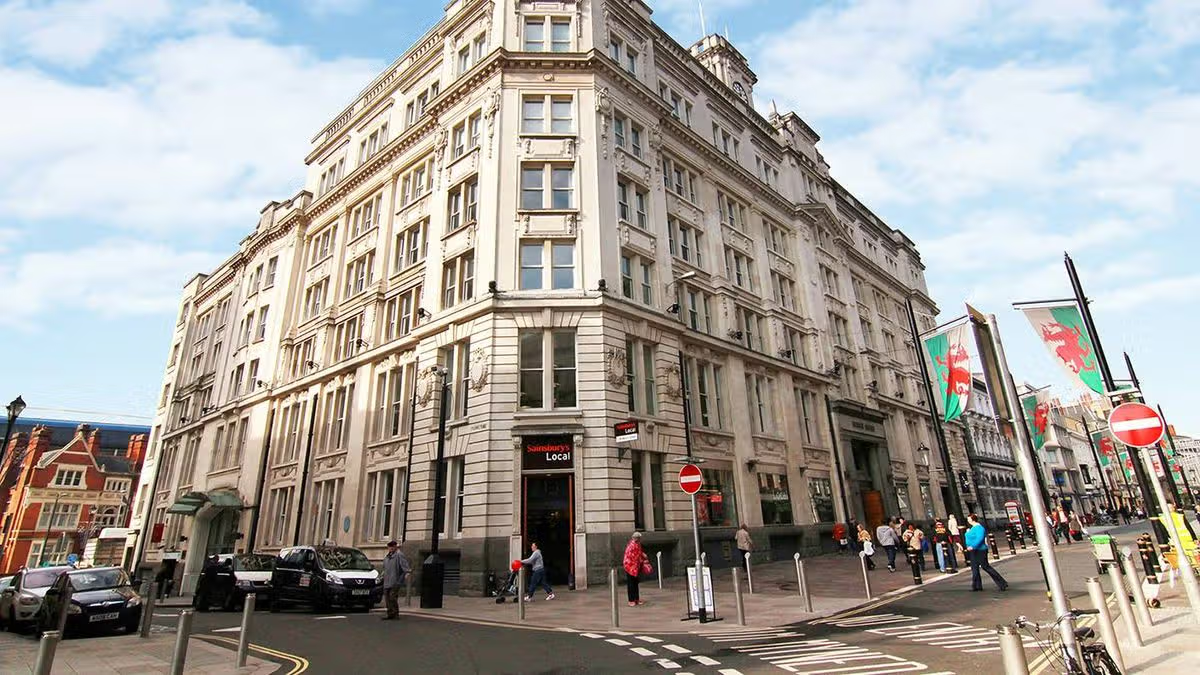
Hodge House on St Mary Street in Cardiff

The standout deal on value for the sale of Hodge House.(Image: WalesOnline)

Property companies (propcos) and high-net-worth investors helped Wales buck the wider UK trend to deliver a positive second quarter for investment in commercial property, according to new figures from Knight Frank.

Analysis from the property advisory firm found that nearly £72m was invested in Welsh commercial property between April and June – up 67% on £43m during the same time last year. It was the highest level since £103m in 2020.

Advertisement

Private investors – predominantly made up of propcos and high-net-worth individuals accounted for 61% of investment in the first six months of the year, well ahead of international buyers who were the next most active group at 21%. That was also far above private investors’ average market share of 24% between 2020 and 2025.

French open-ended commercial property funds known as Société Civile de Placement Immobiliers (SCPIs) made up the vast majority of international investment. They were behind the purchases of Kestrel House in Cwmbran and 5-10 Church Street in Cardiff, home to well-known restaurant chains the Botanist, Honest Burger, and Mowgli.

The second quarter’s strong performance was buoyed by the sale of the grade A Hodge House office building in the centre of Cardiff to SevenCitiesLdn in a £30m plus deal. Outside of the capital there were just under £22m of deals, largely for industrial and warehouse units in South Wales, including the sale-and-lease-back purchase of the AF Blakemore distribution centre in Talbot Green acquired by an SCPI.

Tom Griffiths, associate at Knight Frank’s Cardiff office, said: “Private buyers are driving investment in the Welsh commercial property market this year, representing not far off two-thirds of volumes.

Advertisement

“They have stepped in where international buyers have left off for the moment, as the geopolitical situation softens the appetite for cross-border deals across the UK. These buyers see a mixture of opportunities for value-add purchases and long-term income from strong covenants, with funds often the sellers.

“That said, French SCPIs have remained very active and were behind a number of the largest transactions in the last quarter, with a particular interest in Cardiff’s leisure offering. They are attracted by the value on offer -as they often look for yields of 7% or higher – lean assets with little asset management requirements, and the fact they can find investments that meet those criteria in a capital city makes Cardiff stand out.

“In industrial, rents are still behind the curve and the supply of quality space remains relatively constrained, creating a reversionary story that many buyers are leaning in to. That should help to sustain deal activity in the sector during the months ahead. Another emerging trend we are beginning to see is a shift back towards income‑focused buyers who want longer, steadier income streams.

“While the geopolitical situation and economic outlook will likely continue to loom in the second half of the year, Wales’s market dynamics remain strong. Limited supply, both in Cardiff offices and South Wales industrial, should continue to keep prime rents on a positive trajectory, and we would hope to see that translate into more deal activity in the remainder of 2026.”

Advertisement
Continue Reading

Business

NMDC shares decline 4% after Q1 results. Should you buy, sell or hold the stock?

Published

on

NMDC shares decline 4% after Q1 results. Should you buy, sell or hold the stock?
Shares of state-owned NMDC shed 4% to their day’s low of Rs 81.20 on the BSE on Monday even as the company reported a 2% year-on-year (YoY) rise in profit after tax to Rs 2,007 crore for the first quarter of FY27, compared with Rs 1,969 crore in the year-ago period. Revenue from operations increased 2% to Rs 6,795 crore from Rs 6,634 crore in Q1FY26.

Iron ore production rose 26% YoY to 151.17 lakh tonnes in Q1FY27 from 119.94 lakh tonnes a year earlier. Iron ore sales, however, increased 2% to 117.30 lakh tonnes from 115.17 lakh tonnes. Ore transferred for pellet job work rose 46% to 8.19 lakh tonnes from 5.60 lakh tonnes.

Also read: Picture perfect quarter? Nifty profit growth hits a 10-quarter high, but 5 stocks do the heavy lifting

EBITDA and margin stood at Rs 2,817 crore and 41%, respectively, compared with Rs 2,777 crore and 42% in Q1FY26. Profit before tax increased 2% to Rs 2,692 crore from Rs 2,644 crore.

Advertisement

Average domestic realisation increased 4% to Rs 5,548 per tonne from Rs 5,353 per tonne in Q1FY26. Iron ore sales revenue stood at Rs 6,508 crore, up 6% from Rs 6,165 crore a year earlier. Revenue from other sales declined 39% to Rs 287 crore from Rs 469 crore.

Buy, sell, hold NMDC shares?

Motilal Oswal maintained its Buy rating on NMDC with a target price of Rs 98, implying 16% upside. The brokerage said NMDC reported healthy earnings in the quarter, supported by healthy average selling prices that offset muted quarter-on-quarter volumes. It expects production volumes to rise to around 60 million tonnes in FY27, driven by an increase in the environmental clearance limit and a new mine under the joint venture.
Motilal Oswal has largely retained its FY27 and FY28 estimates and expects volumes and prices to remain elevated, in line with strong demand from steelmakers.JM Financial has maintained a Reduce rating on NMDC with a target price of Rs 87, implying around 3% upside. On operations, NMDC is targeting 60 million tonnes of production in FY27 and 100 million tonnes by 2030, with incremental volumes expected from Deposit 14, NMZ, Kumaraswamy and other mines. JM Financial said volume growth and capex execution remain key factors to monitor.

NMDC Q1 highlights

Total income rose 3% to Rs 7,142 crore from Rs 6,932 crore. Interest income from deposits with banks increased 16% to Rs 212 crore from Rs 183 crore, while other income rose 17% to Rs 135 crore from Rs 115 crore.

Read more: Nifty outlook: Further dips possible before a move towards 25,100, says Anand James

Advertisement

Total expenses increased 4% to Rs 4,450 crore from Rs 4,288 crore. Royalty and other levies rose 31% to Rs 1,644 crore from Rs 1,255 crore, while the additional amount representing 150% of royalty increased 30% to Rs 1,851 crore from Rs 1,425 crore. Pellets job-work expenses rose 23% to Rs 248 crore from Rs 202 crore, while operating expenses increased 34% to Rs 1,801 crore from Rs 1,349 crore.

(Disclaimer: Recommendations, suggestions, views and opinions given by the experts are their own. These do not represent the views of The Economic Times)

Continue Reading

Business

Uflex shares surge 16% after Q1 profit zooms 630% YoY

Published

on

Uflex shares surge 16% after Q1 profit zooms 630% YoY
Shares of flexible packaging solutions provider Uflex rallied 16% to Rs 568.35 on the BSE on Monday, after the company reported a 629.6% year-on-year (YoY) surge in its Q1 net profit for FY27 to Rs Rs 423.3 crore, as compared to Rs 58 crore in the same quarter last year.

The company’s revenue from operations rose 37.6% YoY to Rs 5,366 crore in the quarter ended June 30, 2026, as compared to Rs 3,900.6 crore in the corresponding quarter of the previous year, according to a regulatory filing on the BSE.

EBITDA jumped 92.1% YoY to Rs 919.8 crore in this quarter, from Rs 478.8 crore in Q1 FY26. The EBITDA margin stood at 17%, which is the highest EBITDA level for the company in the last 21 quarters, as per the filing.

UFlex’s domestic Packaging Film sales volume increased by 9.1% sequentially in its India operations, as customers gradually resumed purchases after the price hikes in Q4 FY26. The price hike was driven by the pass-through agreement that allows higher raw material prices linked to higher price realisation, according to the company’s statement.

Advertisement

The war crisis will continue to result in controlled supply of raw materials for manufacturing Packaging Films across Asia, as per the statement, which will help in lowering imports of Packaging Films and higher price realisation in India, especially for BOPET in FY27.


UFlex’s presence of plants in three key markets i.e. Egypt, Dubai and Nigeria, and captive production of PET Chips helped in capturing the benefits of strong local and regional demand especially in Egypt, while Nigeria benefitted from additional traction in export markets. There was a surge in demand for both BOPET and BOPP Films across the MEA region as reflected in the sales volume growth of 14.9% YoY in Q1 FY27.
As per the company’s statement, the local packaging converters prioritize sourcing from local/regional Packaging Film makers to overcome the uncertainties of supply-chain disruptions, higher sea-freight costs, and inaccessibility to key ports due to the West-Asia crisis.

What management said

Chairman and MD Ashok Chaturvedi said, “We have started FY27 with robust financial and operational performance. Our diversified portfolio, integrated capabilities and strong presence across key global markets continue to strengthen our competitiveness.” He further stated that the company witnessed strong performance in its core packaging business, supported by improved volumes, higher capacity utilization and enhanced operating efficiencies across key markets.

“Growth was driven by operating leverage, stronger realizations, improved product mix and forex gains, reflecting the benefits of our integrated global footprint.” said CFO Arun Kumar Sharma. “We enter FY27 with multiple growth levers gaining traction. The recently commissioned 39,600 MTPA recycling facility in Noida Sector 155 and the 80-million-unit WPP bags facility in Mexico will progressively contribute to revenue and EBITDA as they ramp up.” the President for Finance & Accounts stated.
“Higher utilization led by localized sourcing to de-risk the unscheduled supply chain disruption and a shift towards value-added packaging films will remain the company’s key growth themes, supporting sustained profitable growth,” he said, adding that while Q2 is expected to see some normalization from the exceptionally strong realisation in Q1, the company’s underlying growth trajectory remains intact, positioning it for robust FY27 growth and continued improvement in earnings quality.

Advertisement
Continue Reading

Business

Earnings call transcript: Nitro Games posts H1 2026 growth push as shares fall

Published

on


Earnings call transcript: Nitro Games posts H1 2026 growth push as shares fall

Continue Reading

Trending

Copyright © 2025