
Crypto World
Alibaba Drops Gaming Arm as AI Takes Center Stage



Alibaba Group Holding (BABA) is selling its gaming unit, Lingxi Games, to Asian private equity firm Trustar Capital in a transaction reportedly worth at least $1.5 billion.
The sale comes as CEO Eddie Wu makes artificial intelligence and cloud computing key strategic priorities for the company.
Why Alibaba Is Letting Go of Gaming
Lingxi CEO Zhou Bingshu told employees in a Monday memo that the handover frees Alibaba to concentrate on its strategic priorities.
“Alibaba is handing Lingxi to Trustar due to better focus on its strategic priorities,” Zhou said.
Chief executive Eddie Wu has been pruning assets outside the company’s core. Alibaba sold its controlling stake in hypermarket operator Sun Art Retail Group to DCP Capital for roughly $1.6 billion in January 2025.
Trustar Capital, an Asian buyout firm, emerged as the preferred bidder ahead of strategic buyers from the gaming industry, people familiar with the matter said. The reported price tops the roughly 9 billion yuan Alibaba was earlier expected to fetch.
Follow us on X to get the latest news as it happens
The $100 Billion AI Target Behind the Sale
In March, Alibaba outlined its goal to pass $100 billion in combined AI and cloud revenue within five years. The company has already pledged 380 billion yuan, about $53 billion, to that infrastructure over three years.
Momentum has followed. Alibaba shipped its largest model to date this month. Arena ranked Qwen3.8-Max fourth on its frontend coding leaderboard, behind two Claude Opus 5 variants and Moonshot’s Kimi K3.
That push sits inside a wider contest with US labs. Chinese AI model usage has already surpassed that of American rivals in monthly tokens processed.
Alibaba reports June quarter results on Thursday, August 20. The number that matters is whether AI-related product revenue continues to compound fast enough to justify the divestments that fund the shift.
Subscribe to our YouTube channel to watch leaders and journalists provide expert insights
The post Alibaba Drops Gaming Arm as AI Takes Center Stage appeared first on BeInCrypto.

The FMA said Bitpanda breached MiCA rules on crypto white papers and marketing communications, with the decision now final.
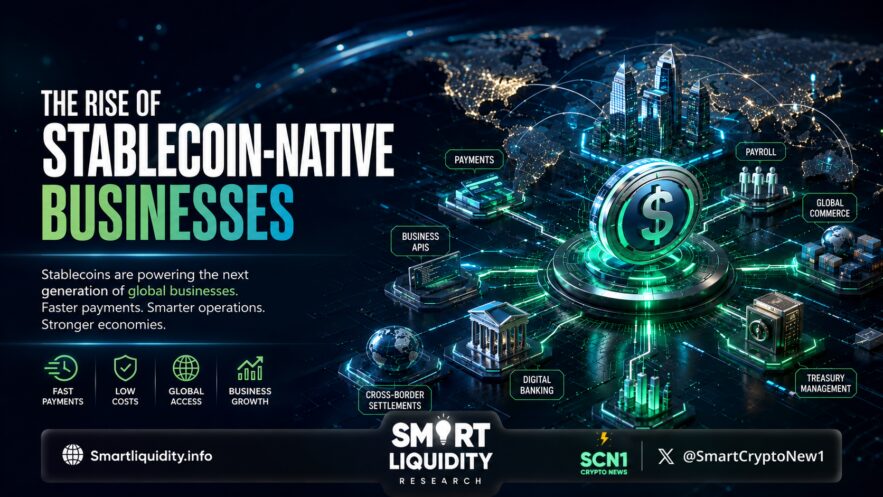
For years, stablecoins were treated mainly as a safe harbor inside the volatile crypto market—a way to move between trades without converting back to traditional currency.
That perception is changing.
Stablecoins are increasingly becoming the financial infrastructure itself, creating a new category of companies that can be described as stablecoin-native businesses. These businesses are not simply accepting stablecoins as a payment option. They are building their operations, treasury management, payments, payroll, lending, and global settlement systems around programmable digital dollars.
From Crypto Tool to Business Infrastructure
Traditional businesses depend on banks for many essential financial functions: sending money internationally, receiving payments, managing treasury assets, processing payroll, and settling transactions.
Stablecoins can potentially compress many of these functions into programmable, internet-native infrastructure.
A business can receive a dollar-denominated stablecoin, move it across borders, interact with decentralized protocols, or settle with another company without necessarily relying on the same banking rails used by traditional finance.
This creates an important shift:
Stablecoins are moving from being products used by businesses to infrastructure businesses can be built on.
The New Stablecoin-Native Business Model
Imagine a global software company with customers in ten countries.
Instead of maintaining multiple banking relationships and waiting days for certain international settlements, it could use stablecoins for selected parts of its financial operations.
Revenue could arrive in stablecoins. Contractors could be paid through stablecoin rails. Treasury funds could potentially earn yield through regulated or decentralized financial products. Suppliers could receive near-real-time settlement.
The company doesn’t need to become a crypto company.
It simply needs to recognize that money itself is becoming programmable.
This opens the door to businesses specializing in:
- Stablecoin payment processing
- Cross-border payroll
- Global merchant settlement
- Stablecoin treasury management
- On-chain credit
- Automated financial operations
- Stablecoin-based remittances
- Business-to-business settlement
- Stablecoin lending markets
- Compliance and transaction monitoring
The opportunity may be much larger than simply building another payment app.
Why Businesses Are Paying Attention
One of the biggest advantages of stablecoins is their ability to operate on internet-native networks.
Traditional financial systems were designed around institutions, banking hours, correspondent relationships, and geographic boundaries.
Blockchain networks operate differently.
Transactions can be initiated globally and settled on-chain, potentially reducing friction between businesses operating in different jurisdictions.
For companies dealing with international customers and suppliers, this could create a meaningful competitive advantage.
The most interesting use case may therefore not be consumer crypto speculation.
It may be boring business infrastructure.
And boring infrastructure can become extremely valuable when it processes enormous amounts of economic activity.
Stablecoins Could Reshape Corporate Treasury
Treasury management is another area where stablecoin-native businesses could emerge.
Companies constantly manage cash balances, working capital, liquidity, and international payments.
Tokenized dollars could provide businesses with new ways to move and allocate capital while interacting with programmable financial infrastructure.
A future treasury system could automatically route funds according to predefined rules:
Revenue → Operating Wallet → Payroll → Supplier Payments → Reserve → Investment
Smart contracts could potentially automate portions of this process.
That changes the role of treasury from simply managing money to programming capital flows.
The Rise of Stablecoin APIs
Another major development could be the emergence of stablecoin infrastructure companies that operate behind the scenes.
Businesses may not want to understand wallets, private keys, gas fees, blockchains, or smart contracts.
They simply want an API.
The winning infrastructure providers could offer businesses simple tools for:
Deposit → Convert → Send → Receive → Reconcile → Report
Underneath the interface, blockchain networks handle settlement.
This could make stablecoins increasingly invisible to end users.
And ironically, that may be one of the strongest indicators of adoption.
The technology doesn’t need to be visible to become important.
Regulation Will Shape the Market
Stablecoin adoption will not happen in a regulatory vacuum.
Businesses need clarity around reserves, redemption, taxation, accounting, custody, consumer protection, and compliance.
This means the next generation of stablecoin companies will likely need to combine crypto-native technology with traditional financial discipline.
Trust will become just as important as transaction speed.
Businesses will ask:
- Who backs the stablecoin?
- How can it be redeemed?
- Where are reserves held?
- What happens during market stress?
- Which jurisdictions are supported?
- How are transactions monitored?
- Who controls the infrastructure?
The winners may not necessarily be the projects with the most sophisticated technology.
They may be the companies that can make blockchain-based money feel as reliable as traditional financial infrastructure.
Stablecoin-Native Doesn’t Mean Crypto-Only
Perhaps the most important distinction is this:
A stablecoin-native company doesn’t necessarily need to sell crypto products.
It could be a logistics company, payroll provider, SaaS platform, marketplace, remittance business, fintech, or global commerce platform.
The common factor is that stablecoins become part of the company’s underlying financial architecture.
That makes the concept much bigger than DeFi.
It connects DeFi, fintech, payments, commerce, and global finance.
What Comes Next?
The first wave of stablecoin adoption focused heavily on trading and crypto liquidity.
The next wave could focus on economic activity outside crypto markets.
Businesses could begin using stablecoins because they offer practical advantages—not because they want exposure to digital assets.
That distinction matters.
When technology becomes useful enough that people stop caring about the technology itself, adoption can accelerate dramatically.
Stablecoins may be heading toward that point.
The future may not be a world where every company proudly advertises that it is “crypto-native.”
Instead, we could see something more subtle:
Businesses simply operating on stablecoin rails because they are cheaper, faster, programmable, and global.
The rise of stablecoin-native businesses, therefore, represents more than just another crypto trend.
It could mark the beginning of a new financial architecture where money becomes software—and businesses learn to build directly on top of it.
REQUEST AN ARTICLE


Binance cofounder Changpeng “CZ” Zhao said Trust Wallet could make its existing Ignore coins feature easier to access after unsolicited meme tokens complicated management of his public wallet.
Summary
- CZ said Trust Wallet already offers an Ignore coins feature, but access requires five steps.
- Zhao reversed his earlier view after users said hiding unsolicited tokens provides practical wallet management.
- Trust Wallet has not publicly announced a release date or confirmed specific interface changes yet.
- Public addresses can receive tokens without permission, while wallet applications can only hide their display.
- CZ retired his closely watched public wallet after unsolicited meme coins complicated balance management there.
Zhao acknowledged on Aug. 17 that he had misjudged how useful the control could be. He said members of the Trust Wallet team told him that users can already ignore unwanted tokens, although reaching the option requires five steps.
No formal Trust Wallet announcement followed his post. The company has not confirmed a product update, specified which application versions may change or published a release date.
CZ reverses his view on hiding unwanted coins
Zhao initially doubted that most wallet users needed a control for hiding random tokens. He reconsidered after people explained that unsolicited assets regularly appear in public cryptocurrency addresses.
“I misjudged that. A few people mentioned it is a useful feature,” Zhao wrote.
He said the Trust Wallet team had seen the discussion and informed him about the existing Ignore coins option. Zhao then offered a personal expectation rather than a confirmed development plan.
“I assume they will make some updates to this feature soon,” Zhao said. Trust Wallet has not publicly confirmed that assumption.
Making the control easier to find could help users organize wallets filled with spam, dust or unsupported assets. It would not remove the tokens from the blockchain or prevent other people from sending more assets to the same address.
Trust Wallet’s glossary advises users not to move or spend unknown dust. It also recommends using tools that hide or ignore unrecognized small balances.
Trust Wallet cannot remove tokens from a blockchain
Public blockchain addresses can receive compatible tokens without approval from the address owner. A sender only needs the destination address and enough funds to pay the network fee.
Wallet software acts as an interface for reading and displaying blockchain records. It can hide unwanted balances from its portfolio screen, but it cannot reverse a valid transfer or erase the token from the underlying network.
Ignoring a token is also different from burning it. A burn requires sending an asset to an address designed to place it outside normal circulation. Hiding an asset changes only how the wallet application displays it.
The same distinction applies to privacy. Concealing an unwanted balance in Trust Wallet does not make the transfer private. Blockchain explorers can still display the sending address, receiving address, token contract and transaction amount.
Trust Wallet has documented the risks of fraudulent airdrops and copycat tokens in its security guidance. The company warns users against opening links promoted by unknown tokens or approving suspicious transactions.
Meme coin spam pushed CZ to retire his wallet
Zhao’s comments followed his decision to stop using a closely watched public wallet. Community members had repeatedly sent meme coins and other BNB Chain tokens to the address, sometimes hoping that visibility in his wallet would attract attention.
As crypto.news previously reported, Zhao moved roughly $965,000 to Giggle Academy before retiring the address. Onchain trackers reported transfers of approximately 1,440 BNB and 182,620 币安人生 tokens to the education project.
Zhao said it was almost impossible to clean out the wallet because anyone could continue sending new tokens. He described the retired address as effectively serving as a burn address, although it is not a protocol defined burn address.
The private key holder could technically use the address again unless access has been destroyed or permanently surrendered. Zhao has said he will no longer use it, but blockchain records cannot verify a personal promise about future activity.
The episode also shows how public wallets linked to prominent people can become promotional tools. A token appearing in a known address does not prove that the address owner purchased, approved or endorsed it.
Zhao previously warned users not to send tokens to him and suggested that projects burn their tokens directly instead. Community members nevertheless continued monitoring the address and speculating about whether he might test selected meme coins.
Hiding tokens does not remove security risks
Unsolicited tokens are not automatically malicious. Some can result from legitimate airdrops, marketing campaigns or ordinary transfers. Others may contain links or names intended to direct users toward fraudulent websites.
The main risk often begins when a user interacts with an unknown contract, visits a website promoted through a token or grants spending approval to a decentralized application. Simply receiving a token does not give its sender control of the wallet.
Trust Wallet separately allows users to review and revoke token approvals. Its official instructions explain that approvals authorize applications to access tokens, while the Ignore coins control concerns portfolio display.
Users should also distinguish unsolicited tokens from address poisoning. In related coverage, a crypto user lost 100,000 USDT after copying a lookalike wallet address that an attacker had planted in the transaction history. Hiding a token would not prevent that form of attack.
What happens next for the Ignore coins feature
Trust Wallet may move the existing control closer to its main portfolio screen or reduce the number of steps required to use it. Zhao’s comment suggests the team is aware of the feedback, but it does not confirm the design, timing or availability of any change.
A formal application update, release note or statement from Trust Wallet would provide confirmation. Until then, reports that the company has announced a new privacy measure would be inaccurate.
The confirmed development is narrower. Zhao reversed his earlier opinion, identified an existing feature that he considers difficult to reach and said he assumed Trust Wallet would update it.
Users can already hide unwanted assets through the wallet interface. Those assets remain visible onchain, and avoiding interaction with unknown tokens remains the safer approach.


Binance gave Russian authorities customer records later used to charge a Russian IT specialist with financing terrorism over donations to Ukrainian groups, according to a report by Reuters on Monday.
The exchange identified Yuri Belenkiy as the source of transfers worth more than $700, Reuters reported, citing law enforcement documents. Binance also allegedly provided his date of birth, address, phone number and passport number, alongside copies of his Russian passport and Bulgarian residency permit.
Russian authorities detained Belenkiy in September 2025 and he remains in jail awaiting trial.
Russia’s Investigative Committee alleged that Belenkiy made the payments between January 2023 and March 2024 after an appeal by exiled Kremlin critic Arkady Babchenko. The funds were intended for the Ukrainian military and a group associated with the Azov Brigade, which Moscow classifies as a terrorist organization.
Investigators reportedly received two responses from case@binanceholdings.ru after requesting Belenkiy’s transaction history. Binance’s website had directed Russian and Belarusian law enforcement agencies to that address.
Binance’s current law-enforcement guidelines say the exchange requires a valid court order, police order or warrant before providing user information in a criminal investigation.


The Federal Reserve’s struggle to manage a soft landing, where inflation falls without triggering a recession or a sharp rise in unemployment, will influence markets this week, with Wednesday’s FOMC minutes offering a closer look at whether the central bank is considering additional interest-rate increases.
Adam Posen, president of the Peterson Institute for International Economics, said he sees just a 25% chance of a Fed hike in September. Rather, he expects the first move in December, even as he forecasts inflation rising again in early 2027.
Geopolitical developments will also need to be monitored, given their strong influence on volatility expectations and the price of oil.
Higher interest rates make risky assets like cryptocurrencies less attractive.
Within crypto, European Union operators face a Sunday deadline to stop transactions with 14 named crypto platforms, marking the week’s clearest regulatory milestone.
What to Watch
(All times ET)
- Crypto
- Aug. 18: Coinbase and Circle’s USDC collaboration agreement, which governs their revenue-sharing economics, enters its first three-year renewal term.
- Aug. 23: The EU’s ban on transactions with 14 named crypto-asset service platforms becomes applicable.
- Macro
- Aug. 17, 8:30 a.m.: Canada Consumer Price Index YoY for July est. 2.6% (Prev. 2.8%)
- Aug. 18, 9:15 a.m.: U.S. Industrial Production MoM for July est. 0.3% (Prev. 0.1%)
- Aug. 19, 2 a.m.: U.K. Headline CPI YoY for July est. 3.0% (Prev. 2.6%); Core YoY (Prev. 2.6%)
- Aug. 19, 5 a.m.: Euro area headline inflation YoY (final) for July est. 2.9% (Prev. 2.8%); Core YoY est. 2.5% (Prev. 2.4%)
- Aug. 19, 2 p.m.: U.S. FOMC Minutes from the July 28–29 meeting
- Aug. 20, 8:30 a.m.: U.S. Initial Jobless Claims for the week ended Aug. 15 est. 201K (Prev. 209K)
- Aug. 20, 7:30 p.m.: Japan Headline CPI YoY for July (Prev. 1.7%); Core CPI YoY est. 1.8% (Prev. 1.6%)
- Aug. 21, 2 a.m.: U.K. Retail Sales MoM for July (Prev. 1.0%)
- Aug. 21, 4 a.m.: Euro Area S&P Global Composite PMI Flash for August est. 51.6 (Prev. 52.0)
- Aug. 21, 9:45 a.m.: U.S. S&P Global Composite PMI Flash for August est. 53.2 (Prev. 54.5)
- Earnings
- Aug. 17: BitFuFu (FUFU), pre-market, $0.01
- Aug. 18: Canaan (CAN), pre-market, -$0.14
- Aug. 18: BTCS Inc (BTCS), post-market
Token Events
- Governance Votes & Calls
- Compound is voting to cut rates on deprecated markets to zero (Prop 595) and apply L2 security upgrades (Prop 596). Voting ends Aug. 16.
- Frax Finance is voting on FIP-450 and FIP-451 to add Gearbox and Royco yield strategies to sfrxUSD through Aug. 17.
- ShapeShift DAO is voting to move its rFOX staking program from Arbitrum to Ethereum Mainnet on Oct. 1, temporarily doubling revenue-share rewards to 50% for three months to incentivize migration. Voting ends Aug. 18.
- Rocket Pool is voting to replace Snapshot with RocketDash as its official offchain signaling platform to reduce costs. Voting ends Aug. 19.
- GnosisDAO is voting to transition Gnosis Chain from a standalone layer 1 into an Ethereum-settled rollup with synchronous mainnet composability, with voting ending on Aug. 19.
- Decentraland DAO is voting on establishing a clear governance framework and appeal process for platform-wide bans. Voting ends Aug. 19.
- THORSwap is voting on TIP-19 to migrate THOR tokens 1:1 to METRO on Ethereum mainnet. Voting ends Aug. 22.
- Unlocks
- Aug. 17: Aster to unlock 1.8% of its circulating supply worth $28.3 million.
- Aug. 18: Official Trump (TRUMP) to unlock 4.1% of its circulating supply worth $40 million.
- Aug. 20: LayerZero to unlock 4.5% of its circulating supply worth $24.8 million.
- Aug. 20: Kaito to unlock 6.2% of its circulating supply worth $11.7 million.
- Aug. 21: Avalanche (AVAX) to unlock 0.7% of its circulating supply worth $23.1 million.
- Aug. 21: Morpho to unlock 3.9% of its circulating supply worth $22.7 million.
- Aug. 21: Akedo Games (AKE) to unlock 4.9% of its circulating supply worth $14.1 million.
- Token Launches


Binance provided Russian investigators with identity documents and cryptocurrency transaction records later used in a terrorism financing case against Russian IT specialist Yuri Belenkiy, according to an Aug. 17 Reuters investigation.
Summary
- Binance provided Russian investigators with Yuri Belenkiy’s identity and transaction records during 2025, Reuters reported.
- Russian authorities accused Belenkiy of sending more than $700 in cryptocurrency to Ukraine linked organizations.
- Belenkiy remains detained awaiting trial, while his lawyer has not publicly addressed Binance’s reported involvement.
- Binance says it answers lawful global information requests under applicable privacy, legal and regulatory requirements.
- Reuters could not establish whether Belenkiy registered with Binance as a Bulgarian or European resident.
The records reportedly included Belenkiy’s address, telephone number, date of birth, passport and Bulgarian residency permit. Russian authorities incorporated details of his Binance transactions into evidence supporting the criminal charge.
Belenkiy, 49, is accused of transferring more than $700 in cryptocurrency to organizations connected with Ukraine’s military. He remains detained in Russia while awaiting trial. Neither his lawyer nor Russian authorities responded to Reuters’ questions about Binance’s reported role.
Binance records identified Belenkiy and his transfers
Documents reviewed by Reuters showed that Russia’s Investigative Committee sent Binance a request for Belenkiy’s transaction history. The exchange reportedly responded with a data file confirming that he initiated transfers to a cryptocurrency wallet promoted by exiled Kremlin critic Arkady Babchenko.
Babchenko had published wallet addresses while raising money for medical equipment for Ukrainian soldiers. Russian investigators allege that Belenkiy made payments between January 2023 and March 2024 following those appeals.
The Investigative Committee also accused him of sending funds to a group associated with the Azov Brigade, which operates within Ukraine’s National Guard. Russia designates Azov as a terrorist organization. Other jurisdictions do not necessarily share Moscow’s classification.
Reuters said it reviewed an interim case outline sent to the Russian prosecutor general’s office. The document cited the Binance transaction records among the grounds for bringing terrorism financing charges.
The First Department, a legal support organization assisting defendants in politically sensitive Russian cases, obtained the documents from one of Belenkiy’s relatives. Reuters said it could not independently confirm how the organization received them.
Binance says it followed lawful information requests
Binance declined to discuss the confidential request or Belenkiy’s individual case. The exchange said it routinely cooperates with law enforcement bodies under applicable rules.
“Like other global financial institutions, we cooperate with lawful information requests from law enforcement globally, subject to applicable legal, privacy and regulatory requirements,” Binance said.
The company added that it does not create national laws, determine criminal charges or control how governments use information in court proceedings. Binance said those decisions rest with the relevant authorities.
An official Binance page instructs Russian and Belarusian law enforcement agencies to send requests to [email protected]. Reuters reported that Russian investigators received two replies from that address.
The page says Binance provides information and support as required by law. It does not explain which Binance entity handles Russian requests, which national law governs each disclosure or how the exchange evaluates requests involving possible political prosecutions.
Russia exit did not end law enforcement contact
Binance announced in September 2023 that it would fully exit Russia through its sale to CommEX. The company said operating there was incompatible with its compliance strategy.
Its official announcement said Binance would have no continuing revenue share or repurchase option. The customer migration and closure of Russian services were expected to take up to one year.
Lawyer Mike Bystrov told Reuters that Binance had no obligation to provide the records because it had left Russia. Binance disputed his interpretation but did not say which law required or permitted the disclosure.
Continued communication with investigators does not by itself show that Binance resumed commercial operations in Russia. Companies can retain historical customer records and respond to information requests after leaving a market. The legal basis and limits of that cooperation remain central questions in Belenkiy’s case.
CommEX later stopped operating after acquiring Binance’s local business. As previously reported, the proposed transition became uncertain when Binance’s Russian successor announced its closure.
GDPR protection remains an unresolved question
Belenkiy holds a Russian passport and a Bulgarian residency permit. Bystrov said European Union privacy protections could apply if Belenkiy registered his Binance account as an EU resident.
Under that interpretation, transferring personal information to Russia could require strict safeguards because the European Union does not recognize Russia as providing adequate data protection. The legal assessment would depend on Belenkiy’s account registration, the Binance entity controlling his data and the authority used for the transfer.
Reuters could not establish whether he registered as a Bulgarian resident. His lawyer did not answer that question, and Binance did not identify the entity that processed the request.
The European Data Protection Board declined to comment on the individual case. It said enforcement responsibility rests with national data protection authorities. Bulgaria’s Commission for Personal Data Protection did not respond to Reuters’ questions about whether any rules had been breached.
Bystrov said Binance “may” have had an obligation not to disclose the information under EU law, but no regulator or court has reached that conclusion.
The available documents concern only Belenkiy. Reuters could not determine whether Binance identified other people who donated through the same wallets or whether Russian authorities opened related cases using exchange data.
What happens next in the Binance data case
Belenkiy remains in detention pending trial. Russian authorities have not announced a trial date, while his lawyer has not publicly addressed the accuracy of the transaction evidence or Binance’s disclosure.
The criminal court may examine the transfers and other evidence when proceedings begin. Any GDPR inquiry would be separate and would likely require a European regulator to establish where Belenkiy’s account was registered and which Binance entity controlled his records.
The disclosure also adds to wider scrutiny of Binance’s compliance operations. In related coverage, Binance CEO Richard Teng rejected separate claims about weaknesses in sanctions controls and said the exchange works with law enforcement agencies worldwide.
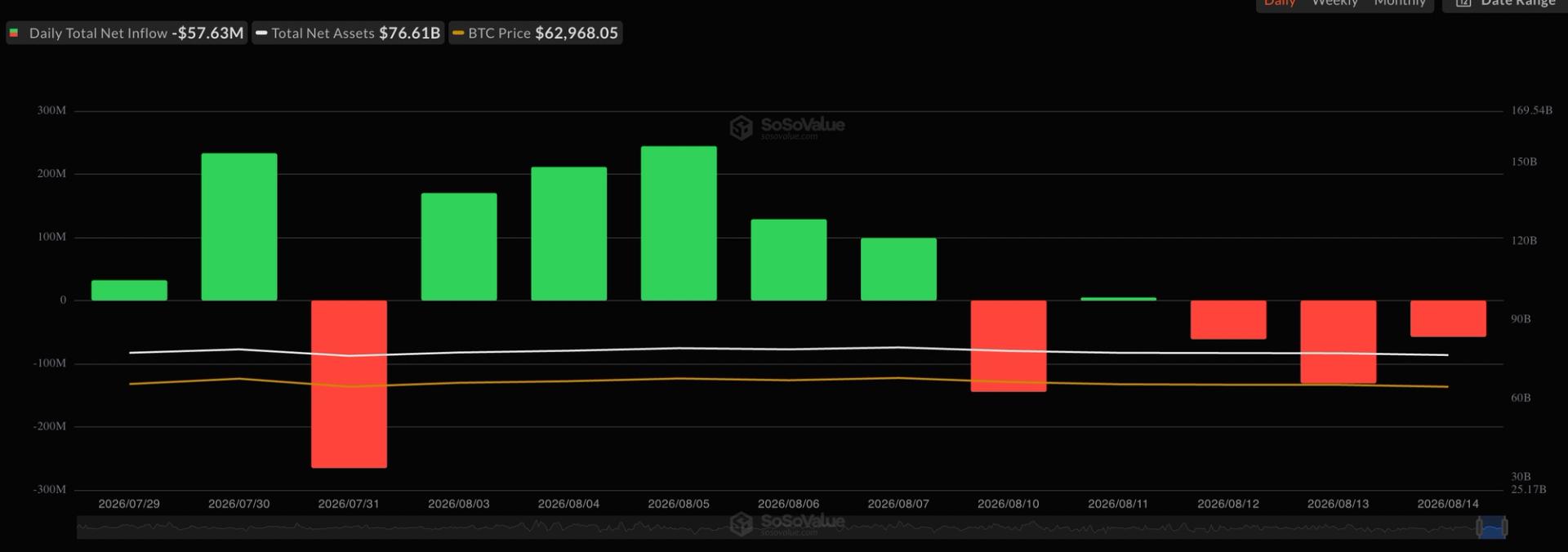
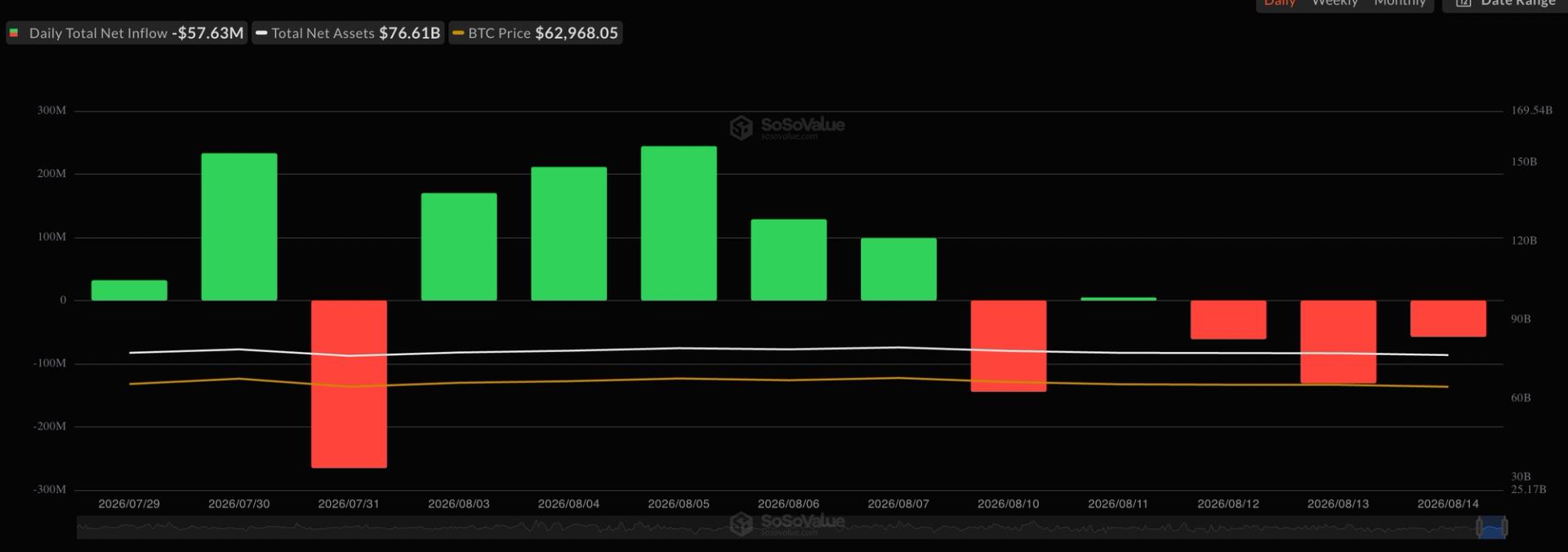
Bitcoin near $63,500 looks like more summer torpor, capped below $64,000 and holding above the low-$60,000s, but the flow picture underneath has reversed, said Yusuf Fakhro, partner at ARP Digital, in a note to CoinDesk.
US spot ETFs took in more than 14,000 BTC over five days into August 7, he said, the strongest stretch since May, and Q3 has drawn roughly 11,000 BTC of net inflows against 110,000 BTC of outflows in the back half of Q2. The institutional selling that defined the second quarter has flipped to buying.
Spot volumes have fallen to two-and-a-half-year lows, perpetual volumes to three-year lows, and volatility sits near multi-year troughs, Fakhro said.
Fresh demand arriving into the thinnest tape in years, when nobody is watching, is how durable bottoms tend to form. He reads bitcoin’s six months stuck between $60,000 and $80,000, holding near a 50% drawdown rather than grinding lower the way the 2014, 2018 and 2022 bear markets did, as apathy rather than deterioration, with on-chain data starting to show bottoming characteristics as sentiment shifts from panic to caution.
The risk sits on both sides. Bitcoin is as stuck below $64,000 as it is above $62,000, a box rather than a launchpad, and leverage sharpens it. Perpetual open interest has held above 300,000 BTC through the summer, elevated against its average while volumes collapsed, which leaves the market exposed to a sharp liquidation move in either direction.
Gold continues to trade close to multi-month highs following its recent advance, which was supported by the latest US inflation data. July’s CPI broadly matched market expectations, reducing the likelihood of a Federal Reserve rate hike in September. Lower expectations for further monetary tightening remain supportive for gold, as elevated interest rates increase the opportunity cost of holding the non-yielding asset. According to CNBC, some investors have begun taking profits after the rally. Over the coming weeks, expectations surrounding the Fed’s interest-rate path are likely to remain one of the main drivers of the precious metal.
Technical Analysis of Gold
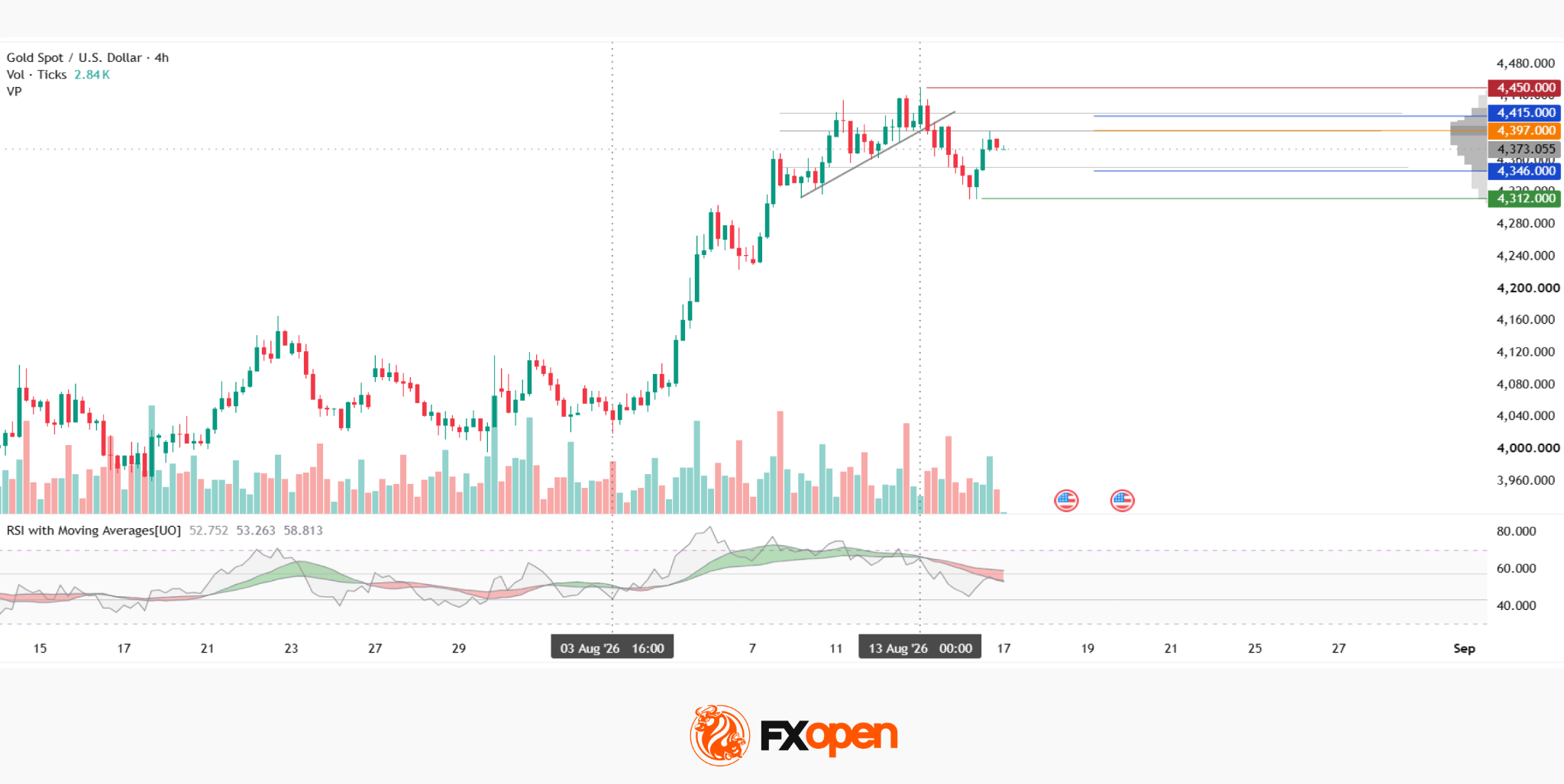
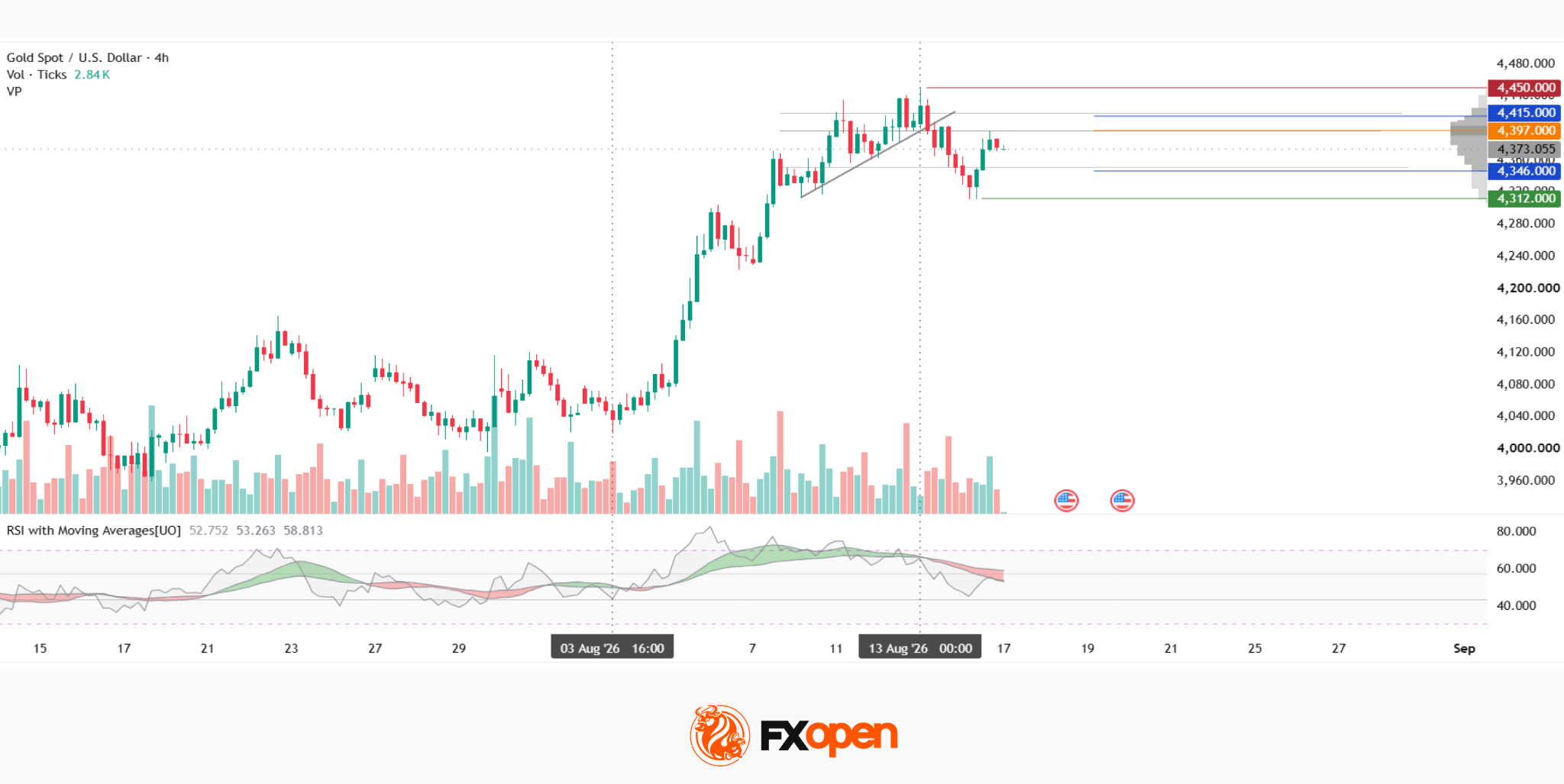
The four-hour XAU/USD chart shows a sustained uptrend that lifted the price towards the red resistance level at $4,450. An ascending trendline developed during the rally, but on 13 August the price broke below it on increased volume. The subsequent decline established a green support area around $4,312.
Following a rebound, gold returned to the dense area of the current market profile and is now trading between the Point of Control (POC) at $4,397 and the lower boundary of the profile at $4,346. If selling pressure builds, the $4,312 support zone could become increasingly significant.
A continuation of the upward move would bring the price into a relatively strong cluster of technical levels. The first obstacles are the POC at $4,397 and the upper boundary of the profile at $4,415. Beyond these levels, attention would shift towards the trend high around $4,450.
The RSI + MAs indicator currently shows readings of 52, 53 and 58. The oscillator and fast moving average have moved back into the neutral zone, while the slower moving average is following the same direction.
Key Takeaways
The main driver for gold remains the market’s expectations for the Federal Reserve’s interest-rate path. A further decline in expectations for rate hikes could continue to support buyers, while more hawkish signals from the central bank could increase selling pressure as the market undergoes a post-rally correction.
In the short term, gold is also likely to remain sensitive to movements in the US dollar and Treasury yields, both of which can significantly influence demand for the precious metal.
Start trading commodity CFDs with tight spreads (additional fees may apply). Open your trading account now or learn more about trading commodity CFDs with FXOpen.
This article represents the opinion of the Companies operating under the FXOpen brand only. It is not to be construed as an offer, solicitation, or recommendation with respect to products and services provided by the Companies operating under the FXOpen brand, nor is it to be considered financial advice.
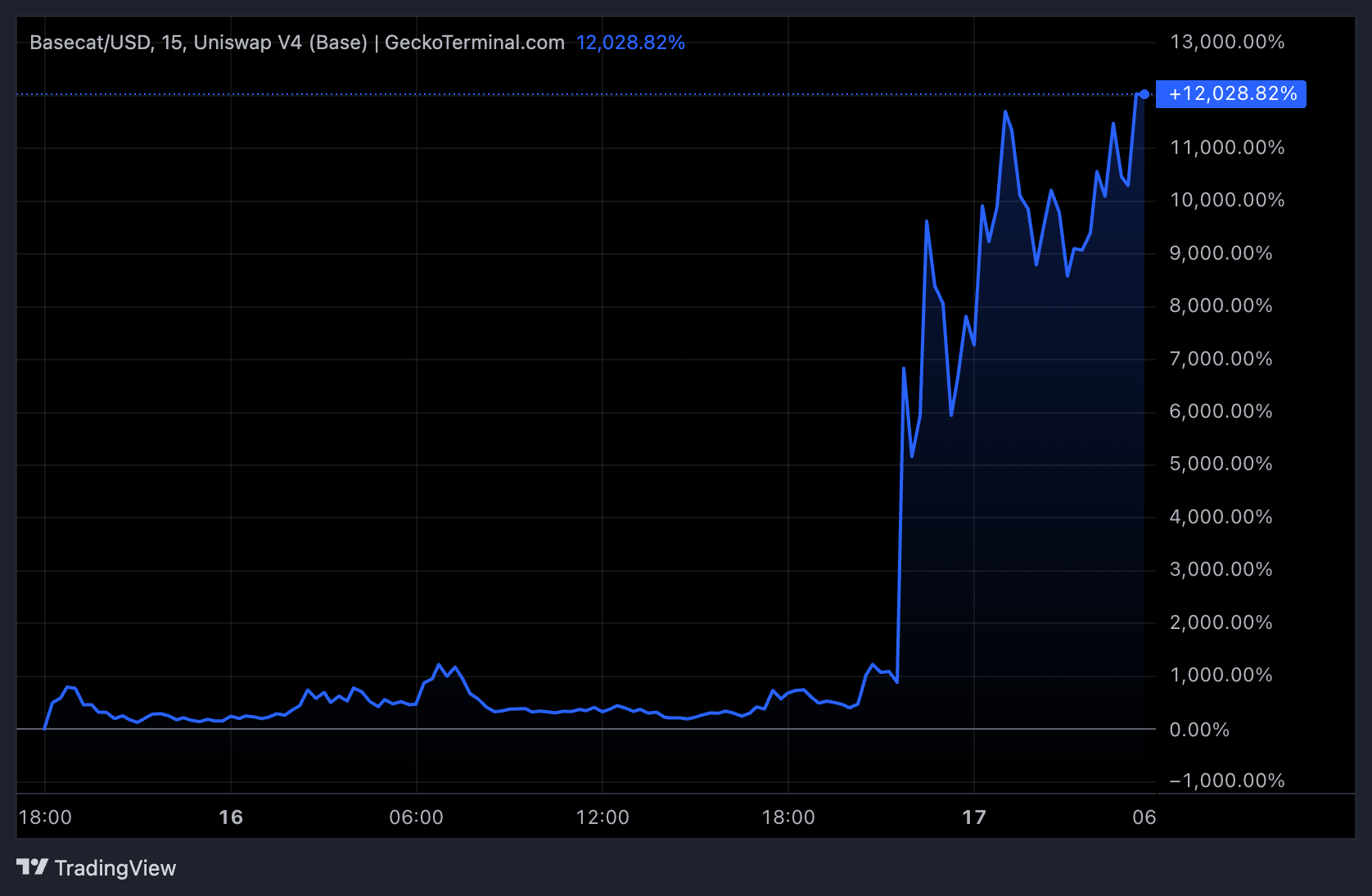
Basecat (BASECAT) surged 2,034% over the past 24 hours, lifting its market value to $17.2 million and extending its gains since launch to over 12,000%.
The token pairs a cartoon cat in a blue construction helmet with no stated utility. Trading activity surged today after two key developments.
Where the BASECAT Rally Started
Trading in BASECAT opened on Uniswap V4 on August 15, according to pool data on GeckoTerminal. The price saw a notable surge on August 16, as the market value jumped from under $1 million to peak at $20.35 million.
The rally has continued today. According to the latest data, BASECAT’s market cap stood at $17.2 million at press time. The meme coin is up over 12,000 since its launch.
Follow us on X to get the latest news as it happens

Trading activity has also been heavily concentrated around the recent rally. Over the past 24 hours, buyers accounted for 30,539 transactions compared with 26,994 sells, for a total of 57,533 transactions. Net buying reached approximately $172,260, while total trading volume climbed to $24.67 million.
However, it’s worth noting that BASECAT has no roadmap or product claims. A community-run site describes the concept in plain terms.
“BASECAT is simple: a meme token on Base built around a tiny cat in a blue hard hat. No invented utility. No fake roadmap. The community makes the story,” the website reads.
Why is BASECAT Surging?
With BASECAT up sharply, a key question arises. What is driving the four-digit surge today? GeckoTerminal attributed the move to listings on Gate and Coinbase Wallet.
However, BASECAT’s market remains relatively thin compared with its valuation. Liquidity stood at about $539,700 against a market capitalization of $17.2 million, with roughly 10,200 holders.
Thus, the combination of high volume and relatively limited liquidity can amplify price movements in either direction. As a result, the token’s rapid rise may also leave it vulnerable to sharp reversals if buying momentum fades.
BASECAT’s move also follows a broader pattern among newly launched meme coins, where social attention and short-term trading activity can quickly drive valuations higher.
For example, PLUMBER climbed more than 10,000% in August after a viral Crypto Twitter argument. The token subsequently gave back a significant portion of its gains, highlighting the volatility surrounding attention-driven meme coin rallies.
Subscribe to our YouTube channel to watch leaders and journalists provide expert insights
The post BASECAT Meme Coin Jumps 2,000%: Here’s What’s Driving the Rally appeared first on BeInCrypto.
Crypto World
Zoomex Launches Stock Perpetuals Competition Round 2: Elevating Cross-Asset Derivatives for Global Traders
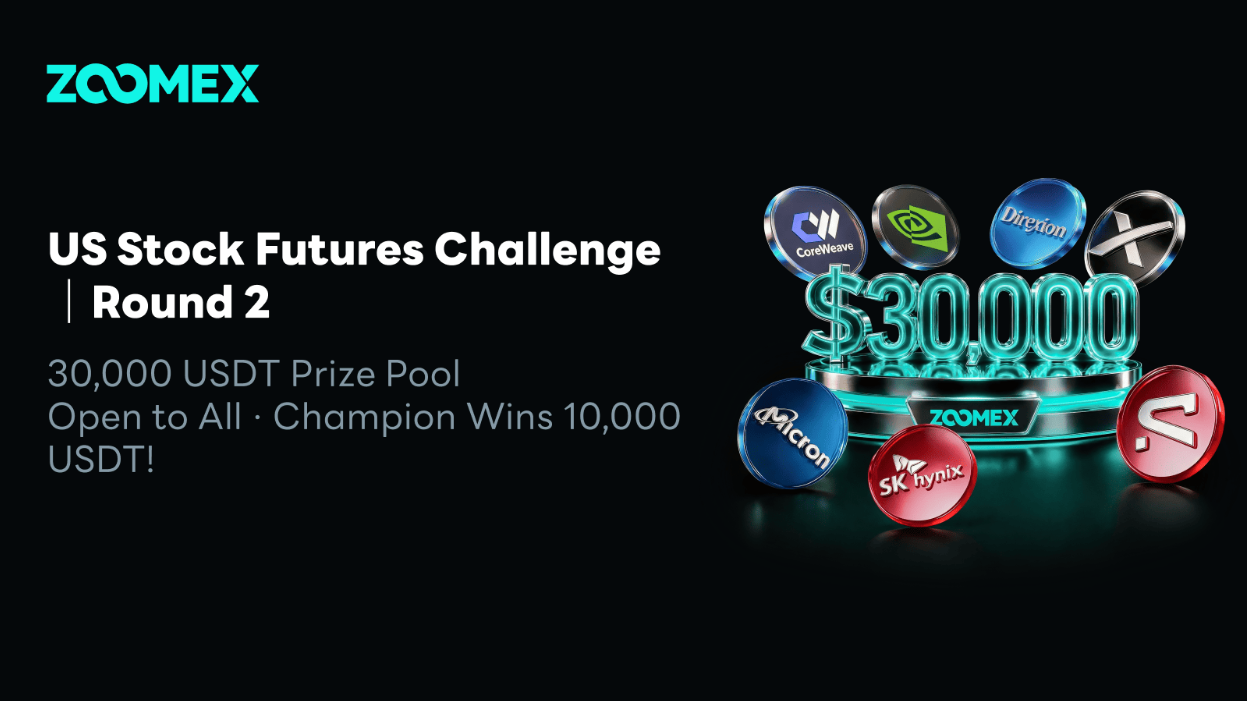

Zoomex, a global cryptocurrency derivatives exchange, today officially announced the commencement of its highly anticipated Stock Perpetuals Competition Round 2. Engineered to seamlessly bridge the gap between Traditional Finance (TradFi) and Web3 crypto derivatives, the event showcases Zoomex’s robust derivatives infrastructure while offering global traders 24/7 access to high-demand U.S. equity perpetual contracts backed by a dynamic escalating prize pool and interactive reward tiers.
As global market volatility intensifies, retail and institutional traders increasingly seek frictionless risk-hedging mechanisms outside conventional trading hours. Zoomex addresses this demand through its proprietary derivatives engine, enabling users to trade perpetual contracts on top U.S. equities – including Nvidia (NVDA), Apple (AAPL), and Tesla (TSLA)—using USDT as margin. The platform eliminates traditional brokerage onboarding friction, offering leverage up to 25x and bi-directional (long/short) trading capabilities without market-close interruptions.
Executive Insight: Redefining Cross-Asset Trading
Addressing the strategic vision behind the competition, the Chief Brand Officer of Zoomex stated:
“At Zoomex, derivatives trading is not merely a feature—it is our core identity and structural foundation. Traditional stock markets remain constrained by strict opening hours, lengthy clearing cycles, and cross-border fiat capital controls. By integrating U.S. equities into our high-performance crypto derivatives matching engine, we deliver uninterrupted 24/7 execution, deep liquidity, and institutional-grade price anchoring.”
“Stock Competition Round 2 serves as both a high-stakes arena for top derivatives traders and a live showcase of Zoomex’s matching capacity and zero-slippage risk management. We are committed to establishing the most reliable cross-asset derivative highway in the digital asset industry.”
Institutional-Grade Derivatives: Core Product Pillars
Zoomex’s Stock Perpetuals product suite is specifically tailored for professional trading strategies, offering distinct competitive advantages:
- 24/7 Uninterrupted Market Access: Bypasses standard U.S. stock exchange market-close hours, permitting real-time risk management and position adjustments around global macroeconomic events.
- USDT Unified Collateral Settlement: Eliminates currency conversion friction and international wire delays by enabling capital deployment directly via USDT margin for opening, maintaining, and settling equity positions.
- High-Concurrency Engine & Anti-Wick Oracle System: Powered by Zoomex’s proprietary matching engine capable of handling high throughput during extreme volatility, backed by multi-source oracle pricing to prevent price manipulation and unfair liquidation wicks.
- Flexible Leverage & Bi-Directional Exposure: Supports up to 25x customizable leverage, allowing traders to execute complex long and short strategies across market cycles with maximum capital efficiency.
Stock Competition Round 2: Key Event Mechanics
- Dynamic Prize Pool: Escalates proportionally based on participant volume and cumulative derivative turnover, rewarding both Return on Investment (ROI) and trading volume.
- Trading Volume “Blind Boxes”: Unlocks milestone rewards as trading volume thresholds are met, offering instant USDT cash prizes, fee discount vouchers, and bonus credits.
- Transparent Leaderboard: Real-time rank updates refreshed every 5 minutes, backed by fully audited PnL tracking for absolute competition integrity.
About Zoomex
Founded in 2021, Zoomex is a global crypto trading platform dedicated to delivering an unmatched derivatives experience, serving over 3 million users across 35+ countries and regions. Built for traders who demand speed, clarity, and control, Zoomex seamlessly integrates high-performance execution, intuitive asset tracking, and transparent fee structures. Backed by a robust trust framework—featuring Hacken security audits, Proof of Reserves, and rigorous compliance standards—Zoomex empowers users with a cleaner, smarter, and more efficient trading ecosystem.
Beyond trading, Zoomex elevates the brand experience through high-profile partnerships with the Haas F1 Team, World Cup-winning goalkeeper Emiliano Martínez, and elite tennis tournaments. By bringing the speed, precision, discipline, and uncompromising fairness of world-class sports to the realm of crypto derivatives, Zoomex ensures its vision aligns seamlessly with every trade.
At Zoomex: Trading made simple. Funds made transparent. Profits made accessible.
The post Zoomex Launches Stock Perpetuals Competition Round 2: Elevating Cross-Asset Derivatives for Global Traders appeared first on BeInCrypto.

Transfer news LIVE: Liverpool and Arsenal get Barcola boost, Man City identify Rodri replacement

Robbie Williams Reveals Autism Diagnosis, Says It’s Now His ‘Get-Out-of-Jail-Free Card’ for His Quirks

Ndifreke Effiong Joins Libyan Club Al-Afreeki Sports Club


-

 Fashion3 days ago
Weekend Open Thread: Ann Taylor
-
 NewsBeat5 days ago
Communication cards help banking customers access services or report scams
-
 Business6 days ago
Oil Price Today (August 11): Crude oil rises to $88 after Trump’s compensation demand dents Hormuz opening. Here’s why
-

 Crypto World6 days ago
Revolut wins French banking licence, creates second EU banking hub
-
 Sports3 days ago
This U.S. Amateur is a glimpse into golf’s future in more ways than you think
-
 Crypto World6 days ago
Why Did Nvidia Stock Fall on Monday Despite a $500 Billion Wall Street AI Deal?
-

 Sports2 days ago
Birmingham 2026: Day 6 Timetable for Irish Athletes
-
 NewsBeat2 days ago
Myanmar says over 300,000 Rohingya refugees verified for repatriation as exodus enters ninth year
-

 Politics2 days ago
SEQ Code: The Three Letter Boarding Pass Code That Could Give You The Worst Seat
-
 Entertainment5 days ago
Keke Palmer Subtly Hints At Sean Evans Drama With Cryptic Post
-
 Crypto World7 days ago
Grayscale quietly drops Cardano, Polkadot and Hedera ETF plans
-

 Fashion7 days ago
Can You Wear Double Cloth Gauze Clothing To Your Office?
-

 Fashion6 days ago
Coffee Break: The Fonteyn Jane Flat
-

 Crypto World6 days ago
Bitcoin's BIP Editors Remove Luke Dashjr Two Days After BIP-110 Fork Stalled
-
 Entertainment6 days ago
57 Years Later, the Best Sitcom Ever Made Still Deserves a Reboot
-

 Tech6 days ago
Zoom Screen-Sharing Bug Let People Fully Take Over Other Devices On A Call
-
 Crypto World7 days ago
Hormuz Nerves Cost Bitcoin $65,000 Mark Despite Solid Institutional Flows
-

 Fashion6 days ago
Claire Life: Kicking Off MVAAFF With the C Suite Luncheon Featuring Phylicia Rashad, Letoya Luckett, and More!
-

 Fashion6 days ago
Should you refinance your debt? Pros, cons, and real numbers
-
 Crypto World5 days ago
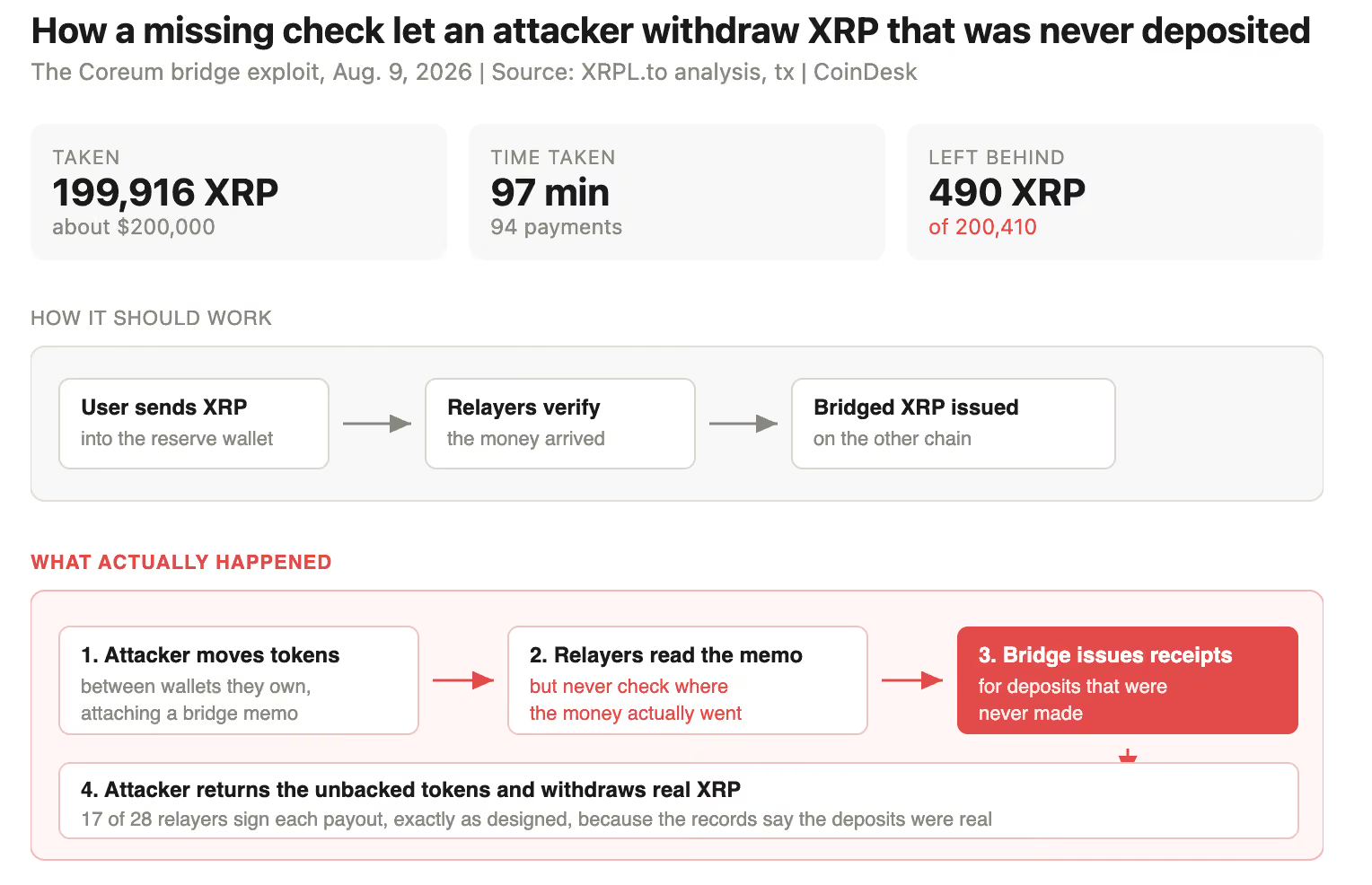
XRP bridge drained after software mistook fake deposits for real ones
You must be logged in to post a comment Login